




Abstract
This article examines how Vietnam's 13th Politburo elected in 2021 affects citizens’ willingness to raise their voices about policy issues through extra-institutional channels such as protests, petitions, and social media. I argue that an exceptionally high number of public security figures in the Politburo reflected the concerns of the Communist Party's Central Committee over regime-destabilizing grassroots activism. Using an online survey experiment administered to 1500 Vietnamese citizens, which manipulates the information on the repressive nature of the public security institution and police representatives’ backgrounds, I find that a heavy police representation in the 13th Politburo makes respondents less likely to sign petitions, share their concerns on social media, and take to the streets to voice their discontent with the government. My findings suggest that single-party regimes can reverse democratic development, particularly the participation dimension, through strategic leadership arrangements.
Introduction
Research on democratic backsliding focuses almost exclusively on democracies and competitive authoritarian regimes. In those regimes, popularly elected leaders can reverse democratic developments by undertaking incremental institutional changes and manipulating elections strategically to limit the power of opposition forces (Bermeo, 2016; Diamond, 2021; Ding and Slater, 2021; Levitsky and Ziblatt, 2018; Pérez-Liñán et al., 2019). Some argue that discussions about democratic backsliding in single-party regimes such as China, Vietnam, and Laos are not even appropriate because there are no democratic elements in those countries (Gilley, 2021). However, while these regimes do not allow multiparty elections and severely restrict liberal freedoms such as freedoms of the press, expression, and association (Levitsky and Way, 2010), single-party governments can sometimes tolerate, instead of constantly harshly suppressing, small-scaled localized grassroots collective actions in which a group of citizens with similar interests come together to advance their claims through, for example, protests, petitions, and sharing concerns on social media. These actions enable citizens’ policy preferences and local governments’ misconduct to be directly revealed to the central government (Chen and Xu, 2017; Lorentzen, 2013; Truong, 2020). Without multiparty elections, protests and movements become essential sources of information about local affairs for single-party governments.
Because democratic backsliding entails “a deterioration of quality associated with democratic governance, within any regime” (Waldner and Lust, 2018: 95), any signs of central leaders’ attempts to weaken channels for citizens to raise voices suggest that the country retrogresses to authoritarianism rather than continue to progress democratically. Scholars suggest that when grassroots collective actions escalate and threaten the regime, elites can increase state repression, pass laws restricting liberal freedoms, and make significant institutional changes (Frantz, 2018).
This article proposes that strategic leadership reshuffling may be another measure a single-party regime uses to weaken extra-institutional channels. In single-party regimes, the composition of the Politburo, the regime's most powerful decision-making organization, reflects elites’ policy direction, policy implementation, elite cohesion, and attitudes toward corruption and political dissent (Le HT, 2021; Naughton, 2013). Thus, in the face of escalating grassroots activism, regime elites may attempt to signal their intention to tighten their grip on collective actions by electing a salient number of officials affiliated with the public security force, which monitors opposition and activists, into the Politburo.
The 13th National Congress of the Communist Party of Vietnam (CPV), in which the leadership for the country from 2021 to 2026 was elected, concluded in February 2021. The 13th Party Congress was exceptional and unprecedented in many ways (Thayer, 2021a). For the first time since the country's 1976 reunification, the Politburo—Vietnam's highest political body comprised of 18 members—can count seven of its members from among its security forces (De Treglode, 2021). Notably, members of the Central Committee (CC), the CPV's most important political institution, elected an exceptionally high number of police officials (five members) into the Politburo, outnumbering representatives from the military (two members). The CC also nominated Pham Minh Chinh, who has a strong background in the Ministry of Public Security, as the prime minister—a prominent figure in Vietnam. In addition, Party General Secretary Nguyen Phu Trong was re-elected for an unprecedented third term.
The 13th National Party Congress took place when the regime faced external and internal threats that could have destabilized the CPV. Externally, China's growing aggression in the South China Sea required the Vietnamese government to diversify its diplomatic relationships to advocate for its sovereignty (Le, 2020). Internally, widespread corruption and growing grassroots collective actions related to various issues, such as land, labor, nationalism, the environment, and democracy, posed a great threat to the regime (Economist, 2021). Observers of Vietnamese politics argue that the unprecedented personnel arrangements in the Politburo reflected the CC's concerns over these regime-destabilizing factors. For example, the election of two generals of the Ministry of National Defense to the Politburo may reflect “the CPV's security concerns over growing tensions in the South China Sea” (Le HH, 2021). That General Secretary Nguyen Phu Trong was re-elected for a third five-year term signals that his “blazing furnace” anti-corruption campaign will continue (Strangio, 2021a). Some argue that a heavy police representation in the Politburo suggests a continuation of the Party's recent “brutal crackdown on dissent” (Strangio, 2021b).
This article examines the impact of the salience of police officials in the Politburo on public attitudes toward grassroots activism. I argue that the combination of two factors, including the election of Pham Minh Chinh as the Prime Minister and an exceptionally high number of public security representatives, may make the public less likely to join collective actions when unsatisfied with the government's policies. This occurs for two reasons. First, the Ministry of Public Security is known for its repressive measures toward protesters and dissidents. Thus, a prominent number of public security representatives in the Politburo may reflect the regime's determination to repress opposition activities, with citizens less likely to raise their voices. Second, public security figures elected to the Politburo currently hold or previously held influential positions in the Ministry of Public Security, especially the newly elected Prime Minister Pham Minh Chinh. This means that these figures authorized repressive actions toward dissidents and activists. Allowing those with such power in the Politburo may signal to the public that the regime would rely heavily on repression to deal with opposition activities.
I use an online survey experiment administered to 1500 Vietnamese Internet users to test this argument. The experiment manipulates the information on the repressive nature and the backgrounds of public security representatives in the Politburo. I find that emphasizing the repressive nature of the Ministry of Public Security, from which public security representatives come, reduces respondents’ willingness to participate in collective actions when unsatisfied with the government's policies.
This article has important implications for Vietnamese politics. Scholars suggest that Vietnam is more democratic than other single-party regimes, such as China, to a certain extent (Malesky and London, 2014) and that Vietnam has become more democratic since the 1990s (Nguyen, 2017). My findings that the new leadership negatively affects citizens’ participation in collective actions imply that the country is undergoing a decline in democratic governance, specifically in the participation dimension (Jee et al., 2021).
Electoral system in Vietnam
Scholars of Vietnamese politics agree that the CPV's CC, a body of about 200 members, is the selectorate with a formal mandate to elect the Politburo and regime leaders (Nguyen and Nguyen, 2022). Thus, this article argues that electing an unexceptionally high number of police officials to the Politburo reflects the concerns of CC members and regime leaders over escalating grassroots activism.
Every five years, the Party's National Congress—the highest institution of the CPV—is organized, which elects the CC. Membership in the CC is prestigious and highly desirable for ambitious politicians for at least two reasons. First, the CC members are involved in selecting regime leaders. The CC elected by the previous party congress nominates candidates for the current party congress. Immediately after a party congress, the new CC meets in executive sessions, elects the next Politburo 1 and the Secretariat, and appoints the Party General Secretary—the highest party position. Second, because the CC selects regime leadership posts from its members, technically every CC member has a chance to become a member of the Politburo—the club of regime leaders. There are three paths for candidates to become members of a new Politburo: (1) the re-election of an incumbent member; (2) special exemption for an otherwise ineligible incumbent (over the mandatory retirement age and/or already having served two terms in office) to stand for re-election; and (3) promotion from the CC after having served one five-year term. To be elected, each candidate must receive 50 percent plus one of the electoral votes.
Because of the privileges and prestige that membership in the CC brings, CC elites have one goal in common: the stability and legitimacy of the CPV and of the entire political regime (Nguyen and Nguyen, 2022). Similar to other authoritarian regimes, ensuring the regime's stability and legitimacy requires CC elites to deal with twin problems of power-sharing within the organization and control against the masses (Svolik, 2012).
While research debates what constitutes a faction within the CC (Nguyen and Nguyen, 2022), there is a consensus that it is characterized by factionalism (Thayer, 1993; Trinh, 2021). The CC deals with the internal power-sharing problem by institutionalizing and standardizing elite promotion and selection so that no specific groups are over-represented, thus becoming too powerful (Nguyen and Nguyen, 2022). This is achieved by using a quota system. Before a national party congress, a party personnel committee sets putative quotas for the CC's future composition, such as age group, sex, and sectors (Thayer, 2021a). The relative importance of a sector to the party determines its seats in the CC. While a ministerial-level agency is typically allocated one seat, the Ministry of Public Security and the Ministry of National Defense usually are given six or seven positions each because of their importance to the survival of the CVP (Nguyen and Nguyen, 2022). It is important to separate the Ministry of Public Security and the Ministry of National Defense because they represent separate sectors (Thayer, 2021b). In addition, according to the Asian Barometer Survey, Vietnamese citizens report different levels of trust in the police force and the military, implying that the public can distinguish these two institutions (Truong and Schuler, 2021).
In addition, there is also intense competition between the Party wing and the Government wing of the Party in electing leadership posts (Schuler, 2021; Thayer, 2022). These two wings differ in members’ backgrounds and their preferences for how to legitimize the regime. While the Party wing typically consists of officials who rise from the Party hierarchy, the government wing is represented by officials in the state bureaucracy. The government wing seeks to legitimize Vietnam's one-party rule by integrating Vietnam with the global economy, whereas the Party wing emphasizes the importance of ideology (Thayer, 2021a). To ensure that the competition between the Party and the Government wing does not destabilize the CPV, the CC elites strategically negotiate to nominate officials from both wings as candidates for the top four leadership posts. For example, in the 13th National Party Congress, a balance between the two wings was reached when Pham Minh Chinh from the Party wing was nominated as the prime minister and Vuong Dinh Hue from the government wing as the chair of the National Assembly (Thayer, 2021a).
In addition to the internal power-sharing problem, collective action from the masses may destabilize the regime and the party (Le, 2012). To control the masses, CC elites typically use state propaganda to project an image of unity, solidarity, and strength, despite internal divergences. State media typically portrays the CC, the Politburo, the Secretariat, and the key leaders as one “united and solidarity” force (Ministry of National Defense, 2022). Projecting elite cohesion is critically important because it signals that the regime is too strong to be challenged, which deters dissidents from uniting against the regime (Schedler and Hoffmann, 2016).
Therefore, there is reason to believe that when sensing an external threat that may destabilize the regime, CC members and regime leaders may put aside their preferences and become or at least appear united to deal with the threats. Indeed, despite having diverging priorities for how to legitimize the one-party rule, elites from the Party wing and the Government wing of the Party share similar opinions and attitudes toward regime-threatening protests. For example, Party General Secretary Nguyen Phu Trong and former Prime Minister Nguyen Xuan Phuc explicitly called participants in recent anti-China protests “extremists and social disrupters” galvanized by foreigners (Le Kien, 2018; Tien Thang, 2018). This suggests that while the CC elites and regime leaders may compete for power and disagree over policy issues and strategies, they do not attack the Party and the regime itself.
It is important to note that CC members must balance their goals of dealing with the twin problems of internal power-sharing and control over the masses. While electing an exceptionally high number of police officials to the Politburo may reflect regime elites’ growing concerns over grassroots activism, this may allow the sector to dominate the Party, destabilizing the system from within. To counterbalance the power of the public security sector, CC elites reached strategic personnel arrangements internally. Specifically, the high number of representatives from the public security sector was balanced by the election of the Ministers of Trade and Finance to the Politburo (Thayer, 2021b). To balance the power between the Ministry of National Defense and the Ministry of Public Security, the former was awarded two seats in which both representatives are full-time officials, while the latter has only one official who is currently working for Ministry 2 (Thayer, 2021b).
The climate of grassroots activism in the run-up to each National Party Congress since 1976
Grass collective actions before the mid-1990s were relatively rare in Vietnam. Before the mid-1990s, when frustrated with policy issues, Vietnamese citizens typically adopted everyday resistance strategies involving “quiet, mundane, and subtle expressions and acts” against the authorities (Kerkvliet, 2005: 23).
As Table 1 shows, it may not be a coincidence that during this period, police officials were outnumbered by military representatives in every Politburo prior to the 9th Party Congress in 2001. Given the early years of reunification and the border war with China, a high number of military representatives reflected the CPV's priorities in defending the nation against foreign enemies (Le, 2021). The lower number of police officials also indicates that grassroots collective actions may have been less of a threat to the regime's stability prior to the mid-1990s.
The Politburo's security representatives and protest issues in the run-up to each congress since the country's reunification in 1976.
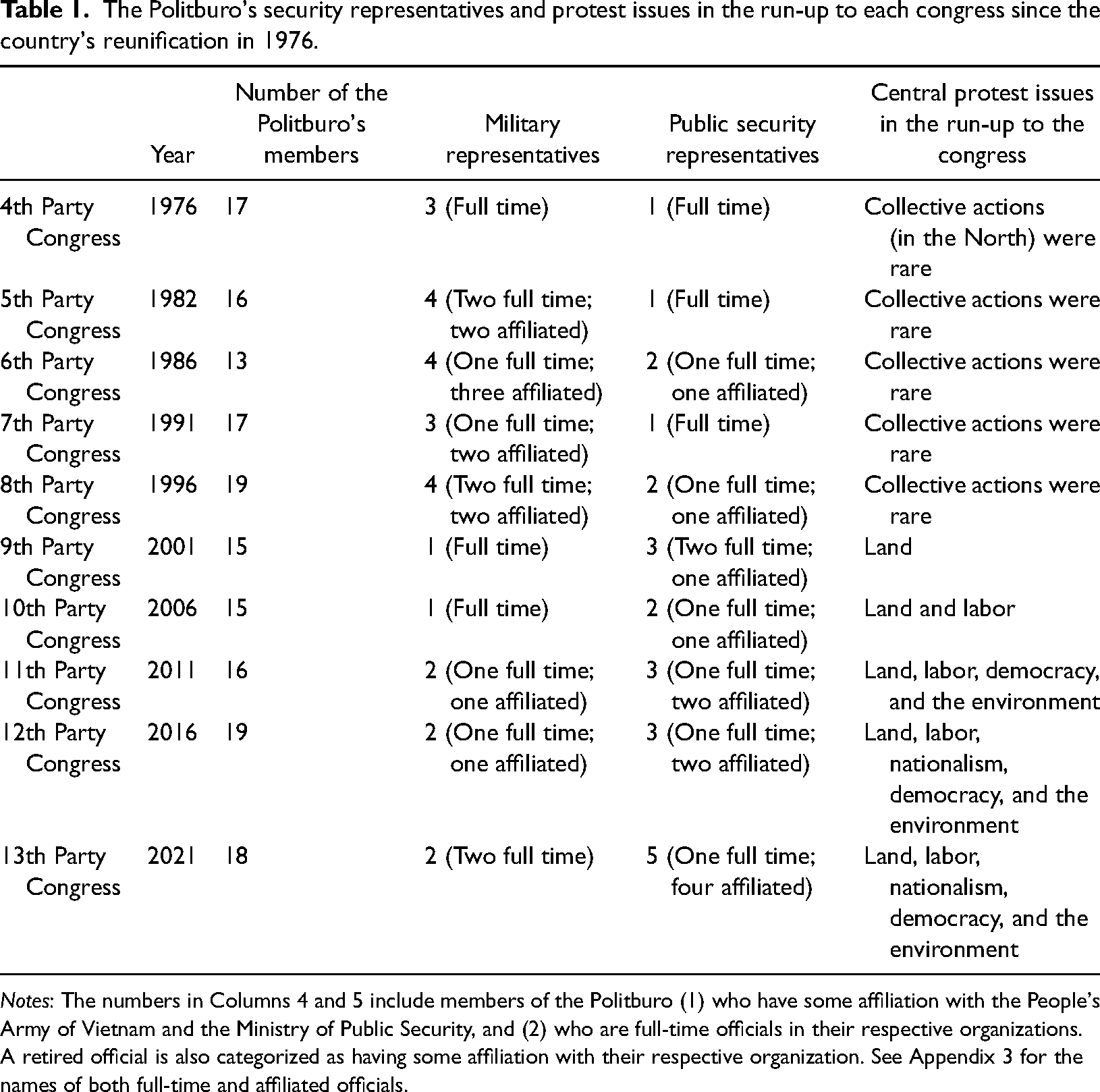
Notes: The numbers in Columns 4 and 5 include members of the Politburo (1) who have some affiliation with the People's Army of Vietnam and the Ministry of Public Security, and (2) who are full-time officials in their respective organizations. A retired official is also categorized as having some affiliation with their respective organization. See Appendix 3 for the names of both full-time and affiliated officials.
The climate of grassroots activism has changed since the mid-1990s, when Vietnam's economic reform started to produce positive results (Nguyen, 2017). While the economic reform has helped the country become one of the fastest-growing economies in the world, it has paved the way for local corruption (Nguyen, 2017). For example, the mass eviction of agricultural land for “national interests” since 2001 has led to prevalent illegal land eviction practices at the local level (Kerkvliet, 2014; Wells-Dang, 2014). The construction of industrial zones has raised concerns about the environment and, in some instances, even nationalist issues (Kerkvliet, 2019).
The central issues of protests in Vietnam have expanded since the 9th Party Congress. Between the mid-1990s and the early 2000s, most protests revolved around local land issues (Kerkvliet, 2014). In the run-up to the 9th Party Congress in 2001, two uprisings threatened the party's legitimacy, including widespread protests throughout Thai Binh province in 1997 and mass protests by ethnic minorities in the Central Highlands in 2001. However, it is worth noting that while the protests in Thai Binh were significant and caused changes to central regulations, villagers avoided challenging the political system by focusing their blame on local officials’ mismanagement of land and power abuse (Nguyen, 2017). Similarly, although mass protests in the Central Highlands had a broader range of demands, including religious freedom and more political independence for minorities, the root causes of their grievances came from “local government officials, graft, and unrecognized land rights” (Writenet, 2006: 4). Because policy protests typically focus on local governments’ misconduct, they provide an essential source of information to the central leaders (Lorentzen, 2013). This explains why Vietnamese elites are more tolerant of and responsive to policy protesters than pro-democracy dissidents, at least to a certain extent (Kerkvliet, 2019).
Labor, land, and democracy became central issues for the protests in the run-up to the 10th Party Congress in 2006. Approximately 600 labor strikes were reported between 2001 and 2005 (Kerkvliet, 2019: 15). Yet, workers rarely challenged the government. Instead, many appealed to government authorities to deal with employers. Regarding land issues, after two years of relative calm, thousands of ethnic villagers in the Central Highlands protested again in April 2004. While the unrest became relatively violent, it was caused mainly by “people's discontent with corrupt local officials and their policies rather than the central government, its policies or the CPV itself” (Le, 2012: 170). However, in the lead-up to the 10th Party Congress, there was a new phenomenon in Vietnamese grassroots politics with the “coalescence of pro-democracy advocates into an identifiable group” (Thayer, 2007: 386). Specifically, for the first time, pro-democracy activists throughout the country formed networks, such as Bloc 8406 which publicly protested to demand the government to respect religious freedom, human rights, and freedom to associate and form political parties (Thayer, 2007).
Protests taking place prior to the 11th Party Congress in 2011 revolved around labor, land, the environment, and democracy issues. The number of labor strikes increased significantly in the lead-up to the party congress, with approximately 2429 strikes reported between 2006 and 2010 (Kerkvliet, 2019: 15). Again, these strikes focused their blame on the employers and, occasionally, the local governments. Land disputes continued to be one of the most contentious political issues before the 11th Party Congress. There was also a new development in land protest movements during this period. Kerkvliet (2014) observed that a few land protests in 2007 and 2008 involved some degree of organization and coordination among villagers from different provinces. For example, in 2007, over a thousand villagers from the Mekong Delta provinces organized and protested at the office buildings of the National Assembly in Ho Chi Minh City. At one point, some 200 protesters joined forces with villagers at Hanoi's Mai Xuan Thuong park to protest at government buildings in Hanoi. In the run-up to the 11th Party Congress, protests against the Ecopark project that involved the construction of a highway and a residential area in Van Giang district, Hung Yen province, started to draw public attention. Unlike many other land protests, Van Giang villagers received more outside support from individuals, lawyers, and political advocates. However, it is important to note that neither the protests in Van Giang nor Ho Chi Minh City challenged the political regime and the central government because their demands focused on a higher compensation rate and a stop to illegal land eviction practices at the local levels.
Environmental issues became a national concern in the run-up to the 11th Party Congress. In 2009, a national elite coalition including “environmentalists, local residents, scientists, economists, retired military officers and veterans, retired state officials, social scientists, other academics and intellectuals, elements of the media and National Assembly deputies” emerged to oppose the government's plan to develop a bauxite mining industry in the Central Highlands (Thayer, 2009: 51). These elites relied on institutionalized channels to voice their opposition, such as sending letters and petitions to the central leaders and organizing seminars to discuss the negative consequences of the project. Opponents also utilized the Internet to voice their criticisms and discontent, leading to widespread online protests (Clark, 2011). Unlike later environmental crises, the anti-bauxite sentiment did not lead to offline nationwide protests and demonstrations led by ordinary citizens.
While no public protests regarding democracy issues seemed to occur in the run-up to the 11th Party Congress, there was a surge in the blogs and websites that called for significant reforms to the political system. Some prominent websites and blogs included Bauxite Vietnam, Dân Luận (People Discuss), Dân Làm Báo (Citizen Journalist), and Anh Ba Sàm (the Gossiper). Starting with a discussion on policy issues such as corruption, the Bauxite mining plan, and foreign policies, these blogs eventually advocated for democracy and civil liberties to resolve these issues (Kerkvliet, 2019: 91).
By the run-up to the 12th Party Congress in 2016, the CPV had been confronted by grassroots collective actions on many fronts including labor, land, nationalism, the environment, and democracy. Regarding land issues, two protests stood out. The first was the uprising of Hmong Christians in Dien Bien province, which called for “an independent kingdom, diplomatic, and land rights” in May 2011 (Ruwitch, 2011). The resistance of Van Giang villagers against the Ecopark project escalated, leading to large violent protests in 2012 and 2014. However, despite being more confrontational, Van Giang villagers mainly demanded to “negotiate a fair price, not accept the government- and investor-stipulated compensation” (Kerkvliet, 2014: 35).
Labor remained a highly prominent issue of grassroots activism between 2011 and 2016. Kerkvliet (2019: 15) reported that about 2406 labor strikes occurred during this period. Anti-China nationalist protests have been especially salient in Vietnam's dissent climate since 2011, with the emergence of “The Flaming Summer” movement (Mùa Hè Đỏ Lửa) which refers to the first sustained protest in Vietnam against Chinese aggressive actions in the South China Sea. This protest marked “the beginning of the longest anti-China protest movement in Vietnam after 1975” (Nguyen, 2021). Anti-China sentiment intensified in 2014 when China deployed an oil rig in Vietnamese waters, leading to a series of anti-China protests and riots across the country in May 2014. Anti-China protests prior to the 12th Party Congress had two important characteristics. First, protests were typically provoked by a particular action of the Chinese government in Vietnamese waters (Kerkvliet, 2019: 68). Second, while protesters partly criticized the central government for “being too soft” on China, they primarily focused their blame on the Chinese government and citizens. However, while citizens joining anti-China protests mainly targeted Chinese leaders and citizens, pro-democracy advocates typically linked nationalist issues to the shortcomings of the political system. Amidst the anti-China sentiment, many regime dissidents advocated for freedom of speech, press, association, and demonstration to protect the nation (Kerkvliet, 2019: 83).
In addition to issues involving land, nationalism, and democracy, Vietnamese citizens were increasingly concerned about the environment. One year before the 12th Party Congress, many Hanoians took to the streets to protest the capital's project to cut down 6700 trees, forming one of Vietnam's most significant urban movements (Schuler and Truong, 2020).
Land, labor, the environment, nationalism, and democracy remained the central issues of protests in the run-up to the 13th Party Congress. However, these protests were more threatening to the party's legitimacy in two ways. First, a few protests that focused on policy issues blamed high-ranking officials affiliated with the central government and regime leaders. Second, as I will show below, there is evidence that linkages between policy protesters and pro-democracy advocates started to emerge before the 13th Party Congress.
In terms of land issues, while small-scaled localized land protests have occurred frequently in Vietnam since the early 2000s, they rarely escalate into such a violent conflict as the clash in Dong Tam commune in rural Hanoi on January 9, 2020. This violent dispute led to the death of three police officers and one civilian (Truong, 2020). The Dong Tam land dispute started to draw public attention in 2017 when villagers protested local authorities’ decision to evict 47.4 hectares of agricultural land for Viettel Group—a military-run telecommunication corporation. More importantly, unlike other land disputes, including the large protests in Thai Binh in 1997 and in Hung Yen in 2012, which targeted local authorities, the Dong Tam land protest eventually targeted the central government. For example, on the night of the clash in January 2021, Dong Tam protesters livestreamed to call for attention and support from around the country; they publicly called police sent by the central government “invaders” (Loa, 2020).
In terms of environmental matters, the massive fish deaths along the coastal provinces in mid-2016 resulted in hundreds of small and large protests throughout the country between 2016 and 2018. At first, protesters directed their blame toward Formosa Ha Tinh Steel 3 and provincial authorities, but eventually targeted the central government, accusing it of attempting to hide the true causes of the incident (Nguyen and Datzberger, 2018). Citizens protesting alongside pro-democracy advocates demanded reforms at the central government, such as greater government transparency and accountability and more freedom of information to resolve environmental issues (Nguyen and Datzberger, 2018). This suggests that there was a linkage between environmental protesters and pro-democracy advocates. 4 Indeed, the emergence of such an informal pro-democracy-environment movement coalition makes some observers of Vietnamese politics argue that environmental activism may open opportunities for Vietnamese democracy activists, environmentalists, urban youths, and others to cooperate toward a common goal (Nguyen, 2020). It is important to note that while the Vietnamese regime has been tolerant of protests, at least to a certain extent, they go to great lengths to prevent protests of different issues from forming coalitions, especially between pro-democracy advocates and policy issues, because this poses the greatest threat to the regime (Kerkvliet, 2019).
There were a few large-scale labor protests in the run-up to the 13th National Party Congress, such as the violent dispute between approximately 2000 Vietnamese workers of a Taiwanese-invested footwear company and its management board (VNExpress, 2016). While labor protesters increased in number, they targeted enterprises and local authorities.
2018 marked a phenomenon in anti-China movements in Vietnam in that anti-China sentiment could be activated even without China's aggressive actions in Vietnam's territory. In 2018, tens of thousands of Vietnamese citizens throughout the country protested the Draft Law on Special Economic Zones, which would allow foreign investors, without regard to citizenship, to lease land for 99 years. However, Vietnamese citizens interpreted that the Draft Law would give privileges to Chinese companies, leading many to take to the streets to oppose the central government. These protests were significantly different from previous anti-China protests because they were provoked by the Vietnamese government's actions, thus directly targeting the central government. Also, in 2018, thousands of Vietnamese citizens protested the Draft Law on Cyber Security that would give authorities wide discretion to censor online content (Trung Khang, 2019). This suggests that ordinary Vietnamese have become more aware of and concerned about the lack of democratic institutions in the country.
As Table 1 shows, it may not be a coincidence that officials affiliated with the Ministry of Public Security have outnumbered those from the military in the Politburo since the 9th Party Congress when the grassroots dissent climate started to change. A heavy police representation in the 13th Politburo may reflect CC elites’ and regime leaders’ concerns over grassroots collective actions that started to directly challenge the central government, its policies, and the CPV. However, this salient representation may have been balanced by awarding two seats for full-time officials from the Ministry of National Defense.
How the 13th Politburo affects grassroots activism
Two reasons may explain why a heavy police representation in the 13th Politburo may make the public less willing to participate in grassroots collective actions.
First, because Vietnamese citizens are aware that the Ministry of Public Security is willing to repress escalating grassroots activism, fear of repression may deter them from raising their discontent. In Vietnam, a critical mission of the Ministry of Public Security, typically emphasized through state propaganda, is to maintain social order, peace, and safety for the people. At the same time, protesters are frequently portrayed as “violent and irrational mobs who incur material costs on others or as affiliates of foreign forces seeking to undermine political stability and societal peace” (Trinh and Truong, 2021: 4). Therefore, breaking up threatening grassroots collective actions is part of the ministry's mission to restore social security.
Although the Ministry of Public Security has been relatively tolerant of and responsive to protests to a certain extent (Kerkvliet, 2019), police forces are often deployed to suppress escalating protests. Indeed, regime elites attempt to make sure that the public is informed of their efforts to control and crack down on opposition activities that are described as threatening to societal peace. For instance, in 2016, when protests related to the massive fish deaths occurred, Minister of Public Security To Lam stressed in state media that the ministry should focus on “fighting and preventing activities that incite illegal protests that disrupt social order, and ensuring cyber security and information safety” (BBC, 2016). It is worth noting that not all police officials in the new Politburo were directly engaged in repression. However, state media frequently broadcast or write about police rehearsals led by leaders of the Ministry of Public Security designed to crack down on protests and demonstrations (Thuy Anh, 2014). Efforts by the Ministry of Public Security to make its repressive actions visible ensure that the public knows this ministry controls and monitors opposition and activists. Thus, a high number of police officials in the Politburo may signal to the people that the regime would rely on repression to deal with opposition if necessary. Fear of repression may discourage the public from voicing their discontent through collective actions.
Second, public security figures’ backgrounds may also affect the public's perception of the regime's attitudes toward grassroots collective actions. All public security figures in the Politburo held high-ranking positions in the Ministry of Public Security. Particularly, newly appointed Prime Minister Pham Minh Chinh is a former director of the Department of Intelligence under the General Department of Security and a former deputy head of the Ministry of Public Security. To Lam is currently the Minister of Public Security. Holding powerful positions in the Ministry of Public Security, which monitors activists and dissidents, means that these figures authorized repressive actions toward protesters and dissidents. Therefore, as long as citizens are aware of security representatives’ backgrounds, they may be reluctant to participate in collective actions because of the perception that repression is an important pillar that the regime uses to deal with opposition.
This discussion leads to the following hypotheses:
H1 (general hypothesis): Signaling the salience of police officials in the Politburo will reduce citizens’ willingness to participate in grassroots collective actions. H1a: Emphasizing the repressive nature of the security institution, where police representatives come from, reduces citizens’ willingness to participate in grassroots collective actions. H1b: Emphasizing public security representatives’ backgrounds reduces citizens’ willingness to participate in grassroots collective actions.
Research design
To test my hypotheses, I use an online survey experiment administered to a sample of 1500 Vietnamese Internet users through TGM Research Company. The survey used the Qualtrics platform and was collected in July 2021. TGM recruited the respondents through local Vietnamese market research firms with proprietary survey panels (see Appendix 1 for recruitment and sampling strategy). To mitigate the concerns that the sample is skewed toward a particular population, I set quotas for groups that are typically underrepresented in online survey experiments, such as women, older residents, respondents without a college degree, and respondents living outside Hanoi and Ho Chi Minh City—the two biggest cities in Vietnam.
My final sample is relatively close to the general population in age and sex. My sample is 42% female and has a mean age of 35. The equivalent numbers from the 2019 Vietnam Population and Housing Census are 50.2% and 30.9 (Vietnam General Statistics Office, 2020). This sample is still far from nationally representative, especially regarding educational level and party membership. While 71% of my respondents have a tertiary education or above, only 12.6% of the Vietnamese population do. Regarding party membership, 25% of respondents in my sample are members of the Communist Party, whereas only 3% of the population are. Finally, 65.6% of the Vietnamese people are rural, but only 33% of my sample are.
The experiment seeks to establish evidence for the causal effect of the salient presence of police officials in the 13th Politburo on respondents’ willingness to participate in collective actions. Before the treatment, all online respondents were asked several questions on demographic characteristics such as age, education level, sex, residence, and income. I also asked some behavioral and attitudinal questions that might impact respondents’ participation in collective actions, such as political interest and the level of satisfaction with the government. After these questions, respondents were randomized into three groups. The control group read no information to establish the Vietnamese's baseline willingness to participate in collective actions. The Repression treatment group provided respondents with texts on how repressive the Ministry of Public Security is. Specifically, respondents in this group read the following texts: The Politburo, the most important policymaking organization, which will govern Vietnam from 2021 to 2026, has five out of 18 officials affiliated with the Ministry of Public Security—the highest number of public security representatives in the Politburo ever and twice as many as military officials.
The Public Security Ministry is reputed for repressive actions such as controlling the Internet, punishing those with unfavorable opinions, preventing people from protesting in the streets, and cracking down dissidents.
The Power treatment group emphasizes the powerful backgrounds of public security figures in the Politburo: The Politburo, the most important policymaking organization, which will govern Vietnam from 2021 to 2026, has five out of 18 officials affiliated with the Ministry of Public Security—the highest number of public security representatives in the Politburo ever and twice as many as military officials.
These officials previously held or currently hold high-ranking positions in the Ministry of Public Security. Remarkably, the new Prime Minister was formerly the director of the Department of Intelligence under the General Department of Security, Ministry of Public Security, which monitors activists and dissents.
For the dependent variables, respondents were asked to indicate the extent to which they would participate in collective actions if they were not satisfied with a government's policy in the future (see Table 2). Specifically, I focus on respondents’ willingness to participate in three types of collective actions: 1) signing petitions to the government, 2) sharing their concerns on social media, and 3) joining street protests. I choose these three outcomes because they differ in the risk of participation. The cost of joining street protests is much higher than that of signing petitions and sharing concerns on Facebook. The response for each dependent variable is on a 10-point scale in which 0 means “would not participate” and 10 means “would participate”: In the future, suppose you were dissatisfied with a government policy. Would you consider participating in any of these activities:
Experimental groups.
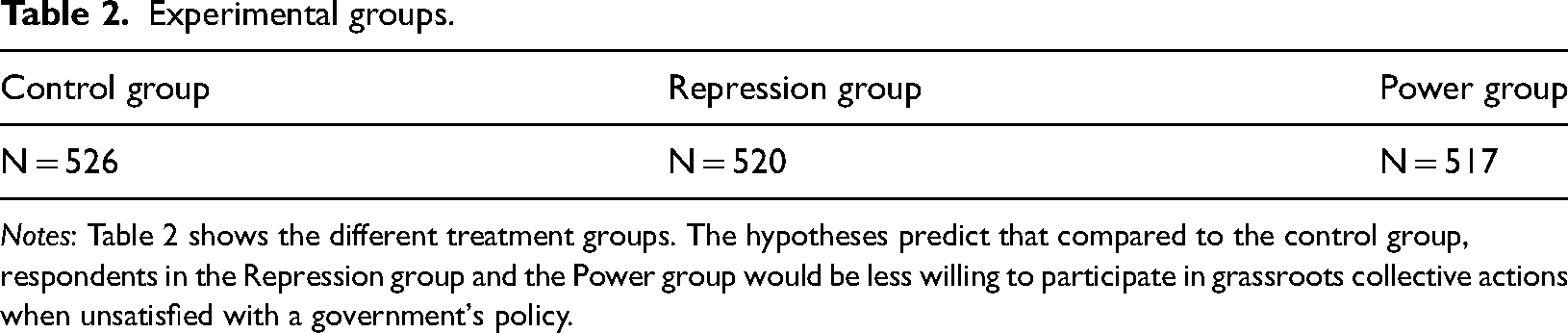
Notes: Table 2 shows the different treatment groups. The hypotheses predict that compared to the control group, respondents in the Repression group and the Power group would be less willing to participate in grassroots collective actions when unsatisfied with a government's policy.
Sign petitions to the government
Share your concerns on social media, such as Facebook
Protest in the street
Figure 1 shows the distribution of the three outcomes. Most respondents expressed that they would sign petitions to the government if unsatisfied with a policy. There is more variation in respondents’ willingness to protest and use social media to express their dissatisfaction. Although more than 15% of respondents said they would not share their concerns on social media, about 12% said they would rely on this channel to voice their concerns. About 20% of respondents said they would not protest when unsatisfied with a government's policy, and 10% said they would. However, for these two dependent variables (using social media to voice dissatisfaction and protesting), more respondents chose answers that were equal to or larger than five on a 10-point scale. This suggests that preference falsification should not be a significant concern. Otherwise, we would expect that most respondents would choose to oppose sharing concerns on social media and protesting in the streets.
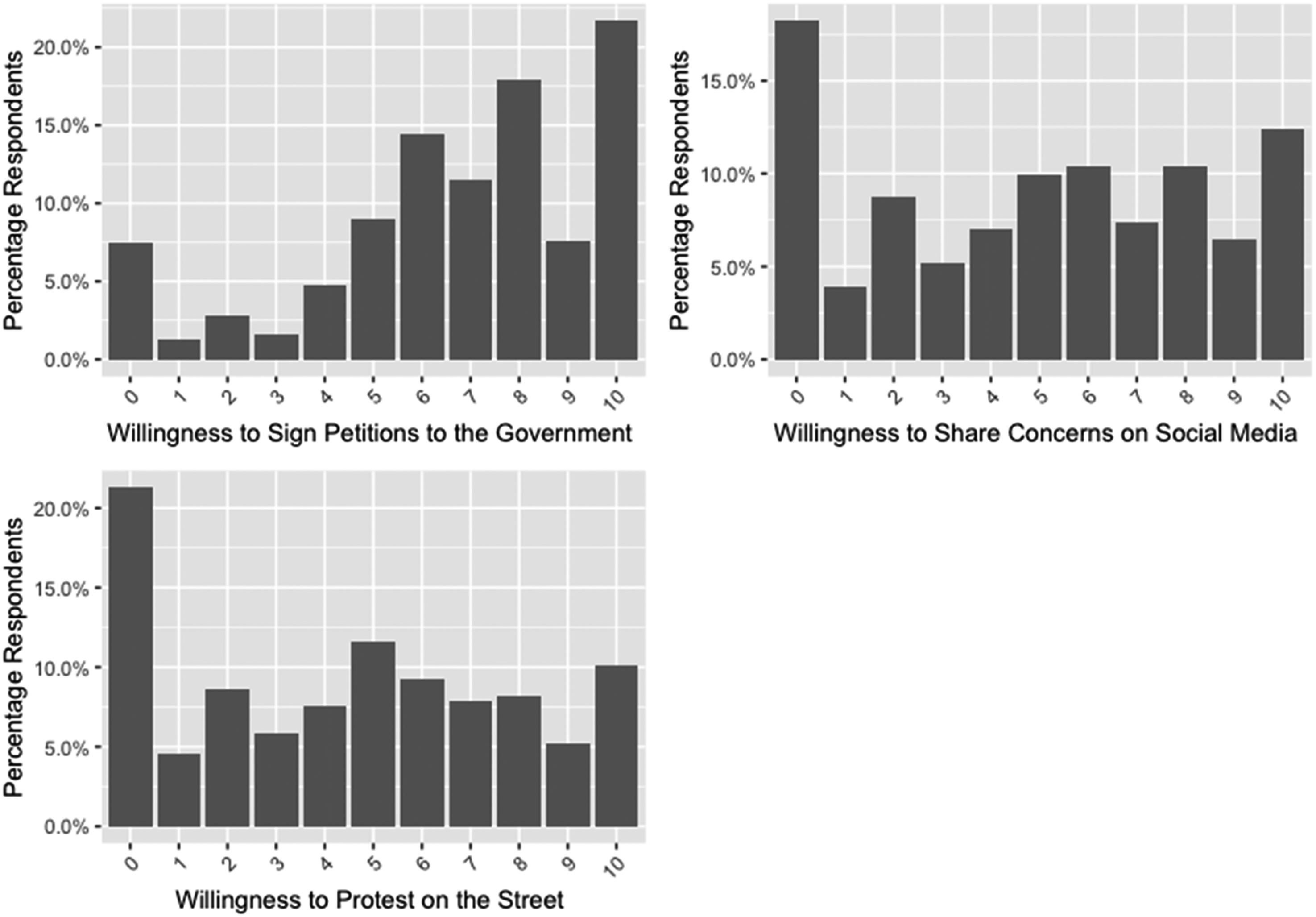
Distribution of willingness to sign petitions, share concerns on social media, and protest on the streets. Notes: This figure shows the distribution of respondents expressing a willingness to sign petitions, share concerns on social media, and protest on the street if unsatisfied with a government's policy. 0 means “would not participate” and 10 means “would participate.”
Before going into the main results, I examine the balance of covariates in my treatment groups. Table 3 shows that there is balance across nearly all covariates except for sex. The Repression group has more female respondents than the others. The control group has more male respondents than the Power and Repression groups.
Balance of potential covariates across treatment groups.
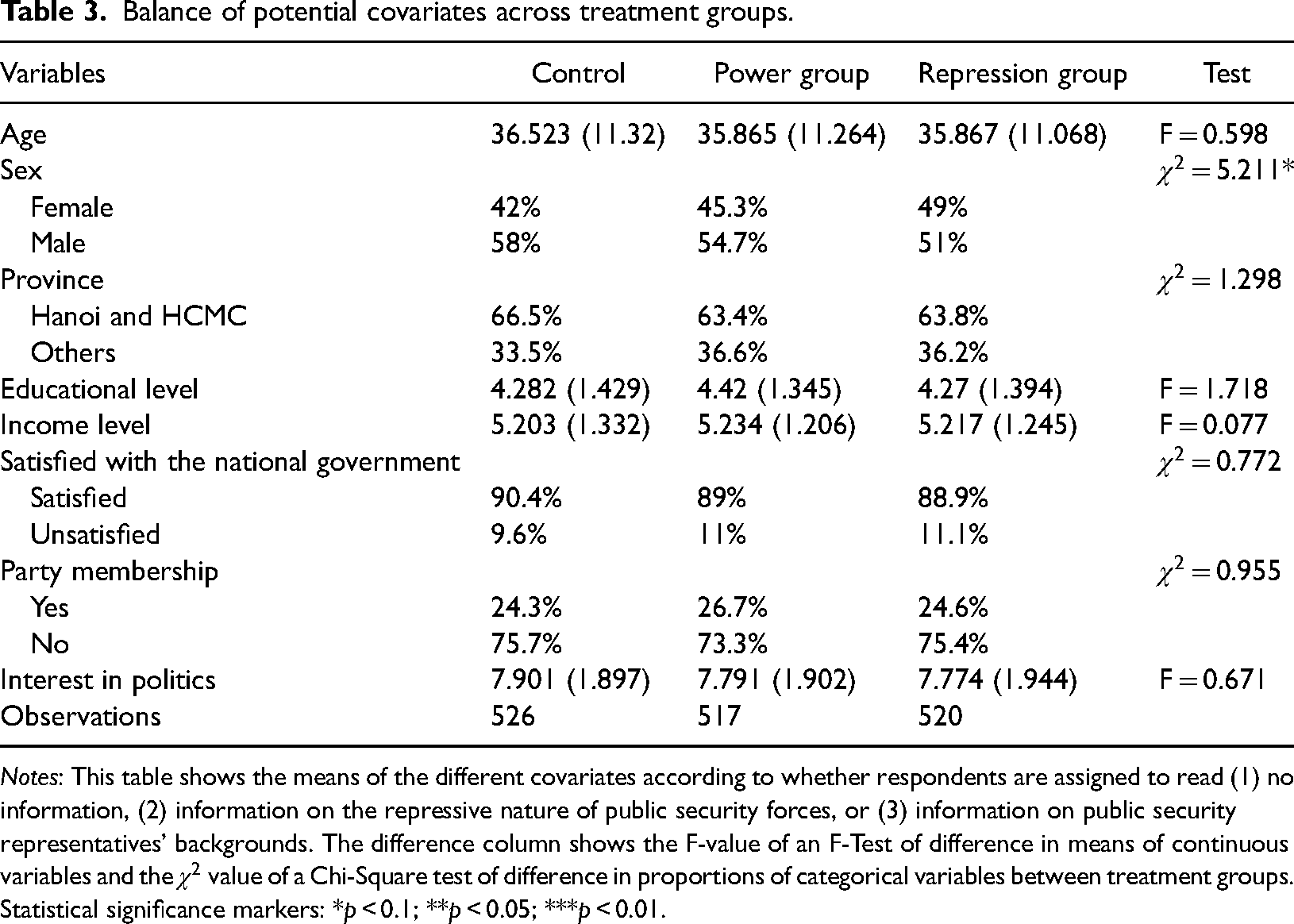
Notes: This table shows the means of the different covariates according to whether respondents are assigned to read (1) no information, (2) information on the repressive nature of public security forces, or (3) information on public security representatives’ backgrounds. The difference column shows the F-value of an F-Test of difference in means of continuous variables and the
Results
To test my hypotheses, I run the following OLS regression models:
Model 1 shows a statistically significant effect of the treatment on respondents’ willingness to sign petitions to the government if unsatisfied with a government's policy. The Power and the Repression groups are less willing to sign petitions to the government than the control group. while the effect of emphasizing security representatives’ backgrounds is only 0.05 standard deviation shift in the mean value of reported willingness to sign petitions, such information shifts the distribution from a mean of 7.1 (in the control group) to 6.5 (in the power group) on a 10-scale point. The effect of the information about the repressive nature of the public security institution is larger, moving the distribution 0.07 standard deviations downward, again at standard levels of significance. Given that signing petitions is the least risky type of collective action, these findings suggest that electing a high number of police to the Politburo may discourage the public from taking even the “safest” approach to raising their concerns.
The effect of treatments on respondents’ participation in collective action.
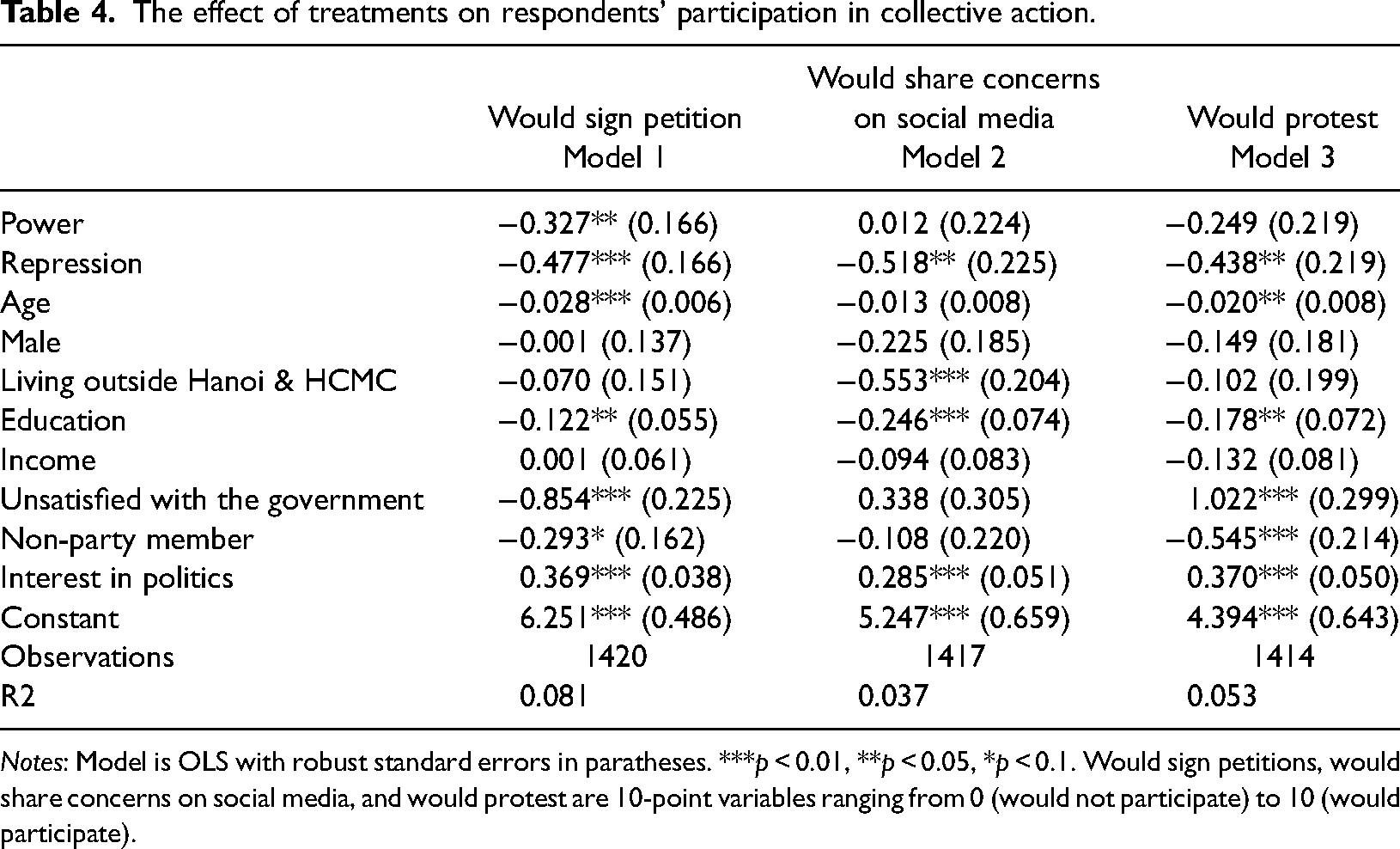
Notes: Model is OLS with robust standard errors in paratheses. ***p < 0.01, **p < 0.05, *p < 0.1. Would sign petitions, would share concerns on social media, and would protest are 10-point variables ranging from 0 (would not participate) to 10 (would participate).
According to model 2, the treatment also has a statistically significant effect on respondents’ willingness to share concerns on social media. The impact of emphasizing the repressive nature of the Ministry of Public Security is at a 0.07 standard deviation shift in the mean of the dependent variable, moving the distribution of the mean from above 5 (in the control group) to below 5 (in the repression group) on a 10-point scale. This finding is expected because the public security force has been more repressive toward online criticisms and dissidents. On the other hand, respondents in the Power group are not less likely to share their concerns on social media than those in the control group. This may mean that emphasizing security figures’ backgrounds does not directly convey their repressive nature to the public.
Model 3 tells a similar story. Information on the backgrounds of police officials in the Politburo has no significant effect on respondents’ participation in protests. On the other hand, respondents exposed to the text on the repressive nature of the public security force are significantly less likely to protest if unsatisfied with the government. The effect is at 0.06 standard deviations, shifting the distribution of the mean from approximately 5 (in the control group) to approximately 4 (in the repression group) on a 10-point scale. This finding is not surprising because the police have been highly repressive toward recent protests, such as the long-standing Dong Tam land dispute and anti-China protests.
Generally, these results suggest that signaling an exceptionally high number of public security figures in the new Politburo makes respondents less likely to participate in high-risk and low-risk collective actions when unsatisfied with a government's policy. However, emphasizing the repressive nature of the Ministry of Public Security, from which police representatives come, has a more substantial effect than emphasizing their backgrounds.
Regarding control variables, age, educational level, satisfaction with the government, party membership, and interest in politics have consistently significant correlations with respondents’ willingness to participate in collective actions. Older respondents are significantly less likely to sign petitions or to protest if unsatisfied with the government's policies. Interestingly, education has a negative effect on participation in collective actions. The more educated the respondent is, the less willing they are to participate in all three types of collective actions. One reason could be that compared to those with low educational levels, it is more costly for educated individuals to participate in opposition activities because they risk losing what comes with better education, such as income, network, and life stability. Those unsatisfied with the government are significantly less willing to sign petitions but more willing to protest than those who are not. Non-party members are less likely to sign petitions and protest. Those with a high interest in politics are more likely to participate in all three types of collective action. This finding is in line with existing research that suggests that individuals who are interested in and know about political issues tend to oppose the status quo (Geddes and Zaller, 1989).
Given the significant correlations between respondents’ willingness to participate in collective actions and age, education, satisfaction with the government, interest in politics, and party membership, Appendices 2A, 2B, 2C, 2D, and 2E present the results of OLS models where I interact treatment groups with each of these covariates. I find no heterogeneous effects of emphasizing the salience of police officials in the Politburo. Because treatment effects are homogenous, the findings of my survey experiment conducted over a non-representative sample can be reliably generalized to the Vietnamese population (Coppock et al., 2018).
Because the article aims to disentangle the effect of a heavy police representation in the Politburo, the treatment texts do not include other irregularities of the 13th Party Congress, such as the election of two full-time generals from the Ministry of National Defense and the re-election of Party General Secretary Nguyen Phu Trong for a rare third five-year term. However, priming respondents with such information would still likely make individuals reluctant to participate in grassroots activism. One reason is that Party General Secretary Nguyen Phu Trong is known for his conservative stances on dissent and activism (Paddock, 2021). Future research should explore this possibility in greater detail.
Conclusion
In this article, I argue that democratic backsliding in single-party regimes occurs when autocrats attempt to tighten their grip on regime-destabilizing grassroots activism. I propose that single-party regime elites may elect a salient number of police officials to the Politburo to signal their unified intention to repress grassroots activism, which may reduce the public's willingness to participate in protests and movements.
The 13th National Congress of the Communist Party of Vietnam provides an excellent example to test my argument, as the Party Congress took place when the regime was threatened by increasing protests and online opposition. The article examines how an exceptionally high number of public security representatives in the Politburo affects individuals’ propensity to participate in grassroots activism. My survey experiment shows that the country's new leadership will likely reduce the public's willingness to rely on collective actions to voice their discontent concerning policy issues. Respondents exposed to information about the new composition of the Politburo are significantly less likely to sign petitions, share concerns on social media, and protest when unsatisfied with a government's policy. Emphasizing the repressive nature of the Ministry of Public Security has an especially strong effect on respondents’ attitudes toward grassroots collective actions. The findings provide suggestive evidence that by carefully crafting the composition of the most powerful organization, regime elites may reverse democratic developments, especially the participation dimension, without institutional changes. Future studies could advance this research by conducting interviews with present and past Party Personnel Committees members who vetted potential candidates to the Central Committee and interviews with party delegates to a national part congress who actually voted on the candidates. Such interviews may help examine the Party's personnel arrangements from the elites' perspectives.
Supplemental Material
sj-docx-1-acp-10.1177_20578911221139764 - Supplemental material for Declining opportunities for speaking out: The impact of Vietnam's new leadership on grassroots collective action
Supplemental material, sj-docx-1-acp-10.1177_20578911221139764 for Declining opportunities for speaking out: The impact of Vietnam's new leadership on grassroots collective action by Mai Truong in Asian Journal of Comparative Politics
Footnotes
Acknowledgements
I would like to thank Yuko Kasuya, Netina Tan, Nhu Truong, and other participants at V-Dem East Asia Workshop on Democratic Backsliding in Southeast Asia for invaluable comments and feedback. I would also like to thank Renard Sexton and Nico Ravanilla for helpful comments on the research idea and design.
Declaration of conflicting interests
The author(s) declared no potential conflicts of interest with respect to the research, authorship, and/or publication of this article.
Funding
The author(s) received no financial support for the research, authorship, and/or publication of this article.

Supplemental material
Supplemental material for this article is available online.
Notes
References
Supplementary Material
Please find the following supplemental material available below.
For Open Access articles published under a Creative Commons License, all supplemental material carries the same license as the article it is associated with.
For non-Open Access articles published, all supplemental material carries a non-exclusive license, and permission requests for re-use of supplemental material or any part of supplemental material shall be sent directly to the copyright owner as specified in the copyright notice associated with the article.
