




Abstract
Why do candidates enter an electoral contest? The Rational Model of Candidate Entry offers a parsimonious explanation focusing on the probability of victory, the benefit of holding office, as well as campaign costs. Quality challengers enter when there is a high probability of victory, while long-shot races attract amateurs. In most contexts, the presence of parties makes it difficult to disentangle candidate decisions from organizational recruitment strategies. To test the basic assumptions of the Rational Model of Candidate Entry, this Research Note examines candidate entry decisions in Indonesia's Regional Representative Council (Dewan Perwakilan Daerah, DPD), the world's largest elected non-partisan assembly. An analysis of constituency-level candidate lists in all four DPD elections indicates that entry decisions are affected by the perceived probability of victory, with fewer candidates entering in constituencies with a more concentrated vote in the previous election. Potentially winnable DPD races attract a greater number of experienced challengers, partisan amateurs, and non-partisan amateurs. Only the number of non-partisan amateur candidates consistently correlates with socio-demographic variables, further underlining the importance of electoral context for ambitious, politically savvy elites. The findings affirm the broad applicability of the Rational Model and spotlight Indonesia's often-overlooked DPD as a venue of strategic behaviour.
Why do candidates enter an electoral contest? The Rational Model of Candidate Entry offers a parsimonious and powerful explanation for the decision-making of individuals seeking public office. When considering a run for office, aspiring politicians assess the probability of victory, the benefit of holding office, as well as the cost of the run. As these variables change, so too does the utility of seeking office. Applications of the Rational Model shed light on the quality of candidates that emerge in a given constituency or election cycle as well as the career paths that politicians pursue.
While the Rational Model serves as the basis for an active field of research, the individualistic assumptions of the model are most often applied in a world of partisan politics, in which strategic political parties are also pursuing organizational objectives. This has theoretical and methodological consequences for the Rational Model. Individual candidate entry decisions occur in tandem with a party's candidate recruitment efforts, potentially obscuring the identification of which actor makes calculations about key variables, like the probability of winning.
To test the basic assumption of the Rational Model, this Research Note examines candidate entry decisions in Indonesia's Regional Representative Council (Dewan Perwakilan Daerah, DPD), the world's largest elected non-partisan assembly. I find support for the Rational Model of Candidate Entry, primarily that individual candidates respond to the electoral context and that the entry behavior of experienced and amateur candidates is influenced by the probability of winning office. It makes two contributions to the comparative literature. First, we gain confidence in the external validity of the Rational Model by testing it in a new context. Existing work on entry has generated theoretical insights and empirical predictions that have been too rarely tested outside the American case. Second, exploring the theory in a non-partisan context sharpens our empirical focus on individual candidate decisions. The analysis of candidate entry into DPD races demonstrates strategic behavior occurring at the candidate level, thereby adding support for the individualist mechanisms underpinning the Rational Model.
The findings also shed light on the careers and strategies of Indonesian political actors. As an advisory body with little formal decision-making authority, we might reasonably expect a seat in the DPD to hold little attraction for ambitious politicians. Why run a costly campaign for an inconsequential seat? Yet, as demonstrated below, elections attract a considerable number of high-quality candidates responsive to the electoral context, which suggests DPD campaigns are a venue for ambitious politicians. In emphasizing the strategic foundations of DPD candidate behavior, this article underlines the need to place DPD candidacies in a broader career trajectory.
The logic of strategic entry
Why do some electoral contests attract more candidates than others? The Rational Model of Candidate Entry can be traced by to Schlesinger's work on ambition and Black's (1972) development of the argument. In Black's simple model, rational politicians calculate costs and benefits to determine if they should seek a particular office. This is formalized as:

In the American context, there is only modest variation in the number of candidates that enter the race, and the vote is consistently dominated by candidates from one of the two main parties. Attention has thus shifted the type of candidate that enters, rather than the raw number. The standard approach is to draw a distinction based on candidate quality, distinguishing “experienced” politicians from “amateurs” (Banks and Kiewiet, 1989; Bond et al., 1985; Canon, 1993; Jacobson, 1989; Lazarus, 2008a, 2008b; Roberds and Roberts, 2002). The most common cut-off point is a blunt sorting of candidates with a history of holding elected office (“experienced”) from candidates with no such history (“amateurs”). Experienced politicians are consistently found to be more electorally successful than amateurs.
Lazarus (2008a) identifies two reasons why experienced candidates may behave differently from their amateur counterparts and outperform them electorally. In the “resources” explanation, experienced politicians outperform amateurs because they are “inherently better at politics” (Lazarus 2008a: 187). Experienced politicians have talents and materials that can help them get ahead, which can range from access to donors to the natural gift of charisma.
A second explanation focuses on self-selection. The cost of seeking office may be higher for experienced politicians. The experienced politician may have to give up one office in order to seek another, exposing them to the risk of losing an office they value. Likewise, experienced politicians typically have ambitions that include an upward career trajectory. In leaving one office to seek a second, experienced politicians face a career-defining test; a loss can make them “damaged goods,” stunting their trajectory. Amateurs do not face the same costs; they do not have offices to lose and their political ambitions are more likely to be modest. Accordingly, amateurs are more willing to pursue low-probability races.
Furthermore, experienced politicians are potentially more capable of identifying winnable seats. As Black (1972: 146) notes, “errors arise because information is almost always limited and expensive, and the decision-maker must generally arrive at his decisions through the process of an educated ‘guess’.” Experienced politicians are well placed to make better guesses than amateurs. Lazarus (2008a: 189) explains that experienced politicians have an edge in “the ability to collect and accurately interpret political information.” This analytical advantage allows them to avoid hopeless races. It also means they should be more attracted to winnable races.
Despite the odds being long on amateur victory, many still choose to put themselves forward. The logic of amateur entry has led to productive debate and theoretical refinement (e.g. Banks and Kiewiet, 1989; Canon, 1993; Lazarus, 2008a). Amateurs are not necessarily devoid of a sense of strategy. There are conditions under which calculating amateurs could be expected to pursue a long-shot challenge to a long-established incumbent (Banks and Kiewiet, 1989) or enter a primary against a high-quality co-partisan (Canon, 1993). Banks and Kiewat argue that Black's model can be fruitfully expanded to capture the “private consumption value” of candidacy. At least some amateurs are motivated by “nonelectoral goals” that accompany a run for office, such as promotion of their business or the thrill of office-seeking itself. Canon (1993) subdivides amateurs, some of whom run for reasons of political ambition, while others are “experience seeking.” Amateurs, in short, are a mixed bunch, with some responding strategically to the probability of winning and others motivated by reasons beyond their electoral success in the immediate race.
In the strategic candidate approach, parties play a significant, albeit often unacknowledged, role in determining candidate actions. Parties typically work to limit the number of candidates they run in a constituency. Varying selection mechanisms produce different results. Furthermore, partisanship structures the information candidates utilize to determine their entry decisions: the two-party constituency margin, a party's presidential candidate's constituency-level support, the economic fortunes of the incumbent party, and so on. Parties recruit, provide information, set rules, and provide resources. The candidates of the strategic candidate model are so heavily integrated into a partisan world that it is empirically fraught to disentangle one from the other. While Black (1972) no doubt intended for his model to be transferred to a partisan world, it is noteworthy that his foundational study of non-partisan local politicians had to step outside of the world of partisan politics before he could conceptualize the world of the candidate.
We regain empirical focus on candidates by returning to a non-partisan context. In the absence of parties, entry decisions are candidate-centered. Whereas parties act as a gatekeeper in most systems, restricting ballot access to a small number of viable contenders, candidate entry in non-partisan contexts is unconstrained by the scarcity of major party nominations. The pool of candidates is free to expand, allowing the underlying strategic dynamics to reveal themselves in the number of candidates entering the race.
The first hypothesis, drawn from the strategic candidate approach, posits a relationship between electoral context and entry: H1: There is a positive relationship between the probability of winning a seat and the number of candidates running in a constituency.
This simple hypothesis suggests that aspiring officeholders will avoid electoral contests they view as unwinnable. This results in fewer candidates.
However, the strategic candidate approach also points to important differences across candidates. Experienced candidates are more likely to have the knowledge and resources to select winnable races. Ambitious amateurs may also be able to accurately identify winnable and hopeless seats. Other amateurs, though, will run for reasons of “private consumption.” On the whole, then, experienced candidates should be more sensitive to the electoral contest (Lazarus, 2008a): H2: The positive relationship between the probability of winning a seat and the number of candidates running is largest among experienced candidates.
If amateurs are less sensitive to the electoral context, their entry into the race is likely to be tied to factors shaping the potential ‘supply’ of candidates, such as education levels or population (Norris and Lovenduski, 1995).
An analysis of Indonesia's non-partisan assembly allows us to test these hypotheses.
The DPD: A non-partisan assembly
The DPD, an elected regional advisory assembly, was created during the post-Suharto constitutional amendment process that took place between 1999 and 2002. 1 The basis for the non-partisan nature of the elected body was established by the constitution, which outlines that participants in DPD elections are “individuals” (Article 22E4) while participants in national legislature (Dewan Perwakilian Rakyat Daerah, DPR] and regional legislatures are “political parties” (Article 22E3). The application of this “party/individual” distinction is still evolving. A 2008 electoral law removed explicit prohibitions on party membership by DPD members while expanding regulation of campaign messaging. Legal ambiguity regarding DPD members holding party positions—combined with the party activism of many DPD members—led to a 2018 decision by the Constitutional Court requiring prospective DPD candidates to resign any partisan postings (Faiz and Winata 2019; Wulandari et al., 2020). How and when the decision was to be implemented became an issue of intense legal dispute, with the Constitutional Court and Supreme Court taking conflicting positions. Despite the change, rules and regulations have consistently barred parties from the candidate nomination process and effectively blocked the formation of partisan labels during campaigns.
Elections are held using a single non-transferable vote (SNTV). Each province is allotted four seats in the DPD, and DPD elections for all provinces occur simultaneously once every five years. Within a province, candidates for the DPD compete against each other and the four candidates with the highest vote totals are awarded seats. The SNTV vote is distinct from the open-list proportional vote used in the partisan DPR and sub-national elections.
Candidates for the DPD self-select into the race by applying to the General Elections Committee for ballot access (Komisi Pemilihan Umum, KPU). The KPU requires that each individual candidate reach a minimal threshold of support in the province by collecting a set number of supporter signatures. The number of signatures varies by province size, and must be spread over a defined percentage of kabupaten/kota within the province. 2 The registration and verification process occurs at approximately the same time as the registration and verification of candidates for the partisan legislatures. Elections for the DPD take place simultaneously with elections for the partisan DPR as well as the partisan provincial (Dewan Perwakilian Rakyat Daerah) and sub-provincial (Dewan Perwakilian Rakyat Daerah – Kabupaten/Kota) legislatures.
While partisans can participate in DPD elections, the assembly's non-partisan nature rests on two absent features that define the existence of partisanship: common labels connecting ‘teams’ of candidates and nominating organizations (Schaffner et al., 2001). Overlap in support bases exists between parties and particular DPD candidates; nonetheless, DPD contests show little evidence of structured party mobilization. Patterns of electoral fragmentation provide one sign of this dynamic. While partisan lower house constituencies – often coterminous with DPD constituencies – had an average of 8.9 effective electoral parties in 2014, DPD elections that year saw 15.7 effective electoral candidates per constituency. Furthermore, the existing fieldwork on DPD election campaigns (Fadhillah and Rafni, 2018; Masduki and Widyatama, 2018; Merisa and Hasan, 2021) does not highlight the importance of party connections. Candidates craft broadly appealing messages, leverage connections to social organizations, target geographic areas, and conduct other activities consistent with pursuing a broad ‘personal vote’ distinct from partisan labels. Although some candidates have partisan histories and connections, DPD elections are not partisan battles by proxy.
Where the non-partisan nature of the DPD provides an ideal electoral venue for the study of candidates, the low benefits from office-holding make it a challenging case for the existence of strategic behavior. The Indonesian constitution grants the DPD limited oversight and advisory powers (Art 22D). It may propose bills in only circumscribed policy areas. With the DPR, members of the DPD constitute the People's Consultative Assembly (Majelis Permusyawaratan Rakyat, MPR), a supra-legislative that has the power to amend the Constitution and impeach the president. Although MPR membership is potentially important, impeachments and amendments are rare events, and the day-to-day of governance leaves few formal budgetary and policy powers to DPD members.
If formal benefits of office are low, the costs of campaign remain relatively high. Mubtadi and Arifin (2020) examined the formal campaign expenses of all winning DPD candidates. The average campaign was Rp. 400 million, or approximately USD$26,000. This sum is approximately six times the 2018 per capita gross domestic product (USD$4291.8). Official candidate reports likely underreport actual costs. Even if unsuccessful candidates spend less, they can expect significant direct costs.
Low benefits from office and high campaign costs have the potential to skew the pool of potential DPD candidates, attracting a disproportionate number of candidates interested in the “private consumption value” derived from electoral participation. If ambitious politicians prefer investing in partisan careers pursuing high-value political offices, the strong presence of “experience-seeking” amateurs in DPD races could overwhelm any strategic calculations focusing on the probability of winning in a particular electoral district. The non-partisan nature of the assembly means we can be confident individual candidates are the central decision-makers, but the configuration of office-holding benefits and campaign costs mean we cannot assume all candidates share the same strategic calculus that prioritizes winning. This reinforces the importance of studying entry using multiple metrics.
Data
The first independent variable—Total Candidates—is the number of candidates that signed up to run for a seat in the DPD, disaggregated by province. The variable measures all those who successfully passed the initial round of verification and were publically announced as DPD candidates. Between the announcement of candidates in the fall preceding the election, and the time of voting in the spring of election year, a small number of candidates withdraw from the DPD race due to medical, legal, or other reasons. For the purpose of this analysis, these candidates are counted as having run for office. The Total Candidates variable exists for all four elections: 2004, 2009, 2014, and 2019.
The candidates are then disaggregated by political experience. Experience is coded using candidate biodata provided to electoral authorities. This biodata has been previously used by Dettman et al. (2017) in their study of DPR candidates. I have biodata for only two elections: 2014 and 2019. In total, 1699 candidates are coded, over 96% of the 1760 total candidates competing in 2014 and 2019. 3
Following the established literature, the cut-off point for experience is whether the candidate ever held elected public office. The form asks candidates to list their work history. Candidates with any experience holding elected office at any time are coded as “1”; all others are coded as “0.” I also code as “0” candidates who did not fill in their work history or did not have a publically available form. In total, 33% of DPD candidates reported experience holding elected office (2014: 31%; 2019: 36%).
I code as amateurs all candidates with no history of holding elected office. However, to disaggregate this group, I also code for partisan activism, defined as any history of activity within a political party. I use partisan activism as a rough level of ambition, separating those with longer-term political aspirations from potential thrill-seekers. Typically, this comes in the form of a branch leadership position, but can also include participation in party courses. Candidates are coded as a “1” if they report any party activism on their biodata form, and “0” if not. In total, 21% of amateurs reported past partisan activism (2014: 23%; 2019: 21%). Given the legal ambiguity between party activism and DPD eligibility, these totals likely undercount the amateurs with partisan ties.
While the measures used are blunt, there are signs that they capture cross-candidate difference consistent with theoretical expectations positing superior campaign skills of experienced candidates. On average, challengers received 3% of the electoral vote. 4 Experienced challengers received 3.9%, while both partisan and non-partisan amateurs received 2.8%.
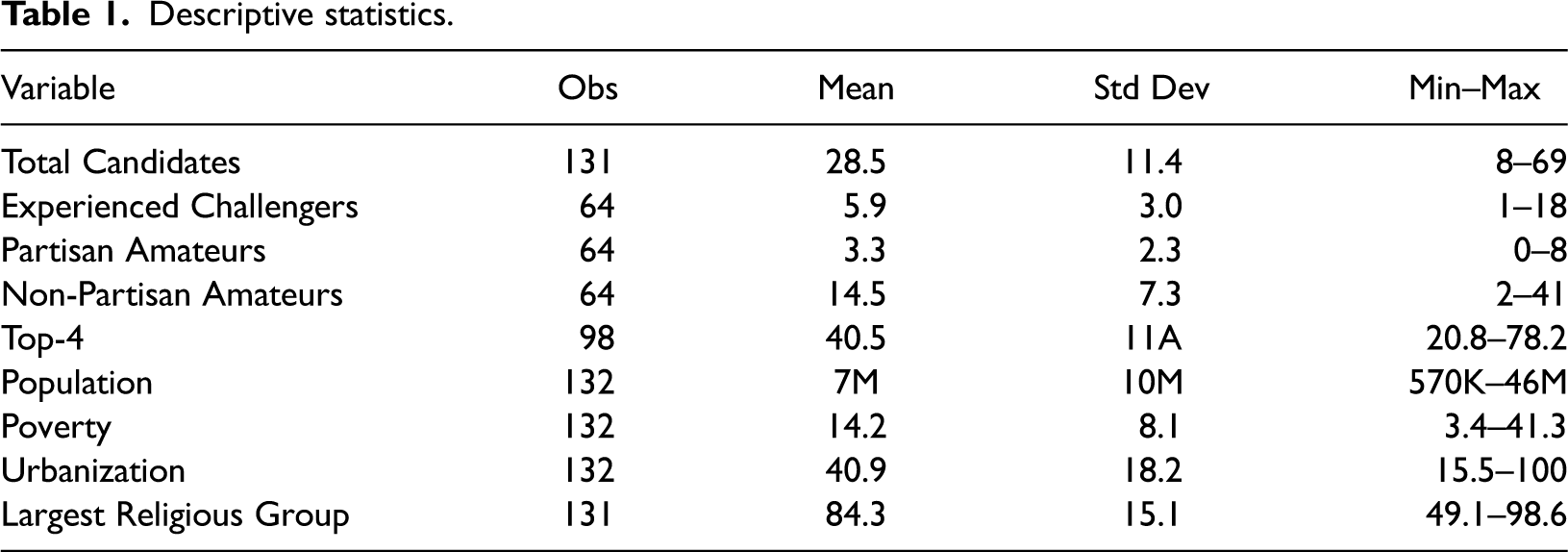
I use these two variables—Experience and Partisan Activism—to create aggregate, province-level measures of three types of candidates: Experienced Challengers, Partisan Amateurs, and Non-Partisan Amateurs. Experienced Challengers is the number of experienced candidates minus the number of incumbents. Since entry is the focus, incumbents are removed from the “experienced” pool. On average, there are 5.9 Experienced Challengers per province. Interestingly, the average number of Partisan Amateurs is lower, at 3.3 per province. There are 14.5 Non-Partisan Amateurs per province.
To measure the strategic context, I used the collected percentage of vote within a province attained by the winners in the previous election, referred to as Top-4. The intuition behind the measure is that aspiring candidates calculate their probability of winning by examining the open electoral space. If the electoral vote in the previous election was concentrated by the winners, aspiring candidates are more likely to view voters as already attached to an established politician and therefore less likely to see a path to victory. The measure also has the virtue of relying on widely available information and a simple process of calculation.
Four ‘supply-side’ control variables are also included: Population, Urbanization, Poverty, and Largest Religious Group. All potentially influence the number of candidates that emerge in a given province. Details are included in Appendix A. Descriptive statistics for all variables used in the analysis appear in Table 1.
Descriptive statistics.
Results
To set the context for analyzing entry, I focus first on the relationship between candidate entry and socio-demographic variables affecting the supply of candidates. Three of these variables—Population, Urbanization, and Poverty—significantly correlate with the Total Candidates in the pooled sample. Of these, Population merits attention as it has the strongest substantive relationship and is the only variable to significantly correlate with Total Candidates in a given election year (2004, 2014, and 2019). 5
Figures 1a–1d plot Total Candidates by logged Population in all four elections. In three of four years, we see a significant relationship between Population and the Total Candidates. This connection is particularly strong in 2004—the first DPD election—in which Population explains approximately half of the variance in the Total Candidates. After the first election, Population explains less variance.
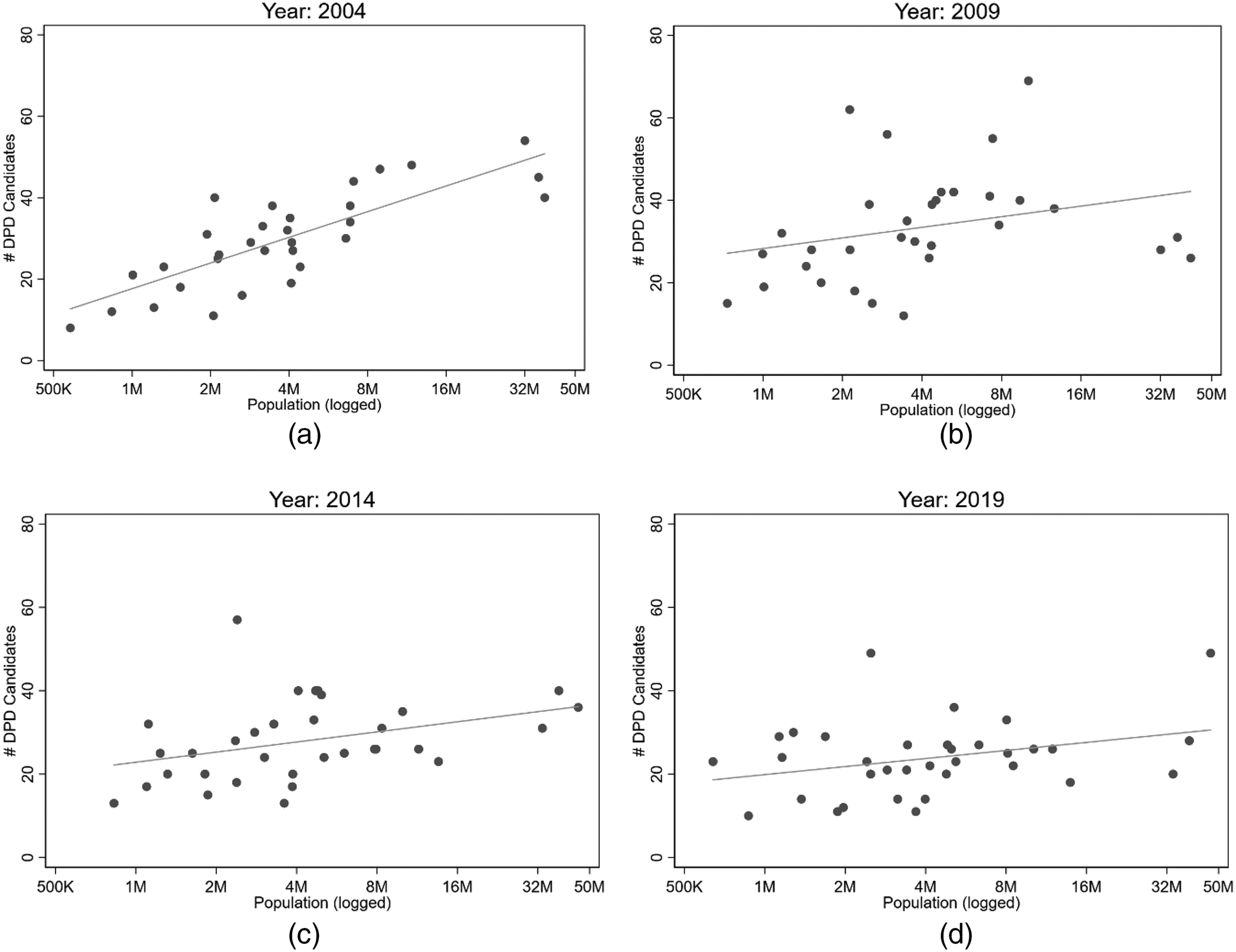
Total DPD candidates by population.
An example helps illustrate the point. In 2004, Nusa Tenggara Timor had just under 5 million residents. In that year, 19 DPD candidates ran for office. Central Java, on the other hand, had over 33 million residents, and saw 54 DPD candidates run for office. In every subsequent election, however, Nusa Tenggara Timor had more DPD candidates (2009: 40; 2014: 39; 2019: 36) than Central Java (2009: 28; 2014: 31; 2019: 20). Population was the dominant determinant of DPD entry in 2004, then resided in importance.
Breaking candidates down by type suggests Population continues to be an important determinant of Non-Partisan Amateurs. Figures 2a–2c plot the total number of Experienced Candidates, Partisan Amateurs, and Non-Partisan Amateurs by logged Population (2014 and 2019 aggregated). I find no relationship between Population, on the one hand, and either Experienced Candidates or Partisan Amateurs, on the other. However, there is a clear, positive relationship between Population and the number of Non-Partisan Amateurs. 6 For instance, in 2019, West Java (population 40 million) and North Maluku (population 1.25 million) both had 11 Experienced Challengers; however, West Java had three times as many Non-Partisan Amateurs (36 to 12 in North Maluku). The results suggest that there is a stock of political amateurs distributed throughout the population that behave in distinct ways from those with more political experience.
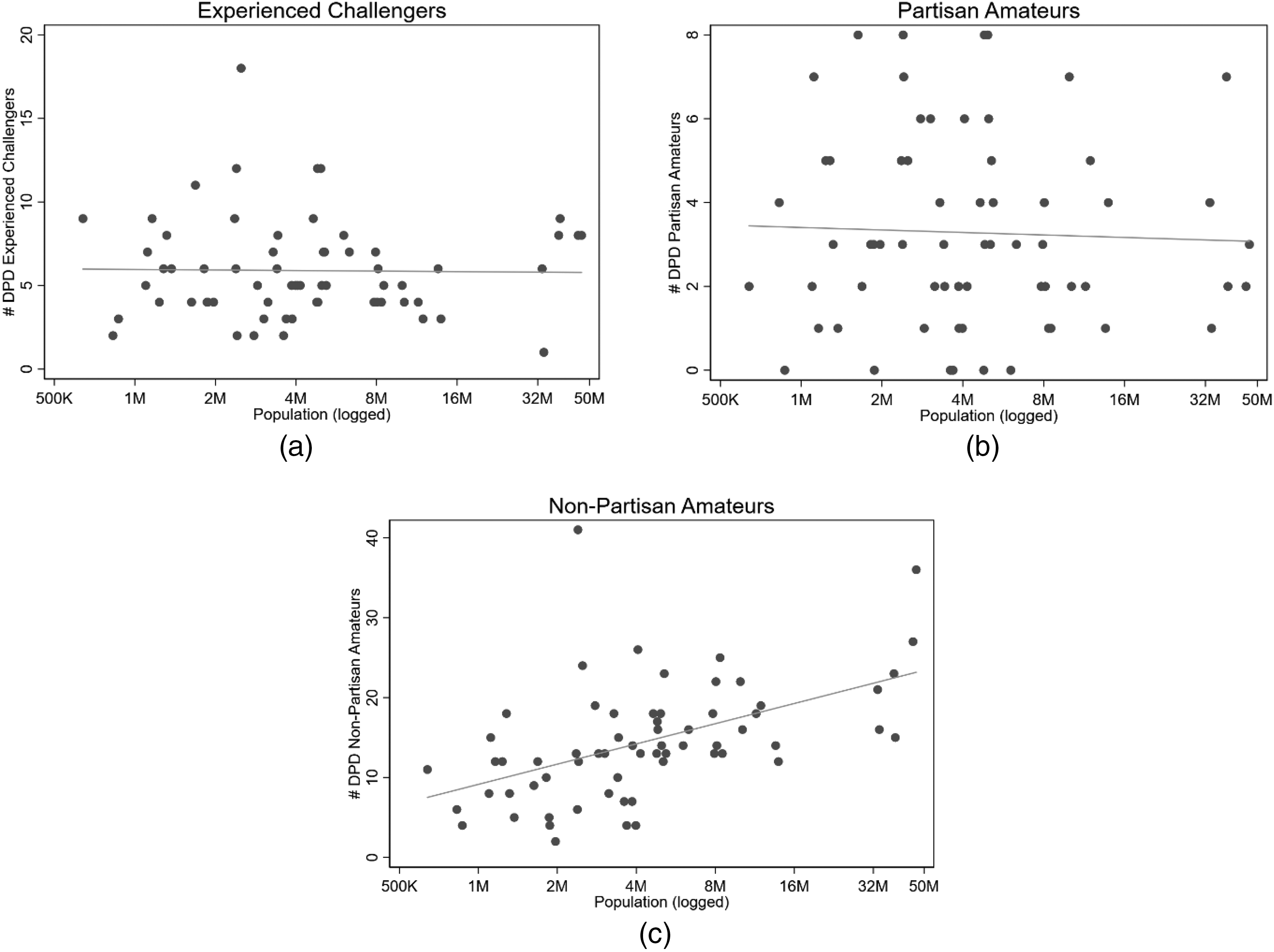
Types of DPD candidates by population (2014 and 2019).
Socio-demographic variables affect the number of certain types of DPD candidates, but there is clearly more going on, particularly for ambitious elites with political savvy. Turning to the strategic context, Figures 3a–3c plot Total Candidates by the Top-4 vote share across years. We see a clear, negative relationship; as Top-4 vote share increases, Total Candidates declines. The relationship is both statistically significant and substantively large. Increasing Top-4 by one standard deviation from the mean (from 40% to 51%) correlates with a predicted change of five fewer candidates, from 28 to 23. These predicted differences using a statistical model underplay, to some degree, the large differences we observe in actual provinces. In 2019, Central Kalimantan and Southeast Sulawesi were roughly equal in population size, both having approximately two a half million people. Central Kalimantan had a relatively concentrated DPD vote in 2014 (Top-4 = 44%), while Southeast Sulawesi had a relatively fragmented vote (Top-4 = 21%). In 2019, Central Kalimantan had 21 DPD candidates, while Southeast Sulawesi had 49.
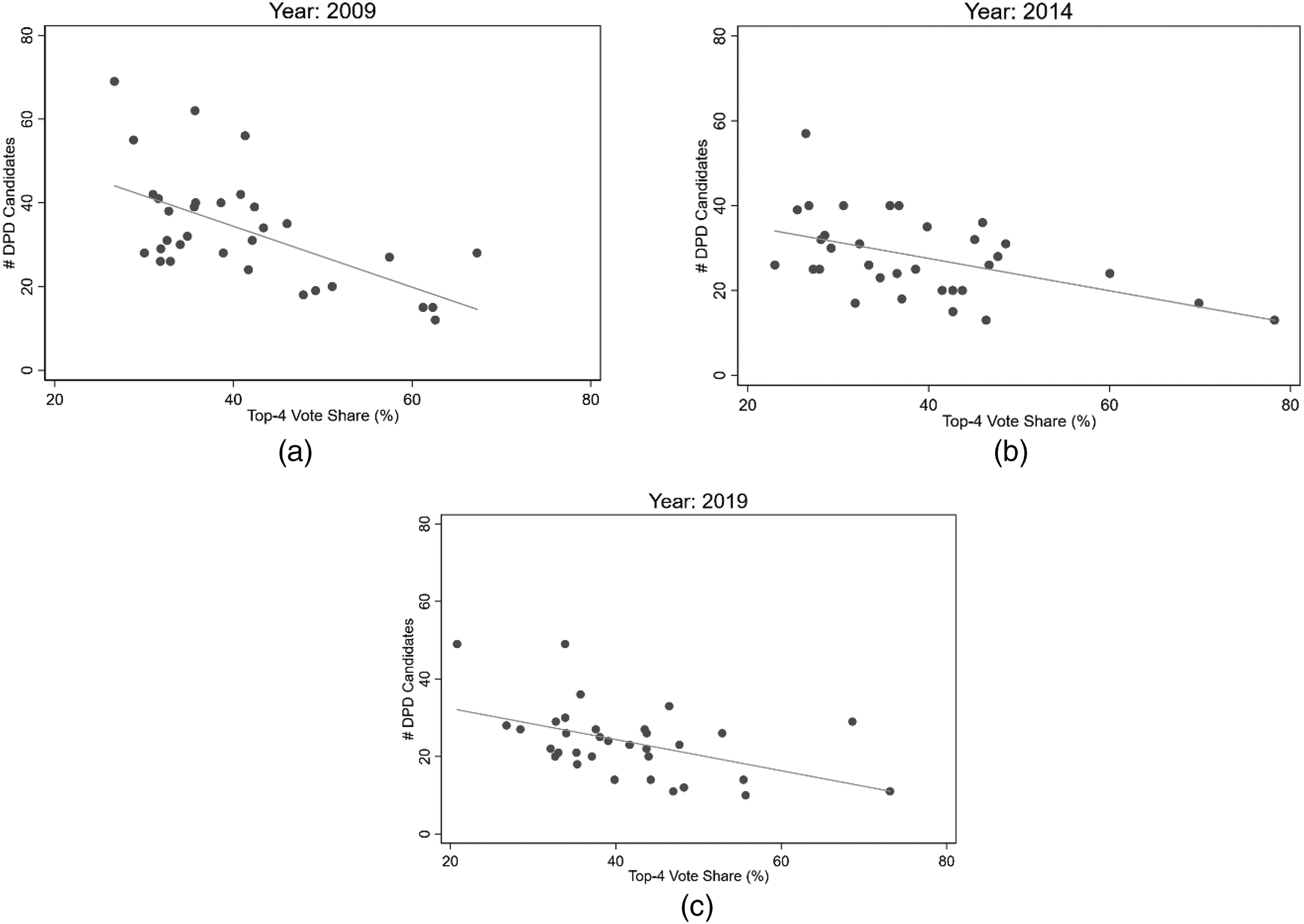
Total DPD candidates by top-4 vote share (%).
These initial results lend support to Hypothesis 1: taken together, entry decisions correlate with the strategic context, suggesting candidates enter when there is a higher probability of victory. 7 But does this hold across all types of candidates, or just candidates with political experience?
Figures 4a–4c plot total candidate type by Top-4 vote share. The relationship between strategic context and candidate number is most apparent for the Experienced Challengers. However, the general pattern remains roughly visible for both the Partisan Amateurs and the Non-Partisan Amateurs. When controls are added in the statistical models, Top-4 is statistically significant in all three groups. 8
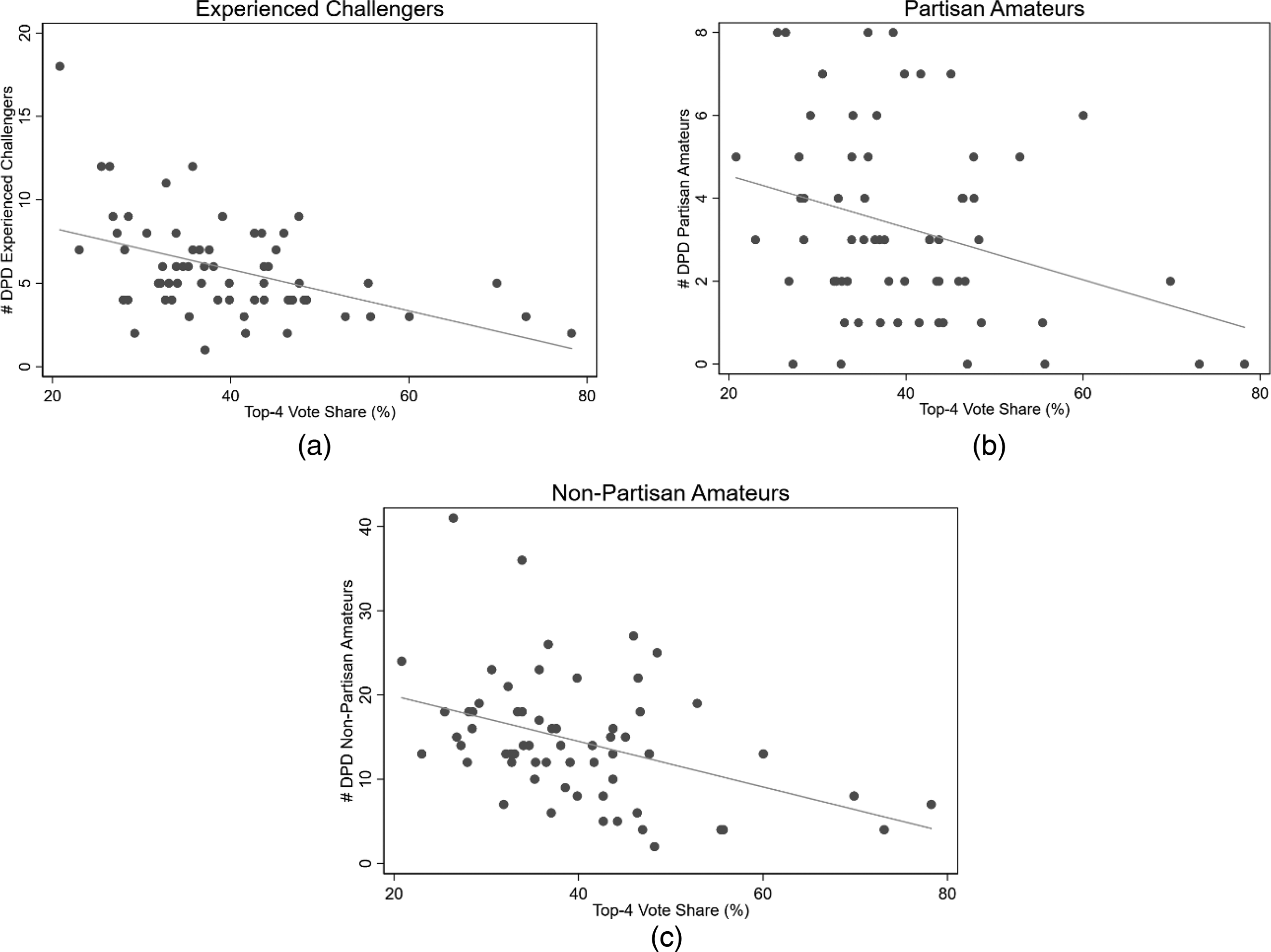
Types of DPD candidates by top 4 vote share (%) (2014 and 2019).
As a further test of Hypothesis 2, we can examine the magnitude of the strategic context variable across groups. For the Experienced Challengers, increasing Top-4 by one standard deviation from the mean (from 40% to 51%) results in two fewer candidates. For Amateur Non-Partisans, a similar change results in four fewer candidates. However, once we take into account that there are more Amateur Non-Partisans in general, we see that in both cases the predicted change is approximately half of one standard deviation from the mean. The strategic context affects both the experienced and amateur pools by roughly the same magnitude.
The evidence for Hypothesis 2 is mixed. On the one hand, amateurs and experienced challengers appear responsive to the same strategic context variable, with no substantively significant changes in the magnitude of the relationship. However, Non-Partisan Amateurs are the only subgroup in which total candidate numbers consistently correlate with metrics of candidate supply.
Conclusion
This article finds that candidate entry in Indonesia's non-partisan assembly offers evidence consistent with both the strategic candidate model and theories of candidate supply. Individual candidates do appear to behave strategically based on their probability of winning, unaided by prodding or expertise offered by partisan organizations. Candidates make these decisions, in part, using their knowledge of previous election results. The electoral consolidation of the previous provincial contest significantly correlates with the number of candidates that contest DPD seats. This holds for both amateur and experienced candidates. While there is a consistent correlation between candidate entry and one measure of candidate supply—population size—the relationship only holds among candidates with the least exposure to electoral politics.
In terms of the comparative politics literature, the findings from Indonesia lend considerable support to previous work on candidate entry in the US (and elsewhere). The decision to become a candidate is influenced by the electoral context. Winnable seats attract aspiring politicians. Furthermore, there are meaningful differences in the calculations of experienced politicians and amateurs; supply-side explanations help us understand the behavior of amateurs but less so of experienced candidates. The results suggest that elections attract some candidates that are in it to win it, and others that are in it for adventure.
In terms of Indonesia, the findings open up as many questions as they answer. On the one hand, despite the relative lack of formal powers associated with DPD offices, contests for these offices are venues of strategic behavior. DPD elections attract plenty of experienced politicians. The entry decisions of both experienced and amateur candidates appear dependent on the electoral context. On the other hand, it remains unclear how a DPD run fits into the career trajectory of an ambitious politician. Is it a proving ground to demonstrate electability or a pasture to send near-retirement politicians? How do politicians view the benefits of DPD office-holding vis-a-vis other options? Importantly for ongoing discussions of institutional design, what is the nature of the relationship between political parties and DPD office-holders, and are these ties affected by regulatory changes? This Research Note establishes a basis for treating DPD candidates as strategic actors; understanding the DPD's place in Indonesia's institutional structure requires a longer-term assessment of careers and connections.
Supplemental Material
sj-docx-1-acp-10.1177_20578911221130945 - Supplemental material for Candidate entry in a non-partisan context: Evidence from Indonesia
Supplemental material, sj-docx-1-acp-10.1177_20578911221130945 for Candidate entry in a non-partisan context: Evidence from Indonesia by Nathan W Allen in Asian Journal of Comparative Politics
Footnotes
Declaration of conflicting interests
The author(s) declared no potential conflicts of interest with respect to the research, authorship, and/or publication of this article.
Funding
The author(s) received no financial support for the research, authorship, and/or publication of this article

Supplemental material
Supplemental material for this article is available online.
Notes
References
Supplementary Material
Please find the following supplemental material available below.
For Open Access articles published under a Creative Commons License, all supplemental material carries the same license as the article it is associated with.
For non-Open Access articles published, all supplemental material carries a non-exclusive license, and permission requests for re-use of supplemental material or any part of supplemental material shall be sent directly to the copyright owner as specified in the copyright notice associated with the article.
