




Abstract
This article examines the conditions under which dictators hold competitive elections, and looks specifically at the role played by a dictator’s age. Drawing on previous studies arguing that uncertainty increases the likelihood of competitive elections, I argue that as a dictator ages, uncertainty over the future increases within the regime, because government insiders’ expected payoffs for supporting the incumbent decline as s/he ages. As a result, I argue that older dictators are more likely to hold competitive elections in order to reduce uncertainty. The article also tests an implication of the argument: if uncertainty over the future drives elections, then it should be mitigated in regimes with a clear successor. Using a large-N, cross-national dataset on autocrats and competitive elections between 1960 and 2012, this article examines the argument and finds that as dictators age, they are more likely to hold competitive elections, all else equal. The analysis also finds that the effect of autocrats’ age on competitive elections is mitigated in one-party regimes where there exists an established succession rule, while the effect is more apparent in personalist regimes without such a system.
Introduction
Between 1960 and 2012, 171 autocratic leaders held competitive elections in which the opposition was legally allowed to compete with the incumbent. A growing body of literature studies competitive elections under autocracy, and examines why autocratic regimes hold them (e.g. see Gandhi and Lust-Okar, 2009; Hyde and Marinov, 2012). However, despite the existence of this extensive literature, there is at least one under-examined factor that helps explain the mechanism of competitive elections in a systematic way: dictator’s age.
A correlation between aging dictators and competitive elections can be observed in a number of cases. Out of 171 autocrats who held a competitive election, 55 held them after they were older than 65 (the 75th percentile). To name a few, Heydar Aliyev of Azerbaijan, Hassan Gouled Aptidon of Djibouti, Hosni Mubarak of Egypt, Alfredo Stroessner of Paraguay, Wojciech Jaruzelski of Poland, Chiang Ching Kuo of Taiwan and Robert Mugabe of Zimbabwe held competitive elections when they were past the retirement age in many advanced economies.
Some scholars argue that since autocrats get better and better at retaining power over time, autocratic regimes become more entrenched in office as time goes by, and as their tenure increases, they become less likely to be toppled (Bueno de Mesquita et al., 2003, Chiozza and Goemans, 2004, Svolik, 2009). 1 Whereas the studies do not directly examine the likelihood of competitive elections, they suggest that autocratic regimes will be less likely to run the risk of electoral defeat over time as the regimes continue to stay in power. If the mechanism is correct, we would expect the likelihood of competitive elections to be higher at the early stage of regime installation, when the incumbent is still learning to hold power.
By contrast, this article argues that an autocrat’s age can also affect the likelihood of competitive elections, and the likelihood increases at the end of his rule. More specifically, drawing on previous studies’ observations that uncertainty leads to competitive elections (Cox, 2009; Geddes, 2006; Schedler, 2013), this article first lays out an underlying mechanism of competitive elections: when government insiders’ expected payoffs for supporting the incumbent decline, threat to the incumbent and uncertainty over his political and even physical survival increases. And to reduce the uncertainty, the incumbent is more likely to hold a competitive election. This article then makes an original claim that dictators’ age provides a reasonable heuristic for government insiders to re-evaluate their expected payoffs. This is because when a dictator gets older, government insiders start contemplating whether the aging dictator is still capable of governing the country or whether his/her successor will be able to do so, and how much longer they can keep receiving the same amount of benefits and privileges. These concerns lead to a decline in their expected payoffs for supporting the incumbent, and the decline in the expected payoffs in turn increases the chance of defection from the disgruntled government insiders. As a result, the uncertainty the incumbent faces increases.
Here, I argue that aging dictators can reduce this uncertainty by holding a competitive election. Previous studies find that holding an election helps consolidate the incumbent’s rule through co-optation (Gandhi and Lust-Okar, 2009; Gandhi and Przeworski, 2007; Geddes, 2006; Magaloni, 2006) and increased legitimacy (Beaulieu and Hyde, 2009; Blaydes, 2011; Levitsky and Way, 2010; Schedler, 2002), thereby reducing the uncertainty over their political survival. In addition, this article argues that competitive elections provide one additional benefit: better post-tenure fates for the incumbents – by holding a competitive election, incumbents can reduce their uncertainty over their physical survival as well as political survival, because such elections allow smooth power transition by providing more information (Cox, 2009) and increasing international and domestic legitimacy during tenure as well as after retirement (Tanaka, 2016).
The article also examines an implication of this argument: if uncertainty over the future drives elections, then it should be mitigated in regimes with a clear successor. More specifically, the article identifies one condition under which a dictator’s age is more or less likely to spur uncertainty over the future, depending on regime type. The key here is whether a regime has an established succession system – the age-driven uncertainty effect is more likely to be observed when there is no established succession system in a regime, while the effect is mitigated if there exists a system of succession. For example, most personalist regimes do not have such systems and uncertainty over the future should increase as the incumbent ages. By contrast, in one-party systems and monarchies, the uncertainty level does not increase as much when the incumbent is aging because built-in succession systems provide a focal point for succession and an internal conflict over the future.
This article tests empirical implications of the mechanism with a cross-national dataset between 1960 and 2012. An advantage of the focus on dictators’ age is that because it is irreversible and this information is publicly shared, it is relatively straightforward to connect observable implications from the unobservable, expected payoffs of government insiders. The empirical analyses provide evidence that as autocrats age, they are more likely to hold competitive elections, all else equal. Furthermore, I find that this relationship between age and competitive elections is apparent in personalist regimes, but the effect is not detected in one-party regimes.
The basic theoretical mechanism that uncertainty and threat to the incumbent explains competitive elections has been proposed elsewhere (e.g. Cox, 2009; Geddes, 2006; Magaloni, 2006; Schedler, 2013). Further, it is important to note that I do not claim that dictators’ age is a primary factor to explain the likelihood of competitive elections. But it is an important heuristic for uncertainty level, and focusing on it provides further empirical support for the underlying mechanism of competitive elections. Recent work in political science has increased its attention to the role of leaders in domestic and international politics (e.g. Bueno de Mesquita et al., 2003; Debs and Goemans, 2010; Magaloni, 2008), but dictators’ age has been a mere control variable in the literature. Clague et al. (1996: 249) even argue that a leader’s age has little impact on autocrats’ incentives. By contrast, I argue that although autocrat’s age may not have a direct impact on their incentives, it does have an impact through influencing government insiders’ calculations. In addition, the article contributes to a larger literature of regime durability. Recent findings suggest that competitive elections tend to destabilize authoritarian regimes in the long term (Geddes et al., 2014; Howard and Roessler, 2006; Lindberg, 2006; Schedler, 2013; Schuler et al., n.d.), and this article provides a more nuanced mechanism of the stability achieved in some cases – by holding a competitive election, aging dictators can stave off uncertainty and may extend their tenure length in the short term, hence the short-term stability. But they may face destabilization of the regime and political liberalization in the long term once the aging dictators are finally gone.
Argument
The article’s theoretical framework follows Schedler’s (2013) observation: autocratic leaders face uncertainty and they hold competitive elections to reduce uncertainty. 2 I argue that the incumbent’s aging aggravates the uncertainty they face, thereby increasing the incentive to hold a competitive election to reduce uncertainty. Here, I mean uncertainty over the incumbent’s political survival and, in some cases, physical survival due to increased internal threat. Below, I first discuss how dictators’ age increases uncertainty and internal threats and then how competitive elections can reduce the uncertainty.
Autocrat’s age and uncertainty
Incumbent autocrats face uncertainty over their hold on power and they can never be sure about whether they can remain in office (Schedler, 2013). Yet, I argue that an autocrat faces more uncertainty as they age. More specifically, I contend that an autocrat’s aging should increase uncertainty from two types of actors within the regime, members of the inner circle and the rival faction, because the dictators’ age contributes to a decline in their expected payoffs from supporting the incumbent. 3
First, aging autocrats should face an increased threat from their inner circle, thereby leading to increased uncertainty over their political and physical survival. Here, I informally compare a young autocrat with an aging dictator to highlight the logic. All else equal, by retaining the autocratic status quo in any given period, the inner circle of a young autocrat can expect to receive privileges over a longer period than that of the aging autocrat, because the members of the latter will be less certain about how long their privileges will last. The supporters of the aging autocrats must also contemplate what the likelihood is that they will keep receiving the same privileges under a new leader. As a worst-case scenario, the supporters may be purged by a new leader and lose all the benefits they used to enjoy from the incumbent (see Bueno de Mesquita and Smith, 2012: 258 for a similar view). Accordingly, as an autocrat gets older, the expected payoff for each member in his/her inner circle declines, because their, not the incumbent’s, uncertainty over their future status within the regime increases. When the autocrat becomes old, the members of the inner circle have to start thinking about his/her successor, and consequently they may become less loyal to the autocrat. 4
Defection can be proactive, from a coup, to deposition, to switching allegiances to a different faction. Due to the decline in their expected payoffs, the inner circle may also react differently to a revolutionary threat – a young autocrat’s inner circle may be more likely to help him/her crack down on a revolutionary threat if such a threat emerges, while those who serve an old autocrat may abandon him/her in the same situation. For instance, Mobutu Sese Seko of the Democratic Republic of the Congo was dying of prostate cancer in 1997. Although rebel leader Laurent Kabila did not have a strong base and lacked experience, the military, Mobutu’s erstwhile supporter, refused to fight back as Kabila’s insurgents captured more and more territory and marched to Kinshasa (Bueno de Mesquita and Smith, 2012: 29). 5
Further, the failure to choose a successor should aggravate the uncertainty problem, while the existence of a clear successor mitigates the inner circle’s uncertainty over the future (see also Brownlee, 2007b; Frantz and Stein, 2017; Tullock 1987). 6 I expect the uncertainty to be mitigated if supporters know and trust the chosen successor, and some regimes are more likely to produce more reliable successors. The case of Egypt’s Hosni Mubarak illustrates this point. Mubarak held a presidential election in 2005 when he was 77 years old. He eventually had to step down after demonstrations in 2011, but the following story sheds light on a cost-benefit analysis of his inner circle: one senior American official who was involved in the delicate negotiations with the Egyptian military officials during the 2011 uprising said, ‘You could almost hear [the military officers] making the calculations in their head (…). Did they want to stick with an aging, sick leader whose likely successor was his own son, who the military didn’t trust?’ (Sanger, 2011; see also Bueno de Mesquita and Smith, 2012: 23). 7 Although this has little to do with a competitive election, it still suggests that a dictator’s age affects insiders’ expected payoffs for supporting the incumbents, in particular when there is no clear successor.
Second, as the incumbent ages, they face increased threat from rival factions. In general, rival factions in the ruling regime and the incumbent’s inner circle are in constant struggle over access to regime privileges and patronage (Schedler, 2013). Although the rival faction always waits for an opportunity to take power, members also benefit from belonging to the regime through privileges and patronage. Therefore, when members of the rival faction expect enough payoffs from the incumbent, an internal conflict over power should be less intense and the incumbent’s reign should be more likely to remain stable. However, similar to the logic of the inner circle, as the incumbent ages, the rival faction’s expected payoffs for supporting the incumbent should start declining due to their uncertainty over the future. In this case, the chance of defection by the disgruntled members of the rival faction should increase, either through forcefully topping the incumbent (Svolik, 2009) or joining the opposition (Brownlee, 2007a). Further and perhaps more importantly, because, as mentioned above, an autocrat’s aging increases uncertainty and the chance of power struggle within the inner circle, the rival faction sees more opportunity to remove the incumbent – some members of the inner circle may be bought off by the rival faction, while others may be purged from the inner circle due to the power struggle. The existence of such an opportunity should decrease the expected payoffs for the rival faction of supporting the incumbent and increase the probability of the incumbent being removed by the rival faction.
Consequently, due to the decreased expected payoffs for one or both of the government insiders, the incumbent is more likely to perceive that threat to their rule and uncertainty over their political and physical survival becomes higher than at other times of their rule. As Schedler (2013) notes, autocratic leaders are generally more prone to opacity than democratic leaders, and face informational uncertainty over knowledge on challenges to their rule. I argue that an autocrat’s age provides a cue to themselves that the challenges are more imminent than at earlier times.From this, I expect at least the following to be true: As autocrats age, we are more likely to observe an irregular exit of the incumbent. Since the observable implication is not the article’s main focus, I will test the implication in the Appendix. Based on this discussion, the next sub-section connects the increased uncertainty that the aging incumbent faces with competitive elections.
Benefits of competitive elections
I argued above that as autocrats age, the level of uncertainty about the duration of the incumbent’s rule is more likely to increase. I now contend that to reduce the uncertainty, aging autocrats are more likely to hold competitive elections. Previous studies suggest that competitive elections can reduce uncertainty faced by the incumbent because: (1) the incumbent can win the election; (2) their legitimacy is increased (Beaulieu and Hyde, 2009; Blaydes, 2011; Levitsky and Way, 2010; Schedler, 2002) 8 ; and (3) they gain information on the regime’s popularity and the strength of the opposition (Cox, 2009; Magaloni, 2006). Further, competitive elections can directly distribute benefits to members of the regime (Magaloni, 2006) as well as divide and weaken or co-opt the opposition (Gandhi and Lust-Okar, 2009; Lust-Okar, 2004), thereby securing the incumbent’s rule. Competitive elections directly and indirectly provide benefits to government insiders as well, leading to a reduction in uncertainty faced by the incumbent.
However, competitive elections are not always beneficial to the incumbents because they involve risk. For instance, they sometimes lead to electoral defeat. Even if the incumbent does not miscalculate the chance of electoral victory, if they commit electoral fraud, it can provide a focal point for dissidents to solve the collective action problem and topple them (Tucker, 2007). Alternatively, government insiders who are concerned about the future of the regime may not be happy with the incumbent’s decision to hold a competitive election. In fact, Wig and Rød (2016) find that the military is likely to engage in a coup following an election once it observes the incumbent’s electoral weakness. Finally, elections may also have a long-term destabilizing effect on the incumbent, if not in the short term (Brownlee, 2009; Bunce and Wolchik, 2010; Howard and Roessler, 2006; Lindberg, 2006).
Given the contradictory effects of competitive elections, they should be more likely to be held when an autocrat’s perceived uncertainty over their political survival increases and outweighs the risks and costs (see also Geddes, 2006). However, even if autocrats fail to secure their political survival by holding competitive elections, there can still be an incentive to hold them because they can provide a better post-tenure fate, which can mitigate some of the negative consequences (Cox, 2009; Gandhi and Przeworski, 2009; Tanaka, 2016). Cox (2009), for instance, argues that autocratic regimes hold competitive elections to reduce the risk of violent removal from office via a coup d’etat or revolution. In line with such arguments, I argue that competitive elections can also reduce uncertainty over physical survival by securing a peaceful retirement even after power is lost due to or after a competitive election.
Generally, when autocrats lose power, they face at least four different negative potential outcomes: prosecution in domestic courts, prosecution in international courts, execution and exile. While prosecution in domestic courts, execution and exile have long been risks for autocrats, nowadays autocrats also feel less secure internationally, in particular since the creation of international criminal tribunals. Even if they live in exile, their movement may be restricted because of the expanded international jurisdiction of institutions like the ICC.
Holding competitive elections can change this gloomy future, however. By examining the current analysis’ dataset on competitive elections that includes the Archigos dataset, 9 which contains information on the post-tenure fate of dictators (Goemans et al., 2009), I find that autocrats who hold competitive elections have much less severe post-tenure fates than their counterparts who do not hold such elections. Table 1 shows that 65.5% of autocrats who held competitive elections continued to be ‘safe’ after leaving office, while more than 50% of autocrats who did not hold such elections faced dire post-tenure outcomes. 10 The difference is statistically significant (p < 0.001), and this suggests that autocrats have an incentive to hold a competitive election when they face uncertainty over their rule because they can avoid the risk of exile, prosecution or execution.
A correlation between competitive elections and post-tenure fates.

Note: The chi-square statistic is 11.345 (p < 0.001).
Why can elections reduce the risk of such irregular exits and increase the chance of a peaceful exit? Previous studies suggest two reasons. First, Cox (2009) argues that elections provide information to both the incumbent and their rival. Without elections, the incumbent is uncertain about how much benefits they should offer to their rival to deter a violent power seizure. By contrast, elections can reduce the risk of a bargaining failure between the two and help the regime regulate leadership succession. 11 In addition to information gain, elections can also increase the incumbent’s legitimacy, thereby increasing the chance of them being a guardian of democracy even after they lose power. In particular, since the end of the Cold War, it is well documented that the international community values the democratic legitimacy of holding a competitive election (Beaulieu and Hyde, 2009; Levitsky and Way, 2010), and that even when the quality of the competitive election is in doubt, increasing voter turnout seems to result in an increase in legitimacy (Blaydes, 2011; González-Ocantos et al., 2015). This suggests that holding a competitive election increases the incumbent’s democratic legitimacy from a broader audience in the country than just government insiders as well as the international community. Accordingly, with the information gain and increased legitimacy, relative to a counterpart who does not hold a competitive election, the incumbent should see a higher chance of a peaceful exit (see also Tanaka, 2016 for a more discussion), and they are more likely to step down peacefully or at least less likely to be executed or prosecuted even after losing power.
In sum, aging autocrats should face increased threats and uncertainty over their political and physical survival. Then, they should face two choices of either the status quo with an increased risk of violent removal, or holding a competitive election. I argue that they are more likely to choose the latter because they can avoid the worst-case scenario – they might not win a competitive election, but they still prefer to retire peacefully by holding such an election rather than face a possible execution or prison sentence.
12
Although increasingly unsatisfied government insiders may want to topple the aging incumbent before they can hold a competitive election, if the incumbent makes the decision public, domestic and international pressure can make it difficult for insiders to remove them and crush their democratic endeavour (Marinov and Goemans, 2014).
13
Accordingly, I expect the following to be true:
Aging autocrats and regime type
So far, I have proposed an underlying mechanism of uncertainty-driven competitive elections, and that an autocrat’s age can trigger that mechanism. Drawing mainly on Brownlee (2007a, 2007b), this sub-section discusses the conditional effects of autocrat’s age on competitive elections by regime type (more generally on autocratic regime types, see Debs and Goemans, 2010; Gandhi, 2008; Geddes 1999, 2003; Geddes et al., 2014; Hadenius and Teorell, 2007).
I argued above that a failure to appoint a clear successor should lead to a decline in the expected payoffs of government insiders because the future is more uncertain. Thus, by logical extension, an increase in such uncertainty should be less likely if a regime has an established rule of succession, because smooth succession via an established rule offers a focal point for reducing uncertainty (see Frantz and Stein, 2017 for more discussion). On this point, Iqbal and Zorn (2008) find robust evidence that the assassination of autocratic leaders and subsequent political instability is more likely in regimes where leadership succession is less regulated, and this in turn suggests that an established succession rule ameliorates uncertainty over the future even when the incumbent becomes old.
A typical example of established rule for succession can be found in one-party systems, and the effect of a dictator’s aging should be thus dampened in the systems. For example, Brownlee (2007b) argues that a pre-existing party often offers a mechanism for succession in an orderly fashion through which elites can reach consensus about the incumbent’s successor. 14 Further, in general, one-party systems tend to have elite cohesion. They have very small ruling coalitions, and the inner circle of the regime thus tends to be loyal to an autocrat (Bueno de Mesquita et al., 2003). Due to the fact that a large number of people may be able to become a party member (e.g. communist parties), supporters of the incumbent have less incentive to defect from the incumbent autocrat, as there is a high likelihood of being purged from the inner circle and replaced with somebody else. Although there may be an increased internal conflict among a party’s rival factions as the incumbent ages, they should agree that they would be better off not toppling the incumbent than having a new leader from outside the party (Geddes, 2003). Thus, because of the elite cohesion and regime endurance, even disgruntled insiders do not go outside the party structure in one-party systems (Brownlee, 2007a). 15 Even if uncertainty over the future increases as the incumbent ages, the existing succession system should mitigate intra-party conflict over succession. From this, government insiders in a one-party regime should not see uncertainty increase even as the incumbent ages. 16
Monarchy also has an established rule of succession, and thus uncertainty over the future should be less severe when a monarch ages. This is because hereditary succession offers a focal point for reducing uncertainty (Brownlee, 2007b); supporters of the aging monarch believe that they have a greater chance of retaining their privileges when succession occurs within a family than when power passes to an outsider, and that it is thus not a bad gamble for them to support the monarch’s successor (Bueno de Mesquita and Smith, 2012: 32). It is true that succession within a monarchy can be controversial when a monarch has multiple children and when some inner circle members prefer the eldest, while others prefer another. Yet, as Herb (1999) argues, monarchy insiders are often given important positions in the regime, and even if some of the royal family could not gain an heir apparent status, they have less incentive to cause internal conflict as insiders hold the important posts and are invested in the regime’s stability.
By contrast, one is less likely to find an established succession system in personalist regimes where the incumbents – the founders of the regime – by nature do not have a pre-existing succession system similar to those in one-party systems or monarchies. In such regimes, government insiders see more uncertainty over the future and their expected payoffs should decline as the incumbent ages. Government insiders may be loyal to the incumbent, but without a succession system, an intense struggle is more likely when the incumbent dies. Although incumbents can develop a succession rule or create a political party with a succession rule in order to avoid such a power struggle, doing this can paradoxically increase the risk of their violent removal because potential successors can accrue more power and become capable of mounting a successful challenge (see also Brownlee (2007b) and Tullock (1987) for a discussion of the security dilemma regarding succession). 17 Faced with increased uncertainty and threat, the aging incumbent should have more incentive to hold a competitive election. 18
Finally, the succession mechanism is more complicated in military regimes. As Hadenius and Teorell (2007: 151) point out, military regimes have several built-in internal conflicts among different branches (army, air force and navy), between different generations and cohorts and between different command levels (top versus lower-rank officers). Consequently, when the incumbent general is aging, rival factions see more opportunity and have an increased incentive to topple the incumbent and take over power. But, at the same time, according to Geddes (2003), officers in military regimes also emphasize the unity of the military over anything else. Thus, even when an incumbent military general is aging and there is internal division over who will be a successor, the military officers may prefer to withdraw to the barracks rather than split over succession. From this, if leaders of the military prefer unity and focus on ‘life after democracy’ for the military as institution (Geddes, 1999), internal defection is unlikely and uncertainty over the future is less likely to increase. But if rival factions of the military want to topple and replace the current ruler with another general, the likelihood of competitive elections should increase.
In sum, different regime types provide additional observable implications of the argument. When an authoritarian regime has an established system of succession, we should not expect to see an increased likelihood of competitive elections even when the incumbent is aging. By contrast, when a regime lacks such a system, uncertainty over the future increases, as the incumbent ages. From the discussion above, I expect that one-party systems and monarchical systems tend to have a solid succession system, whereas personalist regimes have less agreement over who should succeed. Military regimes are in the middle of the two extremes – they may not have an established succession system but they also emphasize the unity of the military, thereby suppressing uncertainty over the future. Thus, I expect at least the following to be true and test the implication below:
Empirical analysis
I test the observable implications of the theoretical argument with cross-national data. First, I discuss the underlying assumption of the article’s argument: whether an autocrat’s age increases uncertainty over their political and physical survival and the likelihood of irregular exit. Then, after confirming the plausibility of the assumption, I turn to the main analysis and assess whether the dictator’s age increases the likelihood of competitive elections in order to reduce the increased uncertainty (hypotheses 1 and 2).
The main task of the latter analysis is to disentangle the effect of age on competitive elections from confounding factors. Competitive elections, which is the dependent variable, does not actively or linearly cause leaders to age, but there are some confounding factors on the right-hand side that may bias the estimates. Among such variables, autocrats’ tenure length might be a potential suspect, because the two variables – leader’s age and tenure length – should be influenced by each other. Although it is rather difficult to disentangle the effects of autocrat’s age and length of rule, the two carry different empirical implications. Studies that argue leaders’ tenure length is more important predict that autocratic regimes will be less likely to run the risk of electoral defeat over time as the regimes continue to stay in power (Bueno de Mesquita et al., 2003; Chiozza and Goemans, 2004; Svolik, 2009). On the contrary, I expect that all else equal, the likelihood of competitive elections increases over time because a leader’s age directly and indirectly spurs political instability within the regime. 19 With the difference in the implications in mind, I now explain data and estimation models.
Data
The unit of analysis is the leader year. The sample consists of all autocratic countries between 1960 and 2012, which is the latest span available for the variables of interest. I limit the sample of autocracies by using the Polity score and keep countries as non-democracies if the score is smaller than 6 in a given year (see Bogaards, 2012 for a discussion).
To assess the underlying assumption on the relationship between autocrat’s age and uncertainty, I rely on the Archigos dataset (Goemans et al., 2009), which contains information on how leaders lose office. Based on the information, I create a dummy variable flagging 1 if a leader loses office in an irregular fashion, and 0 otherwise. If the assumption of the article’s argument is plausible, we should expect that old autocrats will face more irregular exits than young autocrats due to increased uncertainty derived from aging, because theoretically, as autocrats age, supporters’ expected utilities for supporting them decline. I choose the irregular exit indicator over other dictators such as coup attempts because as the article’s argument assumes, the former should capture a more comprehensive set of negative consequences to the incumbent than just military coups. According to the Archigos dataset, irregular exit is defined as follows: Removal from office is coded as Irregular when the leader was removed in contravention of explicit rules and established conventions. […] Irregular removal from office is overwhelmingly the result of the threat or use of force as exemplified in coups, (popular) revolts and assassinations. (Goemans et al., 2009)
20
For all hypotheses tests, given that the dependent variables are binary, I employ time-series cross-sectional logit models (Beck et al., 1998). This means that, for example in the main analysis for hypothesis 1, I estimate a model in which my independent variables of interest affect the likelihood of a leader holding a competitive election in a given year. To correct for a lack of independence within units, I run each model with robust standard errors, clustered by leaders. This acknowledges that observations are independent across leaders, but not necessarily within leaders, and thus improves the reliability of the standard errors. 24 One concern of the model selection is that right censoring may over- or underestimate the regression results – in other words, the effect of leader’s age on the likelihood of competitive elections may be biased when there are many observations that exit the dataset before the event of interest is observed. Cox models can deal with this problem (Box-Steffensmeier et al., 2003), and I employ a Cox model to check the robustness of the logit analyses. 25
The main independent variable is leader’s age, taken from the Archigos dataset (Goemans et al., 2009). As a robustness check, I employ two different variables for age: age and the logarithm of age, separately. The former, the Leader’s age variable, is normalized so that the regression coefficient can be interpreted easily. The latter, the Leader’s age (logged) variable, is used to consider a possible non-linear effect of leader’s age on the likelihood of competitive elections. 26 To test the counter argument that the longer a leader stays in office, the less likely they are to hold a competitive election, I include the logarithm of the leader’s tenure length in office (Tenure length) in all the specifications.
In order to test hypothesis 2 about the conditional effects of age by regime type, I use the Autocratic Regime data by Geddes, Wright and Frantz (2014). The dataset breaks down autocratic regimes into sub-categories including the following: Dominant party, Military, Personal and Monarchy. The variables corresponding to each category, Dominant party, Military, Personalist and Monarchy, are coded 1 for each and 0 otherwise. Because monarchies tend not to hold elections (Roberts, 2015), I use Monarchy as a reference category. To test the conditional effect hypothesis, I use interaction terms and include three of them, separately: Age × Dominant party, Age × Military and Age × Personalist. For the same reason that the executive in a monarchy tends not to be elected (Roberts, 2015), the following analyses do not test the conditional effect of dictator’s age in monarchies.
To minimize the risk of some omitted variables biasing the result, I include a set of control variables in the estimation in addition to a third-order polynomial time counter, t, t2 and t3, to control for temporal dependence (Carter and Signorino, 2010). First, I control for several political conditions. Since the end of the Cold War, elections have spread; autocrats reluctantly or willingly hold more elections (Levitsky and Way, 2010; Schedler, 2002). I measure this with the variable Cold War coding 0 through 1989 and 1 beginning in 1990. Because previous work shows that even rigged elections in the past can promote democratic transition (Howard and Roessler, 2006; Lindberg, 2006, 2009), the models also include the Non-competitive elections history variable to capture the effect of past elections, counting the number of non-competitive elections by the same autocrat in the past. 27 Domestic conflict may increase the autocrat’s risk of losing office (Chiozza and Goemans, 2004), or more dramatically, civil war may be associated with political change (Hegre et al., 2002). To measure this, I include the Civil War variable, which is coded 1 for both civil war onsets and ongoing years of conflict and 0 otherwise. Civil War is taken from the UCDP/PRIO Armed Conflict Dataset (originally Gleditsch et al., 2002). In addition to domestic conflict, there is also literature suggesting that countries are more likely to undergo political liberalization following transitions in neighbouring countries (Gleditsch and Ward, 2006). To account for this, I include the Neighbours Polity change variable, which is measured as the mean annual change in the Polity IV scores for neighbouring countries’ capitals within 3000 km of the target country’s capital. The Neighbour Polity change variable is created by the author based on the Minimum Distance Data (Gleditsch and Ward, 2001).
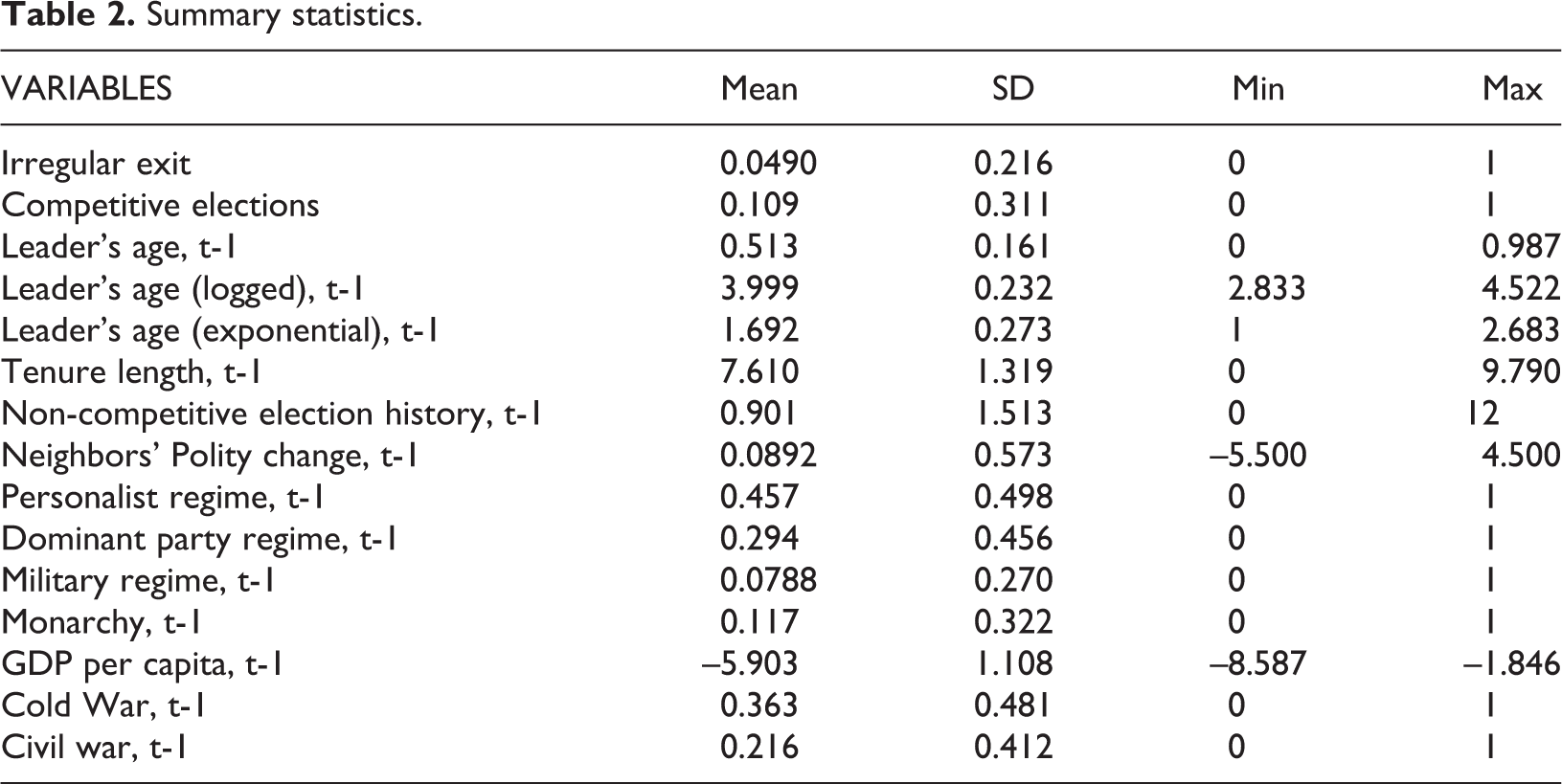
I also include the GDP per capita variable to consider the possible effects of economic conditions on the likelihood of competitive elections. I use the logarithm form for the variable. GDP per capita is a popular correlate of political liberalization, as the literature has argued that the level of development may have an effect on democratization (Boix and Stokes, 2003; Epstein et al., 2006; Przeworski et al., 1999). The data for the variable are derived from the Penn World Tables. Table 2 presents basic descriptive statistics of the data. I lag each independent variable to ensure that they precede the observation of the dependent variable and not the other way around.
Summary statistics.
Main results
Table A in the Appendix presents results for the underlying assumption. In model 1, I use the linear form of the age variable, and use the non-linear form in model 2. For both variables, we see a significant positive effect of autocrat’s age on the likelihood of irregular exit, suggesting that as an autocrat ages, the risk of irregular exit increases. In substantive terms, an autocrat sees a 1.6 percent increase in a chance of irregular exit if they age from 48 (25th percentile) to 65 (75th percentile). 28 Although the article’s argument is agnostic about the outcome of elections, 29 the baseline mechanism assumes that elections should ensure better post-tenure fates for the incumbents. Table 1 provides initial exploration of the correlation, and Table B in the Appendix runs multiple regression to examine the effect of competitive elections on autocrats’ post-tenure fates. It offers additional evidence that holding competitive elections indeed leads to better post-tenure fates for outgoing leaders. Overall, the results increase the plausibility of the baseline mechanism that aging dictators face a greater risk of irregular exit and have more incentive to hold competitive elections.
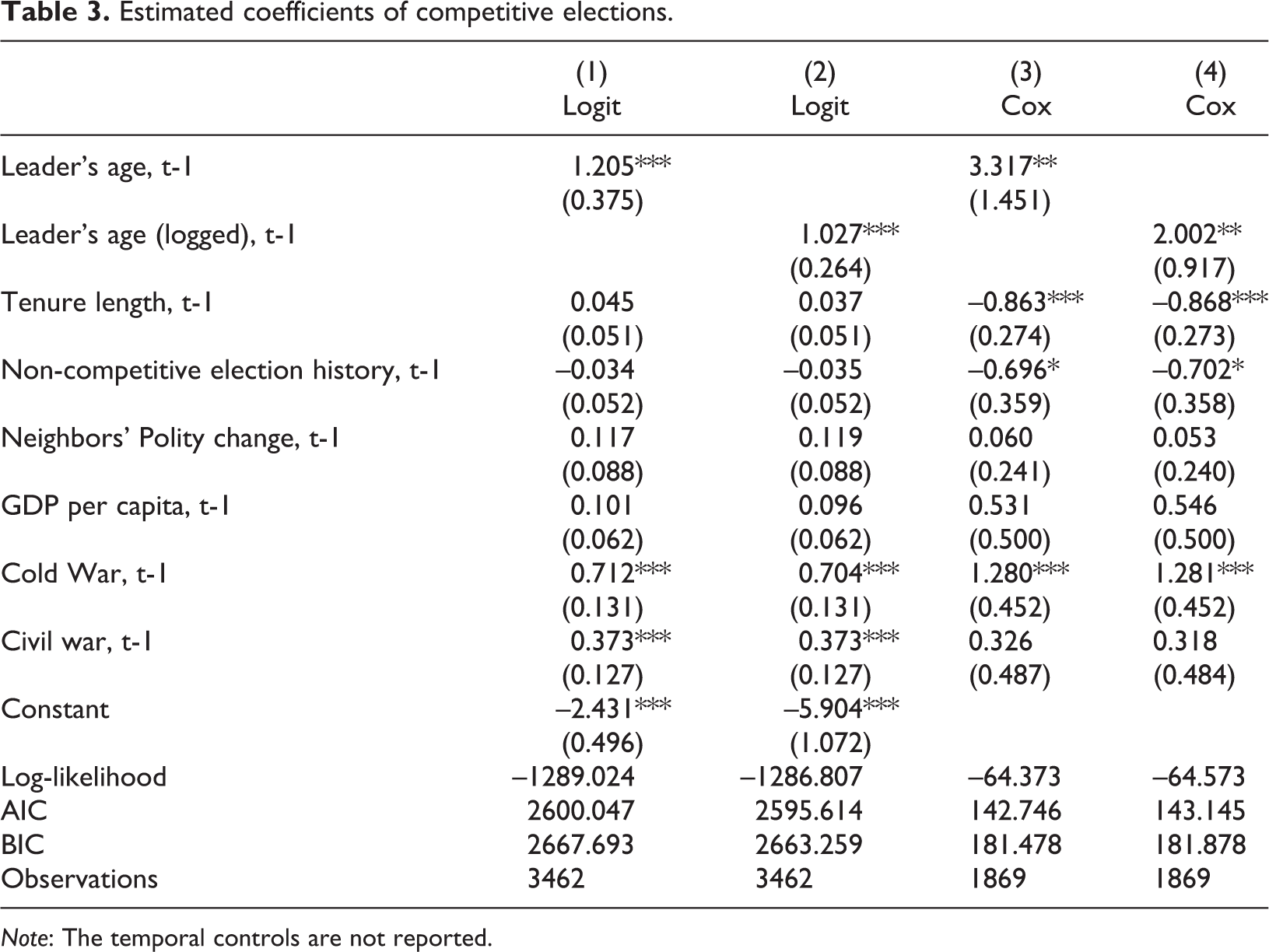
Now I turn to examine the main hypotheses of the article. Table 3 reports the main results for hypothesis 1. Models 1 and 2 use logit models in which the dependent variables are the normalized age (i.e. a value range is between 0 and 1) and logged age variables, respectively. Models 3 and 4 replicate the results of models 1 and 2 by using a Cox model to deal with censored observations. First, I find that an autocrat’s age has a positive and significant effect on the likelihood of competitive elections across all the models. 30 This is consistent with my main argument: as an autocrat ages, the likelihood of competitive elections increases. I also find substantial consistency for the results of age variables across the models, indicating that my analyses are not sensitive to model specifications. Together with the results of Table A, the analyses provide more solid support for the article’s argument: autocrats’ aging spurs uncertainty and increases the likelihood of competitive elections. To interpret the substantive effect of the age variables, I calculate the simulated predicted value of the likelihood of competitive elections. Based on the finding of model 1, advancing a leader’s age from 48 years old (25th percentile) to 65 years old (75th percentile) increases the likelihood of competitive elections by 4.4%, holding the values for the other non-dummy variables at the median. The substantive effect is relatively small, but the robust, consistent finding of the article’s analyses shows the validity of the uncertainty mechanism that uncertainty indeed increases a chance of competitive elections.
Estimated coefficients of competitive elections.
Note: The temporal controls are not reported.
Table 3 also finds that the countervailing effect from leader’s tenure length has mixed results, but the variable still has a strong negative effect on the likelihood of competitive elections (also statistically significant at the 1% level in models 3 and 4). As the previous studies expected, the longer autocrats stay in office, the less likely they are to hold a competitive election. This indicates that autocrats’ tenure length may also be important to explain the likelihood of competitive elections. 31 To see the relationship between the age and tenure length variables visually, Figure 1 presents the simulated predicted value of the likelihood of competitive elections across a range of autocrats’ ages, both for autocrats with short periods in office (25th percentile, i.e. 2.7 years in office) and for those with long periods in office (75th percentile, i.e. 14.7 years in office). 32 Figure 1 first indicates that autocrats who hold onto power for a long time (i.e. dashed line) are better at surviving without competitive elections than their counterparts with short tenure (i.e. solid line), although the difference is not statistically significant at the 10% level. This is consistent with previous studies (Bueno de Mesquita et al., 2003; Chiozza and Goemans, 2004; Svolik, 2009). Yet, more importantly, the figure shows that aging dictators are more likely to hold competitive elections, independent of tenure length (i.e. both the solid and dashed lines). As such, the results are consistent with hypothesis 1 that all else equal, including tenure length, aging dictators tend to hold competitive elections.
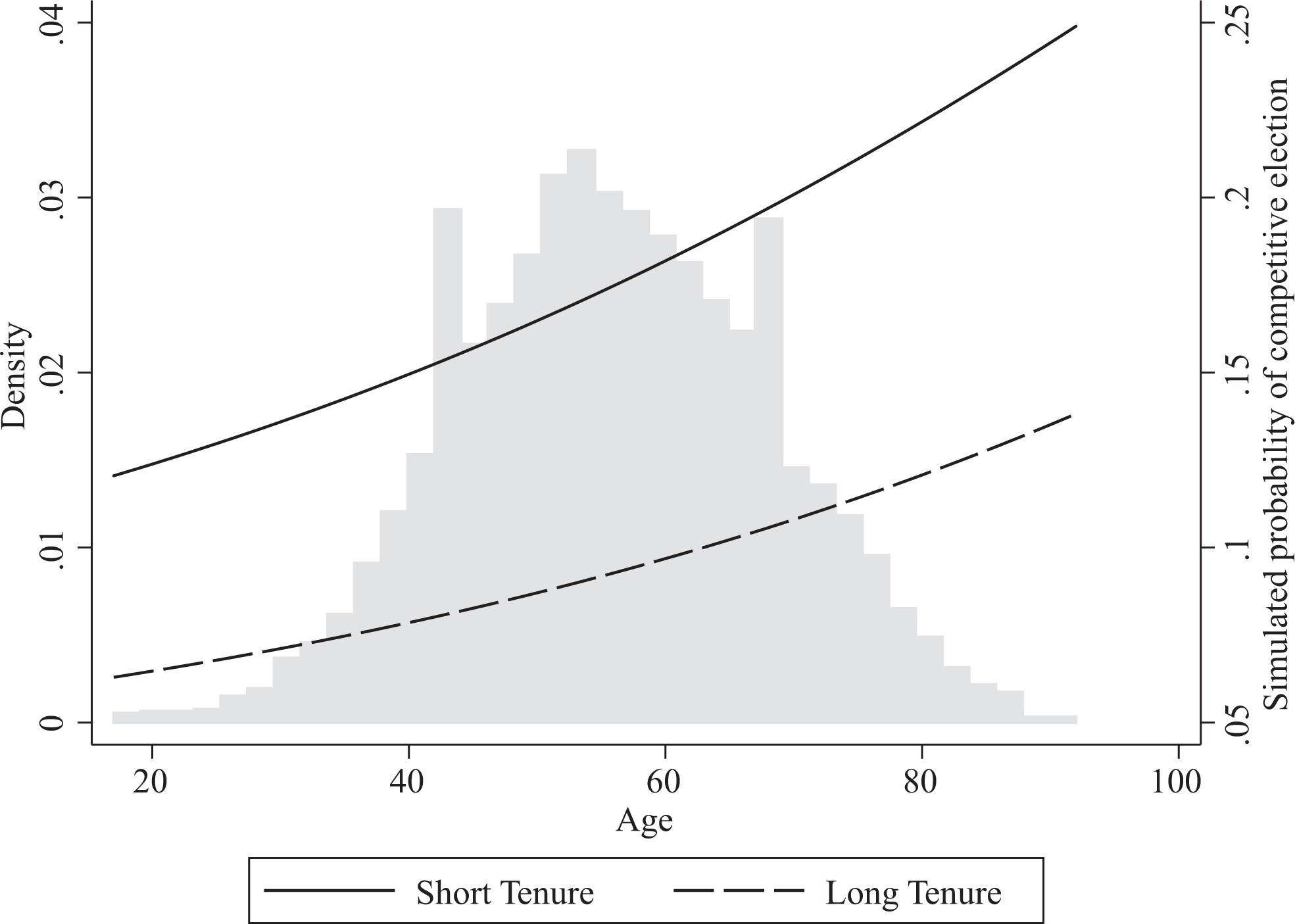
Simulated probability of competitive elections, by dictator’s age and tenure length.
Turning to the control variables, the analyses find that the Cold War variable yields consistent results – the table shows that the end of the Cold War has a positive impact on competitive elections: autocrats in the post-Cold War era are more likely to hold competitive elections than their counterparts in the Cold War era. This result is not surprising given that the number of elections increase post-Cold War. Elections have been increasingly considered to generate international and domestic legitimacy for regimes, and this result indicates an increased incentive for an aging dictator who suffers from increased uncertainty to hold a competitive election.
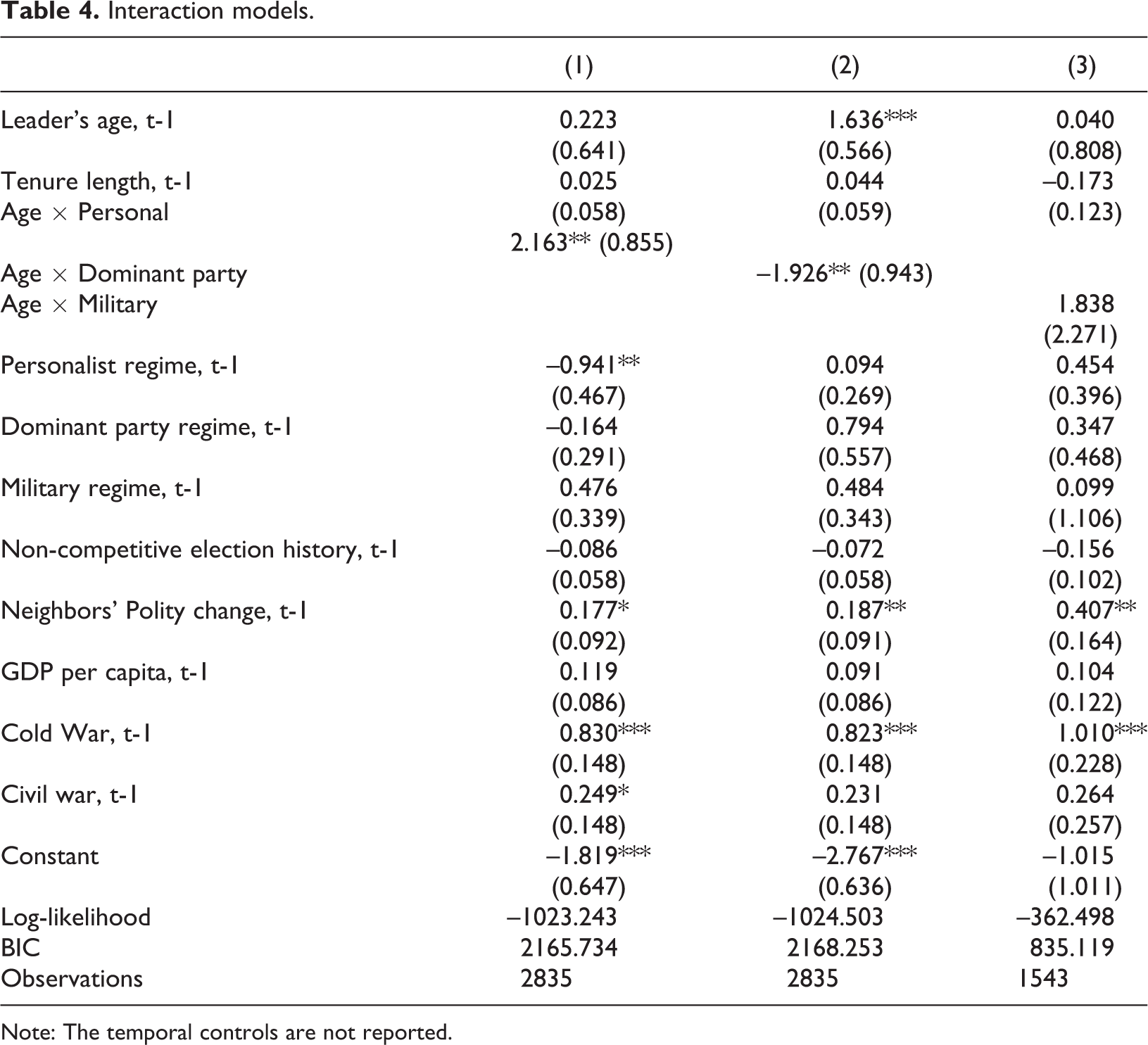
Finally, as a test of hypothesis 2, Table 4 reports the logit model results on the conditional effects of an autocrat’s age by regime types. The table shows that the main effects of the age variable remain positive, but more importantly, the models find that the effect of autocrat’s age significantly differs once we consider interaction effects with regime types.
Interaction models.
Note: The temporal controls are not reported.
First, in terms of coefficient signs, we see that the positive effect of autocrat’s age increases in personalist (model 1) and military (model 3) regimes, but the positive effect dampens in dominant party regimes (model 2). Among them, the two interaction variables (i.e. Age × Personal and Age × Dominant party) show statistically significant results – autocrat’s age is likely to increase the likelihood of competitive elections in personalist regimes; but age is less likely to affect the likelihood of competitive elections in dominant party regimes. The findings are consistent with my expectation. To see the relationship between autocrat’s age and regime types graphically, I summarize the point estimate and 95% confidence interval of each interaction effect in Figure 2. The figure vividly shows different impacts of regime types on the relationship between dictators’ age and competitive elections. In particular, it illustrates robust evidence for the argument for personalist and dominant party regimes. As autocrats age, the likelihood of competitive elections increases in personalist regimes, but it decreases in dominant party regimes. I interpret the results as largely consistent with my argument – the level of uncertainty generally increases as the incumbent ages, but the existence of succession system intervenes in the relationship.
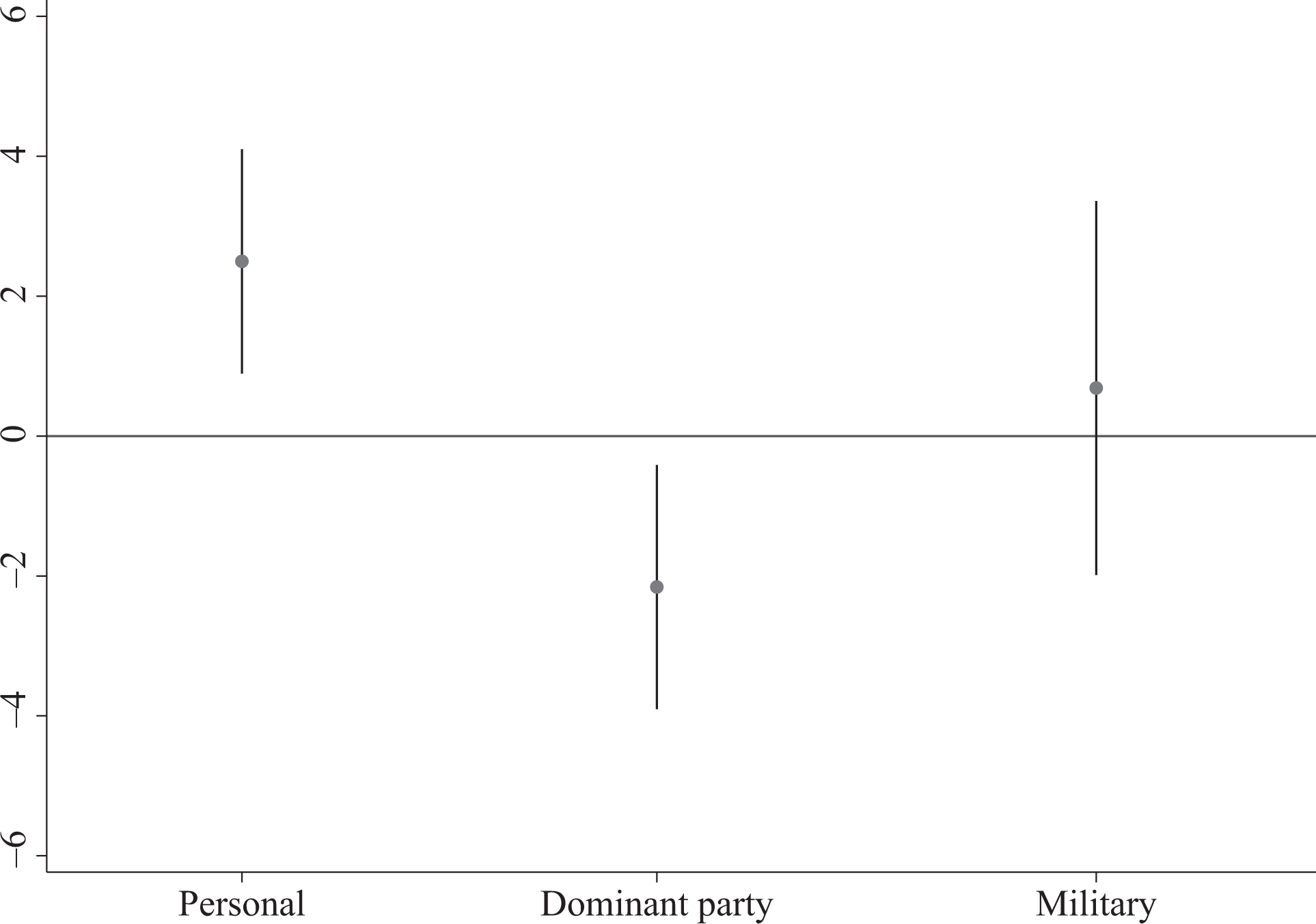
Interaction effects of age on competitive elections, by regime type.
In sum, the empirical analyses indicate support for my main arguments. First, the findings show that as autocrats age, the likelihood of irregular exit increases. I argue that this is because autocrats’ aging spurs uncertainty over the future. Second, the analyses find that autocrats’ age increases the likelihood of competitive elections. Finally, the analyses show that the general positive effect of autocrats’ age varies by regime type, and I find that autocrats in personalist regimes are the most vulnerable to the effect of dictators’ aging and are more likely to hold competitive elections, while aging autocrats in dominant party regimes are less likely to hold such elections. This is because, I reason, as the incumbent ages, uncertainty increases, thereby increasing the likelihood of competitive elections to reduce the uncertainty. However, the existence of succession systems dampens the increasing uncertainty due to autocrats’ aging.
Conclusion
In this article, I argued that as autocrats age, they are more likely to hold competitive elections. The proposed mechanism is that when a dictator ages, the authoritarian regime is more likely to face uncertainty over the future because the expected payoffs for each member of government insiders decline and internal threats to the incumbent increase. As a result, I argue that the dictator is more likely to hold a competitive election to reduce the increased uncertainty – one that in some cases they can even win to retain power.
My empirical analyses, based on a comprehensive dataset of autocrats between 1960 and 2012, find that dictators’ age is indeed systematically associated with competitive elections – when a dictator gets older, all else equal, there is a higher likelihood of competitive elections. Further, the results show that this relationship is even stronger in personalist regimes where there are less established succession systems, while the effect of dictators’ age is weak in dominant party regimes which have more established succession systems. Since expectations about the regime type variables are based on the proposed baseline mechanism, the results corroborate that the mechanism is plausible.
Ultimately, the article’s empirical analysis finds consistent evidence with previous studies arguing that uncertainty and threat to the incumbent explain competitive elections (e.g. Cox, 2009; Geddes, 2006; Magaloni, 2006; Schedler, 2013). Furthermore, although the primary contribution of the article is empirical, the research calls for more attention to the time-varying factors of competitive elections. A number of studies have proposed why autocrats hold competitive elections. However, a systematic analysis of when such elections are held is still scarce and future research should devote more time to examining what explains the timing of competitive elections.
Whereas recent work in political science has focused on the role of leaders in domestic as well as international politics (e.g. Bueno de Mesquita et al., 2003; Clague et al., 1996; Debs and Goemans, 2010; Magaloni, 2008), it tends to ignore or dismiss leader’s age as a factor. However, this article argued that autocrats’ age may not directly influence their incentives, but that they do indirectly through affecting government insiders’ expected utilities. The empirical analyses indeed demonstrated that autocrats’ age increases the internal threats that they face and increases their uncertainty over the future. I believe this insight can be incorporated into other research that involves autocrats’ political and physical survival.
I also believe the finding has important implications for a larger literature of regime durability. Previous studies argue that the likelihood of regime survival increases as autocratic regimes stay in power longer. However, this article demonstrated that there is more complex mechanism in regime durability. As dictators age, they are more likely to hold a competitive election, and such competitive elections can indirectly improve the stability of regimes because they demonstrate the regime’s popularity (Magaloni, 2006; Simpser, 2013), increase legitimacy (Alagappa, 1995) and/or divide and co-opt opposition (Lust-Okar, 2005). But these positive effects tend to happen in the short-term (Schuler et al., n.d.), and aging dictators and their regimes may face destabilization and political liberalization in the long term because the dictators will eventually have to step down or will die naturally, thereby creating a window of opportunity for power struggle among government insiders. This is consistent with recent findings that competitive elections have a long-term destabilizing effect (Geddes et al., 2014; Howard and Roessler, 2006; Lindberg, 2006; Schedler, 2013; Schuler et al., n.d.), but this article suggests a different path of long-term regime destabilization – we may observe regime instability and political liberalization in the long term where aging dictators rule.
Finally, although the finding for the relationship between dictators’ age and competitive elections was robust, there are of course some cases in which my argument cannot apply. Like Muammar Gaddafi of Libya (age 69) or Francisco Franco of Spain (age 82), there is a group of old leaders who hold onto power and do not hold competitive elections, even when their age advances, and even in personalist regimes. Thus, the next step of research is to further nail down scope conditions in which age does or does not operate in personalist regimes.
Footnotes
Acknowledgements
Previous versions were presented at the Alexander Hamilton Center for Political Economy at New York University, the Komaba International Politics Workshop at the University of Tokyo, and the Moynihan Research Workshop at Syracuse University. I would like to thank Julia Bader, Ursula Daxecker, Dimitar Gueorguiev, Jon Hanson, Sandy Henderson, Fernando Limongi, Jessica Maves, Christopher Paik, Kris Ruijgrok, Jun Saito, Jacob Shapiro, Abbey Steele, and Kyohei Yamada for their comments.
Declaration of conflicting interests
The author(s) declared no potential conflicts of interest with respect to the research, authorship, and/or publication of this article.
Funding
The author(s) disclosed receipt of the following financial support for the research, authorship, and/or publication of this article: This project was funded in part by a research grant from the Konosuke Matsushita Memorial Foundation.
Supplemental material
Supplemental material for this article is available online
Notes
References
Supplementary Material
Please find the following supplemental material available below.
For Open Access articles published under a Creative Commons License, all supplemental material carries the same license as the article it is associated with.
For non-Open Access articles published, all supplemental material carries a non-exclusive license, and permission requests for re-use of supplemental material or any part of supplemental material shall be sent directly to the copyright owner as specified in the copyright notice associated with the article.
