



Abstract
Objectives:
The purpose of this study was to review and evaluate the characteristics of 100 most cited articles on ameloblastoma (AB).
Materials and Methods:
A comprehensive list of citation classics in AB was generated by searching the Scopus database without year or language restrictions. The top 100 articles were retrieved after reading abstracts or full texts. The following study variables were evaluated: number of citations, citation density, journal name, impact factor, category and quartile of journals, publication year, authors with their affiliations, and article type.
Results:
The citation number ranged from 76 to 367, with a mean of 122.78 citations per article. The one hundred top cited articles were distributed in 41 journals with Cancer having the highest number of articles (n = 16). There was a dominance of authors form United States (42 articles). The articles were published from 1955 to 2014, and eight authors published more than three papers. There were 57 research articles and 43 review articles.
Conclusions:
This first citation analysis provide a detailed list of the most influential articles on AB to help recognize the quality of the works, discoveries, and the trends steering the study of AB.
Introduction
In today’s era of availability of electronic format of numerous scientific journals with open access facilities, relevant information can be accessed easily, but the possibilities of neglecting the quality of publication cannot be ruled out. In medical literature, academic achievement of an article in a particular field is established by means of number of times that work is referenced by other authors or researchers. 1 Although this citation index does not reflect the quality of work, it has been widely accepted by the scientific community as a measure of recognition. 2 The highly cited articles may influence the changes in clinical practice, controversy, discussion, and further research. 3 Thus, critical analyses of highly cited articles in a particular field are the need of the hour. Such analyses enable scientists and clinicians to identify the research hot spots 4 and also serve as teaching material to educate in the concerned field.
Ameloblastoma (AB) is the most prevalent and clinically relevant locally aggressive odontogenic neoplasm. 5 AB is derived from remnants of the dental lamina and enamel organ. 6 It is characterized by slow growth with a strong tendency of local invasion and can grow a large size without metastasizing. World Health Organization (WHO) has classified AB in 2017 into following types: (1) AB, (2) unicystic type, and (3) extraosseous/peripheral types. The traditional management options include conservative method or radical resection based on the site, type, size of the lesion, and age of the patient. It is evident that AB has a considerable tendency of recurrence if inadequately removed. 7 A recent systematic review reported 50% of recurrence in follicular subtype and significantly low recurrence rate on using radical approach. 8
Recently, studies on citation analysis have been published on important diseases of the oral cavity such as oral cancer 9 and oral submucous fibrosis. 10 Although many scientific articles contributed significantly to the understanding of various aspects of AB, to date these articles have not been ranked and descriptively analyzed. Moreover, interest in AB has risen continuously in the scientific community due to its aggressive clinical behavior, variety of morphological and histological patterns, and its high recurrence rate. In view of making a meaningful tool for clinical, academic, and future research purposes, the current study was performed to ascertain 100 most cited papers and to investigate the characteristics of each article therein.
Materials and methods
In June 2018, a title search was conducted in the Science Citation Index Expanded (SCI-E) section of Scopus library database (www.scopus.com) using medical subject heading terms “ameloblastoma” and “adamantinoma.” There were no limitations on time period, language, and type of study. The option “Cited by (Highest)” was applied to obtain the comprehensive list of most-to-least cited articles for further analysis. SG and SS screened full texts of the articles carefully and those on AB were included, and a list of the 100 most cited AB articles was then prepared. The articles with highest mean number of citations, that is, citation density (citation density = total number of citations/years since publication of the article), were positioned higher in the ranking if two or more articles had same number of total citations.
The type of data retrieved from the articles is depicted in Online Supplemental Table S1. In addition, following information were retrieved from the paper: journal impact factor (IF), journal category/categories, quartile (2017 Journal of Citation Reports (JCR): Science Edition), institution/country of origin of the first author, research type, and level of evidence. Articles were categorized as primary research study (basic, clinical, or epidemiological) or secondary research (narrative review, systematic review, or meta-analysis). 11 The level of evidence of the clinical research was graded as per the classification given by the Oxford Centre for Evidence-Based Medicine (OCEBM). 12
In cases of discrepancy between the two authors (SG and SS), a third author (AG) was included in the discussion until consensus was achieved. As the present study is based on the data retrieved from the database and its systematic analysis, ethics committee approval was not obtained.
Results
The literature search revealed 5521 articles in the Scopus library from 1955 to the present. The overall h-index and h-index after removal of self-citations are 83 and 80, respectively. The details of the 100 most cited publications are displayed in Online Supplemental Table S1.
The top 100 papers have been cumulatively cited 12,278 times. The median number of citations was 122.78, with a range of 76 (article rank no. 100) to 367 (article rank no. 1). The top five papers have received more than 250 citations each. The top cited article was published by Reichart et al. (367 citations) in the European Journal of Cancer Part B: Oral Oncology in 1995. They have reviewed biological profile of 3677 cases of AB in their article. The second most cited paper was contributed by Regezi et al. with 347 citations; followed by Karavitaki et al. with 267 citations in the years 1978 and 2006, respectively. In terms of citation density, a systematic review published by Dimitriou et al. topped the list with 32.57 citations per year. This article was published in the journal Injury in 2011. Whereas minimum number of citation density (1.86) was received by a study entitled “Granular-cell ameloblastoma: a survey of twenty cases from the Armed Forces Institute of Pathology” published by Hartman in Oral Surgery Oral Medicine Oral Pathology Oral Radiology in 1974. It was evident that the articles ranking 7, 3, 88, and 20 had greater relative impact than that of Reichart et al. (rank 1). All these articles were published after 2005.
The Cancer journal contributed significantly with maximum number of articles (n = 16; Table 1). This was followed by Journal of Oral and Maxillofacial Surgery and Journal of Oral Pathology and Medicine, which published 10 and 7 articles, respectively, among top 100 articles on AB. Other journals that published three or more papers included Oral Surgery Oral Medicine Oral Pathology Oral Radiology (n = 6), International Journal of Oral and Maxillofacial Surgery (n = 5), and Oral Oncology (n = 3). Of 41, about three-fourth journals published only single paper each to the top 100 publications. The greatest number of papers among top 100 were published in the discipline of Dentistry, Oral Surgery, Surgery and Medicine (n = 31) and Oncology (19). Of top 41 journals, 26 (63.41%) were positioned in the first quartile of their category, 7 (17.07%) in the second, and only 2 (4.87%) in the third category. The Journal of Bone and Joint Surgery Series A, Journal of Oral Surgery American Dental Association 1965, American Journal of Clinical Oncology Cancer Clinical Trials, British Journal of Plastic Surgery, Journal of Cranio Maxillofacial Surgery, Scandinavian Journal of Plastic and Reconstructive Surgery and Hand Surgery, Surgical Neurology, Veterinary Journal, Veterinary Pathology, and Veterinary Surgery were not included in the 2017 JCR: Science Edition.
Top journals with their individual contribution to the 100 most-cited articles on AB.
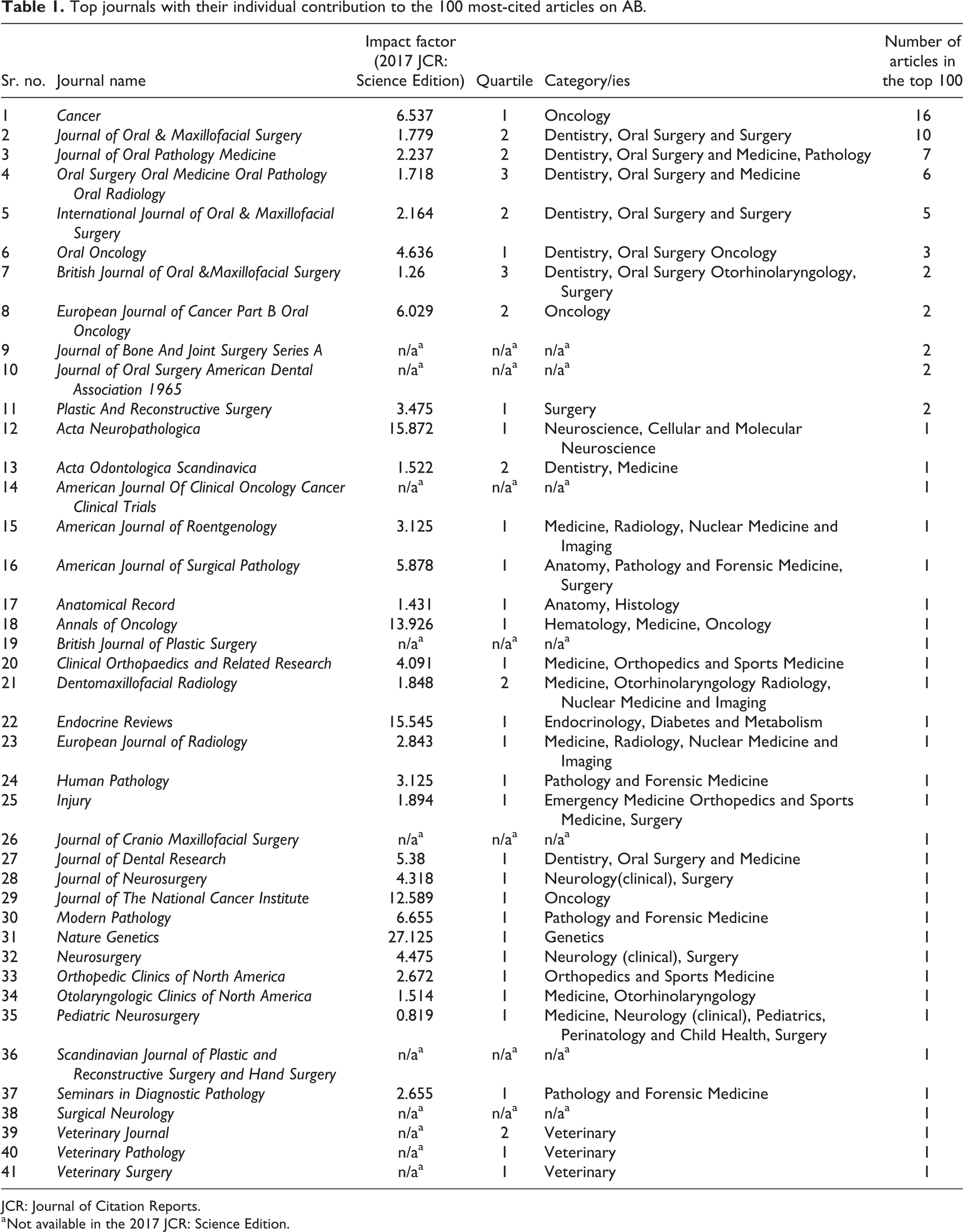
JCR: Journal of Citation Reports.
a Not available in the 2017 JCR: Science Edition.
The IF of the journals associated with top 100 publications ranged from 0.819 to 27.125 (mean 5.45). The journal with highest IF was Nature Genetics that published one article by Sweeney et al. titled “Identification of recurrent SMO and BRAF mutations in ameloblastomas” in 2014. Whereas Pediatric Neurosurgery had the lowest IF (0.819) and published single paper. Both these journals published papers in the first quartile of their categories. The data statistics revealed that only 24.39% journals had the IF of more than five.
All the papers in the top 100 list were in English language. The 100 most cited papers identified in the current study were attributed to past 59 years from 1955 to 2014. The oldest article was by Small and Waldron on “Ameloblastomas of the Jaws” in 1955 in the journal Oral Surgery Oral Medicine Oral Pathology Oral Radiology. While, Sweeney et al. published the most recent article in Nature Genetics in the year 2014. According to data statistics, the greatest number of top cited articles was published in the decade 2000s (n = 27), followed by 26 articles in 1990s. One-fourth of the papers were published in 1980s, followed by 15 articles in 1970s. The decades of 1960s, 2010s, and 1950s had fewer contributions (4, 2, and 1, respectively). As citations are directly proportional to the time, only two articles (rank no. 7 and 88) published after 2010 stood in the top 100 list and none in most recent 4 years. It was evident that more than half among the top referenced articles were published after 1990 (Table 2).
Distribution of the 100 top-cited articles on AB by publication date.

AB: ameloblastoma.
In the task of publication of 100 most cited articles on AB, more than 300 authors contributed considerably. The number of authors ranged between 1 (14 papers) and 21 (Sweeney et al. in 2014). The most frequent number of authors was two (25 articles), followed by three authors (19 articles) and four authors (15 articles). Single authored papers were 14 and remaining 27 articles were published by five or more authors. Among top 100 articles, a total of eight researchers contributed three or more papers on AB (Table 3). Indeed, Gardner stood top in the rank with seven scientific publications, followed by Philipsen, Reichart, and Waldron (4 articles each). As per the address of the first author, researchers from 21 different countries had contributed to the 100 top cited papers (Table 4). Maximum number of contribution was from USA with 42 articles, followed by United Kingdom (n = 12) and Canada (n = 5). Israel, South Korea, Japan, and The Netherlands produced four articles each. The highest number of articles emerged from The University of Western Ontario of Canada (n = 5), followed by Washington University (n = 4). New York University (United States), The University of Colorado (USA), and The University of Hong Kong (Hong Kong) with three publications contributed by each (Table 5).
Authors with at least three articles included in the top 100.

Country of origin of the 100 top-cited articles on AB.

AB: ameloblastoma.
Institution of origin with three or more top-cited articles on AB.

AB: ameloblastoma.
The article types included publications considered primary research (n = 57), and 43 were review articles (secondary research). Under primary research category, majority was clinical research (n = 42), followed by basic (n = 12), and epidemiological (n = 3) research. Among secondary research, 41 articles were classified as narrative reviews, and there were only two meta-analyses. Forty-five clinical studies were categorized as evidence level 4, and 43 review articles were considered as level 5.
Discussion
This is the first bibliometric study summarizing several features of influential articles on one of the most common benign odontogenic tumors, the AB. Looking at the contents of the publications included herein; it was evident that the literature on AB including its biological profile has undergone many changes over the years. Therefore, we believe that citation analysis was justified in the field of AB. Such citation analysis helps in identifying classic papers (papers achieving 100 or more citations) 13 and keep young researchers abreast of classic knowledge. The valuable information obtained from such studies is helpful for better understanding of the targeted topic for clinicians and researchers. In addition, citation analysis is an aid to recognize authors, institutions, and countries for their important contribution toward the scientific literature. A total of 45 papers included in the current analysis have been cited for 100 or more times and thus can be considered classic. In general, researchers prefer high IF journals for their publication and journals with high IF attract high-quality papers. Although positive association has been noticed between citations index and IF of the journals in the previous studies of other disciplines, 14,15 the observation of the present study has shown only one-fourth of the papers published in the journals with IF of more than five. These journals included Cancer (n = 16), European Journal of Cancer Part B: Oral Oncology (n = 2), Acta Neuropathologica (n = 1), American Journal of Surgical Pathology (n = 1), Annals of Oncology (n = 1), Endocrine Reviews (n = 1), Journal of Dental Research (n = 1), Journal of The National Cancer Institute (n = 1), Modern Pathology (n = 1), and Nature Genetics (n = 1). It has been well accepted that in today’s time, specialty journals are the choice of authors to publish their research. Currently, in the field of dentistry, there are no journals with IF more than 5. The present study noticed that more than 35% of the influential papers were published in specialty journals but they have relatively low IFs (below 5). This is in line previous bibliometric analyses. 10,15
In terms of periods of publication, majority of the papers were published in the decade 2000s (n = 27), which is in agreement with results of other bibliometric analyses. 9,10 More than 50% of the top cited articles were published after 1990. It is well-known that the time period is directly proportional to the number of citations received. The older publications have the advantage of time and thus usually graded higher in the citation rankings. However, recent innovative papers with good scientific content may lack citation count. It was suggested that an article requires a minimum of 6–15 years period to accumulate sufficient number of citations to become citation classic. 16 This could explain why none of the papers published in recent 4 years achieved rank on the top 100 list of articles on AB. Observation of the present study revealed that only 29% of papers published in last 18 years appeared on top 100 list. However, emergence of multiple scientific journals with their electronic formats and open access facilities smoothly enables publication of articles and their distribution in the scientific community. Moreover, facility of sharing articles on social networking sites also increases visibility, which in turn could have positive impact on the citation score. In the present study, we have calculated scientific impact annually (citation density) by dividing the number of citations with the number of years. The findings of the current study showed that majority of the articles with greater citation density were published after the year 2000.
The present bibliometric analysis found that 41 different scientific journals published highly influential papers on AB and most of them reflected in the first quartile for their category. It is noteworthy that 100 papers reported herein received uneven citation counts with fewer achieved greater attention and dominated literature on AB and thus follow Bradford’s law. 17 This finding of our study is in accordance with the other bibliometric analyses. 9,10,18
All the papers included in the present study were written in English language. In bibliometric analysis, geographic predispositions of pathology definitely have an impact on the number of papers published by the country. In our previous analysis on oral submucous fibrosis, which is more prevalent in Asian countries, India was the most prolific country with 38 articles. Even though there is no established geographic predisposition for AB, United States has shown strong influence on research in the field of AB followed by United Kingdom. Similar types of results were observed in past bibliometric studies demonstrating higher contribution of United States in research on other topics/disciplines. 9,15,19 United States is well-known in the world for its strong influence on health sciences research, greater number of scientist, and the provision of higher financial grant support to the researchers. 20 The University of Western Ontario of Canada topped the list among institutions with greater research in the field of AB. Gardner with his seven publication on AB was found to be the most recognized author among more than 300 authors.
In terms of research type, present bibliometric analysis reported higher number of clinical studies as compared to basic studies and in line with previous reports. 21 Majority of the articles presented in this study had a low evidence level. Other bibliometric studies also reported similar observation. 3,9,10 We believe that great work has been performed by researchers in the field of AB worldwide continuously but possibly may have not been cited as frequently as low-level evidence studies.
Apart from the Scopus, other databases including Web of Science (WoS), Google Scholar provides the bibliometric data of the published scientific articles. There has been a variation in the quantity of citations to any particular article as allocated by WoS, Google Scholar, and Scopus. Usually, Google Scholar and Scopus assign higher citation numbers than WoS. 22 Although WoS is widely recognized and accepted database by scientific community, this index does not always include citations from textbooks and journals published in other than English language. 23 In the literature, bibliometric studies on various topics preformed comparative analysis of the various databases. 22,23 In the present analysis, we have used only SCOPUS database due to limitation in the availability of the resources.
Interestingly, there are no papers on the randomized clinical trial on treatment of AB in our analysis. Till today, this is the most controversial part of AB and no consensus has been achieved on this topic. Results of this article reflect the dire needs for randomized clinical trial on AB and it should be the main focus of future research.
The present study is not the exception to have limitations related to integral problems of bibliometric analysis. We have retrieved the citation information from Scopus database. Therefore, the probability of non-inclusion of high-quality articles available in other databases such as WoS and Google Scholar cannot be overlooked. Citation analysis is always associated with snowball effect where authors tend to cite previous highly cited articles. 24 In addition, citation analysis just quantify the contribution of an article and unable to reflect its quality. Time factor can be a major determinant in citation analysis with older articles at advantage, and recent articles may get neglected even if they have high scientific impact.
In conclusion, this is the first of its kind analysis on AB with most of the papers published in the decade 2000s. United States found to have strong influence on research in the field of AB, followed by United Kingdom. All papers were published in English language and most of them were associated with specialty journals. Although majority of the clinical research reported had low level of evidence, we believe that the information provided in the current study will definitely be useful for academic and research purposes. Increased number of high level evidence studies in the field of AB are expected in future to promote evidence based medicine.
Supplemental Material
Supplementary_data_(1) - Top cited articles on ameloblastoma: A bibliometric analysis
Supplementary_data_(1) for Top cited articles on ameloblastoma: A bibliometric analysis by Shailesh M Gondivkar, Sachin C Sarode, Amol R Gadbail, Rima S Gondivkar, Gargi S Sarode, Nilookumari Choudhary, and Shankargouda Patil in Translational Research in Oral Oncology
Footnotes
Declaration of Conflicting Interests
The author(s) declared no potential conflicts of interest with respect to the research, authorship, and/or publication of this article.
Funding
The author(s) received no financial support for the research, authorship, and/or publication of this article.

References
Supplementary Material
Please find the following supplemental material available below.
For Open Access articles published under a Creative Commons License, all supplemental material carries the same license as the article it is associated with.
For non-Open Access articles published, all supplemental material carries a non-exclusive license, and permission requests for re-use of supplemental material or any part of supplemental material shall be sent directly to the copyright owner as specified in the copyright notice associated with the article.
