



Abstract
Few studies have examined advanced practice nursing (APN) master students’ insights on the future of work from a digitalization standpoint. The present study aimed to provide insight into the perceptions of APN master students regarding digital healthcare in 2040 using the remembering the future method. A descriptive, qualitative study was conducted. Data were collected using the remembering the future method in 2024. Purposive sampling was employed with a total of 38 APN students as respondents. All respondents were registered nurses. The Consolidated Criteria for Reporting Qualitative Research (i.e., COREQ) checklist was followed. Three themes emerged: 1) Advanced technology enabling customized care, 2) Robots working with nurses and 3) Establishing a respectful and harmonious work environment. APN students see their future work in healthcare positively with respect to technology as part of everyday routine, robots as coworkers and clinical environment characterized by pleasant harmony. These findings can be utilized in designing and implementing nursing curricula, as well as in the continuing education of nurses.
Introduction
Digital technology is rapidly developing and fundamentally altering the way healthcare services are provided. Digitalization increasingly affects nursing; for example, via the growing presence of artificial intelligence (AI), the inceasing use of service robots, and the active implementation of mobile applications and telehealth solutions.1–3 In addition, utilizing exoskeletons and robots and the usage of wearables and contactless monitoring systems, especially in the care of older people, has recently increased.4,5 At the same time, some researchers 6 are concerned about how the competence of the healthcare staff will remain up to date as the work and work environment become digitalized at a very rapid pace. As Alotaibi et al. 7 and Wood et al. 8 underline, the digital capability, digital competence and, more importantly, the digital readiness of healthcare workers are crucial components to the adoption of different types of technologies and ensuring the delivery of high-quality patient care.
This particularly applies to advanced practice nurses (APN) who are required to have an ability to use digital solutions to respond to the needs of patients both now and in the future. According to the International Council of Nurses, 9 an APN is a registered nurse who has acquired the expert knowledge base, complex decision-making skills and clinical competencies for expanded practice. A master's degree is recommended for entry level. Despite the availability of continuous education for healthcare providers, it can be assumed that most of the current workforce, including advance practice nurses, have never been trained in digital healthcare. As Longhini et al. 10 indicated, the use of digital technologies was the weakest competence among nurses and other healthcare providers. Therefore, it is more important than ever for APN students to absorb the digital healthcare transformation during their master's programme. By doing so, they can utilize digital technology and feel empowered to influence decisions concerning future digital solutions at work.
The perceptions, views and expectations of students and professionals on the digitalization of healthcare have been studied to some extent. Researchers have particularly been interested in the perceptions of artificial intelligence (AI) and its use in healthcare. For example, Hamad et al. 11 and Labrague et al. 12 explored nursing students’ attitudes and perceptions towards the usability of AI in healthcare. The results of both studies indicated that nursing students had positive views on the role of AI in nursing, coupled with a strong inclination to embrace AI technology. Sorte et al. 6 obtained fairly similar results when they studied medical students’ understanding and awareness of utilizing AI technologies in clinical practice. The results demonstrated a positive outlook toward the potential of AI to enhance healthcare delivery and patient outcomes. Rony et al., 3 on the other hand, studied nursing professionals’ perceptions regarding the role of AI in shaping the future of healthcare. The study showed the nurses’ enthusiasm for the potential benefits of AI at the same time as emphasizing the importance of ethical and compassionate nursing practice. Researchers further state3,12 that this trend indicates a growing recognition of the value of AI wit respect to enhancing nursing practice, reflecting a readiness among future nurses to integrate AI into their professional roles.
Although important, APN students’ views on the future of work and the work environment from the perspective of digitalization have been scarcely studied. One reason for the lack of research might be that predicting the future is not easy, especially when it comes to healthcare. Regardless, it is worth trying because imagining alternative, probable, unexpected, desirable and undesirable futures help to identify and take the necessary action. Because all APN master students are registered nurses (RN) and most of them work as nurses while they study, imagining the future can add creativity and assist them with finding innovative solutions to everyday practices. Furthermore, as graduates enter the workforce as advanced practice nurses in the future, they will have a meaningful role and make contributions to the development of digital tools for healthcare, particularly in nursing practice. This study fills the research gap by providing insights into how APN master's students view their future work and work environment from the perspective of digitalization.
Purpose and objective
The present study aimed to provide insight into the perceptions of APN master students regarding digital healthcare in 2040 using the remembering the future method. The objective was to produce knowledge that nursing educators can utilize when updating curricula in nursing degree programmes. Furthermore, the findings can support the development of healthcare units, enabling them to operate more effectively through the integration of digital solutions.
Methods
The design of the study was a descriptive, qualitative study aimed at capturing rich, detailed perspectives from APN master students. The qualitative approach allowed for an in-depth exploration of their thoughts, feelings and expectations about the future digital work environment in healthcare. 13 The Consolidated Criteria for Reporting Qualitative Research (i.e., COREQ) checklist was used to optimize the reporting of the study. 14
Remembering the future method
The method is based on the idea that participants can remember possible futures in a way that involves their imagination, rationalization and emotions to anticipate future developments.15,16 It is an activity in which participants try to shift their perspective to a very concrete point of time in the future and then reflect on what things and environment are like and how they got that way. Overall, the method encourages participants to think about potential futures in detail.
Participants
The participants were APN master's students (n = 38) who attended the course titled ‘Digital transformation and literacy skills in healthcare’. All had a bachelor's degree in nursing and experience working as a RN. The course was part of a 2-year EU-funded project (2023-1-FI01-KA171-HED-000138061) and it was the result of a collaborative effort between two higher education institutions: Jamk University of Applied Sciences (Jamk), Finland and Heimerer College (HC), Kosovo in both its design and delivery the course. The joint course was conducted by two teachers from Jamk and one from HC in 2024 and it was taught in English and implemented using a hybrid model. The APN students earned 5 ECTS credits from the course.
A purposive sampling was used in the study 13 and thus participant selection was based on the criteria relevant to the study: participants had work experience as a nurse and were currently pursuing a master's degree in APN. This ensured that the study participants had enough knowledge and experience to envision what digital healthcare would be like in the future. The information letter was sent to the APN students who had enrolled on the joint course where they were invited to participate in the research. All the students (n = 38) agreed to participate in the study. Among the participants, 27 were women and 11 were men, with 16 being first-year students and 22 being second-year students.
Data collection
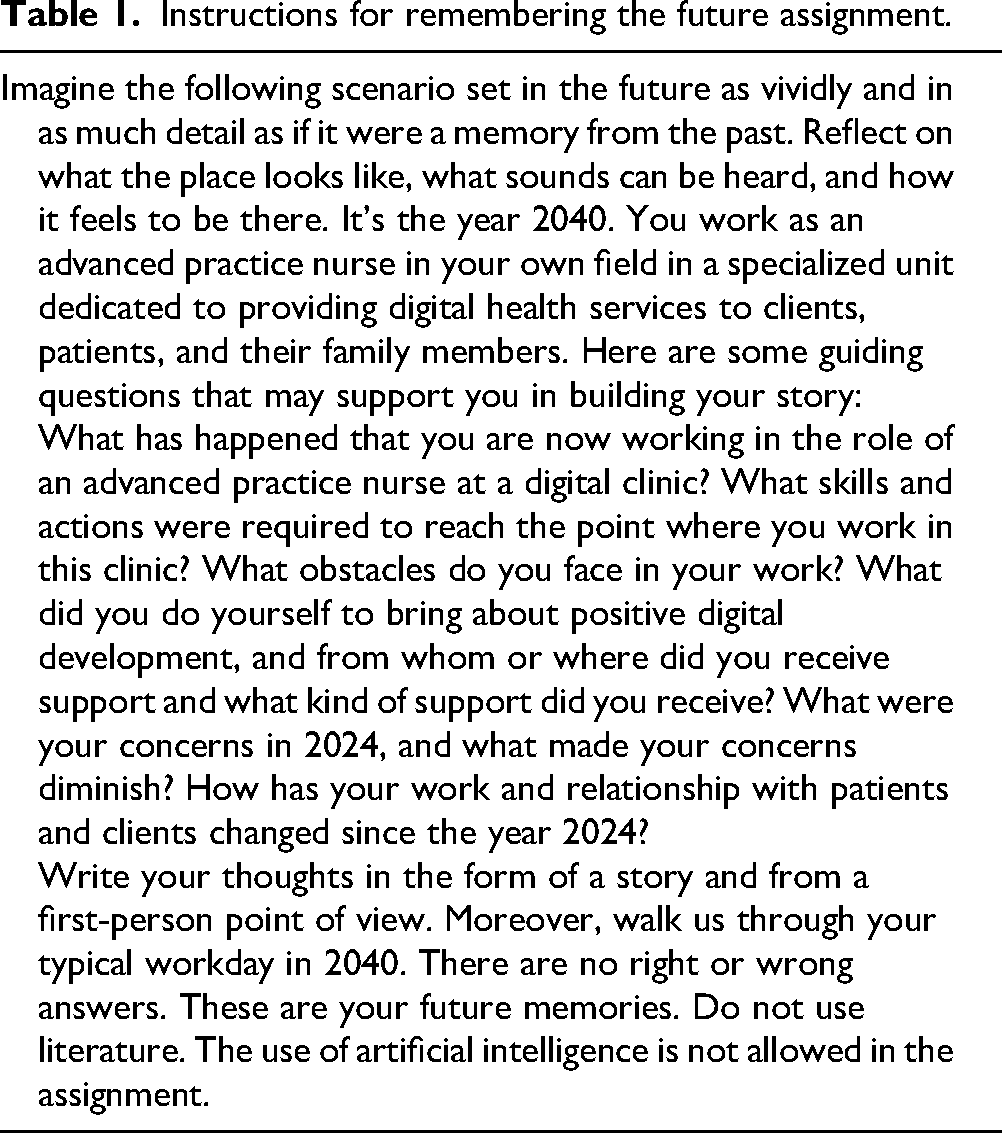
The data were collected in spring 2024. The participants were asked to describe their typical workday at a digital healthcare clinic in 2040 as a form of course assignment. The specific point in time, the year 2040, was used because it was estimated that most of the participants would still be working then and therefore the working day of the specific point in future was more concrete for them to describe. Participants had 2 months to complete the assignment, and the texts served as data for this descriptive qualitative study. The detailed instructions for the assignment are shown in Table 1.
Instructions for remembering the future assignment.
Data analysis
Total data comprised 107 pages (Times New Roman, font size 12, line space 1.5, margins 2.54 cm). The data analysis was based on the phases of thematic analysis described by Brown and Clark.17,18 All researchers participated in the data analysis. The process started by familiarization with the data, which included transferring individual students’ responses into a shared data repository. After this, the data were pseudonymized, followed by a careful reading and rereading while noting down initial ideas. Right from the beginning, the responses from the participants at both higher education institutions were merged into a single dataset because the purpose of the study was not to compare the groups but to analyse the data as a whole. Overall, the starting point for the analysis was to address the purpose of the study.
The next phase entailed choosing suitable units of analysis, creating preliminary codes by immersing in the data and generating initial codes. Then codes were collated into potential sub-themes and then themes, gathering all the data relevant to each theme. After that, the themes were examined and improved to make sure they were in line with the purpose of the study. Each theme was then given a definition and name, which led grouping the themes into overarching main themes. 18
Ethical considerations
The ethical boards of both higher education institutions involved in the study granted their approval to carry out the study (Jamk/432/13.02/2024/486430, HC 352/24). In addition, the researchers signed an Authorship Statement in which they agreed on their roles and responsibilities in conducting the study and reporting the findings. The study was conducted in accordance with the European Code of Conduct for Research Integrity 19 and The Finnish Code of Conduct for Research Integrity. 20 Furthermore, the study complies with the General Data Protection Directive (GDPR). 21
One of the most significant ethical challenges identified was that the teachers of the course had a dual role as educators and researchers. The challenge lay in the fact that APN students’ course assignments were used as data for the study. We, as teacher-researchers, were aware of this challenge. Therefore, pedagogical responsibilities and research integrity were carefully considered during each phase of the study. The participants were informed about the study before the course started, and they provided written informed consent for the use of their course assignments as research data. They were also notified orally and in written form prior to the beginning of the course that their participation or non-participation would not affect their course or the grade they would receive. The course was assessed on a pass/fail grading scale. Study participants submitted their assignments to a learning management system requiring strong authentication from teachers as well as from students. Before data analysis, the assignments were transferred to a protected cloud service and pseudonymized by the researchers.
Results
Three main themes were associated with the digitalized healthcare of the future: 1) Advanced technology enabling customized care, 2) Robots working with nurses and 3) Establishing a respectful and harmonious work environment (Figure 1).

APN students' perception of digitalized healthcare in 2040. APN = advanced practice nursing.
Advanced technology enabling customized care
In 2040, advanced technology enables customized care including better accessibility to care, personalized and seamless care, and empowered patients. From the perspective of better accessibility to care, study participants imagined that in the future, healthcare professionals can project themselves as holograms, thus allowing patients to consult them remotely without requiring physical travel as one APN student described: ‘The clinic is equipped with holographic displays and interactive touchscreens’ (A3). For example, a patient's skin condition can be checked remotely before surgery using hologram technology. Therefore, patients no longer need to come to the hospital for a pre-operative visit. In general, advanced technology brings tools and consultations into patients’ homes, making healthcare more accessible for them. Participants also described how, for example, AR (augmented reality) glasses allow professionals to consult others but also give an opportunity to have an individual meeting with a patient. ‘I am wearing a pair of AR glasses that allows me to do meetings with patients and other people consulting’+ (A14).
In addition, participants explained how sensors are continuously monitoring patient condition without invasive devices, and how interactive touch screens are all over healthcare facilities. Medical equipment is integrated into the hospital room, which makes personnel's work easier. Participants mentioned that, in 2040, clinics have access to immersive rooms with all these features such as the holograms already mentioned, sensors and 3D models, all of which are used by nurses. Individual patient observation and communication with the patient, regardless of location, allows personalized care. Here is how one APN student envisioned the future: ‘The year is 2040 and I find myself in a world where healthcare has transcended its physical boundaries, where the realm of healing extends far beyond the boundaries of traditional clinics and hospitals’ (B9). Overall, in the future, healthcare will be automated to the point where it guarantees a smooth and reassuring experience for patients as well as for staff members. Participants felt that all this ensures a seamless flow of care.
In 2040, holograms also support staff in explaining treatments and procedures in an interactive and visual way, thus improving patients’ understanding of the planned care trajectory. This particularly helps patients to visualize and, therefore, to understand one's own condition better. Participants pointed out that all of this leads to empowered patients. In general, the study participants believed there to be very few or no boundaries at all between the physical and virtual spaces in healthcare in the future.
Robots working with nurses
In 2040, robots are working with nurses as co-workers in the role of assistants, helpers or companions. Participants described that there are several types of robots working as their colleagues in the future. First, there are assistant robots who support patients with their daily tasks like regaining their mobility faster and more effectively. Assistant robots can also identify risk events such as falls and medication errors in care and alert staff members in time as one of the APN students emphasized: ‘Robots identify instances of falling and assist with bathing or restroom needs’ (A3).
Second, helper robots are designed to handle repetitive tasks and daily routines, allowing staff to focus on patient care. Robots can also handle logistics, ensuring that medication or food is available when needed. Participants stated that robots can easily be called in to do routine tasks or to help with patient care. According to the study participants, the introduction of robots into daily work also means that staff have fewer physical injuries. ‘When you need a robot to come and clean something you just call them by their assigned name, and they get the voice info and go to the place where it came from, and they do the job’ (B6).
Lastly, the participants depicted companion robots. These robots are specifically designed to provide emotional support for patients. Robots can sing songs and tell stories to calm patients. Robots are also important companions for patients by keeping their minds active and entertaining them. Participants felt that companion robots can reduce a patient's feeling of anxiety, fear or loneliness. They also described robots working regularly alongside healthcare professionals. ‘It is nice to work at this ward where robotics are fully present’ (A8). According to the participants, the presence of robots in the workplace increases the sense of security and reassures personnel. They believed that, to some extent, robots will replace staff in the future.
Overall, the participants had a positive attitude towards the idea of working closely with robots by the year 2040. They appreciated that robots could perform physically demanding tasks in place of the staff. In addition, they believed that robots might help alleviate potential workforce shortages in the future.
Establishing a respectful and harmonious work environment
In 2040, a respectful and harmonious work environment is achieved by maintaining patient privacy and establishing a comfortable workplace. Participants felt that patient confidentiality is incredibly important in the digitalized healthcare. They described that a dedicated workspace for staff is crucial because it ensures that patient privacy is maintained (no open offices). Passwords have been replaced by biometric identifiers and data flow smoothly between devices and systems. Moreover, the participants viewed that healthcare clinics have a harmonious atmosphere in the future leading to a pleasant working environment. There are no queues or noisy equipment in the clinic. Every phone call or alert is directed into earbuds, so that only staff members may hear it. Patients do not hear any of the other patients’ alarms or other disturbing sounds. The following quote from an APN student illustrates these points ‘It is great how much quieter the workplace has become, compared to 15 years ago, when the phone was constantly ringing’ (A9). Another APN student described the working environment in the future as follows: ‘Thanks to that device we have a “silent ward” this means that every time an alarm occurs, I hear only one light sound, not harmful for my ears …’ (A8).
In addition, birdsong is used as a background sound to reassure both patients and staff members. Participants pondered that since sensors, monitors, and medical devices are wireless, it itself creates a calm working environment. One of the APN students described the change as follows: ‘Work as an advanced nurse, I see a different atmosphere. The long queues of patients and the medical staff running with documents in their hands no longer exist, there is a silence and only the sound of keyboards and computers is heard’ (B7). In general, according to the participants, digitalized clinics in 2040 are relaxing and stress-free places to work where harmony is respected and valued.
Discussion
The study participants identified three distinct phenomena when recalling the future work in 2040. First, they considered that advanced technology would significantly enhance and tailor patient care, make healthcare services more accessible and seamless, and further empower patients. Second, they felt that robots would be an integrated part of everyday work in the future, each fulfilling specific roles such as assisting, helping and providing companionship to the patients. Lastly, participants envisioned the digitalized clinic as a workplace where patient privacy is highly respected, and which is in general a pleasant working environment.
The findings indicate that the APN students generally view the future in the digitalized work environment as a positive development. This is in line with previous studies22,23 where professionals often consider digital transformation positively, highlighting its potential for innovation, increasing visibility of nursing roles, saving time and reducing errors. However, it should be noted that some of the findings described in the present study seem almost obvious when looking at the future of healthcare. For example, it is well known that digital technologies increase accessibility to healthcare services and information, therefore supporting patient's self-management, and can even reduce the strain on healthcare systems. In addition, it is well established by earlier research24,25 that various digital platforms and telemedicine have the potential to enable remote clinical examinations, give information to real-time decision support, and provide better follow-up.
Regarding the various roles of robots described by the participants, similar results have been depicted in the study by Kyranini et al., 26 which introduced different types of robots such as care robots, assistive robots and rehabilitation robots. Kyranini et al. 26 further claim that customizable robots will be required to perform a wide variety of tasks in healthcare while cooperating with a wide diversity of people, even people that are not comfortable with their presence. In this study, participants viewed companion robots as particularly important for patients in the future. Such outcomes have likewise been obtained by Nichol et al., 27 who found that socially assistive robots may help to improve social interaction and mood, decrease anxiety and distress, and even reduce pain.
Nevertheless, the present study brings new insight into the positivity with which the participants perceive different roles of robots as their colleagues at their future work. It almost seems as if it is natural to work alongside with them. Several studies28,29 have demonstrated that there are both positive and negative attitudes among healthcare providers, as well as citizens, towards robots working in the healthcare industry. On one hand, many see robots as beneficial for performing routine tasks and reducing staff workload as was visioned by the APN students in this study. On the other hand, there are concerns that robots can be unreliable, do not have emotional capacity and tend to dehumanize nursing care. 30 These types of concerns were not supported in the present study.
In the present study, participants described that, in the future, respectful harmony at work will be achieved by maintaining patient privacy and creating a pleasant work environment where both patients and personnel feel comfortable. Consistent findings have been reported by Pascale and Achour. 31 In their research, the participants felt that, by the year 2050, hospitals operate in a society that strongly emphasizes more holistic approach to care and prevention, and the hospital has become a ‘place of last resort’, meaning that the healthcare system is based on a fully established integrated care delivery model. In addition, hospitals have implemented a digitally connected system and become hybrid places where virtual wards and secondary care are provided at home and in communities. They further state that technology also helps with automating tests and reducing staff workload. 31 These results are in line with this study where participants envisioned that in future hospitals, care will be seamless, and patient well-being will be continuously monitored via technological devices and systems.
The findings obtained should also be considered from the viewpoint of APN curriculum development. A key question is whether the current APN curricula are truly up to date when it comes to achieving digital skills and competencies. The International Council of Nurses (ICN) 32 has outlined core competencies essential for advanced practice nurses. In terms of digital skills, the ICN does not explicitly mention digital technology core competencies for APNs. However, the ICN's position statement ‘Digital Health Transformation and Nursing Practice’ 31 points out the growing importance of digital skills in nursing where nurses should be involved in the design, implementation and evaluation of digital health solutions to ensure these technologies meet the needs of both patients and healthcare providers. As emphasized by Stunden et al., 33 educational nursing institutions need to design a curriculum that equips students with the necessary ICT (i.e., Information and Communication Technology) skills in preparation for the e-health environment. Thus, it is essential to support APN students to actively envision their future work and work environment.
One fundamental question about the caring nature of professional nursing is brought up by the findings: is the heart of caring at risk as the caring framework prioritizes the patient’s world, vulnerability, health and suffering 34 while also requiring healthcare personnel to operate in a technology-rich environment? Particularly if nurses’ closest coworkers will be robots in the near future. Thus, it is worth considering whether there is a genuine risk that the everyday use of robots and other digital tools may limit chances for patients and healthcare providers to develop trust. Therefore, from time to time, it is beneficial to remind oneself the essence of nursing care, which underlines relationship and dialogue and prioritizes the patient as a human being.34,35
No one knows what the future holds. At the same time, to identify potential opportunities and trends, it is important to consider what attractions and threats it may bring. According to Booth et al., 1 to support practice, professionals need courage to lead the development of new models of patient care enabled by digital technologies. Therefore, it is of utmost importance that, when master students study in the APN programme, they should be encouraged to reflect on assumptions about how, for example, robots, smart phones and other artificial intelligence enabled systems can be seen supporting and enriching nursing practice and process, instead of challenging it. Moreover, it is important to focus not only on technical skills, but also on the critical reflection of ethical, cultural and social implications of digital health technologies.
Methodological considerations
To ensure the credibility, dependability, confirmability and transferability of the study, the criteria of Forero et al. 36 with respect to assessing the rigour of qualitative studies were applied throughout the research process. First, it can be assumed that the participants’ diverse cultural origins and their attendance at higher education institutions in two different countries had an impact on the data. Despite this, a commonality among the participants was that they were all APN master’s degree students and registered nurses with work experience. In addition, most of them were working as registered nurses while studying in the programme. However, in Finland and Kosovo, the role of the APN is not regulated and therefore the scope of practice and other requirements differ between countries and even organizations. The variations in scope of practice, competency expectations and role definitions may have shaped how participants perceived and interpreted the future role of APNs and therefore have influenced the findings.
As for the credibility of the findings, the participants had 2 months to complete their course assignment and, over the given time, were able to produce relatively rich data for the research. However, it should be noted that the quality and probably also the content were somewhat impacted by having to respond in English, which is a foreign language for all respondents. Moreover, the main topic of the course ‘Digital transformation in healthcare’ probably had some influence on the content of the assignment. In any case, participants were instructed to use their own creativity in the task and, therefore, the use of AI was forbidden. Using a plagiarism detection programme (Turnitin; https://www.turnitin.com) to review each participant's assignment, the usage of AI was eliminated. With regard to dependability, it was ensured that the findings of this study would be repeatable if the study was conducted within the same cohort of participants, coders and context. 36 Therefore, the detailed description of the study methods and the data coding process were described.13,37 To ensure the confirmation of the findings, regular sessions with the members of the research team were held throughout the study.
In terms of confirmability, one of the weaknesses of the study is that student-participants were not involved in the analysis process despite Braun and Clarke 38 advocating for member reflections. This means the need to encourage participants to engage with the analysis to enrich the understanding of the findings. However, direct quotes from the respondents were used to support the findings. 37 In this study, the transferability of the findings to other contexts or settings is only possible to a limited extent.
Implications
The findings are particularly important to nursing educators who can utilize them in curriculum design and course planning to ensure the acquisition of relevant digital competencies and readiness during the master's education. Moreover, the present study gives an insight into the potential of digitalization as an enriching element in the work of APNs and in improving the quality of patient care. As for APN students, by envisioning the future, they will develop an increased awareness of the choices that will influence healthcare outcomes. Therefore, assigning the task of remembering the future during a master's degree might be beneficial for the students.
Conclusions
In summary, the findings of the present study indicate that, for APN students, a digital work environment is part of their daily work in the future. Overall, the participants had a positive attitude towards healthcare digitalization. They felt that advanced technology helps the staff and patients, robotization is a positive thing, and, most importantly, that the future work environment respects patient privacy, thus creating a pleasant professional landscape. Based on the findings obtained, it is necessary to evaluate whether the continued use of concepts such as digital transformation or digital change can now be reconsidered or even discontinued. Perhaps it is time to see digitalization as part of everyday reality and routine in healthcare. Nevertheless, more research with different study designs is still needed. Approaches such as service design and participatory action research might be effective ways to explore future digitalization.
Footnotes
Acknowledgements
We express our gratitude to the master nursing students who participated in this study. Additionally, we thank Merja Kalima, Key Account Manager, MA (English language and literature) for critically reviewing the English language of the research manuscript submitted for publication.

Ethical statement
The study was conducted in accordance with the Declaration of Helsinki and was approved by the Ethics Committee of Jamk University of Applied Sciences (432/486430) on 13 February 2024 and the Ethics Committee of Heimerer College (352/24) on 26 March 2024. Participants provided their written consent for using their course assignments as data before starting the stud.
Funding
The authors disclosed receipt of the following financial support for the research, authorship and/or publication of this article: This work was funded by the European Commission: Mobility of higher education students and staff supported by external policy funds (KA171-HED) under grant agreement No. 2023-1-FI01-KA171-HED-000138061. The funding source was not involved in the study design, data collection, analysis, interpretation, manuscript preparation or the decision to submit the article for publication.
Declaration of conflicting interests
The authors declared no potential conflicts of interest with respect to the research, authorship and/or publication of this article.
Data availability
Due to the limited number of participants, the data examined for this research are not publicly accessible. Sharing the data publicly runs the danger of identifying specific participants, jeopardizing their privacy and confidentiality. The data are only accessible from the corresponding author upon request and under circumstances that protect participant identity to maintain participant anonymity and to comply with ethical standard.