



Abstract
This article discusses some challenges fostering cultural competence for student nurses. Norwegian national guidelines uphold study abroad as the norm and set as a future goal that 50% of students should spend time abroad during their studies. This goal has proved hard to reach due to several factors, such as students’ economic situation and obligations to work and family. Higher education institutions (HEIs) need a broader approach to ensure students’ cultural competence despite not being able to travel abroad. We have developed diverse strategies for strengthening the outcomes for cultural desire and competence gained by students who do not travel. We believe that HEIs need to significantly increase their efforts to facilitate ‘internationalization at home’ to benefit students with necessary cultural awareness, knowledge and skills.
Introduction
In an era of increasing global connectivity and cultural diversity, nurses confront dual challenges stemming from unprecedented migration patterns that bring patients from varied cultural and linguistic backgrounds. Oslo, the capital of Norway, exemplifies this trend, with 34% of its residents being immigrants and 228 languages spoken. This demographic reality necessitates a heightened emphasis on cultivating cultural competence among nursing students to ensure culturally congruent care, a critical aspect during both their education and subsequent professional practice.1,2
Campinha-Bacote 3 emphasizes that higher educational institutions (HEIs) play a pivotal role in fostering cultural competence. This entails a cohesive process that imbues students with cultural desire, defined as the motivation to engage willingly in the process of becoming culturally competent. 4 According to Campinha-Bacote,4,5 cultural competence is an ongoing process wherein healthcare professionals continuously strive to work effectively within the cultural context of the patient, be it an individual, family or community.
It is a prevailing notion that cultural competence is primarily achieved through international mobility. This is contrasted by the low number of nursing students who go abroad to study. For many years, it has been considered a success factor to send as many students as possible abroad. This is supported by the current target from the authorities that 20% (future goal is 50%) of all students should have a stay abroad during their studies. Today, the number of students who can study abroad is limited and far from the future national goal. There are several reasons for this. Long periods abroad are not a realistic option for many students due to family situations, higher interest rates compounding financial challenges, coupled with constrained curriculums and reduced exchange opportunities with our international partners. 3 Furthermore, faculty are increasingly expressing frustration due to conflicting reports and evidence regarding the learning outcomes for students going abroad. 6
Lovisenberg Diaconal University College (LDUC) in Oslo recognized these challenges and we have addressed them innovatively by creating an internationalized campus environment and incorporating intercultural learning opportunities within the domestic setting. We propose a comprehensive global learning experience that employs various strategies for building cultural competence, even among nursing students unable to travel abroad, as an answer to the current challenges mentioned above.
The construction of cultural competence
According to Campinha-Bacote, the foundation of cultural competence is found in the affective construct cultural desire, ‘the motivation of the nurse to “want to” engage in the process of becoming culturally competent’.
4
(p. 145) Consequently, cultural desire is a foundation for acquiring the other four aspects of cultural competence according to Campinha-Bacote
4
(p. 204–205):
Cultural awareness, ‘the deliberate, cognitive process in which health care providers become appreciative and sensitive to the values, beliefs, lifeways, practices, and problem-solving strategies of clients’ cultures’. Cultural knowledge, ‘the process of seeking and obtaining a sound educational foundation concerning the various world views of different cultures’. Cultural skill, ‘the ability to collect relevant cultural data regarding the clients’ health histories and presenting problems as well as accurately performing a culturally specific physical assessment’. Cultural encounter, ‘the process which encourages health care providers to engage directly in cross-cultural interactions with clients from culturally diverse backgrounds’.
These four components, along with cultural desire, collectively integrate into what is described as ‘cultural competence’.
Customized learning designs for cultural competence: Internationalization at home
There is a lack of systematic integration of the experiences of students going abroad and incoming international students. Consequently, HEIs need to develop systems that promote the sharing of knowledge for maximizing the benefits of global learning. HEIs can achieve this through five educational strategies described below.
For incoming students from abroad, HEIs should provide an opportunity to integrate into the host environment, learn about local practices and culture, and share their own knowledge and experiences from their home country. This enriches the academic environment and strengthens cultural sensitivity and understanding of diversity among the host institution's students and staff.
A goal for LDUC is to ensure all students meet the cultural competence requirement, as described by Campinha-Bacote. 4 Accordingly, we have developed customized learning designs, collectively termed ‘internationalization at home’. The learning activities form a framework that utilizes to incorporate cultural competence constructs into a coherent educational process. Our framework encompasses academic, pedagogic, cultural and social activities, fostering nursing students’ skills in understanding intercultural challenges to healthcare quality. 3
Learning theories have evolved to prioritize social learning in cultural settings, as evidenced by Vygotsky's sociocultural theory. 7 His theory underscores the fundamental role of social interaction in cognitive development, viewing learning as a social process. We have experienced that leveraging an approach that includes peer-learning with international students, study abroad programs and virtual classrooms has led to global competence for our students (Table 1).
Connecting international and Norwegian students
A strategy that has proved to be successful is systematic integration of incoming students and Norwegian students. Through an institutional agreement between a US university and LDUC, a yearly cohort of US nursing students now partakes in a 2-week internship in Norway. Collaborating faculty from both institutions meticulously plan academic, pedagogic, cultural and social learning opportunities. The goal is for students from both countries to develop cultural competence through collaborative learning, comparing and contrasting academic, social and cultural experiences. This comprehensive experience includes peer-learning, extracurricular and field experiences, as well as structured on-campus immersions.
Moreover, in a shared course titled ‘Urban Health’, students from both countries engage in lectures and exchange experiences regarding marginalized populations, such as substance users and the homeless. The course culminates in mixed international groups of students selecting a topic for a final presentation, promoting collaborative learning and cultural competence. Through close collaboration with American students, they gain insights into and change their perspectives on health challenges in the USA. This approach enhances learning and global competence for Norwegian students without them needing to travel abroad.
In 2022, students from Finland, Sweden and Denmark joined the course, enriching the collaboration and providing an even broader perspective on cultural competence. This allowed students and faculty to delve deeper into common themes. The joint international course at our campus acted as a catalyst for students to reflect on global healthcare disparities and the importance of cultural competency for healthcare professionals. By creating a system for knowledge sharing that connects Norwegian students and incoming international students, we laid a foundation for increased global competence. More precisely, it builds cultural awareness and knowledge. 3
Cross-cultural peer-learning
Peer-learning, rooted in sociocultural learning theories, 8 has been an enriching experience for both US and Norwegian students. During their time in Norway, US students shadowed Norwegian students during clinical practice, 9 creating a unique and immersive learning environment. From our perspective, these peer-learning activities have sparked invaluable discussions, allowing students from both countries to share their experiences and insights openly. The feedback we have received from students has been overwhelmingly positive; they deeply appreciate this chance for situated learning, which significantly enhances their cultural competence.
As the students worked together and shared their experiences, they had plenty of time to converse, explain and inquire about the differences between their respective healthcare systems and the inequalities they observed. This not only fostered a genuine cultural desire but also touched upon all four aspects of cultural competence: cultural awareness, knowledge, skill and encounter. 3
We believe this learning method has greatly contributed to a deeper understanding of global healthcare for our students, aligning perfectly with Vygotsky's sociocultural theory, 6 which emphasizes that learning thrives on collaboration, interaction and relationships. This hands-on experience has been a testament to the power of peer-learning in bridging cultural gaps and enhancing global healthcare education.
Collaborative online international learning (COIL)
In response to the global challenges posed by the COVID-19 pandemic, LDUC and the US university jointly implemented Collaborative Online International Learning (COIL) experiences. COIL connects accredited courses from HEIs in different countries, fostering intercultural collaboration. Unlike typical online classrooms, COIL creates equitable, team-taught environments where faculty from diverse cultures develop a shared syllabus, emphasizing experiential and collaborative learning. This learning model has proven successful in fostering cross-cultural teaching and learning for our mixed international student groups. All students have reported increased knowledge and development of skills related to critical thinking, leadership, problem-solving and intercultural communication in accordance with literature on COIL.10,11 In sum, COIL contributes to cultural awareness, knowledge and skills, and is a good learning alternative to studying abroad. 3
On-campus activities for cultural competence
Structured on-campus activities played a crucial role in disseminating cultural competence acquired by students through international experiences. LDUC organized an annual ‘International Day’, where students who have studied abroad share their knowledge and experiences through exhibits. Media like Instagram, Facebook and LDUC's website are popular dissemination channels where students share experiences and contribute to discussions and cultural learning. Such activities lead to reflection and understanding of cultural variations, inequality and the role of nurses in promoting cultural competence and contribute to the students’ cultural desire and awareness. 3
Extracurricular field activities
Complementing the academic program, extracurricular field activities were designed to enable visiting students to interact and learn from each other as well as from the local students at LDUC. Social and cultural activities, including trips, excursions and planned experiences, were organized for mixed international groups. These activities provided a safe and inclusive environment, contributing to deepened learning through the exchange of perspectives on healthcare, education systems and cultural differences. Consequently, these activities fostered cultural desire and awareness in the students as suggested by Campina-Bacote. 3
Conclusion and implications
If HEIs plan for global learning to mainly occur through study abroad, many nursing students will lack important cultural competence to enable equal healthcare for all. We see the value of study abroad programs for students and do not want to exclude this option. However, considering how few participate, we believe that HEIs should offer alternative arrangements for more students to acquire cultural competence.
To foster cultural competence in the face of barriers to study abroad, we propose innovative strategies for ‘internationalization at home’ to ensure the development of necessary cultural competence.
As previously mentioned, there are also conflicting reports and evidence regarding learning outcomes for students going abroad. HEIs are responsible for ensuring that students achieve their learning outcomes in accordance with national guidelines. Planning ‘internationalization at home’ activities has given us the possibility to ensure quality in the programs and that our students reach their learning outcomes.
Built upon our positive experiences, we highlight the construction of cultural competence, emphasizing Campinha-Bacote’s framework and propose for customized learning designs that integrate various activities to cultivate all aspects of cultural competence within a domestic setting.
Overall, we advocate for a multifaceted approach to cultural competence in nursing education, one that recognizes the limitations of traditional international stay abroad programs and embraces complementary strategies to ensure all students develop the necessary skills and awareness to provide inclusive and equitable healthcare to individuals from diverse cultural backgrounds.
How the strategies for building cultural competence support the development of all aspects of cultural competence as described by Campinha-Bacote. 4
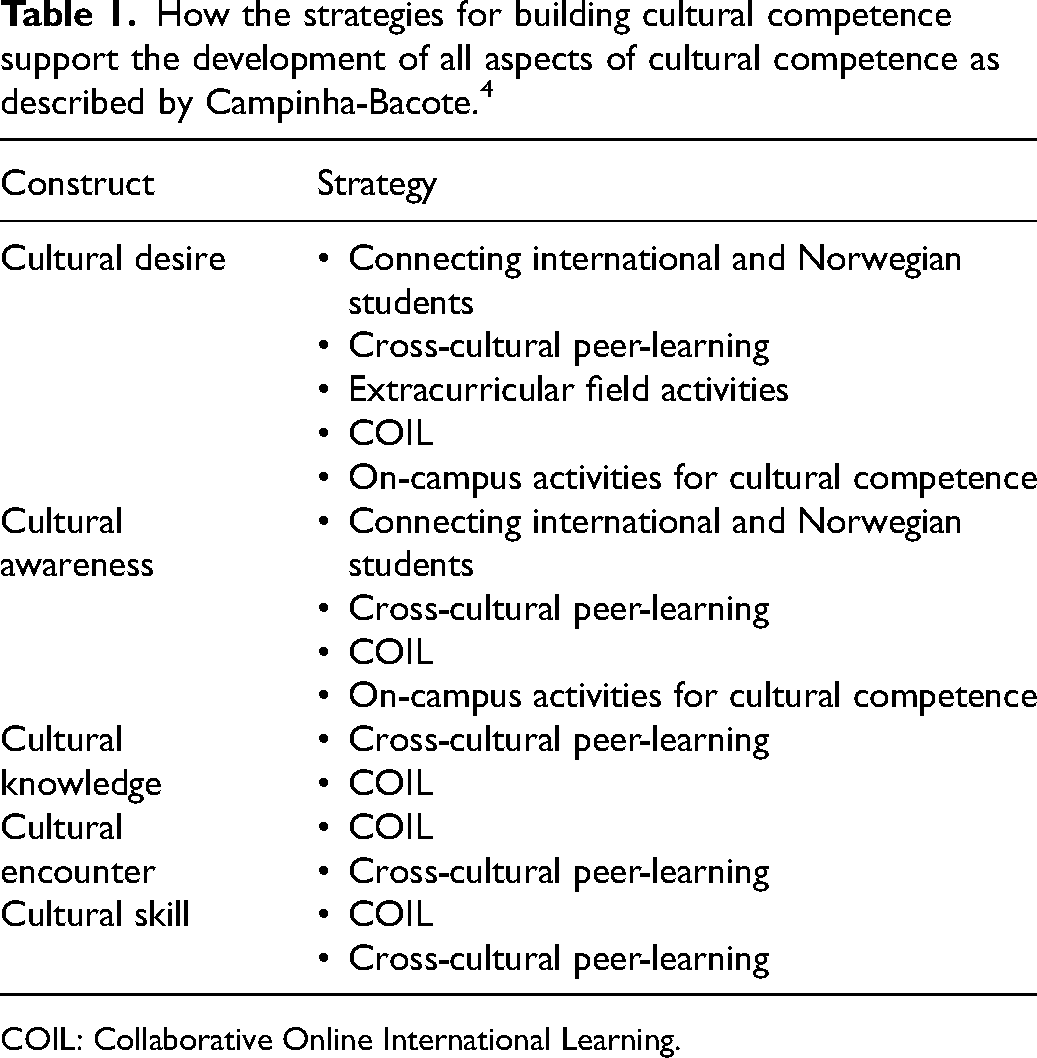
COIL: Collaborative Online International Learning.
