



Abstract
This discussion paper explores the intricate challenges faced by researchers in the selection of suitable journals for the publication of their research findings. Although numerous studies have delved into the hurdles encountered during the publication process, this paper specifically addresses the complexities associated with journal selection. The focus of this paper is on the challenges confronted by nurse researchers, encompassing issues such as impact factor bias, alignment of relevance and scope, and ethical considerations. These challenges, if not navigated effectively, can impede the dissemination of valuable nursing research. By acknowledging and addressing challenges head-on, researchers can contribute meaningfully to the nursing field, ensuring that their work makes a lasting impact. Ultimately, this paper underscores the need for continuous dialogue and flexible approaches to surmount the challenges associated with journal selection and enhance the overall quality and relevance of nursing research contributions.
Introduction
Researchers must carefully choose an appropriate journal to ensure that their work reaches the intended audience and has a meaningful impact. 1 Academic authors aim to share their findings, gain recognition, and reap rewards through publication. Ideally, a good journal not only expedites article publication but also enhances quality through rigorous peer review, selects exceptional research, and guarantees broad visibility and long-term accessibility. 2 However, authors often encounter challenges when weighing factors such as prestigious journals, prompt publication, acceptance rates, and open access. 3
Choosing the wrong journal for publication can cause delays, insufficient evaluation, and limited exposure, leading to low readership. It is crucial to consider factors such as publication speed, journal quality, and acceptance rates.2,4 The prestige of the journal is important since publishing in a prestigious journal brings more recognition than publishing in a less prestigious journal. Being accepted by a reputable nursing journal is a noteworthy accomplishment that amplifies knowledge dissemination and validates its practical application. 5
The publication and dissemination of research findings have an impact on medical teachers’ promotion criteria and are essential for fostering informed dialogue and decision-making within the academic community. 6 Disseminating these findings can inform policy discussions within universities, advocating for the implementation of supportive measures that promote early publication and thereby foster a more dynamic and impactful research ecosystem. 7
Journal selection and research dissemination in nursing: strategies for success
Selecting a journal with a high impact factor aligns research with reputable publications, adding credibility to research findings. The dissemination of research findings among nurse researchers is vital for advancing the field and improving patient care (Figure 1). Mentorship and support from supervisors play a crucial role in facilitating publications, ultimately contributing to increased knowledge output and the development of essential skills among nurse researchers. In the nursing profession, this involves effectively navigating the challenges of research publication and promoting research dissemination to advance nursing practice and improve patient care. 8 The competitive nature of the academic publishing landscape adds pressure to publish in high-impact journals, thereby raising the stakes for journal selection and promoting the dissemination of research findings.9,10 Overcoming the challenges of journal selection requires a strategic approach and a combination of practical steps. This discussion paper provides information to nurse researchers on effective ways to tackle these challenges.
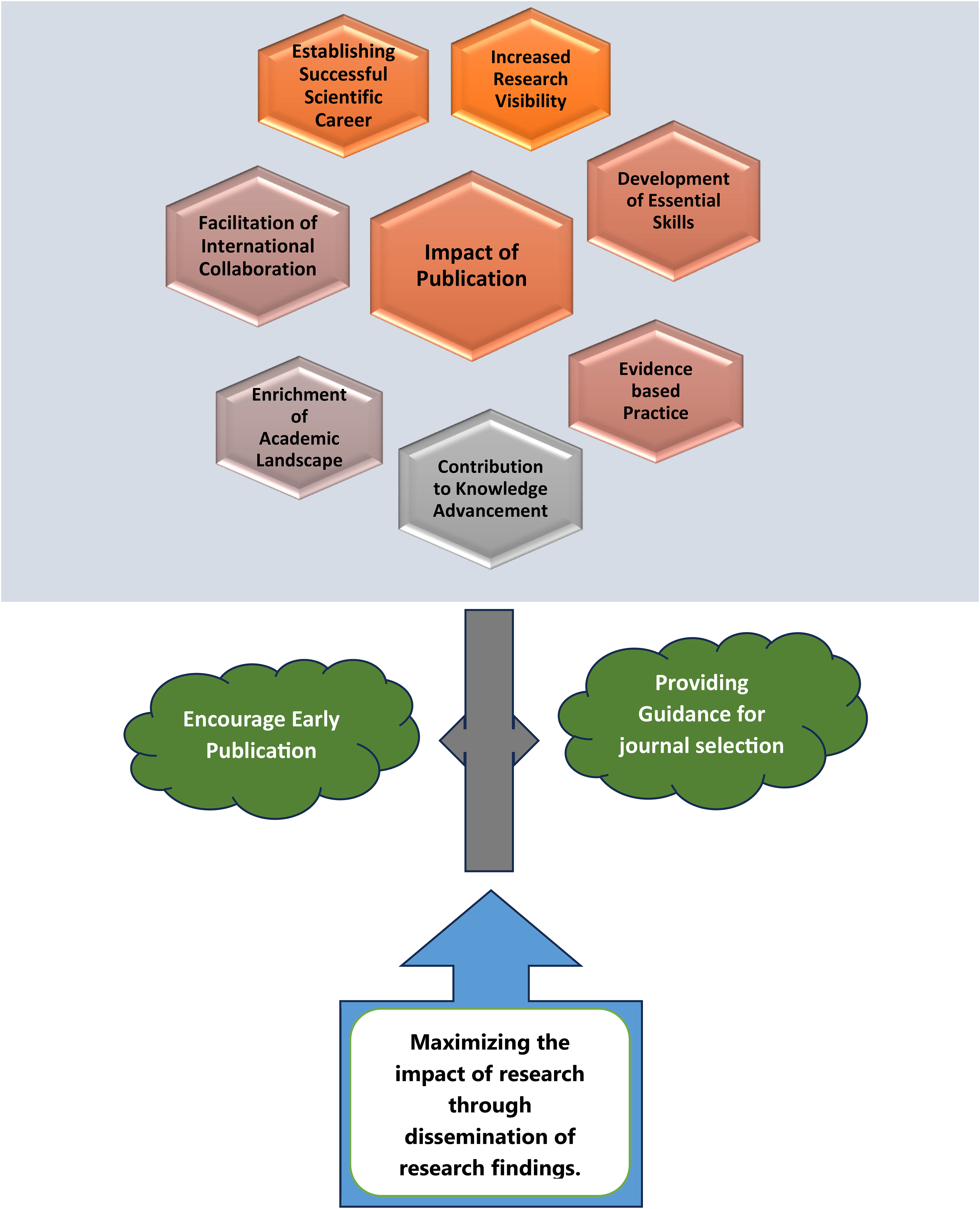
The schematic representation of the impact of research publication on nurse researchers.
Figure 1 presents a consolidated overview of the Impact of Publication and Dissemination on a researcher's career.6,7
Subjective area exploration: balancing specialization and generalization in research dissemination
One major challenge researchers face is identifying journals that align with the specific focus of their research. 11 While some argue that publishing in specialized journals increases visibility within a specific field, others contend that generalist journals may provide a broader readership and potential impact. 12 This argument explores the advantages and disadvantages of both perspectives, emphasizing the importance of carefully considering the relevance of the research topic when selecting a journal. 13
Embarking upon the dissemination journey necessitates a clear identification of the subject area under scrutiny, be it clinical practices, healthcare policies, or educational strategies. 14 Delineating the specific field or discipline provides a foundational framework for subsequent endeavors. Integral to effective dissemination is a profound understanding of the target audience. 9 Whether catering to researchers, practitioners, or a niche academic community, selecting a journal resonant with the predilections and proclivities of the intended readership is paramount. 13
Consideration of indexing, citation rate, and impact factor for research publication
Indexing plays a crucial role in promoting and disseminating research published in journals. 15 There are numerous indexing databases and platforms that aim to curate and organize scholarly content. Some well-known indexing databases include PubMed, Scopus, Web of Science, Google Scholar, and others. Each database has its own criteria for the inclusion, evaluation, and indexing of journals.15,16
Various scientific institutes worldwide employ specific criteria to classify journals based on their citations, serving to compare a journal with others in the same field through journal rankings. One platform that develops journal rankings and utilizes the Scopus database is the SCImago Journal and Country Rank (SJR). The SJR measure considers both the number of citations received by a journal and the prestige or quality of the journals that cite it. Users can employ multiple filters to search for journals on this platform. 17
The impact factor of a journal is often considered a significant criterion for journal selection. However, the overreliance on impact factors may limit nurse researchers’ opportunities to publish in journals that are highly regarded within their specific areas of expertise. 18 This argument discusses the limitations and criticisms associated with impact factors and encourages researchers to consider alternative metrics and indicators of quality when assessing journal suitability.18,19
With scholarly activities increasingly shifting online and the rise of open-access publications, there's a growing need for alternative metrics to measure research impact. These metrics also consider article downloads and online views, offering nuanced insights into scholarly dissemination. One such alternative metric, the Source Normalized Impact per Paper (SNIP), weights citations based on the subject area's citation potential, providing a contextualized measure of impact. SNIP acknowledges disciplinary variations in citation practices, ensuring a fair evaluation of research contributions. This approach enhances understanding of research impact in today's evolving scholarly landscape.20,21
Understanding the quartile placement of Scopus-indexed journals, ranging from Q1 to Q4, aids researchers in selecting appropriate journals for publication. Q1 and Q2 journals signify top-tier publications with high impact factors, while Q3 and Q4 journals are considered lower-ranked. By utilizing platforms like the Scopus website to access journal details and metrics such as SJR or CiteScore, researchers can effectively gauge the standing of journals within their field and make informed decisions regarding submission targets. 22
Open-access publishing and article processing charges: considerations for researchers
Open-access publishing has emerged as a promising avenue for increasing the visibility of research, offering unrestricted access to articles. 23 However, the growth of open-access publishing has led to the rise of ‘predatory publishers’, flooding scholarly platforms with low-quality articles, threatening academic research integrity. 24 Initiatives like ‘Think. Check. Submit.’ aid authors in identifying reputable open-access journals and distinguishing them from predatory ones. This is particularly crucial for researchers in nursing practice, where access to high-quality, reliable information is vital for informing evidence-based practice and decision-making. 25
In considering open-access publishing, researchers must also take into account Article Processing Charges (APCs), which are fees levied by some journals to cover publication costs.26,27 Researchers should carefully assess a journal's website or contact the editorial office to determine if APCs apply and explore funding options, such as institutional support or grants, to cover these costs. 28 Some journals also offer fee waivers or discounts based on criteria like financial need or affiliation with low-income countries, ensuring equitable access to open-access publishing opportunities for researchers in nursing practice.27,29
Authorship challenges in nursing research collaboration: adherence to criteria and guidelines
Determining authorship order and the criteria set by journals can pose challenges for nurse researchers, particularly in collaborative projects. 30 This argument examines the complexities of authorship guidelines, considering issues of inclusivity, acknowledgment of contributions, and potential power dynamics within research teams. Advocating for transparency, fairness, and effective communication among researchers, adherence to recognized authorship criteria is crucial, as outlined by organizations like the International Committee of Medical Journal Editors (ICMJE) and The Committee on Publication Ethics (COPE).31,32
Key considerations include ensuring substantial contributions to the research process, intellectual involvement in the work's accuracy and completeness, active participation in drafting and revising the manuscript, taking accountability for the research's content and disclosing any conflicts of interest, and appropriately acknowledging non-author contributors. 31 Early discussion and agreement on authorship order and criteria are essential to prevent disputes, and many journals require authors to describe their contributions during submission. 30
Understanding the journal acceptance rate
The acceptance rate of a journal reflects the percentage of submitted articles that are approved for publication, indicating its selectivity and competitiveness. 33 Methods to find acceptance rates include direct communication with editors, Google searches for journal websites, consulting resources like Cabell's Directory of Publishing Opportunities, and accessing statistics from organizations like the American Psychological Association (APA). 34 Understanding acceptance rates aids researchers in journal selection and dissemination strategies, informing decisions about where to submit their work for optimal visibility and impact. 33
Ensuring editorial quality and peer review transparency
A high-quality editorial board comprises experts in the relevant field, affiliated with the reputable institutions and possessing appropriate academic credentials, with easily accessible contact details for editorial staff. 13 Authors can gain insights into the peer review process through the journal's website, where guidelines outline formatting requirements and citation styles, with some journals offering downloadable style files for convenience. 35 Familiarity with these policies ensures authors adhere to the journal's standards throughout submission and review.
To determine if a journal is refereed, you can consult the Ulrichsweb Global Serials Directory. By searching Ulrich's, you will obtain a list of journals, and refereed journals will have a checkmark symbol (✓) to the left of their names. 36
Conclusion
The selection of journals for publication is a complex process that poses several challenges for nurse researchers. By engaging in discursive analysis and considering multiple viewpoints, this paper has highlighted the multifaceted factors influencing journal selection. Nurse researchers must navigate these challenges by critically evaluating the relevance of journals, assessing impact factors alongside other indicators, considering publication policies and ethical considerations, addressing authorship criteria, and aligning with their career goals. By understanding and addressing these challenges, nurse researchers can enhance the impact and visibility of their research within the nursing profession and the wider scientific community.
Footnotes
Acknowledgements
I acknowledge my organization Manipal Academy of Higher Education for the technical support.
Author contributions
Remya U R: Conceptualization, Methodology, Data curation, Writing – Original draft preparation. Mamatha Shivananda Pai: Conceptualization, Methodology Visualization, Supervision, Writing – Reviewing and Editing. Baby S Nayak: Methodology, Supervision, Validation, Writing – Reviewing and Editing. Judith Angelitta Noronha: Writing – Reviewing and Editing.
Declaration of conflicting interests
The authors declare that there is no conflict of interest.
Funding
The authors received no financial support for the research, authorship, and/or publication of this article.
