




Abstract
Nursing education prepares students for both academia and practice; however, the contribution of writing a bachelor's thesis in learning nursing is overlooked. The aim of the present study was to explore the role of a bachelor thesis as a learning tool in nursing. A total of 15 nursing students were individually interviewed using semi-structured questions. The data were analyzed using thematic analysis, and the activity theoretical concept of a tool was subsequently applied. The results were reported in accordance with COREQ for qualitative research. The findings identified writing a bachelor's thesis as a ‘Personal tool’ and a ‘Systemic tool for learning nursing’. The personal tool was related to ‘Preparation for patient encounters in working life’ and ‘Discovering bodily mechanisms of disease or health’. The systemic tool was related to ‘Enabling to impact on the organization of work and stakeholders’ and ‘Facilitating knowledge of the links between patient groups and common diseases’. The study discusses and concludes that a bachelor's thesis represents both a personal and a systemic tool that embodies nursing knowledge, preparing students for their future work as registered nurses. An implication for contemporary nursing is that a bachelor's thesis may serve as a boundary-crossing tool that transcends the school, workplace, and even society.
Introduction
In Swedish nursing programs, undergraduate theses have been mandatory since 2007. 1 The completion of a bachelor's thesis (BT) awards a student 15 European Credit Transfer System (ECTS) points and the degree Bachelor of Science in Nursing. Having the status of a quality indicator of higher education, 3 students’ theses are expected to demonstrate the ability to critically investigate and discuss topics of central importance to the discipline of nursing.2–4 For many students, writing a BT is the only chance of receiving hands-on research training. A BT is also considered a validating instance of being able to apply evidence-based practices in nursing, and to participate in healthcare quality improvement projects. 5 As with most theses produced within academia, a BT is expected to follow the academic format of publication, with limited scope and adherence to certain standards of rigor. 6 Therefore, writing bachelor-level theses in higher education has been criticized for applying a one-size-fits-all format that focuses on students’ output as academics at the cost of preparing students to meet the challenges of working life. 7 In nursing education, the debate is fueled in part by different faculty interpretations of the BT, either as a piece of research or as a means to relate to nursing clinical reality more strongly.8,9 For example, Roca et al. 10 screened the types of BT taught in Spanish nursing programs, showing that basic investigation and care plans, along with literature reviews, were the most popular formats. While the BT, together with the degree of Bachelor of Science in Nursing, are an outcome of the nursing program, proficiency in collecting data and writing a report is not considered critical in clinical nursing. 11 This suggests that the skills acquired through the writing module of a BT may become forgotten. According to a recent review, lack of time and relevant settings create further barriers to accessing and utilizing research knowledge by nurses working in their clinical profession. 12
It is important to explore students’ perspectives, as earlier research on nursing students’ expectations regarding writing a BT shows a variety of incentives, ranging from academic to professional interests.13,14 Furthermore, nursing students expect the knowledge gained from a BT to be applicable in their profession. Research has, to little extent, explored such knowledge that is transferable to clinical contexts of patient care.15,16 This is in line with global outcomes-based higher and medical education that has the goal of facilitating students’ enactment of scientific knowledge and skills from university to high quality work in healthcare systems.17,18
Following this argumentation, writing and investigating important questions in nursing in a scientific manner may attract students who aspire to pursue an academic carrier. 19 On the other hand, students who are prospecting clinical work in patient care may not appreciate this part of their nursing education. 20 In other words, the dual learning objective of both preparing nursing students for clinical work and to foster scientific skills and disciplinary knowledge points to a prevailing theory-practices gap.7,12 As one of the survival strategies of students, a recent study shows that students can be drawn into switching their motives from learning nursing by writing to merely carrying out the formal requirements stipulated by the instructional practices. 21
What can also be perceived as contradictory is that the BT is carried out in the final year of the nursing program, on the threshold of working life. To support nursing students in acquiring the adequate skills and knowledge necessary to achieve the dual goals of nursing education, it is important that educators inform themselves about students’ motives and perspectives regarding writing a BT.
Theory and methodology
According to activity theory, learning activities are mediated by a set of elements forming an activity system including a subject, an object, instruments as tools, rules, division of labor, and community.22,23 In this study, a BT as a tool mediating nursing knowledge is the theoretical concept in focus. The concept of tool is originally used by activity theorists drawing on Vygotskian, socio-cultural-historical theory in researching human development and learning.24–26 In line with the activity theorist Engeström, a tool can be characterized in terms of a physical everyday tool such as a computer, and psychologically, in terms of an epistemic means for various learning activities.23,27 Engeström further describes tools as artifacts that can be viewed through a personal or a systemic perspective. 23 While a personal perspective allows for change in the learning task itself, a systemic perspective implies a change of a whole activity system, for example, a workplace. 23 Healthcare work as well as studying and writing are activities that take place together with others in shared sociocultural environments; therefore, a tool also carries culturally and historically mediated meaning.28,29 It is assumed that a BT therefore may constitute culturally relevant, historically accumulated nursing knowledge for taking care of patients and their health. However, according to activity theory, academia and healthcare constitute separate systems of activities and therefore have divide of communities, rules, division of labor, and tools, which also constitutes boundaries to humans who work within and between different systems.22,27 Crucial to the existence and use of a tool is its object-orientedness, i.e. the purpose of achievement for which the tool is used. 30 Regarding learning, a tool can therefore be complex and embody several possible uses, interpretations, and conceptions among its users depending on the direction and context of learning. 31 One such division is the value given to a tool in terms of use and exchange values. 23 Exchange value of writing a BT would be the grade achieved, whereas user value denotes the value of writing a BT conceptualizing the scientific discipline of nursing care and how it would facilitate transition between university and work.32,33
Activity theory has been used in academic and disciplinary writing research before.18,21,26,29,32–34 This previous research clarifies arising tensions and contradictions that hinder students in their efforts to understand the task of writing a BT and to gather information and write about their realities. In order to contribute to the debate of learning and writing in disciplines, the present research focuses on the tool of writing of BT in nursing. In particular, to explore the role of a BT as a learning tool in nursing.
Methods
The study was designed as a qualitative interview study. Qualitative thematic analysis,35–37 informed by the activity theoretical concept of tool, was applied in data analysis. 23 The checklist for consolidated criteria in reporting qualitative studies, COREQ, was used to assure the method and analysis. 38
Settings
The settings consisted of a first cycle higher education for combined baccalaureate and bachelor's degrees in nursing. At the time of recruitment, approximately 110 students were about to start their final year nursing module called the independent thesis course. The formal course consisted of 10 weeks of independent writing in pairs and five weekly obligatory group tutoring sessions.
Recruitment
The recruitment of students took place in an information class given by a course leader to final year nursing students about to start with their independent thesis course. The module of thesis course and writing BT in nursing had not been taken by any of the students before. The sample was thus purposive, 39 addressing the students who would start the writing and whose experiences would be authentic by the time of interviews, planned to 2 weeks after the start of the writing. Two of the researchers (AH and MW) provided information about the study to the class of students in a 5-minute presentation about the interview, which would take place half-way through the writing of a BT. The students were told that participation was voluntary. Lastly, names and email addresses were collected from those of the students giving their consent to be contacted 5 weeks after the start of writing a BT. As shown in Table 1, five of the interviewees had previously university level experience of writing a BT or above in other disciplines than nursing. Thus, the experience of writing a BT consisted of having written half-way through a BT in nursing education.
Socio-demographics and experience in writing a BT in disciplines other than nursing.
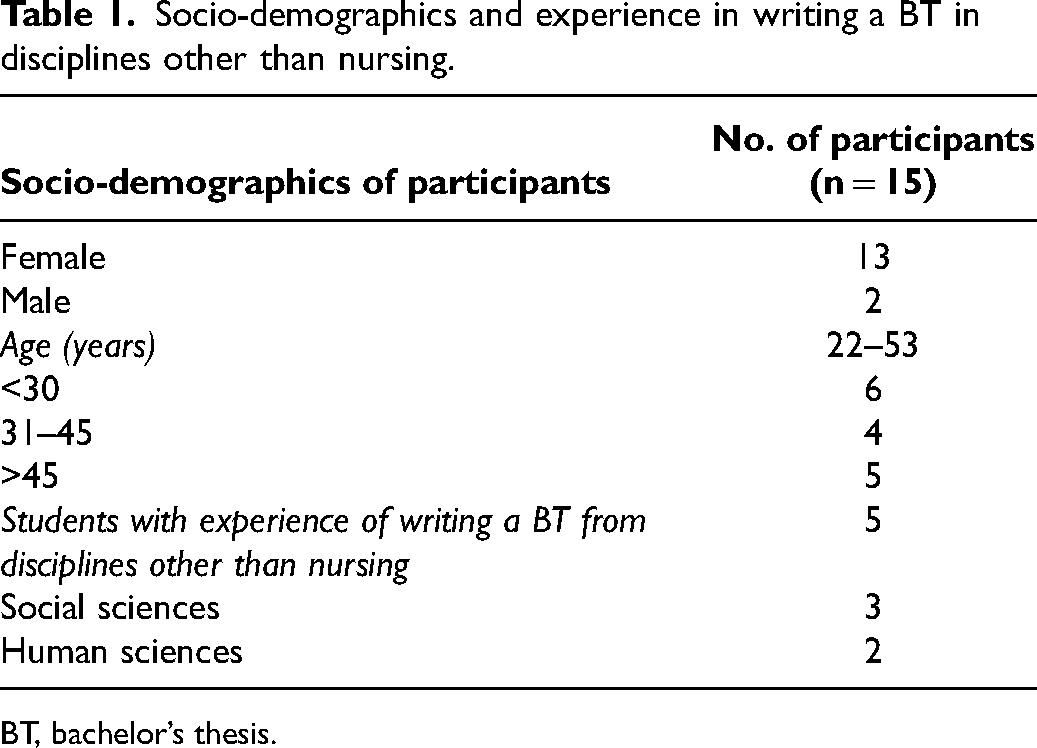
BT, bachelor’s thesis.
Table 1 shows the demographics and previous experience of the interviewed group of students.
Data collection
Individual interviews were conducted during 2019–2020 by the first author. Of the 22 students who had initially agreed given their consent, 15 confirmed their participation in the study. The reasons for the seven dropouts were not followed up. Interviews during 2019 were carried out face-to-face. Due to the restrictions of the COVID-19 pandemic, the interviews during 2020 were carried out using the digital communications platform, Zoom. To promote the participants’ exploring their own views in writing a BT, the questions were semi-structured. 39 The students were initially asked to talk about their writing of a BT at this point and elaborate how they saw its role in, and connection to, their work in the nursing profession. The interviews lasted 20–90 minutes and were recorded with a separate audio recording device. After the completed data collection, the interviews were transcribed verbatim by the first author.
Data analysis
Thematic analysis was chosen as a suitable method to facilitate the induction, description, and interpretation of the data in a systematic way.35–37 Thematic analysis originates from the works of Braun and Clarke.35,36 Moreover, this study drew on the process of qualitative thematic analysis described by Kiger and Varpio. 37 Furthermore, the design of this study utilized the theoretical lens of activity theory to identify themes in the data in the following manner: the personal dimension of a tool was identified in the data as personal knowledge about patient encounters, diseases, or health that related to future work. The systemic dimension of a tool was identified in the data as the relationships between health work and the organizational and societal-political issues of being a nurse in healthcare. The identification and interpretation process of the analysis are shown in Table 2.
Thematic analysis exemplified by one excerpt from the data.
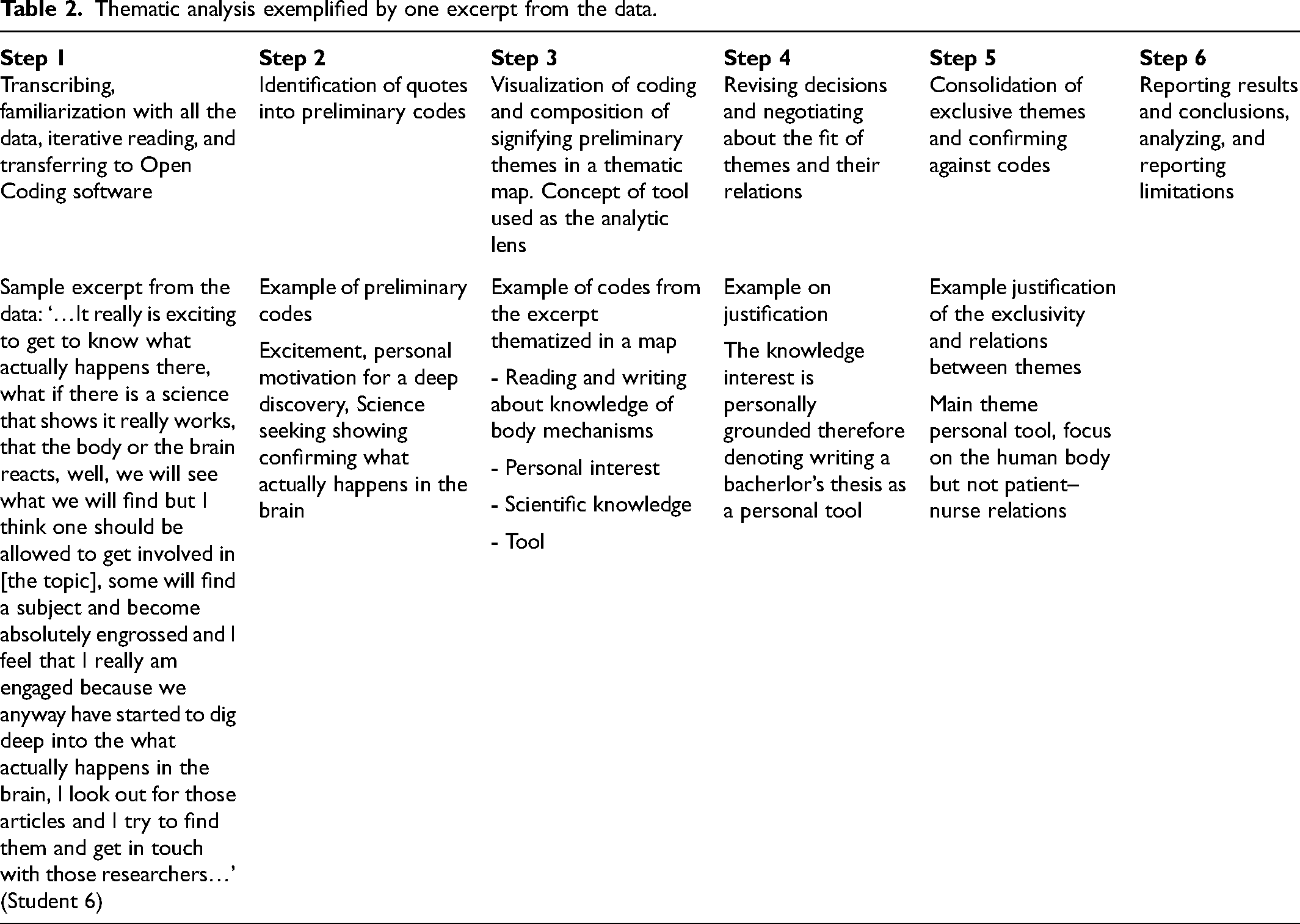
Six steps of thematic analysis were carried out to analyze the data.35,37 Phase 1 of familiarization with the data involved transcribing and transferring it into digital software, OpenCode, version 4.03. 40 In phase 2, iterative reading of the data was carried out. Key sentences relating to the research question were identified and preliminary coding was performed, building a codebook. Phase 3 of the analysis involved discerning and reviewing patterns in the data and applying the activity theoretical concept of tool as a theoretical lens, which gave the codes its contextual meaning. Bearing in mind the object-orientedness of a tool, patterns in the interview material were targeted that would indicate the students’ aims in the learning and thus using writing as a tool. 23 During phases 4 and 5, the patterns were clarified, compared, thematized, and labeled. Throughout the analysis steps, a protocol of altering individual reading with collaborative commenting and discussion by all the authors was used, 41 enabling revisions and consolidation of the results. The final sixth phase included writing the report and analyzing and stating the limitations in the study. Examples of the process of thematic data analysis and interpretation35,37 are shown in Table 2.
Ethical considerations
The declarations of Helsinki 42 and Good Research Practices by the Swedish Research Council 43 were adhered to throughout the phases of design, data collection, analysis, and reporting in the study. Informed consent for the data collection was obtained in writing from all participants. Information of voluntariness and right to withdraw participation without consequences was given repeatedly to every individual participant and the students were invited to ask about and discuss their participation. To protect confidentiality, only one author collected the data, and the analysis was performed on anonymized material only. Original tapes were kept digitally secured by the first author in a personal computer with a two-step authentication code. This study formed part of a larger project and is registered in the Regional Ethics Review Board in Stockholm (No. 2017/639–31/5).
Results
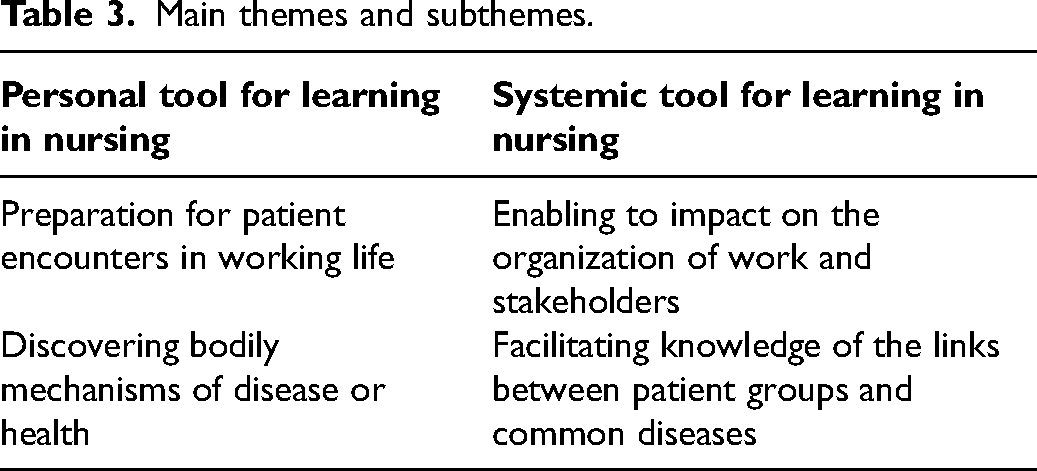
The resulting main themes divide the writing of a BT into personal and systemic tools for students’ learning in nursing. While the personal dimension involves the BT as a tool for learning in relation to understanding patients and the human body, the systemic dimension shows the tool of a BT as a means for impacting and acting in society and understanding different groups of patients that nurses encounter in their work. Thus, two subthemes characterize the ‘Personal tool’ for learning in nursing as a ‘Preparation for patient encounters in working life’ and ‘Discovering bodily mechanisms of disease or health’. The students accounts of a ‘Systemic tool’ for learning in nursing are thematized in ‘Enabling to impact on the organization of work and stakeholders’ and ‘Facilitating knowledge of the links between patient groups and common diseases’.
The resulting themes are presented in Table 3 and key-interview excerpts are shown in the following text.
Main themes and subthemes.
Preparation for patient encounters in working life
The students stated that writing a BT clarifies how a nurse understands patients individually from the perspective of the patient. Writing about patients clarifies in turn that a nurse has the primary responsibility for smooth nurse–patient relations. Patient encounters can be complex and demanding; therefore, writing a BT helps the student to prepare for real-life actions in the provision of care. By writing about specific topics, the students prepare for encounters calling for an understanding of the person behind various conditions, with often unexpected expressions and symptoms. The topic is covered by collecting, reading, and concluding scientific articles, which could offer both negative and positive examples of encounters giving insights into both how to, and how not to, go about encountering patients. ‘…But I think, many people suffer from psychiatric ill-health, [and] regardless of how they express their symptoms, as a nurse I must learn to deal with it and encounter the person and understand that it is not against me as a person, as some think in some of the articles. No, it is rather an expression of the person feeling bad. It is hard and can certainly be very stressful, well yes, it's a matter of being able to understand a little about what is needed.’ (Student 10)
The interviewed students saw the writing of a BT as preparing for patient encounters that may need simultaneous medical and caring expertise and a person-centered attitude from the nurse. In this respect, writing a BT is a means of investigating how the application of a person-centered focus in caring activities takes place. Some of the students expressed their frustration at not having access to patients to interview about their living with health conditions. For example, student 9 felt that reading and writing about ‘others’ studies only’ is to copy others and is not necessarily true. Another student expressed it in a similar way: ‘I think one could have seen more by doing own research, for example a qualitative study, then one could see oneself as a nurse, interviewing and encountering persons; but since it is just a literature review it is really only paper so that is the difference.’ (Student 7)
According to this student, to meet with real patients would bring more authentic nursing knowledge and involvement.
Discovering bodily mechanisms of disease or health
The students talked about writing a BT facilitating knowledge about specialized functions of disease and health in the human body. The writing stimulated their desire to go to the roots of, and obtain, detailed and specialized bio-physiological knowledge. By studying in depth how a disease, treatment, or an intervention works at the organ level of the human body, students hoped to make a discovery. ‘…It really is exciting to get to know what actually happens there, what if there is a science that shows it really works, that the body or the brain reacts, well, we will see what we will find, but I think one should be allowed to get involved in [the topic], some will find a subject and become absolutely engrossed and I feel that I really am engaged because we anyway have started to dig deep into the what actually happens in the brain. I look out for those articles and I try to find them and get in touch with those researchers…’ (Student 6)
The student here talked about the body and brain and how they are affected by non-pharmacological interventions. By writing a BT, the student seeks evidence for a hypothesis and a reliable explanation about possible effects. In this way, writing a BT is a tool for personally checking the reliability of a nursing topic. The students also talked about acquiring knowledge to be ready to explain and increase patients’ understanding of how to impact their bodies using non-pharmacological self-care.
Enabling to impact on the organization of work and stakeholders
The students talked about the writing of topics that consider how healthcare and nursing care work are organized and how they would want to make changes for a better healthcare system, its function, planning, and policy. Writing a BT afforded the students to seek dialogue with healthcare policy planners and stakeholders upon whom nurses and other healthcare personnel are dependent. Writing a BT would enable a nurse to become heard as a representative of the nursing profession. ‘…So, I have already contacted healthcare politicians and talked to them about how I experience healthcare. Especially with my background from another line of work and what I have seen and my reflections about them as employers. I met some of them in May and it was very exciting, but I don’t want to work like they do, I don’t want to work with healthcare quality assurance but I just wanted to have a word…’ (Student 2)
Writing a BT empowers students’ social-political participation in questions such as conditions for the nursing profession, nurses’ role in the workplace, and the retention and exit of nurses. The students wanted to talk to those with expert opinions and influence. In this sense, writing a BT is a systemic tool for insights empowering commitment as a nurse to impact and participate in society.
Facilitating knowledge of the links between patient groups and common diseases
The students talked about collecting data and writing about specific groups of patients and how differing living conditions are factors in disease and health. Writing about a certain population and common diseases within it would inform the students and fill gaps in knowledge, which is needed when entering the nursing profession. ‘I think it really is a telling fact that as a 28-year-old woman and who has studied nearly 3 years in the nursing program, I hardly knew anything about the illnesses women commonly suffer from.’ (Student 11)
‘…What comes out of this [the writing] so far is that it [the intervention] applies to nursing work, auxiliary nurses and doctors could have use of as preventive nursing, both at work and for [patients] who suffer from anxiety and stress.’ (Student 13)
Writing a BT facilitates a future recognition and work with common illnesses and their prevention in patient populations, making the writing a systemic tool for knowledge that regards public health.
Discussion
The aim of the present study was to explore the role of a bachelor thesis as a learning tool in nursing. The findings highlighted that although writing the BT was an acknowledged academic and theoretical part of studying nursing, it was related to real-life, professional nursing activities. A BT is a tool and by using it, students learn about patient encounters, illnesses, patient groups, and healthcare work. Therefore, writing a BT can be seen as a tool for personal knowledge about patient care and as a systemic tool for knowledge regarding work in healthcare systems. The results showed that a BT is a tool that is future-oriented. This echoes previous research on students’ expectations of a BT: that it would be of use beyond the learning module of an independent thesis at university.13,14 In this way, writing a BT is not just a tool for training academic literacy but a strive for deeper and more pragmatic inquiry in nursing. 44 From a pedagogical perspective, the use of BT as a tool then has the potential to integrate and bridge nursing knowledge between the different systems of HE and healthcare. 44 This study brings to the fore the qualities of this potential, and highlights the boundaries and opportunities from students’ perspectives.
Personal understanding and discovery of health phenomena prepare students for nurse–patient relationships, and person-centered decision making that is an accepted core in medical education and a reason to undertake a nursing education.45–47 However, educational processes in nursing are increasingly broad in terms of various contexts, and students meet ‘real patients’ to a historically lesser extent, especially during the module of BT writing. Unlike clinical internships, writing a BT is a process embarked upon only once and during the final months of nursing education, subsequently with few opportunities to test understanding and application of the knowledge in authentic situations. Inquiries about patient satisfaction witness to the deficit in the relational aspects in the provision of healthcare, 48 implying a need of continuous training. In this study, some of the students said that by carrying out the work required by the BT, they would have a scientific grounding in their communication about the human body. This aligns with the utilization and channeling of research for the purpose of patient education, skills that are important when encountering patients with various health literacies. 49
Another highlighted aspect is that the format of the literature review of the BT was identified as a boundary as the students stated that they lacked opportunities to gather information from patients, which indicates a lack of confirmation of their BTs. This questions the user value of the tool and its pedagogical and strategical relevance to satisfy the needs that students had in this phase of their education.23,50 Literature review was seen as an activity involving copying studies that had been done by other researchers. This finding can reflect the different demands and appreciations of research but also points to the gaps between learning to do and learning to learn, discourses that vary in the contexts of university and clinical healthcare.33,34,51 Activity theory assumes that all kinds of learning activities serve what is historically and culturally acknowledged knowledge by members of a group.33,34,52 Therefore, the debate about teaching and learning academic writing for the purpose of the product or a degree and research consumption raises questions about whether the academization is taking place at the cost of the fundamental and pragmatic purposes of nursing. 44
We found that writing a BT facilitated the students’ understanding of individual patients and the bodily mechanisms justifying nursing care. A tool can be a powerful mediator of change, when striving toward a goal. 53 Writing a BT involves engaging in intellectual and epistemic inquiry that enable crossing historically established boundaries between education, work, and society. The latter aspect was especially visible in the subtheme ‘Enabling to impact the organization of work and stakeholders’, where the student was stimulated to participate in socio-political discussions about the organization of healthcare.
Moreover, writing a BT can promote personal growth and self-confidence, which are desired in healthcare and emancipatory to individuals.51,54 However, previous studies confirm that nurses’ self-efficacy and professional autonomy are still under development, especially in writing, which would slow the professional development and expertise acquired by writing a BT.55–57
In university studies, students need to keep their focus on both learning through, and learning about, something in ways that would facilitate transformation and change. 58 This calls for a further definition of the writing as a tool and epistemic means for learning professional knowledge, enabling the students to grow in their ability to appraise critical nursing activities and identify and impact the nursing profession. This also means that the work of the BT can represent a user value to the students as users of the tool.
Furthermore, we identified that writing a BT also served as a systemic tool to impact and manage the working environment, addressing an awareness of the boundaries related to learning about different activity systems of healthcare.
Moreover, in university activity systems, knowledge becomes filtered and modulated by teaching and learning activities. 22 Correspondingly, in working life, tools we use reinforce adjustments and change according to a ‘clinical theory’ and those historically evolved practices prevailing within an activity system.27,32 As nursing education is charged with cultural and historical meaning, students in the nursing program tend to replicate the inherited historical premises and values in their assignments. 20 The tools used in educational activities should mirror and correspond to the needs of a profession, as well as competence and capability in a society. 59 According to Engeström, 23 any learning activity has a goal, and the tools used to achieve that goal can become shaped through the activities and context. The dual goals of nursing education, which aim to develop academic and clinical competencies, both strive towards providing the best patient care. In their review, Westerdahl et al. 60 show that a safe learning environment is important for growth and development, and that learning to think critically requires support from educators. This applies to our findings in that supervision of BTs is needed to focus and promote students’ conceptualization of their future nursing work in a BT. In other words, the BT is a tool that enables learning nursing and facilitates students’ awareness of the tools that promote health and patient care. Engeström 23 describes medical records as a humanizing tool that honor the patients’ perspective.
The topic aligning with the interest of students is key to ‘tooling’ their writing, which optimally involves transformation and agency for change. 18
Some of the students in this study talked about writing a BT as an opportunity to acquire knowledge that is taught in specialties at higher levels. There is a global nursing shortage, and it is known that nurses with a bachelor's degree work in areas of healthcare requiring high specialization and skills together with a capacity to think critically and use professional judgment. However, as Jefferies et al. 61 express it, disciplinary knowledge is a must in academic writing, and in the same way a BT can be seen as a tool to learn nursing knowledge and understand what nurses do. From this follows the idea that the bachelor's thesis can function as a tool that mediates knowing, empowering students to formulate what awaits them in their upcoming professional activities.
While personal knowledge is a kind of inside knowledge, systemic knowledge denotes outside knowledge, which has potential for nurses’ participation in socio-political developments of healthcare.
Limitations
In the organization and analysis of qualitative interview material we applied a set of decisions that impact on the trustworthiness of results. 62 The interviews with the final year nursing students were carried out halfway through the process of writing a BT. Furthermore, the qualitative semi-structured interviews were carried out and transcribed by the first author with no connection to the students in the bachelor's thesis module. We consider this design to be a strength since it enabled capturing authentic student experiences and thoughts about the writing of the BT without confusing the role of the interviewer. The proximity to graduation may, however, have impacted on how the students talked about their BTs in connection to nursing work. Regardless of the students’ experiences from other disciplines, the data were consistent in regarding nursing education and work only. However, our results build on the thematic analysis of 15 nursing students’ accounts and a saturation based on the sample cannot therefore be claimed. 63 Transparency of the analysis process, as shown in Table 2, strengthens the dependability of the proceedings of the study. 41 Furthermore, the use of the theoretical concept of the tool as an epistemological device was justified through peer debriefing39,62 in the following way: the methodology including preliminary coding and analysis was discussed in two external research groups including activity theorists and researchers in medical education. However, to verify the transferability of our results, an analysis of not only tools but the whole of an activity system in similar contexts is suggested as a suitable next step.
Conclusion
The nurses’ role in healthcare is continuously expanding along with the development of health literacy among patients, diversifying patient groups, new health technologies, and evermore complex care decisions to be made. This study demonstrated that writing a BT in nursing is a tool for the development of personal and systemic knowledge in nursing and it can therefore be seen as a tool of great working life value.
We suggest that completing a BT becomes a tool in learning important knowledge but also scholarly participation in the developments for knowledge-intense healthcare of patients and society. The knowledge interests demonstrated here are not formulated in the formal curricula for academic theses. Therefore, in designing modules involving academic writing, taking students’ knowledge interests into account would promote the process of students’ transition from university to working life. Only then can writing a BT be enacted as a tool with potential to break boundaries between academia, healthcare, and society.
Footnotes
Acknowledgments
We gratefully acknowledge the participating nursing students.
Author contributions
AH, MW, MS, BF, MT: design. AH: data collection. AH, MW, MS, BF, MT: analysis. AH, MW, MS, MT: writing the report.
Declaration of conflicting interests
The authors declare that there is no conflict of interest.
Funding
The author(s) disclosed receipt of the following financial support for the research, authorship, and/or publication of this article: Red Cross Research Foundation.
