




Abstract
Chronic heart failure is a common and a serious condition. Research has shown that chronic heart failure has been associated with detrimental effects on wellbeing. Coping effectiveness training (CET) has been applied for patients with heart failure to improve stress appraisal and stress management skills. The aim of this study was to explore the experience of participating in CET for patients with heart failure one year after completion. Eleven patients were interviewed. The study adheres to the SRQR guidelines. A thematic analysis generated three themes: rewarding but challenging to meet other people with heart failure; improved conditions to cope with stress; and not relevant to me. Implications for further development of the intervention were to include existential aspects, recognize comorbidities, test follow-up sessions and apply a codesign.
Keywords
Introduction
Chronic heart failure (CHF) is a clinical syndrome characterized by symptoms such as breathlessness, fatigue and ankle swelling, and may display signs such as pulmonary crackles. 1 Patients with CHF suffer from a considerable symptom burden and CHF is one of the most common causes of hospitalization.2,3 The prognosis is comparable to that of common forms of cancer. 4 CHF affects not only physical health but also mental health. 5 Research has shown that depression and anxiety are prevalent and that health-related quality of life is reduced.5–7 As a result, different psychosocial interventions have been developed for patients with CHF and evaluated in research with various outcomes.8,9 To manage the strain CHF has on physical and mental health, patients may need to use adaptive coping. 10 One intervention that addresses coping skills is coping effectiveness training (CET),11,12 which has been adapted and evaluated for patients with CHF. 13 CET is a manual-based group intervention founded on the cognitive transactional theory of stress and coping. 14 The aims of CET are to improve skills for assessing stress, to teach coping skills that can be used to manage stress and to provide an opportunity for interaction with other people who have CHF. Table 1 displays an overview of the intervention. CET for patients with CHF has been evaluated in a randomized controlled trial (RCT) with patient-reported outcome measures (PROMs) and clinical outcomes, and with a patient-reported experience measure (PREM).13,15 The short-term sense of control over the illness was increased, but there were no sustainable effects. 15 The PREM showed that the participants were satisfied with the intervention. 13 Even though PREM provided some insight into what patients experienced, 13 PREM does not provide the whole picture. With interviews, broader and more in-depth information could be retrieved from the participants, as has not yet been done in research when evaluating CET interventions. To develop or modify an intervention, more in-depth knowledge on the participants’ thoughts about the intervention could be valuable, to raise important aspects to take into consideration. Therefore, qualitative methodology could be favourable for exploring the participants’ in-depth experiences that would otherwise be overlooked. The aim was to explore the experience of participating in coping effectiveness training for patients with chronic heart failure one year after completion. The objectives were to investigate their expectations of CET, the experience of meeting other people with chronic heart failure, and to explore the ways in which CET has led to any changes in their lives.
Overview of the 90-minute sessions in the coping effectiveness training (CET) intervention.

Methodology
Research design
A qualitative research design with semi-structured interviews was conducted one year after completion of the CET intervention during 2013 to 2015. This study is derived from an RCT study from which the research participants were included in the current study. 15 The rationale for performing the interviews one year after the intervention was to avoid any interference during the one-year follow-up period in the original RCT study, since the interviews themselves could be regarded as a form of intervention. The study is reported in accordance with the Standards for Reporting Qualitative Research (SRQR) guidelines. 16
Setting and sampling
The inclusion criteria for the original RCT study were patients diagnosed with CHF hospitalized at a heart failure ward or a heart failure outpatient clinic in Stockholm County Council, Sweden, classified in New York Heart Association (NYHA) class II–III and who were aged over 18 years. The exclusion criteria were cognitive dysfunction, life-threatening disease such as cancer or primary organ failure and/or severe psychiatric diagnosis such as psychosis or severe depression, and inability to understand the Swedish language. Research participants were purposively sampled on the criterion that they had been randomized to the intervention group, had participated in at least five of the seven sessions and had completed the one-year follow-up. Furthermore, participants were sampled on the basis that they were talkative during the group meetings and were likely to provide rich information. 17 In total, 35 patients fulfilled the inclusion criteria for this study, 14 were asked to participate, and 11 agreed (six women and five men). Reasons for declining were: not feeling well; it had been a long time since the intervention; and could not be reached. The age of the participants ranged from 68 to 87 years, with a mean age of 74 years. Ten participants were in NYHA class II and one in NYHA class III, and time since diagnosis ranged from 1 year 5 months to 6 years 8 months with a median of between 2 to 3 years After 11 interviews no further sampling was made as the data had reached saturation.
Data collection
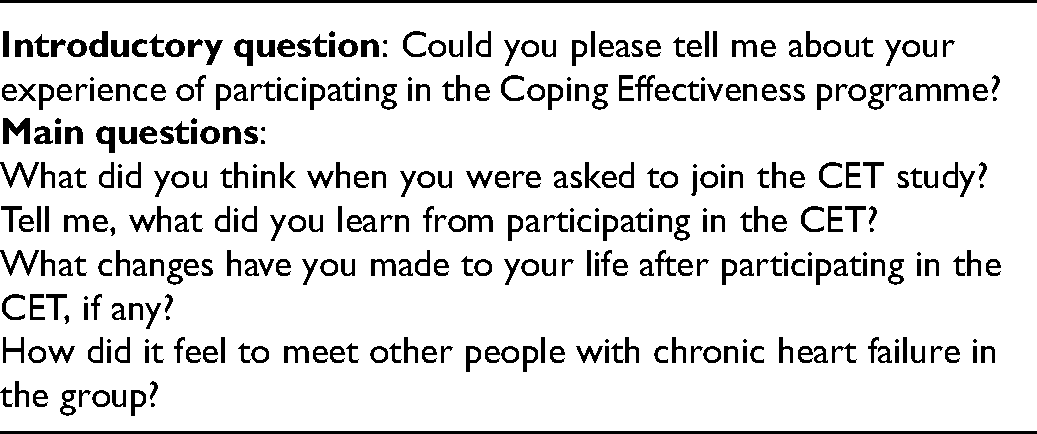
The research participants chose where they wanted the interview to be conducted, and they were either held in the hospital at the centre for nursing research or in the participant’s own home if they preferred. The interviews were conducted by the researcher, who was also the group leader for the CET groups. Some of the participants had also met the interviewer at the heart failure outpatient clinic. The interviews started with an opening question, and the discussion schedule developed for the interviews had four main questions (see Table 2). The interview times ranged from 28 to 90 minutes with a mean time of 48 minutes. The interviews were recorded on a digital device and were transferred to a computer after the interviews. The interviews were transcribed verbatim by the researcher, noting body gestures, laughs and pauses. After transcription, the transcripts were read through while listening to the recorded interviews to ensure that the transcription was correct and to ensure reliability. During this process, some minor corrections were performed.
Discussion schedule.
Analytic process
An inductive reflexive thematic analysis, as described by Braun and Clarke, was employed to analyse the data.18,19 The transcripts were read several times to become familiar with the material. Notes about potential codes interpreted from the text were made in the margins. The extracts from the codes were then gathered and verified against the codes. After this process, subthemes were generated by grouping similar meanings of the codes into a subtheme. The extracts and codes were verified against the subthemes. Finally, themes were generated from the subthemes by comparing similarities and differences. The extracts, codes and subthemes were then verified against the theme to examine whether there was a logical pattern. The themes were also checked against the entire data set. Each step of the generation of codes and themes was first carried out separately by the two researchers who then reached consensus through discussion. The analytic process was iterative, where changes were made in each step throughout the entire process. Table 3 gives examples from the analytic process.
Example of the analytic process for one theme.

Reflexivity
In a reflexive thematic analysis the researchers’ subjectivity and preunderstanding is seen as a resource. 19 The researchers had a preunderstanding of the intervention as they had adapted the intervention to the CHF population and that they had led the intervention. The first author has extensive experience of working as a nurse with patients with CHF and has a preunderstanding of what these patients bring up concerning their life situations. The second author is a psychologist and has a preunderstanding of coping processes.
Ethical considerations
The participants were informed verbally and in writing about the purpose of the study, its confidentiality and their right to withdraw at any time. The responders were asked for permission to record the interviews. Written informed consent from the responders was obtained before the interviews. The interviewer had a referral list in case any questions should arise, i.e. about follow-up at the clinic or if participants were feeling depressed and wanted to get help. In these interviews the referral list was not needed. The study was approved by the Research Ethics Committee at Karolinska Institutet, Stockholm, Dnr 2013/733-32 and conforms with the principles outlined in the Declaration of Helsinki. 20
Results
The experience of participating in the CET programme, as narrated by 11 participants, is presented as three themes and eleven subthemes (see Table 4).
Overview of subthemes and themes.

Rewarding but challenging to meet other people with heart failure
The core of this theme is that participants experienced complexity in the social exchange in the group meetings.
Positive to meet others in the same situation
There was an expectation that it would be exciting to meet and listen to other people with the same problems and to obtain new impressions. Someone expressed a wish to discuss with persons other than next of kin. They reflected that it was interesting and fun to meet other people with heart failure and to hear their experiences. There was a give and take of sharing experiences such as symptoms, taking medicine and medical history as well as sharing strategies, for example, looking at the situation with humour. A prominent finding was that meeting other people with heart failure gave a sense of not being alone with the condition, and this was seen as a source of support. But positive is that you recognize a lot of what they say and you get some connection that others are in the same boat. That could be a support or a security. (Participant 3)
In general, participants felt positively about participating in the course, and the meetings were pleasant. Even if some thought they did not have any direct benefit, they still appreciated the meetings. It was seen as mentally stimulating to participate. Having a mix of men and women in the group was also seen as positive, as it was believed that men and women think differently and thus could learn from each other.
Compare oneself with other people
A dominant finding was that the participants compared themselves with the other participants who they regarded as being in a worse state or who they felt were coping with the situation in an inferior way. It could be that others had a worse level of heart condition or were suffering more or that stress could be experienced in very different ways by different persons. The comparison with others gave participants a sense of being in a better state. It turned out that I was medicating relatively little compared to what most of the others did and so … So … yes … yes but it might have given a feeling of that … I still had a bit of luck that I wasn’t affected more and so … also a little so … I understand that this kind of ailment … so I have a feeling of … how it will develop later then. (Participant 9)
There was also a tendency of having difficulties relating to the others because of the sense of being in a better state and the perception of not sharing the same problems and experiencing the situation differently; that one was not fitting into the picture and not truly belonging to the group. Despite these feelings, it was still possible to contribute possible solutions when, for example, discussing different problem scenarios. Furthermore, it was mentioned that others were talking about fear of the future which oneself did not feel and that others were excessively complaining about their situation. In contrast, feelings of empathy towards other participants were also expressed.
Time distributions of the discussions
There were some contradictory experiences of the group discussions and the time set aside for them. On the one hand, there was a feeling that the group had come as far as it could with the meetings. On the other hand, some expressed that there was not enough time to open up and discuss the themes of the sessions because once you got to start talking the session was over. There was a perception of not knowing enough about the other participants as it takes time to get to know each other. It could feel empty to finish the course and some wanted to have a reunion to wrap it up. Eh … yes I thought it was good but too short. I would have liked to have more time and … yes maybe get to discuss more in the actual group because it takes a bit of time before you get to know those who are in the same group and … yes, I felt at the end that … no but now it is almost finished … so that … that I thought was a bit sad … then if it should be more days or longer time … but that it should … you should take part more in any case. (Participant 6)
An intrapersonal conflict could also arise about wanting to take up space in the group to share your story and not disturb others by taking up too much space. This worry was not unjustified, as there were also expressions that some took up too much space and talked about irrelevant matters. However, when one got to share the medical history, it was felt to be a release.
Reflections and existential thoughts
Existential thoughts were something that was raised spontaneously by several of the participants. Meeting others in the group brought up questions about the current situation: How did I end up here? How dangerous is this condition and can you live with it? It also gave insights into the future that one has to slow down the pace. Several expressed knowing that life would come to an end soon but were hoping for another five to ten years retaining their mental capabilities. Even though some participants expressed fear of death, there was still a notion that this subject was not raised as much as might be needed considering death could be seen as the greatest stress factor of them all. Eh I remember we … I mean … we talked about … It was some time … so … I think I mentioned something about fear of death then. We never talked about it really. Even if you might believe it was the most stressful situation for all then … that it was closer than otherwise. Eh … but we looked at each other and everyone seemed to cope decently … mm … I don’t know if it was that … we avoided that question … (Participant 9)
It was expressed by others in the group that heart failure was an uncurable condition. Some participants reflected that they were aware of this themselves, and the feelings were an ambiguous mixture of recognizing that it was sad but also not reacting too strongly to it. Accepting heart failure and its incurability was mentioned as a way of coping with the awareness that heart failure is a serious condition.
Help others
There was a will of wanting to contribute to helping other people with the same condition. By participating, it was hoped that others would benefit and that it would also be beneficial to research. This fostered a sense of satisfaction and gratitude. … as I said have I with my way of taking part … been able to contribute … to … to help research and to help other people's eventual suffering then I have got the satisfaction I can feel and that I believe I feel … I feel a certain satisfaction of participating in this even if I do not feel sick in any way … anything that can help others to have it better … (Participant 1)
Participants thought they could contribute by sharing their experiences, such as their medical history, and by giving advice about how to cope with different situations. For instance, some wanted to help other participants who seemed afraid, by giving their own example to help calm those who were worried about how much they could exercise or how they should act in an acute situation.
Improved conditions to cope with stress
The core of this theme is that participants experienced personal benefits in relation to their handling of their heart failure in the course content and/or the course material.
Learned coping strategies
Before starting the course, participants had an interest in what the course would be about and whether it could be beneficial to themselves. There was an interest to find out ways of coping with stressful situations that arise. Many participants expressed that they learned strategies and a variety of coping strategies were mentioned, both at a general and at a more specific level, addressing problem-focused and emotion-focused coping. Participants described learned strategies such as dealing with things and not procrastinating; thinking differently, for example pausing to reflect; and dividing tasks so as not do everything at once; learning to calm down instead of getting angry in a stressful situation and thinking about what the causes are for stress and how they can be reduced. Yes, to go through the situation and to find out what makes … gives med stress. What do I get stressed by? Try to take away that situation in some way or reduce it in some way if you can. Then the stress reduces as well. And yes, then you got some good advice as well at the same time. How should you cope with the different situations … So that … that was good. (Participant 8)
The learned strategies were also about devoting more time to self-care, such as exercising and thinking about diet, and to setting aside time, so you could plan to reach a goal. Creating more time for yourself by being more assertive and saying no to requests was also mentioned. Finally, some took a more active part in obtaining social support, such as contacting friends, family, and healthcare services. There was a tendency that participation in the course had led to changes in participants’ lives; they felt they were helped and that it was beneficial because they found means to divert themselves, and pinpointing things made them think differently and slow down the pace.
Benefits of the course material
Among those who had used the course material during and, in some instances, also after the course, relaxation training by means of a compact disc was mentioned as interesting and rewarding. The instructions on the compact disc helped participants to wind down at night, for example, when it was difficult to fall asleep. It was also pointed out that it takes time and patience to learn how to relax. The workbook in the programme was talked of as helpful after the course, for example, as a general reminder of the content or of what you have written down and reasoned about; for example, how to break down situations. Both during the course and after, the workbook could guide participants to new ways of thinking. Well, it is good in the way that it is a structure and … may use a word that isn’t so fun … forces you to think in the ways that are necessary … (Participant 2)
Strengthened self-efficacy
There was an expectation that was met of having tips about how to live in a sensible way and how much participants would dare to exercise. Some participants thought that they had learned that it was possible to live well with the condition, learned more about personal qualities and prejudices and become more aware of bodily changes and personal fitness. For some, a personal view about how to deal with situations in a structured way was strengthened, and thereby confidence was increased. Although one might not identify as having worries, there was a feeling of being safer. Yes, it is difficult to say … I don’t know … [pause] Yes but perhaps you sort of feel that you feel a bit safer and that you have a bit of back up or what I should call it … yes … perhaps there is a bit there. (Participant 7)
As a consequence of the course, someone had started to find information for themselves. Some participants also pointed out that it may be good to be prepared for the future when health might deteriorate; if things become difficult and scary, it might be an alternative to go back to the workbook and the relaxation compact disc.
Not relevant to me
The core of this theme is that participants experienced a lack of personal relevance or usefulness in the course content and/or the course material.
No benefit
Some had low expectations before the start and one participant attended only because the course was given near the person's home. There was also a view that the group was primarily a data source for the researchers. A clearly expressed view was that there were no changes in personal behaviours or health due to participation in the course. As an explanation for this view, it was said that there were no personal benefits regarding the person's own heart failure and how to handle it, for example, because there was no direct advice. Additionally, some thought they already had efficient ways to cope with stress before the course, learned through the years, for example, by a systematic problem-solving approach or relaxation experiences. Furthermore, some did not view themselves as stressed, worried, or troubled, and there was a feeling that the course did not strike a chord with them. … I have never really felt that I have been stressed … huh and that. Maybe a part of the experience was that it sort of passed me by as far as I am concerned. (Participant 9)
Further reasons for not finding any personal applications of the content of the course could be that the person wanted to handle problems in his or her own way and not according to a prescribed method, such as in the course workbook. Another reason for thinking that the course content was not applicable to personal circumstances was a difficult living situation, including responsibility for a disabled relative, resulting in the person having the chance to think about the strategies in theory but not apply them.
Diminishing the heart failure
A central view in this subtheme was not feeling ill from heart failure and that heart failure was downplayed. There was no actual notice of symptoms or limitations due to the disease. Although some participants recognized that they became tired faster than before and did not have the same energy, it was not seen as a limitation, merely an ascertainment, and they attributed the problem to ageing or medicines. Because of a lack of perceived health problems, they judged their own personal health situation to be less severe. These perceptions and judgements could co-occur with a wish not to be ill or a general view that heart failure could be a natural consequence of having lived or that it is just a natural occurrence. If a stress experience was discussed, it was linked to present or previous working conditions. In addition, these participants mentioned that they had other diseases and health problems, such as chronic pain, that were seen as more noticeable or troubling. I think it is the asthma every time I feel anything, and I have not … I don’t think that I have had anything that is dangerous. (Participant 5)
There was also a tendency for participants to talk about having had atrial fibrillation and not to mention heart failure, or for typical symptoms from heart failure to be mixed up with being caused by atrial fibrillation.
Not applied material or techniques given in the course
Some had not used the compact disc and/or the workbook. Some of the participants had forgotten about the content of the workbook, so it was difficult to say what they thought about it. There was a tendency that the part of the workbook containing home assignments was not so good as it reminded participants of school homework and you were sitting alone with it rather than discussing the assignments in the group. Reasons for not using relaxation (or the compact disc) were lack of time, relevance, and difficulties calming down. And I couldn’t when we sat there and tested when we sat there all of us and you read huh and everybody sat there and closed their eyes and tried. I thought they were pretty good at it. I also sat and did what you were supposed to but was in a totally different place in my head too. Yes, I could not relax I can’t do that. (Participant 10)
Discussion
The main purpose of the study was to explore the experience of participating in a psychosocial intervention addressing coping skills in patients with CHF one year after completion. Three themes were generated in the analysis: rewarding but challenging to meet other people with heart failure, improved conditions to cope with stress, and not relevant to me.
To meet other people was seen as both rewarding and challenging. It was positive to meet others in the same situation, leading to a feeling of not being alone with your experiences. Similar results have been found in other studies in people with CHF who have participated in group interventions.21,22 Sharing experiences with others is a source of social support and provides a sense of validation for people with CHF. 23 In contrast, the participants in our study not only identified themselves with the other participants but also compared themselves to others who had it worse, which gave a feeling of being in a better state. A similar phenomenon has also been described in other research involving group interventions for people with CHF. 21 Feeling better by comparing oneself to a less fortunate person is in line with the downward social comparison process suggested a number of years ago. 24
Another complex aspect was the amount of time one could take in the group meetings. There was a need to tell your story, but at the same time a doubt over how much time could be spent on doing that. This could imply that the participants should be further encouraged to speak at the group meetings. Nevertheless, it was a challenge to keep the discussions relevant to the themes in the intervention. Follow-up sessions were also suggested as an improvement to the intervention. A CET programme among patients with HIV included maintenance sessions, 11 however, as the adapted CET intervention for CHF was based on the shortened version for patients with spinal cord injuries that did not have maintenance sessions, 12 maintenance sessions were not included.
Meeting other people in the CET intervention evoked existential thoughts and this was raised spontaneously by several of the interviewees. Most of the participants were in NYHA class II, meaning they only had mild symptoms of heart failure and slight limitations in physical activity. 1 Despite the fact that they had a milder form of CHF, existential aspects were prevalent for them. When existential aspects in CHF are highlighted in research, they mainly include people with advanced heart failure in NYHA classes III–IV.25–28 Although some research about existential issues in CHF does include people with milder forms of CHF,29,30 this could be an area to explore further. Implementing discussions on existential thoughts could be an aspect to take into consideration when designing psychosocial interventions for people with CHF, even if the participants do not have an advanced stage of CHF.
In contrast to acknowledging heart failure as a serious condition, it was also found that participants diminished the importance of heart failure. Research has highlighted the complex situation of people with CHF and the fact that they have a need to experience their lives as normal where normalizing symptoms is part of that process.31,32 Our results also found that participants sometimes referred to illnesses other than heart failure. Multimorbidity is very common in patients with CHF, 33 which brings additional intricacy to their situation that could be taken into consideration when adapting a psychosocial intervention for patients with CHF.
The results showed a variation in what patients experienced they had learned, as seen in the themes improved conditions to cope with stress and not relevant to me. Similar results have been found in short patient feedback when CET was applied to patients with spinal cord injuries. Some felt they had got help, and some did not think they had experienced any benefit. 12 Studies with in-depth qualitative evaluation of other psychosocial interventions also display this difference in experienced benefit in patients with CHF.21,34 These findings are important in order to make improvements in interventions, yet present a great challenge to fit everyone's needs. The CET intervention presents various coping strategies, so it addresses the psychosocial complexity in humans – even though our findings suggest that this could be highlighted to a greater extent. A digital or hybrid format for a psychosocial intervention could have the potential to include more people in different situations. Globally, the use of digital health interventions is on the rise, 35 yet, we believe it is still important that participants get an opportunity to interact with their peer group. Applying a codesign involving the intended group of people could be a successful approach for developing and adapting interventions if done with critical reflexivity. That means that researchers reflect on their own standpoint, the system where the codesign process will occur and have an equitable collaboration with the people involved. 36
Strengths and limitations
A strength of the study is that it provides in-depth information on how the participants experienced the intervention. However, there were some difficulties retrieving memories from one year ago. If the interviews had been conducted earlier, this might not have been a problem.
The study included participants who had participated in at least five of the seven sessions. Including participants who had participated in fewer sessions or dropped out of the intervention could have provided valuable information. The interviews were performed by the same person who was the group facilitator. This might have led to a social desirability response bias. However, the results showed a variation in perceived benefit, which could indicate that the informants were confident in giving less socially desirable responses. 37 As the informants were familiar with the interviewer, this might have resulted in richer material, as they might have felt more comfortable talking to a person they were familiar with. We believe that the authors’ preunderstanding provided a synergy in highlighting the core of the narratives. To enhance the credibility of the study, two researchers performed the data analysis. Examples of the analytic process are tabulated and data extracts are presented in the results section to support the findings. A description is given of the informants and the data collection. Parts of the results of this study could be transferable to the heart failure population in general undergoing a psychosocial intervention when it comes to aspects such as meeting other people with heart failure.
Implications for practice
The findings provide implications of what could be important to further develop in a psychosocial intervention for patients with CHF, not just the intervention in this study. Existential aspects could be incorporated even if the patients do not have severe CHF and recognizing that many patients have comorbidities. Further studies could investigate existential issues in patients with mild to moderate CHF in more depth.
Additional implications could concern follow-up sessions that could be valuable for maintaining the effects of the intervention as well as applying a codesign to further adapt the intervention.
Conclusions
There were some benefits of participating in the CET programme experienced one year after completion of the intervention. Some participants expressed that the problems and situations raised in the intervention were not relevant to them and diminished the importance of CHF. It was considered rewarding to meet other people in the same situation. The CET programme provided a sense of belonging and relief for the participants and it indicates that a group format is favourable for a psychosocial intervention.
Footnotes
Acknowledgements
We would like to thank the participants in the study.
Author contributions
CNB and ME were involved in design/planning. CNB collected data. CNB and ME performed the data analysis and were involved in manuscript preparation.
Funding
This research received no specific grant from any funding agency in the public, commercial, or not-for-profit sectors.
Conflict of interest
The authors declare that there is no conflict of interest.
