




Abstract
Alongside a globalized world and a demographic shift in Sweden, future nurses must provide globally significant nursing care based on relevant knowledges and skills. To contribute to the global nursing discourse, this article aims to describe the process undertaken in developing and implementing a global nursing approach and curriculum in the Swedish Red Cross undergraduate nursing program. A comprehensive process of educational change was carried out, targeting both faculty and students with various academic activities. The new global-oriented curriculum was evaluated positively by nursing students, and a definition of global nursing was disseminated among educators. Nursing students at the Swedish Red Cross University College are now encouraged to advocate for vulnerable persons in need of healthcare services and to counteract inequalities and social injustice in sustainable ways. It is suggested that a global nursing framework is what is required when educating nurses to meet tomorrow’s nursing care needs.
Keywords
Background
Recently, the world has witnessed one of history’s most comprehensive flows of refugees in modern times. 1 People from Syria, Eritrea, Somalia, Afghanistan, Iraq and other countries have been searching for protection as they have fled war, violence and persecution. Globally, Sweden is one of the countries that has welcomed these people and has been caring for them and giving them refuge. 2 These demographic changes, occurring around the world, influence Swedish society and place new demands on its various institutions and support systems. Among these, one of the more important institutions is the healthcare sector. This is where people turn to when they suffer from poor health, physically or/and mentally, sometimes in relation to what they have experienced when they have fled for their lives. 3 These people and other healthcare seekers are in urgent need of professional medical and nursing care, in several instances, within the care system. 4
Registered nurses, henceforth referred to as nurses, have a responsibility to provide quality nursing care based on both evidence and proven experience. To meet people’s various care needs, nurses must have up-to-date knowledges and skills related to global issues. 5 According to the literature, global nursing corresponds to the challenges of human vulnerability and inequity caused by conflicts and demographic changes. Consequently, the undergraduate nursing program has to contain broadened fundamental knowledge on areas such as economics, demographics, politics and social constitutions that may affect the lives and health of the people seeking care. 6 Technological development, as well as policy changes over recent decades, have also increased the meaningfulness and implications of global nursing. Accordingly, a more global approach, with its concepts and perspectives, may be valuable in nursing education programs.5–8 As global competencies have had to be developed, nursing science has partly gone through a deconstruction of long-held nursing values, nursing faculty knowledge and nursing policies. The rethinking and rejuvenation of both nursing education and research have also been highlighted as important aspects when creating conditions for future nurses to think globally and act locally.5,9–25 Moreover, to identify and overcome power hierarchies that sometimes dominate nursing care relations and influence the way in which nurses provide nursing care, nursing education has been challenged to adopt a critical stance as well as to encourage norm criticism, and to include critical awareness as a part of the global nursing approach.5,26–27
Nevertheless, nursing science in the 21st century still seems to have some difficulties in adjusting to the globalized world, both in theory and in practice.18,21,25,28,29 This perhaps explains why few attempts have been made to describe the process of developing and implementing a global nursing framework in nursing education contexts. To contribute to the global nursing discourse, this article aims to describe the process undertaken for developing and implementing a global nursing approach and a global nursing curriculum in The Swedish Red Cross undergraduate nursing program.
A global nursing framework
In this article, we will present the process of developing and implementing a global nursing framework at The Swedish Red Cross University College (SRCUC). The process will be described in three time phases, which, in reality, were overlapping and dynamic. Initially, a brief description of the educational context will be provided. Thereafter, the development and implementation of a global nursing framework consisting of two orientations will be described. One orientation dealt with educational activities targeting faculty members in order to achieve a didactic global nursing approach among them. The other orientation focused on the revision of the undergraduate nursing program based on a new global nursing curriculum. Inspired by Parcells and Baernholth, 23 the process of educational change will be described in an interlaced and interactive way, reflecting its flowing characteristics.
The educational context
As one of the world’s few Red Cross University Colleges, The SRCUC plays a crucial role in educating nurses to support them in alleviating suffering, safeguarding human dignity and contributing to health locally as well as globally. 30 The SRCUC is a state-funded self-governed university college owned by The Non-profit Foundation, which is affiliated with The Swedish Red Cross. The SRCUC is governed by the university board, of which representatives from The Swedish Red Cross, scholars from other universities and representatives from the county council are members. The SRCUC is situated in a campus in a suburb, south of Stockholm, in a newly built building that it shares with the Royal Institute of Technology (KTH). The SRCUC has educated nurses since 1867, and, today, 70 teachers, scholars and administrative staff work there. In total, about 880 students are enrolled in a first- or second-cycle program. The undergraduate nursing program leads to a bachelor’s degree in nursing science and a professional degree. Each specialist program generates a master’s degree in nursing science. The undergraduate nursing program consists of six semesters and includes both theoretical and clinical education situated within a variety of healthcare settings. The nursing program comprises 180 credits in total, based on full-time studies. Nursing science covers 90 credits, in addition to those of the supporting subjects of medicine and public health sciences. The university college’s educational activities partly rest on the basis of The International Red Cross tradition in terms of its basic principles. These are humanity, impartiality, neutrality, independence, voluntary, unity and universality. The basic principles are recurring and important aspects reinforced throughout the nursing education program in various ways. 31 Additionally, internationalization and international exchanges among students and teachers have been, and continue to be, a priority educational issue as part of the manifestation of a global approach in the undergraduate nursing program. The SRCUC has a long tradition both of sending teachers and students on exchange as well as receiving peers and students from various parts of the world as a natural element of the educational context. 32
Time for change – a turning point at the SRCUC
After a national review and scrutiny of the undergraduate nursing program at the SRCUC in the year 2000, it was found that the global nursing profile area of the curriculum at that time was neither clear nor sufficient. It was unclear how the global approach, based on The International Red Cross basic principles and previous research on global nursing, were articulated and operationalized through the nursing program. Based on these notable results, the management of the SRCUC decided that there was a need for a well-defined global nursing profile area, and that this would be developed and implemented in a rigorous and systematic way in the undergraduate nursing program. Somewhat later, a shared vision with a focus on globality and health, updated strategies for pedagogy and research, and a ‘roadmap’ were outlined and launched at the university college. This initial outline constituted a solid foundation on which to build the process of educational change. This was also the turning point for the development and implementation of a new global nursing framework at the SRCUC, as illustrated in Figure 1.
Overview of the educational process of change.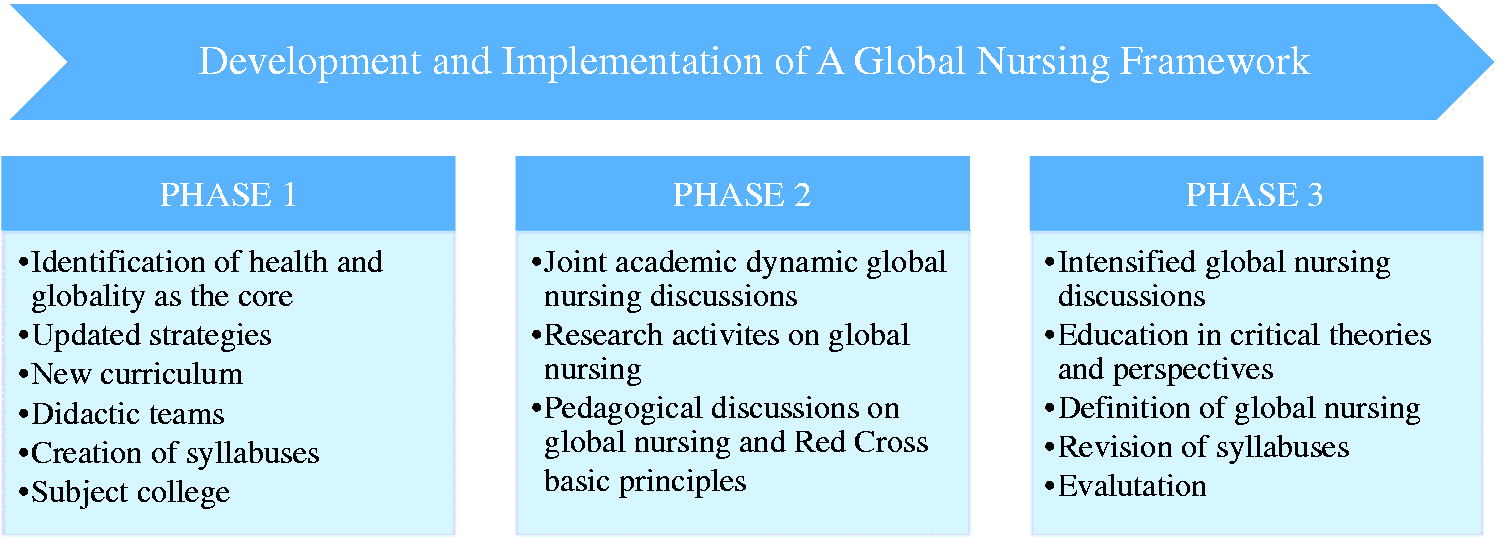
Method
Development and implementation of a global nursing approach and a global nursing curriculum
In the first phase, the issue of globality was identified as being the core and future of a global nursing framework and was prioritized in the development of the undergraduate nursing program. The framework was outlined by senior scholars, taking into account The International Red Cross tradition and its humanitarian values. The former and rather traditional undergraduate nursing program, in terms of course length and theoretical nursing foundations, underwent a transformation and assumed a new form, with the focus placed on globality and health. The new design of the nursing program still consisted of three academic years, but with clearer themes for globality and health anchored in each year, including courses spanning the entire program of six semesters. The senior scholars presented the new global nursing curriculum and its themes to all academic members of the faculty. In relation to the new global nursing framework, teachers and researchers in the undergraduate program were formed into three didactic teams to elaborate on syllabuses, learning objectives, examinations, relevant course literature and didactics. The didactic teams continuously discussed questions that were related to the design of the new nursing program and also actively participated in creating syllabuses for each course. In parallel to this work, a subject college in nursing was established, which provided training to teachers and researchers teaching in the nursing program. Seminars and workshops were organized and led by a deputy head of nursing care and were designed to inform faculty members about the content of the new global nursing framework and comprised educational activities related to the curriculum, assessment and course materials.
In the second phase, the faculty met every other month in the subject college from September 2014 to August 2016. The faculties sought to create a sustainable foundation for a new global nursing approach at the SRCUC. Through dynamic discussions, the teachers and researchers reflected upon important components of global nursing and how they could be applied and operationalized in the undergraduate nursing program. Selected activities included brainstorming on global nursing attributes in education and practice, reviewing published empirical research related to global nursing education, sharing educational experiences in nursing from those who participated in international teacher exchanges and from international conferences, and by engaging in joint activities in pedagogical skills for teachers and researchers. As a result of the discussions and activities related to global nursing in the subject college, an idea emerged to participate by presenting a poster at the International Human Rights and Health Conference, arranged by the SRCUC in Stockholm on 26–27 November 2015. This was accomplished, and the current view of global nursing, at that time, was presented. The poster also constituted the foundation of a forthcoming paper on global nursing.
A significant part of this phase involved discussions in the didactic teams about existing paradigms in guidelines relating to nursing education in Sweden, the nursing discipline, didactics, and how to deal with traditional nursing aspects in the previous curriculum that may also be relevant in the new curriculum. Discussions about the basic principles of The International Red Cross and how to elaborate and integrate them in the new curriculum also took place. Challenges and possibilities were identified and declared among teachers and researchers. It was clear that the humanitarian values had to be more visible throughout the whole nursing program and not only presented in a fragmented way. Furthermore, a joint idea, which emerged over time among academic educators and researchers who participated in the subject college, was to produce a scientific publication identifying and highlighting important aspects of global nursing based on previous research. A systematic literature search was conducted with the assistance of a librarian with the following major search headings: ‘career mobility’, ‘congresses and conferences’, ‘education’, ‘ethics’, ‘evidence based’, ‘expert nurses’, ‘faculty’, ‘international’, ‘interinstitutional relations’, ‘international nursing’, ‘international relations’, ‘interprofessional relations’, ‘health policy’, ‘leadership’, ‘long term care’, ‘nurse administrators’, ‘nurse–patient relations’, ‘nurses’, ‘nursing’, ‘nursing leaders’, ‘nursing manpower’, ‘nursing organizations’, ‘nursing practice’, ‘nursing shortage’, ‘nursing theory’, ‘nursing workforce’, ‘organizational culture’, ‘personnel recruitment’, ‘professional development’, ‘registered nurses’, ‘research’, and ‘world health’. Additionally, in the faculty brainstorming sessions, discussions and seminars, the highlighted topics were: ‘cross-cultural communication’, ‘equal care’, ‘digitizing’, ‘diaspora’, ‘global perspectives’, ‘health literacy’, ‘intercultural competence’, ‘language’, ‘sustainability’, and ‘transcultural nursing’. Retrospectively, this literature search demonstrated that the understanding of globality and global nursing at this point was in some sense broad and tentative among educators and researchers. After the conference in November 2015, a literature review based on a descriptive data synthesis of previously reported findings on global nursing research was conducted, which was published in April 2017. 6
In the third and still ongoing phase, the faculty in the nursing department have met once a month to participate in collaborative discussions, from September 2016, now with the new deputy head of nursing science. The work and academic discussions of the nursing subject college were intensified to reach a possible definition of the SRCUC’s subject profile area of global nursing. Excluding the literature that we read and reflected on in the article by Kraft et al., 6 other relevant scientific texts about globality, global nursing, inequity, social justice, vulnerability, sustainability, ecology and health prevention were discussed during the scheduled academic session.5,20,26,33–37 At this time, we found that the discourse of global nursing had begun to develop and had become more distinct in relation to what it had been in the past. There were some particular aspects that the faculty in the nursing department took into account. These were the vision, the existing definition of the nursing subject, the new curriculum and the pedagogical strategy at the SRCUC. In line with the content of these guidelines, the direction of the subject dialogue had to focus on the college’s connection to The Red Cross movement, a theoretical global nursing point of departure and a norm critical pedagogy. This new direction was presented by the new deputy head of nursing science and more directed academic activities were held in relation to this orientation. For example, The Swedish Red Cross visited us and presented their organization’s humanitarian strategy. Continuously, the teachers and researchers were introduced to and reflected upon critical theory and perspectives such as intersectionality, postcolonial theory and norm criticism. The choice of these particular perspectives was based on the assumption that critical theory ultimately aims to highlight inequalities and social injustice. Once identified, knowledge about unjust and oppressive structures may lead to social change. A very important aspect characterizing the academic discussions was the link to an educational practice within the undergraduate nursing program. To give an example, if we looked at film clips about norm criticism or read scientific texts about intersectionality, the discussion not only focused on the perspective itself as a theory, but also on the possibility to implement the newly gained knowledge in the classroom in encounters with nursing students. Thus, the faculty became educated in both critical theory and didactics.
Another substantial aspect in the global nursing approach was reflexivity, and it became a central and recurring concept in the syllabuses. It is crucial that students and faculty members have the knowledge and skills to be reflective in order to shed light on how we, as subjects, not only interact with each other, but also, how these interactions are connected to power and subordination. In an undergraduate nursing program based on a global nursing approach, we believe it is of great importance not to reproduce stereotype assumptions, pure prejudices or constructions of ‘us and them’. The academic assignment at the SRCUC is designed to educate and encourage nursing students to be critical, having in mind both global and local conditions. This positioning is adopted to allow nurses to be able to counteract inequalities and social injustice in general, and, more specifically, when it comes to the wellbeing and health of vulnerable people. This awareness applies both in local and global contexts, regardless of whether we encounter people in need of nursing care ‘at home’ or in other parts of the world.
After six months of directed educational activities in the subject college, the deputy head and the head of nursing science were commissioned to stipulate a new definition of the subject profile area. The existing, rather traditional, definition of the subject had been outlined during the second time phase and was now about to change and be renewed. The stipulation was that the new definition should be based on international and national research as well as reports on global nursing and nursing. It was also important that the definition had a clear connection to the basic values of The International Red Cross.
31
This was the reason the scientific international global nursing articles reviewed in the subject college and the national reports were collected and analyzed.5,20,35,38 The Swedish Society of Nursing provided assistance in finding the most relevant material they had published on nursing care.38–41 Meaning units and key words were marked in the scientific literature and were gathered in a separate document representing the core substance of nursing care and global nursing. Based on this initial result, a dialogue took place between the deputy head and the head, who, together, grappled with the various concepts. It was found that the international global nursing literature very much represented a public health perspective with regard to health prevention in communities, something that partly influenced the final definition. After a constructive dialogue, a first draft of a definition was formulated. Some core concepts changed places or were slightly developed and their internal order was reconsidered and determined. A fifth and final version of a definition of the subject profile area was provided to the management of the SRCUC for further implementation. The definition was presented in the subject college and was also shared with a group of nursing students who were studying at advanced level, as they had both educational and clinical experience of nursing care. The definition stipulates that: Global nursing is about developing knowledge about health, care, persons, suffering and ecology in local and global contexts. The subject profile area is characterized by advocacy, activism and sustainable development. This includes active use of knowledge and methods that include norm critical approaches to counteract inequalities and social injustice. Ultimately, knowledge in global nursing aims at alleviating suffering, safeguarding human dignity and contributing to health for present and future generations.
Overview of global curriculum themes and course names in the undergraduate nursing program.
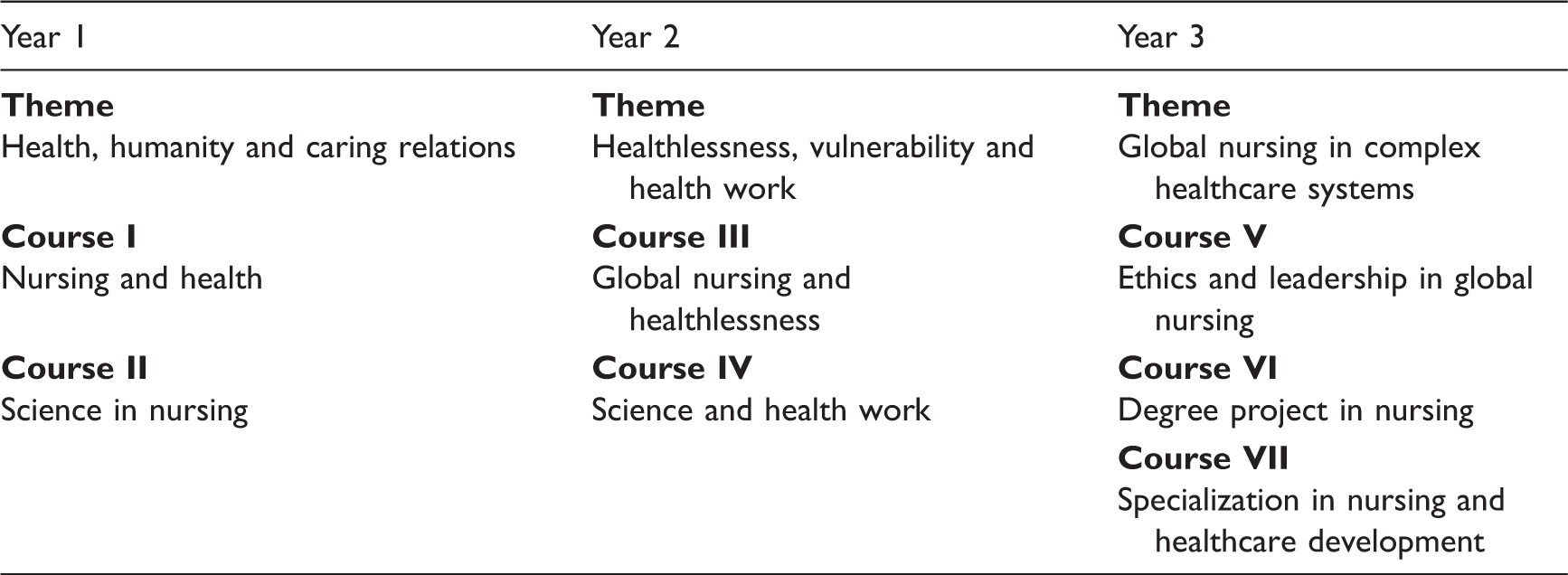
Although the current themes of the curriculum have adopted a less rigid form in comparison to those that were first presented, we believe that this reflects the process that the faculty underwent. The first course, partly integrated with the supportive subjects and on the basis of the new global nursing curriculum, was launched and delivered in the autumn of 2016. So far, of the 140 students in the first group who have studied under the new curriculum, 80% have expressed in their course evaluation that they were satisfied or very satisfied with the course design and its content. It should be noted that the response rate can be regarded as high, as 134 students responded to all seven survey items regarding course design, learning objectives, learning activities and course literature. Furthermore, the undergraduate nursing program at the SRCUC, at time of writing, is the most applied program of all nursing programs in Sweden. Because the students are considered to be the primary stakeholders in evaluating the curriculum changes, a more rigorous evaluation method was also conducted as an additional qualitative element. A student who had completed and passed the course was invited to the subject college in nursing. He represented his fellow students and presented some aspects that needed to be developed from the perspective of the students. The presentation was followed by a constructive dialogue between the student and faculty members. Based on this evaluation, it was possible for the teachers to convey a more norm critical awareness in their encounters with nursing students. It was also necessary to review the reading list choices for the course, some of which the students perceived to be old-fashioned and stereotyped. This student also expressed that, often, nursing students already possessed knowledge of these critical perspectives, which would make it possible for the teachers to challenge students with more complex questions and assignments than they had. Finally, the connection to the Red Cross movement and its basic principles needed to be made much more explicit. This kind of rigorous evaluation method will be recurring, and will include students who are further on in their nursing education.
Discussion
In a globalized world, nurses need to be qualified and well equipped with the relevant knowledges and skills to provide professional nursing care to those who are in need of it. 5 As highlighted at the beginning of this article, Sweden, among other countries, has reached out and served as a refuge for people who have fled war and trauma. 2 In the long and short term, future nurses thus must be offered a modern and globally relevant nursing education. The education program needs to be adapted to the demographic changes taking place in society and to the challenges that arise in the footprints made by these, which are highly visible in healthcare settings. 4 As a response to partly new and more extensive nursing care needs, the SRCUC has developed and implemented a global nursing framework, involving both teaching and research faculty members. The foundation of the future global nursing framework is the newly stipulated definition of the subject profile area, one that has emerged and matured during the process of educational change. The SRCUC is about to enter a new phase where the definition needs to be implemented and must permeate education as well as research. However, there are some aspects that we would now like to highlight in relation to what knowledges and skills nursing students are expected to possess in order to professionally meet glocal 42 nursing care needs in the future.
According to the definition developed at the SRCUC, future nurses need to continue to consider the traditional concepts of nursing, such as health, care, persons and suffering. The concept of the ‘human being’ has been replaced by ‘persons’ as a statement in relation to public health science’s focus on population levels. Even though nursing care is provided within communities and nurses need to be aware of and take into account the different structures in society that affect people’s health, caring relationships still focus on persons. Even the classic concept of ‘environment’ has been updated. We suggest that the nursing subject would benefit from broadening its view of the concept of environment. Shifting the perception of the environment to include ecology incorporates so much more and encourages nursing students to take into account the interaction between living organisms and the environment in which they live. Furthermore, one of the most important aspects of the definition is the inseparable binaries of local/global, or glocal, as it is referred to in previous research. 42 It is imperative that nurses are able to ‘raise their eyes’ and think globally when they provide persons with nursing care locally. We need to think long term and recognize that we are part of various contexts within which we are interdependent. Advocacy, activism and sustainability are three other concepts which will constitute an important base of the nursing students’ knowledges and skills. This is characterized by standing up for vulnerable persons who are in need of healthcare services and promoting social change when identifying irregularities that may affect people’s health negatively. Moreover, with the knowledge that the earth’s resources are finite, future nurses need to care for persons in a considerate way with awareness of how their actions influence communities and future generations. Care should thus be provided in ways that will not affect the ability of future generations to live a healthy life. Last but not least, in alignment with what The International Red Cross tries to achieve with their humanitarian work, it is crucial that nurses continue to alleviate suffering, safeguard human dignity and contribute to health. In order to be able to provide persons with the above-described qualified care, nursing students not only need knowledges but also methods. Methods, in the form of norm critical approaches, theories and perspectives, which may identify and highlight inequalities and social injustices. The aim in adopting this position is, ultimately, to be able to make a difference for vulnerable and marginalized persons when contributing to their health.
As in all processes of change, here there are possible limitations that need to be discussed. Changes take time, courage, persistence and effort. Although the faculty members agreed that the SRCUC could benefit from developing a clearer global nursing approach and a new global nursing curriculum, the task has been challenging. This has been demonstrated in the ‘change fatigue’ experienced among teachers and researchers. Nevertheless, in retrospect, we can see that our efforts seem to have paid off in the form of student satisfaction; they have signaled, at both undergraduate and advanced level, that the global nursing framework and the subject profile area are relevant and timely for them as future nurses educated at the SRCUC. It could be that the process of educational change would have been facilitated if the definition had been stipulated from the very beginning, when the senior researchers identified and launched globality as the core of the global nursing approach. However, we do not think that this would have been possible, because we needed to go through the process of educational change to gain the appropriate knowledge to be able to formulate the definition. The subject profile area thus is a result of the educational academic activities intended for educators. It can be concluded that the process of developing and implementing a new approach while at the same time conducting the daily educational activities for students on campus and in clinics is a difficult task and a delicate matter. This was revealed in how the faculty members found it tiring to participate and engage in the subject college on a regular basis, which may have delayed the development and implementation of the global nursing approach. However, this is not the end of the process of educational change, as more time should be given to implementation and, more specifically, evaluation. There is still much to develop and improve. Finally, we have shared some experiences from a comprehensive process of change and hope that our contribution to the global nursing discourse encourages more than it deters. We also hope to inspire peers to consider the need to adopt a global nursing framework when educating nurses for tomorrow’s nursing care needs.
Conclusion and future directions
Thanks to globalization and the demographic shift that is currently occurring in Sweden, the undergraduate nursing program needs to provide future nurses with globally up-to-date knowledges and skills. In response to this need, the SRCUC has presented and launched a global nursing framework, including the development and implementation of a global nursing approach and a new global nursing curriculum. As part of this process of educational change, a definition of global nursing has emerged, based partly on the humanitarian values of The International Red Cross. As well as continuing to alleviate suffering, safeguard human dignity and contribute to health for present and future generations in sustainable ways, nurses are also encouraged to give voice to vulnerable persons suffering from healthlessness and counteract inequalities and social injustice locally as well as globally. Although the development and implementation of the global nursing framework will require time, courage, persistence and effort, this is probably what it will take to educate nurses for tomorrow’s nursing care needs.
Footnotes
Funding
The authors have declared receipt of funding from the following source: The Swedish Red Cross University College.
Conflict of interest
The authors declare that there is no conflict of interest.