




Abstract
Scientific research is important in guiding the development of evidence-based, cost-effective and comprehensive healthcare. The purpose of this scoping review was to analyse the current stage of research in the field of older people nursing science based on doctoral dissertations completed in Finnish universities. Altogether 418 doctoral dissertations in nursing science were published (1990–2015), and 44 of these (11%) represented older people nursing. The majority of the dissertations focused on patient and family or nursing activities. Usual topics were care procedures and clinical nursing (36%); self-care ability, independence (23%) and existence, being and feeling as an individual person (18%). Only one randomised controlled trial was conducted. The main informants were older people (78%) who were typically interviewed or surveyed. Research in older people nursing science in Finland is focusing on traditional clinical nursing settings. More innovative research is necessary from the perspective of health promotion and technological solutions.
Introduction
Health and social services are undergoing rapid change and reforms for many reasons, 1 and populations are ageing. 2 The aim of these reforms is to offer comprehensive services for citizens that are equal, consistent and based on the best evidence. 1 In Finland, the current reform, i.e. integration of social and health services, is one of the largest to be implemented in the country, and no examples of such integration exist in the world. The Finnish Government Programme 3 has set the strategic goals, and one of these goals focuses on supporting older people's living at home and providing services at home. This integration places a strong emphasis on services that are comprehensive and readily available for individuals, i.e. social- and healthcare clients.1,4 However, synthesised knowledge about the evidence of best practices, processes and activities of all stakeholders and those involved is needed to advance these reforms, the development of practices and national well-being.
Scientific research is important in guiding the development of evidence-based, cost-effective and comprehensive practices and services. Nursing is an integral part of healthcare, as are nursing professionals as service providers. 5 Nurses need to provide evidence-based nursing using the best available research findings in order to maximise the quality of care. Therefore, nursing science will continue to build the scientific evidence base for improved clinical care and quality of care for older people. 6 However, there is an argument as to whether nursing research has been in the front line to support the integration and changes that have been and will be implemented in social and healthcare services. In the past, in the 1990s, nursing research focused strongly on qualitative analysis of patients' perceptions of their health, whereas patients' and nursing staff's perceptions of care and complex interventions to support health have, in general, been lacking. 7 Doctoral programmes are in the front line when the aim is to produce new researchers for analysing, developing and evaluating health and social services, practices, processes, content, care procedures and outcomes. 8 The current reforms are based on policy making, strategic planning and decision making. However, the focus of interest is how the reforms are supported by research results. This scoping review focuses on analysing doctoral dissertations in nursing and caring science from the five Finnish universities.
Some corresponding analysis of dissertations in nursing science has been carried out. Those analyses focused on dissertations published by particular year, 9 during certain time period7,10 or on the topic of a certain nursing area, such as nursing education, 11 history of nursing, 12 research ethics 13 or certain research methods. 14 However, analysis focusing on older people nursing science is limited.
Research priorities
Research priorities have been set in many ways in the area of older people care and services. However, the priority-setting statements are quite old. Firstly, several country-based analyses have been conducted.15,16,17 For example in Sweden research priorities were identified as being human dignity in geriatric care, respectful transfers, continuity of care and exploring the characteristics of a caring encounter. 17 Research improving clinical practice, assuring patients' well-being and a caring environment were prioritised. In China, research on care of the elderly was set as a high priority. 15 Secondly, research priorities were set based on the care settings for older people. 18 Research in nursing homes should focus on care of people with cognitive impairment, and the management of symptoms of dementia, end-of-life care, nutrition, polypharmacy, and developing approaches putting evidence-based practices into practice. 18 Thirdly, research priorities were set on specific areas of older people nursing care, such as palliative geriatric care,19,20 end-of-life, 20 stroke 21 or rehabilitation. 16 Hinshaw stated that research in older adults and their health and illness is considered highly important, and research is needed to identify older adults who are at high risk for loss of independence in daily activities or who are approaching increased dependence. 22 In a review, 23 research priorities were identified for Nordic countries, such as promoting health and well-being, symptom management and coping with chronic conditions, care of the elderly, self-management of health and illness and restructuring healthcare systems. Hinshaw identified that the care of older adults was a research priority not only in Nordic countries but also in the United States, Europe and Africa.
Wellness, promoting health and preventing illness, self-management and quality of life of those with chronic conditions are key research areas in older people care. 20 Lately the American Association of Colleges of Nursing has stated that research on complex health issues of vulnerable groups of people such as older adults is needed. 24
Background
Today, people live longer than ever before, and the number of older people is expected to increase exponentially over the coming decades. 25 Finland has one of the fastest growth rates of older people in the world. 26 In Sweden, the increase in the number of older people aged 80 years and over is expected to double by 2060. 27 Predictions show that the proportion of people aged 75 years or over is expected to rise by 59,000 (10%) by 2020 and by 61,758 (15%) by 2040. 28 Similarly, in Europe, the number of people aged 80 years or over is projected to almost triple from 21.8 million in 2008 to 61.4 million in 2060. 29 These demographic changes pose challenges for society and have implications for the provision of healthcare and social services.
As in many other countries, 30 the main goal of older-age policy in Finland is to support older people's autonomy and to help them live in their own homes for as long as possible.3,31 The trend is that an increasing proportion of older people receive healthcare and social services at home.31–33 Older people prefer to remain in their homes for as long as possible rather than to be institutionalised. By staying in their own homes they are able to maintain the integrity of their social networks, preserve environmental landmarks, and enjoy a better quality of life.34,35 Furthermore, admission to nursing homes or sheltered housing is expensive, both in terms of public and private finances.36,37 However, this does not mean that institutional care is not needed. 38
It has been stated that today, people live healthier lives than earlier generations.39–41 However, health inequalities have been found among older populations belonging to different socio-economic groups. 42 The health and functional capacity of older people is threatened due to many chronic conditions, resulting in a need for care and services. 43 However, it is important to recognise the fact that older people are not a homogenous group but one that consists of people with a wide range of ages (at the moment, 63–109 years), the majority of them relatively fit and healthy. In Finland, for example, only one out of four of those aged 75 years or over use services on a regular basis. 44
To summarise, research is urgently needed for the development of quality care and services. Reviews of published doctoral dissertations conducted from time to time may help in drawing conclusions about the state of research and the need for future research. However, research on this group of people – older people – has some special features that need to be taken into account. For researchers, involving older people in research is a challenge as some of them are vulnerable. 44 Possible demands for some additional time for data collection and the application and use of different methods may require special skills in this population. 45 Furthermore, it has been found, for example, that research on ethical issues in the care of older people is limited, 46 and that access to research sites in the context of older people care settings may be difficult.47–48 Including people with cognitive deficits and similar issues is challenging, 49 and usually, older people are excluded from the studies. 50 For these reasons, research on older people may be limited.
However, there is a discrepancy between the increasing number of older people as healthcare clients and the limited or even minor number of studies in this field. 49 Furthermore, worldwide media report poor healthcare for older people, and concerns are raised about the shortage of well-educated staff in older people care and the quality of care provided for older people. 51 Nursing research can be one tool that can make a contribution to the discussion of older people, their health, nursing care, environment and value base.
Aim
The purpose of this scoping review was to analyse the current stage of research in the field of older people nursing science based on doctoral dissertations completed in Finnish universities. Scoping reviews aim to provide a synthesis of the size and scope of research and identify the nature of research evidence for further research and for informing policy makers. The specific research questions were:
What is the focus of older people nursing science research? What methods have been used in older people nursing science research? What settings are the studies focused on?
Methods
Design and sample
This study employed a scoping literature review 52 of doctoral dissertations in nursing science. The inclusion criteria for the doctoral dissertation studies were: 1) the dissertation was focused on older people nursing or older people in general (as research informants, regarding their care and services), 2) the dissertation was published between the beginning of doctoral programme and the end of 2015 and 3) the dissertation belonged to one of the five doctoral programmes in nursing science in Finland. No specific exclusion criteria were set.
The data were gathered in three phases. Firstly, in the identification phase, the publication lists of doctoral dissertations in five universities in Finland (University of Eastern Finland, University of Oulu, University of Tampere, University of Turku and Åbo Akademi) with doctoral programmes in nursing or caring science were collected. Secondly, in the screening phase, the publication lists of doctoral dissertations in nursing science from different universities were examined on title and abstract levels and potential dissertation were selected based on the criteria set. The researchers worked independently on the first phase and discussed the results and decided which dissertations were to be analysed further. Thirdly, in the eligibility phase, the selections were confirmed in the research group.
Altogether 418 doctoral dissertations were published between 1990 and 2015 in the five Finnish universities where nursing science is taught. Of the identified 418 dissertations, 44 were selected for the final analysis in the eligibility phase. As a result of this step-by-step selection process, a systematic analysis of the remaining 44 dissertations was conducted by three researchers.
Data analysis
A systematic analysis of the 44 dissertations was conducted using a data collection sheet. The data collection sheet included: author, year, name of university, type of dissertation (monography, compilation with original publications), aim, paradigm area in nursing science (patient, health, nursing), environment according to Kim's typology, 53 target group/data, methods, setting, main goal of the whole study and other remarks. Kim's typology 53 was selected based on the comprehensiveness of the core areas in nursing science and one study could include more than one core area. This information was systematically collected on the data collection sheet and used as data for this review. The data were analysed using quantification with frequencies and percentages and content analysis by searching responses to research questions.
The abstracts of the dissertations were the sources of the information. Terms and concepts used by researchers in the abstracts with the help of dissertation title and keywords were used and no interpretations were made. Topics of the dissertations were analysed with inductive content analysis. The manifest content was analysed and the units of analysis (words or sentences) were condensed, and those containing aspects related to each other were grouped together into categories (see Table 3 in the results section).
Results
Description of dissertations
Nursing science dissertations published in Finnish universities.
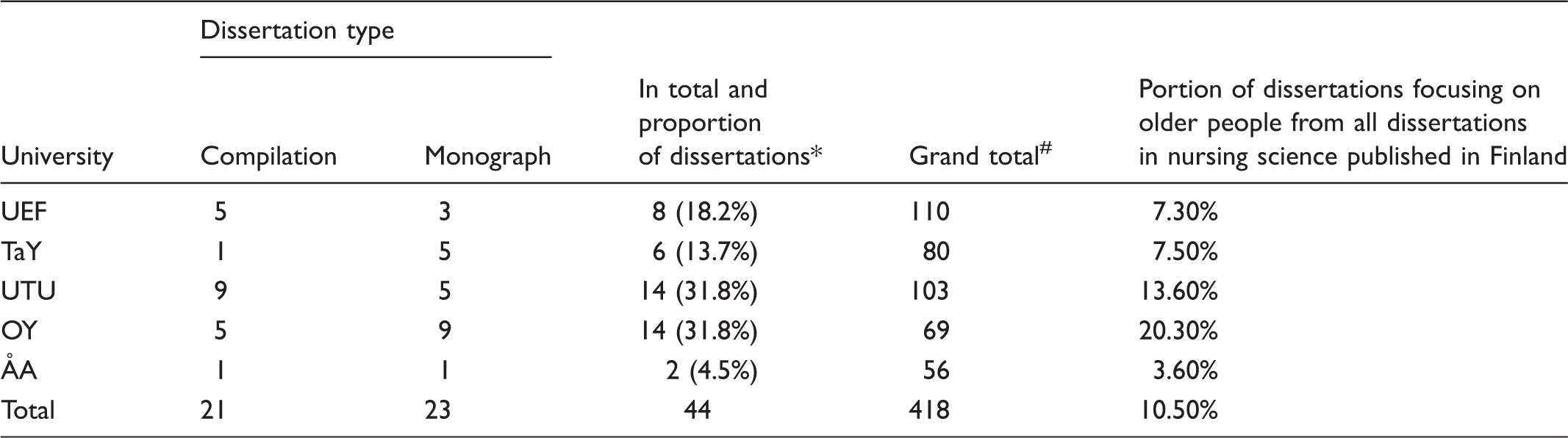
In total = dissertation with focus on older people nursing.
Grand total = dissertations published in total until the end of 2015. UEF = University of Eastern Finland; TaY = University of Tampere; UTU = University of Turku; OY = University of Oulu; ÅA = Åbo Akademi.
Focus of older people nursing science research
Type of dissertation and paradigm in nursing science.

Topics of the dissertations.

Regarding the main target/goals of the dissertations in nursing science, three dissertations included the development or testing of a new instrument such as for foot health, 58 risk assessment for pressure ulcer 59 and appraisal of self-care agency, validation for the Finnish population. 60 A more usual goal was development of a model,61–63 theory57,64 or substantive theory.65–67 One dissertation was on developing a programme, 68 and one was a randomised controlled trial of a self-care programme aimed at older people. 56 One dissertation was a historical analysis about the evolution of geriatric nursing. 69 The rest produced and generated new knowledge in nursing science focusing on issues such as the description of the phenomenon under consideration.
Informants and research methods of the actual dissertations
Informants and contexts
Informants, methods and settings of the dissertations.
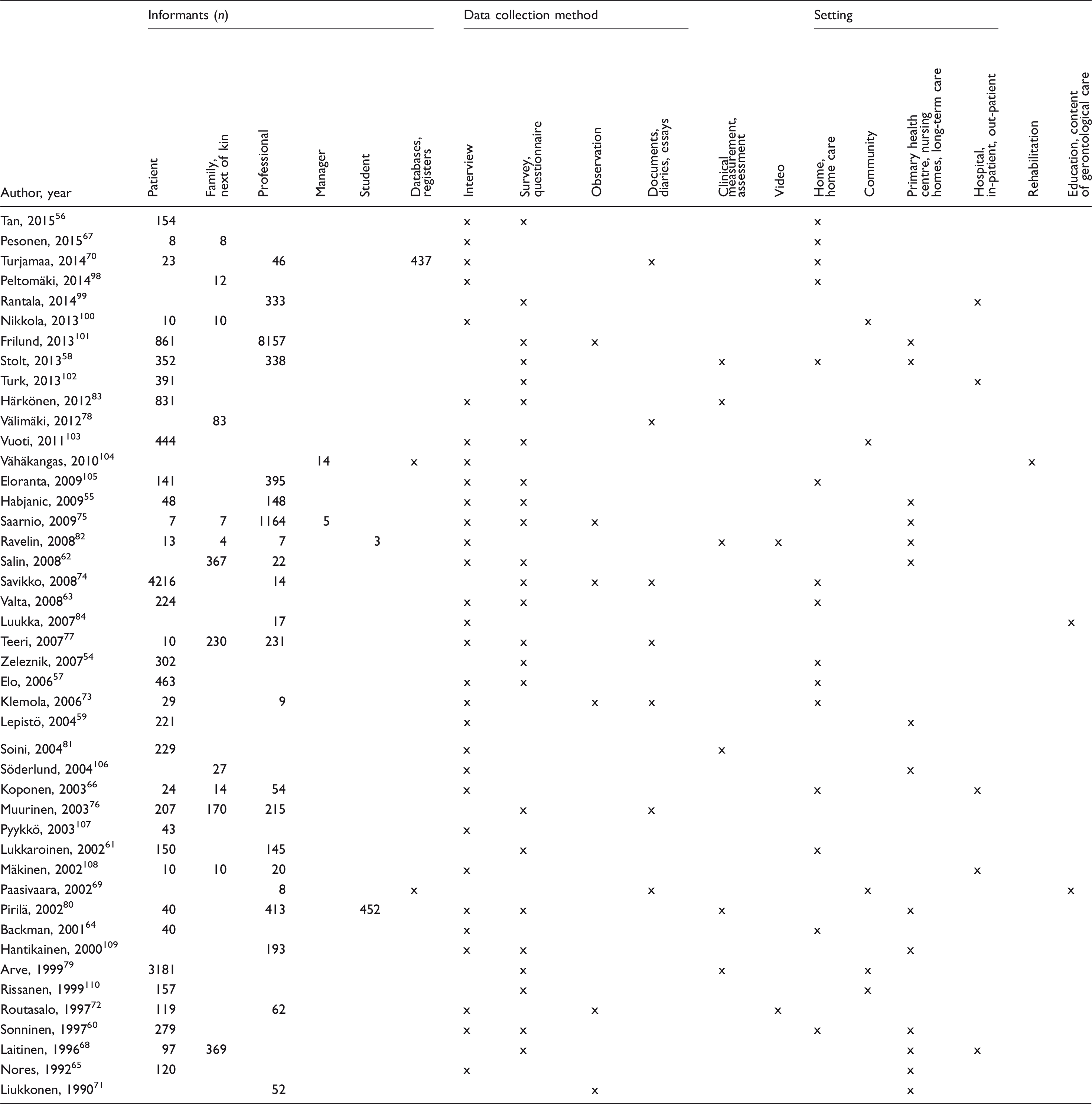
Care settings were home (n = 18, 37%) or community in general (n = 5, 10%), different institutions including primary healthcare centres, nursing homes, residential homes (n = 17, 35%), hospital settings, acute in-patient or outpatient clinics (n = 6, 12%), rehabilitation settings (n = 1, 2%) or others, such as education institutions (n = 2, 4%).
Data collection methods
As many of the dissertations were compilations of original publications they included many different methods combined. Interviews and surveys were the most-used data collection methods. Observation was used in some studies.71–75 Written texts such as documents, diaries or essays were used in some dissertations.69,70,73,74,76–78 Clinical measurement or assessments were used in some studies.58,79–83 Videotaping was used in only two studies.72,82
Discussion
The analysis of the Finnish doctoral dissertations in nursing science revealed the limited number of studies focusing on older people and the care settings of older people. These dissertations were mainly from two universities, Turku and Oulu. Most often the research informants were older people, their relatives or different professionals, many studies including several informant groups.
Using older people as informants in these studies can be judged as being important and appropriate for the development of services for individual people aimed at in many strategies.1,3 In Sweden, Bäck-Pettersson et al. 17 revealed essential areas for future patient-related nursing research and found that the most highly ranked areas of nursing research were preserving human dignity in geriatric care, respectful transfers, and continuity of care and exploring the characteristics of a caring encounter relative to patient welfare, the healthcare organisation and the nursing profession. Based on our review the societal viewpoint was largely missing from the dissertation topics. However, there is an argument as to whether nursing research is otherwise focused on the most appropriate issues in current healthcare, as a minority of the studies dealt with the service systems and their effectiveness. None of the studies focused on cost-effectiveness. Another criticism besides the topics is the use of small and often also regional samples, which are neither representative or generalisable.
Based on the results, there is a need for future research where both nursing educators and students are included in the focus. Only one study focused on nursing education regarding older people. Luukka 84 investigated meaningful learning experiences of the newly graduated practical nurses in older people care. A study by Deschodt et al. 85 reported that knowledge, competencies, and attitudes necessary to care for older people are urgently needed, but that the complexity of the topic is not recognised. Research on education of nurses needs further recognition. Potter et al. 86 recommended that it would be valuable to conduct a longitudinal study using education sessions and tools to explore students' values and beliefs in relation to gerontological care over the span of their nursing programme. In Europe there is growing concern as to how to get a sufficient number of motivated and qualified nurses to work with older people both in the community and in hospitals. Nursing educators have enormous potential when it comes to raising the profile of care of older people by preparing and supporting students. 87
Two main target settings were used: home and similar settings, and institutional care settings. Research in home and community settings is urgently needed as care is strongly moving out from institutions to homes.1,3,4 International research has shown that as people and generations are getting older, there is a strong increase in the number of the oldest old, but also vulnerability and frailty is apparent in the lives of older people.29,31 Thus, early support for a healthy lifestyle, health education and prevention of diseases is needed.39–41 In addition, other important aspects/areas of life need to be taken into serious consideration, such as culture, art, and recreational activities in society, arenas and care settings for older people. 6
The concepts used in the doctoral studies were very general in their nature, such as quality of life, existence, being and feeling as an individual person, life satisfaction or well-being. Support and maintenance of independence, self-care, self-management and ability to function were present in the dissertations, providing a positive viewpoint for the developing care and services to support their own resources, initiatives, responsibility and roles, which is in line with strategies.1,4,31,33 As older people are frequent service users 88 seamless care pathways, transition and collaboration are need to support independence and effective care. 89 Only two studies focused on this service structure and older people's transition to services. This is a clear lack and warrants further research.
The most frequently used research methods were utilised, including interviews and questionnaire surveys. Surprisingly, only one study used a register as data source. This is interesting as the Nordic countries are known for their detailed registers for health- and social-related issues, care and services such as RAI, 90 interRAI 91 or the Finnish Sotkanet. 92 Reasons for this may be the underdeveloped methodology in nursing research, focus on hermeneutics and phenomenological approaches informed by qualitative data sources, restricted access or incomplete skills in statistics and data mining and information technology. Instead of using big data 93 and already existing registry data sources, qualitative studies with few informants continue to occupy a strong position in nursing research. From the early stages of science and discipline development, descriptive studies and experiences of care and services are needed. Based on this knowledge, many substantive theories have been developed, but besides developing theories, there is also the need for testing them and conducting intervention studies to test the proposed associations between the identified concepts. It is also noticeable that quite small sample sizes were used in many studies.
There was clear evidence of re-conceptualisation in the field under study over the years, starting from geriatric nursing, followed by gerontological nursing and older people nursing science. This can be seen as being in line with the revolution of nursing science.94,95 There remains a strong need to continue to grow the field of gerontological nursing and ageing sciences. There is a need to work diligently for health-system reforms and to develop and support gerontological nursing leaders in their work in care settings for older people.
95
Harden and Watman
95
Limitations and methodological considerations
This review has some limitations. Firstly, this review focused only on nursing science in the Finnish context. Similar research topics certainly appear in gerontology, health management sciences, health and human services informatics, geriatrics and social gerontology and biomedical sciences. However, knowing the current state of the nursing discipline may make it easier to focus on multidisciplinary collaborative research. Furthermore, this review focused on Finnish doctoral dissertations. The next step would be the analysis of the Nordic perspective on older people nursing science and comparison of the volume and knowledge base in the Nordic countries. Secondly, this review focused on doctoral dissertations. It is evident that in the field of health sciences there are plenty of research articles focusing on older people and their care conducted by many research groups, which were not included in this review. However, the doctoral dissertation is usually a starting point to a research career, and in dissertations the research area is widely explored, combining data from different sources and using a variety of methods and perspectives. In addition, researchers often continue with the same study topics later in their careers. Thirdly, this review used abstracts of the dissertations as data. Abstracts can vary based on their contents and therefore do not produce detailed information. 96 Despite this, the abstracts were informative enough and produced sufficient information to proceed with data analysis. Fourthly, no large-scale analysis of the quality of the studies was included. This is in accordance with the scoping review method. 97 However, as the analysed documents are dissertations, they are subject to the formal quality requirements concerning doctoral dissertations set by university faculties. In addition, the quality of the original publications included in the compilation dissertations had undergone a quality evaluation in peer-reviewed journals.
The trustworthiness of this review was supported by using many researchers in the retrieval process of the dissertations. Although the analysis was performed by two researchers, the results were discussed within the research team and a consensus was achieved.
Conclusions
This scoping review shed light on nursing research in the five Finnish doctoral programmes since their beginnings through to the end of 2015. One in every ten of the Finnish dissertations focused on older people nursing science. These studies were mainly from two universities describing the research strategies and profiles of the doctoral programmes. The focus of the studies was older people, their situation and lives. The research was mainly focused on traditional clinical nursing settings and more innovative research is necessary from the perspective of health promotion and technological solutions. This is important for producing knowledge and responding to the demand for person-centred services and care highlighted in several European strategies.
Representing the voice of service users is neglected in the development of services but requires strong emphasis in the reforms being implemented today. Therefore, the research focus can be judged to be adequate. A weakness is the number of the dissertations. Further research is needed to strengthen the theory basis of older people nursing science in education, care environment, the integrating healthcare service systems, processes, care protocols and the effectiveness of different nursing interventions in older people.
Footnotes
Author contributions
The conception and design – MS, RS, SiE, SaE, AI; analysis and interpretation of data – MS, SiE, RS; the drafting of the article or revising it critically for important intellectual content – MS, RS, SiE, SaE, AI; and approval of the version to be published – MS, RS, SiE, SaE, AI.
Funding
This research received no specific grant from any funding agency in the public, commercial, or not-for-profit sectors.
Conflict of interest
The authors declare that there is no conflict of interest.