




Abstract
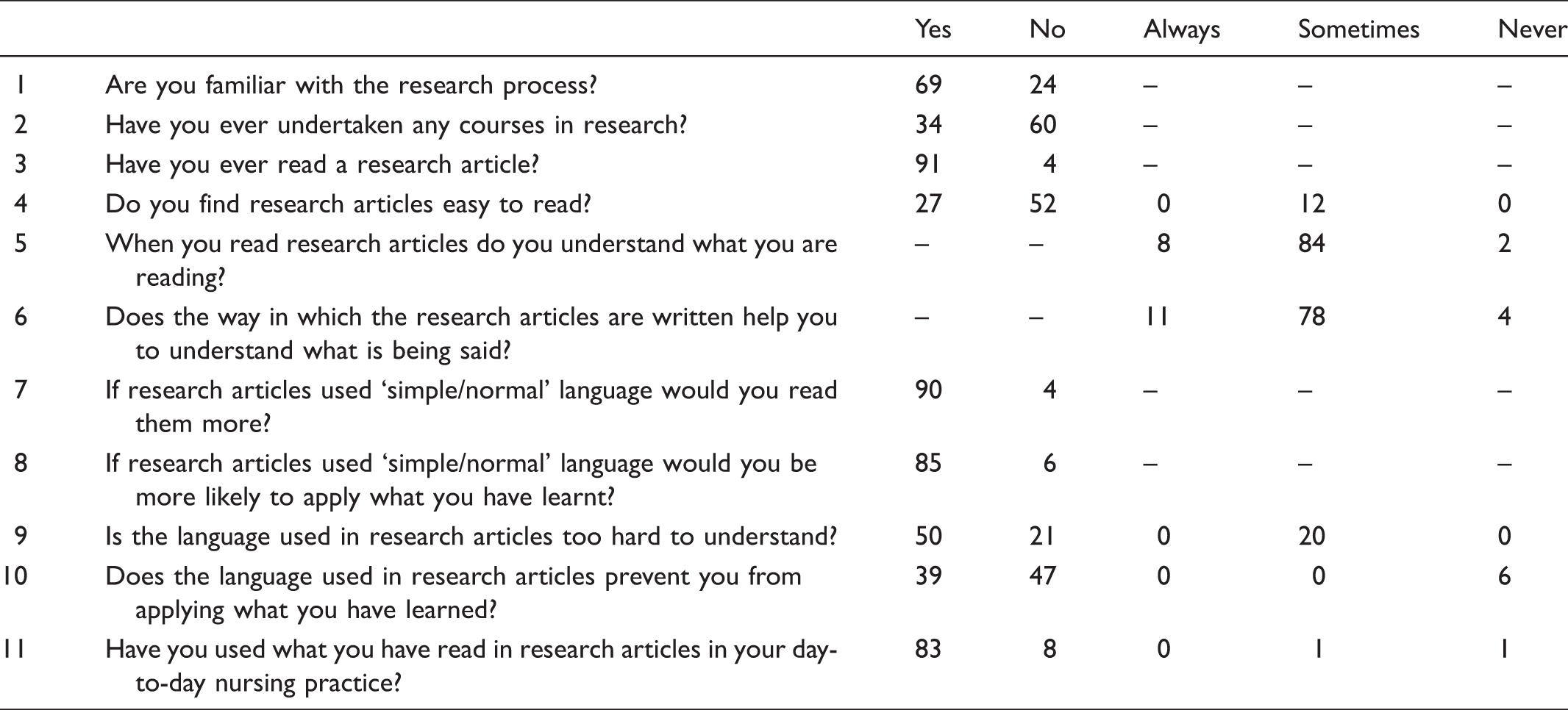
The aim of this study was to find out whether registered nurses read research articles, understand them and translate the research to practice. There is a problem with research knowledge translation in the clinical setting. Despite exposure to research, registered nurses often distance themselves from reading nursing research. A point-prevalence survey was conducted on a sample of registered nurses in a peripheral hospital in Western Australia. The survey was distributed to all wards of the hospital (n = 7). One-hundred and five (n = 105) registered nurses were eligible to participate. Ninety-five (n = 95) completed and the survey. The survey consisted of 11 general questions and an open-ended question. The majority of registered nurses in clinical practice found research articles difficult to understand because of research jargon. Most indicated that they sometimes or never understood what they are reading. Almost all nurses revealed that if research articles were in a ‘simpler’ language they would read them more and apply what they had learned. Promoting a common, user-friendly language in a research abstract or summary which is targeted to the registered nurse audience may assist in finding a common knowledge exchange between researchers and nurses and so help bridge the gap between research and practice.
Introduction
Critical to the nursing profession and to safety and quality in healthcare is the integration of research into evidence-based care. However, studies have claimed that nurses working in the clinical setting are not fully utilising research findings to guide their clinical practice.1–4 Whilst there are many reasons for this it may be contended that one reason is that the dissemination modes used to inform nurses of research findings, namely research articles, are difficult to read and understand and therefore not used to change or innovate nursing practice in the clinical setting. Turale asserts that clinicians should ‘write papers that are focused for clinicians with clear implications for practice … In addition to publishing in appropriate journals, you can put research summaries in simple language with clear implications for practice’.5(p.11)
Language is a complex, learned and culturally determined behaviour that reflects and reifies the dominant discourse. The issue for registered nurses is that the language of research does not ‘fit’ within current nursing culture and therefore is simply not understood with ease.
Background
The application of research into nursing practice is essential to hospital systems for the improvement of outcomes and the advancement of the nursing profession. Nursing research derived from qualitative and quantitative approaches provides data, conclusions and findings that assist and underscore approaches to clinical practice and the integration of best research evidence. 6 Yoder et al. 4 have argued that the translation of research into practice can be challenging as research language and findings are often not presented in a way that is conducive to ease of understanding and interpretation and therefore translation into practice by the hospital clinical nurse. Research studies often present scientific terminology and language written by nurse academics whereby the interpretation can be similar to learning a foreign language. For example, terms such as ‘theoretical’, ‘empirical’, and ‘causality’ are not in everyday language and can be overwhelming and frustrating to the nurse who is unfamiliar with evaluating research studies. The statistical analysis which is used to present and examine confidence intervals, Chi-squared tests, and p-values can be daunting for a registered nurse to understand and analyse. This does not mean that nursing research needs to be ‘dumbed-down’; rather, researchers need to become proficient in the use of the everyday speak of nurses. For example, the significance of 0.05 can be easily translated to ‘95 times out of 100, this will occur’. Nurses just want to know if something works and whether it is the best option for care.
Barriers to research utilisation
Although the application of research into practice is crucial, barriers continue to exist and research utilisation remains a challenge within the hospital setting. Many research studies have evaluated the barriers to research utilisation using the ‘Barriers to Research Utilization Scale’, commonly known as the BARRIERS scale. 7 The scale is used to assess the perceptions of barriers to the use of research into practice. Other scales have been deployed in research studies such as the ‘Edmonton Research Orientation Scale’ 8 and the ‘Evidence-based Practice Questionnaire’. 9 However, the BARRIERS scale is the most extensively used. The common barriers to research utilisation identified using these scales included lack of knowledge or sufficient education, lack of help, lack of support systems, lack of time, lack of awareness, lack of cooperation from physicians, inadequate/insufficient facilities, and inadequate authority.1,10–18
A significant barrier as determined by various studies using the BARRIERS scale is the lack of knowledge translating research into practice. 1 The survey items related to lack of knowledge are ‘the nurse doesn’t feel capable of evaluating the quality of research’, ‘statistical analyses are not understandable’, ‘implications for practice are not made clear’, and ‘research is not reported clear and readable’.1(p.26) Yoder et al. have affirmed that although nurses place a high value on research and that resources were available for nurses in locating research, a major barrier was lack of knowledge. 4 Most survey respondents expected their educator or clinical nurse specialist to collect and analyse the research for them.
Beke-Harrigan et al. 19 and Raines 20 have acknowledged that nurses have difficulties in understanding research articles and find it frustrating. This was primarily due to the language of research and knowledge translation. For countries that are non-English speaking, the lack of knowledge translation is even more of a challenge. Kocaman et al. 21 and Majid et al. 22 verified the language barrier and the understanding of jargon in research articles as being a top barrier in adopting evidence-based practice in Turkey and Singapore respectively. Although research methods have been introduced into current nursing and midwifery curricula, many nurses and midwives still find research incomprehensible, irrelevant to their practice, and are poorly prepared by their education to make use of it.11,19,23 Research findings are perceived as difficult to read and lacking clarity about their significance in practice. 24 The language is alien to most nurses leading to misunderstandings and this unfamiliarity can produce nervousness and avoidance in reading research articles. Research remains a ‘scary word’.
Langendam et al. 25 acknowledged that there has been a realisation that nurses may not be at much more ease than laypersons in understanding the language and interpreting statistical data in research articles. With increasing awareness of the gaps between research and practice, efforts in understanding the barrier of knowledge translation can be addressed. The current study investigated registered nurses’ perceptions of research language and knowledge translation, and queried knowledge exchange between nurse researchers and registered nurses. The terms ‘understandable’ language and ‘simpler’ language refer to language that is readily understood by nurses at all levels of education and experience and is in keeping with Turale’s use of the term: ‘write the information in a simple language form’.5(p.11) This article describes research utilisation by registered nurses and discusses whether the language in research articles is a barrier to their practice of implementing research findings.
Aim
The aim of this research was to describe registered nurses’ opinions of research utilisation in practice.
Objectives
The objective of this study was to find out whether registered nurses read research articles, understand them and translate the research to practice.
Methodology
Study design
This study used a descriptive design using a point-prevalence survey.
Setting
A peripheral hospital in metropolitan Western Australia was utilised as all of the nurse managers within the hospital were participating in an up-skilling course concerning research.
Sample
A convenience sample of registered nurses employed at a peripheral hospital in metropolitan Western Australia working on one particular day covering all shifts, that is, day, evening and night duty, were eligible to take part in the research. Ninety-five (n = 95) registered nurses of a total of 105 eligible registered nurses completed the survey, a response rate of 90%. Registered nurses, in Australia, have as part of their standards for practice an obligation to use evidence-based practice in their daily clinical care. 26 For this reason, this group was asked to complete a questionnaire to assess their understanding and use of research in practice.
Data collection tool
The questionnaire consisted of 11 general questions with five questions using a two-point scale (yes, no), two questions using a three-point scale (always, sometimes, never) and four questions using a five-point scale (yes, no, always, sometimes, never). The final question was open-ended asking: which journals do you read? This question was to gain information with regard to the type of information sources, academic, professional or other were being read by nurses. The questionnaire was developed from questions asked by participants in the research up-skilling seminar. Question topics were reflective of the literature relevant to barriers to the use of research.11,20,23 The questionnaire was then reviewed by an expert panel of nurses comprising a nurse researcher, clinical nurse specialists, nurse managers and registered nurses for coherence and readability. Experts found the questions appropriate and readable. The panel recommended piloting the tool. The tool was piloted on five staff development nurses and based upon their comments no further changes were made to the questionnaire. The researchers acknowledge that, in most instances, the reliability and validity of the data collection tool is of primary importance. However, in keeping with the intent of involving nurse managers in research expert opinion maintained the momentum of ‘doing’ research and making it less ‘scary’.
Ethics
Ethics approval was gained from the hospital ethics committee. The participants were informed that the survey was voluntary and anonymous and that they had the right to withdraw from involvement in the study at any time. Return of the completed questionnaire inferred consent to participate.
Data collection procedure and analysis plan
Questionnaires were distributed at the commencement of each shift by shift coordinators who had been briefed by researchers. Potential participants were also given information related the research’s intent. Completed questionnaires were placed in a locked box in ward staff rooms and were collected by the researcher the following morning. This insured that all registered nurses working the previous day, evening and night duty shift were included. Descriptive statistics were used to tally the questionnaire responses.
Results
Demographic characteristics
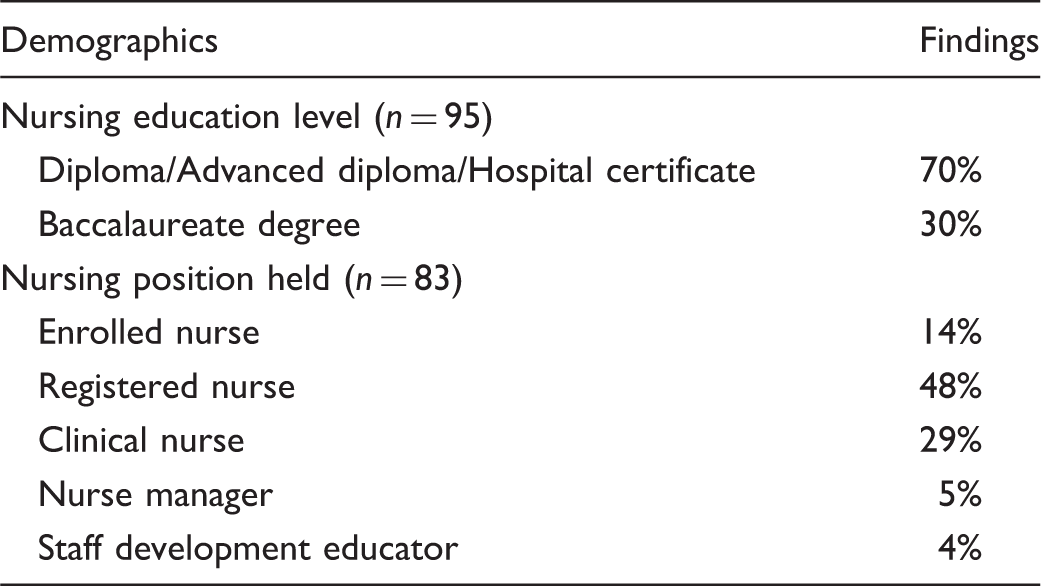
Demographics of participant population.
Responses for research utilisation (n = 95).
The final question asking ‘What journals do you read?’ was completed on seven returned surveys. The responses included the names of various medical and nursing journals. Additionally, nurses indicated that they read those journals specific to their area of practice (wound management, infection control, palliative care, journals of advanced nursing) and those that were available on their unit (critical care, medical-surgical, emergency department).
Discussion
The majority of nurses in this study found research articles difficult to read and if they were in a ‘simpler’ language it was more likely the research would be used and implemented. Recognising that 70% of nurses in this sample had an educational level of diploma/hospital certificate or advanced diploma/associates degree; there may have been limited instruction in the area of research within their nursing programmes. However, research studies have found few differences in research utilisation based on educational level. Atkinson et al. 10 found almost identical mean scores of research utilisation in their study between associate-degree and baccalaureate-degree nurses. Breimaier et al. 11 agreed and further concluded that nursing experience rather than educational level explained the increase in nurses’ engagement in evidence-based practice as they better understood its importance and necessity in their daily work. Improving research literacy post registration is crucial for the nursing profession and is a standard of the Australian national competencies. 27 However, Hines et al. 24 found conflicting results on the effectiveness of post-registration research education to improve research knowledge making it unclear which educational strategies are useful for research utilisation and its translation into practice. Research education is needed but may not be available or provided on a regular basis at the nurse’s place of employment and there is currently no educational approach that has been proven to provide improved outcomes in research utilisation. In this study, 64% (n = 60/94) of nurses indicated that they have not taken any courses in research. This is a critical point because perhaps if the registered nurses had completed at least one course, their ability to understand and use research findings would have been significant. This is an area that should be examined in future research. Also noteworthy is that 70% (n = 66/95) of the participants did not possess a university-based nursing degree. The remaining 30% (n = 29/95) held a baccalaureate degree. However, what is of concern is that the 64% did not feel the need to pursue knowledge in research given the focus on quality, safety and evidence-based practice in contemporary healthcare. This is contrary to Yoder et al.’s finding that nurses value research. 4
Williamson et al. 28 have emphasised that much of nursing research is not being read by most registered nurses even though it is widely disseminated through nursing journals and is easily accessible. Research findings are useful in clinical practice; however, there remains a failure to implement many of these potentially useful findings. Oermann et al. 29 have suggested that many research articles are written in a language which is challenging for the target audience. The authors believed encoding the research message into a practical language for registered nurses may promote the research utilisation process.
Scientific and scholarly language barriers are important factors that hamper and even completely deter some nurses from reading or using research. Nurse researchers report their findings and write in academic language for academic supervisors and other researchers. Reading research can be disheartening as often with traditional academic reporting, the articles can seem so sterile and jargonistic that many nurses, without up-to-date research training, would not be able to read them with easy understanding. This only continues the cycle where academic articles are read by only a few people with a highly specialised education. A culture gap between researchers and clinicians has led to some registered nurses failing to value research.
24
The gap is between ‘academic speak’ and ‘nurse speak’. Turale states: Understanding the needs of your audience is so important. There is no use writing a paper that is heavily philosophical or theoretical, or full of complex statistical data, if the clinicians you want to inform either do not understand your paper, do not read the journal.5(p.10)
The relationship between nursing research and its application in clinical practice hinges on the interpretation of research language. Finding a common knowledge exchange between nursing researchers and registered nurses may help bridge the gap between research and practice. However, if registered nurses do not value research then how do they begin to implement research in their clinical practice? This is of major significance.
New approaches to research include arts-based research methods such as portraiture where the researcher’s hope is that readers would enjoy interpretive, yet authentic research presented, not by esoteric or opaque language but rather by clear, readable language. 30 These types of research are able to ‘get the work out’ to engage for readability, ‘shaping the content of how we present to our potential audience’.31(p.2)
Plain language
The language in research articles is complex but what if it can be modified into plain language so it can be readable and understood by registered nurses at all educational and experience levels? A review of electronic library databases found limited information on the exploration of modifying research studies and/or research abstracts to ease knowledge translation. A clear and simple summary of research evidence can be particularly useful to nurses with little experience in critical appraisal.
One such database that requires research studies to provide a plain language summary is The Cochrane Library. This database comprises systematic research studies that follow a specific format and provide the highest level of research evidence. The studies include a plain language summary so that key messages of the study are presented for a lay audience and can be understood by healthcare consumers. 32 These summaries clearly convey crucial information about the research question and findings. Several studies have evaluated Cochrane Reviews and have shown that the Summary of Findings table improves the understanding of the study.33,34 However, little research has been conducted on the plain language summary and its benefits to the registered nurse. Furthermore, the study’s participants were health professionals and researchers, and did not specifically evaluate registered nurses’ knowledge translation.
Conclusion and recommendations
A major barrier to research utilisation is the lack of knowledge and understanding of the research evidence presented in research studies. Developing skills to interpret research language and critically appraising evidence for its use in practice takes time and effort by the registered nurse who may not consider this to be a valuable activity. If the intent of research is to improve practice, then research should be in the language of the target audience. Language as a powerful discursive tool perpetuates the difference between nurse academics and nurses who have chosen to remain at the bedside. The vocabulary of research is suspended between the objective spheres of nursing academia and subjective sides of nursing in such a manner that the language of nursing research displays an intrinsic ambiguity. Thus, the knowledge exchange required to apply research findings in the clinical setting is hindered.
Plain language summary.
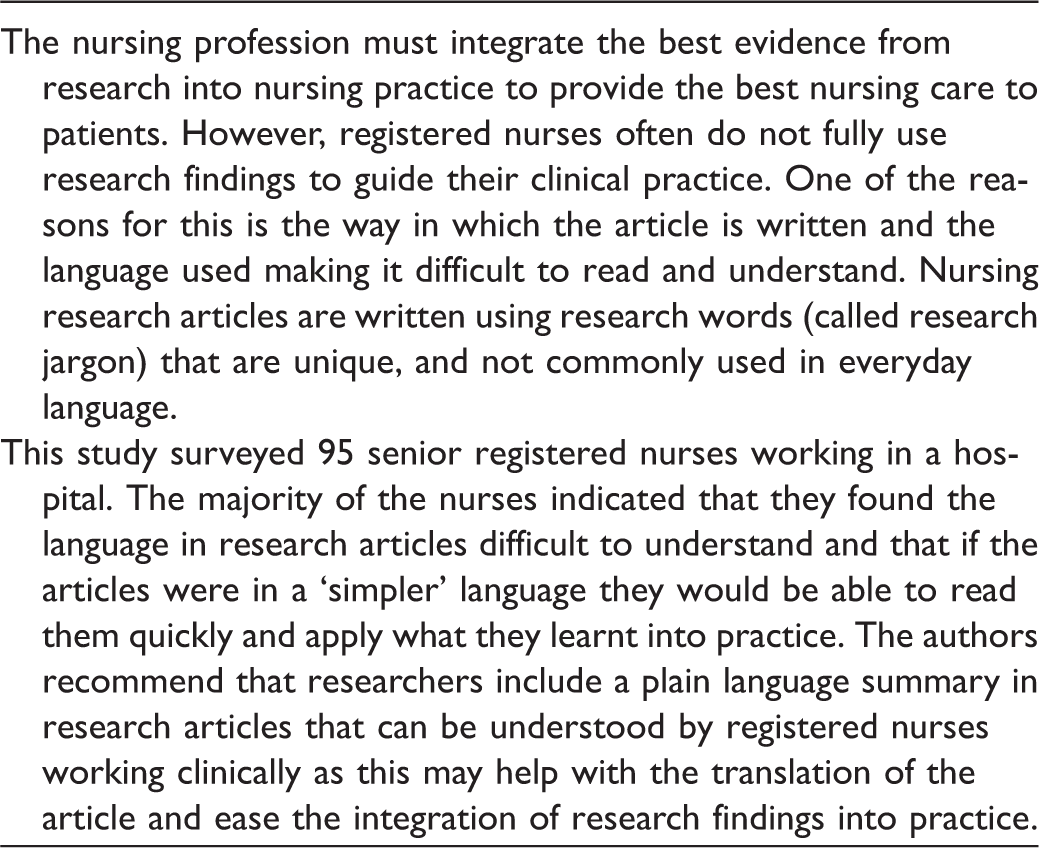
The authors acknowledge the role of professional research language and are not suggesting that researchers compromise professional standards by using simplified language, but simplifying some terminology and how ideas are expressed to make research findings more understandable should be the scholarly goal if the implementation of evidence-based practice is the desired outcome. From this study it is evident that a nurse with research understanding and knowledge is required to assist registered nurses in clinical settings to translate research findings. If this expertise and guidance is not available, then research will remain a scary word and clinical practice will stagnate and will not achieve the best levels of safety and care.
Limitations
The results of the survey are presented in number and percentage of responses for each question. The analysis was simple and descriptive in nature, and did not provide additional perspective with statistical calculations. The survey was of a small, convenience sample and is not generalisable. The objective of this study was to find out whether registered nurses are familiar with or have knowledge of research translation, not how in depth they are familiar with the research process. The study also was not intended as a comprehensive test of nurses’ knowledge, but rather as an assessment of their understanding of general research principles. Another limitation of this research related to the lack of analysis of whether results would have been different between degree-qualified nurses and those with other qualifications.
Footnotes
Funding
This research received no specific grant from any funding agency in the public, commercial, or not-for-profit sectors.
Conflict of interest
The authors declare that there is no conflict of interest.