



Abstract
The aim of this study was to explore attitudes towards research among a subgroup of Swedish nurses specializing in ophthalmic care and to compare the results with the findings of a similar study from 2001. A cross-sectional survey was conducted with a convenience sample of 250 Swedish nurses. A factor analysis was performed on the responses to a web-based questionnaire to discern the factors underlying the ophthalmic nurses’ attitudes. Responses to open-ended questions were analysed using content analysis. A five-factor solution accounted for 47% of the cumulative variance, with Cronbach’s alpha values ranging from 0.56 to 0.8. The responses to the open-ended questions indicated that among the nurses interested in conducting research, lack of time was the most prominent cause for not doing so, whereas older age and time constraints were the most important factors for those who were not interested in research, largely consistent with previous studies. Furthermore, the nurses mentioned frustration and bad experiences related to conducting research during their education programmes. Overall, however, the participating ophthalmic nurses were more reluctant to engage in research, perhaps because of their significantly older age compared to a previous study cohort. The results reveal new information implying that further qualitative studies would be beneficial to the planning of nursing education and to the integration of nurses in clinical scientific work.
Introduction and background
Undergraduate nursing education in Sweden, as in most industrialized countries, is an academic education programme leading to a bachelor’s degree and includes within the content of the curriculum, writing a thesis. The purpose of the nursing thesis is to enable students to acquire a deeper understanding and knowledge of contemporary nursing, including the scientific basis of nursing, knowledge of applicable methods in the field, specialization in a specific area of the field and the direction of current research. Moreover, nurses should be able to demonstrate the ability to search, collect, evaluate and critically interpret relevant information about a problem; critically discuss phenomena, issues and situations; independently identify, formulate and solve problems; perform tasks within specified timeframes and apply current research evidence to practice. 1 Currently, some, but not all, specialist nursing education programmes lead to a master’s degree. A master’s degree enables nurses to study at the postgraduate level. However, only 1.5% of Swedish nurses have a PhD compared to 2.5% of physiotherapists and 25% of physicians. 2 The Swedish Medical Association estimates that approximately 30% of physicians should have a doctorate degree to establish professional skills in all important areas. 3 No such goal has been defined for nursing, but it is reasonable to assume that the current proportion of nurses with PhDs is far too low to maintain high quality in nursing skills and academic nursing education.
Specialist nurses have a high level of autonomy in clinical practice, including making independent decisions with responsibility for out-patient clinics. 4 For example, specialist ophthalmic nurses in both Sweden and in, for example, the UK, often independently work with glaucoma patients and patients with retinal disorders such as age-related macular degeneration. Developments in these areas have been very rapid during the past decades, and the scientific activity in ophthalmology is currently high. However, research activity resulting in a PhD degree in ophthalmic nursing care is low: only 0.5% of ophthalmic nurses have a PhD degree. This is on par with, for example, theatre nursing (0.4%), but much lower than other areas of nursing specialization with a high degree of autonomy, for example, midwifery, in which the proportion is 2.5%.
In a recent study, Morgan and Somera predicted a future shortage of nurses with a doctoral degree. 5 In addition, several studies during the past decades have demonstrated that nurses face a number of significant barriers in research utilization and that nurses do not routinely participate in research-related activities.6–9 Barriers to research use have remained constant over time 10 and across geographic locations 11 and consist of time constraints, lack of awareness of the existing research literature, insufficient authority to change practice, inadequate skills in critical appraisal and lack of support for the implementation of research findings, 7 in addition to lack of funding. 9 Historically, the main factors for not participating in research are reported to be lack of time, lack of peer support and limited knowledge about and skills in the research process. 12 A Swedish study found that even though nurses’ attitudes towards research and development were positive, the application of research and development in their daily work was poor. Age, year of registered nurse examination and acquired research skills were reported to affect nurses’ attitudes. 13 Kuuppelomäki and Tuomi noted the importance of paying closer attention to the choice of research objects in the field of nursing science and the need for more courses in research methods. 14 A more recent study from Norway also observed a positive attitude towards research among nurses but found that few nurses were engaged in research activities. 15
A survey of National Health Services employees in the UK found that 18% of the surveyed health professionals did not think they had the skills required to participate in research, and that 31% of nurses described themselves as not very or not at all confident in discussing research with patients. 16 International studies have reported that the most promising facilitators of research utilization among nurses are managerial and collegial support,7,9 availability of additional time to review and implement research findings, and availability of relevant research. 7 A recent study by Hendricks and Cope drew attention to the fact that research articles can be found difficult to understand because of research jargon and suggested promotion of a common, user-friendly language in research abstracts or summaries, targeted to the registered nurse audience. 17
In summary, most studies have focused on barriers to and facilitators of utilizing research, but only a few have focused on why nurses do not engage in research, and to the best of our knowledge, none have examined this area of specialized nursing.
Aim and research questions
The aim of the current study was to explore attitudes towards research among a subgroup of Swedish nurses specializing in ophthalmic care and to compare the results with the findings of a similar study from 2001.
13
An underlying assumption of this study is that nurses currently use more research in their daily work. The research questions addressed in the study are as follows:
Do nurses currently use research more in their daily work than nurses did in a previous study from 2001? Do ophthalmic nurses, working in an area with rapid development and high scientific activity, have different attitudes towards research than randomly selected nurses in a previous study? What are the underlying factors for attitudes towards research in these cohorts? What are the reasons for not being interested in or conducting research among the current cohort?
Method
Design
The design of the study was a cross-sectional survey, which was delivered entirely online and hosted by Netigate® (http://www.netigate.se).
Sample
A convenience sample (N = 250) of the total population of ophthalmic nurses in Sweden (N ∼ 600) was chosen. Convenience sampling is a type of nonprobability sampling in which members of the target population who meet certain practical criteria, such as easy accessibility or the willingness to participate, are included in the study. 18 The members of the included cohort were easily accessible through their professional organization, to which the author also belongs.
Ethical considerations
The study was conducted in accordance with The Code of Ethics of the World Medical Association (Declaration of Helsinki) for experiments involving humans. According to the Swedish Law (2003: 460) for ethical review of research involving humans, no ethical approval is needed for this type of survey. The questionnaire was anonymous, and the respondents agreed to participate by opening the link to the questionnaire embedded in the information letter. The participants were informed of the voluntary nature of their participation, that they could decline participation by not responding to the survey and that their individual responses would be treated with confidentiality and would not be traceable to them or to their healthcare unit.
Questionnaire
A validated questionnaire 13 was used with permission from the authors, and it was distributed during autumn 2014 via the Internet to all ophthalmic nurses (n = 250) who could be identified by email in the registry of their professional organization. The questionnaire consisted of three sections: 1) demographic data (gender, age and ophthalmic nursing experience in years); 2) an attitude scale ranging from 1 (do not agree at all) to 5 (agree to a very high extent), comprising a total of 35 questions; and 3) five questions about research awareness. The total value for the attitude scale ranged between 34 and 170. The questionnaire also included open-ended questions regarding barriers to conducting research following a yes/no question about interest in conducting research. Two reminder emails were sent.
Two examples from the attitude section are:
The PhD degree for nurses should be a necessary qualification for securing some higher positions in the ophthalmic nursing area. The ophthalmic nursing profession consists of practical work and does not have to include research.
The following are examples from the awareness section, two of which are followed by open-ended questions:
Are you interested in conducting research? If yes, what is the greatest hindrance to doing that? If no, why not? How often do you read a nursing journal, a journal in ophthalmology or a union magazine? Do you know anyone with a PhD in nursing research in Sweden? If yes, name those with whom you are most familiar.
Data analysis
Descriptive statistics and factor analysis were performed using the Statistical Package for Social Sciences (SPSS) version 19 (IBM SPSS Inc., Chicago, IL, USA). The answers to the open-ended questions were analysed using content analysis. 19 The coefficient alpha (Cronbach’s alpha) was calculated to evaluate the internal consistency of the attitude scale in the instrument, adapted to the ophthalmic nursing context. A Cronbach’s alpha value of ≥0.70 was regarded as acceptable. 20
Factor analysis
A factor analysis using principal component analysis (PCA) was conducted to investigate whether there is an underlying structure to the ophthalmic nurses’ attitudes within the pattern of correlations between the variables, that is, to detect latent, not observed, variables out of manifest, observed variables. Before the analysis was conducted, the Kaiser–Meyer–Olkin (KMO) test and Bartlett’s test of sphericity were performed. Missing data for single items were replaced using mean value substitution. A dimension reduction (extraction) using PCA was performed on the 34 variables to identify the factors that explain the majority of the variation in the variables. Eigenvalues were calculated to evaluate how much of the variation in the data material explains the factor (should be >1), and a rotation and factor loading (should be >0.4) indicated the extent to which the variables were explained by the underlying factors.
Content analysis of the open-ended questions/qualitative data
The coding and categorization were performed inductively in several stages. Meaning units were identified, and were labelled with codes on a descriptive level. Thereafter, the codes were compared for similarities and differences and sorted into categories. 19
Results
Demographics
A total of 202 (full or partial) responses were received, resulting in a response rate of 80.8%. The median age of the respondents was 55 years (range 31–66 years), which was significantly (p = .000) higher than the previous study (median age 38 years, range 22–61 years).13 Of the respondents, 95% were female.
Attitude scale
The mean and median values for the attitude scale were both 90 (range 66–111), with a Cronbach’s alpha of 0.9, showing good internal consistency of the adapted instrument, compared to a mean of 126 (range 60–167) and Cronbach’s alpha of 0.94 in the study by Björkström and Hamrin. 13
Of the 202 nurses who responded, 173 answered the question regarding interest in conducting research: 73 (42.2%) were interested in conducting research, while 100 were not. Of these 173 nurses, 130 also answered the open-ended question regarding their reasons for not being interested in research or for not conducting research if they were interested. Of those who responded, 67% had not attended a public defence of a doctoral thesis during the past five years, 66% knew of someone with a PhD in nursing research in Sweden, and half could name someone with a PhD in nursing research. More than half of the respondents never read nursing journals or journals in ophthalmology, whereas 46% read a union magazine once a month. Twenty-three per cent of the nurses used research results often or very often in their daily work and 7% never did, compared to 6.5% and 15.2%, respectively, in the previous study. 13
Of the 42% of participating nurses who were interested in conducting research, lack of time was the most prominent cause for not conducting research (n = 22), whereas older age (n = 18) and time constraints were the most important factors for those who were not interested.
Factor analysis using PCA
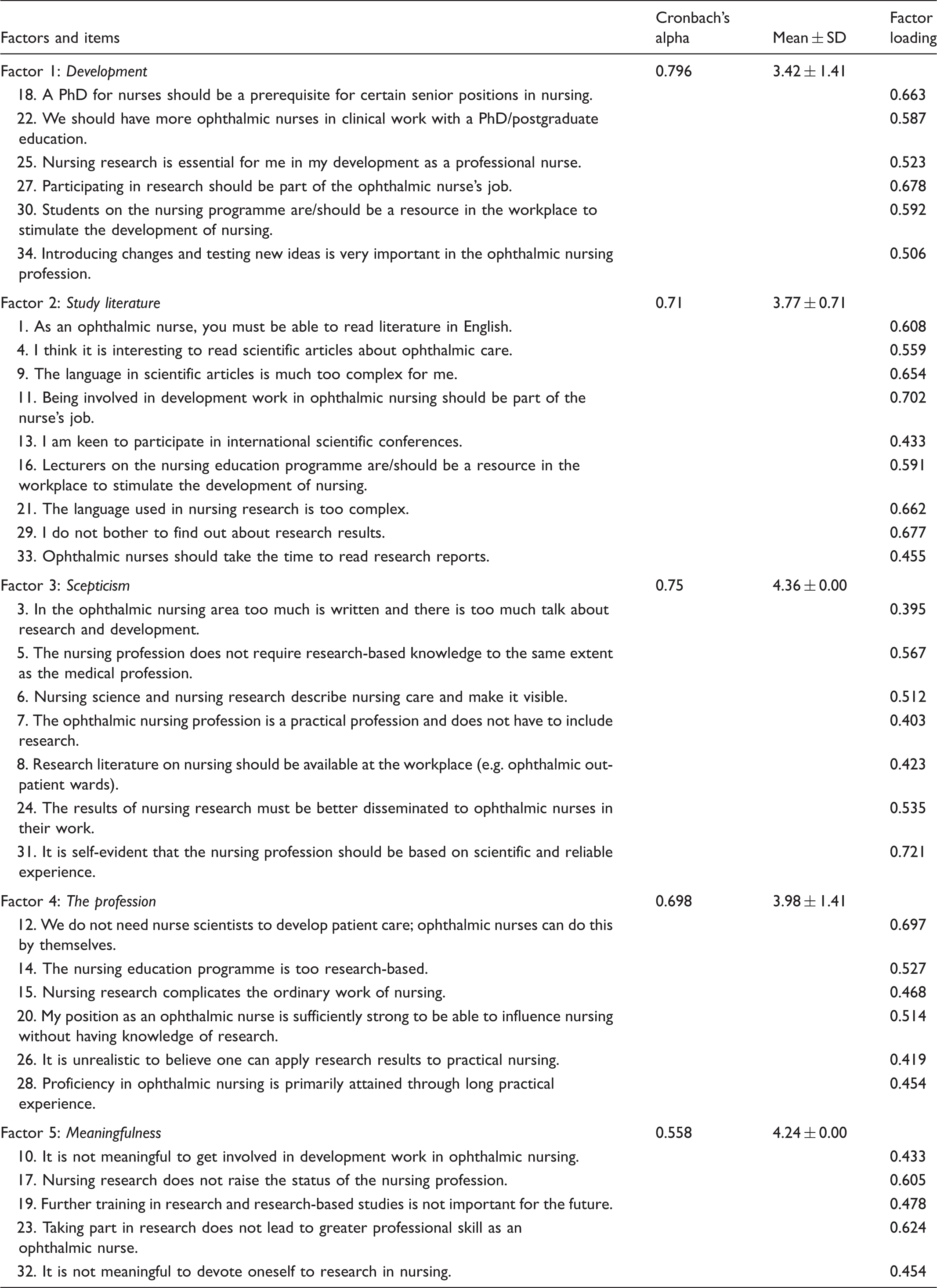
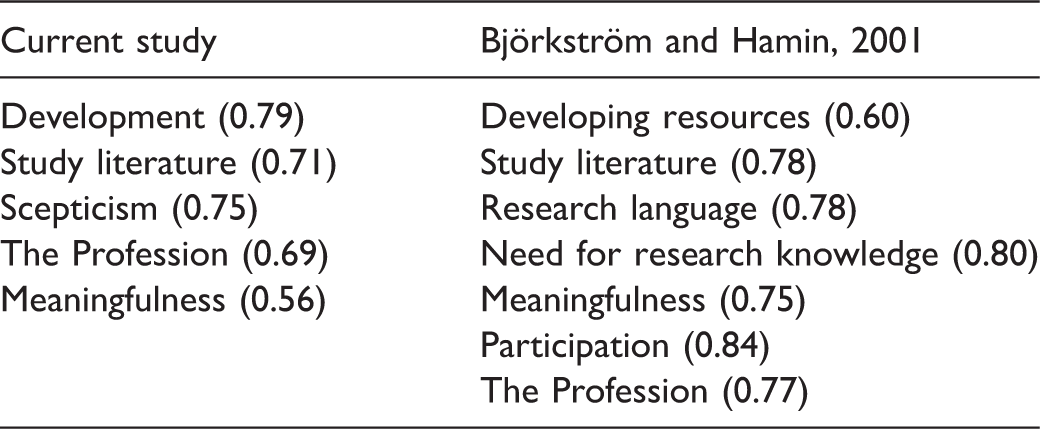
An exploratory factor analysis was conducted to discern factors underlying the ophthalmic nurses’ attitudes. A nine-factor solution accounted for 61% of the cumulative variance, but the scree-plot suggested a five-factor solution that accounted for 47% of the cumulative variance, with Cronbach’s alpha values ranging from 0.56 to 0.8, close to the values of 0.6 to 0.84 in the previous cohort. 13
The five-factor solution, accounting for 47% of the cumulative variance, with a Cronbach’s alpha ranging from 0.56 to 0.8.
Congruence of factors important for conducting research.
Content analysis
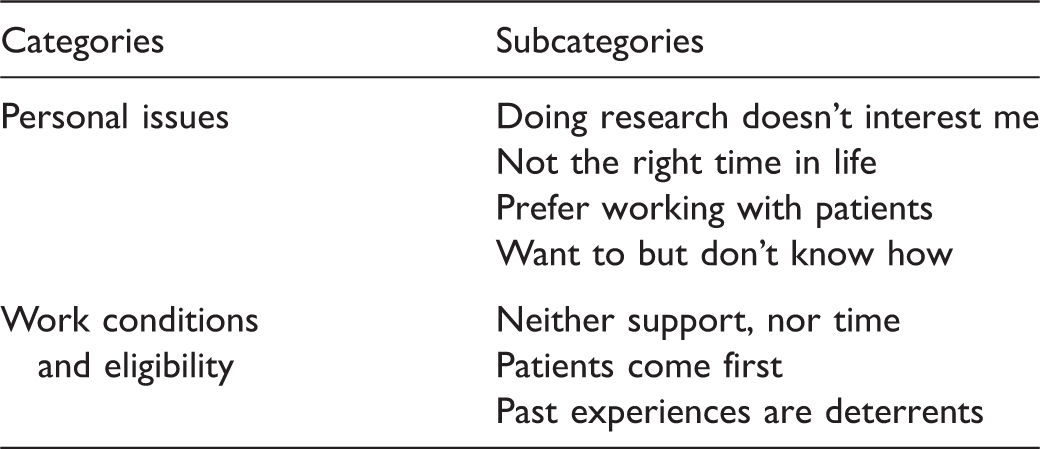
Categories and subcategories emanating from the analysis of the results.
Personal issues
This category includes four subthemes and describes reasons for lack of interest in conducting research related to personal circumstances and personality. Many of the nurses who stated that they were “not at all interested” in conducting research did not explain their answers, whereas others expressed their thoughts about conducting research.
‘Doing research does not interest me’
Some of the nurses described their disinterest in the research process and expressed their perceptions of what is involved in conducting research. Discussing and trying different things is OK, but to sit in front of a computer and interpret responses and then put text down on a piece of paper – no.
‘Not the right time in life’
Many of the nurses who were not interested in conducting research mentioned age as a hindrance and imminent retirement as a reason, whereas others mentioned that they were responsible for caring for small children. … is in the midst of toddler life, so that’s where I put all my time and effort right now.
‘Prefer working with patients’
Other nurses reported that the satisfaction they derive from working with patients was a reason for not wanting to conduct research. They perceived themselves more as practitioners than theorists and found patient work far more interesting than research.
‘Want to but don’t know how’
Other nurses expressed interest in conducting research but did not know how to begin, how to obtain funding, how to identify an interesting topic or how to acquire the time needed. The day it becomes mandatory with research time, then we can do wonders and develop eye care.
Work conditions and eligibility
Lack of time, heavy workloads and lack of encouragement from management and colleagues were mentioned as barriers to conducting research by both those who were interested in performing research and those who were not.
‘Neither support nor time’
Nurses reported experiencing a lack of interest from both their clinic management and their colleagues. It is not popular among some managers and colleagues that you devote some time to research; it feels like there is little understanding that research takes time. At my workplace, it is clear that research is for doctors during and after training, we shall do what doctors inform us about when it comes to news in eye care. It has just been said to me by a doctor here that ‘nurses are subordinate to the doctor and the doctor is superior to the nurses’. This feels outdated and boring, really, the nursing profession should be put forward and upgraded!
‘Patients come first’
The nurses expressed their loyalty to patients and emphasized that working with patients was always their first priority. We are also so far behind in the patient work that it would be unethical to invest in research in the moment instead of taking patients.
‘Past experiences are deterrents’
Many of the nurses mentioned their experiences during their nursing education. They suggested offering more lectures about research by non-physicians to generate interest among nurses. Several of the nurses also mentioned the frustration they experienced when writing a bachelor’s or master’s thesis. What I found in my studies was not priority one; it was where the commas and periods are placed. One week the supervisor says it should be this way, and the next week that it should be that way. This frightened many away from research. Just because someone has a PhD doesn’t mean she is a good tutor. The times I have completed essays in further education I became frustrated all the time with the energy I needed to put into the language and where the various parts must be written.
Discussion
The aim of the current study was to explore attitudes towards research among a subgroup of Swedish nurses specializing in ophthalmic care and to compare the results with the findings of a similar study from 2001 13 The results revealed that nurses currently use more research in their daily work as compared to 2001. However, the assumption that specialist nurses would be more aware of and interested in conducting research was not verified in the current cohort.
Ophthalmic nurses’ use of research in daily work
Nurses’ use of research in their daily work has increased compared to the results observed in the study from 2001. 13 However, it is not possible to determine whether this increase is an effect of a growing awareness among nurses in general or whether it is due to specializing and working in a research-intensive area.
In 2003, Björkström and colleagues investigated attitudes towards and awareness of research among Swedish nursing students using the same questionnaire that was used in both the 2001 study and the current study. 21 Most of the students in the 2003 study had positive attitudes towards nursing research, and 60% anticipated using nursing research in their clinical work. Therefore, although it was encouraging to find that the use of research has increased since 2001, the use of research in nursing practice has not reached the level predicted by Swedish nursing students in 2003. 21 Further, the use of research declines as more time passes after completing nursing education. 22 On the other hand, Wallin and colleagues showed an increase of research use after two years of professional development. 23
In Sweden, nursing education programmes did not lead to a bachelor’s degree until 1993; thus, many nurses educated before that time may never have studied research methods. In addition, specialization in ophthalmic nursing does not lead to a master’s degree. As Nilsson Kajermo and colleagues noted in 1998, 24 nurses who study research methods during their nursing education programme appear to perceive fewer barriers to research utilization than those who do not. This observation is also consistent with a study that found that nursing students emphasized the value of research as a means of improving quality of care and reported that nursing students expressed a desire to learn about and conduct nursing research in the clinical setting. 25
A major finding of the study by Björkström and colleagues 21 was that interest in a specific development or research area was the most important variable influencing students’ attitudes and expectations regarding the use of nursing research in the future. Thus, identifying and encouraging individual nursing students’ potential interest areas during their education programmes may improve their attitudes towards the bachelor’s thesis and help them understand the importance of scientific research. One way of accomplishing this could be to engage nursing students in existing research groups at their universities, thus enabling them participate in ‘real’ research within their interest area.
Ophthalmic nurses’ attitudes towards research and prerequisites for and hindrances to interest in research
The specialist ophthalmic nurses who participated in the current study reported medium to high total values on the questionnaire, albeit with a lower median and range than the previous Swedish studies.13,21 The underlying factors observed in the current study were largely consistent with the previous results, and most of the reported reasons for not conducting research, e.g. lack of time and lack of support, were also consistent with the previous studies. This consistency could be interpreted as reflecting that very little has occurred during the past decade and that the theory–practice gap discussed by Björkström and colleagues years ago remains an issue. 13 The factor Study literature was found in both the current and the previous study, confirming the recent findings from Hendricks and Cope about the difficult language used in the research literature. 17 The participating ophthalmic nurses were overall more reluctant to conduct research, perhaps because of their significantly older age and the longer time lapse since completing their education compared to the previous cohort of working clinical nurses. Thus, the assumption that specialist nurses would be more aware of and more interested in conducting research was not verified. From an educational perspective, a highly discouraging finding that has not been previously described was the ‘Past experiences are deterrents’ subcategory, in which the nurses mentioned their frustrations and bad experiences related to conducting research during their nursing programme. This is not consistent with Nilsson Kajermo and colleagues’ findings, 24 which indicated that nurses who study research methods during their nursing education programme appear to perceive fewer barriers than those who do not. Halabi and colleagues also stated that students’ research abilities should be strengthened to enhance their positive feelings about and increase their involvement in research activities after graduation. 25 Experiences from undergraduate training appears to play a substantial role in nurses’ use of research in their professional careers. 23
According to the findings of the current study, much work remains to be done in both nursing education programmes and the clinical setting, since many of the barriers identified in this study have been previously described in different settings and geographic locations. Critical thinking has been shown to be a significant predictor of positive attitudes towards research and its use and should therefore be recognized and strengthened in both nursing education and clinical practice. 26
Strengths and limitations
This study involved a web-based survey distributed to a convenience sample of all the ophthalmic nurses in Sweden. The overall response rate was 81%; a high response rate for a web-based survey, which tend to have response rates of 25–30% for surveys without a follow-up email and 70% for surveys using multimode approaches. 27 A limitation of the study is that the investigation was carried out only with a Swedish population and with one type of specialist nurse, which could have potential implications for the generalizability of our results. The use of a self-report questionnaire may produce answers that are biased due to private or social desirability. Therefore, interpretation and generalization of the results must be performed with caution.
Conclusion
The ophthalmic nurses participating in this study currently use more research in their daily work than the nurses who participated in a 2001 study. The factors for research utilization found in the current research were largely consistent with those observed in two previous studies undertaken in the last decade. Overall, however, the participating ophthalmic nurses were more reluctant to conduct research, perhaps because of their significantly higher age relative to the cohort in the 2001 study.
The results indicate that little has changed in the past decades regarding nurses’ attitudes towards research, and the assumption that specialist nurses would be more aware of and interested in conducting research was not supported. A content analysis of the open-ended questions revealed new information implying that further qualitative studies would be beneficial to the planning of nursing education and to the integration of nurses into clinical scientific work.
Footnotes
Funding
This research received no specific grant from any funding agency in the public, commercial, or not-for-profit sectors.
Conflict of interest
The author declares that there is no conflict of interest.
Note
A preliminary version of this work was orally presented at the 2016 Nordic Conference in Nursing Research in Stockholm, Sweden.