




Abstract
Retirement is one of the most important transitions in a person's life, which also might affect health and well-being. Adjustment to a life as retiree does not follow a uniform pattern, which emphasizes the importance of an individual perspective. This article uses transition theory as a theoretical perspective. In-depth interviews were conducted with 13 individuals newly retired, focusing on experiences from the last year of work and the time after retirement. Content analysis was used to analyze data. Two themes emerged: ‘become aware of’ and ‘become adapted to’. Nine subthemes describe the individual experiences reflecting positive expectations and outcomes but also feelings of grief and disconnectedness and fears about loss of social network and identity. Transition into retirement should receive more attention from a nursing perspective since experiences such as, for example, grief, disconnectedness and loss of identity if unaddressed could lead to an unhealthy transition.
Introduction
Retirement is regarded as one of the most important transitions in a person's life. Experiencing retirement may in one way support a sense of well-being as workers exit stressful, demanding jobs but might in another way lead to diminished well-being as individuals lose professional networks and social contacts connected to work. Retirement has also been shown to have an impact on an individual's health, but the evidence is ambiguous with findings of both beneficial and adverse health outcomes. 1 Most previous research in this area has investigated the retirement process, its antecedents and outcomes using theoretical models and predetermined variables. The present study intends by using in-depth interviews to let the individual describe their experiences of the transition to retirement.
The official retirement age in Sweden is 65 years; however, it is possible to retire at any stage between the ages of 61 to 67. Average retirement age in Sweden has been constant since 2006 and is for women 64.6 and for men 64.5 years, 2 which compared to international statistics is considered late. 3 Factors which have an impact on the decision to retire early (push factors) include: stressful work situation, quality of work, low social support at work and high physical strain. Factors which influence the decision to remain in the work force (pull factors) include, for example: the economic situation in society, the economic situation of the individual and the various options for retirement the pension system offers. 4
According to Szinovacz retirement as a concept, can be seen as an institution, a process and an experience. 5 As an institution, it refers to social structures that regulate older people's withdrawal from the labor force and also provides old-age insurance for those who have left work. As a process, retirement refers to decisions and patterns of labor force withdrawal; and as an experience, retirement concerns the number of changes in life caused by this withdrawal. 5 These three concepts are intertwined and closely tied to other social structures and aspects of an individual's live. In the present study, retirement represents individual experiences related to leaving the workforce.
Transition theory
Transition has been described as a passage from one life phase, condition and status to another. 6 Transitions can be empowering and result in personal growth but can also result in stress-related symptoms, decreased well-being and vulnerability. During transitions there may be losses of networks, social support and a sense of uncertainty. There may also be problems as a result of not being able to separate from past identities and ways of functioning as well as not being able to make decisions. 7 Transitions which can influence people's vulnerability are, for example; illness experiences, such as diagnosis and surgery; development and lifespan transitions such as childbirth, adolescence and ageing and; social and cultural transitions such as migration and retirement. 6 The theory of transition is in line with the philosophy of holistic health, which is central for nursing practice. 8 The goal for nursing is to help people go through healthy transitions to enhance healthy outcomes, defined by Meleis and Trangenstein as ‘being concerned with the processes and the experiences of human beings undergoing transitions where health and perceived well-being is the outcome’.9(p.257) Late life is a time of many transitions such as retirement, change of residence and loss of spouse and friends. 10 Many of these transitions are unwanted and connected to losses. However, some are positive, desired and represent opportunities instead of the opposite. Retirement, in common with all transitions, more or less implies a role transition that requires new knowledge, changing behavior and hence a change in how one defines oneself. These processes might move the individual either in the direction of health or in the direction of vulnerability and risk, resulting in an unhealthy transition. From a nursing perspective the goal is to facilitate healthy transition processes, to decrease unhealthy transitions and to support positive process indicators, such as a sense of empowerment or a sense of integrity. Reminiscence and role supplementation are examples of nursing interventions that could help facilitate a healthy transition. 10
Health, well-being in and adjustment to retirement
The transition from work into retirement is known to be a heterogeneously experienced process, 11 in which health has been shown to be an important factor for well-being. 12 However, retirement in itself has been shown to have a preserving effect on overall general health. 13 Yet, a study conducted in 11 European countries showed a negative long-term effect on self-assessed, general mental and physical health in association to retirement. 14 An important factor for physical and emotional health (depressive symptoms) is time of retirement, where early retirement (prior to traditional and legal age) dampened health, whereas retirement on time, or late retirement showed no associated disadvantages. 15 The adverse health effects were mitigated if the individual was married, engaged in physical activity, or continued to work part time post retirement. 3
A sense of well-being, which has been defined as the balance between an individual's resources and challenges faced, on a psychological, social and physical level, is another central concept evaluated in this area. 16 Changes in psychological well-being experienced in connection with retirement can be explained by financial, personal and social-relational resources. 17 An important resource that contribute to psychological well-being is a sense of personal control which has been found to decrease depressive symptoms for both men and women. 18 The positive impact of personal control can be exemplified by an increased well-being occurring in voluntary retirement as opposed to non-voluntary retirement. 12 In addition, preretirement planning including both financial and psychosocial planning, preferably together with a spouse, was shown to contribute to increased well-being. 19
How the retiree adapts to retirement is another key issue. Factors important for retirement adjustment are, according to Wong and Earl, 20 organizational influences such as conditions for workforce exit (e.g. perceived preparedness for retirement), but also individual factors such as psychological health, income and marital status. A sense of mastery, of having control over one's life, was, together with conditions of exit, shown to be the best predictor of retirement adjustment. 21 Individual preretirement expectations were also shown to be important for adjusting to retirement. 22 Retirees do not follow a uniform pattern of retirement adjustment, 23 which emphasizes the importance of adopting an individual perspective and examining the variability of retirees' experiences of the transition to retirement.
Studies have shown contradictory results regarding the impact retirement has on health and well-being. According to transition theory, retirement might increase individuals' personal control but it can also be associated with stress-related symptoms, decreased well-being and vulnerability. Nurses might meet individuals in this particular life transition both in primary care as well as in in-patient care and it is important to be aware of what impact an unhealthy transition can entail. In order to find strategies that could prevent an unhealthy transition it is important to examine retired persons' experiences of this process.
Aim
The aim of the study was to describe individuals' experiences of the year before and the time after retirement.
Method
Design/participants
A qualitative design with individual interviews was used to gain a deeper understanding of the transition into retirement. The study was a part of a national project on mental and physical health among retirees. Initially, a questionnaire was sent to the total population of 55–80-year-old retirees in two communities (old industrial villages) in the northeast of Sweden (N = 679, N = 1044). The questionnaire consisted of demographic data and covered areas such as health, educational level, reasons for retirement, depression and quality of life. Respondents were asked to voluntarily state contact information. A reminder was sent after four weeks to the non-responders and it resulted in response rates of 59.5 % (n = 401) and 64% (n = 666) of which 272 and 472 respondents respectively consented to further contact. A purposive sampling was used and inclusion criteria for participation in the interview study were twofold: the participants had to have been retired during the previous 12 months, and they had to provide their contact information. Of those who stated contact information, 39 had been retired during the last year. They were invited to participate through written information about the interview study and were asked to sign an informed consent. Fifteen accepted to take part in the study. Two of them could not be interviewed due to time constraints of the investigators, so 13 interviews were performed (Figure 1). None of the participants reported depressive symptoms, as measured by the Hospital Anxiety and Depression scale
24
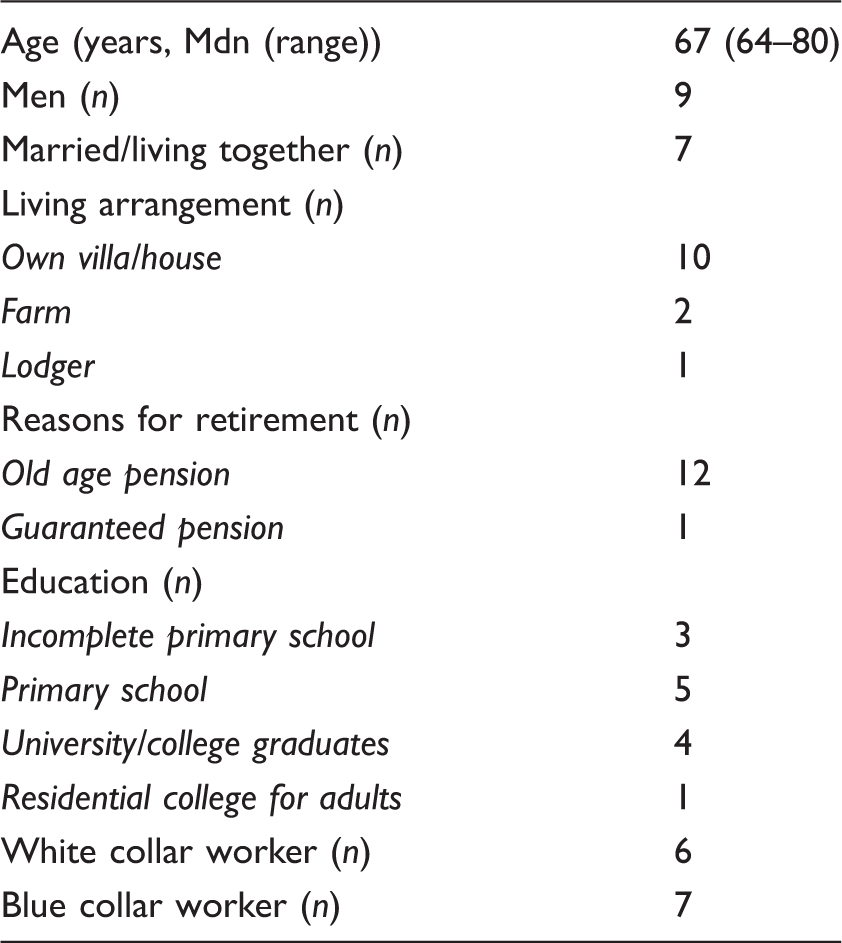
in the questionnaire mentioned above. Regarding self-rated health the answers varied between excellent (n = 1), very good (n = 5), good (n = 4) and fair (n = 3). Demographic data for the respondents are presented in Table 1.
Flowchart for the sampling procedure. Demographic data for respondents (n = 13).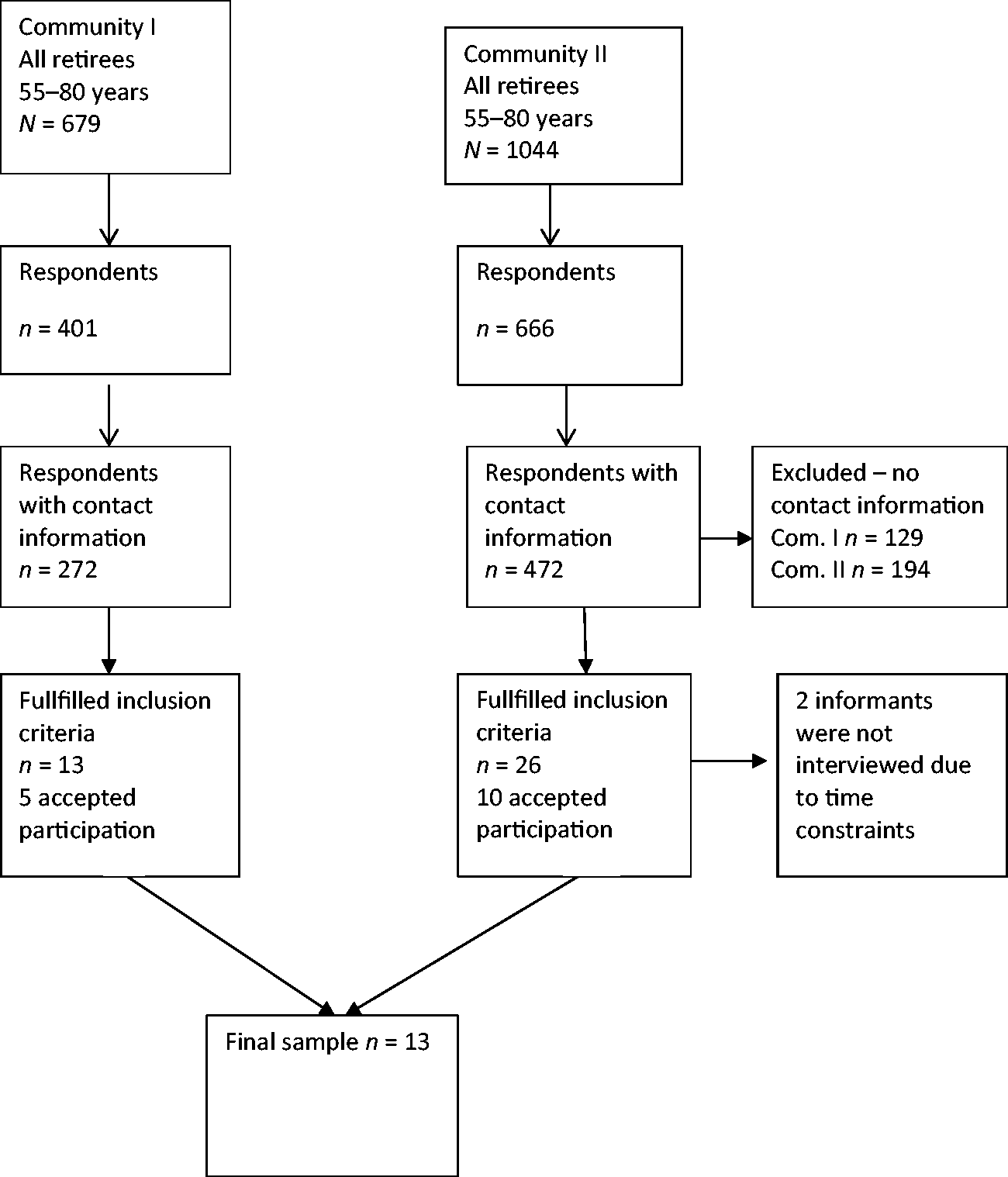
The interviews were conducted in separate rooms at the community healthcare center and lasted between 30 and 45 minutes. They were tape-recorded and transcribed verbatim. A respectful but relaxed atmosphere was striven for by encouraging the respondents to speak freely about their experiences. Two guiding questions were used: How did you experience the last year of work before you retired? How has your life been like since retirement? Probing questions were asked such as: What do you mean when you say …? Would you elaborate on that? The first author conducted nine of the 13 interviews, while the second author conducted the remaining four.
Analysis
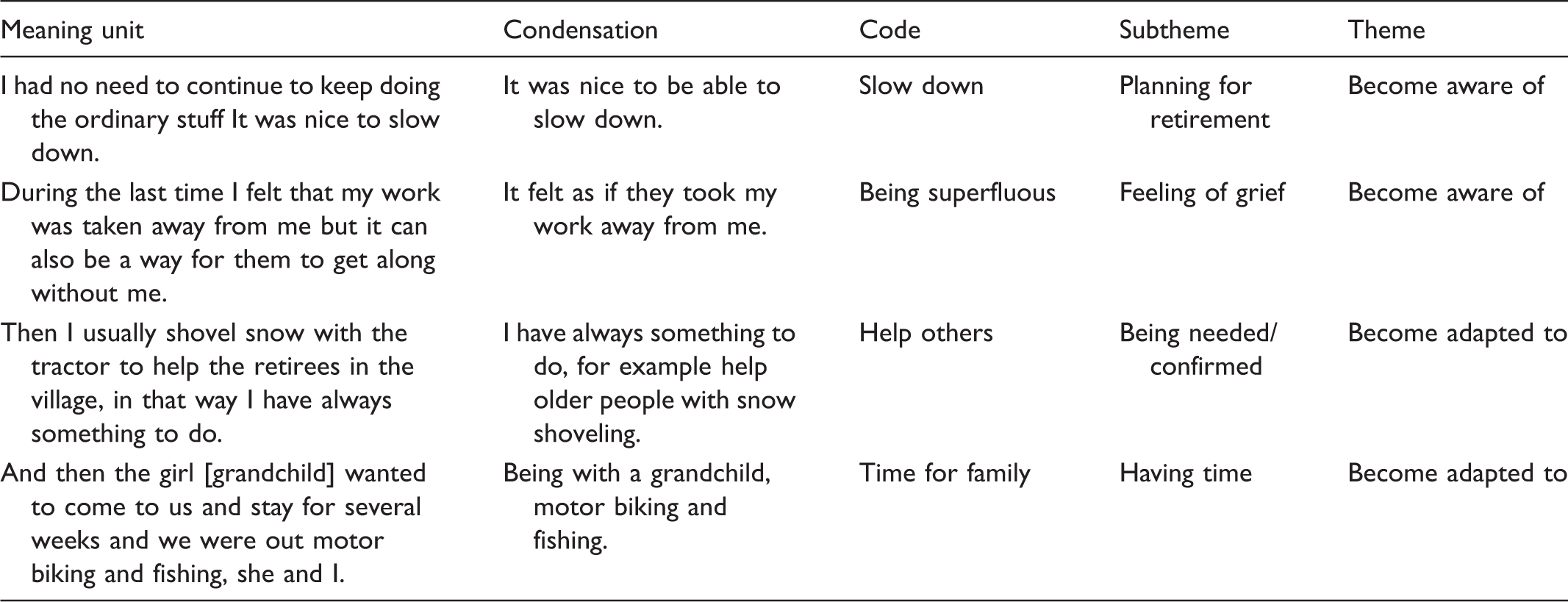
Analysis process.
Ethical considerations
The study was approved by the regional ethical review board of Stockholm (Dnr. 2010/823–31/4). Voluntary participation and freedom to withdraw from the study at any time was stressed and confidentiality guaranteed.
Findings
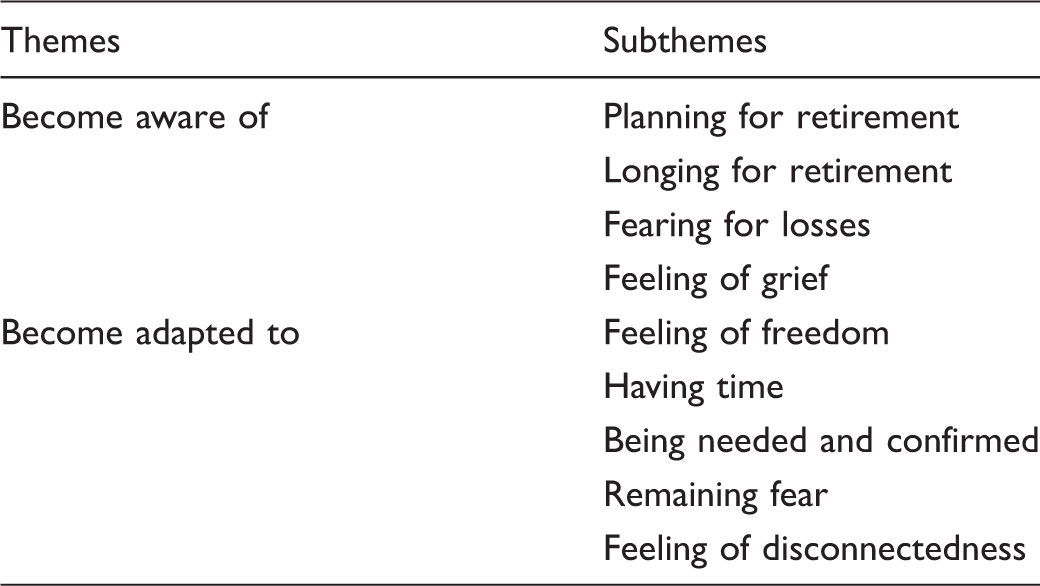
Individuals' experiences before and after retirement.
Become aware of
Planning for retirement
Planning for retirement was done in different ways but, primarily, the study showed that voluntarily reducing one's working time was the most common way. This was considered to lead to a more natural withdrawal from the job and consequently reduced stress. Having control over one's work situation seemed to be important as well as being in control of one's time, to be able to focus on what were important aspects for the years ahead. Some of the informants had a thoroughly thought-out plan for their retirement with one informant working half time for four years before retirement and still retaining job assignments post retirement. Having consultancies and/or also their own firm to fill up free time, were for some informants part of their planning for retirement and continued even after retirement. It was a very appropriate transition and I think it's great if you can do so to cut back and not just work full time and then go home. (woman)
Longing for retirement
Longing for retirement was expressed as a feeling of excitement about a future long leave but also as a sense of satisfaction after a full working life. After physical labor it felt good to let the body rest and to avoid stress caused by work. One informant looked forward to retirement due to disagreement at work caused by reorganization. Hoping to have time to spend on hobbies was also mentioned as well as the feeling of being in control of one's time. Having the possibility to spend more time at home, working in the household and the garden or spending time with one's grandchildren were also reasons for longing for retirement. I thought at first that it didn't feel any different than in the beginning of a holiday except for the fact that the holiday had no end. (man)
Fearing for losses
Fear about the changes in personal finances that retirement could entail was described in the study. The decision to retire was described as anguished due to the expected income reduction. The feeling of not being needed, fears of losing networks constituted by workmates and also fear of remaining alone because of fewer possibilities to meet people were expressed. The fear of feeling emptiness was stressed. Another concern for the participants was the loss of identity, which was considered to be strongly associated with one's job. In the end when I sort of felt that I was going to stop working I was looking forward to it but I also thought … my identity … I cannot escape that my job is very much my identity. (woman)
Feeling of grief
The insight that one is no longer needed at the workplace led to a feeling of sadness. A feeling of redundancy and being used up was described when someone else took over the job as a preparation for the respondent's retirement. The feeling of being superfluous was also stressed when retirement was a result of cut backs at the workplace. Some of the participants also described a desire and an ability to keep working, which was not possible due to the rules for retirement age. This last period on the job it felt as if they took away my job but it could also be a proper way for them to do without me. (woman)
Become adapted to
Feeling of freedom
A feeling of freedom permeated what the informants expressed regarding how life had been since retirement. Some of the informants described that they were still working but that they decided themselves how much they wanted to work, when and with what. To have another job as a consultant after retirement was an economic strategy, but was also pursued because the work was interesting and fun. Life after retirement was also described by the participants as being able to do what one wants, planning one's own time and not having to watch the clock; in other words the sense of having control over one's life. Making one's own decisions, doing things by oneself, resting, and the fact that one does not need take others into account, were also experienced during the first period of retirement. For those participants with a good financial situation, independence also clearly defined by regularly travel abroad and by the ability to buy properties stating that ‘with a good pension you can do whatever you want’. Now I can do what I want, I don't have concerns about anyone. I can go out and walk three miles every day if I want. (man)
Having time
The sense of having time to do things that where subordinated during active working life was prominent among informants. Different forms of physical activity such as walking in the mountains, training at the gym or just spending more time outdoors gardening were activities previously infringed upon as a result of time constraints. Also being able to spend more unlimited time together with the family, without demands was stressed as something positive by the participants. Much time was devoted to commitment and activities in society and in church. Having time to see old friends and to create new friendships was also stressed as something valuable that was made possible after retirement. It was important to the informants to have time for oneself, to not always be available, and also to have one's own commitments in relation to one's partner. A sense of calm and having less to think about were further positive aspects of life post retirement. You feel calmer in a way I believe, and you think why do everything in a hurry? The time is available and you can prioritize. (woman)
Being needed and confirmed
The study further showed the importance of having somewhere to go to, and something to wake up for every morning. Informants who occasionally still worked, stressed the importance of being needed and of having something meaningful to do, such as, for example, being consulted on matters and asked for advice regarding earlier work. For some of the informants their competence was clearly retained by the employer when using them as consultants and advisors after retirement. This was appreciated and expressed with pride by the former employees.
The impact of retirement on family life was mostly expressed as positive, such as being a resource for children and grandchildren. Helping out with babysitting or following the grandchildren's sports activities were often exemplified and expressed with joy. Helping older people with different tasks also gave a sense of satisfaction. Some of the informants had full-time schedules that could lead to a feeling of guilt towards the rest of the family. One informant expressed her many commitments after retirement as a problem from a family perspective, as the commitments prevented her from spending time with them. When they [former employer] need they call me and I go there and help them. (man) The grandchildren are most important but not everything. There is so much that I am committed to. (woman)
Remaining fear
Fears for a weakened economy remained even after retirement for some of the informants. A negative surprise over the deteriorating financial situation as a retiree was expressed and it led to considerable uncertainty, which affected family life negatively. A sense of isolation was feared due to fewer opportunities to meet people. To maintain health was stressed as being very important because there was a concern about a decreased strength/falling ill in relation to aging. I think it is strange this financial compensation you get as a retiree … wages basically being halved and you are expected to manage your life and spending as usual. It is so abrupt. (man)
Feeling of disconnectedness
Continued contact with former colleagues and workplace varied among the informants. Some informants did not have any contact with colleagues at all. They expressed regrets over this and especially the lack of group community that was a natural part of working life. A resistance to visit the former workplace was expressed as fear of disturbing former colleagues or visiting at inappropriate times when everyone had a lot to do. Some informants still had contact with former colleagues through the need and joy of keeping in touch with old friends. You can't just go there to visit … because then it is like … that you interfere in a way. (woman)
Discussion
The results show that positive expectations before retirement were met after leaving the workforce. However, some fears about how life as a retiree was going to be remained unsolved after retirement. Two themes emerged: ‘become aware of’ and ‘become adapted to’. These themes can be seen in relation to the theory of transition which has been defined as a sense of movement, development and flow. 6 The individual perspective and the variations in experiences among retirees are reflected in the subthemes where, for example, longing for retirement is emphasized but also a notable fear exists about what retirement will entail.
One such fear was of loosing one's identity as work, to a great extent, determines the entire identity. This can be understood from how Matour and Prout describe employment: ‘it is much more than a job; it is a world of relationships, routines and expectations that confers a sense of identity and belonging in society’.28(p.59) To relinquish one's professional identity has previously been described as constituting a loss of social contacts and employment challenges 29 but also a loss of status. 30 However, key components of identity are possible to maintain in the transition from work to retirement through, for example, social connectedness, continued learning and continual involvement in aspects of one's former work role. 31 Achieving a healthy transition in this respect requires possibilities for growth and personal development resulting in new dimensions of identity through for example, role supplementation. 10 According to another nursing theory, modeling and role-modeling, 32 each human has capacity for growth and development during the entire life span. Facilitating and gently encouraging this growth and development at the person's own pace is an important part of professional nursing.
Another feared loss described in this study was that of losing social contacts. Recently published research showed that 27.5 % of a Swedish sample (n = 6659) of respondents aged 65–80 years reported feelings of loneliness and that this was most common among women, 33 so this fear may be justified.
The experiences of grief that emerged show how vulnerable the individual might be during the retirement process. According to Robinson and Stell retirement might, for some individuals, be experienced as a crisis were the loss of role and status bring out, for example, grief, depression and feelings of meaninglessness. 34 Meleis explains grief, mourning and powerlessness as signs of role loss and that role transition requires the person to change his/hers definition of him/herself in a social context. 35 This might be realized by either an active engaging lifestyle or the volitional acceptance of a more disengaged way of living. 34 Both ways are suggested to be adaptive and optimal in older adults depending on circumstances, such as the individual's health and social context. 36
A concern that remains during the transition and time frame this study encompasses relates to personal finances. To worry about the economic situation as a retiree is common and is, in Europe, associated with for example being older, being female, having ill health and being less educated. However, the Scandinavian countries have the lowest levels of economic worries in relation to retirement, compared to the rest of Europe. 37 According to Nilsson, Hydbom and Rylander there are significant associations between personal economic incentives and what people aged 55–64 thought would influence why they want to work, and why they think they can work, until 65 years old or beyond. 38 The sample in our study represents both white and blue collar workers, which could imply that the personal financial situation that retirement entails is a reason for concern, irrespective of profession.
Although, our study shows that informants had some negative experiences prior to retirement, there are also positive aspects at that stage, such as planning and preparing and the longing for the ability to freely dispose of one's time. Working part time and/or working as a consultant were examples of preparation and planning for retirement. This so-called bridge-employment has been shown to help retirees maintain psychological well-being 23 and also to prevent illness conditions and functional limitations to a larger extent than for those who chose full retirement. 39 However, if working after the age of 65 would be an option, it is crucial to consider factors such as mental and physical work environment and work pace. 38
The feeling of not being needed and confirmed was expressed as a fear of losses before retirement. Not having demands and expectations can be experienced as stressful, and Jonsson has described this as an ‘imbalance between inner motivation and external demands’.40(p.34) This might explain why people continue to work part time or as consultants after retirement. Another explanation for this might be to avoid loss of social networks and social support. An engaging employment after retirement could reaffirm a person's worth and identity 40 and, according to Oakman and Howie, it is important to confirm the knowledge and skills that older workers can contribute to the workplace, in order to ensure sustainable work arrangements. 41 In fact, a feeling of being needed and confirmed was expressed after being a retiree as something positive, both in relation to former workplace and family.
A sense of freedom; having time for oneself; not always being available; the ability to do what one wants; making one's own decisions; and having control over one's life were examples of how life was experienced after retirement. Altogether this can be expressed as mastery, which Donaldson, Earl and Muratore defined as having control over one's life and also as one of the best predictors for retirement adjustment and an important resource for well-being. 21 Mastery has also been shown to be an outcome of a healthy transition 42 and, for older people in particular, retained empowerment and integrity are indicators for a successful transition. 10 As this study reflects the experiences of the year before and the time after retirement, the informants could still be in the honeymoon phase, which according to Atchley is characterized by enjoyment of one's free time. 43 Duberely, Carmichael and Szmigin also concluded that relatively early stages of retirement might be experienced as a satisfying period. 44
All transitions more or less expose people to vulnerability due to uncertainty about the outcome. The result showed no direct influence on the informants’ health but it might be important to pay attention to the ‘at risk’ status which follows many forms of transition. 6 A feeling of disconnectedness shown in this study is one such risk factor as it is considered to be the most pervasive characteristic of a transition with impact on the individual's health. 8 Thus, feelings of disconnectedness, grief and loss of identity might impede a healthy transition to becoming a retiree.
Strength and limitations
The trustworthiness 27 of the study was strengthened by the participants' different professions, ages and genders which did contribute to a richer variation of the phenomena under study. However, the male retirees were in the majority and that might have had an effect on the result. The interviews were conducted by the two authors who might have influenced the result considering interview technique and experience. Yet, neither of the researchers had met the interviewees before and had no pre-understanding of the current environment and society. Regarding the analysis, investigator triangulation 45 was used to review and confirm relevance of the findings and, together with the presentation of quotes representing the transcribed text, strengthens the trustworthiness of the study. Describing the research method and presenting the analysis in a table makes the process transparent and easy to follow. A limitation of the study is that the interviews were performed on one occasion. Follow-up interviews would have been suitable to further investigate the process of transition in retirement. This study was conducted within a Swedish context, which might limit the transferability, as the conditions for retirement differ between countries.
Conclusion
This study shows a variety of individual experiences of the transition into retirement from fulfilled expectations to remaining concerns. Worries regarding financial situation, loss of social contacts and a fear of loneliness are examples showing that different measures should be considered to support the transition to retirement. Feelings of grief, loss of identity and disconnectedness are experiences that could indicate an unhealthy transition, which should receive more attention from a nursing perspective.
Recommendations for practitioners
As a nurse, be observant of the impact a transition into retirement can have on a person's health and well-being and, if needed, facilitate the process towards a healthy transition. An intervention appropriate to facilitate integration of the transition into the life course, supporting growth and development of identity might be the use of reminiscence. 10 Structured group discussions including reminiscence and a problem-based method have successfully been tested with the aim to prevent depressive symptoms in older people. 46
Implications for future research
This study describes the year before and the time after retirement, which in previous studies has been described as a satisfying period. 44 To gain extended knowledge of how the transition process proceeds and how the individual experiences this would be of interest. This could be achieved through repeated follow-up individual interviews. Then, it would be of utmost interest to focus on the factors that in this study were shown to result in persistent concerns.
Footnotes
Acknowledgements
We would like to thank the Folksam insurance company, Sweden for financial support, and professors Marie Åsberg and Åke Nygren, Karolinska Institutet, for their initiative to conduct this study.
Funding
This research received financial support from the Folksam insurance company, Sweden.
Conflict of interest
The authors declare that there is no conflict of interest.