




Abstract
In contrast to the intergenerational relations of families in the West, Chinese families emphasize mutual support and care among family members and consider parenting and filial duty a continuous process. Based on the typology of intergenerational relations in Western countries, this study constructs an analytical framework for Chinese families consisting of two dimensions: living arrangements and functional exchange. On this basis, it also proposes four potential types of intergenerational relationship: tight-knit, instrumental, independent, and parental support. Using a latent class analysis of nationally representative China Health and Retirement Longitudinal Study data helped us understand the different forms of intergenerational relationship and have a better understanding of their development trends. Several things can be learned from the findings. The significant share of the instrumental type and the emergence of the independent and parental support types indicate a change in intergenerational relationships in contemporary China. Although the traditional tight-knit type is no longer the dominant model, close intergenerational linkages are maintained through the instrumental and parental support types, and almost half of parents continue to have a close relationship with their children. This indicates that parenting and filial duty are preserved, reflecting the continuation of intergenerational relationships. The study also found that the type of intergenerational relationship is significantly influenced by the socioeconomic statuses of offspring and parents, indicating the reproduction of social inequality.
Keywords
Introduction
China has entered an era characterized by a rapidly aging population that surpasses that of many middle- and high-income countries. As of the end of 2018, individuals aged 60 years and older constituted 17.9% of the total population (Ministry of Civil Affairs of the People's Republic of China, 2019). The World Health Organization (2016) projects this proportion to increase to 28% by 2040. While the healthy lifespans of elderly individuals in China continue to extend and social security levels steadily improve, caregiving for the elderly faces new challenges amid demographic and social-structural transformations. Families impacted by the one-child or two-child policies are now entering old age. Moreover, accelerated urbanization is increasing societal mobility. Consequently, adult children face mounting pressures in their professional lives and in nurturing their own offspring. These societal factors play a crucial role in shaping the intergenerational dynamics between adult children and their parents. Thus, what structural features define contemporary intergenerational relationships in Chinese families, and how do they diverge from traditional family patterns? Are the exchange relationships or caregiving obligations between adult children and their parents currently influenced by factors such as the socioeconomic status of the offspring or parents? To address these questions, this study is grounded in nationally representative survey data and integrates the established research tradition in China that emphasizes intergenerational living arrangements and functional exchanges within families. It aims to formulate an analytical framework by which to interpret intergenerational relationships in Chinese households through the lens of opportunity structure and function realization. It employs a latent class analysis (LCA) method to derive intergenerational relationship typologies within this framework and subsequently investigates the patterns of these relationships and the factors that influence them.
Literature review and research hypotheses
Familial intergenerational relationships: Two key research topics
Intergenerational relationships within families encompass two critical research topics. One focus of Chinese scholars is the nurturing and caregiving functions inherent in intergenerational relationships. Traditional Chinese society espouses a reciprocal pattern: parents nurture their children, who upon reaching adulthood reciprocate by providing care for their elderly parents. This dynamic creates a balanced intergenerational flow of familial resources. This “reciprocity model”, as elucidated by Fei (1983), contrasts the Western “relay model”, wherein caregiving obligations are unidirectional—parents nurture children without expecting reciprocal care in later life. The balance of resources is instead achieved through a downward flow across multiple generations.
However, the Chinese context has undergone significant transformations due to demographic and societal shifts. Notably, the extensive migration of rural laborers and young and middle-aged adults to urban areas for employment over the past three decades has significantly influenced rural family structures, leading to the prevalence of “left-behind” elderly individuals and children. Consequently, weakened traditional moral constraints in such dynamically mobile societies have brought rural eldercare challenges to the forefront. Second, the continual advancement of social eldercare provided through the social security system has contributed to establishing relatively stable financial support for the elderly, which is particularly noticeable among the urban retired populace. Third, in terms of the family life course, the extension of elderly individuals’ healthy lifespans has led to situations in which parents, without immediate care needs, share more years together with their adult children. This trend is also indicative of broader societal development. These factors have influenced the traditional intergenerational reciprocity model to varying degrees. Subsequent studies have adopted a reciprocity or exchange lens to investigate intergenerational relationships (Chen, 1998; Wang, 2008; Xiong, 1998). They also emphasize the influence of living arrangements and social interactions on family eldercare (Chen and Chen, 2016; Shi, 2016, 2017; Xu, 2013; Yan et al., 2001), the ongoing parental support for adult children (Liu, 2017; Song and Qi, 2011; Xu, 2017; Yang and He, 2004), and imbalanced rural intergenerational relationships contributing to rural eldercare challenges (Guo, 2001; Jin, 2014).
Another topic in intergenerational relationship research involves typological studies from foreign perspectives. Although earlier scholars, represented by Goode (1963), suggested a trend toward smaller and more nuclear family structures amid industrialization and modernization, empirical studies have not substantiated these claims (Cherlin, 2012). In fact, family structures in Western societies have become increasingly diverse. Concurrently, intergenerational contact, exchange, and support have not diminished (Seltzer and Bianchi, 2013; Swartz, 2009). Against this backdrop, scholars such as Bengtson introduced the six-dimensional theoretical framework of “intergenerational solidarity” (Bengtson and Roberts, 1991; Bengtson and Schrader, 1982). Silverstein and Bengtson (1997) further refined this framework into their own six dimensions: structure, association, affect, consensus, function, and norms. These dimensions were later condensed into three meta-dimensions: affinity, opportunity structure, and functional exchange. Affinity manifests as closeness and identification, while opportunity structure pertains to the living arrangements and daily contact between the offspring and parental generations. Functional exchange entails instrumental support within intergenerational relationships, including mutual aid. Drawing on Hogan et al.'s (1993) LCA of intergenerational exchanges, Silverstein and Bengtson (1997) leveraged the intergenerational solidarity framework to derive five types of intergenerational relationship: tight-knit, sociable, obligatory, intimate but distant, and detached. Their study presented the diversity of American familial relationships through the multidimensional perspective of intergenerational solidarity. Thereafter, Western studies on intergenerational familial relationships increasingly focused on emotional ties among family members and the harmony, conflicts, and ambivalence existing between generations (Shi, 2015). These revised measurement indicators have been employed in research exploring intergenerational relationship typologies in various countries, including in Europe and East Asia, yielding recurrent relationship categories such as sociable, conflicted, ambivalent, and detached (Ferring et al., 2009; Hank et al., 2017; Nauck and Becker, 2013; Silverstein et al., 2010; Yi and Lin, 2009).
Latent class analyses of intergenerational relationships in Chinese families
In recent years, typological research on intergenerational relationships in Chinese families has yielded fruitful outcomes (e.g. Cui and Jin, 2015; Guo et al., 2012; Huang et al., 2017; Ma, 2016; Song and Li, 2017). These studies are predominantly anchored in the theoretical foundation of intergenerational solidarity, focusing on three major relational dimensions: proximity of residence or strength of association, extent of mutual support, and intimacy of affect. Despite variations in sample selection, indicator measurement, the number of latent types, and nomenclature across these studies, a rough comparative analysis can be conducted within the framework of these three dimensions. Drawing on the criteria established for latent classes and characterization of intergenerational relationship types, the current study has systematically reviewed five representative studies, building on the typology division proposed by scholars including Guo et al. (2012) (Table 1). Guo et al. delineated several types of intergenerational relationship with more straightforward criteria across three dimensions. Therefore, their typological classification seems better suited as a benchmark for reference. Nevertheless, in some instances, there are constraints, such as in Ma's (2016) study, wherein the affectional type (constituting 6.1% of the total) depicts close intergenerational relationships when co-residing in the same city, albeit with minimal instrumental and economic exchanges, making it challenging to align with the intergenerational relationship types identified in the other four studies: Song and Li (2017), Cui and Jin (2015), Ma (2016), and Huang et al. (2017).
Representative studies on the typology of intergenerational relationships in Chinese families (%).
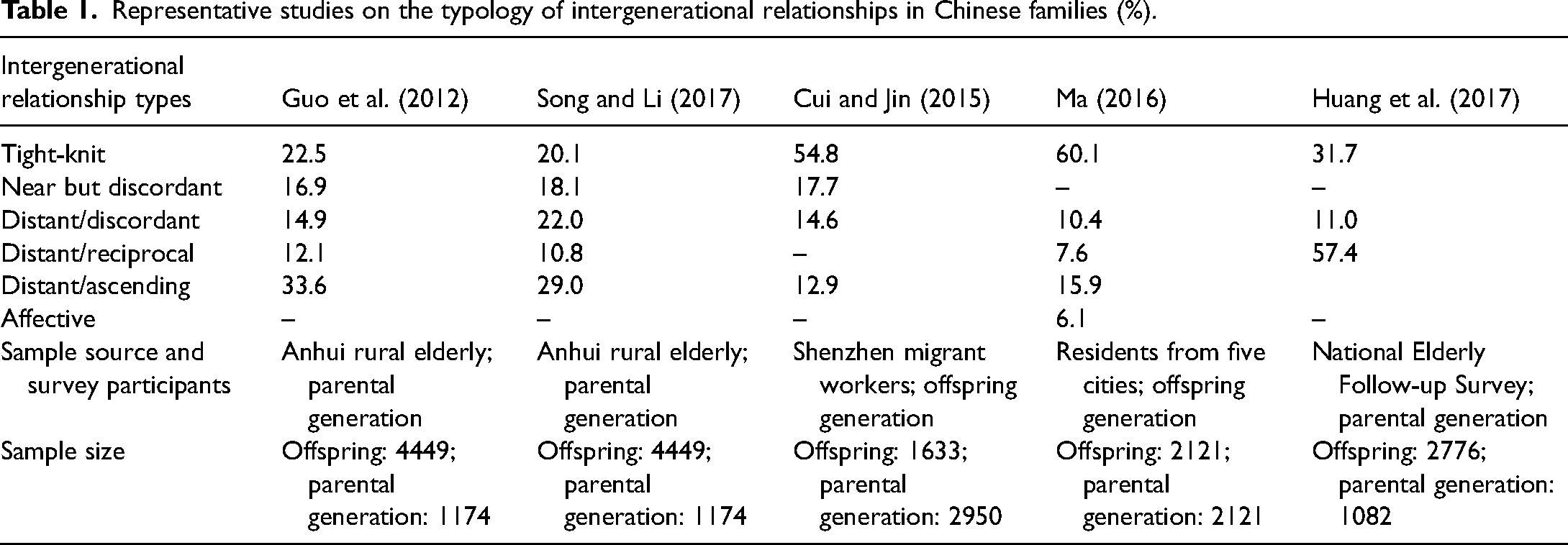
Table 1 indicates considerable differences in the findings of each study, but highlights the prevalence of tight-knit relationships followed by distant/ascending relationships. However, drawing a conclusion regarding intergenerational relationships in Chinese families based solely on this aspect remains challenging for three primary reasons: First, apart from the study conducted by Huang et al. (2017), which relied on incomplete sampled trial survey data, no other study used nationally representative survey data. The majority of these studies were oriented toward particular geographic areas or targeted demographic cohorts. Second, divergences in measurement and classification across dimensions significantly impact the analysis of latent categories, notably seen in the distinct treatment of proximity of residence and frequency of contact (association). For instance, the studies by Cui and Jin (2015) and Ma (2016) expanded the criteria for defining living arrangements. They considered adult children and their elderly parents residing in the same province or city as constituting “proximate” living conditions. This resulted in a significant increase in the proportion of tight-knit relationships (54.8% and 60.1%, respectively). However, using co-residence as the criterion for measuring close relationships might potentially classify certain samples as distant/reciprocal or distant/ascending types.
The third reason pertains to the complexity inherent in the intergenerational solidarity theory, which encompasses three relationship dimensions that theoretically result in eight possible ideal types (23). The complexity presents a significant challenge when comparing the results of latent class analyses. Specifically, within the framework of the six measurement dimensions of the classical intergenerational solidarity model, factors contributing to the complexity include proximity of residence, intimacy of affect, strength of association, cognitive consensus, and extent of instrumental exchanges. That might explain the subsequent focus of research on a solidarity‒conflict (or affection–conflict) binary paradigm (Silverstein et al., 2010; Van Gaalen and Dykstra, 2006).
Summary: An analytical framework
Both the modernization theory, represented by Goode (1963), and the intergenerational solidarity theory, proposed by Bengtson and Schrader (1982), are grounded on a premise of the kind of intergenerational independence prevalent in Western societies. The distinction lies in Goode's prediction of nuclear families with fewer intergenerational interactions, whereas Bengtson et al., in addition to acknowledging the diversity of familial forms, identify emotional bonds and value identification between generations. Chinese familial perspectives, however, emphasize mutual support and care among family members, considering child-rearing and eldercare a continuous process. Hence, intergenerational interactions in Chinese families tend to be closer and more direct, and display distinct functional characteristics that naturally redirect the emphasis of research inquiries.
First, the study of intergenerational relationships in Chinese families must consider the co-residence of adult children with their parents. In Western societies, this co-residence is mostly contingent on circumstances such as sudden divorce or unemployment, typically characterized by parents temporarily aiding their children (Swartz, 2009). Silverstein and Bengtson (1997) excluded the scenario of adult children co-residing with parents in their seminal research. In their survey sample, only 3.8% of adult children co-resided with their mothers, and 1.5% with their fathers. In China, the scenario of adult children co-residing with their parents is widespread and aligns with traditional family ethics (Bian and Logan, 2001; Sun, 2013; Yan et al., 2001; Yi and Ren, 2019; Zeng and Wang, 2004). Furthermore, the trend of living in close proximity has progressively emerged as a prevalent intergenerational housing arrangement pattern (Sun et al., 2018). Second, functionality is particularly significant in Chinese intergenerational relationship studies. Research on intergenerational functions, usually centered on eldercare, constitutes the traditional study approach in Chinese familial relations (e.g. Fei, 1983; Wang, 2008; Yang and He, 2004). Both the intergenerational resource flow in the reciprocity model and subsequent scholarly studies on living arrangements, cross-generational care, and intergenerational support have been approached from a functionalist perspective to study intergenerational relationships and interactions.
In summary, this study integrates a typological analysis of intergenerational relationships with the distinctive characteristics observed in Chinese families. This synthesis establishes an analytical framework based on two dimensions: opportunity structure and function realization (Table 2). Opportunity structure involves living arrangements and the degree of intimacy in interactions, which are not mutually independent because of the prevalence of elderly parents co-residing with adult children. Co-residence or living in close proximity signifies the highest level of contact, rendering the calculation of encounters/interactions or communication frequency irrelevant in the context of co-residence. When adult children do not co-reside with their parents, measuring the frequency of intergenerational contact has practical value. In such cases, spatial distance between living spaces has become irrelevant, as modern modes of communication are independent of distance. Function realization is manifested through economic and non-economic exchanges across generations, addressing the caregiving, nurturing, or caretaking needs resulting from such exchanges.
Two dimensions determining types of intergenerational familial relationship.
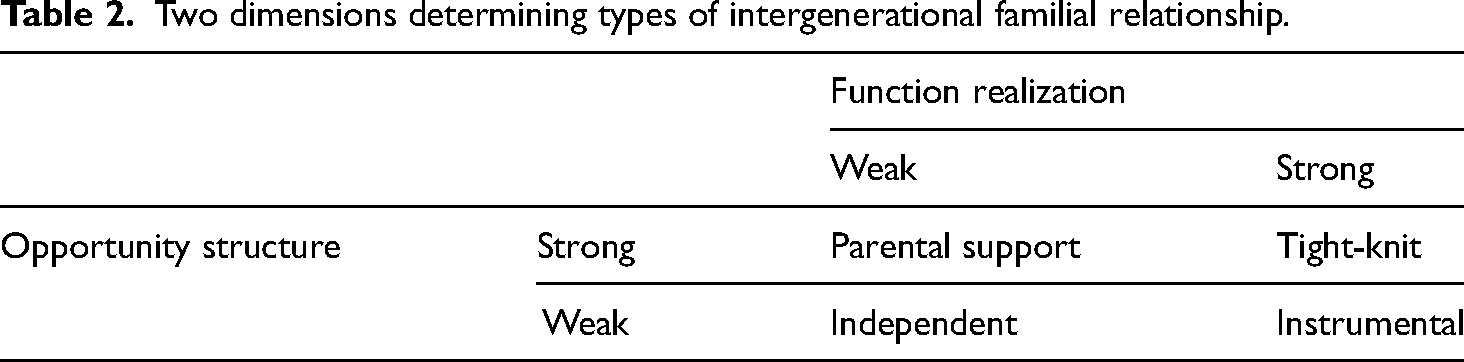
It can be anticipated that when a strong opportunity structure exists between adult children and parents (such as co-residence), several scenarios may emerge: either frequent exchanges or the unidirectional flow of resources. The former establishes a close-knit relationship, while the latter can be further delineated into two scenarios. In one scenario, parents persist in supporting their offspring, forming a parental support relationship. In the other, children unilaterally provide care for their parents, thereby upholding traditional caregiving functions and remaining within the realm of a close-knit relationship. In the context of intergenerational relationships characterized by a weak opportunity structure, two scenarios emerge: In one, frequent exchanges of resources or, at least, a directional flow of resources from children to parents persist, thereby establishing an instrumental relationship. In the other, in cases with hardly any exchange of resources, which fosters the minimal interaction between younger and older generations, an independent relationship ensues. This study avoids labeling the latter as “detached”, because detachment implies emotional distance, which is not encompassed within the structure–function analytical framework. Evidently, the reciprocity model offers the best interpretation for tight-knit relationships, while the relay model might be more suitable for explaining independent relationships.
Given the analytical framework outlined above, this study addresses the following questions: Can the interaction between the opportunity structure and function realization dimensions encompass the primary characteristics of intergenerational relationships in Chinese families? Specifically, is the divergence between younger and older generations in terms of living arrangements and modes of contact independent of the strength of intergenerational exchanges? To what degree do these four potential types of intergenerational relationship validate the perpetuation of reciprocity patterns or transition toward a relay model?
Individual characteristics influencing intergenerational relationship types
Sociological status
The proverb “a poor family yields unfilial children” suggests that children might be unable to provide adequate support to their parents because of economic constraints. Studies have revealed a positive correlation between economic factors and intergenerational relationships. When the younger generation holds a higher socioeconomic status, they are more likely and capable of offering support to their parents (Chen and Chen, 2016; Jiang et al., 2013). Conversely, parents with higher socioeconomic status tend to provide more resources to their children, extending this support even into their children's adulthood. Socioeconomic status can be operationalized through education, occupation, and income, where rural‒urban disparities represent a significant variable. In rural areas, because of the migration of young and middle-aged adults to urban areas for employment, elderly individuals who stay behind often encounter challenges in eldercare. Conversely, urban elderly individuals typically benefit from social security measures such as housing provisions and retirement benefits, contributing to a relatively stable socioeconomic condition. Accordingly, do families of higher socioeconomic status exhibit a greater inclination toward fostering positive intergenerational relationships? Conversely, how do families of lower socioeconomic status facilitate intergenerational functional exchange?
Children's gender
The traditional notion of “raising children to provide support in old age” has undergone substantial change. Influenced by China's family planning policy, a considerable number of parents with only daughters are entering old age. This is undoubtedly fostering new expectations regarding the role of daughters in intergenerational relationships. Traditionally, daughters were more likely to become caregivers for their in-laws, while their connection/contact with their own parents weakened (Bian and Logan, 2001). However, as women's economic prowess and social standing have risen, they now have more opportunities to provide support to their natal parents (Tang et al., 2009; Xie and Zhu, 2009). Therefore, does gender influence the type of intergenerational relationship, and if so, how does this influence manifest?
Generation of children
From the life course theory perspective, children from various generational cohorts undergo diverse societal events during specific developmental stages, thereby exhibiting analogous traits. Regarding intergenerational relationships in Chinese families, individuals from different generational cohorts display disparities in family concepts, including changes in filial piety beliefs (Hu, 2018). In addition, variations are evident in family population structures, such as differences in the number of siblings (Logan et al., 1998). Further, individuals from different generational cohorts find themselves in distinct phases of the family life cycle, which also influences intergenerational relationships in different ways. For instance, young adults transitioning into adulthood are more susceptible to the phenomenon of “ken lao” (prolonged parental dependence) (Liu, 2017; Xu, 2017). Hence, within the spectrum of intergenerational relationship typologies, are there disparities among different generations, and what kinds of intergenerational relationship exist between children at various stages of the family life cycle and their parents?
Data, variables, and analysis methods
Data
This study used data from the China Health and Retirement Longitudinal Study (CHARLS) in 2015, as well as the curated C-version harmonized data for empirical analysis. Several characteristics of these data render them suitable for this research. First, they constitute a nationally representative sample of individuals aged 45 years and above, covering 450 communities (villages) across 28 provinces (autonomous regions, municipalities). Second, the survey, organized at the household level, collected information not only from respondents but also from their spouses and all offspring, providing the necessary foundation for measuring intergenerational relationships. Given that a single respondent may have multiple children, this study focuses on adult children as the unit of analysis, encompassing offspring aged between 18 and 60. The final research sample comprised 29,744 adult children matched with 11,587 corresponding parent households.
Variables
The variables in this study are divided into two sets: one comprising indicators measuring intergenerational relationship types and the other comprising individual information pertaining to the children and parents.
Structural opportunity indicator variables
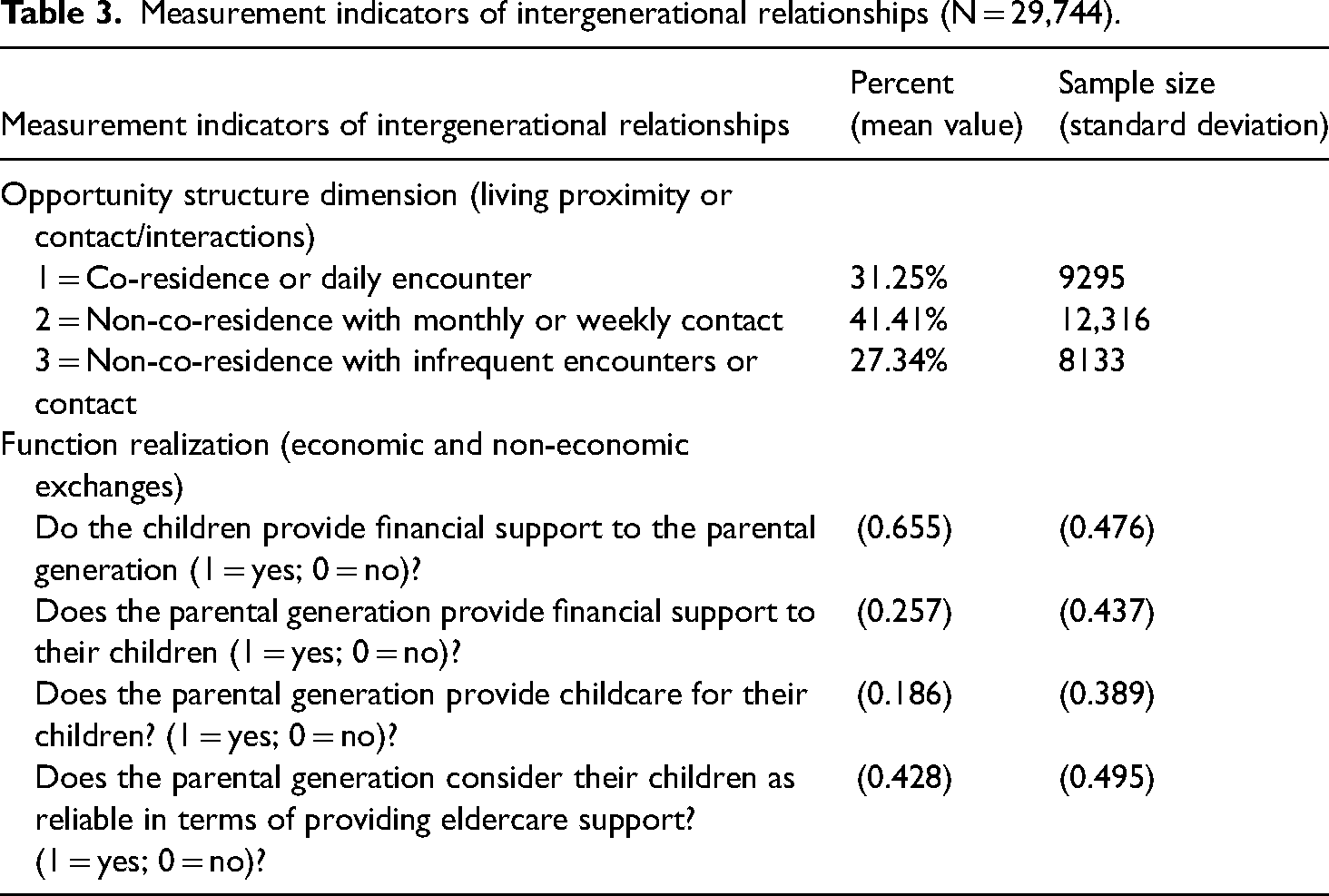
As mentioned above, the structural opportunity indicator variables encompass living arrangements and patterns of daily contact. Within the framework of the CHARLS questionnaire, these variables demonstrate an inherent logical relationship. Specifically, three targeted inquiries were asked subsequently: 1. Do any of your children currently reside with you or have any resided with you for more than 11 months in the past year? 2. What is the frequency of your encounters with your children who do not cohabit? 3. What is the frequency of using alternative communication methods (phone, SMS, mail, or email) with children whom you have face-to-face contact less than once a week? Based on the logical correlation among these inquiries, this study established a categorical variable to address the opportunity structure with three classifications: 1 = co-residence or daily encounter, 2 = non-co-residence with monthly or weekly contact, 3 = non-co-residence with infrequent encounters or contact. In this study, daily encounters and co-residence were grouped together because having a daily encounter, despite not sharing a residence, resembles what is referred to as “a distance that keeps soup warm” (Sun et al., 2018). This proximate arrangement mirrors the opportunity structure of co-residence.
Function indicator variables
Drawing from the existing literature, this study integrates two frequently employed function indicator variables: intergenerational bi-directional economic support (comprising monetary and material assistance) and cross-generational caregiving. Further, to emphasize the focus on caregiving functions, this study included a variable related to the older generation's expectations for eldercare support.
The coding and descriptive statistics for the intergenerational relationship measurement indicators are presented in Table 3. Roughly one-third of adult children either cohabitate or engage in daily face-to-face interactions with their parents. However, from the parental standpoint, this proportion is notably higher, with 56.4% reporting living together or having daily encounters with at least one of their adult children. As the objects of expectations regarding elderly care, 42.8% of adult children are considered dependable. From the parents’ viewpoint, there is a slight increase to 51.7% in their perception of having adult children on whom they can rely to provide elderly care. This preliminary analysis indicates that intergenerational interactions and mutual support persist at a relatively high level.
Measurement indicators of intergenerational relationships (N = 29,744).
Offspring variables
As indicated by Table 4, the socioeconomic status of the children is measured on the basis of their educational level and household annual income (no occupational variable for children is available in the CHARLS data). The original data categorize educational attainment from illiterate to holding a doctoral degree. In this study, it is transformed into a continuous variable reflecting the years of education received (likewise for subsequent variables). As parents may not be fully aware of all of their children's incomes, about a quarter of the sample lacks information on offspring's income, constituting a separate category. Adult children's income, aggregated at the household level, includes that of the offspring themselves and their spouses. Since income information is collected using unequal income intervals, a five-category approach was adopted during data processing to consolidate the respective intervals, thus highlighting relative income differences (similarly for subsequent analyses). To investigate potential generational disparities, a birth cohort variable is included. In addition, pertinent variables such as offspring gender, marital status, and property ownership are incorporated.
Descriptive statistics of offspring and parental generation variables (N = 29,744).
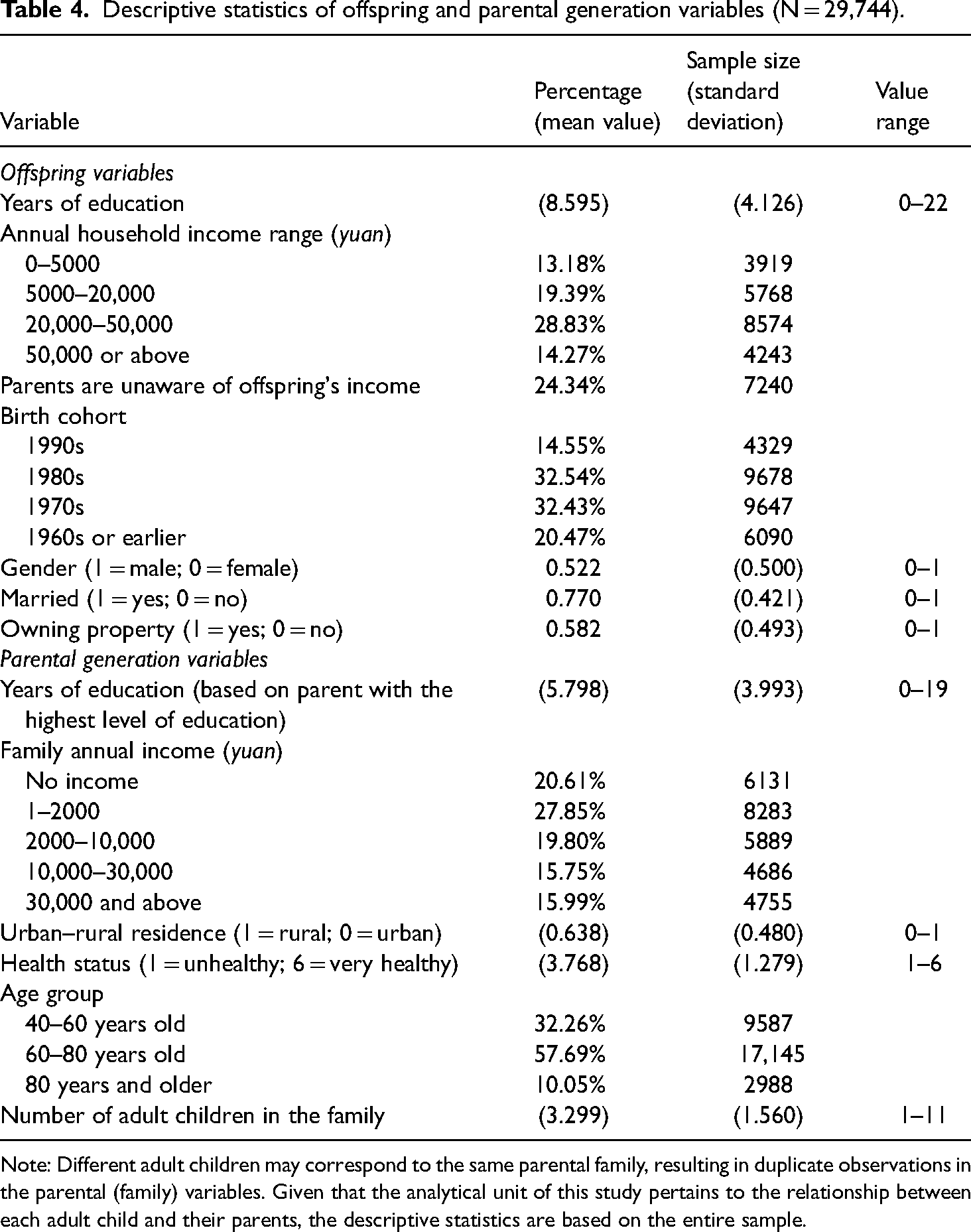
Note: Different adult children may correspond to the same parental family, resulting in duplicate observations in the parental (family) variables. Given that the analytical unit of this study pertains to the relationship between each adult child and their parents, the descriptive statistics are based on the entire sample.
Parental variables
As Table 4 indicates, parental socioeconomic status is measured through education level, household income, and urban or rural residency status. The income of the parents includes both asset and non-asset-based sources such as wages, pensions, and retirement funds, encompassing both the individual and their spouse. Further, this study incorporates the health status of elderly parents into the analytical model, represented by self-rated health. In the CHARLS dataset, all elderly samples were randomly split into two groups, with each asked slightly different self-rated health questions. This study combined these two variables. The study also considers the health status of elderly couples, taking the less favorable health status value to effectively measure the comprehensive health in the parental family. The model also incorporated variables related to the respondent's birth group and the number of adult children in the family.
Analytical approach
This study employed the LCA methods derived from typological research on intergenerational relationships. In contrast to more conventional factor analyses, LCA focuses on the set of samples rather than the set of variables. It examines the diverse values of samples across a series of “categorical manifest variables” to derive unobserved “categorical latent variables”, consequently categorizing the samples into different relationship types.
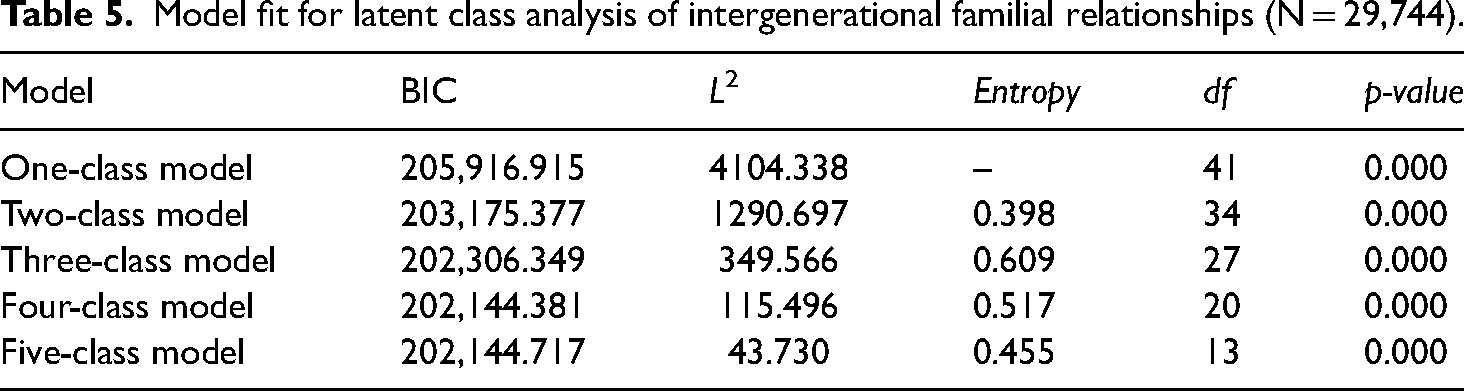
The manifest variables used in this study, as mentioned above, consist of one ternary “distance and contact” variable and four binary variables, resulting in 48 (3*24) response types. Because the classification of intergenerational familial relationships is a variable requiring exploration, we employed an exploratory LCA approach. LCA typically initiates with a baseline model, in which the number of classes is set to 1. Subsequently, it incrementally increases the number of latent classes. Model fit is then assessed on the basis of fit indices such as L2 (likelihood ratio chi-square) and BIC (Bayesian information criterion). When the BIC value decreases or L2 is not significant, the model achieves the best fit. When the sample size is sufficiently large, the class model with the lowest BIC value is often selected (Chiou, 2008; Guo et al., 2012). Moreover, entropy values are commonly employed to evaluate the predictive performance of latent class models, with a value closer to 1 indicating better predictive performance.
Through an LCA, two crucial parameters are derived: latent class probabilities and conditional probabilities. Each latent class has a corresponding latent class probability denoting the relative prevalence of that class within the sample. The total probability of each latent class sums up to 1. Conditional probability indicates the probability of different manifest variable values occurring within each latent class, akin to factor loadings in a factor analysis. Higher conditional probability values indicate the stronger influence of a specific value of a manifest variable within the corresponding latent class. The probabilities of different values of manifest variables within each latent class sum up to 1, reflecting the proportional distribution of various values. Consequently, the assessment and determination of the meaningful implications of each latent class can be accomplished by examining the relative magnitudes of conditional probability values.
LCA also provides expected probabilities for each response type, which can be used to analyze the influencing factors of intergenerational relationship types. Existing literature suggests three analytical approaches. The first uses the expected probabilities of each class as dependent variables (continuous variables between 0 and 1) and individually establishing linear regression models for each class (Silverstein and Bengtson, 1997). The second entails transforming the expected probabilities of each class into a binary variable, where 1 represents membership in that class and 0 non-membership, followed by employing binary logistic regression models for each class (Cui and Jin, 2015; Guo et al., 2012). The third is establishing a novel categorical variable that represents diverse classifications in an LCA and employing a multinomial logistic regression with this variable as the dependent variable (Hogan et al., 1993; Silverstein et al., 2010).
Given that this study involves scenarios wherein multiple children correspond to the same elderly family, it presents a hierarchical data structure based on families. This means that considering differences at both the individual level and among families is essential. For clarification, this study adopted the first approach, employing hierarchical linear modeling and intra-class correlation (ICC) to measure the extent to which individual-level differences are attributable to variations among families.
Results of the analysis
Latent class analysis
This study employed Latent GOLD 5.0 to conduct the LCA. Table 5 presents the results for model fit. From the BIC values, the four-class model was seen to exhibit the lowest corresponding value, meeting the criteria for optimal model selection. Although L2 was significant in all five models (p < 0.05), in large samples, model selection can still be based on BIC values. Considering the practical interpretability of each category, this study opted for the four-class model; the conditional probabilities and class probabilities of each latent class are presented in Table 6.
Model fit for latent class analysis of intergenerational familial relationships (N = 29,744).
Latent class probabilities and conditional probabilities of four intergenerational relationship typologies (N = 29,744).
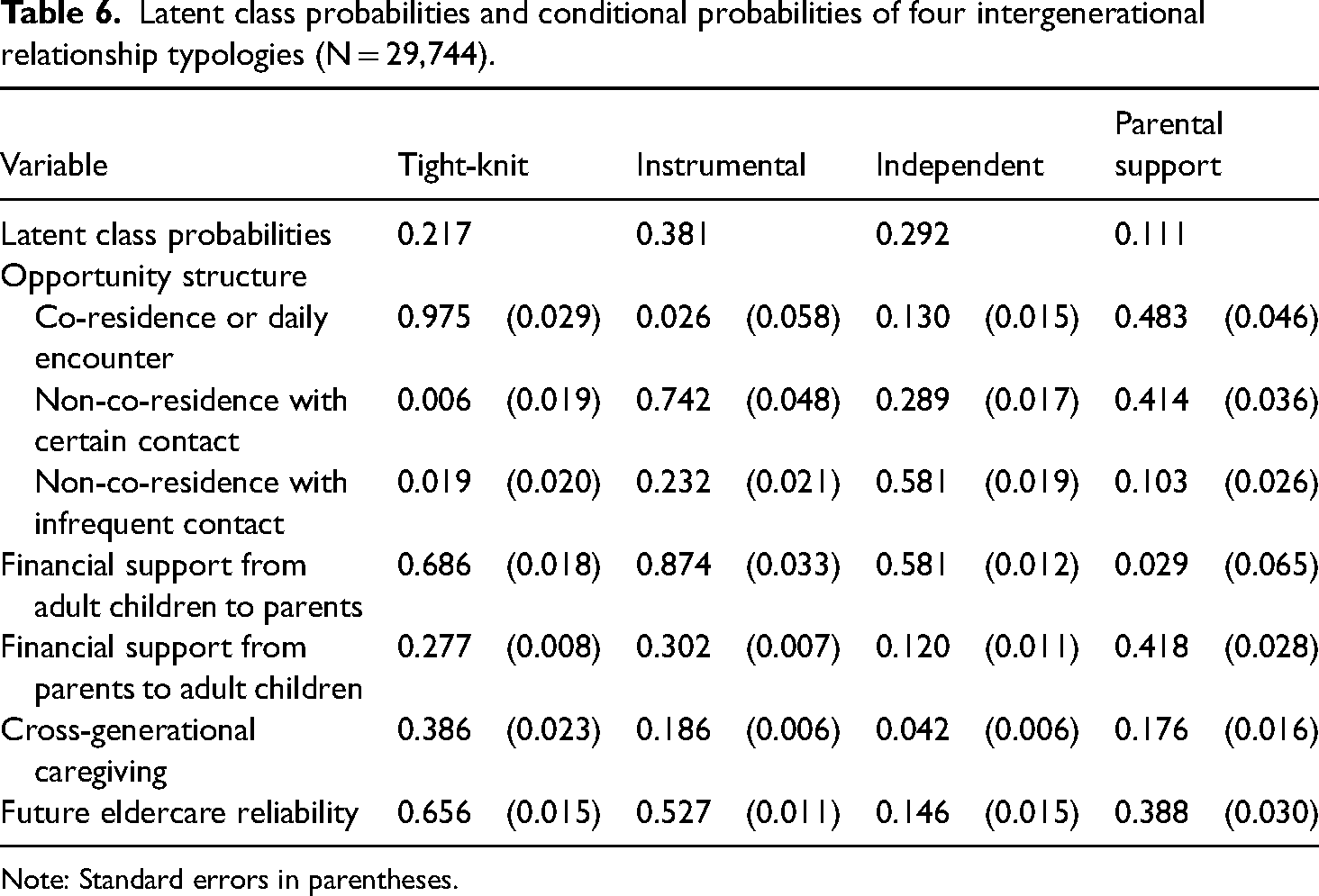
Note: Standard errors in parentheses.
Based on the manifestations of these four categories across various indicators, the analytical framework proposed earlier holds explanatory power regarding the typology of intergenerational relationships in contemporary Chinese households. With reference to this analytical framework, the four identified typologies were labeled as follows: tight-knit (21.7%), instrumental (38.1%), independent (29.2%), and parental support (11.1%).
Tight-knit
This typology denotes instances wherein adult children reside with or live in close proximity to their parents. Of the four types, this relationship is characterized by the most intergenerational caregiving and expectations for elderly care, and is indicative of a considerable level of intergenerational economic interaction.
Compared with existing research, the proportion of the tight-knit type is relatively low (21.7%), 1 which could be due to two reasons. First, this study rigorously defines the opportunity structure of intergenerational relationships, emphasizing traditional, close-knit connections in daily life, thereby excluding certain samples that reside in close proximity but do not exhibit a strong opportunity structure. Second, from a nationwide perspective, the prevalence of tight-knit intergenerational relationships appears to be gradually declining, potentially reflecting an evolving trend in contemporary Chinese families.
Instrumental
This category denotes situations in which adult children and parents inhabit separate living spaces, with only 2.6% of children in this category residing with or having daily encounters with their parents. However, a significant majority of such offspring (74.2%) sustain a certain level of contact with their parents. The most notable characteristic of this type is that it has the highest proportion (87.4%) of offspring providing economic support to their parents, reciprocated by parents providing considerable economic assistance to their offspring. Despite the physical separation between adult children and parents, 18.6% of such households are involved in cross-generational caregiving. Further, a notable percentage of adult children (52.7%) are considered reliable future caregivers for their parents in old age. The instrumental type of intergenerational relationship constitutes 38.1% of the entire sample, reflecting the changing trajectory of intergenerational familial relationships in contemporary Chinese society. Despite the spatial separation and limited contact between parents and their adult children in this category, the primary functions across generations are sustained.
Independent
This typology closely aligns with the “detached” category identified in previous studies, showcasing minimal contact/interactions between adult children and parents. This category most likely includes the lowest proportion (14.6%) of adult children considered reliable in terms of future elderly care. Within the independent category, a notably high proportion of children still provide economic support to their parents (58.1%), indicating the persistence of the filial piety obligation. Thus, differing from absolute detachment, it holds certain characteristics akin to the “distant/caregiving” type. Approximately 29.2% of the sample belongs to this category, ranking second to the instrumental type. Whether this mutually relatively independent intergenerational relationship foreshadows a shift toward a relay model akin to Western societies remains uncertain.
Parental support
This type prompts our association with the contemporary societal concern of ken lao, wherein adult children continue to reside in their parents’ homes and rely on various resources provided by their parents. The data analysis seems to confirm this notion. In this category, few offspring provide economic support to their parents (2.9%), while 41.8% of them receive financial assistance from their parents, the highest proportion among the four identified types. Simultaneously, the two generations maintain a relatively high frequency of interaction, with nearly half the adult children either living with or seeing their parents daily, and only 10.3% having infrequent contact with their parents. The parental support type constituted the smallest category, at 11.1% of the total sample, but represents a novel category. In extant typological studies, this typology aligns closely with the affective type identified by Ma (2016).
Overall, the results of the LCA align with the previously proposed analytical framework for intergenerational relationships in Chinese families. Different types of intergenerational relationship can be identified through the dimensions of opportunity structure and function realization. Note that the parental support type falls under the category with a stronger opportunity structure but weaker function realization. Here, “weaker” refers to difficulty in achieving the anticipated functions of eldercare as per the traditional “reciprocity model”. The continuous support provided by parents does not diminish, however.
Factors influencing intergenerational relationship types
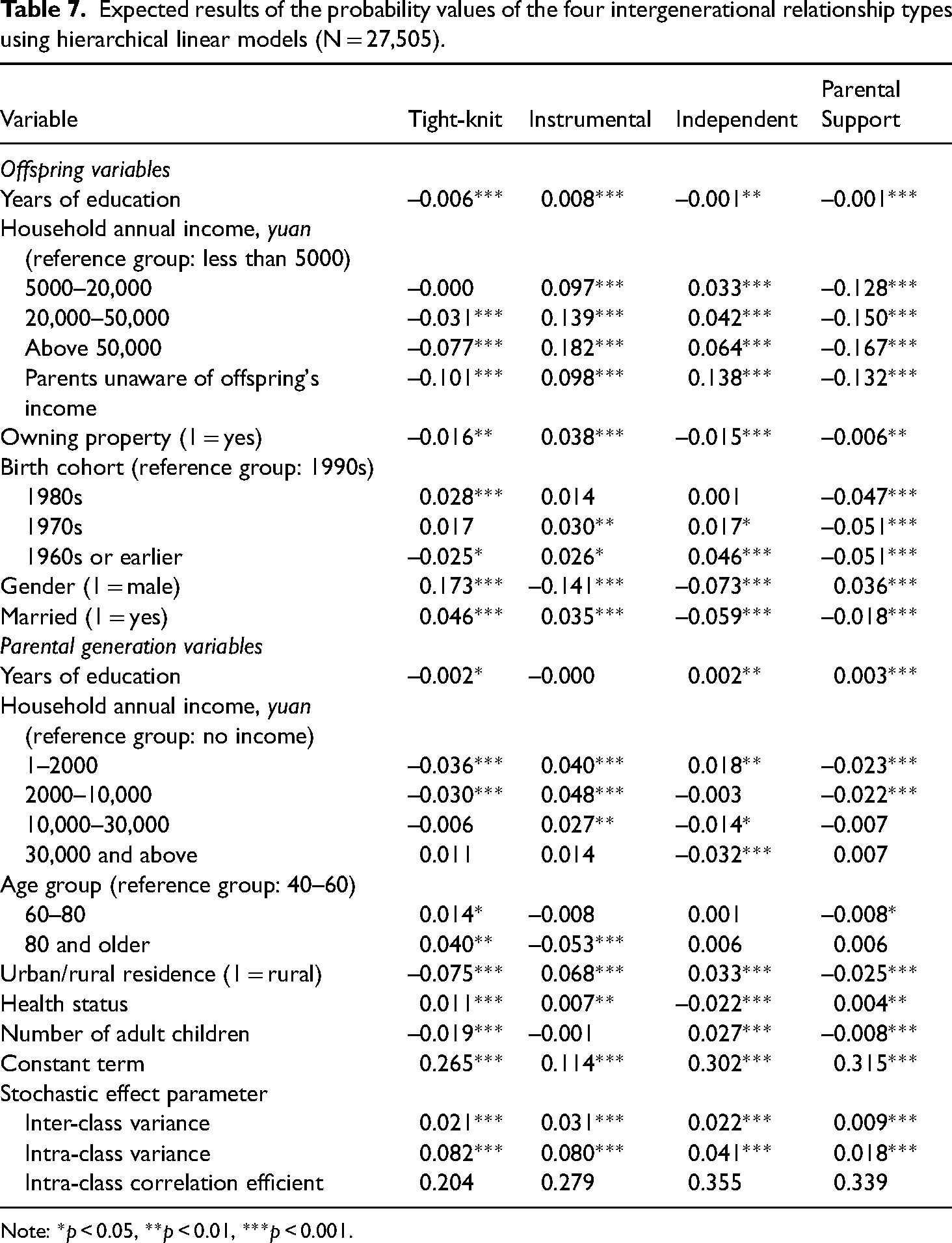
Through an LCA, this study obtained the expected probability values of all four relationship types for a given child. Subsequently, four hierarchical linear regression models were constructed, with each expected probability serving as a dependent variable. These models considered the hierarchical relationship between a single parent and multiple children (Table 7). The ICC values from the model output indicated that approximately 20–35% of the differences at the level of children are attributed to variations in parental families, highlighting the necessity of a hierarchical analysis. The subsequent analysis focuses on the impact of intergenerational socioeconomic status, children's gender, generational cohort, parental health, and other variables on the formation of specific intergenerational relationship types.
Expected results of the probability values of the four intergenerational relationship types using hierarchical linear models (N = 27,505).
Note: *p < 0.05, **p < 0.01, ***p < 0.001.
Socioeconomic status of the younger generation
The socioeconomic status of the offspring generation is significantly positively correlated to the probability of their forming instrumental or independent intergenerational relationships with their parents, and is negatively correlated to the likelihood of establishing tight-knit or parental support relationships. This aligns with existing research and societal realities. In comparison to adult children with an annual household income below 5000 yuan, those with a household income exceeding 50,000 yuan exhibit a higher probability, by 18.2 percentage points, of forming instrumental relationships with their parents, while reducing the likelihood of forming tight-knit relationships by 7.7 percentage points. Roughly a quarter of the offspring sample have parents who are unclear about their children's income. This subset of the offspring sample, similar to those with higher incomes, exhibits notably weak ties in the opportunity structure dimension of intergenerational relationships. However, the latter group maintains relatively stronger functional relationships. Offspring whose parents are uncertain about their income also demonstrate the highest probability of forming independent relationships with their parents.
Children with more years of education are more likely to form instrumental intergenerational relationships with their parents rather than the other three types of relationship. Similarly, children who own property are more likely to establish instrumental intergenerational relationships with their parents. Here, property ownership has a negative correlation with the other three types of relationship.
Parental socioeconomic status
The impact of parental socioeconomic status, including parents’ levels of education and income, on intergenerational relationship types is not unidirectional and is unclear. Compared with parents without income, those with income are more likely to form instrumental relationships with their children. However, for parents in the highest income category, this correlation loses statistical significance. Likewise, high-income parents, in contrast to those without income, are less likely to form independent relationships with their children, and the probabilities of their forming tight-knit and parental support relationships lack statistical significance. Parents with higher levels of education have a higher probability of forming parental support or independent relationships with their children, while their probability of forming a tight-knit relationship with their children is lower. The rural/urban variable is significant across all four relationship types. Urban parents, compared with rural parents, are more likely to maintain tight-knit relationships with their children and to provide support to their children after they reach adulthood. Conversely, rural parents are more likely to form instrumental or independent relationships with their children.
Cohort effects
The generational cohort of a child affects the type of intergenerational relationship that they form with their parents. Compared with children born in earlier decades, those of the 1990s cohort are more inclined to have parental support relationships with their parents. Conversely, the 1980s cohort is more likely to form tight-knit relationships with their parents than the 1990s cohort. Higher probabilities of establishing independent relationships with their parents are observed among children in the 1970s and 1960s cohort groups. From the parental standpoint, older individuals are inclined to foster tight-knit rather than instrumental relationships with their offspring. This suggests that even as elderly parents reach the stage where caregiving becomes necessary, an expectation for everyday companionship and care from their adult children remains. Parents often belong to the older elderly demographic for the 1960s cohort. Herein, the 1960s offspring tend to develop independent relationships while their parents lean toward tight-knit relationships. This might be due to the prevalence of larger sibling groups within this cohort. Despite a decline in the strength of individual child‒parent connections, parents’ caregiving needs are not overlooked, with at least one child fulfilling this obligation. Combining information from both generations, a life trajectory of intergenerational relationships between children and parents can be delineated. In their early adulthood, children rely on continued parental support. As their economic capacity grows, they begin to move away from this dependency but maintain tight-knit bonds with their parents. Transitioning into middle age, they gradually distance themselves from their parents and establish instrumental relationships. Eventually, as they approach their own old age, they form independent relationships with their parents. At this stage, elderly parents typically maintain a tight-knit relationship with at least one of their children.
Children's gender
Consensus in academia regarding the impact of gender factors on intergenerational relationship types remains elusive. While Ma (2016) identified no significant differences according to gender, Cui and Jin (2015) found that daughters are more likely to form tight-knit relationships with elderly parents. Part of this discrepancy stems from the variations in the types of intergenerational relationship. As the concept of co-residence is emphasized in this study, we found that sons are more likely to form tight-knit and parental support relationships with their parents, whereas daughters are more likely to form instrumental and independent relationships. In other words, the probability of parents co-residing with or living in close proximity to their sons is higher than that for daughters, which aligns with reality to a certain extent. Considering that 52.7% of adult children in instrumental relationships are perceived by their parents as being reliable in terms of providing elderly care, it could be proposed that both sons and daughters can be relied on for their parents’ eldercare. However, further research is needed to explore this matter.
As a control variable, the marital status of adult children significantly impacts intergenerational relationships. An intriguing discovery is that married offspring have a higher probability of forming tight-knit and instrumental relationships with their parents, while the likelihood of forming independent and parental support relationships is lower. Based on the reciprocity model, marriage seems to facilitate the fulfillment of offspring's caregiving responsibilities toward their parents. Although parents’ health is also a significant variable, the effect thereof remains unclear. It is assumed that parents in poorer health are more likely to form tight-knit relationships with their offspring; however, the results of the analysis show a positive correlation, indicating that healthier parents are more likely to form tight-knit relationships with their children. Finally, a greater number of adult offspring suggests a higher likelihood of forming independent rather than tight-knit relationships. This serves as evidence of the generational tension existing between children of the 1960s cohort and their elderly parents, as mentioned above.
Conclusion and discussion
This study used representative survey data at the national scale that focused on the elderly population to analyze the types of intergenerational familial relationships and their influencing factors. This section summarizes the research findings and engages in a preliminary discussion across three dimensions.
Changes in intergenerational relationship dynamics
Since Fei Xiaotong introduced the classic concept of the “reciprocity model”, the evolution of intergenerational relationships in Chinese families has remained a subject of scholarly interest. Prior LCA-based studies on specific samples identified various types of intergenerational relationship, such as pragmatic, distant/reciprocal, or distant/caregiving. These types have been elaborated in qualitative studies employing explanatory frameworks such as exchange relationships and rational choice. The findings of this research align with these earlier studies and underscore the dominant position of instrumental intergenerational relationships through a quantitative analysis. Instrumental intergenerational relationships manifest as adult children having higher incomes, living separate lives from their parents but maintaining economic interaction, and engaging in cross-generational caregiving.
Therefore, will intergenerational relationships in Chinese families evolve into a relay model similar to that in Western societies? The relay model implies that resource exchanges between adult children and parents cease after the children reach adulthood. This study found a high proportion of independent relationships, which aligns with previous research on detached relationships, albeit finding this type to be more prevalent than in previous studies. Children in independent intergenerational relationships evince certain advantages in terms of income, but have relatively lower educational levels, and they are more likely to be from the 1970s and 1960s cohorts. Further analysis suggests that individuals in this group (especially those in the 1960s cohort) tend to have more siblings, hence diminishing the pressure or burden on individual children to provide care for their parents. In addition, the socioeconomic status of the parental generation does not have a clear impact on the formation of independent relationships. This implies that the independent model does not align with the assumptions of the Western relay model. As more individuals from the 1980s and 1990s cohorts enter middle age and have fewer siblings, whether the inevitable caregiving obligation may prompt them to form new intergenerational relationships with their elderly parents requires further investigation.
This research uncovered a new form of intergenerational relationship between offspring and parents that we have termed the “parental support” type. While scholars have examined the social phenomenon of ken lao, its classification within the framework of intergenerational relationships offers significant empirical insight. Individuals categorized under the parental support type are predominantly from the 1990s cohort, characterized by relatively weaker economic capacity or an unpreparedness for financial independence. Moreover, sons are more likely to engage in this type of relationship with their parents than are daughters. Notably, the parental support type has no correlation with children's education or parents’ income levels. A more positive interpretation of the parental support type can be considered in modern urban societies, where establishing a career and starting a family often entail greater material requirements such as housing, cars, or well-paying jobs. For young adults entering adulthood, especially sons, there exists a period of transition, and continuous parental support seems increasingly necessary, if not expected.
Continuity in intergenerational relationships
Chinese society is in a continuous process of transition and evolution, consequently impacting the structure of intergenerational relationships in families, with the trend seemingly moving away from the traditional reciprocity model. Thus, to what extent can the traditional caregiving model, based on co-residence, be sustained? Although from the perspective of adult children only one-fifth of relationships seem tight-knit, the proportion may differ from their parents’ standpoint considering the presence of several adult children. This constitutes an intriguing finding from this research. The analysis reveals that in terms of the relative prevalence of the four relationship types, 48.5% of parents have a tight-knit relationship with at least one child, 58.4% have an instrumental relationship with at least one child, and only 7.4% have a solely independent relationship with their children. This indicates that intergenerational relationships in Chinese families are well maintained. As the generation of only children enters middle age without the support of siblings, how they will establish intergenerational relationships with elderly parents requires further research.
Overall, the evolution of intergenerational relationships in Chinese families does not disprove the traditional reciprocity model. From the children's perspective, although the tight-knit relationship based on co-residence does not dominate, the instrumental relationship ensures a connection and interaction with parents. This means that the relationship of caregiving and support continues to exist, sustaining the intergenerational function of reciprocity. Economic support has a substitution effect for daily care, replacing in-person care, thereby enriching the forms of caregiving. Even in the parental support relationship, though younger children rely more on their parents economically and cannot provide support to the latter, because of the strong relationship between children and parents in terms of opportunity structure, parents remain confident that their children will provide them with eldercare in the future. The tension between economic resources and emotional reliance reflects the collision of tradition and modernity.
Intergenerational relationships and the reproduction of inequality
Children's income level significantly influences intergenerational relationships. Children with a higher income are more likely to form instrumental or independent types of intergenerational relationship with their parents. It is noteworthy that in instrumental relationships both adult children and their parents have higher socioeconomic statuses, as such, this form of intergenerational relationship represents a more desirable type in modern Chinese society. However, in independent relationships, parents with lower incomes and poorer health are more likely to be completely isolated from their children. This reflects the existence of a small fraction of vulnerable elderly individuals who simultaneously face challenges in terms of economy, health, and intergenerational relationships.
Urban‒rural distinctions are often perceived as disparities between modernity and tradition. However, this study reveals an unexpected finding: urban families are more likely to establish relationships characterized by stronger opportunity structures (e.g. tight-knit and parental support relationships) than are rural households. Conversely, rural parents are more inclined to form relationships with their children characterized by weaker opportunity structures (e.g. instrumental and independent relationship types). This phenomenon is attributed to the higher mobility in rural households. Working-age rural migrant workers, while employed in urban areas, experience spatial isolation from their parents. Consequently, parents could either belong to the group of left-behind individuals in rural areas or be elderly migrant workers residing in locations different from those of their children. This highlights, once again, the additional costs borne by rural families in terms of intergenerational relationships amid labor migration, while also revealing the predicaments in rural elderly care.
Contributorship
Xuhui Zeng undertook data analysis and wrote the paper. Yifeng Li drafted the manuscript and organized the data.
Footnotes
Declaration of conflicting interests
The authors declared no potential conflicts of interest with respect to the research, authorship, and/or publication of this article.
Funding
The authors received no financial support for the research, authorship, and/or publication of this article.