



Abstract
This study examines the influence of grandparenthood and grandparental childcare on loneliness among Chinese older adults. Using longitudinal data from a nationally representative sample of 9240 individuals from the China Health and Retirement Longitudinal Study (CHARLS), we applied logistic regression to examine the relationship between various grandparental statuses and loneliness with a focus on gender. The grandparental role is a protective factor for loneliness. Providing care to grandchildren was associated with a lower likelihood of feeling lonely for both genders. Among grandmothers, the benefit of providing childcare is less when it is occasional. Among grandfathers, the benefit is less when it is regular and intensive. Regarding transitions in grandparental status, gender differences were only observed among those who recently entered the caregiving role. Given the increasing reliance on grandparents for childcare in China, this engagement in active aging is beneficial for older adults in reducing loneliness.
Keywords
Introduction
Becoming a grandparent is common in late midlife and early later life. With the enormous demographic shifts and socioeconomic reforms in China, increasing longevity and demand for childcare have resulted in greater availability of grandparents and reliance on them. In China, over 80% of adults aged 55 or older are grandparents (Zhang et al., 2020), and more than 50% of grandparents provide care for their grandchildren (Ko & Hank, 2014; Xu, 2019). Being a grandparent childcare giver is more prevalent in China than in other Asian societies like South Korea (Ko & Hank, 2014), Thailand (Komonpaisarn & Loichinger, 2019), and others (Mehta & Thang, 2011). Although a similar share of grandparents who provide childcare has been found in some European countries (Di Gessa et al., 2016; Hank & Buber, 2009), the expectation and intensity of grandparental childcare are generally higher in China (Mehta & Thang, 2011; Tang et al., 2016). While grandparental childcare is common in China, a few studies have investigated the situation of grandparents as childcare givers (Sun, 2013) and the impact of caregiving on grandparents’ health and well-being (Chen & Liu, 2012; Xu, 2019). These studies have primarily utilized data on specific, mostly disadvantaged or rural, subpopulations (Wang et al., 2017), and have primarily focused on health outcomes such as self-reported health, functional limitations, and depressive symptoms (Chen & Liu, 2012; Zhao & Li, 2019). Relatively few studies have explored how grandparenthood and grandparental childcare relate to older adults’ loneliness—one of the indicators of subjective well-being and an important predictor of mortality, psychological problems, and physical health (Hawkley & Cacioppo, 2010).
Loneliness is the subjective evaluation of the gap between an individual’s desired and actual social relationships (de Jong Gierveld et al., 2018). It is usually regarded as part of ageing, and the association between age and loneliness appears to be mostly attributable to ageing-related risk factors that constrain social activities and access to supportive resources (Hawkley et al., 2008). The causes and consequences of loneliness for older adults have been the topic of a lively debate in both Chinese public discourse and academic literature in recent years (Yan et al., 2016). Studies using nationally representative samples show that about 16% of older Chinese felt lonely in the 1990s, and this increased to 28% by the 2010s (Luo & Waite, 2014; Yang & Victor, 2008; Yu et al., 2020). The growing loneliness rate is often attributed to declining intergenerational coresidence during China’s socioeconomic transformation (He & Ye, 2014). Contrary to studies in European countries and the United States (Fokkema et al., 2012; Hansen & Slagsvold, 2016; Hawkley et al., 2008; Hawkley & Kocherginsky, 2018), the few available studies in China have either focused on particular subpopulations such as empty nesters (Wang et al., 2017; Wu et al., 2010) or used data from before the recent socioeconomic transformation (Yang & Victor, 2008). Furthermore, changes in social relationships in later life usually focus on losses over time, for example, adult children moving away, or friends and relatives passing away (Djundeva et al., 2019). Research on the impact on loneliness of gaining family relationships in later life, most notably with grandchildren, is still scarce. This is rather surprising, as there are several arguments in the literature (discussed in the next section) that having grandchildren not only influences health conditions but is also protective against loneliness. This is expected to hold especially true for those grandparent childcare givers who are more likely than people without grandchildren or non-caregivers to connect with their offspring, provided that the tasks are not too burdensome. The few relevant studies focus primarily on the impact of grandparental caregiving roles, and some of them only include respondents with grandchildren (Danielsbacka et al., 2019; Di Gessa et al., 2016; Quirke et al., 2020; Tang et al., 2016; Tsai et al., 2013).
Against this background, this article seeks to add to the field of research by providing a detailed examination of grandparenthood and grandparental childcare with the overarching research question: are being a grandparent and caring for grandchildren protective factors for loneliness among Chinese older adults? We contribute to the related literature by (1) distinguishing between being a grandparent and the childcare role, (2) adopting a life course approach by considering the gender context and the longitudinal influence of transitions in grandparenthood and caregiving roles on loneliness, and (3) using a recent and nationally representative sample of three waves of data from the China Health and Retirement Longitudinal Study (CHARLS).
Grandparenthood, Grandparental Childcare, and Loneliness
Grandparenthood is an important transition in the life course, which induces changes in existing or desired relations. The arrival of grandchildren in an older person’s primary social group can influence their self-efficacy and self-esteem and the sense of feeling hopeful about the future and being connected (Taubman-Ben-Ari et al., 2013). Grandchildren can be the bridges to new social networks, or they can enhance existing relationships, like that between parent and child (Schenk & Dykstra, 2012; van den Broek et al., 2019). Evidence from Western societies indeed suggests a positive association between grandparenthood and well-being, although some studies report statistically insignificant results (Bordone & Arpino, 2019; Di Gessa et al., 2020). Compared to Western societies, Chinese older people have more dense networks with a higher percentage of kin (Fung et al., 2008). In terms of living arrangement, older adults in China traditionally prefer to live with their children even after their offspring have started their own family. Although the empty-nest phenomenon increased in China in recent years, the proportion of three-generation grandparental coresidence households has remained stable at around 16.5% and the proportion of households where grandparents live with their grandchildren only increased in the past decades (Hu & Peng, 2015). Recent quantitative research found that living with family members reduced the risk of loneliness for Chinese older adults (Yang & Gu, 2020). Influenced by Confucianism, Chinese culture highly values the continuation of the family line and large extended families (Goh, 2009; Yasuda et al., 2011). As a result, older Chinese could gain close kin and advance up the family hierarchy when they are grandparents, and this could be a protective factor for loneliness. We therefore hypothesize that grandparents are less likely to feel lonely than non-grandparents (H1).
In addition to being a grandparent itself, grandparenting emphasizes the importance of the direct contact and interaction between grandparent and grandchildren within the extended family. Research findings on the Chinese context consistently show the high level of well-being and happiness that is gained from active grandparental childcare (Baker & Silverstein, 2012; Silverstein et al., 2006), as providing childcare enhances a sense of closeness and intimate ties within the family (Chen & Liu, 2012; Cong & Silverstein, 2012). The perception of actual social relationships appears to be affected by the context as well. The psychological benefit of grandchild care may be more salient in the Chinese context than in Western societies. Traditional Confucian family norms consider the role taken by grandparents who provide childcare as valuable, authoritative and contributing to family welfare (Burnette et al., 2013; Tang et al., 2016). Although filial piety emphasizes upward support from adult children to older parents, recent research has found that taking care of grandchildren is one of the most common behaviors for Chinese grandparents, and they are expected to take full-time and even primary responsibility for the care of grandchildren (Burnette et al., 2013). We therefore hypothesize that compared to grandparents who do not provide childcare, grandparental caregivers are less likely to feel lonely (H2).
Caregiver stress and role strain theory (Goode, 1960) do, however, indicate that the caregiving role interacts with other social roles, and grandparents may be “strained” when engaged in caregiving at a high intensity. This may particularly be the case for those who are primary caregivers or custodial grandparents. Previous research has found that health outcomes were different between custodial and noncustodial grandparents in the United States and rural China (Baker & Silverstein, 2012). Empirical evidence on grandparental childcare also indicates both beneficial and detrimental effects, depending on the caregiving intensity (Chen & Liu, 2012; Komonpaisarn & Loichinger, 2019; Xu, 2019). Although providing childcare can be rewarding, intensive care loads can restrict grandparents’ participation in other social activities (Arpino & Bordone, 2017; Goh, 2009; Zhao & Li, 2019), thus limiting access to social support and resources for well-being and increasing the risk of loneliness. Given the heterogeneous effect of childcare intensity, we could expect a nonlinear effect of the degree of involvement in childcare on loneliness among the group of grandparents who provided childcare. Occasional childcare is often called upon when needed. Regular childcare involvement contributes to a stable grandparent-grandchild connection, whereas high-intensity regular childcare may become too demanding and time-consuming. We therefore hypothesize that grandparental caregivers who are regularly but moderately involved in childcare are less likely to feel lonely than grandparental caregivers whose involvement is either occasional or regular and highly intensive (H3).
Gendered Life Course and Grandparental Roles
Several studies reviewed above have found gender differences in the likelihood of grandchild care provision and outcomes of grandparenthood/grandchild care. The life course perspective suggests that transitions across the life course lead to different roles and relationships that shape individuals’ outcomes (Alwin, 2012), and some life experiences have strong gendered expectations. Gender, therefore, is a critical aspect to consider when studying family roles and caregiving. The gendered division of the grandparental role is likely to derive from the biographical differences between the sexes (e.g., life expectancy) and social factors such as gendered tasks, responsibilities and expectations traditionally associated with grandparenthood (Bordone & Arpino, 2019). Across the life course, women are more likely to provide care and invest in maintaining intergenerational ties than men (Patterson & Margolis, 2019). The role of family carers likewise determines strongly gendered patterns in grandparental caregiving (Hank & Buber, 2009). Empirical evidence shows that these differences account, at least in part, for the gender gap in individuals’ well-being and health outcomes. For example, it is shown that the health consequences of grandparenthood and grandparental childcare were usually stronger (in both a positive or negative sense) for women (Arpino & Gómez-León, 2019; Sheppard & Monden, 2019; Xu, 2019).
In addition, the emphasis on differences by gender in grandparenthood and grandparental caregiver roles follow from another theme of the life course, namely, the impact of social and cultural context on people’s lives (Alwin, 2012). The structural ambivalence approach (Neuberger & Haberkern, 2014) indicates that the contradiction between cultural norms and behaviors is less accepted and rewarded than the agreement between the two. Traditional Chinese culture is collective and patriarchy-oriented familialism (Yasuda et al., 2011). In China, the traditional division of labor in the family dictates that grandmothers are the primary providers of childcare and their involvement is more intensive than that of grandfathers (Chen & Liu, 2012). Hence, this study examines the possible gender differences in the associations between grandparental roles and loneliness in such a patriarchy-oriented society. Connected to the hypotheses above, we expect to find a higher benefit of having grandchildren for women (H1.1), a higher benefit of providing grandchild care for grandmothers (H2.1), and a higher benefit of regular involvement in childcare for grandmother caregivers (H3.1) on lowering the likelihood of loneliness.
Transitions to Grandparenthood and Changes in the Caregiving Role
The literature mostly shows various effects of grandparenthood and grandparental childcare, but longitudinal studies examining the transitions in these grandparental statuses are scarce. A few studies using within-person design found that becoming a grandparent was associated with improved well-being, particularly for women (Bordone & Arpino, 2019; Sheppard & Monden, 2019; Tanskanen et al., 2019), while providing childcare was not causally contributing to grandparents’ better health and well-being (Danielsbacka et al., 2019). Such findings, however, estimate the average effect of grandparental status on outcomes for older adults without regard for the timing and directions of these grandparental status changes. (Quirke et al. 2020) added to this field by using asymmetric fixed effects models to examine the influence of a change in grandparental childcare status, focusing particularly on loneliness, and showed that beginning to provide childcare would increase the risk of loneliness for German grandfathers but not for grandmothers.
Empirical studies have rarely investigated whether the influences of transitions in grandparenthood and grandparental childcare are the same in non-Western societies like China. We therefore assess the influence of transitions to grandparenthood and changes in caregiving role on loneliness. Our study extends previous work by explicitly considering the timing of the transition to grandparenthood and the complex combination of transitions into and out of a caregiving role and the association with loneliness.
Methods
Data and Sample
This study uses data from the China Health and Retirement Longitudinal Study (CHARLS, http://charls.pku.edu.cn/en). CHARLS is part of a family of surveys modeled on the Health and Retirement Study (HRS) conducted in the United States and provides a unique opportunity to study older adults in a nationally representative sample of Chinese families (Lee, 2015). It covers non-institutionalized Chinese persons aged 45 and older and their spouses. Information was collected on the respondents’ family and household structure, health status, employment and income. CHARLS provides a detailed demographic profile for each of the respondent’s children as well as information on care provided to grandchildren. The baseline fieldwork was conducted in 2011. Respondents were followed every 2 years, while wave 3 conducted in 2014 is a life history survey.
For this study, only people who were not childless were considered, and we restricted the sample to those who were between 45 and 75 years old at the baseline wave in 2011 (wave 1) and who were followed up successfully until 2015 (wave 4). It should also be noted that the lower bound of 45 is lower compared to other studies on grandparenting in Western societies, where the transition to grandparenthood is often experienced at higher ages—55 to 60 (Ates et al., 2021; Leopold & Skopek, 2015; Margolis, 2016; Zhang et al., 2020). We used age 75 as the cut-off point because the average Chinese life expectancy was 75.24 in 2010, 1 and among individuals older than 75, provision of care becomes unlikely. In fact, only half of the CHARLS baseline respondents over age 75 had grandchildren younger than 16, and they reported a low prevalence (15%) of grandchild care. After applying these selection criteria, the sample size was reduced to 15,544 individuals. The sample size for the analyses is 9240 (4893 women and 4347 men) due to attrition and missing on at least one of the variables introduced in the next section (see sample characteristics by attrition and missing Supplementary Table S1 in the Supplementary Material). Although we have dropped some observations with missing data, the consequent loss of information is expected to be relatively minor (Young & Johnson, 2015). As a robustness check, we have applied multiple imputation using chained equation and ten imputed datasets, obtaining very similar results as those presented below.
Variables
Loneliness: The dependent variable, loneliness, was generated based on respondents’ report to the question “How often did you feel lonely last week?” in each wave. There are four answer options: “rarely (<1 day)” (74.6%), “some or a little of the time (1–2 days)” (10.3%), “occasionally or a moderate amount of time (3–4 days)” (7.9%), and “most or all of the time (5–7 days)” (7.1%). By recoding “rarely” and “some or a little” into 0 and other categories to 1, a binary variable was created, contrasting older adults with and without loneliness.
Grandparenthood and grandparental childcare: The key independent variables in this study are grandparenthood and grandparental childcare. In CHARLS, the number of grandchildren was derived from the response to the question: “How many children does [Child’s Name] have?” To measure grandparental childcare, respondents who have at least one grandchild younger than 16 were asked “Did you and/or your spouse take care of your grandchild in the last year?” By combining information about whether there is a grandchild and about whether respondents provided childcare at baseline, we generated three categories of grandparent types: grandchildless, grandparent non-caregivers, and grandparent caregivers.
Involvement of grandparental childcare: For those grandparent caregivers, we examine the amount of time spent on caregiving. According to the questionnaire design of CHARLS, one randomly selected person 45 or older and their spouse (if applicable) were interviewed. However, only one of them who knows the family best in the household (“the family respondent” (Zhao et al., 2013)) was asked the question about grandchild care: “Approximately how many weeks and how many hours per week did you spend last year taking care of [Child’s Name]’s children? Yourself __ weeks __ hours per week. Your spouse __ weeks __ hours per week.” We allocated the value of the spouse’s time used for care in instances where the respondent is not “the family respondent.” Considering that one grandparent may take care of more than one grandchild, we used the information on the highest weeks and hours per week caring time allocated to grandchildren. This limits the influence of missing values in care time spent for each grandchild. Three levels of childcare involvement were distinguished: occasional (non-full-year care, spent less than 48 weeks), regular but not intensive (full-year non-full-time care, spent 48 weeks or more taking care of grandchildren but less than 40 h per week), and regular and intensive (full-year full-time care, spent at least 48 weeks and 40 h every week, which corresponds to full-time working hours (Zhao & Li, 2019)).
Transitions in grandparent types: Grandparental childcare is a dynamic family practice. By comparing the grandparent types at baseline and the follow-up waves, we examined the transitions in grandparenthood and the grandparental caregiver role. For those in the sample who were grandchildless at the baseline, we examined those who remained grandchildless and who became a grandparent between wave 1 and wave 2, and those who became a grandparent between wave 2 and wave 4. For those who had grandchildren at baseline, we created an eight-category measure of changes in grandparental caregiver roles in a four-year follow-up. We distinguished those who had never provided childcare, started to provide childcare, ended their caregiving responsibility, and continued to provide childcare, and when these changes happened. Supplementary Table S2 in the Supplementary Material shows the operationalization and distribution of changes in grandparent types across different waves.
Covariates: We included several covariates in the models that are well-known predictors of loneliness and associated with grandparental childcare (Chen & Liu, 2012; de Jong Gierveld et al., 2018): age, gender, educational level (primary school or lower, lower secondary school, secondary school, or higher), whether married or with a partner, number of children, whether currently working for pay, self-rated health status (good, fair, and poor), activities of daily living (ADLs, range 0–4), economic status in terms of household income per capita quantiles, 2 whether there are other people in the household (excluding partner, if applicable), and a dummy variable indicating participation in any social activities (including meeting friends, entertainment, community-related organizations, voluntary or charity work, and educational or training courses). Also, living in a rural or urban area is controlled for in the analyses. The descriptive statistics for covariates can be found in Supplementary Table S3 in the Supplementary Material.
Analytical Strategy
Our analysis starts with descriptive statistics for the variables used in the multivariate models. Considering the binary nature of the outcome measure, we estimated logistic regression models with individuals’ loneliness regressed on a range of independent variables, including grandparental status and controls. First, we assessed the relation between grandparenthood and grandparental childcare status and loneliness. Three sets of models were built with the pooled sample to examine the influence on loneliness of being a grandparent for all older adults (Model 1), being a grandparental caregiver for those who have grandchildren (Model 2), and the involvement in childcare for those who provide childcare (Model 3), controlling for covariates and survey wave dummy variables. Standard errors are clustered at the individual level, accounting for serial correlation over time.
Second, we investigated the longitudinal association between the transitions in grandparent types and loneliness at wave 4, controlling for baseline loneliness as well as for other demographic and socioeconomic factors. To estimate the effect of becoming a grandparent (Model 4), we keep only the subsample of individuals who are grandchildless at baseline. To estimate the effect of changes in the caregiving roles (Model 5), we select only respondents who were already grandparents at baseline. Using a baseline and follow-up design has some advantages: it produces a time order for the causal relationship and limits the problem of endogeneity by controlling for the baseline outcome variable (Arpino & Gómez-León, 2019). The changes in other life domains during the survey waves may influence loneliness at the end of observation. We also took into account several essential life changes between wave 1 and wave 4: becoming widowed (3%), retirement (14%), and declines in health (22% for self-rated health status, 10% for ADLs), as well as controls for loneliness at wave 4.
Separate models were built on the total sample and stratified by gender. Assessment of whether the estimates on the binary outcome are different between men and women requires going beyond the coefficient of the interaction to interpret the size and significance of the underlining gender differences on the predictions (Mize, 2019). We therefore tested gender differences and second-order differences (gender gaps in the loneliness between grandparenthood and grandparental childcare groups).
To check the robustness of the findings, we replicated the analyses mentioned above with ordinal logistic regression models using the original scale of the ordered specification for loneliness variables. Because the results were relatively similar, we decided to present the more easily interpretable dichotomous loneliness scale. As coresidence is a crucial structural dimension of intergenerational solidarity that reflects the opportunity structure for the interactions between grandparents and grandchildren (Silverstein et al., 2006), we tested the robustness of the results using a stricter subsample of those who were not living with grandchildren. The direction of associations was consistent with the results we present. Lastly, given that social participation could mediate the effects of grandparenthood and grandparenting (Arpino & Bordone, 2017; Ates et al., 2021; Jang & Tang, 2016), we re-run the models excluding control for participation in social activities. Results were very similar to those presented here. Full results from each repeated analysis like robustness and sensitivity check are available from the authors upon request.
Results
Descriptive Statistics
Descriptive Statistics of the Variables by Gender and Baseline Grandparental Types.
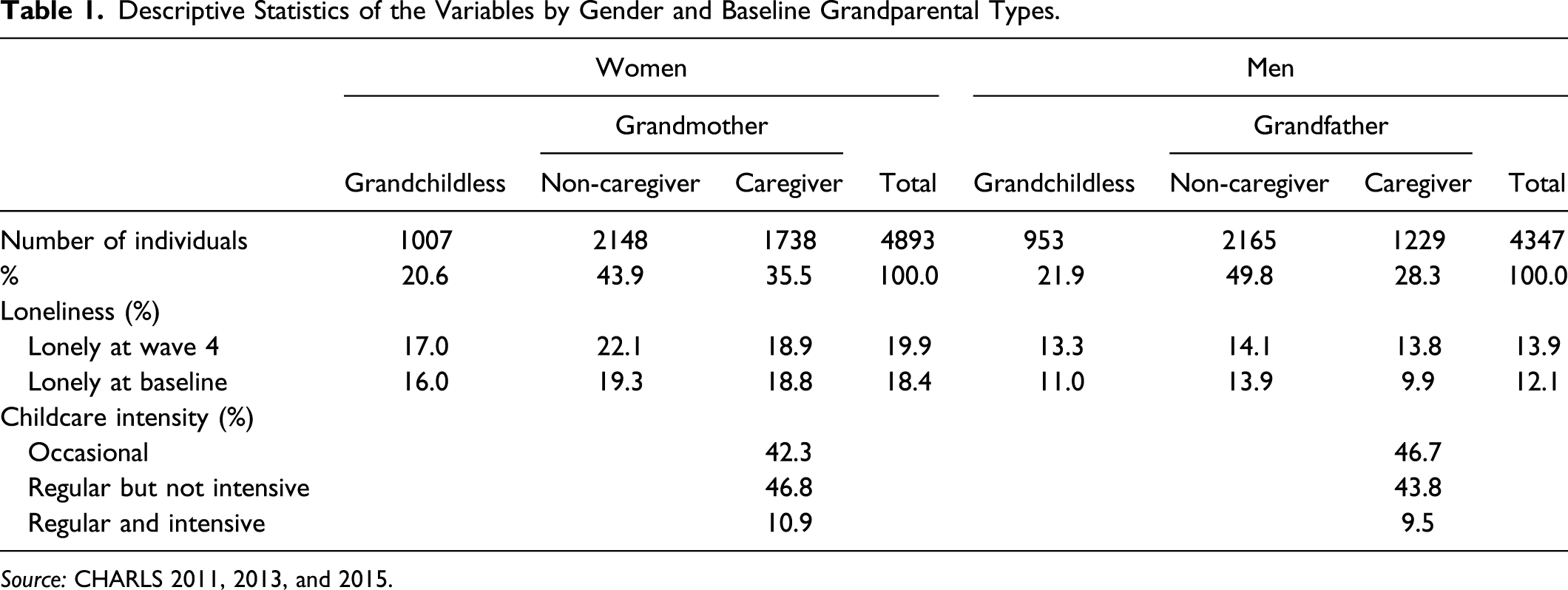
Source: CHARLS 2011, 2013, and 2015.
Association Between Grandparent Types and Loneliness
We investigated the association between being a grandparent (Model 1), providing childcare (Model 2), type of involvement in grandparental childcare (Model 3), and loneliness with pooled logistic models. The marginal effects on loneliness for each grandparent status category are reported in Figure 1. Odds ratios are reported in the text when the association was statistically significant (see full results in Supplementary Table S4 of the Supplementary Material). Marginal effects of various grandparental statuses on loneliness from Models 1, 2, and 3, with 95% confidence intervals. Source: CHARLS 2011, 2013, and 2015 (own estimates). Notes: All models include covariates.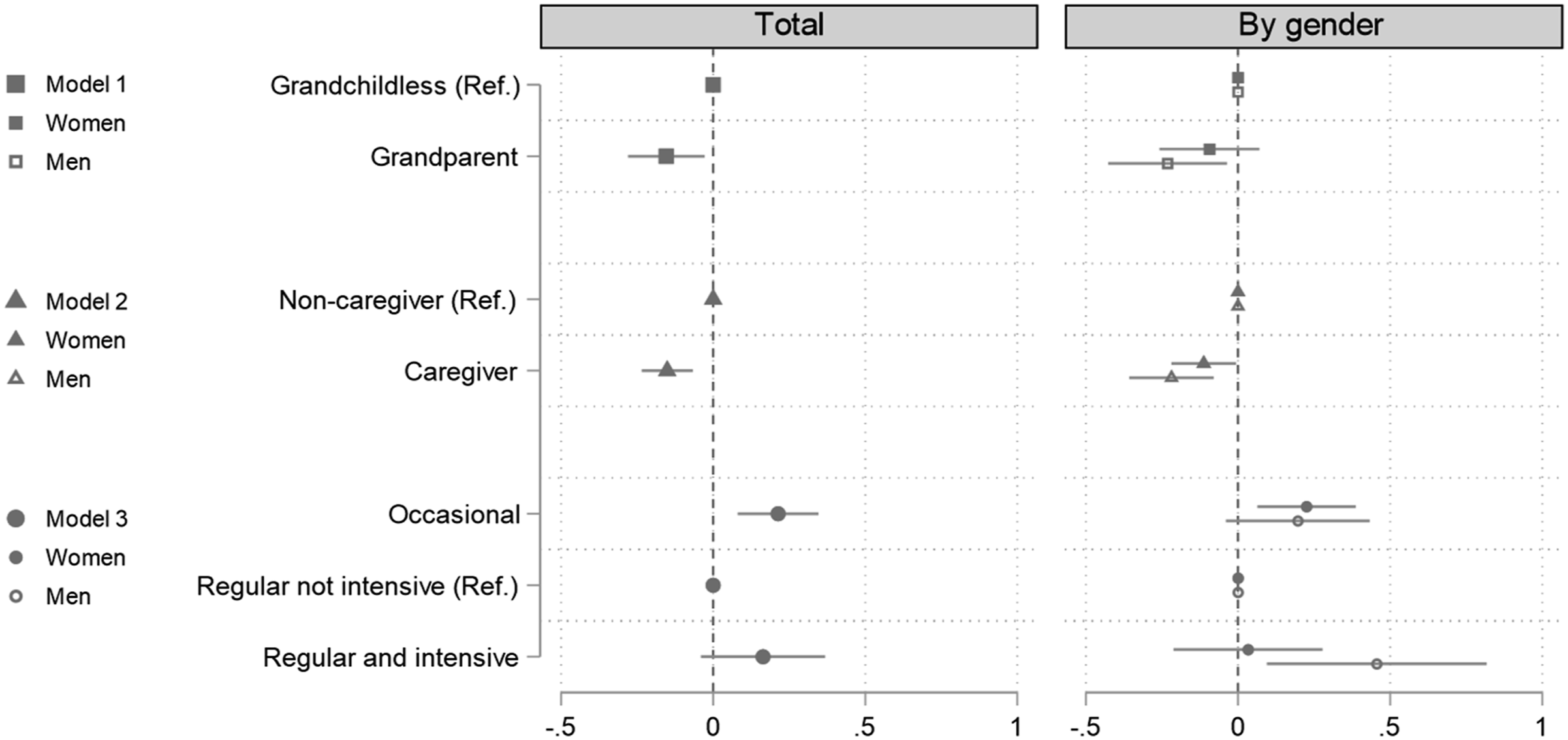
The left panel in Figure 1 shows that for Model 1, people who have grandchildren are less likely to feel lonely than those who are grandchildless (OR = 0.86, p < .05), lending support to hypothesis H1. For those individuals who were grandparents (Model 2), the coefficients of providing childcare are negative and statistically significantly associated with the likelihood of loneliness (OR = 0.86, p < .001), which lends support to hypothesis H2. Model 3 is built on the subsample of individuals who provided care for grandchildren. The result shows that occasional childcare contributes to a higher likelihood of loneliness compared to regular but not intensive involvement (OR = 1.24, p < .01), whereas there is no significant difference between those who provide regular non-intensive childcare and those who provide regular and intensive childcare. These findings partially support our hypothesis H3.
For the grandparental effects within each gender (Figure 1, right panel), no statistically significant result of being a grandparent was found in the female sample, whereas a protective effect of being a grandparent was found for the male sample (Model 1, men: OR = 0.79, p < .05). The negative association between providing childcare and loneliness was found for both grandmothers and grandfathers (Model 2, women: OR = 0.89, p < .05; men: OR = 0.80, p < .01). As for involvement in childcare, the result for grandmothers is similar to that for the total sample. Interestingly, only regular and intensive involvement in childcare was related to a higher likelihood of loneliness compared to regular but non-intensive involvement in the grandfather caregiver sample (Model 3, men: OR = 1.58, p < .05). However, the second-order differences tests (and interaction terms with gender) for the gender differences in various grandparent effects from Models 1 to 3 are not significant, which indicates equality between women and men regarding the effects of grandparenthood and caregiving role status on loneliness. Hence, our hypotheses H1.1, H2.1, and H3.1 are not supported.
Association Between Transition in Grandparent Types and Loneliness at Follow-Up
Association Between Transitions in Grandparental Types and Loneliness at Wave 4.
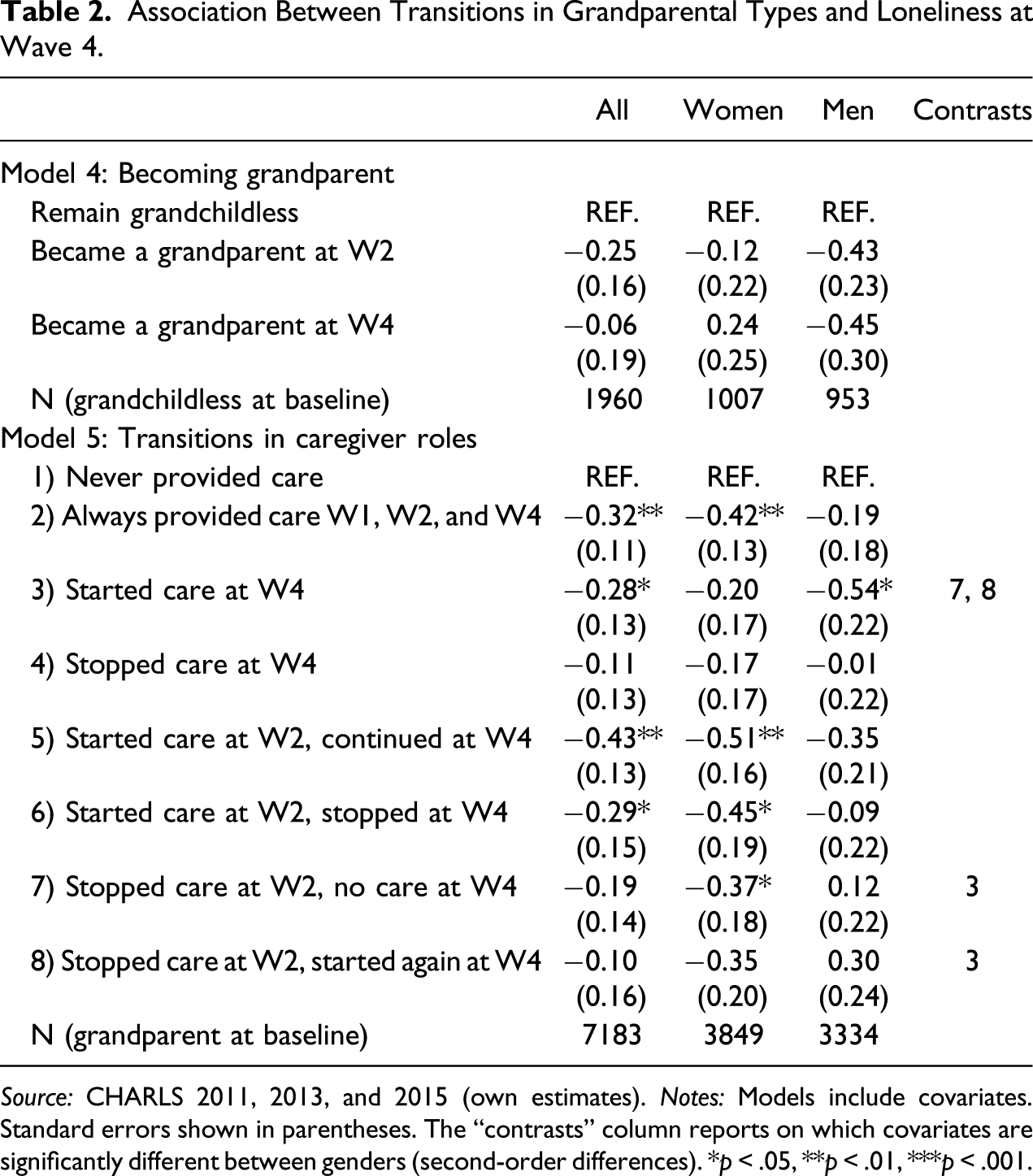
Source: CHARLS 2011, 2013, and 2015 (own estimates). Notes: Models include covariates. Standard errors shown in parentheses. The “contrasts” column reports on which covariates are significantly different between genders (second-order differences). *p < .05, **p < .01, ***p < .001.
Model 4 estimates the effect of becoming a grandparent using a subsample of grandchildless at baseline. Although the direction of the coefficients indicates that becoming a grandparent reduces the likelihood of loneliness (except for women who became grandmothers between waves 2 and 4), no statistically significant association was found. Gender variation in the effect of becoming a grandparent was not significant either.
Model 5 was built based on the subsample of grandparents at baseline and estimated the effects of transitions in caregiving roles. In the total sample, the direction of the coefficients suggests protective effects of any caregiving experience on loneliness compared to grandparents who never provided care. For grandmothers, we found significant associations with a lower likelihood of loneliness for those who always provided childcare and the groups who started to provide childcare at wave 2, compared to those who never provided childcare. For grandfathers, having started to provide care between waves 2 and 4 was significantly associated with a lower likelihood of loneliness compared to those who never provided care and those who had withdrawn from a caregiving role at wave 2. Apart from these differences, there was no significant effect of other transitions in grandparent types. As for gender differences (Table 2, “contrasts” column), the only statistically significant pattern indicated that the effect for beginning childcare at wave 4 compared to those discontinuing childcare at wave 2 differs significantly across women and men (second-order difference 3 vs. 7: 0.085, p < .05; second-order difference 3 vs. 8: 0.104, p < .05).
Discussion and Conclusion
This investigation contributed to the literature on the consequences of grandparenthood and grandparental childcare by examining whether grandparental roles reduce loneliness for contemporary Chinese older adults, using a nationally representative sample and guided by a conceptual framework informed by the life course perspective. Our key contribution lies in highlighting the connections between multiple aspects of the grandparental role and their changes in relation to later-life loneliness.
The findings from our pooled logistic regression analyses on grandparent types showed that, in general, the grandparental role is a protective factor for loneliness. Grandparents were less likely to feel lonely than their grandchildless counterparts. This holds especially true for the caregiving role for both men and women, in line with previous research on other outcomes including depression, self-rated health and well-being for Asian populations (Chen & Liu, 2012; Choi et al., 2021; Tsai et al., 2013; Xu, 2019). For those grandparents providing childcare, we found fewer benefits of providing childcare for grandmothers if it is only occasional. Regular and intensive involvement in childcare is associated with a higher risk of loneliness in men compared to grandfathers who provided regular but not intensive care. One explanation for the harmful influence of intensive childcare for men may be the violation of social expectations to provide childcare (Mehta & Thang, 2011; Quirke et al., 2020).
No clear grandparent-related transition pattern on later loneliness was found. Apart from the protective effect for women of entering a caregiving role compared to those who never provided childcare, the longitudinal results do not show a difference in loneliness over other transitions in and out of childcare for either gender. This finding is consistent with previous empirical evidence on health outcomes (Di Gessa et al., 2016; Zhao & Li, 2019), and the non-significant effects for transition patterns indicate that changes in grandparental childcare roles do not lead to increased loneliness. We acknowledge that the time slot is limited to 4 years in this study. How long the beneficial effect of active grandparental childcare will be retained is unknown, especially when the demand for care decreases as the grandchild grows up.
Unexpectedly, we did not detect significant gender differences in the association between grandparent role and loneliness. Although women were at an initial disadvantage for loneliness, the pattern of associations between grandparental status is similar for both genders. This points to the importance of reconsidering the gender context in understanding the influence of grandparenthood and grandparental childcare for older Chinese. On the one hand, women are still seen as the main kin-keepers and caregivers in the family. Grandmothers are more likely to be the ones providing more routine care (e.g., housekeeping for the whole family and feeding, dressing for the grandchildren) than grandfathers, given that men mainly rely on their wives in later life. Gender differences in grandparental childcare were found in prior research and our sample. As both genders benefit from providing childcare, encouraging grandfathers who stay away to be involved in childcare can be good for their health and well-being as long as it is not too intensive.
On the other hand, the weak gender differences in this study may indicate a changing gender norm for older adults in contemporary China. Traditionally, men/fathers were considered as providers of economic resources and as the family authority (Liong, 2017). Recently, however, with increasing longevity and a relatively young retirement age in China, a large proportion of grandparents have already withdrawn from the labor market (Zhang et al., 2020). This may create a more equal opportunity for both men and women to act as active grandparents in extended families. It is therefore possible, at a later life stage, for the gender norms to be weakened and for grandfathers to benefit from grandparenthood as much as grandmothers (Tarrant, 2012). The investigation of grandfathers is required for future studies and more research is needed across cohorts of the Chinese population and across countries.
Our findings are informative about the influence of grandparenthood and grandparental childcare on loneliness in later life. However, they also have limitations that should be considered for future studies. First, the typology of grandparenthood and grandparental childcare is relatively crude. According to the questionnaire design of CHARLS, the “family respondent” self-reports of caregiving can be subjected to recall bias and social desirability (Xu, 2019). Because we only examined the childcare aspect of grandparenting and focused on time investment in our nationally representative data, it seems that few grandfathers provide childcare personally or mainly share it with their spouses. Besides, the benefit of an individual’s caregiving may spill over to the spouse as caring for a grandchild is usually an activity within the household, especially for those living with a grandchild. Second, although to our knowledge this is the first study to examine first-time grandparents in China, we do not know when exactly the first grandchild was born. Third, we are unable to control for other grandchildren’s characteristics, which are associated with the content and types of interaction between grandparent and grandchildren. Further data collection and research are needed to design a more comprehensive questionnaire to collect information about the content and quality of grandparental childcare. Fourth, our measure of loneliness was imperfect. Because loneliness may carry a social stigma (Lau & Gruen, 1992), people are not always willing to admit feeling lonely. Research shows that direct questions are likely to result in under-reporting in specific groups such as men (de Jong Gierveld et al., 2018). This is more pronounced in studies where loneliness is measured with single-item indicators than in studies using multi-item measuring instruments (Pinquart & Sörensen, 2001). Although both direct and indirect measurements of loneliness can be used, further research using scales consisting of multiple items is warranted to more accurately assess the influence of the grandparental role on multiple types of loneliness.
Despite these limitations, this study extends the literature on the factors influencing loneliness by considering overlooked family roles in later life—grandparenthood and grandparental childcare, and focusing on a non-Western context. The message that can be taken from our study is that there is a protective effect of the grandparental role on older adults’ loneliness for both women and men, even though gendered life courses persist in China. Consistent with the call for active ageing, a better understanding of the consequences of participation in caregiving to grandchildren is important for older adults’ health and well-being.
Supplemental Material
sj-pdf-1-jfi-10.1177_0192513X211041992 – Supplemental Material for Loneliness Among Chinese Older Adults: The Role of Grandparenthood and Grandparental Childcare by Gender
Supplemental Material, sj-pdf-1-jfi-10.1177_0192513X211041992 for Loneliness Among Chinese Older Adults: The Role of Grandparenthood and Grandparental Childcare by Gender by Jing Zhang, Tineke Fokkema and Bruno Arpino in Journal of Family Issues
Footnotes
Acknowledgments
This article uses data and information from China Health and Retirement Longitudinal Study (CHARLS, waves 1, 2 and 4, supported by Peking University, the National Natural Science Foundation of China, the National Institute on Ageing and the World Bank) and Harmonized CHARLS dataset developed by the Gateway to Global Ageing Data ( ). The authors would like to thank Dr. Tom Emery for his insightful discussions during various stages of the paper preparation and proofreading the manuscript.
Declaration of Conflicting Interests
The author(s) declared no potential conflicts of interest with respect to the research, authorship, and/or publication of this article.
Funding
The author(s) disclosed receipt of the following financial support for the research, authorship, and/or publication of this article: This work was part of the project Life Course and Family Dynamics in a Comparative Perspective, ORA-China collaboration (NWO, 467-14-152). JZ acknowledges financial support from the China Scholarship Council (CSC, 201606190207). BA acknowledges funding from the Spanish Ministry of Economy, Industry and Competitiveness (PCIN-2016-005; project “Care, Retirement and Wellbeing of Older People Across Different Welfare Regimes”–CREW).
Supplementary Material
Supplementary material for this article is available online.
Notes
References
Supplementary Material
Please find the following supplemental material available below.
For Open Access articles published under a Creative Commons License, all supplemental material carries the same license as the article it is associated with.
For non-Open Access articles published, all supplemental material carries a non-exclusive license, and permission requests for re-use of supplemental material or any part of supplemental material shall be sent directly to the copyright owner as specified in the copyright notice associated with the article.
