




Abstract
In recent years, the focus of urban grassroots governance in China has experienced a fundamental change in direction from economic growth to public service and social management. Economic growth can be easily quantified, while public service and social management cannot, thus performance evaluation is largely dependent on “impression-based results”. Under such circumstances, a new mechanism of “paired competition” has been put in place to pair superior vertical lines of authority (tiao) with subordinate horizontal levels of grassroots governments (kuai) on a voluntary basis. Pairs compete with other pairs in areas of public services and social management. Paired competition can facilitate close cooperation between the tiao side and the kuai side, promote innovation, and generate quick “impression-based results”. However, the mechanism also generates negative incentives, which lead to excessive innovation and the reluctance to adopt good practices on the part of rival pairings. The case study detailed here is that of a “community analysis tool” promoted by the civil affairs bureau of “district A” in a major Chinese city. In addition to examining the organizational and operational logic of “paired competition”, this study also compared “paired competition” with the traditional methods of the “promotion tournament competition” and “special-purpose project system”.
Keywords
Research background and academic question
In recent years, some remarkable systemic reforms have emerged in urban grassroots 1 governance in China and profound changes have been made in many aspects of the traditional operational modes of grassroots governments. One of these reforms is the in-depth adjustment of the functional structure of grassroots government: from focusing on the economic function to pursuing a more balanced system with multiple tasks and targets. This reform is a response to the requirements of the Five-Sphere Integrated Plan (wuwei yiti) proposed by the central government since the 18th National Congress of the Communist Party of China. 2 The governance transition process began with initial pilot schemes in some front-line cities, 3 with the increasing demand for innovative social governance by the state, in recent years it has been comprehensively implemented in regions like Shanghai and Beijing and has been backed and approved by the central government. 4 Within grassroots governments, street offices (jiedao banshichu) have undergone the most intensive reform. The municipal governments of some cities at the front line of the reforms have taken over the investment-promotion authority and economic functions of the street offices, and have adjusted their focus in the direction of public management and public service. Relatively speaking, township grassroots governments have experienced weaker reforms, but the burden of public service and public management has still surged to an unprecedented level. These adjustments to the functional structure of grassroots governments also signal a gradual weakening of the quota-based pattern of economic competition between grassroots governments, while a new competitive pattern focusing on governance innovation and service innovation has become more prominent (He and Li, 2017; Li, 2016). Notably, due to the difficulty of measuring the productive output of public service and social governance and the lack of clear and objective quantitative indicators such as gross domestic product (GDP), the “promotion tournament” (jinbiaosai) motivation mode often used within the Chinese government system cannot be used in the context of grassroots governance (Huang and Ji, 2018; Zhou, 2004, 2007).
The above-mentioned reforms are mainly carried out on the “horizontal” (“kuai” in the tiao-kuai system) side of grassroots government departments. A second thread of reform – equally important but less well recognized—is the “pushing downward” of functionality and of the labor force on the vertical (“tiao”) side. 5 The original intention of the reform was to ensure that urban grassroots governments can better implement the functions of governance and public service by affording them greater authority in urban governance and overcome the situation in which issues “can be identified but cannot be rectified”, which is caused by tiao–kuai segmentation. The central government urged the functional departments on the tiao side to shift organizational resources and the authorizing center to the street office and township functional departments and thus push the focus of urban management downwards to the grassroots level.
The reform program has undergone in-depth testing across China over the past five years. For example, since 2015 Shanghai has started to change tiao-side grassroots organizations like municipal management brigades (chengguan zhongdui), offices of greening and housing management such that they are now “affiliated to districts, and managed and supervised at the street office level”. In strengthening the authority of these tiao-side units and handing their management over to the street offices, the focus of tiao-side resource allocation and management services has been pushed downwards to the grassroots level. Beijing started to comprehensively explore similar reforms in 2018, and further strengthened the authority of grassroots governments over central government departments. In January 2019, the General Office of the Central Committee of the Communist Party of China and the General Office of the State Council formally issued the “Opinion on the implementation of the integration of approval services and law enforcement at the grassroots level” (Guanyu tuijin jiceng zhenghe shenpi fuwu zhifa liliang de shishi yijian), calling for vigorous efforts to push resources and management down to the grassroots level. In adjusting the traditional tiao–kuai relationship at grassroots level, such reforms also concentrated a great deal of tiao-side resources at the grassroots level, thereby rendering tiao-side bodies important participants in grassroots governance innovation.
The synchronous implementation of these two reforms has significantly changed the structural characteristics of traditional grassroots governance.
First, the weakening and even the abolition of the economic functions of grassroots government have triggered the problem of a lack of grassroots financial flexibility. In the traditional governance pattern, after finishing the economic quotas, such as investment promotion and inviting investment, grassroots governments can obtain financial resources from higher authorities, such as through tax sharing – there is thus substantial financial autonomy and flexibility. In the face of problems like staff shortcomings, insufficient authority, or poor coordination among departments on the tiao side, grassroots governments can make recourse to this financial flexibility and secure extra-systemic support; for example, by employing unofficial personnel and funding the operations of tiao-side departments. 6 However, after the weakening of their economic functions, the financial resources of grassroots governments, particularly those of street offices, are guaranteed by the budgets of higher-level authorities, thus financial flexibility has been severely curtailed and “self-reliance” greatly weakened—as such, they have had to seek support and assistance from higher-level departments on the tiao side. Therefore, it should be noted that, in this round of reform, although the superior government departments delegated some power to kuai-side departments to curb the power of tiao-side bodies – for example, departments on the tiao side that have higher degree of vertical management, such as public security organs, delegate the “right to obtain consent” to the street offices 7 —since local tiao–kuai relations are restricted by government structure at a higher level (Ma, 1998; Zhu and Zhang, 2005), it is very difficult for grassroots governments to use this power. 8 In other words, while the governance reforms use this power in economically developed regions were originally attempts to reinforce the ability of the kuai side to integrate the tiao side, the power delegated to the kuai side by the higher-level authorities can hardly be implemented; moreover, with the changing financial flexibility of the kuai side, the power of the kuai side over the tiao side has actually fallen, even as it has been seen to be rising. Under this new systematic environment, seeking support from departments on the tiao side has become increasingly important in grassroots government competition. In academic circles, one hypothesis is that such kuai-side competition in grassroots governance is important for performance evaluation (Zhou, 2007), but this hypothesis has been seriously undermined by the above-mentioned governance reforms.
Second, with social governance functions, such as public service and public management, becoming more prominent, the grassroots government sector lacks objective and measurable performance indicators, such as GDP growth rate, total investment, and fiscal revenue. There is lack of an effective means for the central government to assess and motivate grassroots governments, and there is also lack of clear and comparable standards for evaluating performance among competing grassroots governments. Under the existing performance evaluation system it is difficult for higher-level, kuai-side government departments to directly evaluate and motivate grassroots governments, and they have had to resort more to tiao-side reports related to the specific work of grassroots governments, whose evaluation procedures are more subjective, to form “impression-based” administrative performance evaluations. In other words, the traditional evaluation system—relying on key economic indicators to compare kuai-side bodies to other kuai-side bodies—is increasingly decentralized and in which kuai is judged through tiao in the field of social governance. 9 The formation of such “impression-based political achievements” relies on tiao-side reporting, construction, and deduction. 10 Existing studies have rarely paid attention to the “black box” of this tiao-side activity. Therefore, it is necessary to construct a new theoretical framework to understand the government's performance-competition mechanism and its social consequences in the context of impression-based political achievement evaluation.
Third, with the downward pressure on the livelihood- and social governance-related functions of the tiao side, competition has arisen among tiao-side departments centering around grassroots governance. When discussing competition between grassroots governments and officials, existing research has incorporated the idea of integrated competition among kuai-side departments, while it has seldom paid attention to the competing relations among the different lower-level tiao-side departments in the government. In fact, among tiao-side departments belonging to the same level of government that are not under vertical leadership, such horizontal competition is not only long-standing but also fierce, as different tiao-side departments face competition for promotion in terms of allocation of scarce resources, evaluation, and appraisal. 11 However, due to the different functions and tasks of different tiao-side departments, this kind of competition – which is often vague and full of uncertainties – cannot simply take the form of empirical comparison. With the downward pressure on the focus of tiao-side departments, how to better serve local communities, promote grassroots governance innovation, and promote systemic reform by taking grassroots society as the focal point have gradually become the core issues faced by various tiao-side departments, and their responsive methods have become the performance indicators that superiors emphasize. They are also an important focal point for the evaluation of performance between competing tiao-side departments. Thus tiao-side departments have become deeply involved in the practice of grassroots governance innovation, and have attempted to obtain the cooperation of grassroots governments. Considering that the attention of grassroots governments is a scarce resource, another aspect of the competition between tiao-side departments is the race to win over grassroots governments. As such, the competition in grassroots governance involves the kuai side as well as the tiao side, presenting the complicated and interesting “tiao–kuai” politics.
The changing governance structure and downward pressure to the grassroots level mentioned above poses a challenge to traditional theory on government behavior and its research presuppositions.
First, among the current mainstream theories on local competition, both financial and tax competition theory (Qian and Weingast, 1997; Zhang, 2009) and the promotion tournament theory for local officials (Xu, 2011; Zhou, 2004, 2007) implicitly assume the concept of an “integrated” (zhengtixing) government, whereby the kuai-side government has complete authority to govern within the confines of a given jurisdiction and there is a direct relationship between its inputs and its results (Zhou, 2007). Under the new circumstances, the results of competition among grassroots governments are not determined by the superior government as a whole, but rely on the inspections, reports, and conclusions of superior tiao-side departments. In addition, in order to enhance administrative performance in their jurisdiction, grassroots governments rely on the support and cooperation of tiao-side departments, especially considering their declining financial flexibility, which has undermined their ability to solve problems flexibly by circumventing tiao-side departments by using their own resources. This signifies that the assumption of the complete authority of grassroots governments in their jurisdiction is no longer valid.
Second, the local competition theories mentioned above are established on a series of objective and measurable economic quotas; the promotion tournament theory is particularly reliant on certain key explicit and measurable economic quotas. However, under the new trend of grassroots governance transition, there is a lack of similar key economic indicators in the field of social governance for grassroots governments, making it difficult to undertake an explicit and objective horizontal comparison; as such, government performance in this field relies more on image management, whose working highlights are mainly presented in institutional mechanism innovation process and its manifestations. In this way, the applicable conditions and boundaries for the promotion tournament theory have been broken, and we have to establish new theories to effectively depict governments’ competitive behaviors and incentives in the field of social governance.
In order to surmount the above limitations, we have been engaged in tracking the complicated practices of grassroots social governance innovation in recent years, and tried to generalize theoretical concepts. By accumulating research materials, we found that, in resolving the problems in grassroots governance, the prevailing government innovation activities in social governance have also generated some thought-provoking characteristics: innovation experiences may easily reflect what Chen and Wang (2013) call the “bonsai” effect; that is, within certain limits, there is a lack of a horizontal learning mechanism in innovation, hindering dissemination of innovation experiences; innovation tactics are highly differentiated in form (He and Li, 2017; Zhu, 2014), commonly leading to the “adding of new aspects at each level [of government]” (cengceng jiama); and a lack of stability in innovation experience, making it difficult to develop in depth or on a long-term basis (Gao, 2008; Li, 2017). It is important to explain such innovation behavior and its underlying operating mechanism. In addition, we have deeper doubts about the governance innovation behaviors of grassroots governments: existing studies normally take the competition for administrative performance (zhengji) as the incentive for grassroots governance innovation (Wu et al., 2007); however, considering that the standard for innovation is vague and can hardly be compared horizontally, how is this “competition” actually being carried out in practice? What mechanism defines “success” or “failure”? The metaphor of the “competition” assumes the operation of a kind of motivation mode, but local public service and public management generally don’t produce economic incentives such as tax sharing, and the relation between innovation and promotion is generally uncertain. Other than financial measures and political promotion, are there any other incentive modes to encourage constant innovation among grassroots governments? How do such incentive modes operate? To what extent do they determine and affect current local innovation characteristics and consequences?
Academics have not yet produced theoretically consistent explanations for the above-mentioned questions. How to integrate the changing situation in the field of grassroots governance into a more explanatory theory of government innovation competition is obviously a new problem. This article attempts to move beyond the traditional theory of “integrated government” (zhengti zhengfu) and analyze the underlying tiao–kuai mechanisms in the grassroots government sector and their consequences for government innovation and competition behavior. Different from existing research approaches that emphasize the tiao–kuai segmentation in the grassroots governance domain, this study is more concerned with the “paired competition” (jiedui jingsai) mode—containing both competition and cooperation between the tiao side and the kuai side in facing performance pressure in the field of grassroots governance. We believe that in urban grassroots governance this mode has become an important operational mechanism replacing the traditional “promotion tournament” mode; it offers an important theoretical perspective for understanding current phenomena in grassroots governance.
The discussion is deployed in three levels: first, we go back to the complex context of the front line of urban grassroots governance reform and analyze the significance of governance innovation on the administrative performance competition between tiao-side and kuai-side departments, as well as the various means of realizing governance innovation and their corresponding organizational mechanisms. This perspective will unfold the organizational principle of paired competition of tiao-side and kuai-side departments and the underlying operating logic. Second, the study attempts to make an in-depth analysis on the innovation process of the “paired” promotion of a community analysis tool by the civil affairs bureau and street offices in district A of city S, at the front line of the governance transition, and explore the complex governance effect of “paired competition” between tiao-side and kuai-side departments. Lastly, we undertake a further discussion on the theoretical framework and corresponding implications.
“Paired competition” in governance innovation: A new theoretical perspective
Compared with economic indicators such as GDP and fiscal revenue, productive output indicators in the domain of public service and public governance are less visible (Wu and Zhou, 2018), making it difficult for the superior government departments to evaluate and motivate subordinate government departments based on key empirical indicators. 12 Under such circumstances, for both tiao-side and kuai-side departments in grassroots governments, if they want to gain advantage in performance competition, they have to as much as possible to come up with “highlights” of their work to attract the attention of higher-level government departments through governance innovation and form a good impression. Existing studies have depicted the characteristics of such governance innovation: in terms of content, it includes political reform, administrative reform, and public service reform (Yu, 2005); in terms of target and direction, it includes cultivating and regulating service organizations, adopting just social policies, perfecting social management mechanisms, and developing grassroots democratic politics (Xiao, 2007). Existing studies pay more attention on analyzing the formal characteristics of governance innovation, but fail in understanding the organizational logic of governance innovation in the context of administrative performance competition; they are especially lacking in understanding the institutional environment of the innovators and their behavioral logic.
This research aims to depict the general logic of administrative performance competition in the governance innovation domain. By working out the different competition environments that the tiao side and kuai side are facing, this article will analyze the innovation strategies that different government bodies adopt, and further reveal the behavioral logic, operation mechanisms, and organizational consequences of “paired competition” between tiao-side and kuai-side departments.
Impression-based performance evaluation and governance innovation
In the field of urban grassroots governance that focuses on public services and public management, assessing administrative performance is highly complex. Existing studies generally used the performance appraisal of higher-level government departments to convey the performance of the lower-level government departments. This idealized presupposition is very different from the realities of grassroots governance. Actually, the work of grassroots governance is wide ranging and highly complex, and clear evaluation of its results is difficult. Some tasks rely heavily on subjective interpretation. 13 Without access to indicators such as amount of investment and economic growth it is difficult for superior departments to effectively evaluate the performance of subordinate departments’ work. Therefore, performance in this field is generally not highly differentiated. 14 The reasons for this phenomenon of poor visibility of governance achievement are complicated.
One of the reasons is related to the strategic plan of enhancing social governance, the main targets of which are abstract and lack detailed specifications. Since the 19th National Congress of the Communist Party of China, the country's prime target for strengthening social governance has become “creating a social governance pattern of joint construction, co-governance, and sharing”, and the main reform direction has become “improving the socialization, legalization, intelligence, and professionalization of social governance”. These requirements represent the direction of governance modernization at the grassroots level; however, due to different starting points and challenges in different regions, such macroscopic policies must leave enough room for local practice. Therefore, these targets and directions are general principles, which can hardly be measured by quantitative indicators. As a result, many important explorations and outputs in this field are highly dependent on professional and subjective interpretation systems without objective standards.
The second reason is related to the multi-directional and dynamic characteristics of the policy signals in the key points of work in the social governance domain. In the progress of governance transition, the state needs to seek an equilibrium point among multi-dimensional targets, such as between development and stability, vitality and order, and to constantly adjust the connotation of policy signals to endow a certain degree of diversity and ambiguity to policy targets in related domain. Taking the development of social organization as an example, since stimulating social vitality can not only enhance the efficacy of social governance, but also has the potential to challenge social stability, policymakers therefore have the following two tendencies: on the one hand, they hope to strengthen the active coordination efficacy of social organizations, thus they emphasize development; on the other hand, they emphasize guidance and control to prevent the incontrollable development of social organizations. The two tendencies intertwine with each other, causing tension among the policy signals of many key dimensions in the policy domain (Huang, 2015). Under such circumstances, it is difficult for governments of all levels to formulate clear working indicators based solely on the scale of social organization development. Instead, they require subordinates to take into account quality and quantity, order and vitality when developing social organizations. This further strengthens the abstract characteristics of the performance output of these work areas.
The third reason is related to the systematic issues affecting the public's assessment of the social governance domain. Theoretically, the public has a say on the performance level of a regional government. Therefore, if we introduce bottom-up public assessment, we may distinguish the performance of governments in different regions, but, in the current governance practice, factors from three aspects invalidate such an assessment mode. First, an important premise for the validity of the public's assessment is their profound knowledge of the measures and activities of grassroots governments; only on this basis can they assess governance performance objectively. However, in reality, the degree of information asymmetry between the public and grassroots governments is generally high; the former has limited understanding of and involvement in grassroots governance, therefore the efficacy of public's assessment is relatively limited. Second, the public's assessment should be built on a multi-dimensional governance structure and a high level of publicness; however, there are many problems in realizing such institutional conditions (Li et al., 2012; Zhou, 2008). Third, the functioning of public evaluation requires the support of scientific sampling and high-level public opinion polling; however, at the present stage, these conditions are hardly available even in economically developed cities. These systematic problems have generally invalidated the bottom-up evaluation of the general public, or put it into a state of formalized operation, and it is more difficult to clearly represent the performance of the grassroots governments.
Against the background of such difficulties in objectively representing administrative performance, the assessment of grassroots governance mainly relies on a kind of complex, impression-based performance evaluation. Grassroots governments and functional departments tried to use multiple methods to affect higher-level authorities’ impression of them, and to gain an advantage in their eyes. Since there is information asymmetry and fragmented allocation of power (Zhou and Lian, 2012), the formation of an impression-based performance evaluation is not simply in the hands of the higher-level government department as the final performance appraiser, but jointly involves kuai-side grassroots government departments, tiao-side functional departments, and higher-level kuai-side government departments.
To be specific, the superior kuai-side governments (e.g. district governments) hold the power of personnel appointment and resource allocation of kuai-side (e.g. street offices and townships) and tiao-side departments (e.g. district civil affairs bureau), and offer corresponding incentives to the latter two based on their performance. However, since it is difficult to clearly compare the performance of the subordinate kuai-side departments in the field of public service and public management, and the tiao-side departments cannot be horizontally benchmarked due to their different work content, either the higher-level governments mainly offer incentives based on impression-based performance evaluation of subordinate kuai-side and tiao-side departments. Such impression-based performance evaluation is based on an overall assessment involving report materials, special meetings, reference reports for decision-making consultations, and commendations from superiors. Impression-based performance evaluation is not a completely arbitrary subjective impression. Since the path through which relevant information on administrative performance is constructed is highly institutionalized, decision makers from higher-level authorities can reach a consensus on impression-based performance evaluation to a certain extent, given that they are surrounded by similar information. Impression-based performance evaluation is not new. In the competition between tiao-side departments of the same level, due to different work contents, the competition mainly takes place through impression-based performance evaluation. With the weakening of objective performance indicators, its role has become increasingly prominent.
The tiao-side and kuai-side departments in grassroots governance jointly participate in the management and construction of impression-based performance evaluation. In this process, if there are no major incidents that contribute to the evaluation; 15 the impression of kuai-side departments in the cognition of higher authorities is mainly constructed on the basis of tiao-side departments. 16 In the governance logic of local management, kuai-side grassroots government departments take on almost all responsibilities in public services and public management. Since most functions are allocated based on the organizational system of tiao-side departments, the performance evaluation of kuai-side government departments is first implemented by tiao-side departments. In addition to the routine annual assessments, tiao-side departments mainly report to the higher-level government on the highlights of their work in the form of written reports, experience summaries, and even on-site meetings. Such reports inevitably present the specific measures or innovative approaches of kuai-side departments, on the basis of which higher-level governments build good impressions of some leading kuai-side departments. Therefore, obtaining the acknowledgment of tiao-side departments with regard to their achievement highlights has always been the direction in which local kuai-side departments strive.
The process by which impression-based performance evaluation by tiao-side departments is built is relatively complicated, but almost no existing research has discussed such questions. 17 For functional departments, one of the approaches for building good results in impression-based performance evaluation is to obtain praise and commendations from higher-level tiao-side departments and to build a good image in the eyes of high-level kuai-side departments. If the district civil affairs bureau can obtain the praise of municipal civil affairs bureau by standing out in municipal civil affairs work, this will make a good impression on the district party committee and district government. The second approach is to show strong administrative capacity and a sense of innovation in implementing the policies released by the superior kuai-side departments, but this normally requires the coordination of subordinate kuai-side departments. For example, if the district government emphasizes innovative governance system in a given residential area, if the district civil affairs bureau quickly works out a pilot project for a new governance system in a corresponding street office, it will easily draw the attention of the district government. The third approach is to present a good impression through reporting of advanced kuai-side grassroots government departments for being able to do something and daring to take responsibility. In the system of official reporting and information exchange, typical and advanced kuai-side grassroots government departments would also take a place, and the reports are also a way to show the performance of tiao-side departments. As a matter of fact, these three approaches more or less require the involvement of kuai-side grassroots government departments. Without the support of kuai-side grassroots government departments, the work of most tiao-side departments cannot be fulfilled.
The discussion above shows that the process of building good results in impression-based performance evaluation is complicated and involves both competition and cooperation among government departments of different levels and different functional departments. The cooperation here reflects the important motivation of mutual support in administrative performance of specific tiao and kuai side departments in order to build the impression-based performance that can attract the attention of higher level authorities. The competition means that the impression-based performance built by the collaboration of one pair of tiao and kuai side departments aims to defeat that built by the others pair of tiao and kuai side departments. For example, when street office A and bureau B jointly launch an important administrative performance exercise, they usually consider how to make this exercise more advanced than similar exercises undertaken by other combinations of tiao- and kuai-side departments, so as to attract the attention of higher authorities and stand out in the impression-based competition conducted by senior leaders. Understanding the above-mentioned behavior is the entry point for understanding the organizational phenomena in grassroots governance.
There are some key differences between government competition based on impression-based performance evaluation and administrative performance evaluation under the traditional promotion tournament system. First, impression-based performance evaluation relies heavily on the interpretation, explanation, and deduction of functional departments and professional systems (such as systems of experts), while administrative performance under the promotion tournament system mainly relies on quantitative indicators. In this sense, the representation of impression-based performance evaluation and the possible effects are full of uncertainties. They may vary with changes in the attitudes of higher-level functional departments, and be affected by changing meanings and values in the governance system as a whole. In contrast, the “visible” key indicators in the promotion tournament model are much more stable. Second, impression-based performance evaluation is more personalized, or more dependent on transmission and presentation by the interpersonal network within the bureaucratic system. When tiao- or kuai-side departments seek support from each other, their behavior is apparently not random – the leaderships of departments with a mutually endorsing relationship have a special system of trust and interconnection. There are also great discrepancies among department directors with different career portfolios and different professional backgrounds in terms of methods and approaches in constructing impression-based performance evaluations. Under the promotion tournament model, administrative performance can be evaluated based on objective and definite indicators, and the mode of presentation draws less support from the interpersonal relationship network and mutual support within the bureaucratic system.
Among the strategies for presenting impression-based performance results, governance innovation might be one of the most important behavioral mechanisms. This is related to the fact that China is currently in a critical period of transition in terms of its social governance mode, and also related to the ambiguity of performance in the field of public governance and the sole path of attracting attention by creating highlights. As tension between the traditional governance mode and the actual situation builds, higher-level government departments generally encourage their subordinates to implement innovations in governance according to the local conditions, and the corresponding behaviors of the subordinates is more likely to be considered positive, forming a shortcut to building good impression-based performance. In addition, governance innovation also provides an important carrier for the grassroots governments to send signals of administrative performance to higher authorities, because governance innovation often requires the grassroots governments to mobilize a great deal of resources and invest a lot of energy; as such, it generally represents the highest expression of practical governance on the part of grassroots government in a certain field. Therefore, these types of signals make it easier to stand out in a competition with peers. In an era in which front-line cities are focusing on innovative social governance, governance innovations at the institutional level have a more significant effect in the impression-based performance evaluation competition, because such innovations are of great significance for understanding grassroots governance reforms and can better identify the capabilities and levels of different grassroots governments.
Innovation strategies and “paired competition”
For local officials, governance innovation has the following dual functions: first, as the method of resolving local problems and enhancing governance efficacy, innovation is presented as the means of solving problems; second, as a method of attracting the attention of higher authorities in administrative performance competition, innovation is in manifested as a kind of signal transmission mechanism (Chen and Wang, 2013). In many circumstances, the two functions are unified. The more able an innovation method is to solve practical problems, the more it is able to attract the attention of higher-level government departments; but there are also certain differences between them, most prominent when the focus of the signaling to higher-level departments and of the focus of the solving of practical problems are not the same; here, the former often affects the direction and manifestation of the latter. Existing research generally studies the process and direction of governance innovation through the idea of “challenge–response” (Li et al., 2018). This kind of research mainly focuses on the first goal of grassroots innovation mentioned above and lacks in-depth research on the second goal. This article focuses on the process and mechanism of achieving the second target by grassroots innovators. It is believed in this article that, under the pressure-oriented system, understanding the internal logic of innovators in seeking for effective administrative performance results is of key significance to understanding the deep-seated problems in governance innovation. Thus, researchers need to go in depth into the grassroots governance field to understand the competition environment that different types of innovators are in and their strategies.
The innovation strategy for kuai-side departments
Kuai-side departments belonging to the same level of government are engaged in fierce competition in terms of impression-based performance evaluation, and they are constantly attempting to broadcast the signal of “governance innovation” in order to surpass one another. This competition environment has determined the following two basic characteristics of their innovation strategy: first, competing kuai-side departments emphasize differentiated innovation strategies (Proposition 1.1), in order to mark the uniqueness and advancement of their respective programs. In this sense, the same kind of innovation strategy will be highly exclusive among kuai-side departments – even as a strategy is proved effective in street office A, it will not be easily studied and adopted by street office B, unless the latter can make adjustments to and innovations on the strategy, to weaken the traces of street office A and strengthen its own apparent creativity. 18 Second, competing kuai-side departments will endeavor to gain the “preferential support” (qingxiexing zhichi) of superior tiao-side departments (Proposition 1.2), to heighten the awareness of their own innovations among higher-level authorities. Preferential support can take the following three forms: first, departments on the tiao side will be the first to recognize the program and support it with their own authority in professional guidance; second, the support from departments on tiao side and the investing of preferential resources and coordinated support; third, by emphasizing the program's success in tiao-side reporting and strategy-exchange system. Proposition 1.2 means kuai-side departments expect tiao-side departments to adopt a dedicated attitude in supporting governance innovation strategies, rather than casting a wide net.
The innovation strategy for tiao-side departments
Tiao-side departments belonging to the same level of government have competition in terms of impression-based performance evaluation, and the same tiao-side departments in different regions are competitors in business. For example, in the area of district A, there is competition among the civil affairs bureau, human resources and social security bureau, and housing management bureau in terms of resource allocation and department evaluation; also, the civil affairs bureau in district A also has business competition with civil affairs bureaus in other districts, and the results of this competition tend to affect the district government's impression of the civil affairs bureau in district A. The complicated competition environment that tiao-side departments are in has resulted in the following characteristics of their innovation strategies. First, equivalent tiao-side departments belonging to different localities have differentiated innovation strategies in terms of business (Proposition 2.1), so as to convey the uniqueness and advancement of their strategies. Therefore, once again exclusiveness is observed in the innovation strategies of related tiao-side departments. An innovation strategy invented by the civil affairs bureau in district A would not be easily studied and adopted by the civil affairs bureau in district B, and the latter would try to introduce its own innovation strategy. Second, different tiao-side departments at the same level of government will try to obtain the preferential support of subordinate kuai-side departments (Proposition 2.2), so as to most clearly present their own innovation performance, and leave a good impression of their administrative performance on the superior government. Here the preferential support of kuai-side departments can take the following three forms: concentrating resources and energy to back the implementation of the innovations of tiao-side departments; taking a different attitude toward the tasks assigned by other tiao-side departments; emphasizing the efficacy of this experience in reporting to higher authorities and document system.
In the complicated practice of grassroots governance, both tiao-side and kuai-side departments will try to put their strategies into practice to create good impression-based performance results. By combining Propositions 1.2 and 2.2, the tiao-side and kuai-side departments may form a new paired competition mode (Proposition 3.1); namely, a tiao-side department will try to work with kuai-side government departments to push forward a governance innovation activity, and, meanwhile, a kind of relatively close association of duty and obligation is formed. The former may invest great energy to ensure the innovation and efficacy of the latter and provide priority support; the latter concentrates resources and guarantees the implementation of policies. In such “paired competition” relationships, the tiao side and kuai side are cooperative partners, and the creation of good impression-based performance results requires mutual support, thus both parties will adopt special principles for treating each other. In this “paired competition” context, since all departments involved are willing to invest a lot of resources focusing on governance innovation, related programs will be deeply explored and practiced in a certain range.
Figure 1 presents the basic mechanism for “paired competition” among tiao- and kuai-side departments. The dotted line frame shows the direction of impression-based performance competition within the range of a district: there is direct impression-based performance competition between “street office/township A1” and “street office/township A2”; there is also direct impression-based performance competition between district civil affairs bureaus and district justice bureaus. In addition, beyond the frame, there is also business competition among equivalent functional departments in different districts, such as the civil affairs bureau of district A and the civil affairs bureau of district B. However, since the outcome of such competition is decided by superior tiao-side departments, who don’t hold the key incentive power over subordinate tiao-side departments, we therefore use denser dotted lines to frame the tiao-side competition across districts. The “paired competition” is expressed as a paired relationship between tiao-side and kuai-side departments around an innovation strategy (that is, the two-way lines connecting the tiao side and kuai side in the figure): kuai-side departments use this paired mechanism to compete with each other; tiao-side departments use this kind of paired relationship not only to compete with other tiao-side departments of the same district, but also to compete with the corresponding tiao-side departments in other districts. For example, the civil affairs bureau in district A relies on its paired relationship with street office A2 not only to compete with other tiao-side departments in district A, such as the justice bureau, but also to compete with the civil affairs bureau in district B. If the civil affairs bureau of district A wins, the municipal civil affairs bureau with the decisive power on business would send corresponding information to the district government of district A (thus there are lines in Figure 1 connecting higher-level functional departments and district government).
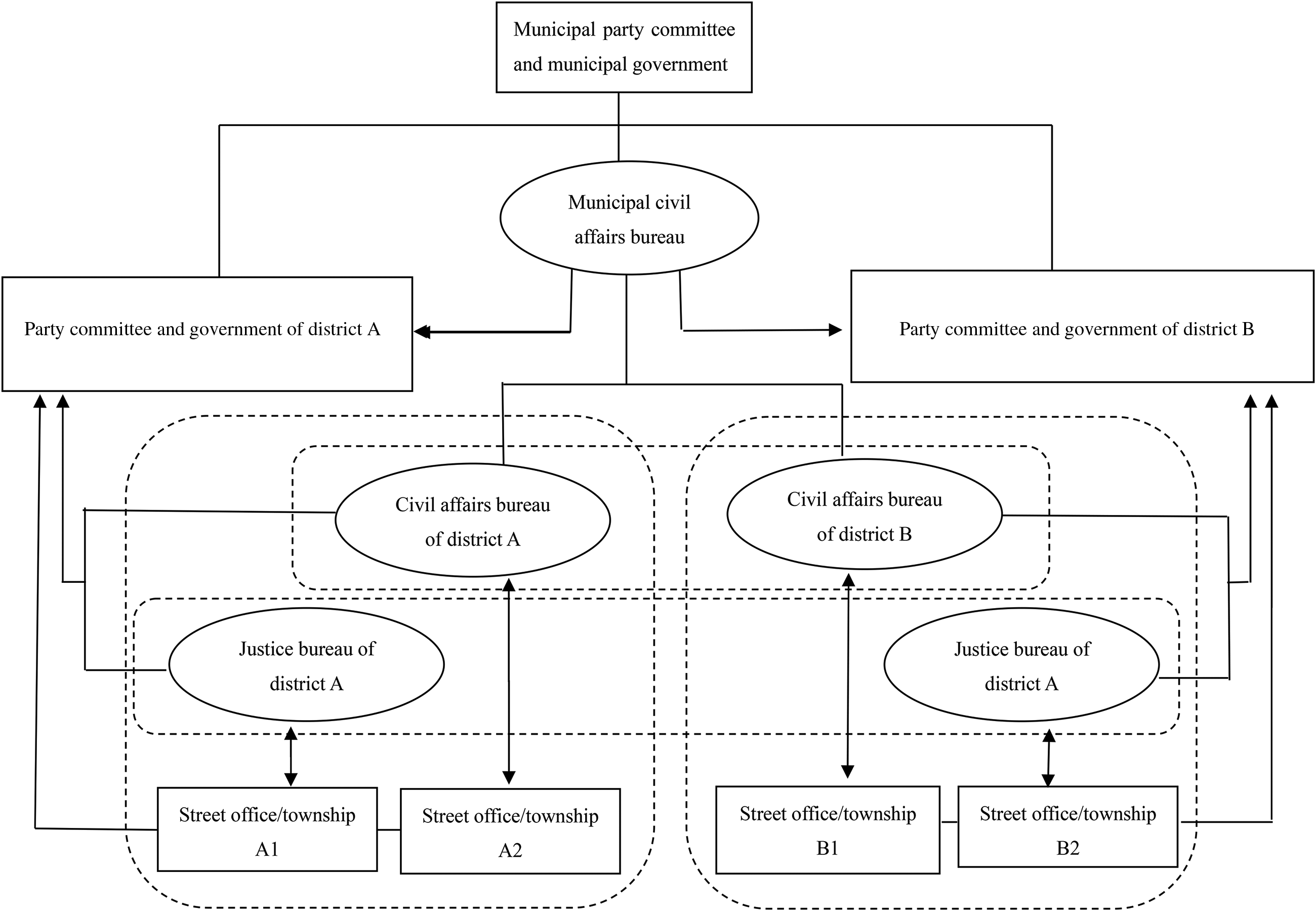
“Paired competition” among tiao- and kuai-side departments.
Based on the discussion above, we can further analyze the underlying organizational consequences of “paired competition” among tiao- and kuai-side departments.
First, after the pairing of a tiao-side department and a corresponding kuai-side department in a governance innovation program, the program will face the problem of promotion (Proposition 3.2). It is known from Proposition 1.1 that there is exclusivity in innovation programs among kuai-side departments belonging to the same level of government; thus, once the program is executed in one kuai-side department, other kuai-side departments normally have insufficient enthusiasm in studying this program. Proposition 1.2 shows that each kuai-side department tries to obtain preferential support from superior tiao-side departments. Once a tiao-side department pairs with a corresponding kuai-side department, it means that it is impossible for it to offer preferential support to other kuai-side departments in governance innovation, thus other kuai-side departments lack incentives to coordinate with this tiao-side department in promoting innovation programs. Proposition 3.2 can explain why there are sufficient “bonsai” in current grassroots governance innovation, but not enough “forests”. 19 In addition, this proposition also urges us to more closely reflect on existing research on policy pilot schemes or tests since the reform, since these studies tend to emphasize that the higher authorities would explore innovation experiences through pilot projects in a test area and then promote them in the whole area; while Proposition 3.2 points out that, under the premise of unclear output of administrative performance, promotion to the whole area is full of challenges. Even when the positive advances of a given program in a region are fully verified, other regions will not necessarily follow suit, especially when these regions have a competitive relationship with each other, either overtly or covertly. The characteristic of “paired competition” in the field of urban social governance is of key significance to understanding institutional innovation and innovation promotion at present.
Under the promotion tournament system, which is based largely on GDP growth, grassroots governments in a competitive relationship have a strong motivation to imitate and learn from the advanced programs and innovation practices of their competitor regions, in order to narrow the gap in performance with these competitor regions as much as possible. This forms a sharp contrast to the difficulty of promoting innovation programs under the “paired competition” model. The most prominent difference is that the promotion tournament model only considers regional economic performance results, and not the methods and approaches by which that performance in created; therefore, as long as it can increase GDP, not only will the aforementioned pattern of innovation program exclusivity not be present, but imitating and learning from innovation practices in competitor regions will be applauded due to the low costs and quick results. In contrast, the impression-based performance evaluation in public governance puts more emphasis on governance innovation itself, and the originality of said innovation, which leads to the exclusivity effect in governance innovation.
Second, after a kuai-side government department pairs with a corresponding tiao-side department on a governance innovation program, the kuai-side government department may take a more relaxed attitude in exploring other governance programs (Proposition 3.3). Since “paired competition” demands that participants invest a great deal of energy and resources into joint innovation, once a kuai-side government department decides to cooperate with a tiao-side department in a given area, it will lessen the investment into other areas. Empirical observation shows that the organizational phenomenon depicted by Proposition 3.3 is newly emergent with the decreasing financial flexibility of grassroots governments in recent years and greater reliance on tiao-side departments. In traditional circumstances, when kuai-side grassroots government departments have sufficient financial resources, they can realize the governance function by bypassing tiao-side departments to some extent. Some powerful kuai-side government departments often innovate in multiple fields simultaneously according to their actual needs. Early on in our research it was found that each district has one or two “star” street offices or townships, 20 in which almost all innovation highlights in the district are concentrated. But with the weakening of kuai-side grassroots government departments and the rising prominence of impression-based performance results, things have changed. At this time, the involvement and support of tiao-side departments is of key significance to innovation by kuai-side government departments. It can be known from Proposition 2.2 that tiao-side departments are more willing to cooperate with those who strongly support their own innovation practices. Therefore, if they find that a certain tiao-side department has paired with another tiao-side department, it will seek for other kuai-side departments. 21 For a kuai-side department, once it is paired with a corresponding tiao-side department, it is not wise for it to seek for other innovations in closely related fields, since this behavior will weaken the existing paired relationship on the one hand, and will hardly attract the attention of other tiao-side departments on the other hand.
It can be known from Propositions 3.2 and 3.3 that, in the context of “paired competition” among tiao-side and kuai-side departments, a competition pattern of “a hundred flowers blooming” (baihua qifang) can easily emerge in urban grassroots governance (Proposition 3.4). This refers to a situation in which most innovation programs are no longer concentrated in just a few “star” townships and street offices but highly dispersed – from the perspective of the “face” in innovation, since tiao-side departments are willing to choose the kuai-side departments that offer preferential support, more kuai-side departments are therefore participating in governance innovation practice. The subtlety of the new pattern is that if the initiative of local innovation can be kept at a relatively high level, even marginal street offices and townships that were once neglected can also get the attention of higher authorities by providing favorable support to tiao-side departments; however, a great deal of innovation experiences struggle to realize further development and expansion through mutual learning, especially in the field of impression-based performance competition among the departments under the same level of government, where the horizontal learning mechanism will be constantly weakened, causing a paradox in governance whereby huge innovation investment results in inefficient output.
In addition, “paired competition” in grassroots government innovation may also cause the phenomenon of the “adding of new aspects at each level [of government]” (Proposition 3.5). Since the innovation strategies of tiao-side and kuai-side departments are differentiated (Propositions 1.1 and 2.1), but the differentiated objects of them are also different, “paired competition” should also satisfy the demand of both parties – objectively speaking, this will result in constant overlay of innovation elements. For example, in the process of a district civil affairs bureau pairing with street office A, the corresponding innovation should not only be unique compared with other street offices, but also be innovative compared with civil affairs bureaus in other districts, urging them to emphasize ever more symbols and elements of innovation, leading to the “adding of new aspects at each level [of government]” phenomenon in grassroots governance innovation, and even “innovation for the sake of innovation”.
Furthermore, “paired competition” not only satisfies the intrinsic demands of tiao- and kuai-side departments for creating impression-based performance results, but also provides additional benefits to all parties concerned. This explains why preferential support is the core mechanism of “paired competition”. First, for kuai-side grassroots departments, preferential support from superior tiao-side departments is of positive significance as an indicator of a complete endorsement of their activities. In addition, preferential support from some tiao-side departments comes with some special resources, thus the feeling of “getting special resources that others don’t have” may encourage grassroots government departments to pair with each other. Second, since different kuai-side departments can seek the preferential support of different tiao-side departments to “avoid competition”, this means that the above-mentioned mechanism of reciprocity is not a zero-sum game, 22 but allows for the benefit of different competitors to some extent; in this sense, the “paired competition” model offers more extensive opportunities for benefit sharing compared with the traditional “promotion tournament” mechanism. Third, for tiao-side departments, preferential support from kuai-side departments facilitates related work and institutional innovation, which is an important factor in their being praised by higher-level authorities. Therefore, the “paired competition” model is very attractive to tiao-side departments.
The complicated influence of “paired competition” on grassroots governance
“Paired competition” is the chief mode of administrative performance competition in the fields of public service and social governance for urban grassroots governments in the transitional period. In spite of the fact that it is difficult to measure administrative performance, it provides a signal transmission method to attract the attention of higher authorities and provides an important motivating mechanism for governance innovation. Subjectively, “paired competition” is of key significance to understanding the underlying challenges in grassroots governance transition in urban areas at present.
First, it is helpful in boosting in-depth institutional innovation in key areas of social governance by grassroots governments. At present, China is undergoing gradual transition in governance. China has multi-dimensional and dynamic policy requirements in many important social policy areas: it must not only effectively stimulate social vitality, but also maintain orderly development; it must improve the accuracy of public services and expand the scale of supply of public goods. The coexistence of these multi-dimensional policy signals makes it difficult to clearly outline the picture of institutional changes at the macro level, thus in-depth testing and institutional innovation at the grassroots level is in urgent demand. “Paired competition” provides an important motivating mechanism for coordinated innovation between kuai-side and tiao-side grassroots departments. In this process, grassroots governments can undertake some institutional risks and endeavor to seek for a practical equilibrium point in the effective combination of multi-dimensional policy targets, which is of key importance to governance innovation.
Second, “paired competition” is very important to resolving the bottleneck problems in grassroots governance by integrating resources from tiao-side and kuai-side departments. Some issues in grassroots governance in urban areas at present (such as pensions, illegal construction, and urban village renovation) cannot be resolved by relying solely on the power of tiao-side or kuai-side departments, but require in-depth linkage between them. “Paired competition” provides an important guarantee for integrating resources of tiao and kuai departments and coping with problems through their joint forces. In the process of pairing with each other, the preferential investment of tiao-side and kuai-side resources makes it possible to solve these problems in a relatively short period.
However, from another perspective, since “paired competition” may trigger a more complicated “tiao–kuai” political process, it has some subtle effects on grassroots governance in urban areas in many aspects at present.
One of these effects is a challenge to the piloting mechanism in the social governance field. There are quite a few difficulties in policy execution in grassroots governance fields. In order to reduce the risk of uncertainties and explore the mechanism of solving problems through joint forces, governments of all levels tend to use pilot schemes to develop programs for wider promotion (Liu, 2010; Wang, 2008). However, some studies have found that while this is successful in the economic sector, it has just average performance in fields like social management and public service marketization (Han, 2009). Some studies have further pointed out that the bureaucratization process of pilot schemes may result in greater rates of failure (Chen and Cai, 2017). Although these studies have noticed that the complicated organizational process of pilot programs may trigger unexpected consequences, few of them have discussed the underlying mechanism in the process. Through paired competition we can identify the reasons for the difficulty of promoting pilot schemes, despite their advantages: successful pilot schemes are normally the product of innovation after the pairing of tiao-side and kuai-side departments. Under such an organizational mode, it is difficult for superior tiao-side departments to support other kuai-side departments in studying advanced programs, thus other kuai-side departments lack the incentive to learn from peers; instead, they tend to start from scratch in developing their own paired cooperation mechanisms. It also means that, if the “tiao–kuai” pairing mechanism is constantly strengthened and expanded, effective pilot schemes in the field of economic reform may come across many obstacles in the field of social governance innovation.
The second consequence is that it causes a lack of continuation and stability in social governance innovation programs. The pairing mechanism in “paired competition” is somewhat accidental; the pairing of the superior tiao-side departments and kuai-side grassroots departments is not only decided by the local characteristics of the kuai-side departments, but is also closely associated with the complicated interpersonal networks in the bureaucratic system. During fieldwork, it was found that the main reason for a tiao-side department choosing a kuai-side department is that the director of the former had once worked in the latter, thus the former was more assured that the latter would fully coordinate its reform program; in other cases, the reason for pairing might be a tacit agreement between directors of tiao-side and kuai-side departments. As a result, factors like personnel changes can easily undermine pairing relationships. It is thus clear that, if governance innovation programs take the presentation of administrative performance as the key target and rely heavily on pairing between tiao-side and kuai-side departments, they tend to lack subsequent motivation for further learning, and this has become a difficult issue to resolve in grassroots governance innovation (Li, 2016).
The third consequence is the prevalence of formalism in grassroots governance. In the process of “paired competition”, the corresponding innovation program should embody the innovation elements of tiao-side departments as well as that of kuai-side departments. As these elements overlap, many elements that are not closely associated with actual demands of local society are also constantly reinforced, thus presenting characteristics of formalist innovation. Recently, in some grassroots areas at the forefront of governance reform, the working hours of neighborhood committees have been continuously prolonged, and it has even been stipulated that the secretaries and directors of neighborhood committees remain on duty over weekends to receive people. Through empirical observation we have found that these practices are of little practical significance, the masses do not have much demand for such services; and while the directors in charge of kuai-side departments are aware of this, these practices have been required to be retained. The reason is that, faced with their peers’ practices of prolonging working hours in other districts, these kuai-side departments’ partner tiao-side departments are searching for formal aspects of their innovation programs in which they can be said to have surpassed their competitors. Such overlapping may easily give rise to formalism that diverges from actual public demand, and this has become an important factor that puts a greater burden on grassroots governments.
In essence, “paired competition” is actually a behavior for coping with information asymmetry between subordinate and superior government departments through “tiao–kuai” political operation in the context of impression-based performance evaluation, so as to realize superior government departments’ evaluation and motivation of subordinate departments. The constant reinforcement of this operational mechanism has further affected the systematic space by which the public becomes involved in bottom-up administrative performance evaluation. On the other hand, although the “paired competition” mechanism may have many negative effects, it is the easiest government operating mechanism to develop in the field of public services and social governance under the existing institutional conditions, and to a certain extent, it has contributed to the diverse forms of grassroots governance innovations, thus this organizational mechanism may evolve over time. In this sense, understanding the organizational characteristics of this operating mechanism is of great significance to understanding the operating logic and its effect on grassroots governance in urban areas of China.
“Paired competition”: A case study on the “community analysis tool” in district A
Since 2014, our research team has begun to focus on various activities concerning social governance innovation of urban grassroots governments. In city S, there has been a large-scale campaign of grassroots government reform, which is embodied by the comprehensive transition of the functions of street offices toward the fields of public service, public management, and public safety. At the same time, economic functions like investment promotion have been cancelled. The economic functions of township governments have also been weakened to a certain extent, and the importance of social governance and public service in their functional structure has been brought to the forefront. During this period, the research team has identified a series of grassroots governance innovation activities, covering fields such as grassroots autonomy, community party building, informatization, cultivating social organizations, and public service model innovation. During our investigation, it was not only the traditional “star” street offices and townships that maintained a high degree of enthusiasm for governance innovation; some street offices and townships that were traditionally unknown in the field of social governance in city S have also made efforts in this field, with many surpassing their better-known counterparts. Based on these observations, the research team started to take an interest in the innovation enthusiasm of grassroots government departments and the motivation mechanism therein.
At the beginning of our research, our theoretical resources mainly came from the promotion tournament theory, which is focused on economic competition among grassroots government departments. According to this theory, the motivating force for the competition between grassroots government departments comes from promotion incentives and corresponding economic incentives, while one of the basic conditions of this competition is that the output of government departments is objective and can be measured quantitatively; in this way, the superior government departments can allocate incentives in correspondence to the administrative performance of subordinate departments.
Since there are great discrepancies in the field of social governance, we have been skeptical about the sustainability of grassroots government innovation initiatives. However, our empirical observations found that in the past five years grassroots government departments in city S have maintained a high degree of enthusiasm for governance innovation. Although a proposed new assessment and evaluation system with a higher degree of distinction has not yet been completed, 23 the momentum of local innovation has not diminished. In this process, we gradually found that the existing studies on governance innovation and its practices are too simple – within the Chinese government system, the incentive mechanism not only includes promotion, tax sharing, and the one-vote veto (yipiao fojue shi) penalty, but also less linear incentives such as commendations from superiors, concentrated attention, and additional support and concern. As such, the actual practice of giving incentives is more complicated than has previously been acknowledged. In addition to the direct superior governments, incentives come from superior tiao-side departments that do not have direct affiliation with grassroots government departments. Since tiao-side departments generally cannot offer promotion and economic incentives to kuai-side grassroots departments, this point it is often ignored by traditional government behavior studies. 24 Nonetheless, it plays an important role in the daily operations of the government.
The simplified approach of existing government behavior studies and practices has mainly been conditioned by the fact that, since reform and opening up, grassroots governments have long been faced with evaluation by a limited number of distinct indicators, such as economic development. Under such circumstances, existing studies have shown more concern for the factors associated with these key indicators, such as promotion and economic incentives. However, in reviewing the history of the promotion tournament system, Feizhou Zhou (2009) points out that, historically speaking, evaluation of government on the basis of a small number of key indicators is not normal. During most of the peaceful periods of the Chinese Empire, the state did not use a limited number of performance indicators to evaluate officials. It was only during the period of legal changes or special reforms that the state made clear and focused performance as the main assessment indicator, and only then did the role of the tournament mechanism become apparent. This observation inspired us to propose that, with the functional structure of grassroots government transitions to a structure in which multiple objectives are in equilibrium, it is necessary to surpass the simplified conceptualization of the incentive mechanism and its execution, and embrace a more complicated government structure.
This research perspective has urged us to pay attention to the real-world organizational process of innovation in grassroots social governance. This approach not only incorporates the behaviors of kuai-side government departments and the responses of their superior government departments, but also tiao-side actors and their behavioral logic, thereby depicting grassroots governance innovation activities in which multiple actors influence one another. Based on this perspective, we not only stress the innovation targets and behaviors of kuai-side departments in our research design, but also focus on the behavioral mechanisms of tiao-side departments. Considering the multi-dimensional and complicated competition relationship among tiao-side and kuai-side departments, our observations on grassroots innovation behaviors in a particular locality should be combined with similar government innovation activities in other districts.
Taking district A of city S as the field of study, the following case study takes a panoramic perspective on the innovation process of the “community analysis tool” jointly created by the local civil affairs bureau and grassroots street offices. The “community analysis tool” is aimed at enhancing the neighborhood committees’ precise understanding of public opinion, and pushing the neighborhood committees to better serve residents by realizing precise matching between local public resources and resident demands. Like most innovations in the field of grassroots social governance, the reform will challenge the traditional working methods of neighborhood committees, putting great pressure on local practitioners. To build this innovation's “brand” and to secure its prominence in municipal and district governance innovation activities, the district civil affairs bureau and local street offices formed a paired competition model of innovation promotion. The in-depth presentation of this case is helpful for understanding the organizational mechanism of paired competition. The case data come from the research team's in-depth field observations of the civil affairs bureaus and several street offices and townships in district A, and related government files. The districts, street offices, and interviewees involved have been anonymized according to research ethics.
Background
Since 2014, city S began to explore in depth various means of innovating in social governance and strengthening grassroots development. Among them, the improvement of governance capacity in residential areas has always been a core issue of various innovations – how to improve the precise understanding of social conditions and public opinions of neighborhood committees and then organize activities has especially attracted the attention of municipal and district leaders at all levels. During this period, whether it be in the “No. 1 Document” issued by the municipal party committee or in the supporting documents issued by the corresponding functional departments, the emphasis has been on the need to continuously “improve the governance capacity of residential areas” and provide public services according to the actual needs of residents. In this context, many districts have begun to explore new methods to change the traditional empirical working mode of neighborhood committees.
From 2014 to 2016, we found that the governance innovation experience of city S in the above-mentioned fields was mainly concentrated in two aspects: first, many districts responded to the requirements of the municipal civil affairs bureau and began to actively explore the construction of an “electronic ledger system” for neighborhood committees. The original intention of the electronic ledger system was to regulate the superior functional departments in deploying the neighborhood committees’ record of ledger. Through unified design of the electronic ledger by related departments in the district, the assigned tables by superior functional departments can be reduced and merged to reduce the burden on neighborhood committees. As some districts continued to explore the construction of the electronic ledger system, the civil affairs bureaus of these districts found that the electronic ledger not only clearly records the progress of various tasks in the residential area, but also records information on the corresponding demands of the residents, so it can serve as guidance for neighborhood committees to more effectively serve the residents. In this context, the civil affairs bureaus began to further strengthen the electronic ledger's collection of residents’ information, emphasizing that this is a critical support for improving the abilities of neighborhood committees. For example, the strengthening of the standardized and systematic construction of the electronic ledger system in district H was acknowledged by the branch director of the city at a municipality-wide meeting.
Second, some districts have started to further push the construction of WeChat-based informatization and interaction pathways for neighborhood committees and residents. Among them, the most prominent is the “Shequtong” platform, developed in district B. Shequtong connects neighborhood committees with residents, and encourages residents to post their opinions on the public issues of the community, and neighborhood committees are encouraged to conduct investigations into residents’ demands, elicit responses, and push social mobilization through the platform. After a period of time in which it was in development, Shequtong became a key innovation product of governance system construction in residential areas of city S, obtaining the acknowledgment of senior municipal leaders and even a nationwide reputation. The national and local media have also long promoted this local innovation practice, and social governance innovation delegations from different regions of the country constantly visit district B to learn from the program.
Under the dual effects of systemic pressure from superior government departments and the pressure of innovations in its peer districts, district A was also trying to blaze a new trail in the field of informatization construction in residential areas. District A was formed by merging two districts in 2015. Originally, the two districts were very effective in the construction of residential area governance systems, but in recent years there have not been many highlights in the field of residential area information construction. How to make up for the shortcomings in this regard and form its own distinctive and leading-edge innovation program has become the entry point of the focus of exploration by civil affairs bureaus of district A.
The innovation logic of tiao-side departments and initial promotion strategies
In 2016, based on repeated investigations and design, the civil affairs bureau of district A planned to promote the “community analysis tool” innovation program. The program originated in issues relate to investigations by the civil affairs bureau. At that time, there were many newly recruited staff in the neighborhood committees, 25 most of whom lacked mass work experience, such as corresponding skills and information collection abilities in interviewing residents. Under such circumstances, it was necessary to provide a kind of modularized information collection tool for the staff of neighborhood committees to comprehensively obtain community information and resident information. Based on this consideration, with the help of professional organizations, the district civil affairs bureau launched the information collection system “community analysis tool” in October 2016.
In the field of local reforms, how to advance institutional innovation not only depends on structural elements, but also depends on the temperament and behavioral characteristics of the innovators. As will be shown later, paired competition takes the form of a pairing of tiao-side and kuai-side departments, but in essence it is a pairing between reformist actors. The reform in district A, from initial idea to action plan, was mainly promoted by a responsible deputy director (hereinafter referred to as “Director H”). Director H has a broad mind and personality, daring to break through traditional thinking and reform approaches, and he maintains a work style of “striving to be first”. His in-depth understanding of civil affairs business was due to his former position as a deputy director of a street office, thus he was very familiar with the actual situation of grassroots governance. In investigating the design and practical promotion of the “community analysis tool”, the staff of the civil affairs bureau in district A lamented that the reform was at first not given much attention by the district committees and district government, and the promotion of the systematic innovation mainly relied on the relentless hard work of Director H and timely and appropriate reform strategies.
In the face of peer districts’ innovation programs, such as the electronic ledger system and Shequtong, from the beginning Director H and his team decided that the design concept must be of a “superior type”. After investigating cadres of local neighborhood committees, the research and development team designed the “community analysis tool”, which includes three working modules: community knowledge (full investigation, data statistics, community resources, demands and questions), community response (determination and execution of topics and projects, classification of questions), and community evaluation. The core of the information system is the investigation, collation, and review of information on, demands of, and resources of communities and residents, and on this basis classifying and replying to residents’ requirements. The core carrier of the “community analysis tool” is resident questionnaires. The district civil affairs bureau request that the staff of neighborhood committees interview residents using these questionnaires and collect corresponding information. The first round of interviews should choose a complete block (it can be a whole residential area, a community, or a building group), with at least 150 households. In 2018, the district civil affairs bureau requested the further expansion of the coverage of interviews, covering 50% of the actual number of households in the jurisdiction. The “community analysis tool” conducts an in-depth analysis of the information collected by the neighborhood committees which brings together community problems raised by more than 50% of local residents, on the basis of which neighborhood committees can respond accordingly. Each neighborhood committee selects at least one demand (question) and prepares a response plan, and incorporates the required funds into the budget for the work of the residential area in the next year. There are a total of five large forms and 11 attachments for each stage of the community analysis process, which try to guide the neighborhood committees to investigate what to ask, how to allocate resources, how to calculate data, how to arrange needs, and how to give responses. District civil affairs bureaus follow up on the whole process, and each street office and township is responsible for business guidance, and provides technical support for the neighborhood committees to carry out community analysis.
The reason why the design concept for the “community analysis tool” has a strong feature of “superiority” in terms of innovation is that it is not only compatible with existing innovations in this field, but also has many further optimized measures (Proposition 2.1). Compared with the early electronic ledger system of the neighborhood committees, the “community analysis tool” has made great strides in the recording of residents’ demands and in the detailed analysis of community resources. Since the initial design idea of the electronic ledger was to record the working progress of neighborhood committees, it has the problem of small data volume, leading to incomplete coverage of main information in recording residents’ demands. With the help of professional questionnaires and visits by neighborhood committees, the “community analysis tool” can help in the collating of residents’ demands, identifying dynamic changes therein, and making corresponding and timely responses. Compared with Shequtong, the “community analysis tool” provides residents with the option of completing the questionnaire by scanning a WeChat QR code, it has a broader coverage and collects more comprehensive information. In addition, information collecting by Shequtong is mainly determined by the interaction level between neighborhood committees and residents, which is generally unstable; however, the “community analysis tool” is in periodic operation on a regular basis and therefore it is more convenient for the neighborhood committees to offer corresponding services. In addition, the “community analysis tool” also provides multiple tools, such as resource analysis and methods analysis, a clear advancement when compared to peer innovation programs. An analysis on the “connotation elements” of the “community analysis tool” shows that, when the civil affairs bureaus of district A launched the innovation practice, it had taken full consideration of the competition effects of different plans, which also embody the feature of mutual competition among cross-regional tiao-side departments.
On the other hand, the advancement and completeness of a plan is dependent on accruing organizational costs, and the promotion of the “community analysis tool” imposed greater pressure on the staff of the neighborhood committees. Under this circumstance, Director H and his team were not very sure if the innovation program could be deeply implemented. Therefore, at the initial stage, the district civil affairs bureaus selected 10 neighborhood committees as pilot units for the program, trying to understand the pressure and feasibility of the innovation practice in local promotion.
It was found through field observation that this method adopted by the civil affairs bureaus in district A was meaningful. Generally speaking, civil affairs bureaus are the superior department guiding the business of neighborhood committees, but they don’t normally allocate work to neighborhood committees directly, but through specific business departments of street offices and townships (such as community self-governance offices (zizhi ban)). That is to say, the tiao-side departments should assign tasks downward through the organizational system of kuai-side departments. However, in this case, the civil affairs bureau in district A adopted the unusual method of pilot units; that is, the civil affairs bureau directly found 10 neighborhood committees of different types of communities through building the peripheral social organization, the Working Research Society for the Neighborhood Committees of District A, and deployed tasks to the 10 neighborhood committees through this society. In essence, in deploying the neighborhood committees to implement the pilot projects, the tiao-side civil affairs bureau bypassed the kuai-side departments of the street offices and townships.
In the investigation, a member of staff of the civil affairs bureau in district A explained that this innovation might boost pressure on the short-term work of grassroots governments. Some kuai-side departments may not offer support, thus the neighborhood committee at the grassroots level may better promote innovation: Our early pilot experience was establishing the “Working Research Society for the Neighborhood Committees of District A”, which is a community organization that is directly affiliated to the district civil affairs bureau. The 275 neighborhood committees of the whole district were members of the society. Forty board members were elected and a secretariat was established at the first board meeting. Through the research society, the civil affairs bureau could get information from neighborhood committees directly, hold various types of seminars with neighborhood committees, and directly release issues to promote work and start training. If the work were promoted level by level according to administrative hierarchies, some street offices might not have any interest in this matter and wouldn’t coordinate the work. Thus we directly conveyed work and obtained information through board members, in this way, the civil affairs bureau got a deeper understanding of the neighborhood committees. (Interview material, 20190429)
When we were investigating in a street office in district A, a staff member gave a different explanation. He believed that the civil affairs bureau at first underestimated the difficulty in promoting governance innovation and attempted to press ahead with the reform with its own power to create innovation highlights: Actually the neighborhood committee reported back to the street office after receiving an assignment, so we knew that the civil affairs bureau was pushing this work in the early stage, but he did not contact us before, thus we did not take the initiative to intervene. Honestly speaking, they underestimated the work pressure on the neighborhood committees in doing investigations and maintaining the system, since these affairs cannot be done without the full coordination of the street offices. Maybe they wanted to make their practice known at first. (Interview material, 20190507)
According to various sources, in the initial stage of promoting the innovation program, the civil affairs bureau on the tiao-side tried to strengthen its resource mobilization ability by bypassing the kuai side. For the civil affairs bureau, by pushing the reform without involving kuai-side departments, it could ensure the realization of its innovation program in its own organizational system, and thus better control innovation. As a matter of fact, we noticed a similar pattern of bypassing the kuai side in the case of other tiao-side departments that were pushing systematic innovations. This shows that, for tiao-side departments, if their reforms can be effectively promoted in their own organizational system, “paired competition” might not be the first choice.
However, with the in-depth development of the “community analysis tool” in the 10 pilot residential areas, the information feedback made the district civil affairs bureau realize that this innovation program might not be fully realized without the strong support of the street offices and townships. First, the pilot neighborhood committees all expressed that the work put too much pressure on neighborhood committees. Since a large number of households were to be interviewed and each questionnaire had a large number of questions, 26 without the full support of street offices and townships it was difficult for the staff of neighborhood committees to carry out these investigations considering their existing workload. Second, the most critical point was that, after the neighborhood committees visited the residents and collected their demands, the residents would have high expectations that the neighborhood committees would then resolve these problems. If the neighborhood committees failed in resolving these problems, the residents would not believe in the work progress made by the “community analysis tool”. Since most of these problems involved the allocation of public resources, the neighborhood committees could hardly solve them without the substantial support of the street offices and townships.
In the face of this feedback, the civil affairs bureau of district A started to further get the district government's full support for the innovation practice. However, due to the fact that innovative solutions may increase the workload of neighborhood committees to a certain extent, the district committee and the district government have not made a clear statement about vigorously promoting reforms in the face of uncertain prospects. At this time, for Director H and his team, how to obtain the support of kuai-side departments, especially by stating the superiority of the innovation practice to the higher authorities through building some typical cases, became increasingly urgent.
The realization of “paired competition” and its consequences
The emergence of pairing originated from the full support for the “community analysis tool” from “street office T”. At that time, the “HK neighborhood committee” under street office T was a pilot unit, and the cadres of the neighborhood committee found through analyzing the data collected by the “community analysis tool” that most of the residents of the area raised the problem of the deteriorating condition of the community entertainment room. The neighborhood committee kept reporting the situation to the street office. In the face of cleardata on residents’ demands, the staff of the community self-governance office persuaded Director Z, the branch director of the street office, to allocate a big sum of money to the renovation of the entertainment room of the HK neighborhood committee. This investment on the part of the street office presented the impression of “doing practical work rather than putting on airs” to residents, leading the district civil affairs bureau to feel that it might be an important opportunity for deepening the reform.
It was found in the investigation that street office T indeed supported the “community analysis tool”. An important reason was that street office T had previously developed a similar information-based working system for neighborhood committees, “Zhangxinhui”. The basic concept of Zhangxinhui was to make an information-based system to respond to residents’ appeals; however, since there were many similar measures in the city, and without the support of higher functional departments, it failed in winning a reputation for street office T. Considering that the district civil affairs bureau had a similar innovation concept, street office T held a supportive attitude toward the “community analysis tool”. On the other hand, the practical circumstances of street office T demanded a working system that could precisely analyze residents’ demands and support public service in the jurisdiction of street office T. It was found in our investigation that the situation of the residential area within the jurisdiction of street office T was complicated, as there were both old communities and new communities, as well as mixed-type communities; also, most of the residents belonged to the middle and lower classes, and they had a great demand for the basic public services of the government; thus, how to accurately provide public services based on residents’ needs became the focus of the leadership team.
In addition, the working idea of the branch director of the street office was close to the measures of the district civil affairs bureau. The director in charge of the corresponding work of street office T had a similar concept on reform to Director H. Both dared to innovate and are highly active in work. The branch director once attempted to make innovations in the working method of the neighborhood committee, but failed in creating notable positive outcomes. Therefore, he showed high enthusiasm for cooperating with the district civil affairs bureau. Under the combined effect of these elements, street office T became a key street office in supporting the “community analysis tool” innovation program.
During the investigation, we unintentionally found an interesting phenomenon: the main nodes in “paired competition” are generally the deputy directors of tiao-side and kuai-side departments. 27 In the promotion tournament mode among kuai-side departments, this group is often neglected on the whole, and researchers tend to carry out research on innovation among the directors of kuai-side departments. But in the fields of social governance and public service, the construction of impression-based performance demands cooperation between both tiao and kuai, and the deputy directors are the main connecting nodes that connect tiao and kuai. For example, to attract the attention of superior functional departments the street offices should first focus on branch deputy directors or deputy secretaries, who maintain the relationship with the tiao side in actual management and maintenance; in implementing a specific innovation policy, the district functional bureau should first appoint a branch director of the district functional bureau to take charge. With the stronger professional ability of deputy directors, the pairing mechanism could go deeper and further.
With the joint forces of specific branch directors of both tiao-side and kuai-side departments, the district civil affairs bureau and street office T gradually established a pairing mechanism that carried forward the “community analysis tool”. The district civil affairs bureau enhanced its support to street office T in the second round of comprehensive promotion for the “community analysis tool”. This point can be manifested by the fact that the district civil affairs bureau provided more resources to street office T in training- and business-related aspects of promoting the “community analysis tool”, and also by mentioning street office T's use of the “community analysis tool” to resolve the insufficient entertainment facilities for residents in various kinds of reporting materials and advanced experience reports. When holding some innovation experience exchange meetings, the district civil affairs bureau would give priority to inviting street office T to introduce its program. A member of staff of street office T mentioned that [t]he district civil affairs bureau fully supports our innovation, it occurred several times when branch directors were present, the cadres from the civil affairs bureau introduced the case of our street office, so we feel that we should make further explorations. (Interview material, 20190511)
With the support of the civil affairs bureau, street office T became more enthusiastically involved in pairing in innovation practice. It was apparent that street office T invested more resources to ensure the effective operation of the “community analysis tool” in the second round of its promotion when compared with other street offices. First, with the help of experts, the street office invested more energy in the optimization and adjustment of the “community analysis tool” questionnaires to make them more suitable for the actual situation of street office T. 28 Second, the street office sensed, through repeated testing, that random selection of resident households was of little significance to obtaining precise information, and such a full-coverage investigation engendered high costs. To solve this problem, street office T employed experts to carry out the sampling in residential areas with a professional social-statistical approach and organized more scientific investigations. Third, when the street office sensed that social workers and working staff of the neighborhood committees were under great pressure in their work and could not devote themselves to visiting households for conducting surveys, the street office contracted the services of professional organizations to assist the neighborhood committees in the investigations, and to provide more scientific data analysis to the neighborhood committees. Fourth, in response to the major demands raised by residents through the “community analysis tool”, the street office integrated resources and give effective responses as soon as possible. For example, in 2018, the HK neighborhood committee found that 90% of households supported a gas flue renovation project in corridors through the community analysis tool. After obtaining this information, street office T immediately deployed self-governance funds to this project. With the preferential support of street office T, an in-depth innovation exploration of the “community analysis tool” was carried out within the range of street office T's jurisdiction.
One example of street office T providing preferential support to the “community analysis tool” was that the neighborhood committees didn’t get equivalent support from street office T when superior authorities deployed economic census tasks at the end of 2018. At that time, the neighborhood committees were also faced with high pressure to visit residents and insufficient professional capacity. Although some cadres of the neighborhood committees advised contracting professional social organizations to conduct the investigation, the related departments of street office T did not offer help. As a cadre of one neighborhood committee said in an interview: Like making investigations involving visiting residents, economic census work is complicated, but the street office did not offer help. In conducting investigations with the “community analysis tool”, professional agencies and social organizations provided help in the whole process, and the latter even completed interviews. And we know that the lack of professional capacity is the focus of the street office. (Interview material, 20190511)
Observations show that the strengthening of the pairing mechanism is based on continuous feedback as the principle of particularism. In response to the favorable support by street office T, the district civil affairs bureau also provided preferential support to the “highlights” of street office T. When the district civil affairs bureau was given an important opportunity in 2018 to organize the “classified governance” site meeting of the municipal civil affairs system, the district civil affairs bureau first arranged the venue of the site meeting in street office T's jurisdiction, and arranged for a director of street office T to make a keynote speech on the achievements and experiences of the “community analysis tool” before senior leaders of municipal civil affairs bureau and district party committee. At the end of the same year, when directors of the Ministry of Civil Affairs visited city S to investigate precision governance of communities, the district civil affairs bureau also took them to street office T for an investigation and to hear the reports of street office directors. In addition, we reviewed the corresponding work reports and work summaries submitted to the district government by the civil affairs bureau of district A, and found an introduction to the application of the “community analysis tool” by street office T. These measures further strengthened the close cooperation between the civil affairs bureau and street office T. With the support and coordination of the latter, the district civil affairs bureau created a series of highlights, such as the “four-step working method in classified governance”, and successfully attracted the attention of senior leaders of the district committee. In 2019, the promotion and deepening of the “community analysis tool” became a working requirement put forward by the district branch directors.
We looked deeply into the practices of promoting the “community analysis tool” by street office T and found that the whole process took consideration of the innovation elements of the district civil affairs bureau and innovation practices of the district, and, in this sense, an element agglomeration that is in line with “tiao–kuai” innovation preferences emerged (Proposition 3.5). The district civil affairs bureau emphasized that the “community analysis tool” not only involves investigation and statistics, but also serves as an important carrier of the mass work method of the neighborhood committee in the new era, and therefore it has been demanding that the cadres of the neighborhood committees finish most of the visits and investigations; however, the street office invited professional social organizations to help collect information on residents’ demands according to the actual situation, trying to emphasize that they should “let the professionals do it”. In the end, even if the cadres of the neighborhood committees contacted for the investigation beforehand, the actual situation was that the cadres of the neighborhood committees accompanied professional social organizations to visit households for investigation. A cadre from a neighborhood committee could not understand the change: It is somewhat an example of formalism, we helped the specialists of the social organizations for visits and investigations by calling residents beforehand, what they should do was just to make investigations. But the street office asked us to accompany them in the whole process. I think there was no need to do so since we are very busy. (Interview material, 20190513)
After establishing the mechanism of “paired competition” between street office T and the civil affairs bureau, was the in-depth practical attention afforded to the “community analysis tool” matched in terms of emphasis and promotion when scaled up to a greater range? We found through observation that the attitudes of other street offices and townships toward the “community analysis tool” experienced subtle changes during this period. Overall, there were three types of situations: first, a few street offices showed disapproval to some extent, and the district civil affairs bureau was clear about this point. Since the data for final demand should be collected to the district civil affairs bureau, the background data clearly reflect the quality of the investigations. Some staff in the district civil affairs bureau found that for some street offices, “a lot of data that they collected was copied; they cheated without making the data looking real”. It can be understood that these street offices failed to explore the “community analysis tool” innovation program whole-heartedly. The second situation was more common. Most street offices and townships would finish the work with acceptable quality, and would require their subordinate neighborhood committees to coordinate with the district civil affairs bureau in data collection and analysis; however, they would not invest time in optimizing the questionnaire and investigation method like street office T had done, nor would they help the neighborhood committees collect information by contracting private-sector services. In these street offices and townships, the neighborhood committees normally took the “community analysis tool” as routine work that had no difference from other work. They did whatever the higher authorities asked them to do, but they lacked additional motivation for innovation (Proposition 3.2). The third kind of situation was found in just a few street offices and townships. Taking street office P as an example, it constantly introduced new innovation elements during its tests of the “community analysis tool”, and even developed its own working system and platform. Street office P emphasized that it established a more systematic and innovative working mechanism based on existing work assigned by the district civil affairs bureau, and tried to make its own brand, putting its own label on the innovation practice. For the third kind of situation, the district civil affairs bureau supported this to some extent, but the support was not so strong as that given to street office T. A staff member of the district civil affairs bureau talked about the reason for supporting and understanding the measures by street office P: “In essence, these measures are a further extension of the ‘community analysis tool’, and we support the street office's initiative in making their own systems, as we shall consider their additions to the design.” (Interview material, 20190521)
We believe that the district civil affairs bureau took a wise attitude toward the third type. In reviewing the innovation practices on the “community analysis tool” in the past three years, without the “paired competition” mechanism many key highlights could not have been implemented. Once the pairing mechanism was adopted, other street offices lacked the initiative to follow up. The third type of situation response tacitly transformed the “ownership” of innovation experiences in the process of practice. In this way, the street offices could claim that, although they carried out work under the guidance of the civil affairs bureau, they constructed more advanced programs by giving full play to their creativity. When this kind of innovation program was branded by the street offices and became a bargaining chip in the impression-based performance competition, the street offices were more willing to invest resources, and the governance target of the district civil affairs bureau was achieved to some extent.
Therefore, this final aspect is full of policy implications: when governance innovation put forward by the tiao-side departments adopts the mode of paired competition, they have to leave some room for the kuai-side grassroots departments to explore freely with their own individuality, otherwise it might be difficult to promote the innovation activity.
Further discussion on the case
The discussion above presents the policy innovation process of the civil affairs bureau of district A in promoting the “community analysis tool” by way of “paired competition”. Many key organizational mechanisms in the case have verified the corresponding propositions and deductions proposed in the theoretical part of this article. As a matter of fact, in the past few years, we also observed several cases in the fields of local party building, community self-governance, and cultivating social organizations, and have clearly identified the examples of the “paired competition” innovation mechanism in them. By way of this new mechanism, some innovation programs were carried forward thoroughly within a certain range; however, in a broader dimension of space and time, the stable progress of these innovations can hardly be guaranteed. Next, this article will make further discussion on the underlying organizational mechanism of “paired competition” by focusing on the “tiao-kuai” politics in these cases.
The scope of the application of the pairing mechanism
In this case, the civil affairs bureau at first underestimated the required investment for the “community analysis tool” on the part of grassroots government departments; as a result, it did not choose the pairing mechanism, but rather it attempted to push forward innovation directly. In the same way, when street office T was promoting Zhangxinhui, a similar tool to the “community analysis tool”, it did not adopt the pairing mechanism. This means that, in the urban grassroots governance and public service field at present, not all innovation practices will adopt the pairing mechanism. The use of the mechanism is somewhat associated to the task property of innovation experiences. As is shown in the case study above, innovation programs such as the “community analysis tool” have two major characteristics: first, they need strong support from kuai-side grassroots departments. Most of the tasks demand that grassroots government departments invest a lot of resources. Since the allocated resources from the higher authorities are insufficient to push the reform, grassroots governments have to offer additional input. Otherwise, the tiao-side departments tend to choose standardized policy practices to promote innovation. The second is the discrepancies in terms of innovativeness in policy practices, whose evaluation highly relies on the identification of superior functional departments. As far as this case is concerned, the innovation of the information collection system by the neighborhood committees is a method that is prone to controversy, because this approach not only improves the precise service capabilities of the neighborhood committees, but also objectively increases the workload of the neighborhood committees, which is in conflict with the goal of the superior governments “reducing the burden on neighborhood committees”. Therefore, without the firm approval and effective support of the superior tiao-side departments, programs like Zhangxinhui cannot attract the attention of superior governments. We noticed that, in grassroots governance practices, innovation activities that possess both of the above attributes are more likely to trigger the “paired competition” mechanism, and the degree of pairing will increase significantly with the increased integration of these two task attributes.
Key personnel and their behavioral logic in “paired competition”
As is shown in the case, the deputy directors of tiao- and kuai-side departments are the key nodes that link different departments in “paired competition”. It was found in our study that this group is sensitive to systematic innovation; also, it is an official group that pays more attention to its direct superiors’ views on its political performance under the system of “appointing leaders of directly subordinate departments” (xiaguan yiji). During our fieldwork, one senior official pointed out the key points from the perspective of cadre management: The power to promote the deputy directors of tiao-side and kuai-side departments is directly in the hands of the district party committee and district government, that is to say, if these cadres can successfully show their diligence and capabilities before their direct superiors and district government directors, the district government would directly promote them. That is to say, the district government has direct decision-making power. For this group, endeavor in innovation is strongly associated with promotion … but for the directors of the street offices and townships, or the top directors of the committees, offices, and bureaus are different, unless the director is moved sideways to accumulate qualifications, which can be determined by the district; but if the director intends to realize a leap in official rank, the director has to become a municipalized cadre [note: deputy-director level], and this is not decided by the district. The district only recommends cadres, but the municipal government has the final say on candidate selection, in this case, there is a much higher degree of uncertainty. (Interview material, 20190628)
This means that, for the deputy directors of tiao- and kuai-side departments, if they can effectively construct impression-based performance that can attract the attention of their higher authorities, they will have a higher probability of getting promotion in the same circumstances. Therefore, this group is generally an important driver of various governance innovations or for the implementation of innovation policies. The main characteristic of the deputy directors is not the overall planning of work; they are mainly focused on specific businesses, and therefore in promoting “paired competition” they would first consider their own business scope, and that will confine innovation in a limited scope objectively and make it difficult to form an optimized systematic pattern.
Policy design in the process of “paired competition”
The case shows that to solve the problem of the difficulty of horizontally expanding innovation practices in “paired competition” it is necessary to leave space in policy design, so as to offer the possibility of a second round of innovation by grassroots government departments not involved in the pairing. In the case above, the district civil affairs bureau was tolerant of such additions to its policy design, and this facilitated other grassroots governments in improving basic experiences in innovation objectively. A case we observed in district P offers a negative experience. After the organization department of district P paired with a street office and successfully built a new platform for party building, the experience was extended to the street offices and townships of the whole district with an extremely technical and standardized concept in system innovation. Since this promotion process pursued a strict and standardized concept in construction, it did not leave room for innovation; thus, this innovative approach has been generally resisted by grassroots actors. In other words, when the tiao-side departments adopt the “paired competition” mechanism, they must consider the complicated effect of the organization mechanism in policy design, to give consideration to grassroots innovators.
Overall, the “paired competition” mechanism in urban grassroots governance has become an important element that affects the policy innovation and implementation level in the social field at present. We believe that the in-depth study of “paired competition” will further open a new perspective for organizational research on governance innovation. So far, due to the lack of analytical tools and research materials, although we can outline a group of “paired competition” mechanisms in empirical research, we still cannot analyze the process and mechanism of competition between different pairs and combinations, and it is difficult to understand the in-depth screening rules of the current institutional structure on innovative behaviors. To analyze these issues in depth, it may be necessary to continuously reveal the theoretical black boxes of “tiao-kuai” politics.
Discussion and conclusion
With the help of the new theoretical perspective of “paired competition”, we can reveal government competitive behaviors and their consequences in the field of urban grassroots governance. It was found in this research that the emergence and strengthening of the organizational mechanism of “paired competition” can to a great extent be ascribed to two important conditions: first, in the context of multi-objective tasks for grassroots government departments, it is difficult to objectively measure and horizontally compare government performance; second, after the cancellation of the economic functions of kuai-side departments and the weakening of their financial flexibility, the importance of tiao-side departments has been enhanced. With the joint effect of these two conditions, the tiao–kuai relationship at the grassroots level presents the characteristics of paired competition involving both cooperation and competition, which is different from the tiao–kuai segmentation emphasized by traditional studies (Ma, 1986, 1998; Sun, 2011).
We noticed that the word “pairing” (jiedui) is extensively applied in the Chinese governance system; for example, in regional development and poverty alleviation. The state promotes the pairing of developed regions (such as Shanghai) and underdeveloped regions (such as Kashgar, Xinjiang) to achieve coordinated development in different regions; in addition, in recent years, the party building work mechanism establishes a co-construction mechanism between some government agencies and local communities to facilitate better development. 29 In the context of the program system, superior functional departments establishing a stable relationship with subordinate kuai-side departments through programs (Qu, 2012; Zhou, 2012) can also be counted as pairing in a sense. What, then, are the differences between “paired competition” as we have mentioned and the pairing phenomena above?
First, the paired competition phenomenon in urban grassroots governance is associated with the difficulty in measuring impression-based performance; therefore, tiao-side departments as the implementation departments and kuai-side departments handle the business side jointly to carry out an innovation practice. Such pairing mainly takes place between tiao-side and kuai-side departments; in the governance context in our discussion, kuai–kuai or tiao–tiao pairing is less possible as these departments tend to be in direct competition. In addition, such pairing was formed spontaneously by tiao-side and kuai-side departments in the face of pressure for administrative performance. Kuai–kuai pairing is possible in areas like pairing poverty alleviation, which is the strategic arrangement of governments of higher levels; thus, such pairing is not formed spontaneously, it often reflects the will of the state and macro-systemic arrangements. In essence, the paired competition discussed in this article reflects a more complicated government competition behavioral model, while examples like pairing in poverty alleviation reflect a cross-regional resource allocation mechanism.
Second, the paired competition discussed in this article is an informal behavioral mechanism in government competition. Its formation, development, and strengthening are not guaranteed by a formal system, so it has contingency and instability to some extent. Comparatively speaking, pairing in the party building field is expected and reinforced by a formal system; as such, it is a routine and stable government organization behavior. But in terms of the essential strength of pairing, by incorporating tiao-side and kuai-side departments’ administrative performance targets, paired competition has become a micro-motivation foundation when compared to pairing in party building.
Third, compared with the pairing phenomenon in the context of the program system, the paired competition mechanism is different in multiple dimensions, such as target, form, and consequences. In terms of target, the program system implies the systematic intention that the contract-issuing party tries to re-control grassroots government behaviors (Qu, 2012); but the target of paired competition is to realize a “win-win” in administrative performance between tiao-side and kuai-side departments, rather than the control of one party over the other. In terms of form, the program system takes the special allocation of funds as the basic form, supported by strict and standardized procedures and systems, while the forms of paired competition are more variant. Other than cooperation based on special funds, it has cooperation forms based on innovation systems and innovation concepts, and the cooperation process put more emphasis on the tacit agreement and coordination between tiao-side and kuai-side departments. Generally speaking, there are no strict procedures and systems that restrict the cooperation method in paired competition. In terms of organizational consequences, in the context of the program system, a tiao-side department can establish a cooperation relationship with multiple kuai-side governments; 30 but in the paired competition mechanism, the innovation practice of a tiao-side department may only cooperate with a particular kuai-side department. In other words, the program system may not necessarily require the superior tiao-side departments to treat kuai-side departments of the program recipient place in the particularism principle, but the “paired competition” mechanism may often result in particularism and potential exclusive inter-governmental relations.
After clarifying the differences between paired competition and other pairing mechanisms in the Chinese government system, we will return to “competition” to further discuss the differences between it and traditional grassroots government competition mechanism. On the whole, paired competition ultimately points to the promotion of officials. In this regard, it is the same as the competition in the promotion tournament mode. As organizational units, tiao-side and kuai-side departments do not spontaneously pair with each other, but the officials behind the organizational units do so considering the political achievement evaluation and promotion. However, compared with the traditional promotion tournament mode on GDP in the economic sector, the systematic environment of the “paired competition” and the derived corresponding organizational mechanisms are different in many aspects.
As is shown in Table 1, paired competition is a competition mechanism for official promotion in the face of the immeasurable multi-objective evaluation in the grassroots governance of urban areas. The emergence and enhancement of the mechanism is often accompanied by the decline of financial power of kuai-side grassroots government departments and the rise of tiao-side departments. Since “impression-based performance” should be constructed in “paired competition”, the paired innovators have strong motivation for innovation, but they are not inclined to learn from the programs of potential competitors within the same arena. While, under the promotion tournament mode, in learning from the innovation experiences of neighborhood regions competitors can quickly realize GDP growth, they are therefore more willing to learn and the related experiences can be quickly dispersed. In addition, the competitors need to undertake great risks in intensive innovation: with the restriction of multiple elements such as tenure, the motivation for innovation among competitors is relatively insufficient. On the whole, if we say the tournament mechanism depicts the competition among kuai-side departments focusing on economic growth, then the “paired competition” of tiao-side and kuai-side departments outlines a new pattern of local competition after the weakening of the economic function and strengthening the social governance function.
Comparison between the paired competition and the promotion tournament mechanisms in urban grassroots governance.
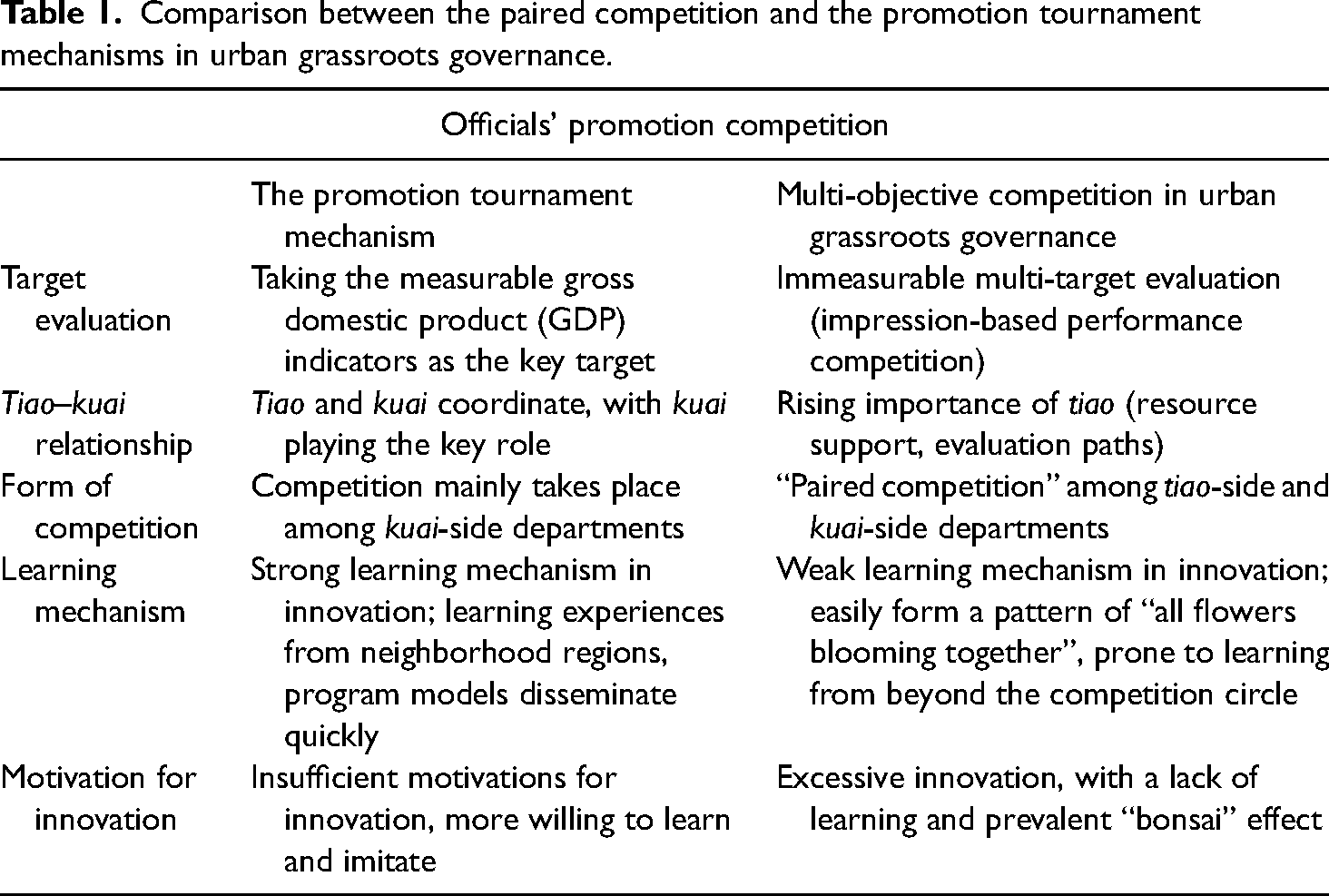
Compared with the promotion tournament mode, the paired competition mechanism is more limited in range of behavior, which is mainly in the field of grassroots governance in urban areas. In the higher administrative hierarchies, the objective and measurable economic growth quotas are the key indicators for administrative performance, and the higher administrative hierarchies have the systematic pattern of “tiao-kuai in coordination in which kuai plays a key role”, and the “paired competition” mechanism seldom plays a role therein. Therefore, the government competition mechanism “paired competition” is not a universal governance mechanism that prevails in different levels of governments. However, as China promotes the transformation of grassroots government functions on a larger scale, the territorial scope of the paired competition mechanism will continue to expand gradually, from first-tier mega-cities to major economically developed cities. In general, paired competition is an important mechanism in the process of constantly deepening grassroots governance system reform and pressing ahead with the local public service system reform by the state.
This study only serves as a new attempt in studying the government behaviors in grassroots governance innovation in urban areas from the perspective of “tiao–kuai” politics. So far, there are still many questions worthy of further exploration regarding the deep organizational mechanism of paired competition and the mechanism of impression-based performance evaluation, such as exploring the difference between the pairing mechanisms adopted by different types of tiao-side departments. Microscopically, what are the conditions and constraints for the pairing between innovators? What are the elements that affect the closeness in pairing? If combined with the cadre management system, how does the impression-based performance work in detail? We believe that, as these questions are revealed constantly, researchers will form a more solid theoretical understanding on the political process of the grassroots governance innovation in urban areas and its consequences.
Footnotes
Acknowledgements
In writing this article, the authors have had discussions with the scholars Xueguang Zhou, Shiding Liu, Feizhou Zhou, Xing Ying, Ying Xiao, Zhenghan Cao, Zhenchao Zhou, Jing Li, Bo Liang, and Rongshan Li, and the authors would like to express their heartfelt gratitude to them. The authors take sole responsibility for their views.
Contributorship
Xiaochun Huang conducted the fieldwork investigation, and the two authors designed and drafted the manuscript together. Both of them read and approved the final manuscript.
Declaration of conflicting interests
The authors declared no potential conflicts of interest with respect to the research, authorship, and/or publication of this article.
Funding
The authors disclosed receipt of the following financial support for the research, authorship, and/or publication of this article: This research is supported by the National Social Science Fund of China in the title of “A study on the support mechanism of service-oriented government reform” (grant No. 19BSH139).