



Abstract
Subjective social status is an individual's perception of his/her position in the social stratum, and it shapes social inequality in a perceived way. By using the China Family Panel Studies and employing growth curve modeling strategies, this article examines the subjective social status trajectories of Chinese people between 2010 and 2018 and how these trajectories are shaped by objective social status. The empirical findings show that the distribution of subjective social status in each wave (2010, 2012, 2014, 2016 and 2018) presents a middle-class identification, which means that the majority of people tend to position their subjective social status at the middle level, while the overall trend in average subjective social status has increased over time. The results of trajectory analysis show that different objective socioeconomic status indicators have different effects on the baseline value and rate of growth in subjective social status, which suggests that the trajectories of subjective social status are influenced by multiple determinants in China. While education, income and political capital reduce the gaps between the classes in subjective social status over time, wealth and employment status enlarge these gaps and thus enhance subjective social inequality. This article highlights the gradient effect that wealth has on the dynamics of subjective social status and helps us to better understand subjective social stratification in contemporary China.
Introduction
Subjective social stratification is an important topic in the field of social stratification research. For a long time, scholars have focused their attention on the objective indicators of social stratification, such as education, occupation and income, and on how objective structural status affects social mobility from one generation to the next as well as within the same generation (Blau and Duncan, 1967). However, with the differentiation of social classes and the increasing attention being paid to the spiritual dimension of people in society in recent years, scholars have increasingly focused on the subjective social stratification that is shaped by an individual's own identity in society (Hout, 2008). Subjective social status is the perception and identification of individuals vis-à-vis others in society, which indicates their perceived relative hierarchical positions (Kraus et al., 2012). On the one hand, subjective social status reflects objective social stratification to some extent, and is shaped by objective socioeconomic status (SES). On the other hand, it is to a significant extent influenced by the psychological characteristics of individuals independent of one's objective SES (Jackman and Jackman, 1973), leading to the recognized pattern of universal inconsistency between subjective status perceptions and objective class status (Fan and Chen, 2015; Hodge and Treiman, 1968), thus generating social inequality in subjective social status. Subjective social status stratification is a consequence of social stratification and has a high degree of explanatory power for inequalities that exist in social mindsets, such as happiness and a sense of distributive justice (Hu et al., 2014). Therefore, research on subjective social status and its determining patterns can enrich our understanding of the sources of social inequality, as well as those mechanisms that underlie an individual's sense of gain, satisfaction and happiness.
It is especially significant to study subjective social status stratification and its determining patterns in contemporary Chinese society. On the one hand, China has undergone rapid development since the market transition in the 1980s, which has led to vast improvements in income levels and quality of life for its citizens. These grand trends raise an interesting question: have these major institutional changes resulted in improvements in the subjective status of the Chinese people? It is reasonable to expect that subjective status can reflect an objective improvement in income and quality of life, and can lead to people experiencing a sense of “gain” in both material and spiritual aspects (Chen and Fan, 2016). On the other hand, the heterogeneity of China's social structure is also increasing. With the rising complexity in the social division of labor in labor markets and the increasing divide of social organizations and interests among different social groups, the criteria of social status have become more diverse, including but not limited to power and authority, income and wealth, professional prestige, cultural capital and social capital, etc. (Lu, 2004). How does this differentiation in objective SES manifest itself in subjective social stratification? What aspects of SES do different social groups rely on to make their subjective identification? To answer these questions, we need a careful understanding of subjective social status patterns and the related changes that have occurred over time in contemporary China.
Previous empirical studies have focused on a cross-sectional examination of the distribution of subjective social status and its determinants in one society at a certain period (Evans and Kelley, 2004; Evans et al., 1992; Hodge and Treiman, 1968; Kelley and Evans, 1995). Other studies used repeated cross-sectional survey data to examine social changes in subjective social status (Hout, 2008; Kikkawa, 1999; Li, 2021). However, these two strands of studies have not yet explored different trajectories of subjective social status between and within individuals nor have they examined how the changes in the trajectories are influenced by different aspects of objective SES. In this regard, there is a need for a more dynamic perspective and a longitudinal approach to the aforementioned issues. Using longitudinal data from the China Family Panel Studies (CFPS), this paper focuses on the trajectories of subjective social status, and examines changes in subjective social status patterns, and the different effects of objective SES factors on the subjective social status patterns. This paper will contribute to a better understanding of the dynamics behind subjective social status and the determinants of the trajectories of subjective social status over time in contemporary China.
The dynamics of subjective social status
Multiple determinants of subjective social status
The phenomenon of subjective–objective status inconsistency — that is, the deviation of subjective social status from objective social status — has long been recognized in the literature (Hodge and Treiman, 1968). Empirical studies in the Western literature found that the tendency toward a middle-level subjective social status distribution is one of the manifestations of subjective–objective status inconsistency. That is, regardless of their SES, approximately half of the respondents tend to position their subjective social status at the middle level, a phenomenon often labeled as middle-class identity bias (Evans and Kelley, 2004; Evans et al., 1992; Kelley and Evans, 1995). This phenomenon has also been observed in China: when identifying subjective social status, upper-class Chinese have a tendency to underestimate their social status, which reflects a downward bias; middle-class Chinese to “agree” with their social status; and lower-class Chinese to show an upward bias (Fan and Chen, 2015; Han and Qiu, 2015; Li, 2021). Subjective–objective status inconsistency implies that the existence of subjective social status is a social fact with independent features that cannot be replaced by objective social status. Therefore, scholars have focused on this inconsistency and examined those factors that shape patterns of subjective social status.
Although inconsistency between subjective and objective status is prevalent in all countries and societies, previous studies show that objective structural determinants are fundamental in accounting for subjective social status formation; that is, an individual's subjective social status is primarily influenced by his/her objective position in the social structure, and is closely related to the objective socioeconomic resources he/she possesses. However, the existence of multiple stratification criteria in contemporary society has led to the explanation of “multiple determinants” from the pluralist approach (Hodge and Treiman, 1968; Hout, 2008; Jackman and Jackman, 1973). The multi-determinant model can be traced back to Weber's theory of social stratification (Jackman and Jackman, 1973). Weber pointed out that society as a whole is a pluralistic stratification system, and a single-dimensional social stratification structure does not sufficiently summarize the diversity and complexity of group structures in modern society. Weber proposed three dimensions of wealth, prestige, and power as the criteria to identify social class. These three criteria are closely related and can be transformed into one another, but they are not equivalent (Weber, 1978). When studying the relative contribution of these three criteria in a given society, we need to take the social context into account (Panday, 1983). When multiple determinants of social stratification exist in a modern country, different dimensions of SES may not exist simultaneously in a particular person or social group — that is, insufficient status crystallization (Lenski, 1954) — which will affect how people perceive their subjective social status.
In the large body of empirical research on multi-determinant model of subjective social status, scholars focused their attention on objective SES indicators along three dimensions: education, occupation, and income. Evidence from Western countries has shown that objective socioeconomic status, indicated by these three dimensions, affects how people evaluate their subjective social status (Evans and Kelley, 2004; Hout, 2008; Kelley and Evans, 1995). However, due to the high level of social differentiation and insufficient status crystallization, objective SES indicators under different dimensions have heterogeneous effects on subjective social status (Hodge and Treiman, 1968; Hout, 2008). Empirical studies in the Chinese context have also highlighted the multiple determinants of subjective social status, namely education, occupation, and income (Research Team of CASS, 2004). Since wealth inequality in China has been steadily increasing in recent years (Xie and Jin, 2015), scholars have further considered the role of assets-related factors in shaping subjective social status, while controlling for educational, occupational, and income characteristics (Huang, 2020; Li, 2021). In addition, political capital is an important aspect of objective social status in Chinese society (Bian, 2002). Therefore, previous research examined the effect of Communist Party of China (CPC) membership as one's political capital characteristic on subjective social status (Fan and Chen, 2015). Previous studies used education, income, wealth, occupational status, and political capital as the five main dimensions to measure the objective social status of individuals in contemporary China, which constitute a pluralistic social stratification evaluation system. These dimensions also provide the basis for a general multi-determinant model of subjective social status. However, as Chinese society becomes increasingly differentiated and the degree of status crystallization on these dimensions decreases, an important question arises: how does the increase in heterogeneity affect subjective status identity? This question brings us to the changes in subjective social status, which will be discussed next.
Subjective social status trajectory within person
Empirical studies on a multi-determinant model of subjective social status have been conducted primarily from a static perspective, and have shown that objective class differences in different dimensions have heterogeneous effects on subjective social status. Scholars researching social changes have further highlighted that this heterogeneous impact varies over time (Hout, 2008; Kikkawa, 1999; Li, 2021). By analyzing repeated cross-sectional survey data, Hout (2008) finds that the role of education and occupation in shaping subjective social status is declining in American society, while “money is clearly the factor on the rise”. Likewise, in Chinese society, it has been found that, since 2008, income and housing assets have increased in importance in shaping subjective social status (Li, 2021). However, as these studies use cross-sectional survey data, comparisons across different periods can only examine the similarities and differences in static patterns of subjective social status formation across samples. To examine within-person changes in subjective social status over time, one need to adopt a dynamic perspective on the basis of longitudinal analysis.
This recognition leads us to an individual's subjective social status trajectory. It is intuitive that people change their self-evaluation of social status over time, resulting in individual-specific subjective social status trajectories. But we know very little about how multiple social status criteria shape an individual's subjective social status trajectory in the long term. Class differences in subjective social status brought about by different SES indicators are likely to either enlarge or converge over time. While previous studies have only focused on between-individual differences in subjective social status, it is important to study within-individual changes when examining how different aspects of objective social status influence the trajectories of subjective social status. This will help us understand how class differences in subjective social status converge or diverge over time and thus shape the dynamic trends of subjective social inequality. This paper investigates the dynamics of subjective social status and examines the multiple determinants of subjective social status trajectories.
Based on the preceding discussion, this paper focuses on how differences in the five objective dimensions of education, income, wealth, occupational characteristics, and political capital shape the subjective social status trajectories in contemporary China. I discuss these factors in sequence. First, education is a social status characteristic acquired by individuals in early adulthood and, for most individuals, does not change over time; therefore, class differences in subjective social status brought about by educational achievement are reflected primarily in the initial level of identification rather than in dynamic changes in trajectories. Second, income and wealth, which are changeable over an individual's lifetime, may affect the dynamics of subjective social status. Furthermore, unlike the flow characteristics of income, wealth, as a stock, may have a cumulative effect due to its cumulative characteristics, thereby further differentiating any initial gaps in subjective social status evaluated on the basis of wealth status over time. Third, the Chinese labor markets today show a variety of new characteristics, such as the increasing complexity in division of labor, the diversification of occupational categories (Lu, 2004), the dual segmentation between state and non-state sectors (Zhou and Xie, 2019) and precarious employment (Kalleberg and Hewison, 2013). These characteristics mean that the information provided by occupational status is complicated and subtle for respondents to use in perceiving and evaluating their own social status. Therefore, the impact of job and occupational status on the dynamic trajectory of subjective social status is likely to be a combination of multiple effects, which needs to be empirically examined with data. Finally, CPC membership is significant political capital in Chinese society that may positively affect subjective social status. However, whether the CPC membership effect will further widen the subjective social class gap over time also needs to be empirically examined. In the next part of the article, I will use panel data to empirically analyze the multiple determinants of subjective social status trajectories.
Data, measures, and methods
Data and variables
The data used in this study come from CFPS, conducted by the Institute of Social Science Survey (ISSS) of Peking University. This dataset fits the purpose of this study well. First, by adopting a multistage, implicit stratification, and probability-proportional-to-size sampling method, the CFPS baseline survey is a nationally representative sample that covers 25 provinces across the country (Xie et al., 2014). Second, CFPS is a high-quality, longitudinal survey that captures changes within the individual along those dimensions of research interest in this study. The CFPS follow-up survey is conducted biennially and the follow-up rate is over 80% (Xie et al., 2014). Since the baseline survey in 2010, CFPS has collected and released datasets for five waves (2010, 2012, 2014, 2016, and 2018), which provides rich longitudinal information for studying the subjective social status trajectories of individuals. In order to examine the dynamics of the subjective social status trajectories, I constructed unbalanced panel data by restricting samples to individuals aged 16–64 who received at least two waves of personal interviews between 2010 and 2018. After the listwise deletion of missing values, the final analytical sample is 56,014 person-years from 13,113 respondents.
Subjective social status is the dependent variable in this study. The CFPS measures subjective social status by asking respondents aged 16 and above the question, “What is your social status in your local area?” The question is answered on a 5-point scale ranging from 1 (very low) to 5 (very high). For simplicity, answers are treated as a continuous variable.
Key independent variables are objective SES indicators from five different dimensions, including education, income, wealth, occupational characteristics, and political capital. Since the effect of objective social status on subjective social status may be non-linear, SES indicators are parameterized into categorical variables. Specifically, education is classified into five categories, including less than primary school (reference group), primary school, junior middle school, senior middle school, and college and above. Economic resources are measured using quintiles of per capita household income and quintiles of per capita family assets. Considering inflation, household income and household wealth are adjusted to the year 2010 by consumer price indices (CPIs) published by the National Bureau of Statistics. Occupational characteristics include employment status (employed = 1, unemployed = 0) and work sector (state-owned sector or “tizhi nei” = 1; private sector = 0). Political capital is measured by membership of the CPC (party member = 1, non-party member = 0).
Control variables are gender (male = 1, female = 0), urban–rural residency (urban area = 1, rural area = 0), age in 2010, marital status, and province of residence. Marital status contains three categories, single (reference group), married, and divorced/widowed. Income quintile, wealth quintile, employment status, work sector, CPC membership, urban–rural residency, marital status and province covariates are time-varying, whereas education, gender, and age in 2010 are time-invariant.
Table 1 presents descriptive statistics of the analytical sample of 56,014 person-years from 13,113 respondents taken from CFPS 2010–2018. The first column is the distribution of each variable. Correspondingly, columns 2–6 are the average subjective social status and its standard deviation for each variable across the five waves.
Descriptive statistics of the analytical sample across the five waves (n = 56,014).
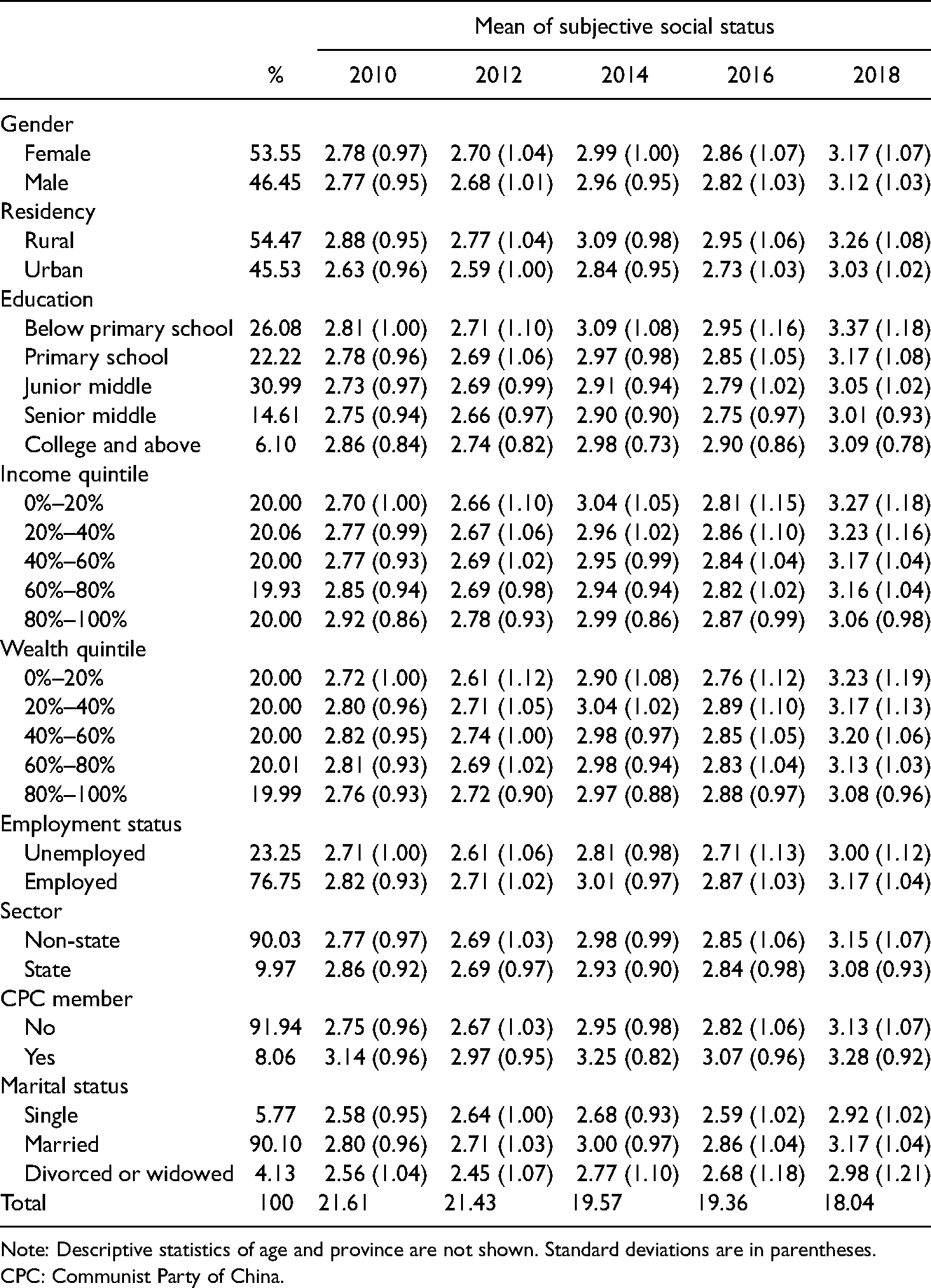
Note: Descriptive statistics of age and province are not shown. Standard deviations are in parentheses.
CPC: Communist Party of China.
Methods
This study employs multilevel growth curve modeling to examine how subjective social status trajectories vary according to objective SES. By taking advantage of multilevel growth curve modeling and unbalanced panel data from CFPS, this study will distinguish two levels of heterogeneity in the subjective social status trajectories: Level 1 model (within-person differences) demonstrates how an individual's subjective social status varies over time; Level 2 models (between-person differences) demonstrate how subjective social status differs among individuals.
The Level 1 model expressed in Equation 1 predicts person-specific, time-varying subjective social status.
Level 1:

The Level 2 model predicts person-specific baseline subjective social status in Equation 2 and person-specific growth rate of subjective social status in Equation 3. X is the independent variable matrix.
Level 2:


Results
The overall subjective social status trajectory between 2010 and 2018
The report of findings begins with the overall distribution of subjective social status (1 = lower class, 2 = lower middle class, 3 = middle class, 4 = upper middle class, 5 = upper class), the mean value, and the resulting trajectory of the overall change in subjective social status of 13,113 respondents in an analytical sample across five follow-up surveys. First, from Figure 1 (overall distribution), the subjective social status of Chinese people shows a distribution that is characteristic of a middle-class identity, which is similar to that of Western societies; that is, the highest percentage of people consider their social status to be “middle class”, with approximately 50% of respondents positioning their local social status at this level. However, in terms of the dynamic changes obtained from successive waves of follow-up interviews, the proportion of people with a middle-class identity shows a fluctuating downward trend over time. For example, 53.03% of people self-identified as middle class in 2010, but by 2018 the proportion had dropped to 47.09%. Second, while the proportion of people identifying as middle class is the highest, the distribution of above-middle-class (upper middle and upper classes) and below-middle-class (lower middle and lower classes) status identification has changed significantly. In 2010, more than 30% of the population perceived their social status to be lower than middle class, and only 15% of the population positioned their subjective social status above middle class; that is, the overall distribution of subjective status showed a downward bias, which is generally consistent with the findings of previous studies (Fan and Chen, 2015; Li, 2005). In 2012, the overall distribution of subjective social status also showed a downward bias; that is, a higher proportion of groups with a lower-middle-class identification. However, in 2014 and 2018, the percentage of groups identifying with a subjective social status in the upper-middle and upper class increased significantly over time. In 2018, the distribution of subjective social status in this sample shifted from the previous downward trend to an upward trend; that is, the proportion of those people who considered themselves to be above middle class exceeded the proportion of those who considered themselves to be below middle class. This is reflected in the change in proportion of “upper class” status, which was only 3.87% in 2010, but rose to 12.3% in 2018. Third, according to the distributions across waves, changes in the mean value of subjective social status show a fluctuating upward trajectory over time in the overall level of subjective social status of Chinese citizens. The average score of subjective social status increased by 0.38 points during the eight-year period from 2010 to 2018.
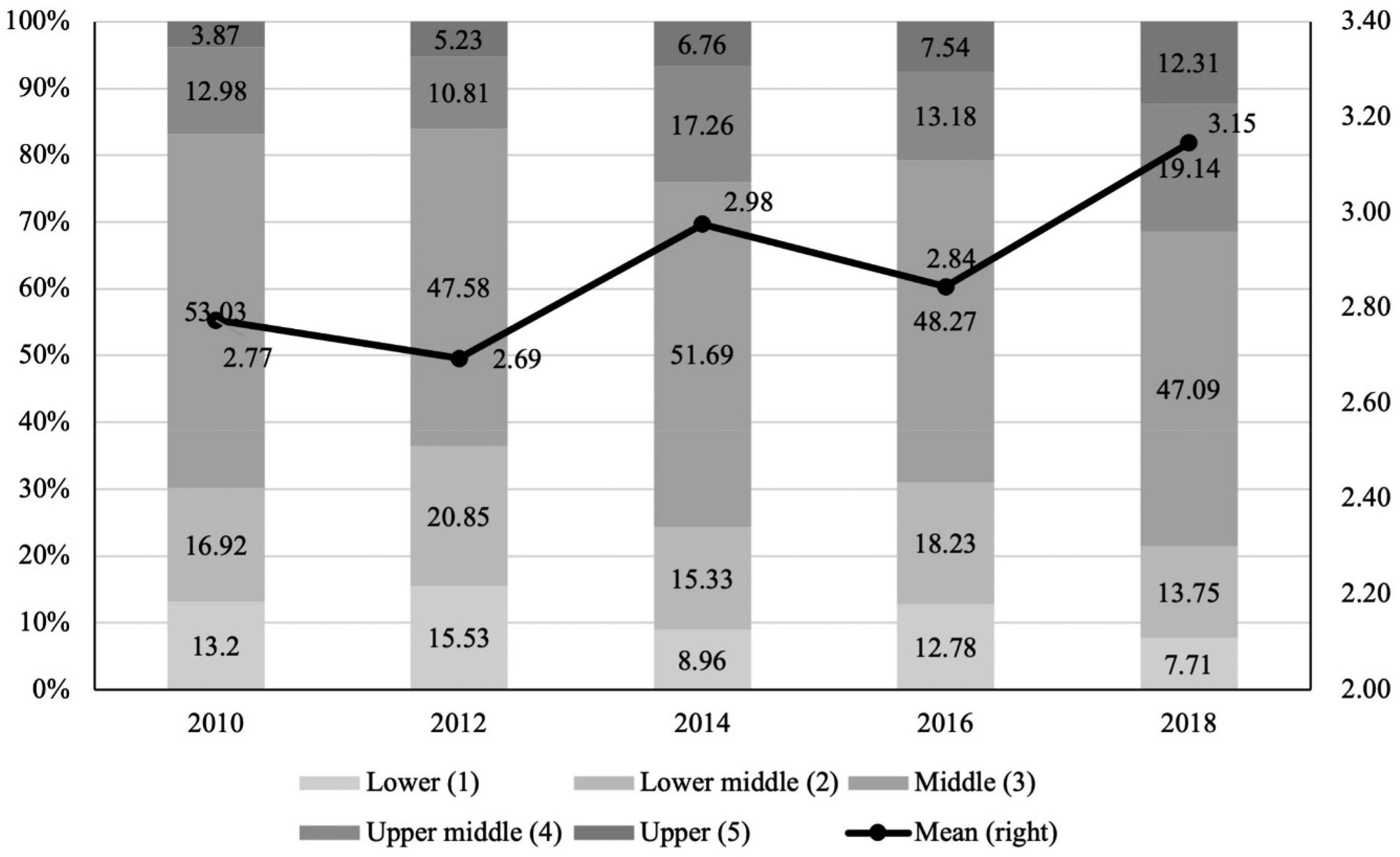
Distribution and changes in subjective social status from 2010 to 2018 (n = 13,113).
Multiple determinants of subjective social status trajectories
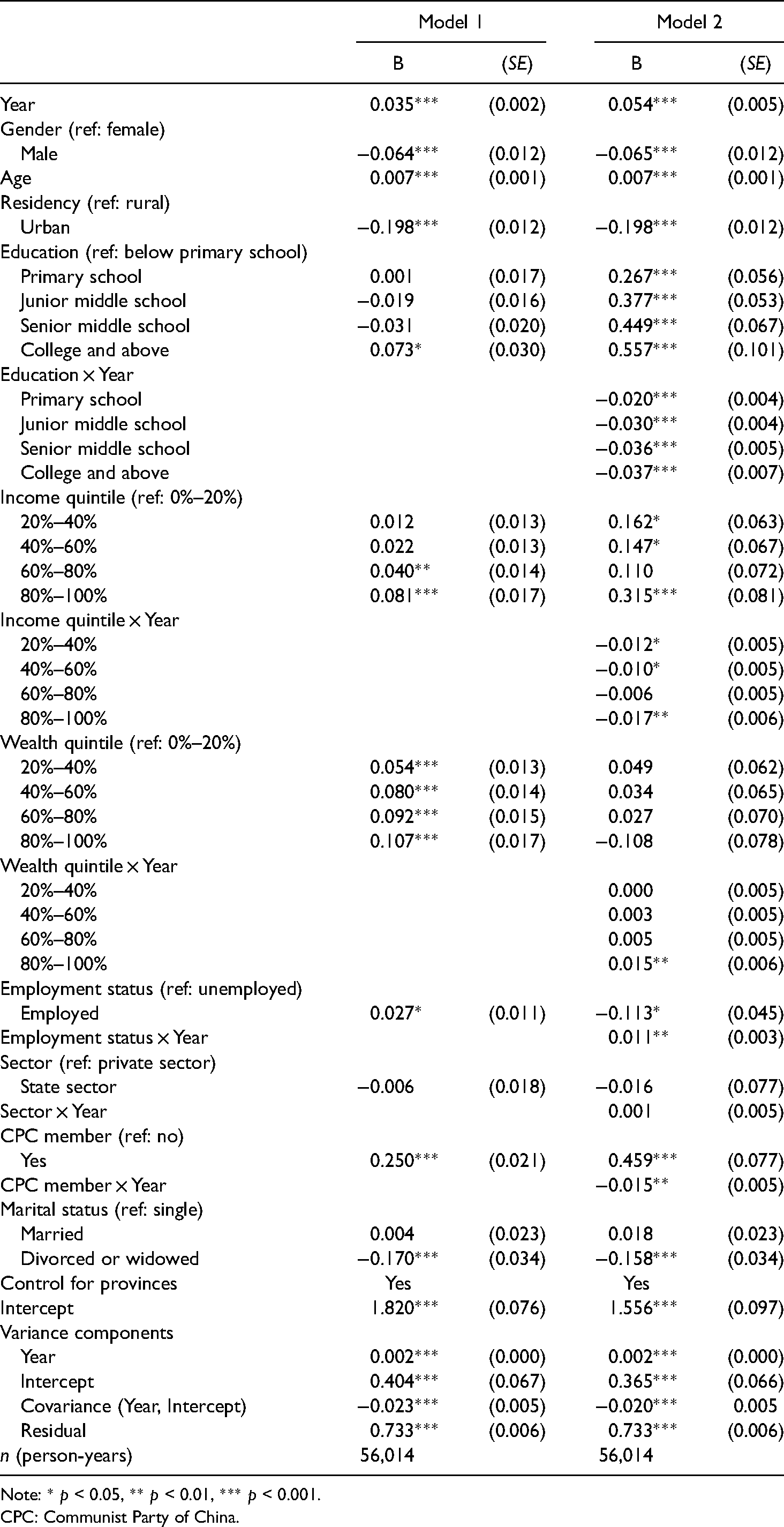
Table 2 presents the results of the growth curve models used to predict subjective social status trajectories. Model 1 estimates intercepts as outcomes and Model 2 estimates both intercepts and slopes as outcomes. From the results of Model 1 in Table 2, it can be seen that time has a significant positive effect on subjective social status. This indicates that an individual's subjective social status increases over time, and the subjective social status trajectory shows an increasing linear dynamic. Objective SES in the different dimensions has a heterogeneous effect on the evaluation of subjective social status. Education only has a significant positive effect on subjective social status when educational attainment is at college degree level or above. In terms of income, income within the 60–80% and 80–100% quintiles significantly improve subjective social status, and the effect of income on subjective social status is non-linear, with income in the top quintile having twice the effect on subjective social status as income in the 60–80% quintile. An increase in property significantly improves subjective social status and it has a significant gradient effect. The effect of wealth is greater than that of income, and this finding is consistent with those of previous studies. It has been shown that class identity in Chinese society has been profoundly influenced by property status in recent years (Li, 2021). The results of the current study also highlight that property has a significant impact on subjective social status. In terms of occupational status, being employed significantly increases subjective social status, but the role of the work unit in the state sector (“tizhi nei”) is not significant. CPC membership, as one's political capital, has a significant positive effect on subjective social status. In conclusion, Model 1 in Table 2 shows that the subjective social status of Chinese people is influenced by multiple determinants, but there is heterogeneity in the effects created by different dimensions of the objective SES indicators of education, income, wealth, etc.
Growth curve models predicting subjective social status over the five waves.
Note: * p < 0.05, ** p < 0.01, *** p < 0.001.
CPC: Communist Party of China.
In addition, Model 2 in Table 2 presents the results of the growth curve model used to estimate the growth rate of subjective social status. In Model 2, I conduct interactive analysis on different dimensions of the objective SES indicators and time variable (Year) to examine the rate of change in subjective social status. First, different levels of educational attainment create a significant gradient effect on both baseline subjective social status and its dynamics, but the direction of the gradient effect is reversed. Individuals with higher educational attainment have higher baseline subjective social status, but also experience slower rates of growth. Thus, class differences in subjective social status brought about by education gradually converge over time. Second, the effects of income on the baseline subjective social status and the growth rate of subjective social status are non-linear. People in the top income quintile have the highest baseline levels of subjective social status, but grow the most slowly. Third, the significant effect of wealth on the dynamics of subjective social status lies mainly in the highest wealth quintiles. The group with the highest quintile wealth experienced the most rapid growth in subjective social status during the period from 2010 to 2018. Fourth, in terms of job and occupational characteristics, being employed increases the growth rate of subjective social status, but working in the state sector does not further accelerate the increase in subjective social status. Finally, while CPC membership positively affects the baseline subjective social status of individuals, the subjective social status of non-party members grows significantly faster than that of party members, and thus the difference in subjective social status between having/not having CPC membership decreases over time.
The effects of other control variables on subjective social status are as follows. First, subjective social status is affected by gender, with men having a significantly lower subjective social status than women. Second, subjective social status increases significantly with age. Third, living in urban areas significantly decreases subjective social status compared to living in rural areas, which is consistent with the findings of previous studies (Fan and Chen, 2015). Finally, in comparison to the unmarried group, the subjective social status of the divorced or widowed group decreases significantly, but there is no significant difference in subjective social status between unmarried and married people.
Figures 2–4 show the effects of objective SES indicators on the subjective social status trajectories for each dimension derived from Model 2, including differences in the heterogeneous effects on baseline subjective social status and the growth rates of subjective social status. As shown in Figure 2, baseline subjective social status is lowest for the “below primary school” educated group, and highest for the “college and above” educated group. Baseline subjective social status is relatively similar for the primary, junior middle and senior middle school educated groups. This suggests that the effect of education on baseline subjective social status is polarized. The class gap in subjective social status between the groups with the lowest and highest levels of educational attainment is the largest. In addition, the different educational levels have a differential effect on the growth rate of subjective social status. The higher the educational level, the slower the rate of growth of subjective social status. The subjective social status of the below primary school educated group experiences the largest change between 2010 and 2018, with the largest rate of growth, while the subjective social status of the senior middle school and above educated groups has the slowest rate of growth. Thus, as Figure 2 illustrates, the subjective social status of the lowest educated group gradually surpasses that of the highest educated group during the period 2010 to 2018.
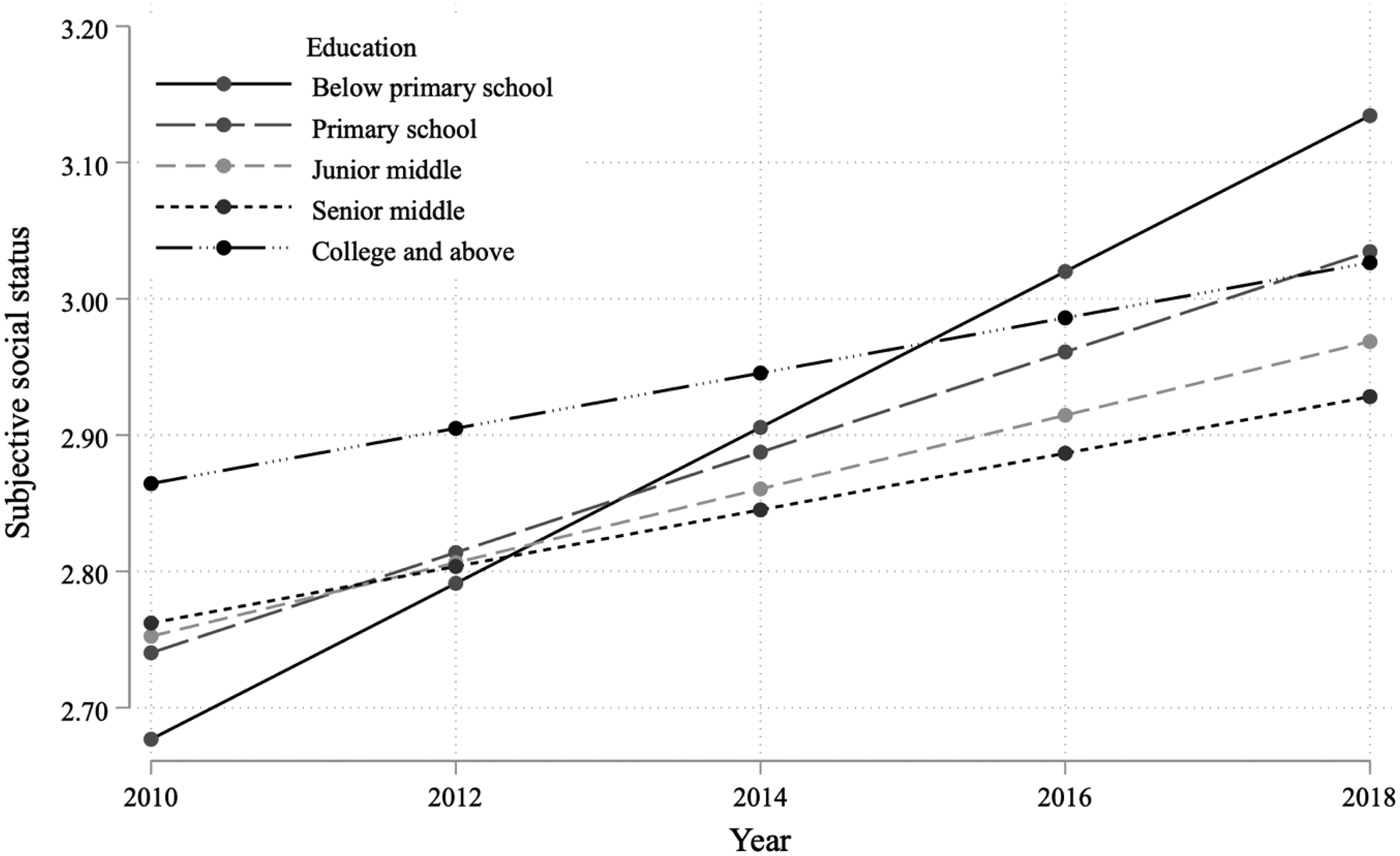
Predicted subjective social status trajectories by educational attainment.
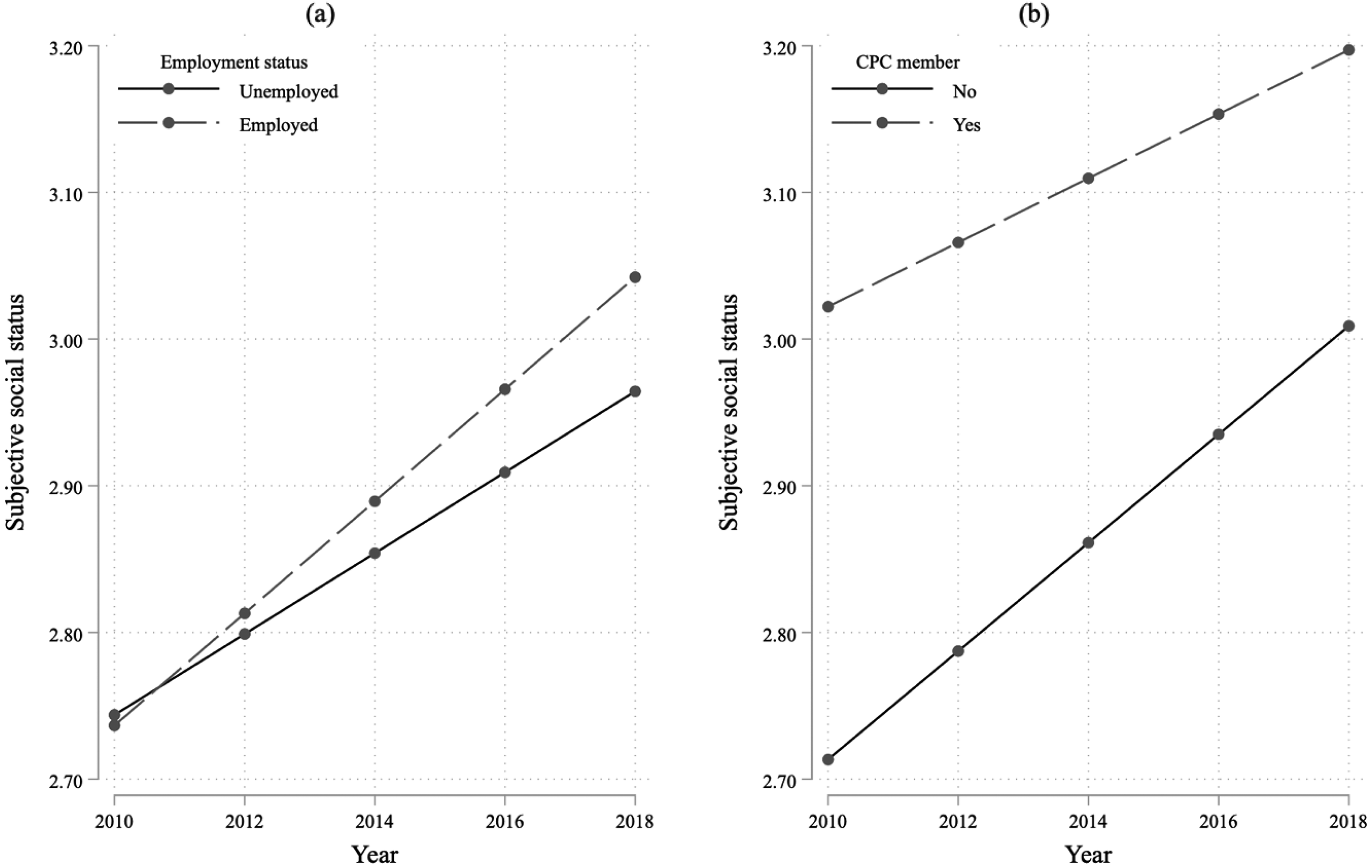
Predicted subjective social status by employment status and CPC membership.
Figure 3 compares the heterogeneous effects of income and wealth on the subjective social status trajectories. In Figure 3(a), the impact of income on baseline subjective social status is reflected in the highest and lowest income groups, but the subjective social status of the highest income group grows more slowly. Thus, the gap between the subjective social status of these two income groups gradually decreases, demonstrating a converging trend over the period 2010 to 2018. In contrast, Figure 3(b) demonstrates that wealth has a quite different effect on the trajectories. The group with the least wealth has a significantly lower baseline subjective social status than all other groups, while the group with the most wealth has the fastest-changing subjective social status. Therefore, different levels of wealth widen the gap between the subjective social status of these two groups over the period 2010 to 2018.
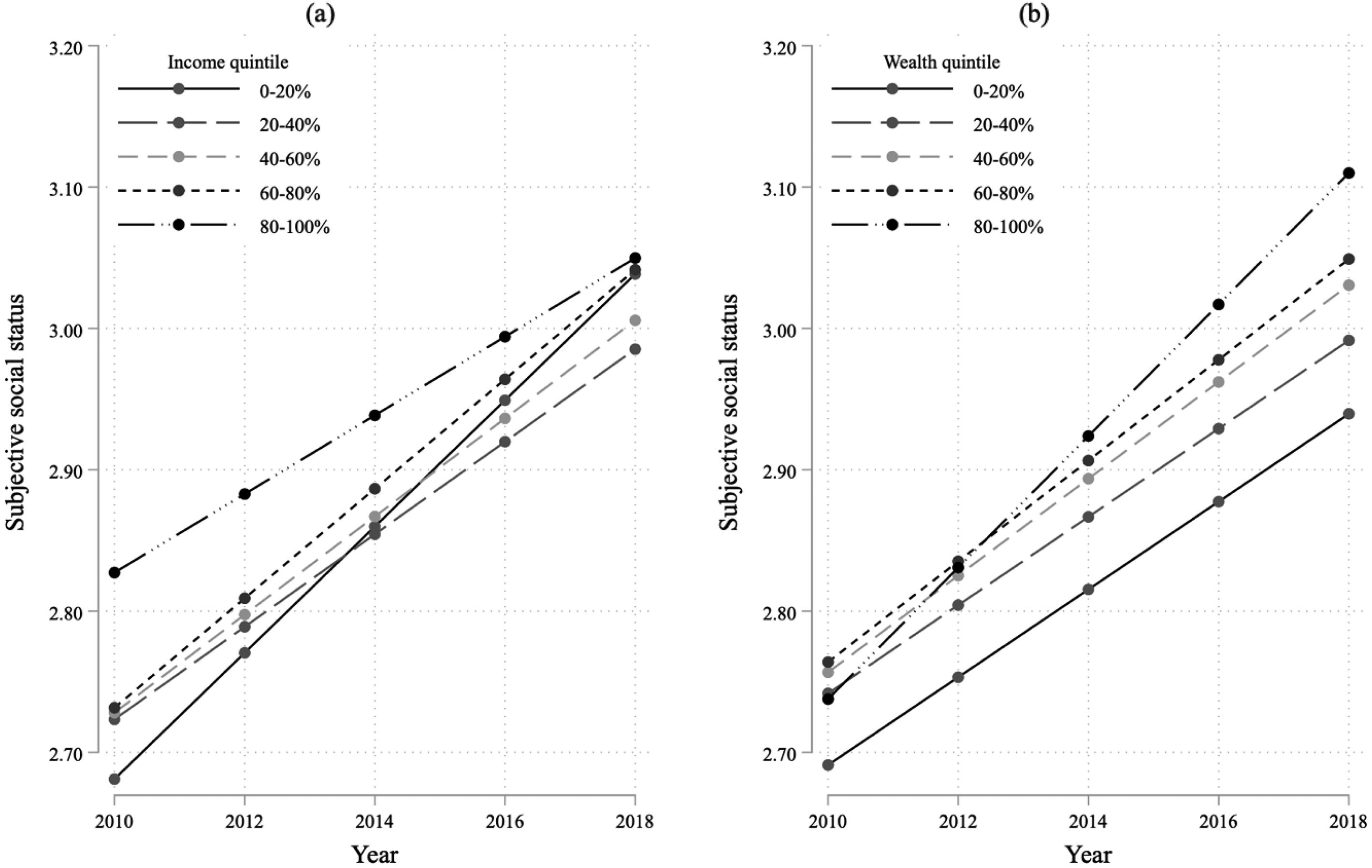
Predicted subjective social status trajectories by income and wealth quintiles.
Figure 4 illustrates the heterogeneous roles of employment status (Figure 4(a)) and CPC membership (Figure 4(b)) on subjective social status trajectories. Of the two variables measured, job and occupational status, only employment status is significant in Model 2; the effect of the work unit being within the state sector is not significant. Being employed/unemployed has no effect on baseline subjective social status, but results in significantly different subjective social status trajectories. Over the years, employment gradually increases the difference in subjective social status. While CPC membership leads to a significant gap in subjective social status during the initial period, the positive effect of party membership gradually decreases over time, and the gap between the subjective social status of CPC and non-party members gradually decreases.
Combining the results in Models 1 and 2 of Table 2, it can be seen that subjective social status trajectories in China indicate a pattern of multiple determinants. Education, income, wealth, employment status, and CPC membership all have, to various extents, significant and heterogeneous effects on baseline and growth rate of subjective social status, thus resulting in dynamic changes of subjective social status in the different social classes. Due to the heterogeneous effects of different objective SES indicators, the trajectories of subjective social status have different shapes. Class differences in education, income and CPC membership have convergent effects on the subjective social status trajectories, while wealth and employment status widen the initial gaps in subjective social status.
Conclusion and discussion
Subjective social status is an individual's perception of his/her position in the social stratum and it shapes social inequality in a perceived way. Subjective social status reflects the self-evaluation of subjective inequality and contributes to our understanding of the social consequences of other aspects of subjective inequality in a society, such as perceptions of fairness, happiness, and so on. Most studies either use cross-sectional data to explore the distribution of subjective social status and its determinants, or use repeated cross-sectional data to explore the social changes in the distribution of subjective social status. This study built on and moved beyond previous studies by using longitudinal data to examine dynamic changes in subjective social status and to investigate the multiple determinants of subjective social status trajectories, thus filling the gap in this field of research.
Using five-wave data obtained from CFPS, this study provides a systematic examination of the determinants of the subjective social status trajectories in contemporary China. The findings of this paper are summarized as follows. First, consistent with the findings in previous studies, subjective social status in China shows a tendency toward the “middle class”, with more than 50% of respondents considering themselves to be in this category. In terms of the overall change in the distributions of subjective social status, the subjective social status in China shifted from a downward to an upward bias between 2010 and 2018, and the mean value of subjective social status showed a fluctuating but increasing trend over time. This reflects the overall continuous improvement in the sense of gain experienced by Chinese people.
Second, based on growth curve modeling, this study finds that the subjective social status trajectories among the Chinese are indicative of multiple determinants. Consistent with the findings in those studies of other societies, this study finds that multiple criteria are employed when the Chinese evaluate their subjective social status. Controlling for other objective socioeconomic characteristics, the five dimensions — education, income, wealth, employment status, and political capital — are all found to influence, to various extents, one's subjective social status. Of these, wealth produces a significant gradient effect on the overall subjective social status of Chinese society, which is consistent with the main finding of Li's (2021) paper. In terms of education and income, only those groups with college level or above of education and higher levels of income have statistically significant and higher subjective social statuses. One important finding of this study is that different objective socioeconomic characteristics further influence subjective social status trajectories over time, resulting in dynamic changes in the growth rate of subjective social status. Education, income and political capital all contribute to narrowing the gap between the different social classes in their baseline subjective social status. This may result from the fact that people with higher levels of education and income have higher subjective social statuses in the initial stage, and thus have less room for an increase over time than those in lower-educated and low-income groups. In recent years, the overall subjective social status of the Chinese has increased over time, with the subjective social status of lower-educated and low-income groups increasing more rapidly. This pattern suggests that the overall economic development has benefited the underclasses, at least in their perceived status. As for CPC membership, some studies find that the selectivity of party membership increases in the post-transition period such that the premium conferred by CPC membership is mainly reflected in the initial stage rather than in later growth (Zhu and Tam, 2019). This is also true for the effect on subjective social status trajectories. Wealth and employment status affect the growth of subjective social status trajectories as well, further widening the gap in subjective social status across the social classes over time. It is worth noting that the wealth gap not only affects baseline subjective social status, but also results in significant gradient effects on the rates of growth. The findings of this paper suggest that the multiple determinants of the subjective social status of Chinese people are by no means static; rather, the shape changes in one's dynamic status trajectory over time.
The longitudinal analysis of subjective social status trajectories in this study provides a dynamic perspective to shed light on the between- and within-person changes in subjective social status and subjective inequality in Chinese society. Although the mean subjective social status in society as a whole shows a fluctuating but upward trend, the findings in this paper uncovered sources of divergence, such as increasing wealth inequality, indicating that the subjective social status trajectories may continue to diverge and further exacerbate subjective social inequality among social classes.
Acknowledgments
Footnotes
Acknowledgements
The author thanks Yu Xie and Chunni Zhang for their helpful comments and suggestions. The author also thanks Tom Marling for editorial assistance. The ideas expressed herein are those of the author.
Declaration of conflicting interests
The author declared no potential conflicts of interest with respect to the research, authorship and/or publication of this article.
Funding
The author received no financial support for the research, authorship and/or publication of this article.
