



Abstract
Folk religion, as the basis of the religious landscape in traditional China, is a highly syncretic system which includes elements from Buddhism, Daoism, and other traditional religious beliefs. Due to the shortcomings of denomination-based measurement, most previous social surveys have documented a very low percentage of folk religion adherents in China, and found almost no overlapping among religious beliefs. This study offers a quantitative portrait of the popularity, the diffuseness, and the diversity of Chinese folk religion. With the improved instruments in the 2018 China Family Panel Studies, we first observe that nearly 50% of respondents claim to have multiple (two or even more than three) religious beliefs and the believers of folk religion account for about 70% of the population. By using latent class analysis, this article explores the pattern of inter-belief mixing and identifies four typical classes of religious believers: “non-believers and single-belief believers”, “believers of geomancy”, “believers of diffused Buddhism and Daoism”, and “believers embracing all beliefs”. Finally, we find that the degree of commitment varies across these religious classes. Believers of folk religion are found to be less committed than believers of Western institutional religions, but as committed as believers of Eastern institutional religions.
Introduction
When describing the religious landscape in traditional China, Zürcher (1980) suggests a well-known metaphor that delineates China's “three religions” (sanjiao), namely Buddhism, Daoism, and Confucianism, as three pyramid-shaped peaks sharing a common mountain base: popular religion, or, folk religion. This metaphor indicates at least two meanings: on the one hand, “popular religious practices and beliefs were shared in common by a wide range of the population of traditional China” (Overmyer et al., 1995: 315); on the other hand, popular religion and institutional religions (e.g. Buddhism and Daoism) are not discrete, but overlap and interweave with each other. Unfortunately, these findings have been rarely tested by quantitative research.
In this article, we will first explore the popularity of folk religion in China, which is a controversial topic among scholars. While anthropologists (Feuchtwang, 1992; Overmyer et al., 1995; Wolf, 1974) hold that folk religion is the mainstream of Chinese religious life, social surveys have indicated that only a small percentage of Chinese people adhere to folk religion. The discrepancy between quantitative and qualitative research, we argue, is mainly attributable to schemes of measurement for Chinese religiosity. In response to this, we offer a quantitative portrait of the diffuseness of Chinese folk religion. Ethnographic research has noted that Chinese popular religion is a syncretic system consisting of elements from Buddhism, Daoism, and other traditional religious beliefs. The adherents of folk religion not only worship various kinds of spirits, but also believe in supernatural forces such as destiny and geomancy. Existing studies, however, have failed to explain how these beliefs are diffused in practice. By using latent class analysis, we will study how various beliefs are mixed with one another in the belief systems of Chinese individuals. Finally, we will discuss the diversity of Chinese folk religion. Previous research has taken it for granted that the believers of folk religion are a homogeneity, and has not quantitatively probed the differences among Chinese folk religion adherents. This article will not only identify different types of folk religion adherents but also explore different degrees of religious commitment among them. Empirically, we make use of the 2018 China Family Panel Studies (hereafter, CFPS) to answer the following three questions: To what extent is folk religion popular in China? How are various beliefs mixed in Chinese religious life? How do different types of folk religion adherents differ in term of commitment?
Chinese folk religion: Mainstream or marginal?
Although almost all experts on Chinese religion (Overmyer et al., 1995; Tamney, 2005; Zürcher, 1980) agree that folk religion was the mainstream of the Chinese religious tradition and nearly all Chinese people practiced folk religion in the past, social surveys indicate that today adherents of Chinese folk religion are much fewer. Figure 1 presents those who claimed to believe in folk religion in the Chinese General Social Survey (hereafter, CGSS) as a percentage of total respondents. It shows that between 2006 and 2017, the proportion of respondents identifying as adherents of folk religion was consistently less than 3%. In other major social surveys, including CFPS 2012 and the World Values Survey (hereafter, WVS), folk religion is totally ignored. In these surveys, folk religionists would have to choose “other religion” as their religious identity. The percentage of “other religion” believers, however, is less than 0.5% in these surveys (Figure 1). In any case, the survey data indicate that folk religion is not mainstream in the Chinese religious market, but rather is a marginal element.
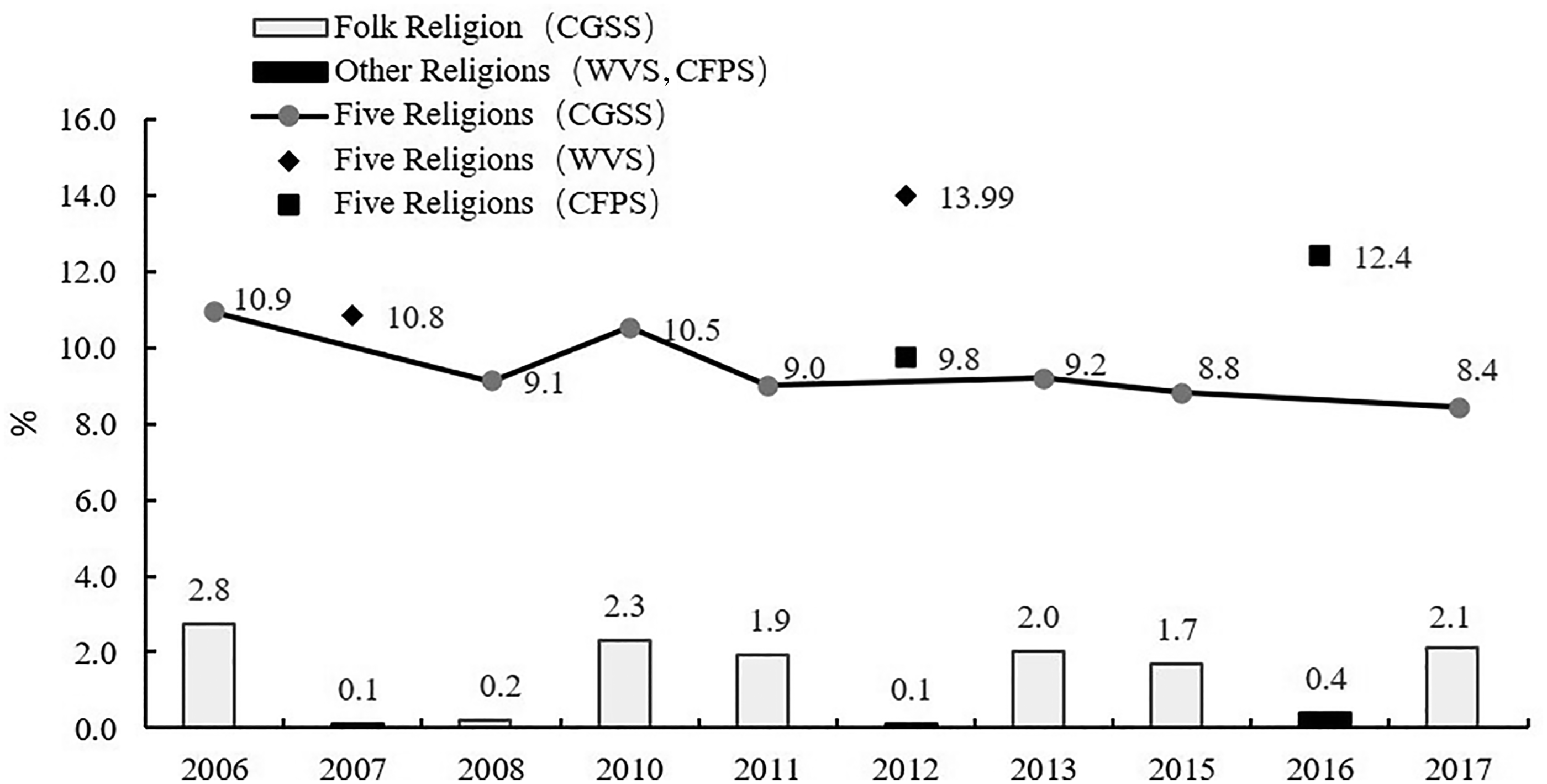
Proportions of believers of the “five institutional religions” (dots and line) and of folk religion believers (bars), 2006–2017.
Why is there so much discrepancy between quantitative and qualitative research? One factor contributing to the discrepancy is that instruments measuring Chinese religiosity typically fail to identify folk religion adherents. When investigating religious affiliation, the above surveys use the question “What is your religion?”; the responses typically include five institutional religions, namely Buddhism, Daoism, Protestantism, Catholicism, and Islam. In rare cases, “folk religion” (minjian xinyang) is listed as a choice. But “folk religion” is mainly an academic term that is little understood by ordinary people. The Chinese Spiritual Life Survey tried an alternative way of measuring Chinese folk religion in 2007 (Yang and Hu, 2012). Instead of using the term “folk religion”, it listed a variety of supernatural practices and spiritual beliefs in the questionnaire, including observing geomancy (fengshui), seeking fortunetelling, worshipping the god of wealth, and engaging in various amuletic practices; it also regarded those who identify as having no religion but who believe in “gods” as believers of folk religion. The survey found that about 55.5% of respondents were folk religion adherents.
Another factor is that folk religion lacks official recognition in China and thus most people do not regard it as a “religion”. Thus, while folk religion adherents can identify as adherents of “other religions”, this is complicated by the fact that folk religion had not been regarded as a religion since imperial China. When the People's Republic of China was founded in 1949, folk religion was treated as a superstition rather than a religion. The situation began to change in 2006 when the National Religious Affairs Administration established a new institution to supervise folk religion, indicating that the state was beginning to recognize its religious status. Nonetheless, for ordinary people, few conceive of popular religion in terms of a “religious identity” for themselves.
The diffuseness of Chinese folk religion
While scholars have noted that folk religion played a vital role in Chinese religious life, it is not an institutional religion equipped with independent theologies, organizations, and theists. In his masterpiece, Religion in Chinese Society, Yang (1961) identified two forms of religion in China: institutional religion and diffused religion. Although diffused religion is not totally equivalent to popular religion, both terms conceptualize Chinese religious beliefs and practices that are beyond the scope of institutional religion. By using the term “diffused religion”, Yang tried to emphasize the diffusive nature of folk religion—that it, rather than being independent, it is highly mixed with everyday life, without significant differentiation. Following Yang's research, Li (1998: 168) states: “The folk belief in China is a very complex religious mixture, in which the teachings of Buddhism and Daoism have formed an important part, but there are also elements that do not belong to the two religions. Ancestor worship, for example, has existed long before the founding of Daoism… Chinese folk religion is therefore a religious integration of Buddhism, Daoism and many other traditional religious beliefs”.
Generally speaking, the followers of popular religion worship at least three classes of supernatural beings: gods, ghosts, and ancestors (Feuchtwang, 1992; Harrell, 1974; Jordan, 1972; Sangren, 1987; Wolf, 1974). With regard to gods, Buddhism and Daoism offer a huge number of deities closely linked with family (e.g. the stove god, Zaoshen), economic group (e.g. the wealth god, Caishen), local community (e.g. the earth god, Tudi Gong), and the secular state (e.g. the city god, Chenghuang). Most of these gods are the supernatural equivalent of imperial bureaucrats, and are typically depicted as dressed in official robes (Harrell, 1974); but there also exist a large number of “unruly gods” that fall outside of the metaphor of bureaucrats, including female deities (e.g. Avalokitesvara Bodhisattva and Mazu) and rebellious gods (e.g. Nezha) (Shahar and Weller, 1996).
Ghosts are the supernatural equivalent of strangers; some of them are dangerous bandits and others are pitiful beggars. Ghosts are dependent on sacrifices provided by human beings; those ghosts who are believed to be efficacious can become gods. People maintain a reciprocal relationship with spirits and they tend to change their loyalties according to the degree of efficacy that they perceive them to be having in their lives.
For ancestor worship, Chinese people believe that ancestors can influence their offspring's well-being. The souls of deceased ancestors are ghosts in nature; if they do not get offerings regularly, they become “wild ghosts” (guhun yegui). That is the reason why traditional Chinese attached great importance to the continuation of the ancestral line.
In addition to gods, ghosts, and ancestors, some supernatural forces are commonly believed by Chinese people to be influential on the life or success of a person. These forces include destiny (ming), fate (yun), geomancy (fengshui), and merit (de). As Yang (1961: 135) has pointed out, these mystical forces seem to be a chaotic mass of ignorant superstitions, but they actually represent a well-coordinated system of religious theory, namely, the theory of Yin-yang (negative and positive) and the Five Elements (metal, wood, water, fire, and earth). Ordinary Chinese people perhaps know little about the theology of Yin-yang and the Five Elements, but they could understand the almanac (huangli), the handbook for choosing auspicious days and times which is based on these theories. When people undertake any major events, including holding a wedding, making a long journey, moving house, and opening a store, they will consult the almanac to receive supernatural guidance. For this reason, it was the almanac, rather than any of the Confucian classics, that enjoyed the widest circulation and use in traditional China. “The same theology of Yin-yang and the Five Elements underlay the theory of fengshui (geomancy), which interpreted the effect of a certain space or the location of a building or a grave upon the luck or misfortune of the affected individuals. Space, no less than time, was involved in the operation of the mystical forces of Yin-yang and the Five Elements” (Yang, 1961: 135).
From the above, we know that Chinese folk religion is a highly syncretic system which includes elements from Buddhism, Daoism, and traditional religious beliefs, but we do not quantitatively know how these elements combine with each other. Previous survey-based studies show that people choosing more than one religious identity account for only 1% of the total respondents, or even less (Yang and Hu, 2012; Zhang and Lu, 2020), and as such have concluded that “the plural nature of Chinese religious identity is probably exaggerated” (Yang and Hu, 2012: 513). Why do empirical findings from survey data contradict the long-recognized diffuseness of Chinese folk religion? We argue that this is a question of measurement, and one of the main tasks of this article is determining a typology of religious diffuseness based on respondents self-identified multiple religious beliefs.
Data and methods
This article uses CFPS 2018 to collect data on folk religion. The CFPS is a comprehensive, longitudinal social survey in China. Following its baseline survey in 2010, the CFPS has conducted four waves of follow-up surveys including all the members and households of its baseline, in 2012, 2014, 2016, and 2018. In the 2018 survey, 29,996 respondents (aged 16 and above) completed religion-related questions.
We have conducted several experiments since the 2014 survey to improve the measurement of Chinese religiosity (Zhang and Lu, 2018, 2020). In CFPS 2018, we made three additional changes to its religion module to explore diffused belief. The first and the most important change is that we shifted from a denomination-based scheme in 2016 to a deity-based scheme (first introduced to the CFPS in 2014) in 2018 when probing beliefs. Specifically, we replaced the question “What is your religion?” with “What do you believe in?” and adjusted the response categories to “Buddha/bodhisattva” (佛/菩萨), “Daoist deities” (道教的神仙), “Allah” (真主安拉), “Catholic God” (天主), “Jesus Christ (Protestant God in 2014)” (耶稣基督), “ancestors” (祖先), and “none of the above”. Compared with the traditional denomination-based scheme, the deity-based measurement can be easily understood, and it enables respondents to link the deities that they worship with their religious beliefs. Considering that Chinese people's understanding of religious identity is relatively narrow and the idea of exclusive religious affiliation is vague, the new approach manifests its advantage in reducing the risk of omitting faith groups. When the deity-based scheme was initially introduced in CFPS 2014, it captured a higher proportion of self-proclaimed religious believers than the standard denomination-based scheme had in CFPS 2012 and 2016, increasing the proportion of adherents to the five major religions in China by 7–10% (Zhang and Lu, 2018, 2020).
Secondly, instead of simply repeating the scheme from 2014, the 2018 questionnaire added two additional belief responses: “ghosts” and “geomancy” (fengshui). Previous research has found that the worship of gods, ghosts, and ancestors and the belief in geomancy and destiny are the most important components of Chinese folk religion (Hu, 2016; Tang, 2014; Yang, 1961; Yang and Hu, 2012). However, these beliefs were largely ignored by many previous social surveys. Thus, CFPS 2018 collected data on eight kinds of beliefs, including Buddha/bodhisattva, Daoist deities, Allah, Catholic God, Jesus Christ, ancestors, ghosts, and geomancy. Among them, ancestor worship, belief in ghosts, and belief in geomancy are the three common components of Chinese folk religion.
Thirdly, CFPS 2018 converted to the forced-choice question format, where respondents provide a yes/no answer for each religious belief item, whereas the CFPS 2014 and 2016 used the check-all (or check-all-that-apply) format, for which respondents are asked to mark all responses that apply from among a list of options. The forced-choice format is usually found to be preferable to the check-all format, because the former encourages deeper processing of each option and discourages a sacrificing response strategy (Krosnick and Alwin, 1987; Smyth et al., 2006). As a result, we expect that respondents tend to report more beliefs in the survey of 2018 than in previous waves.
To give a portrait of the popularity and the diffuseness of Chinese folk religion, at first we will describe the distribution of beliefs, focusing on the prevalence of multiple religions, ancestor worship, belief in ghosts, and belief in geomancy. Since our main question lies in how individuals uniquely combine varying types of religious beliefs and build a diffused religious identity, we then conduct latent class analysis to explore an individual's structure of diffused religious beliefs. Latent class analysis is a data reduction technique that seeks to capture the associations that exist among the observed categorical indicators through a small number of discrete latent classes (Vermunt and Magidson, 2003). In our case, the yes/no binary answers to eight questions on religious beliefs form an eight-way contingency table with 256 (=28) cells. To determine the underlying patterns of the 256 cells, we employ latent class modeling to identify a few typical types (or latent classes). We named the latent classes according to the conditional probabilities of specific responses (or item-response probabilities) for religions within each latent class. We also calculate each individual's probability of being in each latent class (or latent class membership probabilities) and determine the expected religious class for each individual based on his/her highest posterior probability.
Finally, we describe and compare religious commitment among different religious classes. The commitment of a diffused believer could be attenuated by competition among different religions: as the old saying goes, “believing in everything leads to believing nothing”. To explore the relationship between diffused religious identity and commitment, we compare the level of commitment between different religious classes from three aspects, including membership of religious organizations, frequency of attending religious activities, and the salience of religion in one's personal life. Among the three aspects, information about whether a respondent is a member of any religious organizations was collected in CFPS 2018, while data on participation in religious activities and attitude towards the salience of religion in one's personal life were only collected in CFPS 2016 and preceding waves. To tackle this problem, we assume that religious practices and attitudes are largely stable across waves and impute missing values using the most recent valid data from the 2016 wave to the 2012 wave.
Membership of religious organizations is a dichotomous variable, which is coded 1 if a respondent is a member of any religious organization and is coded 0 if the respondent is not a member of any religious organization. The salience of religion in one's personal life is based on the response to the question “No matter whether you attend religious activities/events or not, do you think religion is important to your life?”, with three ordered response categories: “very important”, “somewhat important”, and “not important at all”. We rescale the responses from the least salient to the most salient. Religious activities are divided into two types: burning incense and going to church/mosque. Religious believers responded with the frequency of their participation in the religious activity typical to their own religion; and non-believers responded with the frequency of both types of activities. The frequency is measured on an ordinal scale (1 = never, 2 = once a year, 3 = several times a year, 4 = once a month, 5 = two or three times a month, 6 = once a week, 7 = several times a week, 8 = almost every day). Based on the measurement level of these religious commitment measures, a binary regression model for membership of religious organization and ordinal logistic regression models for religious practice and salience of religion in personal life are constructed to compare differences in religious commitment across latent classes.
Results
The popularity of folk religion in China
The changes made in the measurement approach outlined above have a clear impact on our results when compared to previous surveys, as we find that the majority of Chinese are folk religion adherents. Figure 2 shows that 20.5% of respondents claim to believe in two religions, while 29% believe in three or more religions. Undoubtedly, they are folk religion believers. In addition, among those who identify as having only one belief, as Table 1 shows, 14.5% believe in ancestors, 6.5% believe in geomancy, and 0.3% believe in ghosts. These respondents can also be classified as practitioners of folk religion. Therefore, in total, more than 70% of the respondents are folk religion practitioners. This result verifies the argument that in the Chinese religious market, folk religion has the most adherents.
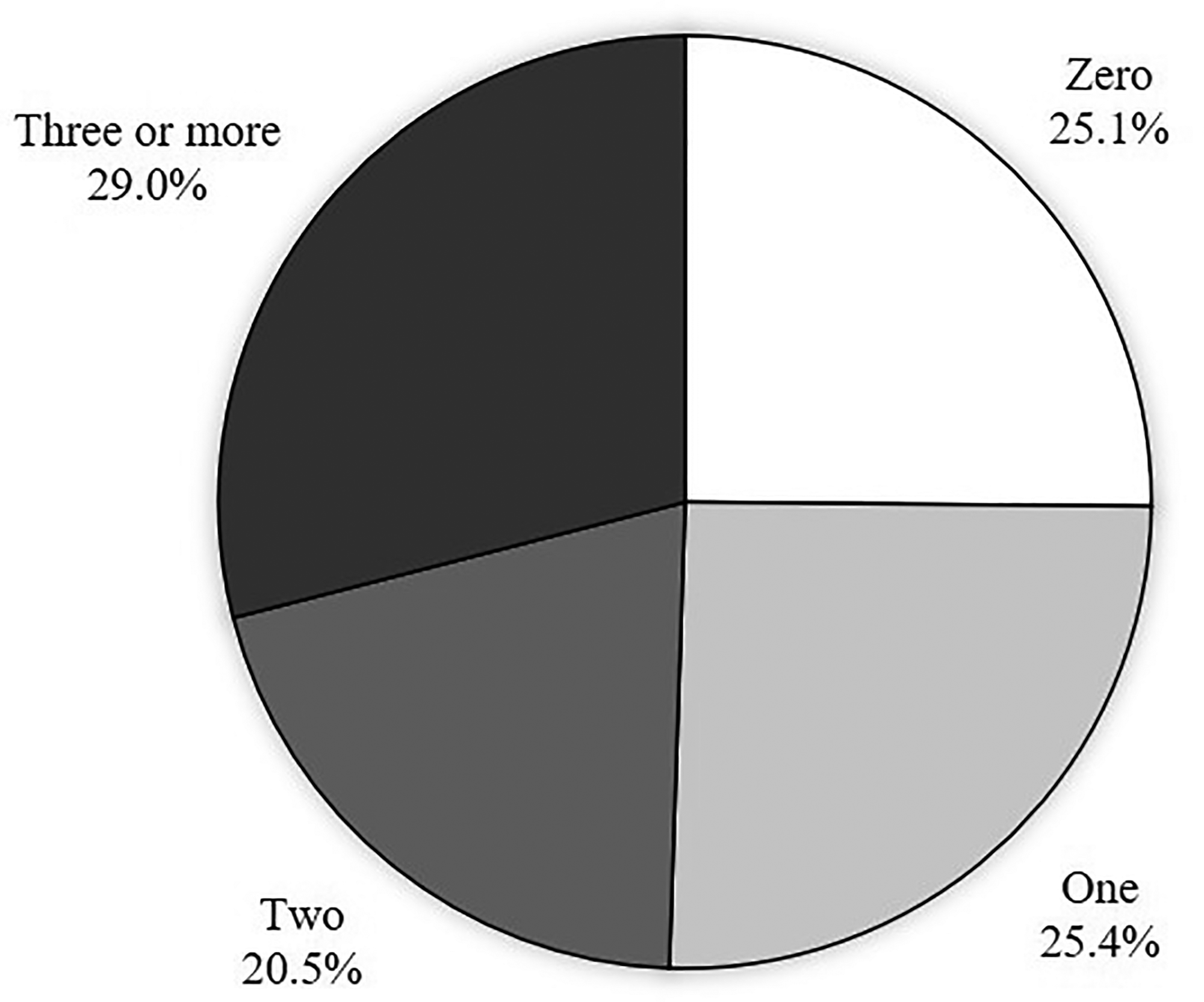
Total number of religious beliefs claimed by respondents, China Family Panel Studies (CFPS) 2018.
Distribution of single-choice and multiple-choice responses for each religious category, China Family Panel Studies (CFPS) 2014, 2018.
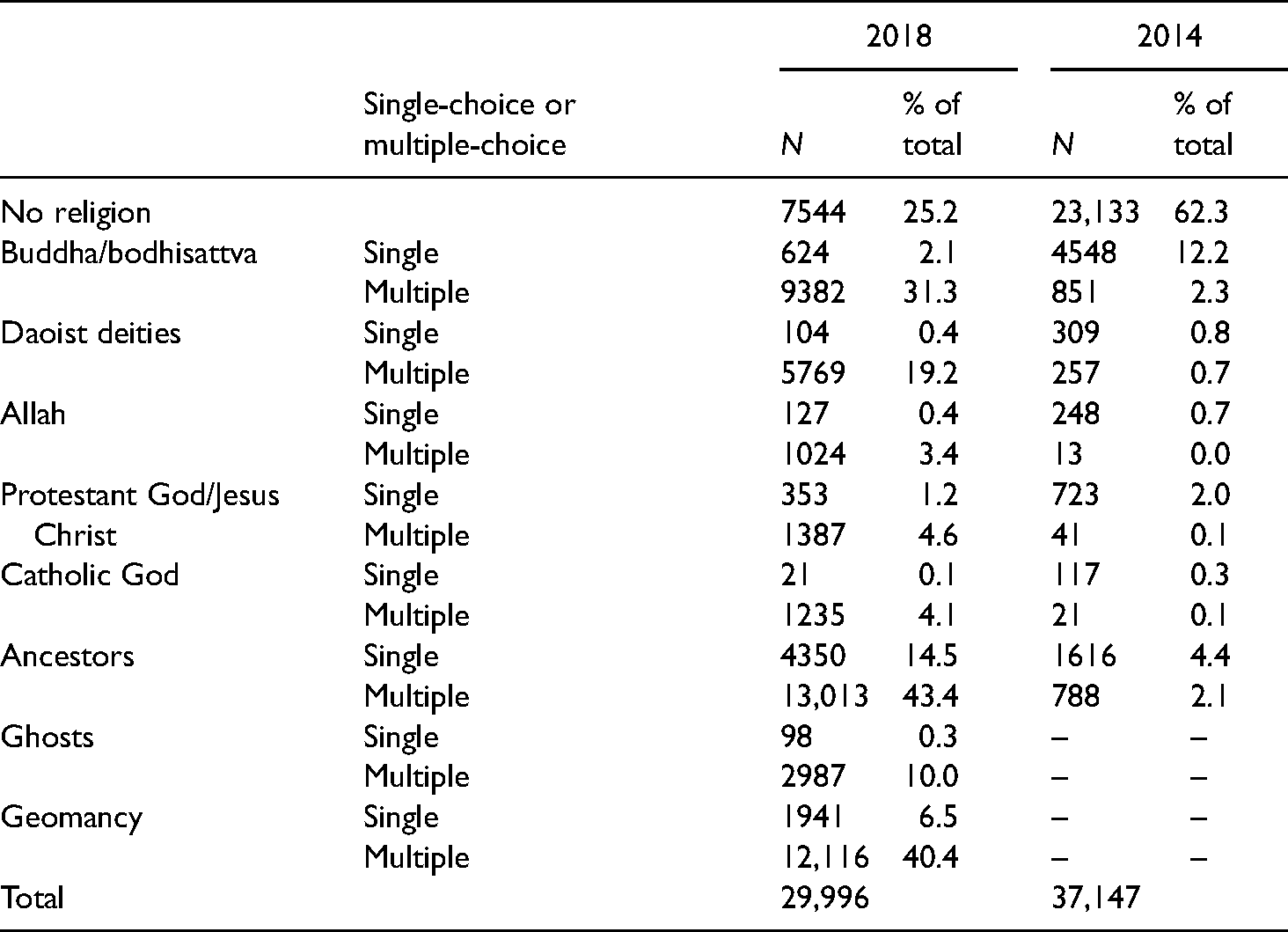
Table 1 also compares the distribution of responses to the “What do you believe in?” question in 2014 and 2018 in terms of whether the response was the respondent's only choice or was part of a multiple-choice response. It shows that the proportion of both single-choice and multiple-choice responses for each religious category in CFPS 2018 rose significantly compared with CFPS 2014. Accordingly, we observe a sudden decrease in the proportion of non-believers, from 62.3% in 2014 to 25.2% in 2018. Although we cannot exclude the possibility of within-individual change across waves, such a dramatic decline in the number of non-believers over such a short period of time is very unlikely to be the result of religious conversions or an overall growth in religiosity in China. Keep in mind that while both the 2018 and 2014 surveys adopted the deity-based scheme, the 2018 survey added several folk religion response categories and adopted a forced-choice format question. The changed format allowed for the recording of a large number of “geomancy” and “ghost” believers in 2018, accounting for 46.9% and 10.3% of the population, respectively; individuals had no such religious categories to claim in 2014.
Perhaps because the forced-choice question format reduced the prevalence of a sacrificing response strategy among respondents, the survey captures a prominent feature that Chinese religion is highly syncretic. Table 1 shows that most respondents in 2018 believed in more than one deity, with a low percentage of respondents adopting a single belief (i.e. making a single belief choice) and a high percentage adopting mixed beliefs (i.e. making multiple belief choices). The prevalence of multiple beliefs can also be found in Figure 2, showing that nearly 50% of respondents claim to have two or even more than three beliefs, compared to 25.4% who had only one belief. This result is quite different from the 2014 survey, where there were very few multi-belief respondents; and the majority of believers chose one religion only.
Additionally, we can observe in Table 1 that the overlapping of beliefs happens not only among adherents of folk religion, but also among adherents of institutional religions. The average number of institutional religious beliefs reported in CFPS 2018 was 1.68, compared to only 1.04 in 2014. We also verify the results from other surveys that adopted check-all format questions. For example, an average number of religious beliefs reported in CGSS 2013 and 2015 and CFPS 2016 was 1.02, 1.01, and 1.01, respectively, which is close to the number of CFPS 2014, but much lower than the number in CFPS 2018.
The overlapping or diffused nature of Chinese religions is more common and prominent than was previously found in other surveys, and a forced-choice question format is more effective at capturing the mixing of beliefs that is taking place in Chinese individuals. In summary, we find that 70% of the Chinese population are folk religion adherents, 5% are adherents of institutional religions, and only 25% are non-believers.
Typologies of diffused religious believers
Given the prevalence of diffused beliefs, we now apply latent class analysis to explore how different beliefs or religious elements combine with each other. We specify models with between two and seven potential latent classes and select the appropriate number of latent classes based on Akaike's information criterion (AIC) and Bayesian information criterion (BIC), parsimony, and interpretability. Among all the models we specified, only the two-class model and four-class model can be converged. We further compared the AIC and BIC values of the two-class and four-class models and find that the BIC and AIC values of the four-class model were 172,750.627 and 172,459.818, both of which were lower than the BIC (179,550.817) and AIC values (179,409.567) of the two-class model, suggesting a better fit of the four-class model with the data. Therefore, we identified four latent classes, each representing a type of combination of the eight beliefs.
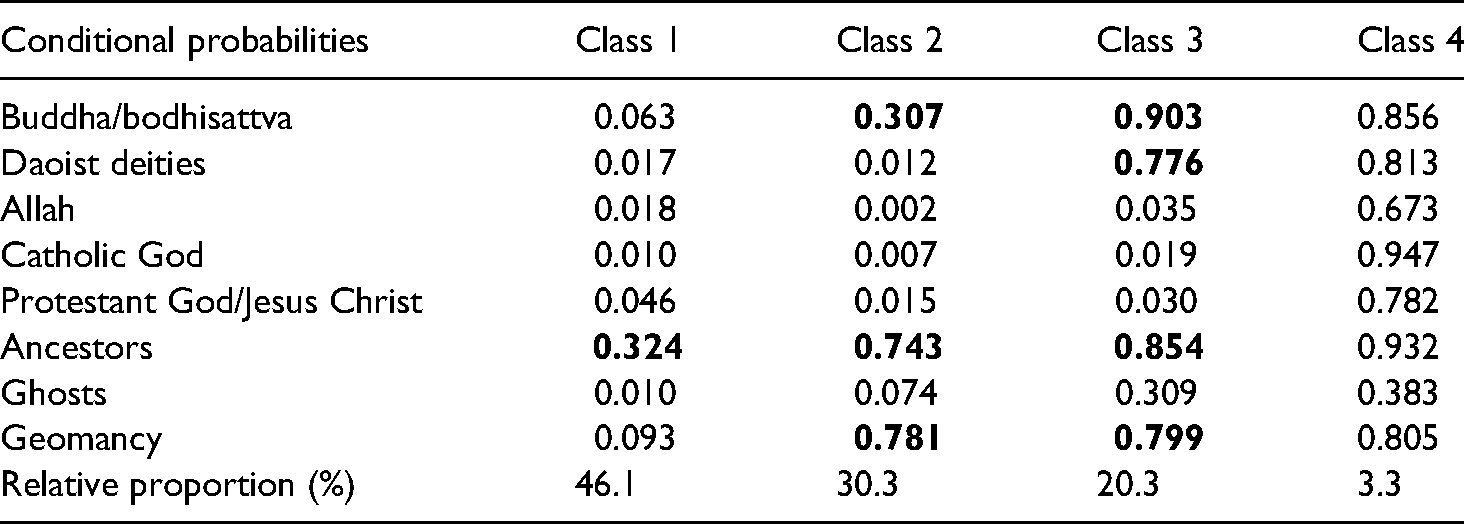
Table 2 presents the item-response probability for the four-class model. We named each latent class based on the patterns of these probabilities. We also estimate posterior probability of every individual being in each of the four classes and assign individuals to the class where the posterior probability is the highest. To better interpret the composition of each class, we also summarized the distribution of believing in a single deity and multiple deities by the four latent classes in Table 3.
Conditional probabilities of different latent religious classes and estimated relative sizes of latent classes under the four-class model.
Distribution of latent classes by responses for each religious category.
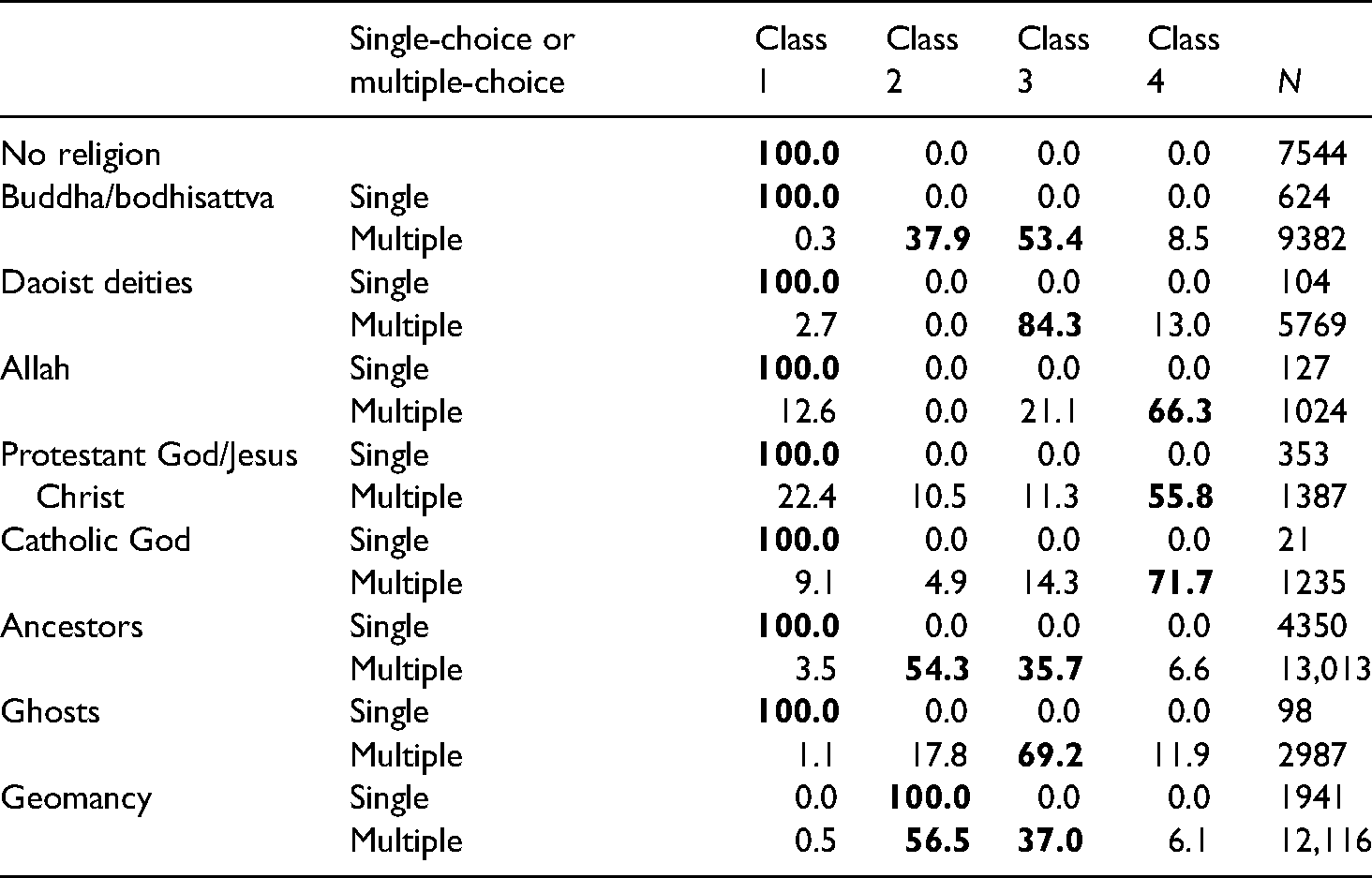
As Table 2 shows, the members of Class 1 are characterized by a very low probability of believing in all deities, indicating that people in this group are the least likely to adhere to multiple beliefs. Table 3 further shows that Class 1 consists of two subgroups. One is those who have no beliefs. The other is single-belief individuals, who only choose a single belief identity, except for geomancy. Therefore, we label Class 1 “non-believers and single-belief believers”.
Class 2 members are characterized by a higher probability believing in geomancy, ancestors, and Buddha/bodhisattva than other beliefs. As shown in Table 3, Class 2 are more likely to consist of those who only believe in geomancy and those who combine beliefs between geomancy and other faiths and between ancestor worship and other faiths. More than half of diffused geomancy believers and more than half of diffused ancestor worshipers are in Class 2. In addition, about one-third of diffused Buddhism adherents are in this group. We hypothesize that belief in geomancy plays a fundamental role in Class 2. If we take a close look at the composition of detailed deity beliefs within this class, we find that the proportion of single or diffused geomancy beliefs in Class 2 is as high as 89.9%, among which the combination of “geomancy + ancestors” (37.3%) accounts for the highest proportion, followed by “geomancy + ancestors + Buddha/bodhisattva” (20.3%), and belief in geomancy only (19.9%). Therefore, we label Class 2 “believers of geomancy”.
Class 3 is represented by the highest probability of belief in Buddha/bodhisattva, Daoist deities, ancestors, geomancy, and ghosts, as shown in Table 2. We note that both Class 2 and Class 3 are a mixture of traditional Chinese religion adherents. However, unlike Class 2, whose members’ diffused religious identity is more concentrated in geomancy and ancestors, members of Class 3 tend to combine folk religion and institutional Chinese religions (Daoism and Buddhism). Class 3 verifies the relationship between Chinese folk religion, Daoism, and Buddhism, as documented by Leamaster and Hu (2014). Further analysis in Table 3 illustrates that more than half of diffused Buddhists, more than 80% of diffused Daoists, one-third of ancestor worshipers, more than one-third of geomancy believers, and more than two-thirds of diffused ghost believers fall into Class 3. The most common combination in Class 3 is “Daoism + Buddhism + ancestor worship + geomancy”, accounting for 31.7%. Considering that 72.5% of the class includes belief in both Buddhism and Daoism, we call Class 3 “believers of diffused Buddhism and Daoism”.
Class 4 has the highest degree of mixture, with a high probability of adhering to all the beliefs, showing a mixture of beliefs across Eastern and Western religions. It is very striking that congregational religions (Catholicism, Christianity, Islam) are mixed with other faiths in this category. People in this class are characterized as believing in everything, both Western beliefs and traditional Chinese beliefs. Hence, we name Class 4 “believers embracing all beliefs”.
The four religious classes are disproportionately distributed in the population. The bottom row of Table 2 displays the relative proportion of each latent class in the sample. Class 1 accounts for 46.1%, but keep in mind that half of this class consists of non-believers. Class 2 and Class 3 account for 30.3% and 20.3%, respectively, while Class 4 accounts for only 3.3%.
The diversified commitment of folk religion believers
We identify four classes of religious believers according to patterns of belief mixing: “non-believers and single-belief believers” (Class 1), “believers of geomancy” (Class 2), “believers of diffused Buddhism and Daoism” (Class 3), and “believers embracing all beliefs” (Class 4). Classes 2 to 4, which are aggregations of folk religion adherents, show the diversity of Chinese folk religion. The diversities of folk religion adherents can also be indicated by the different degrees of religious commitment. Previous studies argue that folk religion adherents are not part of religious congregations, and thus they lack religious commitment, especially compared with adherents of institutional religions. Folk religion adherents mainly maintain a reciprocal relationship with the spirits in which they believe; when they meet personal crisis, they will go to one or more temples or religious specialists until they receive help from a spirit.
The CFPS 2018 data permit us to quantitatively explore the diversified commitment of folk religion adherents. Do single-belief believers have a higher level of commitment than multi-belief believers, or the opposite? If the classification of diffused religious believers based on latent class analysis is valid and substantial, the four latent classes should be distinguishable not only in terms of religious affiliation, but also in other aspects of religiosity. Here, we will turn to comparing believers belonging to different classes according to three dimensions: religious membership, the salience of religion to personal life, and frequency of religious practice.
Given that Class 1 is a very diverse group, consisting of non-believers and single-belief believers from various kinds of independent religions, we further collapse Class 1 into four subcategories: non-believers, ancestor worshipers (including believers in ghosts), pure believers of Eastern institutional religions (including Buddhists and Daoists), and pure believers of Western institutional religions (including Muslims, Catholics, and Christians). By doing so, we can capture the heterogeneity within Class 1. With non-believers being regarded as the reference group, we can compare the religiosity measures of six groups, namely ancestor worshipers (Class 1-AW), believers of Eastern institutional religions (Class 1-EI), believers of Western institutional religions (Class 1-WI), believers of geomancy (Class 2), believers of diffused Buddhism and Daoism (Class 3), and believers embracing all beliefs (Class 4).
Figure 3 displays binary logistic regression estimates with 95% confidence intervals of religious classes for predicting whether a respondent is a member of a religious organization. An estimate larger than 0 indicates that the specific type of believer is more likely to join a religious organization than non-believers. Conversely, a negative estimate indicates a lower likelihood of joining a religious organization. Moreover, if the estimate is equal to 0 or its 95% confidence interval crosses 0, it means that there is no significant difference between the specific type of believers and non-believers in terms of obtaining membership of a religious organization. As can be seen from Figure 3, religious believers are significantly more likely to join a religious organization than non-believers, except for ancestor worshipers (Class 1-AW); but the log odds of joining religious organizations vary across religious classes. Since Islam, Catholicism, and Christianity all put emphasis on religious membership, it is not surprising that pure believers of Western institutional religion (Class 1-WI) have the highest likelihood of being a member of a religious organization. Among the folk religion believers, the believers embracing all beliefs (Class 4) have greater likelihood of being a member of religious organization, followed by the believers of diffused Buddhism and Daoism (Class 3) and the believers of geomancy (Class 2). The latter two are as likely as believers of Eastern institutional religions (Class-EI) to join a religious organization.
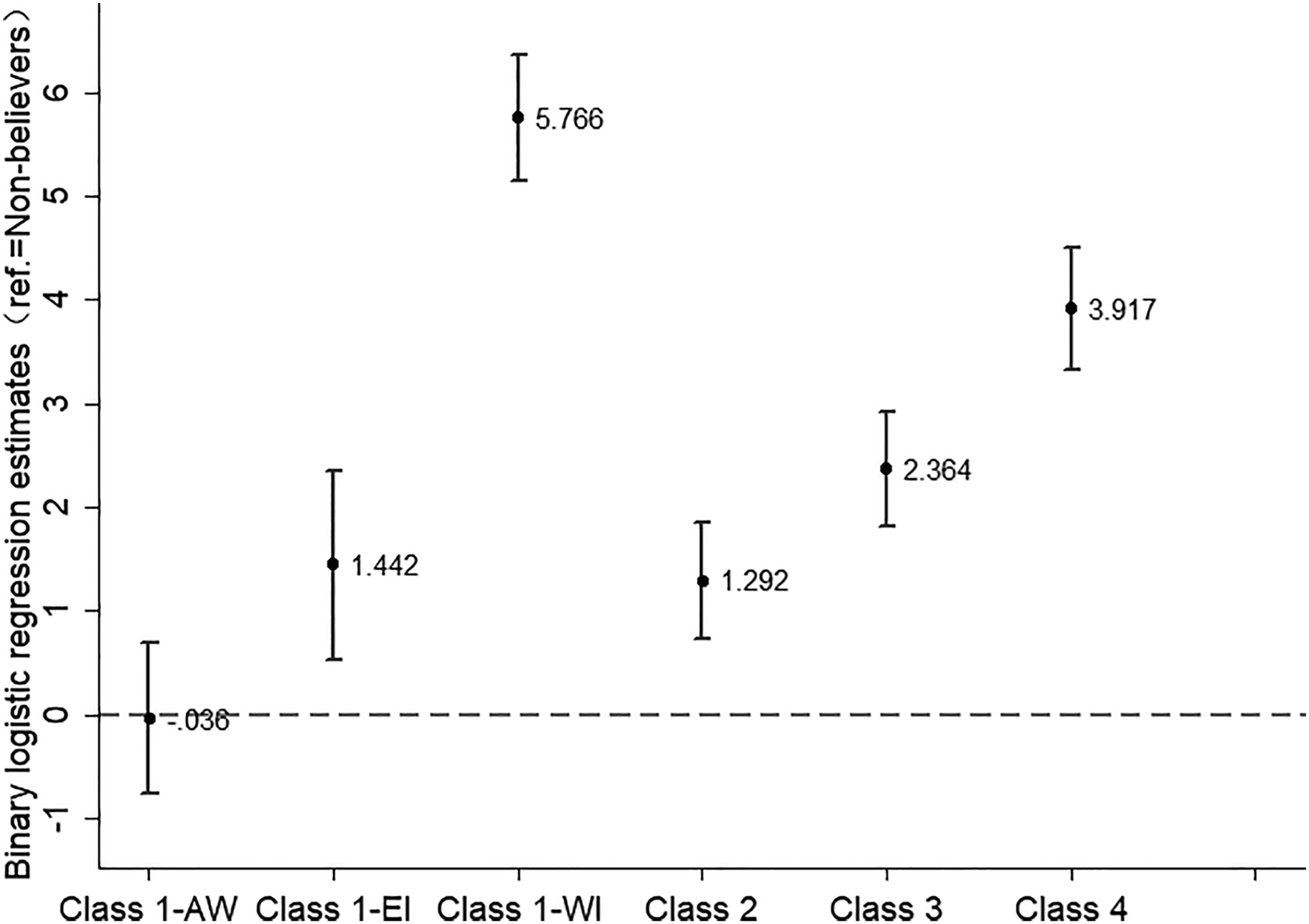
Differences in religious membership between specific religious classes and non-believers.
Figure 4 displays the ordered log odds of a higher level of evaluation towards the salience of religion in life from an ordinal logistic regression model. It is obvious that all religious classes expect for ancestor worshipers (Class 1-AW) afford religion more importance than non-believers. Among them, the ordered log odds are found to be the highest among pure believers of Western institutional religions (Class 1-WI), then believers embracing all beliefs (Class 4) and believers of diffused Buddhism and Daoism (Class 3); Class 3 and Class 4 have no significant difference in terms of appraisal of the salience of religion in life. After them, pure believers of Eastern institutional religions (Class 1-EI) and believers of geomancy (Class 2) rank third and last.
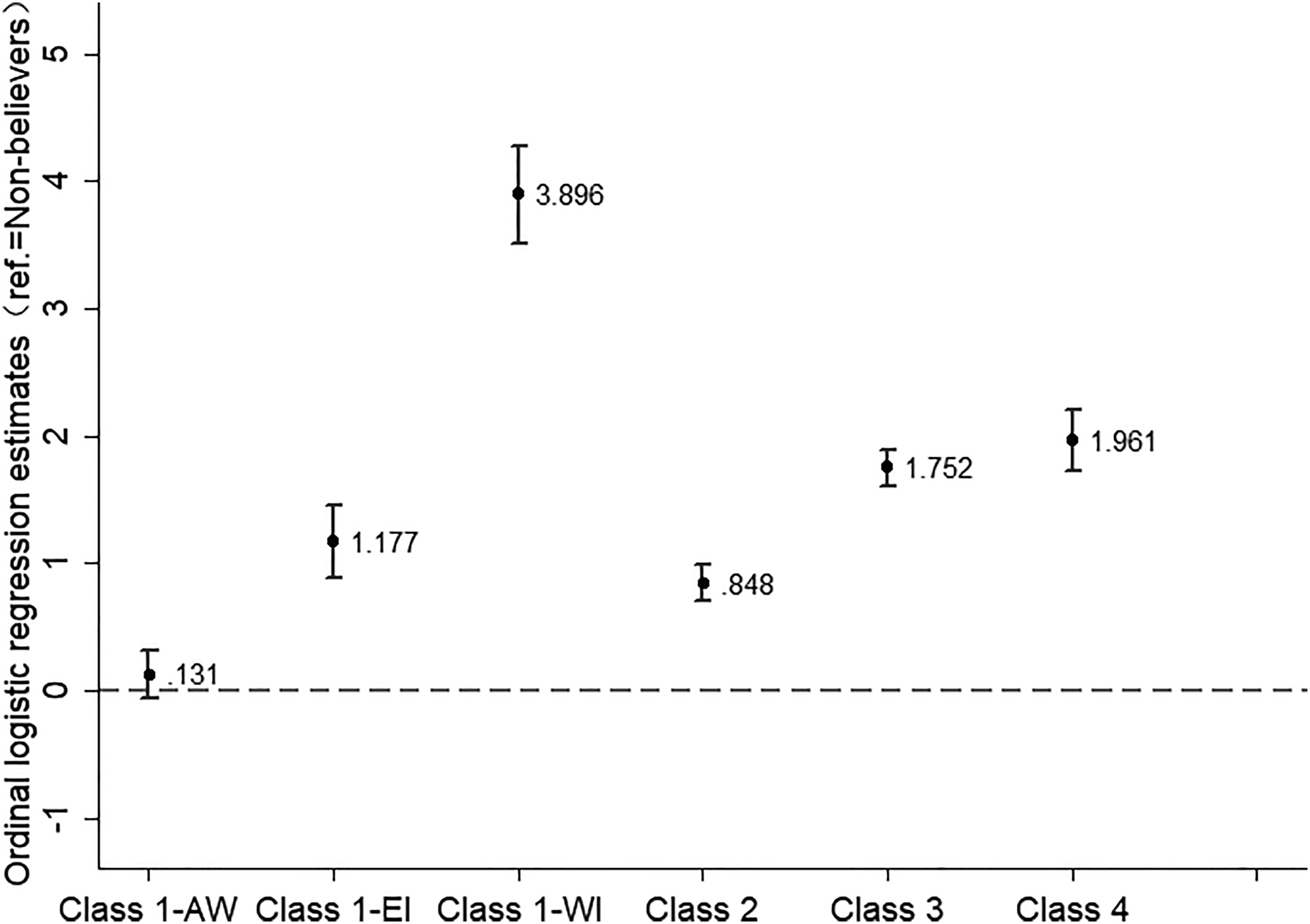
Differences in attitudes toward salience of religion in personal life between specific religious classes and non-believers.
We now turn to examining the frequency of religious practice across religious classes. As we mentioned above, CFPS respondents who believe in Buddhism, Daoism, and ancestor worship are asked about the frequency of burning incense and worshiping Buddha; those who believe in Islam, Catholicism, and Christianity are asked about the frequency of going to church/mosque; and those who claim to be non-believers are asked about the frequency of both types of practices. Thus, in Figure 5, we compare the frequency of burning incense and worshiping Buddha between ancestor worshipers, believers of Eastern institutional religions, three types of folk religion adherents (Classes 2, 3, and 4) and non-believers. It is clear that these five groups burn incense and worship Buddha more frequently than non-believers. The ordered log odds of a higher level of frequency in burning incense and worshiping Buddha are 6.61 times higher among believers of diffused Buddhism and Daoism (Class 3) than among non-believers, and 4.97 times higher among believers embracing all beliefs (Class 4) than non-believers. However, the magnitude difference in frequency of this religious practice between Class 3 and Class 4 is insignificant. It is interesting that pure believers of Eastern institutional religions (Class 1-EI) are even less active than believers of diffused Buddhism and Daoism (Class 3) in terms of burning incense and worshiping Buddha. The ordered log odds of burning incense and worshiping Buddha for the former is only 3.8 times higher than for non-believers.
Differences in frequency of burning incense and worshipping Buddha between specific religious classes and non-believers.
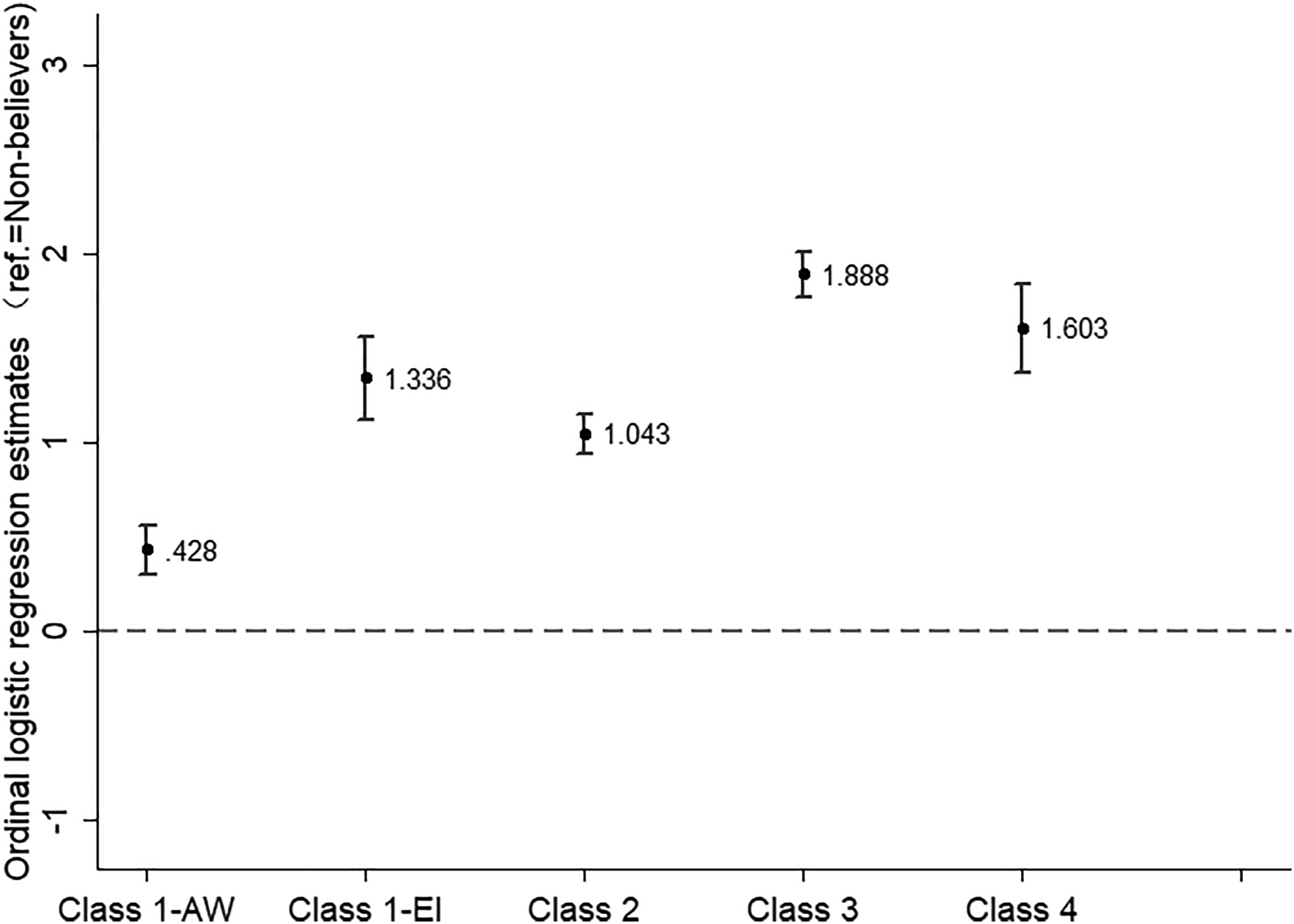
In Figure 6, we compare the differences in the frequency of church/mosque attendance between pure believers of Western institutional religions (Class 1-WI), three types of folk religion believers, and non-believers. The ordered log odd of church attendance is highest among pure believers of Western institutional religion (Class 1-WI), followed by believers embracing all beliefs (Class 4), and then believers of diffused Buddhism and Daoism (Class 3). The believers of geomancy (Class 2) have the lowest frequency of church attendance, which is only marginally higher than non-believers.
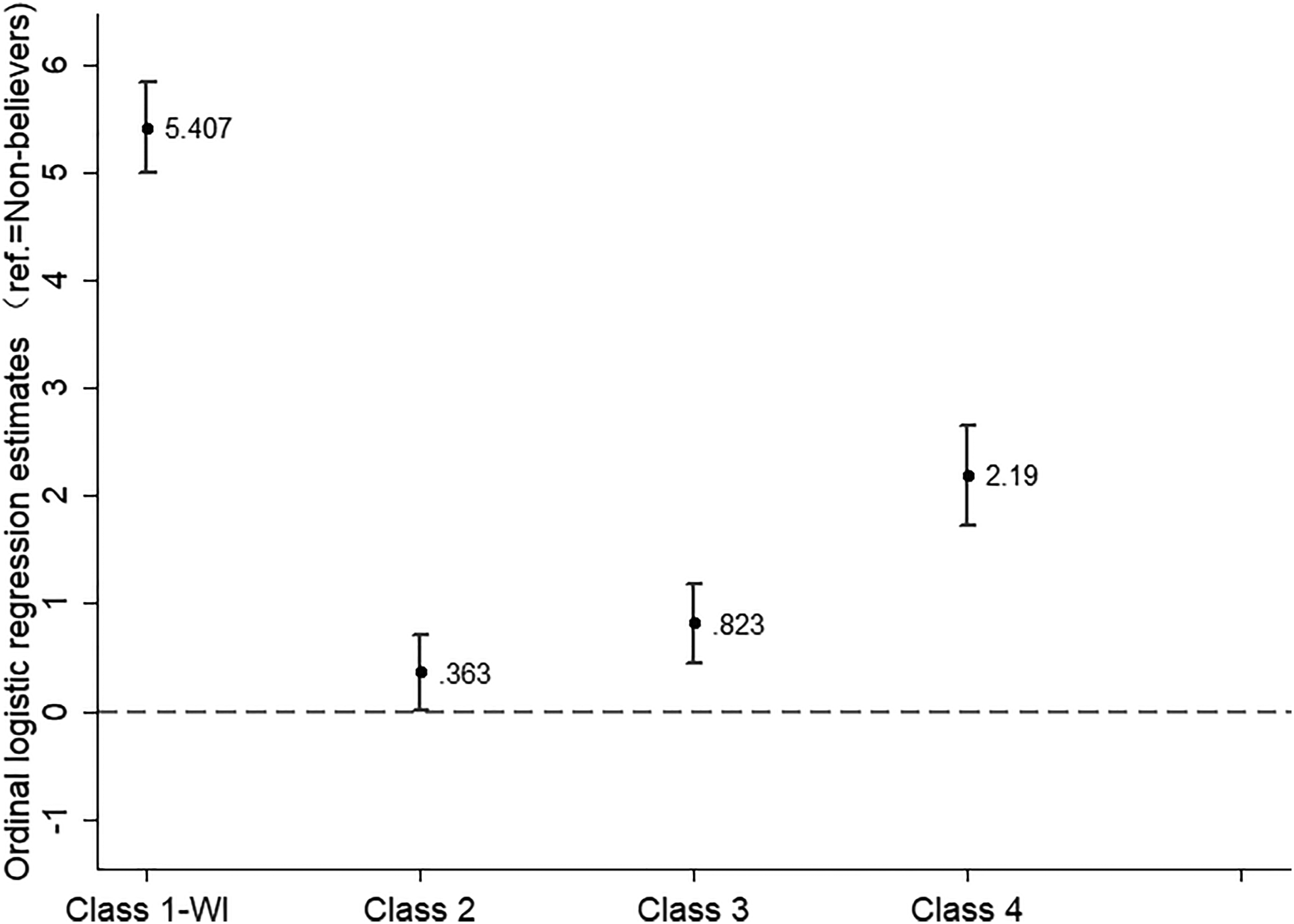
Differences in the frequency of church/mosque attendance between specific religious classes and non-believers.
In summary, the degree of commitment varies across the previously identified religious classes. Firstly, folk religion believers with multiple beliefs are more religious than non-believers. We find no support for the old saying that “believing in everything leads to believing nothing”. More specifically, believers of geomancy (Class 2), believers of diffused Buddhism and Daoism (Class 3), and believers embracing all beliefs (Class 4) are all more likely to join religious organizations, attach more importance to religious belief, and attend religious activities more frequently than non-believers. Secondly, among the folk religion believers, ancestor worshipers have the lowest commitment, followed by believers of geomancy (Class 2), while the believers embracing all beliefs (Class 4) are the most religious, and believers of diffused Buddhism and Daoism (Class 3) are in the middle. We note that Class 4 bears a mixture of four to eight beliefs, including folk religion, monotheism, and polytheism, whereas Class 3 usually bears three to five beliefs and Class 2 usually mixes three beliefs, with the mixture only within polytheism. We conclude that the higher the degree of mixed beliefs, the stronger the religiosity; and inclusion of monotheism leads to stronger religiosity. Last but not least, independent religion believers are not always more committed than folk religion ones. Folk religion believers are less committed than pure believers of Western institutional religions, but they could be more committed than believers of Eastern institutional religions. For example, believers of diffused Buddhism and Daoism are more active in attending religious activities and self-reported a higher level of salience of religion in their life than the pure believers of Eastern institutional religions.
Discussion and conclusion
Anthropologists have extensively studied Chinese folk religion in recent decades. However, quantitative research has rarely been carried out in this field. This article, based on analysis of data from CFPS 2018, probes three characteristics of Chinese folk religion: popularity, diffuseness, and diversity. While anthropologists argue that nearly all Chinese people are practitioners of folk religion, previous social surveys show that only a small percentage of Chinese people adhere to folk religious beliefs. We find that the discrepancy between quantitative and qualitative research is mainly caused by the measurement scheme of Chinese religiosity. By means of a new measurement of religiosity, we verify the prevailing viewpoint of anthropologists, that folk religion is really the mainstream of the Chinese religious market. Around 70% of the Chinese population are folk religion believers, only 5% are members of institutional religions, and 25% are non-believers.
The diffuseness of folk religion is also remarkable. Nearly 50% claim to believe in two or more religions. By using latent class analysis, we find that these folk religion believers can be classified into three categories: believers of geomancy, believers of diffused Buddhism and Daoism, and believers embracing all beliefs. The diversity of these categories can also be verified in term of commitment. We find that the higher the degree of mixed beliefs, the stronger the religiosity; and if respondents got involved in western institutional religion, no matter how many religions they believe in, their commitment will be high.
Footnotes
Acknowledgment
The authors thank Tom Marling for his editorial assistance.
Declaration of conflicting interests
The authors declared no potential conflicts of interest with respect to the research, authorship, and/or publication of this article.
Funding
The authors received no financial support for the research, authorship, and/or publication of this article.
