



Abstract
Prior empirical research on the relationship between socioeconomic status (SES) and meritocratic attitudes has yielded inconsistent findings. This study contributes to the existing literature by examining the heterogeneous relationship between SES and meritocratic beliefs and perceptions across community socioeconomic contexts in China. Using nationally representative data from the China Family Panel Studies, the results show that individual SES is positively related to support for meritocratic beliefs, but negatively associated with perceptions of meritocracy. Moreover, SES disparities in meritocratic beliefs are more salient in socioeconomically disadvantaged and unequal communities, where residents with relatively higher SES are more likely to hold meritocratic beliefs. In contrast, SES gaps in meritocratic perceptions are more significant in socioeconomically advantaged and homogeneous communities, where individuals with relatively lower SES are more likely to perceive the allocation of resources as meritocratic. These findings provide theoretical insights for understanding how self-interest and system justification theories may jointly explain social origin disparities in public attitudes about meritocracy.
Keywords
Introduction
Meritocratic ideals are deeply ingrained in the public consciousness of modern societies. The concept of meritocracy presumes that in an industrialized and modern society, individual talent, effort, and educational credentials play a more critical role in determining individuals’ placement in social systems than do their social origins, such as gender, race, and class (Bell, 1972; Weakliem et al., 1995; Young, 1958). Despite its original pessimistic meanings, coined by Michael Young in his book The Rise of Meritocracy (1958), the public, scholars, and politicians generally consider the ideology of meritocracy to be desirable, as it provides an at least seemingly plausible blueprint to improve the equality of opportunities through the reconciliation of social efficiency and social justice (Goldthorpe, 2003; Goldthorpe and Jackson, 2008). Relatedly, meritocracy serves as a cultural repertoire of justifications that legitimize and make sense of an individual’s social position (Bourdieu and Passeron, 1990; Collins, 1971; Lamont et al., 2014).
Against this background, a longstanding question that has been on the research agenda of social scientists is the association between socioeconomic status (SES) and meritocratic attitudes (Reynolds and Xian, 2014). To answer this question, scholars mainly adopt two major countervailing theoretical perspectives: self-interest theory and system justification theory. Self-interest theory posits that socioeconomically advantaged groups tend to have a rational interest in maintaining their social positions and are more likely to believe that the society is meritocratic and fair when compared with others (Alves and Rossi, 1978; Hechter and Kanazawa, 1997; Kluegel and Smith, 1986). System justification theory focuses on social psychological needs, in which individuals tend to believe that social inequalities are the inevitable consequence of a meritocratic process and internalize the “belief in a just world” (Jost et al., 2004; Lerner, 1980; McCoy and Major, 2007).
While self-interest and system justificatory understandings of meritocracy are not necessarily contradictory to each other, the choice to employ one or the other to examine the influences of SES on variations in meritocratic attitudes often leads to inconsistent and sometimes debatable empirical findings (Duru-Bellat and Tenret, 2012; Mijs, 2019). Thus far, there is still limited work on how to coherently integrate the possibility that self-interest and system justification contribute to SES gaps in meritocratic attitudes. This study takes two steps forward in this regard. First, we focus on two dimensions of subjective meritocracy: meritocratic beliefs and meritocratic perceptions. The former, “desired meritocracy”, concerns whether people consider meritocracy as a desirable belief—do individuals believe that effort and talent are the determinants for individual success compared with other social factors? The latter, “perceived meritocracy”, regards individuals’ perceptions of meritocracy in action—whether merit is rewarded adequately in society and whether or not social inequalities are justified and legitimized as the result of a meritocratic system (Duru-Bellat and Tenret, 2012). Second, a growing literature has found that the influence of individual SES on meritocratic beliefs and perceptions is conditioned upon localized social contexts (Li, 2018; Merolla et al., 2011; Newman et al., 2015). Building upon this scholarship, we bring local community socioeconomic settings to the forefront, thereby enhancing our understanding of how SES is related to meritocratic attitudes under different community contexts in contemporary Chinese society.
Following these two lines of reasoning, this study examines two important research questions: (1) How does individual SES, on average, relate to meritocratic beliefs and perceptions of meritocracy? (2) How do the relationships between individual SES and meritocratic beliefs and perceptions vary by community socioeconomic contexts? Using nationally representative data from the China Family Panel Studies (CFPS), this study examines the above two questions. In doing so, it provides important insights for understanding how individuals’ socioeconomic positions and experiences may have distinct influences on their beliefs and perceptions towards meritocracy. It furthers understanding of how self-interest theory and system justification theory are jointly relevant to explaining variation in meritocratic beliefs and perceptions. In addition, the findings help to interrogate under what social contexts SES gaps in meritocratic ideals are reinforced or attenuated. As such, we respond to and extend prior studies examining contextual variations in the influence of SES on meritocratic attitudes (Kunovich and Slomczynski, 2007; Li, 2018; Merolla et al., 2011; Newman et al., 2015).
Theoretical framework
Sociopolitical background
Variation in meritocratic attitudes is a growing concern among scholars, citizens, and policymakers (Hitlin and Piliavin, 2004; Kluegel and Smith, 1986; Mijs, 2019; Small et al., 2010), one which is related to sociopolitical transitions over the past decades. Specifically, as neoliberal policies have profoundly shaped the world economy since the 1980s, we have witnessed a dramatic increase in income and wealth inequality across the globe (Atkinson et al., 2011; Piketty, 2015). In many Western societies, rising inequality is accompanied by widespread and growing support for meritocracy, such that individual success is mainly determined by effort and ability (Kunovich and Slomczynski, 2007; Mijs, 2019; Roex et al., 2019). One example of a meritocratic narrative is the so-called American Dream; it is, however, a narrative that elites foster to justify their privileges, and serves as a coping mechanism for the extremely high levels of inequality in the US (Hochschild, 1996; Kelly and Enns, 2010). Previous research finds that individuals with high educational attainment and personal income tend to have strong meritocratic ideals in Western societies (Duru-Bellat and Tenret, 2012; Kunovich and Slomczynski, 2007; Reynolds and Xian, 2014). However, some studies document that individuals from low-SES groups are more likely to perceive meritocracy and benefit from such system-justifying beliefs, since these ideals emphasize the perceptions of individual control over life outcomes (McCoy et al., 2013). How to make sense of these inconsistent empirical findings? Chinese experiences provide a vital angle to explore this puzzle.
Historically, traditional Chinese sociopolitical ideology has embraced merit-based inequality (Xie, 2016). For instance, as embodied in the ancient imperial examination system, China’s culture of credentialism accentuates the crucial role of intellectual competence in the elite formation of a merit-based social hierarchy (Brown, 2001; Collins, 2009; Ho, 1962; Weber, 1951[1916]; Xie, 2016). However, as China moved into a socialist state in the late 1940s, meritocratic ideas were severely challenged and undermined by the official egalitarianist ideology, whereby political loyalty functioned to regulate the chance of upward mobility (Walder, 1996). This situation persisted until China initiated market reform in the late 1970s, following which thriving economic development has witnessed the renascence of meritocracy in the post-socialist period (Bian, 2002; Song, 2009).
A growing number of empirical studies have demonstrated that as individuals and groups increasingly succeed in a growing market-oriented economy, individual ability and educational attainment have played a more critical role in determining access to life chances and economic rewards than social origins and political attributes (Bian, 2002; Cao, 2004; Liu and Hu, 2016; Li, 2018; Nee, 1989; Zhou, 2000). As a result, meritocracy has become part of the mainstream ideology in China’s reform era. However, empirical investigation into China’s meritocratic attitudes remains scarce. Therefore, it is crucial to examine whether a straightforward self-interest process drives meritocratic beliefs and perceptions, or whether they simply reflect the worldview of privileged and dominant groups imposed on the public under the Chinese context.
SES and meritocratic beliefs and perceptions
To better understand the roots of subjective understandings of meritocracy, we draw upon prior literature focusing on the cognitive explanation of culture (Bourdieu and Passeron, 1990; Swidler, 1986; Vaisey, 2009). As implied by Bourdieusian practice theory, as acquired cultural dispositions, the ideals of meritocracy guide individuals’ judgments quickly, automatically, and unconsciously, since people are internally motivated by the meritocratic values that they learned from society (Bourdieu, 1984; Vaisey, 2009). Meritocratic motivations are transmitted via socialization from families and schools to children (Hitlin and Piliavin, 2004). Since society treats meritocracy as a dominant ideology, individuals with high educational attainment and income tend to value meritocracy more strongly as a desired belief because those who succeed in the competition are instilled with the dominant and legitimate ideologies (Bourdieu, 1984). In this way, meritocratic beliefs, as desired moral principles, play a motivational role in safeguarding self-interest and legitimizing advantaged social status (Mijs et al., 2016). In China, both traditional Confucianism and the rise of meritocracy in the economic reform era emphasize the importance of diligence for individual achievement; this serves as a dominant ideology that is indoctrinated across social institutions, including families, schools, and workplaces (Liu, 2016). Research also shows that Chinese people’s belief in meritocracy as a justification for individual success is directly linked to social status: higher SES is associated with more substantial support for meritocratic beliefs (Li, 2018; Liu and Hu, 2016; Xian and Reynolds, 2017).
Another cognitive dimension of subjective meritocracy is that perceptions of meritocracy gravitate toward the use of cultural symbols and narratives to navigate individual observations and construct understandings of social inequalities (Swidler, 1986; Vaisey, 2009). Individuals tend to rely on their perceptions of whether or not diligence and talent are rewarded in society to justify their experiences and choices. However, since societies vary in the degree to which meritocratic allocation is indeed achieved (Krauze and Slomczynski, 1985; Kołczyńska, 2019), people’s perceptions of meritocracy may not reflect the real degree of meritocratic distribution of income and wealth in society (Kunovich and Slomczynski, 2007). Instead of passively accepting the meritocratic doctrine, more-educated individuals may be especially conscious of social inequality and whether or not effort and talent are properly rewarded and, therefore, more skeptical of meritocracy (Duru-Bellat and Tenret, 2012). On the contrary, members of low-SES groups are perhaps not well informed about existing inequality and are embedded in the social system; as such, they are subject to “system justification”, whereby they perceive social inequalities as legitimate outcomes of a meritocratic process (Jost and Hunyady, 2005; Karadja et al., 2017; McCoy and Major, 2007; Trump, 2018). Previous studies conducted in China have reported that socioeconomically disadvantaged rural residents tend to view rising income inequality as a legitimate outcome of economic reform (Xie et al., 2012). They are more likely to hold the perception that individual effort can improve their living standards (Xie et al., 2012). Compared with them, urban residents with higher educational attainment and income are less likely to perceive society as meritocratic and thus emphasize the importance of non-meritocratic factors, such as social origins and social connections (Li and Wu, 2012; Whyte, 2009; Wu and Li, 2017).
In this study, we explicitly examine how SES is related to individuals’ beliefs and perceptions towards meritocracy in contemporary Chinese society. Under the Chinese educational system, desired meritocracy is an outcome of socialization that is motivated and reinforced by the self-interest process, which reflects distinctions in cultural beliefs among groups of different social status. Perceived meritocracy is a product of system justification, especially given the unequal access to information and varied personal experiences under the contexts of China’s booming economic development and rising income inequality. Overall, self-interest theory clearly makes predictions about SES differences in desired meritocracy, while system justification theory, in contrast, helps to explain SES variations in perceived meritocracy. Consequently, we examine the following hypothesis:
Hypothesis 1: In Chinese society, compared with their low-SES counterparts, individuals who have a relatively high SES are more likely to support meritocratic beliefs, but are less likely to perceive that society is meritocratic, net of other background factors.
Community socioeconomic contexts and the SES gap in meritocratic beliefs and perceptions
The discussion above assumes that the relationships between SES and meritocratic beliefs and perceptions are generally homogeneous across social contexts. However, individuals’ subjective understanding of meritocracy relies on social comparison processes that are constrained or reinforced by social contexts (Mills, 1959). Previous research shows that SES differences in meritocratic beliefs and perceptions may vary by the broader social contexts of poverty exposure and income inequality (Duru-Bellat and Tenret, 2012; Kunovich and Slomczynski, 2007; Merolla et al., 2011; Mijs, 2019; Minkoff and Lyons, 2019). Nevertheless, much research remains to be done, particularly in sorting out the heterogeneous relationships between individual SES and meritocratic beliefs and perceptions by community socioeconomic contexts (Merolla et al., 2011).
In China, the local community provides an important social and ecological context that can influence cultural values and norms (Bian, 1997; Fei et al., 1992). For example, research shows that rural villages are spatial and social venues for shaping how peasants from different family backgrounds interact with one another and thus influence and reinforce one another’s cultural beliefs and perceptions (Fei et al., 1992). As economic reform proceeded unevenly in China, there was a substantial stratification in local community socioeconomic conditions and inequality (Wu, 2019). Hence, community socioeconomic standings and income inequality may alter the relationship between SES and meritocratic beliefs and perceptions.
Previous studies suggest that in a more disadvantaged social context, individuals display higher support for individualistic beliefs that explain success to be a result of meritocratic processes (Merolla et al., 2011; Mijs, 2018, 2019). In disadvantaged communities, individuals with relatively high SES may firmly support the meritocratic ethos because such beliefs can justify their interests, that is, upward mobility within the existing social and economic system (Kreidl, 2000). However, when low-SES individuals are exposed to concentrated community disadvantage, it may enhance their awareness of being at the bottom of the class spectrum and a sense of relative deprivation (Merolla et al., 2011). They may believe their disadvantaged social positions to be consequences of external factors or structural barriers, thus developing a sense of constraint, which jeopardizes their belief in meritocracy (Newman et al., 2015). Thus, SES disparities in desired meritocratic beliefs may be reinforced in socioeconomically disadvantaged communities compared with advantaged ones.
Studies also show that the levels of income inequality can moderate SES gaps in meritocratic beliefs. People from different backgrounds tend to have more polarized views about meritocracy in more economically heterogeneous areas (Li, 2018; Merolla et al., 2011; Newman et al., 2015). For example, focusing on the US, Newman et al. (2015) find that residing in areas with high levels of income inequality increases rejection of meritocratic beliefs among low-income residents and strengthens faith in meritocracy among high-income residents; conversely, there are no significant differences in the levels of support for meritocratic beliefs between high- and low-income individuals in relatively income-egalitarian areas.
1
Research has revealed similar patterns in the Chinese context: income inequality has significant and negative influences on belief in meritocracy, particularly for individuals with lower SES (Li, 2018). Altogether, the heterogeneous relationship between SES and desired meritocratic beliefs across community socioeconomic contexts suggests the following hypotheses:
Hypothesis 2a: The positive relationship between SES and meritocratic beliefs is stronger in more socioeconomically disadvantaged communities.
Hypothesis 2b: The positive relationship between SES and meritocratic beliefs is stronger in communities with higher levels of income inequality.
The process of system justification on meritocratic perceptions can be strengthened in communities with low levels of income inequality. Compared with their counterparts residing in economically heterogeneous communities, perceived meritocracy among low-SES individuals may be more influential in communities with relatively lower degrees of income inequality. Previous research shows that personal experiences of inequality and exposure to information regarding income inequality can affect the degree to which income gaps are thought of as a legitimate outcome of a meritocratic process (Edmiston, 2018; Trump, 2018). For low-SES individuals living in relatively equal environments, when comparing themselves with reference groups that are socioeconomically similar to them, including their coworkers, family, and friends in their neighborhoods, they are more likely to have a similar worldview and generally perceive a fair economic system (Newman et al., 2015). Thus, we would expect the following hypotheses:
Hypothesis 3a: The negative relationship between SES and meritocratic perceptions is stronger in socioeconomically advantaged communities.
Hypothesis 3b: The negative relationship between SES and meritocratic perceptions is stronger in communities with lower levels of income inequality.
Data, measures, and methods
Data
This study uses nationally representative data from the CFPS, carried out by the Institute of Social Science Survey of Peking University. The CFPS uses a stratified multistage sampling design, and the sample represented 95% of the total population in China when respondents were first interviewed in 2010. The CFPS is a longitudinal study that collected individual-, family-, and community-level data from a nationally representative sample of 33,600 adults and 8990 children living in 14,960 households within 649 communities. The CFPS includes rich measures of desired and perceived meritocracy, individual sociodemographic backgrounds, and community socioeconomic characteristics (Xie and Hu, 2014).
The analysis is based on a cross-sectional sample of working-age individuals (ages 16–64) who were in the labor force at the time of the 2010 baseline survey of the CFPS. Focusing on working-age individuals can minimize the potential measurement errors of individual SES. The total sample size for working-age and employed individuals is 15,545. 2 To preserve cases, missing values in independent variables are imputed using multiple imputations by the chained equations (m = 10) (Royston et al., 2009). Following Von Hippel’s (2007) suggestions, missing cases for the dependent variables are included in imputation equations but excluded from subsequent analyses. The final sample is 15,134 individuals, nested within 624 communities.
Measures
To measure the perceptions of meritocracy—that is, whether individuals perceive that merit is rewarded adequately in the society compared with other non-meritocratic factors—we focus on the following statements for capturing non-meritocratic and meritocratic perceptions (Duru-Bellat and Tenret, 2012). There are two meritocratic items: (1) In today’s society, hard work is rewarded; (2) In today’s society, intellect is rewarded. One non-meritocratic item is identified: In today’s society, having social connections is more important than having individual capability. Five possible responses to these statements were given by respondents, ranging from “totally disagree” to “totally agree”. All items are coded on a scale of 1–5, with 1 indicating “totally disagree,” and 5 referring to “totally agree”. Principle-component factor analysis is used to construct latent scales for meritocratic perceptions.
Following previous research (Li, 2018; Reynolds and Xian, 2014), variables for meritocratic beliefs and perceptions are calculated by subtracting respondents’ scores on the non-meritocratic scale from their scores on the meritocratic scale and then transformed into a standardized z-score measure. A score of 0 suggests that respondents evaluate the importance of non-meritocratic and meritocratic factors equally or favor neither factor. A score above 0 indicates that respondents think meritocratic factors are more important than non-meritocratic factors, while a score below 0 implies the opposite condition. Overall, these relative measures of meritocratic beliefs and perceptions provide useful information on how strongly individuals believe meritocracy is desirable in contemporary Chinese society and how meritocratic an individual thinks Chinese society is.
Analytical strategy
Since the CFPS sample consists of individuals nested within communities, the main analysis uses two-level mixed-effects models to examine the effects of SES on the composite measure of desired and perceived meritocracy (Raudenbush and Bryk, 2002; Singer and Willett, 2003). The estimated mixed-effects model takes the following form:




Where
Results
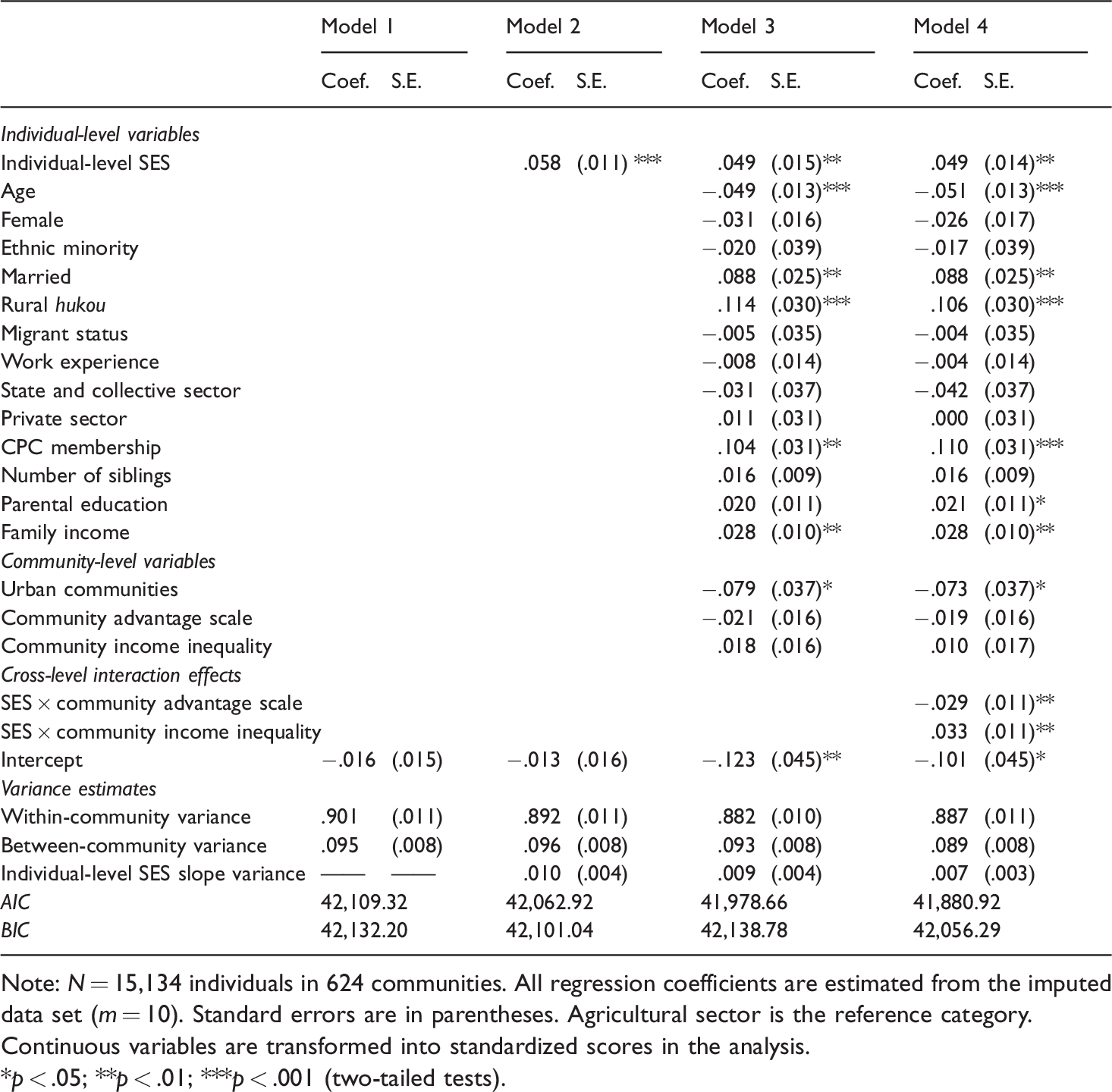
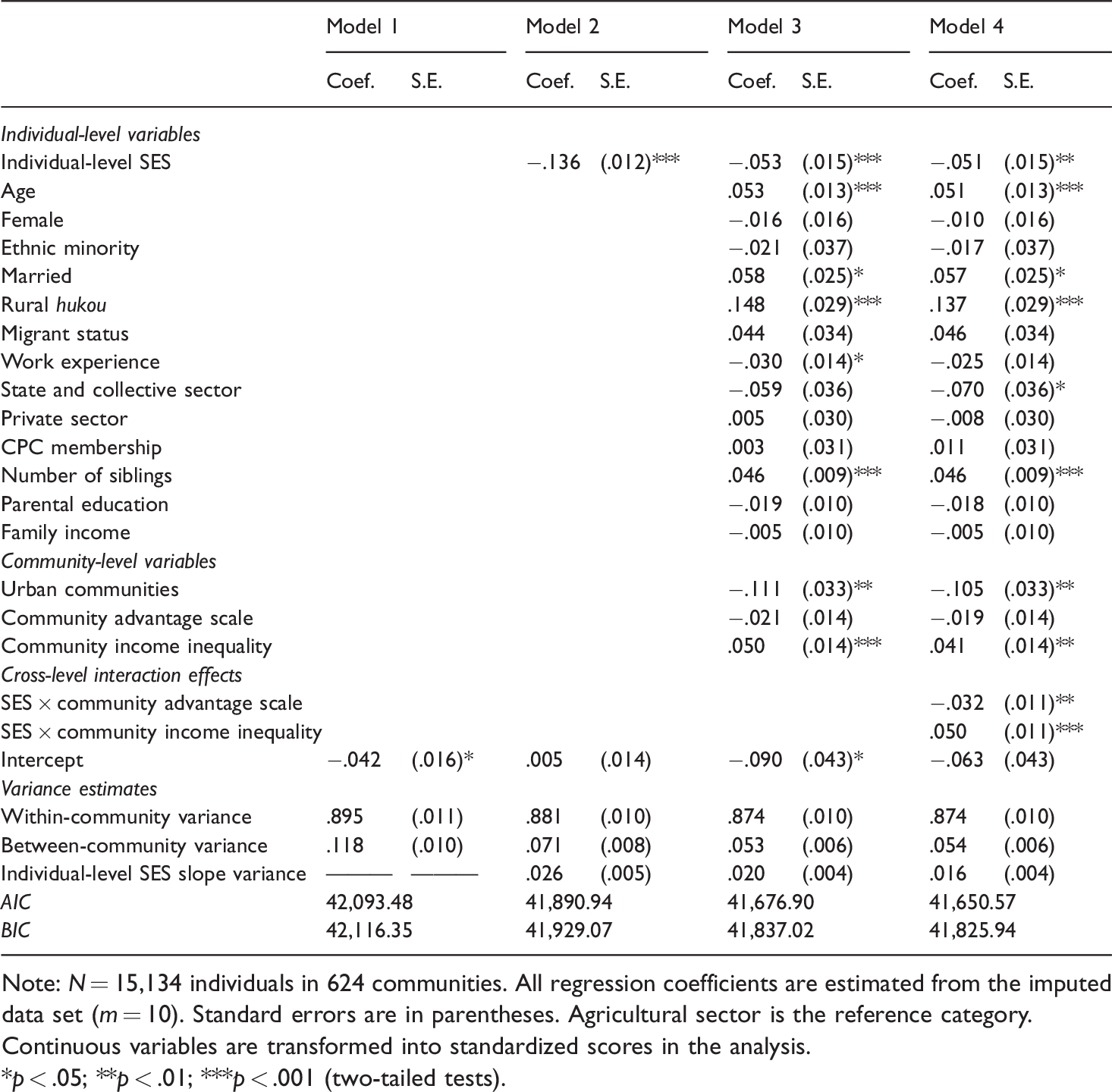
Tables 1 and 2 report the results of the mixed-effects regression coefficients on meritocratic beliefs and perceptions. Model 1 estimates unconditional mean models to examine the intraclass correlation coefficient (ICC) for desired and perceived meritocracy, which is the ratio of the between-community variance to the total variance. The ICC for beliefs in meritocracy is
Parameter estimates for mixed-effects models predicting meritocratic beliefs.
Note: N = 15,134 individuals in 624 communities. All regression coefficients are estimated from the imputed data set (m = 10). Standard errors are in parentheses. Agricultural sector is the reference category. Continuous variables are transformed into standardized scores in the analysis.
*p < .05; **p < .01; ***p < .001 (two-tailed tests).
Parameter estimates for mixed-effects models predicting meritocratic perceptions.
Note: N = 15,134 individuals in 624 communities. All regression coefficients are estimated from the imputed data set (m = 10). Standard errors are in parentheses. Agricultural sector is the reference category. Continuous variables are transformed into standardized scores in the analysis.
*p < .05; **p < .01; ***p < .001 (two-tailed tests).
Model 2 examines the bivariate relationship between individual-level SES and meritocratic beliefs and perceptions. The results show that individual-level SES has distinct influences on beliefs in meritocracy and perceived meritocracy. On the one hand, individual-level SES is significantly and positively associated with beliefs in meritocracy. For one standard deviation increase in the SES scale, belief in meritocracy is expected to increase by .058 standard deviations. Without controlling for other factors, these results support the self-interest theory that individuals with higher SES are more likely to believe that their success is attributed to meritocratic factors. On the other hand, individual-level SES is significantly and negatively related to perceived meritocracy. For one standard deviation increase in the SES scale, the level of perceived meritocracy declines by .136 standard deviations. This finding supports the system justification theory that individuals with relatively lower SES are more likely to perceive that society is meritocratic than their socioeconomically privileged counterparts. This finding supports Hypothesis 1 that individual SES has a distinct influence on people’s meritocratic beliefs and perceptions.
Furthermore, Model 2 includes random slopes for individual-level SES. In Table 1, when predicting beliefs in meritocracy, the estimated variance of the individual-level SES slopes is .010, with a standard error of .004. In Table 2, the estimated variance of the individual-level SES effects on perceived meritocracy is .026, with a standard error of .005. The 95% plausible value range for the effects of individual-level SES on beliefs in meritocracy is
Model 3 adds individual- and community-level control variables. The results show that individual-level SES has a positive relationship with desired meritocracy, yet a negative one with perceived meritocracy, net of all other background factors. The results for control variables are mostly consistent with the literature. In Table 1, among individual-level factors, the results show that older respondents tend to be less likely to support desired meritocracy. Besides, marital status and rural hukou status are significantly and positively associated with meritocratic beliefs. CPC members have significantly higher levels of belief in meritocracy compared with those without CPC membership. Furthermore, family income is positively associated with the levels of beliefs in meritocracy. For community-level variables, urban communities, on average, have lower levels of belief in meritocracy than rural communities. However, community advantage scale and community income inequality are not significantly related to meritocratic beliefs.
In Table 2, the results for some background controls reveal different patterns when predicting perceived meritocracy. Older respondents are more likely to perceive society to be meritocratic. Individuals with longer working experience are less likely to have meritocratic perceptions about society. Individuals with more siblings tend to have a higher level of perceived meritocracy. For community-level controls, similar to its effects on beliefs in meritocracy, urban communities on average have lower levels of perceived meritocracy than rural communities. Also, community income inequality is significantly associated with a greater sense of perceived meritocracy.
Model 4 adds cross-level interaction terms between individual-level SES and community advantage scale and the Gini index. The cross-level interaction term for community advantage scale is significant and negative, suggesting that the positive relationship between individual-level SES and meritocratic beliefs is more significant in relatively disadvantaged communities. In comparison, the negative relationship between individual-level SES and perceived meritocracy is stronger in advantaged communities. Also, the cross-level interaction effect for community income inequality is significant and positive. It implies that the positive relationship between individual-level SES and meritocratic beliefs is greater in communities with a higher level of income inequality. It also suggests that the negative relationship between individual-level SES and perceived meritocracy is more potent in communities with a lower level of income inequality. These results support our Hypotheses 2 and 3.
After examining the cross-level interaction effects, the residual variance of individual-level SES effects on desired and perceived meritocracy is .007 and .016. Compared with the variances of .009 and .020 shown in Model 3 for the effects of individual-level SES, the results suggest that community advantage scale and income inequality help explain 22% of the variation in the effects of individual-level SES on beliefs in meritocracy across communities and 20% of the variation in the effects on meritocratic perceptions. Overall, the results imply that community socioeconomic contexts are essential to shaping how individual-level SES affects people’s beliefs in meritocracy and their perceptions about whether society is meritocratic or not in contemporary Chinese society.
Figure 1 provides a graphic illustration of the cross-level interaction effects by community socioeconomic contexts reported. The results show that the positive effect of individual-level SES on beliefs in meritocracy is greater in socioeconomically disadvantaged communities and communities with higher income inequality. It suggests that compared with lower-SES citizens, individuals with higher SES are more likely to attribute their success to meritocratic factors when they are situated within relatively underprivileged and unequal social contexts. Further, the results reveal that the negative effect of individual-level SES on perceived meritocracy is more substantial in socioeconomically advantaged communities and communities with lower income inequality. This finding suggests that low-SES individuals are more likely to perceive that society is meritocratic when they reside in more socioeconomically advantaged and equitable communities.
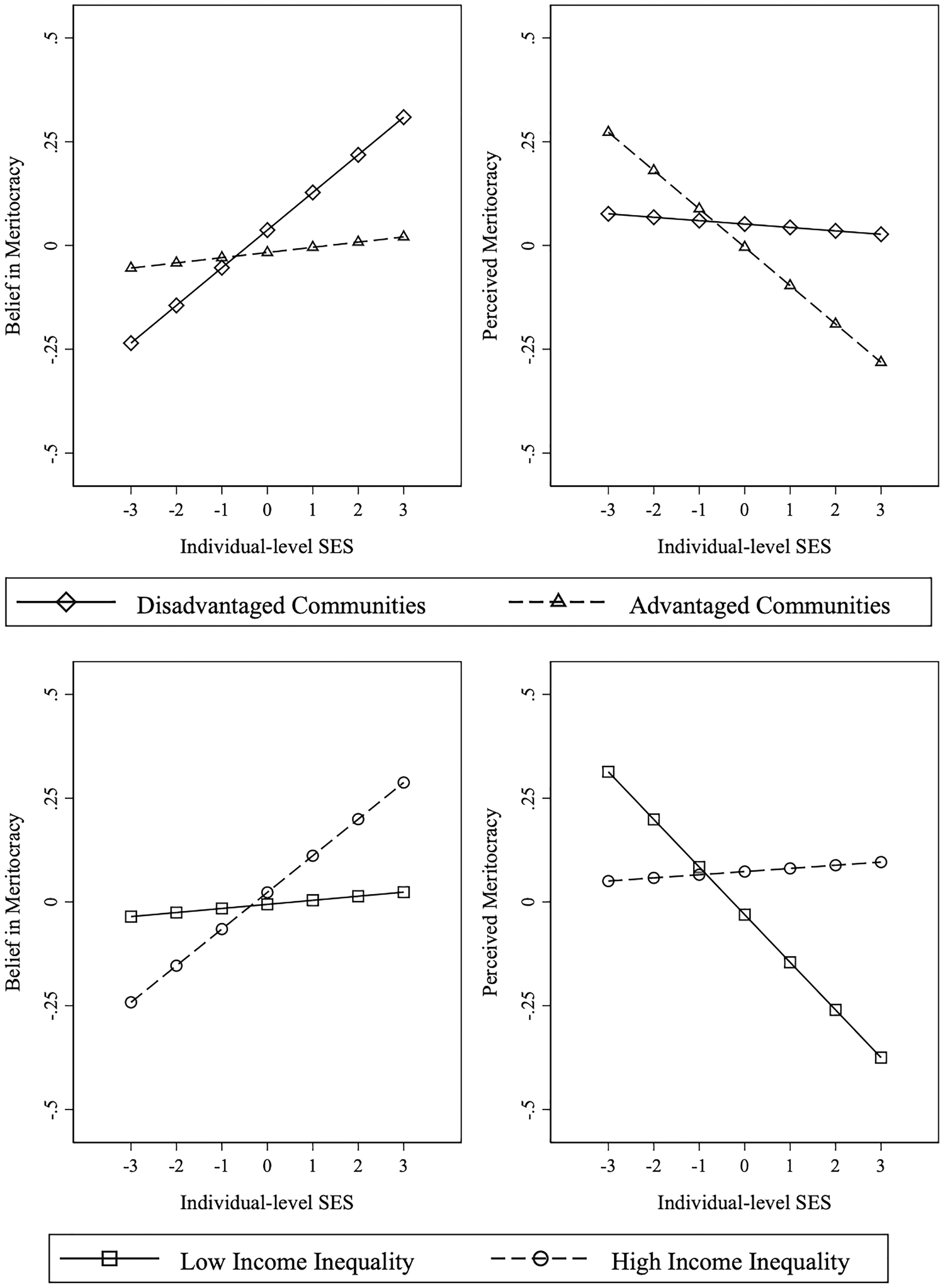
Heterogeneous relationships between SES and meritocratic beliefs and perceptions by community socioeconomic contexts.
To better examine SES gaps in meritocratic beliefs and perceptions across community contexts, in Table 3 we calculate the predicted scores of desired and perceived meritocracy scales at the 10th, 50th, and 90th percentiles of community advantage scale and community Gini index based on Model 4 reported in Tables 1 and 2. SES gaps in meritocratic beliefs (i.e., defined as the gap between the 10th and the 90th percentiles of the individual SES scale) are more substantial in socioeconomically disadvantaged communities than in those advantaged ones. Holding all other variables at their sample means, for example, the predicted SES gap in meritocratic beliefs is .243 (p < .01) at the 10th percentile of the community advantage scale, showing that high-SES individuals are more likely than low-SES individuals to support meritocratic ideals in disadvantaged communities. Nevertheless, SES differences in beliefs in meritocracy are much smaller in advantaged communities. On the contrary, the predicted SES gap in perceived meritocracy is −.247 (p < .01) at the 90th percentile of the community advantage scale. The results show that low-SES individuals are more likely than high-SES individuals to hold meritocratic perceptions about society in advantaged communities.
Predicted social class differences in meritocratic beliefs and perceptions at the 10th, 50th, and 90th percentiles of community advantage scale and income inequality.
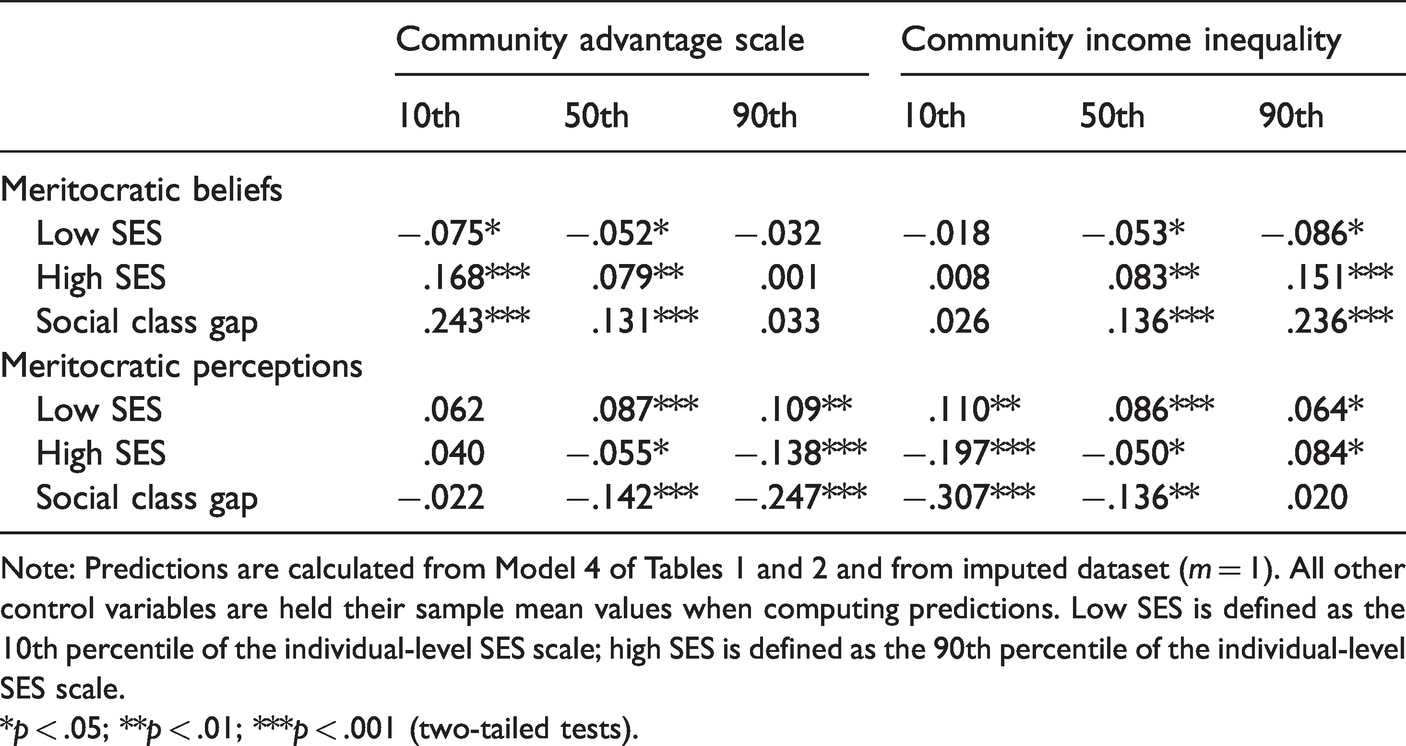
Note: Predictions are calculated from Model 4 of Tables 1 and 2 and from imputed dataset (m = 1). All other control variables are held their sample mean values when computing predictions. Low SES is defined as the 10th percentile of the individual-level SES scale; high SES is defined as the 90th percentile of the individual-level SES scale.
*p < .05; **p < .01; ***p < .001 (two-tailed tests).
SES gaps in desired and perceived meritocracy also vary by the levels of community income inequality. The gap in desired meritocracy is largest at the 90th percentile of the community Gini index, where high-SES individuals are much more likely to believe meritocratic ideals than low-SES individuals. In contrast, the gap in perceived meritocracy is greatest at the 10th percentile of the community Gini index. Compared with their high-SES counterparts, low-SES individuals tend to have stronger perceptions about meritocracy in economically homogeneous communities. Overall, the results lend support to the notion that self-interest theory may better explain how individual SES shapes desired meritocracy, while mechanisms of system justification may help to understand SES variation in perceived meritocracy. Further, the results confirm Hypotheses 2 and 3, that SES gaps in meritocratic beliefs are reinforced in socioeconomically disadvantaged and unequal communities. On the contrary, SES disparities in meritocratic perceptions are greater in socioeconomically advantaged and equal communities in which relatively low SES residents are subject to a strong process of system justification.
Discussion and conclusions
Social scientists have been concerned about SES differences in meritocratic attitudes, since the gaps in such beliefs and perceptions may influence the tolerance of inequality, political legitimacy, and social stability (Lei, 2020; Merolla et al., 2011; Mijs, 2019; Newman et al., 2015). Previous research has focused on two dominant perspectives explaining the relationship between SES and meritocratic attitudes. Proponents of self-interest theory contend that individuals with high SES are more likely to believe in the meritocratic ethos because support for meritocracy justifies their privileged social position by favoring the importance of individual efforts and educational attainment rather than social origins and family wealth (Alves and Rossi, 1978; Hechter and Kanazawa, 1997). Supporters of system justification theory maintain that low-SES individuals are more likely to perceive society to be meritocratic since they tend to consider income and wealth as legitimate outcomes of a fair meritocratic system and are not well informed about the full extent of rising inequality (Jost et al., 2004; McCoy and Major, 2007; Shepelak, 1989). Overall, these two competing theoretical perspectives have often led to inconsistent findings in prior empirical research.
Focusing on contemporary Chinese society, this study adds to a growing sociological literature on SES differences in meritocratic attitudes by accounting for the heterogeneous relationships between SES and meritocratic beliefs and perceptions across local community socioeconomic contexts. We examine two dimensions of subjective understandings of meritocracy. Meritocratic beliefs are an implicit and desired form of meritocracy, while meritocratic perceptions are an explicit and evaluated meritocracy. We contend that self-interest theory plays an important role in explaining SES disparities in meritocratic beliefs, while system justification theory helps to explain SES gaps in perceptions about meritocracy under different community socioeconomic contexts. Using nationally representative data from the CFPS, the analyses examine the distinct relationships between SES and meritocratic beliefs and perceptions. We then investigate the differential influences of individual SES on meritocratic beliefs and perceptions through community socioeconomic standings and income inequality levels.
This study yields several major findings. The results show that net of other individual- and community-level background factors, in China individuals with higher SES are more likely to hold meritocratic beliefs but less likely to perceive the society to be meritocratic. On the one hand, consistent with previous research (Li, 2018; Liu and Hu, 2016; Xian and Reynolds, 2017), the results suggest that high-SES individuals are more likely to attribute economic success to personal endeavors and intelligence versus structural factors. On the other hand, the results also confirm that low-SES individuals are subject to system justification in forming perceptions about the meritocratic allocation of resources in Chinese society (Liu, 2016; Xie, 2016; Xie et al., 2012). Overall, this finding generally suggests that since there is a growing spatial and social distance between individuals from different SES groups in a rapidly changing society, individual SES has different influences on people’s beliefs and perceptions toward meritocracy.
Although our focus is on examining meritocratic beliefs and perceptions to better understand variation in meritocratic attitudes, we acknowledge that people’s beliefs and perceptions towards meritocracy can simultaneously influence one another and are not mutually exclusive (Duru-Bellat and Tenret, 2012). In supplementary analyses, results show that there is a positive correlation between meritocratic beliefs and perceptions, suggesting that higher degrees of meritocratic beliefs often lead to strong meritocratic perceptions. Perceptions about a meritocratic and fair society may also reinforce people’s beliefs that effort and talent are the determinants of individual success.
The findings also show that SES disparities in meritocratic beliefs and perceptions vary significantly by local community socioeconomic standings and income inequality. Specifically, SES gaps in meritocratic beliefs are more potent in socioeconomically disadvantaged and unequal communities in which high-SES residents have stronger support for meritocratic beliefs. However, SES disparities in meritocratic perceptions are higher in socioeconomically advantaged and homogeneous communities where low-SES residents are more likely to perceive society to be meritocratic. These results prove that self-interest is likely to be intensified in disadvantaged and unequal contexts, while system justification tends to be reinforced in socioeconomically advantaged and homogeneous contexts.
These findings carry out important implications for understanding the variation in meritocratic beliefs and perceptions in a rapidly transitioning society. China’s market transition has changed the mode of distributing economic rewards in favor of human capital based on educational and occupational attainment, which has incentivized stronger support for meritocracy over the past decades (Bian and Logan, 1996; Walder, 1996; Zhou, 2000). Marketization has reinforced the dynamics of self-interest by polarizing belief in meritocracy for individuals from different social status groups. Our results suggest that as China has progressed in its marketization and economic development, self-interest theory appears to play an essential role in explaining the stratification in belief in meritocracy, particularly in underdeveloped areas with concentrated disadvantage and places with growing income inequality. This finding is consistent with studies examining meritocratic beliefs in Western societies (Merolla et al., 2011; Newman et al., 2015).
Previous research also documents that most Chinese citizens are more tolerant of rising inequality and feel more optimistic about upward social mobility than do citizens in other Western countries (Whyte, 2009; Xie et al., 2012). For example, Whyte (2009) finds that socioeconomically disadvantaged rural farmers are more likely to perceive economic fairness than well-educated urban residents who tend to be more critical towards social inequalities. Thus, system justification theory may help to understand the empirics of why rising inequality has been tolerated by socioeconomically disadvantaged groups focusing on meritocratic perceptions during China’s market reform era. The finding reported in this study suggests that the mechanism of system justification is reinforced in socioeconomically advantaged and homogeneous communities in which relatively low-SES individuals tolerate social inequalities as they are more likely to perceive the society is meritocratic and just. This finding is consistent with previous research focusing on regional differences in subjective perceptions of social inequality, demonstrating that residents from poor rural areas are tolerant of rising inequality and favor meritocracy (Li and Wu, 2012; Whyte, 2009).
This study contributes to the literature on meritocratic attitudes in contemporary China, but it has several limitations. First, our study is limited in considering the heterogeneity in types of communities in contemporary Chinese society. In the Western context, the community or neighborhood is the immediate social environment where individuals live, work, consume, socialize, and raise families (Harding, 2007). However, the definition of a community is more complicated under the Chinese context, particularly in urban areas, given rapid social and economic changes. For example, rural migrant enclaves or “urban villages” are types of communities with crowded and poor-quality housing units, low residential stability, and higher crime rates, while commercial housing communities and work unit communities contain more socioeconomically advantaged families with much better social services and resources (Lei, 2018). In our analyses, although the community advantage scale can capture the socioeconomic variation across communities, it is limited in measuring the qualitative differences among different types of communities. Furthermore, since the community advantage scale is constructed based on interviewers’ observations, it may lead to potential measurement errors that are loaded with interviewer effects. Second, selection bias may be present to the extent that communities’ variations in meritocratic beliefs and perceptions could be attributed to community-level socioeconomic standings. Systematic differences between individuals in disadvantaged and advantaged communities would bias the estimates of contextual effects of community-level advantage scale.
Future research should address these limitations with a refined theoretical framework to better examine how individual SES matters for people’s values and attitudes towards social and economic fairness under different social contexts. Future studies should also continue examining how the relationships between individual SES and meritocratic beliefs and perceptions have changed over time during China’s economic reform and document trends in the macro-level impacts of market transition on meritocratic attitudes. Overall, this study provides empirical evidence that helps us to understand how the relationship between SES and meritocratic beliefs and perceptions vary by community socioeconomic contexts given China’s dramatic social and economic changes during economic reform.
Footnotes
Acknowledgements
We thank Mengchen Liu, Miranda Wu, and Allen Hyde for their helpful comments and feedback in preparing the early versions of the manuscript. We also thank the editor and the anonymous reviewers for their recommendations on improving this article.
Declaration of conflicting interest
The author(s) declared no potential conflicts of interest with respect to the research, authorship, and/or publication of this article.
Funding
The author(s) received no financial support for the research, authorship, and/or publication of this article.