




Abstract
Filial support has been recognized as a main source of social support for China’s aging population. While traditional Chinese families generally adhere to patrilineal, patriarchal, and patrilocal principles, there have been signs of an emerging trend of a complex, bilateral family system that has influenced the ways in which married women support elderly family members, both natal kin and in-laws, in contemporary China. However, little research exists focusing on the perspectives of married women in China on intergenerational support. Drawing on nationally representative data from the Chinese General Social Survey, this study investigates the patterns and determinants of women’s financial and instrumental support of their parents and parents-in-law in China. The main results show that, while education and income separately affect women’s support patterns, their husband’s income level is the crucial factor determining women’s financial support for parents and parents-in-law. In terms of instrumental support, norms of reciprocity are evident between women and parents/parents-in-law. Despite a positive association between financial support that women give to parents-in-law and that which they receive from parents-in-law, women’s financial support tends to be less frequent when their own parents have financially supported them. The implications of these findings for our understanding of intergenerational support mechanisms and for future research are discussed.
Keywords
Introduction
An unprecedented rate of growth in the aging population in China has spurred new demands on families and the need for a clarification of citizens’ attitudes towards filial obligations. In the wake of the improved living standards and health care brought by rapid economic development over the past 40 years, China’s life expectancy at birth increased from 67 years in 1980 to 76 years in 2016 (World Bank, 2017). The number of citizens aged 60 or above reached 241 million by the end of 2016, representing 17.3% of the total population, and this number is estimated to peak at 487 million by the middle of this century (Xiang, 2018). On the other hand, as a result of the decades-old one-child policy, the total fertility rate in China decreased from 2.6 in 1980 to 1.6 in 2016, which was well below the replacement level (World Bank, 2017). Long life expectancy and low fertility contribute to a high elderly dependency ratio in China, which is expected to reach more than 0.5 by 2038, indicating that, on average, fewer than two young adults will support one elder adult (Hu and Yang, 2012). Although China has been developing its public pension system since the 1960s, the state has not yet established a comprehensive social security system (Vilela, 2013). The public pension system covers a small proportion of the whole population, with only a small percentage of retirees living in urban areas actually receiving their pensions in 2002 and less than 10% of the rural population joining the rural pension insurance schemes in 2007 (Shen and Williamson, 2010; Vilela, 2013).
Under such circumstances, the traditional discourse of the filial obligation to provide elderly care and support has become particularly significant. Elderly citizens, especially those living in rural areas, have conventionally relied on their adult children for financial and instrumental support, regardless of recent demographic and socioeconomic challenges to these ideals of filial piety in China (Jackson and Liu, 2017; Tu, 2016; Whyte, 2020). Previous research has found that nearly half of urban elders and more than 60% of the rural elderly population in China rely on their adult children to satisfy their financial needs (Lee and Xiao, 1998; Ng et al., 2002). Intergenerational support is significantly associated with the subjective well-being of the elderly in China (L Zhang, 2016). Indeed, filial support has been recognized as a main source of social support for China’s aging population (Deutsch, 2006; Lin and Yi, 2011; Whyte, 2005). The filial roles and obligations of sons, daughters, and daughters-in-law are clearly defined within the traditional Chinese family structure. Adult sons, as well as their spouses (daughters-in-law), assume filial duties for their elderly parents; by contrast, after marriage adult daughters are supposed to leave their natal families and move to provide care for their parents-in-law (Lee et al., 1994; Lin and Yi, 2011; Lin et al., 2003; Yang, 1996). However, in the wake of the sociopolitical and economic transformation in China over the past decades, there have been signs of an emerging trend toward a complex, bilateral family system, which has influenced the ways married women support their elderly parents and parents-in-law (Cong and Silverstein, 2012a, 2012b; Deutsch, 2006; Ji and Wu, 2018; Ji et al., 2020; Lei, 2013; Xie and Zhu, 2009; Yi et al., 2016; Zhan and Montgomery, 2003; Y Zhang, 2016; Zheng and Di, 2018).
Little empirical research has focused on married women regarding filial norms and relationships with parents and parents-in-law by using large, representative samples of China’s population (Zheng and Di, 2018). This study is one of the rare attempts to examine the perspective of married women on intergenerational support for their parents and parents-in-law. Notably, in light of recent trends in China’s aging population, this study generates further insights to address the ongoing discussion concerning the role of married women as the main source of support for an ever-larger retired population in post-reform China (Ji and Wu, 2018). Despite China’s implementation of a universal two-child policy in late 2015, the tremendous impact of the decades-long one-child policy, together with the traditional preference for sons, on the aging demographics will not be reversed in the near future (Jackson and Liu, 2017; Tu, 2016). Academic and policy attention need to be extended to a systematic understanding of filial piety norms and intergenerational relationships among married women (Yi et al., 2016; Zheng and Di, 2018).
Drawing on nationally representative data from the 2006 Chinese General Social Survey (CGSS), this study aims to gain a better understanding of the patterns of intergenerational support provided by married daughters in China. Specifically, this study investigates women’s perceived financial and instrumental (e.g. helping with household chores) support for their parents and parents-in-law and identifies mechanisms underlying the support patterns by testing three main theoretical models: socioeconomic resources, reciprocity between generations, and the family context (i.e. geographic proximity and family composition).
The role of women in caring for parents and parents-in-law
It is well established that intergenerational support behavior is not gender neutral or homogeneously patterned among parents and parents-in-law (Henz, 2009, 2010; Raley and Bianchi, 2006; Swartz, 2009; Szinovacz and Davey, 2008). As men are traditionally expected to be the breadwinners and women are expected to be the caregivers, men are more likely to manage the financial tasks, while women tend to take care of emotional support (Chesley and Poppie, 2009). Numerous studies have shown that men spend significantly less time taking care of elderly parents than women do (Gerstel and Gallagher, 2001; Henz, 2009; Lee et al., 2003; Sarkisian and Gerstel, 2004). Notably, in brother-only families, wives and husbands tend to behave in gender-appropriate ways, with wives caring for their husbands’ parents as daughters-in-law by helping with household chores or personal care and providing emotional support and husbands performing “masculine” tasks such as transportation and home maintenance (Matthews and Heidorn, 1998).
As the “kin-keeper” role of women has been widely acknowledged (Allen et al., 2000), women are expected to maintain closer contact with parents and parents-in-law than are men. However, asymmetry in couples’ relations with husbands’ parents and wives’ parents has conventionally existed in American families (Noël-Miller and Tfaily, 2009). When facing the competing demands of two sets of parents, couples are more responsive to wives’ parents despite the predominant bilateral kinship in most Western societies (Kuznesof, 2005). Women’s centrality in kin networks is restricted to their own original kin and does not extend to the relationship with their husbands’ families (Rossi and Rossi, 1990). Given the higher position of parents in the kin hierarchy, parents generate a higher level of obligation than parents-in-law and thus claim the privilege of the time and resources of adult children, which results in parents receiving more support from adult children. Drawing on a nationally representative sample of American middle-aged married persons, Lee et al. (2003) determined that women give priority to their relations with their own parents, providing more contact and assistance to their parents than to their parents-in-law. Waite and Harrison (1992) found that middle-aged women have contact with their own parents more frequently than with their parents-in-law. However, Noël-Miller and Tfaily’s (2009) study in Mexico showed the opposite results: a couple is more likely to provide financial assistance to the husband’s mother than to the wife’s mother when there is similar financial need; in cases in which the wife has previously been in paid employment, the financial transfer given solely to the husband’s mother actually increases. In addition, Shuey and Hardy (2003) argued that couples show a unilineal assistance pattern, in terms of both time and money, to their parents and parents-in-law and that the matrilineal line is privileged in American families. Henz (2009) found that British daughters-in-law generally assume direct responsibility for caring for their parents-in-law and assist their parents-in-law for significantly greater amounts of time than sons-in-law do with their parents-in-law.
The contemporary Chinese context: Continuity and change in intergenerational relations
The Chinese family system is traditionally patrilineal, patriarchal, and patrilocal in principle. Traditional Chinese families emphasize a hierarchical order based on age and gender, with the senior male members as the patriarch and family provider; only sons are entitled to receive most family investments and possess the right of inheritance (Whyte, 2005). As part of the filial norms in Confucian beliefs, adult children, especially sons, are obligated to provide various kinds of support and care for elderly parents. By contrast, daughters are traditionally regarded as transitory members of their natal families and are expected to live with and be devoted to their marital families (Whyte and Xu, 2003). Married daughters, traditionally described as “spilled water”, cease to fulfill their support obligations for their birth parents and instead shift their support to their parents-in-law, assuming a caregiver/kin-keeper role primarily out of obligation to their spouses (Y Zhang, 2009).
Despite the continuing relevance of traditional norms and values in modern Chinese families, many norms and values have begun to weaken as a consequence of China’s socialist reform and one-child policy in the post-war era and the rise of consumerism under China’s transition to a market economy in the 1990s (Whyte, 2005). Chinese parents’ strong preference for sons over daughters in providing care for them has relatively diminished in both urban and rural areas (Hu and Chen, 2019; Li et al., 2004; Song et al., 2012). In contemporary Chinese families, as patrilineal norms have been undermined and individual conjugal families increasingly live separately, the dynamics of intergenerational support among married women are changing (Cong and Silverstein, 2012a, 2012b; Deutsch, 2006; Lei, 2013; Xie and Zhu, 2009; Yi et al., 2016; Zhan and Montgomery, 2003; Y Zhang, 2016; Zheng and Di, 2018). An illustration of the importance of this changing pattern of support is that the kin-keeper role of women may cause them to maintain even closer contact with both their parents and parents-in-law than do their husbands (Chappell and Kusch, 2007; Rossi and Rossi, 1990). Daughters-in-law play an important caregiving role for the psychological well-being of elderly parents in rural China (Cong and Silverstein, 2008). Filial obligations of adult daughters and daughters-in-law are also closely associated with the significance of maintaining family reputation (mianzi) (Y Zhang, 2016).
Indeed, there have been signs that the Chinese family has taken new shapes and forms in recent decades, one of which is the trend toward a complex, bilateral family system (Ji et al., 2020). Xie and Zhu (2009) found that, in contemporary Chinese families in urban areas, thanks to women’s rising economic status, married daughters, especially those living with their parents, provide more financial support to their birth parents than their male counterparts do. However, parents still favor sons over daughters when providing support to children in need (Xie and Zhu, 2009; Zhu and Xie, 2017). Lin et al. (2003) found that sons in Taiwan assume the major responsibility of caring for their elderly parents, while daughters are not expected to do so unless they have no brothers. Married sons assist their parents more than unmarried sons do, and unmarried daughters provide more assistance to their parents than married daughters do (Lin et al., 2003). Compared to those in Taiwan region, daughters in Chinese mainland are more prone to provide physical support to their parents (Lin and Yi, 2011). Furthermore, Lei’s (2013) study using national data shows that there is little gender difference in financial support, but daughters provide more instrumental and emotional support to their parents than sons do in urban China. Similar gender differences in intergenerational support were found in China’s rural areas (e.g. Li et al., 2004; Song et al., 2012). Despite the persistence of filial piety norms in general, adult children and their elderly parents can negotiate how to enact these norms and responsibilities in upward generational support (Eklund, 2018; Zhu and Xie, 2017). Taken together, there has been continuity within change in the gendered nature of intergenerational support in contemporary Chinese society, which involves different, sometimes contradictory, filial roles, expectations, and obligations prescribed to sons, daughters, and daughters-in-law.
To extend our understanding of the support mechanisms between married women and parents/parents-in-law, we draw upon three main theoretical models according to the existing literature on intergenerational support: socioeconomic resources, reciprocity, and the family context (family composition and geographic proximity). These models are not competing with each other and are closely related. The formulation of the hypotheses to be tested in the present study is grounded in these three theoretical models.
Hypotheses
Although adult children in Chinese families are traditionally expected to support their elderly parents, the type and extent of the support a child devotes to his or her parents varies not just according to gender but also by his or her capacity and socioeconomic status (Sun, 2002). Adult children’s socioeconomic resources, often measured by education and/or income, influence their capacity and motivation to provide intergenerational support. In general, educational attainment is found to be positively associated with adult children’s recognition of filial norms and obligations to provide financial support to their elderly parents (De Koker, 2009; Lei, 2013). Adult children who have received financial resources from their parents, such as educational opportunities and monetary support in their early life stages, are often socialized to provide support as repayment to their aging parents (Lin et al., 2003). Lillard and Willis’s (1997) study in Malaysia showed that highly educated children were more likely than those with lower education levels to provide monetary and material support to their parents. On the other hand, providing instrumental support to parents is often difficult for working couples due to time constraints. If educational attainment has a normative influence on women’s tendency towards intergenerational financial support, then we would expect the following: Hypothesis 1: Higher-educated women tend to more frequently provide financial support to their parents/parents-in-law. Hypothesis 2a: Women’s income is positively related to their frequency of providing financial support to their parents/parents-in-law. Hypothesis 2b: Women’s husbands’ income has a positive effect on women’s frequency of providing financial support to their parents/parents-in-law. Hypothesis 3: Women who have received instrumental support from their parents/parents-in-law will tend to provide financial/instrumental support to their parents/parents-in-law more frequently than women who have not received such support. Hypothesis 4: Women who have received financial support from their parents tend to provide financial support to their parents less frequently than women who have not received such support. Hypothesis 5: Women who have received financial support from their parents-in-law tend to provide financial support to their parents-in-law more frequently than women who have not received such support. Hypothesis 6: Women who live closer to their parents/parents-in-law tend to more frequently provide instrumental support to their parents/parents-in-law. Hypothesis 7: Women who have children tend to provide financial/instrumental support to their parents/parents-in-law less frequently than women who do not. Hypothesis 8: Women who have more siblings/siblings-in-law tend to less frequently provide financial/instrumental support to their parents/parents-in-law.
Data and methods
The data for this analysis are taken from the 2006 CGSS, which includes the socioeconomic and demographic characteristics of the respondents and their family members. Compared with other national datasets such as the China Family Panel Studies, China Health and Retirement Longitudinal Study, and Chinese Longitudinal Healthy Longevity Survey, the 2006 CGSS is one of the few available datasets on China that provides the comprehensive data containing the variables of intergenerational support, particularly for married women, that are required to test the hypotheses in this study.
Based on the sampling frame of counties, towns, and communities from the 2000 Chinese census, the respondents were selected using a four-stage cluster sampling method. In the first stage, 125 counties were randomly selected from 28 provinces, autonomous regions, and centrally administered municipalities (i.e. Beijing, Shanghai, Tianjin, and Chongqing) in China. Then, four towns or sub-districts from each county were randomly selected, which resulted in 500 second-stage units. At the third stage, two neighborhood communities were drawn from each town, and 1000 communities were obtained. At the final stage, 10 households were randomly chosen from each community, amounting to 10,000 households. An individual aged 18–69 was randomly selected from each household to answer the questionnaire. A sub-sample of 3208 respondents, including 1754 females and 1454 males, completed an additional family module of the survey. Among 730 married female respondents with at least one surviving parent and one surviving parent-in-law, 11 records with missing values for dependent variables and 26 records with missing values for independent variables were dropped from the analysis. 1 Subsequently, the final sample for regression analyses was 693. As geographic proximity had the most missing values, multiple imputations were used to address the missing data (Allison, 2001; Cong and Silverstein, 2008).
Dependent variables
The two dependent variables were financial support and instrumental support provided by married daughters to both their parents and parents-in-law. The respondents were asked, “How often did you provide the following types of help to your parents/parents-in-law in the past year?” 2 The two types of help listed were “Providing money” and “Helping with household chores (including cleaning, preparing dinners, shopping, running errands, and taking care of children or other family members)”. The responses were measured on a 5-point scale (1 = Very often; 2 = Often; 3 = Sometimes; 4 = Rarely; 5 = Never). As a small number of responses fell into the categories of “Very often” and “Often”, those two categories were combined into one category labelled “Often”. The scale was also reverse-coded, with higher values indicating more frequent support of parents and parents-in-law.
Independent variables
The analysis had three sets of predictor variables, including socioeconomic resources, support provided by parents and parents-in-law, and family composition and geographic proximity. Socioeconomic resources were measured by women’s educational attainment, women’s annual income, and husbands’ income. Educational attainment was measured by years of schooling, which ranged from 0 to 19 years. Annual income was measured by the logged value of the annual incomes that the respondents earned during the previous year (+1).
Financial support and instrumental support received from parents and parents-in-law were measured on a 5-point scale. Financial support was based on the frequency of married women receiving money from their parents and parents-in-law. Instrumental support was measured by the frequency of receiving support in household chores: “How often did your parents/parents-in-law provide help with housework (such as house cleaning and preparing dinner) and personal care (such as taking care of a baby or an elderly individual) in the past year?” The two types of support were transformed into dummy variables for the present study: whether the respondents were given financial/instrumental support by their parents/parents-in-law in the past year.
Geographic proximity and family composition were measured by geographic distance from the parents/parents-in-law, whether the respondent had children, and number of siblings/siblings-in-law. The distance to a parent/parent-in-law was measured by six ordered categories, including “in the same community”, “within a 15-minute walk”, “within a 30-minute drive”, “a 30-minute-to-1-hour drive”, “a 1-hour-to-3-hour drive”, and “more than a 3-hour drive”, which were coded from 1 to 6, respectively. If both the parents and parents-in-law were alive, the longer distance was selected. If either the parents or parents-in-law were not alive, then the other’s score was used. In this study, the distance was recoded to a dummy variable (more than 30 minutes = 1). Whether the respondent had children was dummy-coded, with 0 indicating having children. The number of siblings/siblings-in-law was coded as a continuous variable (0, 1 or 2, 3 or more).
The analysis also included several control variables. Age was controlled in the models, given that intergenerational transfers vary substantially over the family life cycle. For example, the support that parents provide to adult children may decline with age and then the children might tend to spend more time, effort, and money to care for their aging parents. As a proxy for relative marital power, 3 the husband-to-wife annual income ratio was coded as a continuous variable. Dummy variables were used for Hukou (i.e. place of registered residence; Rural = 1) and the health status of the parents/parents-in-law (Unhealthy = 1). Previous studies have shown a positive relationship between the health status of parents and the likelihood of children providing support (e.g. Shuey and Hardy, 2003; Silverstein et al., 2006).
A preliminary analysis was performed to compare the difference in upward intergenerational support between that provided to parents and parents-in-law and between that provided by married women and married men. Then, ordinal logistic regression models were used to analyze the impact of the three sets of independent variables on the two types of support for parents and parents-in-law.
Results
Table 1 shows the descriptive analysis of the two types of support provided by married women to their parents and parents-in-law. There were no distinct differences in the type and frequency of support for parents and parents-in-law. More than half of married women reported that they often or sometimes provided financial support (57.9%) and instrumental support (54.4%) to their parents. Similarly, most reported that they often or sometimes supported their parents-in-law financially (55.8%) and instrumentally through household help (55.3%).
Descriptive statistics of the dependent variables.
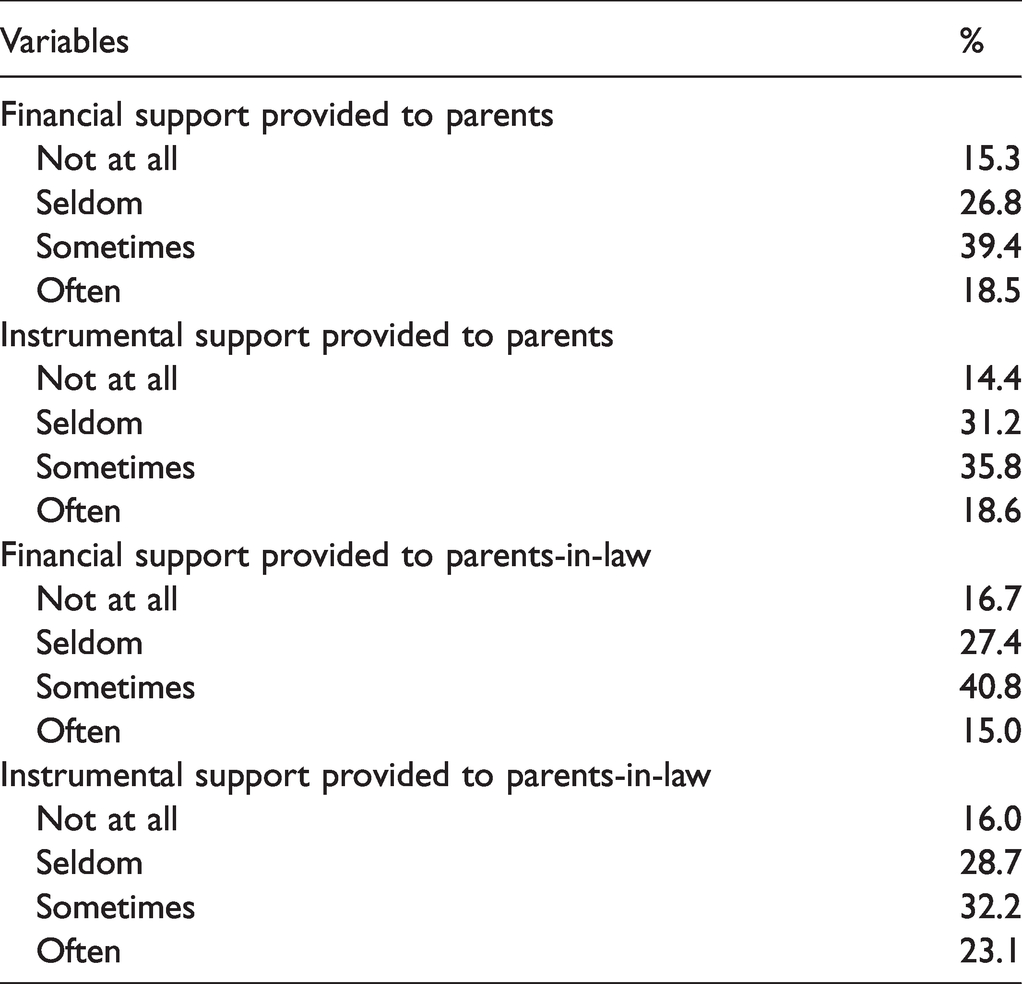
Table 2 displays the descriptive statistics of the independent and control variables. In the analytic sample of 693 married women (age range: 20–63 years), the mean education level for the women was approximately 8.8 years of schooling. On average, the women had 2.8 siblings and 2.6 siblings-in-law. The women had an average annual income of 10,481.3 yuan in 2005, while their spouses had an average annual income of 14,123.6 yuan; the husband-to-wife income ratio was 1.1. An overwhelming majority of the women (91.2%) reported having children, and more than half (57.6%) were urban hukou holders.
Descriptive statistics of the independent and control variables.
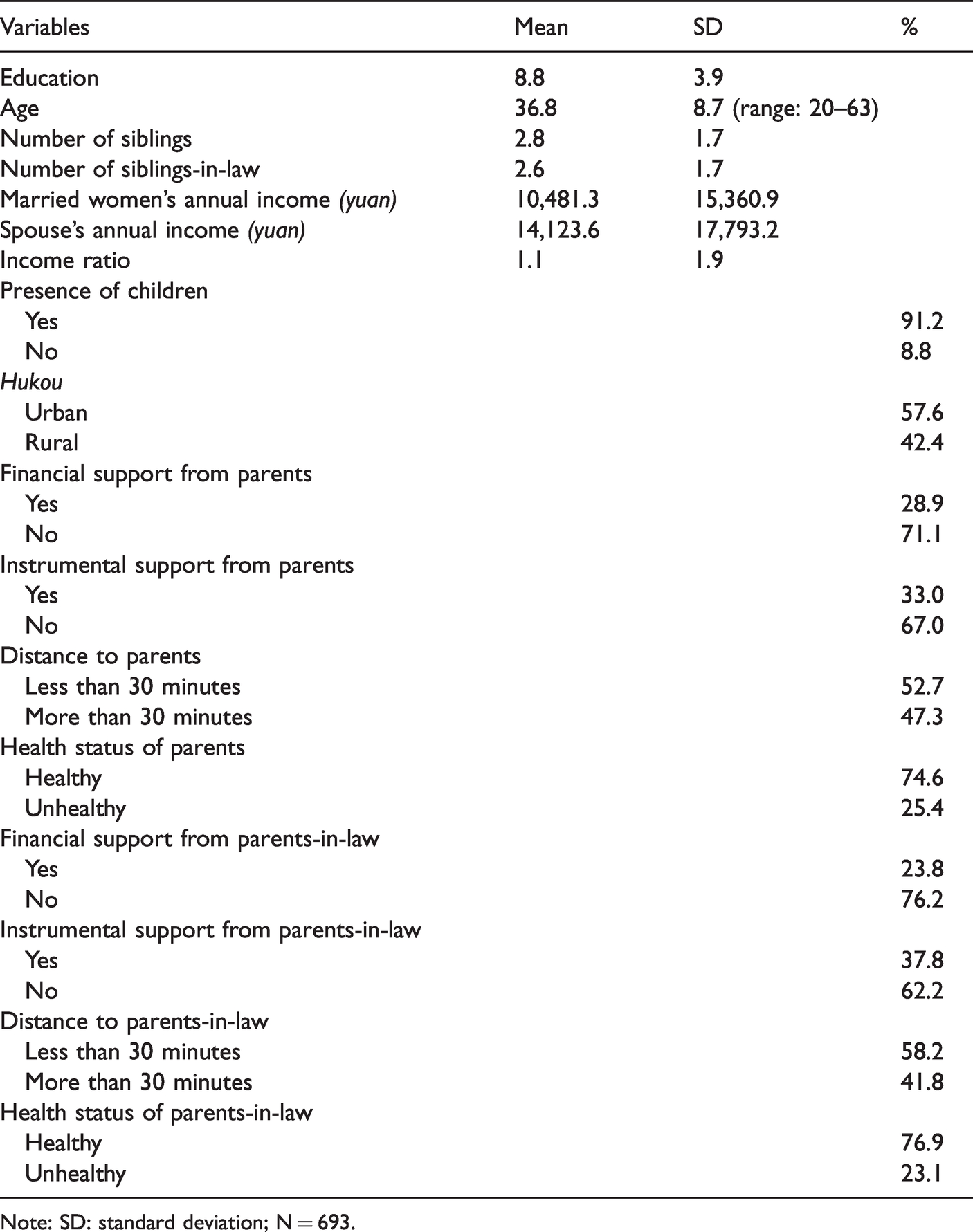
Note: SD: standard deviation; N = 693.
More married women in this sample had received financial support from their parents (28.9%) than from their parents-in-law (23.8%). On the other hand, a higher proportion of the women had received instrumental support from their parents-in-law (37.8%) than their parents (33.0%). Slightly more than half (52.7%) and nearly three-fifths (58.2%) of the women lived at a distance equivalent to less than a 30-minute drive away from their parents and their parents-in-law, respectively. In addition, most parents (74.6%) and parents-in-law (76.9%) were reported to be healthy.
Before the regression analysis procedures, a chi-square test was conducted using the larger sample from the dataset (N = 1309) that consisted of both male and female respondents to capture a general pattern of gender differences in intergenerational support. Table 3 presents the difference in the mean levels of frequency of support of parents and parents-in-law between married women (N = 719) and married men (N = 590). Married men provided more financial and instrumental support to their parents than did married women. However, the significant difference for parents-in-law was in the other direction: women provided more instrumental support to their parents-in-law than did men. In addition, there was no gender difference in married women’s and married men’s financial support of their parents-in-law. These results are broadly indicative of the gendered division of caregiving, as discussed earlier, among married sons and daughters for parents and parents-in-law (Ji et al., 2020; Zhan and Montgomery, 2003).
Gender differences in the provision of support to parents and parents-in-law.
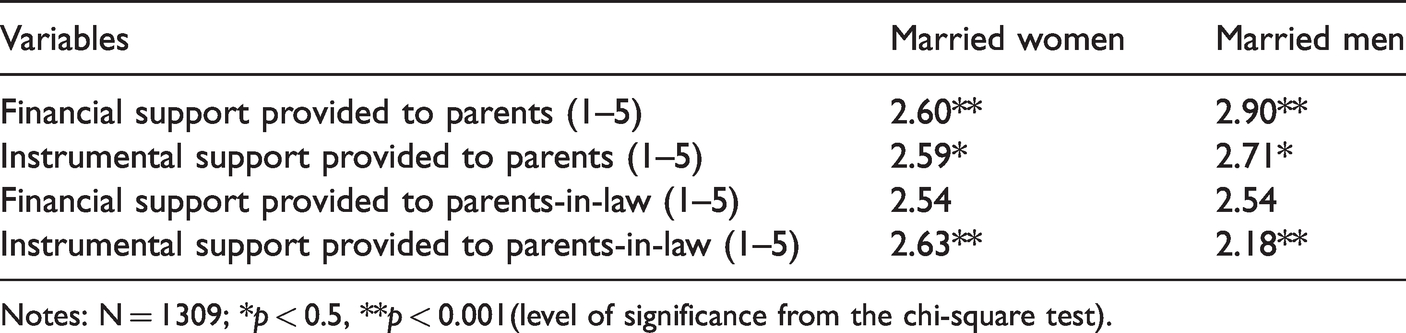
Notes: N = 1309; *p < 0.5, **p < 0.001(level of significance from the chi-square test).
Regression results
Support for parents
Table 4 shows the results of ordinal regression models of women’s support of their parents. Years of schooling was positively related to the frequency of financial and instrumental support of parents. Controlling for relative earnings, husband’s income, but not women’s income, had a significant positive effect on women’s financial support of their parents. 4 Therefore, Hypotheses 1 and 2b were supported.
Ordered logistic regression models predicting married women’s provision of support to parents.
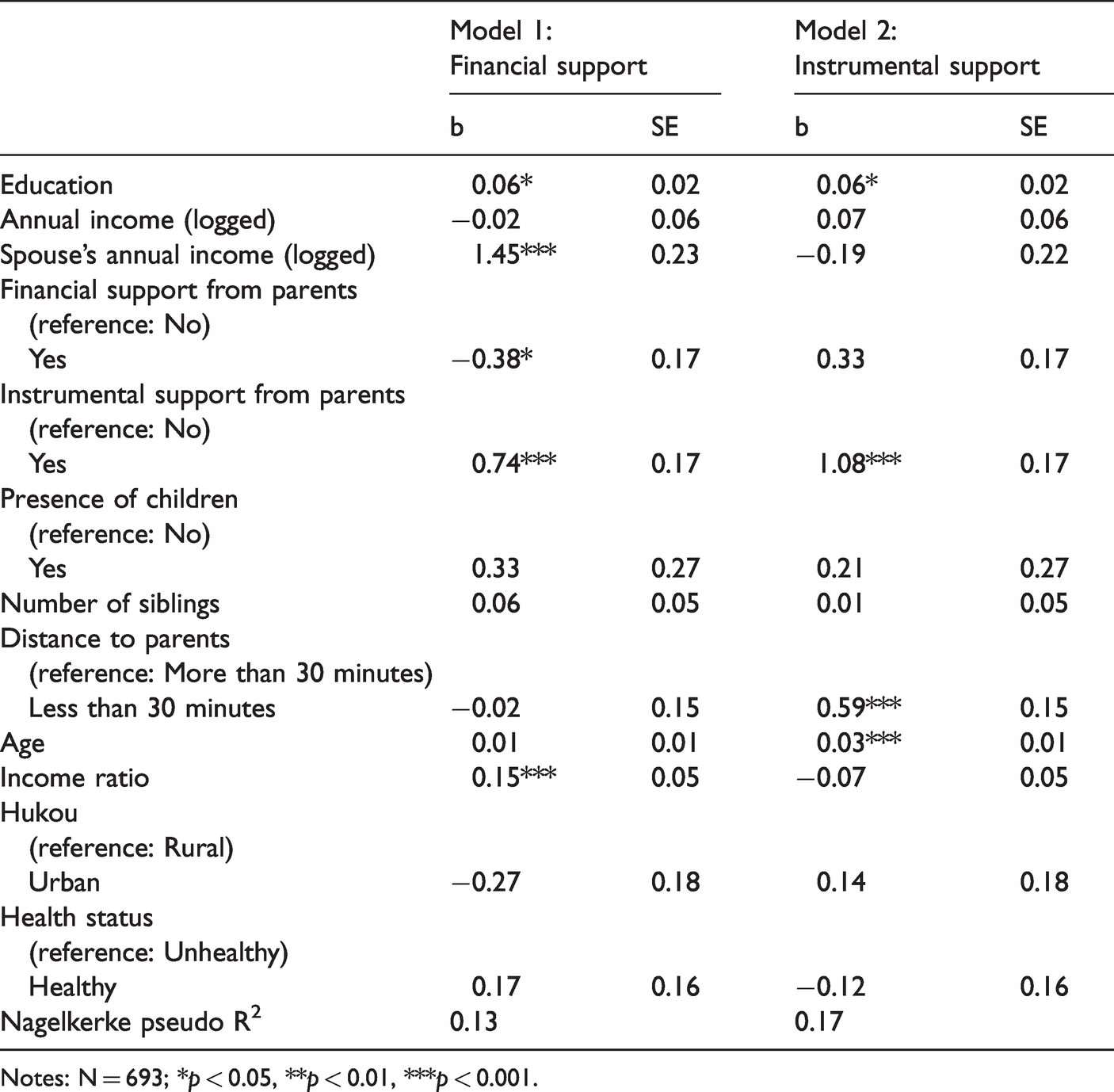
Notes: N = 693; *p < 0.05, **p < 0.01, ***p < 0.001.
Married women who received instrumental support from their parents tended to provide financial and instrumental support to their parents more frequently than those who had not. Receiving financial support from parents decreased the frequency of financial support provided to parents. The results supported Hypotheses 3 and 4.
Consistent with Hypothesis 6, geographic distance was positively related to women’s frequency of providing instrumental support to their parents. In other words, married women who lived close to their parents were more likely to provide instrumental support. However, Hypotheses 7 and 8 (family composition) were not supported. Whether respondents had children did not affect financial and instrumental support provided by married women to their parents. The number of siblings had no impact on married women providing any type of support to their parents. 5
Support for parents-in-law
Two models predicting financial support (Model 3) and instrumental support (Model 4) provided by married women to their parents-in-law are presented in Table 5. Those with a higher level of education more frequently provided financial support to their parents-in-law, but education had no effect on their instrumental support of their parents-in-law. Similarly, husbands’ income, not women’s income, was a significant predictor of financial support of parents-in-law. These results were, again, consistent with Hypotheses 1 and 2b.
Ordered logistic regression models predicting married women’s provision of support to parents-in-law.
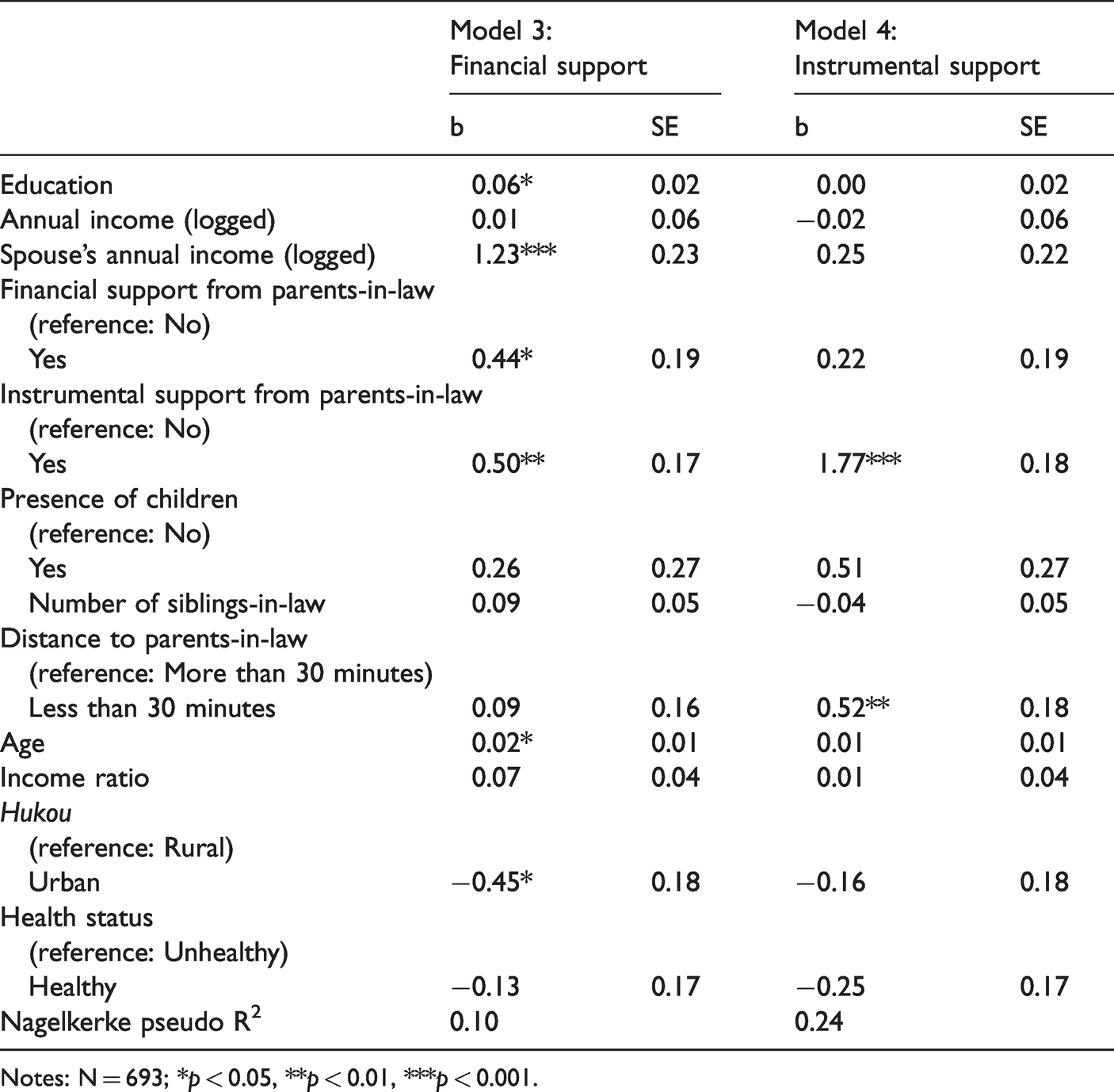
Notes: N = 693; *p < 0.05, **p < 0.01, ***p < 0.001.
The reciprocity between married women and their parents-in-law produced strong significant effects, which also supported Hypotheses 3 and 5. Women tended to provide more instrumental support to their parents-in-law if they had received instrumental support from their parents-in-law. Women increased their financial support of their parents-in-law in return for receiving financial or instrumental support from their parents-in-law.
Proximity was also found to be a strong predictor of support for parents-in-law, which supported Hypothesis 6. The closer women lived to their parents-in-law, the more frequently they provided instrumental support to them. However, Hypotheses 7 and 8 (family composition) were not supported.
Discussion and conclusion
The present study provides insights into mechanisms underlying intergenerational family support, with a particular focus on married women and their filial relationship with their parents/parents-in-law. Specifically, the results show that (a) higher-educated women more frequently provided financial and instrumental support to their parents and more frequently provided financial support to parents-in-law; (b) spousal income was positively linked to women’s financial support for parents and parents-in-law; (c) instrumental support of parents and parents-in-law was more frequent among women who had received instrumental support from their parents and parents-in-law than those who had not; (d) while there was a positive association between receiving financial support from and providing financial support to parents-in-law, women who had received financial support from their parents tended to provide financial support to their parents less frequently than those who had not; (e) women’s instrumental support for their parents and parents-in-law was positively related to geographic proximity; and (f) women’s family composition (presence of children and number of siblings/siblings-in-law) had no effect while controlling for age and other related variables.
One notable finding of this study is the suggestion that education and income separately affect women’s support patterns. The more years of education women have attained, the more frequently they tend to support their parents financially and instrumentally and support their parents-in-law financially. Higher-educated women may have a stronger sense of filial obligation to do something “in return” for their parents’ investment in their childhood and educational qualifications (Lei, 2013). Irrespective of how much women earn, however, their husband’s income level is the crucial factor determining financial support for parents and parents-in-law. In regard to financial resource allocation across generations, the traditional patriarchal concept of men’s dominant economic contribution may persist in many Chinese families in the present era. Another important finding is that intergenerational reciprocity also operates differently between financial and instrumental support. Norms of reciprocity in instrumental support are evident between women and parents/parents-in-law. However, women’s financial support tends to be less frequent when their own parents have financially supported them. This finding may be understood by the idea that those grown children who tend to receive their parents’ financial support are those who are more in need (Fingerman et al., 2009). For these cases, parental obligations (caring for adult children) may overshadow filial norms in financial exchanges between children and their own parents, but not with their parents-in-law. It is also important to note that the differences of reciprocity in financial support may also be related to the different norms between parent–child relations and in-law relations. When parents-in-law provide financial support to their daughters-in-law, they may in fact want to support their son’s family as a unit. While daughters who receive support from their own parents may not be expected to return the favor as suggested above, sons are traditionally supposed to do so. In this case, daughters-in-law may give financial support to their parents-in-law on behalf of their husbands (or at least have taken this into consideration when providing support).
In addition, the hypotheses regarding dependent children and siblings are not supported. As noted earlier, the possible effects of family composition may be confounded by differences in age. A shift in the flows of intergenerational support would likely occur when women and their parents/parents-in-law get older (this study’s results indicate that older women more frequently provide instrumental support to their parents and financial support to parents-in-law, respectively). It is also possible that regardless of the number of siblings, the overall efforts of parental care among siblings might increase when parents/parents-in-law age and become dependent (Tolkacheva et al., 2010). Geographic proximity is found to be a main determinant of instrumental support to parents/parents-in-law, which is perhaps attributable to the convenience of proximity that increases the likelihood of upward instrumental support. It is also possible that those families opt for living close to each other because parents/parents-in-law are more dependent on children for instrumental support. Sibling effects were non-significant in the models, which may be attributable to the “offset” effects of the family life-cycle stages. Interestingly, although it is not the focus of this study, urban women are found to be less likely to provide financial support to their parents-in-law than their rural counterparts. It is possible that, compared with rural women, urban women are more “individualized” and economically independent in their conjugal family, and thereby perhaps less prone to consider financial support to the parents of their spouses as their filial duty.
There are several limitations to this study that should be acknowledged. First, we modeled the support behavior of married women without full information on the patterns of support across spouses and siblings. As noted above, the norms of intergenerational support exchanges may apply to sons, daughters, daughters-in-law, siblings, and siblings-in-law differently. It should be also noted that how women provide support to or receive support from their parents-in-law might hinge, at least in part, on the conjugal family as a unit (for example, supporting parents-in-law on behalf of their husbands). Thus, researchers using the measures of intergenerational support used in this study should remain aware of potential validity limitations. More specific information involving the resources, needs, and support behaviors of spouses, siblings, and siblings-in-law would be of use to better understand married women’s perceived support of their parents and parents-in-law. Another important caution in interpreting the results of this study is that the measurement of the two dependent variables concerns the frequency, but not the magnitude, of the support. This might explain, as the findings of this study show, a lack of difference between support provided to parents and parents-in-law. Third, this study is unable to identify the socioeconomic resources of parents and parents-in-law due to the missing data from the sample. Previous research has shown that parents with higher income and education levels tend to receive less support from their children (Logan and Bian, 2003). To address this issue, future research should employ a dataset that includes the socioeconomic characteristics of parents and parents-in-law. Finally, this study is solely based on cross-sectional data, which cannot account for causal mechanisms underlying married women’s intergenerational support. As such, longitudinal data would be useful for examining the changes over time in married women’s patterns of providing support to their parents and parents-in-law.
Footnotes
Declaration of conflicting interests
The author(s) declared no potential conflicts of interest with respect to the research, authorship, and/or publication of this article.
Funding
The author(s) received no financial support for the research, authorship and/or publication of this article.