




Abstract
The Chinese term ‘gong-yi’ (公益), which is usually translated as ‘philanthropy’ or ‘public interest’ in English, has long been regarded as a new modern concept which originated from Japan in the early 20th century. This study, however, finds that it appeared in China no later than the middle of the Qing Dynasty. At that time, its usage had three major meanings: economic benefits; national interests; and local public affairs. The ‘national interest’ meaning of the term was most likely introduced into Japan and was brought back into China in the late 19th century along with the new thinking of the Meiji Restoration. ‘Gong-yi’, with its newly coined meaning, was used as an ideological term to express ideas about reformation in early 20th century China. It was in this capacity that the Chinese ‘gong-yi’ was swiftly popularized and often referred to the reformation as national interest. At the same time, the denotation of ‘gong-yi’ was sometimes ambiguous, wavering between ‘the nation’ and ‘the local’. It reflected the volatile conflict between the state and the local over legitimate control of ‘public’ resources in a transitional period. In my view, the question of to what extent this interlock between the emergence of modern ‘gong-yi’ and the nation’s modern transition might have shaped the historical formation of Chinese citizenship yields insights for the investigation of the nature of Chinese philanthropy and its essence in the public spirit.
Research questions and literature review
‘Gong-yi’, a common Chinese term nowadays, basically refers to ‘public interest’ 1 and is often used in combination with ‘ci-shan’ (charity) to convey the meaning of ‘public charity’. According to Zhu (2011: 225–226), the contemporary research on public charity is mainly composed of three trends of thought. The first thought trend is charity-themed research, in which ‘public charity’ in the Chinese context is mostly understood as driven by compassion and kindness, and embodied by good persons and good deeds. The second trend comes from discussions on non-governmental organizations, including social groups, private non-enterprise units, foundations, and a large number of unregistered or unofficially registered voluntary groups. Related studies focus on the theoretical framework of the ‘government–market–society’ relationship and various possibilities of civil society. The last trend is the government’s idea of building a ‘harmonious society’. ‘Public charity’ is not only the focus of policies, but is also a special term for policies and regulations.
Among the three trends mentioned above, the second one has had a particularly significant impact. Therefore, relevant research often refers to the definitions and interpretations of ‘philanthropy’ and ‘public interest’ by Western academics in their concept of the contemporary Chinese term ‘gong-yi’. For example, Payton and Moody’s as well as Silber’s definitions of ‘philanthropy’ are often cited (Li, 2015: 71; Payton and Moody, 1988: 4–5; Silber, 2002: 93; Zhu, 2011: 226–227). Their emphasis on citizenship, volunteerism, and publicity resonates with the purpose of the second trend of thought, gradually forming a research context of exploring contemporary Chinese citizenship and public spirit in the field of public charity (Gao and Yuan, 2008; Yang, 2012; Zhu, 2012).
Correspondingly, history scholars’ research on the transformation of traditional Chinese charity into the modern ‘gong-yi’ is also connected with terms such as ‘public space’ and ‘civil society’. However, it is basically believed that Chinese society did not form a public space in the European sense after the end of the Ming Dynasty (1368–1644) (Chamberlain, 1993; Fuma, 2005; Huang, 1993; Liang, 2013; Madsen, 1993; Rankin, 1993; Rowe, 1993; Wakeman, 1993). In this case, what kind of new public meaning does China’s modern ‘gong-yi’ imply existed at the term’s birth? This problem has always been ambiguous, for academics have not fully studied the specific emergence of ‘gong-yi’ within the context of Chinese history as well as the modern characteristics of its discourse structure.
At present, interpretations of China’s modern ‘gong-yi’ can be generally divided into two types. The first type of interpretation integrates many practices in Chinese history based on the contemporary ‘gong-yi’ concept or Western ideas of ‘philanthropy’ and ‘public interest’. There are examples in every dynasty, especially referring to: matters related to public welfare such as building bridges, roads, embankments and dams; investing in education; and relieving famine (He, 2009; Li, 2013; Song, 2010; Wang, 2009; Xie, 2008; Zeng, 2018; Zhang, 2000). However, the original documents that recorded these historical facts did not actually use the term ‘gong-yi’, but rather used ‘yi-xing’ (righteous deeds), ‘yi-ju’ (chivalrous deeds) or ‘shan-ju’ (benevolent deeds). 2
The second type of interpretation regards ‘gong-yi’ as a sub-field product in the process of the modern transformation of China. Academics see the late Qing Dynasty and the early Republic of China as the beginning of the transition from traditional Chinese charity to modern ‘gong-yi’ in the same way that they regard the Opium War (1839--1842) as the dividing line between ancient China and modern China. Scholars elaborated the ‘modern’ characteristics during this period. For example, thoughts and concepts relating to philanthropy changed from ‘valuing rearing while ignoring education’ to ‘paying equal attention to rearing and education’, and the practice subjects and scope of care switched from the assistance wealthy elites provided to vulnerable groups into ordinary citizens’ responses to a wide range of social issues, including updated methods of fund-raising or financing (Fuma, 2005: 533–602; Huang and Wang, 2009; Tsu, 2016: 93–98; Wang, 2005, 2010; Zhou and Zeng, 2007; Zhu, 2001).
However, only sporadic research exists regarding these two pathways upon which the real things related to the term ‘gong-yi’ appeared and what they specifically referred to. Researchers found that the concept of ‘gong-yi’ in Chinese did not appear until the early 20th century (Liu, 2015; Wang, 2013: 151; Yang, 2009: 2–3). Chen, a scholar in Taiwan, wrote this: In addition to ‘gong-de’, a relevant new concept was also popular in the late Qing Dynasty, namely ‘gong-yi’. There seems to be a lack of research on this subject in the academic circles. In other words, just a very preliminary observation has been made. In China, the term ‘gong-yi’ seems to have been used quite late and rarely seen in literature before the 20th century, but it became extremely popular as soon as it emerged and was even used more frequently than ‘gong-de’. ‘Gong-yi’ was not only common, but often appeared together with ‘gong-de’ as well. They were like a bird’s two wings, bringing the seeds of new public awareness during the late Qing Dynasty. (Chen, 2006: 110–111)
As to whether the ‘gong-yi’ expression existed before 1898, Qin (1999: 169) simply said that he did not find the word in ancient Chinese. Chen (2006: 110–111) also said that ‘gong-yi’ ‘was hardly seen in documents before the 20th century’. However, he mentioned two clues. The first clue is that the term ‘gong-yi-shi’ appeared in a genealogy of 1882. Based on this information, I discovered the original text (translation): “If there is ‘gong-yi-shi’ in the clan, it is better to make the rich donate money rather than the poor. Surplus resources can be used to make up for the shortage” (Chen and Sheng, 1987: 94). Therefore, ‘gong-yi’ may be a Chinese term, but it was rarely used at that time. The second clue is that ‘gong-yi’ was already a common word in Japan during the 1880s, and was mutually translated with Western language expressions such as ‘utilitas publica’, ‘public interest’, ‘public benefit’, etc. It mainly served as a legal term to express national interests and collective social interests (Chen, 2006: 112). From this, we can conclude that the emergence of ‘gong-yi’ in Japanese did not begin with Kosuke Tomeoka, but must have occurred earlier.
Based on these discussions, Liu (2015) found that ‘gong-yi’ appeared frequently in the 1895 edition of Annals of Japan by Huang Zunxian, a native of Meixian County in Guangdong Province. Huang was appointed Counsellor in Japan in 1877, and he was deeply shocked by the social achievements brought about by the Meiji Restoration. Therefore, he wrote Annals of Japan to introduce various aspects of Japanese society in detail to the Chinese people. This book was completed in 1887, yet it was not published until 1895. 3 It caused great repercussions upon its publication and had a profound impact on a large number of patriots such as Kang Youwei and Liang Qichao. The term ‘gong-yi’ began to appear frequently in the writings of Kang and Liang, among others. Therefore, scholars have speculated that the emergence and popularity of ‘gong-yi’ in modern China may be directly related to Annals of Japan.
If the Chinese concept ‘gong-yi’ really emerged and was popularized in the late Qing Dynasty, when the modern state system came into being, the internal structure of the term ‘gong-yi’ must be intricately related to the construction of national discourse and its reality at that time. Therefore, in this paper, conducted from the perspective of contextualization of concept and meaning systems, I try to return to the historical context in which ‘gong-yi’ first emerged and was popularized, to further clarify the localization process of China’s ‘modern gong-yi’, and to explore the structural connections among various modern characteristics of philanthropy in the late Qing Dynasty, which may possibly reveal actual meanings of the ‘new public awareness’.
Local concepts of ‘gong-yi’ in China
As I pointed out above, academics basically believe that the Chinese ‘gong-yi’ concept was imported from Japan. Liu’s (2015) discovery moved the import time back from the early 20th century to the Reform Movement of 1898. As to whether the term ‘gong-yi’ has its own local origins, only a few ambiguous clues can be found, which makes it difficult to judge. Are these faint clues indicative of another possibility? In a petition of 1859, a tea shop was entitled ‘gong-yi’. The petition was called ‘A Joint Petition from Guangzhou Business Groups to the British Consulate’ and was jointly submitted by 34 Guangzhou commercial firms to the British Consulate in Guangzhou. It reflected the situation that Portuguese abducted and sold Chinese people out of the country in the name of Britain while the Portuguese Consulate ignored it in the hope that the British side could deal with the problem. This is the earliest document with the Chinese usage of the term ‘gong-yi’ that I have discovered.
In this petition, there were five commercial firms related to tea in total: Black Tea Group; Green Tea Group; Qingyuan Tea Shop; Gong-yi Tea Shop; 4 and Xijin Tea Shop. Except for Gong-yi Tea Shop, the other four firms were named after their own tea varieties or producing areas, which had nothing to do with social undertakings. Since Gong-yi Tea Shop ranked among them, it is likely that the meaning of ‘gong-yi’ was unrelated to social undertakings, which means that Chinese ‘gong-yi’ might have local origins but with the usage quite different from current usage. From this perspective, I paid special attention to historical materials and found that the term ‘gong-yi’ was indeed used before the First Sino-Japanese War (1894–1895) and had at least three main semantic usages.
Economic benefit
The first usage was that ‘gong-yi’ served as a financial term representing common economic benefit. According to current historical materials, ‘gong-yi’ has been used along with the terminology of commercial firms or financial institutions since the 1880s, as in ‘Gong-yi Foreign Firm’, ‘Gong-yi Pawnshop’, ‘Gong-yi Financial Company’, etc. In order to thoroughly interpret ‘gong-yi’ when used this way, it is necessary to first clarify the nature of these institutions.
In 1882, a ‘Gong-yi Foreign Firm’ specializing in Luzon tickets opened in Shanghai (Shenbao Newspaper, 1882). The Luzon ticket was the first lottery to be introduced into China. It can be seen that selling lottery tickets was a special business of this foreign firm. In 1889, a notice on the equity transfer of a ‘Gong-yi Pawnshop’ was published in the Shenbao Newspaper, which briefly mentioned several major businesses of the pawnshop, including general accounts, official deposits, and bank transactions (Shenbao Newspaper, 1889). In 1898, a company named ‘Gong-yi Financial Company’ was registered at the US Consulate in Shanghai and published its articles of association in the Shenbao Newspaper, stating that its business involved ‘lending money with mortgages on industries and goods such as houses and land’ while elaborating on the rules of profit-making through equity participation. There was a line in its articles of association which stated that ‘You can keep the principal and interests while getting an additional bonus, which can indeed be called gong-yi’ (Shenbao Newspaper, 1898). It can be seen that ‘gong-yi’ as a financial term mainly represents the common economic benefit of fund-raisers or shareholders. The aforementioned ‘Gong-yi Tea Shop’ probably belongs to the same category.
It is worth mentioning that the earliest group I have found that was named after ‘gong-yi’ was a ‘Gong-yi Association’ mentioned in a Shenbao Newspaper article of 1886, which was initiated by merchants in Eastern Guangdong. The association raised 1.8 million liang (= 50 grams) of silver in the form of shares for military supplies, but the money was returned because of the Zhi Jun’s unhappiness (Shenbao Newspaper, 1886). ‘Zhi Jun’ is the title of local governors in the Qing Dynasty (1644–1912). 5 It should be noted that the association aimed at raising funds for the local army. Unfortunately, due to lack of historical materials, we cannot obtain more information about the association. Therefore, the usage of ‘gong-yi’ here is still unclear. It may indicate the economic benefit of the shareholders, or the local interests safeguarded by the association, or both.
Local public affairs
The second usage of ‘gong-yi’ mainly involves benevolent deeds of the gentry related to local public affairs. For example, in 1884, ‘gong-yi’ was mentioned in a tombstone inscription written by a senior licentiate (a scholar recommended by local governments), Feng Jisheng, to eulogize Chen Yindong, head of the Sichuan Department of the Ministry of Revenue. The original text is as follows: He was always ready to do benevolent deeds for local people. He lectured in the Yanfeng Academy for more than ten years and especially regarded encouraging and exhorting the younger generation as his own responsibility. The Academy was almost full as so many students came from afar to consult with him. Speaking while gesturing, he was good at giving systematic and gradual guidance. His excellence and unselfishness in nature made him respected. Besides, he was always filial to his parents and friendly to his brother. After the death of his mother when he was four, he served his father and stepmother reverently and did what they wanted to do before they asked. He showed great affection for his brother-in-law. He brought up the child left by his cousin who died young and treated him like his own child. Moreover, he bore the great difficulties alone when building the ancestral temple and compiling the genealogy with clansmen. Generous and filled with a sense of justice, he lived a simple life without any assets left, but helped others as fast as birds flying. If there were weddings or funerals in the poor families of the clan, he would be generous with his money to help them. If there were lawsuits in the county, he could solve problems and settle disputes by persuasion. He also built the Yue Ting (a place for teaching rituals in ancient times) to educate people, held provincial examinations for scholars, and advocated the ‘Tujia Household Registration System’ to exempt people from corvee (unpaid labor forced by ancient rulers). All these kinds of ‘gong-yi behavior deeply benefited the local people.
6
(Rare Book, Metal and Stone Inscription Group of National Library, 2000)
National interest
The third usage of ‘gong-yi’ is as a legal term mainly expressing national interest during international exchanges. This usage began with the Chinese version of Elements of International Law translated by American missionary W.A.P. Martin in 1864. Its original author was Henry Wheaton, an American jurist on international law. By comparing Wheaton’s original work with Martin’s translation, we can see that the original English expressions corresponding to eight ‘gong-yi’ in the Chinese version are quite different, which can be specifically subdivided into the following three usages: the first usage is to express the common practices and habits of international exchanges. In the second volume, talking about the legal power of various countries, the corresponding English context of ‘gong-yi’ is ‘according to its sovereign will and public polity’ (Wheaton, 1836: 163). In the same volume, when discussing whether the crimes of individuals committed in other countries should be investigated again after the trial in another country, the Chinese translation reads: ‘然诸国以友谊公益, 各循常例’ [In the spirit of friendship and ‘gong-yi’, countries follow common practices] (Wheaton, 2003: 105). Its corresponding English expression is ‘the general comity, utility, and convenience of nations’ (Wheaton, 1836: 206).
The second usage is to express national interests as opposed to private interests. In the fourth volume, when it comes to the rules of war, the translation is: ‘有时交接为有益之事, 但人民不得以己之私利为公益也’ [Sometimes engagements are beneficial, but people should not regard their private interests as ‘gong-yi’] (Wheaton, 2003: 121). The original expression of ‘己之私利’ is ‘private advantage’ and ‘公益’ (‘gong-yi’) is ‘the general interests of the State’ (Wheaton, 1836: 383). In the same volume, talking about establishing contracts, the Chinese text reads: “公师有云: '倘为公益许退让地方, 毁坏民产(min-chan),必当赔偿’” [The duty of making compensation to individuals, whose private property Is thus sacrificed to the general welfare,is inculcated by public jurists, as correlative to the sovereign right of alienating those things which are included in the eminent domain but this duty must have its limits] (Wheaton, 2003: 254). ‘Gong-yi’, the opposite of ‘min-chan’ (private property), is ‘the general welfare’ in English (Wheaton, 1836: 608).
The third usage is to indicate the common interests among countries. In the fourth volume, when it comes to building lighthouses and suppressing pirates in Danish waters to safeguard the interests of passing merchants and countries’ ships, ‘gong-yi’ means ‘ … has been … beneficial for the protection of commerce’ (Wheaton, 1836: 242). In the same volume, when referring to Switzerland’s role as a neutral country in the Franco-Austrian war, ‘gong-yi’ in English refers to ‘in the service of those States’ (Wheaton, 1836: 484).
It can be seen from the above that ‘gong-yi’ in most cases is actually translated freely, and the phrases literally translated are only ‘the general interest’ and ‘the general welfare’. Therefore, the term ‘gong-yi’ first mutually translated with English is more likely to be Chinese than Japanese. W.A.P. Martin, a famous Western scholar in the late Qing Dynasty who had often been employed as the translator of the Qing court in foreign negotiations, thought that it was necessary to translate classics of Western international law. This idea was supported by the Qing court. The Ministry of Foreign Affairs in the Qing Dynasty (1644–1912) dispatched a commissioner for proofreading the manuscript. After it was printed at the public expense, Yixin, Prince Gong also appointed four people to help revise the final revision. 7 Therefore, although the main translator of Elements of International Law was an American, the rigorousness and standardization of this book are undoubted. It must have conformed to the habits and norms of Chinese expressions at that time with careful consideration in that the book repeatedly uses the word ‘gong-yi’ to refer to national interests and international public interests.
The transnational circulation of ‘gong-yi’
In 1865, the second year of the publication of the Chinese version of Elements of International Law, the Japanese shogunate reproduced it with Martin’s translation as the blueprint. Chen Xiuwu’s (2009) research showed that this book not only quickly became an important tool for Japanese diplomacy and a reference for policy-making, but also featured in the daily education of the general public. For example, in a Japanese primary school curriculum in 1871, students were asked to study related content.
In fact, a large number of Chinese translations of Western classics, including Elements of International Law, had been spreading eastward since the 17th century, which became an important channel for Western ideas entering Japan. As a result, large quantities of Japanese words that express Western ideas through Chinese characters emerged, such as ‘ge-ming’ (revolution), ‘ke-xue’ (science), ‘wen-ming’ (civilization), and ‘jiao-yu’ (education). Academics call such words ‘Chinese expressions formed by Japanese’. A considerable proportion of them returned to China with the rise of reformist ideas from the late 19th to the early 20th centuries (Wei, 2006: 19–28). ‘Gong-yi’ was probably one of these. Under such circumstances, did ‘gong-yi’ exist in the Japanese language before 1865? To me it seems to have appeared at least as early as in the Edo period (1603–1868), as evidenced by three historical materials,
8
the earliest of which was from 1722 and the other two from 1782. The original texts and their Chinese as well as English translations are as follows:
丁未、幕府、日本橋に掲榜し、凡そ代官の管地、若くは其地藩封と参錯するもの、苟も墾闢すへきあれは、代官、藩主・其土民と熟議、申請せしむ、又、代官の令する所、公益なくして部民に害ある者は、告訴するを許す。
9
译文:丁未日, 幕府于日本桥榜示, 全体代官所辖之领地有与他藩封地参差交错者, 若需开垦, 务由代官、藩主及其土民熟议。又, 代官之命令, 若有不和公益而为害部民者, 允许起诉。
Translation: On the 44th Day of the Sexagenary Cycle, the shogunate posted a notice on the Nihonbashi announcing that the territories under the jurisdiction of officials that overlap with other territories of lords, if there is a need for exploitation, must be discussed in detail by the officials, the lords and local residents. If the order of officials does not conform to ‘gong-yi’ (‘koeki’ in Japanese) but violates the interests of the people, prosecution is permissible.
b. 幕府、越後頸城郡川浦村の農下鳥冨次郎、資財を擲て公益を興し、諸氏救助の功あるを賞して、銀を賜ひ、苗字帯刀を許す。
10
译文:越后颈城郡川浦村农民、下鸟富次郎捐资兴办公益, 救助诸氏。幕府嘉奖其功, 赐银, 允许其使用苗字(姓氏 ——译者注), 并可佩刀。
Translation: A peasant of Kawaura, Kubiki District in Echigo Province, Shimotori Tomijiro, donated money for ‘gong-yi’ undertakings to rescue people. The shogunate rewarded him for his merits with money and allowed him to use the surname and wear a sword.
c. 金澤城主前田治脩、城下の貞婦璵都を賞し、銭若干を与へ、會津耶蘇郡栗生沢村の民市左衛門の公益に篤きを賞し、城主松平容頌、米若干を與ふ。
11
译文:金泽城主前田治修嘉奖城下贞妇都, 予钱若干。会津耶苏郡栗生泽村之民、市左卫门热心公益, 城主松平容颂嘉奖之, 予米若干。
Translation: The Lord of Kanazawa Castle, Maeda Harunaga, rewarded a woman with a certain amount of money. Ichi Zaemon, a resident of the Kuryuuzawa Village, Aizu Yaso County, was devoted to the ‘gong-yi’ cause and awarded with some grain by the lord Matsudaira Katanobu.
From “not conforming to ‘gong-yi’ but violating the interests of the people”, “donating money for ‘gong-yi’ undertakings to rescue people” to “being devoted to the ‘gong-yi’ cause and awarded with some grain by the lord Matsudaira Katanobu”, it can be concluded that ‘gong-yi’ generally refers to things beneficial to the local public welfare and consistent with the interests of the rulers such as the shogunate and the lords. In terms of the specific time, these materials are earlier than the record of the ‘Gong-yi Tea Shop’ in 1859. Therefore, China and Japan are likely to have their own local ‘gong-yi’ terms, respectively, but neither was used frequently in the early days. According to the research of Chen Ruoshui and other scholars, ‘gong-yi’ became a common expression in Japanese society in the 1880s during the Meiji period (1868–1912). It was often used in the legal context to express national interest. For example, the Second Part of The Criminal Law, promulgated in 1880, talked about “crimes related to ‘gong-yi”’ (Chen, 2006: 112; Zhou, 2013: 80).
In fact, the usage of ‘gong-yi’ referring to national interest has continued and can even be seen in contemporary Japan. A civil law scholar, Shi (2000: 38) found that “Japanese civil law does not use the word ‘gong-yi’, but tends to use ‘public welfare’. It is likely that ‘gong-yi’ has a semantic preference to national interest.” Jiang (2011) specifically distinguished two main lines of the development of modern social undertakings in Japan: one is the emotion of ‘love’ originating from religions, and the other is ‘gong-yi’ that represents national interest. These findings resonate with Mizoguchi’s (2011: 83) interpretation of the Japanese concept of ‘public’. He wrote: “The Japanese ‘public’, taking the country’s ‘public’ as the ultimate and largest purpose, so far … actually it is no other than the ‘public’ of the country.” According to this logic, the people’s public welfare should be subordinated to the ‘final and largest’ ‘public’, namely national interest. Kenichiro Shoda’s research specifically illustrates the modern evolution of this ‘subordinate’ relationship. Through analysis of the assassination of a plutocrat in 1921, Shoda pointed out that the extent of public awareness of the rich during the period from Meiji to Taisho was regarded as a social and national issue, and therefore, rich individuals were attacked. Since then, the public sense has constantly been emphasized, and private interests have been limited thereby. In the early Meiji period, the Enlightenment spirit of ‘one country’s public interests are the accumulation of all private interests in the nation’ was gradually replaced by the modern nationalism of “refining the ‘public’ sense from self-interestedness” (Shoda, 1990: 24).
At the end of the 19th century, the usage of ‘gong-yi’ referring to national interest was introduced into China through various publications written or founded by people living in Japan. Among them, the earliest and most influential was Annals of Japan by Huang Zunxian, a counselor of the late Qing Dynasty in Japan. It offers a comprehensive introduction to how Japan takes ‘misfortune as fortune and weakness as strength’. Published shortly after the signing of the Treaty of Shimonoseki (1895), it immediately caused a sensation. People rushed to read this book and many bookstores competed for reprinting (Sheng, 1987: 109–110; Zheng, 1988: 166–168). The term ‘gong-yi’ appears many times in the book, mainly discussing major issues concerning ‘national security and public interests of the people’. 12 There are two specific usages.
The first usage is to refer to major events concerning the state and people of the country as a whole. In Volume 3, Annals of the Nation and Volume 14, Annals of Officials, Huang twice quoted ‘An Imperial Edict for the Gradual Establishment of a Constitutional Government’, issued by Emperor Meiji in 1875, which stated that ‘the Senate is set up for clarifying the source of legislation; the Supreme Court is established for consolidating the judicial power; local officials are organized to know about people’s realities, pursue gong-yi, and gradually a constitutional government is to be established’. 13 In addition, the Annals of Officials contained one line stating that ‘The Book Bureau is directed by the Grand Secretary whose duty is to reward and admonish books so as to achieve gong-yi’ (Huang, 2005a: 359). The second usage refers specifically to concrete matters related to the construction of the country. In Volume 18, Annals of Food and Goods, there are two enumerations, one saying ‘It is likely that ships and railways are closely related to a country’s gong-yi’, and the other similarly saying, ‘Automobiles, railways, river management and farming require huge funds and are related to the gong-yi of all the people’ (Huang, 2005a: 498, 479).
From referring to organizing local officials to ‘important things’ such as ships, railways, transportation, agriculture, etc. (Huang, 2005b: 736), ‘gong-yi’ in the book mainly describes issues related to the Japanese political system and people’s livelihood, and ‘gong’ refers to the aggregate of ‘national people’—namely the nation. Therefore, one can speculate that the concept of ‘gong-yi’ used by Huang Zunxian may be a Japanese term.
In 1895, the same year when Annals of Japan was published, Huang Zunxian and Kang Youwei met in Shanghai, and they ‘stayed together day and night, talking about everything’ (Kang, 1997: 295). Soon after, Kang began to ‘search for Japanese books extensively’, devoted himself to reading, and finally ‘saw the twists and turns of Japan’s reform’ (Kang, 1987: 2). In 1896, he set out to write Research on Japan’s Reform, which was submitted to Emperor Guangxu at the beginning of 1898. The term ‘gong-yi’ also appeared many times in this book, and its usage was completely consistent with that in Annals of Japan. In 1896, Liang Qichao, together with Huang Zunxian and Wang Kangnian, founded the Current Affairs Newspaper in Shanghai to publicize the reformist ideas to the rest of society. Emperor Guangxu was one of the readers. Liang’s well-known articles of ‘General Discussions on Reform’ were first published in the Current Affairs Newspaper as serials. ‘Gong-yi’ appeared in one of the series, On Things That Should Be Done in Hunan. At the beginning of 1898, General Discussions on Reform was assembled into a book and presented to Emperor Guangxu.
With the intensive submission of readings such as Annals of Japan, Research on Japan’s Reform, and General Discussions on Reform, Emperor Guangxu soon promulgated the ‘Pragmatic Sanction’ and became determined to reform. Although the reform only lasted for 100 days, the enlightened power and terms, concepts, and ideas it introduced took root and sprouted in China. In fact, in addition to Annals of Japan and the writings of Kang and Liang, the term ‘gong-yi’ was also used mainly to express ‘national interests’ in reformist-sponsored newspapers and periodicals such as the Xiang Newspaper, Scientific Review, and Changyan Newspaper.
It is worth noting that the term ‘gong-yi’ as Liang (1999a: 178) first used it in the article ‘On Things That Should Be Done in Hunan’ referred to the ‘public welfare of one county and one prefecture’ rather than to national interests. Did Liang transform the Japanese usage of ‘gong-yi’, or did he just use local elements of native semantics? In either case, it is certain that the Japanese ‘gong-yi’ introduced along with the trend of reformist ideas was interacting with the original pattern of the Chinese concept of ‘gong-yi’. In order to present and understand this process, the semantic structures of ‘gong-yi’ between China and Japan as well as their cultural connections with the ‘public’ concepts of their own traditional societies need to be elucidated.
The conceptual resources of Chinese ‘gong-yi’
‘Gong’ in ideology
Previous research studies have found that the two key original concepts of ‘gong’ appeared in the Spring and Autumn and Warring States Periods. The first concept, taking shape in the Middle Warring States Period, meant connection with the masses, universality, and equality. In terms of usage, it was often combined with ‘ping’ (equality) to refer to a broad spectrum of earthly things, as can be found in the classic sentence: “When the great way prevails, the world is equally shared by all (‘gong’)”, forming a sharp contrast to the passive concept ‘si’ (private), meaning ‘self-centeredness’ and ‘showing others only one side to conceal one’s selfishness’. The second concept originated from oracle bone script and looked like royal palaces, referring to ancestors, elders and betters, and the monarch and imperial court. After the Spring and Autumn Period, the concept’s meaning gradually changed and denoted the official duties of the imperial court, the government, or the nation, forming the concept of ‘gong for the whole nation’ (Fan and Wu, 2002: 109–112; Jiang, 1998: 15–17; Mizoguchi, 2011: 5–7). Within all the definitions, the first concept of gong for the whole world’ has been embraced by most people throughout the Chinese ideological artery and its evolution. As Mizoguchi noted: In China, the first group of implications was still existent in the Han and Tang Dynasties, then in the Song Dynasty, it further integrated with ideas such as heavenly principles and human desires. Even in modern China, it evolved into the idea of people’s co-governance proposed by Sun Yat-sen. The meaning of ‘gong’ in China is completely different from the Japanese ‘gong’, which merely contains ‘gong’ of the nation or government. (Mizoguchi, 2011: 7)
Firstly, they believed that the emperor, as an individual, cannot represent ‘gong’, and will probably use his power in an inappropriate way for his own benefit. Thus ‘gong’ after the late Ming Dynasty became ‘a common notion referring to the social relations between the emperor and the affluent’ (Mizoguchi, 2011: 23); secondly, the passive implication of ‘si’ was replaced by its positive meanings—the natural, justifiable, and reasonable desires of individuals, which mainly referred to the moderately reasonable desires and private properties of individuals, including not only the requirements to safeguard their interests, but also the structural thinking of myriad individual interests as well as the wish to reconstruct social justice criteria therein; and finally, the redefined ‘gong’ and ‘si’ were no longer binary opposites such as ‘eradicating si with gong’, but were integrated into a brand-new concept of ‘combining si into gong’, which was elaborated in the works of both Gu Yanwu and Huang Zongxi.
In summary, the small torrent of ideas in the late Ming Dynasty unprecedentedly put the desires of emperors at the position of ‘si’, which was in opposition to ‘gong’ standing for the convergence of numerous individual desires of the populace. As a result, ideas that the regality should be restricted were proposed, as in Huang Zongxi’s Waiting for the Dawn, published in 1663. In Huang’s (1993: 10) opinion, since there is no such ethical relation as ‘the son obtained his individual entity from his father’ between the monarch and his subjects, filial piety cannot extend to royalism. Therefore, the ethical idea of ‘the father is affectionate and the son is dutiful’ does not apply to the relationship between the monarch and his subjects which, instead, is supposed to be relatively independent and decentralized. In addition, schools shall play a role in distinguishing right from wrong and achieving the goal of local governance to supervise and restrict imperial power.
As is well-known, among all the administrative systems in previous Chinese dynasties, the county government was the most basic unit, with local elites and their patriarchal clans governing areas outside county governments’ jurisdiction. Since the Han Dynasty (202 BC–220 AD), Confucianism has tended to regard the nation as an extension of clans, and therefore the same criteria of values are shared by both the imperial court and individual clans, that is to say, being patriotic and loyal to the throne is equivalent to fulfilling one’s duty as a son. Due to the special pattern of ‘the clans and the nation sharing the same structure’, it is quite difficult to form such a public sphere separate from the individual sphere as in the Western world (Jin and Liu, 2009: 77–78). However, with the ideological trends in the late Ming Dynasty disassembling the integration of filial piety and loyalty as well as the same structure of the clans and the nation, the emergence of the ‘public sphere’ seemed to become possible.
In the early 1990s, a heated discussion took place in academia and resulted in a basic consensus that a special sphere appeared in China after the late Ming Dynasty, which was, however, not the public sphere proposed by Habermas (Chamberlain, 1993; Huang, 1993; Madsen, 1993; Rankin, 1993; Rowe, 1993; Wakeman, 1993). In Chen Baoliang’s opinion (Chen, 1991), there was an ‘Association Society’ in the late Ming Dynasty; Philip C.C. Huang (1993) referred the gentry-based sphere after the Ming and Qing Dynasties to ‘the third realm’ between the nation and the society; 14 while Jin and Liu (2009: 81) believed that this sphere dated back to the conceived society that Huang Zongxi proposed in Waiting for the Dawn, and named it ‘the public sphere of the gentry’, characterized by a clan basis and gentry representation; and the empirical studies conducted by Liang (2013) and Fuma (2005) also proved that the special sphere marked by charitable institutions has sprouted quietly since the late Ming Dynasty. Mizoguchi (2011: 117–124) integrated the abovementioned aspects, and proposed that local practices of benevolence, such as charitable institutions, guilds, civil corps, and academies, are the externalization and inheritance of Huang Zongxi’s idea that ‘local affairs should be handled by the local government’. These organizations permeated the Qing Dynasty (1644–1912) and gradually became hidden local forces.
The term ‘hidden local forces’ is used here because the ideas put forward by Huang Zongxi and other thinkers were not fully inherited from the orthodox Confucian classics in the Qing Dynasty, but instead reflected a few words 15 and concrete practices of the people. 16 Since the reign of Emperor Daoguang (1782–1850) and Xianfeng (1851–1861), an increasing number of intellectuals had obtained access to Western concepts such as democratic systems, liberty, democracy, and rights through translations by Wei Yuan, Lin Zexu, Liang Tingnan, and Feng Guifen, and regarded the modern Western systems and ideas as the best medicine with which to cure the autocratic malady, in expectation of freedom of speech and a bond between upper and lower classes, thereby achieving the utopia similar to that in the ancient period of Yao, Shun, and Yu (the three successful Chinese governors).
Absolute monarchy, constitutional monarchy, and democratic republic, the three basic modern types of government, were popularized in Chinese intellectual circles during the twenty years after the Opium War (1856-1860), and the number of people in favor of the latter two systems was growing with each passing day, constituting the majority after the First Sino-Japanese War (1894–1895). Actually, most literati obtained their understanding of Western democratic systems by means of secondhand information through popular books of that time. Huang Kewu (2012: 101) listed 10 of the most influential books in the late Qing Dynasty and pointed out that three books in particular—Evolution and Ethics by Yan Fu, On New Citizenship by Liang Qichao, and The Study of Benevolence by Tan Sitong—directly motivated patriots to seek changes and reforms. The classic works of Yan Fu and Liang Qichao, especially, were seen as a must for intellectuals seeking to understand the Western world, and these embodied the affirmation and extraction of ‘si’ and the deduction of ‘combining si into gong’ in their explanations of democratic political systems.
For instance, in the discussion of ‘gong-de’ (social morality) in On New Citizenship, Liang Qichao (1978: 36) expressed the intersubjective idea of fraternity and self-interest and elaborated on the idea that ‘the collective rights are a combination of partial rights, and a nation’s thoughts on rights are accumulated by individual thoughts on rights’. Yan Fu used similar expressions and quoted words of Gu Yanwu to expound on how to establish ‘min-de’ (civil morality), wishing to arouse people’s patriotism: “Therefore, we have to work in concerted efforts to advance civil morality against the current background … just as Mr. Gu Yanwu said, it is hard for people to discard their selfishness, and therefore, the reason for sages’ excellent governance is that they combined ‘si’ all over the world into ‘gong’” (Yan, 1986: 31–32). In this way, people would be motivated to concern about national affairs and develop the ability and habit of political participation and deliberation, thus gradually forming the foundation of a council. Even though the council could not operate for the time being, pilot local autonomy projects could be conducted to achieve the final goal of ‘combining numerous si into gong’ (Montesquieu, 1930: 9). The ideas of Liang Qichao and Yan Fu not only had great influence on their society, but also represented the attitudes of visionaries concerning issues such as the relation between ‘gong’ and ‘si’ and that between the community and individuals, as well as national reform methods, to a large extent.
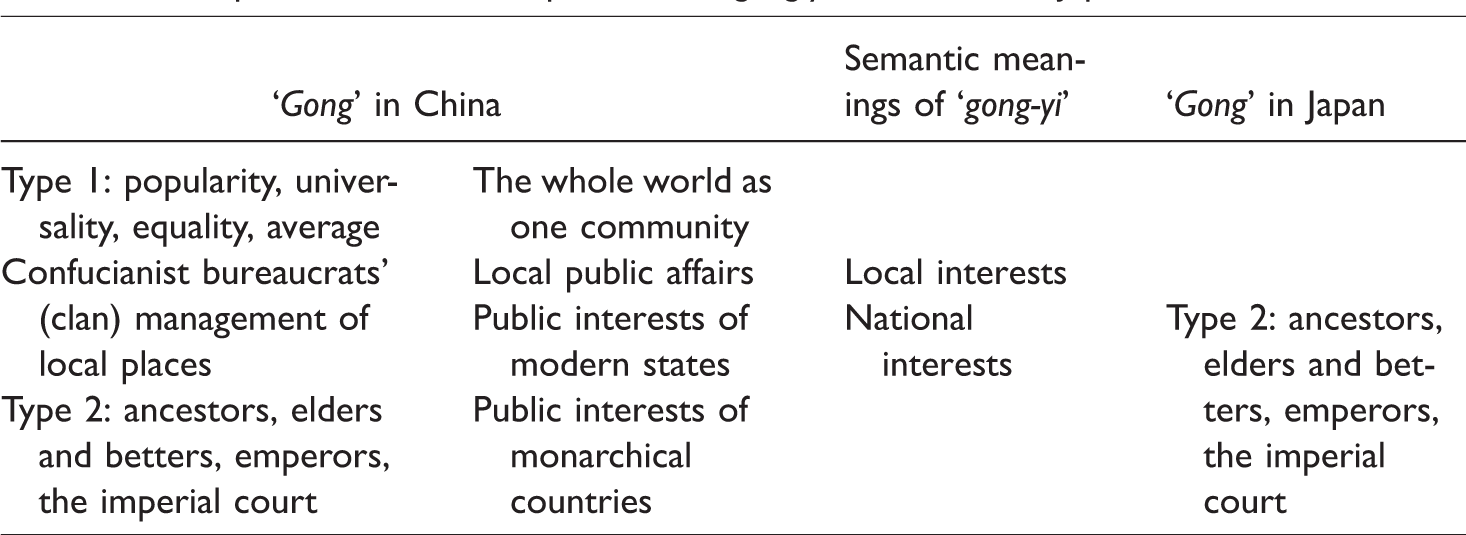
This series of complicated changes was quite different from the situation in Japan. For the sake of conciseness, the concepts of ‘gong-yi’ in China and Japan as well as their cultural relations with the traditional concept of ‘gong’ are listed as follows (see Table 1).
Comparison of semantic patterns of ‘gong-yi’ in China and Japan.
The folk meaning of ‘gong’
According to Table 1, we can have a clear understanding of the origins of ‘national interests’ and ‘local interests’ manifested in Chinese ‘gong-yi’. How, then, can we explain the meaning of ‘economic benefit’ indicated in ‘gong-yi’? Mizoguchi (2011: 87) mentioned that ‘the world’ and ‘the country’, the two basic concepts of ‘gong’, were actually only generalized ideas of governance and order stored and inherited by scholar-bureaucrats and literati, which was quite far from the common ‘gong’ concept and failed to reflect the real lives of ‘the masses’. One specific example put forward by Mizoguchi was the ‘gong-ye’ (public property) of patriarchal clans, yet it lacked specific explanations. Chen Ruoshui also found that families and patriarchal clans were in close relation with ‘gong’ and gave a detailed explanation of ‘gong-ye’, which reads: In Taiwan, the common property or fields used for ancestral worship are called ‘public property (gong-ye) for worship’; a similar shared patriarchal property or fields are called ‘gong-chang’, which is quite popular in the Hakka community. In Zhu’s Ancestral Rules of Chang’gou Village, Pi’ling City (Pi’ling, i.e. Changzhou City in Jiangsu Province) concluded in 1696, the public fund was named after ‘gong-ci’ (public ancestral halls). The original meanings of ‘gong-chang’ and ‘gong-ci’ were public funds for ancestral worship, but their functions were more than that, also used for patriarchal relief, education grants and outward investment. (Chen, 2006: 112) Ancestral temples are established to commemorate ancestors and uphold the spirits of Cheng Hao and Cheng Yi (two eminent neo-Confucianists in the Song Dynasty). They can also serve as a communicating place with the divinity and revered forefathers and women of moral integrity to promote civil morality. Tablets of our deceased forefathers have been preserved in the ancestral temple since the Song and Yuan Dynasties, spanning over four centuries and passed down for generations. To renovate the desolate ancestral temple, a Public Benefits Association was initiated to raise donations from clansmen through good negotiations and decorate it with magnificence of gold, which can comfort the spirits of ancestors and set the family style right. In recognition of public donations, names of contributors are inscribed as follows, in the hope that they will be forever remembered.
17
Regarding the system of ‘shares’ in patriarchal clans, Chen (1990: 138) interpreted this as the rules of ‘the status or share formulated according to the rules of housing distribution’, which were embodied in affairs such as the ‘dismemberment of family properties’, ‘group division of households’, ‘distribution of the profits of property used for worship’, ‘rotating support for aged parents’, ‘annual rotating management of property used for worship’, ‘allocation of sacrifice obligations’, and ‘the management of the patriarchal clan’s affairs’. Zheng (2009: 202) once quoted the records of ‘various public fields and mountains’ in Chen’s Ancestral Hall in Yinchuan County of Fujian Province to explain the evolution of the housing portions of patriarchal clans into shares. Lin Yueh-Hwa (1989: 108–109) also expounded on the complicated development of the mix of housing portions and shares through the description of the conflicts of Huang’s clan in Lin’s book Golden Wing.
Faure (2009: 265) pointed out that the shareholding system was widely practiced to manage properties of patriarchal clans in the 1750s, and that this probably had to do with the prevalence of ‘chit funds’. Ye and Lin (1998: 53–65) also found that the chit funds in Guangdong Province usually took the unit of patriarchal clans and were entitled ‘X Benefits Association’. ‘Chit funds’, also known as ‘bidding funds’ or ‘united funds’ (‘Rotating Savings and Credit Association’) are a kind of ancient private lending organization scattered widely in the rural areas of China. The initiator usually acts as the leader, invites some relatives and friends to gather at the appointed time and pay a certain amount of fees and then, in turn, transfers the funds to some member by means of drawing lots or bidding to finally achieve the goal of mutual support. When all the members have finished their shifts, a period comes to an end (see Chen, 2011: 154–172; Wang, 1935).
Based on current research, the combination of patriarchal clans and chit funds was quite popular during the Qing Dynasty (see Faure, 2009: 224–225; Freedman, 2000: 118; Liu, 1993: 264–266). Actually, a ‘Triple Benefits Association’ is a kind of chit fund.
19
In this sense, the ‘gong’ in He’s ‘Public Benefits Association’ refers not only to clan affairs, but also to the shared economic profits of shareholders for the reason that the patriarchal clan itself can be regarded as a kind of ‘corporation’ (Freedman, 2000: 94–97). Faure (2009: 232) concluded that such private corporations integrated two principles—‘properties for everyone’ and ‘rotation management’—and pointed out that this system was more popular in the field of ‘management of business and public institutions’ than in the operation of public assets of patriarchal clans. Zhang (2017: 230) also indicated that the system of ‘shares’ extended to the operation of charitable country estates, local elementary schools, local barns, temple property, charitable associations, and charitable halls, and formed the rotation system that characterizes the universal practices of traditional Chinese welfare. These observations all reflect an implied extension mechanism, namely ‘social organizations beyond the limit of families’ proposed by Zheng (2009: 208), who also gave this issue insightful expression: The family organization was not the only social organization in the social structure of the Ming and Qing Dynasties, but the most basic one. Various organizations beyond the limit of families in the Ming and Qing Dynasties evolved from or consisted of family organizations, which developed into factions among upper-level scholar-bureaucrats, associations of people with different surnames for shared properties among lower-level civilians as well as guild halls for the balanced development of certain industries and local groups among industrialists, businessmen and farmers.
20
(Zheng, 2009: 208)
The implied extension mechanism is vital in that it not only proves that the ‘gong’ of joint stock contained in the ‘gong’ of patriarchal clans can extend beyond the field of clans, but also means that ‘private thoughts and behavior logic have yielded institutional social outcomes’ (Luo, 2015: 17). Therefore, the ‘Gong-yi Tea Shop’ established in 1859 may be a shareholding commercial firm.
In addition, the aforementioned ‘Public Benefits Association’, reported on in the news-flash of the Shenbao Newspaper in 1886, was also a joint-stock organization, based on the specific rules of ‘one tael [usually refers to the Chinese tael, since 1959 standardized to 50 gram and a part of the Chinese system of weights and currency] per share, four meetings per year, issuing ten thousand shares per meeting, and eight years as a period’. Financial institutions independent of clan economies, such as ‘Gong-yi Foreign Firm’, ‘Gong-yi Pawnshop’ and ‘Gong-yi Financial Company’, then emerged one by one. In fact, there were still old-style Chinese private banks and shops entitled ‘Gong-yi’ during the period of the Republic of China (1912–1949). Jianglan Street in Guangdong Province was once a gathering place of old-style Chinese private banks and Chinese pharmacies. According to the street map of 1928, the No. 88 shop was called ‘Gong-yi’. 21 Moreover, we can still see the sotto portico (part of the building that stretches out to cover the sidewalk) of ‘Gong-yi Cai Ji’, built in the 1930s on Zhuhai East Road, Beihai City of Guangxi Province. 22 The shareholding system was so prevalent that David Faure (2009: 232) concluded that ‘the property right in the Ming and Qing Dynasties is such a kind of collective ownership’.
From the aforementioned facts, it can be seen that the concepts of Chinese ‘gong-yi’ originated from both the ruling philosophy and ideas of ethical governance embodied in the works of scholar-bureaucrats and literati as well as the clan values and financial traditions of civil lives, and its profound changes during the Ming and Qing Dynasties merit special attention. The aforementioned accounts are summarized in Table 2.
The semantic structure of Chinese ‘gong-yi’.
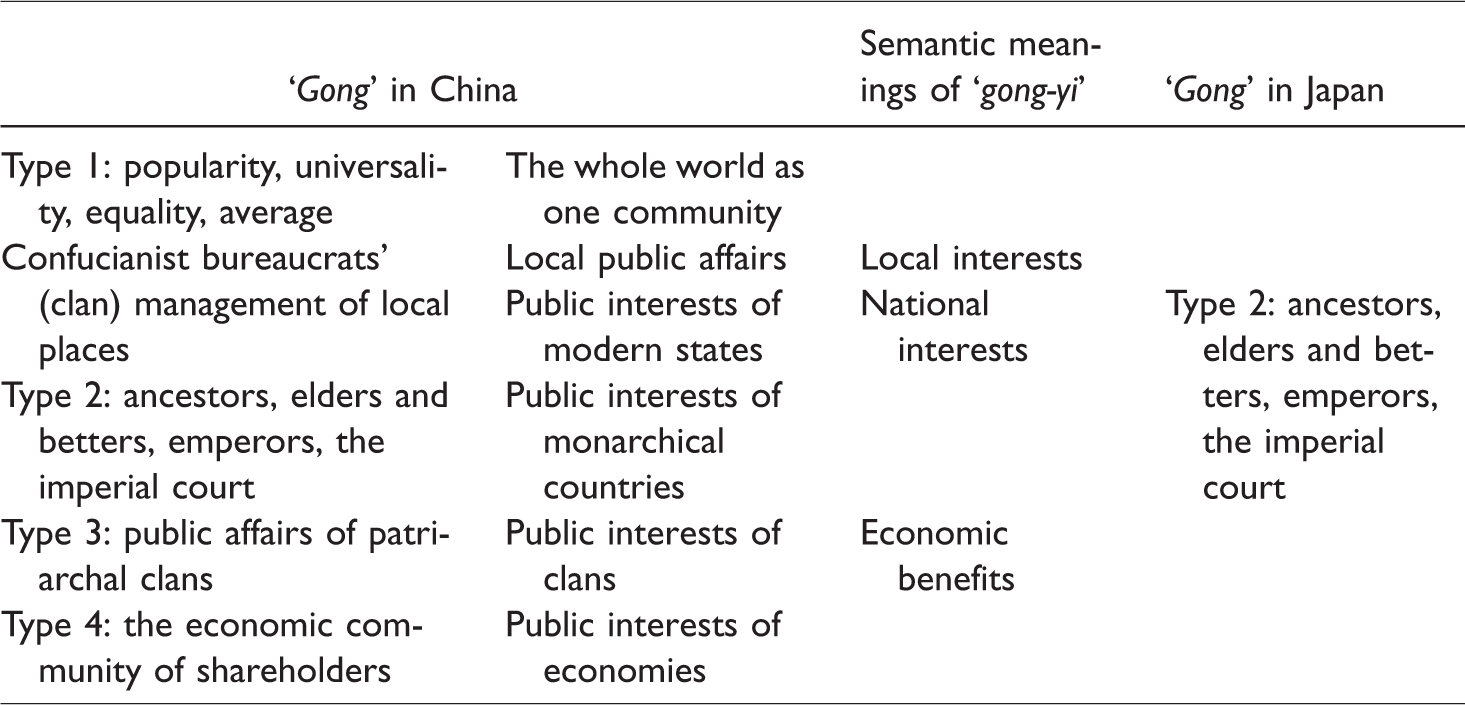
As we can see in Table 2, the ‘gong’ concept in Japan is relatively simple, merely including the second type of Chinese ‘gong’ system, namely the national ‘gong’ with regality-centered implications. As far as Mizoguchi is concerned, this structural difference directly determines the profound evolution of modern transformations in these two countries. Although the constitutional practice of the Meiji Restoration changed the state power structure, it did not radically exceed the highest-level ‘gong’ concept, namely ‘gong’ of the nation, but just made adjustments to the relation between the monarchy and the country. In contrast, China was totally different from Japan. After the late Ming Dynasty, ‘the whole world’ as the maximum of ‘gong’ gradually outweighed the royal power, and in turn evolved into resources providing regime legitimacy to modern countries (Mizoguchi, 2011: 7). In other words, the abstract ‘gong’ concept needed to be transformed into the tangible ‘national’ system. 23 Therefore, how to reconstruct a compatible public and private relation became the logical focus of realizing the transformation, in which the logical relation and inherent tension among individuals, local places, and the state generally determined the semantic reconstruction pattern of Chinese ‘gong-yi’ after the Reform Movement of 1898.
The semantics of ‘gong-yi’ after the Reform Movement of 1898
The earliest record of ‘gong-yi’ that can be found in the ‘Full-Text Database of Journals in the Late Qing Dynasty (1833–1911)’ 24 appeared in 1903, and its frequency increased year after year, thus becoming a high-frequency term after 1908. During this period, the Qing Government took initiatives to practice new policies, abolished imperial examinations, and prepared for constitutionalism. Meanwhile, waves of uprisings were widespread all over China, and the revolution was waiting in the wings, until the Revolution of 1911 abolished the imperialism, which could be described as ‘an unprecedented change in the past five thousand years’. From this it can be seen that it was in these volatile ten years that the previous patterns of Chinese ‘gong-yi’ and Japanese ‘gong-yi’ interacted with one another and became popular. What, then, were the main contents of ‘gong-yi’ during this period?
Local public affairs
Firstly, the context of the listed ‘local benevolent deeds’ in the aforementioned Chen Yindong’s gravestone inscription can still be applied to indicating the responsibilities of traditional elites over local affairs. In 1902, it was reported in the Shenbao Newspaper that the gentry and businessmen in Guangzhou donated money to education ‘for local gong-yi’ (Shenbao Newspaper, 1902). In 1908, Li Deqing and his brother, who were gentlemen from Tianjin, established a private elementary school, which was praised as ‘beneficial to the hometown’ and ‘devoted to gong-yi’ (Zhili Education Magazine, 1908). In the same year, a gentleman in Shunde County of Guangdong Province was criticized by News Illustrated for undermining the local smoking-quitting association. The opening line of this newspaper article reads that “The gentry should be a paragon of the village, and those who not only discourage the ‘gong-yi’ cause [local benevolence] but also undermine its development are evil, which nobody will approve” (News Illustrated, 1908), reflecting the general expectation regarding the local gentry’s responsibility.
Meanwhile, with new policies introduced, a series of measures such as changing mores, building schools, starting businesses, disciplining policemen, initiating military conscription, and promoting local autonomy were widely adopted and gradually became important ingredients of local ‘gong-yi’ (public affairs). In 1905, some patriots in Xiaoshan District of Hangzhou City launched a ‘Public Benefits Association’ to improve local corrupt customs (Shaoxing Vernacular Newspaper, 1905). In 1909, a man named Wei Yongyu came back to China with his newly invented knitting machine after finishing his studies in Japan and started a shareholding factory in Jianzhou County of Sichuan Province (now Jiancheng County, Jianyang City of Sichuan Province). An essay published in The Universal Progressive Journal remarked that “As Mr. Wei is able to invent machines, we can say that he is concerned with current affairs. Nowadays, the shareholding system is more appropriate to help people discard their selfishness and work together for ‘gong-y’, so as to improve local people’s well-being, thus delivering a blessing to the poor people and the local place” (The Universal Progressive Journal, 1909). In 1911, farmers represented by Zhu Baokui in Jiashan County of Zhejiang Province established schools, and the local government complimented them: “These farmers, who make a living by ploughing with physical strength, know the importance of education, and are devoted to ‘gong-yi’ to develop education by pooling their hard-earned money” (Zhejiang Education Communique, 1911).
It can be seen that the semantic component of ‘local gong-yi’ not only inherits its original semantic meanings but also presents new connotations closely related to political transformations during the late Qing Dynasty. Furthermore, the generation of those who practiced ‘gong-yi’ were becoming increasingly diverse, including the traditional gentry, patriots, people with international educational backgrounds, and even common villagers. Actually, one core objective of the new policy was precisely to enlighten and educate civilians on the ideas that everyone is entitled to rights and ‘everyone has a stake’ in the country. 25
Enlightening the people
At that time, the common channels for enlightening the masses were newspaper reading clubs and speech activities. News Illustrated reported in 1906 that when Zhou Fu, governor of Guangdong and Guangxi Provinces, passed by the southern areas of the middle and lower reaches of the Yangtze River, he saw ‘widespread domestic and foreign newspaper offices, and even slaves and pawns read newspapers’, and felt that ‘everyone is fully aware of civic obligations and gong-yi, thus being qualified for constitutionalism …’ (News Illustrated, 1906). In 1907, the Yang family in Hongya County of Sichuan Province set up a ‘Gong-yi Book House’, giving people free access to their collection of ancient and modern books. It was recorded that ‘people could read and copy as they like, and different kinds of books and newspapers were purchased to broaden people’s horizons’ (The Universal Progressive Journal, 1908). In 1911, three patriots were planning to organize a newspaper reading club at Huiyouxuan [a place for friends to gather] Teahouse in Beijing, and the Brief Introduction Illustrated (1911) praised them as ‘devoted to gong-yi’. The trend of newspaper reading began in 1898 and continued until the Republic of China was established in 1912.
It is worth noting that the cultivation of citizens included not only males, but also females. Therefore, a wave of emancipating women and developing women’s education was also on the rise in 1898. In 1903, Liu Mengyang established the ‘Independent Feet Emancipation Association’, which was later renamed the ‘Gong-yi Feet Emancipation Association’ to exhort women to give up foot-binding for free (Ta Kung Pao, 1904). ‘Gong-yi’ carried the meaning of ‘benefiting the masses’ (Ta Kung Pao, 1903). In the same year, Du Qingchi started the ‘Gong-yi Female School’ on Fengyuan West Street in Guangzhou, which was later renamed the ‘Gong-yi Female Normal School’, aiming at ‘cultivating women in aspects of virtue, intelligence and physical education and making them elites in the society as well as examples in families’ (Du, 1918). In 1906, two female patriots, Li Yiqing and Xie Baoyun, were reported on by the Illustrated Anecdote Newspaper for their launching of the Women’s Education Association, which ‘aimed at supporting women’s education and was for everything related to gong-yi’ (Yin, 1906). It can be seen from ‘benefiting the masses’ to ‘cultivating social elites’ that females were no longer completely subordinate to males. They also had rights and responsibilities for national construction and social service, and they could become patriots just like males.
This series of practices was accompanied by the prevalent Community Theory at that time, advocated by Liang Qichao. In 1902, the public notification of his Sein Min Choong Bou, founded in Yokohama, Japan, announced that ‘This newspaper focuses on education and targets the public interest and public well-being (gong-yi) of the Chinese people’ (Sein Min Choong Bou, 1902). Later, the one hundred-thousand-word book, On New Citizenship by Liang was serialized in this newspaper, presenting a systematic explanation of a complete Community Theory on cultivating citizens. This theory placed great emphasis on the cultivation of ‘social morality’. In Liang’s opinion, citizens’ disregard of ‘gong-yi’ results from their lack of social morality, which is further due to the fact that the absolute monarchy of several thousand years monopolized the whole nation (including the people contained therein) and regarded the people as the private assets of emperors (Liang, 1999c). Therefore, the task at that time was to help Chinese citizens realize the difference between ‘the nation’ and ‘the imperial court’. ‘We should be fully aware that the nation is the public property shared by everyone, while the imperial court is merely the emperor’s private assets’ (The China Discussion, 1901: 157–160). “As everyone has a share, all of us shall shoulder our responsibility and work in concerted efforts to lead the nation on the ‘Road of Gong-yi,’ which is developed domestically and competitive internationally” 26 (Yu et al., 2005).
Being patriotic and gregarious
As the Community Theory became popular, the term ‘gong-yi’ characterized by being patriotic, gregarious, and unselfish gradually predominated in the ideological sphere. ‘The New Decrees During the Reign of the Qing Emperor Guangxu’, published during the New Deal period 27 , listed ‘gong-yi’ as a compulsory discipline of universities and explained that ‘it specializes in teaching people laws and rituals of public interest and discouraging selfishness’. In Japan it is called ‘sociology’, and in China it is translated as ‘Community Theory’. 28 In 1903, Zheng Guangong and his friends started the World Gong-yi Newspaper in Hong Kong with a special statement attached: ‘On behalf of the national citizens, this newspaper is a public instrument instead of a private one speaking for certain people’ (World Gong-yi Newspaper, 1905). Contemporaries also began writing essays to discuss what kind of practices could be called ‘gong-yi’.
In 1906, two essays on the discussion of ‘gong-yi’ and ‘kindness’ were published in Treasure Domestic Property. The former essay maintained that worshiping the Buddha with burning incense, distributing alms to monks, and freeing captive animals in temples were all ‘worthless kindness’ and that giving alms to beggars could only be regarded as ‘small kindness’, while only actions out of patriotism and humanity could be called ‘gong-yi’ (Treasure Domestic Property, 1906a). The other essay expressed the same opinions and cited a specific example: there was a rich man named Zhang Anren in Jinhua Prefecture of Zhejiang Province. He hoarded grain during the harvest and built bridges and roads during the famine to help improve the harvest, rather than opening the granary to help the poor. The author commented at the end that ‘This kind of generous behavior shows not merely kindness but gong-yi for people’ (Treasure Domestic Property, 1906b), vividly expressing the idea ‘give a man a fish and you feed him for a day; teach a man to fish and you feed him for a lifetime’ and regarding it as the standard by which to differentiate ‘kindness’ from ‘gong-yi’.
In 1907, Wang Bingkun’s long essay, ‘The Comparison of Contributions to Gong-yi between Confucianism and Christianity’, was published in The Globe Magazine. Wang stated: Although Confucianism has played a dominant role in people’s mindset cultivation for several thousand years, it cannot help people discard their selfishness, from which we can see its utility and understand the reason why Confucianism lacks gong-yi. Then, how about Christianity’s role in gong-yi of those Christian countries? Countless examples of gong-yi can be listed. (Wang, 1907: 24–26)
In the end, the author indicated that emancipating slaves, helping disaster-stricken victims, establishing hospitals, and fostering orphans were all ‘small acts of gong-yi’, and only dispatching missionaries was a ‘great act of gong-yi’, which could save their souls and change their bad habits of ‘being self-centered and showing no concern for the community and the nation’ (Wang, 1907: 24). Therefore, it can be observed that at that time, people’s understanding of ‘gong-yi’ was largely influenced by the Community Theory. Based on the facts above, it can be predicted that although ideas of ‘modern gong-yi’, namely ‘teaching others to fish’ and paying equal attention to rearing and education, were proposed during the Westernization Movement (Huang and Wang, 2009), it is highly possible that these ideas were actually incorporated into the semantic structure of ‘gong-yi’ in the early 20th century, when new citizens were being cultivated.
Local autonomy
Coinciding with shaping new citizens, the political practice of fostering public participation in real governance had been popular in China since 1898. In February 1898, the Hunan Security Bureau and Hunan Society were established, which were the two earliest local autonomous organizations in modern China. 29 In 1903, Gong Fazi wrote an essay in which he stated, ‘In order to teach people to develop the idea of performing social responsibilities, the government shall not [author’s note: ‘not’ may be a typo] give them the chance to get access to public affairs. In this way, they will not merely rely on the nation, and pursue personal interests regardless of the national gong-yi’ (Gong, 1903: 5). He pointed out clearly that autonomy was the basis of representative politics. Later, other writers such as Kang Youwei, Liang Qichao, Zhang Qian, and Sun Yat-sen also wrote essays to discuss the relationship between autonomy and constitutionalism. Liang believed that ‘all the great forms of government advocated autonomy’ (Liang, 1999c: 682).
In 1906, Duan Fang and Liu Zhi put local autonomy on the agenda as the basis of preparatory constitutionalism. 30 In the same year, an autonomous group entitled ‘gong-yi’ emerged from groups such as the ‘Jinshi Gong-yi Association’ jointly launched by the Capital General Office of Police as well as local businessmen and gentry. In this way, they hoped to connect government and business to exchange information and finally achieve favorable autonomy results (Political Art Journal, 1906). Another example was the ‘Students Gong-yi Association’ established by students studying in Japan. The association produced self-management articles for students studying in foreign countries and issued graduation certificates to preserve ‘gong-yi’ in academia (Sein Min Choong Bou, 1906). Furthermore, Chen Xunzheng, a gentleman in Ciyi (now Cixi City) of Zhejiang Province, together with others, established the ‘Cixi Fellow-Townsman Gong-yi Association’ to ‘enable local people to shoulder local responsibilities, facilitate communication and unite villagers’ (The Universal Progressive Journal, 1906), thereby paving the way for local autonomy.
At the end of 1908, the Qing government followed the example of Historical Records of Cities, Towns and Villages (in Japan) and published ‘Regulations on Local Autonomy of Cities and Townships’, specifying that ‘local autonomy specializes in the local gong-yi cause, with official governance playing a supplementary role’. The listed ‘local gong-yi causes’ involved education, sanitation, road engineering, agriculture, industry, commerce, and other fields related to the well-being of the village, town, or city. Accordingly, ‘gong-yi’ became a high-frequency term in the context of autonomy and triggered a discussion on the jurisdictions of local ‘gong-yi’ and autonomous offices (Xu, 2004: 3–4).
In 1910, it was stated in the Hunan Local Autonomy Vernacular Newspaper that local ‘gong-yi’ affairs such as education, employment encouragement, and speeches should be included in autonomy lists (Hunan Local Autonomy Vernacular Newspaper, 1910). In the same year, Yu Yurui, leader of the ‘Gong-yi Preservation Association’ in Wuchang County, announced that he would draw a clear line with local autonomous offices (Datong Newspaper, 1910). The ‘Gong-yi Seminar’ in Jiangning (now Nanjing City) also issued ‘Brief Regulations’, announcing that ‘gong-yi (public) affairs unseen or unfinished by the department of new policies would be handled by the seminar through research and cooperation’ (Jiangning Study Affairs Magazine, 1910). In 1911, the Jiangsu Governor, together with local people, drafted ‘Special Regulations of Local Autonomy Regarding Private Gong-yi Organizations’ and submitted it to the imperial court (Jiangsu Autonomy Public Newspaper, 1911a), in which six cases were specified as private causes and excluded from the public sphere (Jiangsu Autonomy Public Newspaper, 1911b). Various differences and discussions show that the roles of the departments enforcing new polices and private ‘gong-yi’ organizations were overlapping, and they also manifest the profound meaning of local co-governance at the beginning of modern Chinese ‘gong-yi’.
The rights of railways
After the First Sino-Japanese War (1894–1895), Japan was allowed to invest in and set up factories at Chinese treaty ports. Western powers followed suit and, one by one, began building railways and mining in China. As a result, various powers fought for railway rights and set off a frenzy of carving up China. Although the Qing government recognized the importance of building roads, it had to borrow money to build roads due to a shortage of funds and the impotent commercial circle. In January 1897, the Qing government in Shanghai established China Railway to be in charge of building roads with foreign loans. In August 1898, the Mining Railway Administration was established. The Qing government briefly changed its mind and encouraged railways to be managed by businessmen. However, only a month later, the Qing government and the Ministry of Foreign Affairs issued a joint announcement that the railway construction would be planned and controlled by the central government (Mi, 1963: 182–340). Due to such upheavals, China’s railway rights were nearly lost, which sparked great anger and caused a wave of Railway-Rights Recovery Movements to arise all over China.
The first group to protest was patriotic gentry and businessmen in Hunan, Hubei, and Guangdong provinces. In 1903, these people sought to recover the building rights of the Canton–Hankow Railway from the USA, and this marked the beginning of the Railway-Rights Recovery Movement. In the same year, the Qing government abolished the Mining Railway Administration, established the Department of Business, and empowered it to manage railways so as to encourage businessmen-managed railways (Cui, 1993; Quan, 1991; Rui, 1995). From then on, commercial railway companies were established one by one in various provinces. When they raised donations and publicized their companies, ‘gong-yi’ became a high-frequency term to stand for national interests.
In 1904, Yixi Chen, a Chinese citizen of Taishan origin residing in the USA, came back to his hometown and devoted himself to the independent movement of Xinning Railway. In 1905, Chen returned to America and made speeches to motivate overseas Chinese to invest in Chinese railway companies with the slogan ‘Advocating Gong-yi, Recovering Rights’ (Chung Sai Yat Po, 1905a). At that time, Chung Sai Yat Po praised Chen as a gregarious, ‘gong-yi-spirited patriot who could recover the rights of a town’ (Chung Sai Yat Po, 1905b). In the same year, Ninghai Port in northern Taishan City was renamed ‘Gong-yi Port’, which meant benefiting the masses. It became an important town along the Xinning Railway (Lei and Liu, 1985: 28–29; Liu et al., 1980: 30–32). Based on the abovementioned ‘gong-yi’ expressions, ‘gong-yi’ in the context of railways contains both the specific local interests and abstract collective interests.
In October 1906, the Ministry of Business was changed to the Ministry of Agriculture, Industry and Commerce. In addition, the Postal Communication Department was established to take charge of ‘ships, railways, electricity and postal services’. As for building roads with loans, the Postal Communication Department was equivocal, but it confirmed that commercial railways should be nationalized, which soon triggered discussions on government control and private control of railways (Su, 2005: 1–19). Therefore, ‘gong-yi’ in the context of railways swung between local interests and national interests with increasing frequency. In 1907, Yuen-Nan Journal praised the local Public Association for its dedication to ‘gong-yi’ and its concern for local ‘gong-yi’ causes (local public affairs). However, the society mainly focused on the issue of the Burma–Tengchong Railway (Yuen-Nan Journal, 1907), which made the railway issues local affairs. In 1908, when speaking of the privatization of the Canton–Hankow Railway, Zhang Zhidong objected that provinces were merely concerned about local interests, ‘regardless of gong-yi, thus impeding the overall development’ (Zhang, 1998: 9674). From the aforementioned facts, it can be seen that ‘gong-yi’ in the context of railways swung ambiguously between local interests and national interests with the dividing line being unclear. 31
Economic benefits
The last kind of ‘gong-yi’ follows the aforementioned financial semantics and is used to refer to common economic benefits. In 1908, Henan Vernacular Science Journal published a ‘Gong-yi Bank’ advertisement with the full text as follows: The Bank is called Gong-yi Bank, located in Lunan of Hufang Bridge.
32
The bank has a total capital of one million tael of silver, which can be regarded as affluent and reliable. The Bank’s business is divided into two categories, a lending business that specializes in remittances and loans on security, and a savings business that specializes in receiving sporadic deposits. (Henan Vernacular Science Journal, 1908: 2)
Modern ‘gong-yi’ and its changes in the Ming and Qing dynasties
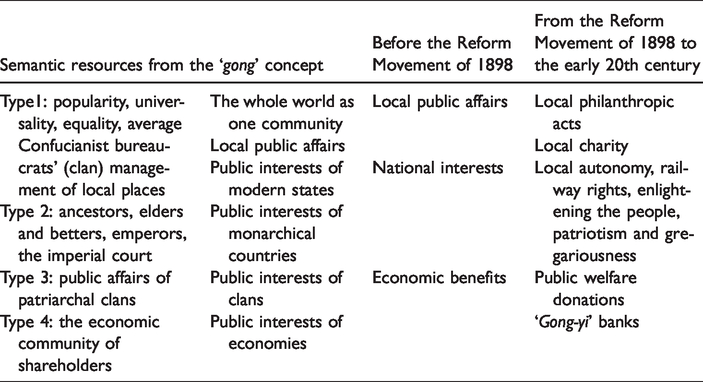
It can be seen that apart from extending the meanings of ‘local public affairs’ and ‘economic benefits’, other new usages were all directly related to political transformations during the last ten years of the Qing Dynasty. The semantic structure of the concept ‘gong-yi’ before and after the Reform Movement of 1898 is summarized as follows (see Table 3).
Changes in the semantic structure of ‘gong-yi’ in China from the 19th century to the early 20th century.
It is generally believed that the meaning of ‘local public affairs’ and its associated recognition of individual ‘private interests’ and the idea of ‘contributing to public interests via private accumulation’ during the late Qing Dynasty intentionally or unintentionally inherited or projected traditional resources of the late Ming Dynasty or even earlier dynasties. Huang Zongxi was even praised as the ‘Rousseau’ of China during this period, enshrined together with Gu Yanwu and Wang Fuzhi at the Confucius Temple (He, 1991: 71–89). In this regard, different scholars’ choices of words and sentences imply subtle differences in their tendencies concerning historical views. The choice of words such as ‘inheritance’ often means they regarded the dramatic changes in the late Qing Dynasty and the early Republic of China as a historical expansion of China’s traditional anti-authoritarian ideology, while the choice of ‘projection’ and ‘reinterpretation’ is more often regarded as Chinese scholars’ efforts to promote the localization of Western democratic thoughts. This article is not intended to engage in this macro issue, but tries to understand the complex relations between the ‘gong’ concepts of the late Ming and late Qing Dynasties, and how they shaped the concept and practices of ‘gong-yi’ in modern China by drawing fully on different perspectives and voices to balance historical narratives, thereby identifying three aspects that have not received enough attention from academia.
The first aspect is the dispersion of the ‘gong’ in daily life. Judging from the current data, this ‘gong’ concept embodying an economic community was closely related to clan property. It was not only the jointly owned asset-sharing system, but also a financing method of taking control by turns, which continuously infiltrated and was dispersed in the operation of various public affairs during the Ming and Qing Dynasties, thereby intermingling with other types of ‘gong’ and giving birth to a uniquely local usage of ‘gong-yi’. As an important type of ‘gong’ concept in China, it merits further study in the future.
The second aspect is the transnational generation of the modern concept of ‘gong’. The popular enlightenment spirit of ‘one country’s public interests are the accumulation of all private interests within’ in the early Meiji period in Japan was very similar to that of ‘accumulating private interests to contribute to public well-being’ proposed by Gu and Huang in the late Ming Dynasty. Studies have shown that some adherents of the late Ming Dynasty who immigrated to Japan later, such as learned scholars Zhu Shunshui and Chen Yuanyun, had close connections with modern ideas in Japan (Han, 2008; Xu, 2004; Zhong, 1988). It remains to be studied in detail to what extent these connections and the similar public–private concepts mentioned above implied possible relevance between Japanese society and the Chinese intellectual community in the late Ming Dynasty and their comprehensive role among the people of the late Qing Dynasty. At the same time, they also suggest that the formation of the modern ‘gong’ concept in China actually involved a complex and multiple transnational process.
The third aspect is the dual relationship of ‘local regions and the state’. It is embedded in the idea that ‘local affairs should be handled by the local government’ in the late Ming Dynasty and expectations for higher autonomy originating from expanding local political and economic forces in the late Qing Dynasty. On the one hand, the elites wanted to fully release the power of scholar-officials in the ‘villages’ to limit the central government. On the other hand, they also hoped that ‘local regions’ could become the middle link between individual autonomy and the democratic system, namely extending the logic of ‘privatizing affairs of a county like family affairs’ to ‘privatizing the country like one’s own’, with a view to inspiring patriotism. Such double expectations left the discourse leeway in arguing for the legitimacy of ‘gong’ when the local interests conflicted with the national interests.
This leeway was particularly evident during the forming period of the concept ‘gong-yi’ in the modern sense from the Reform Movement of 1898 to the early 20th century. It can be seen from Table 3 that the six new meanings in the late Qing Dynasty all contained the intended meaning of the modern state, jointly forming centripetal energy towards ‘national interests’. However, when taking a closer look, one may find that some semantic meanings of ‘local public welfare’, ‘advocates for autonomy’, ‘donations for public welfare’, and ‘railway rights’ were closely related to local interests. In fact, the dichotomous relationship between national interests and local interests contained the logical connection and internal tension within the six new semantic meanings.
Let us first talk about the logical connections. In the last ten years of the Qing Dynasty, when ‘gong-yi’ gained popularity, the Qing court had to implement the New Deal and prepare for constitutionalism after the failure of the Reform Movement of 1898 and the Gengzi Incident. At the same time, a large number of scholars who had once supported constitutionalism lost confidence in the Qing court and turned to the anti-Qing revolution. Constitutionalism and revolution then became two competing approaches to transforming the society throughout this process (Luo, 2012: 4–27). In fact, regardless of the route to be taken, they all pointed to future democracy, with voices of and discussions on setting up the parliament becoming the most critical talking points.
However, it is clear that national conditions in China were unprepared for implementing a parliamentary system at that time. Most ordinary civilians were still illiterate, with little sense of civil rights, let alone the capabilities or habits needed to participate in governance. Therefore, many visionaries did not advocate setting up a parliament immediately, but suggested that local autonomy experiments be conducted in some places while vigorously carrying out educational practices of ‘enlightening the people’. These were the two major approaches to fostering the foundations of democracy at that time and were carried out simultaneously.
In terms of local autonomy, the idea Yan Fu and Gong Fazi proposed of regarding it as the ‘basis of representative politics’ was actually very common at that time. Not only did pro-constitutionalism scholars such as Kang Youwei and Liang Qichao repeatedly make similar remarks, but pro-revolutionary publications such as Zhejiang Chao also expressed the opinion that ‘everyone should give full play to his own talent and strength, devoting himself to the country, the province, the prefecture, the county, and the township as if these were all his own property, so as to save the people in his own country, province, prefecture, county, and township’ (Zhejiang Chao, 1903). It can be seen that the idea of gradually cultivating, honing, and finally refining modern national consciousness and the concept of community via the principle of ‘hierarchical order’ had won wide support from people with different political views.
As for enlightening the people, this began to be popular between 1901 and 1903. At that time, there emerged a large number of newspaper-reading associations, lecture halls, speeches, and even pictorials, vernacular newspapers, novels, operas, and dramas that promoted the enlightenment of civilians in various forms throughout the country. Practitioners of this ‘gong-yi’ enlightenment movement were not only learned scholars such as Kang and Liang, but also various persons with ideals and integrity and even merchants, civilians, and women (Li, 2001: 52). At the same time, the enlightened people were no longer limited to intellectuals, but extended to women, children, and even disabled people, directly prompting the shift from charity to modern concepts of ‘teaching others to fish’ and ‘paying equal attention to rearing and education’.
In this sense, the neoteric people in the late Qing Dynasty can be described as the first Chinese public welfare group in the modern sense. Although some of them held office in the court, some were out of office, some were pro-constitutionalism, and some pro-revolution, and some had vague or constantly changing stands, yet they all shared the dream of invigorating China by following the Western example and firmly believed that this dream could only be achieved through political reforms. The whole set of theories underlying the reforms was the community theory, so ‘gong-yi’ embodying ‘national interests’ was not only embedded in the logical construction of public–private issues and the community–individual relationship, but also implemented in the specific design of transforming grassroots society. During this period, ‘gong-yi’ was used interchangeably with ‘community theory’.
So far, it can be seen clearly that the several new semantic meanings of ‘gong-yi’ all contained the constructive intentions of modern countries, because their manifestation of ‘national interests’ was endowed with the core theory and specific contents of supporting the transformation of state systems. It is particularly worth noting that although ‘gong-yi’ in the railway context appeared mostly under the banner of national interests, its actual operation shows that the discourse of local interests was often more appealing. Such ‘disagreements of slogan and action’ occasionally occurred when people were speaking of ‘local public welfare’, ‘autonomous wave’, and ‘public welfare donations’. To understand the internal tension, we need to trace back to the discussed period.
A large number of studies have shown that localism centering on provincial awareness was very popular in the late Qing Dynasty (Hu, 2011: 1–23; Ma, 2006; Xu, 2015). During the reigns of Emperors Xianfeng and Tongzhi, in response to the Taiping Heavenly Kingdom’s uprising, the Qing government enlisted villagers, offered weapons, and organized military drills, which enabled local governors to obtain real military power. As a result, the military power was transferred from the central government to local governments, gradually leading to the heavy weight of local power and little weight of the central authority, which academics termed ‘heavy weight of the outside and little weight of the inside’ (Li, 2012: 363–364). In the late period of the Taiping Heavenly Kingdom Movement, the Westernization Movement emerged. Under the system of ‘co-sponsorship between government and business, government supervision and business management’, regional governors and local merchants were more closely related and even became ‘one without clear distinctions’ (Hu, 2011: 19–20). Independent local finance plus independent military power constituted the strong power of the ‘villages’ in the late Qing Dynasty that Mizoguchi (2011) mentioned.
At the same time, after the First Sino-Japanese War (1894–1895) the Westernization Movement was replaced by reformist trends. The new idea of invigorating China aimed to rebuild centralized modern power with stable politics and independent sovereignty, which had been adopted as new national policies after 1900. In 1906, the Qing court prepared for constitutionalism and implemented reforms of its official system to recover the military and political power previously delegated to local places (Li, 2012: 363–411). Therefore, at least from the reign of Emperor Xianfeng and Tongzhi to the period of official reform, local forces continued to be on the rise, and this period also included reformist trends’ efforts to integrate the state itself (the whole country) and its constituents (national individuals) (see Liang, 1999b: 2061). As Xu Jilin concluded: In the late Qing Dynasty, there were two conflicting trends centering on the goal of invigorating China by following the example of western modernization: firstly, with the emergence of modern nation-states, the government tried to strengthen centralization and enhance its fiscal capacity via reforms; secondly, in the name of local autonomy, provincial governors tried to achieve regional autonomy with the support of local gentry. Such a feature is reflected in both the Westernization Movement and the New Deal in the late Qing Dynasty. (Xu Jilin, 2015: 30)
In the last few years of the Qing Dynasty, measures such as official reforms were taken to curb local forces. As a result, the state power was increasingly engaged in local affairs, while the power of local governors gradually shrank. However, the centralization of power had not been strengthened, but weakened due to intensified conflicts in the ruling cliques, leading to a situation in which ‘the central government cannot control local places and the local government cannot afford to pledge loyalty to the central government’, which was described by historians as ‘little weight of both the inside and the outside’ (Guan, 2007: 29–30; Li, 2012: 13–14, 410). Most interesting is the fact that the progression from ‘heavy weight of the outside and little weight of the inside’ to ‘little weight of both the inside and the outside’ coincided with the period of ‘reconstruction and popularization’ of the ‘gong-yi’ concept, which led to the dynamic tension of local and national components in its semantic structure, instead of increasing national components in the ‘gong-yi’ of Japanese-style reforms.
Conclusion and discussion
In contrast with traditional perspectives interpreting the origins of China’s ‘gong-yi’ from ‘righteous deeds’, ‘chivalrous deeds’, and ‘benevolent deeds’ in the traditional society, or perspectives regarding public welfare and charity as sub-phenomena within the modernization process since the Opium War (1839-1842), this paper starts from the perspective of concept and thought and traces the evolution of ‘gong-yi’ in the Chinese context as well as its synchronized concept re-creation and social reality, thereby arriving at three main findings and research implications as follows: firstly, the evolution of the ‘gong-yi’ concept in modern China was actually a sub-process embedded in the long process of continuous reconstruction of public–private issues and community–individual relationships. Therefore, its formation involved long-term thought changes and complex trans-national interactions, rather than simply originating from Japan through reforms. In fact, the use of ‘gong-yi’ in Chinese appeared at least as early as the middle of the Qing Dynasty, with three usages relating to economic benefits, national interests, and local public affairs. Its semantic resources came from both ‘gong’ (meaning public) in the elites’ ideas and the daily practices of the people. Among them, the semantic indication of ‘national interests’ very likely arose from Chinese translation of the works of Western international law by missionaries, namely Elements of International Law. This translation was immediately introduced to Japan, and reshaped the concept of ‘gong-yi’ in the Japanese vocabulary to a large extent, then returned to China at the end of the 19th century with the publication of works promoting reformation thoughts, such as the Annals of Japan. The concept then collided with the local usage of ‘gong-yi’, the evolving public–private concept and the rapidly-changing social reality in the process of reinterpretation and actual use by various people, thereby giving birth to a series of new semantic meanings.
Secondly, the modern trait of new ‘gong-yi’ semantics in the late Qing Dynasty lay, on the one hand, in the ‘national interests’ it represented being endowed with community theory and reform practices supporting the political transformation, and on the other hand, carrying the actual tension between the country and local places in this process of transformation. Mainstream views then held that the parliamentary system required by the modern state should be accompanied by ‘new nationals’ with modern rights awareness and nationalism values. Therefore, the educational movement of ‘enlightening the people and promoting civil rights’ became the core underlying the concept and practice of the Reform Movement of 1898 and the New Deal in the late Qing Dynasty, including intellectual cultivation among women and vulnerable groups. Modern concepts such as ‘teaching others to fish’, placing equal emphasis on rearing and education, as well as grassroots autonomy were integrated into the discourse of ‘gong-yi’ that contributed to the nation and people, transforming charity that originally played a complementary role in governance into public welfare, which led social changes proactively. In this process, the intricate dynamic relationship between the state power and local forces as well as their competition for ‘public’ resources led directly to different divergences of ‘gong-yi’ semantic meanings towards ‘national interests’ and ‘local interests’.
Thirdly, if the modern use and popularization period of ‘gong-yi’ in Chinese is adopted as a perspective from which to understand the transformation of traditional charity into modern public welfare, then non-profit practices conducted by reformists after the Reform Movement of 1898 and various ‘patriots’, including merchants, civilians, and women, based on their civic awareness, can be described as the beginning of modern public welfare in China. These individuals, despite their different identities and even different political opinions, shared community concepts that threaded common interests of the public and national government together. Thus, at that time, ‘gong-yi studies’ was equated with ‘community studies’ or ‘sociology’, which offered the most practical ‘public’ resources to the transformation of ‘the world’ to the ‘nation’ and also provided a theoretical basis for grassroots soil cultivating modern institutions. In this sense, Chen Ruoshui’s ‘new public consciousness’ driven by ‘gong-yi’ in the late Qing Dynasty was based on its clear sense of the modern state and concrete efforts to promote transformation, and it also includes the local isomorphism of the society and state. The question of to what extent this isomorphism shaped Chinese citizenship in a particular cultural context may stimulate a sense of concern for local endogenous attributes when discussing philanthropy and public spirit today.
Footnotes
Acknowledgements
I thank two anonymous reviewers for their valuable suggestions. In addition, I thank friends Meiqi Xu, Tzu-Hsuan Huang, Jiangang Zhu, Yanchun Jing, Zeying Cai, Yuanze Zhong, Kyoko Nagura, and Guangzhou School of Philanthropy for their great help in historical material collection and article modification.
Declaration of conflicting interests
The author(s) declared no potential conflicts of interest with respect to the research, authorship, and/or publication of this article.
Funding
The author(s) disclosed receipt of the following financial support for the research, authorship and/or publication of this article: This research was supported by the China Charity Alliance’s ‘Bamboo Program’ (Grant Number: 2016ZLJH-251), a Joint Project with the Guangdong Planning Office of Philosophy and Social Science for the 13th ‘Five Year’ Plan, which was entitled ‘Cantonese Patriots and the Formation of Modern Chinese Gong-yi’ (Grant Number: GD16XLS06), and the Seiyu Kiriyama Foundation for Young Scholars of Social Science and Humanities at Sun Yat-sen University (Grant Number: 1709001).