




Abstract
Nearly all past studies on educational inequality have examined the relationship between family and children’s educational achievement in western countries. Very few have examined this question in other social contexts, such as China. This article investigates differences in factors that influence children’s development between China and western countries. Capitalizing on recent national representative data, we extend previous studies by using more recent data and considering different measurements of educational outcomes. Our findings show that structural forces, such as hukou and residence, are more important than family and individual characteristics in China for influencing children’s educational outcomes; and that family non-monetary resources such as expectations and parenting practices are more important than family monetary resources such as income, for children’s educational achievement.
Keywords
Introduction
Education, a primary pathway on which social class is reproduced over generations, is a central theme in the field of stratification and inequality studies. After decades of research in this field, it is now widely known that family socioeconomic status (SES), measured by parents’ education, income and occupation, significantly affects children’s educational outcomes in western countries such as the USA (Duncan et al., 1994, 1998, 2010; Reardon, 2011). Notably, family income has been established as the most significant determinant of children’s academic achievement (Duncan and Murnane, 2011). It is argued that students from more affluent families perform better in school because their parents can invest more in educational products and services that can help them to succeed (Becker, 1991; Duncan et al., 1994; Kaushal et al., 2011). Recent research has also found that income potentially affects parents’ mental wellbeing, as financial strains can create stress for them. Therefore, low-income parents are more likely to feel over-stressed and less likely to build a stable and stimulating home environment for their children, which could hurt their children’s wellbeing and academic achievement (Linver et al., 2002).
Moreover, there is now increasing evidence attesting to the importance of family non-monetary characteristics to children’s education, such as parents’ childrearing practices and expectations. Nevertheless, research based on US data has found these non-monetary characteristics to closely correlate with family income, in causal or non-causal ways. For example, wealthier parents in general hold higher educational expectations for their children and are more motivated to engage in practices cultivating their children’s academic abilities. While the debate remains over whether the observed association between income and children’s educational outcome is causal or spurious (Mayer, 1997), most studies to date have found significant income effects even after controlling for non-monetary characteristics such as parents’ education and childrearing practices. Unfortunately, most of the previous studies examining the social determinants of children’s educational achievement are based on experiences in western countries, and few endeavors have been made to systematically investigate this question in other social contexts, such as China.
Revisiting this classic question in China is important because it will improve our knowledge about whether and how the social stratification process differs across social contexts. It is plausible that previous findings from the West may not hold true for China, which is fundamentally different both socially and culturally. To begin with, unlike the USA and other western countries, the government in China exerts a predominant influence on regional development and individuals’ social outcomes, which could cause huge regional and rural/urban differences. Consequently, structural factors, such as hukou (household registration) and region, stand out as more important determinants of individuals’ social attainment than individuals’ personal abilities and family backgrounds. For family income, we already know the difference in social determinants between the USA and China: individual and family characteristics such as race/ethnicity and family structure in the USA versus structural forces such as region and hukou status in China (Xie and Zhou, 2014).
China also differs from the USA and other western countries culturally. Specifically, the Confucian culture shared by Chinese and people from other East Asian countries advocates education and holds that social attainment is a result of continuous effort and that upward social mobility can be achieved through good education. It is also widely believed that ability is learned and can be improved, in contrast to the tendency in western countries to view ability as innate and hard to change (Stevenson and Stigler, 1994). These cultural beliefs are likely to motivate Chinese parents to help their children succeed academically, regardless of their own socioeconomic background and especially their financial wellbeing. As a result, Chinese parents generally prize education, encourage their children to work harder to attain academic success and are willing to make personal sacrifices for their children’s education.
Unlike western countries, where education-related attitudes and practices are usually correlated closely with social class and family income (Davis-Kean, 2005), most Chinese parents, from the bottom to the top of the social ladder, are found to be motivated to invest in and make sacrifices for their children’s education, hold high educational expectations and strive to provide their children with good education (Li and Xie, 2019). For instance, even parents in poverty (Yue et al., 2016) emphasize the importance of education, and many parents would move to another location so as to improve children’s educational opportunities (Du, 2016). Because these non-monetary factors are important in predicting educational outcomes of Chinese children (Liu and Xie, 2015), their emphases across the full spectrum of family SES lead to weaker dependence of children’s educational outcomes on family SES and higher average educational attainment.
Evidence from studies on Asian Americans has lent some support to this proposition. For example, Asian American immigrants in the USA on average hold higher educational expectations for their children and have scored higher on education-promoting attitudes and behaviors than other racial and ethnic groups (Hsin and Xie, 2014; Xie and Goyette, 2003), which accounts for Asian American students’ achievement success (Hsin and Xie, 2014). Asian Americans’ educational expectations and other relevant attitudes and behaviors are also less correlated with their socioeconomic backgrounds. In other words, compared with other racial and ethnic groups in the USA, lower-SES Asian American parents and children are much less discouraged by their family background when it comes to education: not only do they hold high aspirations, they are also willing to make efforts, sacrifices and investment. As these factors influence academic success and are important pathways for channeling family background’s effects on attainment (Sewell and Hauser, 1975), it is no surprise to observe a smaller SES-achievement gradient for Asian American students than for other racial/ethnic groups. In other words, the association between family background and educational achievement among Asian American students is weaker than it is among white students (Liu and Xie, 2016).
In this paper, we start by reviewing the recent advancements in research on children’s development in China and discuss how the factors that influence children’s development are different in China from those in western countries, such as the USA. We also carry out additional analyses to replicate and extend previous studies by using the most recent data. We highlight two features that distinguish China from western countries:
Structural factors such as hukou and residence carry more weight in determining children’s educational achievement in China than family and individuals’ characteristics per se. Family monetary resources, such as income, matter less to Chinese children’s education than family non-monetary resources, such as parental educational expectations.
Structural forces and children’s achievement in China
Previous literature on children’s educational achievement in western countries has reached the consensus that family and individual social demographic characteristics such as race/ethnicity, family structure and family income are all significant predictors of children’s educational outcomes, such as achievement test scores and educational attainment (Bradley and Corwyn, 2002). Although these factors may also be important for Chinese children’s achievement, the extent to which they account for the variation in educational outcomes among Chinese children is likely to be different given the country’s distinct features.
The government’s prominent role in social life is one such feature that distinguishes China from western countries. The ways that social and political institutions are set up in China render its social and economic inequality more heavily driven by structural forces such as geographic region and hukou than by individual and family characteristics per se, deviating from western countries such as the USA. Taking income inequality as an example, geographic regions account for around 10% of the total inequality in China, but hold almost no explanatory power in the USA. Family structure, in contrast, accounts for 12% of the inequality in the USA but only 2% of that in China (Xie and Zhou, 2014). In addition, most of these structural factors are already determined at birth and are very hard to change by an individual’s own ability and effort, creating social barriers that are difficult for individuals to overcome (Xie, 2016). As previous studies have suggested, the most significant determinant of personal income in China is not individuals’ attributes but regional location, and regional differences in earnings have increased over time (Hauser and Xie, 2005; Xie and Hannum, 1996).
The strong impacts of region and household registration also hold true for education. Opportunities for primary and secondary education in China are tied to hukou and residence. For instance, when children are ready for primary school, their residential address for their hukou largely decides which school they can attend. In contrast to the USA, where parents can choose to move to a better school district for their children’s education, Chinese parents find this difficult because hukou, especially rural/urban status, is very difficult to change. It is rare for rural parents to change their rural status to urban and send their children to key (high-quality) public schools, which are only available in urban areas.
Region and the rural/urban divide also shape the distribution of educational resources, placing children from less-developed regions and rural areas at a great disadvantage. In China, primary and lower-secondary education is compulsory and is provided as a public good by the local government. This implies that the quantity and quality of teachers and facilities relies heavily on the locality’s socioeconomic wellbeing, which gives rise to significant rural/urban and regional differences. As Figure 1 shows, indicators of educational resources, such as public expenditure on education, teacher-to-student ratio and teachers’ education are all closely correlated with the regions’ socioeconomic development, and the differences in these measures between regions with the highest gross domestic product (GDP) and lowest GDP are large. There are also significant differences in educational resources between rural and urban areas, and these differentials have grown since China’s economic reform in the 1970s (Hannum, 1999). Compared with schools in rural areas, urban schools have more access to books, magazines, computers and other materials that facilitate teaching and learning (Figure 2).
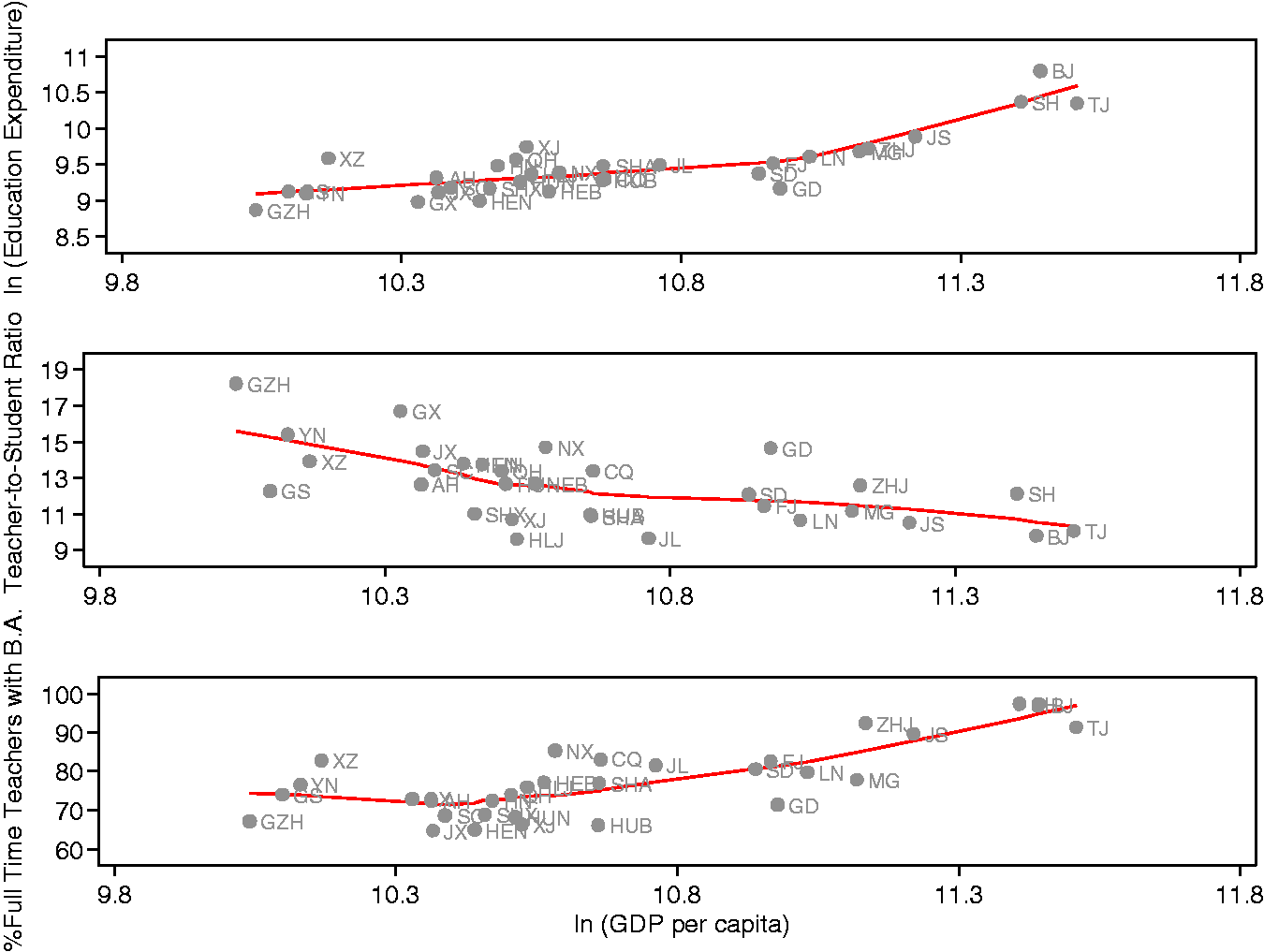
Regional differences in educational resources. ln: natural logarithm.
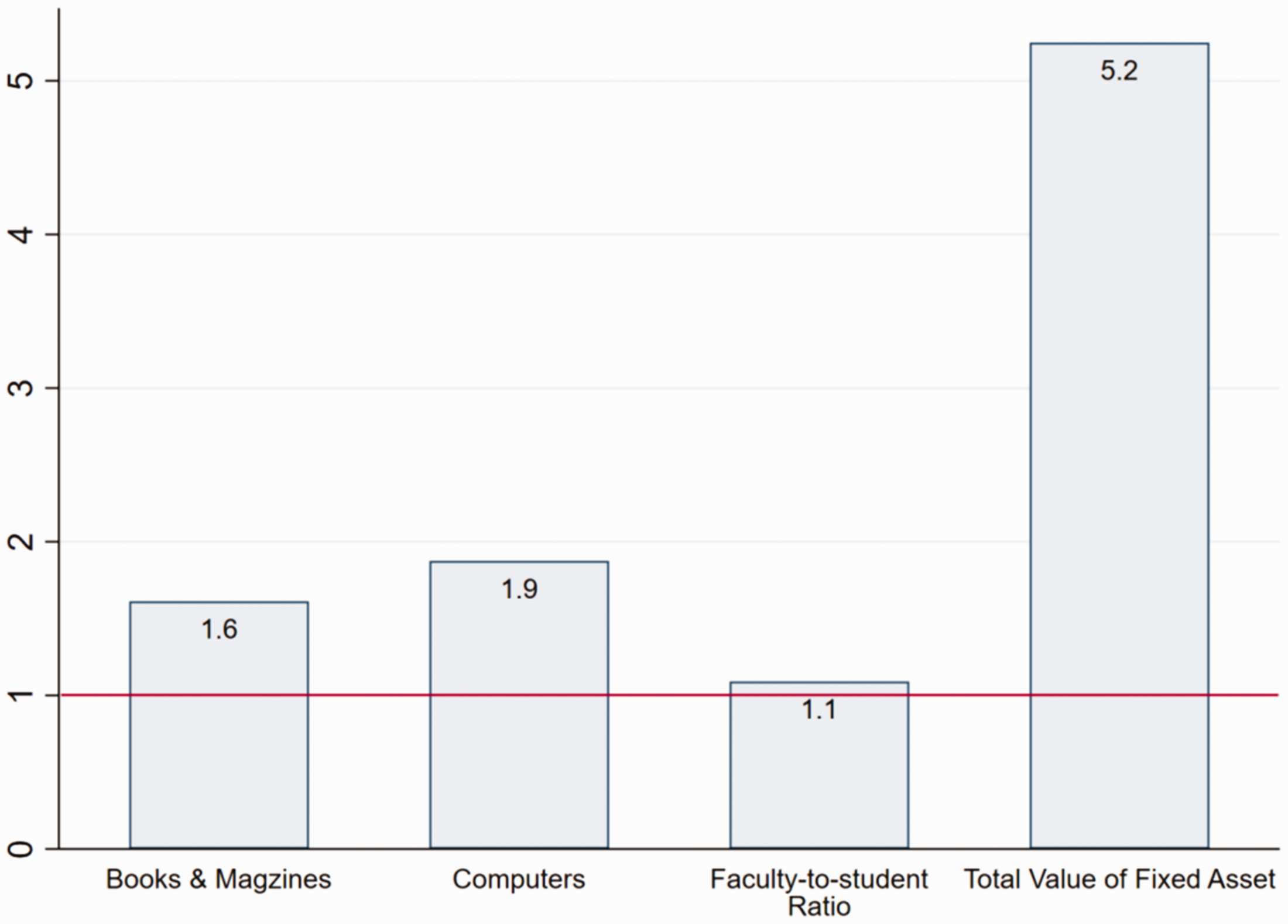
Rural/urban differences in educational resources.
Such regional and rural/urban differences in educational resources suggest that children from more developed regions and urban areas have better chances to excel academically. As numerous previous studies have found, rural/urban differences are stark in a wide range of educational achievement and attainment measurements. For example, urban residence is a significant positive predictor of higher educational attainment among adolescents and young adults in China (Hannum, 1999; Knight and Shi, 1993, 1996). More recent data show that rural students’ disadvantage in educational achievement and attainment emerges as early as in primary education and persists into secondary education and post-secondary education. Using data from three provinces in China, Bai et al. (2017) showed that rural students in primary schools perform worse on reading tests than their urban counterparts. Such a rural/urban achievement difference in the early years becomes more striking as children progress through school. For instance, rural students are far less likely to be enrolled in high school than their urban peers: fewer than 30% of students from poor rural areas attend high schools, while more than 80% of students in large city school districts do (Ministry of Education of the People’s Republic of China, 2006; Wang et al., 2011). Children’s educational achievement also varies greatly across regions. As previous studies have pointed out, compared with children in less-developed areas, children in counties with higher per capita incomes are more likely to attend and complete primary, middle and high school (Connelly and Zheng, 2003; Hannum, 2002).
The prominence of structural factors in shaping children’s educational development distinguishes China from western countries. Recently, scholars analyzed five national representative data sets from China, the USA and Germany and found that while rural/urban status is a significant predictor of Chinese children’s achievement, it holds almost no explanatory power over the variation in achievement in the USA and Germany. Conversely, the explanatory power of parents’ education and race/ethnicity in the USA and Germany is at least twice what it is in China (Lyu et al., 2019). In short, these findings highlight the profound role of structural factors in China, which are more important to individuals’ educational achievement than they are in western societies.
Family and Chinese children’s achievement
In western countries, such as the USA, family SES, usually measured by parents’ education, family income and parents’ occupation, is an established significant predictor of children’s educational achievement. One of the major reasons for this is that higher-SES parents have more money to invest in children’s education to help their children succeed in school (Figure 3(a)). For instance, higher-income parents can afford housing in better school districts to access higher-quality education, purchase additional educational resources for their children, such as tutoring and remedial classes, enrich their children’s lives with diverse extracurricular activities and send their children to expensive private and elite schools (Becker and Tomes, 1994; Bradley and Corwyn, 2002; Chin and Phillips, 2004; Haveman and Wolfe, 1994; Mayer, 1997; Yeung et al., 2002).
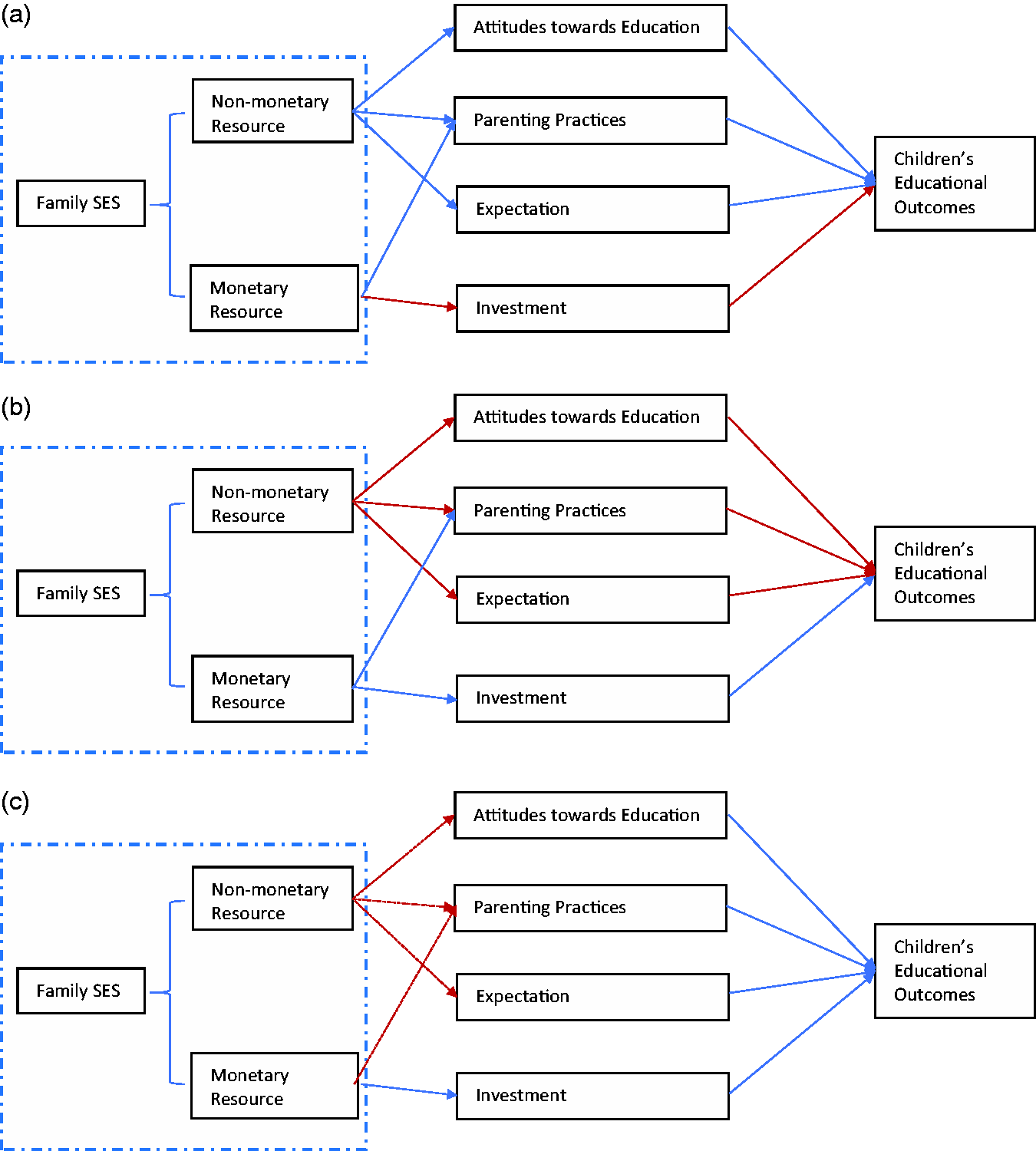
Family SES, monetary and non-monetary resources and children’s achievement.
In addition to benefiting from such advantages in monetary resources, higher-SES children are also at an advantage in terms of non-monetary resources compared with their low-SES peers, which also contributes to their higher achievement at school (Figure 3(b)). In the Wisconsin Model of status attainment, Sewell and colleagues found that educational expectations are an important channel through which family advantages or disadvantages are transmitted over generations (Sewell and Hauser, 1975; Sewell et al., 1969). Recent studies have not only corroborated that higher-SES parents hold higher expectation for their children, but also shown that parenting practices are another important mediator of family SES’s effects on children’s achievement. Compared with lower-SES parents, higher-SES parents are more engaged in interacting with their children and building a stimulating home environment. They talk and read to them frequently and structure their children’s daily lives around carefully chosen activities, all to the benefit of their development and academic success (Bradley and Corwyn, 2002; Davis-Kean, 2005; Halle et al., 1997; Lareau, 2011; Smith et al., 1997).
Concerning the relative importance of family monetary resources versus family non-monetary resources for children’s development, no consensus has been reached yet. While some studies suggest that income has independent effects on children’s education (Duncan and Murnane, 2011), others claim that the observed income’s effects on children are likely to be spurious and contaminated by other non-monetary characteristics and family processes (Mayer, 1997). Despite the debate, most previous studies have reported significant income effects after controlling for an extensive set of family non-monetary characteristics.
Generally speaking, in western countries like the USA, family non-monetary characteristics that are important to children’s academic achievement are highly correlated with family monetary resources, both being closely related to a family’s overall social status (Figure 3(a) and 3(b)). Parents from wealthier families tend to hold higher educational expectations for their children and provide more stimulation at home (Davis-Kean, 2005). Experiencing less financial stress, these parents are also more likely to create a stable home environment conducive to children’s learning and development (Yeung et al., 2002).
However, we postulate that the relationship between family socioeconomic wellbeing and family non-monetary resources among Chinese parents may be substantially weaker than that among parents in western countries. We derive this conjecture from the finding that the SES gradient in parents’ educational expectations is much smaller among Asian parents than that among white parents in the USA and from Liu and Xie’s (2016) interpretation that this difference may be rooted in the Confucian culture shared by East Asian Americans.
As is widely known, East Asian countries are deeply influenced by Confucian culture, with a heavy emphasis on the importance of education and continuous effort. Rather than viewing cognitive ability as innate and difficult to change, a belief shared by many western educators, parents and students, East Asians hold that ability is malleable and can be improved through consistent hard work (Chen and Stevenson, 1995; Hsin and Xie, 2014; Li, 2004; Stevenson and Stigler, 1994). These cultural elements could help promote an education-oriented parenting style among Chinese families and render their attitudes toward education and parenting practices much less dependent on the family’s economic resources than in the case of white people in the USA (Figure 3(c)).
Previous empirical studies have shown that parents in China, regardless of their socioeconomic background, hold positive attitudes towards education, expect high returns from education and have high educational aspirations for their children (Brown, 2006; Zhang et al., 2007). In their recent study, Li and Xie (2019) compared the relationship between family SES and parents’ educational expectations across many countries and regions. They found significant differences in the patterns of SES gradient between China and other western countries. Specifically, the SES gradient in educational expectations for their children is much flatter among parents in China than among parents in the USA and Germany (Li and Xie, 2019). In other words, parents’ expectations for their children depend more on SES in western countries, such as the USA and Germany, than in China. Another revealing finding reported in Li and Xie’s work (2019) is that even in Huachi county, a poor county on the national level in Gansu province, 96% of the rural parents of newborns expected their children to finish four-year college and 53% to finish doctoral degrees. Such universally high educational expectations reveal a strong emphasis on education among Chinese parents, largely independent of family SES.
The weak relationship between family SES and parents’ educational expectations for children may explain why Chinese parents from resource-constrained households still make great efforts to invest, both in goods and time, in their children’s education. It has been found that in rural China, parents’ allocation of time to helping children with homework, reading to their children and discussing children’s studies with teachers in school do not significantly vary by their economic wellbeing measured by family wealth. Family income is a significant predictor of neither parents’ engagement in communication with their children and positive parenting (Brown, 2006; Yue et al., 2016) nor parental involvement (Liu and Xie, 2015). These findings differ from what scholars have seen in the USA, where parenting behaviors, expectations and other non-monetary characteristics correlate significantly with a family’s economic wellbeing and serve to mediate family income effects on children’s education (Davis-Kean, 2005). Liu and Xie (2015) studied how family characteristics and resources influence children’s development in China. They categorized family characteristics into two main groups: monetary resources, which refer mostly to family income; and non-monetary resources, which include parenting behaviors such as involvement, home environment and expectations. Results from their study show that children’s test scores in mathematics and reading are more closely related to non-monetary characteristics than to monetary resources.
Data and analyses
Given the recently updated data, we conducted additional analyses to replicate and extend the previous studies in order to complete our understanding of the social determinants of children’s development in China and of how these are different from those in western countries. We organized our investigation around the two arguments proposed and suggested by previous studies:
Structural factors are more important than individual and family characteristics for educational outcomes in China. Family non-monetary resources are more important to children’s development than family monetary resources.
Data
Our analyses are based on data from the China Family Panel Studies (CFPS), an on-going, nationally representative, longitudinal survey of Chinese communities, families and individuals, launched in 2010 by the Institute of Social Science Survey at Peking University. The nation-wide CFPS baseline survey successfully interviewed 14,960 families in 25 provinces, along with 33,600 adults and 8990 children within these families. The individuals are tracked through biennial follow-up surveys. The CFPS has a child module for all respondents aged below 15. In this module, questions about children’s achievement as well as parenting behaviors and attitudes are asked. Moreover, children aged 10–15 are administered cognitive tests on their maths and reading ability. When children grow beyond the age of 15, they are automatically interviewed by the adult questionnaire. One important feature of the CFPS is that it collects information on the family as a whole and on the core family members, which allows us to link children with their families and thus to better answer our research questions. To examine the children’s educational achievement and progression in school, this study draws on data from the 2010, 2014 and 2016 CFPS.
We extracted children’s achievement information from the child questionnaire and family/parent information from the family and adult questionnaires. We restricted our analysis to children 10–18 years old. Table 1 presents descriptive statistics for the variables used in our analyses.
Descriptive statistics on parents and students’ demographic and socioeconomic characteristics, behaviors, attitudes, and achievement: China Family Panel Studies, 2010–2016.
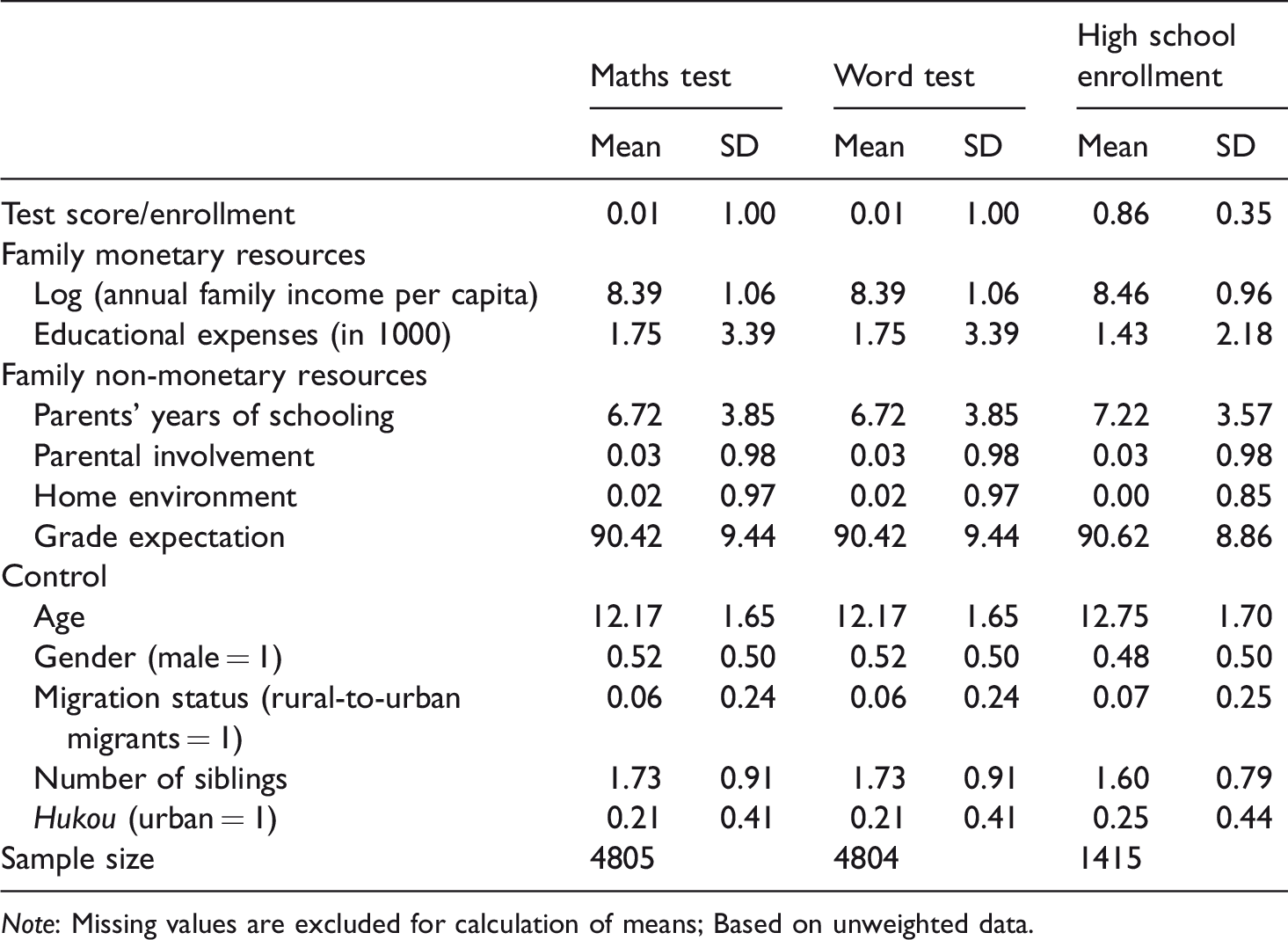
Note: Missing values are excluded for calculation of means; Based on unweighted data.
Measures
Educational achievement
We use several variables to measure both children’s academic achievement and attainment. The first two are the test scores on maths and reading. Two standardized tests, including a maths test and a word test, were administered in CFPS 2010 and 2014 to measure children’s academic performance. The maths test asked the respondent children to solve the mathematical problems presented to them, ranging from 0 to 24. In the meantime, the word test asked the respondent children to read out the characters, ranging from 0 to 34. Because we combine information from multiple waves and the children are in different age groups, some of them may have taken the tests multiple times. For these children, we use the score from the time that they first took the assessments. We standardize the test scores and use standard scores as the dependent variables. The third measurement is respondent children’s high school enrollment during 2010 to 2016. High school education in China is not compulsory but is considered a necessary step for future post-secondary education. High school enrollment status is thus a direct and objective measurement of educational progression and attainment. We code this variable in binary fashion to indicate whether a student was enrolled in high school (1 = Yes) or not (0 = No).
Key independent variables
Our key independent variables fall into several categories. First, to measure structural factors, we use hukou (rural vs. urban) and county. Hukou is coded 1 for urban and 0 for rural, with approximately 20% of our sample being urban. A dummy variable of county residence is included to account for regional variation at the county level.
To measure family economic resources, we use two variables: (a) family income, and (b) family expenses on children’s education. A family’s income is measured by its annual family net income in the past 12 months divided by the number of people in the household, yielding a family per capita income. Missing values are imputed by using a multiple imputation method with available information on hukou, province and parents’ education. To be sure, our results are not sensitive to this parametric specification; we also enter family income, the natural logarithm and family poverty status into regression analysis. A family ‘in poverty’ corresponds to a dichotomous variable, indicating that a family’s income is less than the official poverty threshold for a family of that size. As shown in Table 1, the mean per capita family income in our sample is around 7100 yuan annually, while approximately 20% of all families are in poverty.
We measure educational expenses by the total amount of money a family spent on all children’s education during the past 12 months. The mean for education expenses is 1750 yuan in the cognitive ability test sample and 1430 yuan in the high school enrollment sample.
To capture a family’s non-economic resources, we incorporate the following measurements: (a) educational involvement, (b) home environment, and (c) grade expectation. A parent or adult guardian was asked about their parenting behaviors and attitudes for each child in our sample. We sum the 6 scores, and the composite score ranges from 6 to 30, with a higher score indicating greater educational involvement. The standardized score is used in our analysis. Home environment is measured by interviewers’ observation during the survey. The interviewers were asked to rate the quality of the parent–child relationship. We sum these two rate scores ranging from 2 to 10, with a high score indicating a more stimulating environment for children. We standardize the composite scores of educational involvement as well as home environment in regression analysis. In addition, grade expectation is measured by parents’ expected score (out of 100) for children’s achievement in the current or coming semester. As shown in Table 1, the mean of grade expectations is roughly 90.
Covariates
In our regression models, we also control for such demographic characteristics as age and gender. For gender, female is coded as 0, with male coded as 1. As the resource dilution model claims that an additional sibling of any given child dilutes the quantity of family resources and thus exerts a negative influence on that child’s development (Blake, 1989), we include children’s sibship size as a control variable.
Analytical strategy
Our analyses consist of two parts, each of which corresponds to one of our focal propositions. To investigate the relative importance of structural factors and family characteristics to children’s education achievement, we construct 
To the model of equation (1), we add the structural factors (county indicator and hukou) and family characteristic variables (parents’ education and income) one at a time (equation (2)). In equation (2), 
We then calculate the difference in
To deal with potential bias and corroborate our findings, we further calculate the partial 
We denote the 
This
To examine the second proposition regarding the relative importance of family’s monetary and non-monetary resources to children’s education outcomes, we employed conventional regression analyses. The model is set up as follows:

In the equation,
Analysis and results
Confirming findings from previous studies, our results show overall that structural forces are more important than family-level factors to children’s educational achievement, and that family monetary resources carry less weight than non-monetary characteristics in affecting children’s educational outcomes. In the following section, we discuss our results in more detail.
Structural forces versus family background
As has been discussed, for each focal factor, we calculated two
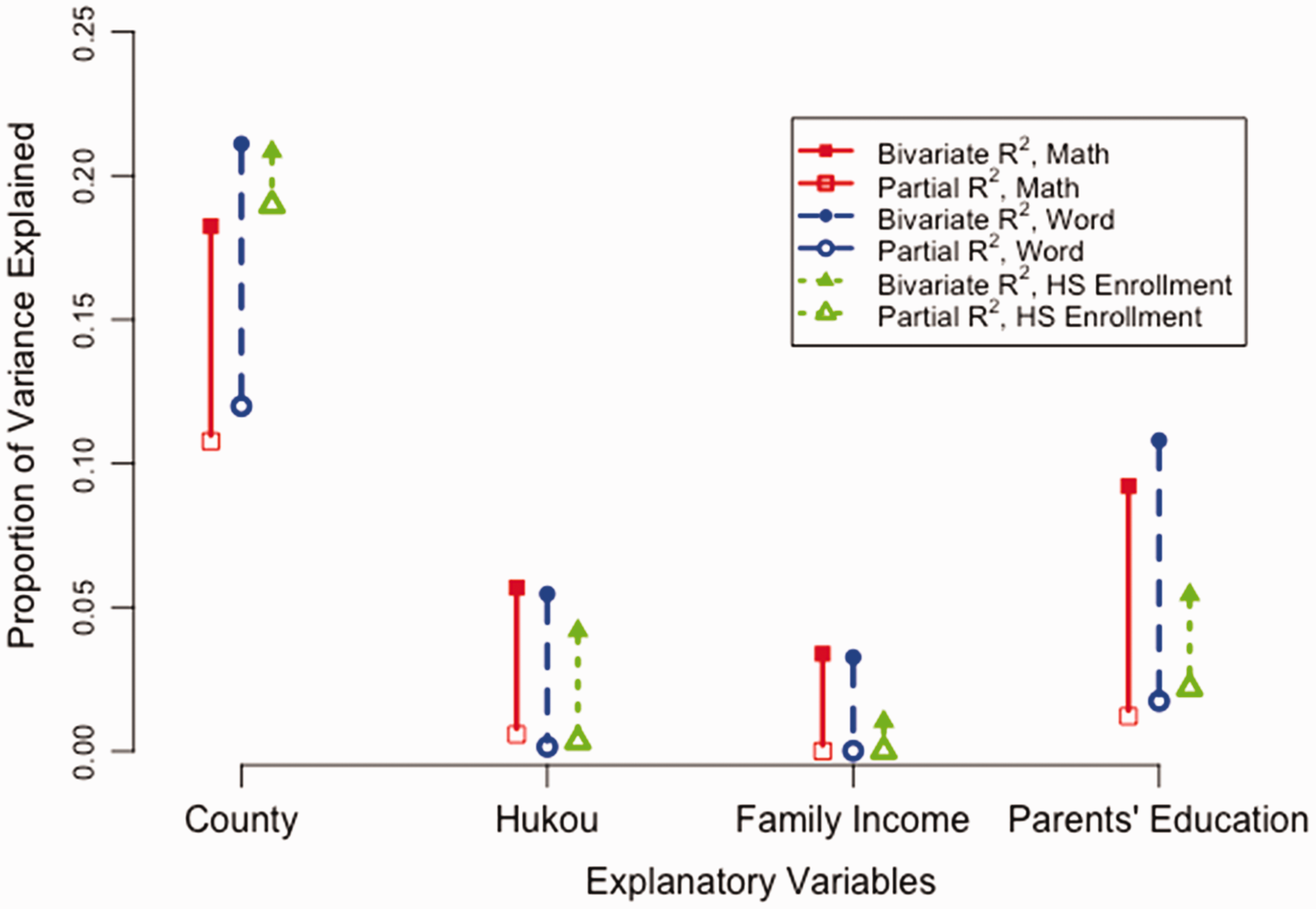
Bivariate and partial R2 for different predictors of educational achievement.
Let us start with the bivariate
As we have mentioned earlier, one caveat with the bivariate
Our findings corroborate what has been found in previous work (Lyu et al., 2019) in revealing that structural factors, such as county and hukou, affect a person’s education much more profoundly in China than individual and family characteristics that are known to have a significant impact on educational achievement in western countries. Moreover, our results suggest that in contemporary China, county location, instead of hukou status, has probably become the most important driver of educational inequality – a point that has not been explicitly indicated in previous studies.
Family monetary resources versus non-monetary resources
We now move on to examine how family-level characteristics contribute to child development in China, with a particular interest in how the effects of monetary and non-monetary resources influence children’s maths scores, word scores and high school enrollment. We set up the analyses in a similar fashion to that in Liu and Xie (2015). Nevertheless, we extend that study by augmenting the data with more recent waves and incorporating high school enrollment, an educational attainment measurement, into our analyses.
The results are shown in Table 2. Net of the demographic and structural variables, neither of the two monetary measures – family income and educational investment – has a significant effect on children’s scores on maths and word tests, nor on children’s high school enrollment. At the same time, family non-monetary characteristics, such as parents’ education, family environment and grade expectation, are significantly and positively associated with children’s educational outcomes.
The effects of family monetary and non-monetary resources on children’s education.
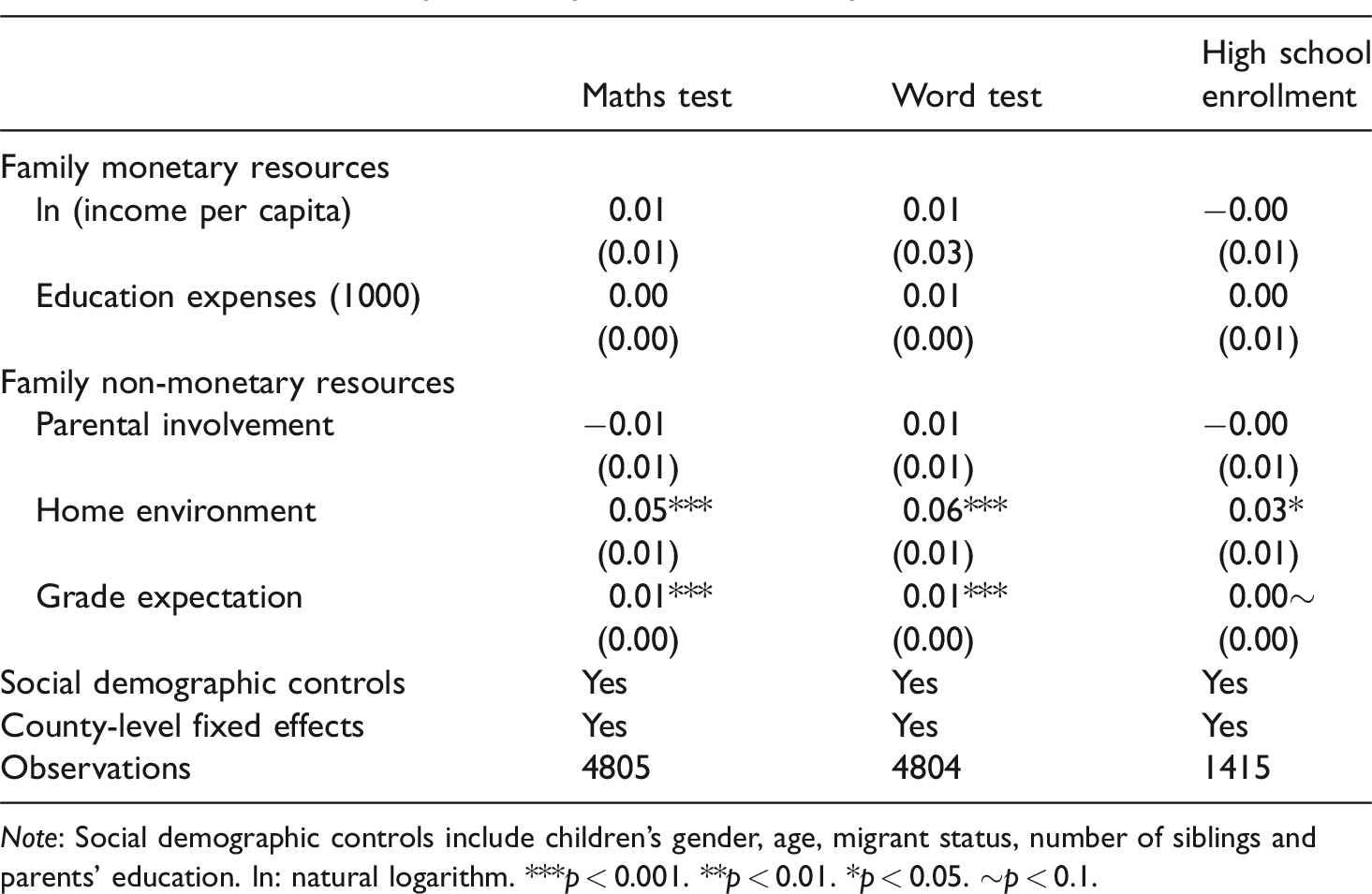
Note: Social demographic controls include children’s gender, age, migrant status, number of siblings and parents’ education. ln: natural logarithm. ***p < 0.001. **p < 0.01. *p < 0.05. ∼p < 0.1.
Again, results from multivariate analyses are consistent with Liu and Xie’s (2015) argument that family non-monetary resources are more important to children’s educational development in China than monetary resources. Surprisingly, the estimated effects of family income and educational investment on children’s cognitive ability test scores and high school enrollment are insignificant after all other factors are accounted for. In contrast, home environment and parents’ expectations still affect children’s educational outcomes net of all the other factors included in the analysis.
Conclusion and discussion
The social determinants of children’s educational achievement have been very well researched in western societies, such as the USA. Fewer attempts, however, have been made to examine whether and how those well-known determinants of educational outcomes vary in East Asian countries, such as China. Given the fundamental institutional, social and cultural differences between China and western countries, it is plausible that factors that influence children’s education are different in China. In this article, we have attempted to understand the social determinants of children’s educational achievement in China. By reviewing previous findings and carrying out additional analyses using recent data, we have replicated the results from earlier work and show the following:
Structural factors or forces, such as residential county and hukou, are more prominent predictors of children’s educational achievement than their family socioeconomic background measured by income and parental education. Unlike in western countries, such as the USA, where family monetary resources, such as income, are found to have a significant impact on children’s educational outcomes, in China family monetary resources matter much less, to the point of insignificance, than family non-monetary characteristics such as parental involvement and educational expectations.
Our analyses also highlight county-level regional differences in educational outcomes in China, something that has not been explicitly stated in the past literature. Though it has been widely known that the hukou system creates rural/urban bifurcation in many aspects of social life, such as income, and is a prominent factor generating social inequality in China, our findings suggest that in contemporary China, county is also a significant driver of social inequality in China, at least in the case of educational inequality.
In conclusion, we find that the basic contours of educational inequality in China differ from those in western countries such as the USA. In China, family-level characteristics that are known to be important in the West are much less important than structural factors such as location and the urban–rural divide. Such notable differences call for further research into why and how social processes generating educational inequality may be shaped by social contexts.
Footnotes
Declaration of conflicting interests
The author(s) declared no potential conflicts of interest with respect to the research, authorship and/or publication of this article.
Funding
The author(s) disclosed receipt of the following financial support for the research, authorship, and/or publication of this article: The research was partially supported by the Center for Social Research at Peking University, the Paul and Marcia Wythes Center on Contemporary China at Princeton University, and the National Natural Science Foundation of China (Grant No. 71461137001).
