




Abstract
Left-leaning social thoughts are not a unitary and coherent theoretical system, and leftists can be divided into divergent groups. Based on inductive qualitative observations, this article proposes a theoretical typology of two dimensions of theoretical resources and position orientations to describe left-wing social thoughts communicated in online space. Empirically, we used a mixed approach, an integration of case observations and big-data analyses of Weibo tweets, to investigate three types of left-leaning social thoughts. The identified left-leaning social thoughts include state-centered leftism, populist leftism, and liberal leftism, which are consistent with the proposed theoretical typology. State-centered leftism features strong support of the state and the current regime and a negative attitude toward the West, populist leftism is characterized by unequivocal affirmation of the revolutionary legacy and support for disadvantaged grassroots, and liberal leftism harbors a grassroots position and a decided affirmation of individual rights. In addition, we used supervised machine learning and social network analysis techniques to identify online communities that harbor the afore-mentioned left-leaning social thoughts and analyzed the interaction patterns within and across communities as well as the evolutions of community structures. We found that during the study period of 2012–2014, the liberal leftists gradually declined and the corresponding communities dissolved; the interactions between populist leftists and state-centered leftists intensified, and the ideational cleavage between these two camps increased the online confrontations. This article demonstrates that the mixed method approach of integrating traditional methods with big-data analytics has enormous potential in the sub-discipline of digital sociology.
Introduction
China has made great achievements in economic development during the past 30 years of reform and opening up, accompanied by tremendous social changes. One of the most important changes has been the differentiation of social interests and diversification of social thoughts among members of Chinese society (Ma, 2014). These changes, combined with salient social problems in China in recent years, constitute the social basis for diverse social thoughts springing up. At the same time, the rapid development of the Internet has been providing an unprecedented expression space and multiple dissemination channels for diversified social thoughts (Esarey and Xiao, 2008; Han, 2015; Hyun and Kim, 2015; Tong and Lei, 2013), which have produced a variety of social and political phenomena worthy of intellectual reflection. One of the most eye-catching phenomena has been the emergence of a large group of internet users commonly known as ‘leftists’ and corresponding ‘left-wing’ social thoughts. This phenomenon is a lens for understanding Chinese online ecology and a necessary element for understanding Chinese society. Nevertheless, although this phenomenon is a hot topic which has been described by a great deal of mass media or We Media, comprehensive and rigorous academic studies are still lacking. In addition, the following questions remain to be answered in a satisfactory manner. What are the main claims of the left-leaning social thoughts? What specific attitudes do the leftists hold toward all kinds of salient and related issues? What are the characteristics of the online interaction structure within the left-leaning communities? And, finally, are the leftists a unified and coherent ideological community? This study aims to empirically explore these questions.
Many previous scholarly studies have conceived of the Internet as consisting of ‘online public spheres’ (Rauchfleisch and Schäfer, 2015) and investigated the debates between different actors in online space as well as the public opinions, collective actions, and ideational communities formed during these debates (Bondes and Schucher, 2014; Gleiss, 2015; Han, 2015; Huang and Sun, 2016; Tong and Lei, 2013). At the same time, Internet users have actively participated in public affairs and gained a high level of influence in the ‘online public sphere,’ since the Internet features a low entry barrier, fast dissemination, and a large user base. Thus, the production and dissemination of public opinions and social thoughts is no longer limited to elite netizens, but includes a much broader range of diverse actors, who actively or passively participate in various public debates and have become the dominant forces of online public opinion and social thought (Fang and Wang, 2010). Moreover, the self-selective, individualized, and weakly constrained expression in the online public sphere exacerbates the fragmentation and extreme tendency of online debate (Damm, 2007; Li, 2010). In the face of information overload, information recipients tend to process information depending on their natural temperamental tendencies or the social influences of similar community members, which probably means that the Internet is a locally homogeneous information space (Huang, 2010). This fragmented and homogenous cyberspace facilitates the aggregation of similar discourses and opinions, and in turn fosters values-based online communities, which has the effect of social views developing into factions, being in opposition at two or more poles, as with utopian and conspiracy theories in online discourse (DiMaggio et al., 2001). In this context, it is of great scholarly significance to investigate online social thoughts and their possible social impacts.
Of all the phenomena related to social thoughts, the Left and the Right as well as the disputes and conflicts between them are undoubtedly the most noticeable. Along with the widespread use of the Internet, actual confrontations between the Left and the Right have gradually penetrated into cyberspace. Some researchers have conducted empirical studies on this topic and arrived at some interesting findings.
Firstly, a division between the Left and the Right does exist on the Internet. Studies of the political attitudes of Chinese netizens have found that there appears to be obvious differentiation between them, which leads to debates and controversies on political, economic, social, and diplomatic issues, as well as on related policies. Right-wing netizens are more in favor of ‘liberalism’ than leftists. Compared to the right-wing netizens, leftists have more authoritarian personalities and tend to hold stronger nationalist sentiments (Ma and Wang, 2015; Ma and Zhang, 2014). Pan and Xu (2018) used data from a large online survey to describe the characteristics of conservative and liberal users, and quantify netizens’ left-leaning or right-leaning tendencies.
Secondly, there is indeed a ‘right-and-left debate’ in online space. In addition, the conflict between the leftists and the right-wingers on social media is one of the most salient topics in Chinese Internet studies. Early studies argue that with the development of social media, the state has, to a certain extent, lost its dominant discursive power in online space. Governmental authority in Weibo space is facing challenges, whereas critical and liberal discourse is becoming increasingly influential (Tong and Lei, 2013). Recent studies have revealed a more complex picture in which online social thoughts are no longer dominated by ‘liberalism’ discourse, and discourses on nationalism and those that support and defend the current regime are becoming an important online force (Cairns and Carlson, 2016; Han, 2015). Netizens voluntarily express their views to support the state and the current regime and self-identify as the ‘voluntary fifty-cent army.’ An Internet ethnography study of the ‘voluntary fifty-cent army’ has found that the political identity of the group is based on ‘nationalism’ and ‘rationality,’ in which the former distinguishes this group from ‘liberal’ netizens, while the latter distinguishes them from other leftists (Han, 2015). Another study shows that the ‘fifty-cent army’ leads positive public opinions by distracting attention, diverting topic subjects, cheerleading online, and so on, instead of engaging in rational debate (King et al., 2017). However, this finding might not be generalizable because it is based only on data from Ganzhou city in Jiangxi province. Another study also confirmed that the ideology in Chinese online space is gradually polarizing into nationalism versus cultural liberalism (Wu, 2014).
These exploratory studies reveal some interesting discoveries of significance. Nevertheless, these studies were based on two common assumptions: firstly, they presupposed that both the Left and the Right have unified cognition systems consisting of certain essential elements of their own, and that the two cognition systems hold conflicting views on a few salient economic and political issues relating to free markets, democracy, and the state; and, secondly, since both the left-wing and the right-wing ideological systems are coherent and unified, they are supposed to have high levels of internal consistency, whereas significant differences only exist between the Left and the Right. That is to say, the line between ‘left’ and ‘right’ is the most critical, while internal differentiations within the left and right wings are negligible because of the cognitive coherence on the core issues. The commonality of the two assumptions is that people's ideological cognitions are usually constrained along one single dimension. In other words, people's attitudes and tendencies on different issues converge on a core cognitive continuum and thus can be categorized into two types along the poles of this continuum. For example, a study by Pan and Xu (2018) demonstrated a certain level of coherence in people’s attitudes toward market economy and democratic values; in other words, a pro-free-market economy attitude (supports marketization) and a liberal political attitude (supports democratization) are intertwined, and a conservative economic attitude (opposes marketization) is often associated with a conservative political attitude (opposes democratization).
This single-dimensional view, which divides social thoughts into the Left and the Right along a continuum, ignores the complexity of people’s views and values; hence, it fails to depict the landscape of social thoughts completely and accurately. The belief that the Left and the Right are oppositional, while both have high levels of internal consensus, is mere deductive theory from existing scholarly literature, instead of an empirical induction from the social reality. This conventional deductive analysis framework might be confirmed by empirical data, but in essence, it forces one to fit the observed attitudes and ideological tendencies to the framework deduced from ideological theory, instead of generating fine inductions and generalizations from the empirical observations of the actual ideological tendencies of left- and right-wing Internet users. Emphasizing the observation of the delicate and complex social reality, we make two significant observations regarding the ideological differentiation of the Left and the Right in Chinese online space. Firstly, they are not simply positioned along one single dimension, and both ideologies are multi-dimensional. Secondly, the Left and the Right cannot be quantified along a continuum; instead, there are important internal differentiations within the two types of social thoughts, and in some cases, internal differentiation is more significant than the differences between them. Furthermore, some elements of the left-wing and right-wing social thoughts have a certain commonality and can be transformed under certain circumstances.
The above analysis indicates that we not only need to study the division between the left wing and the right wing, but also to explore internal differentiation within each wing in order to fully understand social thoughts expressed in Chinese online space. Therefore, this article attempts to focus on left-leaning social thoughts from a multi-dimensional perspective, and to investigate their internal differentiation in terms of ideological boundaries and group diversification. It should be clarified that ‘left wing’ is defined here in accordance with neither Western ideologies, nor any literature, but refers to the people who are widely regarded as the ‘Left’ and self-labeled as the ‘Left’ in Chinese online space. Specifically, this article will, through case observations and big-data analysis, depict the essential characteristics of the Left social thoughts in Chinese online space and investigate the differences within these thoughts, as well as the interaction communities among leftist internet users.
The terms ‘left’ and ‘right’ have fluid meanings in different historical and social contexts, and in extreme cases, the same concepts may refer to completely opposing ideologies. In traditional Western political ideologies, the fault line between the two lies mainly in their stances toward individual rights, state power, free markets, and government intervention. The Left is often radical, advocating state intervention and big government to improve social equality and welfare, whereas the Right is relatively conservative, upholding traditional social values, supporting free markets, and opposing government intervention and high levels of welfare (Bobbio, 1997; Ma and Wang, 2015). In the Chinese context, ‘left’ and ‘right’ have substantive meanings completely different from those in the West. For instance, the debates about social thoughts in the early years in China were typically exemplified by opposition between ‘New Leftism’ and ‘liberalism,’ with the former advocating prudent judgment of the market economy and criticizing economic determinism and the latter calling for political reforms and opposing the coexistence of state power and market mechanisms (Zhu, 2003). In general, the Left in contemporary China tends to emphasize nationalism and national interests and to support public ownership and state intervention in the market, while the Right tends to support democracy, freedom, individual rights, and free markets (Chen, 2004; Zhang, 2015). Therefore, the left wing in the Chinese context refers to social thoughts that are totally different from those of the left wing in the Western context. Moreover, we believe that the left-wing social thoughts in online space might be even more complicated than the existing theorization and characterization. Therefore, it is necessary to sort out and study the central claims and values of the left wing on the Internet empirically and systematically.
Furthermore, from our empirical observations of Chinese online space, there appear to be various topics, opinions, and factions intertwined in the online dispute and confrontation between the Left and the Right, which make it complicated and confusing for researchers to accurately characterize the two types of social thoughts. In terms of stances and discourses, the boundaries of different ideologies are unclear, while in terms of interaction communities, the division between different camps is also very confusing. The reason probably lies in the fact that the differentiation between left and right wings in Chinese online space is neither one-dimensional nor linear, but rather an intricate spectrum both between and within the two wings. Neither the left nor the right wing is monolithic in its internal viewpoints and community, and left- and right-wing social thoughts are not completely incompatible. Therefore, what are the sub-types within the left-leaning social thoughts? On which issues do these sub-types reach a consensus or have different stances? And how does the evolution of online community structures among sub-types of leftists occur? All these questions merit further exploration and discussion.
Research approach and methods
This article will adopt an inductive approach in seeking answers to the above questions so as to explore and depict the core characteristics of and the internal differences among left-wing social thoughts through empirical observation. Our reasons for choosing this approach are based primarily on the following considerations. Most existing studies use the left–right continuum perspective, but such a deductive approach can easily lead to a similar methodology that fails to satisfactorily answer the questions we posed in this article. For our research design, we use Sina Weibo, an online platform in China with relatively high levels of data openness and rich expression of social thoughts, and integrate case observations and big-data analysis to investigate leftism and leftists. Case observation is the basis of and preamble to inductive analysis. The openness of Weibo and the free expression of its users helps us to immerse ourselves in Weibo users’ own perspectives, partially overcoming the gap between the world depicted by scholars and that of the studied subjects so as to explore the commonality and particularity of different types of left-wing users’ expressions and ideas and to provide an empirical basis for the development of typology and guidance for big-data textual analyses. Big-data analyses then test and confirm the findings of case induction and further describe the types of social thoughts and interactions of left-wing users.
Case observation
We conducted long-term and intensive online observations of Weibo users (IDs) who had expressed strong ideological leanings on the Weibo platform since 2011, by the method of systematically reading the concerned Weibo tweets. We gradually included new users who had expressed ideological claims and viewpoints different from those of previously sampled users through a snowball method and finally obtained more than 200 users. Since many user IDs have been deleted or their use was prohibited during the observation period, it is impossible to count the exact number of observed users.
The purpose of observing Weibo users’ online expressions was to identify different types of social thoughts and to come up with a saturated typology (Small, 2009). During the long-term observation, the choice of the observed users conformed to the principle that, after the number of observed IDs had accumulated to a certain degree, new IDs with ideological leanings similar to those of existing users would not be included, and only new IDs with different ideological leanings would be included in the final samples for follow-up observation. In this way, the types of social thoughts we observed tended to be saturated over time. We have not had to add any new observation cases over the past year according to this principle, which indicates that no new IDs have been found to express social attitudes differing significantly from existing social thoughts.
Big-data text analysis
Yearly distribution of Weibo tweets.
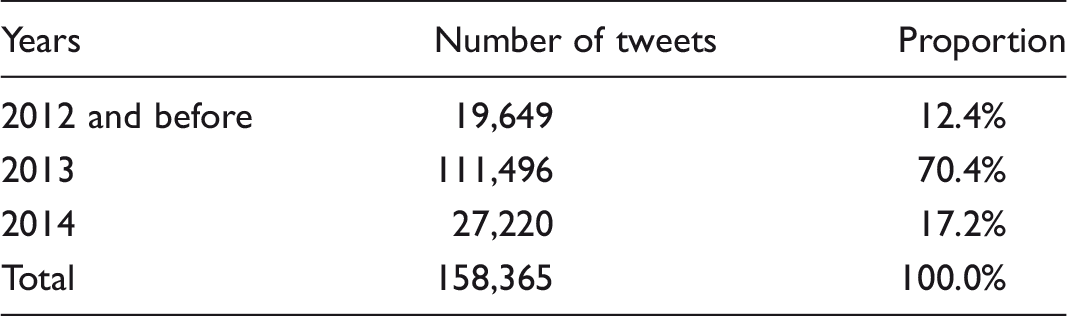
We used social network analysis and supervised machine learning to process the corpus in order to show the changing tendencies of social thoughts held by different online communities. This article describes the process of data analysis only briefly because of space limitations, but interested readers can contact us for details. We used a social network analysis method to identify the user groups for further analyses. Firstly, we extracted user IDs from the tweets by regular expressions and constructed a directed interaction network (excluding reposts) according to direct mention (@ID) relations between users. Secondly, the aim of this study was to investigate the online communities formed by active users with evident social thoughts. Considering that the frequency of interactions in terms of mention relations between some users is low, which fails to represent continuous and stable interactions, we decided to delete isolated users and users with low frequencies of interaction 2 and eventually obtained an interaction network composed of 745 users and 17,985 pairs of interaction relations. Subsequent analyses will focus on the tweets that the 745 users participated in. Thirdly, community detection was performed on the interaction network to reveal the interaction structure among users.
The steps of supervised machine learning are as follows: firstly, we randomly drew 3000 tweets from the blog corpus and manually coded the sampled tweets according to the six core topics described shortly; secondly, we used the manually coded tweets to train a support vector machine (SVM) model and then used the trained model to predict the attitudes expressed by other tweets in the corpus on the six topics; and, thirdly, using the predicted attitude data, we calculated the frequency of each user expressing particular attitudes on these topics. After normalizing the aggregated data, we conducted cluster analysis so as to classify the users into different types according to their expressed attitudes. Moreover, we analyzed the corresponding relationship between the interaction structure and the characteristics of social thoughts expressed by different types of users.
Theoretical resources and position orientations: The three faces of the leftists in Weibo space
As previously mentioned, we conducted long-term case observations and gained a substantial understanding of Weibo users with strong ideological characteristics, then built a typology that depicts the key distinctions within the left wing. The typology indicates that theoretical resources and position orientations are two core elements for identifying social thoughts. Based on these two core elements, we empirically identified three faces of the left-wing social thoughts expressed in online space.
Before presenting our typology, it is necessary to briefly review the existing literature on left-wing social thoughts in the Chinese context. The first type of literature introduces the development of Western left-wing social thoughts (Kocka and Yin, 2005; Zhang, 2014). The second type focuses on the ideologies and theories of Chinese left-wing intellectuals (Li, 2015; Ma, 2014; Mierzejewski, 2009), dividing left-wing social thoughts into the ‘Old Left’ and the ‘New Left.’ The former firmly defends Mao Zedong Thought, whereas the latter are a loose group whose ideological sources include Western critical theories, Mao Zedong Thought, populism, statism, and nationalism. However, these studies have not systematically investigated whether the left-wing social thoughts are widely disseminated and accepted by the general netizens. Moreover, the division of the left-wing social thoughts into the New Left and the Old Left has not yet provided an accurate and comprehensive analytical framework for empirical studies of online left-wing communities. The third type of literature quantifies the leftist tendency of Chinese netizens or describes certain netizen groups with left-wing characteristics from a continuum perspective (Han, 2015; King et al., 2017; Ma and Zhang, 2014; Pan and Xu, 2018). The continuum perspective assumes that there are only differences in the degree of left leaning, which not only ignores the qualitative distinctions within the left wing but also is unable to explain why some left-wing and right-wing groups take similar stances on certain issues. Therefore, it is necessary to propose an analytical framework to identify social thought systems so as to transcend the classic continuum perspective and investigate the manifestation of different types of left-wing social thoughts.
Essential elements for identifying an ideological system
Considering the intense ideological distinctions within the online left wing in the past two or three years to the extent that some values and stances were no longer reconcilable and the wide variety of concerned issues and stances taken by different leftist Weibo users, this article contends that the key to constructing a typology of social thoughts is to carefully choose the core issues and related attitudes that reflect the fundamental and differentiated stances and perspectives. That is, it is essential to determine the core elements of online social thoughts in order to identify the internal distinctions within the left-wing social thoughts. Otherwise, simply including a large number of topics would produce countless types of combinations, which might, in turn, generate a trivial typology lacking theoretical insight, and it is difficult to grasp the essence of different types of thoughts.
How, then, can we determine the core elements of the left-wing social thoughts in online space? This article contends that the key to understanding social thoughts lies in identifying their core ideological tenets, that is, the most fundamental ideological theory and symbolic discourse in the social thoughts system. Core ideological tenets are the center of social thoughts systems. These core ideological tenets can be disseminated in a concrete and commonsense manner through their supporters’ explanations and interpretations and eventually be widely distributed to and accepted by netizens. The core ideology and its explanations and interpretations further affect people's understanding of specific social issues, ultimately leading to the formation of particular social attitudes. The core ideology, interpretation of core ideology, and affected social attitudes altogether form a particular social thoughts system. Of course, there is flexibility in the explanation and interpretation of core ideology, as well as in most netizens’ judgments and acceptance of these interpretations. In particular, the perspective of interpretation and the accepted content are influenced by the social positions of interpreters and recipients (see Figure 1).
Structure of social thoughts system.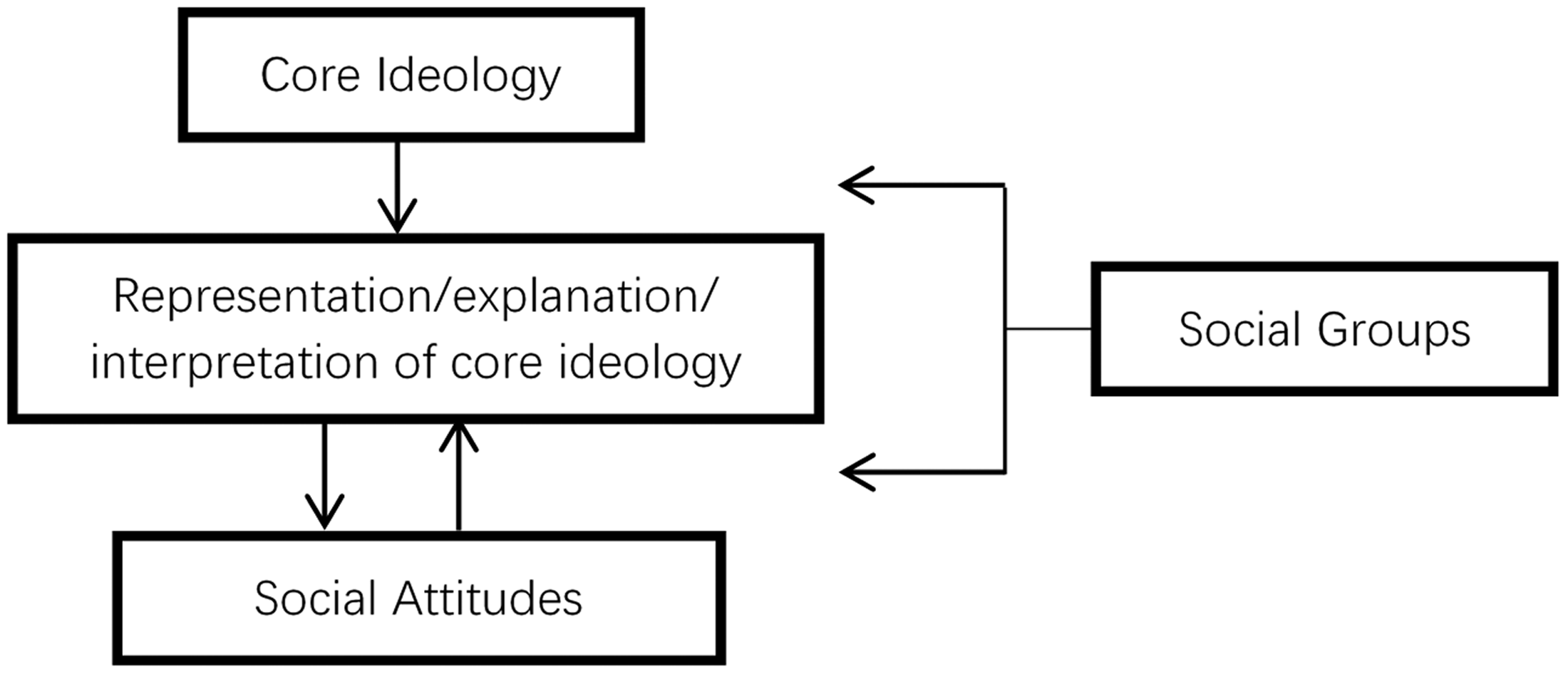
In a social thoughts system, the social attitudes are influenced by the core ideology and its interpretations, but there is no one-to-one relationship between the two. Therefore, we need to adopt a holistic perspective to analyze the core ideology and specific standpoints of the interpreters (recipients) of social thoughts. In other words, developing a typology of social thoughts requires specifying two essential dimensions, including (a) an abstract ideological theoretical resources and discourse system and (b) the positions of those who interpret and accept the ideological theoretical resources.
What kind of values system can be considered a social thought? We define ‘social thoughts’ as values systems that are rooted in social reality and have relatively high levels of social influence, which are socially shared or discussed rather than only being expressed in academic literature or debated by a few intellectuals or radicals. Thoughts that do not resonate with the social mentality of ordinary people are not real social thoughts, but only ideological theoretical resources. Thus, social thoughts are a deep reflection of the interests of various social classes and groups and represent an extreme expression of mentality in a specific economic and social environment. A social thought with a high level of social influence is very likely generated by resonating with large social groups and broad social interests. Therefore, in addition to identifying the specific ideological and theoretical resources, we also need to clarify how such ideological and theoretical resources are gradually applied to specific social issues by their interpreters. That is, we need to clarify who stands in what position to interpret and explain theoretical resources and who takes what standpoints in accepting these theoretical resources.
A coherent values system can only become powerful online social thoughts when the constituting ideological theoretical resources are interpreted, explained, and accepted from a corresponding position orientation, and such a system provides high levels of dissemination and persuasion among a large number of internet users. In accordance with the above analysis, the next section will briefly summarize the core ideological resources and position orientations of online left-wing social thoughts.
Three types of online leftists and their core ideologies
Three types of theoretical resources and position orientations
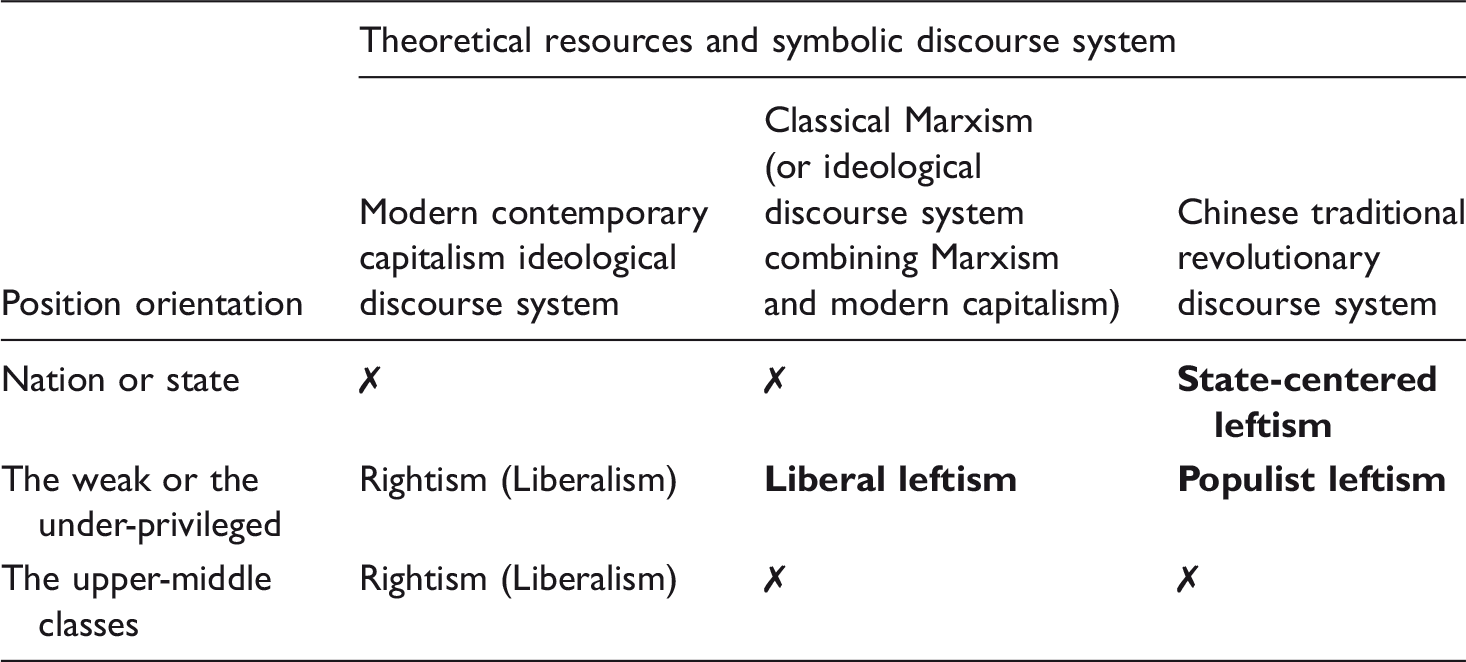
From our long-term tracking of online social thoughts over the past few years, we have come to believe that the theoretical resources and position orientations that are implicitly expressed in specific left-wing viewpoints can be divided into three categories. Specifically, the contemporary capitalist ideological discourse system, classical Marxism (or an ideological discourse system combining Marxism and capitalist ideological elements), and the Chinese revolutionary discourse system constitute the three theoretical resources and discourse systems prevailing in China’s online space. In the first type, interpreters and recipients tend to seek systematic ideological support from values and theoretical systems developed during the emergence of modern capitalism, and to apply the symbolic discourse from the modern capitalist theoretical system to analyze and/or advocate individual rights, state–social relations, legal systems, and state operational mechanisms, as well as discuss social problems. In the second type, interpreters and recipients tend to seek systematic ideological support from classical Marxist theory, or partly integrate the values and theoretical system developed during the emergence of modern capitalism, to interpret and explain for laborers and under-privileged social groups and to discuss social inequality and many other social phenomena, with equality, freedom, and care for the under-privileged as their primary guiding values. In the third type, interpreters and recipients draw ideological resources from Chinese revolutionary leaders’ discourses and actions and make extensive use of traditional revolutionary discourse and analytical perspectives to analyze and explain various international and domestic phenomena (see Li, 2015; Ma, 2014).
Different social thoughts may possess different position orientations. Position orientation is an indispensable element in the development of a typology of social thoughts, since the interpreters and recipients of the same theoretical resource might interpret theoretical resources from different positions, whereas different interpretations can be so ambiguous as to be seen as the same type. In addition, interpreters and recipients of different types of theoretical resources may also hold a common position orientation, which opens up the possibility of the evolution and cross-fertilization of different social thoughts that are seemingly incompatible. 3 Moreover, to become a social thought, specific theoretical resources must combine with a particular position in order to arouse widespread social resonance and support or to legitimize the interests and rights of specific subjects. Observation of ideological perspectives on the Internet during recent years suggests that the three main positions of online social thoughts are a state-centered position, a grassroots position, which is sympathetic of the under-privileged, and an upper-middle-class position. 4 Among these, the state-centered position refers to the pro-regime, pro-ruling party, and pro-government stance, which tends to affirm and defend the current regime (Han, 2015). The grassroots position speaks for weak and under-privileged social groups and tends to be critical regarding increased social inequality (Huang, 2017; Li, 2015). The upper-middle-class position refers to the stance in favor of those social groups with relatively rich resources and high status in the current social structure. It is worth mentioning that although an association between position orientations and the social statuses of Weibo users may exist, there is no one-to-one correspondence. For example, intellectuals can hold a pro-grassroots position, sympathizing with and supporting under-privileged workers (Huang, 2017).
Typology of the online left wing and right wing.
Three faces of the online left wing
Based on the above typology and long-term case observations, we have been able to identify three types of left-wing social thoughts, which we have named ‘liberal leftism,’ ‘state-centered leftism,’ and ‘populist leftism’ (in bold, Table 2). These different types, which we call the ‘three faces’ of the online left wing, constitute the left-wing spectrum.
Liberal leftism appears to be relatively independent of the other two types of left-wing social thoughts in terms of position orientation, theoretical resources, and network interaction. This camp draws theoretical sources from classical Marxism and some elements of modern liberalism, integrates many discursive elements from modern capitalist ideology, and takes a grassroots position in favor of the under-privileged to explain and even develop its theoretical and discursive claims. Generally, supporters of liberal leftism come from different generations and intellectual backgrounds. Specifically, older intellectuals or those from frontline work tend to draw ideological resources from classical Marxism and focus on topics related to traditional fields, such as labor issues (for research on labor issues, see Huang, 2017), while younger intellectuals tend to use ideological resources that are commonly known as ‘white-left values’ on the Internet, featuring egalitarianism and individual rights. Meanwhile, they emphasize both social and national responsibilities and focus on modern issues that are widely related to a variety of ‘under-privileged groups.’ A few leftists of this type even use feminist or lesbian, gay, bisexual, and transgender (LGBT) discourse. 5
State-centered and populist leftism have more commonalities in their ideological positions and theoretical resources, and their network interactions are relatively frequent. However, over time, the two camps have gradually been drifting apart. In terms of ideological characteristics, both state-centered and populist leftism seek ideological support from revolutionary traditions and use lots of relevant discourse to analyze and explain theoretical and practical issues. Of course, there is also a key difference between them. State-centered leftism tends to analyze social issues from the perspective of ‘the state,’ while populist leftism analyzes issues in terms of ‘the people.’ State-centered leftism quotes and interprets relevant ideological resources and discourse from the position of the state, then analyzes and explains real life social problems, while populist leftism quotes and interprets relevant ideological resources and discourse from the position of the weak and the under-privileged, then analyzes and interprets actual problems. Specifically, state-centered leftism and populist leftism have the following differences.
Firstly, although a considerable number of state-centered or populist leftists admire the revolutionary leaders, supporters of state-centered leftism tend to create memorials for past times and figures, while populist leftists emphasize revolutionary leaders’ care for the weak, laborers, and peasants and the legitimacy of the rebellious spirit and the actions involved in breaking down an unfair structure.
Secondly, state-centered leftism regards ‘being on the left’ more as a symbol, emphasizing the historical legacy of the socialist line and the Communist Party, as well as the legitimacy and orthodoxy of the existing system endowed by the revolutionaries and history, while populist leftists pay more attention to the weak and to current social problems faced by Chinese society. They believe that China's problems and existing inequality are caused by capitalists and bureaucrats, which is compatible with the theoretical elements in the revolutionary tradition, such as the revolutionary characters, mass line, direct democracy, and so on.
Thirdly, although a basic value of both types of leftism is opposing social inequality, state-centered leftism emphasizes the international and economic dimension of inequality, while populist leftism emphasizes its international, economic, and political dimensions, sometimes even placing the political dimension above the other two in importance. In fact, a typical expression of the former is ‘nationalism,’ and a typical expression of the latter is ‘populism.’ For supporters of online nationalism, national honor and pride, Sino–US relations, anti-Korean and anti-Japanese attitudes, and Taiwan issues are the most common and controversial topics, and those who do not argue in favor of national interests are usually regarded as ‘traitors.’ The commonality of online nationalism is that national interests always take priority over the interests of individuals or particular social groups. In contrast, online populism pays more attention to grassroots groups as well as related social problems and events, taking a ‘grassroots-based’ position in opposing the elite position. 6
Liberal leftism has been developing independently in accordance with its own logic, in terms of its ideological and theoretical resources, issues of concern, and the structure of personnel organization and network interaction, and it is relatively distinct from state-centered leftism and populist leftism. On the other hand, in the early days, state-centered leftism and populist leftism were, to some degree, united as a ‘Pan-leftist Front’ when ideological articles disseminated on a few left-leaning websites helped the two camps to reach a consensus and a unified ideological network was constructed between different authors, between authors and readers, and between the readers of these articles. In recent years, however, especially after some significant social events occurred, the ‘Pan-leftist Front’ has split up.
Salient issues and attitudes of different types of leftists
Attitudes of different types of leftists concerning salient issues
In order to empirically identify the three faces of left-wing social thoughts, we need to determine the core issues and related attitudes that reflect ideological resources and position orientations. Therefore, we summarize the attitudes about salient issues from the expressions of hundreds of IDs on the Weibo platform who are regarded as left-wing users over our extensive observations and sort out different degrees of leftists’ attentiveness and attitudes toward the selected issues.
Our analytical steps were as follows: firstly, one author who had observed these IDs for a long time listed the salient issues of each type of left-wing social thought and described the typical attitudes on these issues; then, another author carefully read the tweets of the selected representative IDs of various leftists and independently commented on the attitudes; finally, we compared the descriptions of the two authors. The results showed that the two authors had a high degree of agreement in their judgments of attitudes on salient issues. As can be seen from the results of the collation, these issues are of great importance in online public discussion. Since different types of leftists hold common attitudes on some issues, but different or completely opposite attitudes on others, it is necessary to make an overall judgment based on selected core issues.
Certainly, not all topics are equivalent when describing and identifying particular types of social thought, among which some occupy a central position and best reflect the divergence of views among the different faces of left-wing social thoughts. Based on empirical observations and theoretical considerations, this article argues that attitudes toward the state, the under-privileged, capital, first-generation state leaders, the USA, and individual rights are the six most central issues. According to different attitudes of online leftism regarding the six issues, we can clearly identify the type of left-wing social thought to which an ID belongs. Among them, attitudes about the state and under-privileged groups most directly reflect the position orientation through the expression of relevant IDs. Attitudes about the first-generation state leaders and individual rights reflect the theoretical resources and symbolic discourse on which certain Weibo tweets rely. These four topics directly correspond to the typology of left-wing social thoughts. In addition, attitudes about capital and the USA clearly reflect key attitudinal tendencies of some of the online leftists. Among them, attitude toward the USA is a proxy of attitude toward the West, which to some extent indirectly reflects leftists’ position orientations toward the state. Although attitudes toward the West and capital do not directly correspond to the typological classification, qualitative analysis shows their close relation to different faces of left-wing social thoughts. In particular, the three faces of the left wing have the following attitudes on these six core issues.
Attitudes toward the state
The state-centered leftists show a distinct tendency toward the state, emphasizing the supremacy of national interests, while at the same time affirming and defending the authority of the existing regime. The manifestations of statism include safeguarding national interests and the authority of the government (e.g., national sovereignty, national security, collective political and economic interests of the state, etc.) and strongly supporting the stability, legitimacy, and superiority of the current regime. Correspondingly, populist leftists both advocate safeguarding national interests actively and emphasize the legitimacy of the regime established after 1949. However, populist leftists make a distinction between the abstract concept of the state and the concrete political and economic phenomena, safeguarding the state in its abstract sense while criticizing concrete figures, systems, and policies. Their logic in discussing state-related issues is typically characterized by a perspective that puts ‘the people’ first rather than by a statist perspective, because they believe the legitimacy of the state stems from its service to ordinary people. Liberal leftists, however, are wary of the state and believe that the state sometimes fails to fulfill its responsibilities.
Attitudes toward the weak and under-privileged
Populist leftists and liberal leftists are highly concerned for under-privileged groups, an attitude that they share with Western leftists. Both factions show a definite grassroots position on this issue, being in sympathy with, identified with, and in support of the weak and under-privileged and using the interests of people at the bottom of society as a primary criterion. Their Weibo tweets are full of content about migrant laborers, cleaners, farmers, disabled people, poor people, and so on. They often write or repost texts describing rights violations and life dilemmas of these grassroots groups. The state-centered leftists show rather different attitudes from the above two factions on this issue. For the state-centered leftists, the wellbeing of the under-privileged is not necessarily an issue that merits discussion. Sometimes, the state-centered leftists also explore how to safeguard the interests of the grassroots group, for example, when capital infringes on the rights of these groups. However, more often, they pay little attention to these issues. If there is a conflict between the grassroots group and the state authority, state-centered leftists usually think and act from the position of the state. Even in considering some incidents that have nothing to do with state authority and capital, the state-centered leftists also argue that it is individuals' irresponsibility for themselves that results in their unfortunate suffering. This is also why the state-centered leftists are not considered real leftists by other leftists.
Attitudes toward first-generation state leaders
First-generation state leaders have bequeathed rich and influential ideological and theoretical resources to China, which constitute the core theory of the revolutionary tradition and are the most striking theoretical resources and symbolic discourses in contemporary online left-wing social thoughts. The state-centered and populist leftists hold first-generation state leaders in high esteem and apply relevant theoretical perspectives, discourses, and symbols to analyze and judge many domestic or international economic and political issues. The difference between state-centered and populist leftists on this issue is that the state-centered leftists highlight the statist orientation of the first-generation leaders as well as the legitimacy granted to the regime, with its great spirit being symbolic. The populist leftists, on the other hand, focus more on the first-generation leaders’ disapproval of authority and bureaucracy, emphasizing the mass line and serving the people, and believe that they should carry forward their substantive spirit of paying attention to the interests of the people at the bottom and pursuing equality. Among liberal leftists, however, neither the state-centered nor the populist leftists’ attitudes regarding first-generation leaders exist.
Attitudes toward individual rights
Strongly advocating and defending individual rights is a distinctive feature of liberal leftists. This leftist camp makes full use of the ideological and theoretical resources and symbolic discourse that emphasize individual rights, especially the rights of the weak, to analyze and evaluate various economic and social phenomena. They advocate individual as opposed to collective interests and emphasize this viewpoint concerning a large number of real life issues, such as equalization of economic rights, freedom of speech, popularization of education, integration of immigrants, and gender equality. Populist leftists also emphasize the rights of society members, although they do not justify this claim from the perspective of individual versus collective interests, but from the abstract concept of ‘the people.’ State-centered leftists hold a vigilant and critical attitude toward the ideological and theoretical resources and discourse that support individual rights and criticize and ridicule those who use the relevant discourse as ‘public intellectuals.’
Attitudes toward capital
The state-centered leftists and populist leftists express disgust about and highly object to capital, capitalists, and even market economy. They hold a strong negative attitude toward capital operation and capitalists, emphasizing the ‘profit-first’ and ‘original sin’ of capital and capitalists, the exploitative nature of capital, or the capitalists' use of various tricks to obtain improper benefits from the state and the people, which indicates that capital and capitalists are responsible for the unfair distribution of social wealth and various social disorders. Liberal leftists appear to be tolerant and friendly toward capital and market economy, although some of them who are highly concerned about labor organizations and laborers’ rights are also critical of capitalists because they believe capital is part of the reason for the laborers’ rights and interests being damaged. Nevertheless, the symbiotic relationship between capitalists and other social groups is still a tacit premise of this social thought.
Attitudes toward the Western world and the USA
Liberal leftists are relatively tolerant and friendly toward Western countries and Western cultures while also caring for their own nation’s interests, and some even advocate selective emulation of the Western world. In contrast, state-centered and populist leftists have a strong sense of exclusion in relation to Western countries, such as Japan and the USA, which are different from China ideologically or may have engaged in conflicts with China in historical or international situations. These two factions believe that there has always been a conspiracy from the West to suppress China and that the Western world will infiltrate and subvert China by planting people and disseminating particular values. At the same time, there is also a subtle difference between populist leftists and state-centered leftists in their attitudes toward the Western world. Populist leftists’ attitudes toward the Western world and the related statist ideology are separated by their attitudes toward political authority. Among state-centered leftists, statist ideology is closely linked to the maintenance of political authority. They use patriotism as the first criterion by which to judge individuals and criticize statements and individuals as being pro-American, pro-Japanese, or supporting Western forces and ideas, regarding them as ‘traitors’ and ‘treasonable actors.’
Centrality of the attitudes about the six issues
The above description is empirical induction from different left-wing social thoughts on several essential issues. But do these six issues form the core variables with sufficiently discriminating power to differentiate each type of left wing? By observing left-wing Weibo users’ attitudes concerning these six issues, is it possible to determine accurately the faction to which each Weibo ID belongs?
We used data analysis to test and verify the centrality of the six issues. Firstly, we identified 18 IDs of leftists whose ideological tendencies we thoroughly understood and classified each ID into one of the three leftist categories according to the ideological tendencies reflected in their Weibo tweets so as to establish a standard for comparing the results of our machine learning analysis. We then used supervised machine learning and cluster analysis to classify the ideological types of each ID and compared them with the results of human judgment.
The basic steps of supervised machine learning are as follows: manually code a set of Weibo tweets; use the coded tweets to train a SVM model; then predict all of the Weibo tweets’ expressed attitudes and tendencies using the trained model. According to the predicted results, it is possible to calculate the frequency of a user ID's expression on the six core issues and obtain a dataset with user IDs as analysis units and frequency of issue expression as variables. Considering that frequency of issue expression not only reflects the relative importance of an issue, but also relates to differences in levels of activity, we divided the frequency of each issue expression by the total frequency of all IDs’ expressions on the six issues, and thus we obtained the relative frequency of issue expressions. Finally, k-means cluster analysis was used to classify the ideological groups. The results of cluster analysis of the social thought categories of the above 18 IDs were then compared with the results of human judgment so as to evaluate the validity of the selected six core issues and the machine learning model. 7
Summary of vector support machine models for core issues.
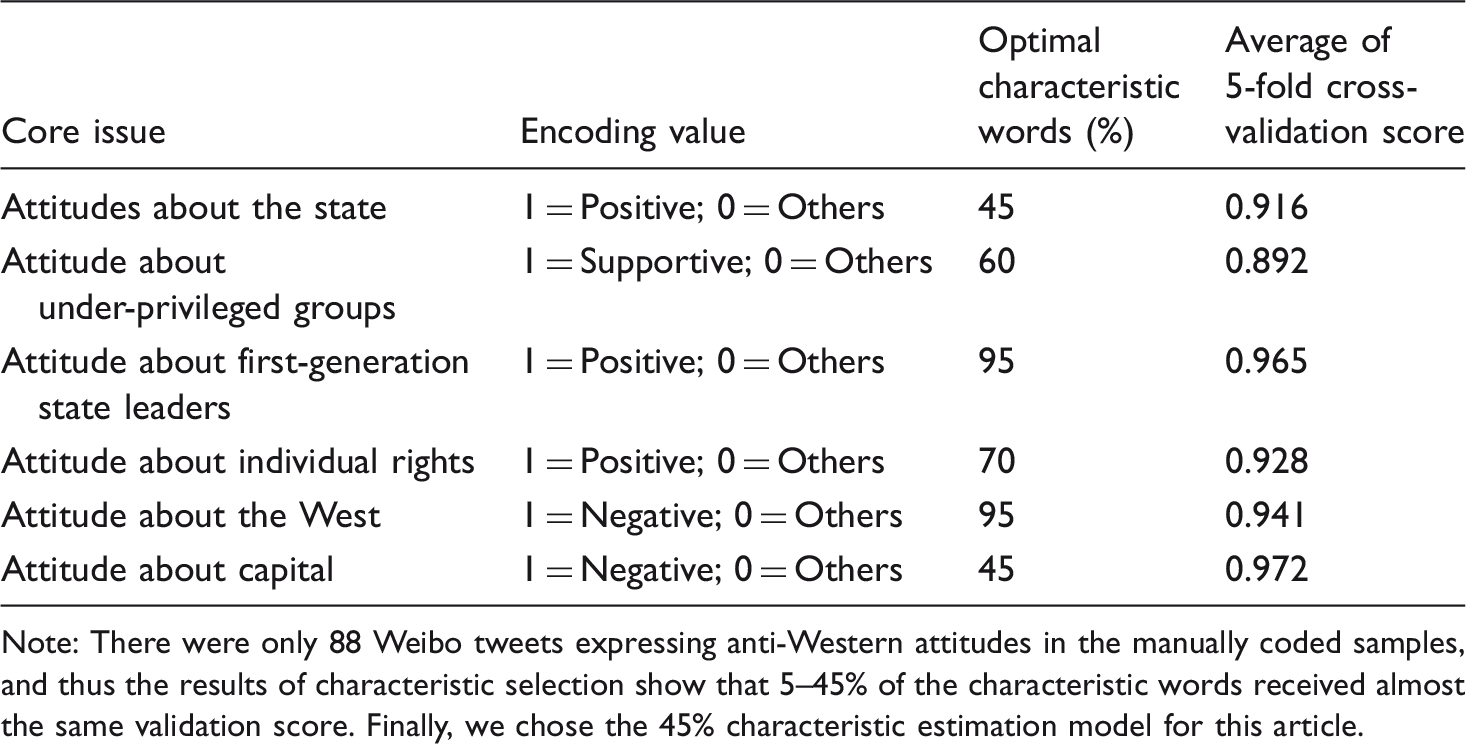
Note: There were only 88 Weibo tweets expressing anti-Western attitudes in the manually coded samples, and thus the results of characteristic selection show that 5–45% of the characteristic words received almost the same validation score. Finally, we chose the 45% characteristic estimation model for this article.
Comparison between two methods of classifying the types of social thoughts of 18 IDs.
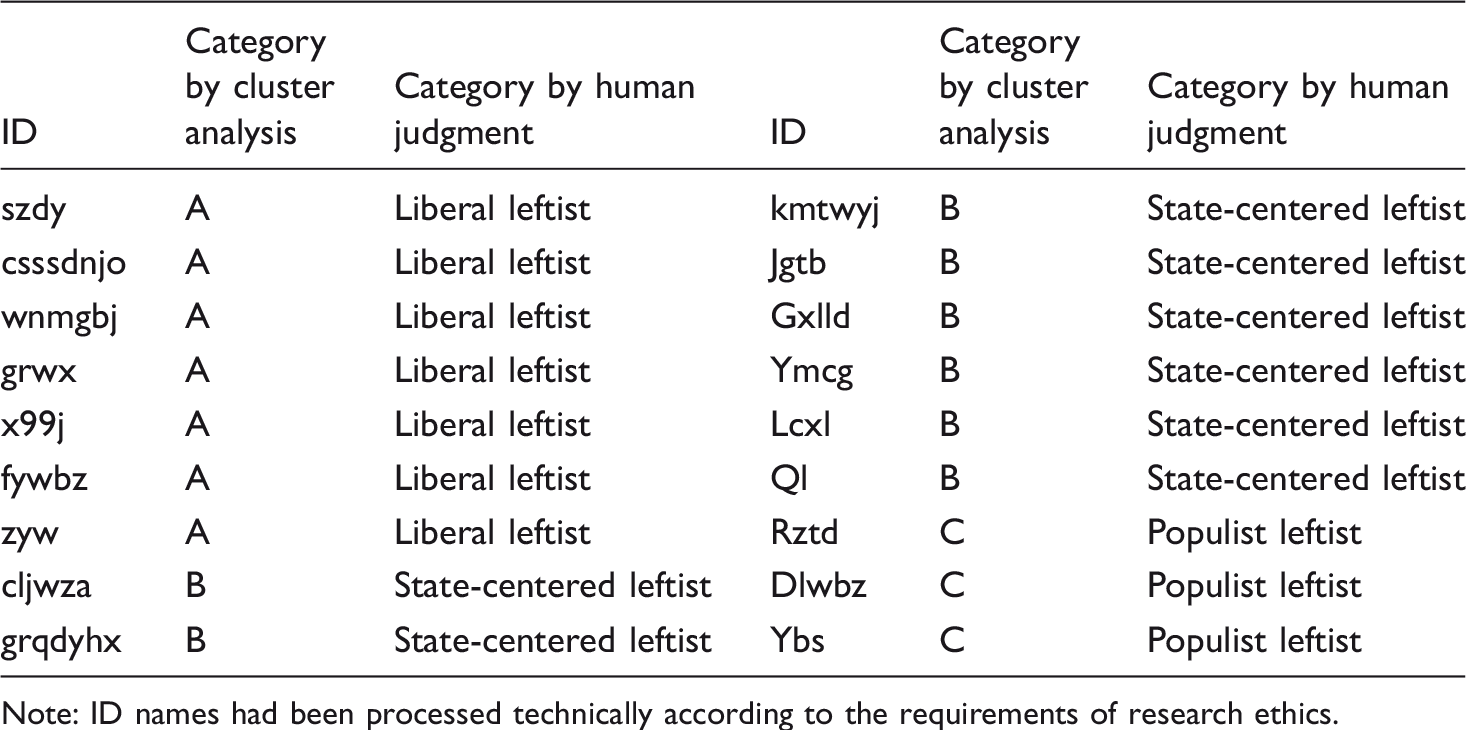
Note: ID names had been processed technically according to the requirements of research ethics.
The spectrum of left-wing social thoughts and corresponding online communities
A social network analysis technique was used to examine Weibo users’ network interaction patterns, as well as the corresponding relationship between online interactions and issue orientations that were predicted by machine learning and cluster analysis, in order to systematically confirm the above finding about the issue attitudes of the three faces of left-wing social thoughts and to reveal the interaction structure within and between different types of leftists from a holistic perspective. The object of analysis is an interaction network that consists of 745 Weibo users and 17,985 pairs of interaction relations in which there was direct mentioning (@ID) between users. The results of cluster analysis will be reported in the first section, which is also the basis for a substantive interpretation of the network interaction structure. The second and third sections will respectively focus on the interaction structure of the network community and its dynamic evolution.
Characteristics of the social thoughts spectrum: Cluster analysis based on issue expression
To analyze the characteristics of different types of Weibo users' social thoughts, we aggregated the attitudinal frequency of each issue according to the results of our cluster analysis and calculated the average attitudinal frequency and relative attitudinal frequency of each type of user. The results in Figure 2 show that the first type of user is clearly characterized by a strong anti-Western attitude, a strong positive feeling toward the first-generation state leaders, and statist values. It is worth mentioning that although the expression frequency in support of statist values is smaller than the frequency of anti-Western attitudes, a cross-sectional comparison of the three types of users indicates that the first type of user has the strongest approval of statist values, especially in the relative frequency chart. Based on the above analysis, we named the first user group ‘state-centered leftists.’
Social thoughts characteristics of three cluster groups.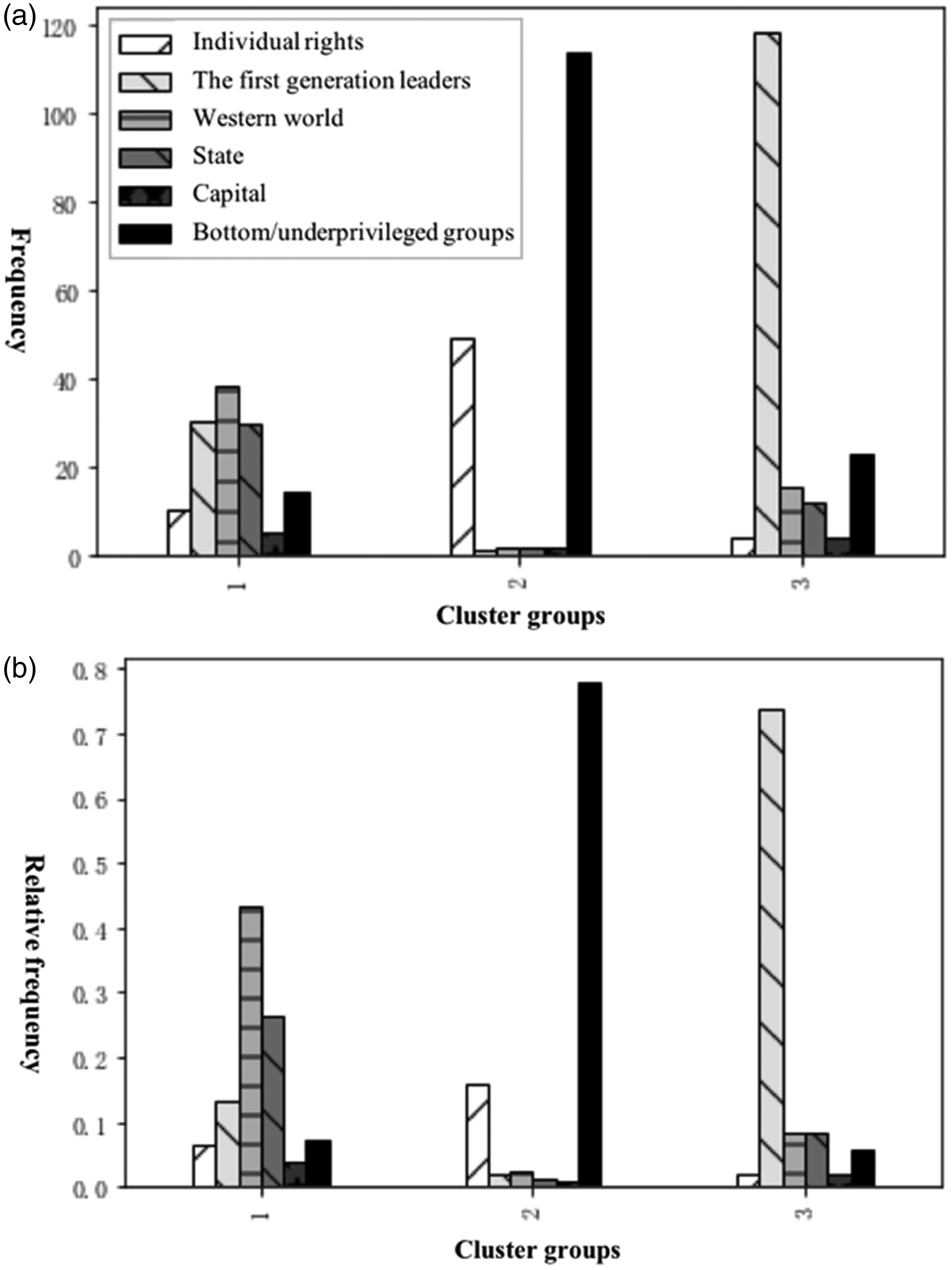
Both the frequency and the relative frequency indicate clearly that the second type of user holds a strong grassroots position orientation and affirms the importance of individual rights. However, this type of user pays little attention to the other four issues. Since these characteristics are consistent with those of the liberal leftists, we named the second user group ‘liberal leftists.’
The most striking feature of the third user group is the strong positive attitude toward the first-generation state leaders, for which both absolute and relative frequency are far higher than their attention to other issues. Further analysis shows that this type of user also expresses support for the grassroots groups to some extent. In general, the third user group has obvious populist characteristics.
Inter-community interaction structure and its holistic interpretation
We extracted the interaction networks that consist of direct mention relations between users embedded in tweets and discovered the interaction structure between users by community detection technique. Community detection analysis classifies users who have close interactions with each other in the same community. It turned out that the 745 users studied in this article formed five interaction communities (Figure 3(a), color represents the membership of interaction community). We used different shapes to represent the types of users’ social thoughts and overlaid the information of social thought types on that of the community membership derived from interaction structure (Figure 3(b)), thus visualizing the relations between users’ social thoughts characteristics and their online interaction patterns.
9
Relationship between community structure and social thoughts clusters.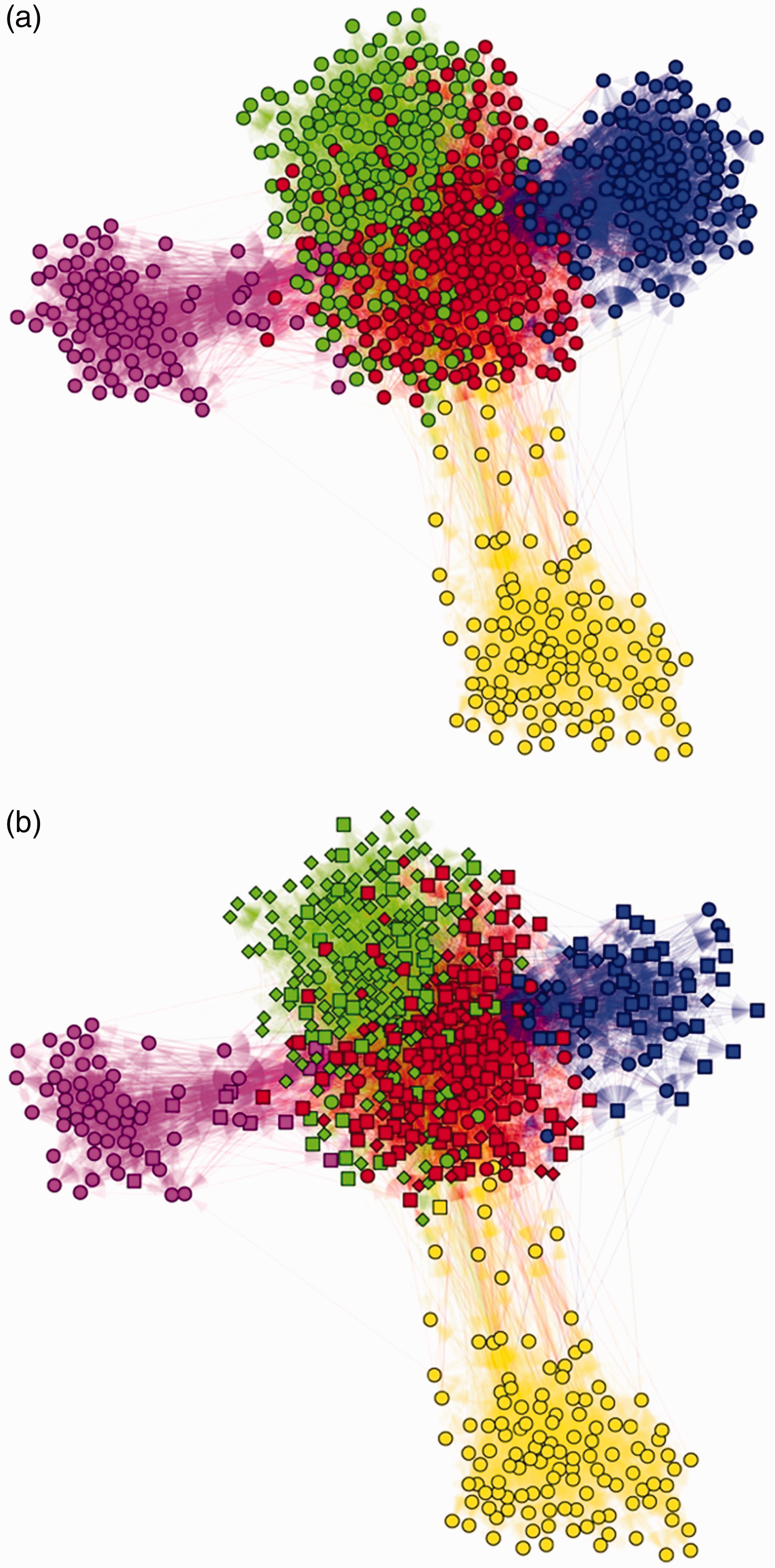
Our results show that populist leftist users (diamond-shaped nodes on the top right of Figure 3) form an interaction community, and liberal leftist users (circle-shaped nodes on the left and bottom of Figure 3) and state-centered leftist users (square shape on the right and middle of Figure 3) form two relatively independent interaction communities respectively. This suggests that users with the same ideological leanings tend to form relatively independent online communities centering on different key influential users. In addition, the existence of two relatively independent interaction communities of liberal leftists probably points to the following social fact: the current policy environment has, to some extent, narrowed the space for actions to safeguard and advocate the rights and interests of weak and under-privileged groups (such as laborers’ rights and interests), and liberals have not reached a consensus regarding how to promote the under-privileged groups’ interests and rights while avoiding the potential political risks associated with these actions, which in turn prevents liberals from forming a close-knit community.
Among the five interaction communities, the state-centered leftism community marked with red squares occupies a central place, and the other four communities all have certain interactions with the state-centered leftism community, which indicates that, to some extent, the controversy between leftist social thoughts is more or less related to the core issue of the state–society relation. It is interesting that the state-centered leftists marked with blue squares mainly interact online with the state-centered leftists marked with red squares, while not interacting much with liberal and populist leftists. Further analysis reveals that the interactions between state-centered and liberal leftists are dominated by online debates about attitudes toward the West. Therefore, we can see that not all state-centered leftist users actively engage in debates with users of other social thoughts communities (Han, 2015). Thus, researchers need to study the characteristics of social thoughts and the interaction patterns of Weibo users simultaneously, so as to fully present the values systems and the corresponding political implications in online space (Garcia et al., 2015).
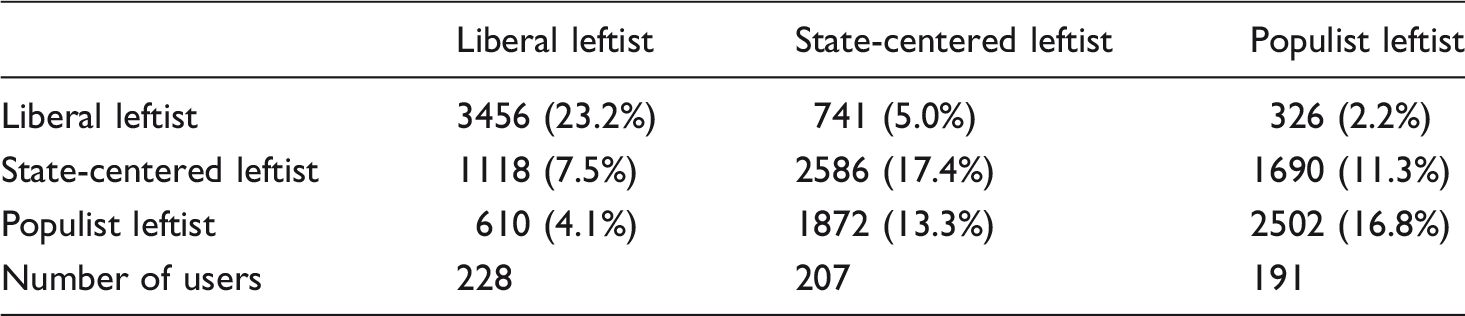
Distribution of interactions among different social thoughts factions.
Exponential random graph analysis of interactions between different social thoughts users.
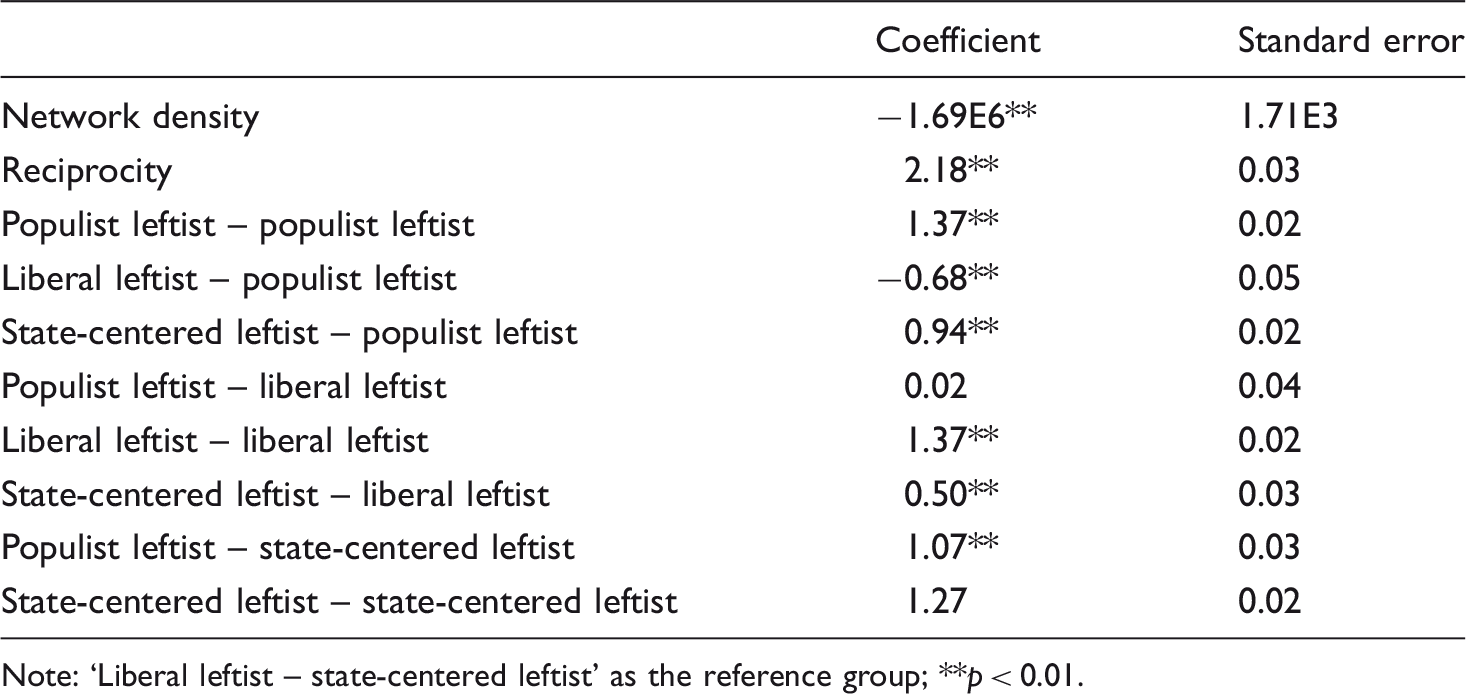
Note: ‘Liberal leftist – state-centered leftist’ as the reference group; **p < 0.01.
Although both liberal and populist leftists hold the position for the weak and the disadvantaged, there are no close interaction relations between them. Statistical analysis (Table 5) reveals that only 2.2% of interactions are from liberal leftists to populist leftists and 4.1% from populist leftists to liberal leftists, which are percentages significantly lower than the proportions of other interactions between leftist communities. The exponential random graph model further supports these findings. Taking the interactions between liberal leftists and populist leftists as a reference group, the coefficients of the interactions between the other factions are all above zero and highly significant. Among the coefficients, the coefficient of the interactions from populist leftists to liberal leftists is the smallest (0.70). One possible explanation is that the two left-wing factions draw on different theoretical resources and use different symbols and values systems to safeguard the rights of the under-privileged groups. For the liberal leftists, the establishment of effective rules and institutions to protect individual rights is essential for safeguarding under-privileged groups. However, the populist leftists emphasize under-privileged groups as taking the moral high ground, question authority, and believe that the direct participation of ordinary people is the solution to many social problems. This finding is to some extent consistent with the framing theory (Benford and Snow, 2000), which suggests that actors have different diagnostic methods and solutions in facing the same social problems and that the difference will largely influence their actions and the possibility of cooperation between actors.
Evolution of the community structures
We further analyzed the evolution of community structures during 2012–2014. To this end, we have constructed three annual interaction networks year-by-year according to the following rules: firstly, the boundary of a community was limited to users with distinct characteristics of certain social thoughts in the middle right of Figure 3, which helps us to investigate the temporal changes of community members’ ideological characteristics. Secondly, considering that there were only a few Weibo tweets in 2012 and 2013, we chose six as the cut-off point for high-frequency interaction, and interactions with less than the cut-off point were deleted. 11
Analysis of three annual interaction networks (Figure 4) reveals that the interaction network in 2012 consisted of 237 Weibo users, of whom 57.8% were liberal leftists, 31.2% were state-centered leftists, and 11.0% were populist leftists. The interaction network in 2013 consisted of 596 Weibo users, of whom 36.3% were liberal leftists, 33.6% were state-centered leftists, and 29.9% were populist leftists. The interaction network in 2014 consisted of 294 Weibo users, of whom 12.9% were liberal leftists, 40.1% were state-centered leftists, and 46.9% were populist leftists. Comparison shows that liberal leftist users formed two relatively close-knit communities in Weibo space in early 2012, which lasted until 2013. However, the proportion of these types of users dropped significantly in 2014, after which they no longer constituted an identifiable interaction community.
Evolution of the community structure (2012–2014).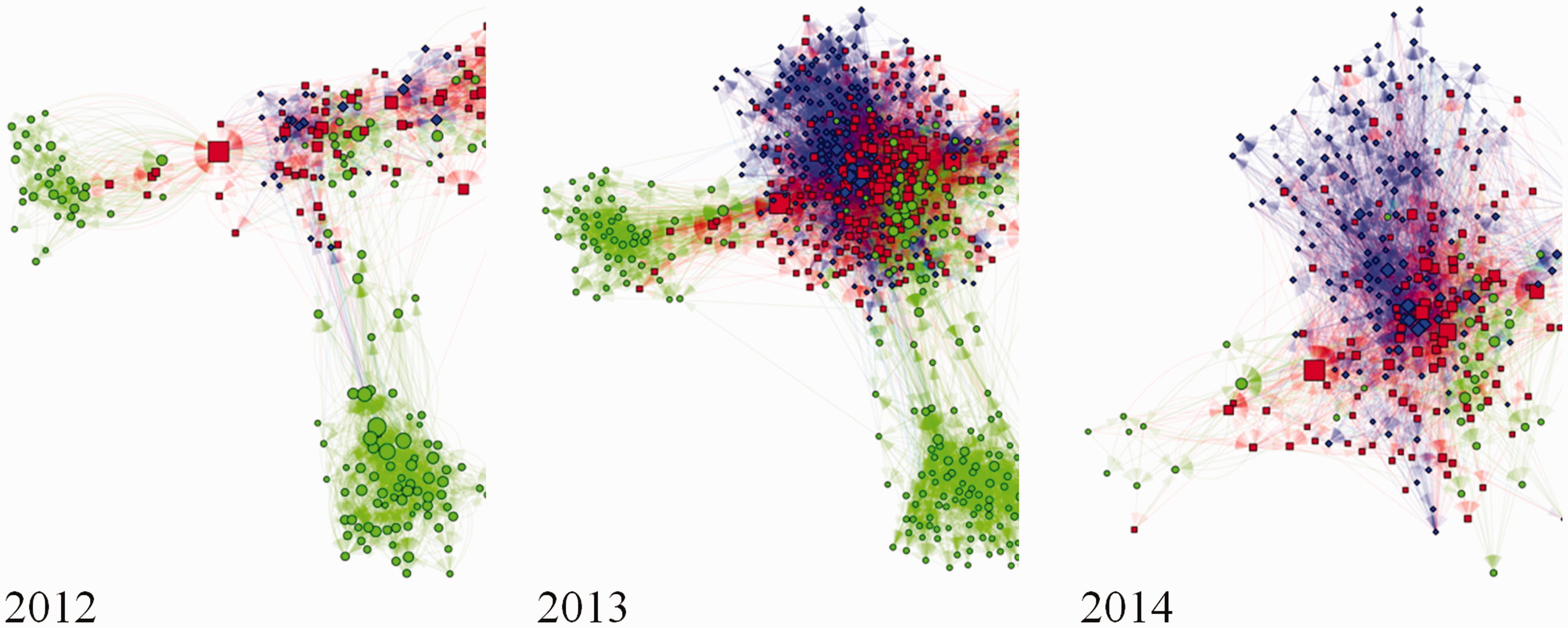
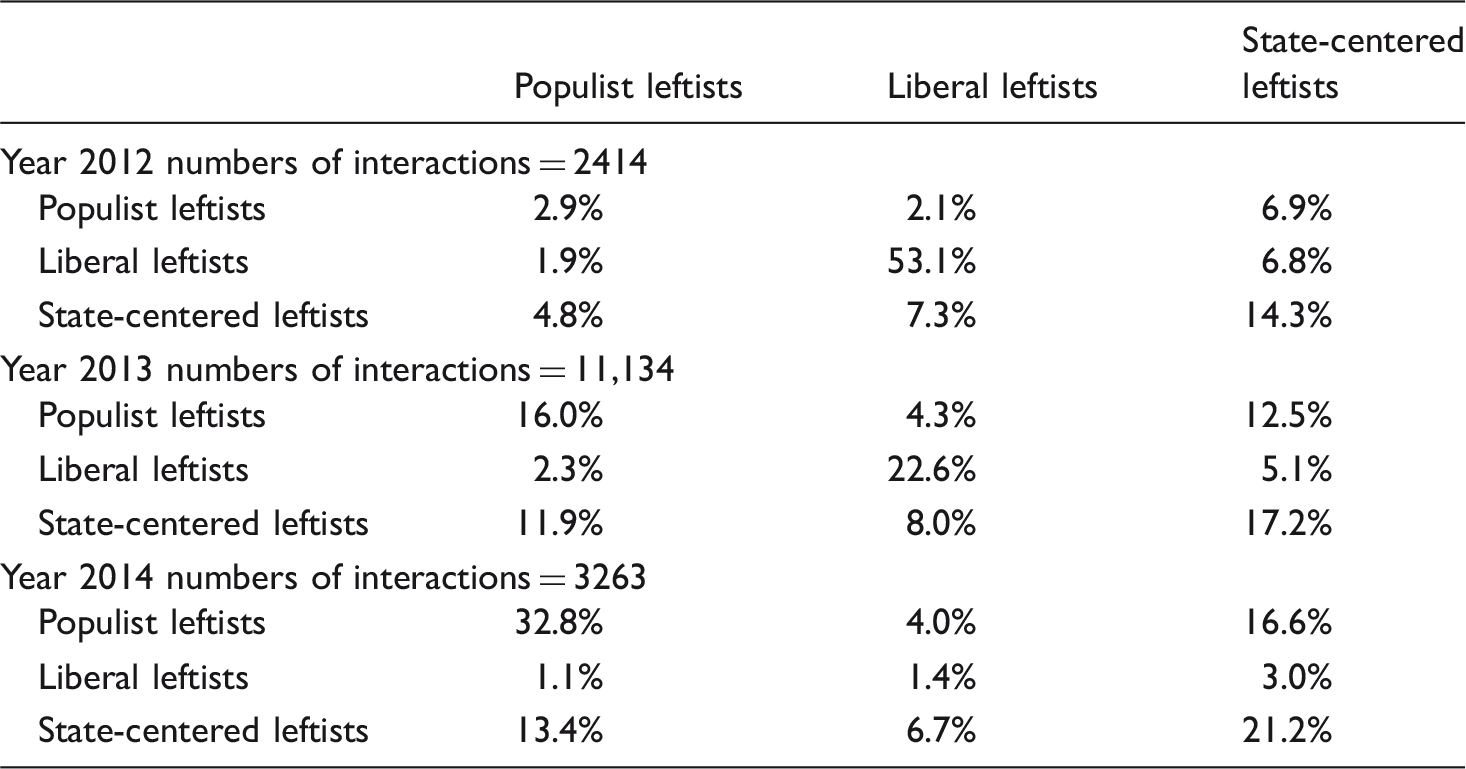
Temporal changes of the online interactions between different types of left-wing users.
Exponential random graph model analyses of online interactions among different types of leftist users.
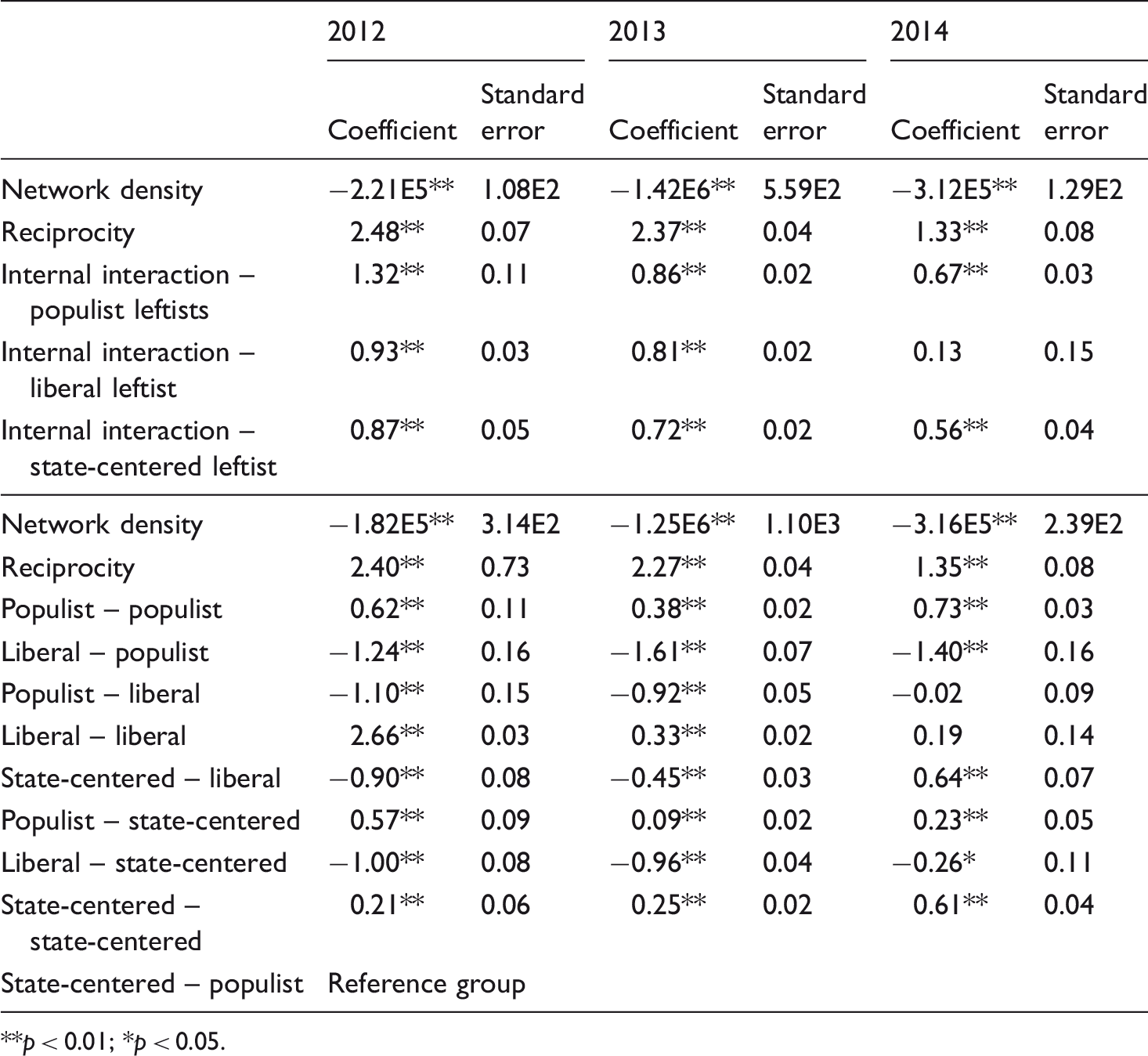
p < 0.01; *p < 0.05.
Analyses of the interaction communities between different types of leftist users show two interesting patterns: firstly, cross-community interactions mainly occurred between state-centered and populist leftist users, and these interactions gradually increased. Secondly, interactions from populist leftist users to state-centered leftist users were more common than those from populist leftist users to state-centered leftist users, which was further supported by the exponential random graph model (see the populist state-centered coefficients in Table 8). In addition, descriptive results show that the proportion of interactions from populist to state-centered leftist users increased from 6.9% in 2012 to 16.6% in the first half year of 2014. Similarly, the proportion of interactions from state-centered to populist leftist users rose from 4.8% in 2012 to 13.4% in 2014. This finding indicates that online debates among different camps of left-wing users change along with the external socio-political environment. Meanwhile, it also lends support to the argument that it is necessary to investigate the diverse faces of the left-wing social thoughts. Moreover, it is worth mentioning that the interaction pattern between populist leftists and state-centered leftists probably reflects the distinctions and controversies between these two camps. From our online observations, disagreement and conflicts between populist leftists and statist leftists who originally drew upon similar intellectual resources for inspirations has gradually widened over the past few years, and the conflicts of opinions and stances have been manifested on a variety of social issues. The state-centered leftists focused on the issues of public intellectuals, nationalism, and historical topics, whereas the populist leftists tended to hold a grassroots perspective, paying more attention to social injustice, under-privileged groups, labor movements, and state power. Due to the deep-rooted divergence on the above-mentioned issues, although both state-centered and populist leftists adhere to similar, even identical, ideological resources and discourses, they have been ridiculing and criticizing each other in recent years, with discursive controversies sometimes even turning into online bullying and attacks, indicating an evident trend of splitting. Some young populist leftists develop a strong emotional hatred toward some state-centered leftists and take the initiative in launching online collective campaigns. For example, in the ‘Leiyang’ event, the state-centered leftists argued that it was legitimate for plainclothes policemen to carry out their public duties according to the law and accused Lei Yang of obstructing public duties after his offence involving prostitutes. From their perspective, the degree of force used upon Lei Yang was appropriately determined by his strength of resistance. In contrast, the populist leftists believed that the state-centered leftists’ view was ‘conditional for different people,’ stressed the equality between Lei Yang and the police, and accused the state-centered leftists of losing human beings’ basic moral sense.
Conclusion and discussion
This article proposes a theoretical model consisting of two dimensions, position orientation and theoretical resources, to construct a typology of the left-wing social thoughts expressed in online space. Based on our long-term follow-up observations of a few hundred Sina Weibo users, we identify three types of left-wing social thoughts according to our theoretical model: state-centered leftism, populist leftism, and liberal leftism. Among them, liberal leftism draws theoretical resources from classical Marxism as well as modern capitalist ideology and holds a grassroots position that prioritizes the interests of the weak and the unprivileged to interpret and further develop the underlying theoretical resources and discourse system. Both state-centered leftism and populist leftism seek ideological support from the Chinese revolutionary tradition. However, state-centered leftism, to a greater degree, holds a pro-state and pro-nation position to quote and re-interpret the underlying ideological resources and discourse systems, while populist leftism holds a grassroots position to stand for the interests of the weak and the under-privileged and to quote and re-interpret the underlying ideological resources and discourse systems.
This article uses a mixed method of case observations and big-data analyses of Weibo tweets to study the three faces of online left-wing social thoughts. These three faces have distinctive attitudes concerning six core issues, including attitudes about the state, the weak and the under-privileged, the first-generation state leaders, individual rights, capital, and the Western world – especially the USA. The results of supervised machine learning and cluster analysis also support the proposed typology. Specifically, we integrate the results of supervised machine learning and network community detection to identify the interaction community structures of different types of online leftists, as well as analyze the associated online interaction network structure and its temporal evolution. We find that the liberal leftist community has gradually declined over time and no longer constitutes a discernable interaction community. There have been more frequent online interactions between populist leftists and state-centered leftists, but the increasingly visible rift between them has also led to increasing controversies and conflicts in online space.
Based on the above findings, several issues merit further discussion: firstly, an important lesson to be learned from this study is that understanding the differentiations of social thoughts in online space from a linear spectrum perspective has obvious limitations. Social thoughts have pluralistic and multi-dimensional characteristics. Therefore, a typological analysis of a particular social thought should proceed from a multi-dimensional rather than a single-dimensional perspective. Meanwhile, the spectrum of social thoughts is not linearly arranged from one end to the other, according to the quantity of specific attributes. Thus, we cannot identify different social thoughts from a static and linear perspective.
Different social thoughts constantly change their discursive boundaries and holders of social thoughts constantly (re)define their allies and enemies. For instance, although state-centered leftism and populist leftism both rely heavily on the Chinese revolutionary discourse system and thus are commonly considered to be one leftist ideological faction, they have nowadays developed into two distinctive and confrontational camps in the face of the decline of ‘public intellectuals’ and liberal leftism. On the other hand, left- and right-wing social thoughts, which are regarded as incompatible, like fire and water in conventional wisdom, may take the same position and viewpoint on certain social issues. In some online events, moderate right-wing users with capitalist and individualistic ideologies tend to emphasize elements related to legal principles as well as the moral logic of modern individualism, while moderate state-centered leftist users tend to pay attention to elements relating to the political regime. Both elements ultimately lead to the affirmation and support of the existing social and political order, through which some right-wing users and leftist users reach a consensus.
Some may argue that state-centered leftists and conservative right-wing users only assume the same positions on and attitudes about some issues in an accidental manner and that the two camps follow fundamentally different ideological logics. Thus, the populist left wing and populist right wing have more in common and may even have converged in recent years. This article does not discuss right-wing social thoughts in detail because they are more complex and diverse. Nevertheless, a sub-community of right-wing users does have a mode of ideological thinking that is highly similar to that of populist leftists. Although the populist right wing takes modern capitalist ideology as their discourse system and the populist left wing uses the Chinese revolutionary discourse system, they have a similar framing strategy of problem diagnosis, and both tacitly acknowledge the natural moral high ground of the weak and the disadvantaged. The theoretical resources of populist leftism, including the mass line and the supremacy of ordinary people, are actually similar or compatible with democracy in contemporary Western ideology in the sense that both are concerned with defending the rights of the weak and the disadvantaged. Of course, there are still some insurmountable obstacles for the two social thoughts to reach a full consensus ideologically, since there are inherent conflicts in their discourse systems unless one side is willing to transform its own discourse system or both try to heighten the ideological elements that can discursively coexist in order to reach a consensus. Yet, it should be noted that the two camps originate from similar basic values with a trace of populism but use different symbolic and discursive resources to express and elaborate these basic values. In this sense, populism and democracy are two sides of the same coin, regardless of whether their discourse systems originated in China or the West.
The multiple faces and temporal evolution of online social thoughts suggest that researchers need to take the context of online ecology into consideration to better understand the social meaning of speeches and frames as well as the complicated underlying social mechanisms. Because online public opinions are shaped by different regional/provincial governments, different levels of government departments, and different businesses (Yu et al., 2015), and online discursive controversies constantly evolve with changing media ecology, which is, in turn, influenced by a variety of online and offline social, political, and business environments, it is essential for researchers to make ‘thick descriptions’ of the multiple faces of social thoughts in online space in terms of their basic values, online behaviors, and deep-rooted motivations, instead of only using abstract theoretical modes to depict the common patterns of certain social thoughts.
Secondly, in an era of intense interdisciplinary competition, discovering how to effectively integrate traditional sociological research methods with big-data analytics and to maintain the competitiveness of sociology while embracing the new trend is an urgent task for sociologists to explore. This study preliminarily shows that the mixed method design of case observation as the basis for and guide to big-data analyses works well in the study of online social thoughts. On the one hand, sociologists of empirical studies should approach big-data analytics with open minds (Sun and Shi, 2016). As this study shows, big-data text analyses help researchers portray cultural communities and their temporal changes in a systematic and empirical manner, thus providing a solid empirical foundation for the sociological studies of cultures and values (Bail, 2014). Meanwhile, the texts and embedded social relations generated on social media platforms enable us to examine the interactions of different social thoughts groups from the perspectives of the expressed social thoughts and online interaction patterns. Since there is no one-to-one association between the expressed social thoughts and online interactions, albeit close association does exist, examination of the two jointly through big-data analytics is valuable in deepening our understanding of the evolution of social thoughts communities and the underlying driving forces (Garcia et al., 2015; Huang, 2017). In this sense, identifying a ‘fifty-cent army’ only from Weibo users’ posting behavior (King et al., 2017) is a valuable but incomplete research strategy. This study also shows that qualitative analysis still plays an important role in sociological research based on big-data analysis. Preliminary qualitative exploration not only helps researchers to put forward clear and meaningful research questions, to manually label the text data in an accurate way, and then to evaluate the validity of big-data analysis results, but it also helps researchers to re-contextualize the results so as to obtain an accurate understanding and interpretation (Boyd and Crawford, 2012). Yet, there are still many methodological questions to be explored: for instance, how to conduct in-depth mining of big data, how to integrate the formalism of big-data analyses with substantive case analyses effectively to increase the accuracy of data mining, and how big-data analytics can work well with traditional sociological methods to achieve the best trade-off in terms of efficiency, costs and benefits, analytical depth, and accuracy.
It is worth pointing out that this article only depicts the characteristics of three sub-types of leftism and the interaction network structures between Weibo users holding different types of left-leaning social thoughts. However, the study is far from enough for us to fully understand the complex online landscape of social thoughts, and many related issues warrant further exploration. Here, we would like to point out a few questions with scholarly and substantive significance.
From a scholarly perspective, a natural follow-up question after depicting the characteristics of different types of social thoughts is why such different types of social thoughts exist and what their social roots are. A sociological study of the driving forces underlying the expression of values and beliefs might need to examine the effects of visible group, class boundaries, and interest boundaries, or any other institutional and structural objective factors, such as family background, education level, occupation, and place of origin. Alternatively, perhaps the social thoughts and values have their own particularities and cannot be satisfactorily explained by structural sociological factors. Our preliminary analyses of offline interviews have found no significant divergence of values across social groups and institutional settings. This suggests that sociological studies on social thoughts and values may require a more subtle and complex analytical approach.
What direction will left-wing social thoughts move toward in the future? This is an important question that may exert a significant impact on Chinese society. Theoretically, a social thought can have a substantial social impact only if it resonates with the interests of a large segment of the society. So far, online left-wing social thoughts manifest mainly as an online ideological phenomenon at a relatively large distance from the interests of different social groups in the offline society. In the long run, social thoughts with high levels of social influence and great historical significance are not ideologies or values supported by specific opinion leaders, but those capable of generating widespread social resonance and that are closely intertwined with the broadest social interests. Moreover, these resonant social thoughts might even be transformed into a multifaceted new form by adapting to offline social interests, organizations, and social groups, even though this transformation might occur at the cost of partially losing their ideological purity. Will the left-wing social thoughts further evolve to better echo the social groups and social interests in offline society? And, if so, in what ways? The actual answers to these questions relate to many complex factors and perhaps cannot be summarized by or inferred from an abstract theoretical model about an ideological system, class structure, or interest structure.
Footnotes
Declaration of Conflicting Interests
The author(s) declared no potential conflicts of interest with respect to the research, authorship, and/or publication of this article.
Funding
The author(s) disclosed receipt of the following financial support for the research, authorship, and/or publication of this article: This work was supported by the 2019 Major Project of the National Social Science Foundation [19ZDA148] (Big-data-driven research on the development and the guiding strategy of online social mentality).