




Abstract
This study explores the question of how ethnic groups were assimilated by the Imperial State to be placed under the administration of the central government and how their ethnicity changed during this process of nationalization. This paper studies the case of the Yi ethnic group in Bailu Ying of Mianning county, Sichuan Province in China. The ancestors of Yi people in Bailu Ying lived on Mount Daliang before the Wanli reign of the Ming Dynasty. In the early period of the Ming Dynasty, the government had set up Ningfan Garrison on the river valley on the west side of Mount Daliang. By the late Wanli Period, the garrison was consistently being attacked by the indigenous people in the area. In order to quell the resistance, the Imperial Court recruited Yi people as soldiers to guard the garrison. Afterwards, a new settlement of the Yi tribe in the Bailu Ying River valley emerged, and in the process the Yi people’s livelihood was transformed from herding and fishing to agriculture. In the early Qing, the Yi people in Bailu Ying were further integrated into the Imperial system with the inclusion of chieftains in the imperial governing body. However, up until the later years of the Qianlong reign, the Yi maintained relative autonomy in terms of its tribal settlement, power structure and cultural integrity. Later, with the arrival of new Han migrants, the introduction of the Baojia system, and the promotion of Han culture and education, the Yi group in Bailu Ying gradually lost its independence and began to be assimilated into the national identity, leading to the formation of Shuitian (rice field) Yi ethnicity.
The case of the Shuitian Yi shows that the survival strategy of tribal minorities from the mountains did not necessarily follow the pattern of ‘avoiding becoming part of empires’, as suggested by James C. Scott, nor were these ethnic people always slow and passive in integrating with empires. On the contrary, the acceptance of the imperial rule was a survival strategy that helped to creating new ethnic groups while also consolidating frontiers for the Ming and Qing Empires.
Introduction
The subject and literature review
How were ethnic groups in the frontiers assimilated by the Imperial State during the Ming and Qing dynasties? Answering this question is an important way to understand the ‘grand unification’ of China. For a long time, scholars have been accustomed to describing this process as a centre-to-periphery transition of national political, economic, military and education systems. This ‘top-down’ perspective, in fact, is a continuation of the Chinese traditional mentality of ‘centre/edge’ that takes the Central Plains (central China) as the centre. It views ethnic groups’ assimilation into the state as a passive process, without sufficient consideration of their subjective initiatives (Lan, 1992: 5–6).
The inadequacy described above has driven the South China School, represented by scholars such as David Faure, Zhiwei Liu, Chunsheng Chen and Helen Siu, to try to understand South China and the ethnic groups in it and their relation with the Imperial State from the ‘bottom-up’ perspective. Focusing on the issue of how ethnic groups were assimilated to the state, these scholars have extended in-depth discussions from multiple angles such as ritual traditions, legends and stories, spirit worship, etc. For example, Faure (2016) argued that ritual reform constituted the most important part of the state–society relationship, and that it is probably the most important element in the assimilation process of the frontiers to the state. He pointed out that the school worshipping ritual for Confucius and the book Family Rituals by Chu Hsi were found in Guangzhou as early as the Song Dynasty, heralding the nationalization process of the Pearl River Delta. But it was in the Ming Dynasty that this area was genuinely assimilated into the Imperial State. With the implementation of the Lijia System (a system of social organization) and restoration of the Imperial Examination System at the beginning of the Ming Dynasty, the legitimate rituals promoted by the local people were spread widely among villages in the Pearl River Delta in the 16th century. Lineages turned themselves into ‘gentries’ with the help of rituals. Thus, the Pearl River Delta area was assimilated into the Imperial State’s feudal code of ethics (Faure, 1999; Faure and Liu, 2000).
Zhiwei Liu found that, for the development and control of Shatian (farmland), the former residents in the Pearl River Delta in the early Ming Dynasty applied various national systems and cultural symbols, such as constructing a lineage in accordance with the national rituals and the literati tradition of gentry (Liu, 1999, 2006) and worshiping Beidi (the North Deity) as the symbol of legitimacy (Liu, 1994), to associate their local power with imperial legitimacy (Helen, Siu and Liu, 2004).
Studies on South China show that with the implementation of a series of institutions, including household registration, land transactions, taxation and imperial examinations in the early Ming Dynasty, in order to take advantage of resource control, local groups often consciously applied the means symbolizing legitimacy, such as institutions, rituals, characters, faiths and legends to create a sense of identity with the state in their local communities so that the state order could be established and consolidated in the frontier. In this way, the frontier ethnic groups were integrated into the ‘grand unification’ of the Imperial State. In a word, while discussing the nationalization process of the ethnic groups, the South China School emphasizes the initiative of local people and comprehends the formation of the ‘grand unification’ of the state as a process in which local people actively use the state discourse in undertaking society construction (Liu, 2003).
Scott (2009) was keenly aware that, unlike many of those experiencing nationalization in South China, some of the highland ethnic groups in the southwestern frontier had their own particular strategies in the process of nationalization. He pointed out that the highland groups residing in Thailand, Laos, Burma, Cambodia, Vietnam and some places over 300 metres above sea level in four provinces of southwestern China (Sichuan, Guizhou, Yunnan and Guangxi) had long been conducting slash-and-burn farming rather than becoming literate so as to escape state governance. Only very recently, with the state becoming absolutely powerful, did the highland ethnic groups end their state of anarchy. In Scott’s description, the highlands were like a vessel for population. There were constant migrations from the plains to escape the state, rather than any people living in the highlands moving to the plains to join it. Thus, the process of nationalization of highland ethnic groups was quite recent, passive and unitary. In that case, were there any other ways that highland groups became nationalized, and how did the nationalization process affect the generation of ethnicity (ethnic and cultural characteristics)? This article will study the case of the Shuitian Yi ethnic group in Bailu Ying, Mianning County, Sichuan for further discussion of these questions.
Case background
The term ‘Shuitian Yi’ in this paper refers to the Yi ethnic groups living in Pingba, the river valley of the Anning River and its tributaries in Sichuan. They live in many counties and cities, such as Mianning, Xichang and Dechang. This subgroup of Yi people call themselves Mixisu (meaning ‘Pingba people’) and are also known as Shuitian Yi for their skill at reclaiming paddy farmlands and planting rice. According to investigations, Shuitian Yi once lived in the highlands and later migrated to the plains for a variety of reasons (Wu, 1987: 34). Having lived in Pingba for a long time and having been influenced by the Han people, they are significantly different from the highland Yi people living on Mount Daliang in many aspects, including their methods of production, way of life, economy and culture. The investigations in the 1960s showed that before 1949, Shuitian Yi people mainly lived on agriculture, with side-lines such as fishing and selling firewood; they had already entered the landlord economy stage, maintaining different degrees of land tenancy relations while keeping a small number of slaves; they lived in the same communities with Han people and were surrounded by them; they spoke the Chinese language, used Chinese names, wore Han clothing and had reached a very high degree of Sinicization (Wu, 1987: 33–37). These characteristics highlighted the ethnic differences between Shuitian Yi and highland Yi people.
The research on Shuitian Yi can generally be divided into three categories. The first category includes the investigation reports on Shuitian Yi. For example, Chen (1947 and 1948) investigated and recorded the status of distribution, marriage, mythology and religion of Shuitian Yi living in Dechang in the Republican era. In 1950s and 1960s, an in-depth survey on the social history of the Yi people in southwest China was carried out for ethnic groups’ identification. Some of the content of the survey was about the historical and social situation of Shuitian Yi (Social and Historical Investigation Group of Sichuan Ethnic Minorities, The Institute of Ethnology, Chinese Academy of Sciences, 1963; Wu, 1987).
The second category includes the works on the general history of the Yi people, and Shuitian Yi is usually taken as a branch of the Yi ethnic minority for discussion (Fang, 1984; Social and Historical Investigation Group of Yunnan Ethnic Minorities, The Institute of Ethnology, Chinese Academy of Social Sciences, 1963).
The third category includes the monographic studies involving miscellaneous aspects of the society and culture of Shuitian Yi, and the results of these studies have been quite fruitful. For example, Harrell (2000) did a case study on the Yi people living on the Manshui River in Mianning. He discussed the ethnic identity of Shuitian Yi and pointed out that consanguinity marriage within the nationality was the main reason for maintaining self-identity; Zhu and Zhang (2005) analysed the language spoken by Shuitian Yi living on the Manshui River and in the town of Mianshan in Xide in terms of lexical and grammatical aspects; Xiao (2007) studied the funeral culture of the Yi people in Dashitou in Xide and on the Manshui river in Mianning and concluded that Shuitian Yi strengthened their ethnic memory through the inheritance of religious beliefs; Deng (2011) studied the wedding laments of the Yi people living in Shunuo village and in the town of Huilong in Mianning and pointed out there were three different statuses in the inheritance of oral tradition among Shuitian Yi: ‘complete’, ‘transitional’ and ‘vanishing’.
In summary, there have been many studies on Shuitian Yi, but these studies have not paid enough attention to the process of nationalization, not to mention the influence of the nationalization process on their ethnicity. In other words, how did Shuitian Yi come from the highlands to the plains, and how did their ethnicity come into being? These questions have not yet been explored. This paper expresses my view that such a process is precisely what we need for our examination and reflection on the nationalization process and ethnicity generation of the highland ethnic groups. It is true that it is not easy to discuss these issues, as the relevant historical materials are extremely scarce. The research in this study is based mainly on the materials 1 on the Shuitian Yi that I collected in the Sichuan Mianning survey and the Mianning Archives 2 from the Qing Dynasty. The former has a more detailed record of the formation process of Shuitian Yi in Bailu Ying, Mianning during the Ming and Qing Dynasties, while the latter provides us with historical data on their social environment. Using these data in this paper, I will present a detailed study of the nationalization process and the generation of the ethnicity of Shuitian Yi and address some viewpoints on the nationalized transition of the highland ethnic groups.
From the highlands to the plains: the formation of Yi settlements in Bailu Ying during the Ming Wanli Period
Bailu Ying, where Yi ethnic groups settled during the reign of Emperor Wanli of the Ming Dynasty, is a place belongs to Xin’an administrative village, Hebian Town, Mianning County, Sichuan Province. In Bailu Ying, the Yi people and Han people live in close proximity to each other. According to my investigation, the Yi ethnic groups living in Bailu Ying are what the local people call Shuitian Yi. From the existing literature, we can find that the formation of their settlement can be traced back to the reign of Emperor Wanli in the Ming Dynasty, and that it is related to the historical event of Ningfan Garrison recruiting highland Yi people to fight against a local rebellion as battalion soldiers.
The rebellion of the ethnic minorities in the 36th year of the Ming Wanli Period
Bailu Ying is located along the southern part of the Dadu River, which originates from the Anning River and flows southward through today’s Xichang, Dechang, Huili, Yanyuan and other counties and cities, and finally into the Jinsha River. Historically, the Anning River passed along Mount Daliang in the east, where Luoluo (the Yi) lived, and along the Yalong River in the west, where a minority group (Tibetans) lived, connecting Sichuan and Yunnan and posing strategic importance in restraining ethnic minorities residing in the peripheral areas (Liu, 2003: 461). Therefore, in the early Ming Dynasty, six garrisons were stationed along the Anning River basin from north to south, at Yuexi (now Yuexi County), Ningfan (now Mianning County), Jianchang (now part of Xichang City), the former Jianchang (now part of Xichang City), Huichuan (now Huili County) and Yanjing (now Yanyuan County), together with eight Shou-yu suo (defence groups, each one having about 1000 soldiers). Six garrisons and eight Shou-yu suo had 58,000 soldiers to protect the flow of Sichuan–Yunnan arteries (Huang, 1986: 61). In addition, the Ming Emperor appointed local officials under garrison systems in Jianchang, Dechang, Weilong and Puji to assist with governance (Li, 1986: 556).
At first, the garrisons in Ningfan and Jianchang had plenty of army provisions and strong military forces. But during the Ming Wanli Period, due to a bad environment, delayed delivery of army provisions and exploitation by garrison officers, a large number of guardian soldiers deserted their posts, leaving only about 5000 soldiers, less than one-tenth of the armed forces in the early Ming Dynasty. This led to a great decline of the guardian forces of Ningfan Garrison, making it difficult for them to control the surrounding tribes (Huang, 1986: 61). In addition, since the middle of the Ming Dynasty, Chief An, the region's local official with the highest rank, also the commander-in-chief of Jianchang Garrison, had no son to inherit his position for years. His people in the same tribe tried several times to abet the surrounding tribal rebellion in order to inherit his position, which also weakened the guardian forces (Gu, 1996: 118). As a result, in the late Ming Dynasty, rebellions among the surrounding tribes of Ningfan Garrison and Jianchang Garrison became increasingly frequent.
On 22 October in the 36th year of Wanli’s reign in the Ming Dynasty (1608), An Shilong, the head of Jianchang Garrison, was assassinated by his subordinates, and this event subsequently triggered a series of serious local rebellions. Qian Huan, the Governor of Sichuan Province, in Volume Nine of Memorials in Sichuan, kept detailed records: On 27 October, A man called Baiyixia from Xifan area, Meizi village, Ningfan Garrison, and dozens of Yi people robbed and burned Liujia Tun (the stationed village), stabbing Liu Zhongli, a Han person. The next day, some Yi people from Shenzha, Tongcao (now belonging to Xide County) in Mount Daliang, and some Yi people and western minorities from the tribes of Xizu, Baxian and Wadu on the mountain areas along the banks of the Dachong River (an upper stream of the Yalong River) gathered together in Lugu (now Lugu Town in Mianning) and Gaoshan Pu and robbed the army provision of Ningfan Garrison. On 29 October, Yang Xun, a military officer of Ningfan Garrison, along with seven family members, was killed, dozens of people were robbed and more people fled. From 2 to 6 November in the lunar calendar, tribes robbed these stationed villages of Ningfan Garrison again. They robbed the home of Wang Qinger, a military officer and that of Zhou Huaxin, a Xiucai (scholar who passed the imperial examination at the county level). They seized 12 people, including Bu Yuqi, some cows and horses and other possessions, killed one person and wounded three. On 7 November in the lunar calendar, Tianwang Tun, Libaihu Tun and Dapuzi Tun in Ningfan Garrison were all robbed and over 40 people were killed. For two days, 8 and 9 November, tribes ganged together to jointly attack Wuhai Tun, Wenzhuang Tun, Tianwang Tun, Libaihu Tun, Jingbaihu Tun, Gaoshan Tun and Zhengbaihu Tun (villages of Ningfan Garrison, where guardian forces were stationed). They captured Yang Zhisan and his family and declared that they would attack the fortress of Ningfan Garrison. On 7 December in the lunar calendar, hundreds of members from the tribes of Baxian, Xuepo, Tongcao and Shenzha marched towards the stationed and fortressed villages of Ningfan Garrison along two separate paths, plundering and looting as they went. They captured Chen Qice, Zhou Xi and Chen Jiafu, killed one person and robbed cows, horses and other possessions of those villages. On 25 December, over a thousand people from tribes such as Adu attacked the town of Ningfan Garrison in four directions and only retreated after the guardian army fought back (Qian, 1851–1911).
Recruitment of soldiers and the formation of Yi settlements such as Bailu Ying
From the discussion above, we can learn that since the guardian forces of Ningfan Garrison greatly declined, after the rebellion in the 36th year of Wanli’s reign, the garrison was unable to defend itself, leaving stationed villages vulnerable to repeated attacks, with great loss of personnel and property. To prevent the situation from deteriorating further, Ningfan Garrison had to recruit armed forces to deal with the rebellion. It was reported that the area of Ningfan Garrison was scourged and sabotaged severely. Li Yingchun, the supreme Commander of Ningfan Garrison, and Ou Yingshi, military officer, went out to recruit capable men to defend themselves. However, local officers were still murdered, artery roads were blocked, messages could not be sent out, and the social order was severely disrupted (Qian, 1851–1911). On 15 August of the same year, according to recollections by a dozen Yi people in Nanshan Ying, including Puche, Jiaohu, Shenzha and Biezan, ‘The rebellion of Yi people broke out in the 36th year of Wanli’s reign. They burnt the stationed villages and killed their guardians. People were too scared to go out in public, and no boatmen were found by the riverbank. Official documents could not be smoothly transmitted. Roads were blocked. Some head of the local gentry in Ningfan Garrison suggested to Zhao Caosi, the director in Mianshan, that Yi people could be recruited to pole the boat for Nanshan Ying. Zhongsuo and Qiansuo could be allocated a wasteland of 48 dan [an ancient unit of measurement, 1 dan = 1999.8 m2] and the estimated rice crop yield would be around 4 dan and 8 dou [ancient units of measurement, 1 dan = 10 and 1 dou = 20,000 ml]. Yi people could get a tax reduction by reclaiming the wasteland. We could have them do these tasks: pole the boat, transmit official messages, hand in crops for army provisions and guard the river and road (Mianning Archives, 400-449)
In fact, Ningfan Garrison recruited more than one battalion in addition to Nanshan Ying in the 36th year of Wanli’s reign. Another file in the 52nd year of Kangxi’s reign (1713) recorded, ‘rebelled, Zhao Caosi was assigned to recruit Yi people into eight battalions for defence’ (Mianning Archives, 1-31). Thus, we can know that Ningfan Garrison had recruited a total of eight battalions to help ward off the rebellion. Among the eight battalions, Bailu Ying (Bailu battalion) was also one of them, as was recorded in a contract signed in the Ming Dynasty. The contract was collected by a Yi person with the surname Lu in Bailu Ying: The gathering area of Yi people in Bailu Ying, Bailu Gou is located 14 li [a unit of distance, 1 li = 500 metres] away from Bailu Ying, adjoining Pusa in the east, Zhujiafen in the south, Shuigou (a ditch) in the west and Shaorenchang in the north. The areas there were clearly divided, and the Yi people never coveted Han people’s land. Wenxiang Shuigou (a ditch) was connected to Baitagou in the north, Shamaoshi in the south, Shuigou (a ditch) in the middle, with dry land on both sides. There was no farmland of Han people in the neighbourhood. The contract was thus signed hereby to be obeyed by my descendants that the paddy field and farmland in this area were to be farmed by six Yi brothers: Gengzhi, Asi, Keniu, Hala, Jiaonuo and Luoniu. Descendants of the Yu family should not argue about that later. Signed by Yu Hong, on 1 November, the 36th year of Wanli’s reign. (The Contract signed by Yu Hong in the 36th year of Wanli, collected by Lu Hongyou.)
First, both places were strategically important. They were strongholds in Ningfan Garrison to ‘defend the area by recruiting capable people’. Nanshan Ying was located at the junction of the Anning and Bailu Rivers and was an important transportation hub. It was in charge of document delivery and water transportation. Bailu Ying (located at ‘Bailu Chong’, also known as ‘Bailu Gou’) was west of Nanshan Ying. It was in a buffer area where the mountain stretches east to the plains area, Pingba, beside the Anning River. It was also the place people who lived in the neighbouring mountains had to go through to get to Ningfan Garrison (see Figure 1). According to Ming Dynasty documents, ethnic minority residents in neighbouring mountains often went through Bailu Chong to Pingba so as to rob the stationed villages of Ningfan Garrison: Bandits from many tribes went out to rob frequently, so any delay in action would lead to uncontrollable consequences. Investigation showed that those bandits were from tribes like Baisuwa, Adu, Awei and Baxian, who had been raiding neighbouring areas for years. Their dens were located in 16 villages, including Yumake, which was adjacent to Ningfan Garrison, and was called Bailu Chong (Qian, 1851–1911).
A sketch map of Bailu Ying and its surrounding area in the late Ming Dynasty.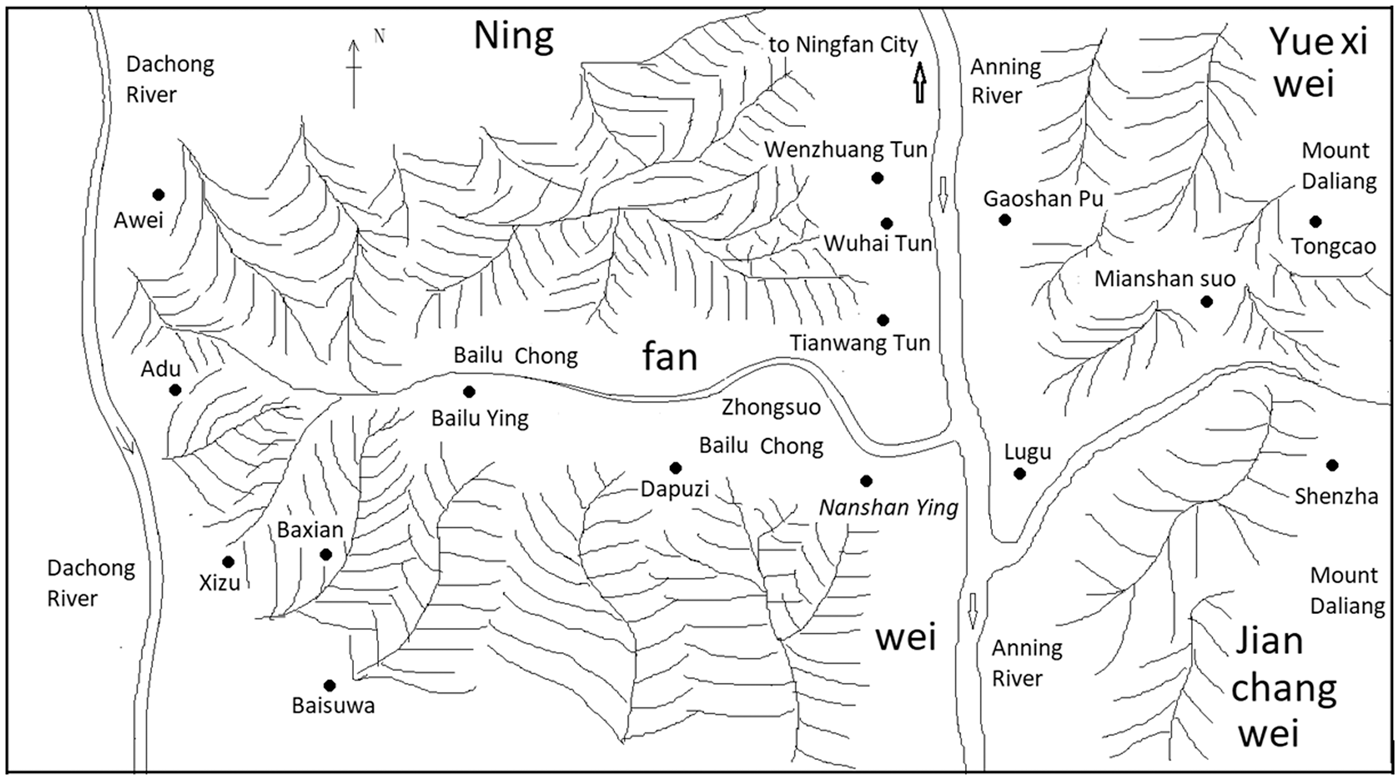
Second, ancestors with the surname of Lu in Bailu Ying were Yi people who originally lived in the highlands, just like Yi people in Nanshan Ying. As previously mentioned, Lu’s ancestors once lived in Bagu before migrating to Bailu Ying. According to Ming Dynasty records, Bagu was a small Yi ethnic minority tribe living in the highlands of Yuexi Garrison. Yi people in Bagu had maintained good relations with the guardian army there. On 19 February of the 32nd year of Wanli’s reign (1604), the home of Xu Shizhong in Yuegui Garrison was raided and burnt by a group of burglars, including Jiaobai and Nagu. On 22 February, Yi people in Bagu helped the army capture Jiaobai (Qian, 1851–1911). From what we know, Yi people in Bagu were from the highlands in the neighbourhood of Yuegui Garrison and had been on good terms with the local guardian army. This explains why Lu’s ancestors were instantly recruited to the army after the rebellion happened. Also, I found in my field work that many people with the surname Lu said their ancestors came from Yuexi and Zhaojue in the interior area of Mount Daliang, which verified the records of Bagu’s location in the Ming Dynasty. By analysing archives and investigation data, we can confirm that ancestors with the surname Lu in Bailu Ying were originally Yi people living in the highlands, were later recruited by Ningfan Garrison to join the army and then migrated from the highlands to the ground area Pingba on the Anning River, thus forming the settlements of Yi people in Bailu Ying.
Third, like Yi people in Nanshan Ying, Yi people in Bailu Ying also obtained large tracts of land. According to the above-mentioned contract records and my field visits, the land that Lu’s ancestors in Bailu Ying obtained was mainly composed of two parts: mountain area and paddy fields. The mountain area was not far from the south of Hebian Village, Mianning County, called by locals ‘Lujia mountain’. The mountain sits south and faces north, with three ridges stretching in the direction of Pingba, called ‘Pusa Mountain’, ‘Lingpai Mountain’ and ‘Zufen Mountain’. The paddy field was located in Pingba under Mount Lujia, extending from the big ditch (called ‘Wenxiang Ditch’ in the above-mentioned contract) at the back of Hebian Village to the foot of Mount Lujia. This whole field belonged to Yi people with the surname Lu. The acquisition of land resources is of great significance: on the one hand, it laid the foundation for the formation of Bailu Ying, Nanshan Ying and other Yi settlements; on the other hand, it changed the mode of production of some Yi people from a grazing and hunting economy in the highlands to a farming economy in Pingba. In this way, Shuitian Yi were gradually differentiated from Yi people living in the highlands.
Bailu Ying and its Yi ethnicity characteristics from the early Qing Dynasty to the late Qianlong reign
After the Ming was replaced by the Qing Dynasty, the Yi group in Bailu Ying was further integrated into the imperial system with the inclusion of Tusi 3 in the imperial governing body. However, up until the late Qianlong reign, the Yi remained relatively autonomous in terms of its tribal settlement, power structure and cultural integrity, with significant differences from the Shuitian Yi observed afterwards. An analysis will be presented with detailed materials below.
The settlement pattern of ‘more minorities, fewer Han people’
As stated above, in the late Ming Dynasty, there were few Han Tunpu (forts) around Bailu Ying, and Bailu Gou, a larger area around Bailu Ying, was once regarded as a ‘thieves’ den’. The status of ‘more minorities, fewer Han people’ lasted for a long period after the establishment of the Qing Dynasty.
In the early Qing Dynasty, the power of some garrisons, such as Ningfan Garrison, began to decline. At first, they were invaded by some mountain tribes: In the 18th year of Shunzhi’s reign, after Chief General Wang Mingde led troops on an expedition to east Sichuan, the minorities in Mount Daliang formed a gang, invaded Mount Mian and Xiang Hill, and robbed and killed villagers of Tongcaozhan. As a result, there were no traders or official post offices there, and roads were blocked (Huang, 1986: 56).
After the post of Tusi was established, the above described situation changed. According to document records, from the late Kangxi reign onwards, there were a few migrant Han people in the vicinity of Bailu Ying. For example, Ye Xianqing was originally a Lizhou native of Jianchang Garrison and migrated to Bailu near the end of Kangxi’s reign (Mianning Archives, 1-1). Also, Wang Shengyuan, a native of Hu county in Xi’an Prefecture in Shanxi Province went to Ningfan Garrison for business in the 47th year of Kangxi’s reign, and moved to Bailu in the second year of Yongzheng’s reign (1724) (Mianning Archives, 42-29). After Ningfan Garrison was reorganized in Mianning County in the sixth year of Yongzheng’s reign (1728), in order to clamp down on Tusi power, the Imperial Government of the Qing Dynasty set up Bailu Station in Bailu Gou (belonging to Huaiyuan Ying), and a Han village was formed centering on this station, Hebianpu. Nevertheless, only a few Han people lived in this village until the end of Qianlong’s reign. In the 59th year of Qianlong’s reign (1794), Yang Lizhong, the Magistrate of Mianning county, pointed out that the county had 24 villages, including Lugu, Mianshan and Hebianpu, in which ‘only Lugu and Mianshan are the most populated places, with over one hundred households and shops; other villages only have dozens of households. The population density is not uniform, and most regions are scarcely populated areas’ (Yang, 2001: 93). It is thus clear that until the late Qianlong reign, although Han villages were formed gradually around Bailu Ying, with its small population, it could not change the settlement pattern of ‘more minorities, fewer Han people’.
The power pattern led by chiefs
From at least the early Qing Dynasty, the non-Han ethnic settlements placed chiefs in some garrisons, such as Ningfan, to manage local affairs. A document in the 49th year of Kangxi’s reign (1710) contained the following statement: Since the founding of our Dynasty over 60 years ago, all aboriginal tribes and ethnic groups have shown respect and gratitude to us, and no one can play the bully. However, in the past, the people under chieftains were governed by Xuanfu Si, Xuanwei Si, Qianhu, Baihu, and there were also tribes gathering in valleys that elected their chiefs by themselves (The First Historical Archives of China, 1984: 90–91).
After the post of Tusi was established in the 49th year of Kangxi’s reign, although the chieftains of Ningfan Garrison each governed several villages, the specific administration of settlements was under the administration of their own chiefs. Meanwhile, the government oversaw the chiefs’ work, mainly through the rule that a chief’s appointment was valid only after it was officially recorded, and the certificate of appointment was issued. Nevertheless, the authority of chiefs was not undermined: on the contrary, it was acknowledged by the Imperial Government. This can be verified by examining the certificate of appointment presented to Biche, the chief of Bailu Ying, by the Imperial Government in the fifth year of Yongzheng’s reign (1727): This certificate was presented to the chiefs to ensure that they would restrain the minorities to safeguard their land, live and work in peace and contentment, not default or revolt in paying taxes to the government, and enjoy the peace of the region. If there are cases of theft, kidnapping, organizing bandits and paying taxes privately, the offenders will be given grave punishments … to Biche, the chief of Bailu Ying, please act according to this principle. (Notes on the certificate of appointment presented to Biche, chief of Bailu Ying, second lunar month of the fifth year of Yongzheng reign, collected by Lu Hongyou.) since Biche as the Bailu Ying chief was old and could not send people on errands as he did before. His son Eyi is in his prime age and can be a substitute for Biche, so we can appoint Eyi as the new Bailu Ying chief … therefore, we shall present the certificate of appointment to him, and please act according to this principle. (Notes on the certificate of appointment presented to Eyi, the chief of Bailu Ying, on third lunar month of the fifth year of Yongzheng reign, collected by Lu Hongyou.) Since Bailu Gou was a place where various ethnic groups lived, all the villages had their own chiefs to manage affairs; if there wasn’t a head chief to manage all the affairs, the chiefs of the villages would shirk their responsibilities. Now we know a chief named Enyi, who is diligent and prudent, and always concerned about public affairs. He can be trusted with the post of head chief and be presented with the certificate of appointment as head chief of Bailu Gou. (Notes on the certificate of appointment presented to Enyi, head chief of Bailu Ying in the seventh year of Qianlong’s reign, collected by Lu Hongyou.) Since the area of Bailu has a Tusi and a mass of ethnic minorities, management is poor. Although there are law-abiding people, there are many gangsters and criminals … and the Tusi could not manage all the affairs by itself; among the ethnic groups, only Enyi … who is at the prime of his life, can be appointed as the head chief to deal with general affairs of the ethnic groups … thus, Enyi is presented with the certificate of appointment as head chief of Bailu Gou. Please act accordingly. (Notes on the certificate of appointment presented to Enyi, head chief of Bailu Gou, 14th year of Qianlong reign, collected by Lu Hongyou.) Chieftain An and his two sons had made a verdict that the three hills in Pusa Mountain in Bailu Ying would be handed over to Enyi and Lu Bicheng to maintain Pusa Mountain for permanent conservation, and no chopping of trees would be allowed … For fear of different motives, we thereby write this note as proof. Witnesses: Juhua, Shada, Wujia, Abao, Putie, Bizu, Puzi, Riwai, Lumuxia. The verdict was written by Chieftain An and his two sons on the 20th of the 10th lunar month, the 21st year of Qianlong’s reign. (The Verdict of Chieftain An in the 21st year of Qianlong’s reign, collected by Lu Hongyou) We ancestral home was originally in Bailu. We ancesters lived there for decades and had left three mountains – Pusa Mountain, Lingpai Mountain and Zuying Mountain – for over 20 generations; none of them destroyed the mountains. Unexpectedly, in the 20th year of Qianlong’s reign, the mountains were forcibly occupied by Chieftain An, who finally recognized that these mountains belonged to us. (A record of occupation of minority properties by Han to avoid aggression in the first lunar month of the 24th year of Daoguang reign, collected by Lu Hongyou.)
In the 28th year of Qianlong’s reign (1763), Enyi died of an illness, and his post as chief was inherited by his son, Longshenbao: It is verified that Enyi of Bailu Ying died of an illness, and the post of chief is vacant. After investigation, we think that his son Longshenbao is strong, honest and diligent and can be appointed … so we intend to appoint him as the chief; please act accordingly. (Notes on the certificate of appointment presented to Longshenbao, Chief of Bailu Ying in the 28th year of Qianlong’s reign, collected by Lu Hongyou.)
The continuation of Yi culture
After settling in Pingba, although Yi people inevitably had contact with Han troops and common people living in the surrounding garrisons, Han culture had no significant influence on them until late in Qianlong’s reign; on the contrary, Yi people inherited a great deal of culture of their own nationality. Figures of Ethnic Minorities and Foreign People, edited in the middle and later years of Qianlong's reign contained the following record: The chieftains of Xulang and Bailu, had many Tibetan Settlements. There were also Luoluo, whose clothing and food were basically the same as those of the Yousuo. They were tenacious, cunning, aggressive, and always took bows and arrows with them. They generally treated cultivation and farming as their business. Most women were not engaged in spinning and weaving; they always went fishing along rivers (Fu, 1986: 609). In the Xide Village under the Yousuo Tusi in Yanyuan County, the Yi wore cone-shaped buns and short garments, walking barefoot and carried broadswords. They always hit the bamboo pipes at their waists. The women gathered their hair into a knot and wrapped it with a handkerchief, and their dresses were similar to those of the nearby Han women. The women were wicked and cunning. They knew a lot of farming and weaving, and each year they turned grains in as taxes to the Imperial Government (Fu, 1986: 609).
Production
The Yi people in Bailu Ying treated ‘cultivation and farming as business’, which was associated with the fact that they had acquired land resources after they settled in Pingba. In addition, the Yi women were not good at weaving and took up fishing as a side-line business. This shows that along with a developing agricultural economy, there were also some remnants of a fishing and hunting economy.
Clothing and accessories
The Yi people of Bailu Ying had cone-shaped buns, wore short garments and went barefoot. They always brought weapons with them. Yi men’s clothes were very different from those of Han people during the Qing Dynasty. Yi women gathered their hair into a knot and wrapped it with a handkerchief. Their dresses were similar to those of Han women in border areas. It is worth mentioning that women are often regarded as representatives of conservative culture, but the Yi men who settled in Pingba maintained more ethnic characteristics than the women did in their clothing. This phenomenon may be related to the religiousness of Yi men's clothing. For example, the cone-shaped bun of Yi men, made up of some hair in front of the forehead, also known as the ‘Heaven Buddha’, symbolized the heaven god, and inviolable dignity (Ye and Ye, 2000: 111).
Names
The chieftains and people in Bailu mostly used their Yi names and rarely their Han names. For example, the chief family in Bailu Ying had all four chiefs from the fifth year of Yongzheng’s reign (1727) to the late period of Qianlong’s reign, Biche, Eyi, Enyi and Longshenbao, using their Yi names, with only one or two exceptions (for example, Lu Bicheng in the chief family). It is clear, therefore, that the Yi people in Bailu Ying inherited a great deal of culture from their own ethnic group up until late in Qianlong’s reign, in contrast with the situation of extreme Sinicization later.
In conclusion, the settlement pattern of Bailu Ying from the early Qing Dynasty to the late period of Qianlong’s reign was one of ‘more minorities, fewer Han people’. Its power pattern was led by the chief, and in culture they inherited a great deal of Yi culture. The characteristics were quite different from those of the Shuitian Yi in later times.
The formation of the Shuitian Yi in Bailu Ying since the late period of Qianlong's reign in the Qing Dynasty
With a large number of immigrants to Sichuan during Qianlong’s and Jiaqing’s reign, the Yi in Bailu Ying and those immigrants were all incorporated into the Baojia system (a community-based system of law enforcement and civil control). In interacting with the Han in the same community, Yi people in Bailu Ying had changed significantly in terms of their tribal settlement, economic forms, power structures, customs and culture. Their national identity grew increasingly strong. Eventually, the identity of ‘Shuitian Yi’ was formed, differentiating this subgroup from Yi people living in the highlands. A detailed analysis of these changes will be made below.
The settlement of Yi people and the evolution of their economic pattern
Starting in the early Qing Dynasty, more and more immigrants moved to Sichuan. Until the middle period of Qianlong’s reign, there were limited land resources in Sichuan, with Chengdu plains as its centre. Many people had to seek a living in the less developed border area of Sichuan that was administered by Tusi. Mianning County was located in the south of Sichuan Province, and it had jurisdiction over more than 20 Tusi. Therefore, it became one of the main areas for the settlement of homeless people. In the 55th year of Qianlong’s reign (1790), Tang Zhaoxiang, the magistrate of Mianning County, mentioned that there were people who sneaked into the Tusi area of the county to open up wasteland: ‘The border area near Huaiyuan, where Yi ethnic minority people live has the broadest undeveloped land, and some exiled people have been secretly reclaiming the land called volcanoes’ (Mianning Archives, 158-4). ‘The Yi’s land in Huaiyuan’ refers to Tusi areas like Bailu, Hexi, Xulang and Erwagou in the vicinity of Huaiyuan Ying, which was in the southwest of Mianning County. Many displaced people went there to burn the forests and reclaim the land, which was called by the locals ‘reclaiming the volcano’. It was the same with Bailu Ying, administered by Bailu Tusi. Since the late Qianlong reign, exiled people had been reclaiming wasteland in the back mountain area of Bailu Ying. This letter of promise is to witness that a few years ago, Deng Chengfu and Deng Chengshu opened up two sections of mountain area which were originally the hill pasture, thus causing people’s protests. Since the pasture was opened up for farming and people had nowhere for grazing, some villagers let their cows trample on the newly opened farmland. Both of us, Deng Chengfu and Deng Chengshu, are willing to write down our commitment that we will never farm this land and will take any punishment if we break our promise. For fear of oath-breaking, we hereby write this letter of promise to all the villagers as a proof of our will. (Abbreviated; written by Deng Chengfu, Deng Chengshu on 4 July of the 55th year of Qianlong’s reign.) (The Promise Letter by Deng in the 55th year of Qianlong reign, collected by Lu Hongyou.)
In summary, with the gradual arrival of migrant people who came to reclaim the wasteland near the volcano in the late Qianlong reign, the number of Han people in the Tusi area, Mianning County, increased steadily. During the years of Jiaqing’s reign, a drastically growing number of Han people migrated to Mianning County due to the rebellion of the White Lotus Society in Sichuan and Shaanxi. In most Yi ethnic minority settlements in the Prefecture of Ningyuan, Han people were recruited to farm the land. Thanks to the religious riot of the White Lotus Society, hundreds of thousands of refugees came to Sichuan, causing many disputes (Zhao, 1977: 11347). Statistics of hukou (household registration) in Bailu Tusi during Daoguang’s reign.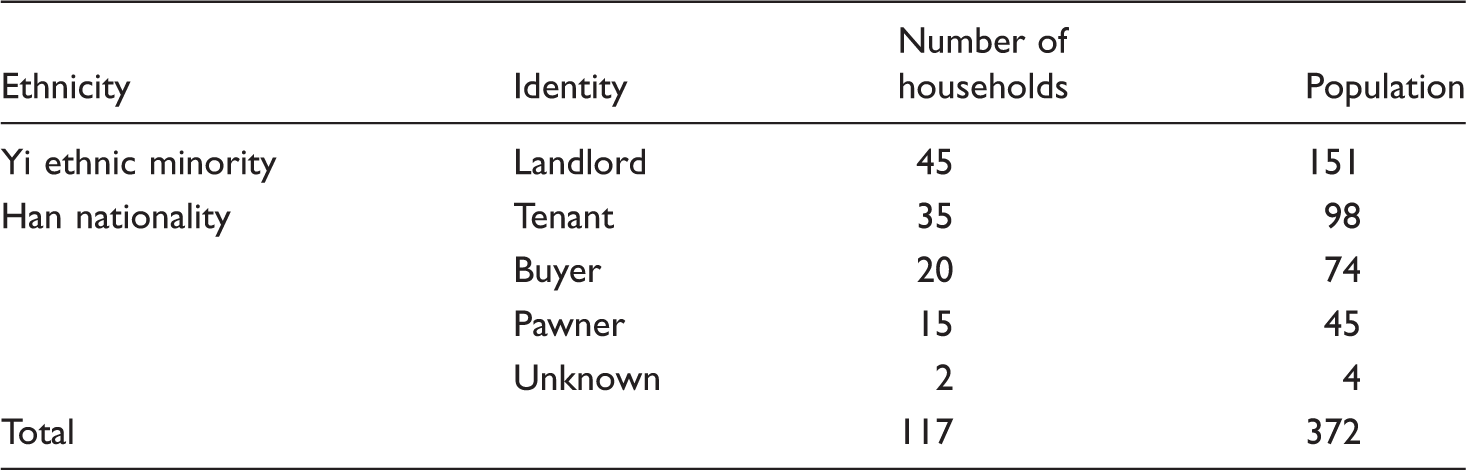
First, in terms of settlement pattern, the proportion of the population of Han and Yi in the Bailu Tusi area changed greatly during the years of Daoguang’s reign. Among the 117 households listed in Table 1, there were 211 Han people in 72 households and 151 Yi people in 45 households. The number of Han people exceeded that of Yi people. An increasing number of Han villages gradually surrounded Tusi tribes in Bailu Ying, bringing about a reversal change in settlement areas in Bailu Ying and its neighbouring areas where there were many more members of ethnic minorities than Han people.
Second, in terms of economic form, Table 1 shows that Han people mainly settled in the Bailu Tusi area by means of three methods: farming by renting land, purchasing land, and farming the land mortgaged by local people. These three paths to settlement were recorded in documents kept by Lu’s ancestors about the Yi in Bailu Ying. For example, in the 24th year of Daoguang’s reign (1844), a Han person named Huang Fenggao rented a piece of mountain land from Lu Guiyuan, a Yi person in Bailu Ying. Huang Fenggao had to pay an annual rent of rice amounting to 3 shuo and 2 dou (ancient units of measurement, 1 shuo (also known as dan) = 100 litres and 1 dou = 10 litres) to the landlord Lu Guiyuan (the leasing contract of Huang Fenggao on 8 February, the 24th year of Daoguang’s reign, collected by Lu Hongyou). In addition to renting, Yi people also sold their land or mortgaged it to Han people. For example, in the 23rd year of Jiaqing reign (1818), Tiezu and Muniu, two Yi people in Bailu Ying, sold a piece of their mountain land to Song Guocai, a Han person, at the price of 10 liang (an ancient unit of measurement, 1 liang = 50 g) silver currency (the land sales contract of Tiezu on 26 March in the 23th year of Jiaqing’s reign, collected by Lu Hongyou). In the 10th year of Daoguang’s reign (1830), Shouchang, a Yi person in Bailu Ying, mortgaged a piece of his non-irrigated farmland (hantian) to a Han person named Kang Ziyun for 1000 wen (the smallest unit of currency in ancient China) (the land mortgage contract signed by Shouchang in Bailu Ying on October 22, the 10th year of Daoguang reign, collected by Lu Hongyou). In the 18th year of Daoguang’s reign (1838), Lu Zujin, a Yi person in Bailu Ying, mortgaged a piece of his dry land to Chen Zhifeng and Chen Zhiao, local Han people, for 4000 wen (the land mortgage contract signed by Shouchang in Bailu Ying on 8 January, the 18th year of Daoguang’s reign, collected by Lu Hongyou). From Table 1 we can see that among the three types of land transfer, land leasing was the most frequently used, which motivated the development of the landlord economy of the Shuitian Yi.
The disappearance of chiefs and their local authority
With the sharp increase in Han population in the Tusi area starting in the late Qianlong reign, the Baojia system also expanded to the Tusi area. The Baojia organization became the centre of local power and dominated local affairs. The authority of the local leaders gradually became marginalized and eventually went off the stage. The original power structure of the Tusi society thus changed. In the sixth year of Daoguang’s reign (1826), the ‘Forbidden Mountain Monument’ set up by Bailu Ying and other tribal settlements revealed this trend. The inscription is quoted as follows: On the fourth day of June this year, local people Song Qin, Xing Dianan, Yang Guorong, Pan Junfeng, Hongzan and Keya reported to the Imperial Government that the back mountain of Santun, Liujia was the place where local Han and Yi people had collected firewood before. Immigrants from other places are forbidden to cut wood in the back mountain area to prevent soil erosion and landslides in the winter and harmful consequences for the farmland. Now, a group of people led by Xiao Chengyuan were often found lumbering on the mountain. Thus, when it was raining or snowing heavily, the water on the mountain flooded a large area of farmland. We hereby report this situation and plead for a deportation order. (The Forbidden Mountain Monument in Santun, Xinbai in the sixth year of Daoguang reign, collected by Lu Hongyou.)
There are two main reasons why Han people began to dominate local affairs. The first reason relates to land registration. Due to the dramatic increase in the number of Han people in the Tusi area, the Qing Imperial Government conducted a large-scale investigation in the 18th year of Jiaqing’s reign (1813). When Han people farmed the Yi people’s land, either by land purchase, leasing, or mortgaging, the Imperial Government had to review their contracts of land transaction, measure their land, confirm their land borders, register their land information and issue and record their land number, so as to make sure that the land information was correct. It took over a year to thoroughly investigate a household and land in the Yi settlements (The First Historical Archives of China, 2000: 829).
The second reason why Han people began to dominate local affairs relates to the Baojia system implemented in the Tusi area by the Imperial Government. During the investigation, the government set up the Baojia system throughout this area (Mianning Archives, 70-4 ∼ 16). Bailu Ying and other Han people’s villages were incorporated into ‘Qingxiang Liujia’. Under the Baojia system, local affairs were governed mainly by the organizations of Baojia, so local tribal chiefs gradually became less influential. This was fully manifested in the case that Han people and the tribal chief family in Bailu Ying argued for the dominance of a mountain during the late Daoguang reign.
At the end of the 23rd year of Daoguang’s reign (1843), a notice was put up in Bailu Ying by Han people: The notice was made that because the mountain pastures had been properties in the tuns of Bailu Ying and Pusa Mountain for years and trees were now being cut down without permission, Xing Yukui, Xie Zhihua, Luo Yingfu, Deng Yuanhong, Lu Xueli, Deng Shihui, Lu Gui, Song Derong, Pan Tingfa and Xie Zhi hereby propose that the mountain pastures be open to the public for wood-cutting, after discussion in the tuns of Bailu Ying and Pusa Mountain. The proposal is the final decision without any dispute, and this notice was posted as a proof. (Notice of forbidden mountain in the 23rd year of Daoguang’s reign, collected by Lu Hongyou.) The notice was made that because the mountain pastures had been properties in the tuns of Bailu Ying and Pusa Mountain for years and trees were now being cut down without permission, Xing Yukui, Xie Zhihua, Luo Yingfu, Pan Tingfa, Deng Shihui, Song Derong, Deng Yuanhong hereby propose that the mountain pastures be open to the public for wood-cutting, after discussion in the Tuns of Bailu Ying and Pusa Mountain. The proposal is the final decision without any dispute, and this notice was posted as a proof. Posted on the auspicious day in December, the 23rd year of Daoguang reign. People from three tuns of Xinbai shall attend the meeting to be held at Zhenxiang Temple on the 10th lunar day of January for a discussion about the mountain pasture. Anyone who cannot attend the meeting will be fined 1200 wen [the smallest unit of currency]. Don’t make excuses when fined for not coming, as it’s already clearly stated in the notice in advance. (Notice on forbidding and allowing the wood cutting on the mountain in the 23rd year of Daoguang reign, collected by Lu Hongyou.) It was not expected that this spring, some people in Bailu Ying would post a notice several times declaring that three mountains, including Pusa Mountain, should be open to the public for wood-cutting … if the mountains were open to exploitation, the natural resources on the mountains would run out rapidly. (An indictment by Lu of Bailu Ying in the 24th year of Daoguang reign, collected by Lu Hongyou.)
Second, Zhenxiang Temple, mentioned in the second notice, was actually the ‘Jia Temple’ for villages like Bailu Ying in Qingxiang Liujia. Jia Temple was an organization under the Baojia System. Around the sixth year of Yongzheng’s reign, Mianning county began to set up a Baojia system like many other counties. A hundred households were incorporated into a Jia (the smallest settlement unit). Since there were only a few households in each village in Mianning, several villages were incorporated together into a Jia. For example, the villages of Houshan and Wangerpu became a Jia; the villages of Yangquangou, Huangnipo and Hebianpu became a Jia; the villages of Zhongtun and Zhanjiachong formed a Jia; the villages of Shaba and Yangfangzi formed a Jia, etc. (Mianning Archives, 111-21, 149-57, 149-63, 131-12, 55-36, 55-37, 157-76, 146-67, 60-51, 58-5, 58-6, 150-46). The town was above Jia, a higher-level settlement unit, usually consisting of several Jia. Mianning County had four towns: Funing (the second town), with six Jia; Funing (the fourth town), with five Jia; Changning, with five Jia; and Qingning, with eight Jia (Yang, 2001:93). Starting in the late Qianlong reign, by removing the middle character ‘Ning’, the names of Xiang in Mianning were abbreviated into Fu (the second town), Fu (the fourth town), Chang and Qing towns. In the above mentioned Baojia system, each Jia had several villages and one or several temples. For example, the Eighth Jia in Qing Town had Sanlang Temple, the Seventh Jia in Qing Town had Guanyin Temple, the Sixth Jia in Qing Town had Wenchang Temple, the Fifth Jia in Fu Town had Tudi Temple, and the Third Jia in Fu Town had Sanguan Temple. All these temples belonged to their corresponding Jia (Mianning Archives, 63-66, 222-31, 166-85, 168-31, 230-34). For each temple in a Jia, several heads played important roles in negotiating disputes and cases, dealing with temple affairs and managing mountain pastures (Mianning Archives, 222-31,168-31,230-34). Especially concerning affairs of mountain pastures, the Jia temples were in charge of issuing the ban on lumbering and organizing lumbering because each Jia had its own mountain pasture. For example, the villages of Wenjiatun, Wuhaitun and Lalatun in Mianning County at one time belonged to Si Jia in Qing Xiang, and they were later divided into two Jia for their population growth. Wenjiatun became Zhengsi Jia in Qing town, and Wuhaitun and Lalatun became Yousi Jia in Qing Town. Afterwards, however, the temple of Zhengsi Jia still controlled the mountain pasture of Si Jia and kept Yousi Jia away from the mountain pasture. Eventually, the Imperial Government made the decision after investigation that this mountain pasture should be divided into two parts: one part should belong to Zhengsi Jia, managed by its Da Temple, and the other part should belong to Yousi Jia, managed by Guandi Temple. Two Jia set up monuments respectively in their temples for the public (Museum of Yi Autonomous Prefecture of Liangshan, Administration of Cultural Relics of Yi Autonomous Prefecture of Liangshan, 2011: 228). In accordance with the tradition of the Baojia system that Jia temples could manage the affairs of the Jia’s mountain pasture, the Han people believed that after Bailu Ying was integrated into the Sixth Jia, Qing Town, the mountain pasture of Bailu Ying should be managed by its Jia temple, Zhenxiang Temple, so they had every reason to fight for the right to cut wood in the mountain. This shows that after Bailu Ying was incorporated into the Baojia system, Jia Temple, as the Baojia organization, became the centre of local power, playing a leading role in administrating local affairs. The authority of tribal chiefs thus became marginalized and gradually declined.
Thanks to their timely report, the chief family in Bailu Ying won the dominant right over their back mountain in this case, and the Han people failed: In the 24th year of Daoguang’s reign, some Han people posted a notice that they would occupy the mountain of Yi people and cut wood. Yuesa and Shouchang, both Yi people, went to Bai Luxun, Tusi Shen and other places to report this situation. Later, some Han people went to cut wood on the Yi ethnic group’s mountain. They got caught and wrote their confession letter. (The petition letter of Lu in Bailu Ying in the 30th year of Daoguang reign, collected by Lu Hongyou.)
In the 30th year of Daoguang’s reign (1850), Han people tried again to contend for the mountain: Deng Shihui and Zhao Xuguang, together with martial scholar Deng Yuanlin and Tao Deming, bullied Yi people. On the third lunar day of this month, the bully Chen Zhongying asked Yi people to Guanyin Temple, where he and other Han people tried to persuade them to allow public access to Yi’s mountain for wood-cutting. Yi people refused to do so, and these bullies tried to tie them up and send them to Bai Luxun. The Yi people were frightened and ran away. (The petition by Lu in Bailu Ying in the 30th year of Daoguang reign, collected by Lu Hongyou.) My cousin Lu Shouchang, the cousin of Qingyi, reported that bullies, including Deng Shihui, occupied the Yi people’s graveyard. Deng Yuanling colluded with his fellows to occupy Yi tribe’s mountain by force, so we asked for your help to deliver a forbidden notice on our mountains. Thanks to your acute judgement, those bullies’ attempts were noticed, and actions were taken. On the 24th of this month, with the order of the county government, local officers Zhou Julai, Tusi Shen investigated this case and Deng Shihui admitted that the forbidden mountains were Pusa Mountain, Lingpai Mountain and Zuying Mountain, owned by Yi ethnic groups, and that he did occupy those mountains against their owners’ will. (The joint petition by Lu in the 30th year of Daoguang reign, collected by Lu Hongyou.)
In summary, as Bailu Ying was integrated into the Baojia system, Baojia organization gradually took a leading position in administrating local affairs, replacing the tribal chiefs of Bailu Ying in local authority. Up until the late Qing Dynasty, the tribal chiefs of Bailu Ying finally stepped down from the local historical stage.
Changes in culture and traditions
As shown above, Bailu Ying in the late Qianlong reign had inherited a great deal of ethnic culture and many traditions. However, as the number of Han people in the Tusi area kept increasing, having started in the late Qianlong reign, the interaction between Han people and Yi people continued, and cultures from both Han and Yi kept spreading; Yi ethnic groups in Bailu Ying underwent great changes in culture and traditions:
Clothing and accessories
In the middle and late Qianlong reign, Yi men in Bailu Ying put their hair up, wore short shirts and went bare-footed. Their look was quite different from that of Han people. Then, in the late Qing Dynasty, Yi and Han people gradually began wearing similar clothes. The original image of men of the Yi ethnic group recorded in the Mianning County Annals in the years of Xianfeng’s reign was that ‘Yi people would wear a vertebral bun with a bamboo hair stick, a blue undershirt, black and grey felt coat, and blue and white trousers, with bare feet’ (Li, 1992: 1006). This line of text, in smaller characters, was found beside the above sentence: ‘Recently, many Yi people also wore the hairstyles and clothes of Han people’. Apparently, as the interactions between Yi and Han became increasingly significant, men of the Yi ethnic group in the Tusi area, Bailu Ying in the late Qing Dynasty were more influenced by the clothing styles of Han people.
Names
From the beginning of the Qing Dynasty to the later years of Qianlong’s reign, the chief families in Bailu Ying mostly used names of Yi ethnicity; they seldom used Chinese names. Not until the late Qing Dynasty did Chinese surnames and given names become widely used by Yi people. This can be illustrated by the monument erected by the chief family of Bailu Ying in the 30th year of Daoguang’s reign (1850): We hereby authorize Mianning County of the Ningyuan Government in Sichuan to post a notice to forbid land occupation again. The mountain inherited by Yi people Lu Xian and Lu Shouchang was occupied by Han people, who cut wood on the mountain, as Yi people reported to the government … The case was closed with the conclusion that Han people and their descendants should not trespass on the mountain … Thus, five families with the surname Lu – Lu Xian, Lu Shouchang, Lu Jizu, Lu Zu and Lu Weifuhua – were assigned to safeguard the mountain with Yang Xijia and other people. They should follow the government’s order, manage the affairs of their own stipulated areas and never cross the line. (Abbreviated) Witnesses: Tusi. Sanguan Village: Lu Qiyuan; Ximiwo: Lu Weixiu, Lu Weiyou; Shagouying: Lu Weixing; his great-grandsons Lu Futie, Lu Jiningbao, Lu Wenzhi. Bailu Ying: Wenzhi, Yang Tiebao, Yang Tiezan. The monument was erected by five tribal families in the 30th year of Daoguang’s reign, Qing Dynasty (Museum of Yi Autonomous Prefecture of Liangshan, Administration of Cultural Relics of Yi Autonomous Prefecture of Liangshan, 2011: 146).
Language and words
According to archives about the Lu family in Bailu Ying, in the years of Guangxu’s reign, there were at least four men in the family – Lu Wenzhi, Lu Dezhi, Lu Pinghai ( This receipt of loan is signed by Lu Deda and Lu Dexing. For personal reasons, they would like to borrow 20 Liang [a unit of currency for silver] of silver from Dong Shiliang. Both parties agree that after the borrowers receive money, they will pay the creditor 9 dou of rice in interest every year. The borrowers must pay the creditor both principal and interest within 10 months; otherwise they pledge their 5 dou of paddy field at Luangshijiao to the creditor. The paddy field will be at the creditor’s disposal, either to be planted or to be sold. The borrowers’ second opinions will not be considered. This receipt of loan is thus signed as proof for the above agreement, witnessed by Wang Dacai, and written by Lu Pinghai. Signed on the 20th lunar day of January, the 28th year of Guangxu’s reign. (The receipt of loan by Lu Deda and Lu Dexing at the 28th year of Guangxu reign, collected by Lu Hongyou.) Those who learned to read, learned martial arts, and attended government schools were mostly from Sandazhi, secondly from Bailu … People from Xifan, Luoluo and Mosuo of Mianning were quite barbaric in their nature, but in recent years they became more civilized, and plenty of them learned to read and were not illiterate anymore (Li, 1992: 1006, 1066). ) and Lu Pinghai (
 ) – who were capable of writing contracts in Chinese. For example, in the 28th year of Guangxu’s reign (1892), Lu Pinghai wrote a loan contract for his fellow tribe-member, as follows:
In addition, Chinese language became widely used in Bailu and other Tusi areas in the late Qing Dynasty, which was quite different from the situation before the reign of Jiaqing. According to archives in the 4th year of Qianlong’s reign, the chieftain of the Yi tribe in Bailu did not speak Chinese, so he hired a secretary who spoke the language to assist in his work for the government. Unfortunately, his secretary was half deaf and often made mistakes: ‘Since the chieftain did not speak Chinese and could not supervise his secretary’s work, his secretary misheard and made mistakes in writing reports on the government’s expenditure’ (Mianning Archives, 37-15). The chieftain did not speak Chinese, nor did his people. An example was that Yi person Luzu once lived in Bailu Ying and later moved to Baxian (under the jurisdiction of Tumu, Wadu and Mianning) in the 38th year of Qianlong’s reign (1773), but he did not fully understand Chinese until the 40th year of Qianlong’s reign (1775) (Editorial Group of Sichuan Province, 1987: 305). The above situation changed greatly as the interactions between Han and Yi became more frequent and cultural exchanges intensified starting in the late Qing Dynasty. For example, in the Revision of Unification Ethnography of the Qing Dynasty, compiled in the years of Jiaqing’s reign, it was recorded that ‘Only people from the Luoluo ethnic minority were the most stubborn and refused to learn Chinese’, while in the Mianning County Annals in the years of Xianfeng’s reign, the correction was made: ‘Recently, more ethnic minority people could speak Chinese’ (Li, 1992: 1011). This shows that in the late Qing Dynasty, a growing number of ordinary people, even including the chieftains of the Tusi area with Yi ethnicity in Bailu Ying, could speak Chinese.
Strengthened national identity
As the social environment changed in the reign of Daoguang, Yi people with the surname Lu in Bailu Ying became more closely bonded with the Empire and more conscious of a national identity. This is shown clearly in the case of the mountain pasture. In the first fight for the mountain pasture in the 23rd year of Daoguang’s reign, Yi people with the surname Lu chose to appeal to the chieftain and other battalions. In the second mountain case in the 30th year of Daoguang, in the face of more powerful opponents, the Yi people adjusted their strategy and appealed to the county government, which better represented the imperial authority. To win government support, Yi people got their land registered and paid their taxes to protect their property. Thanks to the county government’s just judgement, it was confirmed that Pusa Mountain, Lingpai Mountain and Zufen Mountain were all mountain pastures inherited by Yi ethnic groups, who paid an annual tax of silver weighing 1 Qian, 2 Fen, 1 Li and 5 Hao [units of measurement: 1 Qian = 3 g; 1 Fen = 0.3 g; 1 Li = 0.03 g; 1 Hao = 0.003 g]. These mountains were owned and managed by five tribes of the Yi ethnic group. Han people were not allowed to meddle with the affairs on these mountains. The conclusion of this case was clear and recorded. Descendants of Han people should respect the conclusion and never occupy these mountains against Yi people’s will (Museum of Yi Autonomous Prefecture of Liangshan, Administration of Cultural Relics of Yi Autonomous Prefecture of Liangshan, 2011: 146). Water has its source and tree has its root, so isn’t it natural that our Pusa Mountain has its origin? Pusa Mountain was where our ancestors Enyi and Lu Bicheng settled when they worked for the Imperial State in the second year of Hongwu’s reign. Fourteen generations of their descendants had owned this mountain, and no dispute had happened between Han and Yi people on the affairs of the mountain until the 36th year of Wanli’s reign. In the 20th year of Qianlong’s reign, some chieftains of the Tusi area coveted this mountain pasture and fought with our ancestors for it. Our ancestors reported this to local communities. The chieftain of the Tusi area was fully aware of his misdoing and was willing to withdraw from the mountain. Thus, the judgement was made that the chieftain’s descendants would never occupy our ancestors’ mountain for force, which was fully obeyed for dozens of years. They bullied the weak, took up the mountain and fought in the courts, and thanks to the just judgement, the mountain was returned to its owner. Wood-cutting was not allowed so that trees could grow and the Fengshui [geomantic omen] would be better. Han people from near or far, if caught secretly cutting woods on our mountain without notice, would be reported to the court. Let’s join together to protect the mountain with our strenuous efforts, so that Pusa Mountain can have its forestry landscape and picturesque scenery restored (Museum of Yi Autonomous Prefecture of Liangshan, Administration of Cultural Relics of Yi Autonomous Prefecture of Liangshan, 2011: 146).
In the above mountain case, Yi people with the surname Lu in Bailu Ying won their case with the help of national authority by means of land registration, tax payment and story fabrication. Thus, Imperial power’s control over grassroots society was enhanced, and Yi ethnic groups’ national identity was further established. These two processes took place simultaneously. The frontier society was gradually integrated into a unified state, thus further consolidating the state.
In summary, with the arrival of a large number of immigrants during the reigns of Qianlong and Jiaqing, Bailu Ying and those immigrants were all integrated into the Baojia system. In the interactions with Han people in the same Jia, Yi people in Bailu Ying changed in many ways. In terms of their tribal settlement pattern, the Tusi area where Bailu Ying was located had ‘more minorities, fewer Han people’ compared with the previous situation of ‘more Han people, fewer minorities’. A great many settlements of Han people had gradually surrounded the Tusi tribal settlement areas like Bailu Ying. In economic terms, land transactions were frequent, the tenant system developed, and a landlord economy took shape. In terms of power structure, the Baojia organization led by Han people developed rapidly, while in contrast, the tribal influence of Bailu Ying declined day by day. In terms of culture and customs, thanks to intensive communication between Han and Yi people and the spread of Han culture, Yi people in Bailu Ying in the late Qing Dynasty wore Han clothes, used Han surnames or given names and used Han characters and spoke Chinese: they exhibited a high level of Sinicization. Meanwhile, furious competition over resources drove these Yi people in Bailu Ying to seek support from the state authorities, which led to the beginning of their assimilation into the national identity. It was at this stage that the Shuitian Yi ethnic group observed by contemporary scholars was officially formed.
Conclusions and discussion
The nationalization of Shuitian Yi in Bailu Ying progressed through different stages in the Ming and Qing Dynasties, and a new ethnicity emerged in each stage. The late Ming Dynasty marks the beginning of the nationalization of Shuitian Yi. During this period, when garrisons were recruiting soldiers, some Yi people from Mount Daliang migrated from the mountainous areas to the plains. In terms of identity, they became soldiers under the direct leadership of the garrison after being people beyond the constraints of the Imperial Government, signifying the initiation of its nationalization process. Meanwhile, because of changes in circumstances and the acquisition of land resources, Yi settlements such as Bailu Ying gradually formed. Their mode of production gradually evolved from highland nomadism, fishing and hunting to farming and cultivation on the plains, and the characteristics of their ethnicity became gradually differentiated from those of the Yi in the highlands. The period between the early Qing Dynasty and the late Qianlong reign was the remoulding stage of the nationalization of Shuitian Yi. Affected by the warfare at the turn of the Ming and Qing Dynasties, the Yi in Bailu Ying in the early Qing Dynasty had been beyond the Imperial governance. With the establishment of Chieftains in Sichuan in the late Kangxi reign, Shuitian Yi were included in the state system again. However, restrained by the relatively closed Chieftain (Tusi) system, although the Yi made some changes in tribal settlement, grassroots power structure, customs, and culture up until the late Qianlong reign, they still preserved strong independence, which is different from what the Shuitian Yi observed afterwards. The period between the late Qianlong reign and the late Qing Dynasty witnessed the consolidation period of nationalization of Shuitian Yi. In this period, although Bailu Ying was still a Yi tribal settlement under the governance of chieftains, it was incorporated into the Baojia system together with the Han people who came to the region. The interaction between the Yi and the Han in the same Jia produced drastic changes in the Yi people of Bailu Ying: in tribal settlement pattern, they were besieged by the Han; economically, although a landlord economy took shape, it was marginalized among local ethnic groups; culturally, they wore Han clothing, used Chinese surnames and given names, spoke Chinese and wrote Chinese characters. Their sense of national identification was further enhanced. Such characteristics have been associated with Shuitian Yi ethnicity since the late Qing Dynasty. In brief, the ethnicity of Shuitian Yi was formed during the process of its nationalization. The generation mechanism and its process cannot be understood profoundly without taking nationalization into consideration.
It is important to note that although the Yi of Bailu Ying assimilated some Chinese culture and customs in the course of their nationalization process and formed a new ethnicity, they did not totally abandon their original Yi culture and self-identification, becoming a Shuitian Yi group that differed from both the Han people in Pingba and the mountainous Yi people. Their ethnicity embodied the autonomy and acculturation of the Yi of Bailu Ying in the face of social transition. By what means did Shuitian Yi maintain their autonomy? Harrell (2000: 127) believes that endogamy was one important reason, while Xiao (2007) attributes their continued autonomy to their religious inheritance. I myself believe that since the middle period of the Qing Dynasty, the fierce local resource competition between Han and Yi people also objectively reinforced the self-identification of Shuitian Yi. This is another important factor given that they were not assimilated when under siege by the Han people.
In seeking to understand how frontier ethnic groups were assimilated by the Imperial State, the study centring on the Pearl River Delta by the ‘South China School’ shows that the active and innovative interpretation and utilization of the state system was an important feature of the nationalization process for the frontier ethnic groups during the Ming and Qing Dynasties. It is of significant importance in helping us to understand the coexistence of the unity in traditional Chinese politics and the diversity in local culture. However, the academic practice of the South China School mainly focuses on the ethnic groups in the plains area and does not pay sufficient attention to the nationalization process and characteristics of highland ethnic groups. Scott’s (2009) study on Southeast Asia and Southwest China is focused on the impact of geographic height on the nationalization of frontier ethnic groups. He pointed out that the highland ethnic groups took advantage of geographical strengths and used the survival strategy of evading state rule for as long as they could. This continued until recent years, when strong, absolute state power finally included the highland ethnic groups under its governance. This judgement can be partially verified by the Yi people of Mount Daliang: they took grazing, fishing and hunting as their main modes of production until the eve of the liberation. They maintained the rigidly stratified social structure of slavery, continued traditional Yi customs and culture, and kept at a distance from the Imperial State by relying on their geographical advantages in the mountains. Based on Mount Daliang, they controlled the roads from Xichang to the mountains north of the Dadu River, often attacked business travellers and villages along the roads, and even harassed villages in the Anning Valley. In the late Qing Dynasty and the Republic of China, the state tried to penetrate into the mountains, but this yielded very little effect. This situation did not end until after the year 1949. Thus, the nationalization process of the Yi people of Mount Daliang was quite consistent with that of highland ethnic groups described by Scott.
However, the discussion above is just one aspect of the history of highland ethnic groups and does not represent the whole picture of the nationalization process of highland ethnic groups. I believe that Scott put too much emphasis on the opposition between highland ethnic groups and the state and underestimated the possibility of cooperation between them. For example, Scott (2009: 142) believed that within the almost 2000 years, the pressure from the expansion of the Central Plains Dynasty formed a single historical process of pushing population into the highlands. Although the pressure was sporadic, it proceeded in the same direction. Thus, it is clear that, for Scott, the state always pressed the flatland population into the highlands, while the opposite trajectory, that is, highland ethnic groups migrating to the plains which were under the control of the state, could hardly be seen. In talking about the internal competition among highland ethnic groups, Scott also emphasized that if the ethnic groups that invaded the highlands had stronger military power, they would drive the aboriginal ethnic groups to higher places; otherwise, they could only take up small patches of areas in the highlands (Scott, 2009: 140–141).
In summary, regardless of their power, if there was competition among highland ethnic groups, they would, without exception, seek their own resources in the highlands, rather than migrate to the flatlands. Based on the case of Shuitian Yi, we can say that this viewpoint is too absolute. The investigations by Wu (1987) and Harrell (2000) in the Anning River Valley in Sichuan show that Shuitian Yi were originally highland Yi people living on Mount Daliang who migrated to Pingba later. By reviewing the literature from the Ming and Qing Dynasties, I verified this point in this study, and I also reviewed the nationalization process from highlands to flatlands and its characteristics in detail and drew conclusions. Why were highland ethnic groups willing to move to the flatlands? Wu (1987: 34) summarized four reasons for this: first, they moved after the setup of Tusi; second, they escaped after Black Yi violated the customary law; third, they escaped to the flatlands after being defeated in a resistant struggle; and fourth, since their ancestor was an illegitimate child of the Black Yi, they moved to the flatlands because of discrimination. I believe that the amnesty and granting of land resources by the state were also important reasons for the highland Yi people moving to Pingba. The last reason is not in contradiction with the first four reasons, they are interdependent. Since the first four reasons can be regarded as internal causes, the last one can be regarded as the main external cause. For example, there is differentiation and competition among highland Yi ethnic groups. The departure of the defeated can be regarded as an internal cause for migration, while the amnesty of the ethnic groups and the offer of land resources by the state can be regarded as an external cause for migration. Therefore, if there was competition among highland ethnic groups, they would resort to the flatland for living space and resources, rather than keep away from the state. This also shows that a highland ethnic group would not always remain isolated, but at last would be forced into the process of assimilating into the state. As this paper shows, there was another nationalization process for the highland ethnic groups, that is, with the implementation of the battalion system, Tusi system and Baojia system in the Ming and Qing Dynasties, the highland Yi people migrated from highlands to flatlands and gradually became integrated into the state order. This process not only moulded the unique ethnicity which is different from highland Yi people, and formed the identity of Shuitian Yi, but also drew them closer to the state and cultivated a strong national identity in these frontier inhabitants. This change greatly promoted the stability of frontier society in south Sichuan during the Ming and Qing Dynasties.
Footnotes
Acknowledgements
In writing this paper, I would like to thank several professors for their many valuable suggestions, including David Faure, Shiyu Zhao, Zhiwei Liu, Zhenman Zheng and Shishan Zhang; my gratitude also goes to the editors, editorial board members and anonymous reviewers of the Chinese Journal of Sociology. The author takes sole responsibility for his views.