




Abstract
Based on a comparison between labor markets in China and those in the USA and using data from the China Family Panel Studies and the Panel Study of Income Dynamics, this paper studies the level, distribution and socioeconomic patterns of job mobility in contemporary China. I first discuss the different social contexts in China and the USA that have generated distinct opportunity structures of job mobility. Differences in levels of economic development, cultural traditions and institutional arrangements help to shape different labor markets and job mobility patterns across the two societies. I argue that job mobility is not always as good as we thought. There is a duality of job mobility at both the individual and the societal levels. Second, I develop several indexes and use the percentile share method to analyze job mobility rates by different groups and their uneven distributions. Compared to the USA, I find that China has a lower overall level of job mobility, a more skewed distribution and a higher concentration of mobility in socioeconomically disadvantaged groups, such as the elderly, the less-educated and those of rural origin. The results demonstrate the importance of understanding the duality of mobility; that is, that mobility can be either upward or downward. In contemporary China, socioeconomically disadvantaged people may suffer downward job mobility.
Introduction
In contemporary societies, the overall trends of social mobility and social fluidity have increased with modernization. Fluidity, a core concept in the social stratification and inequality literature, reflects the degree of openness of a society. Social mobility is divided into intergenerational and intragenerational mobility. Job mobility over the life course, as a carrier of intragenerational mobility, is the main mechanism by which individuals obtain or change their socioeconomic status. A study of job mobility over the individual life course and the aggregation of such individual paths helps us to better understand the overall patterns of intragenerational mobility in a society.
After 40 years of economic reform and market transition, China has become increasingly modernized. Modernization theory posits that the mobility and openness of a society increases with its economic development (Blau and Duncan, 1967). Research has shown that China has experienced much higher rates of migration and job mobility since the market transition in the late 1970s. Walder (1986) pointed out that the lack of mobility was a major feature in China before the economic transformation. Under the planned economy, the strict household registration system (hukou) resulted in two types of job mobility under urban–rural dual segmentation. First, urban workers became highly attached to their work units (danwei), which were in charge of almost all aspects of individual lives: economic, political and social. Job mobility was limited to the internal labor market within the unit (Xie, 2010; Xie and Wu, 2008). Second, rural people were highly dependent on agriculture and the collective (Zhang, 2011). Migration to urban areas was highly restricted. All these patterns have changed in the reform era, as the market transition and institutional changes led to the rise of labor markets. The emergence of the private sector has generated a huge demand for labor, and the relaxation of household registration restrictions has provided rural people with opportunities to move to and work in urban areas (Meng, 2012; Meng and Kidd, 1997).
Two strands of research have been conducted on job mobility in China's reform era. One strand of research focuses on patterns and causes of job mobility for specific groups separately and under different institutional regimes, such as the employment model of rural migrants under the household registration system, the promotion model of urban workers under the work unit system, the gendered promotion mechanisms in the labor market, and wage inequality of job mobility among migrants (Song, 2007; Wei, 2012; Xie, 2007; Zhang, 2011). These studies are mostly concerned with how individual characteristics affect job changes and the consequences of these changes, and they lack a panoramic view of our knowledge on job mobility. In other words, these studies deal at best with one limited aspect of these interrelated labor market issues, which need to be understood as a whole.
Another strand of research argues that job mobility is a consequence of the market transition, reflecting the impact of institutional changes on individual life chances. Previous studies have examined differences in outflows from the work units before and after the transformation (especially for the elites), promotion models within the work units, and changes in returns to human capital (Bian and Logan, 1996; Li et al., 2017; Walder, 1995; Zhou and Moen, 2001; Zhou et al., 1997). These studies often used retrospective data to distinguish different historical periods and to compare differential returns to education, seniority and political capital. Unfortunately, most studies along this line were confined to the early stages of the market transition and were unable to capture major changes in job mobility patterns in recent years.
As these studies have shown, China's economic era has witnessed multiple paths of mobility, such as spatial migration, intergenerational mobility and intragenerational job mobility over the life course. But important research questions remain. What is the actual level of intragenerational mobility? Or, more generally, what is the job mobility pattern in contemporary China?
In this study, I build on previous studies and improve on two fronts. First, I develop theoretical arguments that allow us to take a broader view of job mobility in different areas and examine the patterns and consequences of such patterns in relation to one another. Specifically, I propose the sociological interpretation of job mobility patterns which may have positive or negative directions of movement; that is, the duality of mobility. Second, empirically, I adopt a comparative perspective to examine job mobility patterns in China and the USA, the former developing labor markets and the latter mature labor markets, which may help us to better understand the duality of job mobility in the Chinese context and see how structural factors work. I make use of high-quality longitudinal data (China Family Panel Studies (CFPS) and Panel Study of Income Dynamics (PSID)) and develop different indexes in the empirical analyses.
This paper is organized as follows: I first discuss the opportunity structure of job mobility in different social contexts and the duality of mobility. On this basis, I introduce the research design, data and related measures and methods. I then report the empirical findings on the level, distribution and socioeconomic patterns of job mobility in light of contrasts between China and the USA. The final section is the conclusion and discussion.
Job mobility opportunity structure and duality of mobility
This section begins with a discussion of the different social contexts in China and the USA and their impacts on the opportunity structures of job mobility in labor markets. I then discuss the sociological meaning of mobility; that is, the duality of mobility. On this basis, I propose a research design aimed at capturing the job mobility pattern in contemporary China that is consistent with key ideas about the duality of job mobility.
Job mobility in a comparative perspective: China vs the USA
As one main aspect of social fluidity, job mobility patterns reflect the propensity of individuals to change their positions in the labor market and the extent of social stratification. It is generally believed that high job fluidity is an important engine of economic development and social mobility (Moscarini and Thomsson, 2008). The higher the job fluidity in the labor market, the more opportunities there are for individuals to change their socioeconomic status, and the more workers tend to shift their jobs in order to improve salaries, working conditions and welfare. High job fluidity, therefore, can promote the well-being of the whole society. Specific social context influences the operation of the labor market and the allocation of social resources in three ways: (1) economic and market mechanisms; (2) social and cultural norms; and (3) political system and institutional arrangements. All three aspects help shape specific opportunity structures for job mobility, which then influence individual decisions on job changes and lead to observable job mobility patterns in the society. For the purpose of this research on job mobility, I compare and contrast labor markets between China and the USA in terms of these three aspects.
First, in terms of the degree of marketization and modernization, the USA is one of the most developed societies, with a mature market system, including its labor market. There is high job fluidity, which follows the logic of market mechanisms. High job mobility is both the reason for and a consequence of the high level of development. In contrast, China has been undergoing a period of market transition from traditional planned economic systems to a market economy. The increase in economic development has brought a surge in labor demand. Meanwhile, institutional changes have led to the relaxation of restrictions on geographic migration. These two forces together have fueled the rapid development of labor markets and individuals' active participation in job mobility.
Secondly, upward mobility through job changes is deeply rooted in American culture and is linked to the concept of the ‘American dream’. Being able to obtain and change jobs successfully is seen as the primary way to attain status and realize one's American dream. Chinese culture, on the other hand, emphasizes job stability. Under this tradition, people often try to pursue a stable and comfortable job. In the era of the planned economy, it was most desirable to hold an ‘iron rice bowl’ job in the state sector (Wang and Xie, 2015). Working in the state sector still has a great appeal for many people today.
Finally, political and institutional arrangements also shape labor markets and differentiate China from the USA. The labor market segmentation theory posits that the labor market is divided into a primary labor market of good jobs, with good work conditions and well-delineated promotion channels, and a secondary labor market of bad job conditions (Li, 2014; Reich et al., 1973). Many scholars have examined the causes and mechanisms of the segmentation, including structural division for economic efficiency maximization and segmentation based on statistical discrimination (such as on gender and racial differences). These mechanisms are used mainly to explain the inequality in labor markets in western societies. However, the segmentation theory is less applicable in the Chinese context. In fact, some political factors outside the market in China play a crucial role in segmentation (Xie and Hannum, 1996; Xie et al., 2009; Zhou and Xie, 2015). Recent institutional changes have had the greatest impact on labor market segmentation, including the relaxation of the hukou system and the decline of the work unit institutions in the reform era. Individuals are subject to both market mechanisms and political constraints on job changes.
In sum, there are obvious differences in terms of the level of economic development, cultural traditions and institutional arrangements between China and the USA, which have shaped different opportunity structures in labor markets. These contextual differences help us to better understand job mobility patterns in China in the post-transition era.
Duality of mobility
There are differentiated sociological meanings behind job mobility, which needs to be situated within specific social contexts. In contrast to the mature labor market in the USA, job mobility patterns in China are subjected to specific institutional and market conditions. In the Chinese context, one important issue that needs to be discussed is whether or not a job-changing event is necessarily an ‘opportunity’. That is, does job mobility necessarily lead to an increase in individual benefits and social well-being? I posit that a higher level of job mobility does not always entail an increase in social openness and social equality. In this section, I develop a sociological interpretation of the dual meaning of job mobility and argue that job mobility can be both positive and negative at both the individual and societal levels, which need to be understood in a specific context.
The idea of duality of mobility highlights the fact that the implications of job mobility for an individual may vary in different social contexts. At the individual level, a high job mobility rate may reflect the optimal matching process (Hachen, 1990), but it may indicate instability and precarious work for the individual. At the population level, a high job mobility rate may reflect the efficient mechanism for job matching in the labor market. However, it may also raise inequality if job mobility is a circulation of those socioeconomically disadvantaged individuals among bad jobs. In any society, there is a duality of job mobility, and the overall job mobility model is dominated by the overall direction of mobility, upward or downward. For example, in the mature labor market to allocate resources and shape job mobility in the USA, American people tend to regard the ‘high mobility’ in the labor market as the vitality of the economy, which implies that high mobility is mainly positive. However, there are still some negative job shifts in the whole market. Kalleberg (2009, 2012) and Kalleberg and Hewison (2013) proposed the concept of ‘precarious work’ to describe the situation in which individuals with disadvantaged socioeconomic status are easily stuck in the secondary labor market and have experienced job instability and frequent job shifts in recent years.
In the context of China's reform era, I propose that it is important to develop a sociological interpretation of the duality of job mobility patterns. Given the large-scale socioeconomic transformation China has experienced in the last 40 years, a significantly higher rate of job mobility has been the inevitable outcome. But has this ‘mobility’ led to an increase in individuals’ socioeconomic status and the improvement of the overall social welfare? Does the job mobility in China mainly mean ‘opportunity’ or ‘precarious work’ (Kalleberg, 2009)?
Specifically, I argue that labor markets in China's post-transition period are still largely constrained by the existing political system and sociocultural traditions. Therefore, the job mobility model in China follows both the efficiency mechanism of the market economy and the logic of redistribution (Zhou et al., 1997). The coexistence of market and redistributive sectors means that job mobility may reflect distinct paths within or across these sectors. Some job mobility events may mean movement toward jobs with better benefits and working conditions, hence, upward mobility. Other job changes may reflect movement among precarious jobs. In other words, some job mobilities may be voluntary, and others may be involuntary, forced upon socioeconomically disadvantaged groups. Whether the interpretation of the job change is positive or negative is actually highly selective by the socioeconomic characteristics of people who change their jobs.
In light of the sociological interpretation of the duality of job mobility developed above, we need to go beyond the ‘job mobility rate’ and look into the substantive nature of job mobility, at who changes jobs the most.
Understanding the duality of job mobility in China by comparing and grouping
In the Chinese context, duality of job mobility implies that there are different kinds of jobs associated with variable benefits, working conditions and levels of stability. Unfortunately, without data on specific motivations (voluntary or involuntary mobility) and specific consequences (upward or downward mobility), it is difficult to directly capture the meaning of job mobility patterns in China associated with a certain mobility rate. Thus, I propose that we analyze the duality of job mobility in the Chinese labor market in terms of the basic patterns resulting from grouping people by different socioeconomic characteristics. Job mobility that stems from frequent job changes among people with lower socioeconomic status is more likely to be negative, whereas job mobility from job changes among those with higher socioeconomic status is more likely to be positive. Admittedly, this is not the most direct and unambiguous way to measure and differentiate jobs of positive and negative natures. But given the limitation in data information, I see this proposed method as a first step toward addressing this important issue of duality in job mobility.
To help us better understand and interpret job mobility patterns in China, this paper compares mobility rates with those in the USA using a unified and comparable measurement. I chose American society as a benchmark for comparison because job mobility patterns in the USA are shaped in a mature labor market in which the level and distribution of job mobility rely mostly on market mechanisms. From a comparative perspective, we can interpret the overall level of job mobility in China and make sense of how market forces shape job mobility patterns, the dual nature of job mobility in China, and the ways in which sociocultural traditions and institutional arrangements affect the overall trends and patterns of job mobility.
Data and method
Data
This research focuses on the sociological interpretation of patterns of job mobility. For this purpose, I used data from the CFPS and the PSID in the US context. Both databases are high-quality data with national representation (Xie et al., 2014). The CFPS began in 2010, and the PSID began in 1968. Both are biennial surveys. The CPFS (since 2014) and the PSID (since 2003) both use the Event History Calendar (EHC) method to collect respondents' work experience information, which provides more accurate and detailed individual work history. The EHC helps respondents accurately recall relevant information about the past through timelines and event queues (Beaule et al., 2007). Although this data collection method is controversial in survey methodology due to its high cost and coding challenges, it undoubtedly provides higher quality data than traditional retrospective survey methods. CFPS 2014 used the EHC in three major modules: migration, marriage and work histories. When collecting job history information, the EHC helps respondents recall complete and accurate job changes during the two waves by introducing detailed chronological order and using other major events (migration, marriage) as clues. By integrating the work information of the 2014 wave, I could get every respondent's complete workflow in 2012 in the CFPS and PSID. To ensure that the samples were active in the labor market, the research sample was limited to individuals in the labor force under age 60. In both databases, a job may include agricultural work, an employed job and a self-employed job but does not include housework and volunteer work. After cleaning, there were 9053 respondents in the CFPS and 9752 in the PSID who were in the active labor force throughout 2012.
Indexes and methods
I define and construct different indexes and measure different aspects of job mobility based on the purpose of this research.
Job mobility: Job shifts (job to job). A job shift happens when the start time and end time of the two jobs are not completely coincident in the job history. Shifts from and to part-time jobs are not considered job shifts in this study.
Job mobility rate: Job-shift rate per month. First, I constructed person-month data from the CFPS and PSID. I marked the record as ‘1’ when a person changed his/her job in this month, otherwise as ‘0’. The exposure period was 12 months. Thus, a respondent could have a maximum of 12 job shifts in 2012. Then I counted the total number of job shifts occurring in every month of 2012 and divided it by 12. The job mobility rate was from 0 to 1. The overall job mobility rate was the average of all the individual rates in 2012. This measurement reflects the repeated job mobility information, which is more meaningful than the crude proportion of people who changed jobs. The missing month records here were inserted based on the starting and ending months of each job. I inserted the starting time of the next job if there was no ending month of the specific job, and vice versa. However, if the starting and ending times were completely overlapped or inclusive between two of one individual's jobs, this meant that one job was part-time, and moving between these two jobs would not be seen as a job change.
Percentile share of job mobility: The proportion of people with the most job shifts to the total job shifts of the entire group. The statistical index of ‘percentile share’ is often used to examine income or wealth inequality (Jann, 2016; Piketty and Saez, 2014). In this paper, I use it to measure the distribution of job mobility. By ranking the job mobility rate of each population, I calculated the proportion of the whole variation in the rates; that is, the part of the population which most frequently changed jobs to all the changes. This paper will show the overall percentile shares and the job mobility rates at key percentiles in both China and the USA. The formula is as follows:
Y represents the total job shifts of the population, and p is the percentile of the Y distribution. The distribution function of Y is F(y) = Pr{Y ≤ y}, and its quantile function is


The percentile share is the proportion of a certain quantile interval [Qp1, Qp2], expressed as

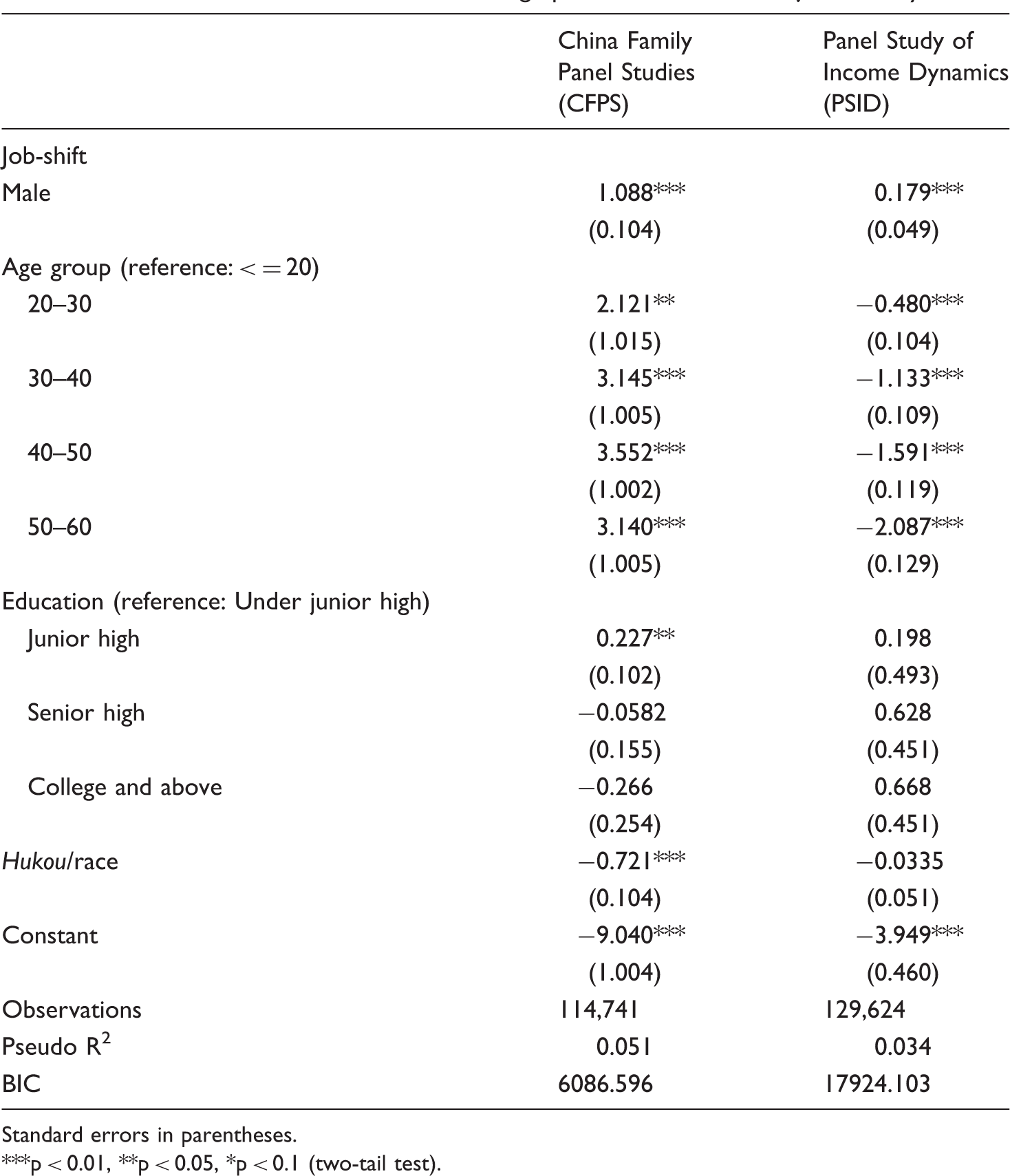
Job mobility rate in subgroups: I grouped all individuals by socioeconomic and demographic characteristics and compared the job mobility rates among different categories. I used the logit model for auxiliary analysis. The socioeconomic and demographic characteristics included gender, age (≤20, 20–30, 30–40, 40–50, 50–60), and educational attainment (less than junior high, junior high, high school, college and above). I also used hukou status (urban and rural) in China and race (Whites and Asian Americans vs Blacks and other minorities) in the USA to construct subgroups.
Comparison of job mobility patterns between China and the USA
In this section, I report the empirical findings from the statistical analyses of job mobility patterns in contemporary China, comparing these with job mobility rates in the USA as a benchmark.
The overall level pattern of job mobility
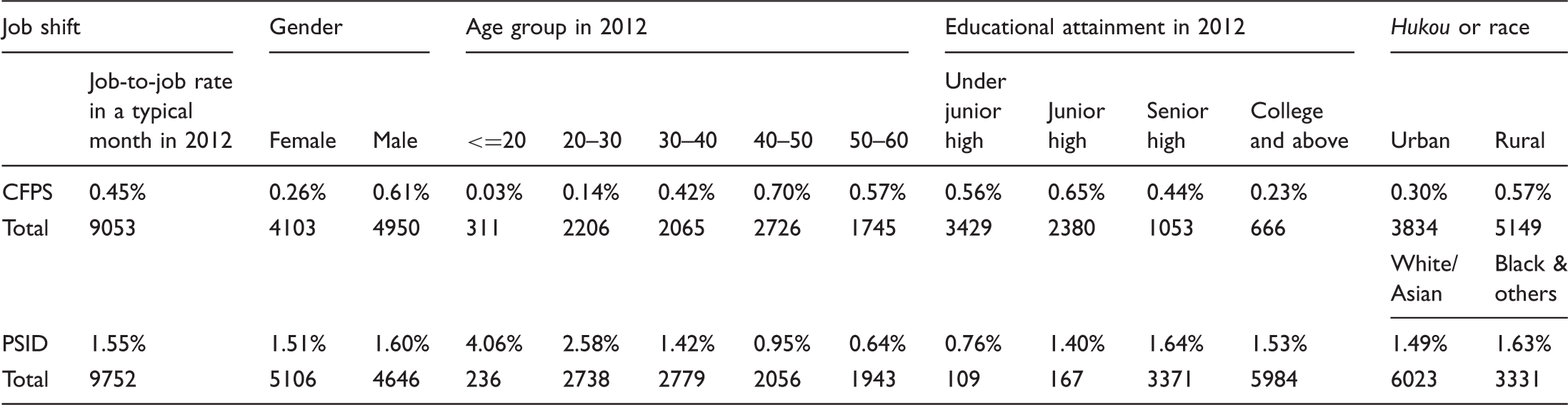
The overall level of job mobility rates and by different groups (China Family Panel Studies (CFPS) vs Panel Study of Income Dynamics (PSID), 2012).
Job mobility rates by different groups
I further calculated the inter-group level patterns of job mobility by different social groups, as shown in Table 1. Across the gender groups, the job mobility of men in both China and the USA is higher than that of women, but the gender gap is much higher in China. In China, men shifted jobs twice as often as women, whereas the rates of men and women were quite similar in the USA. With regard to age variations, the high job mobility rate in China was mainly concentrated among those aged 40 to 60. People aged 40 to 50 changed jobs most frequently (0.70%). The job mobility rate of people under the age of 20 was the lowest, 0.03%, whereas the rate of people aged 20 to 30 was much lower than the overall level, which was only 0.14%. This seems quite counterintuitive in showing that young people do not shift jobs as often as the middle-aged, since we usually expect younger people to change jobs more for better job matching. The situation in the USA was just the opposite of that in China. The job mobility rate decreased with age. Job mobility was mainly concentrated among those under the age of 30. The youngest group changed jobs the most (4.06%). It is also worth noting that even among those aged 50 to 60, the age group with the lowest job mobility level, the job mobility rate (0.64%) was still higher than the overall rate in China (0.45%).
This study also examined how job mobility rates varied by socioeconomic characteristics such as educational attainment. The results suggest that the job mobility patterns by education in China are also the opposite of those in the USA. The highest level of job mobility was among high school graduates in America, followed by college graduates. The lower the education level individuals attained, the fewer job shifts they experienced. In China, however, people with a junior high school education or less changed jobs the most, whereas those with at least a high school education had lower job mobility. Those with college diplomas had a job mobility rate of only 0.23%.
The urban–rural dual system is one of the most important forces shaping the hierarchical structure and patterns of social mobility in China. Therefore, I divided the population into two groups according to hukou status. As can be seen in Table 1, rural people experienced more job shifts, and the job mobility rate was nearly twice that of urban people. Correspondingly, racial status is a segmentation mechanism that is prominent in American society. I assign Whites and Asians to one group, and Blacks and other minorities to another. Blacks and other minorities have a higher job mobility rate than Whites and Asians. However, the racial gap in the USA is much smaller than the urban–rural gap in China. It should be pointed out that even though we compare the urban–rural difference in job mobility patterns in China with the racial gap in job mobility in the USA, this is not meant to imply that the two mechanisms are equivalent in these two social contexts.
Estimates of socioeconomic and demographic characteristics on job mobility.
Standard errors in parentheses.
***p < 0.01, **p < 0.05, *p < 0.1 (two-tail test).
Distributions of job mobility
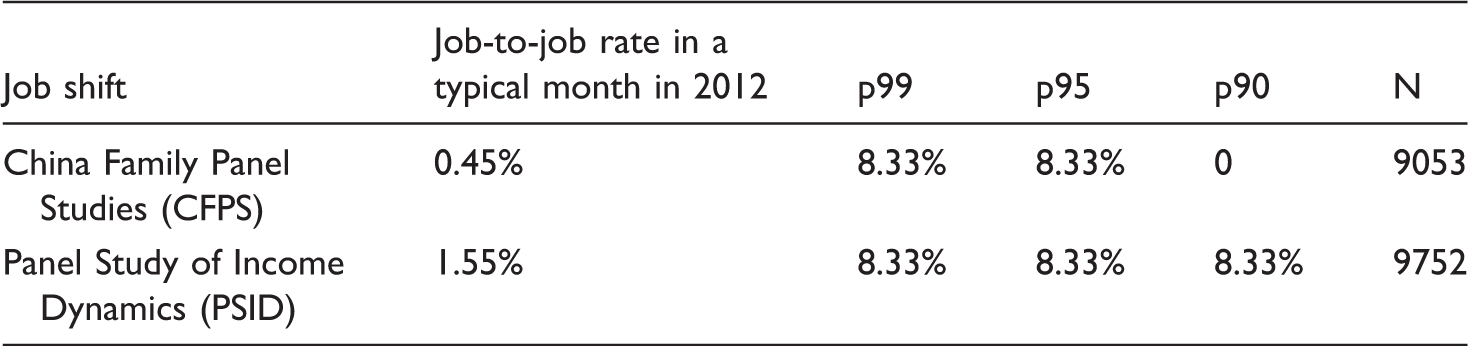
The average level and central tendency reflect only one aspect of job mobility patterns. We also need to consider the tendency of dispersion of distribution in order to better describe and portray job mobility patterns. This section attempts to calculate the job mobility rate at key percentiles and percentile shares, which outlines the distribution of job mobility patterns in contemporary China.
Job mobility rates at key percentiles.
Further, I examine the distribution of job mobility patterns in China and the USA by depicting the percentile share of the job mobility rate, as shown in Figure 1. Figure 1 shows the percentile share of the average rate, and rates by gender. The overall level of job mobility (1.55%) in the USA was caused mainly by the 25% of people who change jobs most frequently. People in the upper 10th–25th percentile (the furthest bar to the right) drove 42.3% of the total changes in job mobility, while the top 5% people generated 30.88% (the two furthest bars to the left) of total mobility. The next 5% of people (the upper 5th–10th percentile, the remaining bar) drove 26.8% of the mobility. The vast majority of the labor force (75%) did not contribute to the overall job mobility in the American labor market.
Percentile share of the overall job mobility rate and by gender, China and the USA.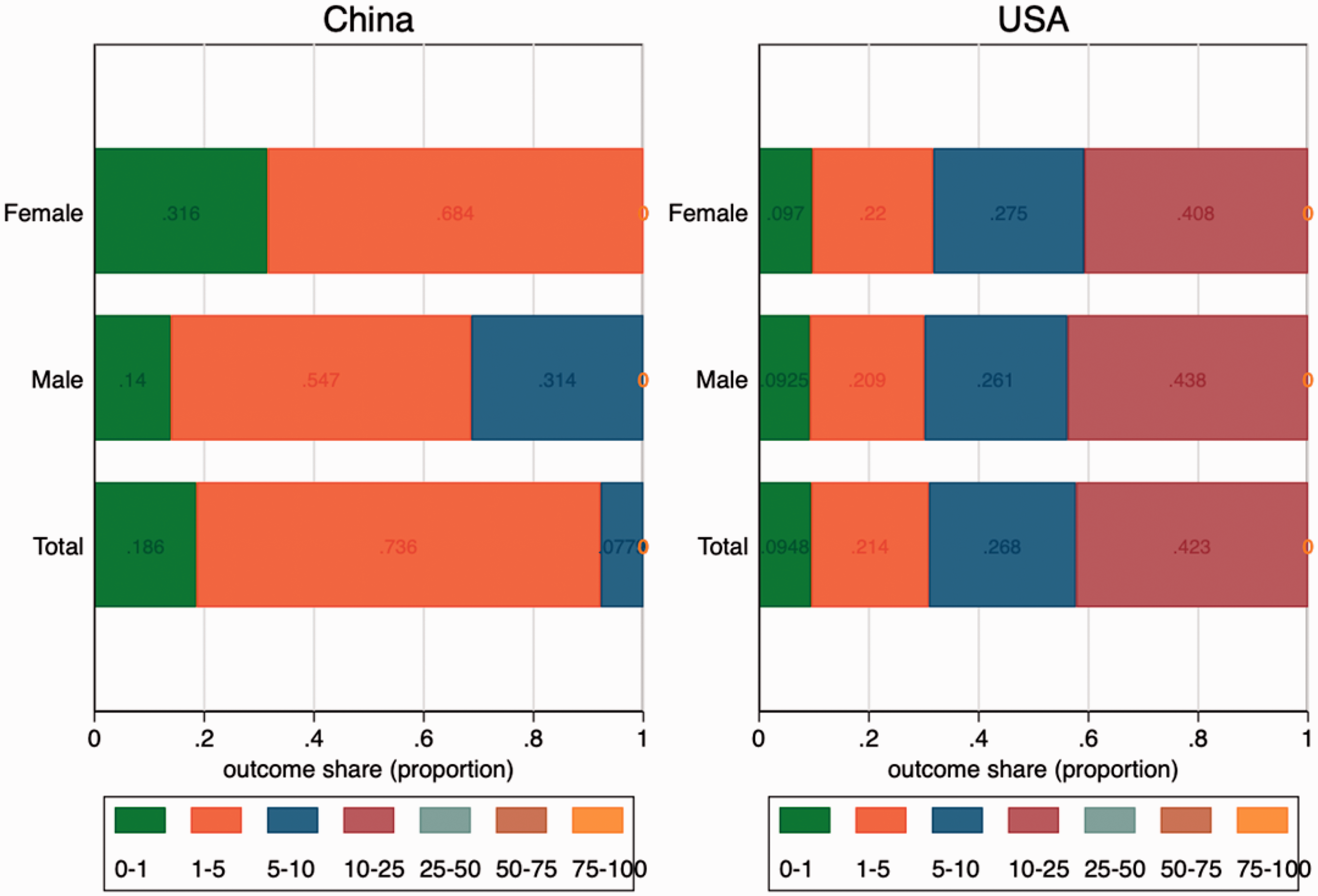
This situation has become extreme in China, showing a dramatic polarization. Job mobility occurred frequently among a small group of people, shaping the overall job mobility patterns in China. The total change in job mobility rates is driven mostly by the top 5% of people with the highest job mobility rates, which accounts for 92.2% (the green bar + the orange bar) of the variation. Specifically, the top 1% of people frequently changed jobs, which accounts for 18.6% of the overall mobility. Compared to the USA, China has a more skewed distribution of job mobility; that is, the job shifts are caused by a very small number of people who change jobs frequently.
With regard to gender differences, also shown in Figure 1, the distribution of job mobility between men and women in the USA tends to be similar, although the distribution is slightly more skewed among women. However, in China, the polarization is quite different between men and women. The top 1% of the female labor force accounts for 31.6% of changes in job mobility, while the situation among men is relatively less polarized.
As for age variations, the skewness of job mobility distribution in the USA increases with age. In the under-30 groups (< = 20 and 20–30), half of the labor force with the highest job-shift rates drives their groups' job mobility, which reflects only very moderate skewness. However, all age groups in China have more skewed distributions than those in the USA. Those aged 40 to 50 have the least skewed distribution, as shown in Figure 2.
Percentile share of job mobility rate by age, China and the USA.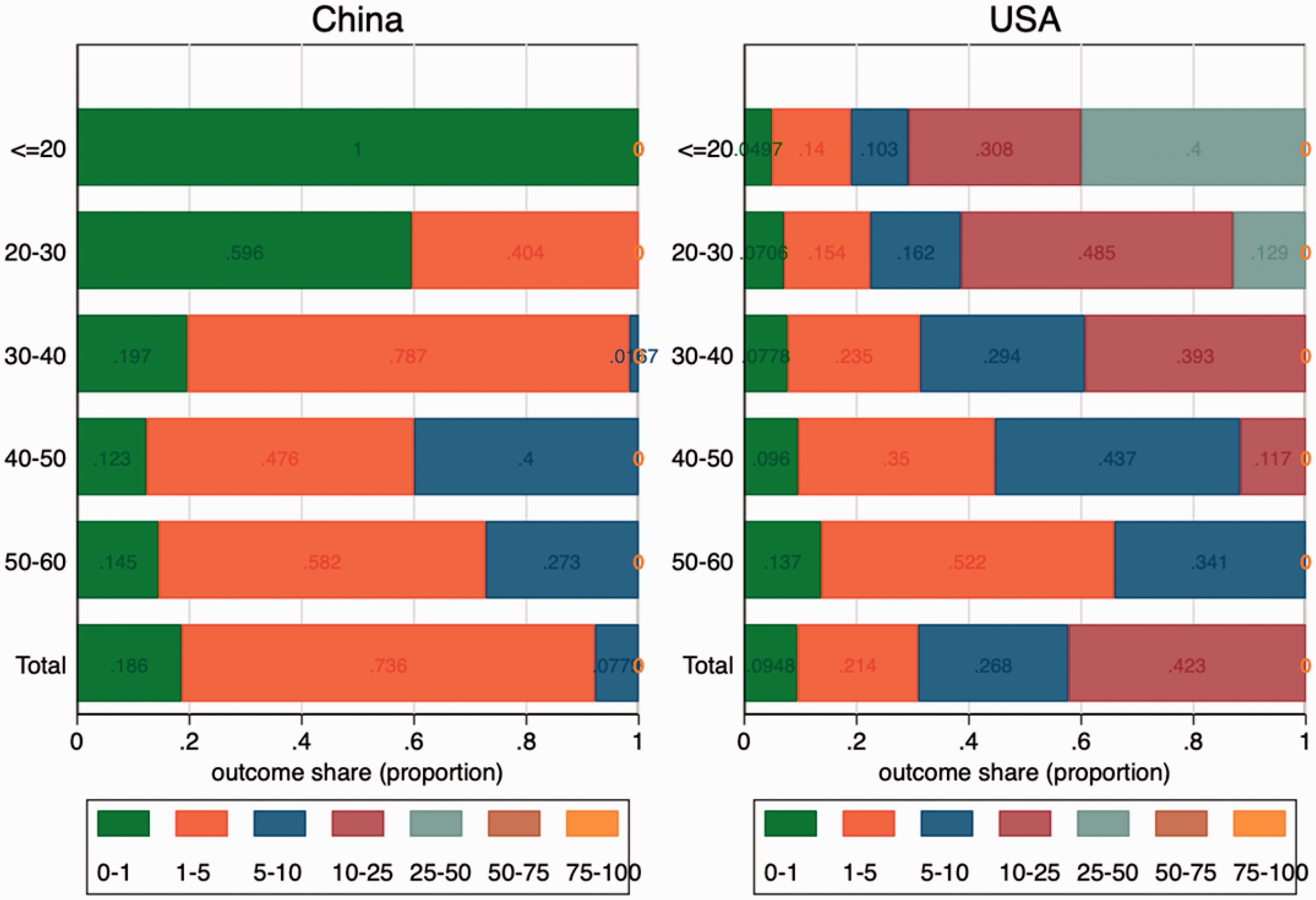
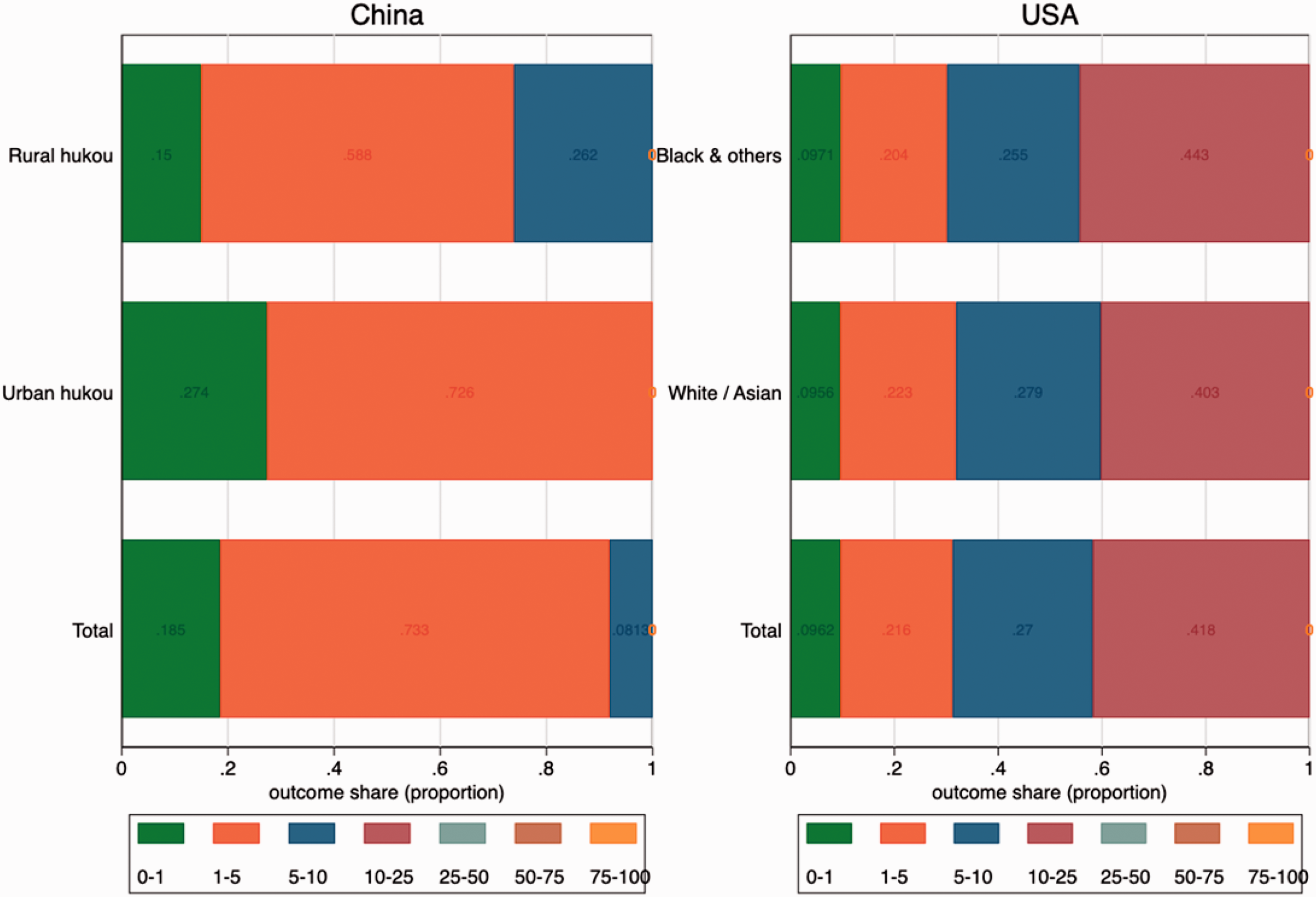
I also examined the distribution of job mobility by education, hukou and race as shown in Figures 3 and 4. China has a more skewed distribution in each group than that in the USA. It is worth noting that the racial gap in the USA is not obvious, while the urban–rural difference in China is quite polarized. Compared with urban people, urban–rural migrants in China may get stuck in precarious job shifts because of household system discrimination and their low human capital.
Percentile share of job mobility rate by education, China and the USA. Percentile share of job mobility rate by hukou in China and race in the USA.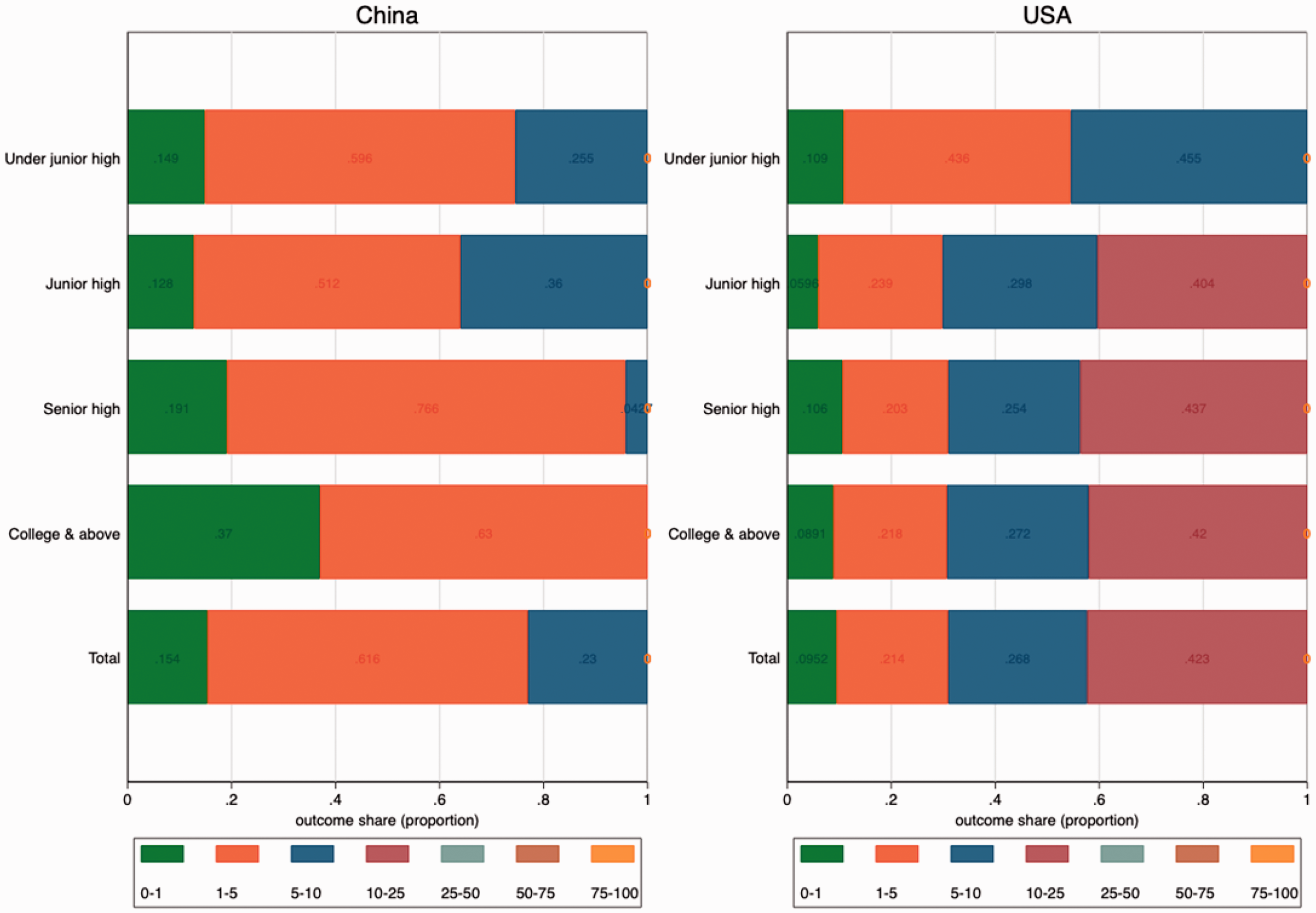
Conclusion and discussion
In this study, I developed a sociological interpretation of the duality of job mobility, which may have positive or negative directions of movement, to better understand job changes in China's reform era. To facilitate the interpretation, I adopted a comparative perspective and used job mobility in the USA as the baseline for comparison. Based on CFPS and PSID data, I constructed several unified and comparable indexes to analyze job mobility patterns in China and the USA, including job mobility rates and percentile shares of all groups and among subgroups. This paper summarizes the following basic features of job mobility in the Chinese context, in comparison with the context of American society.
First, the overall level of job mobility in contemporary China remains low. Although the institutional barriers to job change have been removed gradually along with market transition, this study finds that the average monthly job mobility rate is much lower in China than in the USA. This low mobility is the basic feature of job mobility patterns in post-transformation China.
Second, the job mobility pattern in contemporary China presents an extremely skewed distribution. The 5% of people who change jobs most frequently shape the overall trend in China (25% in the USA). Moderate job mobility reflects the efficient adjustment of the market mechanism to a reallocation of jobs, while the situation in China is more likely to be the opposite. One speculation is that the small group of people who often change jobs may be suffering from precarious work and downward mobility, which will not be conducive to the accumulation of human capital.
The above speculation is reinforced by the observation that job mobility is mainly concentrated among those with lower socioeconomic status in contemporary China. Specifically, older people and people with less education change jobs the most. In particular, those aged 40 to 50 and those with junior high education experienced more job shifts. In fact, the less educated are disproportionately represented among those older individuals because of period and cohort effects. These individuals received their education in the period before the reform and did not enjoy the opportunities introduced by educational expansion. In this sense, socioeconomically disadvantaged people changed jobs most in China. This feature is not in line with our expectation that high socioeconomic status people will be more likely to change jobs to get more returns, as is the case in the USA. In China, however, high fluidity may not always equal abundant opportunities.
Third, there are also noticeable differences in connection with other socioeconomic indicators. For example, in both countries, men's job mobility rate is higher than women's. However, compared to the USA, the gender gap is much greater in China. In the Chinese context, males have more ambitions, experience more economic pressures and are more capable of migrating and moving, while females are highly restricted by the family, which can partly explain the gender difference in the job mobility level.
In addition, rural people have a higher job mobility rate but a less skewed distribution than urban people. Comparing the two specific identity segmentation mechanisms between China and the USA, I found that the hukou difference in Chinese job mobility patterns is greater than the difference due to the racial gap in the USA.
The main findings summarized above highlight the duality of job mobility and call for a sociological interpretation of such patterns in contemporary China. As we have shown, the sociological meaning of ‘fluidity’ is twofold, as reflected in the duality of mobility. At the macro level, the job mobility may reflect the optimal matching process of human capital and job opportunities in the labor market, which increases the social welfare of the whole society. However, high-frequency job mobility may entail a different possibility; that is, the instability of the labor market due to economic changes, which is detrimental to social welfare. Similarly, at the individual level, job mobility may not necessarily be a good thing. For example, involuntary job shifts will not only decrease income, but also bring about worse working conditions. Even if such job shifts are better than being unemployed, job mobility is not always beneficial to individuals. Both upward and downward job mobility exist in the labor market. We cannot simply say that as one main aspect of fluidity, job mobility is always positive for individuals and societies, especially when people with lower socioeconomic status experience more job shifts. One needs to look into the proportion and distribution of job mobility by different groups in light of the sociological interpretation discussed in this paper.
The observed job mobility patterns in the Chinese labor market are shaped by two unique forces: (1) inadequate market mechanism; and (2) path dependence of institutional changes and structural detention effects. On the one hand, market transitions and modernization processes have brought about an increase in labor demand and established a labor market from scratch, which promotes intragenerational job mobility. On the other hand, the traditional institutional arrangements have also continued to affect the labor market and shape its segmentation.
The path dependence of institutional changes shows a strong effect on the opportunity structure of job mobility. Two institutional changes need to be stressed. First, the hukou registration system has relaxed since the late 1970s at the national level, which has lessened the restrictions on migration and increased spatial mobility. Rural people can be employed in the labor market and no longer have to stick to agricultural work. Thanks to the growth of the labor market, they can even seek a better job matched to their human capital. However, rural migrants are more likely to fall into the secondary labor market because of their socioeconomic disadvantages. The second institutional change is the danwei system reform, which brought about the rise of the private sector and built a free labor market. People can choose and change jobs freely. However, the concept of the ‘iron rice bowl’ still influences people's preferences for job mobility, reinforcing segmented labor markets and the skewed distribution of job mobility.
More specifically, this study discussed the systematic difference between China and the USA and the sociological interpretation of this difference. China presents a more skewed and polarized distribution of job mobility. The distribution is shaped by a very small group of people who are relatively socioeconoically disadvantaged and change jobs very often. Compared to the USA, China has a greater gender gap in job mobility, reflecting the inequality of mobility opportunities by gender. There is also a large rural–urban gap in job mobility in China, indicating that the hukou system has a segmentation effect on the labor market. In the secondary labor market, rural migrants are forced to change jobs and suffer from precarious jobs and instability. Older people experience more job shifts in China but fewer job shifts in the USA. Young Americans in the early stages of their careers are prone to change jobs to maximize the returns to human capital. The age pattern of job mobility in China, however, is more likely to reflect negative mobility. Educational differences in job mobility also display opposite patterns in China and the USA. Less-educated people in China with less human capital are mainly in the secondary labor market and change their jobs the most, which implies negative or involuntary mobility. In summary, high job mobility in China is mainly concentrated among the socioeconomically disadvantaged, significantly skewed, and thus more likely to be a negative factor.
Taking a comparative perspective and using the American labor market as a benchmark, this study offers a systematic examination and interpretation of job mobility patterns in China. In contrast with the conventional positive image of job mobility in the literature, this study found a low overall level of mobility and a skewed distribution, with a high concentration among people with low socioeconomic status. These patterns alert us to the emerging patterns of inequality and intragenerational mobility in contemporary China. The emphasis on the duality of job mobility offers a sociological angle from which to understand ‘fluidity’ and opportunity.
There are some limitations in this study. First, we need a direct way to separate positive mobility from each job shift based on some standards. Second, the time window is still too short. I hope future research can improve upon this work, gain a better understanding of the multifaced paths that job mobility may imply, and further enrich our knowledge in this area.
Footnotes
Acknowledgements
The author thanks Yu Xie and Cheng Cheng for their helpful comments and suggestions. The ideas expressed herein are those of the author.
Declaration of Conflicting Interests
The author(s) declared no potential conflicts of interest with respect to the research, authorship and/or publication of this article.
Funding
The author(s) received no financial support for the research, authorship and/or publication of this article.