




Abstract
Behavioral problems are recognized as playing a potentially important role in educational attainment, but their function in contexts of extreme poverty is not well understood. In such settings, other factors might swamp any effects of children’s behavioral problems. Further, the interpretation of behavioral problems in circumstances of deep poverty is not clear: problematic behaviors might be in part a direct function of adverse experiences in childhood. In this paper, we focus on the case of 2000 rural youth sampled in the year 2000 from 100 villages in Gansu, one of China’s poorest provinces, and followed up through 2015. We investigate whether behavioral problems—internalizing problems, externalizing problems, and teacher-reported behavior problems—predict subsequent educational attainment among the rural poor, and consider the contributions of cumulative adversity to behavioral problems. Results in a high-poverty context where promotion decisions are closely tied to performance show that behavioral factors are linked to long-term educational outcomes. These results are robust to adjustment for a host of individual, family, and community context variables. There is some evidence that children in higher socioeconomic status families and in more developed communities are less vulnerable to experiencing behavioral problems. While girls are slightly less vulnerable to experiencing teacher-reported behavior problems than boys, there is no gender difference in the implications of behavioral problems for educational attainment. Finally, behavioral problems do not appear to operate simply as a proxy for measured family adversity.
Introduction
Behavioral problems are recognized as playing a potentially important role in status attainment and social mobility, but the extent to which they play an important role in contexts of extreme poverty is not well understood. In such settings, other factors might swamp the effects of children’s own behavior. Further, the interpretation of problematic behaviors in circumstances of deep poverty is not clear: problematic behaviors might be in part a direct function of adverse experiences in childhood. For instance, there has been evidence showing that poverty affects goal-directed behaviors (Blair and Raver, 2012) and self-regulatory behaviors (Farah and Hackman, 2012). As McEwen and McEwen (2017) argue, adversity can be a ‘toxic stress’ that heightens allostatic load, shaping brain and body development, diminishing self-regulatory capacity, and eventually reducing academic performance and occupational success.
In this paper, we focus on the case of rural youth in one of China’s poorest provinces, in China’s poorest region. We investigate the role of early behavioral problems, including internalizing behavioral problems, externalizing behavioral problems, and teacher-reported behavior problems, as correlates of long-term educational attainment among the rural poor, and consider the contributions of cumulative adversity to behavioral problems and to long-term educational attainment. Specifically, we address three research questions. First, do behavioral problems contribute significantly to explaining educational attainment, after adjusting for family and community economic status and aptitude test scores? Second, does the relationship of behavioral problems to educational outcomes vary by early academic skills, sex, socioeconomic status, or community development context? Finally, are the observed relationships between behaviors and outcomes explained by higher levels of cumulative adversity experienced by children who exhibit behavioral problems?
To address these questions, we analyze the Gansu Survey of Children and Families (2000, 2004, 2007, 2009, 2015), a longitudinal study conducted among 2000 children in 100 rural villages in China’s impoverished Northwest. The children were first interviewed at ages 9 to 12 in the year 2000 and last interviewed in early adulthood in the year 2015. We model conditional educational transitions and years attained, measured in 2015, with early behavioral problems, namely internalizing behavioral problems, externalizing behavioral problems, and teacher-reported behavior problems, measured in 2000, after adjusting for measured aptitude and socioeconomic, demographic and community characteristics. Further, we consider whether the relationships vary by gender, socioeconomic status, or community development context, and test the potential role of cumulative adversity in driving these relationships.
As we will show below, even in a high-poverty context, and in a setting where promotion decisions are closely tied to performance, behavioral factors are linked to educational outcomes. These results are robust to adjustment for a host of individual, family, and community context variables. Family socioeconomic status and community development appear to be protective in terms of risk of behavioral problems. While girls are slightly less vulnerable to experiencing teacher-reported behavior problems than boys, there is no gender difference in the implications of behavioral problems for educational attainment. Finally, behavioral factors do not appear to function simply as proxies for measured cumulative adversity.
Background and research questions
While links between physical health in childhood and economic outcomes in adulthood are well established, the long-term implications of psychological and behavioral problems in childhood are less well studied (Smith and Smith, 2010). 1 Such studies are challenging in terms of data requirements, as they require measurement of conditions during childhood and the ability to follow children into adulthood (Smith and Smith, 2010). In this section, we discuss the limited literature about the long-term implications of childhood behavioral problems for educational attainment, then introduce a key caveat in the literature that we will investigate in this paper: the possibility that observed behavioral problems are a function of early achievement problems or family background, or cumulated adverse experiences. We close with our research questions.
Long-term effects of early behavioral problems
Smith and Smith (2010) estimated educational attainment in the United States Panel Study of Income Dynamics using ordinary least squares (OLS) and fixed effects within-sibling models, to test for effects of childhood psychological problems. Results from OLS models showed that any childhood psychological condition was associated, on average, with a decrease of about six-tenths of a year of schooling. Estimated effects in sibling fixed-effects models were almost half as large, but remained statistically significant. In this study, while within-sibling models addressed unobserved family background factors, the authors by necessity operationalized psychological conditions in childhood retrospectively. The study created a single measure of any childhood psychological condition from respondent recall answers to questions about whether before age 17 the respondents suffered from (1) depression, (2) drug or alcohol abuse, or (3) other psychological problems. Thus, it is possible that current psychological issues might partially drive the recall of past psychological issues, and the issues recalled might tend to be those of a rather serious nature.
Some prospective studies of the relationship of early psychological problems with later outcomes have been implemented. For example, Carneiro et al. (2007: 7) studied the association of social-behavioral problems with later outcomes in Great Britain using the National Child Development Survey (NCDS). The NCDS survey used the Bristol Social Adjustment Guide to measure social maladjustment at age 11. Teachers reported behaviors that applied to children across multiple items in 12 domains. 2 One point was given for each item that applied to a given child. Results showed that children who exhibited better social adjustment at age 11 were both more likely to stay on at school post-16 and to achieve a higher education degree, after adjusting for early academic skills and other background factors (Carneiro et al., 2007: 11). A 25-year cohort study in New Zealand revealed statistically significant associations between childhood conduct problems reported by parents and teachers during ages 7 to 9 and adverse educational outcomes: failure to receive an educational qualification and failure to attain a university degree by age 25 (Fergusson et al., 2005). However, after adjusting for confounding factors, including family adversity, the associations between conduct problems and educational outcomes became statistically non-significant.
Using data from the children in the National Longitudinal Surveys of Youth (1986–2000) in the United States, McLeod and Kaiser (2004) showed that internalizing and externalizing problems at ages 6 to 8 were significantly associated with reduced probability of receiving a high school degree. Furthermore, among youth who received a high school degree, externalizing problems were also associated with a reduction of the probability of subsequent college enrollment, though internalizing problems did not have a significant association with college enrollment. An analysis of National Educational Longitudinal Survey (NELS88) data from the United States indicated that persistent externalizing and internalizing behavioral problems in sixth and eighth grade showed small but significant associations with subsequent high school and post-secondary degree attainment (Farkas, 2011). However, based on data from the Dunedin Multidisciplinary Health and Development Study in New Zealand, Miech et al. (1999) found that internalizing disorders did not significantly predict educational attainment. Externalizing disorders such as conduct disorders and attention deficit disorder, however, may impair educational attainment. In particular, adolescents who met the DSM (Diagnostic and Statistical Manual of Mental Disorders) criteria for a diagnosis of conduct disorder were less likely to earn a school certificate, with an odds ratio of 0.54, even after controlling for family socioeconomic background and the presence of other comorbid disorders.
Potential confounders: Unmeasured family background and adverse experiences
One important caveat to the interpretation of long-term effects of behavioral problems is unmeasured confounders. As Smith and Smith (2010: 110) note, ‘some effects attributed to childhood psychological conditions may instead reflect unmeasured difficulties in the family or neighborhood in which the children were raised.’ Discussing findings from a cohort study using teacher- and parent-reported conduct problems in New Zealand, Fergusson et al. (2005: 847) argue that, … a quite substantial component of the continuity between early conduct problems and later outcomes is likely to reflect the correlated effects of social disadvantage, family adversity and individual cognitive/attentional difficulties that act to exacerbate the adverse outcomes of children with early conduct problems.
Such concerns may be particularly important in low-income settings in which children could experience many challenges related to economic deprivation. Using a measure of non-cognitive skills that was a composite of traits and competencies related to self-esteem and self-efficacy, an analysis of the Young Lives data on children from Peru, Vietnam, India and Ethiopia found that child’s non-cognitive skills, across all countries and at different ages, were fairly consistently associated with mother’s non-cognitive skills (self-esteem, self-efficacy, and perceptions of respect), social capital, and aspirations for the child’s education, and sometimes with wealth or parental education, though these socioeconomic factors were highly significant in some countries and for children at some ages (Georgiadis, 2017). 3
In China, studies suggest that community and family background and socio-economic disadvantage might be closely tied to behavioral problems. Earlier work in Gansu Province linked internalizing problems in adolescence to both community socioeconomic development and cumulative adversity in the household (Davidson and Adams, 2013). Song (2010) analyzed a sample of 1259 children in seventh grade in Wuhan to examine the risk factors for children’s behavioral problems, measured by the Youth Self-Report Questionnaire, the Internet Addiction Test Scale, and the Symptom Scale of Neurotransmitter Deficiency Questionnaire, using logistic regression. The study found that parents' occupations and level of education, as well as presence of both parents and child-rearing style, were related to children’s behavioral problems. 4 In addition, girls tended to have more internalizing problems, while boys tended to present more delinquent behaviors. Chen (2008) surveyed 4559 children in first to ninth grade from Hubei, Hunan, and Anhui provinces. The rate of children with behavioral problems, measured using the Child Behavioral Checklist for ages 4 to 16, ranged from 15.79% to 21.92% in these three provinces, with an average of 19.19%. Economic hardship, along with parent’s psychological problems, marriage problems, and watching TV and playing video games for extended periods, were risk factors associated with children’s behavioral problems. These findings highlight the need to consider the possibility that some groups are more vulnerable than others to experiencing behavioral problems, and that adverse experiences could be a source of behavioral problems.
Potential confounders: Academic skills or performance
Another potential confounder is educational aptitude or performance. Evidence about links between behavioral problems and academic performance has been somewhat contradictory. Behavioral problems were not significantly related to literacy or numeracy attainment in Carneiro et al.’s (2007) study using NCDS data from Great Britain. The lack of impact of behavioral measures on academic performance has also been found in the United States. A study using the early childhood longitudinal study in the United States found, with the exception of a kindergartener’s capacity to pay attention, virtually no impacts on later school performance of early socioemotional skills (Claessens et al., 2009). A meta-analysis of 236 coefficients linking school-entry skills to achievement showed that only three of five school-entry skill categories predicted subsequent reading and math achievement: reading, math, and attention; behavioral problems (internalizing and externalizing) were not associated with later achievement, holding constant achievement as well as child and family characteristics (Duncan and Magnuson, 2011).
However, focusing on an economically vulnerable population in the United States, Turney and McLanahan (2015) analyzed the Fragile Families and Child Wellbeing Study to investigate how internalizing, externalizing, and attention problem behaviors in early childhood were linked to cognitive test scores in middle childhood. Analyses showed that externalizing problems at age three and attention problems at age five, along with externalizing and attention problems at both ages, were associated with poor cognitive development in middle childhood, after adjusting for a wide array of control variables and prior test scores. In addition, a cohort study in Sweden showed that school conduct problems measured at grade 6 and grade 9 were associated with grades (Kratzer and Hodgins, 1997).
Further, in China, a number of studies have shown correlations of behavioral problems with academic achievement. Li et al. (2005) utilized Conners Comprehensive Behavior Rating Scales to measure behavioral problems of 1540 children aged 6 to 13 in Anhui province and then tested its correlation with children’s academic achievement. The authors found that hyperactivity and inattention problems were significantly negatively related to test scores, and that the occurrence of behavioral problems decreased as test scores increased. Another survey of 1999 students in elementary and junior middle schools showed that attention deficit hyperactivity disorder, psychosomatic disorder, and autism were important risk factors associated with lower academic achievement; furthermore, junior middle school students were more likely to have behavioral problems than elementary school students (Shen et al., 2011). Zhou (2011) used the Strengths and Difficulties Questionnaire to measure children’s emotional and behavioral problems, and divided these problems into six dimensions—emotional problems, behavioral problems, hyperactivity, peer problems, total difficulty, and teacher-reported behavior problems. Based on a sample of 877 children aged 7 to 10 in Shanghai, Zhou (2011) found that these six dimensions of emotional and behavioral problems were all negatively related to children’s academic achievement. These findings suggest that early academic achievement could be a possible confounder for behavioral problems.
Research questions
In short, studies have suggested the importance of investigating psychological or behavioral problems in childhood as a potentially important precursor of educational attainment, and, by extension, economic outcomes in adulthood. However, studies also highlight the need for caution in interpreting any observed relationships, as household or community economic deprivations, hardships, and other factors could be a source of child behavioral problems. Further, it is important to note that the measurement of psychological and behavioral problems has been inconsistent across different studies. Finally, although gender is not the focus of the current paper, it is important to be sensitive to potential gender differences: studies have also suggested that there might be gender differences in vulnerability to experiencing behavioral problems, though not necessarily in the impact of behavioral problems on outcomes (for example, see Kratzer and Hodgins, 1997; see discussion in Fergusson et al., 2005).
In this study, we utilize two standard self-reported behavioral problem scales and one purpose-designed teacher-reported measure to address three research questions: 1. Do behavioral problems contribute significantly to explaining educational attainment, after adjusting for family and community economic status and aptitude test scores? 2. Does the relationship of behavioral problems to educational outcomes vary by early academic skills, sex, socioeconomic status, or community development context? and, 3. Are the observed relationships between behaviors and outcomes explained by higher levels of cumulative adversity experienced by children who exhibit behavioral problems? In focusing on a 15-year longitudinal dataset purpose-designed to collect information on childhood adversity and economic deprivations, as well as educational experiences, in an impoverished region, we are able to investigate long-term implications of behavioral problems while adjusting for key potential confounders.
Data and methods
Study site and data
The study site for this project is rural Gansu Province, in China’s arid and impoverished northwest. The province is long and narrow, stretching across desert, mountainous and hilly areas, and vast grasslands. Much of Gansu is mountainous or highland plateau, with an elevation of more than 1000 meters (United Nations Economic and Social Commission for Asia and the Pacific, 2005). In 2010, the most recent census year, Gansu’s population was 25.58 million people. This figure would make Gansu the 47th largest country in the world (in population size) in that year—the province is about the size of Ghana or North Korea (US Bureau of the Census, 2010). Gansu remains a majority rural province: in 2010, 64% of the population resided in rural areas (Gansu Bureau of Statistics, 2011). Gansu is one of China’s poorest provinces: in 2010, it ranked last among provinces in per capita rural household income and third to last in per capita GDP (China National Bureau of Statistics, 2011a, 2011b). Per capita GDP in 2010 was $4031 USD—about equivalent to the 2010 figure for Iraq (The Economist, 2011).
We analyze the 2000 and 2015 rounds of the Gansu Survey of Children and Families (2000, 2004, 2007, 2009, 2015), a longitudinal study of 2000 children in 100 rural villages in China’s impoverished Northwest. The sample drawn was a multi-stage cluster sample of rural households with children in the target age range. The children were first interviewed at ages 9 to 12 in the year 2000 and last interviewed in early adulthood in the year 2015. The initial sample consisted of 2000 children interviewed in the year 2000, of which we are able to analyze data for a follow-up analytic sample for the current analyses of 1613, in 2015. In the former year, questionnaires were administered at schools and in homes to children, teachers, school principals, mothers, and household heads, while in 2015, the survey focused on the now-adult children. In the latter year, in order to reduce non-response and attrition due to out-migration, interviews were conducted in family homes during Chinese New Year, when out-migrants were likely to return home for family reunions during the festival. For respondents who did not return home during the festival, basic demographic and education information from the household head and self-reported information through phone interviews were collected to reduce selection bias due to non-response and attrition. In the analysis, we include an analytical sample with full information on educational outcomes and key independent variables of interest.
Measurement
Educational attainment
The dependent variable in this study is educational attainment. In the 2015 survey, respondents were asked about their highest degree of education attained. Based on this question, we generated a set of categorical variables and a continuous variable. First, we generated three binary variables, with each coded one for ‘yes’ and zero for ‘no’: whether completed compulsory education, whether completed secondary education conditional on completing compulsory education, and whether completed tertiary education conditional on completion of secondary education. Using this measurement strategy, the proportion of completing compulsory education was 0.86, with corresponding figures of 0.67 for secondary education and 0.56 for tertiary education. Second, we generated a years of education attained measure, with an average of 11.24 years.
Behavioral problems
The key analytic variables in this study are behavioral problems. Self-rated behavioral problems were measured in 2000 using scales adapted from the Child Behavior Checklist and Youth-Self Report (Achenbach, 1991), edited through local piloting for cultural relevance (Liu, 2003). Two basic types of behavioral problems are included: internalizing behavioral problems and externalizing behavioral problems. Internalizing behavioral problems are inner-directed behavioral problems such as withdrawal and anxiety, and externalizing behavioral problems are outer-directed behavioral problems, which reflect children’s negative actions directed toward the external environment, such as delinquent and aggressive behaviors (Eisenberg et al., 2001; Liu, 2004). In addition, a scale generated from teacher-reported behavior problems is also considered.
Each behavioral problem indicator is a summative score of items measuring different symptoms, such as social withdrawal and difficulty concentrating for internalizing behavioral problems, stealing and impulsive acts for externalizing behavioral problems, and fearfulness and disobedience for teacher-reported behavior problems. Each item for constructing internalizing and externalizing behavioral problems is rated from 1 to 4 as ‘totally disagree’, ‘disagree somewhat’, ‘agree somewhat’, and ‘fully agree’. Each item for constructing teacher-reported behavior problems is rated from 1 to 3 as ‘never’, ‘sometimes’, and ‘often’. Thus, a higher score implies more serious behavioral problems. Average scores are 37.80 for internalizing behavioral problems, 37.46 for externalizing behavioral problems, and 15.70 for teacher-reported behavior problems. The Cronbach’s alpha scores are 0.82 for internalizing behavioral problems, 0.88 for externalizing behavioral problems, and 0.68 for teacher-reported behavior problems, which represent adequate reliability for each behavioral problem scale. All items for constructing behavioral problem scales are listed in Appendix Table A1.
Demographic and family background variables
We adjust for age and other demographic and background characteristics that might be related to children’s educational attainment. Gender could be important, although a study of 146 countries shows that the ratio of female to male average years of schooling has increased from around 57.7% in 1950 to 80.3% in 1990 and 85.9% by 2010, which indicates the gap has been narrowed significantly (Hausmann et al., 2009; Barro and Lee, 2013). There are also some studies showing that sibship size has an inverse relationship with educational attainment (Blake, 1989; Steelman and Powell, 1989), while some research suggests that this is not always the case (Buchmann, 2000). To control for these possible effects of demographic characteristics on educational attainment, we include in our analysis children’s birth year, gender (1 for ‘male’ and 0 for ‘female’), and number of siblings as controls.
We adjust for family socioeconomic status using measures of father’s education and family income per capita. Father’s education is a four-category variable (none, primary school, middle school, high school or above) with middle school as reference. Family income per capita is the total family income from different sources (wage, farm and forest production, livestock farming, and self-employment), reported in 2000 divided by family size.
Early academic skills
We incorporate a curriculum-independent test of aptitude, bespoke for the project and administered to all children in 2000.
Village context
Descriptive statistics.
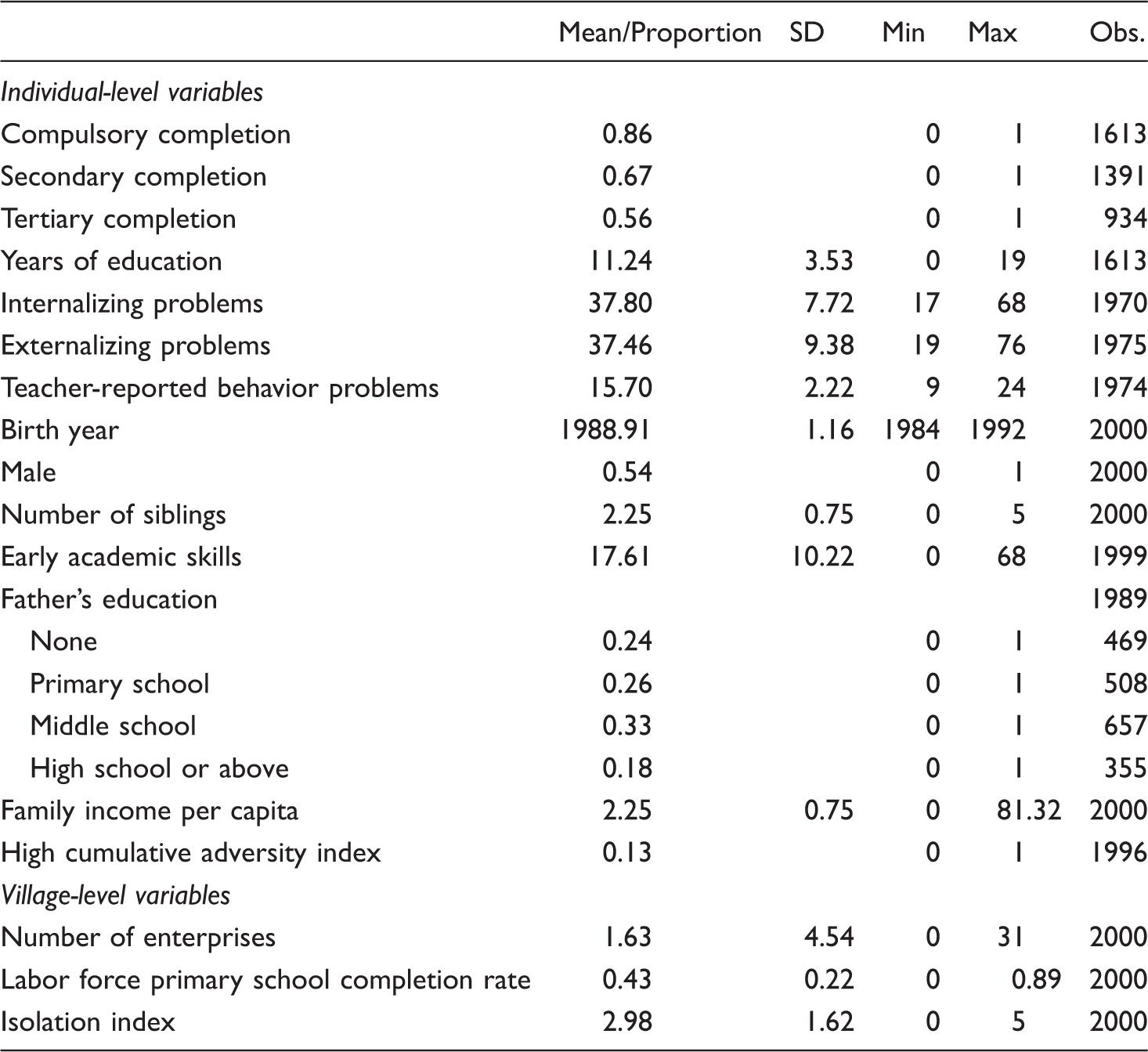
Note: Secondary completion is among those who completed compulsory education; tertiary completion is among those who completed secondary education.
Unit for family income per capita is 1000 yuan.
Cumulative adversity
Children growing up in circumstances of economic deprivation may be vulnerable to a host of adverse events. Research, including research in rural China, has shown that cumulative experiences with adverse events are associated with children’s behavioral problems (Davidson and Adams, 2013; McEwen and McEwen, 2017). To address adverse events as a potential confounder of behavioral problem effects, a cumulative adversity index is compiled from family questionnaires about adversity experienced by sample children in the 2000 wave. The index covers 15 items in three domains: economic hardship, health problems, and family structure change. Following this calculation, we convert the cumulative adversity index into a binary variable: individuals with the highest scores (80th percentile or above) are coded as 1, and all others are coded as 0. This approach is preferred because studies show that effects of adversity are likely to operate at threshold levels of risk rather than in a continuum (Wethington and Kessler, 1986). Items used to construct the cumulative adversity index are listed in Appendix Table A2.
Methods
To account for the multi-level structure of the data, we use multilevel regression models. For models of compulsory education completion, secondary education completion, and tertiary education completion, multilevel mixed-effects logistic regressions with random intercepts are used. For models of years of education, multilevel mixed-effects linear regressions with random intercepts are used. Robust standard errors are calculated in all models. We use likelihood ratio tests to compare models without behavioral problem measures and with behavioral problem measures to address the question of whether adding behavioral problem measures can produce models that fit more closely to the data. In addition, to test whether the effects of children’s behavioral problems on educational attainment vary with gender, family socioeconomic status, and village background, we interact children’s behavioral problems with children’s gender, father’s education, family income per capita, and the village isolation index. Finally, when we incorporate cumulative adversity into the model, family income per capita is excluded because the cumulative adversity index encompasses level of family income.
Results
Description of the sample
Table 1 presents descriptive statistics, including proportions who have completed compulsory, secondary, and tertiary education, behavioral problems, and all other individual, family and community-level characteristics. The proportion who have completed compulsory education is about 86% among all rural children. Among those who complete compulsory education, only about 67% complete secondary education. The proportion who have completed tertiary education is even lower, at about 56% among those who complete secondary education. Among these children, around 54% are boys, which reflects elevated sex ratios at birth in rural China. The average family income per capita is around 2250 Yuan, which is far below the national average, indicating the constrained resources these families possess. The average proportion experiencing high cumulative adversity is about 0.13, meaning that approximately 13% of children experienced multiple adverse events.
For village-level variables, number of enterprises, labor force primary education completion rate and isolation index are used as a proxy for economic activities, labor markets and infrastructure. The average number of enterprises is 1.63, with a range from no enterprise to a maximum of 31 enterprises, reflecting diverse economic contexts across the villages. The average isolation index is 2.98 and ranges from 0 to 5, revealing that the level of infrastructure is highly diversified.
Contribution of behavioral problems to educational attainment model fit
Likelihood ratio test for goodness of fit.
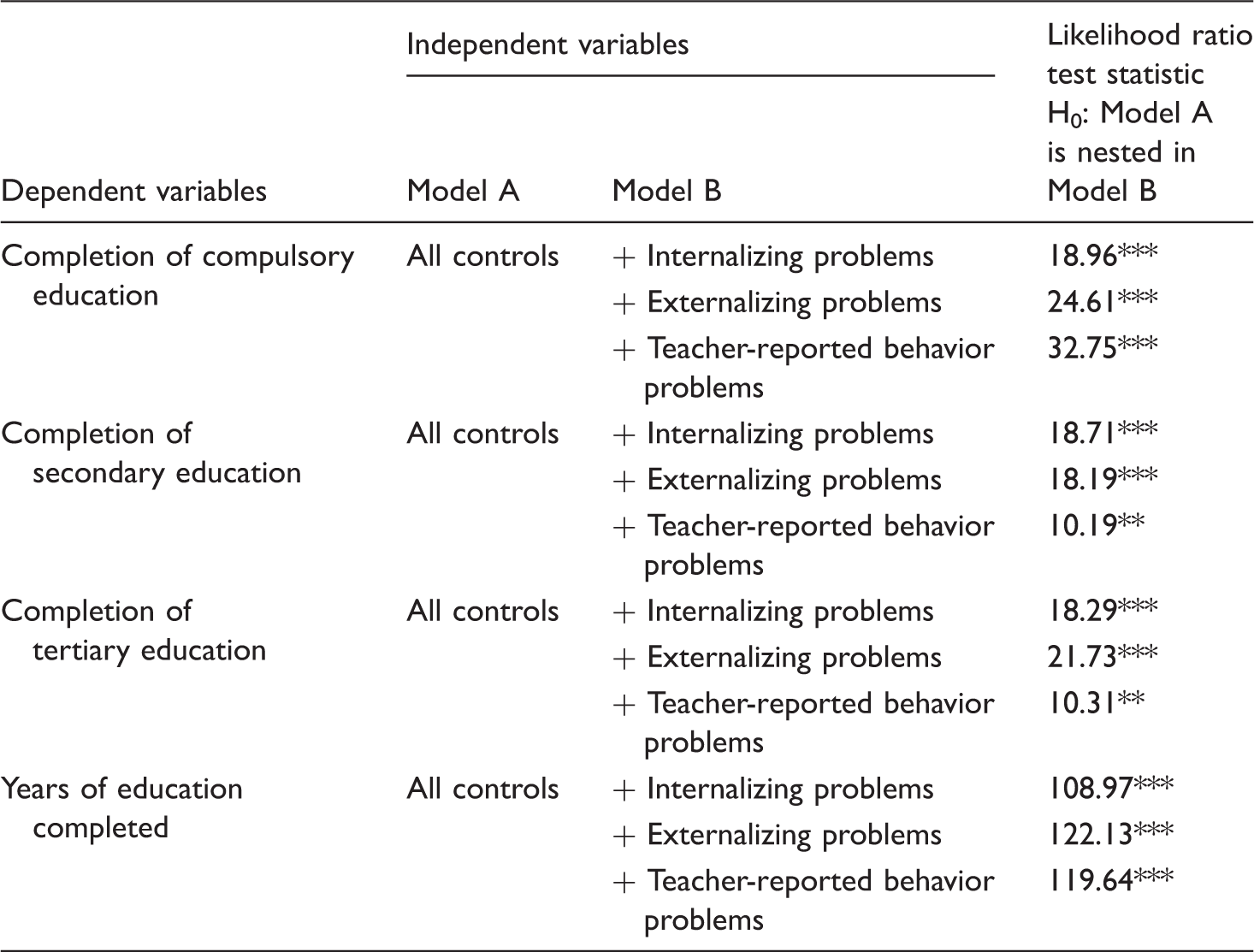
Note: Control variables are each child’s birth year, gender, number of siblings, early academic skills in 2000, family income per capita in 2000, father’s education, number of enterprises in each village, labor force primary-school completion rate in each village, and isolation index of each village.
All models are multilevel models.
Models for completion of compulsory, secondary, or tertiary education are logit models; models for years of education completed are linear models.
<0.05, **<0.01, ***<0.001
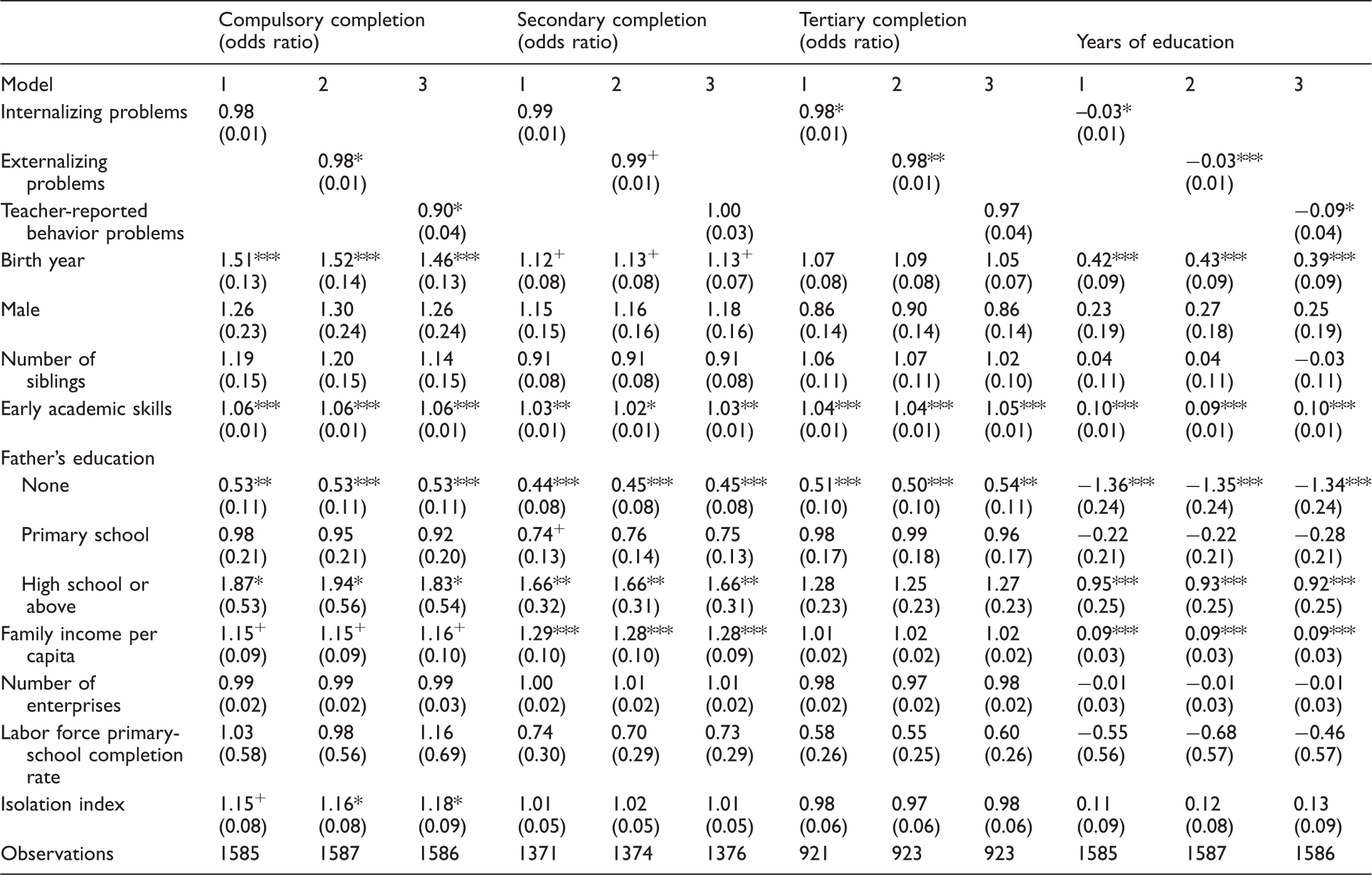
Multilevel models predicting education attainment by behavioral problems.
Note: Robust standard errors in parentheses.
The reference category for father’s education is middle school. The unit for family income per capita is 1000 yuan.
<0.1, *<0.05, **<0.01, ***<0.001
Estimated effects of behavioral problems
Table 3 presents multilevel models predicting educational attainment with behavioral problems. In models (1) to (3), each behavioral problem is introduced in turn. 5 We can see that externalizing and teacher-reported behavior problems are related to compulsory education completion after adjusting for child characteristics, sibship size, cognitive skills scores, and family and community characteristics. Every unit increase in externalizing and teacher-reported behavior problems is related to a 2% and 10% decline in the odds of compulsory education completion, respectively.
The relationship between conditional secondary completion and early behavioral problems is less evident, but a relationship re-emerges in the estimated association between the conditional tertiary education measure and two of the behavioral problems: internalizing and externalizing problems. A unit increase in either internalizing and externalizing behavioral problems is related to about a 2% decline in the odds of tertiary education completion. Using the summary dependent variable of years of schooling, the role of behavioral problems, is very evident: every unit increase in internalizing or externalizing behavior problems is associated with a decline of about 0.03 years of education, and a unit increase in teacher-reported behavior problems is associated with a decrease of about 0.09 years of education. Even without a causal interpretation, Table 3 suggests that behavioral problems in childhood are significant risk factors for educational attainment among rural children, even after adjusting for skills and family and community factors, in the context of general impoverishment and an exam-oriented education system. 6
Testing for heterogeneous vulnerability to behavioral problems
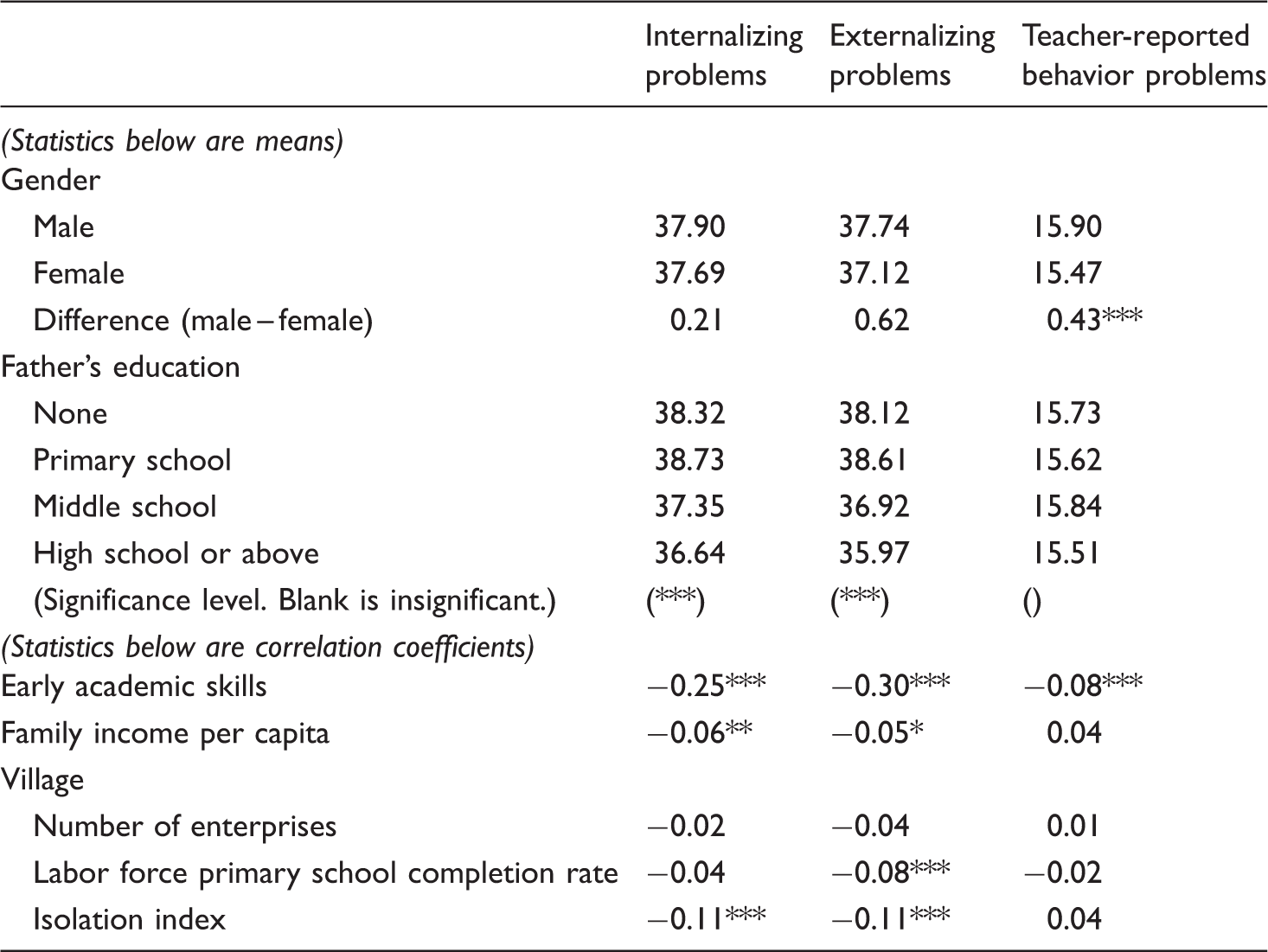
Bivariate relationships between behavioral problems and individual, family, and village variables.
Note: *<0.05, **<0.01, ***<0.001
Unit for family income per capita is 1000 yuan.
The test for gender difference is two-sample t-test of difference in means; the relationship between each behavioral problem and father’s education uses multivariate analysis of variance, which tests the null hypothesis that the mean of each behavioral problem is the same across all four categories of father’s education; all others are correlation coefficients.
There is also some evidence of advantage in behavioral problems for children likely to perform better at school, and children from higher socioeconomic status households. Children with higher scores on the skills test have fewer internalizing, externalizing, and teacher-reported behavior problems. Overall, children whose fathers received more education tend to have fewer internalizing and externalizing problems, while father’s education is not significantly related to children’s teacher-reported behavior problems. Similarly, children from families with higher per capita income do not show any significant advantage in teacher-reported behavior problems, but they have fewer internalizing and externalizing problems—even if this negative association is not strong.
Finally, village context variables show a mixed picture. Number of enterprises, which indicates a village’s economic activities, has no significant relationship with any type of children’s behavioral problems. Children living in villages with a higher proportion of more-educated people in the labor force (i.e., higher primary education completion rate in the labor force) have fewer externalizing problems; and children in less-isolated villages tend to have fewer internalizing and externalizing problems.
Testing for heterogeneous implications of behavioral problems
Main effect and interaction effect coefficients of behavioral problems and other variables in multilevel linear regression models of years of education.
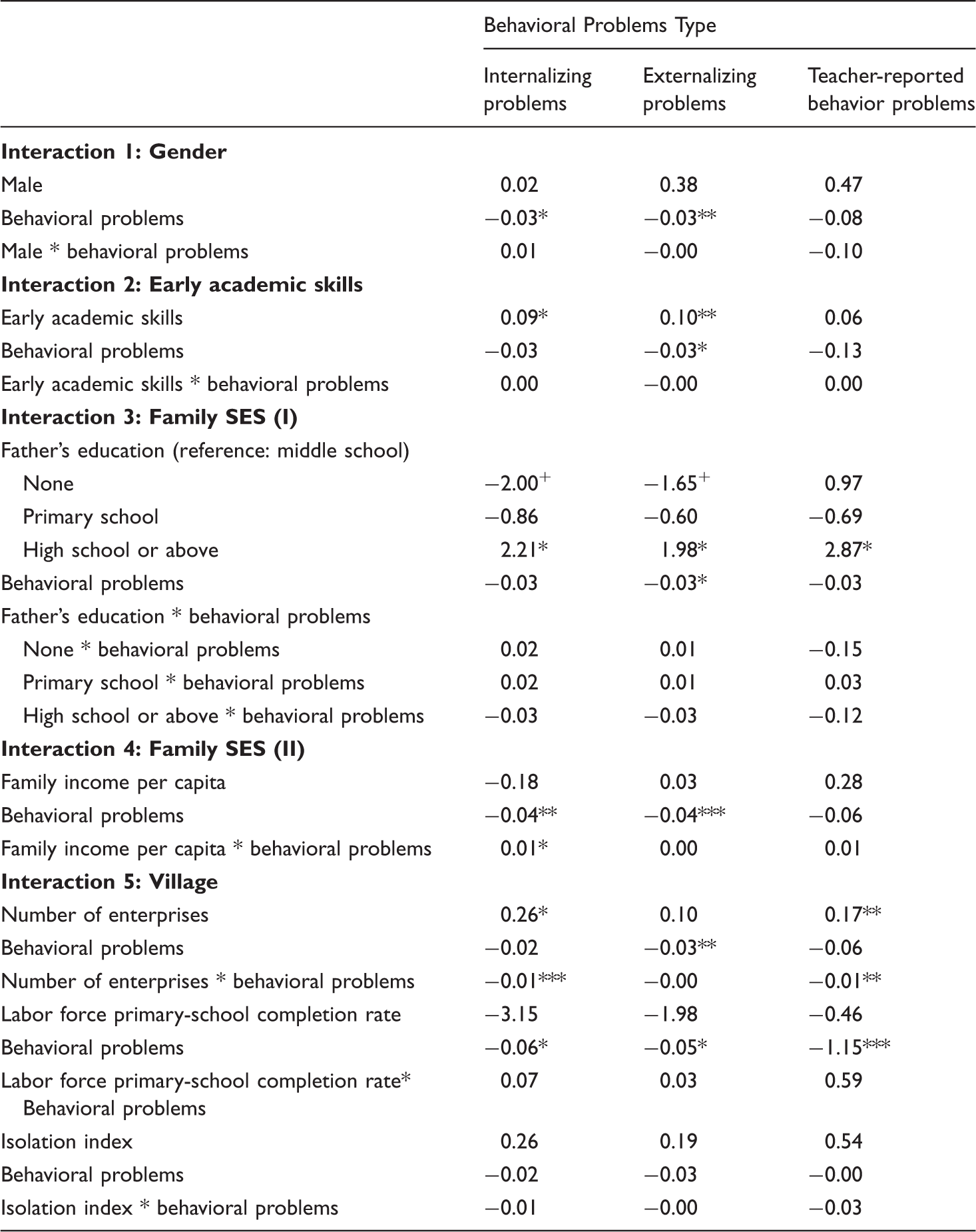
Note: Each interaction for each type of behavioral problem comes from a separate model. Every interaction model controls for child’s birth year, number of siblings, early academic skills in 2000, family income per capita in 2000. In addition, for the four interaction variables, when one is used to interact with a type of behavioral problem, the other three variables are used as control variables.
The reference category for father’s education is middle school. Unit for family income per capita is 1000 yuan.
+<0.1, *<0.05, **<0.01, ***<0.001
We also tested interactions between early academic skills and behavioral problems. High stakes tests are a defining feature of the Chinese education system. Presumably, better-performing students are more favored by teachers. Thus, how behavioral problems shape educational transition and attainment may depend on early academic skills. However, our estimation suggests that the negative association between educational outcomes and behavioral problems does not vary with measured early academic skills.
Finally, we examined whether the link between behavioral problems and educational attainment differs across various community contexts. Only number of enterprises significantly moderated the estimated effects of behavioral problems on educational attainment. For children from villages with more enterprises, the negative effects of internalizing and teacher-reported behavior problems on educational attainment are slightly stronger. But the labor force primary school completion rate and isolation index do not moderate the estimated effects of behavioral problems.
Cumulative adversity as a confounder?
In the specifications presented, we have shown that behavioral problems persist as a significant predictor after adjusting for a variety of potential confounders in the family and community, as well as for children’s early academic skills. Here, we test more directly the hypothesis that adverse experiences might be confounding the observed relationship between behavioral problems and long-term educational attainment, using the high cumulative adversity indicator variable (CAI).
It is the case that high CAI children have more teacher-reported behavior problems. As shown in Figure 1, on average, high CAI children are 0.38 units (0.17 standard deviations) higher than non-high CAI children in teacher-reported behavior problems, indicating that children with more adverse experiences indeed tend to have more teacher-reported behavior problems. A two-sample t test shows that this difference is significant at p < 0.05. There are no significant differences in internalizing and externalizing behavioral problems between high CAI and non-high CAI children.
Comparison of mean behavioral problem scores between non-high CAI and high CAI children.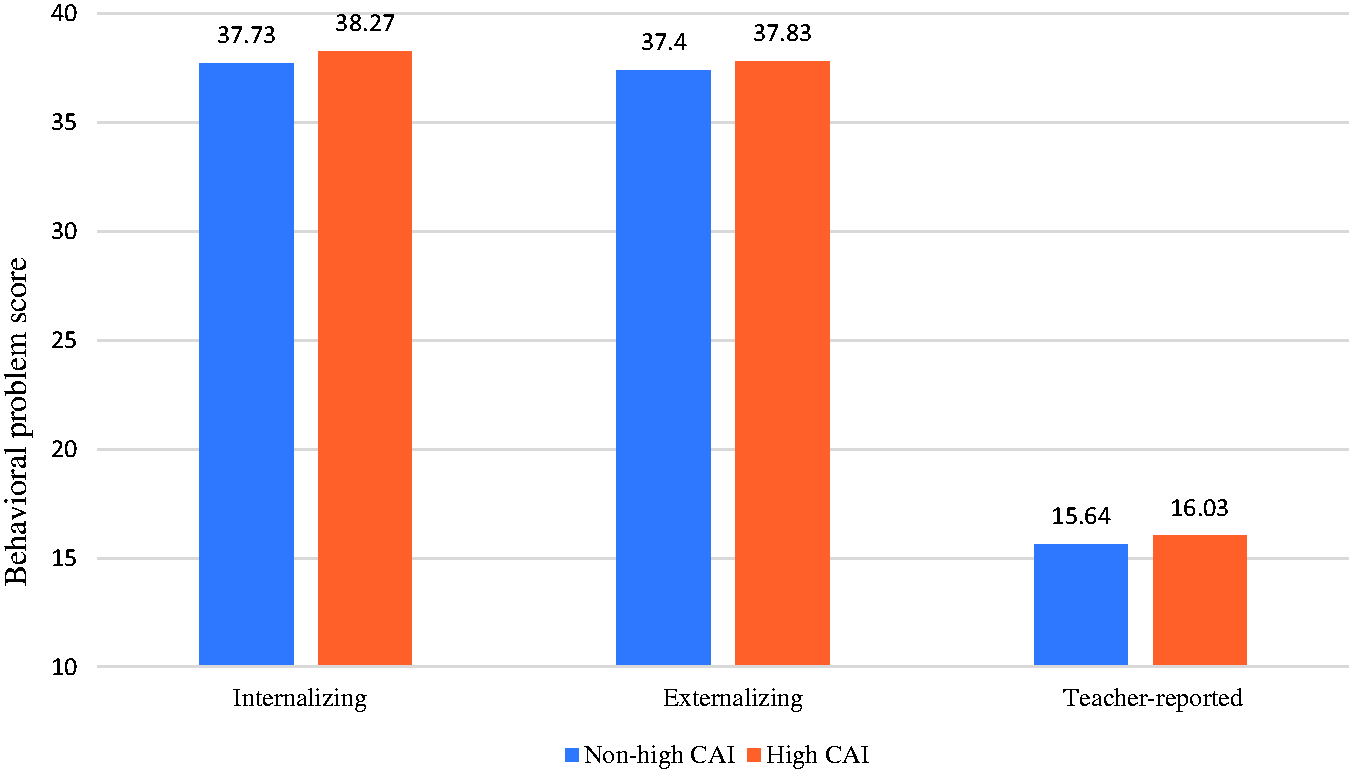
Multilevel models predicting education attainment with behavioral problems and cumulative adversity index (CAI).
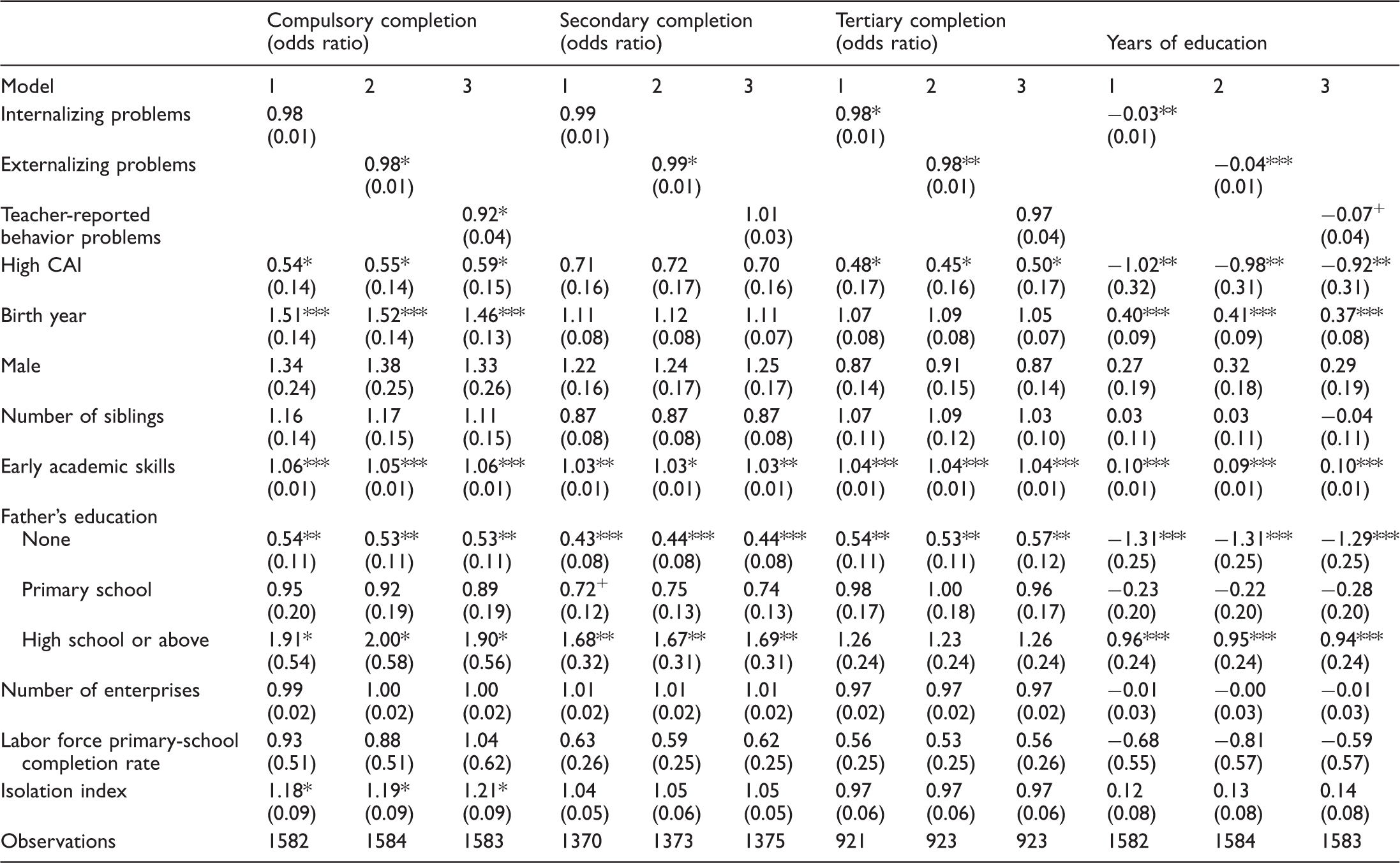
Note: Robust standard errors in parentheses.
Reference category for father’s education is middle school. Unit for family income per capita is 1000 yuan.
<0.1, *<0.05, **<0.01, ***<0.001
Conclusions
In this paper, we have sought to illuminate the potential role of behavioral problems in educational attainment, in the context of a highly resource-deprived setting, and after taking into account high levels of adversity experienced by children in these settings. Results show that children who display more behavioral problems, who experience childhood cumulative adversity, and whose fathers are poorly-educated, face lower levels of educational attainment 15 years later, compared to their counterparts who did not experience these characteristics. Our results indicate that behavioral problems, as measured here, contribute appreciably to model fit in models of educational attainment and transition, after adjusting for family and community socioeconomic status and early academic skills. Estimated coefficients for behavioral problems, especially externalizing behavioral problems, show persistent associations with educational attainment and transition in rural China even after early academic skills and background factors are taken into account. This relationship is consistent with findings from studies such as McLeod and Kaiser (2004) and Farkas (2011) that early behavioral problems are negatively associated with children’s educational attainment. There is some evidence that children in higher socioeconomic status families and in more developed communities are less vulnerable to experiencing behavioral problems. While girls in our sample are slightly less vulnerable to experiencing teacher-reported behavior problems than boys, there is no gender difference in the implications of behavioral problems for educational attainment.
At the start of this study, we had thought that behavioral problems might simply operate as a proxy for measured family socioeconomic status or cumulative adversity. Impoverished children can face both major stressors at home and minor humiliations at school that can be traced back to inadequate funds for clothing, supplies, nutrition, medical care, and even housing, which could lead to behavioral problems. However, our findings suggest the importance of both adversity and behavioral problems. Behavioral problems are still significantly associated with fewer years of education after adjusting for high cumulative adversity and other factors. High cumulative adversity is linked to the attainment of less schooling overall; it is significantly associated with completion of compulsory and tertiary schooling. Thus, our findings show that adversity and behavioral problems are both importantly linked to long-term educational outcomes.
Our study has some limitations. First, the notion of behavioral problems is multifaceted, and we have adopted a small set of measures for inclusion in this study and so do not capture the full implications of behavioral problems for educational mobility. Second, existing literature suggests that cumulative adversity is a risk factor for behavioral problems, and thus cumulative adversity is a potential confounder for the relationship between behavioral problems and educational mobility (for example, see Fergusson et al., 2005). However, our findings do not show this relationship. It is possible that unmeasured factors—for example, other dimensions of hardship, even earlier childhood experiences, or parental psychological issues—account for the emergence of behavioral problems, or that unmeasured factors contribute to the occurrence of cumulative adversity, and these unmeasured factors shape long-term educational mobility.
Even with these caveats, our findings suggest the insight, to be tested in further work, that behavioral problems and cumulative adversity may have lasting implications for educational mobility in rural China. We have adjusted for many potential underlying issues to which children’s behavioral problems could be a response. While we cannot rule out the possibility that behavioral problems are a red flag of risk for, rather than a root cause of, educational attainment differences, either interpretation suggests that behavioral problems are important to consider in stratification processes in rural China. These aspects of rural children’s experiences have not often been incorporated into studies of rural poverty and educational mobility, in China or elsewhere. Much academic work and policy effort have been grounded in an assumption that family financial status and academic performance are the predominant issues shaping educational opportunity in rural China. While these factors are clearly very important, our findings suggest the need to also address sources and treatment of behavioral problems, and to pay additional attention to questions of how to buffer childhood experiences of adversity (Davidson and Adams, 2013).
Footnotes
Acknowledgements
This paper benefited from the comments of Hua-yu Sebastian Cherng, from feedback from seminar participants in the College of Education at Northwest Normal University, and from discussions at the Hong Kong University Symposium, “Education for the Countryside: Interrogating Social Mobility and Urbanization” (6/29–6/30, 2017).
Funding
The Gansu Survey of Children and Families was supported by the Hong Kong Research Grants Council (HSSPFS 36600014). Earlier waves of data were supported by the United Kingdom Economic and Social Research Council and Department for International Development (ESRC RES-167-25-0250), The Spencer Foundation Small and Major Grants Programs, The World Bank, and NIH Grants 1R01TW005930-01 and 5R01TW005930-02.