



Abstract
The authors propose an expanded conceptualization of single parenthood that acknowledges within-group heterogeneity and investigate differential short- and long-term poverty outcomes on the basis of pathways into single parenthood. Using representative panel data for the United States, the authors present descriptive trends in the evolution of four pathways into single parenthood (divorce, separation, widowhood, and never getting married) and the diversity of demographic characteristics across these pathways. The authors then identify the associations between pathways into single parenthood and child poverty. In 2019, most single parents were single because they had never been married, compared with the 1970s, when the most common pathway into single parenthood was divorce. Moreover, the authors find large heterogeneities by age, race/ethnicity, and education across the pathways. Never getting married and separation are associated with the most negative consequences for child poverty. In contrast, no statistical differences emerge in children’s later life poverty for those raised by divorced or widowed single parents compared with children raised in two-parent families. The findings demonstrate that studies treating single parenthood as a homogenous demographic overlook meaningful within-group differences. The negative effects of single parenthood are not uniformly distributed among children of single parents. However, a nontrivial part of the heterogeneities between pathways is a result of compositional differences, and the authors do not argue that some single parenthood types are “better or worse” for child poverty outcomes.
Single parenthood is commonly identified as a risk for poverty and economic disadvantage (Brady, Finnigan, and Hübgen 2017; McLanahan 2009; Moullin and Harkness 2021). Moreover, greater exposure to childhood poverty, which is more common in single-parent families, is associated with greater economic challenges in adulthood (Jenkins and Siedler 2007; Lersch and Baxter 2021; Lesner 2018). Many studies into the poverty of single parents and their families have generally treated single-parent (or single-mother) families as a homogenous group, comparing their outcomes with that of two-parent families. The few studies that address differences in single parenthood on the basis of pathways have done so in a different context to that of the United States (Hübgen 2020; Zagel 2023) and with qualitative methods (Bernardi and Larenza 2018). In the United States, a few studies have investigated heterogeneity in single parenthood on the basis of pathways but focused on other child outcomes rather than poverty (McLanahan and Sandefur 1994). In this study, in contrast, we ask, (1) Are there substantial within-group heterogeneities among single parents in the United States? and (2) How are these heterogeneities relevant for the short- and long-run poverty outcomes of children raised by different types of single parents? Additionally, we recognize the importance of contextualizing the individual characteristics associated with poverty (Brady, Fullerton, and Cross 2009) and investigate the effects of social policy and family characteristics on poverty reduction across family structures.
We propose three arguments for understanding and comparing pathways into single parenthood: statistical, conceptual, and practical. Statistically, children of single parents are a common demographic in the United States. One in four children spends at least some of their childhood in a single-parent family (Weinraub and Kaufman 2019). This is a large population that is potentially at risk for economic disadvantage and deserves more careful investigation than past literature typically provides.
Conceptually, the differential experiences associated with pathways into single parenthood (e.g., a parent never being married or partnered vs. a widowed parent) necessitate investigation of how differential selection into single parenthood affects children’s well-being. Consider that children of divorced parents might be affected by parental conflict, custody battles, or guilt over their parents’ separation, while children of nonmarried adolescent mothers might be more influenced by fear of abandonment because of a missing parent or the lack of parental experience, and children of widowed parents might mourn their lost parent (Weinraub and Kaufman 2019). Given these different experiences of parents and children alike, and their interaction with cognitive, behavioral, and emotional aspects of children’s development, it is important to understand if and how different single-parenthood pathways influence children’s well-being.
Practically, if differential pathways into single parenthood are associated with differential outcomes among single-parent families, then policy strategies intending to address the challenges of single-parent families may likewise need to be differentiated. Studying heterogeneity among single parents may thus be important for more accurately identifying vulnerable groups and improving policies meant to address their needs.
With these motivations in mind, we use longitudinal data from the Panel Study of Income Dynamics (PSID) from 1970 to 2019 to pursue three aims. First, following conceptualizations from previous research (Bernardi and Mortelmans 2018; Zagel 2023) we identify different pathways into single parenthood, distinguishing between never-married, divorced, widowed, and separated single parents. Here, pathways are used as a way of describing the “reason” a parent is single or the event leading to single parenthood (Nieuwenhuis and Van Lancker 2020:309) and not the life-course trajectory of an individual’s family structure. However, our analysis indicates that the never-married category is made up mostly of individuals who have never been partnered, as well as individuals whose cohabitating units have dissolved, while separated individuals are mostly those who were previously married. Second, we document trends and demographic differences in each type of single parenthood. Third, we empirically (but noncausally) connect different pathways into single parenthood with short- and long-run poverty outcomes for the children of single parents. We do so by measuring the time spent in each family structure over a child’s entire childhood and not by simply looking at point-in-time family composition.
Our findings confirm previous research showing that single parenthood has increased over time (Dunifon 2009) and that the incidence of different pathways into single parenthood has changed meaningfully over time. In the 1970s, single-parent children were most often raised by divorced single parents; in the 2010s, the most common pathway into single parenthood was never getting married. Additionally, we identify meaningful differences in the characteristics across these types of single parenthood. Never-married single parents are substantially younger and less educated than other single-parent types. Moreover, never-married single parenthood is far more common among Black families, while single parenthood because of divorce is relatively more common among White families.
We also find large heterogeneity in poverty for children of single-parent families. In broad terms, we find that within-group differences in child outcomes among single parents often match or exceed the between-group differences in outcomes of children in single-parent families compared with two-parent families. Specifically, we demonstrate that the poverty penalty for single parenthood is higher for never-married groups compared with any other pathway, followed by separation. The association between separated and never-married single-parent households and poverty is almost double compared with the one between divorced and widowed households and poverty. In line with previous results in the literature (Zagel, Hübgen, and Nieuwenhuis 2022), we demonstrate that the variation in outcomes associated with each single parenthood type is due partly to compositional differences (such as age, education, employment, occupation type, and more) across the single parents in each pathway, as well as different poverty reduction effects of social policy. Particularly important, the employment status of single parents seems to matter more for poverty outcomes than single parenthood status (Baker 2015; Brady, Baker, and Finnigan 2024). However, unlike previous research, we find that the difference in poverty among pathways remains even after controlling for these factors, indicating that pathways identify unique factors related to single parenthood that influence child poverty. This is partly true because single parents, and never-married single parents, in particular, are disadvantaged with respect to education, employment, and age, making them more vulnerable to poverty risks (Brady et al. 2024; Brand et al. 2019; Cohen 2018; Cross 2020; Ellwood and Jencks 2004; Härkönen 2018; Hogendoorn, Leopold, and Bol 2020; Rodríguez Sánchez 2022).
For the sociology, family demography, and inequality literatures, our study reveals disadvantages are not uniformly distributed among different types of single-parent families. Instead, single parents are a heterogenous group with varying implications for children’s later life poverty depending on the specific pathway into single parenthood.
Background
Poverty and Family Structure
Poverty, generally defined as a shortage of resources relative to need (Brady 2019), is associated with a variety of negative consequences for the individual and the community. Understanding the determinants of poverty has thus been a central focus of past research. In a review of the literature on the causes of poverty, Brady (2019) concluded that there are three broad perspectives: behavioral causes (i.e., those who are poor are more likely to engage in counterproductive, risky behaviors), structural causes (i.e., poverty is a result of economic and demographic contexts), and political causes (i.e., poverty is the result of power dynamics determining collective decision making and thus the redistribution of resources). Among the behavioral (or individual) causes, the most important risk factors for poverty are low education, young headship of the household, unemployment, and single motherhood (Brady et al. 2017; Dahl 2010; Edin and Kissane 2010).
The latter of these risk factors—single parenthood, and single motherhood especially—has been a central focus of poverty and inequality research in recent decades (Brand et al. 2019; McLanahan 2009; Moullin and Harkness 2021; Musick and Mare 2004). Most notably, McLanahan’s (2004, 2009) foundational work on family structure and its consequences on child development has demonstrated that children who live in families without a father tend to have worse life outcomes as a result of the mother’s reduced mental health, parenting challenges, and lower financial resources (see also McLanahan and Percheski 2008). McLanahan’s (2004) “diverging destinies” theory demonstrates that children who are raised in single-parent families have worse socioeconomic outcomes than those raised in two-parent families, and that this gap is increasing over time as a result of the social transformation associated with the second demographic transition. The increased employment and income among highly educated, partnered women, coupled with the increase in singlehood among low-educated, low-paid women have led to increased inequality and poverty among the latter.
Many studies have since corroborated these claims. Single motherhood can negatively affect child outcomes such as cognitive and academic achievement (Demir-Dagdas et al. 2018), emotional symptoms, conduct problems, hyperactivity and inattention, peer problems and prosocial behavior (Flouri, Narayanan, and Midouhas 2015), and a variety of other behavioral problems (Waldfogel, Craigie, and Brooks-Gunn 2010). Children of single mothers (and fathers) seem to be more likely to engage in risky behaviors, such as substance abuse and delinquency (Jablonska and Lindberg 2007). Family instability and low family income are two oft identified mechanisms that can generate these challenges among single-parent families (Fomby and Cherlin 2007; Martinez and Forgatch 2002; Lee and McLanahan 2015; Waldfogel et al. 2010). In contrast, a few studies point to the importance of context (Zagel 2014) and warn that the relationship between single parenthood and economic outcomes may be overstated (Cooper and Pugh 2020). Amid debate over the relative role of single parenthood compared with other factors in driving poverty rates, however, one important aspect remains understudied: the within-group heterogeneity among single-parent families.
Heterogeneities in Single Parenthood
Research on the effects of single parenthood on poverty generally treats single parents as an homogenous group, and compares them to two-parent families or looks at different processes that lead to single parenthood and investigates them individually. Some exceptions (McLanahan 1997; Weinraub and Kaufman 2019) acknowledge diversity among single-parent families, and some examine time trends in different pathways into single parenthood (Dunifon 2009). Other studies compare the income of unpartnered mothers at birth to those whose union dissolves sometimes later on (Fomby, Harvey, and Musick 2023; Page and Stevens 2004), or cohabitating to marriage families (Cooper and Pugh 2020). Some studies acknowledge the differences in child outcomes on the basis of the age when they experience single parenthood (Harkness, Gregg, and Fernández-Salgado 2020). In her book, Zagel (2023) investigated the different effects of parental leave policies on different family types in Germany. Overall few studies empirically investigate differences in child poverty on the basis of pathways into single parenthood, but when studies do examine particular single-parent pathways, they tend to do so in isolation (for a recent review, see Härkönen, Bernardi, and Boertien 2017).
Many studies have focused, for example, on the effects of divorce on child outcomes, (Amato and Anthony 2014; Cao, Fine, and Zhou 2022; Demir-Dagdas et al. 2018), including education and emotional development (Brand et al. 2019; Demir-Dagdas et al. 2018), well-being (Booth and Amato 2001), adult labor outcomes (Johnson and Mazingo 2000), as well as intervention to limit the negative effects of divorce (Grych and Fincham 1992). Most of these studies find a detrimental effect of divorce on child outcomes; others, such as Cao et al. (2022), argue that it is not the divorce per se creating negative outcomes for children, but rather it is a matter of the pre- and post-divorce family environment that account for how children react to a divorce. There is limited exploration, however, of the economic circumstances of divorced parents compared with other types of single parents, with the exception of one study that concludes that divorced mothers suffer from larger income declines compared with mothers who were single at the birth of their child (Harkness 2022).
Some studies also investigate separation, either individually or compared with divorce (Clarke-Stewart et al. 2000; Garriga and Pennoni 2022). The results point to a similar direction: there is an association between separation and worse child educational, social, behavioral outcomes (compared with children from two-parent families), but these are explained by family characteristics, such as income, mother’s education, ethnicity, mother’s emotional well-being and parental practices (Clarke-Stewart et al. 2000). Compared with children of divorced families, separation seems to be even more detrimental (Garriga and Pennoni 2022).
One other pathway into single parenthood is parental death. Steele, Sigle-Rushton, and Kravdal (2009) found that parental death is less detrimental to child educational outcomes than divorce, while others find similar negative effects of both parental death and divorce (Amato and Anthony 2014).
Last, some have descriptively analyzed the development of nonmarital births over time (Solomon-Fears 2014) or tried to investigate the effectiveness of pro-marriage initiatives on unmarried mothers (Lichter, Graefe, and Brown 2003; Wood et al. 2014). Others show that children born to unpartnered mothers have lower income levels compared with mothers who separate sometimes after the birth of their child (Fomby et al. 2023). There is little evidence, however, of the longer run consequences of growing up in this family type. In short, most studies have investigated the consequences of individual pathways into single parenthood but have not offered a unified analysis of how differential pathways into single parenthood are associated with distinct poverty outcomes for the single parents and their children (for an exception, see Zagel 2023).
Another strand of literature has shown that family instability (i.e., multiple transitions from one family structure to another) can better explain negative outcomes of single parenthood on child’s well-being and development (Fomby and Cherlin 2007). We argue that heterogeneity in single parenthood captures a different aspect of family experience as opposed to instability. As opposed to family instability approaches, we demonstrate that the unique characteristics of each pathway into single parenthood, beyond the number of transitions, influence long-term child outcomes differently. At the same time, our focus on heterogeneities in family structure allows us to engage with the literature on poverty and economic disadvantage that still focuses a lot of its attention on the predictive power of single parenthood as a family structure.
Why Do Pathways Lead to Different Poverty Outcomes?
Given the results of previous studies, we expect to find differential outcomes for children of single parents depending on the pathway into single parenthood. We anticipate that divorce will be the least detrimental pathway into single parenthood, as it is more common among older individuals with more secure employment and implies some formal arrangements about custody and child support (Skinner and Hakovirta 2020). Compared with other pathways into single parenthood, divorce does necessarily imply reduced support from the nonresidential parent. Rather, child support and childcare are regulated by court orders allowing the nonresidential parent to continue to help with the raising of the child (Zagel 2023).
In the case of widowhood, in which the financial and time loss of the second parent is absent, the loss of income can be mitigated by substantial widow pensions and often inheriting material resources (Zagel 2023), leaving widowed parents with potentially a reduced likelihood of poverty relative to, say, divorced parents.
Separation is potentially more harmful to children, as it generally does not involve any formal arrangements related to contact or financial support from the absent parent. Particularly compared with divorce, separation is associated with a greater likelihood of receiving less from the second parent, both financially and in terms of childcare support (Zagel 2023).
Last, never marrying is increasing fastest among single parents 20 to 24 years old (Solomon-Fears 2014), potentially leaving these parents vulnerable to the poverty risks associated with younghood (Brady et al. 2017). Never-married single parents often lack access to formal ways of securing child support, which might leave them worse off compared with the rest of the pathways. The increase in childcare is common among all transitions into single parenthood, but it is most intense after birth, leaving never-married single parents in situations in which the responsibilities of care are demanding to the point that they often do not allow time for employment (Zagel 2023) or pursuing education, both with potential negative consequences on income and poverty.
Short- and Long-Run Consequences
Another limitation of prior research is the frequent focus of the short-run, rather than longer run, consequences of single parenthood. A focus on short-run associations of single parenthood with poverty, as one example, is useful for describing point-in-time disadvantages. For understanding the consequences of single parenthood (and variations within it) for children, however, a longer run perspective is required. Life cycle bias, a common concern in the intergenerational mobility literature regarding the age period in which adult outcomes are examined, suggests that the negative associations of single parenthood with economic outcomes may vary depending on the age in which we measure the child’s later life economic circumstances. Economic consequences during childhood, when the individual is living with the single parent, are likely to be strongest; in contrast, consequences during adulthood may be notably smaller (though perhaps still negative) as the child of the single parent establishes an independent employment, education, and family structure profile.
Social Policy and Single Parenthood
Previous research has identified social policy as one of the main ways to mitigate the negative effects of single parenthood. Studies have shown that in countries with more comprehensive welfare programs, single parents and their families are less often in poverty and have higher incomes compared with countries with limited welfare regimes, such as the United States (Aerts, Marx, and Parolin 2022; Maldonado and Nieuwenhuis 2015). Child benefits, parental leaves, and quality affordable childcare all support single parents allowing them to work and raise their children at the same time and keeping them out of poverty. In the United States, the limited family policies contribute to the increased association between single parenthood and poverty (Fomby et al. 2023).
Even in the United States, the earned income tax credit, as well other programs such as the Supplemental Nutrition Assistance Program and Temporary Assistance for Needy Families have been shown to reduce poverty among families with children, including single parents (Biegert, Brady, and Hipp 2022; Brady et al. 2024). In this study, we acknowledge the importance of social policy and examine how poverty among different pathways into single parenthood is reduced as a result of taxes and transfers. We argue that depending on the pathway into single parenthood, families will have access to different social policies (or to different degrees) contributing to maintaining differences in poverty outcomes. For example, unmarried parents and their children receive child support payments far less than other single parents (Cancian and Meyer 2018) and widowed parents can access widowhood benefits.
In short, studies have investigated the consequences of different types of single parenthood (divorced, widowed, separated, and never-married single parents) in past research, but clear shortcomings remain: the literature lacks a thorough and unified investigation of within-group heterogeneities in pathways to single parenthood, the changing incidence of these pathways over time, diversity of demographic characteristics across the pathways, and the long-run implications of each pathway for child poverty. This study investigates poverty, positing, in broad terms, that variation in the incidence and consequence of different single-parent pathways warrants the study of single parenthood as a diverse, rather than homogenous, family structure.
Data and Methods
We investigate the incidence and consequences of single-parenthood pathways using data from the PSID, a longitudinal dataset that follows the same U.S. households over a long period of time. The PSID provides data on household-level and individual-level variables. This allows us to identify family relationships between members and household income, but also individual outcomes, such as education, employment, and marital status. The PSID offers the unique ability to follow people from childhood into their adulthood always observing their household composition. The PSID covers the period between 1968 and 2019, with a total sample size of almost 900,000 respondent-years observations (about 16,000–30,000 individuals per year). Specifically, we use the WZB-PSID file (Brady and Kohler 2022), which offers post-tax and transfer income components and combines individual and household-level indicators for more efficient analysis.
Sample Selection and Characteristics
Our initial sample is composed of heads of households, their partners, and their children (we drop all individuals who live in households with no children, as well as other household members such as grandparents, siblings of parents, roommates, and other unrelated adults). This sample selection is conducted after we construct the relative poverty measure. We drop data for 1968 and 1969 because of limited sample size and incomplete information on marital status and other important variables. The full sample is used to define the median income and poverty status. We determine each individual’s family type for each year on the basis of the marital status of the head (or partner) of the household. Then, we restrict our sample to individuals observed for at least for 5 years in the PSID before they turned 18 (in Supplemental Material 5, we replicate these results with a criterion of 3 years or more). We do this because it is important to have enough observed years to confidently infer the type of household a child grew up in. For example, if a child in the PSID is observed starting at 17 years of age, it is not feasible to assess their family structure over the entire childhood. Our final sample contains all individuals observed for at least 5 years before they turned 18 (including the adult time periods for individuals who meet these criteria). All our analyses use “children” as the unit of analysis, referring to all individuals younger than 18 years and the observations from these individuals in adulthood. Thus, we analyze and present results for “children” of single parents both before and after they turn 18 years of age.
In the first part of our analysis, we present descriptive evidence on trends in the share of children in each single-parenthood pathway. In this analysis, we focus on children (i.e., individuals younger than 18 years), regardless of their presence in the sample later in life. This sample contains 295,739 observations from a total of 20,677 distinct individuals, of which 51.15 percent identify as female and 50.2 percent are self-classified as White, 42.5 percent as Black, and 7.3 percent as part of other racial groups. We apply cross-sectional sample weights available in the WZB-PSID in all analyses. Because this analysis is based on yearly estimates of family structures—meaning that in each year, we classify family structure independently of the family structure of other years—truncation is not an issue.
We then analyze children’s outcomes over their life both comparing single-parent households to two-parent households, and within single-parent households on the basis of pathways into single parenthood. As detailed, this analysis focuses on three stages of individual development: childhood (0–17 years old), young adulthood (18–25 years old), and adulthood (26–35 years old). As such, an individual will be part of the analysis only if they are observed for at least 5 years before they turn 18, and at least once between 18 and 25, and once between 26 and 35. Next, we present descriptive results of the contribution of each pathway to the overall poverty rate of single parents to contextualize the consequences of changing single parenthood. Last, we investigate two mechanisms that can explain differences between pathways: family characteristics (number of siblings, parental education, employment, occupation, and racial belonging), and social policy.
Measuring Family Structure
In some studies, single motherhood is defined as an unmarried or unpartnered female who resides with her own underage children and who heads her own household (Brady et al. 2017; Zagel 2014). This creates at least two challenges: (1) by including or excluding cohabitation from the definition of single mothers, studies reach different and sometimes conflicting conclusions, and (2) single mothers who coreside in households with other adults are excluded from such a definition (Moullin and Harkness 2021). A second approach, aimed at addressing this second issue, is to count any household containing a single mother as a single motherhood household (Moullin and Harkness 2021). This approach also has shortcomings: a single mother coresiding with other adults, say her parents, is different than a single mother living only with her children, both in terms of pooling resources and the support she might get, for example in the form of childcare.
Acknowledging its limitations, we adopt the first approach of defining single parenthood: a single parent is an adult living alone with their minor children, in line with other approaches in the literature (Maldonado and Nieuwenhuis 2015; Van Lancker, Ghysels, and Cantillon 2015). (In Supplemental Material 6, we replicate our analysis by eliminating single father households from our sample of single-parent families. The results are very similar.) This approach is particularly suitable in our circumstances, because it allows us to only investigate the resources available to single parents who are the sole providers in their families, as most U.S. single parents are (Kearney 2023), and thus understand the poverty of children raised by single parents who do not pool resources or share costs with other individuals in their household, allowing us to identify the most vulnerable populations. Additionally, previous research shows that definitions not including single mothers who coreside with adults other than their partner have similar results with those who do include them (Brady, Finnigan, and Hübgen 2021).
On the basis of the marital status of heads of household, we create a variable for household type that can take any of the following values: married; single parent: never married; single parent: widowed; single parent: divorced; single parent: separated; and cohabitating. We assign to each child (individual younger than 18 years) in the household a year-specific value for the type of family they were part of in that year. Following the example in Cross (2020), we then calculate the share of childhood each individual spent in each family type by dividing the total number a child has lived in a particular family type by the total number of years a child is observed in the sample before turning 18 years old. Consider the example of a child observed in our data for 16 years between birth and age 17: if that child’s parents are married for the first 5 years of this observed period, followed by a year of separation, and then divorced for the rest of the time, then this individual will have the value 0.3125 for the variable recording the share of time spent in a two-parent family, 0.0625 for share of separated single-parent family, 0.625 for the share in a divorced single-parent family, and 0 for the widowed single parent, never-married single parent, and cohabitation. In Supplemental Material 7, we offer more details on the transitions from one family structure to the others and the composition of each category on the basis of the family structure in the previous year. We show that all family structures are stable across time, with some variation: although 87 percent of children remain in married families from one year to the next, only 58 percent do so in cohabitating families. For single parenthood, the percentage is as high as 80 percent for never-married single parents and as low as 61 percent for separated single parents.
The literature is not united in its classification of cohabitation: some authors include cohabitation as a form of single parenthood, because of either data limitations (Bitler, Hoynes, and Kuka 2017; McLanahan 2004) or conceptual arguments that cohabitating households are more similar to single-parent households (McLanahan 1997). Others, conversely, argue that cohabitation should be considered a form of two-parent household (Brady and Burroway 2012; Kennedy and Fitch 2012; Moullin and Harkness 2021). We adopt the second approach and argue that cohabitating households should be included in the definition of two-parent households for three reasons: (1) they are more similar in economic resources because of the dual-earner potential, (2) there are two adults in the household who can provide the time resources required for childcare and supervision of a child, and (3) the cohabitating partner of a “legal” parent (i.e., biological or adoptive parent) can be an important compensation for children lacking parental role models or emotional support because they have a single parent (Cross and Zhang 2022). All three arguments have been used in the literature to explain why single-parent families lead to negative child outcomes. Additionally, the PSID allows us to identify cohabitating couples only after 1983. For all these reasons, we will treat cohabitating and married families as one type of family structure and refer to them as two-parent families from hereafter. When a cohabitation union dissolves, the pathway assigned to the child depends on the reported marital status of the residential parent.
Outcome of Interest
We seek to understand how different single parenthood types are associated with children’s poverty outcomes during their childhood, young adulthood (ages 18–25 years), and adulthood (ages 26–35 years).
To measure poverty, we follow the standard approach in the literature of computing relative poverty indicators with a threshold set at 50 percent of the annual median equivalized household income. The household income is a sum of total family income from labor earnings, asset flows, private transfers, public transfers, and social security pensions minus total household taxes. We adjust household incomes with the square root equivalence scale and for the number of individuals in the household. The poverty of an individual is then based on the income reported in the household in which the individual resides in any given year. The Supplemental Poverty Measure is not generally available in the PSID. The official poverty measure, meanwhile, does not include near-cash and tax-based transfers, and is thus well regarded as an incomplete measure of poverty. Accordingly, we do not use it in this study. The relative poverty measure is also superior to the Official Poverty Measure because of its adaptability to changing living conditions. We measure the share of childhood spent in poverty by dividing the number of years an individual was in a household with an income below 50 percent of the median to the total number of years they were observed before they turned 18. We do the same, for young adults, defined as individuals between 18 and 25 years old, and adults, defined as individuals with ages between 26 and 35 years old.
Methods
Our initial set of results relies on descriptive data, documenting trends in the share of children living in two-parent families compared with single-parent families, and in different types of single parenthood, from 1970 to 2019. We also present heterogeneities by race, as well as demographic characteristics of the individuals in each family type. We then apply a series of regression estimates to evaluate the unconditional association between single parenthood (and its variants) with childhood, young adult, and adult outcomes described above. We apply two main models, as follows:

And

In both equations, Outcome ib is poverty as described in the previous section, for individual i born in year b. We apply linear probability models (conclusions are consistent when applying logistic regression models). Single i , as well as NeverMarried i , Divorce i , Widow i , and Separation i , are shares of the time spent in each family type during childhood. Xi is a control for the gender of individual, and δ b is a year-of-birth dummy. When accounting for composition, we replicate these models while including controls for parental education, employment rate and occupation, the age of the youngest parent at childbirth, the number of siblings, and race/ethnicity (largely following Brady et al. 2024). The employment rate is the share of each individual’s childhood (between 0 and 17 years old) when either of their parents is employed if they are in a two-parent family. If they are in a single-parent family we only consider the employment of the residential parent. We control for occupation because, even when single parents work, they tend to do so in vulnerable, less flexible, low-pay occupations. In Supplemental Material 9, we present alternative results that do not include occupation as one of the controls. We include a comparison of pre–child support and pretax and transfer poverty estimates to test for the effects of help from nonresidential parents and social policy in explaining differences between pathway. We acknowledge that our analyses are noncausal.
Last, we calculate the average annual poverty rate among children in single-parent families (as well as each pathway) and children in two-parent families in a linear regression setup, and weight it by the size of each group to determine the (noncausal, descriptive) contribution of single parenthood in determining child poverty and the contribution of pathways in determining child poverty among single parents.
Findings
Trends in Single Parenthood
We first document trends in the share of children living in single-parent families. Figure 1 shows that in 1970, 15.2 percent of children in the U.S. lived in single-parent families. This share increased to 25.8 percent in 2019 (results are similar to Brady et al. 2024). These aggregate trends, however, conceal large heterogeneities in levels and trends across types of single parenthood.

Trends in the share of children in single-parent and two-parent households.
Figure 2 documents trends across types of single parenthood observed in the PSID. Figure 2a presents trends in the number of children in each pathway into single parenthood relative to all children in our sample. This allows us to investigate how common each pathway is relative to all family structures. Figure 2b presents trends relative to children in single-parent families only, which allows us to investigate the prevalence of each pathway relative to each other. Figure 2a shows that the share of children in the “single: never married” type of single parenthood is mostly responsible for the growth of single-parent families overall, at least until 2010. From 1970 to 2019, the share of all children living in this single parent type increased from 1.8 percent to 8.9 percent. Among single-parent homes (Figure 2b), the share of children in the “single: never married” group climbed from 12 percent to 34.2 percent, making it the fastest growing pathway into single parenthood.
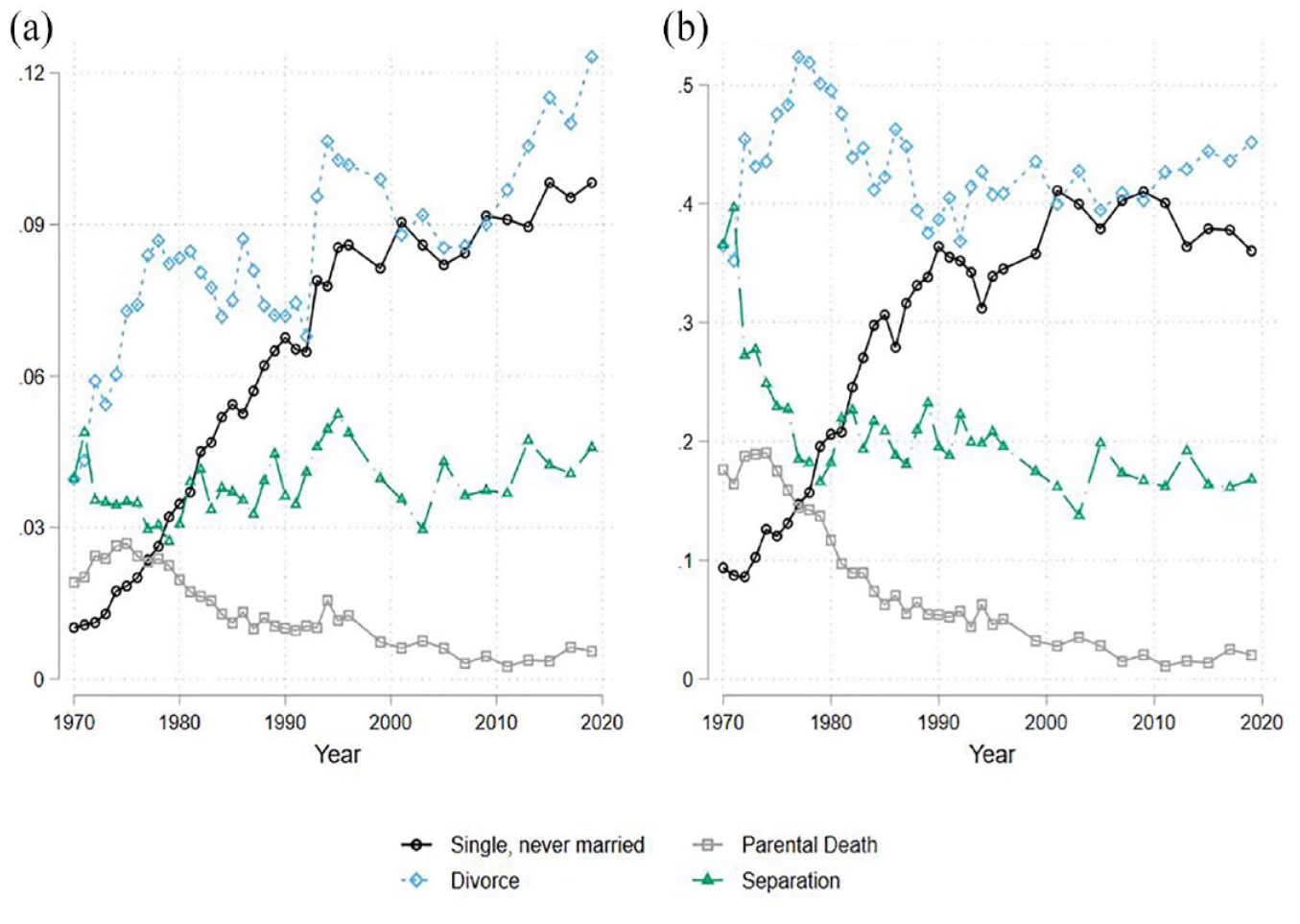
Trends in the share of children in different types of single-parent households.
The share of all children in divorced single-parent homes increased particularly after the 1990s, though the relative share of children in single-parent homes in this category has declined in relative terms over time, largely because of the rise of the “single: never-married” group. Although the never-married single parents temporarily became the most common pathway to single parenthood in the early 2000s, divorce reclaimed the highest share from the 2010s onward. Meanwhile, the relative share of children living in single-parent households resulting from parental death or separation have decreased, over time, compared with other pathways into single parenthood, but have remained relatively stable as the share of total children in the United States.
Demographic Differences among Types of Single Parenthood
Although Figure 2 documents large heterogeneity in types of single parenthood, these subcategories also overlap with other demographic differences—such as race, ethnicity, and gender—that further emphasize the need to study heterogeneity within the population of single parents (and their children). Table 1 documents descriptive differences across children of single parents according to their pathway into single parenthood and the birth cohort of children. We present results from five birth cohorts, each comprising 10 years, except for the first birth cohort that includes 1957 to 1970 (for sample-size reasons, separating the 3 years between 1957 and 1960 was impractical). In this section, our goal is to summarize the compositional differences across pathways into single parenthood and as a result we cannot account for over-time changes in demographic characteristics of single parenthood.
Differences in Demographic Characteristics across Single-Parent Families and Two-Parent Families.

Note: Authors’ calculations from the Panel Study of Income Dynamics. Education is measured as a binary variable for whether the parent has a college degree or not. Occupation is measured on a six-point scale inspired by the Erikson-Goldthorpe-Portocarero classification. The percentage on occupation is relative to individuals who are employed (not the total sample). For children in two-parent families, we use the education of the lowest educated parent, and for occupation we choose the occupation belonging of the parent with the lower occupational class. Employment is measured as the share of childhood when either resident parent was employed. Percentage values represent the share of children in the family type (see labeled columns) who have the demographic feature in the labeled row. The sample consists of all children (i.e., individuals younger than 18 years) who are observed for at least 5 years in the data. All cells refer to individuals who we observe in childhood, for example 24.5 percent of our sample lived in a never-married single-parent household in which the parent has a college degree.
The average age when a parent becomes single is much lower for never-married single parents across cohorts of birth (between 23 and 26.5 years old) than other pathways (which range from 25.8 to 42 years old). Young age of childbearing is recognized as a risk for poverty (Brady et al. 2017), and single parents who are in their early 20s might find it harder to allocate resources and time to their personal development, such as education, because of their responsibility for raising children. Table 1 verifies this association: only a quarter to a third of children live with a never-married single parent with a college degree, compared with almost half of children of widowed and divorced parents. However, all single parent types have lower levels of college degree completion relative to parents in two-parent homes, and this remains true across cohorts.
With respect to race/ethnicity (we rely on WZB-PSID labeling to determine the race/ethnicity of an individual), Table 1 demonstrates that Black children are far more likely than White children to live in single-parent homes across cohorts. In fact, our sample of Black children in the PSID are more likely to live in single-parent homes relative to two-parent homes. Nearly 90 percent of children in families with never-married single parents are Black; only 5 percent to 10 percent are White. In contrast, 38 percent to 50 percent of children in divorced single-parent households are White, compared with 36 percent to 57 percent who are Black. Black children are also more common among widowed families before 2000 compared with White families.
In terms of occupation, single parents, compared with two-parent families, are less often employed in service occupations, which is usually associated with higher pay, more time flexibility, and better family support. Among single parents, those who are widowed, as well as never-married single parents, are less likely to be employed in higher service jobs. Single parents are more employed in lower service and routine clerical jobs, or in manual labor, but there are again large heterogeneities between pathways.
The last two rows of Table 1 provide some information about the over-time stability of each pathway. Unsurprisingly, children spend the majority of their life in a two-parent household (between 86.5 percent and 78 percent), even when they experience single parenthood. For children who spend time in never-married single-parent households, the average amount spent is between 59 percent and 70 percent of their childhood, making this pathway the most stable one. Children who experience a parental death will spend almost one third of their childhood, on average, in a widowed single-parent household. The least stable pathway, separation, with 24 percent and 41 percent of childhood spend in this family structure comes close to the 32 percent to 44 percent of childhood spent in a divorced family. Additionally, 45.8 percent of children do not transition to a divorced household any time after the first separation spell (if they have any), indicating that separation is a unique pathway into single parenthood and not just a way into divorce (not shown in the table). Last, between 23 percent and 55 percent of children who spend some time in a divorced or separated single-parent household will experience a parental repartnering, while only a quarter of children of never-married single parents do the same; the percentage of children experiencing a parental repartnering is lowest among widowed single parents.
Differential Consequences of Pathways into Single Parenthood
Our descriptive information revealed notable heterogeneities among single-parent pathways, while Supplemental Material 8 shows overall child poverty trends, finding trends comparable with those produced in the Current Population Survey, as in Parolin and Filauro (2023). We now turn toward our empirical estimates that seek to understand heterogenous poverty outcomes of children who grow up in different types of single-parent households.
Figure 3 focuses on poverty outcomes in childhood, young adulthood, and adulthood by single parent type. For simplicity, we only plot the association of an entire childhood spent in the given single-parent household type with the poverty rate in the specified age period; as such, the reference group in each row is children who did not spend any time during their childhood in that given type of single parenthood. However, recall that we use a continuous measure of family type that quantifies the share of one’s childhood spent in each family structure.

Coefficient plot for the association of childhood poverty with shares of childhood spent in single parenthood.
The “single parent” line documents the association of being raised by a single parent (as opposed to a two-parent family) over the entire childhood with poverty status. An increase in the share of childhood being spent in a single-parent family is associated with an increase in poverty during each life stage. This relationship is stronger for individuals younger than 18 years, who depend entirely on their parents’ income: an individual who is in a single-parent family their entire childhood will spend 50 percentage points more time in poverty during their childhood. This coefficient declines, but remains large, for young adults (37 percentage point disadvantage) and adults (28 percentage point disadvantage). Thus, from childhood to adulthood, the penalty associated with growing up solely in a single-parent household falls by nearly half, consistent with concerns of life cycle bias.
The subsequent rows display large heterogeneity in the associations depending on the specific pathway into single parenthood. Children raised by separated parents have the strongest increase in poverty: 65 percentage points relative to children who are never in separated single-parent households. Never-married single parents also have high poverty rates among their children: a nearly 60 percentage point disadvantage. In contrast, the poverty of children of divorced parents is consistently the lowest: a 27 percentage point disadvantage in childhood, falling to a 12 percentage point disadvantage by adulthood. Although children of all single parent types still experience a poverty penalty (relative to children from two-parent families) in each of the observed life stages, the strong heterogeneity in those penalties indicate that different pathways into single parenthood affect poverty differently. The difference in poverty rates for children of separated versus divorced single parents, for example, is almost 40 percentage points, comparable with the 50 percentage points differences between single-parent versus two-parent families.
Explanations for Differentiation
In this section, we investigate and document two reasons that could explain the differences in poverty among pathways. First, we analyze the poverty after taxes and transfers, as well as income from child support as a way to understand if access to resources from the nonresident parent and the state could be behind differences among pathways in poverty outcomes. Second, we explore changes in association with poverty among pathways as we include demographic controls in our regression models. This will tell us how much of the differences in pathways is due to compositional effects. Comparing across estimates in models in Figures 3 to 5 will tell us how much the association between single parenthood and poverty can be attributed to compositional effects, while comparing the estimates within each model tells us the difference in association between pathways (if we compared dots of the same color and shape). Each figure also presents models that estimate the association of single parenthood with poverty outcomes in three different age groups—childhood, young adulthood (18–25 years) and adulthood (26-35 years)—to assess long-term consequences of single parenthood.

Child poverty before and after accounting for child support and taxes/transfers.

Coefficient plot for poverty with composition controls.
One potential channel of differentiation across pathways is economic resources beyond income from work activities. We argue that differential help from the nonresidential parent through child support, as well as access to social policy programs can be an important mechanism that explains differences across pathways in poverty outcomes.
To test this expectation, we estimate the associations between pathways and poverty among children of single parents before accounting for the income received from the absent parent, as well as the one received from tax credits, the face value of food stamps (Supplemental Nutrition Assistance Program), transfers from Temporary Assistance for Needy Families (or Aid to Families with Dependent Children payments), housing benefits, Supplemental Security Income, unemployment compensation, and worker’s compensation. We present the results of this analysis in Figure 4. Child support only reduced poverty associations among divorced single parents, but the magnitude is very small. However, it does indicate that the child support system is failing single parents across pathways. Compared with 44 percent of children in divorced single-parent families who receive child support payment, only 19 percent of never married, and 22.4 percent of separated families have some income from this source.
In the United States, social policy has the biggest poverty reduction effect for widowed single parents whose poverty is reduced by 20 percentage points. For all other pathways, social policy reduces association with poverty to a much lesser extent: 7 percentage points for divorced single parents, 11 percentage points for never married, and 9 percentage points for separated. This is particularly problematic for never married and separated single parents, as it is coupled with a high level of baseline poverty and very little help, if any, from the nonresident parent.
This demonstrates that the poverty reduction effects of social policy and of child support are differential across pathways. Divorced single parents benefit from some help from the nonresident parent, while for never married and separated the magnitude of the reduction is far smaller than for divorced single parents. At the same time, the reduction in poverty due to social policy is small for never-married single parents, and even smaller for separated parents, especially as opposed to widowed single parents (but divorced single parents fare better as well).
Next, we rerun our models in equations 1 and 2 by controlling for the number of siblings, the age of the youngest parent at childbirth, parents’ education, employment and occupation, and the racial belonging of the child. Because the number of single fathers in the sample is small, we only analyze single mothers in this section.
Unsurprisingly, given the large demographic heterogeneity demonstrated in Table 1, differences in the penalties associated with each single parenthood type generally narrow (Figure 5), but do not close, when adding demographic controls to our regression model, indicating differential selection into each single-parenthood pathway and confirming previous results (Hübgen 2020). The most important reduction in the association with poverty is apparent for separated single parents and never-married single parents. Once we control for demographic characteristics, this association with child poverty drops by 20 percentage points (from 67 percent to 47 percent), and by 17 percentage points, respectively. The association decreases slightly for widowed single parents for divorced single parents, by 2 percentage points each. Similar, but smaller in magnitude reductions are also registered for later in life. These results indicate that single parents, and especially never married and separated single parents are more vulnerable to poverty partly because of their employment and educational characteristics. Supplemental Table A3, in Supplemental Material 3, shows the results of the regression analysis that controls for family characteristics and is used to create Figure 5. On the basis of the coefficients in this table, the decrease in the association between pathways and poverty with higher level of education, employment and occupational class indicate that children might experience single parenthood differently on the basis of socioeconomic status, while the increase in poverty associated with identifying as Black or as other racial/ethnic minority point toward unequal distribution of consequences across racial/ethnic groups. Differences across pathways in poverty outcomes are then partly, but not fully explained by family characteristics and social policy.
When focusing on adult poverty outcomes, we lose precision in our conditional estimates, and cannot claim that adult poverty outcomes vary (in a manner that is statistically significant) across the pathways. This is due largely to a decline in sample size and wide confidence intervals around each conditional estimate. Together, the findings confirm that a nontrivial part of the heterogeneities between pathways is a result of compositional differences, and reinforce a point advanced earlier: our analyses are not evaluating causal effects of single parenthood and should not be used to argue that one type of single parenthood is “better or worse” for a specific outcome. Even when accounting for composition, however, we find consistent evidence that children’s poverty outcomes vary meaningfully across single parenthood types, and often vary more than the mean differences in outcomes between single-parent versus two-parent families overall. This suggests that pathways into single parenthood shape life outcomes through additional channels beyond demographic and family characteristics.
Contextualizing the Consequences of Single Parenthood Heterogeneity
As a final analytical step, we contextualize the consequences of single parent heterogeneity with respect to trends in child poverty rates in the United States. We emphasize that the results in this section should be viewed as a descriptive accounting exercise, rather than any claims regarding the ‘causal’ effect of single parenthood on poverty. Specifically, Figure 6 documents the contribution to the overall poverty rate of children in two-parent families compared to children in single-parent families. The relative child poverty rate in the United States increased by about 7 percentage points from 1970 to 2019, but the descriptive contributions of each family type vary notably. The contribution of children from single-parent families doubled from the 1970s to 2019. In other words, single parents contributed 6 percentage points of the overall 16.3 percent child poverty rate in 1970 but contributed 13.8 percentage points out of the 23 percent poverty rate in 2019.

Contributions of children from single- and two-parent families to overall child poverty.
How do different pathways into single parenthood, combined with the heterogeneities in outcomes across the single parenthood types, influence poverty rates? Figure 7 zooms in on child poverty among single-parent families from Figure 6 and shows the composition by pathway over time.

Contributions of children from different types of single-parent families to child poverty.
The changing contribution of each single parenthood over type emphasizes the usefulness of accounting for single parent heterogeneity. Specifically, three takeaways emerged. First, widowhood contributions to single-parent poverty declined from 1.5 percentage points in the 1970s to only 0.8 percentage points in 2019. Second, the reverse is true for children of never married parents, who contributed very little in the 1970s but accounted for more than 6 percentage points of poverty among children of single parents since 1984. Divorced single parents, meanwhile, added 1.4 percentage points to child poverty in the early 1970s, but in 2019, they contributed 4 percentage points. Third, the contribution of separation is much more stable at about 2.5 percentage points throughout the time period examined.
The increase in poverty among children of single parents can be a consequence of an increase in overall single parenthood, an increase in poverty among single parents, or a change in the composition of the single-parent group. The evidence suggests that all three are mechanisms at play. As shown in Figure 1, and elsewhere in the literature (Bernardi and Mortelmans 2018; Bianchi 1994), the share of single-parent families is increasing over time.
At the same time, some types of single parents might grow poorer over time (Christopher 2005). For example, while the share of separated single-parent families among all single-parent families has decreased over time, their contribution to overall poverty did not, possibly indicating that the average single parent of this pathway might have experienced an increased likelihood of poverty over time or that there may have been compositional changes in the separated single parent population. Last, our results point toward the importance of the changing composition of single parenthood in shaping child poverty trends. As shown in Figure 2, the most economically disadvantaged group (never married single-parent families) has recently become one of the most common pathways into single parenthood.
Sensitivity Checks
We take several steps to validate our results. First, in Supplemental Material 1, we demonstrate that the time trends in single parenthood presented in Figures 1 and 2 are not a result of the sampling technique in the PSID by replicating them using nationally representative data from the Current Population Study. Next, in Supplemental Material 2, we replicate our regression analysis with two different outcome variables, education and employment, that are highly related to poverty. We do this to understand if the differences in long-term consequences associated with pathways into single parenthood are consistent across different specification of economic well-being. We find that although there are some differences between poverty, education, and employment the bottom line is the same: growing up in separated single-parent households, as well as never married ones is more negatively associated with long-term outcomes, then divorced and widowed households. In Supplemental Material 4, we show that even when controlled for both compositional effects and social policy effects, differences in the association of pathways into single parenthood and child poverty persist, indicating that there are unique characteristics of these pathways that have consequences on child outcomes. We further explore the important role of employment in Supplemental Material 9, which only controls for employment, and not for occupation. The associations between single parenthood and poverty decrease to some extent, but the differences between pathways remain, indicating that although employment plays a major role in explaining poverty among single parents (Brady et al. 2024), the unequal distribution of poverty across pathways cannot be completely accounted for by employment. In Supplemental Material 5, we replicate our regression results by relaxing the inclusion criteria to three years instead of five years observed in childhood. Results are very similar.
Discussion
Much of the sociological, demographic, and poverty literatures have treated single parenthood as a homogenous demographic group. This study, instead, opens the black box of single parenthood to explore different pathways into single parenthood, compositional differences across each pathway, and the implications for children’s short- and longer run economic well-being conditional on being raised in a given single parenthood type.
Using U.S. PSID data, we have identified four pathways into single parenthood (divorce, separation, widowhood, and never getting married) and have documented the prevalence of each over time. We find that in the 1970s, single-parent children were most often raised by divorced single parents; in the 2010s, however, the most common pathway into single parenthood was never getting married. Confirming previous studies that illustrate how child poverty is affected by long-term changes in family structure (Iceland 2003), our study further shows that the rise of never-married single parents explains the vast majority of the rising contribution of single parenthood to child poverty rates in the United States over the past five decades, while the relative contributions of parental death and separation have been steadily declining over time (Figure 7).
Next, we connect the distinct single-parenthood pathways to heterogeneities in poverty for children of single-parent families. In broad terms, we find that within-group differences in child outcomes among single parents often match or exceed the between-group differences in outcomes of children in single-parent families compared with two-parent families. In line with Brady et al. (2024), we argue that the focus of poverty among single-parent families in the US is best placed on the high penalties for single parents (i.e., the strong association of poverty with single parenthood); beyond Brady et al. (2024), however, we show that these penalties are not uniformly distributed across different pathways into single parenthood.
We also document large compositional heterogeneity across the single parenthood types. Never-married single parents are substantially younger and less educated than other single parent types. Moreover, never-married single parenthood is far more common among Black families, while single parenthood due to divorce is relatively more common among White families. Our results also indicated heterogenous effects of pathways into single parenthood on the basis of parental education, employment, and occupation, as well as racial belonging. At the same time, divorced single parents are the only one benefiting from income from child support. The lack of child support among separated and never married single-parent families could also be an indication of the lack of contact with the nonresidential parent, potentially further explaining the more negative consequences of these two pathways.
However, composition cannot fully explain the differences between pathways (as seen in Figures 4 and 5 and Supplemental Material 3), and neither can social policy (or a combination of the two). We argue that the remaining differences are a result of differential experiences accumulated as part of different family structures. For example, divorce and separation might affect children differently because they could imply different degrees of stability, parenting styles, or family conditions that are unexplained by demographic differences (Augustine 2014). Consider also that separation can be involuntary, for example, because of incarceration or other forms of institutionalization (Massoglia, Remster, and King 2011), which can be damaging for children and their developmental paths. Children born to never-married single parents are likely to experience these types of family structure for most of their childhood (Kearney and Levine 2017:335), as partnering among these parents is contingent on the economic potential of a new partner (Bzostek, McLanahan, and Carlson 2012), while divorce and separated households are more exposed to repeated family transition. In sum, all of these differences emphasize the need for acknowledging substantial heterogeneity across the different categories of single parenthood.
Our findings have important consequences for analyses of economic outcomes associated with single parenthood. Across the vast majority of such research, scholars treat single parents as a homogenous demographic group; this is true even in studies that are critical of academic perspectives that overlook the role of political and institutional sources of poverty (e.g., Brady 2019). Our findings instead reveal that it matters what type of single parenthood one is discussing, particularly when evaluating longer term consequences of single parenthood (which cross-sectional studies also tend to overlook). Consider that the two most common pathways into single parenthood in recent years, divorce and never-married single parenthood, are associated with vastly different outcomes for affected children: divorce is associated with only a small poverty penalty among affected children in adulthood, whereas children of never-married single parents face large and persistent penalties. The never-married single parents are predominantly Black, whereas divorce is relatively more common among White families experiencing single parenthood; this also emphasizes the need for studies connecting single parenthood to racial/ethnic differences in poverty to fully interrogate heterogenous paths into single parenthood, a clear opportunity for future research.
Similarly, our findings point to important limitations of current social policy aimed at reducing single parent poverty. Although previous research warns about the weakness of social policy in the United States (Aerts et al. 2022), our results complement this line of research by showing that in the United States, social policy works better for some single parents than others. The poverty of widowed single-parent families decreases by one third after accounting for public transfers, whereas the poverty of other pathways decreases by only approximately 10 percentage points, indicating unequal distribution of social policy benefits across single parents. The most vulnerable of single parents, the ones who never marry, are also the ones who have access to the least social support.
Our study has limitations. First, our data do not allow us to investigate one important pathway into single parenthood: choice. The category of never-married single parent may obscure differences between teenage parents who raise their children alone, parents who are single because they have been abandoned by the other parent of their children, as well as those who chose to be parents without a partner. This could bias our representation of this family type if so. Additionally, because of data limitations, we are unable to identify other sources of heterogeneity of single-parent families, such as adoption, fostering, or union dissolution of same-sex couples. These are important distinctive characteristics with consequences on family and life course circumstances that further increase the complexity of single-parent families and are potentially affecting outcomes of children raised in these families.
Second, our analysis corroborates that single parenthood is an intersectional issue, and that both gender and race substantially interact with it. In this article, we lack space to deeply investigate gender and racial/ethnic differences in each single parenthood type, though this would make a useful exploration in future research. In practice, the vast majority of single parents are women (see Table 1), but we have largely focused on single parenthood as a whole to be inclusive of the broader single parent population.
A third limitation is our inability to observe the help from and interaction with the nonresident parent. Some divorced parents might have joint custody of their children, separated parents might be away from the main household because of work-related migration but still be very involved in childrearing, and people who never married might have some coparenting agreement. These are important factors, especially if they involve material resources that could affect our results by underestimating the poverty among parents who are truly the only provider for their children.
Last, the results of this study are limited to the circumstances of single parents in the US, a country with particularly weak family policies, such as child benefits, parental leaves, and early education and childcare services, all known to alleviate poverty among single parents elsewhere (Maldonado and Nieuwenhuis 2015). Further research is needed to understand if pathways into single parenthood are as consequential for child outcomes as in the United States in other high-income countries. At the same time, our results can consider changes in policies and social norms and their potential effects on poverty only to a limited degree by including year fixed effects.
Despite these shortcomings, our empirical results confirm that different pathways into single parenthood are differentially associated with poverty and other child outcomes, with important implications for the ways in which scholars conceptualize single parenthood in economic analyses.
Supplemental Material
sj-docx-1-srd-10.1177_23780231241299013 – Supplemental material for Diverging Paths: Heterogeneities in Single Parenthood and Consequences for Child Poverty
Supplemental material, sj-docx-1-srd-10.1177_23780231241299013 for Diverging Paths: Heterogeneities in Single Parenthood and Consequences for Child Poverty by Roxana-Diana Burciu and Zachary Parolin in Socius
Footnotes
Acknowledgements
We acknowledge useful feedback from participants of the Poverty & Policy Working Group and the ExpPov research team.
Funding
The author(s) disclosed receipt of the following financial support for the research, authorship, and/or publication of this article: We acknowledge funding from the 2021 European Research Council Starting Grant (ExpPov, grant 101039655).

Supplemental Material
Supplemental material for this article is available online.
Author Biographies
References
Supplementary Material
Please find the following supplemental material available below.
For Open Access articles published under a Creative Commons License, all supplemental material carries the same license as the article it is associated with.
For non-Open Access articles published, all supplemental material carries a non-exclusive license, and permission requests for re-use of supplemental material or any part of supplemental material shall be sent directly to the copyright owner as specified in the copyright notice associated with the article.
