




Abstract
This article offers the first systematic, comparative analysis of China’s AI diplomacy across all six Gulf Cooperation Council (GCC) states – Bahrain, Kuwait, Oman, Qatar, Saudi Arabia, and the United Arab Emirates – foregrounding Gulf governments’ agency in negotiating the intersection of Chinese digital infrastructure and global AI governance. Challenging portrayals of the region as a monolithic or passive recipient of external influence, the study advances a polycentric negotiation framework that integrates theories of norm diffusion, strategic hedging, and co-production to reveal how Gulf states selectively absorb, filter, or recalibrate Chinese technological offerings and regulatory models. Drawing on systematic documentary analysis and comparative case studies, the research uncovers significant intra-GCC divergence: while some states exhibit high infrastructure dependence with limited normative alignment, others compartmentalize Chinese participation and prioritize regulatory convergence with Western frameworks. The findings highlight Gulf states’ strategic use of digital sovereignty and alignment flexibility to maximize autonomy amid intensifying US–China competition. Ultimately, the analysis demonstrates how Gulf agency and institutional innovation shape the global diffusion and localization of AI norms, providing a replicable model for understanding digital diplomacy in other geopolitical contexts.
Keywords
Introduction
Artificial intelligence (AI) and digital infrastructure are rapidly reshaping the contours of twenty-first-century geopolitics, with states leveraging these technologies as instruments of strategic influence, regulatory export, and developmental acceleration. Yet claims about a “borderless” digital world obscure the ways in which borders, states, and platform power continue to structure these transnational data flows (Mattelart et al., 2024). Amid the intensifying global race over digital norms and infrastructure, the People’s Republic of China has emerged as a pivotal actor (Huang & Meng, 2025), deploying AI diplomacy as a key extension of its Belt and Road Initiative – particularly through the Digital Silk Road (DSR). Nowhere is this more evident than in the Gulf Cooperation Council (GCC) states, where China’s investments in telecom networks, cloud services, and smart city infrastructure intersect with diverse local ambitions for technological modernization, techno-sovereignty, and global regulatory alignment.
Despite the scale of Chinese digital engagement in the Middle East, scholarly analyses often overlook the agency of Gulf states in mediating, adapting, or resisting external technological influence. Existing literature frequently presents the region as a monolith or focuses narrowly on case studies of the United Arab Emirates and Saudi Arabia, neglecting substantial intra-GCC variations in institutional capacity, regulatory readiness, and foreign policy orientation. This study addresses these critical gaps by providing a comparative, theoretically informed analysis of China’s AI diplomacy across six GCC countries: Bahrain, Kuwait, Oman, Qatar, Saudi Arabia, and the United Arab Emirates. Adopting a polycentric negotiation framework that synthesizes norm diffusion, strategic hedging, and co-production perspectives, the research investigates how Gulf states negotiate the multidimensional pressures of infrastructure adoption, regulatory adaptation, and normative alignment in an increasingly multipolar technological order. This inquiry aligns with recent calls within Global South communication debates to foreground control over information infrastructures and digital sovereignty as core dimensions of contemporary geopolitical realignment (Wang & Zhao, 2025).
Through multi-method case studies, this article reveals the dynamic interplay between Chinese digital offerings and local governance innovation in the Gulf. By examining the processes through which recipient states absorb, filter, or recalibrate foreign digital norms and technologies, it advances a more nuanced account of digital diplomacy – one that foregrounds the context-specific strategies and institutional negotiations shaping the global spread of AI governance and standards.
Literature Review: Conceptualizing AI Diplomacy and the DSR
China’s DSR and the Transformation of AI Diplomacy
China’s AI diplomacy has increasingly emerged as a defining feature of the country’s foreign policy, widely conceptualized as an extension of the Belt and Road Initiative (BRI). This is most evident through the DSR, formalized in 2015, which anchors Beijing’s efforts to foster cross-border digital infrastructure, including data centres, submarine cables, large-scale 5G rollouts, and smart city systems. Scholars such as Hillman (2021), Liu (2020), and Zhang and Chan (2023) interpret China’s AI diplomacy as not merely technical, but also as an explicit tool for geopolitical influence and as an ideological alternative to Western technology governance regimes.
Scholars caution against viewing the BRI and DSR as tightly coordinated master plans. Callahan (2016), Zeng (2020) and Jones and Zeng (2020) show that these initiatives often serve more as broad political slogans, with the label applied to projects that were already underway before formal memoranda were signed. In many host countries, including those in the Gulf, Chinese digital investments were significant well before DSR branding appeared, and joining the initiative did not always translate into a surge of new projects. In this sense, the DSR functions less as a centralized programme and more as a strategic narrative and loose coordination tool – an important nuance when assessing its role in AI diplomacy. Relatedly, China’s Global AI Governance Initiative (GAI), a China-led proposal for shaping international AI governance norms, is analytically distinct from Western-led multilateral forums such as the Global Partnership on AI (GPAI). Negro’s (2024) work further underscores the complexity and diversity within China’s digital diplomacy, challenging the perception that initiatives like the DSR are monolithic or centrally controlled. He highlights how digital spaces and governance models in China involve multiple actors, contested narratives, and alternative publics, reflecting a broader trend in which Chinese digital initiatives are shaped by negotiation and multiplicity rather than a single, top-down agenda.
Within the DSR, AI diplomacy extends beyond the physical export of digital technologies to encompass standards-setting, governance frameworks, and regulatory practices embedded within the exported technologies. Triolo et al. (2020) contend that Chinese technology giants – including Huawei, Tencent, and Alibaba Cloud – operate as semi-official extensions of state interests. These firms blend commercial aims with Beijing’s diplomatic objectives, seeking strategic market access while minimizing the visibility of direct state involvement.
Yet, as Shen (2021) emphasizes, Chinese technology companies should not be reduced to passive state proxies. While their global activities often align with national policy trajectories, firms such as Huawei, Tencent, and Alibaba Cloud exhibit internal competition, adaptive strategies, and at times divergence from official state priorities. They are better understood as hybrid actors navigating a fluid techno-political environment, where commercial imperatives and state objectives intersect but do not fully converge. This point is further reinforced by Heeks et al. (2024), which highlight that China’s digital expansion in the Global South is shaped by a complex interplay of strategies, governance frameworks, and local agency, suggesting that technology firms and state actors are better understood as partners in a dynamic, multi-layered process rather than state-dominated entities.
Research has mapped out multiple channels for the implementation of Chinese AI diplomacy, encompassing direct infrastructure export, capacity-building programmes, technical-legal assistance, and engagement in regional forums. In the Gulf region, this dual approach is visible both in high-profile partnerships involving 5G and smart city systems, especially in Saudi Arabia and the UAE, and in more subtle regulatory mechanisms, such as technical training and cloud service harmonization (Data & Society, 2021; Morales & Dait-Sánchez, 2024). More recent scholarship has highlighted an ongoing evolution: China’s influence is shifting “beyond hardware,” with legal harmonization, standards training, and regulatory discourse rising in prominence (Huang, 2022; Zhang & Chan, 2023).
Theoretical Perspectives: Norms, Governance, and Strategic Hedging
Analyses of China’s AI diplomacy draw on several theoretical foundations, though few works synthesize these approaches in Gulf studies. Norm diffusion theory (Finnemore & Sikkink, 1998) and norm localization theory (Acharya, 2004) are particularly useful in explaining how recipient states receive, adapt, or resist external governance norms. This literature demonstrates that, for Gulf states, the acceptance of Chinese infrastructure does not entail automatic regulatory convergence: local adaptation often prevails.
Nye’s (2004) concept of soft power is often invoked to describe China’s narrative strategies in projecting non-Western models of digital development. However, scholars such as Gagliardone (2020) and Segal (2019) argue that the technocratic and transactional modalities of China’s AI engagement in the Global South often exceed the explanatory reach of soft power alone.
To account for the mutual shaping of technological and social order, recent work draws on Science and Technology Studies, particularly Jasanoff’s (2004) concept of co-production. This approach reveals that Gulf institutions often filter and localize Chinese AI systems, transforming their operational logic and governance potential in line with domestic imperatives. In addition, strategic hedging theory from international relations (Haass & Kupchan, 2022; Kuik, 2008) proves effective in capturing the strategies of states such as Qatar and the UAE, which leverage Chinese technology while actively mitigating dependence and managing exposure to external political risks. However, most scholarship fails to integrate these theoretical lines of inquiry, limiting its capacity to assess the intricate interplay of infrastructure, norms, and diplomacy over time and across different levels of governance.
Gaps and Future Directions in the Study of Gulf AI Diplomacy
Despite a growing body of work, key gaps remain in both analysis and empirical coverage. A persistent tendency exists to equate the proliferation of Chinese digital infrastructure with diplomatic or normative success. Yet, as seen in Gulf countries such as Qatar and the UAE, adoption of Chinese platforms does not predict regulatory convergence: these states commonly implement Chinese hardware while aligning governance with EU, OECD, or hybrid principles.
Much of the literature treats the GCC as a monolithic region, overlooking substantial variances in national capacity, AI maturity, regulatory readiness, and broader foreign policy positioning. While case studies on the UAE and Saudi Arabia abound, countries like Oman, Kuwait, and Bahrain receive little attention, and cross-case comparative studies remain rare. The application of norm diffusion theory is often superficial, neglecting grey zones such as selective uptake, hybridization, and institutional buffering. For instance, Bahrain’s adoption of Tencent’s cloud infrastructure coexists with data protection legislation modelled after the EU’s GDPR; Oman’s engagement with Chinese satellite-AI projects has been paralleled by efforts to harmonize with GCC digital ethics. These instances suggest norm filtering and adaptive governance rather than wholesale adoption – a dynamic not yet systematically theorized.
Another area needing further research is the role of legal, judicial, and soft governance channels in advancing China’s digital influence. Initiatives such as judicial AI cooperation, regulatory training, and semi-formal institutional linkages remain peripheral in mainstream accounts. Likewise, the emergent competition with US-backed AI diplomacy (e.g., the arrival of Amazon Web Services’ (AWS) “sovereign cloud” in Qatar and the Kingdom of Saudi Arabia (KSA), or Nvidia’s strategic supply agreements in Saudi Arabia) is insufficiently theorized, with most studies failing to treat US and Chinese efforts as interactive and competitive rather than isolated.
Limited longitudinal analysis and process tracing, alongside neglect of domestic institutional mediation – e.g., the roles of the Ministry of Communications and Information Technology (MCIT) in Qatar, the Saudi Data & AI Authority (SDAIA) in the KAS, Mohamed bin Zayed University of Artificial Intelligence (MBZUAI) in the United Arab Emirates (UAE), and the Ministry of Transport, Communications and Information Technology (MTCIT) in Oman –, further constrain the literature’s ability to account for changes over time and within state bureaucracies. Finally, typological and comparative frameworks adapted specifically to the MENA context are lacking. Emerging typologies – such as “Norm-Takers, Strategic Hedgers, and Norm Co-Creators” – require empirical elaboration and further scholarly validation.
In sum, although scholarship on China’s AI diplomacy and the DSR has grown more sophisticated, substantial analytical and empirical gaps remain. This study seeks to address these shortcomings by adopting a regionally specific lens focused on the Gulf, employing a theoretically pluralist framework as detailed below, and pursuing empirical rigour through comparative case studies across six Gulf countries. By foregrounding the microprocesses of institutional mediation, this approach aims to illuminate how Gulf states engage with, adapt to, and shape China’s AI diplomacy amid an increasingly dynamic and competitive landscape of global technological influence.
Theoretical Framework: Introducing the Polycentric Negotiation Model of AI Diplomacy
This study contends that China’s AI diplomacy in the Gulf is not reducible to transactional exchanges or mere technological dissemination. In today’s world, power, norms, and technology are constantly renegotiated across multiple, interacting centres, producing outcomes that are contested, contextual, and adaptive. China’s engagement with the region constitutes a polycentric and contested process – continuously shaped by the interplay of external influence, domestic agency, and evolving geopolitical alignments. To grasp the complexity and variability of how Gulf states adopt, resist, or reappropriate Chinese digital tools and norms, the authors propose a new theoretical lens: the Polycentric Negotiation Framework (Table 1).
The Polycentric Negotiation Framework.
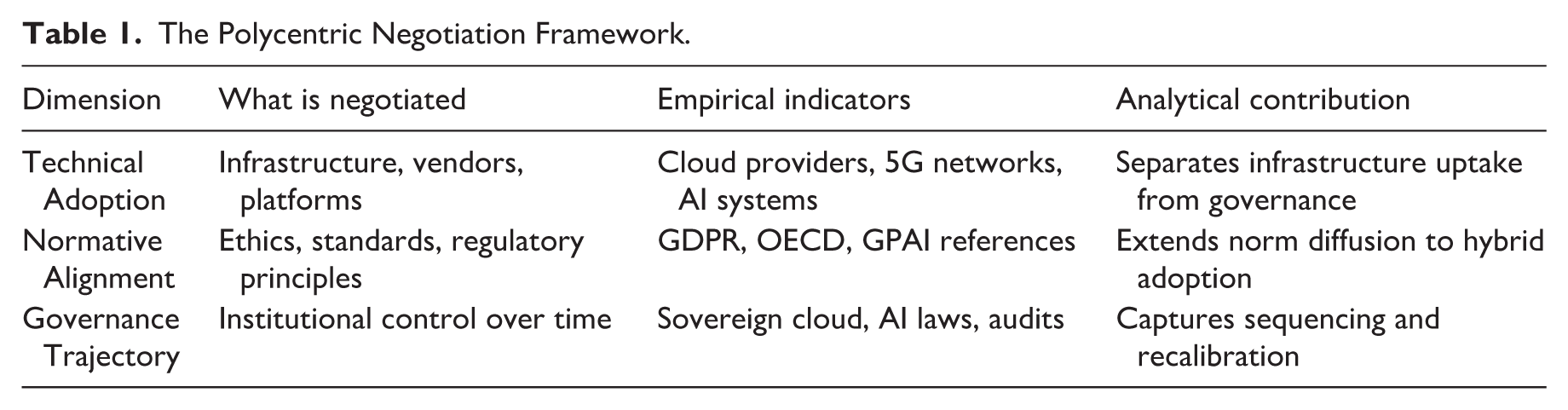
This framework synthesizes and advances three distinct strands of existing scholarship – namely, norm diffusion and localization (Acharya, 2004; Finnemore & Sikkink, 1998), strategic hedging (Kuik, 2008), and the co-production of technology and governance (Jasanoff, 2004)—to provide a more nuanced and dynamic understanding of China-Gulf AI engagements.
The first pillar of this framework draws from the literatures on norm diffusion (Finnemore & Sikkink, 1998) and norm localization (Acharya, 2004), emphasizing the inherently normative character of China’s AI diplomacy. Through digital infrastructure investment, professional training, and institutional exchanges, Chinese actors embed distinct concepts such as data sovereignty, algorithmic efficiency, non-interference, and techno-developmentalism into their outreach. While norm diffusion theory posits that global norms proliferate through processes of socialization, institutional adaptation, and emulation, Acharya’s extension underscores that non-Western regions – including the Gulf – actively reinterpret and localize foreign norms, adapting them to pre-existing legal, institutional, and cultural frameworks. This dynamic is particularly salient in the Gulf context, where countries neither passively copy nor completely reject Chinese digital norms. Qatar’s national AI strategy, for example, prioritizes data ethics modelled on the European Union (EU)’s General Data Protection Regulation (GDPR) even as it maintains significant Chinese engagement in cloud services. Similarly, Bahrain anchors its digital priorities amid a growing presence by firms like Tencent. The result is not straightforward adoption, but rather a negotiated accommodation, where foreign digital norms and infrastructures are filtered and mutated in line with local priorities.
The second pillar of the framework focuses on hedging as a key diplomatic and technological strategy (Kuik, 2008), which provides critical insight into the Gulf countries’ management of external alignment. Recent frameworks emphasize that the balance or bandwagoning paradigm is insufficient for explaining Gulf actions in AI regulatory architectures and technology procurement. GCC states consistently pursue dual-track approaches to digital infrastructure. Both Saudi Arabia and the UAE, for instance, host Huawei smart campuses even as they cultivate deep partnerships with US and European firms, including Microsoft and AWS. This hedging strategy allows the Gulf states to maintain flexibility, access to technological advances from multiple partners, and leverage over both Chinese and Western actors.
The third pillar, co-production of technology and governance, draws on Jasanoff’s (2004) scholarship, highlighting that technology adoption is not a linear or unilateral process but a site of ongoing negotiation between foreign providers and domestic institutions. In the context of Gulf-China relations, regulatory standards and digital practices are developed through joint initiatives, legal experimentation, and collaborative problem-solving. Digital architectures are thus shaped not only by external supply but also by domestic adaptation, reflecting the agency of local actors in steering technological change to fit political, economic, and societal objectives.
Together, these three pillars comprise the Polycentric Negotiation Framework, which foregrounds the Gulf states’ roles as active agents negotiating, adapting, and at times contesting external digital influence, thereby shaping the contours of AI diplomacy in the region.
Unlike existing models that conflate infrastructure adoption with political or normative alignment, the Polycentric Negotiation Framework disaggregates technical uptake, normative positioning, and governance trajectories. This allows the analysis to explain divergence, sequencing, and partial convergence across Gulf cases rather than assuming linear diffusion.
Methodology: Comparative Case Studies and Typological Analysis
The authors employ a comparative case study approach covering all six GCC countries: Bahrain, Kuwait, Oman, Qatar, Saudi Arabia, and the United Arab Emirates. This framework enables the study to reveal both common patterns and significant divergences in how each state navigates digital globalization and engages with China’s AI diplomacy. The research systematically analyses AI and ICT initiatives, official and societal responses, and the political and economic motivations behind Gulf engagement with Chinese actors. Analytical categories are developed to support deeply contextualized, within-case analysis, while also enabling systematic regional comparison.
This study relies exclusively on documentary analysis. Our dataset includes a wide range of official documents (governmental policy papers, national AI strategies, regulatory frameworks, bilateral memoranda), academic and policy publications, and public communications (press releases, corporate announcements, speeches reported in national media). These materials were collected across all six GCC states and coded thematically according to categories such as infrastructure adoption, regulatory adaptation, and normative positioning.
In total, we reviewed 58 official documents, 36 scholarly and policy publications, and 97 public communications from 2018 to 2025. “Official documents” refer to materials issued by government entities or intergovernmental bodies (e.g., AI strategies, data protection laws, cabinet decrees, GCC policy communiqués). “Public communications” capture the less formal layer of discourse – press releases by technology companies, public speeches by Gulf and Chinese leaders, and news reports in national outlets (Table 2).
Sources Overview.
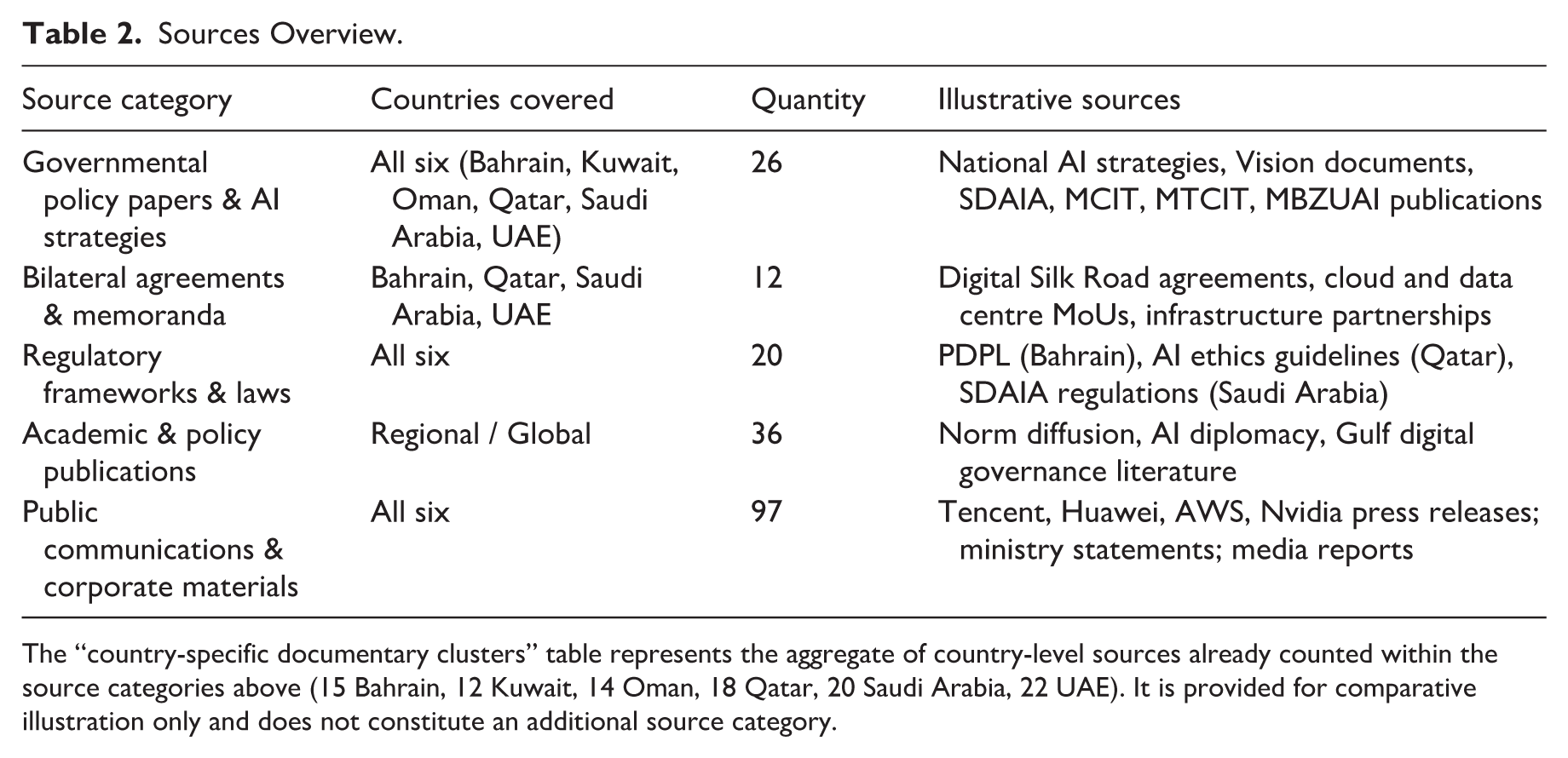
The “country-specific documentary clusters” table represents the aggregate of country-level sources already counted within the source categories above (15 Bahrain, 12 Kuwait, 14 Oman, 18 Qatar, 20 Saudi Arabia, 22 UAE). It is provided for comparative illustration only and does not constitute an additional source category.
Methodological limitations should be acknowledged. The volume of publicly available documents varies significantly across the six Gulf states: Saudi Arabia and the UAE produce extensive digital policy material, while Kuwait and Oman have fewer publicly released documents. As our analysis relies on published sources, it is not possible to capture informal or unpublished negotiations. While these limitations do not fundamentally undermine the study’s comparative framework, they suggest caution in extrapolating findings, particularly in contexts with less-documented policy processes. The cross-country findings are based on a structured and transparent methodology, drawing on a balanced corpus of policy documents, regulatory texts, and public communications. Despite uneven data availability, triangulated analysis allows us to identify consistent patterns of norm localization, hedging, and co-production. This approach ensures that the conclusions rest on sound empirical foundations as well as robust theoretical framing.
Synthesizing findings through an analytic rubric derived from the theoretical framework, the authors identify patterns and enable rigorous comparison across cases. Each country is thus compared not only on observable outcomes but also interpreted through its unique institutional, normative, and geopolitical environment. This multi-source approach ensures the validity and relevance of the findings, allowing the research to contribute authoritatively to debates on the diversity and complexity of AI diplomacy and technological governance in the Gulf region. To strengthen methodological rigour, all documents were thematically coded according to categories of infrastructure adoption, regulatory adaptation, and normative positioning. Triangulation was applied by cross-checking governmental policy papers, corporate announcements, and secondary academic sources across all six states. While relying on documentary evidence has inherent limitations, this comparative approach ensures consistency and robustness in identifying regional patterns. The findings presented below should therefore be read as systematic outcomes of structured analysis rather than anecdotal observations.
A consolidated overview of documentary sources by country and type is as follows:
It should be noted that in the “Underlying Drivers” section, the identified drivers are derived from official strategy documents, corporate announcements, and secondary academic analyses, rather than being treated as self-evident. The sections on “Prospective Pathways” use scenario-based analysis to synthesize policy statements, diplomatic trajectories, and investment trends following US President Donald Trump’s 2025 Gulf visit to anticipate plausible developments. Grounded in publicly observable policy trajectories rather than an extension of the empirical dataset, these exercises illustrate potential directional shifts in Gulf strategies under changing geopolitical conditions without attributing causal weight to a single diplomatic event. They draw on trends up to 2025 to outline plausible pathways through which high-level US re-engagement could shape Gulf AI diplomacy. All empirical claims in the following country case studies are drawn from referenced official documents, corporate communications, and secondary literature. Where practitioner perspectives inform the interpretation, they are based on published commentaries and reports rather than private interviews, due to the sensitivity of the topic.
GCC Countries Case Studies
Bahrain
Overview of Digital Relations With China
Bahrain’s engagement with China in the digital and AI domain is predominantly shaped by pragmatic considerations. As the smallest GCC economy with limited hydrocarbon resources, Bahrain has pursued rapid digitalization under Economic Vision 2030 (Kingdom of Bahrain, 2025), prioritizing innovation, private sector growth, and infrastructure modernization. Despite lacking a dedicated national AI strategy, Bahrain has advanced AI adoption in government services, fintech, logistics, and education by leveraging vendor-led solutions and regional leadership through agencies such as the Information & eGovernment Authority and the Ministry of Interior.
China’s DSR has been pivotal in meeting Bahrain’s infrastructure needs. In 2021, Bahrain became the first country in the Middle East and North Africa to host Tencent’s hyperscale internet data centre, positioning the kingdom as a regional gateway for Chinese cloud services. Huawei, a key telecommunications partner, has further expanded its footprint through the rollout of 5G, AI-ready networks, and the establishment of Tier III-certified data centres with local operators like Batelco and STC Bahrain. The 2024 Comprehensive Strategic Partnership Agreement institutionalized cooperation in the digital economy, cloud computing, and cross-border AI development.
Beyond technical cooperation, China’s digital engagement extends to judicial capacity-building through initiatives such as the Huawei ICT Academy at the University of Bahrain and participation in regional forums like the China–Arab States Cooperation Forum. This multi-layered relationship highlights Bahrain’s strategy of leveraging Chinese partnerships to advance national development goals while maintaining flexibility within the broader regional and geopolitical context.
Key AI and ICT Initiatives
Bahrain’s most significant Chinese-linked digital initiative is Tencent’s data centre – the company’s only hyperscale investment in the Arab Gulf – serving as a critical enabler of Bahrain’s expanding digital banking and virtual asset infrastructure by providing low-latency access across MENA. Meanwhile, Huawei has partnered with Batelco and stc Bahrain to implement 5.5G technologies, expand broadband coverage, and deploy advanced edge-compute nodes.
At the human capital level, the Huawei ICT Academy has institutionalized AI training programmes at the University of Bahrain, enrolling hundreds of students annually. In the judicial sector, Bahrain’s Public Prosecution engages with Chinese counterparts to explore algorithmic tools for prosecutorial efficiency and digital evidence management. In addition, Bahrain has prioritized educational transformation through a 2023 partnership with EON Reality, establishing an XR and spatial AI training hub to promote immersive learning and workforce development.
Response to China’s AI Diplomacy
Bahrain’s response to China’s AI diplomacy is technically positive but normatively cautious. Chinese vendors have been welcomed as infrastructure providers – particularly in cloud and telecom – facing little public scrutiny or legislative resistance. However, Bahrain has adopted a regulatory stance that distances its governance from Chinese digital norms. The Personal Data Protection Law (PDPL), enacted in 2018, is modelled on the European Union’s GDPR (Al-Ammal & Aljawder, 2021; Personal Data Protection Authority of Bahrain, 2018), explicitly referencing individual rights, data transfer restrictions, and consent requirements. While Bahrain hosts Chinese data centres and engages in bilateral dialogues, it has not joined Beijing-led digital governance or AI standardization initiatives and remains outside major US-led AI governance coalitions like the Global Partnership on AI and the OECD’s AI Policy Observatory. Bahrain’s approach is thus best characterized as pragmatic adoption of technology without embracing Chinese governance models or narratives.
Underlying Drivers
Several structural and institutional factors shape Bahrain’s digital choices. Its limited oil reserves have driven efforts to diversify the economy through logistics, digital finance, and innovation-led services. Digital infrastructure is seen as essential enablers of these sectors. However, Bahrain faces significant internal constraints, including the absence of a national AI policy, limited domestic R&D capacity, and reliance on foreign vendors for implementation. Huawei and Tencent offer affordable, turnkey infrastructure solutions that reduce the need for extensive local technical expertise. Capacity-building initiatives, such as the Huawei ICT Academy and EON Reality’s training centre, help address skill shortages in AI and immersive technologies.
On the foreign policy front, Bahrain’s close alliance with the United States, including hosting the US Fifth Fleet, significantly influences its technology choices – particularly in cybersecurity and defence – leading to infrastructure decisions that deliberately avoid sensitive areas.
Prospective Pathways
President Trump’s 2025 Gulf tour did not yield headline AI or cloud infrastructure deals for Bahrain. Unlike neighbouring Saudi Arabia, UAE, and Qatar – who secured Nvidia chip deals, AWS sovereign cloud zones, and major AI investments – Bahrain remained outside this wave of US-anchored AI expansion. Nevertheless, the visit led Bahrain to quietly reaffirm its alignment with US digital governance standards, especially regarding data integrity, cybersecurity, and regional interoperability.
Regional developments have also pressured Bahrain to recalibrate its digital dependencies. As neighbouring countries adopt sovereign compute models and strengthen AI regulation in line with US frameworks, Bahrain risks being left out of digital integration unless it adapts its policies. While an abrupt shift from Chinese platforms is unlikely, Bahrain is expected to gradually adopt Western-style compliance and transparency protocols within its existing infrastructure. Its future strategy will likely focus on maintaining Chinese systems while improving interoperability with regional frameworks influenced by US and EU standards.
Typology Placement
Bahrain fits the typology of a Norm-Taker with emerging traits of a Strategic Hedger. It demonstrates high dependence on Chinese digital infrastructure, especially Tencent’s cloud platform and Huawei’s telecom networks. However, Bahrain actively avoids regulatory alignment with China by upholding GDPR-style data protection and maintaining its strong defence ties with the United States, including exclusion from formal AI norm-setting bodies of both powers. This cautious stance reflects a preference for autonomy over digital governance rather than ideological commitment. Bahrain’s AI diplomacy is shaped more by operational necessity than ideology; its hedging is deliberate yet passive, hosting Chinese technology while signalling long-term normative alignment with Western regulatory models.
Kuwait
Overview of Digital Relations With China
Kuwait’s engagement with China in AI and digital infrastructure has been relatively modest compared to its Gulf neighbours. Guided by its Vision 2035 and New Kuwait development plans, Kuwait has prioritized digital transformation and public sector reform, but progress has been incremental. The absence of a standalone AI strategy until at least 2024 has placed Kuwait behind regional peers, though recent efforts by the Ministry of Communications and the Central Agency for Information Technology (CAIT) have begun to formalize AI integration in government services, education, and planning.
China’s digital footprint in Kuwait remains limited, focused mainly on soft engagement and peripheral sectors. Huawei has been the primary Chinese partner, involved in training, telecom upgrades, and pilot smart infrastructure projects. Tencent has not launched a data centre in Kuwait, despite its broader MENA presence. Chinese AI and cloud platforms are not embedded within Kuwait’s infrastructure, and there is no formal bilateral AI partnership on the scale of those seen in Saudi Arabia or the UAE. While China is positioned as a potential infrastructure partner, Kuwait continues to prioritize digital partnerships with Western vendors and regional standards.
Key AI and ICT Initiatives
Kuwait’s AI development remains in an early-stage, capacity-building phase, with Chinese engagement focused largely on training and limited infrastructure planning. Huawei’s primary role has been through its ICT Academy partnership with Kuwait University, training students in cloud, AI, and cybersecurity, alongside digital literacy initiatives such as “Seeds for the Future”, which support youth skill development but do not involve major infrastructure deployment.
The South Saad Al-Abdullah Smart City project, undertaken with Chinese and South Korean consultants, includes AI-enabled urban planning and smart traffic systems. Although not yet operational, it exemplifies China’s prospective role in Kuwait’s vision for smart urban development.
More broadly, Kuwait’s has been shaped by partnerships with Microsoft (Kuwait News Agency [KUNA], 2025), Cisco (Kuwait Times, 2022), and Google Cloud (Government of Kuwait, 2025). In 2024, Kuwait signed a memorandum with Microsoft to advance eGovernment integration and deploy secure national cloud capabilities, underscoring a preference for US-anchored platforms in critical governance functions. While Huawei continues to participate in 5G innovation and telecom upgrades, it does not play a significant role in AI systems design, regulatory consulting, or cloud infrastructure in Kuwait.
Response to China’s AI Diplomacy
Kuwait’s approach to China’s AI diplomacy has been guarded and selective, shaped principally by skills development priorities rather than by strategic or normative considerations. Chinese infrastructure does not form the backbone of Kuwait’s digital ecosystem; there are no Tencent or Huawei cloud centres operating domestically, nor has Kuwait endorsed any of China’s proposed frameworks for AI ethics, governance, or standardization.
Nevertheless, Kuwait has not explicitly rejected Chinese engagement. Instead, it has confined partnerships to non-sensitive sectors, chiefly education and telecommunications. Huawei’s training initiatives are acknowledged, but Kuwait has clearly delineated that public data governance, cloud sovereignty, and strategic AI applications will remain under national jurisdiction or be aligned with US-EU regulatory models.
Kuwait has also preserved regulatory flexibility. Its forthcoming AI and data protection frameworks – anticipated in 2025 – are expected to follow GCC principles and ensure interoperability with international standards such as the GDPR. Importantly, Kuwait has issued no endorsements of China’s Global AI Governance Initiative or DSR policy frameworks.
Underlying Drivers
Kuwait’s cautious approach to Chinese AI engagement stems from a combination of geopolitical, institutional, and structural factors. Its long-standing alliance with the United States, underpinned by reliance on US military and cybersecurity assurances, renders deep technological and political alignment with China particularly sensitive. In addition, Kuwait’s relatively limited market scale and lack of regional centrality deter the large-scale Chinese investments observed in Saudi Arabia and the UAE.
Institutionally, Kuwait’s decentralized governance structure – comprising CAIT, the Ministry of Communications, and sector-specific regulators operating independently – reduces the feasibility of coordinated, large-scale foreign technology integration. The private sector’s comparatively nascent digital economy further diminishes Kuwait’s priority for Chinese cloud and AI vendors.
Moreover, Kuwait is committed to regional digital cooperation through the GCC and Arab Digital Economy Strategy, frameworks that emphasize normative convergence with global partners and promote interoperability, thereby further discouraging exclusive digital alignment with China.
Prospective Pathways
Kuwait did not play a prominent role in the AI and cloud diplomacy outcomes of President Trump’s 2025 Gulf tour, in contrast to Saudi Arabia, Qatar, and the UAE, which secured sovereign chip agreements, AI facilities, and dedicated US cloud zones. Instead, Kuwait reaffirmed its digital defence partnership with the United States, participating in strategic dialogues on digital resilience and AI risk governance.
This renewed engagement reinforced Kuwait’s commitment to technological neutrality. After 2025, the government expanded its collaboration with Microsoft and localized cybersecurity training through US partnerships. Kuwait also joined GCC-led initiatives for data protection harmonization, drawing extensively on European and US frameworks. Collectively, these efforts further marginalized China’s normative influence and underscored Kuwait’s preference for multi-alignment under Western regulatory assurance.
Typology Placement
Kuwait is best described as a Strategic Hedger with low infrastructure dependence on China and a regulatory trajectory aligned with Western digital governance norms. Its selective engagement with Huawei, exclusion of Tencent from national infrastructure, and preference for Microsoft-led governance reforms distinguish it from the norm-taker category. At the same time, Kuwait’s lack of formal alignment with US-led AI governance coalitions such as GPAI or OECD initiatives also precludes classification as a norm co-creator.
Kuwait’s diplomatic strategy remains intentionally ambiguous: it leverages Chinese training and planning where beneficial, while core AI and cloud decisions are shaped by US security concerns and regional interoperability objectives. This profile exemplifies hedging through institutional segmentation and low-risk AI adoption, driven by economic pragmatism and geopolitical caution rather than technological ambition.
Oman
Overview of Digital Relations With China
Oman’s digital engagement with China reflects pragmatic development objectives and strategic caution. As a mid-income Gulf state with relatively limited digital infrastructure and moderate institutional capacity, Oman has actively welcomed Chinese investment through the DSR. Although Oman lacks a dedicated AI law, its National Programme for Artificial Intelligence and Advanced Digital Technologies (2024–2026) (Ministry of Transport, Communications, and Information Technology [MTCIT], Sultanate of Oman, 2024) prioritizes the integration of AI across logistics, environmental management, public services, and education.
China is a key partner in this agenda. STAR.VISION, a Shenzhen-based AI company, collaborates with Oman on urban planning and environmental monitoring via AI-enhanced satellite imaging. Huawei has facilitated 5G rollouts and the development of Oman’s telecom backbone in partnership with Omantel and Ooredoo. In addition, Oman participates in the China–Arab States Cooperation Forum and has signed memoranda of understanding on digital infrastructure, smart cities, and cloud computing. These initiatives reflect Oman’s openness to Chinese AI solutions, especially in supporting national planning priorities.
Key AI and ICT Initiatives
Oman’s most prominent Chinese-linked AI initiative is its partnership with STAR.VISION, whose AI-powered satellite WonderJourney-1A began serving Omani ministries in 2024 with environmental, land use, and smart city data. This collaboration equips Oman with advanced geospatial analytics for flood prediction, urban expansion, and infrastructure planning, establishing the country as a regional leader in AI satellite integration.
Huawei has been pivotal in expanding Oman’s 5G infrastructure through partnerships with Omantel and Ooredoo, contributing to national broadband, edge compute systems, and data transport layers optimized for AI applications. Huawei also supports training and capacity-building via programmes such as the ICT Academy and Seeds for the Future in collaboration with local universities.
Oman has launched several pilot initiatives, including AI-based traffic management, agricultural optimisation, and Arabic language NLP tools – some in cooperation with international and Chinese vendors. The government’s AI Strategy Roadmap targets AI-enabled eGovernment, predictive health modelling, and smart port logistics, all domains where Chinese firms have delivered pilot solutions.
Response to China’s AI Diplomacy
Oman’s approach to China’s AI diplomacy is marked by high openness to Chinese infrastructure – notably in satellite AI, smart cities, and public infrastructure – yet limited normative alignment. While Chinese firms are granted privileged access across key sectors, Oman has not endorsed Chinese AI governance or regulatory frameworks. The government has also refrained from adopting Chinese evaluation tools or algorithmic risk models, instead participating in Arab League and GCC forums where AI governance debates are shaped by international principles, albeit incrementally.
Oman’s public discourse on AI remains technocratic, with Chinese systems valued primarily for cost-effectiveness and turnkey solutions in areas such as environmental monitoring and logistics – domains with lower Western engagement. However, public awareness, civil society participation, and political debate regarding the governance ramifications of these Chinese partnerships remain minimal.
Underlying Drivers
Oman’s adoption of Chinese AI and ICT infrastructure is shaped by several structural and institutional factors. Economic diversification under Vision 2040 prioritizes logistics, tourism, and digital services – areas where AI tools offer efficiency gains. Constrained fiscal space and human capital make AI-driven automation and planning attractive as cost-effective modernisation strategies. Institutional and human capital limitations, including a nascent R&D landscape and slow legislative progress, heighten dependency on vendor-led innovation; firms such as Huawei and STAR.VISION provide turnkey solutions that minimize implementation burdens for local agencies. Oman’s geopolitical neutrality and tradition of strategic independence facilitate engagement with Chinese partners without provoking diplomatic friction, given its balanced relations with the United States, China, Iran, and the GCC. Finally, China’s AI diplomacy corresponds with Oman’s state-led development model, where central ministries oversee national planning and favour operationally efficient, turnkey partnerships – even if these do not foster long-term institutional capacity. This strategic neutrality is reflected in Oman’s dual engagement with both Huawei-led 5G rollouts and Arab League AI forums.
Prospective Pathways
Oman was not a key recipient of President Trump’s 2025 Gulf visit, receiving no major AI or chip agreements. While the visit spurred substantial new US technological investment in the region, these resources were mainly directed towards Saudi Arabia, Qatar, and the UAE. Oman maintained its digital neutrality by continuing cooperation with both US and Chinese partners in the aftermath.
Nevertheless, the evolving regional landscape has introduced indirect pressures. As neighbouring states deepen integration with US-anchored AI and cloud providers such as Nvidia, AWS, and OpenAI, Oman faces an expanding interoperability gap. The absence of sovereign cloud zones or Western AI investment risks increasing Oman’s dependence on Chinese systems, particularly if Western vendors prioritize larger regional markets.
In response, Oman has begun to explore ways to align its AI architecture with GCC digital strategies. Recent engagement by the Omani government in Gulf AI ethics forums and participation in the Arab Digital Economy Strategy indicate Oman’s intent to bridge Chinese infrastructural reliance with broader efforts at regulatory convergence.
Typology Placement
Oman exemplifies the Norm-Taker typology, characterized by substantial Chinese infrastructure integration and minimal normative alignment. Chinese AI is actively adopted in planning, environmental management, and telecommunications, yet Oman does not advance Chinese models of AI regulation or ethics. While public institutions depend heavily on Chinese technical systems, governance frameworks remain loosely aligned with Arab and international rather than Beijing-led standards.
Oman’s constrained policy development capacity, commitment to geopolitical balance, and reliance on vendor-driven implementation underpin its passive approach. Lacking the strategic hedging seen in Qatar or Saudi Arabia and the institutional autonomy for norm co-creation, Oman’s AI diplomacy is defined by instrumental adoption without ideological alignment – a textbook case of infrastructure-driven norm insulation.
Qatar
Overview of Digital Relations With China
Qatar’s engagement with China’s AI diplomacy is defined by a dual strategy: leveraging Chinese infrastructure while concurrently deepening partnerships with Western actors. Digital modernisation is principally guided by the Qatar National Vision 2030 (National Planning Council of Qatar, n.d.), TASMU Smart Qatar initiative (Ministry of Transport and Communications, State of Qatar, n.d.), and the National Artificial Intelligence Strategy (Ministry of Communications and Information Technology, State of Qatar, 2019), all of which position Qatar as a regional leader in digital innovation, emphasizing ethical AI adoption, data sovereignty, and sectoral transformation across health, logistics, environment, and education.
China’s DSR has supported Qatar’s infrastructure development, with Huawei contributing to telecom modernisation, 5G deployment, and sector-specific projects such as Qatar Media City and collaborations with Al Jazeera. While Tencent and Alibaba Cloud have signalled regional ambitions, neither has established sovereign operations in Qatar. In the absence of a formal bilateral AI partnership, engagement continues through training programmes – most notably the Huawei ICT Academy at Qatar University – and Qatar’s participation in the China–Arab States Cooperation Forum. These collaborations are deliberately structured to prevent Chinese firms from gaining a foothold in strategic or governance-critical domains.
Key AI and ICT Initiatives
Qatar’s AI strategy has produced several flagship initiatives, principally led by local institutions in partnership with US or neutral international vendors. Notable examples include the development of sovereign cloud infrastructure with AWS, a quantum AI collaboration with Quantinuum (UK–US), and the establishment of an AI Centre of Excellence under the Ministry of Communications and Information Technology’s (MCIT) supervision.
Chinese engagement has been confined to soft channels. Huawei’s contributions are primarily in the media sector and in public training through the ICT Academy, offering programmes in cybersecurity, AI fundamentals, and 5G to students and civil servants. While Huawei also provided technology infrastructure for metro systems and stadiums – especially during the FIFA World Cup – these deployments are purposefully excluded from AI governance functions.
In 2023–2024, Qatar launched an updated national AI ethics policy and conducted AI readiness assessments aligned with OECD, GPAI, and UNESCO standards (Ministry of Communications and Information Technology, State of Qatar, 2024). These efforts, overseen by MCIT’s AI Committee, were cross-ministerial and deliberately excluded Chinese input, demonstrating Qatar’s clear preference for Western-aligned governance frameworks.
Response to China’s AI Diplomacy
Qatar’s response to China’s AI diplomacy is strategically selective and compartmentalized. Chinese firms are granted operational access in low-sensitivity sectors (e.g., media, telecom, and training), but are excluded from national data platforms, AI governance policymaking, or sovereign infrastructure domains. Huawei is notably absent from Qatar’s national cloud programme, sovereign chip procurement, or AI regulatory design.
This selective posture is consistent with Qatar’s AI ethics and digital trust framework, which explicitly draws from GDPR, OECD, and GPAI guidelines. Qatar has not joined China-led AI governance initiatives, nor has it endorsed Beijing’s proposals for global AI regulation. Instead, it has established partnerships with Microsoft, AWS, Palantir, and Quantinuum – firms with deep entrenchment in Western regulatory and defence ecosystems.
Qatar continues to welcome training programmes and infrastructure from Chinese vendors, but within well-defined, state-controlled parameters. The underlying logic is to benefit from China’s technical delivery capability while avoiding normative dependency or geopolitical entanglement.
Academic institutions, notably Qatar University and Hamad Bin Khalifa University, and private research partnerships also contribute to AI governance debates, indicating that state policies interact with a broader ecosystem of actors.
Underlying Drivers
This compartmentalized posture is enabled by Qatar’s high institutional capacity in digital governance, particularly within the Ministry of Communications and Information Technology and associated cross-ministerial coordination mechanisms. Long-standing security partnerships, reputational considerations as a neutral global mediator, and a strategic interest in regulatory credibility within Western-led AI governance forums further reinforce this approach. These structural drivers allow Qatar to extract technical value from Chinese vendors while maintaining firm control over governance trajectories.
Prospective Pathways
President Trump’s 2025 Gulf visit is widely interpreted as reinforcing Qatar’s AI agenda, including the anticipated expansion of AWS’s sovereign cloud in Doha, prospective Nvidia’s graphics processing unit (GPU) allocations for national AI clusters, and high-level political support for a sovereign AI compute roadmap. Concurrently, Qatar formalized AI resilience planning with Palantir and launched joint research with OpenAI and Quantinuum.
Taken together, these developments are likely to further marginalize China’s position in Qatar’s AI ecosystem. Huawei’s involvement is now largely confined to infrastructure and education, with its influence strictly circumscribed. Following the visit, Qatar appears to have accelerated alignment with US and EU AI governance frameworks, participating in global initiatives on AI transparency, algorithmic safety, and cross-border data trust. As a result, China’s role in Qatar is limited to technical cooperation in non-strategic domains, with minimal influence over long-term policy or normative frameworks.
Typology Placement
Qatar exemplifies a Strategic Hedger, characterized by selective adoption of Chinese infrastructure and strong normative alignment with Western models. Chinese vendors are engaged for operational functions, yet Qatar rigorously maintains sovereignty over data governance, cloud infrastructure, and AI policy. Its partnerships with AWS, Nvidia, and Quantinuum demonstrate a commitment to Western-oriented digital architecture, while pragmatic participation in Chinese forums, such as the Huawei ICT Academy, is confined to non-strategic domains.
Distinct from Bahrain or Oman, Qatar is not a norm-taker; nor does it pursue technological duality at the infrastructure level like the UAE or Saudi Arabia. Instead, Qatar practises partitioned pragmatism: Chinese vendors are utilized for specific, operational roles without normative influence. This typology illustrates a deliberate hedging strategy – preserving sovereignty and regulatory legitimacy while selectively harnessing Chinese capabilities and consolidating AI credibility through Western regulatory standards.
Saudi Arabia
Overview of Digital Relations With China
Saudi Arabia’s digital engagement with China began with robust infrastructure partnerships under Vision 2030, subsequently transitioning to a more selective and strategically hedged orientation. The Kingdom’s pursuit of global AI leadership is articulated through the National Strategy for Data and AI (SDAIA, n.d.) and implemented by the Saudi Data and AI Authority (SDAIA). Initial phases saw Chinese firms such as Huawei and Alibaba Cloud deliver telecom infrastructure, cloud services, and surveillance technologies, supporting major initiatives like NEOM and the Hajj Smart Platform.
Diplomatic ties have been sustained through the Belt and Road Initiative and the China–Arab States Cooperation Forum, with multiple memoranda covering digital economy, AI training, and infrastructure cooperation. However, since 2023, and especially following the US re-engagement post-2025, Saudi Arabia has recalibrated its digital policy to prioritize sovereign AI development, Western-aligned governance frameworks, and domestic innovation capacity. Consequently, China now occupies a peripheral technical role rather than that of a core infrastructure partner.
Key AI and ICT Initiatives
The NSDAI articulates Saudi Arabia’s ambition to rank among the top 15 global AI nations by 2030, emphasizing sovereign AI model development and compute infrastructure. Key initiatives include the launch of HUMAIN, the national AI company, and the ALAT platform, dedicated to AI-driven industrial transformation and manufacturing, alongside large-scale AI integration within projects such as NEOM, Red Sea Global, and The Line. These initiatives are supported by institutions including King Abdulaziz City for Science and Technology (KACST), King Abdullah University of Science and Technology (KAUST), and the Ministry of Communications and IT.
Chinese firms were pivotal to early infrastructure deployment: Huawei supplied network and surveillance systems for NEOM and other urban projects, trained Saudi engineers via the ICT Academy, and supported AI-powered analytics in logistics and energy. Alibaba Cloud, in partnership with STC, provided initial cloud services. From 2024, however, these roles were progressively marginalized as Saudi Arabia secured exclusive GPU and AI partnerships with Nvidia and AMD and signed multi-billion-dollar agreements with AWS and IBM. AI protocols for HUMAIN and NEOM are now co-designed with US and European firms.
Response to China’s AI Diplomacy
Saudi Arabia’s initial approach to China’s AI diplomacy was characterized by pragmatic receptivity, with Chinese technologies such as Huawei and Dahua’s surveillance systems and Alibaba Cloud’s services deployed for rapid infrastructure development when Western alternatives were less accessible. As Saudi Arabia’s regulatory capacity and geopolitical alignment evolved, the Kingdom moved to recalibrate these partnerships. Huawei’s current role is confined to telecom functions, including 5G and smart grid support, but it is no longer involved in core AI model development, national data governance, or strategic computing. Alibaba Cloud’s presence has declined, and surveillance contracts have shifted towards domestic or Western-aligned firms. Saudi Arabia has neither joined China’s Global AI Governance Initiative nor endorsed Beijing’s regulatory frameworks (Organisation for Economic Co-Operation and Development, 2025; SDAIA, n.d.).
Instead, the Kingdom has prioritized tailored partnerships with Microsoft, OpenAI, IBM, and Nvidia, aligning its governance standards with Western norms and technical protocols. While China remains involved as an infrastructure and training partner, it no longer occupies a central role in Saudi Arabia’s AI development or digital governance.
Underlying Drivers
Saudi Arabia’s shift from extensive Chinese integration is driven by geopolitical, economic, and institutional imperatives. Close security and diplomatic ties with the United States necessitate alignment with Western export controls, cybersecurity protocols, and defence-sector data governance, resulting in the exclusion of Chinese firms from sensitive digital domains. Vision 2030’s focus on developing a sovereign AI ecosystem further mandates localization of talent, compute infrastructure, and governance capacities. Initiatives such as HUMAIN, investment in high-performance computing, and the establishment of national data centres aim to reduce reliance on external providers, particularly those from less transparent jurisdictions. China’s opaque approach to algorithmic governance and content moderation is increasingly at odds with Saudi Arabia’s emphasis on AI trust and transparency.
Institutionally, bodies such as SDAIA, KACST, and the Digital Government Authority have attained the capacity to evaluate, govern, and regulate AI partnerships, allowing for selective engagement. This maturity supports a polycentric hedging strategy: the Kingdom maintains non-sensitive cooperation with Chinese firms while reserving sovereign digital functions for trusted Western partners.
Prospective Pathways
President Trump’s 2025 Gulf visit is best understood as signalling a potential inflection point in Saudi Arabia’s AI diplomacy. The Kingdom secured a landmark agreement with Nvidia for sovereign chip access and compute infrastructure, and established partnerships with AMD, AWS, and OpenAI, positioning Saudi Arabia as a regional AI super-node for developing and deploying large language models in defence, energy, and health care. These developments suggest a continued reorientation of the Kingdom’s digital alliances away from China, which, while not excluded, was sidelined from strategic negotiations and procurement channels.
In the aftermath, Saudi Arabia promulgated new AI ethics frameworks aligned with OECD and GPAI guidelines, instituted an AI audit regime, and mandated the local storage of critical datasets in facilities meeting US and EU cybersecurity standards. Although Huawei and other Chinese firms continue to participate in training, edge infrastructure, and logistics, they no longer hold strategic access. The visit can therefore be read as consolidating Saudi Arabia’s ongoing pivot towards Western-oriented AI governance, limiting Chinese involvement to transitional, non-strategic domains.
Typology Placement
Saudi Arabia exemplifies the Strategic Hedger typology, having transitioned from initial reliance on Chinese digital infrastructure to a model of controlled, polycentric engagement. Western firms now lead in sovereign cloud, AI model development, and governance frameworks, while Chinese participation is limited to peripheral domains such as telecom, hardware supply, and vocational training. The Kingdom demonstrates high institutional capacity and agency in digital alignment, actively reconfiguring partnerships in response to shifting geopolitical and institutional imperatives. Unlike Bahrain and Oman, it does not passively accept infrastructure, and unlike Qatar, its engagement is neither rigidly compartmentalized nor exclusionary. Saudi Arabia’s approach reflects advanced hedging and segmentation – retaining operative Chinese involvement while consolidating strategic alignment with US-led AI ecosystems.
United Arab Emirates
Overview of Digital Relations With China
The UAE’s engagement with China’s AI diplomacy has evolved from early enthusiasm and high infrastructure integration to a recalibrated strategy emphasizing US-aligned governance and compute sovereignty. As one of the region’s most technologically advanced states, the UAE rapidly adopted China’s DSR offerings. The National AI Strategy 2031 (Government of the United Arab Emirates, 2017), established the UAE as the regional pioneer of AI governance, positioning AI as central to the Vision 2021 agenda across smart government, autonomous mobility, digital health, and economic diversification.
Chinese firms initially played a critical role in AI infrastructure deployment. Huawei supported 5G rollout and smart city integration (e.g., Expo 2020 Dubai), while Alibaba Cloud established a data centre in Dubai internet City and expanded operations through public-private partnerships. G42, an Abu Dhabi-based firm, developed key AI capabilities in collaboration with Huawei and other Chinese vendors before a strategic realignment. Diplomatic ties with China were maintained via the China–Arab States Cooperation Forum and Belt and Road coordination frameworks.
Since 2023, however, the UAE has reoriented its core AI infrastructure, compute sourcing, and governance partnerships towards the US and allied states. This AI sovereignty agenda now circumscribes the role of Chinese firms to operational collaboration in non-sensitive sectors.
Key AI and ICT Initiatives
The UAE’s AI ecosystem is anchored in the Ministry of Artificial Intelligence, the Telecommunications and Digital Government Regulatory Authority (TDRA), and national innovation agencies like G42 and the Advanced Technology Research Council.
Key initiatives include the launch of the Mohamed bin Zayed University of Artificial Intelligence in 2019, which has emerged as a regional centre for AI ethics, policy research, and talent development. The Stargate project, announced in 2025, aims to establish the world’s largest AI data centre outside the United States, in partnership with OpenAI, Microsoft, Cerebras, and G42. This facility represents a pivot to US-anchored sovereign compute architecture and Western regulatory alignment.
In earlier phases, Huawei played a central role in building Expo 2020 smart city infrastructure, airport facial recognition systems, and logistics AI deployments. Alibaba Cloud supported smart retail and AI video analytics in collaboration with Dubai’s public sector entities. G42’s genomics and public health AI capabilities were developed in partnership with Chinese institutions, particularly during COVID-19.
Today, Huawei remains active in telecom and smart infrastructure, while G42’s strategic redirection towards Microsoft and OpenAI demonstrates the UAE’s move to de-risk from Chinese core AI dependencies.
Response to China’s AI Diplomacy
The UAE’s response to China’s AI diplomacy has evolved from open embrace to structured hedging. Initially, the UAE positioned itself as a strategic node in China’s DSR. The country welcomed Chinese cloud, AI surveillance, and smart infrastructure as enablers of its state-driven innovation agenda. Public-private partnerships with Huawei and Alibaba were viewed as instrumental in accelerating national objectives.
However, increasing scrutiny over data sovereignty, geopolitical pressure from Western allies, and the UAE’s aspiration to play a global AI governance leadership role have prompted a strategic recalibration. Chinese platforms have been gradually replaced or restructured in sensitive sectors such as health data, sovereign cloud, defence AI, and high-performance compute. G42’s delinking from Chinese partners and pivot towards US-centric partnerships represents a high-profile institutional manifestation of this shift.
Yet the UAE continues to maintain extensive economic and operational ties with China in non-core domains such as telecom infrastructure, training, logistics, and green energy. Huawei remains a Tier 1 vendor in telecom and ICT training, while Emirati delegations regularly attend Chinese digital economy forums. The UAE’s posture is best understood as one of functional continuity under strategic segmentation.
Underlying Drivers
The UAE’s AI diplomacy is shaped by a combination of national ambition, geopolitical balancing, and institutional recalibration. First, the UAE seeks to establish itself as a global AI powerhouse, not only through infrastructure, but also through regulation, ethics, and international leadership. Its participation in forums like GPAI, AI for Good (ITU), and the OECD’s AI Working Party reflects a normative commitment to transparent, human-centric AI governance. This ambition is not easily reconcilable with China’s state-driven and less transparent AI regulatory frameworks.
Second, the UAE’s strategic partnership with the United States – particularly in defence, cybersecurity, and space – places implicit constraints on deep integration with Chinese digital vendors. Export control considerations, diplomatic alignments, and intelligence-sharing agreements have limited Chinese participation in critical systems. The Stargate data centre, built in partnership with Microsoft and OpenAI, symbolizes this pivot towards Western-aligned digital sovereignty.
Third, the UAE possesses a highly centralized and adaptive institutional architecture, capable of executing strategic pivots when necessary. Entities like G42, MBZUAI, and the Advanced Technology Research Council operate under sovereign mandates that prioritize resilience and competitive neutrality. As a result, the UAE has moved decisively from vendor dependency towards an ecosystem approach in which partnerships are modular, risk-weighted, and geopolitically conscious. G42’s pivot away from Chinese partnerships and towards US-aligned compliance frameworks was documented in the media (e.g., Bloomberg, 2024; Financial Times, 2023).
Prospective Pathways
The UAE was one of the core beneficiaries of President Trump’s 2025 Gulf tour, emerging as a central partner in the US AI re-engagement strategy. Major announcements included the Stargate sovereign compute facility, Nvidia’s commitment to support large-scale AI model training in the Emirates and expanded AI chip supply through partnerships with Cerebras and AMD.
These announcements formalized the UAE’s position as a Western-aligned AI hub. While no formal disengagement from China was declared, the regulatory and infrastructure implications were clear. Post-visit, G42 announced new compliance frameworks aligned with US and EU standards, and MBZUAI expanded its collaboration with Western AI ethics institutions. Huawei’s participation in national security-related tenders decreased, and UAE’s AI governance documents began explicitly referencing OECD and GPAI principles.
Despite these shifts, China remains a strategic economic partner. Bilateral trade, joint ventures in green energy and port infrastructure, and Huawei’s role in non-sensitive ICT deployments continue. However, the visit confirmed the UAE’s trajectory: China remains an operational player, but is no longer a strategic partner in AI governance or sovereign compute.
Typology Placement
The UAE exemplifies a Strategic Hedger that has moved from early high dependence on Chinese infrastructure to Western-aligned digital governance and AI sovereignty. It retains operational ties with Chinese vendors but has structurally repositioned its AI trajectory through US-anchored partnerships in compute, governance, and regulation.
Unlike norm-takers such as Oman or Bahrain, the UAE exerts strong institutional control and ideological selectivity in its AI ecosystem. Unlike Qatar, which ring-fences Chinese involvement at the outset, the UAE pursued initial openness followed by systemic realignment. Its typology is marked by sequential hedging – leveraging Chinese AI diplomacy for infrastructure deployment, then pivoting towards trusted governance and compute ecosystems as its strategic capacity matured.
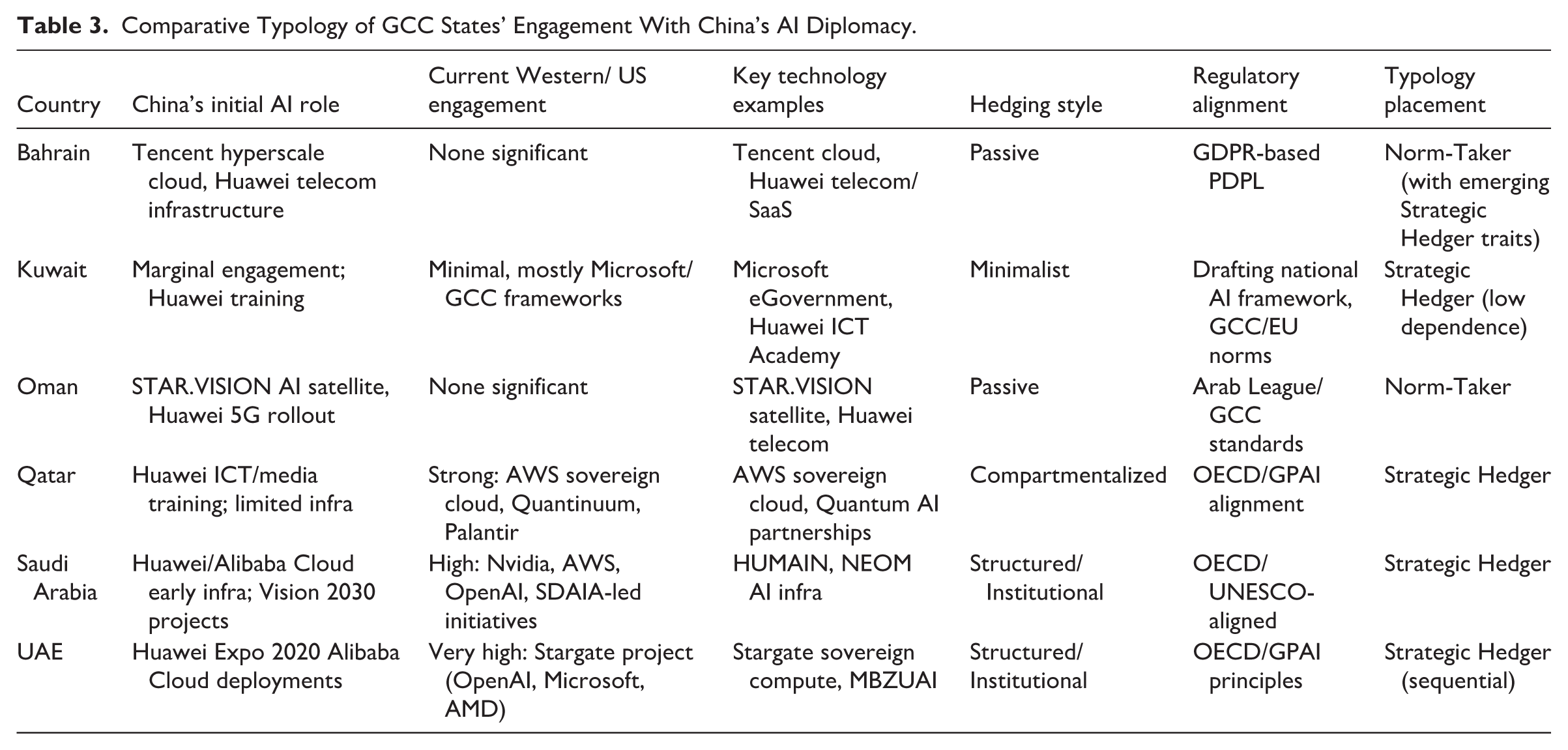
Table 3 provides a comparative typology of Gulf states’ engagement with China’s AI diplomacy, mapping initial roles, current alignments, and regulatory postures against the categories of Norm-Takers, Strategic Hedgers, and the (currently absent) Norm Co-Creators.
Comparative Typology of GCC States’ Engagement With China’s AI Diplomacy.
Discussion: Applying the Polycentric Negotiation Framework
The following discussion reconnects the empirical findings across the six GCC states with the three theoretical pillars – norm diffusion and localization, strategic hedging, and co-production – central to the Polycentric Negotiation Framework. This section not only situates the comparative results within the theoretical framework but also demonstrates how these mechanisms help explain the divergent trajectories of Gulf states in engaging with China’s AI diplomacy. By analysing the interplay of norm localization, hedging strategies, and processes of co-production, this analysis clarifies how the framework enriches the interpretation of empirical evidence and advances theoretical understanding of Gulf-China digital relations.
A brief process-tracing illustration can be observed in Qatar. Chinese engagement entered first through telecom infrastructure and training programmes, while governance design, sovereign cloud architecture, and AI ethics frameworks were explicitly reserved for Western partners. This sequence demonstrates how technical adoption preceded normative exclusion, directly illustrating the framework’s claim that infrastructure does not determine governance alignment.
Norm Diffusion and Localization
Evidence from Bahrain and Oman demonstrates that the uptake of Chinese digital infrastructure does not equate to wholesale regulatory convergence. Both states rely heavily on Huawei and Tencent systems, yet maintain data protection and governance frameworks inspired by European or GCC standards. This supports Acharya’s argument that norms are localized rather than copied, highlighting the agency of smaller Gulf states in filtering foreign digital norms. By contrast, Qatar’s explicit adoption of OECD- and GPAI-style AI ethics, while engaging Huawei in training and telecom infrastructure, illustrates a compartmentalized localization strategy.
Strategic Hedging
The Saudi and Emirati cases show the salience of hedging theory. Both initially embraced Chinese providers for large-scale smart city and infrastructure projects, but subsequently pivoted towards Western-aligned compute sovereignty and regulatory partnerships following US re-engagement in 2025. This dual-track posture – retaining Chinese operational roles while consolidating strategic reliance on US partners – corresponds to Kuik’s notion of hedging as simultaneous engagement and risk management. Kuwait’s limited Chinese presence likewise reflects hedging through avoidance and selective adoption, rather than alignment.
Co-Production of Technology and Governance
Across the region, the interaction of Chinese technical offerings with Gulf institutional adaptation illustrates Jasanoff’s principle of co-production. In Bahrain, the PDPL law interacts with Tencent’s cloud presence to create a hybrid governance environment. In Oman, STAR.VISION’s AI satellite data is embedded into national planning processes, producing context-specific applications not foreseen by the vendor. In the UAE, G42’s initial collaborations with Huawei followed by a pivot to OpenAI and Microsoft underscore how domestic institutions shape foreign technologies to fit evolving national priorities.
Taken together, these findings confirm that China’s AI diplomacy in the Gulf is neither uniformly accepted nor uniformly resisted. Instead, Gulf states actively negotiate Chinese influence through selective localization, strategic hedging, and co-production. The typological mapping – Norm-Takers (Bahrain, Oman), Strategic Hedgers (Qatar, Kuwait, Saudi Arabia, UAE) – demonstrates that Gulf agency is central to shaping the trajectory of digital engagement.
Theoretical Implications
First, the study challenges deterministic readings of BRI/DSR as linear projects of geopolitical capture, showing instead that their influence is mediated by local institutional logics. Second, it extends norm localization theory to digital governance, where hybrid and compartmentalized adoption are more prevalent than wholesale convergence. Equally, the absence of any Gulf state as a Norm Co-Creator underscores both the limits of China’s AI diplomacy and the still-nascent role of the region in shaping global AI governance norms. A shift towards norm co-creation would require institutions such as SDAIA or MBZUAI to extend their influence beyond national priorities and play a more active role in shaping international AI governance standards. Third, it refines hedging theory by demonstrating its application not just to military and economic alignment but also to digital and AI infrastructures.
While the analysis has focused on state strategies, it is important to note the emerging role of non-state and societal actors in Gulf digital governance. Universities such as MBZUAI in the UAE and Qatar University host AI ethics programmes; private firms like G42 and Palantir increasingly shape technical standards; and professional associations in Bahrain and Kuwait contribute to digital literacy and data protection debates. Although civil society and digital rights groups remain less visible than in Western contexts, their gradual involvement suggests that the future trajectory of AI governance in the region will not be determined by state elites alone.
The absence of any Gulf state in the ‘Norm Co-Creator’ category is analytically significant. While Gulf governments have invested in AI centres of excellence, such as MBZUAI in the UAE or SDAIA in Saudi Arabia, their influence remains primarily national or regional rather than global. This suggests that, at least in the short term, Gulf states are unlikely to co-develop international digital norms with China, the US, or multilateral bodies. Instead, their role is more often one of selective adoption or adaptation. The ‘Norm Co-Creator’ category should therefore be read less as an existing status and more as a potential aspiration, contingent on Gulf institutions acquiring greater agenda-setting capacity in global AI governance forums.
With regards to limitations and future directions, the findings are bounded by reliance on publicly available documents and secondary sources, which may underrepresent informal negotiations and unpublished initiatives. Moreover, the typology highlights Gulf agency vis-à-vis China, but further comparative research could examine whether similar dynamics apply in other regions where US and Chinese AI diplomacy overlap.
Overall, the empirical results reinforce the utility of the Polycentric Negotiation Framework for capturing the diversity of Gulf responses. The framework explains not only why Gulf states diverge in their engagement with China but also how they recalibrate those engagements amid shifting geopolitical conditions.
Conclusion
The Gulf region emerges not as a passive recipient of China’s expanding digital footprint but as a laboratory of selective adaptation, institutional filtering, and strategic hedging. Using a threefold typology of norm-takers, strategic holders, and norm co-creators, the study shows how GCC states pursue distinct trajectories shaped by varying infrastructural dependencies on China and differentiated alignments with global governance models. Bahrain and Oman operate as norm-takers, marked by high infrastructural reliance and limited normative convergence with China, whereas Kuwait, Qatar, Saudi Arabia and the UAE act as strategic hedgers, compartmentalizing Chinese partnerships while prioritizing data sovereignty and regulatory compatibility with Western standards. Crucially, no Gulf state currently functions as a norm co-creator with China, highlighting the limits of Beijing’s normative projection despite deep technical penetration.
These findings indicate that Gulf states are better understood as norm filters than norm exporters, actively reshaping external AI governance templates through institutional buffering and selective localization. This dynamic challenges deterministic assumptions that infrastructure deployment straightforwardly produces regulatory convergence or geopolitical realignment. Instead, Gulf governments construct digital sovereignty through regulatory arbitrage and alliance diversification, maximizing autonomy within an increasingly competitive landscape of great-power rivalry.
The analysis carries two core policy implications. First, governments should explicitly decouple AI infrastructure procurement from governance and regulatory design to preserve institutional autonomy. Second, international AI governance initiatives need to recognize hybrid and graduated adoption pathways rather than treating alignment with Chinese or Western models as a binary choice.
The theoretically pluralist and empirically grounded approach developed here offers a transferable framework for analysing the diffusion and localization of AI norms beyond the Gulf, highlighting the centrality of institutional agency in global digital governance. Future research should extend this typological lens to other Middle Eastern cases and probe underexplored arenas – including algorithmic governance, legal harmonization, and AI auditing – where the effects of China’s AI diplomacy are only beginning to materialize. By broadening comparative scope and deepening empirical inquiry, scholars can more precisely trace how evolving interactions among infrastructure norms, and state agency will shape the geopolitics of AI in the decades ahead.
Footnotes

Funding
The authors disclosed receipt of the following financial support for the research, authorship, and/or publication of this article: This research was supported by the Faculty Development Scheme (FDS) of the Research Grants Council, the University Grants Committee of Hong Kong. Project title: China’s Role and Social Power in the Middle East and North Africa (MENA). Project no. UGC/FDS16/H13/24.
Declaration of Conflicting Interests
The authors declared no potential conflicts of interest with respect to the research, authorship, and/or publication of this article.