




Abstract
Firms are investing in social media (SM) to encourage internal information-sharing behaviour (ISB) for efficient teamwork and the organization’s success. However, literature that examines the determinants of ISB on organizational SM remains scarce; thus, this study intends to investigate several factors that influence and hinder workers’ ISB on a firm’s SM platform. It hypothesizes whether individual, technological and organizational factors are related to ISB on a firm’s SM. It analyses empirical data to provide a complete depiction of the variables influencing workers’ choices and whether they are willing to share information on organizational SM. This study uses a qualitative method to gather data from organizational SM reviews and semi-structured interviews at Kompas Gramedia, a major Indonesian broadcasting company with over 22,000 employees. The study uses the iterative analysis tenets of systematic repetition and recursive switching between various phases. The qualitative data analysis software ATLAS.ti was used for the qualitative encoding. The findings confirm that the three factors – individual, technological and organizational – are influential drivers and barriers to workers’ willingness to perform ISB on the firm’s SM. Subsequently, this willingness to perform internal ISB affects workers’ external ISB, that is, their willingness to voluntarily communicate and share information about the positive aspects of firms to the broader public.
Introduction
Organizations are presently making social media (SM) investments to improve their inward and outward communications. Internal organizational SM platform are multifaceted cyberspace-based communication devices that enable colleagueship and information-sharing behaviour (ISB) within and outside of organizations (Leonardi et al., 2013). Workplace by Facebook, Jive and Yammer are some of the types of platforms. There is a need for empirical research that examines how SM affects internal communication in organizations as this platform become more widely used. The issue of ISB routines becomes crucial since SM promote participation and exposing (El Ouirdi et al., 2015; Leonardi et al., 2013; Majchrzak et al., 2013). Internal ISB is essential to an organization’s success and enables efficient teamwork. Participants of a company can participate in the innovation process, perform tasks, disseminate knowledge and develop relations through ISB with their colleagues (Chow & Chan, 2008; Kietzmann et al., 2011; Leonardi et al., 2013; Lin, 2007). The term ‘exposing’ refers to ‘the degree to which user exchanges, distributes and receives content’ on SM (Kietzmann et al., 2011). This study defines ISB as someone who posts or comments on organizational SM platform.
According to the standpoint of individual SM, forms of ISB have recently attracted researchers’ attention, such as Twitter and Facebook (Ashuri et al., 2018; Ledbetter et al., 2010; Spottswood & Hancock, 2017). Organizational SM, in contrast to these individual SM, differ from them in that they are used for different purposes and are viewed and used by distinct audiences (company’s participants) (Ellison et al., 2015). As a result, ISB’s goals may be different. In large and dispersed organizations, exposing knowledge on organizational SM is especially important since it facilitates participants to know organization’s issues and exchange and preserve knowledge on platforms that are available across organizations.
In this work, we examine workers’ perceptions of information-sharing on organizational structure in major Indonesian broadcasting organizations. To improve internal communication, the 22,000-person organization adopted a Google þ-based organizational SM system. In the study, we look at how several elements influence workers’ knowledge and skills, including the characteristics that support worker’s ISB and the major obstacles that cause workers to think twice before posting on organizational SM or to refrain from posting at all. We argue that individual confidentiality control values and technical advantages are crucial in comprehending ISB on organizational SM. We base our argument on two conceptual frameworks: communication confidentiality control (CCC; Petronio, 2013) and the technology advantage perspective (Rice et al., 2017; Treem & Leonardi, 2013). For instance, it has been discovered that publicly accessible SM users weigh the advantages and hazards and the platform’s legitimacy before performing IS on it (Ashuri et al., 2018). In addition, it has been discovered that privacy, control and monitoring concerns all come into play when people use various open, interactive technologies (Humphreys, 2011). The technology advantage perspective takes into account the interaction between the users and the technologies (Treem & Leonardi, 2013), whereas confidentiality control theory concentrates on intraindividual and relational processes by viewing ISB on SM as something happening in the individual’s mind and in the relationship between the exposing person and the observed viewers.
This study makes five contributions to the literature as follows. First, SM is a practical interaction and reciprocal communication device; a two-route equal interaction on SM can support correspondence of advantages within public organization associations (Namisango & Kang, 2019). SM also develops a feeling of interconnection between the public and the organization, which entices the community to connect with the organizations (Namisango & Kang, 2019). However, studies in communication and the public mostly emphasize public relations that focus on an organization’s work to portray itself positively to the general public, stakeholders and customers (Duncan, 2024). Very little attention has been paid to a subdivision of public relations that receive less consideration but is similarly imperative: internal public relations (Duncan, 2024). Communication and interaction inside an organization can be defined as internal public relations (H. Kim, 2018), such as between a firm and its employees or stakeholders or among employees within a firm. Although numerous publications have focused on examining the influence of digital platforms (especially SM) on public communication (i.e., Abu-Ayyash, 2024; Craig et al., 2023; Ding, 2024; Hoang, 2023; Jin, 2024; Lu & Cindy Ngai, 2024; Uwalaka & Nwala, 2023; Xie, 2024), very few have concentrated on their role in communicating and sharing knowledge and information to strengthen internal public relations in an organization like this study does. Thus, this study provides a significant contribution to the existing literature.
Second, by using CCC theory to the perspective of organizational SM, our study expands understanding of individual factors influencing workers’ choices to expose or not share information on organizational SM (Petronio, 2013). All organization members are permitted to create content on organizational SM, and this is frequently requested of them. However, individual or job-associated confidentiality preferences influence the choices to expose, hold back or amend communicated information, particularly the one viewed as personal news. In this technologically mediated organizational circumstances, the research intends to better explain the types of confidentiality control that workers pay attention to when intending to perform ISB.
Third, because organizational SM differs from publicly accessible SM in several ways (Choi & Bazarova, 2015; Ellison et al., 2015; Spottswood & Hancock, 2017), this study aims to provide the body of knowledge with broader understanding about technical advantages by utilizing it as a lens to discover technology usage-associated clarifications for workers’ ISB or choices to not post on organizational SM. By demonstrating how the similar advantages in the same company will be regarded as drivers and barriers in regard to ISB and secrecy control, this article also emphasizes the perspective of advantages and advances theory. Fourth, this work offers intriguing new directions for the taken-in conceptual perspectives. By demonstrating, for example, how confidentiality control values relate to the advantages of perceptibility and continuance and what these values entail from an organizational perspective, the research furthers the ideas.
Fifth, we add to the existing publications by demonstrating how organizational aspects – like organizational-stage structure and norm – become known as another crucial component in workers’ ISB determinations. According to our findings, workers respond to information in a different way reliant on whether they view it as individual or organizational. The opportunities and expectations for ISB are also shaped by organizational rules and goals. The research attempts to provide a thorough understanding of the variables influencing workers’ ISB choices towards organizational SM by merging these three aspects (individual, technical and organizational).
Last but not least, to make this study contribute more to the broader field of communication and its intersection with the public, a new variable is added to the conceptual model, that is, external ISB as seen in Figure 1 (green square). In this study, external ISB is defined as what researchers (J.-N. Kim & Rhee, 2011) described as ‘micro-boundary spanning’, which is among the widely studied subjects in the communication field (e.g., Otchere, 2024; Yan et al., 2022). Micro-boundary spanning refers to the degree of voluntary reciprocal communication attempts by non-designated workers between an organization and its strategic public (J.-N. Kim & Rhee, 2011). Academicians have claimed that for organizational effectiveness – especially in the knowledge management area – the boundary spanner is an important person to bridge the organizations and their surroundings and convey beneficial resources, ideas and information through inter-organizational or intra-organizational frontiers (J.-N. Kim & Rhee, 2011).
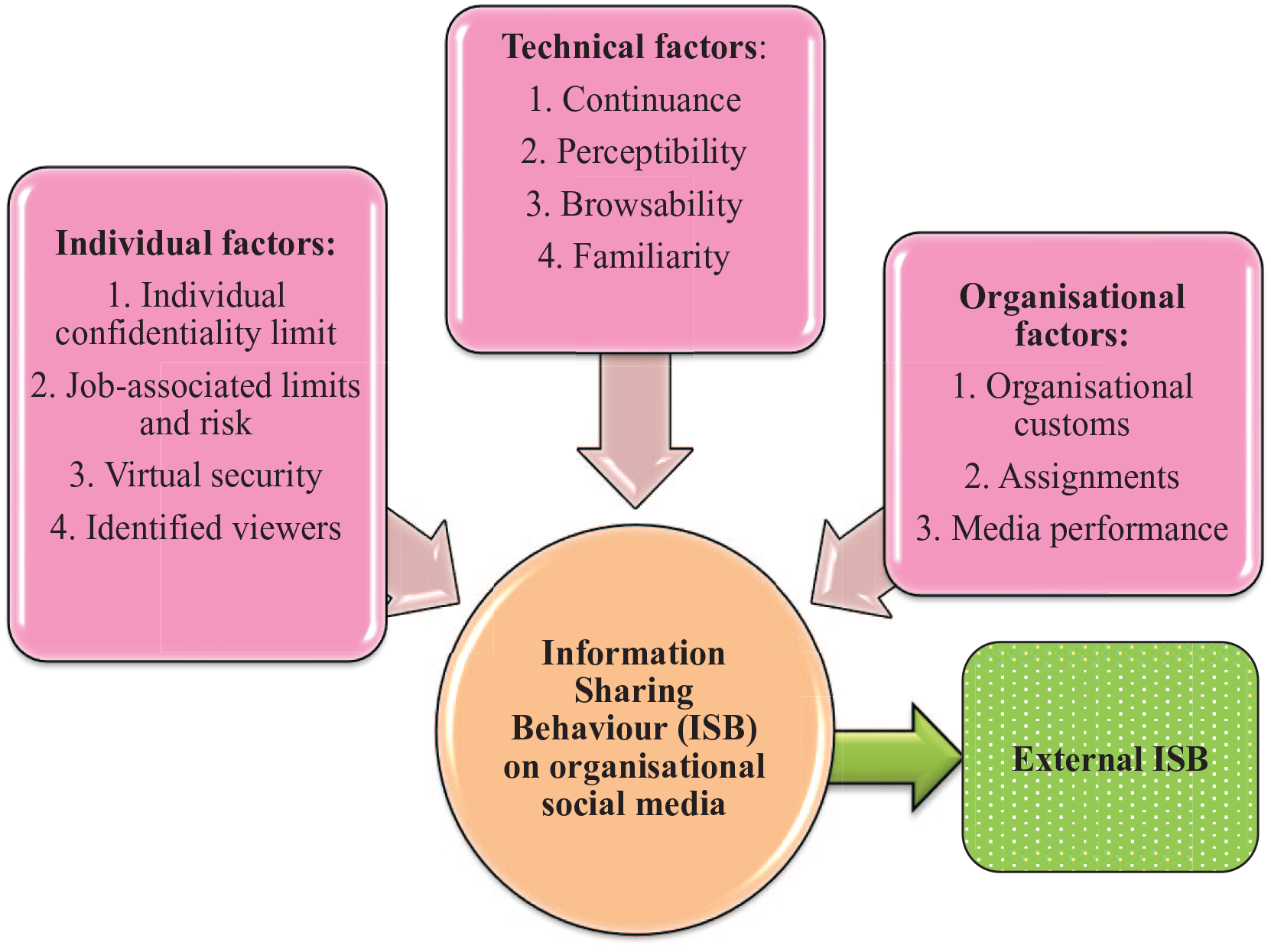
Framework of the aspects that drive and limit workers’ ISB on organizational SM.
Taking into account the limitations/gaps in the existing literature, this study offers four research questions. The first two questions concentrate on the two theories that have been provided, the next issue arises from the importance of comprehending how the office or organization perspective affects how organizational SM is used by workers and the last research question is related to how this study can contribute to a broader field of communication and its intersection with the public. The following are the research questions:
(1) How does workers’ knowledge of organizational SM frontiers affect their ISB?
(2) What technological factors can be used to illustrate how workers share information in the organizational SM?
(3) What organizational elements drive or inhibit workers to perform ISB on organizational SM?
(4) How will workers’ ISB on organizational SM influence their external ISB (i.e., sharing information about their work and companies to strategic publics)?
The study is divided into four sections. To provide a thorough knowledge of ISB on organizational SM and the conceptual frameworks used in this work, the first three sections of the study illustrate the body of literature that has been written on the subject. We provide potential research questions for the study at the conclusion of the literature review. We detail the technique by which the results were obtained in the second section. Following the research questions, the third section offers the study’s major findings. Finally, we examine the conceptual and practical consequences of the research, and its limitations and upcoming studies, at the conclusion of the article.
Literature review
ISB on organizational SM
Modern businesses have a wide range of options for communication tools they might utilize for internal communication. The success and acceptance of publicly accessible SM systems can be used to justify the establishment of organizational SM platform. While some businesses merely use publicly accessible websites as in-house channels, more businesses are using internal websites that are privately accessible and frequently tailored to their requirements (Leonardi et al., 2013). Organizational SM system gives workers the option to communicate in a variety of methods through a single platform and also provide access to an archive where organization participants can examine information uploaded at any time and from any location (Leonardi et al., 2013; Treem & Leonardi, 2013). Organizational SM provide information exposure and continuance in a way that offers special opportunities, such boosted societal education (Leonardi et al., 2013).
Publicly accessible social networking sites (SNs), such as those used for organizational SM, offer a variety of communication networks (such as news feeds, message boards and chats) that promote societal engagement and ISB among organizational elements. By updating statuses, leaving comments, and maintaining their own SM accounts, workers are both users of SM tools and content providers at organizational SM (Ellison et al., 2015). It is a key distinction between organizational SM and another intranet-style communication platform used throughout an organization. The organization’s whole membership is, or at the at least has the potential to be, an active content provider for the platform, making it all the more important to understand the elements that go into ISB choices.
For example, environmental, individual, relational and societal factors can all influence how individuals behave in knowledge exposing circumstances and how they engage in information exchange (Matschke et al., 2014). In addition, it has been discovered that variables like a scarce time or trust limit exposing behaviour in organizations, whereas worker generosity and financial incentives might promote exposing (Razmerita et al., 2016). Lin (2007) discovered that organizational, individual, and technical aspects affect IS process in organizations, according to a broader ICT approach. By looking at the various features of ISB from the perspective of contemporary organizational SM platform and using two conceptual views to better explain and clarify these issues, the research adds to the body of knowledge.
Organizational SM and publicly accessible SNs differ in five important ways, according to Ellison et al.’s (2015) research. First, whereas corporate SM usage is typically governed by company norms, user behaviour on publicly accessible SNs is mostly affected by site customs. The workers of an organization are its users of organizational SM. Third, whereas organizations’ designs foster interactions that suit organizational needs, publicly accessible SNs’ designs stimulate interactions among users. Fourth, while viewers of organizational SM are members of an organization, viewers of publicly accessible SNs are a more generalized combination of various networks. Fifth, organizational SM are designed to be used to achieve job-related goals, whereas publicly accessible SNs are largely employed for social and relational goals. These variations point to the necessity of examining ISB in organizational contexts in order to identify the precise advantages of organizational SM.
According to research by Waters and Ackerman (2011), ISB on publicly accessible SM is driven by factors like IS requirements, information storage, self-recreation, bragging and synchronizing with trend. The organizational perspective, however, has a greater impact on workers’ ISB than on publicly accessible SM since organizational SM are primarily used as a medium for workplace communication. According to research, choices about whether to perform or not perform ISB in head-on environment at workplace are influenced by relational factors, organizational culture and the trade-off between the aspiration to get response and safeguard confidentiality (advantage/risk concerns) (Smith & Brunner, 2017). Therefore, it is important to take into account both technical issues and the appropriate organizational features and the CCC values of different workers when examining the various causes of workers’ ISB on organizational SM.
As mentioned earlier, despite the proliferation of publications that focused on examining the influence of digital platforms (especially SM) on public communication, very few have concentrated on their role in communicating and sharing knowledge and information to strengthen internal public relations in an organization like this study does. For example, Lu and Cindy Ngai (2024) examined the role of digital platform usage for communication by the government in people’s SM engagement during the pandemic. Despite the huge number of people working in governmental organizations, which reached 56.3 million in 2021 (Textor, 2023), they did not focus on SM communication among these people. Similarly, Jin (2024) and Koswara et al. (2024) focused more on the digital communication of government to open citizens than internal communities. This is unfortunate as the organization/workplace is a kind of community as well; the extent to which workers feel fulfilled, connected and valued in this community significantly impacts the business’s health and organizational culture (Lankinen, 2023).
Another study by Xie (2024) examined digital communication and its problems like firms’ profit-pursuing motivations of owning mobile platforms yet did not focus on SM communication within the internal communities of the firms. Hoang (2023) revealed the substantial effect of nonprofit organizations’ digital communication using Twitter on organizing public self-structured networks but neglected this effect in the context of firms’ internal public communication. Besides, other academicians (e.g., Abu-Ayyash, 2024; Craig et al., 2023; Ding, 2024; Uwalaka & Nwala, 2023) highlighted the roles of SM communication within the open public sphere, not inside formal organizations, and ignored the importance of seeing these roles in internal public relations within the organizations, especially in terms of knowledge-sharing among employees. Thus, this study tries to fill this research gap by focusing on internal public relations and communication within an organization with a community of 22,000 employees to provide scholars and managers with new insights regarding factors that hinder or accelerate ISB in ‘employee community’ as Lankinen (2023) said.
ISB among workers can cause strong internal relations as it leads to better communication, teamwork and collaboration (Ardill, 2023). It is because sharing knowledge and information will help with clarity, making sure that all parties understand what is happening and building trust as workers realize their workmates are open and willing to cooperate and share their knowledge (Ardill, 2023). Strong internal relations will immediately cause better external relations (Introhive, 2024), that is, organization-public relations. Meanwhile, a poor internal relation within the organization will harm organizational development and subsequently relations with clients (Introhive, 2024) and other strategic publics.
CCC and organizational SM
The frontiers around personal data are altered when it is publicly publicized, as stated by the CCC theory. The theory postulates that individuals strategically plan their confidentiality control procedures to correspond with the beliefs they have on the exposing of personal data in a given circumstance (Petronio, 2002). The concept is more concerned with the exposure process and the fundamental guidelines, limitations, and values that influence the choice to perform or not perform ISB (Petronio, 2002) than it is with the specifics of what is revealed. The choice to self-expose or hold back information is assessed according to the circumstances and the interaction colleagues (Frampton & Child, 2013). These confidentiality control routines are deeply appropriate. As a result, to make confidentiality values and control procedures compatible with the characteristics of various technical platform, they must be continually evaluated.
To prevent turbulence resulting from rules being broken, confidentiality rules for strategic management and publicized information regarding how publicized information must be managed by interaction colleagues are forever agreed. As a result, the viewers have a big impact both before the choice to publicize personal data is taken and after ISB and the extension of possession (Petronio, 2002). The location and recipients of ISB are taken into account while coordinating confidentiality regulations. As people assess the circumstances and their communication colleagues, weigh potential rewards and hazards and assess both the circumstances and their communication colleagues, conflicts between exposing and holding back information are ever-existent (Ashuri et al., 2018; Petronio, 2013).
The CCC framework has been developed and evaluated in previous articles (see Petronio, 2013). It is critical to look at two different views where CCC has formerly been used: publicly accessible SM and intra-organizational communication. This is because the research uses CCC to investigate ISB in the organizational SM perspective. Individual characteristics and backgrounds, motivations and prior SM experiences, all influence the strategic choices for confidentiality control on publicly accessible SM (Choi & Bazarova, 2015; Waters & Ackerman, 2011). Information releases online may suffer as a result of people’s strong need for privacy control, as scholars have found that perceived privacy risk and privacy concerns affects non-self-exposure behaviour (Mutimukwe et al., 2022).
Recently published works have also demonstrated that if workers utilized publicly accessible SM, their’ choices regarding confidentiality are influenced on the SM’s ability to select confidentiality backgrounds, organizational confidentiality attitudes and the degree to which workers are satisfied with colleagues (Frampton & Child, 2013). As information is frequently given with several viewers at once in SM circumstances, it can be difficult to identify your audience (Vitak, 2012). This is also obviously pertinent when discussing organizational SM from the standpoint of confidentiality control in larger organizations, in which the viewers of the publicized material may be the whole organization.
When there is a scarce a complete comprehension of the viewers, how can the laws of information possession be conveyed? Workers are compelled by confidentiality control in an organizational SM context to take into account with who and where information is communicated, as well as the fundamental values and customs of the business, for example, the communication culture or organizational SM standards. Other issues associated with worker confidentiality control are also raised by the organizational context. Institutional and organizational confidentiality thoughtfulness also come up when discussing confidentiality from a working viewpoint (Ball et al., 2012; Humphreys, 2011).
To expose or not expose information is an individual choice, even while the organizational perspective does bring up these varied questions about what personal information is in general. However, it is impossible to overlook the effects the organizational perspective has on information possession.
Combining CCC study on publicly accessible SM and research from the organization perspective helps advance theory because the research revolves around ISB on organizational SM. By examining how sharers deal with confidentiality control difficulties in technology-mediated organizational contexts, for example, information possession and viewers appreciation, the research furthers the notion of confidentiality control, which was originally created primarily for face-to-face viewpoints.
Technical advantages of organizational SM
The advantage method to technologies enables SM to be described from a societal and a material standpoint because it is according to the environmental perspective of comprehending things regarding their physical features and how they are utilized and used (Gibson, 1986). The advantage context is among numerous frameworks that aims to equalize technology’s characteristics with consumption and user’s opinion, as stated by Rice et al. (2017). Although it is among the few methodologies that enables for an intermediate ground between socially constructivist and technically deterministic positions, this framework’s emphasis on the interaction between people and technology makes it unique (Leonardi & Vaast, 2017).
Advantages are ‘relationships among behaviour likelihoods to which managers observe they can implement a channel (or several channels), inside its possible structures/abilities/barriers, compared with their demands or intentions, in a certain perspective’ (Rice et al., 2017). The options to act according to the given standpoint are advantages.
Users’ opinions of the technical platform and its potential applications are determined by technical advantages. Researchers have examined a number of organizational SM’s technological advantages, including perceptibility, editability, continuance and relationship (Oostervink et al., 2016; Treem & Leonardi, 2013), and they have developed measures for defining the advantage (Evans et al., 2017). Users’ capacity to allow their actions, information, likings and communication systems observable to others is referred to as perceptibility. How well communication maintains its original shape when the sender has delivered their messages can be used to determine continuance.
According to Rice et al. (2017), editability is the capacity of a user to draft and rewrite his or her communications prior to being viewed by other users and to alter or modify the communications they have delivered. The definition of relationship is ‘building relations among persons, between content and a person, or between a performance and a player’ (Treem & Leonardi, 2013). According to another study, self-presentation, browsability and pervasiveness are the three main organizational broadcasting advantages (Rice et al., 2017).
It has been discovered that the technical advantage perspective is a useful framework for examining how contemporary SM shape organizations and organizing. For instance, according to Leonardi and Vaast (2017), the advantage lens may be used to understand how SM has spread, how it is employed in organizations, and how various organizing processes are affecting organizational SM systems. The technology-related element of workers’ knowledge of organizational SM can be explained using advantages, which represent the perceived possibilities of organizational SM.
Internal ISB and external ISB
As mentioned in the Introduction section, to make this study contribute more to the broader field of communication and its intersection with the public, a new variable is added to the conceptual model, that is, external ISB as seen in Figure 1 (green square). In this study, external ISB is defined as what researchers (J.-N. Kim & Rhee, 2011) described as ‘micro-boundary spanning’, which is among the widely studied subjects in the communication field (e.g., Otchere, 2024; Yan et al., 2022). Micro-boundary spanning refers to the degree of voluntary reciprocal communication attempts by non-designated workers between an organization and its strategic public (J.-N. Kim & Rhee, 2011). Academicians have claimed that for organizational effectiveness – especially in the knowledge management area – the boundary spanner is the important person who bridges the organizations and their surroundings and conveys beneficial resources, ideas and information through inter-organizational or intra-organizational frontiers (J.-N. Kim & Rhee, 2011). According to J.-N. Kim and Rhee (2011), external ISB or micro-boundary spanning is measured by the following activities: (1) posting constructive commentaries or supporting the company on SM posts, (2) telling close people (i.e., neighbours and friends) regarding the good elements of the firm and managers, (3) regularly endorse the company and its goods and services to others, (4) try to convince those with undesirable sentiments regarding the company, (5) disprove stereotyped or biased views regarding the company or products/services, (6) formerly, struggled with people who disapproved of the company and its commerce, (7) is hurt and inclined to protest when facing ill-informed or prejudiced thoughts regarding the company, (8) discuss and consult with supply partners and governmental organizations to gather latest news, (9) willingly talk to individuals who have complaints with the company, (10) willingly ask for customers’ responses on company’s programmes, (11) find the latest info and pay out for publications, newsletters, Listserv for company, (12) even when the work time is over, still advocate strategic people and patrons for their grievances or latest info and share the news with coworkers, (13) put more attempts to nurture and uphold relations with outward patrons and strategic people, (14) see those who are working for related fields and obtain information regarding companies or commerce and (15) communicate or share knowledge to appropriate coworkers regarding latest development or trend associated with works.
Methodology
Setting
We carried up qualitative research at Kompas Gramedia, a significant Indonesian broadcasting company, to look at workers’ knowledge of organizational approach. Researchers can collect data that accurately capture the truth of genuine companies and societies in field backgrounds (Tracy, 2013). Qualitative approach enables the investigation of various growing communication practices and the nuanced perspectives of organization’s participants, in contrast to experimental backgrounds (Gibbs et al., 2014).
Over 22,000 people are employed by Kompas Gramedia in more than 20 locations in the country. The organization is made up of four support function units and six different core units. All organizational core units are made up of a number of distinct departments that collaborate on a variety of radio and television productions, including comedies, dramas, educational programmes and news and local affairs programmes. Among the initial national major companies to change its outdated intra-web to a cutting-edge organizational SM network as its primary organization-stage communication tools was Kompas Gramedia. The modification was made as an element of in-house advancement programmes, which changed the compositions and practices of comparatively conventional organizations to support more contemporary, mobile and autonomous types of job.
The organizational SM platforms had been utilized by Kompas Gramedia for the past 7 years when the investigation was conducted. The platform, which used Google þ technology, included a feed-enabled frontage that showed messages from teams that workers were a part of and deliver accessibility to facilities and team dialogue forums. Users had access to all Google services, such as Drive and Hangouts.
Although most were focused on work, the organizational SM had a number of team discussion websites. Some unofficial teams, such workout teams and a variety store team, also present. The questionable board met three criteria that were part of Leonardi et al.’s (2013) definition of organizational SM. First off, the platform was very adaptable. It served as a ‘website’ for different technical systems and tools and permitted both team work and organization-wide posting. Second, the platform was accessible to all workers, and the company expected a proactive engagement and unrestricted communications from the entire staff members. Third, because the platform was web-based, it could be accessed from a variety of locations, including away from the office and while using a smartphone.
Regarding what to post and what not to put on organizational SM, there were no hard rules or standards that applied to the entire organization. However, team managers obtained scripted instructions on how to initiate their team’s organizational SM usage, and workers were urged to post frequently on the platform. Use your [organizational SM] community instead of email, according to the instructions in the guidelines, and be active there every day by posting, leaving comments, and liking. There were no established confidentiality policies in the organization that were organization-specific. The platform was stated as ‘No worries, [organizational SM] is stable and safe’ in the user manual.
Sample
To get a comprehensive feel of in what way the organizational SM was utilized in many divisions of the company, we first chose and selected Kompas Gramedia workers from various divisions and job roles for a discussion. This was done with the assistance of our contact people at Kompas Gramedia. The following three criteria were used to choose the interviewees. First, we sought to speak with workers representing various organizational stages and positions. Second, we wanted to examine both workers who commuted close to one another and those who worked slightly remotely. Third, we sought out workers with moderately active organizational SM usage and workers with less active organizational SM usage. Because of these criteria, we were able to interview a diverse range of people, which helped us better understand the perspectives, requirements and inspirations that various types of workers in a big company possibly possess.
Nineteen interviewees between the ages of 22 and 55 participated in this round of interviews. Given that the mediocre age of workers at Kompas Gramedia was 36, the age range of the interviews accurately represented Kompas Gramedia personnel. The respondents had positions in a variety of fields, including corporate training, data handling and television production. They differed regarding roles and organizational stages they held, the extent to which they engaged with colleagues in person or virtually and if their job was highly knowledge-centred or merely minimally computer-intensive. In addition, the organizational SM usage of interviewees ranged from constant usage to utilize just a sometimes monthly (as seen in Table 1). The choices gave us access to a dataset that accurately represented the company formation.
Sample profile.
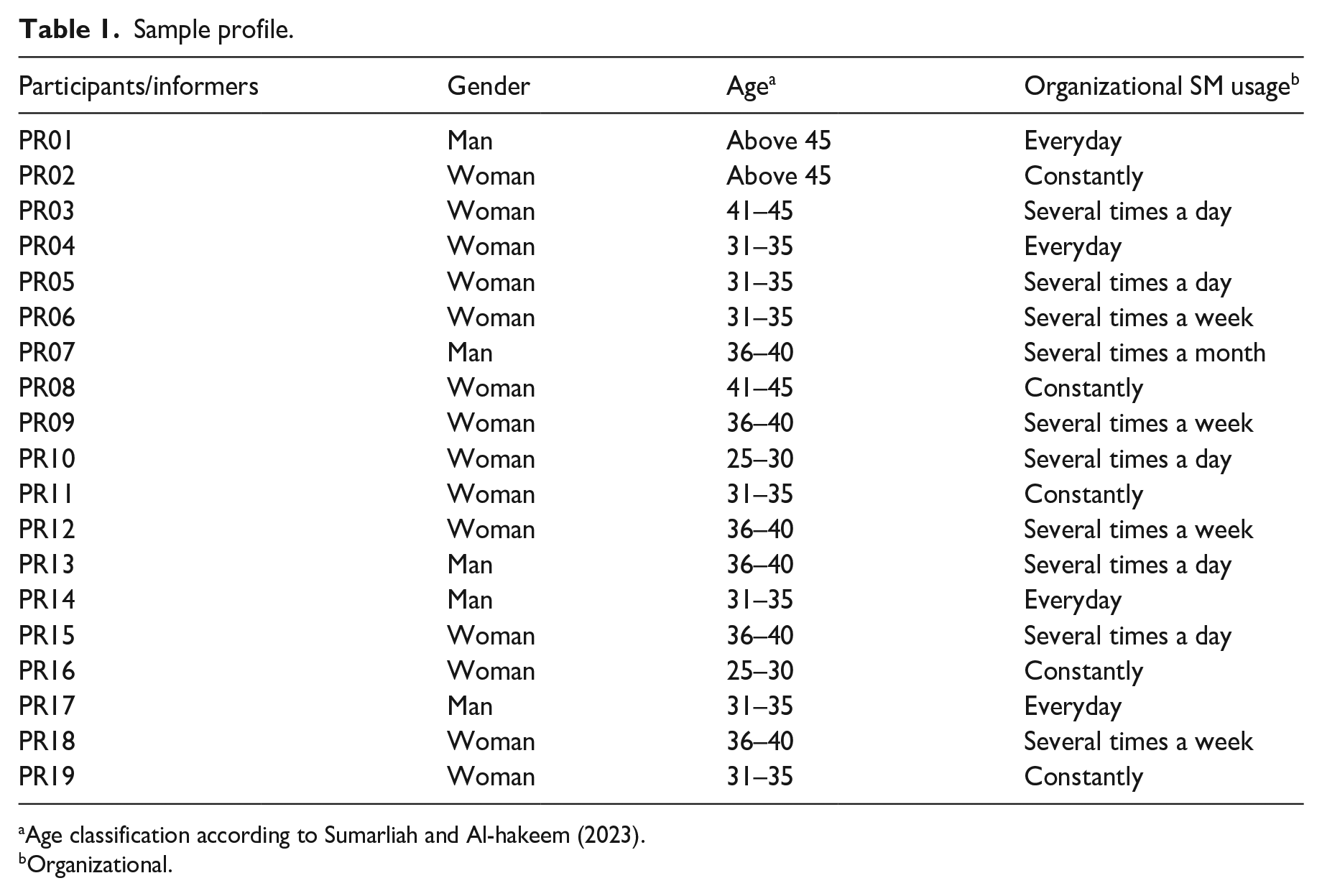
Age classification according to Sumarliah and Al-hakeem (2023).
Organizational.
SM activities as determined by participants in pre-dialogue questionnaires. The seven predetermined options were Constantly, Several Times a Day, Everyday, Several Times a Week, Several Times a Month, Several Times a Year and Never, and participants must select one.
Second, the author held separately 120 minutes interviews with the organizational SM programme team at Kompas Gramedia. The team was made up of 3 to 4 Kompas Gramedia supervisors who were in charge of the organization’s SM platform and worked with the organizational development, strategic planning and organization’s communication divisions. These two encounters took place at various stages of the investigation. The first meeting took place as data gathering was about to come to an end, and the second one followed thorough data analysis. These focus teams were convened to (1) learn more about the organizational objectives and plans for implementing the organizational SM, (2) testify the information gathering and discuss the records with the company’s specialists and (3) describe preliminary study outcomes. We were able to better understand the organization’s ISB culture and the appropriate characteristics of the organization through these project team sessions. The information gathered from worker interviews was reflected using the insights from these talks.
Data gathering
As quantitative studies see a huge data quantity to produce numerical and statistical findings, qualitative research uses a small number of samples (Alam, 2021; Mthuli et al., 2022). The sample in a qualitative study is intended to collect information for identifying the context, difference, difficulty or complexity in an event, rather than demonstrating statistics like in a quantitative study; thus, it is effective with few samples (Alam, 2021). The commonly advised criterion for qualitative studies is gathering information up to a saturation point, that is, attaining the greatest situation of information similarity or redundancy with no additional novel contribution to any useful data for the research (Alam, 2021). Hennink and Kaiser (2022) reviewed the empirical sample sizes in qualitative studies and found that the saturation point can be achieved by interviewing 9 to 17 respondents or 4 to 8 focus groups. Their findings show that a ‘small’ sample size is applicable for qualitative studies as it can attain saturation point.
Other scholars such as Crouch and McKenzie (2006) argued that a sample size below 20 participants can assist in making and maintaining an intimate association hence leading to attentive and open information-sharing. Consequently, for numerous qualitative studies with homogeneous respondents, the appropriate sample size ranges from 15 to 20 individuals (Alam, 2021), 15 to 30 individuals for a case study (Marshall et al., 2013), or even 10 respondents (Sandelowski, 1995). Green and Thorogood (2018) highlighted that the majority of the qualitative studies have used 20 or more participants, and they discovered insignificant novel information and saturation. Thus, this study selected 19 participants for the interview as an appropriate sample size due to the nature of the homogeneous individuals within a case study of one particular media company in Indonesia, that is, Kompas Gramedia company.
Moreover, from the earlier works in the field of communication and organization published by Emerald within the last 3 years, it can be found that scholars have employed sample sizes of below 20 participants in their qualitative studies. For example, Hu and Olivieri (2023) analysed the acceleration of digital communications in Italian firms by conducting a qualitative approach, that is, semi-structured interviews with 13 marketing experts. Camngca et al. (2024) investigated the use of information and communication technology in a South African public sector as a case study using unstructured interviews with 15 workers. Schwaiger et al. (2022) examined organizational resilience using semi-structured interviews with a sample size of seven family business owners in European countries. Antony et al. (2024) explored organizational performance by interviewing 15 senior managers from various organizations and different countries as a method of their qualitative study. Thus, it is suitable for this qualitative study to use a sample size of 19 experts.
The study made usage of two different types of data: (1) transcripts of worker interviews and (2) images, notes and transcriptions of workers’ usage of organizational SM and actual organizational SM posts seen during the interviews. The assertions made by the informers could be contrasted with their real organizational SM behaviour because of the usage of triangulating data sources (such as Bilandzic, 2008) to explore variety in the comparatively restricted datasets. Understanding factors that influence and obstruct workers’ organizational SM ISB was the primary focus of the research, which led to the usage of qualitative interviews as the primary data source. What the informers described was shown and supported by the organizational SM posts.
Qualitative, semi-structured interviews were used to acquire the main dataset for the 19 Kompas Gramedia workers. Using the assistance of the author’s contacts at the company, the interviewees were contacted. The invitation for the informers through emails prior to the interviews, providing them with details regarding the study and the meeting environment and a linkage to brief setting questionnaires. The survey asked pertinent inquiries into demography and the informer’s organizational and personal usage of SM. The author was able to expedite the interview process because to this practice. With the informers’ permission, the author conducted the interviews at their offices and videotaped them. Thirty to ninety minutes were allotted for the interviews. The majority of the interviews lasted 60–90 minutes. The author occasionally had to adjust to the informers’ busy schedules, which resulted in shorter interviews. But for all of the interviews, the author followed the same semi-structured interviewing procedure. Although the complexity and number of follow-up questions for the shorter ones were less detailed than for the longer ones, all major issues were covered.
The interview protocol was divided into two sections: organizational SM evaluations and semi-structured interviews. Questions about job assignments, SM experiences, perceived technical skills and barriers, and organizational SM characteristics, concerns, and goals regarding ISB were all covered in the semi-systematized dialogues. These respondents were invited to examine the organizational SM website after completing the semi-structured process; they visited, discussed their own organizational SM profiles and provided instances of their postings on the website.
The researcher recorded the dialogue and took pictures or notes of the organizational SM posts. With the transcription of all the information, including the photographed postings, 317 sheets of texts containing roughly 7500 words each meeting were produced. These semi-systematized discussions and interviews portion of the organizational SM assessment records, namely the section in which the informer outlined her or his objectives for ISB or general ideas about the platforms, were the focus of the analysis. The actual organizational SM posts were categorized according to content, and their accuracy in capturing the details provided by the interviewees was examined. In general, the organizational SM posts supported and confirmed the informers’ accounts rather than adding fresh insights to the findings.
Data examination
The data from the worker interviews were analysed under the direction of data-driven analysis. It indicates that the examination was the integration of theoretical model and empiric evidence, and that this study constantly aims to deliver clearness and consistency in its illustrative extrapolations (Mantere & Ketokivi, 2013). This procedure includes both theory-guided analysis and data-driven analysis according to the two conceptual frameworks of CCC and technical advantages outlined earlier. We performed the study using the iterative analysis tenets of systematic repetition and recursive switching between the various phases (Tracy, 2013). The qualitative data analysis software Atlas.ti was used to carry out the qualitative encoding. The first author started the analysis, and the second author read it through to ensure validity using peer-debriefing procedures (Lincoln & Guba, 1985). To increase the reliability of the findings, the two researchers collaborated to discuss and resolve the challenging cases.
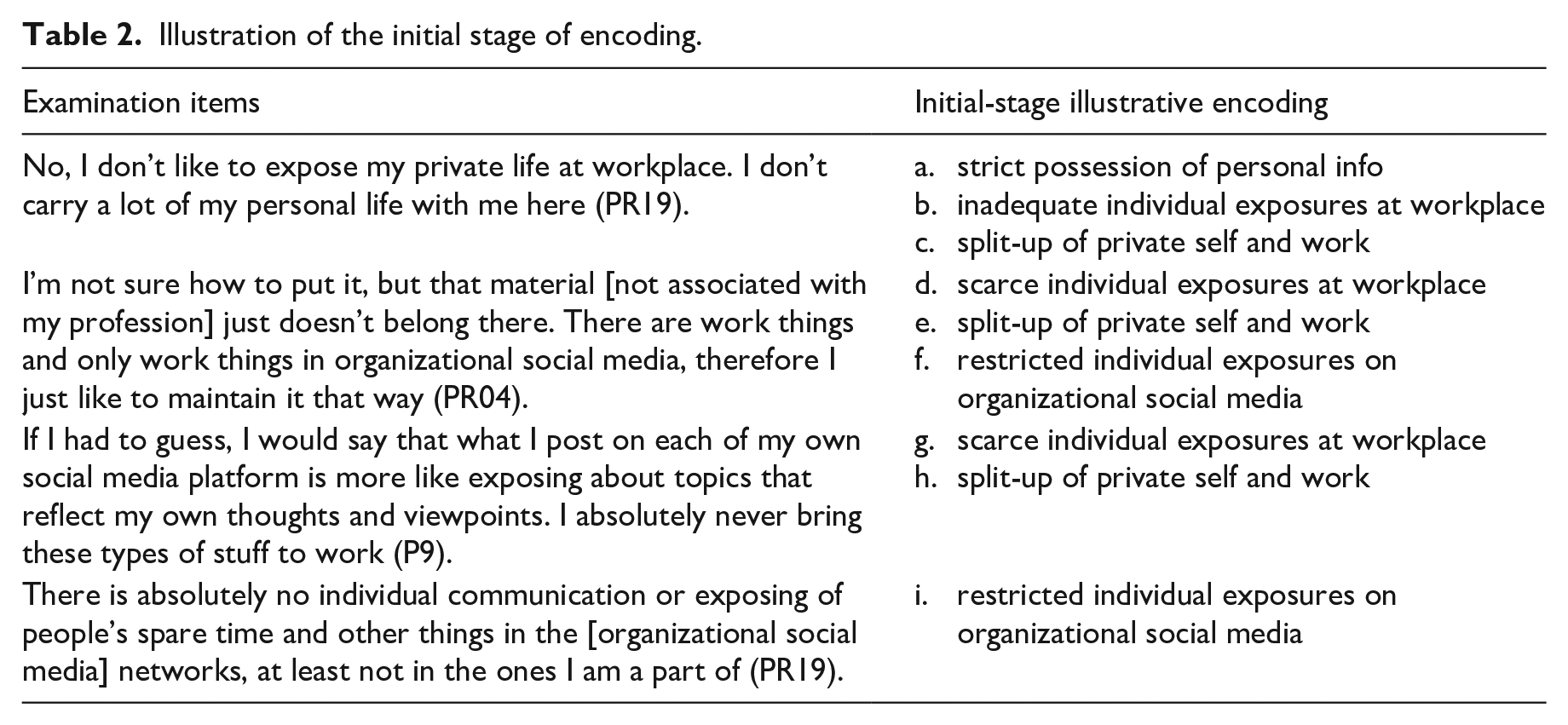
The analysis was done in three steps. First, using the confidentiality control and technical advantage conceptual frameworks and the data, this study examined the recorded information to extract initial illustrative encryptions (Tracy, 2013). The examination began by deducing illustrative encryptions for any words or phrases relating to the usage of technology, knowledge exposing, and organizational exposing of SM. This portion of the initial assessment was entirely abductive. Next, this examination utilized the entire illustrative encryptions and carried on encoding in accordance with the conceptual frameworks, that is, secrecy control values and tactics, and technical advantages, that were selected. The first theoretical-based encryptions linked to advantages and confidentiality control within organizational SM at the end of the initial examination cycle, along with data-based encryptions linked to workers’ ISB on organizational SM (see Table 2).
Illustration of the initial stage of encoding.
The data were assessed for the second time using the reiterative examination and continual relative approaches after the author had reviewed the first encryptions (Strauss & Corbin, 1998). This stage involved revisiting the encryptions, drawing links between them and developing the illustrative categories into second-stage investigative sets (Tracy, 2013). For instance, the second-stage category ‘organisational assignments’ was created from the personal illustrative encryptions ‘postings of information that are associated with job’ and ‘time and assignments limiting organisational SM usage’. The separate encryptions were then integrated and contrasted after the author had discussed the analysis, leading to third-stage conceptualizations that matched the data and the emergent conceptual framework (as seen in Appendix 1).
Next, the study explored more about the features of workers’ ISB on organizational SM and their motivations, tactics and how much technical advantages or confidentiality control goals influenced them in comparison to other elements, such as organizational customs. These findings were also teamed in accordance with the conceptual framework we are developing. One category was created from the data, and two of the final categories were inspired by the conceptual frameworks (see Figure 1). Translations into English were made for the whole data extracts employed in the article to explain the results, and pseudonyms were employed to identify each interviewee.
Results
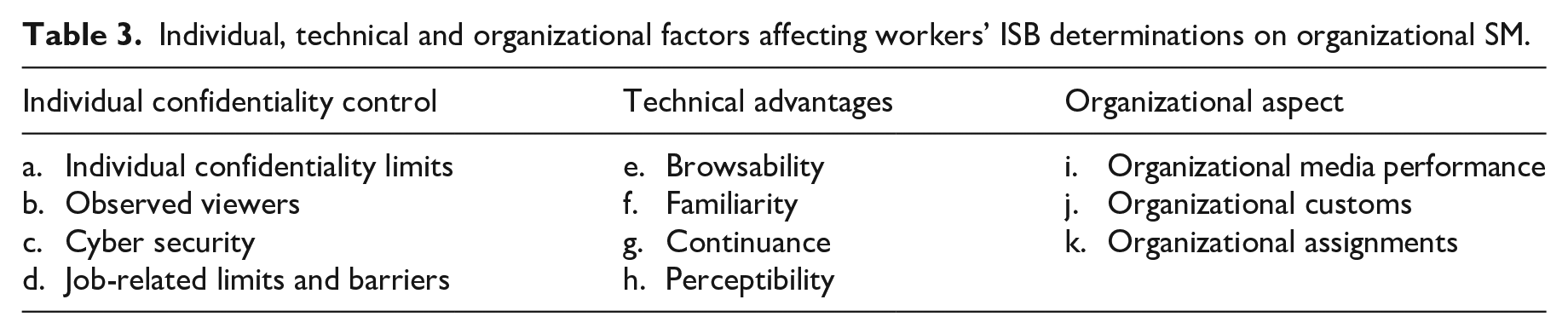
Values of secrecy control, technological advantages and organizational variables all fostered and restricted workers’ knowledge of organizational SM. The findings imply that the three characteristics of individual, technical and organizational can be linked to the workers’ motivations to perform ISB and their observed restraint on ISB on organizational SM (see Table 3).
Individual, technical and organizational factors affecting workers’ ISB determinations on organizational SM.
Individual aspects: drivers and barriers
Through concerns and synchronization on four stages – individual confidentiality frontiers, job-associated limits and barriers, cyber security and observed viewers – confidentiality control values and data confidentiality control shaped the ISB of the workers (see Table 3).
First, workers at Kompas Gramedia explained their individual limits for secrecy as being rather strong; they refused to excessively provide personal data to their colleagues. Thus, ISB was constrained by the rigorous rules governing who might own personal data, which prevented any individual exposures in the workplace. The organizational SM was rarely used by workers to share possession of specific news. The following excerpt serves as an example of how ‘work self’ and ‘private self’ are distinct: Knowing my closest colleagues is plenty for me. I don’t need the entire organisation to be aware of my personality type. I don’t wish to share myself there or on any other SM, including the organisational SM. (PR15)
The information presented on the organizational SM was obviously more issue-focused because to the strong division between job and personal life. As a result, the social networking platform’s potential for building relationships or getting to know colleagues was restricted.
The following paragraph illustrates how restricting individual exposures on organizational SM seems to be a typical confidentiality control approach: You can add a lighter comment, but it must also contain some information that is pertinent. Like Facebook, where you can just write like that and be more social, this is not that. Everything around here is very problem-associated that relationships are not truly the emphasis. (PR13)
Second, the constraints and hazards of professional jobs affected ISB by forcing workers to either carefully analyse the material or refrain from posting at all. Those in managership positions were especially prone to this type of secrecy calculus. PR19 thinks about how her position within the organization affects her ISB and coordination with regard to personal data in the example below: My current role within this organisation has an impact as well, as whatever I type and say. . . this role makes my statements really give an impact; thus, I constantly think about how others might respond [to the postings]. – I continuously must think about my writing very carefully. (PR19)
Similar to this, the following excerpt from the opinions of another team manager on how to maintain stricter frontiers around personal data due to her job function: As a manager, I believe I need to maintain some sort of distance from my subordinates. I can’t be overly honest with everyone in a way that doesn’t feel right. (PR08)
Third, workers also gave thoughtfulness to cyber security. They characterized the organizational SM as ‘vast’ and overly attached to the company that created the platform (Google). They were unaware about whether the company was exposing their personal data with outside parties and how much of it was being documented by the programme makers, as shown by the below passage: Next, certainly, I think about the reality that Google is a global company and that you can never be certain who views everything people post there (PR16).
Because they were worried about ISB on the Cyberspace, this example demonstrates how workers’ individual secrecy control values were severe on organizational SM. Workers at Kompas Gramedia were more worried about secrecy because Google ran the company’s SM platform. Although the organizational SM enables the confidentiality setting to be altered, it is interesting to note that the workers rarely mentioned them as part of their routines for maintaining secrecy. The main confidentiality control methods involved holding back personal data and paying close attention to the content. PR16 stated the following in describing the absence of demand for confidentiality backgrounds: Because the organisational SM is intended for discussing job-associated information, there is no confidentiality setting here. Naturally, since the material I post here is designed to be publicized, I cannot restrict it to just my two closest friends. (PR16)
Fourth, choices to give or hide information about the organizational SM were linked to perceptions of the viewers. Different types of teams were incorporated in the organizational SM platform. ISB was viewed differently according to the viewpoint of the team. Job-associated teams were incline to have higher activities and viewer-driven content than the general feed, which is material that is crucial for the team members. These teams often consisted of small teams of people.
Specifically in terms of one’s own beliefs and perspectives, entertaining teams were thought to convey more private data than expert organizations. One of the respondents provided the following example to demonstrate this: Many of our teams are solely concerned with work and professions, and communication is closely associated with jobs and office-related assignments. However, teams such as discussions or social gatherings also exist. I believe that the conversation will be more open and controversial in these teams. Members are capable of definitely expressing their own opinions and raise questions in those discussion-style teams. (PR19)
For worker’s ISB, the diversity and nature of the viewers occasionally presented hazards and uncertainties. These hazards included providing inappropriate or excessive content from a reputable expert role, disclosing excessive personal data to many viewers, being misinterpreted or expressing tough beliefs that can have a negative impact on one’s career. The next two instances serve as illustrations of these: If the knowledge is received by a large team that people are unaware of. If too many people unexpectedly gain access to something that was intended to be private knowledge. (PR19) Okay, one problem is that by publishing, as if we create a picture of ourselves, and we by no means recognize how other people may interpret or understand what you said. Given that people interpret things so differently, I would exercise extreme caution in that regard. (PR01)
It was discovered that the exchanged messages’ content influenced ISB in accordance with confidentiality control rules. Workers inside the organizational SM took into account their own personal confidentiality frontiers, the obligations associated with professional duties, the reality of cyber security and a general anxiety about the viewers.
Moreover, generational differences significantly shape employees’ utilization and perceptions of SM for internal communication within organizations. Baby Boomers, born between 1946 and 1964, may prefer traditional communication channels like emails or face-to-face interactions, viewing SM as less formal and potentially disruptive. Generation X, born from 1965 to 1980, adapts to various communication tools but might prioritize privacy on SM. Millennials, born between 1981 and 1996, comfortably embrace SM for real-time communication, considering it a natural and efficient way to connect. Generation Z, born from 1997 to 2012, is highly tech-savvy and perceives SM as integral to work life, fostering collaboration and innovation.
To address these generational discrepancies, organizations can implement strategies such as providing training on internal SM platforms, offering a mix of communication channels to cater to diverse preferences and showcasing leadership endorsement of these tools. Encouraging cross-generational collaboration and mentorship fosters knowledge-sharing, while flexible communication policies accommodate various comfort levels. Continuous improvement through feedback channels and an emphasis on common organizational goals unites employees across generations. By embracing diversity, encouraging adaptability and leveraging each generation’s strengths, organizations can cultivate a more inclusive and effective internal communication environment.
Technical aspect: drivers and barriers
The behaviour and attitudes towards the organizational SM were both explained in terms of technical advantages. Perceptibility, familiarity, continuance, and browsability were determined to be the most significant advantages that organizational SM provide for workers.
First, it seemed that the advantage of perceptibility explained ISB in two conflicting ways. When discussing information associated with a job, perceptibility was viewed as a motivator because this type of news was typically put on the organizational SM to get as many viewers as achievable. Nevertheless, perceptibility was also thought about to be a barrier to ISB, particularly when it came to personal data. The majority of workers claimed that when choosing what to post, information perceptibility is a key factor. Workers were generally hesitant to submit any private information since they weren’t aware how visible the information they shared was. The snippet that follows demonstrates perceptibility as a restriction: Similar to how I can pretty much control who sees my posts in a private team on Facebook, I can also only partially control who sees my posts on our platform. (PR09)
The ability to go along and connect with various elements of the organizations was seen as another advantage of familiarity-supported ISB as the organizational SM. When viewed in this light, the organizational SM was viewed favourably since it was presented as an instrument for comprehending the events in the organization. The organizational SM, according to workers, helped them ‘ become familiar with’ or ‘be conscious’ of problems occurring in different areas of the company. As the feature was significant to them, it boosted their desire to communicate.
Third, the advantage of continuance was regarded as a crucial element in the availability of news and ISB associated with jobs. However, information that was available on the site for a long time caused people to be more wary of specific ISB. The following passage from PR03 describes her preference for conversation across the organizational SM team due to the info’s continuance: Because info is shared more widely and is accessible for a longer period of time on [organisational SM] teams, it is simpler to post something for everyone to view in those [chat teams]. (PR03)
The chat system let staff members manage information continuance, reducing the bar for less formal content. Due to the platform’s design and information continuance, it was also felt that there was a lot of information on the organizational SM platform overall. This had a big impact on how workers decided on ISB. It was assumed that any new information publicized on the organizational SM would be helpful to the organization because it was believed that all new content would just add to the already excessive amount of information. This is demonstrated in the scenario that follows, in which a worker discusses the effects of information continuance associated with the volume of info: When someone wants to post their vacation photos, go ahead, who am I to judge? However, I still believe that focusing on topics associated with jobs would be beneficial. Since there is essentially no limit to the amount of information available today, if it is spread any further, no one will read it. (PR14)
Fourth, the advantage of browsability turned out to be quite important in describing users’ ISB on the site. One of the most significant ways workers used the organizational SM was to get result information associated with their task. However, the platform’s search function was thought to be unclear and badly built, as shown by the sample below: Even though it ought to be a good search engine by this point, it isn’t since it can’t recognize certain language conjugations or something similar in [workers’ native languages]. I should put in many endeavours [to look for the paper] if I am unable to recall if a word in the document’s title was written one way or another. (PR16)
The reality that users saw the advantage of browsability as being of great value but that the real browse capability fell short of their expectations appeared to blatantly dissuade ISB on the organizational SM platform.
Organizational aspect: drivers and barriers
We discovered three organization-related elements influencing workers’ ISB on the organizational SM in addition to confidentiality values and technical advantages: (1) organizational customs, (2) organizational assignments and (3) organizational media performance (as seen in Table 3). Organizational SM are an extension of the organization; as a result, worker thoughts about what is appropriate to share are shaped by organizational conventions. Workers used the excuses ‘Nobody else shares either’ or ‘That is what other people also do’ to rationalize their ISBs. This indicates how workers viewed both the institutional logics for using the organizational SM and the methods in which other organizational members used the platform. The organizational-stage custom of how the organizational SM should be used was developed by these interpretations. Both the workers’ justifications for their posts and the organizational SM posts made reference to this custom. The following extract demonstrates how organizational customs in the usage of the organizational SM are also visible in the portrayals of anticipated organizational SM subject: There aren’t any personal problems there, thus I don’t believe anyone shares anything there. It is not like Facebook, where you may post things like, ‘I had a salad for lunch’. It is more like a career-related information channel, which is how I believe it should be. Then, for leisure time, there are Facebooks, Twitters, and Instagrams. (PR04)
The expectations about how ISB on organizational SM should appear were influenced by organizational customs. In contrast to ‘cat videos’, assignment-related, formal content was chosen, as shown in the following excerpt: Obviously, you must behave responsibly because this is the inner channel of this type of workplace. I would say, ‘Whatever’, if someone publicized kitten videos, but it would ultimately be removed from the stream associated with my employment. (PR14)
This extract demonstrates how exposing and receiving confidential or individual information was occasionally viewed as a risk. Because the platforms were organizational, posts associated with jobs were favoured. However, this made the networking and social features of the SM less prominent.
In addition, workers’ organizational SM posts revealed organizational traditions. The majority of those postings associated with workers’ training course involvements, viewpoints on job-associated issues, out-of-workplace memos and compliments from trips associated with their jobs. Workers occasionally also uploaded a little more individual data, like pictures from colleagues’ anniversary parties. However, the workers described all of this material as being purely professional. Since workers use the organizational SM to present their ‘professional selves’, exposing news about everything outside job-associated subjects was viewed negatively. PR05 in the following excerpt provides an example of this: These kinds of job roles are played with [on the organisational SM]. Nobody, in my opinion, goes there for personal reasons; everything there is about work. It is the job function that you discuss and utilize to act [on the organisational SM]. (PR05)
Examining actual organizational SM posts made this even more clear. The following two postings from Kompas Gramedia’ organizational SM platform demonstrate how the favoured material was heavily job-associated, delivering instructions and job-related news or the community’s rubrics: All of this division’s vehicles and registrations have now been transferred to the online platform. Schedules are no longer available in the office, and reservations for automobiles are currently only accepted online. If you need assistance making a booking, ask Putra or Dessy. (PR08 published an organisational SM post) Welcome to the Video neighbourhood. You may get up-to-date information and advice regarding Kompas Gramedia’s audiovisual content (online programs, clips, work materials, TV shows), and about their content explanations and filing, in this group. Anyone can ask questions and engage in conversations around content narratives and issues associated with archiving in this forum. (PR19 published an SM for the organisation).
These kinds of customized posts helped shape the posts made by other users on the organizational SM and in the same community. With the exception of teams for amusement, the majority of team posts were primarily composed of informational messages about jobs. Questions and requests for assistance on issues associated with jobs made up other, more significant types of posts.
The second important motivating reason for information exchange on organizational SM was organizational assignments. According to those who participated in the interviews, the publicized news needed to be pertinent or valuable to the viewers or other group participants. The usefulness was typically described as thing that should be communicated to complete a task at work. For instance, workers in a remote team frequently used organizational SM to submit a problem they wanted the entire team to solve. In addition, workers in managership roles believed that exposing information was a requirement of their jobs. When workers thought about their choices to post something on the organizational SM, these expectations associated with the task were frequently evident. Both ‘It is included in my work’ and ‘I should do it to let other people know my field of duty’ were used to characterize these motivations.
The workers’ enormous quantity of work assignments was another assignment-related, but restricting, factor that was associated with ISB among workers. This ‘busyness’ made it difficult to post on the official SM. According to a worker in charge of the production and acquisition of supports for TV and film backgrounds, the deadline is below: Although it would take time, I can create an improved summary and note down my abilities and other things. In order to reserve time specifically for it, there would essentially need to be a shift without anything else. (PR09)
Last but not least, ISB on the organizational stage was also correlated with organizational media performance. Two things served as proof of this. First, a scarce proficiency in using the organization’s organizational SM prohibited workers from exchanging information there and encouraged them to do so on other, even non-organizational (such as publicly accessible SM), platforms. According to one informer, the organizational SM has the following difficulties: I often want to select different, simpler and faster method to tell other people when I firstly should understand how to share before really sharing (PR12).
The workers chose to express the pertinent issue using other, more established technologies as a result of their scarce expertise with organizational SM. Numerous workers also stated that they would need time to research the platform’s numerous prospective uses and that their regular work schedules did not permit them to do so.
Second, workers believed that several boards used by the entire organization were more comfortable and logical for ISB. At Kompas Gramedia, face-to-face interaction, email, and team chat (Google Hangouts) were cited as excellent means to exchange more flexible and even individualized information. For instance, the capacity to communicate just with a select few persons one knows was used to justify this preference: To me, [the organisational SM] doesn’t feel like a natural setting. Email communication with persons I know and wish to convey my information to feels more natural to me. (PR09)
The existence of additional organizational communication technologies demonstrated that there was a structure inside the organization that restricted the ISB on organizational SM and directed it to these alternative channels. In addition, the organization’s policy for exposing information was not sufficiently clear, which allowed staff to rely on their personal preferences.
Impact of workers’ ISB on their external ISB
As mentioned earlier, the ISB among workers can cause strong internal relations as it leads to better communication, teamwork and collaboration (Ardill, 2023). It is because sharing knowledge and information will help with clarity, making sure that all parties understand what is happening and building trust as workers realize their workmates are open and willing to cooperate and share their knowledge (Ardill, 2023). Strong internal relations will immediately cause better external relations (Introhive, 2024), that is, organization-public relations. PR11 stated clearly the following explanation to justify this argument: When the relationship between fellow employees is well established by providing information openly to each other, then I think they will automatically have a kind of team pride that will eventually be voiced to parties outside the company, for example to friends or the public on social media, that this company is good, the work team is good, the products are good, and if there are complaints from customers, automatically the proud employees will try to defend their team and their company and give a good image of the company to the public. (PR11 in an interview)
Meanwhile, a poor knowledge-sharing and internal relation within the organization will harm organizational development and subsequently relations with clients (Introhive, 2024) and other strategic publics. PR17 gave the following statements to justify this argument: Unsolid relationships between fellow employees and lack of information sharing within the organization will reduce mutual trust within the team and employee loyalty to the company so that there can be efforts by employees to ‘badmouth’ their work team or about their company’s business (products and services) to the wider public. This is dangerous if employees have posted negative things about the company because this will not only negatively impact the company’s image but also put them at risk of losing their jobs. (PR17 in an interview)
These interview results revealed that a strong and positive ISB among workers within the organization will lead to strong and positive external ISB performance. This implies that internal ISB will motivate workers to perform external ISB, that is, to voluntarily share information about positive aspects of the organization and its business.
Discussion
Following Zulfiqar et al. (2019) and (Kholaif et al., 2023) the results demonstrate the complex interplay of individual, technical and organizational factors in shaping workers’ knowledge and behaviours related to ISB on organizational SM. The findings provide valuable insights into the multifaceted nature of information-sharing dynamics within organizational contexts. To address the question of employee willingness to contribute information on internal SM platforms concerning the connection of organizational aims and personal ambitions, the study’s results suggest came align with (Kholaif et al., 2023) that workers’ decisions to share information are influenced by a combination of individual, technical and organizational factors. The alignment of information with organizational customs and relevance to tasks at work are key considerations, indicating that employees are more willing to contribute information that aligns with organizational aims and expectations associated with their roles. The study underscores the importance of understanding the complex interplay of these factors in shaping information-sharing dynamics within organizational contexts, providing valuable insights for organizations seeking to optimize internal SM platforms.
In addition, this study shows how implementing a comprehensive rewards and recognition system for knowledge-sharing on internal SM platforms yields multifaceted benefits for organizations (Dwivedi et al., 2023). This approach stimulates increased participation as employees are motivated by the prospect of acknowledgement and rewards, fostering a positive work environment and elevating overall employee morale (Kietzmann et al., 2011). The initiative contributes to the development of a pervasive knowledge-sharing culture, where insights and best practices are freely exchanged, creating a collaborative atmosphere. Peer-to-peer recognition on SM platforms reinforces a sense of community and teamwork, complementing formal recognition (Leonardi et al., 2013). The intrinsic motivation derived from contributing meaningful knowledge, combined with external rewards, ensures a balanced approach that sustains consistent employee engagement. Recognized employees exhibit higher loyalty and retention rates, and the overall quality of contributions improves as employees strive for thoughtful and valuable insights (Frampton & Child, 2013). Introducing friendly competitions and gamification elements introduces a competitive spirit, making knowledge-sharing more engaging, and openness to skill development is promoted. Leadership involvement sets a positive example, emphasizing the strategic importance of knowledge-sharing in organizational culture, and regular recognition fosters continuous improvement through adaptive knowledge-sharing approaches. In conclusion, a robust rewards and recognition system significantly enhances the knowledge-sharing culture, contributing to organizational development and employee engagement.
Moreover, effectively addressing employee apprehension about the negative effects of sharing information on SM requires a multifaceted approach rooted in communication, education and organizational culture. Establishing clear communication policies is essential, providing guidelines on permissible content and consequences for policy violations. Regular training programmes can equip employees with the knowledge needed for responsible SM use, emphasizing the representation of the company online and the potential consequences of inappropriate posts (Frampton & Child, 2013). Highlighting success stories of employees who have positively utilized SM for professional growth can serve as inspiration and showcase the benefits of responsible online engagement. In addition, addressing privacy concerns, encouraging thoughtful posting and developing response protocols for negative feedback contribute to creating a supportive environment.
Fostering a positive organizational culture that values open communication, innovation, and employee contributions is crucial. Building trust within the organization ensures that employees feel secure in engaging positively on SM without fear of repercussions (Nusrat et al., 2021). Monitoring and promptly addressing employee concerns, celebrating instances of positive advocacy, providing practical SM guidelines and creating a supportive environment for professional development collectively contribute to mitigating apprehension. By striking a balance between responsible use and leveraging SM for organizational success, businesses can create a culture where employees feel confident and empowered in their online interactions.
Furthermore, the impact of organizational culture and hierarchy on employees’ willingness to share information on internal SM platforms is considerable (Kholaif et al., 2023). Organizational culture, encompassing norms, values, risk aversion, information ownership and communication style, significantly influences employees’ behaviour. Cultures that prioritize privacy, discourage risk-taking, instil a sense of information ownership and enforce a top-down communication style may create an environment where employees are hesitant to engage in open sharing on SM. On the other hand, following Zulfiqar et al. (2019) and Kholaif et al. (2023), organizational hierarchy introduces power dynamics, fear of judgement, approval processes and preferred communication channels that can impede the free flow of information. Lower-ranking employees may be reluctant to share with higher-ups, fearing repercussions and formal approval processes may slow down information dissemination.
The combined impact of organizational culture and hierarchy reveals that alignment with technology, innovation, creativity and organizational trust are crucial factors. A culture that aligns with the collaborative nature of SM and fosters innovation is more likely to facilitate information-sharing (Zulfiqar et al., 2019). Conversely, a hierarchical culture may stifle creativity and hinder the adoption of open communication platforms. The level of organizational trust is influenced by both culture and hierarchy, with a trusting culture encouraging free information-sharing and a lack of trust leading to information hoarding. In conclusion, organizations fostering openness, transparency and collaboration, coupled with a more flattened hierarchy, are better positioned to overcome obstacles and promote effective information-sharing on internal SM platforms.
Moreover, following Ardill (2023) and Introhive (2024), this study argued that the ISB among workers can cause strong internal relations as it leads to better communication, teamwork and collaboration, and the strong internal relations will immediately cause better external relations, that is, the relations between the organization and the public. The findings revealed that positive and strong ISB among workers will strengthen their trust and loyalty towards the team and company and increase their external ISB, that is, their willingness to share information about the positive elements of their companies and businesses with the broader public (customers, stakeholders and other strategic publics), especially using SM.
Theoretical contributions
This study demonstrates that three factors, including individual (confidentiality control), technical (advantages) and organizational (customs and routines), influenced workers’ knowledge of organizational SM. We offer a framework (see Figure 1) of the links between the three characteristics to create an even more thorough understanding of the factors influencing workers’ ISB. The chart also shows which categories appear to be drivers of workers’ ISB on organizational SM (plus) and which appear to be barriers of those ISB on SM (minus). We then go into further detail about these linkages and contributions.
This study employs two theories – CCC and technical advantages – to direct the analysis and explain our findings. We can link some of the categories that are produced as a result of the study to these theories. Two significant connections were discovered: (1) the individual and technical aspects are related via workers’ observations of viewers and the advantages of perceptibility and familiarity; and (2) the individual and technical aspects are also related via individual confidentiality frontiers that are associated with the observed advantages of perceptibility and continuance.
First, organizational SM will be viewed as one of accountability technologies (Treem, 2015). This phrase refers to how organizational SM promote worker accountability by making communication accessible to all organization members. The feeling of responsibility may create doubts to workers in using SM from an organization’s standpoint, which may affect their knowledge-based strategies. Our findings are consistent with this viewpoint, as workers stated concerns about ISB depending on the potential audience for their posts or the information’s perceptibility. As a result, there is a link between the advantages of perceptibility and the worker’s perspective of the potential viewers. On the one hand, higher knowledge of organizational operations may result from the information’s perceptibility. When the viewers are appropriate for the content, it is highly desired and promotes ISB. The advantage of perceptibility, on the other hand, might operate as a restriction on utilizing organizational SM and promote the usage of alternative organizational interaction channels if a worker doubts the viewers and the content she or he plans to share.
Second, the perceived advantages of information perceptibility and continuance are constrained by the bounds of personal secrecy. The likelihood of extensive information perceptibility and long post-persistency can make people hesitate before putting anything on the organizational SM because workers often have very stringent confidentiality frontiers at workplace and prefer to have an unconnected ‘self-job’ space. Personal data was therefore communicated face-to-face or through more targeted contact channels (like chat or email).
Generally, this study’s outcomes are consistent with the paradigm of ISB in organizations described in Lin’s (2007) study. The three criteria that are in the vein of our results were seen as driving factors in their job. This work adds three new dimensions to this framework. First, the research thinks about both enabling and restricting elements that affect workers’ knowledge systems. Second, to further explain the elements identified by the research, this study integrates relational and technical theories. Third, this study adds a new element of external ISB to see how internal ISB may have an impact on the external ISB, that is, workers’ eagerness to voluntarily share information about the positive elements of their companies and businesses with the broader public (customers, stakeholders and other strategic publics). The combination of these factors within a hypothetical framework have never been done by earlier researchers.
Practical contributions
The research’s findings can be applied at various stages of an organization’s SM adoption. The findings suggest that if stronger ISB is anticipated, it is necessary to take into account organizational cultures and routines and technical advantages and secrecy control rules. These findings necessitate two different types of managerial thoughtfulness. Both these ideas are in line with the findings of our study, which involved the implementation of the novel in-house messaging platforms in a conventional company that had formerly depended on vertically communicating procedures and in which the workers had not produced the in-house organizational message content.
While adopting the organizational SM, the goal needs to be prudently thought about and made clear to the workers. Workers will pick other tools to utilize if managerial aims for organizational SM are at odds with how the platform is perceived by the workforce. In addition, workers are more inclined to view the platforms as additional thing instead of a regular communication tool if the goal is not made obvious to them. It is critical to have clear regulations and procedures in place that influence communication practices in addition to explicitly communicating the aim. Workers will feel more unclear and concerned regarding content-associated interests, like as confidentiality, if there are no clear-cut restrictions on the type of information that is appropriate to share on organizational SM.
This is particularly crucial to take into account in traditional organizations, like Kompas Gramedia, which deployed organizational SM following a prolonged chronicle of intra-web system in the type of bulletin boards that were primarily utilized for ISB from the top down. Workers will view societal intra-webs that depend on contribution as a voluntary or supplementary component of the office if they believe that such use is the only way to utilize intranets and should be the only way. In addition, given the short amount of time that workers have at their disposal and the importance of organizational elements associated with their assignments, any uncertainty may lead workers to choose a different, more convenient method of ISB.
Second, managers must take into account the organizational and individual factors that influence workers’ choices to share or refrain from posting altogether if an organization wants to use organizational SM to increase the amount of ISB or the number of workers who actively use the platform. For instance, organizations should make sure that the organizational SM platform allows users to control information perceptibility because perceptibility elements in the research showed to be crucial in respect to confidentiality. This would entail, among other things, the ability to manage who sees each post and to raise understanding of team memberships by making members of each team readily available to all users. Worker limits associated with their assignments and positions need to be regarded from an organizational standpoint. If more organizational SM positions are needed, these initiatives should be carefully integrated into the tasks given to workers. The platform can be used more often just by giving workers chances to discover the organizational SM and its features or revise their summaries. If the organizational SM system is introduced in a company where workers have not previously produced material for the internal communication systems, these problems are once again brought to light.
Moreover, companies should be aware of challenges in fostering ISB on internal SM. According to Vukušić Rukavina et al. (2021), there are three most typical challenges in internal SM platforms that may prevent staff members from posting content: (1) security concern when sharing individual information, that is, the risk of inability to protect the data of customers/stakeholders, (2) the risk of the leakage of private customers/stakeholder’ data such as transaction files, password, credit card data and confidential information regarding unreleased service/product that may dwell in SM chats and (3) the risk of being involved in improper workers’ conversation, cyber bullying and harassment as conversation within internal SM platform is lack of physical and verbal hints at the office and thus miscommunications of intention and tone can be usual.
Leadership plays a vital part in encouraging an SM culture of ISB among staff members. According to Xcelerate (2023), leaders can foster ISB by: (1) providing important tools and facilities to enable information-sharing practices like collaboration platform and information depositories, (2) establishing rules and procedures that appreciate and recompense information-sharing endeavours, hence motivating workers to enthusiastically join in ISB activities, (3) nurturing an atmosphere of psychological safety and trust, which are essential for successful ISB practices at workplace by giving workers a sense of safety in expressing opinions, communicating their skills and learning others’ knowledge with no anxiety of being judged and (4) promoting respect, transparency and openness to build an environment in which workers are at ease sharing information, causing enhanced problem-solving ability and creativity (Xcelerate, 2023). Similarly, Al-Husseini et al. (2021) argued that leaders can encourage and foster the culture of ISB via ideal encouragement by implanting respect and admiration, as well as boosting psychological empowerment, communication and commitment.
Tactics or best practices that businesses can use to foster a more welcoming and inclusive online community for information-sharing are depend on the type of companies. According to Khando et al. (2021), for private companies (like the sample in this study), the tactics are as follows:
(a) Increase information security awareness (ISA) among workers that can enhance ISB among workers in private companies, such as management support, information security governance (independent unit/department for information security), ICT-knowledge (typical knowledge regarding fundamental ICT usages), training and education and information security policies.
(b) Encourage workers to perform the actions of openness, shareability and autonomy towards their colleagues.
(c) Build the culture of information-sharing on the internal SM platforms as cultural setting affect perception about security.
Some examples of effective tactics or programmes that have increased workers’ information-sharing on organizational SM are: (1) InfoSecure, an interactive game to increase information-sharing awareness for health workers – it has been proven to enhance ISA after playing it by knowing some issues like password protection, malicious codes, web usage and phishing (Ghazvini & Shukur, 2018); (2) Bitrix24’s and Smarp, two apps that can keep workers informed with the newest firms’ information and distributed content and help them perform ISB to colleagues within the network (Englander, 2018) and (3) LSTM-integrated Hyperledger Fabric 2.0, a permissioned blockchain using descriptive captioning, video and audio is a useful device to combat fake news in SM platforms (Chan et al., 2020). According to Etemadi et al. (2022), other general methods to enhance SM usage for ISB are: (1) selecting the proper SM platforms according to these conditions: least uncertainty, content-sharing capacity, practicality, and availability; (2) providing realistic suggestions to solve uncertainty; (3) employing truthful instruments, crowdsourced quality evaluation, encouragement of group behaviours and experimental learning and (4) measuring the SM operation outcomes and optimizing the SM usage.
Furthermore, this study’s findings support the empirical evidence by Ara et al. (2022), which reported that awareness about privacy strongly affects trust on using SM platforms, which subsequently influences willingness to share information. Meanwhile, concerns about security negatively affects the willingness to share information. Thus, to foster ISB on organizational SM, companies should find a way to develop trusts among workers by increasing their awareness about privacy and security; for example, by hiring a trustworthy service provider for securing SM usage by company workers.
Finally, this study’s findings revealed that positive and strong ISB among workers will strengthen their trust and loyalty towards the team and company and increase their external ISB, that is, their willingness to share information about the positive elements of their companies and businesses with the broader public (customers, stakeholders and other strategic publics), especially using SM. Thus, companies and managers should encourage workers to perform ISB on organizational SM and motivate them to share positive postings that can strengthen internal relations among workers and boost team pride so that these workers will subsequently become volunteers who speak out to the broader public regarding the good side of the company that can enhance company’s reputation and attract more and more customers.
Conclusion, limitations and upcoming studies
Conclusion
Three categories: individual, technical and organizational can be used to describe the elements influencing workers’ knowledge of organizational SM. Four different confidentiality control values influence how workers share information. Workers take into account their personal and job-associated confidentiality limits and cyber security and perceived viewers. In the organizational SM perspective, the technical advantages of perceptibility, familiarity, continuance and browsability are the most significant advantages that influence workers’ ISB in a variety of, sometimes even contradictory, ways. ISB on organizational SM is also influenced by organizational norms, organizational assignments and how other organizational media are used. These are the three main factors, according to our findings, that influence workers’ choices on whether or not to share information on organizational SM. The study adds to the body of work on organizational SM and integrates the theoretical stances on CCC and technical advantages. To improve understanding on how the individual, technical and organizational characteristics are existent in different technical, cultural and organizational perspectives, more research is needed.
Limitations and upcoming studies
The results could be influenced by organizational and country culture since this study’s data are according to only a single company. Interesting features of organization’s values are introduced with reference to both the substance of organizational SM posts and workers’ choices to perform or not perform ISBB. One sign of Kompas Gramedia’ distinctive organizational culture was the frequently stated willingness to preserve communications, particularly on the organizational social network, very much job-associated; in some cases, individual data were even viewed as a risk to exposing and getting job-associated news. Furthermore, ISB was substantially shaped by their professional duties at Kompas Gramedia. This might also be a feature of the way that supervisors are seen within the organization. Because of this, the workers in these positions take extra caution while handling the content of their posts.
The importance of national culture must be taken into account while discussing organizational culture. Workers at Kompas Gramedia demonstrated a readiness to segregate their personal and professional lives, even going so far as to distinguish between their selves at workplace (the job person) and at family (the leisure person). The domestic values of the workers of this large Indonesian company might also be used to explain this, even though it may be an example of organizational culture. The great value placed on keeping work and play separate in Indonesian societies (e.g., Wieland, 2011) may possibly have an impact on the findings of this study.
Further empirical study in the future may address the two-face character of the advantages of perceptibility and continuance, that is, how advantages are instantaneously regarded as drives and impediments. Similar to this, greater study is needed on the differences among ISB cultures, such as what constitutes information about organizational SM that should be shared in various country and organizational cultures. To gain a greater familiarity of the issue, it is important to study the framework we offer in the research from many angles and within various organizations.
Footnotes
Appendix 1
Encoding of the questionnaire feedbacks.
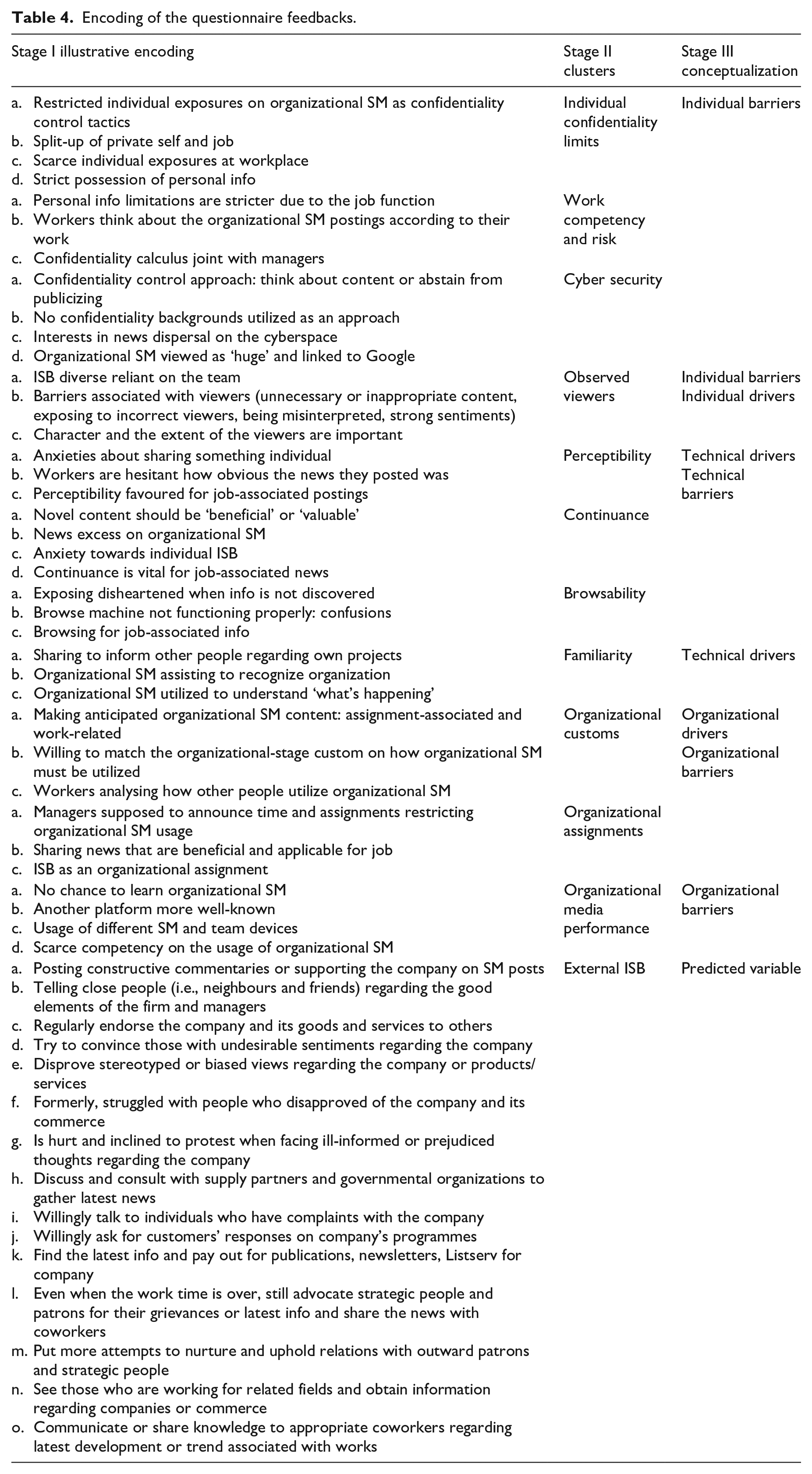
| Stage I illustrative encoding | Stage II clusters | Stage III conceptualization |
|---|---|---|
| a. Restricted individual exposures on organizational SM as confidentiality control tactics b. Split-up of private self and job c. Scarce individual exposures at workplace d. Strict possession of personal info |
Individual confidentiality limits | Individual barriers |
| a. Personal info limitations are stricter due to the job function b. Workers think about the organizational SM postings according to their work c. Confidentiality calculus joint with managers |
Work competency and risk | |
| a. Confidentiality control approach: think about content or abstain from publicizing |
Cyber security | |
| a. ISB diverse reliant on the team |
Observed viewers | Individual barriers |
| a. Anxieties about sharing something individual |
Perceptibility | Technical drivers |
| a. Novel content should be ‘beneficial’ or ‘valuable’ |
Continuance | |
| a. Exposing disheartened when info is not discovered |
Browsability | |
| a. Sharing to inform other people regarding own projects |
Familiarity | Technical drivers |
| a. Making anticipated organizational SM content: assignment-associated and work-related |
Organizational customs | Organizational drivers |
| a. Managers supposed to announce time and assignments restricting organizational SM usage |
Organizational assignments | |
| a. No chance to learn organizational SM |
Organizational media performance | Organizational barriers |
| a. Posting constructive commentaries or supporting the company on SM posts |
External ISB | Predicted variable |

Data availability
The data underlying this paper will be informed on reasonable demand to the corresponding author.