



Abstract
Since the 2008 US Presidential election, the salience of Twitter in political discourse has been apparent. Donald Trump revolutionized presidential communication through his use of Twitter by communicating to narrow audiences, which are difficult to reach with traditional communication channels. Although now back on the platform, his controversial tweets were subject to widespread scrutiny and eventually led to him being permanently banned from Twitter. Due to Trump’s status as a political elite, it is essential to examine his rhetoric’s morality as public elites have the power to shape public opinion. However, existing literature on morality and presidential communication does not offer an analysis of whether moral disengagement is used by presidents on new media platforms such as Twitter. This study employs quantitative content analysis to explore the use of moral disengagement mechanisms as a communicative tool by Trump approximately 3 months before the 2020 US Presidential election. Our analysis found that at least one moral disengagement strategy was present in Trump’s tweets 45% of the time, with attack being the most commonly used strategy. Moral disengagement mechanisms were used most commonly when other politicians, election/voting, or news was mentioned. Overall, based on an index that we created, a low level of moral disengagement was used.
Introduction
Social media platforms have become a useful tool for political candidates during election campaigns. For instance, pundits and scholars have argued that Donald Trump’s use of social media was a key factor in his victory (Potts, 2017; Wells et al., 2016). 1 In fact, Trump himself attributed his victory to his messaging on Twitter by claiming to maintain an honest, authentic presence compared with the media and other politicians (Clarke & Grieve, 2019). However, Trump’s use of Twitter was controversial and led to a violent insurrection of the US Capitol on January 6, 2021. As a result, he was banned from the platform (Twitter, 2021). Although his ban was reversed following Elon Musk’s takeover of the platform, Trump’s controversial and aggressive tweets raise questions regarding the morality of such rhetoric. Bandura (2002) argues that individuals in power often need to justify their actions by disengaging audiences from moral behaviors and attempting to reshape their cognitions of what is moral. Hence, it is important to critically analyze the tweets of political elites such as Trump, who hold significant communicative power. Although researchers have studied incivility on social media in the context of politics (Muddiman & Stroud, 2017; Rheault et al., 2019), and specifically on Twitter (Ott, 2017; Theocharis et al., 2020; Vargo & Hopp, 2017), there are no studies which examine morality in tweets to the best of our knowledge.
Hence, using Albert Bandura’s theory of moral disengagement, this study explores whether moral disengagement mechanisms as a communicative tool were used by Trump in his tweets. Since political elites have the power to disseminate messages to the public and shape their opinions and the ensuing debates, it is critical to understand whether political elites’ communication mechanisms serve to disengage audience’s morality by legitimizing previously unacceptable behavior (Schmidt, 2008; Zaller, 1992). Specifically, we conducted a quantitative content analysis of tweets from Trump’s personal account (@realDonald Trump) during a period of approximately 3 months between August to October 2020. We investigate if and how moral disengagement mechanisms were used by Trump around certain issues and whether there were patterns of high or low use of moral disengagement. Finally, we observe trends in the use of moral disengagement in attacking an individual, institution, or a nameless force.
This study contributes to existing literature by extending the examination of political discourse by political elites in a computer-mediated environment such as Twitter. Moreover, this study extends the theory of moral disengagement by utilizing it in a political communication context and contends that attack as a communication strategy is a focal component of moral disengagement.
Moral disengagement and presidential communication
According to Bandura (2002), perpetrators of injustice require justification of their actions by moral reasoning. Social cognitive theory links moral reasoning to moral action via self-regulatory mechanisms which mediate how moral agency is used (Bandura, 1986, 1991). Moral disengagement involves the use of self-organizing, self-reflective, proactive, and self-regulatory mechanisms which drive moral conduct (Bandura, 2001, 2002). One’s moral self is established by adopting standards of right and wrong which drive behavioral conduct. Hence, people tend to not engage in behavior which violates these standards as that leads to self-condemnation. However, people may behave in ways which violate their moral standards through self-influence, which may violate internal standards. Bandura (2002) describes moral actions as “the product of the reciprocal interplay of cognitive, affective, and social influences” (p. 102). People disengage from moral misconduct through the use of psycho-social “maneuvers,” which are also known as disengagement mechanisms (Bandura, 2002). Recent work by scholars such as Kalmoe and Mason (2019) has extended the theoretical scope of the moral disengagement framework by arguing that disengaging through mechanisms proposed by Bandura (2002) does not imply direct support for immoral conduct, but rather serves as a gateway for the development of violent attitudes. We discuss these moral disengagement mechanisms in detail below.
In the context of presidential rhetoric, people expect presidents to uphold a certain moral standard of communication. Of course, moral political behavior can be difficult to define, given that certain moral attitudes are subjective. Yet, previous work has found that people are able to intuitively judge moral violations related to factors such as loyalty, care, and social norms (Clifford et al., 2015). As such, though definitions of moral political leadership vary, definitions typically center on socially agreed-upon virtues, including honesty, integrity, fairness, and not causing harm (De Hoogh & Den Hartog, 2008; Kanungo, 2001; Kirkpatick & Locke, 1991). Furthermore, political leaders are expected to act as ethical role models who inspire these same behaviors in others (Hassan et al., 2014; Kouzes & Posner, 2009). Nevertheless, presidents have defied these standards by using moral justification. For instance, Shogan (2007) points out that despite the immoral conduct of Bill Clinton, he was able to turn public opinion in his favor and against impeachment by using moral appeals (p. 4). Studies have investigated the prevalence of moral framing, moral foundations, and moral politics in political elite rhetoric (Deason & Gonzales, 2012; Feinberg & Willer, 2015; X. Wang & Yu, 2021). For example, moral rhetoric can be strategically employed by political elites to boost power forms of engagement, such as activism and unity, but also can promote extremist ideologies and violence (Eddy, 2024; Ryan, 2017; Zaal et al., 2011). However, these studies focus on the effects of such rhetoric on citizens. Existing literature on presidential communication lacks focus on presidents’ use of communication to morally justify rhetoric or behavior antithetical to the normative standard of conduct that presidents are held to. Furthermore, existing scholarship overlooks whether presidents use moral disengagement mechanisms in their communication.
It is critical to examine whether presidents use moral disengagement mechanisms in their communication due to their status as political elites. Presidents hold significant communicative power and have the ability to capture the attention of mass audiences. This impact has been intensified with the availability of newer forms of technology, such as social media, which allow presidents to maintain a highly visible, ubiquitous presence that allows them to capture the attention of narrow and increasingly uninterested audiences (Scacco & Coe, 2016, 2021). As such, if presidents use moral disengagement mechanisms, it can have harmful effects for the citizenry and a democracy. This may occur due to the ability of presidents to dictate and circulate political discourses (Heidt, 2012; Zaller, 1992). These discourses model expectations of what it means to be “presidential.” Traditionally, presidents step in and out of civil and uncivil discourse, adhering to social and democratic norms (Stuckey, 2020). What happens when a president violates these social and democratic norms?
First, presidents often use vituperative discourse to violate social and democratic norms to evoke emotions related to common enemies (Stuckey, 2013). This kind of discourse can also serve to bridge gaps between the people and the president by making the president appear more relatable. However, such discourse is typically balanced with educative and performative discourse. In the case of Trump, his presidential communicative strategy overly relied on vituperative discourse, which violated many traditional social and democratic communicative norms (Stuckey, 2020). Then, what mechanisms might a president, such as Trump, use to justify the violations of such norms? We argue that presidents, such as Trump, may use moral disengagement mechanisms in their communication to justify these violations. Stuckey (2020) posits that Trump’s communicative strategy consists of demeaning language, false equivalency, exclusion of groups, and acceptance of violence. Interestingly, the strategies outlined by Stuckey (2020) are directly reflected in moral disengagement mechanisms. For example, demeaning language is a characteristic of dehumanization, which is a moral disengagement strategy (Bandura, 2002). Additionally, scholars such as Prasch (2021) buttress claims of Trump’s violation of presidential communicative norms by highlighting the impact of such violations.
Presidential discourses involve discussions about various issues and topics such as policy, news, and international events, among others. Scholars categorize this presidential engagement under the umbrella of educative rhetoric (Stuckey, 2013, 2020), which allows presidents to develop a sense of shared identity with the public (Beasley, 2011). We argue that it is important to assess whether moral disengagement mechanisms are used by presidents–Trump in this case–around certain topics and issues, as political elites such as the president hold the communicative power to frame issues for the media and the public. Through this framing, presidents can coin the terms of public discourse surrounding these issues. We argue that political elites may be able to successfully permeate and reshape the moral compasses of some citizens through the use of moral disengagement mechanisms. Trump’s rhetoric may have encouraged individuals to engage in behaviors harmful to others because he provided justifications for why behaviors typically considered morally unacceptable were now acceptable. Hence, the moral disengagement framework is appropriate in understanding how Trump used these mechanisms as it may have implications for the rising political tensions in the United States. Trump’s primary mode of communication during his presidency, until his banishment from the platform, was Twitter.
Trump’s use of Twitter
During his presidency, prior to him being banned from the platform, Trump heavily relied on Twitter to share his unfiltered thoughts regarding everything. Ott (2017) describes Trump’s use of Twitter as a “contagion” and argues that its effect on public discourse has been toxic. This toxicity stems from the sexism, racism, homophobia, and xenophobia reflected in Trump’s uncivil and impulsive tweets. Some have argued that Trump’s rhetoric on Twitter reverberates with white supremacists (Kharakh & Primack, 2016). In fact, Trump tweeted messages and videos in support of white supremacist groups. A recent example of this occurred on June 28, 2020, when Trump tweeted a video of his supporters chanting “white power.” Trump, in response, thanked the supporters in the video by referring to them as “great people” (Stracqualursi & Westwood, 2020). This tweet, like many other tweets from Trump, received a bipartisan rebuke and was deleted soon after. However, the tweet was defended by some officials who unsuccessfully attempted to argue in favor of the former president. Importantly, Trump’s tweets reflected a larger outrage culture that sought to attract attention and insult others.
Trump’s penchant for insulting people has garnered attention and interest from scholars, who have identified an extensive list of people, places, and things that Trump attacked or insulted on Twitter (Lee & Quealy, 2016). Furthermore, as a platform, Twitter allowed Trump to connect directly with supporters as a way to bypass traditional media communication channels. Stolee and Caton (2018) argue that Trump used his Twitter account not to communicate with the nation; rather, he used it to address his base of supporters that carried him to the presidency in 2016. This is captured by the ubiquitous presidency paradigm, which suggests that the president maintains a highly visible and constant presence in American life, both inside and outside of political contexts (Scacco & Coe, 2016). Trump’s ubiquitous presence allowed him to target marginalized groups, garner media attention to his policies, and use moral disengagement (Coe & Griffin, 2020; Wells et al., 2016). Trump’s use of Twitter exemplifies this idea, as he used the platform to communicate policy decisions, nominations and firings of governmental officials, endorsements of other political candidates, and his typical thoughts and attacks on individuals in varying positions. Ott and Dickinson (2019) analyzed Trump’s communicative patterns on Twitter and argued that they embodied white rage and constituted a threat to “democratic norms, principles, and institutions” (Ott & Dickinson, 2019).
In the context of moral disengagement, Trump’s frequent insults against politicians, institutions, and individuals in general, along with support for hate groups, may have been a means of morally disengaging the citizenry by legitimizing inert morally corrupt behaviors. In addition, Trump lent confidence to individuals who were emboldened by his rhetoric and chose to act on the aforementioned morally corrupt behaviors. For example, in October 2020, the FBI arrested several individuals who were plotting to kidnap Michigan governor Gretchen Whitmer and whose larger scheme involved overthrowing several state governments because, in their view, they were violating the US Constitution. This development came after Trump made Whitmer the focus of frequent aggressive attacks and insult due to her policies regarding COVID-19 (Carrega et al., 2020). At the time, Trump’s status as a president awarded him significant communicative and political power. As such, what he said and how he said it mattered. Scholars have repeatedly emphasized that the citizenry responds to the words of a president (Prasch, 2021). A glaring example of this was evident when, following Trump’s radically charged speech, his supporters overran the Capitol of the United States. This has been characterized by many as a direct attack on democracy as a result of the rhetoric of a president. What could lead people to attack the foundations of democracy in their own country? The answer may lie in the use of moral disengagement mechanisms as tools by presidents and political elites such as Trump. Now back in office and reinstated on Twitter, Trump’s communication on the platform sets a dangerous precedent and example for others to adopt. We now explore the moral disengagement mechanisms as outlined by Bandura (2002) and offer some examples of what morally disengaged content could look like.
Moral disengagement mechanisms
The moral disengagement framework comprises seven mechanisms which are: social and moral justification, euphemistic labeling, advantageous comparison, displacement and diffusion of responsibility, disregard or distortion of consequences, dehumanization, and attribution of blame.
Social and moral justification
According to Bandura (2002), people do not engage in moral misconduct until they have justified it. In social and moral justification, people justify harmful actions by portraying them as serving socially worthy or moral purposes. This is best represented in military pursuits. Historically, military leaders have redefined the morality of killing so it can be conducted on a mass level, free of self-censure. Religious fundamentalists have also used social and moral justification to justify mass murder (Bandura, 2002); for example, some groups might present an immoral action as a “religious duty” or doing “god’s work.” In the case of presidential rhetoric, religion is a prominent theme that has been used by presidents to achieve various goals. As an example, Domke and Coe (2010) argue that religious discourse in presidential communication can be used to achieve support for a policy, especially if the policy aligns with the religious discourse.
Euphemistic labeling
Euphemistic or sanitized language is used to transform pernicious conduct into respectable actions that are necessary (Lutz, 1987). When sanitized, language can shape patterns and actions. An example of this would be referring to killing people as “wasting” people or “collateral damage” (Bandura, 2002). Another form of euphemistic labeling is agentless passive voice. Bollinger (1982) states that reprehensible acts can be attributed to nameless forces or even inanimate objects. An example of this could be assigning the responsibility for an immoral act to “them,” without any clear indication of who that is. Presidents, especially Trump, often use sanitized language to mask their shortcomings and to assign blame or responsibility to a nameless force. Indeed, researchers have argued that euphemistic language is often used in presidential communication to save face (Crespo-Fernández, 2018).
Advantageous comparison
In the process of moral disengagement, individuals often color their behaviors by comparing them against a contrasting behavior. Religious fundamentalists color their immoral behaviors as martyrdom by comparing them with cruelties inflicted on their group (Bandura, 1990). Higher reprehensibility in the contrasting behavior translates to a more benevolent coloring of one’s own destructive behavior (Bandura, 2002). An example of advantageous comparison could be painting the opposing party’s actions as malicious and thus requiring immoral action to be taken (i.e., “Washington sucks on the blood of the poor, we must take action”).
Displacement and diffusion of responsibility
Displacement of responsibility refers to minimizing the agentive role one has in moral misconduct. People often place the blame on an authority to liberate their moral selves from self-censure (Milgram, 1974). For example, when asked about why they conducted mass murders, Nazi prison commanders argued that they were following orders and were not responsible (Bandura, 2002). However, responsibility for morally corrupt behaviors does lie on the actors even if they are ordered from higher authorities. Yet, individuals and political elites continue to displace responsibility on others (Bandura, 2002).
Diffusion of responsibility differs from displacement in that it is divided among more people. The agentive role of displacement is not present in the diffusion of responsibility. When tasks are dividing among people, moral misconduct can be seen as harmless. Collective action enables anonymity and weakens moral control (Bandura, 2002; Zimbardo, 1995). A simple example of displacement and diffusion of responsibility can be characterized as a “it wasn’t me” response (i.e., “The government shut down because of them. We did everything we could.”).
Disregard or distortion of consequences
The disregarding, denial, and misconstruing of the consequences of a destructive behavior also lowers moral control. People employing this strategy will often first attempt to minimize the harmful behavior; if that does not work, they will minimize or distort the consequences of that behavior. When there is a large ambiguity surrounding the consequences of morally corrupt behavior, it is easier to justify that behavior. When people see and hear suffering, they are distressed and self-censure is activated (Bandura, 1992; Milgram, 1974). An example of this can be found in the denial of immoral and destructive behavior by leaders (i.e., “That never happened”). As part of the outrage culture he embodies, Trump often denied the consequences of negative actions.
Dehumanization
The strength of moral self-censure is directly affected by how elites regard the people they mistreat. When people are stripped of human qualities, it becomes easier to treat them poorly. Once dehumanized, people’s feelings, hopes, and concerns are not considered. Dehumanization allows for humans to engage in extraordinarily cruel behaviors (Bandura, 2002). Examples of dehumanization include animalistic terms used to describe humans, such as “dogs” or “dirty pigs.” During political campaigns, candidates have increasingly begun dehumanizing their opponents through visual and verbal communication (Cassese, 2020).
Attribution of blame
By shifting the blame to the “enemy,” one can exonerate themselves from taking responsibility for a destructive behavior. People may argue that they were forced to engage in morally corrupt behavior due to the so-called enemy, or even blame victims for their suffering (Bandura, 2002). This differs from displacement and diffusion of responsibility because there is no agentive role involved in the attribution of blame. Rather, attribution of blame can be assigned for anything negative that may occur. For example, putting the responsibility on the opposing party for all of the United States’ accumulated debt (i.e., “The debt has risen only because of Democrats/Republicans”).
Attack
In addition to the moral disengagement mechanisms presented above, we argue that attack is a central feature of moral disengagement. While some studies indicate that attacking a political opponent can be a winning strategy, especially for challengers (Geer, 2006; Mark, 2007), evidence that attack messaging works is mixed (Krasno & Green, 2008; Lau et al., 2007). What is clearer is that—regardless of its efficacy—going negative has become a staple of US political rhetoric and campaigning (Gross & Johnson, 2016; Theilmann & Wilhite, 1998). In recent decades, social media has become a primary outlet for candidates to attack their opponents’ policies and character (Auter & Fine, 2016; Borah, 2016), with aggressive attacks being especially common in competitive races (Gelman et al., 2021).
Trump used Twitter to widely criticize both Republican and Democratic politicians. Trump’s attack messages were widely retweeted, and—in addition to potentially aiding his political victories—likely had a number of other effects. For example, while some have argued that attack messaging, under some circumstances, may produce pro-democratic outcomes, such as stimulating candidate selection (Geer, 2006; Krupnikov, 2012), other research indicates that attack messaging can have a variety of anti-democratic outcomes, including demobilizing voters, decreasing political news consumption, and dampening trust in government (Crigler et al., 2006; M. Wang et al., 2012; West, 2014). Attack messages from right-wing politicians on social media, which often include attacks on the mainstream media and minority groups, may also encourage populism (Engesser et al., 2017). Therefore, there are reasons to be wary of attack messaging on these platforms.
The attack code is an apt addition to the existing moral disengagement framework for several reasons. First, Bandura (1986, 1991, 2002) argues that the regulation of moral conduct occurs beyond cognitions and includes actions such as attacking individuals on a variety of factors. Second, Trump’s rhetoric on Twitter has been known for attacking or insulting people and institutions (Lee & Quealy, 2016). Despite being banned from the platform for a while, Trump’s attacking and unorthodox rhetoric set a precedent for other political elites. For example, several Republican elected officials have drawn the ire of the public and media for their attacking and irresponsible rhetoric on Twitter; these political elites may run for the office of the president and might even be elected. Furthermore, Trump maintains a strong political and communicative presence in the Republican party and has been elected into the presidency again. Foundationally, when explicating moral disengagement, scholars have repeatedly stressed the importance of attack as a feature of moral disengagement (Hartmann et al., 2014; McAlister et al., 2006). We argue that attack is directly involved in moral disengagement and is an integral part of the moral disengagement mechanisms used by political elites. Hence, the code is a meaningful addition to this analysis and the moral disengagement framework in the context of political communication.
Based on the information mentioned above, we seek to answer the following questions:
RQ1: How are moral disengagement mechanisms used, if they are used, by Donald Trump?
RQ2: Are there patterns in Trump’s use of moral disengagement mechanisms around certain issues?
Materials and methods
We collected tweets from Donald Trump’s personal Twitter account (@realDonaldTrump) from August 21 to October 12 from a publicly available archive (see https://www.thetrumparchive.com). Only tweets from this account and explicitly tweeted by Trump were included in the analysis. We excluded any retweets made by Trump since it is hard to assess his level of endorsement for the content in those tweets. We also excluded tweets from the @POTUS account, the White House Twitter Account, and any account associated with his campaign. August 21 was chosen as the date to begin analysis because it was the day Joe Biden officially accepted the Democratic Presidential nomination at the Democratic National Convention. October 12 was chosen as the last date of the time we wanted to analyze as it was the Monday after Trump was released from Walter Reed Medical Hospital after receiving treatment for announcing he had contracted COVID-19 on October 2. This range of dates also included several important events in the United States that offered the opportunity to look to see if and when President Trump employed moral disengagement. Some of these key events included the shooting of Jacob Blake in Kenosha, Wisconsin, subsequent protests, and the shooting of two protesters by Kyle Rittenhouse in Kenosha; the death of Ruth Bader Ginsberg; the nomination of Judge Amy Coney Barrett to the United States Supreme Court; the first Presidential Debate; and several voter registration deadlines, the Vice-Presidential Debate, and the publication of Trump’s tax returns by the New York Times.
This analysis only looked at tweets that included texts by Trump, so tweets that were only a link, picture, or video were excluded for analysis as our unit of analysis was the text of a tweet. We found 1209 tweets which matched this criterion between these dates. After removing tweets that exclusively contained links to pictures, videos, and websites, 860 tweets were left and used to test intercoder reliability and analysis. A random number was assigned to each tweet in Microsoft Excel using the RANDBETWEEN function. Numbers were checked to ensure no numbers were repeated. After the random numbers were assigned, a random number generator from the internet was used to determine which tweets would be included in the analysis. If a tweet selected only contained a link, video, or picture, the next randomly numbered tweet was selected for the analysis. If a number appeared twice in generating random numbers, it was skipped, and a new number was selected. In sum, Trump tweeted 16,612 times, excluding retweets, from his personal account during his tenure as president (see https://www.thetrumparchive.com for details). Our final sample represents approximately 5% of the total number of tweets by Trump during his presidency.
Coding procedures
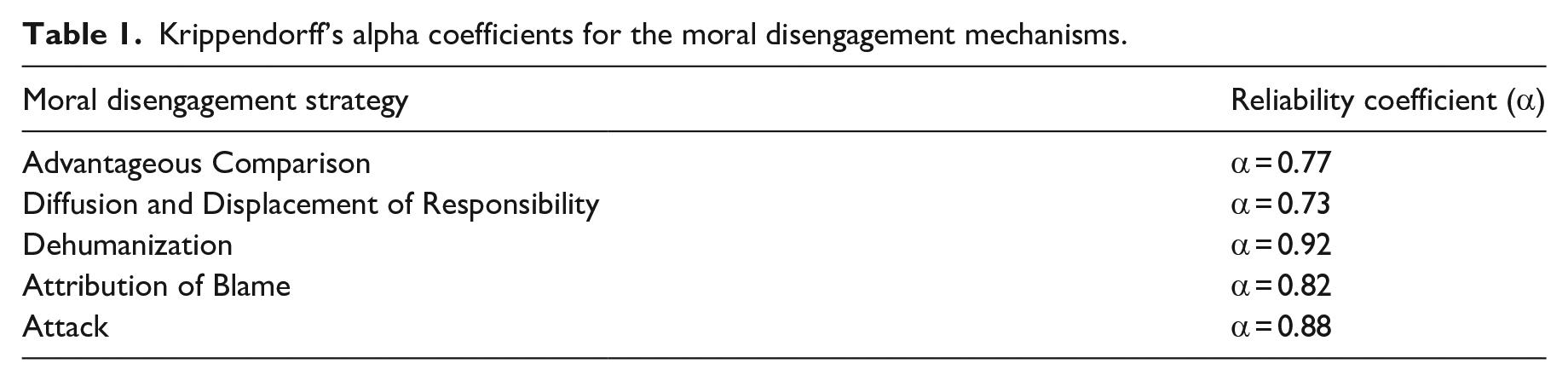
The codebook included moral disengagement mechanisms with the exception of three. Social and moral justification, euphemistic labeling, and distortion of consequences codes were removed from the codebook due to reliability lower than the acceptable standard of α = 0.67 (Krippendorff, 2018, p. 356; Neuendorf & Kumar, 2015). Moreover, the codebook also included codes for the absence/presence of moral disengagement mechanisms, a spectrum of moral disengagement, and a code for the category of topic the tweet falls under. The reliability coefficients can be found in Table 1.
Krippendorff’s alpha coefficients for the moral disengagement mechanisms.
Results
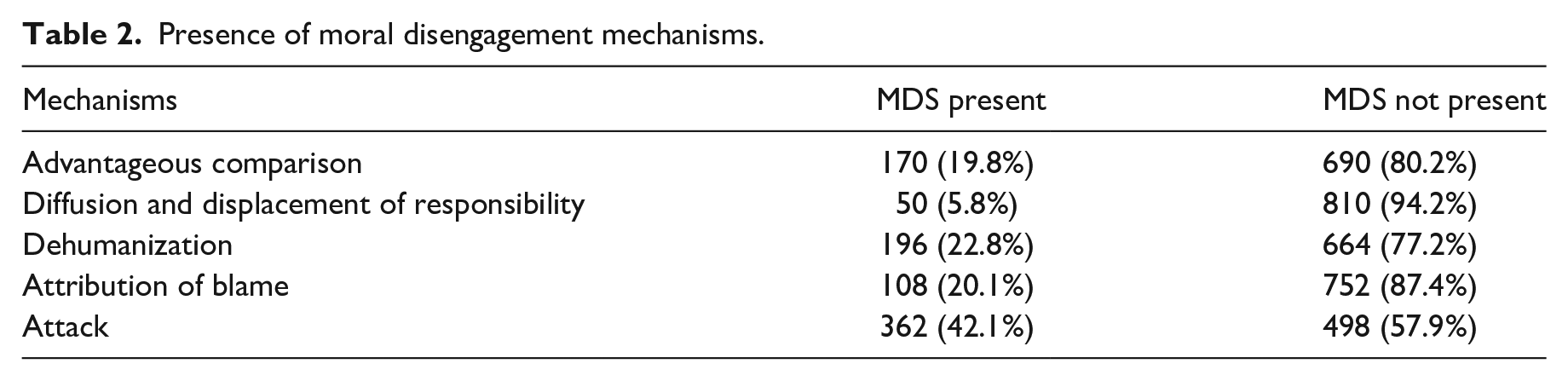
The first research question asked about how Donald Trump used moral disengagement mechanisms-if at all. From our analysis of 860 tweets (see Table 2), we found evidence that Donald Trump used at least one moral disengagement mechanism in about 45% of the tweets analyzed (n = 385). However, not all mechanisms were used equitably by Trump. From the five moral disengagement mechanisms we explored in Trump’s tweets, we found that he most often attacked other people, institutions, or nameless forces (42.1%, n = 362). However, beyond attack, no other moral disengagement strategy was used more than 23% of the time. Dehumanization was used 22.8% of the time (n = 196) followed by advantageous comparison (19.8%, n = 170). Attribution of blame was used in 12.6% of tweets (n = 108) while diffusion and displacement of responsibility was found to be used the least by Trump in his tweets (5.8%, n = 50). Advantageous comparison was used by Trump comparing his actions to another individual’s and presenting them as detrimental. For example, Trump tweeted, “Fake News asks why I bring up Booker. It’s because Biden supports Booker’s bill that forces federal control of local zoning and low-income housing in suburbs.” In addition, diffusion and displacement of responsibility was used by Trump in his tweets via displacing the responsibility to others and minimizing his agentive role in any harm. For instance, while campaigning, he tweeted, “Biggest and Fastest Financial Recovery In History. Next year will be the best ever, unless a Sleepy person, who wants to massively raise your taxes, gets in. I’m which case, CRASH!!!” The use of dehumanization was denoted by demeaning names such as “sleepy Joe,” “crazy Nancy,” and referring to Democrats as “lunatics” or “scum.” Attribution of blame was exemplified in Trump’s tweets by shifting the blame of an outcome to others. Specifically, Trump tweeted, “So I had to constantly fight off all of this Scum, achieve more than any other President in First Term, and then they talk Chaos. They created crimes against me and this administration!” Finally, attack was used by Trump through an aggressive use of words toward others. One example of Trump utilizing attack was when he tweeted,
Presence of moral disengagement mechanisms.
“The failed former Governor of Michigan, RINO Rick Snyder, who was responsible for the Flint Water Disaster (and I let him know it!), is now endorsing Sleepy Joe Biden, who doesn’t have a clue! Snyder, whose political career was ruined by Flint, hurt a lot of people in Michigan . . .”
Although the aforementioned examples reflect specific examples of individual mechanisms in Trump’s communication, several of Trump’s tweets contained multiple moral disengagement mechanisms. For example, Trump used advantageous comparison, dehumanization, attribution of blame, and attack when he tweeted,
“If Joe Biden is elected, far-left lunatics won’t just be running failed Dem Cities—they will be running the Department of Justice, the Department of Homeland Security, and the U.S. Supreme Court. No city, town or suburb will be safe. On November 3rd, your vote will SAVE AMERICA!”
Our second research question sought to explore if there were patterns of moral disengagement mechanisms used by Trump around certain issues and topics. We developed seven different categories that tweets could fall into for this analysis. These seven categories were (1) gratitude and support (messages that congratulate or thank an individual or group or offers on endorsement of a political candidate, show, or book), (2) policy and other updates (messages that share a view or update on policy and other actions being conducted by the White House, such as news conferences, or suggests future policy), (3) news (messages that involve Trump sharing news stories, sharing his views on news stories, and discussions and attacks on news media), (4) politicians (messages that mention or attack another politician in the United States), (5) countries (messages that directly discuss foreign countries), (6) elections and voting (messages that discuss voting deadlines, early voting reminders, attacks on the 2020 US General Election, or claims of voter fraud), and (7) other (messages that did not have one contain one main thought or did not fit into the other categories).
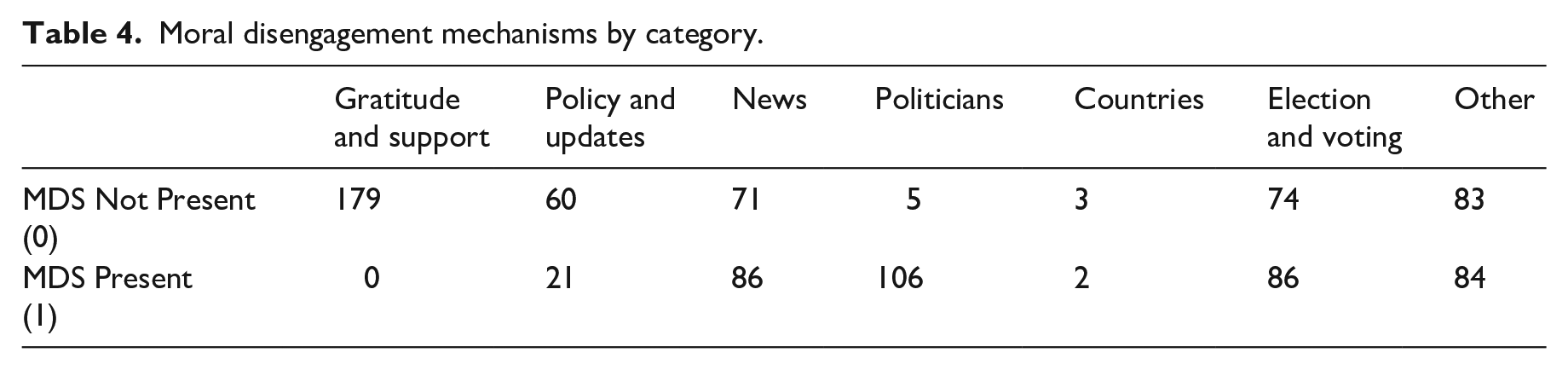
Our analysis showed that Donald Trump tweeted most often expressing gratitude or support (20.8%, n = 179; as shown in Table 2). This was followed by messages that had no singular focus (19.4%, n = 167) and election and voting messages (18.6%, n = 160). Tweets that focused on politicians comprised 12.9% (n = 111) of Trump’s tweets, while policy and update tweets were found 9.4% of the time (n = 81). Finally, tweets that focused on other nations were found the least amount of time (2.1%, n = 5).
Furthermore, we found that moral disengagement mechanisms were used the majority of the time when mentioning other politicians (n = 106; as shown in Table 3). Moral disengagement mechanisms were also used more than 50% of the time when he focused on the election and voting (n = 86) and the news (n = 86). Moral disengagement mechanisms were not found when Trump focused on sharing messages of gratitude and support (n = 179; see Table 4).
Categories of Trump’s tweets.

Moral disengagement mechanisms by category.
We also wanted to investigate the level of moral disengagement used by Trump in his tweets. To do this, a scale was created between 0 and 5; 0 and 1 mechanisms used in a single tweet represented a low level of moral disengagement; 2–3 mechanisms used in a single tweet represented a moderate level of moral disengagement; and 4–5 mechanisms used in a single tweet represented a high level of moral disengagement. Overall, when analyzing our sample of tweets (n = 860), we found on average that a low level of moral disengagement mechanisms used by Trump in his tweets (M = 1.03, SD = 1.342).
Discussion
The primary goal of this study was to examine how moral disengagement mechanisms were used by Donald Trump as a communicative tool on his Twitter account, if they were used. In addition, we also examined if there were any patterns in the use of moral disengagement mechanisms around certain issues and if there were any trends regarding who Trump attacked in his tweets. Due to Trump’s status as President, he has tremendous political and communicative power. It also means that Trump is assured a large audience on Twitter and other social media platforms, and even as he violates the site’s rules, his communicative power is unlikely to be suspended (Coe & Griffin, 2020). Hence, it becomes critical to assess the morality of his communication.
Our findings show that some form of moral disengagement was used in at least 45% of Trump’s tweets, with attack being the most common one. Further, we find that Trump used moral disengagement mechanisms when talking about other politicians, elections and voting, and news. In addition, these attacks were almost always directed toward Democrats and the media. The attacks on media outlets may be especially concerning as they may diminish citizens’ trust in the news and promote populist beliefs (Engesser et al., 2017). In addition, Trump’s portrayal of these groups as villains may have contributed to increased hostility toward them. Due to an increase in political polarization over time, individuals have displayed increased homogeneity with their political party, and have begun to exhibit increased hostility toward members of the opposite party (Boxell et al., 2017; Iyengar et al., 2012; Mason, 2013, 2015). Along with increasing polarization, Trump’s morally disengaging conduct may have encouraged extremism. While the formation of online communities based on similar viewpoints may not be inherently problematic, when individuals actively ignore opposing viewpoints, they may adopt extreme opinions and values (Conover et al., 2011). A deliberative democracy relies on an informed public, and if individuals are heavily exposed to facts and news which reinforces their pre-existing beliefs, then the democracy suffers the negative consequences (Ratkiewicz et al., 2011; Sunstein, 2002, 2007).
As a platform, Twitter also played a major role in amplifying Trump’s rhetoric. It served as an efficient platform for Trump to reach narrow audiences with little consequences. In addition, Twitter allowed Trump to disseminate messages at any time which is unique in that his tweets were often emotionally charged (Coe & Griffin, 2020; Ott & Dickinson, 2019). In our analysis, we found that whenever Trump attacked someone or something in his tweets, his messaging was emotionally charged and angry. This may explain why Trump favored communicating via Twitter. Elon Musk’s takover of Twitter, along with his outspoken support for Trump, has resulted in Trump returning to the platform along with a lot of his base (Ingram, 2024). Consequently, the platform has become a hub for pro-Trump discourse, resulting in a widespread use of conspiracy theories, misinformation, and moral disegagement mechanisms such as attack (Bond & Allyn, 2024). Under new platform policies, contnent moderation measures may be limited, which could further increase the presence of moral disengagement mechanisms.
Since political elites have the power to disseminate messages to the public and shape their opinions and the ensuing debates, it is critical to understand whether political elites’ communication strategies serve to disengage audience’s morality by legitimizing previously unacceptable behavior (Schmidt, 2008; Zaller, 1992). That is evident in Trump’s endorsement and open support of white supremacist groups. Further, Trump’s frequent use of dehumanizing tactics to belittle other politicians, institutions, and journalists is also troubling. His supporters may use his tweets as guiding principles to engage in morally corrupt behavior. In fact, the US House of Representatives January 6 committee found that it was Trump’s incendiary rhetoric that caused the riots (Jalonick et al., 2021). This kind of rhetoric is one reason why Trump was banned from Twitter (2021). However, as noted previously, Elon Musk’s takeover of the platform has seen Trump’s account reinstated.
In our analysis, we found that attack was present in at least 42% of Trump’s tweets, indicating its association to moral disengagement mechanisms. This finding aligns with the existing literature focused on moral disengagement which argues that attack is actively present in moral disengagement (Hartmann et al., 2014; McAlister et al., 2006). We argue that attack should be conceptualized as part of the moral disengagement framework, particularly in the context of political elites’ communication strategies. This has implications for studying political attacks and how they legitimize adversarial politics and shape public opinion. For instance, while some research has indicated that traditional attack campaigning may have pro-democratic outcomes, such as encouraging political discussion or decision-making (Geer, 2006; Krupnikov, 2012), this study indicates that anti-democratic outcomes of attack messaging on social media should be re-evaluated. Specifically, this study broaches the idea that some politicians’ attack messaging on social media may also include tactics such as dehumanization, displacing blame, and displacement of responsibility. Thus, it is possible, based on the results, that attack messaging on Twitter may be sufficiently toxic so as to have more negative outcomes for democracy than traditional attack campaigning.
Limitations and future research
Like any study, we were limited in our analysis. First, this study only looked at Trump’s communication on Twitter which limits our ability to infer conclusive results on whether moral disengagement is used by him in all of his communication. Second, our analysis was limited to a short time period of approximately 3 months when Trump’s use of Twitter dates years back, amplified during the 2016 election. In addition, we were not able to fully code for all moral disengagement mechanisms due to low reliability. We plan to revisit the discarded disengagement mechanisms in future analyses. We acknowledge that the sample of tweets in our study reflects only around 5% of Trump’s tweets from his personal account, and therefore, it is difficult to reach robust conclusions. However, our analysis offers a unique and interesting insight into Trump’s behavior during a time period marred by tension. Finally, our results are only partial and do not reflect an overall picture of Trump’s tweets. Nonetheless, Twitter was Trump’s preferred form of communication and his return to the platform warrants further investigations.
Future research would benefit from analyzing the use of moral disengagement over time in Trump’s communication. In addition, Trump’s rhetoric spans across multiple channels. Researchers can broaden the scope of moral disengagement in Trump’s communication by analyzing his speeches, for example. Another future direction could be to examine Trump’s rhetoric over a longer period of time which can assist in providing an overall view of how and whether moral disengagement is used in his communication. Researchers can also examine the presence of moral disengagement mechanisms in other elites’ communication. Finally, an additional future direction that could benefit researchers could be to examine and discuss how moral disengagement mechanisms are employed during times of national decline and crises. For instance, is it acceptable to use moral disengagement mechanisms to identify individuals or factors that are involved with the decline or crisis? Existing research has argued that it may be tolerable for leaders to employ moral disengagement if dealing with militants who are equally likely to engage in moral disengagement to justify immoral conduct (Mafimisebi & Thorne, 2015). In the context of US politics, given our findings that Trump used moral disengagement mechanisms in his communication that often echoed anti-Democratic themes, should the current political leadership use moral disengagement mechanisms to counter Trump?
Conclusion
Although Trump used a variety of channels to communicate, he favored Twitter. Allowing him to reach narrower and more engaged audiences. Although he was banned from Twitter, his return under Elon Musk’s leadership raises the likelihood that moral disengagement mechanisms will be used as a communication strategy by Trump, his supporters, and other political elites. In this study, we found evidence of the presence of moral disengagement mechanisms in Donald Trump’s tweets. Our findings revealed that moral disengagement mechanisms were more prevalent around certain issues than others. We also argued that attack is an integral part of the moral disengagement framework. This study makes important theoretical contributions toward the study of political communication and elites. Future studies utilizing the moral disengagement framework will aid in our understanding of how political elites communicate and its consequences for Democracy. Such work will help reserachers and policymakers grapple with the long-term consequences of moral disegagement.
Supplemental Material
sj-docx-1-ctp-10.1177_20570473251314521 – Supplemental material for “When you’re a star, they let you do it”: Trump, Twitter, and moral disengagement
Supplemental material, sj-docx-1-ctp-10.1177_20570473251314521 for “When you’re a star, they let you do it”: Trump, Twitter, and moral disengagement by Muhammad Ehab Rasul, Audrey Halversen and Jonathon Smith in Communication and the Public
Footnotes
Data availability statement

Declaration of conflicting interests
The author(s) declared no potential conflicts of interest with respect to the research, authorship, and/or publication of this article.
Supplemental material
Supplemental material for this article is available online.
Notes
Author biographies
References
Supplementary Material
Please find the following supplemental material available below.
For Open Access articles published under a Creative Commons License, all supplemental material carries the same license as the article it is associated with.
For non-Open Access articles published, all supplemental material carries a non-exclusive license, and permission requests for re-use of supplemental material or any part of supplemental material shall be sent directly to the copyright owner as specified in the copyright notice associated with the article.
