




Abstract
The traditional mainstream media is often considered part of the capital and power network involved in corruption, casting doubt on the traditional media’s watchdog functions. This study examines whether social media can be a positive communicative tool for addressing corruption, especially in developing countries such as Ghana. Drawing on in-depth semi-structured interviews and relevant secondary data, Habermas’s theory of the public sphere, and the notion of citizen journalism as a form of social accountability, the study addresses key questions: As a communicative platform/tool, does social media provide utility toward the fight against corruption? In what ways does social media support or undermine the fight against corruption? Findings indicate that social media is a valuable communicative instrument for combating corruption. It offers an alternative platform for exposing corruption; naming and shaming offenders; and mobilizing, organizing, protesting, and demanding accountability. Nevertheless, the study reveals that social media routinely spreads fake news, propaganda, and misinformation, undermining its credibility as an effective anti-corruption communicative tool. This article contributes to the debate on whether social media is a valuable communicative tool in the fight against corruption, especially in the developing country context.
Keywords
Introduction
Corruption―the misuse of entrusted power to serve private interests by both state and non-state actors―undermines political stability, human rights, and fair distribution of society’s resources (Otusanya, 2011; Transparency International, 2019b; United Nations Development Program (UNDP), 2018), making it imperative to address the problem. Although the media is a critical player in combatting corruption (Brunetti & Weder, 2003; Srivastava, 2016; Stapenhurst, 2000), both the private and public mainstream media are generally considered ineffective largely due to the profit motive and government influences, respectively (Asomah, 2020; Besley & Prat, 2006; Omojola, 2010; Vaidya, 2005). In this context, can social media make any difference in the fight against corruption?
A debate revolves around whether social media is a useful tool for combating corruption generally. Some scholars argue that the growing social media sites, such as X (formally known as Twitter), Facebook, and YouTube, provide useful sites for communicating, mobilizing, and addressing pressing social problems, including corruption (Arayankalam & Krishnan, 2022; Bertot et al., 2010; Demirhan, 2017; Dzulfikar, 2018; Manrique & Manrique, 2017). Other scholars question the prospects for social media as a useful anti-corruption tool (Edmond, 2013; Essien, 2017; Gentzkow & Shapiro, 2011; Morozov, 2011). They argue that social media faces limitations similar to those of the traditional mainstream media: partisanship, strategic propaganda, and manipulation by corrupt powerful interests and their affiliates to frustrate or neutralize anti-corruption efforts. As an emerging field, the role of social media in corruption is open to question, leading scholars, including Essien (2017) and Jha and Sarangi (2016), to call for further research.
In response to this call for further research, this article aims to examine social media’s role in corruption in the Ghanaian context. Based on in-depth interviews conducted in Ghana and relevant secondary data, theory of citizen journalism, and Habermas’s theory of the public sphere, this study addresses these key questions: As a communicative tool, does social media provide utility toward the fight against corruption? In what ways does social media support or undermine the fight against corruption? In this article, corruption refers to “the abuse, according to the legal or social standards constituting a society’s system of public order, of a public role or resource for private benefit” (Johnston, 1996, p. 331). Ghana’s 1992 Constitution, as exemplified in Article 218 (Sections A and E), provides a generic definition of corruption as “abuse of power and unfair treatment of any person by a public officer in the exercise of his official duties” (Republic of Ghana, 1996, p. 107). Habermas’s (1989) theory of the public sphere holds that citizens with a free and independent platform (public sphere) make useful contributions in fostering government accountability. The theory of citizen journalism (Dzulfikar, 2018; Schuaseil, 2019) suggests that social media provides a new influential public space, which citizens can exploit to participate politically and influence government decisions and actions. Citizen journalism is a classic form of social accountability, “the wide range of citizen and civil society organization (CSO) actions to hold the state to account, as well as actions on the part of government, media and other societal actors that promote or facilitate these efforts” (McNeil & Malena, 2010, p. 1).
Why does this article focus on Ghana? Examining social media’s role in corruption in Ghana can enrich the corruption and social media literature for several reasons. First, Ghana is considered by many to be a model democratic country in sub-Saharan Africa primarily because of the country’s relative democratic freedoms (Freedom House, 2022) and the peaceful transfer of power through the ballot box since 1992 (Kpodo, 2012). The country’s democratic freedoms indicate that people can use social media platforms to expose corruption in the government and express their views without the government crackdown, as seen in some African countries such as Egypt (Abdelmalak, 2022). Second, corruption is a major problem in Ghana (Asomah, 2019, 2021, 2023a, 2023b; Transparency International, 2022; United Nations Office on Drugs and Crime (UNODC], 2022; Yeboah, 2019). For instance, from 2012 to 2022, Ghana received an average corruption score of 43.6, far below the maximum score of 100, which indicates a low level of corruption based on the Transparency International corruption perceptions index (Transparency International, 2022). Third, social media, especially Facebook, is widely used. Ghana has seven million and four hundred thousand social media users, representing 21.5% of the Ghanaian population (Global Digital Report, 2024). Facebook (42.46%) and YouTube (31.66%) are widely used social media platforms, followed by X, formerly Twitter, (9.74%), Pinterest (9.11%) and Instagram (5.77%; StatCounter, 2024).
In addition, social media activism involving anti-corruption activists and influential members of opposition political parties is increasingly gaining popularity in Ghana (Ajazeera, 2021; Daswani, 2020; Graphic Online, 2023; Nartey & Yu, 2023). Several protest movements, such as the #Fix the Country campaign, the #OccupyJulorbiHouse protest, and the #OccupyFlagStaffHouse started online and culminated in offline demonstrations, urging the government in power to deal with Ghana’s challenges, including rampant corruption (Ajazeera, 2021; Daswani, 2020; FixTheCountry, 2024; Graphic Online, 2023; Nartey & Yu, 2023; Ofori & Sena Dogbatse, 2023; Wanjiru, 2021). In 2023, for instance, the #OccupyJulorbiHouse protests demanded multiple reforms, including ending corruption, reducing the cost of living, and improving the management of the economy in the country (Graphic Online, 2023). Political parties and their members also use social media to mobilize political support, raise funds, discuss national issues, and share their policies on addressing the county’s social problems (Gyampo, 2017).
Finally, unlike the previous Ghanaian studies on social media (Adu, 2022; Daswani, 2020; Kwode, 2023; Nartey & Yu, 2023; Ofori & Sena Dogbatse, 2023), this work investigates social media’s utility in the fight against corruption, focusing primarily on examining the mechanisms through which social media supports or undermines the anti-corruption work in the country. For instance, the vital work by Ofori and Sena Dogbatse (2023) focuses on how anti-corruption activists use memes on Facebook to ridicule and condemn the pretentious fight against corruption in Ghana. Daswani’s (2020) crucial study mainly examines different Ghanaian social media activist orientations toward corruption in Ghana before and after the country’s 2016 elections. Kwode (2023) investigates how the National Democratic Congress (NDC) and the New Patriotic Party (NPP) exploit fake news and propaganda to serve their interests, with social media providing them with an influential platform. Another Ghanaian study by Nartey and Yu (2023) examines tweets during the #Fix the Country campaign in Ghana and the linguistic resources used to frame the campaign on X, formerly Twitter. Nartey and Yu’s (2023) work discovers three discursive strategies used in the tweets to frame the protest as one that challenges social inequalities and promotes a collective vision: “(1) depicting the Ghanaian government as irresponsible, (2) portraying the Ghanaian people as victims, and (3) issuing a clarion call to action” (Nartey & Yu, 2023, p. 1). However, this article’s unique contribution to the literature lies in its exclusive focus on examining the pathways through which social media strengthens or weakens anti-corruption work in Ghana, further enriching the literature on social media’s role in corruption.
Literature review
To what extent does social media as a communicative tool empower citizens, strengthen (emerging) civil society, promote democracy, and foster accountability, especially in combatting abuses of power? In general, social media is seen as a liberation and accountability technology (Diamond, 2010) because it allows citizens to express their views, expose abuses of power, and mobilize the masses to demand accountability (Arayankalam & Krishnan, 2022; Bertot et al., 2010; Brym et al., 2014; Demirhan, 2017; Dong et al., 2017; Enikolopov et al., 2018; Goh & Pang, 2016; Halpern & Gibbs, 2013; Jha, 2014, 2017; Jha & Sarangi, 2016; Kim & Chen, 2016; Manrique & Manrique, 2017; Qin et al., 2021; Shao & Wang, 2017; Ye et al., 2017). In 2020, for example, a video showing police officers beating Lady Tola Azeez for violating lockdown went viral on social media, leading to their arrest and subsequent dismissal from the Nigerian Police Force (Olabiyi, 2020).
Research indicates that social media contributes to the exposure of corrupt public servants’ activities (Enikolopov et al., 2018) and government transparency and accountability (Bertot et al., 2010; Jha, 2014, 2017; Jha & Sarangi, 2016; Tang et al., 2019; Ugochukwu, 2020). For instance, Ngassam et al. (2023), using data from a panel of 47 African countries, show that social media curbs executive, judicial, and legislative corruption. Similarly, a study based on a five-year (2011–2015) panel dataset of 62 countries, including Algeria, Uganda, South Africa, and Nigeria, indicates that “a greater use of social media is positively associated with stronger perceived corruption control” (Tang et al., 2019, p. 7).
Social media promotes democracy by offering a communicative platform that allows people to express their views, share information about issues affecting their lives, and organize for change, including ensuring political accountability (Diamond, 2010; Jha & Kodila-Tedika, 2020). The study by Jha and Kodila-Tedika (2020) indicates that social media advances democracy, emphasizing that social media’s effects on democracy are even stronger in developing countries. During the Arab Spring, a series of anti-government/corruption protests, in both Tunisia and Egypt, the protesters called for democracy, and in doing so, they used social media to speak in favor of democracy, helping to mobilize other citizens to join the protest movements (Abdelmalak, 2022; Breuer et al., 2015; Howard et al., 2011; Lageman, 2020). Diamond (2010, p. 73) argues that social media performs democratic functions, including providing “an uncensored forum for commentary and debate, giving rise to a critical public sphere.” It also offers “space and voice to those whose income, ethnicity, or age put them on the margins of society” (Diamond, 2010, p. 73). By empowering individuals to communicate, share information, and mobilize for change, including fighting corruption and human rights abuses, social media promotes democracy since it augments the freedom of speech and expression, strengthening citizens’ political participation in influencing how they are governed.
Social media has become an influential tool for protest movements (Daswani, 2020; Diamond, 2010; Jha, 2014, 2020). Activists can create social media pages to share corruption experiences, raise awareness about corruption, and mobilize people for collective action (Jha, 2020; Nartey & Yu, 2023; Ofori & Sena Dogbatse, 2023). Across Africa, for example, social accountability actors have used social media for activism to address different social problems, from corruption to social inequality, anti-government, feminist issues, and deplorable critical infrastructure (Daswani, 2020; Guesmi, 2023; Kimeu, 2022; Nartey & Yu, 2023; Ofori & Sena Dogbatse, 2023; Sebeelo, 2021). Examples of these social media-based activisms include #CatchKony (Uganda), #RhodesMustFall (South Africa), #BringBackOurGirls (Nigeria), #MenAreTrash (South Africa), #BringBackMutharika (Malawi), pressing state authorities to address their grievances (Sebeelo, 2021). In Kenya, young people have used social media for online activism and offline protests demanding social justice (Kimeu, 2022). Working in partnership with activist organizations, such as the Kenya Fight Inequality Alliance, people organized “Twitterstorms” to air their grievances, resulting in members of parliament opposing planned tax increases in the prices of staples (Kimeu, 2022).
Social media was critical for the Arab Spring, which began in Tunisia when Mohamed Bouazizi, a young fruit and vegetable vendor, publicly set himself ablaze in Sidi Bouzid in December 2010 (Lageman, 2020). He did so out of desperation following the provincial governor’s refusal to see him after having his scales seized by the police for lack of a permit to sell on the street. The act of taking his life in such a manner he did was also to protest against a corrupt system. A blogger posted on Facebook a recorded video of a public protest at Sidi Bouzid’s city hall against the treatment of vendors, motivating more concerned citizens to join the protests across the country Lageman, 2020). Studies by Howard et al. (2011) and Breuer et al. (2015) showed that the Internet and social media were instrumental in organizing the protests that forced the then dictator (former Tunisian President Zine El-Abidine Ben Ali) out of power in Tunisia in 2011. Mohamed Bouazizi’s self-immolation sparked the Arab Spring, which was also facilitated by social media.
In Egypt, social media was equally vital in organizing anti-government protests. Following the police murder of 28-year-old Khaled Said in June 2010, Wael Ghonim created a Facebook page titled the page “Kullena Khaled Said” (meaning “We are all Khaled Said”) with the victim’s bloodied and disfigured face (Ahram Online, 2012; Preston, 2011). He also spread the information on X (formerly Twitter) to attract further attention, prompting thousands of protesters to converge on Tahrir Square and calling on President Hosni Mubarak to relinquish political power (Jha, 2020). On 11 February 2011, following an 18-day protest demanding him to step down, President Hosni Mubarak’s 30-year rule finally ended (El-Terk, 2021). Social media played a pivotal role in the overthrow of President Hosni Mubarak in 2011 by serving as the venue for communicating and sharing information urging people to join the protest movements (Abdelmalak, 2022; Howard et al., 2011). One Egyptian protestor said, “We use Facebook to schedule the protests, Twitter [now X], to coordinate, and YouTube to tell the world” (Shearlaw, 2016, para. 7).
In Nigeria, social media outlets—X, Facebook, and WhatsApp—were crucial for mobilizing people for the 2020 #EndSARS protests to end police violence (Adisa, 2021; Uwalaka & Nwala, 2023). The Special Anti-Robbery Squad (SARS), a unit of the State Criminal Investigation and Intelligence Department (SCIID) in Nigeria, became the face of police brutality in the country. Although they were heavily armed, SARS officers seldom wore uniforms, making it difficult for many Nigerians to differentiate between the police and the criminals SARS claimed to pursue. The officers were also infamous for collecting bribes from people at checkpoints (Daly, 2020). The SARS went beyond its mandate of patrolling and investigating because the unit also decided who was guilty and meted out punishment, which included torture and extra-judicial execution as in the military regime (Amnesty International, 2020; Daly, 2020).
In 2016, Segun Awosanya, a human rights activist, launched the EndSARS campaign on X, raising awareness of police brutality. This campaign resulted in an announcement of reforms by the President Buhari-led administration and the police authority (Adisa, 2021). However, since no concrete reforms were implemented, police brutality worsened (Adisa, 2021), resulting in the massive 2020 EndSARS protest (Akinwotu, 2021; Daly, 2020; Uwalaka & Nwala, 2023). Social media enhanced the publicity and the organization of the 2020 #EndSARS protests: I can make bold to say the protest would not have been possible without the use of social media. The protest started on social media a few years back and as such, it already created the background through rigorous awareness before the eventual physical protest. (Adisa, 2021, para 23)
A viral video shared on social media about SARS officers reportedly killing a young man in Nigeria caused public outrage, prompting more people to join the protests calling for the dissolution of SARS (Adisa, 2021; Daly, 2020). At the peak of the demonstrations, Nigerians sent over 10 million tweets a day, and conversations revolving around the protest had over 48 million mentions, which expressed national and international support for the protestors (Adisa, 2021). The EndSARS campaign culminated in the then President Muhammadu Buhari’s decision to dissolve SARS (Daly, 2020).
Aside from promoting anti-corruption and anti-government movements, social media provides an outlet for naming and shaming offenders (Nartey & Yu, 2023; Prabowo et al., 2018). For example, according to Prabowo et al. (2018, p. 31), social media such as X, formerly Twitter, “when properly used, can be an effective instrument to induce shame in those who have committed corruption and thus deter others from choosing the same path in the future.” In Ghana, Nartey and Yu (2023, p. 5) report that social media activists’ “construction of the Ghanaian government as irresponsible is amplified in the tweets via a name-and-shame mechanism that calls out the negligence of specific politicians” such as municipal chief executives, the president and vice-president, and ministers. By providing the public sphere with a means of naming and shaming those believed to have committed acts of corruption, social media provides a useful platform to de-normalize corruption. Shaming offenders as one strategy to control behavior is part of the perceived costs of engaging in corruption, and it is intended to deter corrupt acts. For Silfver (2007), guilt and shame play an important role in developing moral behavior, as some people are compelled to conform to social norms and avoid guilt and shame.
In democratic and authoritarian countries, governments’ attempts to control information by using sweeping security laws, conducting Internet surveillance, and censoring content on the net undermine social media’s potential to reduce corruption (Brennan Center for Justice, 2022; Diamond, 2010; Jha, 2020; Jha & Sarangi, 2023; Xu & Albert, 2017). In China, for instance, the government uses libel lawsuits and arrests to force Chinese media organizations and personnel to censor themselves; the government also blocks access to multiple websites, including Facebook, Instagram, and Google services, to restrict information that can threaten the regime (Xu & Albert, 2017). Also, some democratic countries “considered to be the pioneers of the freedom of speech such as the United States and the United Kingdom have been subject to criticism for attacking freedom on the net by spying on users” (Jha, 2020, p. 64). Similarly, the UK spy agency Government Communications Headquarters’ (GCHQ) bulk interception of online communications violated the users’ right to privacy and freedom of expression (Jha, 2020; Siddique, 2021). Both the National Security Agency (NSA) of the United States and the GCHQ of the United Kingdom have been accused of working to develop technologies for undermining the Internet anonymizing tools and accessing encrypted traffic (Freedom House, 2015). The government surveillance of online communications means that “many Internet users may resort to self-censorship if they are afraid of being watched” (Jha, 2020, p. 64).
In 2020, the Southern African Development Community (SADC) published a communique urging “Member States to take pro-active measures to mitigate external interference, the impact of fake news and the abuse of social media, especially in electoral processes” (Media Institute of Southern Africa, 2020, para. 1). Countries, such as Angola, Tanzania, Uganda, Malawi, Swaziland, and Zambia introduced harsh laws to address the so-called “social media abuse,” which is a pretext for stifling online activism and government criticism (Media Institute of Southern Africa, 2020; Mhaka, 2020). During elections, some African countries such as the Democratic Republic of Congo, Burundi, Chad, and Sudan shut down social media sites because of fear of unrest or peddling of falsehoods (Sebeelo, 2021).
As governments try to control access to information that could be harmful to them if revealed, the public and civil society also work to fight back or find other ways of sharing information. According to Jha (2020, p. 64), “Bloggers and social activists have been able to share information regarding government corruption and human rights violations stealthily, sometimes anonymously and using virtual private networks (VPN).” In the United Kingdom, Liberty, an independent membership organization, helped file a legal challenge to the mass surveillance powers of the UK spy agency regarding bulk interception of online communications and won the case (Siddique, 2021).
In Africa, CSOs, including the Media Institute of Southern Africa (2020) and the Association for Progressive Communication (2021), have condemned governments’ regulations and laws violating online privacy rights, suppressing free expression, and stifling participation in online activism. For Brunetti and Weder (2003), a free press is also critical to controlling corruption. Studies show that “social media can be more effective in reducing corruption in countries where press enjoys greater freedom and in countries with strict social norms” (Jha & Sarangi, 2023, p. 183). In the same vein, social media also complements free press in reducing corruption (Jha & Sarangi, 2017). Social media and civil society are complementary in the fight against corruption.
Civil society can play a vital role in ensuring freedom of speech, freedom of the press, the right to privacy, and the freedom to share ideas freely, especially on the Internet (Diamond, 2010; Jha, 2020; Siddique, 2021). But the limits of civil society involvement in pushing back against governments’ efforts to monopolize information and weaken anti-corruption movements must be acknowledged. Using social media to share information and organize protests does not always lead to achieving desired changes, especially in contexts where authoritarian regimes crack down on protestors. One classic example is when protesters in Thailand used social media such as Facebook and X to organize protests in March 2010, but the military crackdown ended the protest with 90 casualties and over 2000 injuries (Newley, 2011). Another example is the #EndSARS protest, which resulted in the unit’s disbandment, but the Special Weapons and Tactics Team (SWAT) has replaced SARS, prompting the #EndSWAT protest (Daly, 2020). Thus, social media’s potential to bring about the needed changes hinges more on state authorities’ openness to political accountability than the strength of civil society.
Finally, although the new media has empowered more voices, these voices are “hardly all rational and civil” (Diamond, 2010, p. 80). Some scholars argue that social media is subject to strategic manipulation, propaganda peddling, and political or ideological partisanship (Edmond, 2013; Essien, 2017; Gentzkow & Shapiro, 2011; Morozov, 2011). For instance, in Nigeria, Essien’s (2017) work indicates that social media is an ineffective anti-corruption instrument because it is also characterized by partisanship and propaganda peddling, in much the same way as the traditional mainstream media. In several places, including the United States, social media such as Facebook has been used for spreading propaganda messages, misinformation, and fake news to influence electoral results (Transparency International, 2019a). Although independent organizations, including FactCheck.org and AfricaCheck, are helping to counter fake news and propaganda, they are unlikely to identify and counter all fake news and propaganda on social media (Transparency International, 2019a). The open access nature of the new media can promote and threaten democracy at the same time. In the same way, the new media can facilitate and impede anti-corruption work.
Theoretical framework
This study is guided by the theory of citizen journalism and Habermas’s theory of the public sphere. In The Structural Transformation of the Public Sphere, Habermas 1 (1989) argues that the public sphere is a socio-spatial space where private people can freely converge and engage in critical and rational discourse to discuss societal needs and influence state policies. Habermas (1989) further argues, however, that powerful interests such as giant corporations, politicians, media owners, and experts control the traditional media-dominated public sphere to advance their interests. This theory of the public sphere suggests that citizens who access independent public spaces offered by social media as readily available communicative public platforms make rational and critical contributions to the public discourse and promote government accountability.
The theory of citizen journalism indicates that access to media platforms and the Internet has dramatically transformed the contemporary public sphere into multiple arenas, empowering ordinary citizens to connect, interact, and shape public discourse and policies (Bertot et al., 2010; Dzulfikar, 2018; Jha, 2014, 2017; Jha & Sarangi, 2016; Manrique & Manrique, 2017).
Citizen journalism is a form of social accountability, “an evolving umbrella category” encompassing “citizen monitoring and oversight of public and/or private sector performance, user-centered public information access/dissemination systems, public complaint and grievance redress mechanisms, as well as citizen participation in actual resource allocation decision-making, such as participatory budgeting” (Fox, 2015, p. 346). Fox (2015) distinguishes between two types of social accountability—tactical and strategic. Tactical social accountability approaches involve information-led interventions projecting only the citizen voice, which is inadequate for improving institutional performance. But the strategic social accountability approaches “deploy multiple tactics, encourage an enabling environment for collective action for accountability and coordinate citizen voice initiatives with reforms that bolster public-sector responsiveness” (Fox, 2015, p. 346).
The new media—social media and the Internet—is considered part of the “fifth estate,” the branch of government expected to contribute to political transparency and accountability (Dzulfikar, 2018; Schuaseil, 2019). But some scholars argue that the new media cannot be a watchdog over the government because it is not entirely free from manipulation, propaganda, and partisanship by powerful state and non-state actors furthering their parochial, private interests (Edmond, 2013; Essien, 2017; Gentzkow & Shapiro, 2011; Morozov, 2011). Finally, citizen journalism may be subject to the limits of (tactical) social accountability because citizen voice alone cannot “do the work of the state’s horizontal accountability institutions” when the state is not genuinely committed to responding to voice (Fox, 2015. p. 356).
Research method
This study aims to understand the pathways through which social media support or undermine efforts to combat corruption, particularly in developing countries such as Ghana. In doing so, the study employed a qualitative approach. This approach was deemed the most appropriate because it enables a researcher to investigate social phenomena in greater depth by capturing contextual dynamics, especially insiders’ real-life experiences and perspectives (Bryman, 2016; Merriam, 2009).
The primary data were generated from 25 in-depth interviews conducted between October and December 2017 in Accra, Ghana’s national capital. The interviewees comprised experienced journalists and editors (N = 10), politicians with legal backgrounds (N = 4), independent anti-corruption activists (N = 2), academics (N = 5), and university students (N = 4). The interviews focused on whether social media is a useful communicative tool in the fight against corruption in Ghana. All the interviews were done at times and safe places agreed to by both the researcher and the participants. Prior to the interviews, participants had the opportunity to read the informed consent forms and ask questions, before signing these forms.
Purposive and snowball (referral) sampling strategies were used to select potential interviewees. Ghanaians aged over 18 years with requisite knowledge of and experiences with the relationship between social media and corruption qualified to participate in this study. The participants were identified through the researcher’s local contacts and referrals from those he had already interviewed in previous studies. As the participants were proficient in English due to their higher education in the country’s official language, they opted for English as the medium for their interviews.
The roles and experiences of all these interviewees were relevant to deepening the understanding of this study’s subject matter (see Appendix 1). For instance, four academics from the Ghana Institute of Journalism and University of Ghana have been involved in anti-corruption work. Also, because politicians are responsible for enacting laws and formulating policies to address the corruption problem, it was vital to include their perspectives on the subject matter of this research. Two politicians were chosen from the ruling party, the NPP, and the remaining two from the main opposition party, the NDC. In addition, the media personnel selected from both print and electronic media outlets have been involved in undercover corruption investigations in Ghana’s Fourth Republic. Including interviewees with those who have had different roles and experiences enabled a broad-based perspective on the study’s subject matter. This article also draws on secondary data in the form of relevant examples from different sources, including social media outlets such as Facebook, X, and YouTube. The examples were purposively selected because they gained social media traction and public attention and addressed the article’s subject matter. This study used the work on reflexive thematic analysis (TA) by Braun and Clarke (2006, 2013, 2019). Reflexive TA reflects “the values of a qualitative paradigm, centering researcher subjectivity, organic and recursive coding processes, and the importance of deep reflection on, and engagement with, data” (Braun & Clarke, 2019, p. 593). The themes represent the different clusters of the underlying meanings of the data concerning the purpose of a study (Braun & Clarke, 2019; Creswell, 2013; Onwuegbuzie & Leech, 2007). NVivo (version 12) software was used to facilitate the qualitative data analysis. After importing all the electronic interview transcripts into this software, the researcher explored and coded the data. The coding process focused on marking or “colouring interview excerpts pertinent to the study, summarizing the underlying meanings using a few words that capture their relevance to the study, and linking them to the appropriate themes” (Asomah, 2020, p. 9). In this work, the themes emerged from the interviews, as informed by the study’s objective and theoretical guide.
Findings and discussions
As a communicative platform/tool, does social media provide utility toward the fight against corruption? In what ways does social media support or undermine the fight against corruption? Based on the patterns in the interviews, four themes were identified: (1) platform for exposing corruption; (2) platform for mobilizing, organizing, protesting, and demanding accountability; (3) outlet for naming and shaming; and (4) platform for propaganda and misinformation.
Platform for exposing corruption
Social media provides a platform for individuals and anti-corruption CSOs to share findings of anti-corruption investigations with the public, helping create awareness of corruption and encourage everyone to join the fight against corruption. In 2022, for example, the findings of an investigative piece on corruption within Ghana’s Driver and Vehicle Licensing Authority (DVLA) were shared on social media platforms such as YouTube by Corruption Watch Ghana (2022), which conducted the investigation. In this study, participants argued that social media provides a platform for exposing and sharing corruption-related information. For example, one participant stated, We have noticed people sitting in Trotro [commercial buses] and recording police people taking bribes and then putting it out there [on social media]. In the past, if you tell the police that they collect bribes, they will say produce the evidence, but now social media is making that possible. (Interview, V23, political scientist and anti-corruption activist)
Another participant said that “even where a journalist does an investigative journalism and thinks that within the structures where she or he works there are constraints, they put on social media such exposures” (Interview, V22, professor and politician).
For participants, social media is already “doing a lot in exposing corruption, more importantly because you have a lot of citizen journalism that goes on there,” as individuals record and publish on social media instances of corruption cases witnessed (Interview, V19, lecturer and former journalist). They explained that, at times, the traditional media selects information from social media and then puts it in the public domain. V19 added the following: Hitherto, you see that the mass media manipulated information or monopolize[d] information so to speak. So, we have sources coming from radio, television and newspapers and therefore if you want clarifications, rejoinders, you have to write letters to the editors, and some are not published. But now social media has opened a platform, an interactive platform, so people can give instant comments, and people can generate their own sources of information on any national issues. (Interview, V19, lecturer and former journalist)
Social media provides a larger number of people with the ability to come forward with any information they have. In 2018, a video showing police offer, Lance Corporal Frederick Amanor Godzi, beating Patience Osafo, who wanted to withdraw her savings from Midland Savings and Loans Limited in Accra, went viral on social media (GhanaWeb, 2018a; Pulse Ghana, 2018). Without social media providing the avenue for sharing the video, such abuse of power might not have become public.
In addition, key members of opposition political parties, such as Sam George and Samuel Okudzeto Ablakwa of the NDC, have used social media platforms to expose the government’s failings, including the inability to curb corruption in government (Donkor, 2022; Tornyi, 2024). For example, Samuel Okudzeto Ablakwa, the Member of Parliament for North Tongu, has used X (formerly Twitter) to scrutinize President Akufo-Addo-led government, unmasking alleged corruption cases, including a US$48 million contract awarded by Ursula Owusu without the Public Procurement Authority’s approval, and calling on Ghanaians to demand political accountability (Tornyi, 2024). On his Facebook page, Ablakwa (2023, para. 1–4) also revealed the following about the alleged bloated Bank of Ghana Head Office’s contract: Unraveling the Bankrupt BoG Head Office mystery— from an initial US$81.8 million, suddenly escalating to US$121 million & currently threatening to exceed US$250 million. I have depressingly followed the national debate on what many outraged Ghanaians have described as the extravagant and wasteful US$250 million new Bank of Ghana Corporate Head Office . . . A shocking and embarrassing interview of Mr. Charles Elias Reindorf, Director of Finance at the Central Bank where he abruptly ended an interview following a harmless question on the cost of the project has since gone viral.
In another social media post shared on 16 February 2024, Okudzeto Ablakwa disclosed that Resources Access Limited, a company with family ties to Vice President Dr. Mahamudu Bawumia, had a monumental share of the 87% non-competitive and overpriced cocoa road contracts revealed by Ghana’s auditor general (Tornyi, 2024).
If those being called out as corrupt have power over traditional media outlets or justice channels, social media offers an alternative way of disseminating the information to the public. In traditional media, only a select few people decide what stories to run and not run. But on social media, each person is their own publisher. With few restrictions on what can be posted and by whom, social media is a valuable tool for exposing corruption. Not only can anyone post information about suspected corruption, but they can also remain largely anonymous while doing so, creating a barrier of protection between themselves and corrupt institutions. This reality has helped empower citizens to share information about corruption much more easily.
This study speaks to citizen journalism as individuals collect, analyze, and report corruption information on social media platforms. Such positive use of social media reflects Habermas’s public sphere theory about the role of critical journalism, which cannot occur if the media (or the public sphere) is monopolized/controlled by power and capital to advance their parochial interests. As documented in studies (Diamond, 2010; Jha, 2017, 2020; Prabowo et al., 2018; Tang et al., 2019; Uwalaka & Nwala, 2023), social media is a useful tool for addressing corruption because it provides a platform for exposing or leaking corruption-related information. Since social media reaches a large audience and is constantly being updated and changing, users can communicate and collaborate to expose those who commit corruption (Tang et al., 2019).
A platform for educating, mobilizing, organizing, protesting, and demanding accountability
Social media acts as a critical venue for educating and mobilizing people against corruption. People can be mobilized to address corruption if they are educated about how corruption diverts resources meant for development, such as improving roads, housing, healthcare, and electricity infrastructure. According to participants, anti-corruption activists create groups on social media platforms to discuss corruption, educate the public, and raise awareness, urging people to refrain from corruption and to join the campaign against corruption. One such group, Kill Corruption in Mother Ghana, has garnered 35.8 K members (Duku, 2014). Likewise, Corruption Watch Ghana (2023), established by the Center for Democratic Development Ghana (CDD-Ghana), has a Facebook page with 5.7 K followers. Participants explained that social media “allows the citizens to be outraged and wanting something to be done about [corruption] and bring it more home” (Interview, V6, media scholar and former journalist).
Ghanaians have used social media to demand accountability. Participants detailed how people on social media push for anti-corruption action through site features such as hashtags: These days, when you go to the social media, you will find people setting [an] agenda, and putting them in hashtags. For example, in Ghana, there is a case running about public officers who have taken state lands and today, if you go to the social media, Ghanaians are championing that the lands should be taken back, be retrieved. (Interview, V20, journalist)
Another typical example is Richmond Amoakoh’s open letter to President Akuffo Addo, urging him to demonstrate a strong commitment to fighting corruption in Ghana: Mr. President, you know deep down that you could have done better. You know deep down that we shouldn’t be where we are today. You know that you could have done better in your fight against corruption and Galamsey. Sir, you know you could have protected the public purse better and could have acted in the best interest of Ghana, not a few party people and financiers, and damned the consequences because that is the kind of person we thought you were. (Amoakoh, 2022, p. 1)
About 90% of the over 500 people who commented on this open letter agreed with the writer, urging the President to deliver on his promises, particularly in protecting the public purse. Over 2000 Facebookers liked Amoakoh’s call on the president to be tougher on corruption.
Anti-corruption activists have consistently used social media to critique any government in power and organize protests to pressure the government to address the country’s challenges, including corruption (Ajazeera, 2021; Graphic Online, 2023; Daswani, 2020; GhPage, 2023; Nartey & Yu, 2023). In 2021, the hashtag
Similarly, Fix the Country Campaign activists use their X page to encourage Ghanaians to collectively put public officials in check: #FixTheCountry: Our leaders have so much failed us. Look at the waste of money and resources and later they will go and seek loans from other countries. #FixGhanaNow: The [mainstream traditional] media can’t talk because they fear they will lose their job. The hashtags are being reported. Injunction being placed on the demonstration. They are not ready to listen. They are not ready to work. They are not ready to be held accountable. #FixTheCountryNow: Arise Ghana Youth! This is time to let your voices be heard. Speak up today! Arise Ghana youth for your country. The nation demands your devotion. Let us all unite to uphold her. And make her great and strong. We are all involved in building our motherland. (Nartey & Yu, 2023, p. 4)
Like the #FixtheCountry Campaign, in July 2014, some middle-class Ghanaians used the #OccupyFlagStaffHouse on X (formerly Twitter) to express displeasure about government corruption and organized anti-corruption protests (Daswani, 2020).
Civil society groups use social media to share information about the venue, time, and dress code for protests and encourage people to join them. For instance, in 2018, the CDD-Ghana in partnership with Ghana Integrity Initiative (GII), the Africa Centre for International Law and Accountability Ghana (ACILA), and Anti-Corruption Coalition (GACC), and the media organized a silent march (Corruption Watch Ghana, 2018). The march focused on the failure to deal with those involved in corrupt practices and the need to address the problem: The march seeks to create awareness of the social costs and impact of corruption, especially on deprived communities and citizens, and call on the general public, Civil Society Organizations (CSOs), duty bearers, and the various accountability institutions to work towards arresting the problem. (Corruption Watch Ghana, 2018, para. 3)
The information for this march was shared on the Corruption Watch Ghana’s (2018) Facebook page.
These observations are consistent with previous studies (Bertot et al., 2010; Brym et al., 2014; Demirhan, 2017; Dong et al., 2017; Halpern & Gibbs, 2013; Jha, 2014; Jha & Sarangi, 2016; Kim & Chen, 2016; Manrique & Manrique, 2017; Qin et al., 2021; Shao & Wang, 2017; Ye et al., 2017). In Ghana, Nartey and Yu’s (2023) work reveals that social media empowers campaigners to mobilize against social problems, including corruption and social inequalities. Social media has also been pivotal in exposing abuses of power and mobilizing the public against them in Egypt (Abdelmalak, 2022; Ahram Online, 2012; Preston, 2011), and Tunisia (Breuer et al., 2015; Howard et al., 2011; Lageman, 2020). In Nigeria, the human rights violations committed by the now disbanded SARS were shared on social media, resulting in the #EndSARS movement (Adisa, 2021; Daly, 2020).
Outlet for naming and shaming corruption offenders
Shame is “an unpleasant emotional reaction by an individual to an actual or presumed negative judgment of himself by others resulting in self-depreciation vis-à-vis the group” (Ausubel, 1955, p. 382). For Bedford and Hwang (2003, p. 128), shame is “the feeling of loss of standing in the eyes of oneself or significant others and can occur as the result of a failure to live up to expectations for a person of one’s role or status.” As the literature indicates, social media provides the space for naming and shaming corruption offenders (Prabowo et al., 2018).
Similarly, in this study, participants asserted that social media provides an outlet for naming and shaming corruption offenders as part of the efforts to address corruption. Recording corrupt acts they witness and sharing them on social media platforms is one way Ghanaians use social media to name and shame corrupt offenders. Participants indicated that merely the knowledge that information and discussion about corrupt actions can be shared and accessed online can help deter corrupt actions: “If you are doing something that is wrong and you fear that social media may catch up with you, you might want to stop doing the wrong thing” (Interview, V15, media scholar). In addition, Kelvin Taylor’s Ghanaian Facebook program With All Due Respect—Loud Silence Media is partly intended to name and shame those involved in corruption. For example, Kevin Taylor’s recent revelation of “official corruption” involving Kofi Jumah in the case of Ghana Industrial Holding Corporation (Taylor, 2023) is part of the efforts to name and shame people involved in corruption in Ghana. 2
As the following tweets show, Ghanaians have used X to name and shame public officials and politicians, including the president and ministers, perceived as not doing their work properly: TWT 129. #FixGhanaNow #NameAndShame: This is the Tanoso Kessben area! This is supposed to be a bridge! Not safe at all. Dr. Kingsley Nyarko. Sir, kindly fix this death trap bridge. TWT 201. #Fixthecountry: This is enough evidence that [President] Akufo Addo and [Finance Minister] Ken Ofori-Atta don’t need an additional tax to deal with the sanitation in Ghana. They only need to deal with the fraud and obscene monopoly in the sanitation sector. (Nartey & Yu, 2023, p. 5)
Also, the police officer, Lance Corporal Frederick Amanor Godzi, who assaulted Patience Osafo (a nursing mother), was publicly condemned because of the viral video shared on social media (GhanaWeb, 2018a; Pulse Ghana, 2018). With smartphones, social media, and the Internet, citizens can police the police, warning others in positions of power that their abuses may be exposed and condemned if they do not stop. As the literature suggests, one effective method for increasing the deterrent effect on individuals engaged in corruption is to raise the probability of their exposure and social condemnation (Prabowo et al., 2018).
The risks of propaganda and misinformation
As previously emphasized, social media serves as a powerful platform for disseminating crucial information on corruption, owing to its open nature that allows users to freely share and redistribute content to a broad audience. Nevertheless, this unrestricted environment also carries a significant risk of propagating propaganda, disinformation, and misinformation. Participants in this research spoke about the unreliability of information published on social media and the associated risks. One explained it this way: Ordinary people using social media “are often not equipped with journalistic skills; they don’t know how to verify or confirm the information” (Interview, V18, journalist). And another participant said, “Anyone can put out any information on social media where the credibility of the source is difficult to confirm” (Interview, V13, journalist).” This participant further argued, There should be punishable consequences that will keep people in check and probably verify their news or their source before putting it out there. But right now, people put a lot of things there that are not true and get away with it. (Interview, V18, journalist)
The likelihood of people being punished for their social media postings in democratic countries is unlikely, but just as regular people, knowingly or unknowingly, post untruths on social media, corrupt actors can manipulate information, disguising or derailing discussions of corruption with disinformation, misinformation, or propaganda.
Furthermore, social media’s unrestricted environment means that people can be falsely accused and targeted. Given that corrupt actors can exert just as much influence on social media narratives as whistleblowers and anti-corruption activists and since people are capable of fabricating stories to suit their own interests, it becomes challenging for people to trust any corruption-related information they see on social media. As one participant maintained, “Social media as [it is] now has not helped in fighting corruption because of fake news. So even if there is [a] story of political corruption, the public does not take it seriously because it is perceived to be fake” (Interview, V12, journalist). Indeed, participants identified the spread of disinformation, misinformation, and propaganda as a particular concern in the use of social media as an anti-corruption tool. As another participant asserted, The disadvantage is that, as it were, people can conceive ideas and put there any type of information whether it is true or not. At times, people are not clear about the credibility of sources of information, but they are all there on the net since there is no editor. It is free and people can pick all sorts of information . . . some can be very damaging. (Interview, V19, lecturer and former journalist)
Yet another elaborated: “Social media is a platform for a faceless people to make baseless allegations and before you will know that the information being peddled is false, the harm may have been done already” (Interview, V15, media scholar). Another said, “Social media has its downside relating to an abuse of information and the use of photo shopping to distort information and as a propaganda tool and things like that” (Interview, V23, political scientist and anti-corruption activist).
These findings align with studies suggesting that social media also provides the space for political/ideological partisanship, manipulation, misinformation, and propaganda peddling (Edmond, 2013; Essien, 2017; Gentzkow & Shapiro, 2011; Morozov, 2011; Transparency International, 2019a). According to Transparency International (2019a), fake news, the spread of false information, is used to discredit anti-corruption activists and institutions and the real-life corruption cases they expose. This downside of social media indicates that Habermas’s theory of the public sphere is normative and does not fully reflect reality. Even if citizens can access media not completely controlled by power and capital, as in the case of social media, the political and economic elites can still use these platforms for partisanship and propaganda peddling to serve their own interests. As Diamond (2010, p. 71) argues, social media is a tool “open to both noble and nefarious purposes” (Diamond, 2010, p. 71), so it can bolster or undercut anti-corruption work depending on who is using it and for what purpose.
Individuals and organizations, such as Stop Fake Project, Snopes, FactCheck.org, and AfricaCheck, can debunk fake news and propaganda by using, for example, truth stories to counter such fake news and propaganda (Transparency International, 2019a). However, true stories are about 70% less likely to be retweeted or reposted on social media than fake news stories (Office of the Director of National Intelligence [ODNI], 2021), making it harder to reverse all the harm caused by fake news. As a result, Habermas’s theory that unfettered access to media inevitably leads to active participation in critical discussions on the conduct of public affairs is not entirely accurate.
Critical evaluation of social media’s role in combatting abuses of power
The new media—including the Internet and social media—has been viewed as “liberation” and “accountability” technology enabling “citizens to report news, expose wrongdoing, express opinions, mobilize protest, monitor elections, scrutinize government, deepen participation, and expand the horizons of freedom” (Diamond, 2010, p. 71). As this study exemplifies, social media is a venue for accessing alternative information, exposing abuses of power, identifying and condemning corruption offenders, mobilizing people, organizing protest, and calling for accountability. It also promotes democracy by empowering individuals, groups and organizations to express their views on public affairs, helping to demand and entrench democratic freedoms and rights such as the right to free speech/expression. In addition, people’s reactions, including activism, on social media regarding public affairs help provide insight into public opinion, which can influence government policies. In Kenya, for instance, the MPs’ opposition to planned tax increases in the prices of staples resulted from online activism on X, formerly Twitter (Kimeu, 2022).
Nevertheless, cautious optimism must be expressed about the outcomes of the new media’s potential for transformative liberation and accountability in developing countries such as Ghana. Cases such as Lance Corporal Frederick Amanor Godzi’s unwarranted beating of Patience Osafo (the nursing mother) may be limited to public condemnation (GhanaWeb, 2018a; Pulse Ghana, 2018), which can have a preventive impact as others may elect to desist from such behaviors in fear of public backlash. However, delivering justice and fundamental institutional changes beyond public condemnation are needed. In the assault case already cited, the court discharged the police officer (Frederick Amanor Godzi) based on the victim’s lack of interest in the trial, a claim challenged by the victim (Peace FM, 2019), suggesting that the prosecutor was disinterested in ensuring justice let alone for police authorities to embark on reforms.
In Ghana, mentalities such as “have your say, and I will do what I want” and “our government has come, and it is our turn to enjoy” further suggest that social media mediated activism can achieve little in addressing abuses of power in the country. For example, Ghanaians have expressed frustration about Ghana’s two main parties (the NPP and the NDC) “always positioned for power, and it is always family and friends, as a cartel, always come together, steal and go, and another will come” and do the same without consequences (Asomah, 2019, p. 643). Expectedly, in many cases, when abuses of power have been exposed, “governments have mounted vigorous rebuttal and response against such reports and have used the party machinery and media that is favorable to the party or government to fight back” (Asomah, 2019, p. 648). Such instances indicate that no amount of social media activism or “media criticism and public outcry can fight corruption in Ghana” (Ofori & Sena Dogbatse, 2023, p. 91). In other words, despite social media-mediated anti-corruption and anti-government activism (Donkor, 2022; Graphic Online, 2023; Nartey & Yu, 2023; Tornyi, 2024; Wayo, 2023), the strong political will required to curb corruption decisively has been absent or weak in Ghana (Asomah, 2019, 2023). Unsurprisingly, anti-corruption activists have continued to use memes on Facebook to criticize the pretentious or the “hollow” fight against corruption in Ghana [by whichever government is in power] as captured in the expression, “We are only to appear to be fighting corruption . . . we can’t even bark” (Ofori & Sena Dogbatse, 2023, p. 91). There have also been instances where traditional and religious leaders intervene in pleading with relevant state authorities to stop investigating and prosecuting corrupt public officials (GhanaWeb, 2018b).
Put differently, although social media provides a platform for individuals and CSOs to speak out, organize, and call for strict enforcement of laws to deal with corruption, the success that can be achieved may be minimal without the commitment of all societal powerholders, especially those in government. For instance, despite social media playing a fundamental role in organizing protests to overthrow dictatorships and giving way to democracy, as typified in Tunisia and Egypt (Breuer et al., 2015; Howard et al., 2011), the citizens have yet to benefit significantly from democracy (Abdelmalak, 2022; Guesmi, 2023; Lageman, 2020). In Egypt, journalists continued to be jailed, online platforms where people can express their opinions have been banned, and anti-government posts face jail time, suggesting that the democratic freedoms fought for during the Arab Spring remain a mirage (Abdelmalak, 2022). Likewise, in Tunisia, the birthplace of the Arab Spring, dictatorship has returned (Guesmi, 2023). In Nigeria, while the #EndSARS protests resulted in the dissolution of SARS, a similar unit called the SWAT was created, resulting in #EndSWAT (Daly, 2020). Also, SARS victims and the protestors who suffered during the #EndSARS protests have yet to see justice delivered (Akinwotu, 2021). More than citizen voice/journalism may be needed to bring about the fundamental transformations social accountability activists hope to achieve.
Conclusion
This article has focused on social media’s role in addressing corruption by examining how social media as a communicative tool strengthens or undermines the fight against corruption in Ghana. The study underscores the significance of social media as a valuable communicative instrument in the fight against corruption. Social media offers an alternative platform for exposing corruption, naming and condemning offenders, and mobilizing, organizing, protesting, and demanding accountability. It has helped in providing access to uncensored information by receiving and generating information, ending the monopolization or manipulation of information by the traditional media, and prompting the traditional media to adopt stories on social media and bring them into the public domain. But, when it comes to what content can be shared, the same features of accessibility, public participation, and freedom both promote and undermine social media as a tool for combating corruption. As this study has shown, social media is a place where corruption can be brought to light, discussed, and organized against, but it is also a platform where disinformation, misinformation, and propaganda can find traction, muddying the waters and preventing the efficient confrontation of corruption. The absence of any form of robust censorship, such as editors to edit or verify the sources of information, can damage reputations.
Overall, this study corroborates the notion of citizen journalism, as individuals collect, share, distribute, and discuss corruption-related information on social media. But Habermas’s theory of the public sphere is only partially supported. On one hand, some people use the public sphere provided by social media communicative platforms positively to collect and share information about corruption cases and to call for accountability. In this way, citizens empowered by the social-media-enabled public sphere can contribute to transparency and accountability. On the other hand, others use the same public sphere created by the social media for spreading fake news and propaganda, making the social media a double-edged sword. Civil society can be crucial in countering fake news and propaganda with truth stories, although fake news may spread more than accurate stories.
Nevertheless, Ghana’s ability to fully benefit from the opportunities social media offers for combatting abuses of power will depend not only on sustained online and offline public activism but also on the commitment of powerholders in all facets of Ghanaian society, especially those in government, to enforce existing anti-corruption laws and embark on genuine reforms to close further opportunities for corruption. In other words, robust social media-enabled activism combined with decisive political commitment/accountability is vital to realizing social media’s full potential in combatting abuses of power, particularly in developing countries.
Footnotes
Appendix
Descriptive statistics of participants’ socio-demographic characteristics.
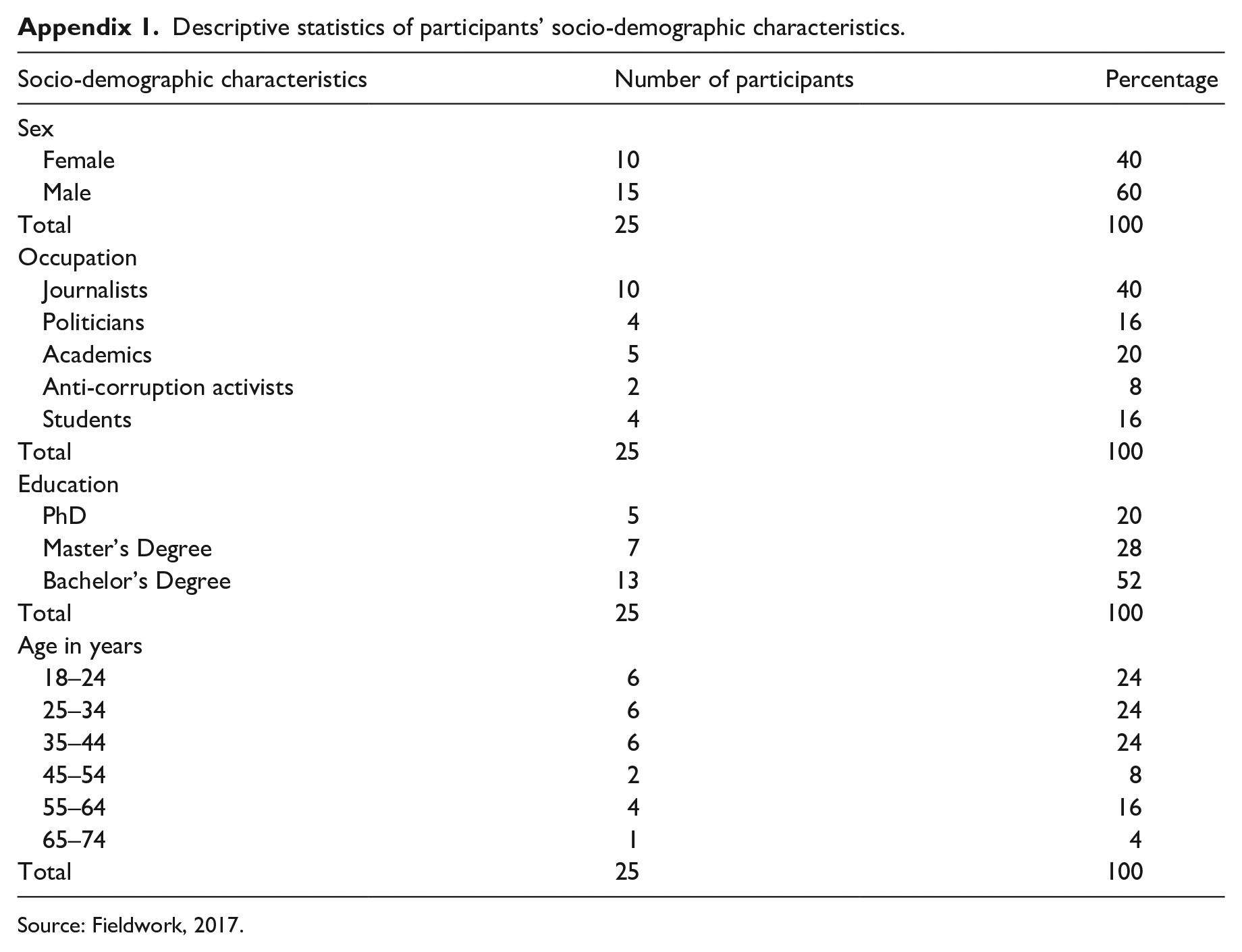
| Socio-demographic characteristics | Number of participants | Percentage |
|---|---|---|
| Sex | ||
| Female | 10 | 40 |
| Male | 15 | 60 |
| Total | 25 | 100 |
| Occupation | ||
| Journalists | 10 | 40 |
| Politicians | 4 | 16 |
| Academics | 5 | 20 |
| Anti-corruption activists | 2 | 8 |
| Students | 4 | 16 |
| Total | 25 | 100 |
| Education | ||
| PhD | 5 | 20 |
| Master’s Degree | 7 | 28 |
| Bachelor’s Degree | 13 | 52 |
| Total | 25 | 100 |
| Age in years | ||
| 18–24 | 6 | 24 |
| 25–34 | 6 | 24 |
| 35–44 | 6 | 24 |
| 45–54 | 2 | 8 |
| 55–64 | 4 | 16 |
| 65–74 | 1 | 4 |
| Total | 25 | 100 |
Source: Fieldwork, 2017.
Acknowledgements
I am grateful to the interviewees for their time and insights and to the editors for the opportunity to revise and re-submit the article. Finally, I sincerely thank the anonymous referees for their time reviewing the article and offering insightful, constructive comments to improve its quality.
Declaration of conflicting interests
The author(s) declared no potential conflicts of interest with respect to the research, authorship, and/or publication of this article.
Funding
The author(s) received no financial support for the research, authorship, and/or publication of this article.
