



Abstract
Developed by tech-savvy citizens, Rosie is a bot that autonomously checks the public spending of elected representatives of the Brazilian Lower Chamber and uses Twitter to engage peoplein discussing suspicious findings. Rosie is the most visible face of Operação Serenata de Amor (Operation Love Serenade), a data-enabled activism initiative that revolves around the creation, use and dissemination of open data to hold politicians accountable and empower citizens to react against the misuse of public funds. The article draws on an original data set – including interviews, participant online observation notes and secondary qualitative materials – to examine Operação Serenata de Amor, focusing on how material and symbolic elements related to both human and non-human actors shape the organisational patterns of this type of initiative. The findings suggest that there are three organisational patterns, each with further specific challenges, based on the presence of three modes of participation that depend on different types of engagement with digital technologies and data. Findings indicate that data-enabled activism can emerge with typical characteristics and values of tech startups, such as the goal of creating a sustainable budget and providing strategic content by validating it with user feedback, while also retaining some traits of online activism, such as ad hoc and temporal networks of highly autonomous actors concerned with specific contentious issues. In this respect, the eventual demobilisation of Operação Serenata de Amor's initiators due to commercial values and struggles to maintain it active and engaging can be seen as a cautionary tale for data-enabled activism, particularly for initiatives closely associated with civic innovation and social tech startups.
Introduction
In 2016, a few months after the impeachment of Brazilian President Dilma Rousseff, a group of tech-savvy citizens launched Operação Serenata de Amor (OSA) (Love Serenade Operation) to develop an innovative anti-corruption open-source tool whose main aim was to identify suspicious expenditures of members of parliament (MPs). They ended up deploying an ensemble of digital technologies capable of empowering the civic auditing of public officials using open data. OSA is not just a bottom-up anti-corruption initiative in the digital era. Most of the activities that support OSA revolve around the employment of digital data. Emerging research suggests that anti-corruption and pro-integrity activism are profoundly tied to a variety of data that allows activists to unveil otherwise hidden corruption-related behaviour (Mattoni, 2020). Activists employ digital technologies to gather data about corruption with the help of concerned citizens and use data about corruption to develop protest campaigns. Activists also transform data about corruption, often difficult to understand at first glance, into meaningful information to increase public awareness of corruption's consequences on societies (Mattoni, 2017). In this regard, the OSA initiative is a clear example of dataenabled activism in the anti-corruption sector: its three founders and the community of thousands of supporters they attracted entail the creation, employment and diffusion of open data to hold politicians accountable and allow citizens to react against the misuse of public money by their elected representatives.
Data activism has been defined as a form of activism emerging in connection with the ever-more pervasive process of datafication (Couldry and Hepp, 2017). To Andrew Schrock (2016: 591), data activism is ‘a specific association of technologically mediated participation with particular political goals' occurring when, for example, civic hackers are accessing, generating, modelling and contesting data or creating alternative modes of political participation through data. The extant literature suggests that data activism aims at challenging the power relationships that datafication brings forward in societies and employing big and other types of data to support mobilisations to achieve social justice (Kazansky et al., 2019; Kennedy, 2018; Lehtiniemi and Haapoja, 2020). More specifically, data activism can be reactive or proactive (Milan and van der Velden, 2016). On the one hand, data activists and their movement organisations can mobilise against the infringement of their rights due to the collection and use of big data by corporations and state actors, hence engaging in reactive forms of data activism that are also called data-oriented activism (Beraldo and Milan, 2019). On the other hand, proactive data activism is viewed as the engagement with different types of data by activists and their movement organisations as leverage to reach their goals, that is, the creation and use of data are enablers of activism (Beraldo and Milan, 2019). The OSA initiative, which will be under scrutiny in this article, fits in the latter form of data activism.
Indeed, the literature on hacker collectives (Coleman, 2014; Dobusch and Schoeneborn, 2015; Massa and O’Mahony, 2021) and online communities (Chen and O’Mahony, 2006; Puranam et al., 2014) has been paying more attention to different forms of organising that deviate from formal organisations or resemble looser social collectives. However, these studies do not explore how digital technologies, along with the meanings and values attached to them, lead to specific organisational patterns of collective actions and, in turn, pose organisational challenges for the activists and participants involved. Nor do they consider these initiatives through the lenses of data-enabled activism. Within the growing literature investigating the links between digital technologies and social movements, attempts have been made to look at specific social media platforms, impacting mainly the contentious organisational patterns of activism (Bennett and Segerberg, 2013; Earl et al., 2015). Yet, these studies have not looked at how movement organisations, and social movements more broadly, use multiple types of digital technologies simultaneously and combine them into multifaceted technological assemblages in which activists deploy existing and newly created technologies to obtain, use, translate and publish different types of data.
Considering the role of different digital technologies and related data developed and used by OSA, the Brazilian initiative poses a relevant case study to explore how the intertwining of technological, social and political factors related to the employment of data contributes to shaping the ‘modes of organising’ in data-enabled activism (Milan and van der Velden, 2016: 61–62). More specifically, the article focuses on the endogenous features of OSA and its organisational patterns, considering decision-making processes and forms of participation of both human and non-human actors that sustain the initiative. We also aim to reflect on crucial organisational challenges that activists face to sustain their data-enabled practices.
The article is structured as follows. First, we present the analytical framework that blends organisational and social movement theories to investigate the organisational aspects of data-enabled activism. Then, we detail the case study and qualitative methods for collecting and analysing data. In the remainder of the article, we assess how OSA was created and structured by identifying three different organisational patterns and their key features. We reflect on how the symbolic and material elements associated with the creation and use of data through digital technologies allow for different forms of engagement in the OSA initiative and bring up relevant challenges for data-enabled activism. In the conclusion, we outline some relevant points of reflection on data-enabled activism and some further lines of research to be explored in the future on the subject matter.
An analytical framework to study organisational aspects of data-enabled activism
In recent decades, social movement studies became particularly interested in loosely structured networks of participants and new forms of collective actions, especially ones related to online activism. These networks do not necessarily depend on social movement organisations, are often leaderless and horizontal and may encompass anarchist principles, as suggested by the growing approach of organisational theory on ‘partial organizing’ (De Bakker et al., 2017: 8; Den Hond et al., 2015; Graeber, 2004). Regarding new forms of collective actions, Bennett and Segerberg (2013) claim that global movements like Occupy Wall Street were deeply entrenched with the use of Twitter and that this, in turn, reshaped and repositioned the role of social movement organisations in them. As the authors argue, the extensive employment of social media platforms in these mobilisations contributed to moving social movements from the logic of collective action, where social movement organisations were the central pillar of mobilisations, to the logic of connective action, where social media platforms became actors able to structure loose forms of organising revolving around the grassroots political participation of individuals (Bennett and Segerberg, 2013).
The importance of organising outside organisations is also stressed by Earl and Kimport (2011) while discussing the multiplication of activists’ ingenious uses of digital technologies that lower organising costs, facilitate engagement, and increase contributions to social movements. They remind us that other studies had already shown the role digital technologies play in the growth of online movements initially conducted by a small core group of people trying to make a difference (Bennett and Fielding, 1999; Earl and Schussman, 2003; Gurak, 1997; Gurak and Logie, 2003). When looking at the voting e-movement, for instance, Earl and Schussman (2003: 160) discovered that the sites were created and run by an average of 2.7 organisers per site. Another emblematic example is the Anti-Eviction Mapping Project (AEMP) 1 , a data-visualisation, critical cartography and multimedia storytelling collective founded by one person –Erin McElroy in 2013– to, initially, publish digital maps and analyse eviction data in the San Francisco Bay Area. The project was later expanded to Los Angeles and New York and counts on a large network of volunteers, including activist academics, cartographers, oral historians, discontented tech employees, and people living in the area, to make visible and actionable processes of gentrification and social transformation(Maharawal and McElroy, 2018: 381).
Despite the increasing relevance of individual engagement and small informal groups of concerned citizens and the parallel decline of social movement organisations in the development of campaigns, mobilisations and movements, the notion of organisation remains useful, as Dobusch and Schoeneborn (2015) highlight in their study of the Anonymous collective. Massa and O’Mahony (2021), for example, identified challenges of self-organising emerging with the rapid growth of digitally enabled networks of protest participants, including struggles to integrate newcomers and coordinate increasingly complex activities in the case of Anonymous. In addition, literature on data activism reminds us that data can be deeply entrenched with organisational features. Data are more effective in generating communal empowerment in terms of resource mobilisation, relationship building and greater group self-reliance than in enabling the performance of contentious politics, as noted by Meng and DiSalvo (2018) after documenting the action of a grassroots affordable housing advocacy group in the United States.
Both the literature focusing on the relationship between digital technologies and social movements and the literature exploring different forms of data activism suggest that there have been profound changes at the organisational level in the field of activism. In terms of social movements and their mobilisations, collective actors such as movement organisations are increasingly confronted with the broad individual participation facilitated by social media platforms. Even in the context of data activism, collective actors may not have disappeared, but their organisational dimensions have certainly changed profoundly. As mentioned in the introduction, the purpose of this article is to explore the organisational patterns that characterise data activism and the organisational challenges that activists face in developing their actions. To do this, we use an analytical framework to unpack key features of technologically mediated participation and action, as explained next.
Main analytical dimensions
To analyse the organisational features of less structured forms of interaction among highly autonomous actors, Ahrne and Brunsson (2011: 84) suggested a ‘definition of organisation as a decided order, including one or more of the elements of membership, hierarchy, rules, monitoring and sanctions’. The authors also introduced the concept of ‘partial organisation’ when we cannot observe all the above-mentioned organisational elements. In contrast, Graeber (2004: 3) listed ‘self-organisation’, ‘voluntary association’ and ‘mutual aid’ as ‘basic principles of anarchism’ elements. In turn, Den Hond et al. (2015), based on Aharne and Brunson and Graeber's fundamentals, present a theoretical framework designed to promote an organisational analysis of social movements. This article applies the framework of Den Hond et al. (2015: 205), which draws on partiality and partial organising. It does so by observing key dimensions they highlighted as essential to assess movement organising to apply to data activism and its new forms of agency and political participation in a data-driven society.
This theorising on organisational analysis of social movements allows us to assess better autonomous dynamics and conscious interventions appearing in movement settings that are, by nature, unstable. The main dimensions to be analysed are participation and membership, namely, who is allowed to join and what is necessary to take part; forms of decision-making, considering collective and consensual decisions taken by direct democracy and other forms of democracy which are then biding; rules and oversights, including the existence of explicit rules and clear guidelines regarding actions and behaviours along with monitoring and sanctions for those who break the norms; and governance, paying attention to whether any type of hierarchy is in place, how tasks are distributed and executed and the level of adherence and freedom of in complying with them. Additionally, our analysis incorporates elements such as objectives, the aims being pursued and funding, considering financial resources and earnings destinations.
Material and symbolic elements
The analytical framework includes material and symbolic elements to understand these organisational dimensions. Material elements are seen here as the technological features that characterise IT artefacts, including data and existing digital media. The focus here is on relations between the properties of technical objects presented to their users, what DeSanctis and Poole (1994) (in Markus and Silver, 2008: 613) called ‘functional features’. Symbolic elements encompass the communication of meaning and values (Grgecic et al., 2015) that surround these technological objects concerning themselves or their functions. Symbolic elements are not limited to the designers’ intentions, nor can they be defined purely as the relation between users and technical objects because communication of meanings and values guides actions and beliefs and defines how resources are used (Markus and Silver, 2008).
The assumption is that there is an interplay among human actions, social structures and digital technologies that shapes group behaviour, impacting especially the type of participation, governance's level of the hierarchy, decision-making processes and the number of normative provisions and their enforcement.
These key features are illustrated in Figure 1, which shows the framework for organising data-enabled activism co-constituted by the material and symbolic elements and key organisational features. We developed this analytical framework to explore how data activism deploys a wide range of data and digital technologies to establish relationships, define responsibilities, roles and rules and select and group the tasks to be performed by both humans and non-humans.
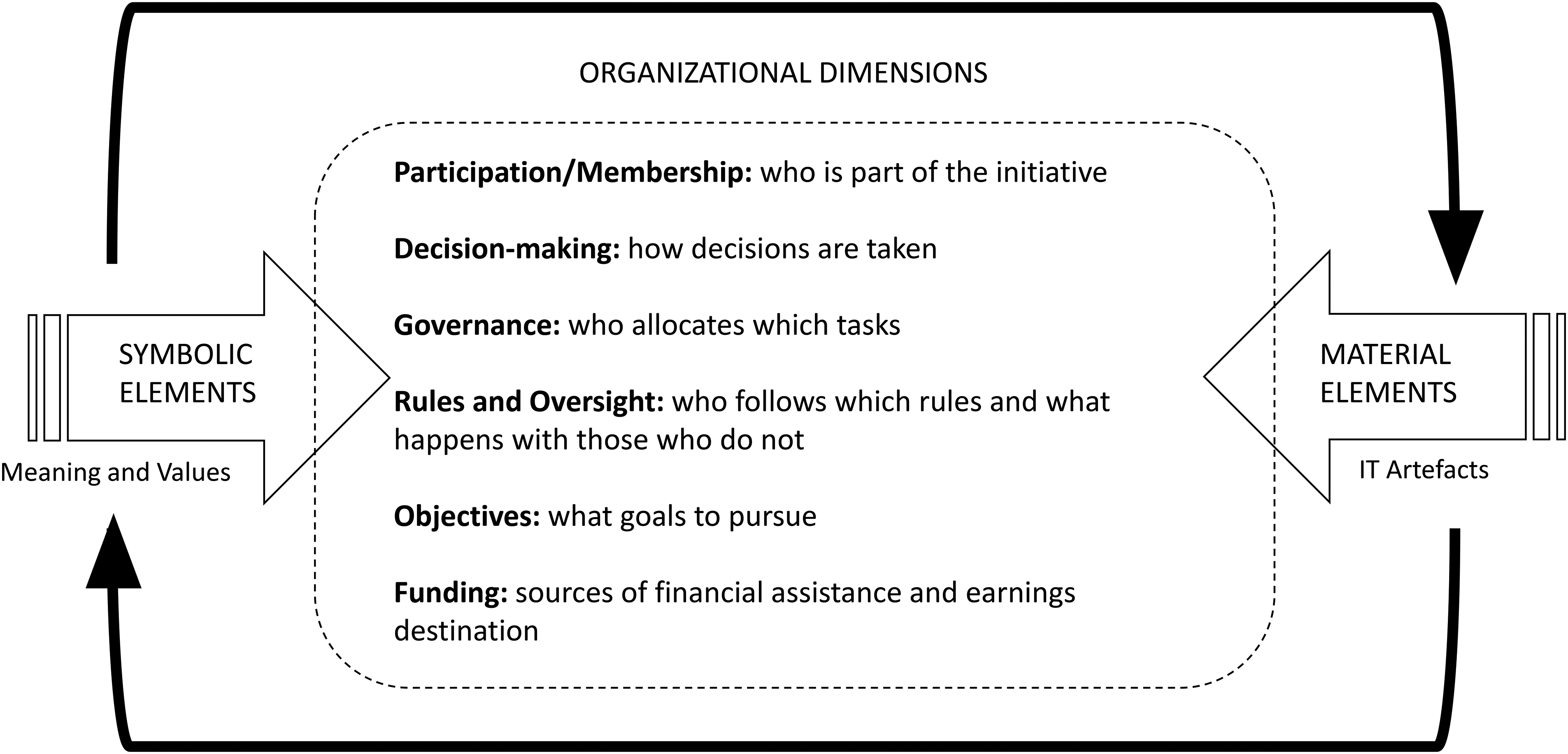
Analytical framework to investigate the organisational aspects of data-enabled activism.
In this article, this analytical framework is applied to explore the organisational patterns that characterise the OSA initiative, which mobilised hackers, journalists, activists and concerned citizens with various levels of tech knowledge. In general, most of these individuals, recognised as different types of ‘open data intermediaries’ (Schrock and Shaffer, 2017), are expected to influence collective actions in their unique manner, primarily by adhering to principles and standards rooted in their individual past experiences. Not by chance, in newly formed organisations, such as tech startups, the development of the organisational culture involves the prevalence of beliefs and values that are typically reflective of those of the founders, as they bring their assumptions to the table (Pöllänen, 2021; Schein, 2010). Indeed, while ‘the speed, reliability, scale, and low cost of the digital network are what enable the great scope and reach of contemporary activism’ (Joyce, 2010: viii), these features can also be seen as the conditions that have been motivating people to invest and become entrepreneurs, some of them to do business with a social purpose. On this matter, it is worth noting that many digital anti-corruption innovations are developed by tech-literate civil society groups and the private sector (Davies and Fumega, 2014).
Prior research on social entrepreneurship had already shed light on a growing sector aimed at building up a social economy that mixes elements from business, non-profit and state sectors and faces friction among different organisational cultures, especially in hybrid social business organisations (Nicholls, 2006; Smith and Besharov, 2019). Social enterprises tend to selectively couple elements of commercial and social welfare logic to gain legitimacy and sustainability (Pache and Santos, 2013). While activists are more likely to form social ventures as a continuation of their ongoing work on a social issue, market-oriented social entrepreneurs’ first activity on a social issue is to immediately form a social venture (Shumate et al., 2014). The literature on digital activism also indicates that developers’ technical imaginaries are often fed by practical and future-oriented goals, in which notions of ‘free market and autonomous, free-spirited individuals benefiting from advances in information technology’ prevail (Lehtiniemi and Ruckenstein, 2019: 3).
Due to the many types of individuals involved in data-enabled activism initiatives, including the OSA initiative under scrutiny, this article expects to find what might at first glance be interpreted as competing organisational patterns and cultures. The attempted recombination of these different organisational patterns and cultures may represent a relevant challenge for data-enabled activism that goes beyond those instead related to the joint participation of civic activists and volunteers to better give voice to demands and build up successful coalitions and the usual process of institutionalisation of social movements as they develop (Anheier and Scherer, 2015). Data-enabled activism may also involve resources, services and products aimed at stimulating social change that is not necessarily rooted in the same realm, with the social movement elements being only some of the many involved as will be clear in the next section, where we present the case study under investigation in this article.
Case of study and methods
A small core group of people with professional tech backgrounds, experience with open-source communities, and familiarity with crowdfunding campaigns and short-term project design created OSA in 2016 when a large-scale anti-corruption movement was popular around that time in Brazil. 2 OSA has never positioned itself in the political–ideological spectrum, as many other digital anti-corruption initiatives did, and it was initially projected to be a tech (for good) startup, that is, an entrepreneurial venture intending to grow large beyond the solo founders but also to fight corruption with civic innovation. Although OSA uses technology to take on a social issue, enabling advocacy has never been an ambition. To start the first prospects, OSA's three founders used technical and human resources from the tech company in which two of them were partners. They found enough financial backing to get off the ground through online crowdfunding of BRL 80,424 (around USD 24,700 in 2016) donated by 1286 people, allowing them to pay a core group of eight people, including the three initiators, for three months. 3
From its beginning, the project deployed an ensemble of existing and new digital data and technologies to attract and connect to potential funders, collaborators and users. OSA was open for contributions on the messaging app Telegram and the open and collaborative code hosting web platform GitHub. These two platforms attracted people interested in codes and analysis of open data on the use of public money. These included journalists, data scientists, software engineers and free software activists but not many anti-corruption activists, according to OSA's creators. Over 600 people joined OSA's Telegram group and later transferred to the chat app Discord. Although not everyone had highly active roles, 102 people collaborated with the project on GitHub. 4 OSA publicised its activities on Facebook. Its practices and beliefs were documented on the open social publishing platform Medium and were later transferred to a monthly civic innovation newsletter.
Some members of this new tech community contributed with ideas, tests and innovative solutions on a volunteer basis. The core paid group along with these volunteers created a mainly Python-programmed application named Rosie, a bot that first extracts and merges data and applies hypothesis (audit trails) and test-driven development processes to estimate a ‘probability of corruption’. 5 Rosie bases its predictions on the legislative established internal and formal rules such as reimbursement only allowed for individual meals and non-alcoholic beverages to then analyse each reimbursement receipt submitted by MPs, by processing public and private open databases made available by the Lower Chamber, the Revenue Service, Google, Foursquare and Yelp (Odilla, 2023). For example, Rosie flags suspicious cases such as MPs requesting reimbursement for a meal eaten in a restaurant in their state of origin on the same day, and at the same time they were in the congress voting in the federal capital. 6
The bot also sets up a database used as a reference source in future analyses, publishes its analysis outcomes online on a dashboard called Jarbas, and uses an automated Twitter account to invite its 39,000 followers to use OSA's tools and processed data to hold politicians accountable. Until August 2021, the Facebook account was used to promote Rosie's main findings among its 67,000 followers, among other topics, when an MP pays money back or questions the suspicions flagged, and events and new initiatives they take part in. Under the anti-corruption scope, OSA succeeded in revealing an unprecedented number of potentially irregular expenditures by MPs, who were forced to respond to these claims publicly and paid public money back when irregular expenses were recognised as such (Savaget et al., 2019: 374).
Despite all this, OSA did not generate enough revenue as its creators expected to keep them exclusively engaged with Rosie and their civic tech goals. Instead of killing the bot and closing the initiative, they negotiated to incorporate OSA into Open Knowledge Brasil (OKBR), the Brazilian chapter of an internationally known NGO, the Open Knowledge Foundation, which campaigns for governmental transparency and open data. In February 2018, a year and a half after being created, OSA joined forces with OKBR by investing in a supervised transition that took one year. One of OSA's creators led the then-new data science program for civic innovation within the OKBR for one year and started to develop new tools and projects.
Rosie and Jarbas are still operative and keep attracting people interested in using technology to fight the misuse of public money. Both require a relatively low level of maintenance, but there have been very few improvements to increase the scope and engagement around these tools. Since 2020, Rosie and Jarbas have not been treated as a priority by OKBR anymore. Because they are automated tools, they had been running autonomously, including on Twitter, for years. 7
We selected OSA as a case study based on its uniqueness and relevance for understanding organisational features of data-enabled activism in the realm of anti-corruption. As noted by Creswell (2013: 97), the case study method allows us to explore real-life, contemporary-bounded systems over time through detailed, in-depth data collection involving multiple sources of information. We reconstructed the trajectory of OSA from its creation in 2016 until 2021, to understand not only its key organising features but also how they interplay with symbolic and material elements of digital technologies. We recognise that OSA's creation, transition and status as part of a broader portfolio of a not-for-profit organisation are three important phases in its trajectory. Nonetheless, the analysis focuses on understanding the initiative's overall key organising features that, it must be said, did not vary much over time during the years of analysis (2016–2021). To grasp the case study in all its complexity, different techniques of qualitative data collection and analysis are combined, as detailed in Table 1.
Description of methods and material studied.

Interviewees, 8 whose names were converted into numeric characters, were asked, among other umbrella questions, to detail how and why they got involved with OSA, in which capacity they engaged in the initiative, what their daily interaction with others was like, the role of digital technologies and other non-human elements in their work and their communication and operative processes. Creators, core group members and volunteers also talked about implementation and maintenance processes, funding, challenges, achievements, communication strategies and outcomes. Followers on Twitter were, in turn, invited to talk about the types of interactions they have with the bot, what they like and dislike and what they would change in OSA (Table 2).
Demographics of interviews participants.

On the date of the interview.
Data collected through interviews were combined with online observation of the interactions on the Telegram and Discord groups and Twitter and Facebook. In addition, content shared by the initiative on their website, Medium and GitHub was included in the qualitative data set related to the case study.
We employed thematic analysis (Guest et al., 2012) performed with the support of the software MAXQDA Plus 2020. We coded the materials using a coding scheme that rested on the dimensions of the analytical framework outlined above: organisational dimensions and their sub-dimensions (participation and membership, decision-making, governance, rules and oversight, objectives and funding), the material and the symbolic elements. While we initially employed a deductive analytical strategy that applied the analytical framework to the data, we further developed the coding scheme while coding, letting new, more fine-grained codes emerge that were related to the dimensions listed above and to the material and the symbolic elements included in the OSA initiative.
The organisational patterns of OSA
The OSA initiative is based on the combined employment of different communication technologies. Some of them have been created from scratch by the initiators, like the algorithms and the dashboard to detect and access suspicious expenses of the elected MPs of the Lower Chamber. Others are already existing ones, including GitHub, Telegram, Discord, Facebook and Twitter. From the data analysis, three organisational patterns emerged, each related to a specific configuration of communication technologies that, in turn, allowed three types of actors to participate differently in the anti-corruption initiative, engaging with data from different perspectives. The first type of actor is centred around the core group of activists who first developed the OSA initiative and was responsible for maintaining the technology. The second type of actor revolves around the interactions between the core group of activists and the community of developers, data scientists, journalists and other collaborators who support the initiative. The third involves the integration of OSA's social media followers into the anti-corruption initiative, whom the core group of activists sought to engage in social accountability activities, as described below.
Table 3 outlines the main features that characterise each organisational pattern. In the remainder of this section, we explain how the material and symbolic features of communication technologies employed by the three types of actors lead to the three organisational patterns.
Organisational layers, communication technology most used and type of engagement with data of Operação Serenata de Amor (OSA).
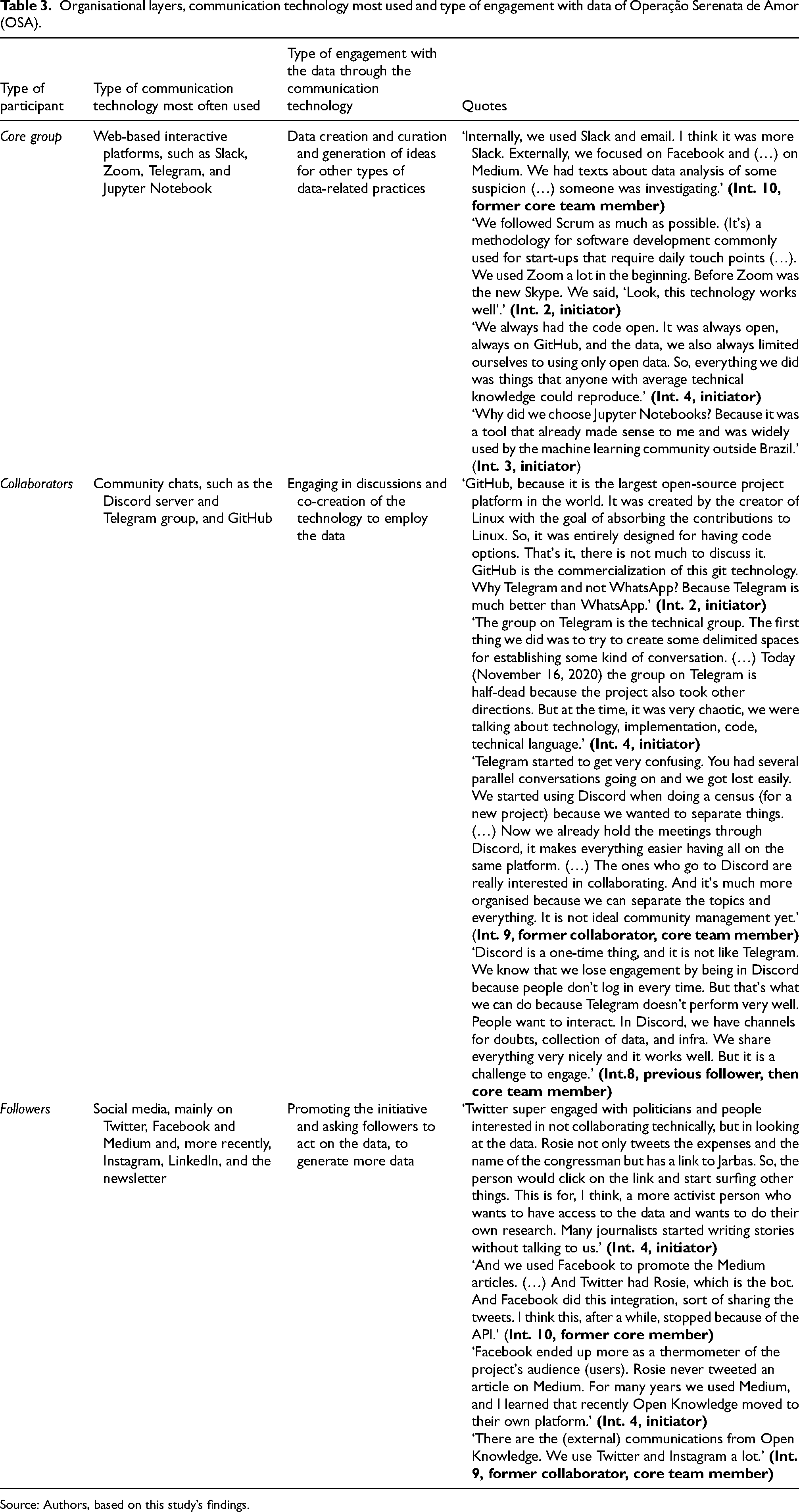
Source: Authors, based on this study’s findings.
Organising the core group
The OSA initiative rests on three initiators, whose primary motivations were to ‘do something with their tech skills’ and ‘develop robots to fight corruption in Brazil’. In 2016, their overall goal was to do something useful using their knowledge at a moment when corruption perception was peaking in Brazil. OSA was launched just after President Rousseff was impeached by a congress that was not entirely clean: out of Brazil's 594 MPs, 352 were under investigation or facing charges of corruption and other serious crimes (Bevins, 2016). Interviewee 2, one of the initiators, summarises how it started: With our background as ‘startuppers’, the rationale is very simple: How do we deliver value quickly and easily to prove to the user that we are able to grow the business? And the first thing we hit was the Lower Chamber data, which was better organised. The difficulty was that it was the XML, XML is the old JSON format, and it was gigantic. (…) The purpose was to feel good trying to do something against all that was happening. It was fighting corruption, but it wasn’t… [deep breath] it wasn’t a paladin thing, it wasn’t like ‘Let's go save the world!’. It's more what we do with what we know. (…) So, what was distinctive about Serenata was exactly this junction with a startup model. (Interviewee 2)
The combination of different professional experiences, skills and motivations of the paid team also reflected the initial aspirations of the OSA's initiators, who presented the initiatives’ core organisers as a bunch of diverse individuals, as the call for crowdfunding stresses: We are programmers, hackers, entrepreneurs, dreamers, Brazilians, activists, and outraged (people). We are specialists who want to completely stop our lives dedicating ourselves for two months only to OSA to create the necessary devices to identify cases of corruption and misuse of public money.
9
The previous professional experiences of the core group help to explain the selection of the communication technologies they used to work together. At the same time, the platforms used, for example, Zoom, Slack, Telegram and GitHub, also shaped their organisational features. These digital tools facilitated flexible online interactions among the core team members, who were free to decide their preferred working times and locations. This is seen on OSA's profile on GitHub: ‘We have no non-virtual headquarters, but we work remotely every day. Most of our ideas are crafted to work in any country that offers open data, but our main implementations focus in (sic) Brazil.’
According to Interviewees 2 and 12, from OSA's beginning in 2016, the initiators held daily short Zoom meetings to support ‘the team spirit’ and keep everyone informed about their most important tasks for the day. The high flexibility of using Zoom and Slack, for example, helped the core team members to meet and take decisions collectively despite their different locations. These platforms also collaborate more horizontally to define and monitor strategies, tasks and deadlines. OSA's core group is organised in a leaderless structure with fluid and sometimes overlapping roles, following the agile working management methodology (Anderson, 2003). This interactive working approach became popular in the software industry and focuses on self-organising, expanding collaboration, speeding procedures with short-term goals, and continuous releases based on feedback to respond to market trends. When creating Rosie, the core group followed the domain-driven design, a flexible and adaptive process framework for agilely solving complex problems, to study regulations and reimbursement rules and convert them into software code (Cordova and Gonçalves, 2019) written in Python using the web-based interactive computing platform Jupyter Notebook.
OSA's ‘read me’ profile on GitHub provides a glance at the fusion of symbolic elements related to civic tech, data-enabled activism and social entrepreneurship that are coherent with the background of its core group: ‘We have been creating open-source technological products and tools, as well as high-quality content on civic tech. Empowering citizens with data is important: people talk about smart cities, surveillance, and privacy. We prefer to focus on smart citizens, accountability, and open knowledge’. 10 These symbolic elements are not only represented by the existing and newly created technologies and type of data deployed by OSA's co-group but also guided their actions and beliefs and defined how they organised themselves to use their scarce resources.
Organising the collaborators
Apart from the paid staff, OSA is based on voluntary association and high levels of autonomy of voluntary collaborators but with hierarchical control by the core team. Motivation among collaborators varied and overlapped, ranging from curiosity to the opportunity to learn, practice, use knowledge and boost the portfolio by using data for good, fighting corruption with technology and reacting to and promoting political change. According to the interviewees, collaborators were developers, programmers, designers, journalists and people interested in data science and open-source projects. While it was relatively easy for volunteers to get in touch with the initiative through one of the many available channels of communication available, their actual participation in OSA might be problematic, at least at first. Interviewee 6, for example, discovered the initiative on Twitter and joined OSA's Telegram group for believing in disruptive technologies. He is also part of the Wikimedia movement and noted that, despite the openness of the core group, the project seemed to have been already completed with little room for taking an active part in the development of Rosie and Jarbas. He stayed, though, and got more involved in follow-up projects, Querido Diário and Perfil Político. 11
Volunteers who contributed to coding, running tests or helping to organise tech sprints, such as Interviewees 12, 16 and 1, managed to get more active roles. Indeed, the level of volunteer participation depends on tech literacy and coding skills. No proficiency in Python, for example, can be an inhibitory factor for participating, according to collaborators. Two of these three interviewees were later hired as part of the core group after meeting some of the initiators at face-to-face events, and the third was inspired to create her own open government data initiative.
The interactions between initiators and collaborators are concentrated on GitHub, Telegram and, more recently, Discord. Interviews and participant observation on these three social media platforms also revealed less obvious but key features impacting the organising, such as defined rules, openness to criticism and receiving feedback, attempts to improve communication and guidelines and, especially, communal support. For instance, at its beginning, the group on Telegram worked as a space to ask for and receive feedback. Multiple times, the core team improved its documentation and refined its guidelines and communication policies based on volunteers’ comments on Telegram, which supported this type of interaction quite smoothly.
Initially, collaborators had to follow clear rules, such as English-only communication on Telegram and GitHub. This rule was a topic of tension at times. A GitHub issue titled ‘Por que não em Português? (Why not in Portuguese?)’ 12 was opened to question the rule, generating a heated debate among collaborators. Some interviewees recognised that the rule may have intimidated potential contributors and compromised the participation of non-English speakers. Initiators, on the other hand, argued that English is a standard language for software development in the global market, to attract international contributors and create impact. Although GitHub kept the codes in English, the rule was abandoned on Discord, which started as an alternative channel for communication in Portuguese to facilitate communication when the initiative was already being conducted by OKBR. Today, Discord is the main platform where the core team interacts with collaborators and organises their actions following a startup model to achieve data-enabled activism goals.
The coordination of volunteers is loose, but interactions observed on the message app groups proved they were a space for intense collaboration, with people helping each other by clarifying questions not only about programming languages, data sources, code errors and tests but also about the legal apparatus, the political system and other similar social tech initiatives. Tensions also developed in specific cases: it was possible to identify meanings and expectations of data and open-source projects, which varied among initiators, core members and collaborators. The fact that OSA had paid staff attracted questions on the Telegram group, exposing the already observed interactive tension among the tech volunteers about being an open-source project with civic innovation features and its closely aligned tech startup values. At other moments, however, initiators positioned themselves less as ‘startuppers’ and more as data-enabled activists concerned with participatory democracy. However, the interaction among initiators, core members and collaborators, at least on Telegram, suggests the plight to develop consensus-based decisions, despite the attempts to employ the principles of participatory democracy to transform the decision-making process of the initiative. That said, a loosely tied network of collaborators sharing common interests was observed, whose members aimed to participate with codes and ideas even under the hierarchical control of the core group. The organisation of collaborators, therefore, combines the use of popular chats for communities (Discord's servers and Telegram's channels) with their symbolic imaginaries of community management, often seen as the processes of creating safe spaces to bond with targeted audiences and create a network in which, in the case of data-enabled activism, activists, volunteers and partners can connect, share and grow.
Organising the followers
OSA has always had a strong presence on social media aiming at gaining visibility and interacting with a broader audience. Apart from using Twitter to call for people to check on MPs’ expenditures, OSA started publicising its main activities on social media, using existing platforms such as Medium, Facebook and YouTube. OSA used illustrated and provocative cards on Facebook to call for people's attention and engagement. More recently, Instagram, LinkedIn and newsletters have become the channels used to communicate directly with the public. Initiators and collaborators interviewed recognised that OSA always had a very well-designed communication strategy that was not limited to social media. They attracted the attention of mainstream media and participated in, among others, face-to-face talks, training, programmers’ meetings and events on tech innovation. Interviewees’ part of the core group made clear that communication was not limited to sending updates, instructions and forming impressions of potential users. An attempt was made to mobilise individuals, although in a quite different vein from more traditional forms of participation that often encompasses protest, campaigns or advocacy.
This different type of engagement, afforded by the combination of various digital technologies, became clear when the bot Rosie got its Twitter account. OSA faced issues to activate formal accountability channels when law enforcers did not open inquiries to investigate Rosie's findings, which made them redefine its creators’ strategies. Although Twitter does not enjoy the same level of popularity as Facebook or Instagram in Brazil, its API was seen as more flexible, and, therefore, it was chosen because it allowed the creation of new components such as bots and automated posts. Through the bot's account on Twitter and OSA's profile on Facebook, a fine-grained network of thousands of individuals was created, giving scale to OSA's actions and allowing these followers to activate their networks and personalise the fight against the misuse of public money by MPs.
Followers interviewed say they started to follow Rosie on Twitter for different reasons such as curiosity, because of friends, professional reasons, having seen the initiative on the mainstream media or being outraged by corruption. The level of interaction with Rosie and Jarbas also varies; some people share or like the posts, while others sometimes check the receipts and yet others simply do nothing. There is no formal organisation, no leaders, no rules, no oversight and no interactions with followers. Anyone who accesses the internet can be part of OSA with absolute autonomy to interact or not with the content on Twitter and Facebook. There is no guarantee that there will be any response. In short, data showed that followers represent a less adherent layer of both participation and organising.
Not only was anti-corruption mobilisation work externalised to Twitter's bot followers, but there was also no attempt to develop a closer relationship with Rosie's followers to increase the use of the tool, intensify pressure on politicians or develop new strategies to curb the misuse of public money. The fact is that Rosie and Jarbas have been running in the same way since 2016 and nothing else has compromised the initiative's engagement levels. Followers interviewed showed disappointment with the lack of updates to make the bot more attractive on Twitter and frustration with the fact that politicians keep misusing public money, as indicated by Rosie's posts. Initially, congressional representatives tagged on Twitter started replying to the bot and its followers to question the posts, justify the expenditures or just communicate that public money had been paid back. Over the years, a response from politicians became less likely when a dubious expense is reported by the bot.
Four organisational challenges in the OSA initiative
The type of digital technologies and data deployed in the OSA initiative along with the different imaginaries related to them allowed for three forms of participation, each of them in turn sustained by a different organisational pattern, as explained above and summarised in Table 4.
Key features of the three OSA's organisational patterns.

Note: Authors, based on this study's findings.
The presence of the three organisational patterns proved difficult to recombine and align substantially and sustainably both material and symbolic elements of organising features. Such a difficulty brings with it four challenges that arose along the way in the development of the OSA initiative and that influenced its course: the combination of different organisational cultures, lack of cohesive collective identity, dispersal of participants and sustainability.
Combination of different organisational cultures
The first challenge emerges from the presence of different organisational cultures, namely, the startup background and ideals of its initiators, on the one hand, and OSA's participants, followers and supporters’ identification with an activist ethos. The two were indeed difficult to combine in a cohesive and consistent organisational culture. Despite the civic-minded approach, in which data and technology empower people, the commercial mindset is undeniably present and linked to the entrepreneur culture, especially among the core team – one of them explicitly says they were ‘startuppers’ – and the collaborators. Interviewees 2 and 3 both acknowledge their background as tech ‘startuppers’ influenced OSA's formation and its further aims. Interviewee 3's ambitions for OSA illustrate this connection between tech startups and anti-corruption data-enabled activism values: ‘I wanted to be financed, to have millions every year, to have 100 people working on it, to buy a building’ and ‘become an independent data-driven court of accounts’ (Interviewee 3).
OSA's initial market-oriented values created friction between the core group and collaborators. On Telegram, for example, collaborators questioned why there were paid contributors and the criteria that were used to hire them. During debates around the English-only rule, collaborators left comments questioning whether OSA was to serve the community or build up a portfolio. However, the OSA case also shows how the role of different organisational cultures might shift over time. Indeed, OSA started as an attempt to form a social venture, as expected for business social entrepreneurs’ first activity (Shumate et al., 2014), but it has incorporated less market-oriented features over the years. When the group decided to join forces with a global, non-profit network such as the Open Knowledge Foundation, open data, free software and civic tech activists and even developers who were just observing the interactions on Telegram and GitHub started taking more active roles. They started engaging in training and periodical online meetings with contributors to decide together on subsequent actions and follow-up projects.
Lack of cohesive collective identity
The second challenge arises from the lack of a collective identity able to coalesce the various types of actors that participated in the initiatives into cohesive collective actors. From the very beginning, indeed, OSA suffered from an ‘identity crisis’ for not knowing its exact place, according to Interviewee 4, one of the initiators, who highlighted that: There is a natural issue for a project like this, it has always been more of a proof of concept than a closed project. At the beginning of our story, the question was how to use technology to navigate politics. Serenata [OSA] was a response to that. (…) There was a time when we used to self-identify more as content producers, as suppliers for journalistic purposes rather than as a technology or data science initiative. We always had an identity crisis about our role. (Interviewee 4)
In short, the presence of multiple understandings of what the OSA initiative was contributed to the development of distinct types of frustration that made the demobilisation of the initiative's participants easier. OSA's initiators did not break the glass ceiling of becoming a self-sufficient social enterprise. For creators, the problem was not being able to make a living by working exclusively at OSA. For collaborators prevailed the perception that the initiative was somehow already settled and, therefore, there was little room to make substantial contributions. For followers, after initial enthusiasm, a low expectation prevailed that corruption could be effectively curbed via a bot posting on Twitter and its followers engaging with it.
Dispersal of participants
The third challenge is related to the quick demobilisation of the participants in the initiative. It emerges from the material difficulties initiators had to face in sustaining the digital technologies and the community of supporters and followers. Although over 600 people were discussing and willing to collaborate on Telegram, very few helped, usually only with coding for a couple of days, and then simply disappeared, according to the core team interviews. Some collaborators just wanted to update their skills, keep practising or add to their GitHub profile to get a better job in the IT market. Others wanted to do more but did not feel comfortable collaborating because they were still learning to program or did not program in Python. When they realised they would fail in converting deliverables to generate enough revenue to sustain its creators and the project, they started looking for an NGO to embrace OSA before leaving the project. In a negotiated transfer, one of the initiators stayed for one year to coordinate the new data science program for civic innovation within OKBR. Four years after Rosie and Jarbas were created, everyone from the original core group had already left to pursue other professional goals. Most of them mourned the end of the job but justified their absence by explaining the need to pay their bills. Within OKBR, former and new collaborators were hired not only to keep Rosie operative but also to develop new projects; hence, they have been prioritising other initiatives.
Sustainability
The fourth challenge relates to the sustainability of data-enabled activism. As data infrastructures grow, non-human actors like Rosie and Jarbas are more likely to keep collecting and exposing data to reveal specific issues with extraordinarily little maintenance. On the one hand, this automated feature may help initiatives such as OSA survive, despite its leaderless, connective and sometimes conflicting characteristics. On the other hand, this techno-centric affordance may also contribute to transforming them into empty initiatives, abandoned and risking becoming obsolete because of low levels of collective action and social mobilisation.
For instance, in March 2021, Rosie stopped running and tweeting and Jarbas stopped being updated. The request for someone to fix it and ‘help Rosie to tweet again’ was published by OKBR on Telegram and Discord, but it did not echo immediately. Just one volunteer offered help but was immediately invited to collaborate with other projects. It was only five months later that Rosie and Jarbas started working again after an insufficient memory issue was identified. On 10 November 2022, Rosie stopped tweeting again. Three followers reacted by interacting with its last post and asking: ‘Rosie, is everything all right?’; ‘Rosie, it seems you stopped working. What happened to you’ and ‘Rosie, are you all well? Do you need help?’. 13 By June 2023, the bot's Twitter account was still without posting. 14 These two episodes call attention to the necessity of maintenance and expose how demobilised the OSA community was almost five years after its creation, raising questions about the sustainability of these civic innovation initiatives.
Undoubtedly, these four identified challenges reduce the potential of initiatives like OSA to promote positive impact and sustainable success within the scope of data activism. If the broad mobilisation observed in the case of OSA is an identifiable factor of a social startup organisation with social movement-like behaviours, the ultimate demobilisation due to business factors, such as initiators not succeeding in making a living from the initiative and allowing it to become just another product part of an international NGO's portfolio, can be seen as a precautionary tale for data-enabled activism, particularly for initiatives closed aligned to civic innovation and social tech startups.
Conclusion
The article expanded Den Hond et al.'s (2015: 205) framework that draws on recent organisational theory on partiality and partial organising applied to social movements to explore material and symbolic elements shaping the organising of data-enabled activism through the case of OSA. In so doing, our study offers implications for understanding the organising of data-enabled activism more generally, allowing us to develop a nuanced view of its different modes of participation and the related organisational patterns, each with its features and dynamic use of digital technologies ensembles ranging from existing platforms to innovative technologies developed to access, generate and create data.
Paying attention to the interconnected presence of different layers of participation and organisation helped to identify not-so-obvious challenges. One of them is the fact that data-enabled activism may be sustained by non-humans responsible for both automating data practices and calling for action. Another challenge is that initiatives may be triggered by and attract tech-skilled people willing to innovate but not with so much altruistic spirit. Challenges like these should be considered in the design process of future data-enabled interventions. This finding serves as a reminder that data-enabled activism is part of an intricate infrastructure in which the focus of attention should not only be towards data-related practices. Rather, an entire ecology of communication, not only specific platforms or devices, needs to be taken into consideration when it comes to the organisational patterns in which a broad range of actors are involved, including data activists, tech workers and people more broadly interested in digital innovation, through a variety of digital technologies.
We have reason to believe that our analytical framework may help to address further questions related to how data activism is organised and with what consequences. While scholars such as Milan and her co-authors (Kazansky et al., 2019; Milan, 2017; Milan and van der Velden, 2016) suggest that democratic agency is a relevant component of data-enabled activism and its outcomes, this study illustrated how democratic agency is not a static given but rather an ongoing process, which might often be rather fragile. The engagement with data brings together different organisational patterns and modes of participation that involve a variety of actors, who may have different goals and expectations on what they are doing in the framework of a given data-enabled grassroots initiative. Further research, however, could explore whether this is likely to be a more general feature of initiatives that are strongly based on digital technologies, and hence not necessarily instances of data activism, and what happens to democratic agency when participants in data-enabled activism do not feel empowered, but rather disillusioned about grassroots initiatives and their outcomes.
In addition, this study expands prior research that had already identified businesses, more specifically powerful corporations and elites creating and/or funding grassroots mobilisation (Walker, 2009; Weber and King, 2014). The case of OSA shows us how the tech startup environment is capable of generating bottom-up initiatives that, in this case, mobilised a wide range of people to join digital technologies ensembles to fight corruption. Although OSA is far from the idea of ‘privatizing participation' (Walker, 2009), the commercial values and expectations of its creators and collaborators impacted its organising and created uncertainty and ambiguity for the initiative's processes of development and mobilisation.
Therefore, this article contributes to the discussion of the challenges of organising and maintaining digital data-enabled activism, especially in instances of ‘middle ground’ projects, that is, projects which fall short of achieving their major intended goals (e.g. making money from civic and anti-corruption technologies) but are not mere failures either (e.g. mobilise thousands and become a case of data-enabled activism to fight corruption). As the case of OSA shows, the large influx of technically skilled individuals early on, who built impressive mobilisation and communication structures, may face difficulties in sustaining the volunteer base needed to maintain and expand these structures. On a more theoretical level, this should be seen as a call for systematically combining organisational studies with social movement scholarship to assess data-enabled activism in other sectors than anti-corruption. Research at the intersection of organisations and social movements can provide answers to a changing world in which formal organisations and movements alike evolve (Weber and King, 2014: 501). Examples of this synergy range from the increasing professionalisation and institutionalisation of movements to the adoption of movement-like tactics in campaigns led by corporate actors to movement-like processes being important to efforts to create new organisational forms (Davis et al., 2008; della Porta, 2020). As this article showed, we can add to this list of examples the tech startup-like initiatives developing new forms of civic and political engagement around contentious issues. Yet, future research should further examine the interplay between different forms of tech and social enterprises and data activism emerging in the light of similar technological and social shifts.
Footnotes
Acknowledgements
This article's research was conducted in the framework of the BIT-ACT (Bottom-Up Initiatives and Anti-Corruption Technologies) project, funded by the European Research Council (ERC). Preliminary drafts of this article were presented at the 37th EGOS Colloquium (July 2021), the 16th Organization Studies Workshop (May 2022) and the 72nd Annual ICA Conference (May 2022). We express our gratitude for the valuable opportunities and feedback provided by Donatella della Porta, Mario Diani, Pablo Fernandez, Jen Schradie and all the attendees who participated in the panels and engaged with us. We are also thankful for the comments provided by the anonymous reviewers.
Declaration of conflicting interests
The author(s) declared no potential conflicts of interest with respect to the research, authorship and/or publication of this article.
Funding
The author(s) disclosed receipt of the following financial support for the research and publication of this article: the European Research Council (ERC) under the European Union's Horizon 2020 research and innovation program (Grant agreement No 802362).
