




Abstract
Limited literature exists to explain why the masses comply or do not comply with orders from separatist groups. In this study, the researchers used variables from frustration-aggression theory, cognitive dissonance theory, and theory of fear to suggest a model that explains why operators of micro, small and medium enterprises comply with messages from Indigenous People of Biafra. The researchers made use of a descriptive survey research design with a structured questionnaire as the instrument for data collection. A total of 470 participants who were sampled using respondent-driven sampling chain referrals took part in the study. Results from the structural equation model analysis showed that predictors of compliance to Indigenous People of Biafra sit-at-home order among micro, small and medium enterprises operators include perceived injustice, believe in government as well as believe in Biafra agitation. Additional results showed that fear and information cues moderate this relationship. Recommendations are made based on the outcome of the study. The result of this study could inform policies on how to communicate messages aimed at addressing issues that have the potential of fuelling separatist agitations.
Keywords
Introduction
One of the problems facing the world today is how to curtail the influence of violent non-state actors who attempt to enforce their will on defenceless citizens (Okeke et al., 2019). According to PM News (2020) in some countries of the world, violent non-state actors such as terrorists, secessionist groups and religious extremists, among others, have resorted to taxing citizens in a bid to fund their criminal activities. Terrorists are a group of people who engage in crimes such as murder, kidnapping, hostage-taking, arson, and so on and spread fear among the general populace (United Nations Office on Drug and Crime, 2022). It should be noted that there is no generally accepted definition of terrorism, but in most cases, terrorists have an agenda which they are promoting. Religious extremists are people with radical views about religion and who are willing to engage in violent activities because of religion (Hogg & Adelman, 2013). However, secessionist group attempts to separate from a larger federation and form an independent entity.
For example, in Nigeria, bandits levy citizens from the Northern part of the country while also issuing directives. In states such as Kastina, Kaduna and Zamfara, armed bandits collect taxes from farmers before they are allowed to harvest their crops. Sometimes, even after paying the taxes, the bandits still steal the harvest of farmers (PM News, 2020). In addition, terrorist groups such as Al Qaeda and Islamic State (ISIS) in Iraq and Syria have been accused of exploitation under the guise of religious taxation. They have also been accused of hostage-taking for money as well as smuggling (Piazza & Piazza, 2017). Statutorily people are expected to pay taxes only to the government but the growing instances of insecurity have led to a situation where non-state actors compel the citizens to pay taxes and issue other directives.
In different countries such as Turkey, Germany, Indonesia, India and Nigeria, among others, separatist groups have emerged clamouring to correct perceived injustices and issuing orders to the citizens (Derin-Güre, 2011; Lyon & Uçarer, 2001; Roth & Sever, 2007). In Nigeria, the most prominent separatist group that has posed a serious security threat to the government and citizens is the Indigenous People of Biafra (IPOB). The group is clamouring for the separation of five states from Nigeria to constitute the Republic of Biafra. The states are Abia, Ebonyi, Anambra Enugu and Imo. Its current leader is Mazi Nnamdi Kanu. IPOB has issued different directives to the citizens at different times. However, the arrest and subsequent detention of its leader by agents of the federal government of Nigeria has led to the group declaring every Monday as ‘ghost Monday’ and citizens from South-East Nigeria are expected to sit at home. In declaring the sit-at-home, the group notes: We the global family of the Indigenous People of Biafra IPOB (IPOB) wish to announce to all Biafra citizens, friends of Biafra and lovers of Biafra freedom and independence that IPOB leadership has declared every Monday ‘a ghost Monday’. This declaration takes effect from Monday, August 9, 2021. From that day Biafra land will be on lockdown every Monday from 6:00am to 6:00pm until our leader, Mazi Nnamdi Kanu . . . is released. (David-Chyddy, 2021, para 3)
The states government from the region asked citizens to ignore the sit-at-home order and go about their normal business activities. The government went as far as threatening workers with a sack while businessmen and women with the permanent closure of their shops. The first Monday after the declaration saw the death of many people while property worth millions of naira was destroyed (Isaac Madukwe et al., 2024). The government is the legally recognized and empowered institution to provide a guide to the general public and issue directives regarding public holidays when citizens should go to work as well as when markets should open for commercial activities. The government also has the security architecture to enforce law and order while also providing security for citizens to carry out their legitimate business activities (Isaac Madukwe et al., 2024). However, in this particular instance, the government has been unable to stop the sit-at-home order as businessmen and women have continued to close their shops with a corresponding negative implication on the economy. South-East Nigeria is known for its business activities and it is curious to know why business owners will rather obey IPOB by closing their shops instead of coming out as directed by the government. Therefore, the objective of this study was to suggest a model that explains why IPOB messages have been succeeding with particular attention to micro, small, and medium enterprises (MSMEs).
Impact of MSMEs on economic development
There is no generally accepted definition of MSMEs because it can be defined using criteria such as investment, number of employees, capital, and turnover, among other indicators. However, in Nigeria, micro-enterprises are defined as business enterprises that have employees of less than 10 with an asset of below 5 million naira only (Hassan et al., 2023). However, small enterprises are defined as businesses with employees capacity of between 10 and 49 with an asset of between 5 and 50 million naira only. Finally, medium enterprises are defined as businesses that are made up of 50 to 199 employees with an estimated asset of 50 to 500,000 million naira only (Hassan et al., 2023; National Policy on Micro, Small and Medium Enterprises, 2020). The critical point to note here is that MSMEs are made up of people who are very small in number but whose activities are capable of significantly affecting the larger economy.
MSMEs are essential for the economic development of any nation. According to Beck et al. (2005), there is growing interest in MSMEs among researchers because of the critical role they play in economic development, redistribution of income, and poverty alleviation through job creation. Aminu et al. (2018) corroborate that any nation that desires to achieve meaningful development will take the issue of its MSMEs seriously. Researchers (Anthony & Arthur, 2008; Aremu & Laraba, 2011; Chinweuba & Sunday, 2015; Vijayakumar, 2013) are in agreement that MSMEs are critical to the overall economic development of a country. According to World Bank (n.d.), MSMEs contributed substantially to the creation of jobs globally. It adds that MSMEs makeup 90% businesses and contribute 50% of job creation the world over. The impact of MSMEs on economic development has been measured in literature. For example, Nursini (2020) conducted a study to determine the impact of MSMEs on economic growth and poverty reduction. The researcher utilized secondary data with attention on poverty gap index, head count index, poverty severity index. However, the MSMEs were categorized based on their sizes. The researcher then made use of control variables like openness, government expenditure, economic growth, and investment. The result of the study showed that MSMEs significantly impact on poverty reduction as well as economic growth with particular reference to Indonesia.
Yahaya et al. (2016) carried out a study wherein they examined the impact of MSMEs on the economic development of Nigeria. The researchers made use of a descriptive survey as the design with a structured interview as the instrument for data collection. The researchers interviewed MSMEs operators as well as officials from the Small and Medium Enterprise Development Agency of Nigeria (SMEDAN) and a credit officer of a microfinance bank. They found that MSMEs are essential tools for the economic development of Nigeria. However, insecurity was identified as one of the challenges facing the development of MSMEs in Nigeria.
Harvie (2003) carried out a study intending to determine the impact of MSMEs on poverty reduction in East Asia and reported that engagement in MSMEs has a significant positive effect on the economic improvement of people who are poor. The result further suggests that MSMEs are important tools for economic growth through the empowerment of citizens. Studies conducted in other countries such as Bostwana (Mukras, 2003) and West Virginia (Gebremariam et al., 2004) as well as those involving many countries such as Malawi, Sri Lanka Swaziland, the Caribbean Bangladesh Kenya, Ethiopia and Tanzania (Koshy & Prasad, 2007) also showed that MSMEs are effective tools for economic development. The critical point to note here is that MSMEs are essential for economic development of countries. However, businesses cannot strive in an atmosphere devoid of peace. Sonobe et al. (2021) in a study also reported that MSMEs are usually negatively affected during crises situation in the areas of sales, employment as well as growth.
Nigeria and the burden of separatists’ agitation
In recent memory, Nigeria has been faced with different separatist agitations clamouring to break away from the country and form their independent entities. Almost every part of the country is faced with separatist agitations. For example, in Northern Nigeria, there is the Middle Birth Federation (MBF) that is seeking to break away from Nigeria and create an independent entity (Okeke et al., 2019). The reason for their quest is the perceived injustice which they currently suffer from the Nigerian federation. In South-South Nigeria, there is the Movement for Survival of Ogoni People (MOSOP) which is seeking the attainment of the Niger Delta Republic largely because they have little or no control over natural resources deposited in their area. Going by the current arrangement, natural resources, such as oil, found in locations are exploited by the federal government and shared among the federating units (Gever et al., 2019). Citizens from the Niger Delta region believe that they are not deriving sufficient benefits from the natural resources deposited in their location, hence the need to separate from the Nigerian state. Another separatist agitation in Nigeria which is the focus of this study is that from South-East Nigeria championed by IPOB. The grouping is clamouring for the creation of the Sovereign State of Biafra (Okeke et al., 2019). It is important to note here that even though the agitation for the creation of Biafra dates back to the 1970s, which even led to the outbreak of a civil war, the agitation has not been as serious as the current one.
Nnamdi Kanu, a Nigerian-British who is based in London founded IPOB. According to Najakku (2017), IPOB is a faction that broke away from the Movement for the Actualisation of the Sovereign State of Biafra (MASSOB) as a result of the perceived compromise of the latter. Najakku notes further that IPOB is well sponsored, thus making it very powerful, hence it is able to produce emblems such as T-shirts, flags, and bracelets, among others. According to Ugorji (2017), IPOB makes use of emerging communication channels to mobilize people to support their aspirations. Among the media platforms being used include Radio Biafra, and social media platforms, among others.
The Federal government of Nigeria has responded in different ways to the challenges which IPOB poses. Among the steps taken is the legal means as the government approached the Federal High Court, Abuja for the proscription of IPOB and the order proscribing IPOB as a terrorist group was granted (Ikhilae, 2017). In addition, the Federal government of Nigeria on 14 October 2015 arrested, but granted him bail on 28 April 2017. He was re-arrested from Kenya to Nigeria in June 2021, and this is responsible for the correct sit-at-home being observed in South-East Nigeria (Akinwotu, 2021). The government equally applied the military approaches through the launch of different military operations in the area known as ‘Operation Python Dance’ I, II and III, respectively (Okeke et al., 2019). IPOB on its part has not relented as they have issued different orders. For example, IPOB issued an order directing all public institutions to remove Nigerian flags mounted in their territories. The general public within the South-East zone was also directed to observe sit-at-home on 1 October 2021, which is normally marked in Nigeria as Independence Day (Opejobi, 2021). The group also issued an order directing members of the general public within South-Eastern States to observe every Monday as a sit-at-home day (David-Chyddy, 2021). In addition, the group ordered that every day that its leader is appearing in court, members of the general public should sit at home. IPOB also directed the general public to observe another day of sit-at-home the day President Mohammadu Buhari was visiting Imo State (Ojonugwa, 2021). In all of these orders, the government of the various Southeast states released counter orders, directing the general public within their states to go about their normal business activities
Theoretical framework and study model
In this study, the researchers made use of three theories to develop a model that was tested among a sample of MSMEs operators. The first theory that was used was frustration aggression theory (FAT). The theory was suggested in 1939 by Dollard et al. to explain why people engage in protest behaviour. According to the theory, people engage in aggressive behaviour because of the already existing perceived injustice. Dollard et al. argue that where there is a perception that a person is not getting what he or she deserves, it can lead to the feeling of frustration which will eventually lead to aggressive behaviour. Such feelings of injustice can also influence perception as well as eventual behaviour. The theory is all about the contrast between what a person deserves and what he or she gets. This theory is related to the current study because it provides the basis for understanding the role of perceived injustice in response to information on the sit-at-home order of IPOB among businessmen and women. MSMEs operators may feel that South-East Nigeria has not been fairly treated in Nigeria and hence may express their frustration by supporting Biafra agitation. They may also feel that the state governments from South-East Nigeria have not done enough to correct the injustice against the zone and, hence may not obey government information countering sit-at-home orders. FAT has been tested in the literature. For example, Ogbonne (2019) made use of the theory to examine the activities of Niger Delta Militants and found that the framework provides an adequate explanation regarding why people engage in violent behaviour or protests. Reio (2011) in a study found that frustration-aggression provides an important basis for understanding people’s behaviour. Breuer et al. (2015) and Schafer et al. (2006) in their study also support the postulations of frustration-aggression theory. Based on the frustration-aggression theory, the research hypothesized:
Another theory that was considered is the Theory of Cognitive Dissonance (TCD). The theory was propounded in 1957 by Leon Festinger to explain the central role of cognitions in human behaviour. Accordingly, TCD is made up of three basic components which collectively explain the assumption of the theory. The first assumption of the theory is that people are typically sensitive to differences between their beliefs as well as action. As such, people always ensure that their actions are in line with their beliefs (Festinger, 1957). Within the context of this study, it can be said that MSMEs operators will make efforts to ensure that there is harmony between their beliefs and actions.
In the second assumption of the theory, it holds that when people are exposed to information that is contrary to their beliefs, it will result in dissonance; which is a state of internal disagreement and discomfort. This theory is relevant to the current study because it explains the centrality of pre-existing information in determining the effectiveness of information on secession agitations. From the perspective of this study, an MSMEs operator who believes that Biafra is worth fighting for may regard government counter messages as less valuable; hence, such messages from the government may constitute dissonance for such MSMEs operators. Researchers such as Bølstad et al. (2013), Chatzisarantis et al. (2008) have carried different studies applying the cognitive theory and the outcome showed that the theory is an appropriate framework for studying the impact of pre-existing cognitions on human behaviour. Therefore, the researchers hypothesized:
Another aspect which is worth pointing out here but has not been highlighted by TCD is the issue of fear. It is possible that fear will moderate the actual decision to comply with IPOB messages or listen to government assurances. Kirsch (1990) in his theory of fear and avoidance notes that outcome expectancy was an important determinant of fear while fear itself plays a critical role in influencing engagement in behaviour. This means that perceived danger as a negative outcome expectancy is likely to play a moderating role in determining compliance to IPOB’s sit-at-home order, irrespective of whether an MSMEs operator believes in the agitation or not. Kirsch et al. (1983) in a study reported that expectancy is an important consideration in fear reduction. This means that where the expectation is positive, fear will be low and vice versa. Ruiter et al. (2001) in a study reported that fear plays an important role in determining whether people will comply to messages or not. Therefore, the researcher hypothesized:
Another important moderator of frustration and aggression is information that provides cues. Information from the media such as radio, TV, newspapers and magazines can provide cues for MSMEs operators to feel frustrated in the Nigerian state. Breuer and Elson (2017) aver that the media have the propensity to provide information that will serve as the cues that trigger aggression. Schlangenotto and Kundisch (2017) in a study also reported the moderating effect of information cues on human behaviour. Consequently, the researchers hypothesized:
Methodology
The researchers carried out this study with the use of descriptive survey design. This design is typically beneficial for studies that seek to explore, explain, or describe phenomena. Therefore, in this, the researchers sought to explain why MSMEs operators comply with IPOB messages on sit-at-home.
Study location
This study was conducted in Imo State, South-East Nigeria. The area was considered most suitable because it is part of the area which IPOB regards as Biafra land. Imo State has the highest number of MSME in South-East Nigeria (Small & Medium Enterprises Development Agency of Nigeria (SMEDAN), 2017). According to SMEDAN, Imo state has a total of 2,020, which is the highest in South-East Nigeria. Therefore, the population of this study was 2,020 MSMEs from Imo state, Nigeria.
Study participants
A total of 470 MSMEs operators from Imo States took part in the study. The researchers carried out a priori power Analysis with the utilization of G*power programme (Faul et al., 2007; Ugwuanyi et al., 2023). The parameters were ticked as power (1 − β) at .90, .30 effect size f, and α = .05. The outcome revealed that a sample size of 470 MSMEs was needed to determine the existence of a significant relationship at .05 level of significance.
Sampling technique
The sampling technique that was utilized in this study was respondent-driven (RDS) chain referrals. This type of sampling technique is normally utilized by first identifying earlier respondents who 10 recommend subsequent participants. The researchers recruited the earlier respondents (who are called the seeds) through the trade union of the MSMEs operators. Researchers (Ezeah et al., 2020; Obasi et al., 2021; Onuora et al., 2020) who have applied this sampling technique achieved accuracy in their sampling, an indication that it is an effective sampling technique for sample selection. The criterion for inclusion was that respondents must be operators of MSMEs operating in Imo State. At first, a total of 25 seeds were identified who then assisted in the selection of the rest of the sample.
Instrument for data collection
A structured questionnaire served as the instrument for data collection. The questionnaire was utilized because of its capacity to collect data in large volume (Agama, 2023; Audu, 2023; Ismail & Liman, 2020; Kwaghtser, 2023; Obiechina, 2023; Ogbonne, 2023). The questionnaire had two segments; the first segment sought the demographics of the respondents while the second segment focused on the psychographic data. The response format for the demographic was multiple options while the response format for the second segment was a 5-point Likert-type scale. The researcher validated the questionnaire by giving it to three experts who ascertained the clarity, logicality as well as appropriateness of the items presented.
Model measurement
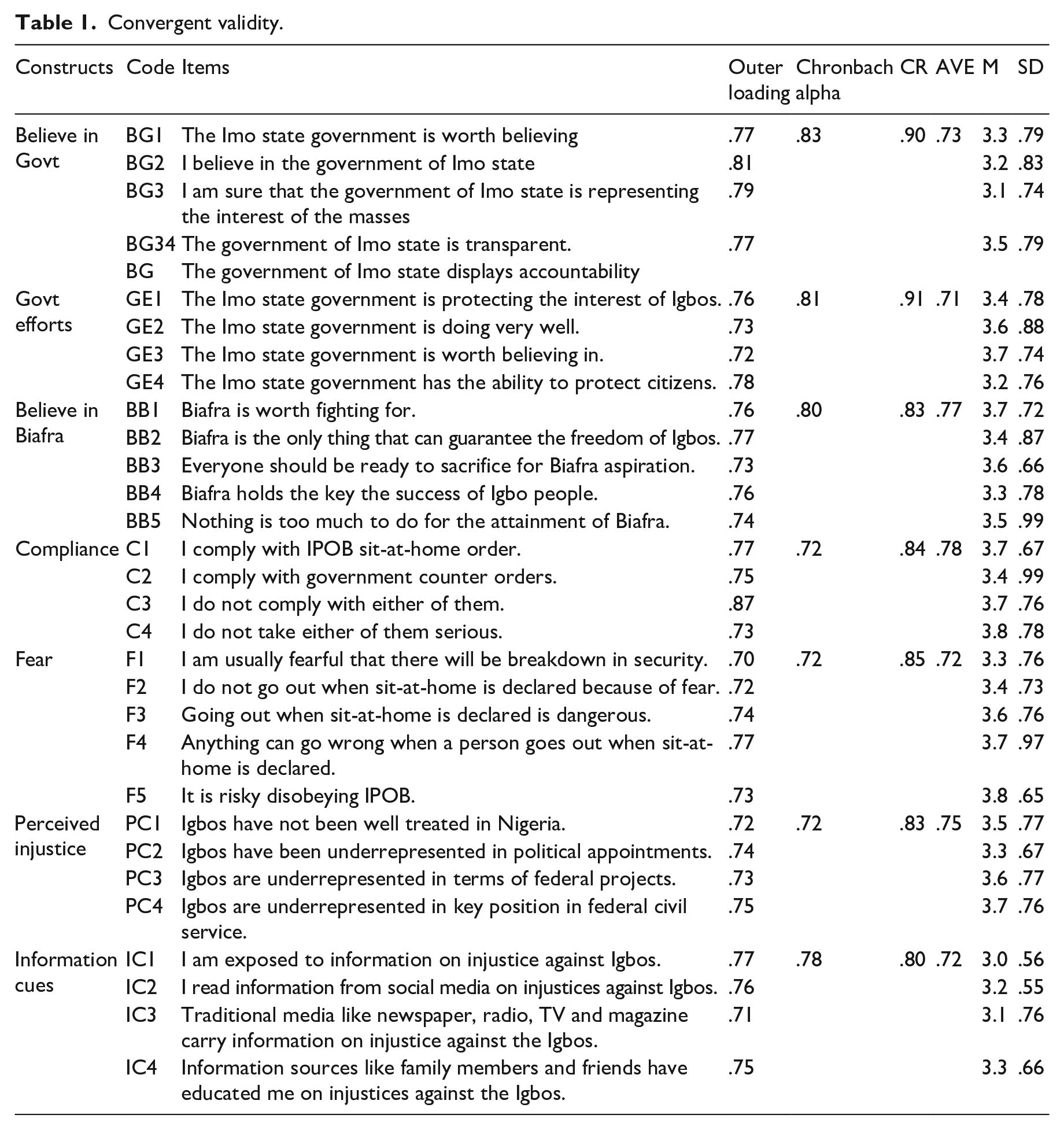
To ensure that the psychometric components of the study were satisfactory, the researchers determined its convergent validity and discriminant validity. Regarding the convergent validity, the researchers assessed the indicator loading and the outcome showed that the loadings passed the baseline of 0.7 (Hair et al., 2017). The same thing was applicable to the average variance extracted (AVE) as it was found to be above the required baseline of 0.5. The additional result showed that the Composite Reliability (CR) scores were all more than 0.7 (Hair et al., 2017). The result of the Cronbach’s alpha scores was also above the pass mark of 0.7 (Hair et al., 2017). Because of these results, the researchers concluded that the convergent validity was acceptable (see Table 1). Also, analysis was conducted to determine the discriminant validity and the outcome revealed that each construct AVE’s square roots were above their correlations with other constructs (Fornell & Larcker, 1981); an indication that discriminant validity was acceptable.
Convergent validity.
Data analysis
The researchers’ descriptive statistics such as simple percentages, mean and standard deviation were used to analyse the result for the study. In addition, the researchers made use of structural equation modelling (SEM) among inferential statistics. In doing so, the researchers utilized Partial Least Squares (Smart PLS 3.3.2) in the analysis. Also, the researchers evaluated the path of the study model with the utilization of Bootstrap re-sampling that was made up of 5,000 samples. All the inferential statistics were tested at .05 level of significance while results were presented in tables.
Results
Among the 470 copies of the questionnaire that were administered to MSMEs operators within the study area, 425 copies representing 90% were returned and found useful. The sample was made up of 55% male and 45% female. The age distribution showed that the mean age was 27 years. The average number of years of MSMEs operation was found to be 5 years. Regarding their educational background, the majority of the MSMEs operators had secondary education.
Table 2 reveals the result of the structural model containing the hypotheses for the study. The result of the study showed that all the three hypotheses presented in the table were supported. The additional result showed that the independent variables predicted 74% of the dependent variables (R2 = .74). Furthermore, result showed that Cohen’s d (Cohen, 1988) point to the fact that the effect size for the relationship range from large to medium. The result of the moderating effect of gender, information cues and fear is presented in the table.
Structural model results.
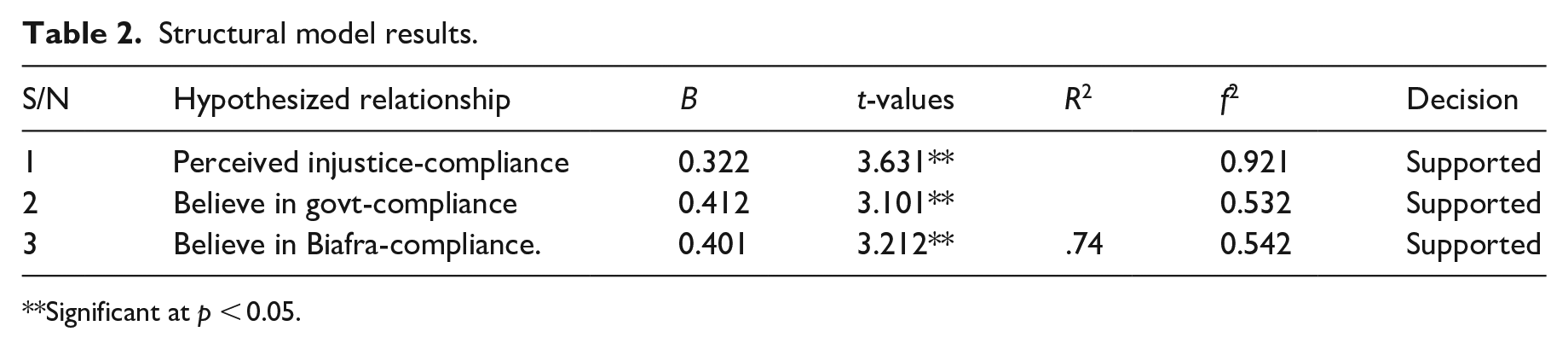
Significant at p < 0.05.
The researchers computed Table 3 to determine the moderating effect of fear vis-à-vis the relationship between perceived injustice, believe in government, believe in Biafra and compliance to IPOB’s sit-at-home order, and it was found that fear did moderate the relationship, so did information cues moderated the relationship. Based on the result of this study as shown above, the model for predicting compliance to IPOB’s sit-at-home order among MSMEs is presented in Figure 1.
The moderating effect of information cues and fear.
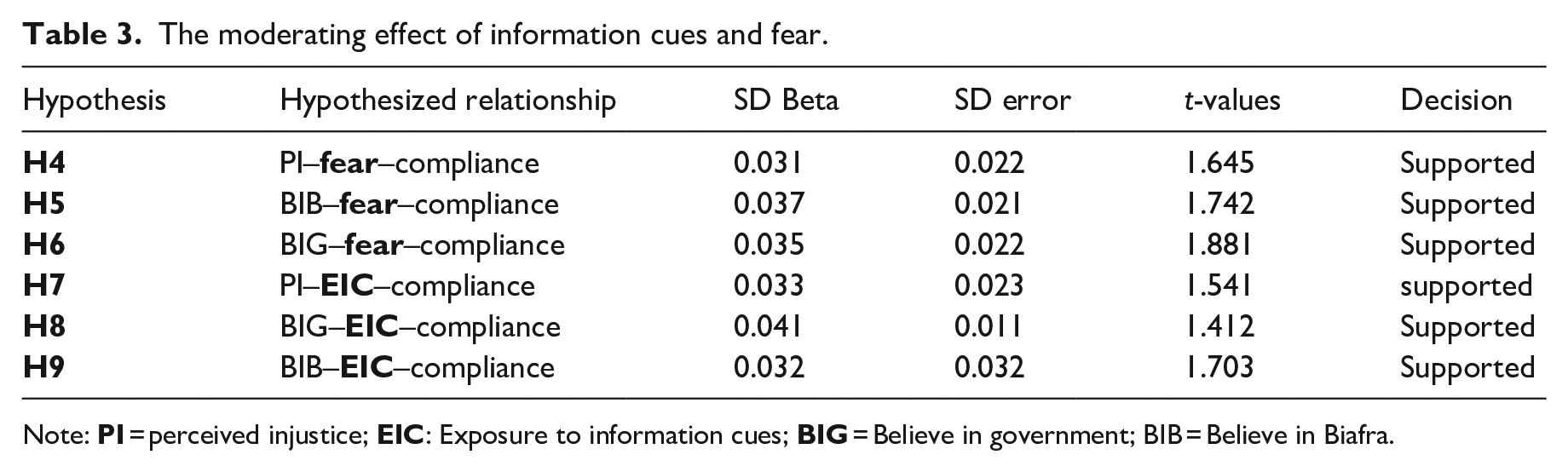
Note:
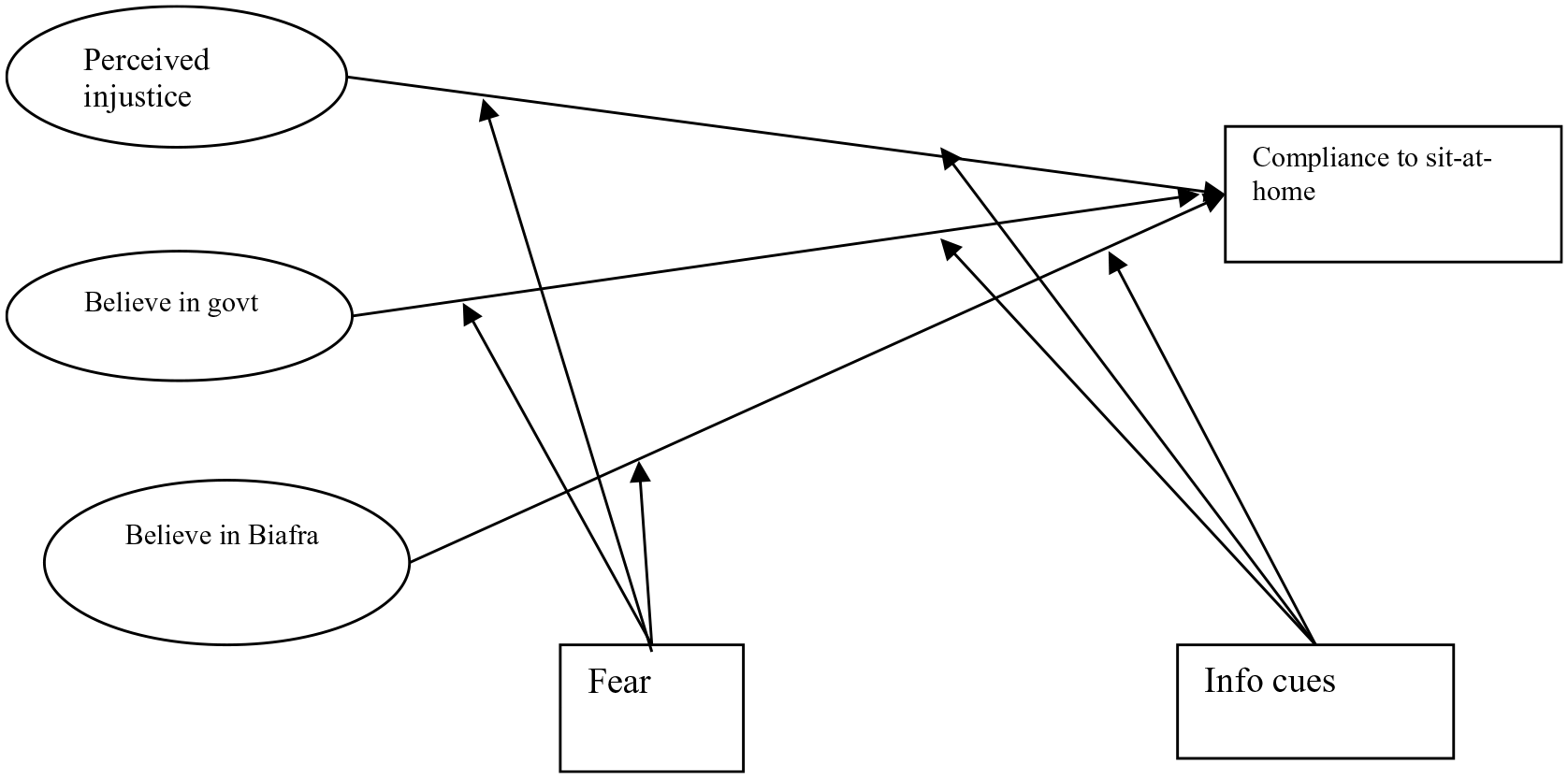
A model for predicting compliance to IPOB’s sit-at-home order among MSMEs.
The model contribution of this as shown in Figure 1 shows that factors like perceived injustice, believe in government as well as believe in Biafra predict compliance to IPOB messages on sit-at-home among small business operators. This relationship is moderated by fear as well as information cues.
Discussion of findings
In this study, the researcher sought to provide a model that explains why separatist communication messages succeed with particular attention to the IPOB. The researchers focused attention on operators of Micro, Small and Medium Enterprises operators (MSMEs) because they provide a good context for understanding why messages from separatist groups succeed. This is because MSMEs constitute the economic engine of every country and anything that affects that sector of the economy is likely to have a huge impact on the overall economic development of such country. Therefore, in this study, the researchers made use of variables from the Frustration Aggression theory of Dollard et al. (1939), the Theory of Cognitive Dissonance of Festinger (1957), as well as the fear theory of Kirsch (1990). Based on variables from these theories, the researchers tested nine hypotheses that aimed to achieve the objective of the study.
The result of the study showed that perceived injustice is significantly associated with compliance with IPOB sit-at-home order. The implication of this result is that people do not just believe in Biafra, they do so because of their perception that South-East Nigeria has not been fairly treated by the current political structure in Nigeria. The result further showed that the relationship between perceived injustice and compliance with the sit-at-home order is moderated by exposure to information cues on the marginalization of South-East by current Nigeria’s political structure. The current study has also extended studies (Breuer & Elson, 2017; Schlangenotto & Kundisch, 2017) that have examined the role of information as an important trigger for human behaviour. In the current study, information cue was examined from the perspective of perceived injustice which could lead to aggressive behaviour.
The result of the study also showed that believe in government plays a significant role in determining compliance to sit-at-home order of IPOB. The result of the study also showed that the relationship between believe in government and compliance to IPOB order is moderated by fear and information cue. Irrespective of whether people believe in government or not, they are likely to comply with sit-at-home order as a result of fear. This result has extended the study of Ruiter et al. (2001) on the centrality of fear in human behaviour by linking it with MSMEs. This addition could extend the debate on how to encourage the growth of MSMEs in an era of different conflict situations confronting different parts of the world.
Finally, the result of this study showed that believe in Biafra significantly predicts compliance to IPOB sit-at-home order. It was, however, found that this relationship is moderated by fear as well as information cue. What this means is that irrespective of whether MSMEs operators believe in Biafra agitation or not, they are likely to observe IPOB sit-at home order. This result has extended previous studies (Gebremariam et al., 2004; Koshy & Prasad, 2007; Mukras, 2003) that have examined the impact of MSMEs on economic development by looking at how separatists’ agitations impact economic activities. This addition will shape future debates regarding how to minimize the economic impact of conflict.
Contribution to knowledge
The result of this study has made a contribution on policies, theory, scholarship and methodology. Concerning policies, the result of this study has provided information that could serve as a guide in formulating and implementing policies and programmes aimed at promoting the smooth operations of MSMEs in times of uncertainties such as conflicts and emergencies. Regarding theory, the result of this study has provided greater insight into frustration-aggression theory as well as cognitive dissonance theory by showing that these theories could be useful for understanding predictors of compliance to orders from non-state actors among MSMEs. This information could be useful to other researchers who may want to apply these theories in their studies. Finally, this study has added to previous studies on the impact of conflict on economic development by showing why MSMEs operators may comply with orders from non-state actors. Finally, this study has explained why messages from separatist groups may be successful in influencing behaviour. This addition could help communication experts in drafting messages aimed at influencing the views of the general public during conflict situations. With regard to methodology, this study has shown that a priori power analysis offers an efficient strategy for selecting sample sizes that are efficient enough make generalizations on issues related to separatist agitations.
Overall, this study has provided a model that explains why information from separatist groups succeeds with particular reference to MSMEs. This information will help the government and other concerned individuals in coming up with information strategies that will address the growing separatist agitations currently taking place in different parts of the world. Countries like Turkey, Germany, Indonesia, India, Nigeria, among others are current facing separatists’ agitations and information is key in fuelling these agitations. In addition, MSMEs operators are critical to the overall economic development of countries. Therefore, it is hoped that empirical evidence from this study will provide a guide on how best to encourage the effective operation of business activities in the midst of growing violent agitations.
Conclusion/recommendations
The conclusion of this study is that one of the reasons communication messages from separatists’ groups succeed is because of fear as well as information cues available to people. In most cases, separatists’ groups engage in violent behaviour and this injects fear into people. Therefore, when separatist groups make orders, people who may not believe in their aspirations may also comply as a result of fear of anything bad happening to them. Another important reason why communication messages from separatist groups succeed is as a result of information cues from sources like traditional media, social media, family and friends, among others. When people have access to certain information, such may contribute to making them identify with the ideologies of the separatist group. Within the contest of IPOB, it is concluded that in addition to fear and information cue that serve as moderators, predictors of compliance to IPOB sit-at-home order are perceived injustice, believe in government as well as believe in Biafra.
Based on the results of this study, the researchers recommend that the government agencies should concentrate their efforts on trying to reduce fear among operators of MSMEs so that they can be bold enough to carry out their activities. It is also suggested that relevant government agencies should plan and execute campaigns aimed at circulating appropriate information to the general public regarding the true state of things in the country as they affect the Igbos. This is important because misleading information could provide the wrong cues for the general public. There is also the need for the government to put in more efforts that will make MSMEs operators believe in them. This is important because the result of the study showed that this plays a role in determining compliance to IPOB sit-at-home. One basic limitation of this study is that the researchers did not examine the messages of IPOB. It is suggested that further studies should look at the message elements of IPOB and see how these have an influence on the masses.
Footnotes
Declaration of conflicting interests
The author(s) declared no potential conflicts of interest with respect to the research, authorship and/or publication of this article.
Author biographies
 . He is a lecturer at the Department of Mass Communication, University of Nigeria, Nsukka. He holds a Ph.D. in mass communication. Gever is an enthusiastic communication scholar who has published in Web of Science Journals. He has published widely in areas like media and conflict, political communication, new media, gender and representational communication. Gever is grounded in communication research, data analysis and research methodologies. He is also the Editor-in-Chief and founder of a Scopus-indexed Journal- Ianna Journal of Interdisciplinary Studies.