




Abstract
The State of the Nation Address is one of the most important public speeches of a president because it sets the tone, framework and plans of the administration in any given year. This research contributes to contemporary scholarly studies by systematically studying presidential discourse within a growing African democracy – from a communication perspective – rather than the routine generic policy analysis. Since communication is a vital aspect of governance, the present study helps to unearth the policy priorities and framework that characterized a major administration under Ghana’s democracy. From a broader perspective, the textual analysis of this speech offers a modest attempt to examine some elements of political communication within Africa’s democratization process. The major objectives of the study were twofold: (a) first, to analyse the major topics or subject areas embedded in the speech and (b) to ascertain the recurring essential thematic elements of the State of the Nation Address as postulated by Shogan. The results indicate that the social agenda (including sanitation, housing and social amenities) was the central focus of the President’s address, followed by politics, while economic affairs featured as the third predominant issue in the address. Three thematic elements – bipartisanship, past and future, and optimism – are discursively analysed. This study contributes to the study of political communication and Presidential agendas in one of Africa’s fledgling democracies.
Introduction
The State of the Nation Address (SONA) is the speech given to parliament or the legislative arm of government in which the President accounts for his stewardship of the nation while presenting proposals for the upcoming year (Adjei et al., 2015; Shogan & Neale, 2009). The SONA deserves critical analysis or scrutiny because it is one of the President’s most important formal governance and communication events that provide a blueprint for the nation’s developmental agenda during the year. According to Moen (1988, p. 775), it is the ‘. . . clearest expression of an administration’s priorities’. Light (1983) calls the address ‘. . . the central battleground for presidential priorities . . .’ (p. 160). Collinson (2019) defines it as constituting ‘typically long lists of proposals for government action and statements of foreign policy goals meant to be heard by . . . foes and friends around the world’ (p. 1). The data for this research were Ghana’s 2019 SONA. The SONA in Ghana, like most democracies, is a speech delivered by the President to parliament at the beginning of each year during the 4-year tenure mandated by the constitution.
The SONA is significant for several reasons. This is an opportunity for the public to hear directly from the President on the state of national affairs. It helps to achieve democratic consolidation in terms of accountability and transparency measures. The SONA also serves as a communicative link between citizens and the president as the populace is able to hear directly from their leader. It is a national moment with the potential to bring the country together, deepen national values, inspire citizens towards a national cause and engender patriotism. In general, presidential discourse is an important area of study as it gives insight into a president’s intentions and use of power (Campbell & Jamieson, 2008; Charteris-Black, 2005). The primacy of the SONA is demonstrated by Moen (1988) who writes that ‘. . . compared to most presidential discourses, the State of the Nation Address is a carefully constructed, conscious statement of true presidential priorities’ (p. 776).
The SONA is not just a policy speech. It shows the current condition of the nation and is expected to offer a vision for the coming year or tenure. It is also a communication event. As one of the leading democracies in Africa (Arthur, 2010; Ayee, 2016; Sikanku, 2019), the time has come for systematic and scholarly analysis of such an important moment of discourse in one of Africa’s most promising democracies. While there have been studies on the policy dimensions of the SONA, there have been limited studies dedicated to the communicative aspect. The existing academic study on the SONA in Ghana analysed it from a linguistic perspective (Adjei et al., 2015), leaving out the aspect of the recurring thematic elements of the SONA as set forth by Shogan and Neale (2009) and the content analytic dimension that enabled Moen (1988) to determine the nature of emphasis for the various topical issues of subject matter or determining presidential agendas. Amoakohene (2019) conducted a study on SONAs in Ghana from 1993 to 2018 focusing on the extent to which the addresses integrated media and communication. The study helped to ascertain the significance assigned to the sector of media and communication as well as the extent to which media and communication were incorporated into the various addresses. This study contributes or adds to studies of SONAs in Ghana by considering the 2019 address.
This study contributes to social scientific research by examining presidential agendas and critical elements of a major national address such as the SONA. What were the topical substantive subject matters discussed by the President? What were the recurring thematic elements present in the speech? These are the central questions guiding the present research. Importantly, this study is useful because it provides hard data to examine a leading policy speech of the President through a systematic analysis from a communicative perspective.
SONA and presidential discourse
One of the fulcrums around which the practice of democracy revolves is communication (Sikanku, 2014; Sikanku & Amoakohene, 2014; Sikanku et al., 2022). Without a doubt, communication is a major catalyst for democracy because it constitutes an important means through which the government keeps citizens informed on policies, programmes and initiatives (Sikanku, 2011, 2019). Various communication platforms provide the means through which citizens discuss occurrences in the nation, and debate policy initiatives while holding the government accountable. The role of political communication in any democracy cannot, therefore, be underestimated (Fordjour, 2015; Sikanku, 2019; Sikanku et al., 2019). There are many platforms through which political communication takes place in many democracies: speeches, press releases, debates, advertisements, televised addresses and press conferences among others (Sikanku, 2013). While some of these have been studied extensively in Ghana – particularly media coverage, content, debates and advertisements – there have been limited scholarly studies on important national speeches, such as the SONA.
The SONA is important for several reasons: it is an event of national significance because it offers the President the opportunity to give an account to citizens of his leadership of the nation; and offers the President the platform for presenting his policy initiatives and proposals to the nation for the coming year. In many advanced democracies, the SONA is an important occasion to unite, inspire and galvanize the nation for a national cause. From a broader perspective, the address has a nationalistic purpose because it gives the President another avenue to appeal to the values, history, heritage and common bonds in the nation. In other words, the nature of the address is expected to be nationalistic rather than partisan; and usually contains legislative agendas.
In general, presidential speeches are always significant because they address problems while inspiring the audience. The communicative role of the Presidency is seen in the SONA because it helps to decipher the policy agenda of the administration through the attention given to various topics or subject matters. Analysing presidential speeches is important because the President is seen as an influential source of information and his messages receive widespread attention. Words and speeches in general have the potential to galvanize a nation to action, inspire or offer hope, empathize and discuss emerging problems while offering solutions among others. According to Druckman and Holmes (2004, p. 759), the SONA is a ‘once-a-year chance for the modern President to inspire and persuade’ citizens. It is a significant speech because it fulfils the checks and balances aspect of democratic governance when the President accounts to the nation. The speech has been described by Shogan and Neale (2009, p. 1) as ‘the most important presidential speech of the year’. It furthermore demonstrates the power of the Presidency to shape the course of public life. Shogan and Neale (2009, p. 1) assert that the address enables the President to fulfil several roles: ‘chief of state, chief executive, chief diplomat, commander-in-chief and chief legislator’.
Another important role that the SONA performs is to use the opportunity to draw public and media attention to particular issues or problems of national concern. In analysing SONAs, examining recurring thematic elements has been postulated as one of the ways of further probing such addresses. Shogan and Neale identified three recurring thematic elements in SONAs: past and future, bipartisanship and optimism. The literature suggests that the SONA affords the President the opportunity to set the tone for his period in office based on plans, goals and projects. This is likely to affect the way the nation is governed, what is given priority, set the agenda and dominate news coverage.
In Ghana, Amoakohene (2019) examined SONAs in Ghana from 1993 to 2018. The research investigated attention paid to media and communication or the extent to which they incorporated media and communication in their addresses. This comprehensive research contributed in a significant way to knowledge of how the various presidential regimes in Ghana saw media and communication as a major part of democracy. The results indicate that the National Democratic Congress (NDC) paid much more attention or greater attention to the media (in the SONAs) than the New Patriotic Party (NPP). The author explained that this was because the NDC had been in power longer than the NPP. On the whole, Amoakohene (2019) concluded that both the NPP and NDC regimes paid lesser attention to media and communication compared to other sectors. This research takes such studies on SONA further by examining the 2019 address in terms of other subjects/attention of attention and the recurring thematic elements of political communication when it comes to the SONA.
One of the established ways to scientifically or objectively analyse the SONA, is to interrogate the speech according to subject area or topic. This is an approach that has been used over the past decades by scholars, such as Moen (1988), and by the University of California, Berkeley’s School of Information for investigating the State of the Union addresses in the United States since 1913. This approach has been missing in research studies on the SONA in Ghana and thus would be useful in the present study. In such studies, the attention given to various subject areas, contextual to the nation or jurisdiction is examined.
Theoretical framework: framing
Framing is a widely applied theory used to analyse communication content within the political communication field. Framing helps to unearth how narratives are shaped or particular positions are promoted within the public space. Framing is thus an appropriate theory to employ in analysing one of the important speeches within the democratic space, that is, the SONA.
For the SONA, narrative structures are exceedingly important as the President seeks to present information on developments within the past year, galvanize the nation and enumerate plans for the coming year. This research will therefore investigate these narrative structures to unearth how the President framed his address.
Framing is relevant to this analysis of the SONA because in general, leaders, through the power of communication, must convey a large body of information to the audience in a manner that makes it useful and understandable to them. To connect with audiences, speakers must frame the issues in a manner that makes them comprehensible using narratives, storylines, metaphors, keywords and other framing or rhetorical devices. Framing helps in this process because it gives speakers, such as the President in this case, the ability to ‘meaningfully structure the social world’ (Reese, 2001, p. 11). The President thus constructs the nature of the national life and social reality through his address to the citizens in delivering the SONA.
One of the most applied definitions of framing was provided by Entman (1993) who wrote that ‘to frame is to select some aspects of a perceived reality and make them more salient in a communicating text, in such a way as to promote a particular problem definition, causal interpretation, moral evaluation and/or treatment recommendation’ (p. 52). In his address, the President is expected to offer his diagnosis of the state of the nation by talking about the problems or challenges, possible causes, his judgements on those issues and proffers policies, programmes and measures to address the existing problems.
Through the President’s speech, he enumerates ‘what exists, what happens, and what matters’ as far as the state of the nation is concerned (Gitlin, 1980, p. 6). This is one of the ways framing takes place. Fairhurst and Sarr (1996) define framing as the ability to shape the meaning of a subject . . . to hold the frame of a subject is to choose one particular meaning (or set of meanings) over another. When we share our frames with others (the process of framing), we manage meaning because we assert that our interpretations should be taken as real over other possible interpretations. (p. 3)
The President as leader of the nation, and the SONA being one of the speeches that attracts immense attention nationally and from the diplomatic community in Ghana, gives the President the opportunity to make meaning of developments in the nation and to offer his interpretations to these events.
To capture the attention of readers, the President may choose to frame the SONA using certain general frames related to the various sectors of national life, such as the economy, politics and social and international affairs. Other frames, such as bipartisanship, appeals to unity, plans and programmes may be employed by the President. Framing theory has been applied to the analysis of speeches worldwide (Fordjour & Sikanku, 2022). In such analyses, researchers unearth how speakers, such as the President classify information, and how they present themes in a way that raises their salience among listeners through the use of cues, framing devices, historical connections, narratives and cultural references that make the information relatable. This is consistent with De Vreese’s (2005) assertion that ‘a frame is an emphasis in the salience of different aspects of a topic’ (p. 53). Framing theory is thus applicable and well suited for this study because it is concerned with how issues are constructed using language and issue presentations.
Methodology: textual analysis
The methodological approach employed in this study is textual analysis. Textual analysis has often been used to qualitatively analyse communication data (Osei Fordjour, 2022; Savoy, 2015; Sikanku, 2020; Smith, 2017; Sowińska, 2013). Textual analysis is a methodology that helps researchers gather data and make sense of written or spoken language (Chung & Park, 2010; McKee, 2003). As a qualitative approach, it enables researchers to deconstruct messages while bracketing essential elements or themes. According to Fursich (2009), textual analysis involves extensive engagement with the text to tease out agendas, major narratives, categories and themes. This is done by observing patterns or recurring themes and subjects of interest in the messages being presented.
Textual analysis is in lockstep with the framing approach because it involves the detection of themes (also known as frames) used in a selected sample, which in this case is the SONA. This makes the current study a theory-guided methodological approach to analysing text. According to Reese (2001), analysing communicative text using framing theory as an entry point helps researchers to ‘group, categorize and thematize texts to get to the heart of issues being discussed’ (p. 7).
The study adopted Moen’s (1988) topical issue categorizations, which will help address issue frames in terms of attention paid to the various sectors of national life. To be specific, this study relied on the work of Moen (1988) who analysed seven different State of the Union Addresses in the United States where he did a word count for the entire address and then repeated that for different categories. This approach is useful because it helps to get to the crux of the SONA by revealing the central subject areas embedded in the speech.
The various issue frames to be analysed include international, economic, cultural, political, educational, defence, health and social affairs. Other frames include the elements of the SONA as set forth, which are optimism, bipartisanship, past and present.
This method involves prolonged engagement with a single text thereby helping with meaning-making (Burke, 1966; Slagell, 1991; Yin & Miike, 2008). Applied to the current study, the reading and re-reading of the SONA, guided by the research questions or objectives of the study, helped to glean the President’s preferred agenda and the presence of three elements of the SONA. Data were analysed thematically and according to these previously set forth approaches with the results presented and discussed in the next section.
Results and discussion
Results generated from the data analysis are presented in this section. The first part of the results will address the topical issues present in the SONA presented by the President. The second part will thematically discuss the elements of political communication contained in the address.
Topical issues
Results from the examination of the SONA revealed eight major topical issues. The overall word count for the speech stood at about 11, 645. A breakdown of the topical categories of the speech is presented in Table 1.
Total number of words by category in President Akufo-Addo’s 2019 State of the Nation Address.
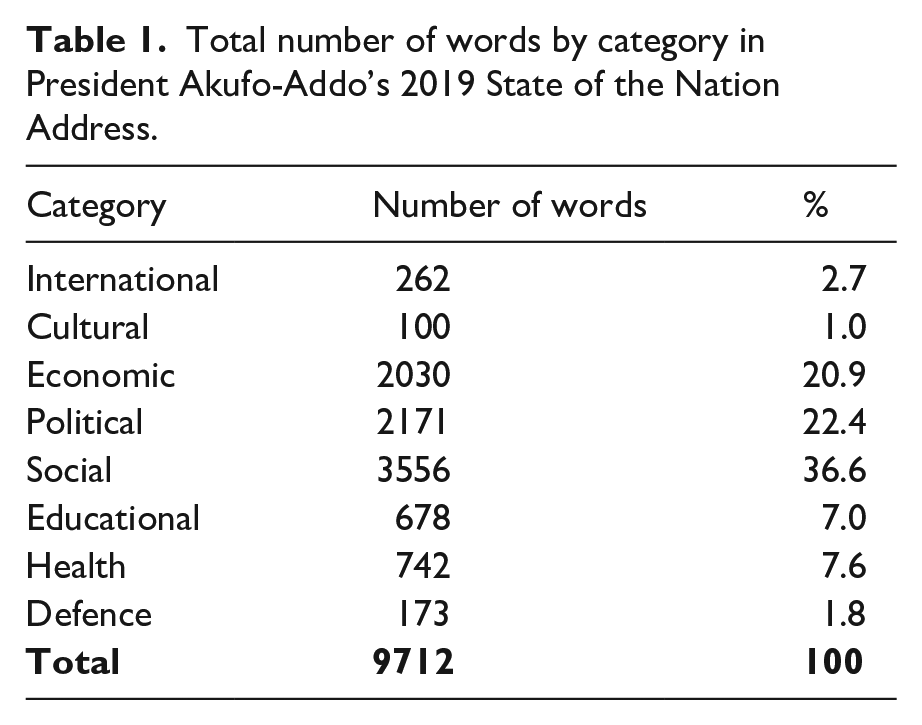
The results indicate that in his 2019 SONA, the President dedicated 3556 words to social issues. The next area of attention was in the area of politics (n = 2171), followed by economics (n = 2030), then health (n = 742), education (n = 678), international (n = 262), defence (n = 173) and cultural (n = 100). In 2019, the Akufo-Addo administration’s policy focus was clearly on social issues. Sanitation was one of the social issues that received the most attention. This is not surprising because of Ghana’s struggles with dealing with filth in the capital Accra and nationwide. The President touched on efforts being made to provide toilets to various households, the formation of a national sanitation brigade and the vision to make the country ‘open-defecation free’ (SONA, 2019, p. 16). He spent a considerable amount of time touching on e-waste management, recycling and the provision of social amenities such as water and houses. When it came to housing, the President talked about the need to complete unfinished affordable housing projects, re-engineering the Odaw storm drain and the improvement in solid waste management. It has to be stated that as a developing African nation, Ghana is still struggling with some of the most basic social amenities and issues. It is therefore not surprising that such issues as open defecation, housing, water supply and sanitation garner extensive attention in the SONA. In the President’s words, Ghana has a ‘sanitation crisis’.
The next issue of highest emphasis was politics. As a growing democracy, the practice of politics, political processes, structures, conflicts and issues continue to dominate in Ghana, which has been noted to have a fledgling democracy anchored by vibrant media. Political contestations and issues regarding democratic practice remain pervasive. The political issues included the President’s efforts at resolving the Dagbon conflict in northern Ghana, which had assumed political undertones; the creation of new regions, which was a major issue on the President’s agenda; and the election of local government officials and passage of the Right to Information Law. Others included the Ayawaso West by-election violence, commitment to ending political violence and the need for dialogue among political parties on political vigilantism.
Economic issues featured as the third issue of emphasis. The economic issues in the President’s address included reports on economic management and economic growth, debt cancellation, alternative measures of economic growth, pensions and salary reform, tax reform and an increase in manufacturing. The rest of the issues are presented in order of emphasis from the fourth to the eighth. Health issues (fourth) included the essence of health, facilitating the health care system, employment of nurses and health practitioners, health infrastructure and personal health consciousness. Education was the fifth area of emphasis and this included improving the quality of education, ensuring a standards-based curriculum, redefining free senior high school (SHS), increase in technical and vocational training/institutions, applications of science and technology, tertiary education policy bill and degree certification for teacher trainees.
International or foreign affairs issues were the sixth area of attention, and included Ghana’s international security commitment and efforts to engage the diaspora. Defence was the seventh area in terms of attention garnered. Ghana’s defence issues that came up in the SONA included the provision of equipment, housing for security services, security service operations and increase in police recruitment. The last issue of emphasis was cultural. This included redesigning the creative arts industry and Ghana’s heritage campaign.
Recurring thematic elements of the SONA
The second research objective was to ascertain what has been referred to as the recurring thematic elements of the SONA as postulated by Shogan and Neale (2009). These are bipartisanship, past and future, and optimism. These indicators are operationalized below.
Past and future refer to achievements and plans. This component involves historical antecedents, achievements and enduring national values. Specifi-cally, Shogan and Neale (2009, p. 7) write that, ‘through attention to both past and future, Presidents can . . . develop their own definition of the national identity. Moving back and forth between historical themes and contemporary issues is a common rhetorical practice . . .’ in SONAs. The past and future indicators also include ‘using the past to explain legislative proposals and decisions is a method aimed at legitimizing the President’s policy program’ (Shogan and Neale, 2009, p. 7).
One of the major things to note about the SONA is that it is not a partisan political speech. The President delivers the speech in his capacity as the leader of the nation or ‘father of the nation’. There is, therefore, the expectation that presidents will use language that unifies, cuts across the aisle of the political divide and seeks to build consensus. The second recurring thematic element is bipartisanship.
The final recurring theme is optimism. Here Shogan and Neale (2009) write that presidents must adopt the ‘can-do’ tone in such addresses. This involves acknowledging the problems of a nation but also stating that there is hope.
Past and future
Past and present constitute the last recurring theme according to Shogan and Neale (2009). Issues related to achievements, future programmes, national heritage, forebears and the formation of national identity fall under this theme. An analysis of the SONA revealed the following issues constitute the components of this theme: the implementation of SHS and the redefinition of basic education to include SHS; the introduction of drone technology into the country’s health sector; the taking off of government’s One District, One Factory programme; the imminent passage of the Right to Information Law; the creation of 38 Municipal and District Assemblies and plans for the election of local government officials; plans to establish world-class technical and vocational centres; the proclamation of 2019 as the ‘Year of Return’; and recognizing the efforts of forebears who laid down the foundation for peace.
Other areas included the creation of the Oti Region (one of six new regions); Ghanaian value of hospitality; increased government support for district assemblies; the establishment of the Hospitality Training Institute; a presidential support programme for businesses; construction of a dam at Pwalugu; and the removal of electricity transmission bottlenecks. There were 15 such issues overall. A few major ones will be discussed.
When the NPP won power, and even before then, serious questions were raised about their ability to implement free secondary education. However, the President implemented this policy once they came into office. It is therefore not surprising that the President touted this achievement. The introduction of drone technology into Ghana’s health sector was a novelty and the President spent time talking about this as well. Industrialization was a major theme of the Akufo-Addo regime characterized by their flagship programme, ‘One District, One Factory’. This was likewise something the President highlighted in talking about past accomplishments and what was to come in the future. The creation of the new district and municipal assemblies can be classified as a past issue since it was something the government had already done in the previous year, and was reporting on in the current address.
One major characteristic or indicator of this theme is the reference to issues of the country’s heritage, history and issues of identity. Concrete examples can be cited when the President refers to the historical agitation for the creation of the Oti Region and more especially when the President dubbed 2019 the ‘The Year of Return’ for people of Black descent in the United States and worldwide. In doing so, he was recognizing black identity and emancipation globally, making Ghana a centre of attraction.
Every president has to define, in one way or another, what their presidency will be noted for and the SONA can highlight the issues of greatest importance to an administration. It is important to note that the President sought to project his Presidency as one that promoted Afrocentrism or African identity and culture. To be specific, here is a quote from the President’s address concerning this issue: We intend to use the symbolism of this ‘Year of Return’ to bring together Africans, persons of African descent, and all well-wishers and lovers of freedom to strengthen the commitment to ensuring that the blots on our history, i.e. the Transatlantic Slave Trade and slavery, never reoccur. (SONA, 2019, p. 13)
The general function and symbolism of this particular aspect of the SONA helped the President to accentuate his Afrocentric ideology and Pan-Africanist identity. Beyond this, it is relevant to point out that the President also highlighted the Ghanaian sense of hospitality as a way of using the address as a means to shore up national values or identity as postulated by Shogan and Neale (2009). Here is an example: Yes, we have castles and forts, we have waterfalls and dramatic mountain ranges, we have breath-taking beaches, and historical sites that reduce visitors to strong emotions, but it is the people of Ghana and our welcoming attitude that are the strongest attraction to visitors. (SONA, 2019, p. 14)
The point here is that the mention of Ghana’s hospitality is crucial to consolidating the theme of values and national identity contained in the President’s address. The inclusion of such narratives helps to prevent the SONA from being just a recital or presentation of facts and figures, but qualitatively contributing to enriching the lives of citizens through the foregrounding and shaping of enduring national values with far-reaching impact and benefits. Taken together, these extracts from the speech contribute to the last recurring thematic element of President Akufo-Addo’s 2019 SONA.
In all, the analysis was guided by two broad objectives: to ascertain the topical categorizations contained in the speech (Moen, 1988); and the recurring thematic elements (Shogan & Neale, 2009). This section contributes to offering analytical insights into the data by extracting and discussing relevant sections as guided by the research objectives using indicators set forth by previous scholars and literature.
Bipartisanship
Shogan and Neale (2009) identify bipartisanship as one of the major thematic elements of the SONA. The SONA is expected to be a nationalistic speech that seeks to unify the country. It is therefore important to ascertain elements of this nature of the speech in the present analysis. There were instances of bipartisanship when he spoke about the spate of political vigilantism: the need for the parties in Parliament to engage in decorous debate; and a referendum regarding whether Ghana should elect rather than appoint their local government officials (municipal, metropolitan or district chief executives (MMDCEs)).
In the case of political vigilantism, the President condemned the act and asked the two major parties, the NDC and the NPP, to have a rare unity meeting to address the increasingly violent practice. Political vigilantism in Ghana usually refers to various supporters of the various political parties engaging in acts of violence to demonstrate their anger or displeasure towards issues. The President in his address stated that I want to use the platform of this Message to make a sincere, passionate appeal to the leaders of the two main political parties in our country, NPP and NDC, to come together, as soon as possible, preferably next week, to agree on appropriate measures to bring an end to this worrying and unacceptable phenomenon of vigilantism in our body politic. I have asked the leadership of the NPP to extend an invitation to the leadership of the NDC for such a meeting. (SONA, 2019, p. 29)
In politics, it is fashionable for parties to score political points by engaging in propaganda or blaming each other for one thing or another. However, the SONA is expected to be apolitical and we see this show of bipartisanship here. The second example of bipartisanship came when the President asked the nation together to vote in a particular direction in a referendum that was to take place. In this referendum, Ghanaians are to decide whether to vote in support of major changes in local government administration. The laws permit the President to appoint MMDCEs. However, the President wanted to change the laws to make these officials electable. Early on, the country had shown broad support in a referendum for the creation of new regions. He asked Ghanaians to show similar national support: I am calling, respectfully, for a repetition of the bi-partisan support, that made possible the hugely successful outcomes in the referenda for the new regions, to ensure the success of the impending referendum. Furthermore, a multidisciplinary panel of experts is being assembled to plan, cost, schedule, and help implement a roadmap for the election of MMDCEs. We are committed to devolving more and more power to the Ghanaian people. (SONA, 2019, p. 4)
It is important, though, to point out that these were the only moments of bipartisanship and thus seem limited particularly in an address that was supposed to be highly nationalistic. This is cause for concern as many African nations, including Ghana, seek to consolidate democracy, entrench collective values and formulate nationalistic policies that offer hope and progress for the nation.
Optimism
The theme of optimism occurred in five different scenarios; the President spoke about education, improvements in agricultural yields, regeneration of urban slums, development of oil blocks and the health of the nation. For instance, on education, he said, We have no choice but to provide our young people with quality education and lifelong learning opportunities for every Ghanaian. It is the only way to ensure prosperity and protect our democracy. We are not sparing any efforts to make education in Ghana of the best quality, and fit for the needs of the 21st century. (SONA, 2019, p. 8)
These statements demonstrate optimism for the country’s education, particularly for young people in the 21st century.
On agriculture, the President was optimistic about the future as well, saying, ‘We are hoping that the success will lead to a fundamental change in attitudes towards farming practices, and the sector will be truly transformed. Bumper harvests and increased food production, in general, would be the norm . . .’ (SONA, 2019, p. 9). This was in relation to the President’s flagship programme, Planting for Food and Jobs, which he felt has contributed to a transformation in the agricultural sector, a rare bumper harvest that should provide much optimism for regularizing such achievements when it comes to yields and harvests. The development of oil blocs was another major area the President sounded optimistic about his government and the future of the nation, saying, Mr. Speaker, this has led me to think that an NPP government must be good for Ghana. After many, many years of our looking and almost giving up, it took an NPP government to discover oil in 2007. In eight years of NDC administration, 13 oil block deals were signed, and not a single one was developed. The first one signed in 2017, under my government, which was Aker, has led to the second-biggest oil discovery in Africa. Enough to make a believer of anyone, I might say. (SONA, 2019, p. 17)
The basic premise here, according to the President, is that his party and government are key to the country’s success. From a thematic analysis perspective, the President is using optimistic rhetoric to portray his government’s contributions as a good omen for the nation. The next indicator of optimism is observed when the President talks about housing, specifically urban slum or low-income housing. He states that The most exciting news on the housing landscape, though, is the drafting of plans to regenerate Nima, which holds the dubious title of being Accra’s first slum. (SONA, 2019, p. 12)
The President subsequently spoke of specific plans by the Finance Ministry to launch a 1 billion Ghana cedis housing fund that would help to address the housing needs of low-income earners. Considering the pervasive nature of housing challenges in the country and the bold initiative stated by the President, such announcements portray elements of optimism in addressing a long-existing problem.
In the next example, the President shows his overall conclusion on the state of the nation in optimistic terms, saying, ‘Mr. Speaker, we have our challenges, but our nation is in good health’ (SONA, 2019, p. 30). Using optimistic language, the President in this example demonstrates his conviction in the strongest of terms in a way that contributes to this present recurring theme.
Conclusion
The central issues of concern in this research were to identify the major topical areas present in the SONA and to ascertain the essential thematic elements. The study reached a few major conclusions. First, the results indicate that social, political and economic issues dominated the President’s address. As a developing country struggling with the provision of social amenities and infrastructure, this is not surprising. Sanitation took up a major part of the discourse on social issues. Within this narrative, the issue of open defecation was central. This is not surprising since the matter of open defecation has been a nagging problem in Ghana for a considerable period. In fact, the sanitation problem has been a subject of public discussions, forums and major deliberations in Ghana. Washghana (2020) asserts that open defecation costs Ghana $79 million a year due to an increase in epidemic disease outbreaks. It is further stated that political will and dedication to research and education will contribute to addressing this debilitating issue. From a communication and presidential discourse perspective, the President’s emphasis on this issue is consistent with the idea that a SONA must be responsive to topical issues of national concern (Moen, 1988).
The other two topical issues were political and economic subject areas. Political issues had to do with violence in Ghana’s politics. From a discursive perspective, this shows that peace and security continue to be serious issues affecting Ghana’s democracy. Despite widespread praise of Ghana’s democracy (Ayee, 2002; Gyimah-Boadi, 2008; Gyimah-Boadi & Prempeh, 2012; Sikanku, 2019), it indicates that there are underlying issues related to the threat of violence and possible instability, which should continue to be substantially deliberated upon and addressed. Economic issues were the third predominant area of attention. This is understandably so, as bread and butter or pocketbook issues always maintain prominence in national life.
The second major objective of this study was to ascertain the recurring thematic elements present in the study. The findings are consistent with the work of Shogan and Neale (2009) who found three recurring thematic elements consistently present in addresses of this nature. In other words, there was substantial support for all three of the recurring thematic elements which were found in the President’s speech. These are past and future, bipartisanship and optimism. The optimistic theme was exemplified when he spoke about improvement in education and the need to provide ‘life-long opportunities’ for young people. The theme of optimism similarly came in when he spoke about one of his flagship programmes, the Planting for Food and Jobs. These are not surprising since, as one of his major areas of focus, he tended to be more passionate and optimistic about their prospects. From a communication perspective, optimism in the SONA tends to give hope, and sometimes inspire and galvanize citizens about the prospects of a better future. This is helpful as a leader tries to get the citizens to buy into his ideas and vision and carry them along. In this sense, the President fulfilled a major element of SONAs, namely, optimism.
A SONA must have elements of the past and the future. In talking about the past and present, the President referred to the slow-paced nature of health care delivery in Ghana, emphasizing that the introduction of drones into Ghana’s health system will bring about the speedy dispensation of health care. Under this theme, there was a reference to the creation of new districts and assemblies to help aid decentralization. The passage of the Right to Information Law was expected to take Ghana out of the past where information access was difficult to a future where access will be better enhanced through the passage of the Right to Information Law.
Bipartisanship was demonstrated when the President spoke of the need for both sides of the aisle to work together to address the spate of political vigilantism. He likewise touched on this theme when he spoke of the need to work together to bring about constitutional amendments to the way local government officials are elected in Ghana.
Overall, the current investigation of President Akufo-Addo’s SONA gives us a better appreciation and understanding of constitutional politics in the fourth administration of Ghana’s fourth republic and the nature of Presidential discourse agendas. The findings reveal that the President’s agenda was ensconced in social factors but also showed that concerns still lingered over violence, peace and security in Ghana. Substantive democratic practice, which appears to be a major goal of most nations in Africa and globally, is predicated on effective communication.
This research reveals that in Ghana the President uses the SONA as a major democratic tool to discuss issues of priority and to set the agenda for national discourse and projects. The research also shows the capacity of the SONA to serve a nationalistic function using narratives and communicative frames to engender bipartisanship and offer hope. One of the major challenges of bad governance in Africa identified over the years has been the personalized nature of the rule, the closed and restricted nature of communication, and few opportunities for linguistic connection with citizens. This research provides us with rich insights into the political agendas of modern presidents in Ghana and the functions of communication when it comes to the SONA. By noting what is emphasized, prioritized and talked about in a given period, this research provided a foundation for indexing the nature of Ghanaian society or the state of the country for historical and other related purposes.
Theoretically, beyond Africa, the present research contributes to the study of political communication by providing insights into the functions, themes and topics of the SONA within the political ecosystem. The study extends the theory of framing to a major communicative text, such as the SONA to ascertain the variety of techniques, frames and propositions used to construct social reality within nation states. This is important for public understanding of governance within a fragmented or varied media and communicative landscape in the contemporary era. Practically, as one of the most significant speeches of the president, the SONA significantly shapes public perception and policy direction within the public sphere. The research, from a practical perspective, helps to analyse and synthesize the SONA into the various subject areas, narratives, underlying meanings, ideological underpinnings and existing communicative frames in presidential communication without the filtering of journalistic reportage.
Moen’s topical analysis and Shogan and Neale’s recurring thematic elements, based on the results, can be used in the analysis of SONAs in Ghana. From a theoretical perspective, it shows that both postulations can be extended to SONAs in different cultures. Future research can engage in comparative analysis with different jurisdictions and between different administrations in Ghana, within the African continent and globally.
