




Abstract
In its efforts to establish order and legitimacy among the people it once controlled, Islamic State in Iraq and Syria followed standardized and systematic nation-state building policies. The terrorist group attempted to establish an imagined jihadist nation-state with the assistance of standardized media productions and practices. These media productions that are examined in this article reflect Islamic State in Iraq and Syria’s unified vision of the ultra-conservative society that it once intended to form in its different territories. I argue here that Islamic State in Iraq and Syria used standardized media productions to promote strict sharia laws including emphasis on men and women’s garments, distrust in secular rule, and calls for jihad in the different cities that it controlled. For Islamic State in Iraq and Syria, media is jihad and journalists are Mujahideen whose main purpose is to mobilize the masses and assist in creating a jihadist nation-state.
Keywords
Introduction
This article deals with the Islamic State in Iraq and Syria (ISIS) and its nation-state building efforts with the assistance of media productions such as billboards. This article is focused on some productions released by Al-Himmah Library which is ISIS’s official printing press. ISIS sought to create a jihadist nation-state whose ideology is focused on imposing a strict version of sharia law, conducting ongoing religious wars, and restoring old Islamic empires. In order to achieve this goal, ISIS used media as a means because it is regarded as an important tool in mobilizing the public and gathering support. For ISIS, media is considered as a form of jihad and journalists are jihadists whose roles are as important as those who use arms. In general, ISIS is known to be more militant and dangerous than Al Qaeda as it has evolved to be a hybrid group as “Qutb’s concept of hakimiyya [rule] and other Islamist ideas provided the political and activist ingredients of the new hybrid formulations, while Wahhabism and traditional Salafism offered its jurisprudential and doctrinal basis” (Hassan, 2016). Previous studies on ISIS have not entirely focused on the theoretical concept of nation-state building and the role of standardized media.
Shortly after its spread, ISIS declared itself a so-called state especially after controlling large areas in Syria and Iraq. Other remote militant groups in other regions like in Libya and Nigeria pledged allegiance to Abu Bakr Al Baghdadi, making ISIS extend its outreach. Indeed, this self-proclaimed jihadist nation-state is, in itself, an appealing feature that can draw recruits to join and become part of this alleged utopian notion. Building on the theories of nation-state building and Anderson’s imagined communities concept, I argue here that in its utopian objective in creating a nation-state, ISIS attempted to establish an imagined nation-state especially that one of its goal was to demolish the Sykes-Picot Agreement in 1916 and any available secular laws.
This article is divided into five sections. After this introduction, a theoretical framework offers a discussion on nation-states concept and standardization followed by a literature review that applies this theoretical discussion to ISIS’s policies. The fourth section discusses ISIS’s standardized media productions, while the last part provides a concluding discussion that is linked to the theoretical framework, dealing with ISIS’s media strategies through the examination of some relevant publications.
Nation-state building by ISIS
The envisioned jihadist nation-state represented ISIS’s objective of creating a militant ideological entity. In the discourse on civil states, Benedict Anderson discusses the notion of states as “imagined communities” that are often able to impose or create “prime culture areas” (Postill, 2006, p. 16). Here, nations are in an imagined state because its members must continuously share a collective identity and think that they all belong to the same place. This is mostly done by the elites whose duty is to unify the members of the nation, and media plays an important role here. Anderson (2006) mentions how some South East Asian colonies were formed by making accommodation to and maintaining the impact of some religions like Islam and Buddhism as they “could rarely do more than to regulate, constrict, count, standardize, and hierarchically subordinate these institutions to its own” (p. 169). In this regard, Geertz (1963) believes that the state needs to unify its people to better achieve its goals despite their ethnic, racial, and linguistic differences.
In this regard, the notions of state and an imagined jihadist nation building are intertwined because ISIS intended to transform the nation into a militant state. Conceptually, a nation is a cultural term which is related to a group of people who have a number of binding features that provide them with a sense of commonality, while state is a political term that refers to a group of people living in certain territories and following a number of rules and regulations dictated by those who hold power (Connor, 1978). The combination of the two terms is meant to indicate that “politics and culture support each other, where a state derives the legitimacy to rule from its endorsement of a specific cultural group, and in turn a culture survives and thrives by the aid of political power” (Lu & Liu, 2018, p. 111).
In his seminal study on nation building, Karl Deutsch (1963) argues that several elements contribute to the formation of states including establishing economic production means, trade, education, and mass communication especially by offering communicative spaces. Ernest Gellner (2008) focuses on other aspects in nation-state building like the importance of educational and linguistic homogeneity and standardization, but he suggests that the role of media cannot be overlooked here since it enhances values and creates co-cultural group or cultural area. In this regard, Mylonas (2012) defines nation-state building as “the process through which governing elites make the boundaries of the state and the nation coincide” (p. xx) by employing three main policies: accommodation, assimilation, and exclusion. In relation to accommodation, it is a reference to “the ruling elites’ option to retain the non-core group in the state, but grant the group special minority rights” (Mylonas, 2012, p. xx). On the contrary, “exclusion policies, such as ethnic deportations and mass killings, remain a part of the repertoire of state elites around the world,” while assimilation is more related to cultural genocide (p. xxi) by the intentional removal and destruction of previous political, religious, and historical symbols.
In general, there are violent and non-violent means of nation-state building; however, accommodation and assimilationist policies are often non-violent, though the latter are often “coercive” (Mylonas, 2012, p. 23). In order to build a nation-state, the elite group must implement certain policies often with the use of force in order to ensure that the new political system can work. Historically, Smith (1986) states that there are four types of nation-state formations: the Western, for example, European countries; the Immigrant, for example, United States, Canada, and Australia; the Ethnic, for example, Japan; and the Colonial, for example, many Arab and African countries that were formed due to colonial powers (pp. 241–242).
In this article, I argue that ISIS followed standardized and systematic nation-state building policies similar to the above strategies. Despite its terroristic ideology, ISIS is an example of such an imagined jihadist nation-state which makes its unique among other terrorist groups because of its ambition to create a physical (and possibly an internationally recognized) space for its followers and controlled subjects. Unlike other Islamist terrorist groups, ISIS had a unique advantage of mass recruiting civil servants and officials mostly from Iraq and Syria who had prior experience in running secular states and practicing a variety of coercive and non-coercive strategies; for example, when Saddam Hussein invaded and annexed Kuwait in 1991, he removed the word “state of Kuwait” from the Iraqi curriculum by replacing it with the term “governorate” in his attempt to wipe it from the map. This was an example of cultural genocide. In the occupied Kuwait, the Iraqi Baath regime insisted on using the Iraqi curriculum as well as its currency. Thousands of crimes were committed such as looting, killing, rape, and destruction (Amnesty International, 1990a, 1990b), and major efforts were made to impose the Iraqinazation policy including changing the names of streets and using a unified Iraqi national flag. An eyewitness account mentioned the details of this assimilation policy, stating the following: During the fifth week of the occupation the Iraqis distributed an instruction sheet that read: “any house that possesses Kuwaiti flags, pictures of the Emir, flyers, or guns, will be burned. Any attack on the Iraqi army from any house will result in the burning of all the houses surrounding it in 360 degrees. (Ghabra, 1991, p. 119)
Kuwaitis and expatriates were asked to report to work, while Iraqis were appointed in senior administration posts. As part of the standardization policy, everyone was given Iraqi ID cards, and “all Kuwaitis were ordered to get new license plates or risk punishment” (Ghabra, 1991, p. 121). Most importantly, the official Iraqi TV channel became the national television, and huge street billboards were installed showcasing “pictures of Saddam Hussein-15 to 25 feet long and 10 to 15 feet … like monuments all over the city, in front of every major installation, government building, and so on” (Ghabra, 1991, p. 115).
Although Saddam Hussein’s regime was secular and used pan-Arab rhetoric, the techniques and policies followed were similar to the way ISIS practiced cultural genocide and assimilation in the different cities it controlled. ISIS followed standardized and systematic nation-state building policies which were largely borrowed from the Baath’s regime strategies especially in the way the latter implemented accommodation, assimilation, and exclusion policies. However, ISIS attempted to do this using its own radical version of Islam as a unifier, as will be later discussed. Most importantly, ISIS’s elites purposefully tried to create a nation-state and collective identity with the use of media, yet this entity remained an imagined concept because its members “will never know most of their fellow[s] … meet them, or even hear of them, yet in the minds of each lives the image of their communion.” This jihadist concept was only “an imagined political community” (Anderson, 2006, p. 6).
Media and ISIS’s policies in nation-state building
Media and nation-state building are closely connected because media plays a highly important role in disseminating the idea of “imagined communities” especially in enhancing the national identity of the nation’s diverse and scattered members. Whether they are called “communicative spaces” (Deutsch, 1963), “cultural areas” (Gellner, 2008), or “prime culture areas” (Postill, 2006), assimilation policies intend to shape a given culture through media in diverse ways. Here, media is used as a medium for achieving unity among people. Ross Poole (1999), for example, mentions that socialization, language, and mass media play important roles in forming the national identities of most individuals living in a certain nation (p. 14). Furthermore, John Postill (2006) discusses the third wave of nation building represented in Malaysia in 1963 and other South East Asian countries and emphasizes that the role of media is “integral to their formation and maintenance” (p. 15). AD Smith (1989) mentions here that states are partly shaped by emphasizing a unique type of mythology and symbolism enhanced by mass communication and education to convince and influence the masses (p. 361), and one of the main elements that assist media and nation-state building in shaping national identities is, in fact, standardization. People living in a certain nation-state need to consume and absorb the same messages, symbols, and cultural practices to feel a sense of shared values, beliefs, and outlook toward life. In this regard, Stein Rokkan (1999) argues that there are four main institutional solutions in nation-state building such as standardization which incorporates “conscript armies, compulsory schools, mass media, creating channels for direct contact between the central elite and parochial populations of the peripheries” (p. 83). As indicated above, standardization incorporates several aspects such as language, education, and media. 1
As explained above, nation-state building requires a great deal of standardization as well as systematic efforts, and ISIS tried to achieve some of these goals with the assistance of former secular and civic officials from Iraq and elsewhere. In terms of accommodation, the terrorist organization was run by senior members or elites mostly consisting of former Iraqi intelligence officers (Coles & Parker, 2015). In its new formation, Abu Bakr Al Baghdadi sought to bring in more former Baathists especially those who had military and intelligence background (Tønnessen, 2015). Liz Sly (2015) lists a few shared ties that connect the Baathists with ISIS such as the reliance of sophisticated intelligence networks, smuggling tactics to sell oil and avoiding sanctions, using fear to frighten the masses, branding themselves as transnational movements (pan-Arabism vs pan-Islamism), and running camps for foreign fighters.
In nation-state building, elites are needed to manage the nation, and captured documents show that ISIS had a systematic hierarchy and bureaucracy in which the elites played important roles (Reuter, 2015); for example, “society has seen the rise of a new elite class—the jihadi fighters—who enjoy special perks and favor in the courts, looking down on ‘the commoners’ and even ignoring the rulings of their own clerics” (Hendawi, 2016). In this hierarchy, there were departments responsible for managing “‘war spoils’ including slaves, and the exploitation of natural resources such as oil, creating the trappings of government that enable it to manage large swaths of Syria and Iraq and other areas” (Landay, Strobel, & Stewart, 2015). This systematic management effort in nation-state building included diverse aspects like hiring specialized services for paving roads or cleaning streets, issuing ID cards, running schools, printing standard school curriculum that corresponded with ISIS’s terrorist ideology, regulating trade, imposing taxes, setting sharia laws … and so on. “Hundreds if not thousands of cadres have set themselves to work creating rules and regulations on everything …” (Malik, 2015). As a result, ISIS imagined nation-state was formed based on social classes and coercive power enshrined by strict sharia laws similar to the way totalitarian secular states were run.
As for exclusion policies in nation-state building, they include ethnic cleansing and deportation of certain ethnic or religious groups. Here, Andreas Wimmer (2006) discusses the ethnic boundary enforcement in nation-state building which is related to the elite’s institutionalized discrimination policy (p. 340), and ISIS was known to have practiced such a policy in the way Yazidi men were killed and their women were raped and enslaved, or in the mass killing of Shiite soldiers at Camp Speicher in Tikrit partly to enhance the sectarian tension between Shiites and Sunnis (Cockburn, 2015). At the same time, the properties of large numbers of Iraqi Christians living in Mosul and elsewhere were confiscated (Hawramy, 2014). In an ISIS document entitled “The principles of administering the Islamic State,” the general structure of the organization was revealed including its vision of a very divisive society. Instead of accepting minorities, the document mentioned the importance of removing the old school secular curriculum in Syria partly because it “focused on … rejecting division among the sects which led to diminishing the Sunni identity” (Islamic State Blueprint, 2014).
Finally and in relation to the assimilation policy in nation-state building which is related to cultural genocide, ISIS systemically tried to erase the secular roots of the Syrian and Iraqi societies by enhancing and planting a Salafist and militant interpretation of Islam in all aspects of life starting from what men and women should wear and up to the destruction of tombs and archeological sites. As an example, the streets billboards discussed below show the constant obsession ISIS had with imposing its strict sharia laws and teachings on all people since it was fiercely trying to indoctrinate the society by spreading its messages and militarizing it. Based on several direct eyewitness accounts from ISIS’s previously controlled regions, the terrorist group normally lashed people who were viewed as offenders or violators of their own Islamic rules such as listening to music or allowing women to leave their homes without a male companion, and “if someone doesn’t believe they cut his ear” (Speckhard & Yayla, 2015, p. 114). For more serious offenses like homosexuality or fornication, ISIS normally resorted to killing.
In connection to other assimilation practices, special attention was devoted to children because ISIS wanted to plant the seeds of radicalization in them. In fact, ISIS called children “Ashbal Al Khilafa” or the cubs of the Caliphate (RT, 2015) as part of introducing its own militarized vision of childhood, and it was estimated that about 50,000 children were living under ISIS’s control in early 2016 (Townsend, 2016) who were compelled to attend school or their parents would be punished (CNN Arabic, 2015). In this regard, an ISIS document written in Arabic contained instructions directed to Syrian schools, instructing teachers and educators to get rid of all secular images from the curriculum that do not correspond with Islamic Sharia as well as removing the phrase “the Arab Syrian republic” and the words “home” or “homeland” wherever they occurred by replacing them with the term “Islamic State.” The document instructed the following: “Do not teach the concept of [secular] nationalism and pan-Arabism but instead teach the idea of belonging to Islam and its followers” (Al Malah, 2015). Even mobile apps targeting children were designed to teach them standard Arabic language as well as ISIS’s militant ideology (Knox, 2016).
To sum up, many nation-state building endeavors by ISIS were standardized since they were observed in the different cities (willayat) that the terrorist group controlled, requiring a collective effort. ISIS took advantage of the failed states of Iraq and Syria to recruit former Baathists who, despite their original secular tendencies, had ample experience in running civil states. Besides, standardization gave some form of legitimacy to the group’s militant brand and projected it as fearful establishment especially if continuous violence and intimidation were practiced. ISIS’s general goal was to subdue the masses with fear tactics, erase the previous cultural and secular heritage and spaces, and cleanse the society from unwanted members. ISIS used its own hybrid version of Salafist Islam (Hassan, 2016) hoping to achieve its nation-building goals. In the following section, a discussion is presented on the way ISIS used standardized media methods and productions in order to promote the idea that it was a unified nation-state entity rather than a fake one.
ISIS’s standardized media productions
ISIS used many offline communication techniques in an attempt to influence people who lived under its control as part of the terrorist group’s jihadist nation-state building efforts. In relation to the manner of dissemination, books and pamphlets were distributed by hand to as many people as possible since face-to-face dissemination and offline communication activities were regarded as standard practices followed in the different regions ISIS controlled (see Figure 1). These communication techniques were similar to that followed by ISIS’s Al-Husba religious police which was responsible for imposing ISIS’s strict religious rules in relation to clothing and behavior. All of the offline promotional items were posted online in various printable layouts; for example, almost every publication was posted in different file formats, for example, PDF and Bitmap as well as in colored and black and white versions which was meant to be printed in standardized ways in the different cities and regions under ISIS control. Since these publications were easily circulated online, they enhanced ISIS’s efforts in consolidating its nation-state building activities as geographically diverse; ISIS-controlled territories were able to consume and print the same promotional materials without the need to physically interact. For instance, Figures 2 to 4 show how the same billboards were used in diverse and scattered cities often located in different countries like Libya, Iraq, and Syria. Indeed, all of these standardization efforts assisted in branding the terrorist group as transnational nation-state and projecting the imagined idea of its expanding powerful outreach.
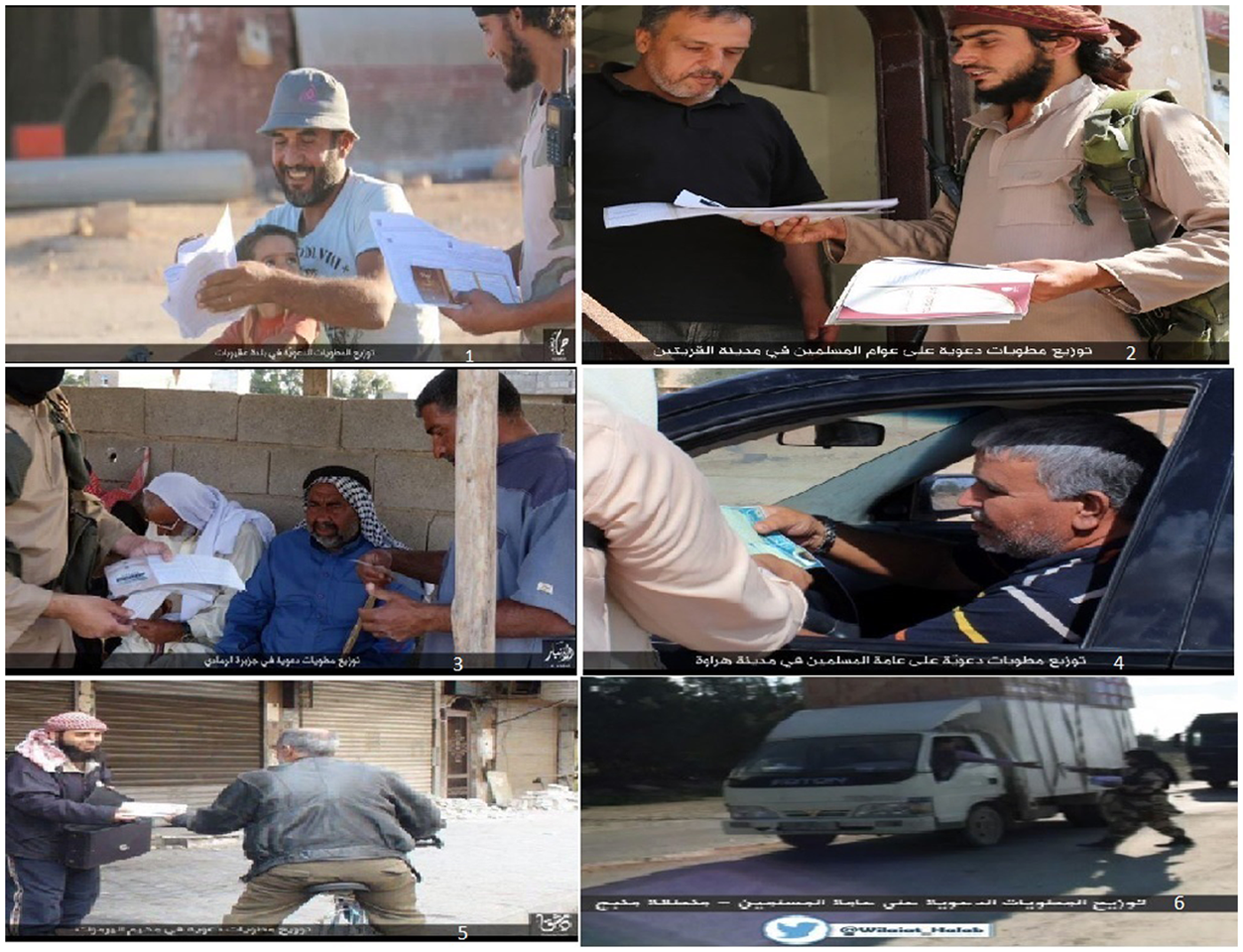
ISIS members distribute pamphlets and books to ordinary people in different cities. ISIS’s Al-Himmah Library images are assembled here by the author: (1) Eqirbatt (Syria), (2) Qaryateen (Syria) (3) Ramadi (Iraq), (4) Harawh (Libya), (5) Yarmuk Camp (Syria), and (6) Manbaj (Syria).
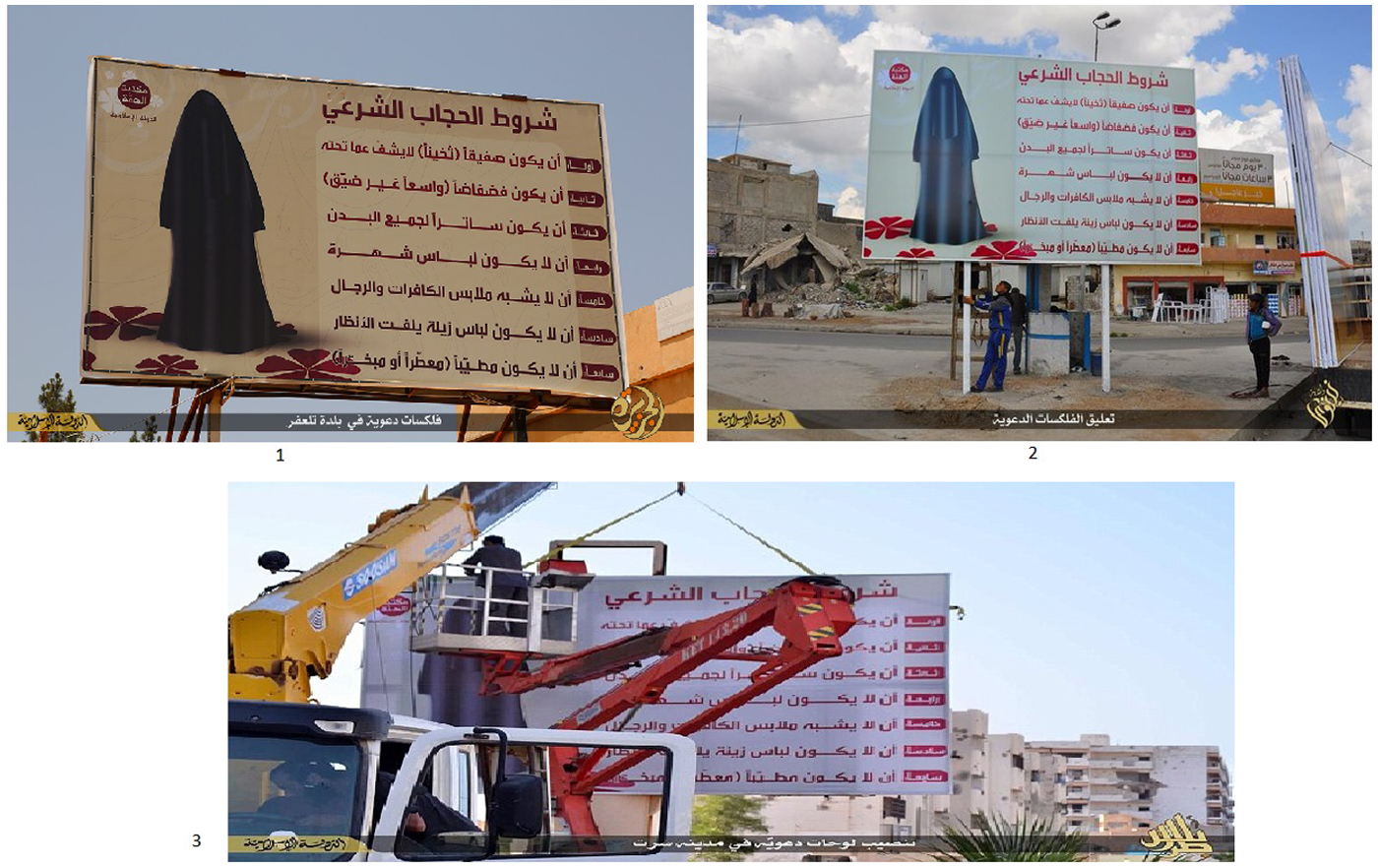
The same billboard dealing with women’s attire (niqab wearing) used in different ISIS controlled cities. ISIS’s Al-Himmah Library images are assembled here by the author: (1) Talafar (Iraq), (2) Mosul (Iraq), and (3) Sirt (Libya). The billboard lists seven conditions on the niqab’s features such as being odorless in order not to attract attention.
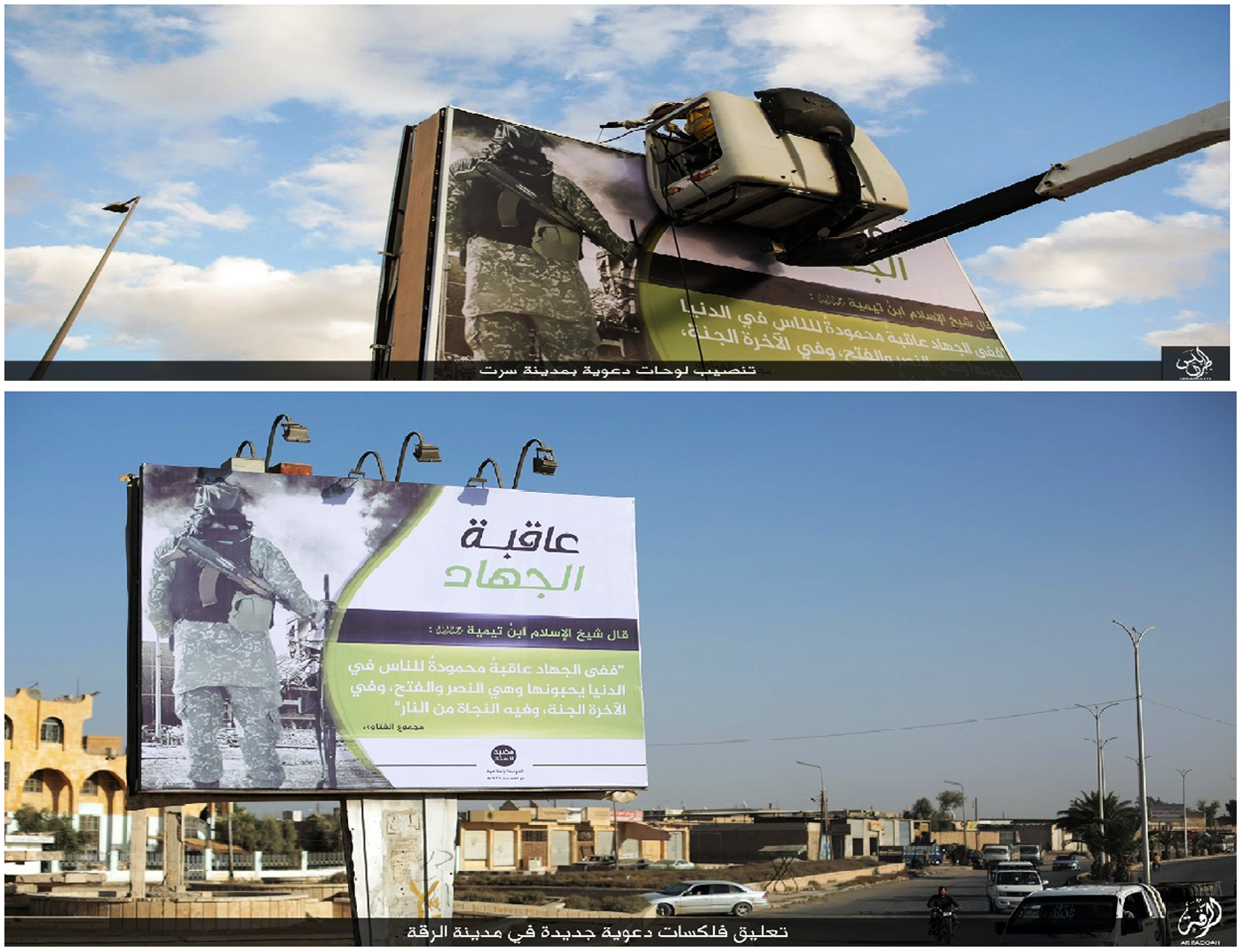
The same billboard calling for Jihad used in two different ISIS controlled cities. ISIS’s Al-Himmah Library images are assembled here by the author: (1) Sirt (Libya) and (2) Raqqah (Syria). Citing the Wahabbi preacher, Ibn Taymiyyah, the billboard references the worldly and heavenly rewards of jihad.
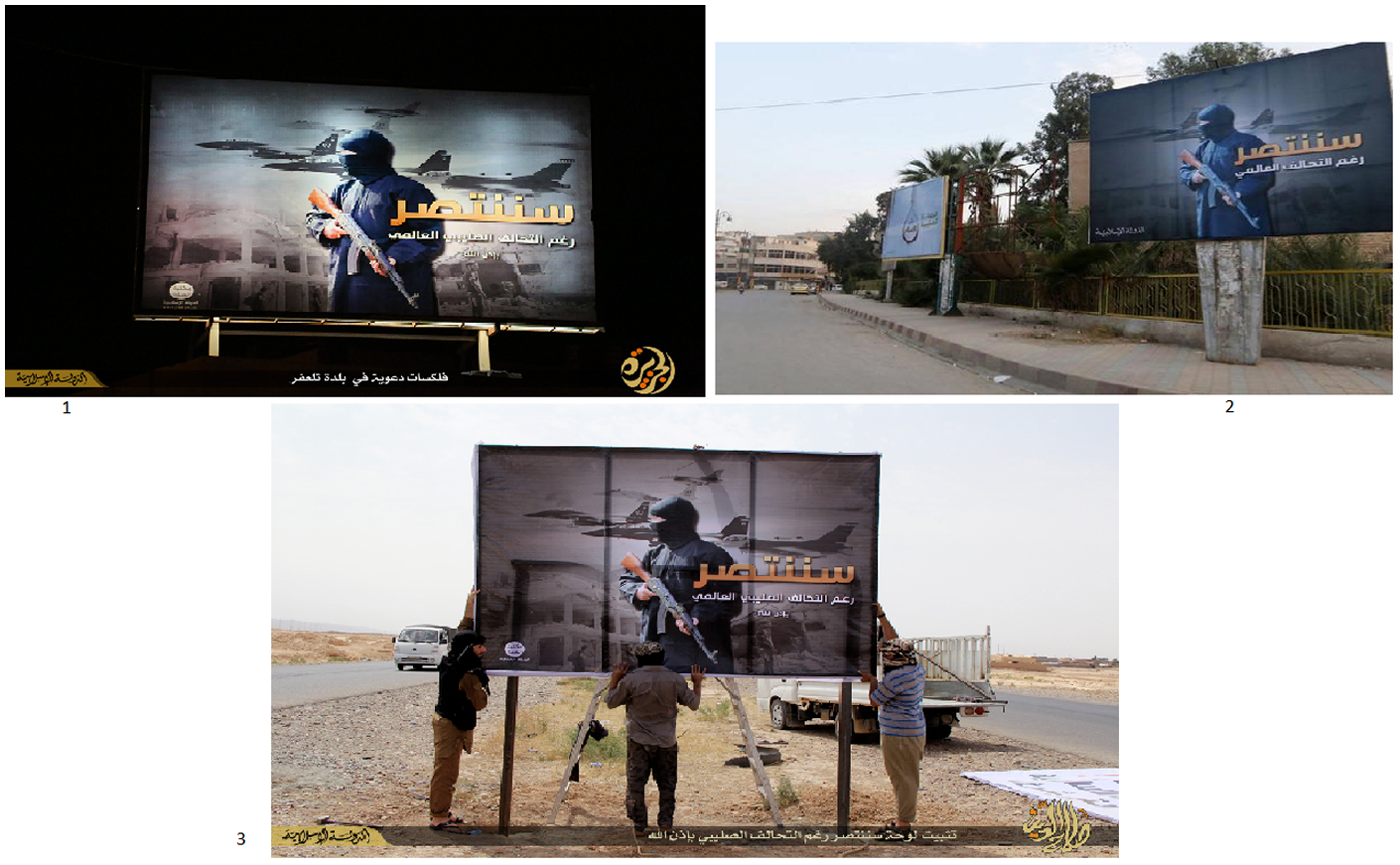
The same billboard promoting the group’s alleged future victories used in three different ISIS controlled cities. ISIS’s Al-Himmah Library images are assembled here by the author: (1) Talafar (Iraq), (2) Mosul (Iraq), and (3) Tikrit (Iraq). The billboard reads as follows: “We’ll be victirious despite the global crusading colation.”
This section discusses ISIS’s pamphlets and billboards which were collected from a variety of online sources using several Arabic Google searches such as “promotional flex” and “promotional billboards.” The time period of posting these publications is not known, but the Google search conducted by the author was done over a period of 4 months in early 2016. Due to the large blocking effort on Twitter, the terrorist group heavily used blogs (https://adkhilafah.wordpress.com, http://dawaahaq.blogspot.ca, or http://aladnnani.blogspot.ca), forums, and well known websites like justpastit, archive.org (Smith, 2015), and dawaalhaq.com in order to disseminate its various materials. One of the main data sources in this study was ISIS’s publishing agency known as Al-Himmah Library (http://himmah1437.blogspot.ca) which ran an educational app targeting children and published hundreds of books, pamphlets, and wall posters. On this blog, 62 billboards, 56 pamphlets, 8 wall posters, and 19 books including school textbooks were posted. All the pamphlets (n = 70) and billboards (n = 77) mostly taken from the website above were examined in this study because they offered an important insight into ISIS’s offline standardized media productions which remain largely under-researched. The author is not aware whether the number of collected pamphlets and billboards is exhaustive due to the difficulty of conducting field research, and this remains one of the study’s limitations.
Methodologically, the author used Thematic Analysis (TA) to identify the main themes found in the examined offline publications by analyzing the texts and images. TA is a qualitative method based on grounded theory (Guest, MacQueen, & Namey, 2011) and uses inductive coding in what Wimmer and Dominick refer to as “emergent coding.” Here, constructs are classified “based on common factors or themes that emerge from the data themselves” (Wimmer & Dominick, 2013, p. 168). Themes are identified by observing patterns, commonalities, and repetitions in the messages that are textually and visually communicated (Corbin & Strauss, 1998; Guest et al., 2011). Finally, ISIS’s offline publications are connected to the broader context since leaving “a text analysis at the level of topics, explanatory themes, or frames runs the risk of accepting content in a one dimensional way … while missing the complicated ideological context at play” (Fursich, 2009, p. 248).
In general, these offline publications focused on nine main themes revolving around imposing Islamic jurisdiction following the group’s strict interpretation of Islam. The main highlighted themes and their frequencies in these offline publications are as follows: (1) call for jihad (n = 32); (2) women’s garment appearance, and behavior (n = 12); (3) observing ISIS’s sharia law (n = 73); (4) men’s garment appearance, and behavior (n = 9); (5) promoting ISIS as a functional state (n = 12); (6) critical of Arab regimes (n = 2); (7) critical of coalition forces (n = 1); (8) anti-smoking (n = 4); and (9) call for using a new currency (n = 2). As can be seen, the most prominent theme is observing Sharia law followed by calls for jihad, indicating the importance given by ISIS to these two issues. As an example of theme 3, one of the pamphlets provides 20 different reasons to remove satellite dishes and break them, while another one explains that loyalty should be for Islam rather than to ones’ secular homeland. Regarding themes 6 and 7, a few publications criticized Arab governments like Iraq, Syria, and Egypt as well as coalition forces for their military support or direct involvement against ISIS. As for theme 9, ISIS introduced and promoted a new currency called the golden dinar to replace national and foreign currencies. The dinar is similar to the currency used during the climax of the Muslim empire and control during the Abbasside period which was expected to offer a standardized currency that can provide authority and legitimacy to the Islamic state in the different territories it controlled.
As mentioned above, nation-state building is undertaken in several ways including accommodation, exclusion, and assimilation, and ISIS used offline publications as part of its jihadist nation-state building efforts and to brand itself as a real nation-state that could provide public services and protection for its subjects. For instance, there are a few anti-smoking publications which were meant to project the image of a nation-state concerned about the general health of its citizens using religious teachings, while others highlighted the alleged urban improvements that occurred in some cities such as Mosul. One prominent type of publications is that that calls for Jihad (theme 1) with a clear message that targets men rather than women. There is an emphasis on the alleged “heavenly rewards” for military relocation and remote stationing on the Islamic State’s borders (Murabbatta) in order to encourage people to protect ISIS’s territory. Men’s garment and appearance are also highlighted in some of these publications with a special focus on their long beards, shaved mustaches, and short gowns. However, many productions target women especially those that highlight the importance of their garments, for example, niqab wearing (see Figure 5). They provide detailed instructions on the “proper” way of dressing full women’s clothing including the niqab. One of the billboards shows an empty throne, while the text reads: “The Muslim woman is a Queen at her house” with a Quranic verse “Stay at your homes” (Al-Ahzab – 33). Human Rights Watch (2016) conducted interviews with 21 Sunni Arab women who lived under ISIS’s control, and the report stated the following in relation to the assimilation policies of ISIS: All women … reported being forced to wear the niqab, which covers body, face, and head, with veils over their eyes, gloves, and socks whenever they left their houses. All clothing had to be black and without decoration. Many said that with their eyes veiled, they could not see where they were going and sometimes stumbled and fell. Before ISIS took over their areas, they said, they wore headscarves with their faces showing, and colored clothing.
In this regard, women were compelled to convert to ISIS’s ideology, or they risked being harshly punished. ISIS’s Al-Khanssaa Brigade, for example, consisted of women only who released a manifesto in 2015 in which the group emphasized “the importance of motherhood and family support.” The publication itself is “fundamentally misogynist and, within its interpretation of Islamism, the role of women is ‘divinely limited’” (Winter, 2015c, p. 5). Indeed, the teachings of this manifesto could be clearly observed in these billboards that target women.
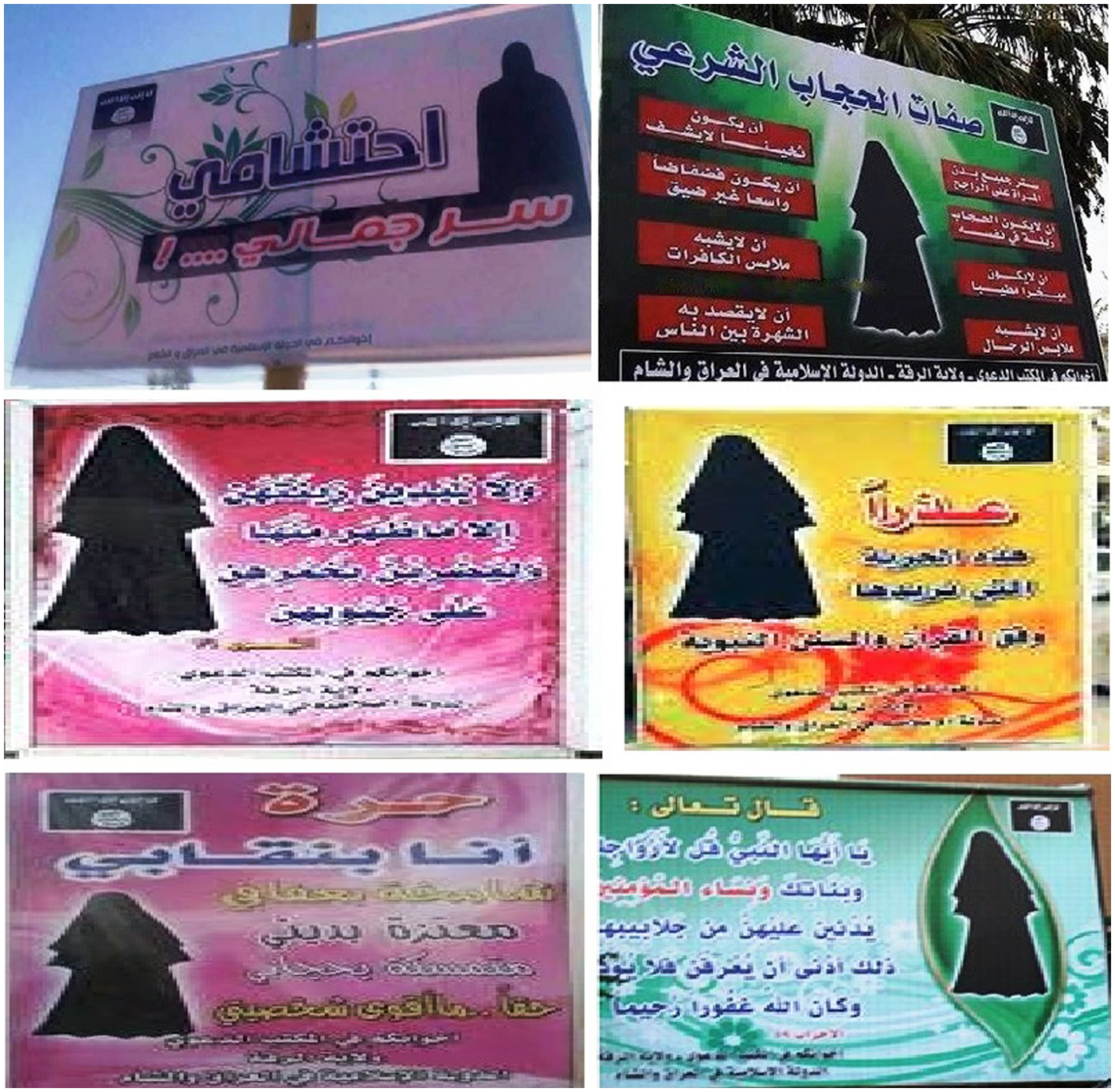
Billboards instructing women on how to wear their garments (niqab). Most of the above images are produced by ISIS’s Al-Himmah Library and are assembled here by the author.
In terms of assimilation which is related to cultural genocide, ISIS imposed its strict Islamic rules by force, and any offenders were harshly punished by the Husba police. In this regard, all billboards assisted ISIS in its nation-state building efforts by their call for adopting a new non-secular way of living. To give the messages some legitimacy, most of the publications, if not all, contain Quranic verses or some of Prophet Muhammed’s sayings. As for publications dealing with sharia law, the terrorist group planned on managing an imagined nation-state allegedly similar to what appeared in early Islam (Shane & Hubbard, 2014; Thielman, 2014), particularly in connection to religious rules, duties and obligations (Winter, 2015b) such as alms giving and praying on time. All the sharia promoting publications are meant to brand ISIS as a purely Islamic group, so an attack against it is communicated to its followers as an attack against Islam itself. Other publications that urge for Jihad include persuasive messages that present the terrorist group as a defender of Muslims, while Jihad is meant to protect Islam and Sunni Muslims in general. In fact, ISIS repeatedly portrays itself as “the protective vanguard for the world’s Sunni Muslims” (Cottee, 2015; Quilliam, 2014, p. 32; Winter, 2015a, p. 23) which can be regarded as an important appeal and recruiting factor for Jihad. To better understand ISIS’s standardized media and nation-state building efforts, a brief concluding discussion is provided on the terrorist group’s media strategy in the following section.
Discussion and conclusion
Regarding it as part of its fights against its enemies, ISIS placed great importance to media in relation to its nation-state building activities. In terms of standardized policy, ISIS was paranoid when it came to private and uncensored Internet networks as well as satellite dishes which were both banned in its controlled territories (Ali, 2016; Coles & Parker, 2015; Malik, 2015). Internal ISIS documents show that this ban extended to print publications especially that the group burnt several libraries in order to limit what people can read. For example, some of ISIS’s documents mention that it is absolutely forbidden to circulate any publications, newspapers or educational schedules not issued by the Islamic State offices in Wilayat Dimashq. And all books, newspapers and stored newspapers will be confiscated in the offices and held by the Diwan al-Ta’aleem so as not to spread them. (Zelin, 2015)
In order to organize these standardized laws, ISIS created a centralized media division similar to a Ministry of Information running several other media production centers like Al-Hayat, Al-Furqan, and Al-Ethar. Each province or city controlled by ISIS had a media department which disseminated materials in coordination with the military and security administrators (Islamic State Blueprint, 2014). In each city, there were also what is termed as “Media Point” where people could receive ISIS’s publications and forcibly watch its promotional videos. ISIS’s media division had its own news agency called Amaq (depths) which ran its own Android app, and there was also Al-Nabaa newspaper, the monthly Dabiq magazine in Arabic and English as well as Al Bayan radio station which aired in different ISIS controlled areas (Callimachi, 2016; Shiloach, 2015b). This media vision is similar to that that is followed by totalitarian secular states including the former Baath regime in Iraq. For example, media is largely expected to mobilize the public and propagate for the state in Baathist Syria and Iraq during Saddam Hussein’s rule, Sudan, and Libya during Muammar Qaddafi’s rule (Al-Rawi, 2012; Ayish, 2002; Rugh, 2004, pp. 29–31). Similar to ISIS’s media policy, Saddam Hussein ran a Ministry of Information that oversaw and managed media production and a centralized Iraqi News Agency (INA) (Boyd, 1982).
In relation to social media, the terrorist group used only a few centralized Twitter accounts (Al-Rawi & Groshek, 2019) that “tweet official statements and news updates” as well as provincial accounts run from the provinces ISIS controls “which publish a live feed about [local] ISIS operations” (Kingsley, 2014). The centralization of media messages was meant to standardize the message which was part of the nation-state building effort and branding a unified official image. This standardization was even seen in the kind of standard emojis ISIS followers often used (Shiloach, 2015a).
One of the earliest publications that is attributed to shaping the ideological foundations of ISIS is called “The Management of Savagery” written by a jihadist called Abu Bakr Naji (2006) (Al-Rawi, 2018). In relation to media’s role, Naji discusses how the media plays an important part in projecting the idea of a powerful nation-state which was what ISIS was obsessed with. He further stresses that the masses have to be persuaded, stating that the “role of media politics is to gain [people’s] sympathy, or at the very least neutralize them” (p. 52). In other words, media is viewed by ISIS as a propaganda tool that is used to directly influence people or to the very least silence them in order to be subdued. Specifically, media has three separate roles in relation to the masses living under the Islamic State’s control which include persuading “a large number of them to join the jihad, offer[ing] positive support, and adopt[ing] a negative attitude toward those who do not join the ranks” (pp. 50–51). As for people living outside the group’s control, media should also target them in order to “motivate” them “to fly to the regions which we manage, particularly the youth after news of (our) transparency and truthfulness reaches them so that they may be fully aware of the loss of money, people, and worldly gains” (p. 51). The last target group includes enemy combatants especially those “who have lower salaries, in order to push them to join the ranks of the mujahids or at least to flee from the service of the enemy” (pp. 50–51). Due to its important role in Jihad, Naji emphasizes the significance of creating a special media division which is what ISIS actually operated “whose purpose is to communicate what we want to say to the masses and focus their attention on it, even if this requires exposing the group to danger that is comparable to the danger of a military operation …” (pp. 95–96). Indeed, Naji defines the jihadist struggles as “media battles” (p. 73) waged against the “infidels.”
In another important Arabic book publication entitled “Journalist, You’re a Jihadist” that was distributed internally and posted online, we find a more elaborate vision of media’s standardized role (ISIS, 2015). 2 The book begins by explaining that journalism is jihad and journalists are themselves jihadists because “jihadist media has a great heavenly reward” (p. 10). The authors inquire the following: “Have you not seen how the film maker carries his camera instead of the Kalashnikov and runs in front of the soldiers during the raids, receiving the bullets in his chest!” (p. 18). This militant vision of journalism is also found in a few other images released by ISIS on the role of media in the battlefield. In its insight on jihadist media, the authors stress that “a journalist is a suicide attacker without a [suicide] belt” (p. 18).
In general, there is a clear importance given to media workers due to “the gravity of their job” as well as their “large responsibility” (p. 10). The book also emphasizes that “the power of words is sometimes stronger than that of nuclear bombs” (p.11) especially that media efforts complement military actions in the sense that media should aim at “achieving psychological defeat of the enemy” since jihadist media is “half the battle” (p.11). The stated goal of the book is to “prepare a new generation of media workers that are of high quality similar to the high standards that the Islamic State requires from its followers” (p.11). In this regard, journalists’ duties include writing articles, going to the battlefield (Jihad with the self), urging for jihad, agitating the enemy, pleasing the faithful ones (ISIS followers), following the rulers’ orders, covering reality, and countering cultural invasion. The publication insists that most if not all media outlets disseminate lies, while the role of ISIS’s journalists is to be different by “conveying to simple people the true picture of the battle without exaggeration or deception” (p. 40). However, ISIS’s book itself clearly preaches the importance of media mobilization in which objectivity and neutrality can never be attained in ISIS’s imagined jihadist nation-state. Also, unfavorable ISIS footage is never disseminated to the public (see for example Vice News, 2016).
Several other audio-visual materials released by ISIS stress the importance of media in supporting the Islamic State. To give one example, Shumukh Instigation Workshop (n.d.) released a video with the title “Journalist, you’re a Jihadist” in which several interviews with ISIS fighters were conducted. Many responded on the role of media, stating the following: “Your support lifts the morale of ISIS fighters.” The video’s goal is to provide a standardized social media literacy crash course on whom to follow, block, and how to retweet as well as the importance of protecting ones online privacy using the Dark Web (Tor network) and VPNs. The main message in this video is “Your tweets are your weapons.” In brief, all of the above media goals are limited to mobilization and advocacy because they are meant to assist in the nation-state building efforts of ISIS in order to better achieve its intended objectives of creating a jihadist nation-state. This media vision is similar to that followed by totalitarian states as media is largely expected to mobilize the public and propagate for the survival of the state. This standardized media strategy is reminiscent of that that the former Baath regime in Iraq followed. For example, one of the most famous statements by Saddam Hussein was the following: “The pen and rifle have one barrel” which was written on hundreds of thousands school textbooks, buildings, and posters.
To sum up, ISIS intended to build a jihadist nation-state with the direct and indirect assistance of media due to its importance in disseminating pro-ISIS messages. Its goal was to indoctrinate people to actively participate in Jihad and blindly follow all of its rules without questioning their superiors. As part of ISIS’s efforts, standardized offline communication techniques were heavily used to target people living under ISIS’s control, and most billboards and pamphlets focused on highlighting the importance of sharia law, calls for Jihad, and marketing for the terrorists. Since the exact same offline media productions were found in different ISIS controlled cities, they helped in providing a false impression of the group’s imagined outreach. With its use of standardized messages as well as centralized media strategy and production departments, ISIS attempted to create a stronger brand image whether be inside its territories or outside them. All of these efforts were meant to enhance the idea that ISIS created a real nation-state characterized by its jihadist ideology. With the defeat of ISIS in Iraq and most of Syria, the distribution of billboards, pamphlets, and textbooks will be much more difficult offline, yet they might continue circulating online as other ISIS members and sympathizers could use them for promotional and recruitment purposes because they might serve as a reminder of the terrorist group’s once imagined jihadist nation-state.
Footnotes
1.
In relation to language, it has always been important in nation-state building as it is used as “a salient identity symbol, as well as a political instrument” (Luong, 2004, p. 123). There are numerous examples on how language teaching and imposition has been used to unify the nation such as the case of enforcing Kazakh and Uzbek languages and vocabulary in Kazakhstan and Uzbekistan, particularly after the break-up of the Soviet Union (Ubiria, 2015) or the standardization of the Romani language of the stateless Roma people in the Baltic states (Daftary & Grin, 2003). Other examples of language standardization include Zimbabwe (Ndhlovu, 2009), Bosnia (Kolstø, 2016), and other part of Southeast Asia like Indonesia (Sercombe & Tupas, 2014). In relation to education, the standardization of the American educational system and curricula have been regarded as a crucial element in “the development of national and state content and performance standards … [which] are an instrument of public control of education” (Rapport, 2015, p.164). In other words, standardization provides an important centralized tool for the nation-state to control and monitor the overall educational process. Other aspects of standardization include laws such as the case of Turkey (Aslan, 2014, p. 146) and currency.
2.
The Arabic word “Ellami” or media worker is translated as journalist here. It can also mean a media professional.

Author biography
Ahmed Al-Rawi is an Assistant Professor of Social Media, News, and Public Communication at the School of Communication at Simon Fraser University, Canada. His research expertise is related to news, social media, and global communication with emphasis on critical theory. He authored three books and over fifty peer reviewed book chapters and articles published in journals like Information, Communication & Society, Online Information Review, Social Science Computer Review, Public Relations Review, and Journalism.