




Abstract
BTS fandom has been one of the strongest, and many Adorable Representative M.C. for Youth members have dedicated themselves to protect BTS from numerous controversies, while promoting the group’s messages, which can be identified as cyber-nationalism. By employing a critical discourse analysis on BTS fans’ social media posts and their online activities surrounding a few incidents, this article attempts to develop cyber-nationalism in the context of the BTS fandom. It investigates the formation of transnational cyber-nationalism, and then discusses how Adorable Representative M.C. for Youth members as citizens in the BTS nation utilize cyberspace, in particular, social media, not only to form alliances but also to protect BTS from any critical points of view. Finally, it articulates how transnational cyber-nationalism in tandem with BTS has shifted the notion of cyber-nationalism, which can be identified as negative, even patriotic parochialism, into constructive and socio-culturally corrected cyber-movements.
Introduction
In the early 21st century, BTS—a seven-member boy band in Korea—has continued to reign supreme in the global music sphere. Since its debut in 2013, BTS has released several incredibly popular songs and albums and received numerous major awards. There are a few different elements that contribute to BTS’s global fandom, and Adorable Representative M.C. for Youth (ARMY)—the BTS fandom name—has certainly played a key role. ARMY as one of the largest and powerful fandoms actively participates in all levels of fandom activities, from translation to fundraising, and they have effectively utilized social media platforms as sites for fan activity.
ARMY members have especially established various online gathering spaces, including the group “BTS Nation” on Facebook and the “BTS National” Twitter account, which has 1.9 million followers. While fans protecting their objects of fandom from criticism is not necessarily new in popular music culture, a large subset of ARMY is especially protective of BTS, which is notable considering their ability to mobilize on social media in the name of their imagined communities.
How ARMY members act can be characterized not only as general fandom (see Jenkins, 1992) but also as “cyber-nationalism,”—known as digital nationalism or internet nationalist activism as well (Mihelj & Jiménez-Martínez, 2020). The recent fandom activities by ARMY can be also understood as the formation of “transnational” cyber-nationalism. The members are located in more than 100 countries, but ARMY members strongly support BTS as the citizens of an imagined transnational fandom sphere. As Yoon (2019) points out, previous fandom studies have not engaged with transnational flows of non-Western popular culture. However, BTS fandom indicates the growth of non-Western-based transnational fandom, which is situated in the discourse of cyber-nationalism. It does not mean that the emergence of transnational cyber-nationalism in the BTS context replaces current cyber-nationalism or eradicates banal nationalism, both of which emphasize national territory or ethnicity.
Cyber-nationalism in tandem with fandom has become an interesting research topic in the early 21st century (Han, 2015; Ju, 2007; Lyan, 2019; Wu et al., 2018; Yoon, 2019); however, there is no specific research, focusing on the characteristics of BTS and ARMY from a cyber-nationalism perspective. By employing a critical discourse analysis on BTS fans’ social media posts and their online activities surrounding major incidents, including Japanese network TV Asahi’s cancelation of BTS’s scheduled appearance in November 2018 and #BLM in June 2020, this article attempts to develop cyber-nationalism in the context of the BTS fandom. It especially traces some social media accounts, titled BTS National on Twitter and BTS Nation on Facebook, as many fans left their comments or tweet their opinions relevant to these issues. It investigates the formation of transnational cyber-nationalism, and then discusses how ARMY members as citizens in the BTS nation utilize cyberspace, in particular, social media, not only to form alliances but also to protect BTS from any critical points of view. Finally, it articulates the ways in which transnational cyber-nationalism in tandem with BTS has shifted the notion of cyber-nationalism, which can be identified as negative, even patriotic parochialism into constructive and socio-culturally corrected cyber-movements.
From banal nationalism and cyber-nationalism in a BTS nation
The notion of nationalism is complex and encompasses diverse dimensions, including a territorial boundary, political integration, and cultural homogeneity. Nationalism has been defined broadly as the sum of those beliefs, idioms and practices, oriented to a territorially delineated nation and embodied in the political demands of a self -identified people, which may or may not be realized in a nationalist movement and state “of their own.” (Cox, 2007, p. 3143)
The key characterization of nationalism in traditional theories is a political principle, which holds “the political and the national unit should be congruent,” namely, one state, one nation (Gellner, 2006, p. 1). National identity, which is one of the most significant elements in the notion of nationalism, is based on the sentiment of belonging to a specific nation. From this approach, a nation-state is traditionally limited in a certain geographical boundary, and nationalism refers to a sensibility carried by people who reside in any particular space, and their collective identity and emotional consolidation (Ju, 2007). National homogeneity and pureblood nationalism are some of the most significant elements in the discourse of nationalism (Han, 2015).
Broadly categorized in cultural nationalism, focusing on “a stretched concept, encompassing the full gamut of cultural practices and texts” (Woods, 2016, p. 1), rather than political nationalism, Anderson (1983) challenged this traditional notion of nation and nationalism and proposed a new concept beyond a traditional spatial understanding of the nation. His notion of “imagined community” is the interlock between particular discursive and ideological manifestation. He proposed the idea that nationalism is symbolic and cultural recognition as well as territorial and political. As long as the theory of nationalism is discussed with the concept of political sovereignty and ethnic territoriality, an emerging concept of cultural nationalism challenges the traditional theory of nationalism (Ju, 2007). For Anderson (1983), nationalism is a work of imagination, and he conceptualized nationalism in terms of the ways that nation-states are imagined and created. Major concerns of nationalism are no longer territorial and political ones. Instead, those concerning national identity and popular culture have been noteworthy.
More importantly, Anderson’s notion of nationalism is closely related to media, which would include social media contemporarily. As cyber-nationalism in tandem with fandom is deeply related to digital technologies, the role of the media in articulating digital nationalism is important. In our contemporary society, digital media are some of the major mechanisms through which an idea of cyber-nation is established and through which the relationship between an imagined nation-state and its global milieu is articulated (Zeng & Sparks, 2020). As media, including newspaper and print capitalism, are identified as major agents of the imagining of a nation, the practice of cyber-nationalism also started with the growth of digital technologies; contexts for the performance of banal nationalism and belonging have changed markedly with the emergence of the Internet as a significant constituent and mediator of everyday activities. National anthems, depicted as echoed realizations of the imagined community, now exist in cyberspace, offering new public spaces for observing, participating in and responding to anthem spectacles. (White, 2015, p. 627)
The prevailing political economy of digital technologies means that, “in the online sphere, nations are increasingly imagined and communicated as communities of consumers—a trend that further enhances the already evident growth of economic and consumer nationalism, and the related practice of nation branding” (Mihelj & Jiménez-Martínez, 2020, p. 3). Their institutionalization of cyber-nation, and therefore, cyber-nationalism necessitates coordination of online and offline activities, resources, information, and venues of socio-cultural power across national territories for political, cultural, technological, and economic purposes (Held et al., 1999).
Several works on cyber-nationalism have critically developed Anderson’s notion as digital media play a primary role in forming cyber-nationalism or fan-nationalism. In its fan studies iteration, a theory of imagined communities “foregrounds the transborder, transnational reach of the internet in creating a sense of simultaneous, shared popular cultural experience” (Morimoto & Chin, 2017, p. 174). This kind of new formation in cyberspace suggests “a feeling of collective belonging through transnationality and a will to consolidate their solidarity as a political community that transcends member states” (Kastoryano, 2007, p. 159). In a broader sense, such transnational communities, in particular on social media, take into account the context of globalization and economic uncertainty that facilitates the construction of global networks.
With the advent of the internet, social media, and smartphones, people’s mobility has greatly increased and intensified such transnational relations, leading community members to socio-cultural and political mobilizations that cross national boundaries (Kastoryano, 2007). Cyber-nationalism has been formed with the advent of digital media has played a primary role in our contemporary cyber-nationalism. This mode of action points to the existence of a new type of nationalism that is transnational—that is, a nationalism that is expressed and developed beyond and outside the borders of a single state and its territory, and that (1) arouses nationalist sentiments in both home and host countries, and beyond; (2) creates new expressions of belonging and a political engagement that reflects the nationalization of communitarian sentiments guided by an imagined geography. (Kastoryano, 2007, p. 160)
Cyber-nationalism here is the reflection of nationalistic enthusiasm and discourses on cyberspace, which means that digital technologies reproduce our sense of belonging to a world of nations (Mihelj & Jiménez-Martínez, 2020).
However, due to its unique technological and cultural aspects, cyber-nationalism is notably different from banal nationalism. Cyberspace is theoretically open to everyone, and two-way communication has been made possible. As cyberspace goes beyond time and space limitations, it is possible to develop communicative nationalism (Suh & Tang, 2013). By critically employing Anderson’s notion in K-pop, Lyan (2019, p. 3766) argues, “fan-nationalism as a work of imagination envisioned by fans through performances of popular national culture to construct a positive image of the nation, fandom, and fans.”
What is significant in the BTS fandom as an imagined nation-state in the social media era is that the deep and horizontal comradeship has been actualized via transnational social media in seeking various values, including social justice. Unlike physical nation-states in which netizens promote national identity and supremacy against other nation-states, BTS fans develop communicative transnational cyber-nationalism, which advances solidarity among themselves, while forming implausible cyber-power against social injustice and youth struggle. Transnational cyber-nationalism, not based on ethnicity and/or race, but based on global fandom, solidarity, and loyalty, has been shifting the notion of nationalism, both politically and culturally, in the early 21st century, and BTS and ARMY advance a new form of cyber-nationalism.
As Mihelj and Jiménez-Martínez (2020, p. 12) argue, discourses on cyber-nationalism ideally “seek to combine the analysis of both the mundane reproduction of nationalism online and the dynamics of more explicit articulations of digital nationalism, ranging from nationalist consumer boycotts to competing articulations of national belonging during major political events.” However, cyber-nationalism in the BTS sphere is not what traditional digital nationalism intends to do, which involves loyalty to any specific territorial/ethnic-based nation-state, as their nation is a BTS nation—imagined, transnational, and open to everyone. Fueled by the increasing popularity of the Korean Wave, many fans have already “replaced ethnic Koreans in performing nationalism beyond Korea’s borders,” and cyber-nationalism is “a work of imagination envisioned by fans through performances of popular national culture to construct a positive image of the nation, fandom, and fans” (Lyan, 2019, pp. 3765–3766). ARMY members utilize social media as their major communication tools, for not only simply conveying news and information but also strategically organizing necessary fandom activities.
BTS and ARMY in the global music sphere
BTS as one of the most successful and powerful idol groups originated from Korea has expanded its popularity in the global music scene. BTS debuted in 2013 as a typical idol group who pursed hip-hop music, which reflected some of the general trends of K-pop, with a variety of songs that included typical love songs to commentary on the Korean school system and society’s obsession with technology, echoing past themes of other groups. BTS kicked off “a trio of projects—2 Cool 4 Skool, O!RUL82, and Skool Luv Affair—that looked inward, venting frustrations about the constricting experience of Korean teendom” (Bruner, 2020). BTS quickly gained fans overseas, including in Japan, as the group saw its first Billboard World Albums appearance with their EP Skool Luv Affair (2014) peaking at number 3, while its first Japanese release reached the top 10 in Japan’s Oricon charts. By 2015, the group began topping charts in Korea and the United States and became the most anticipated K-pop boy group in the United States (Kim, 2019; McLaren & Jin, 2020).
BTS has continued to create numerous successful albums, which have regularly topped Billboard charts for the past few years. From early albums such as The Most Beautiful Moment in Life trilogy to later albums, including Love Yourself: Tear and BE, BTS earned global popularity in many parts of the world. BTS has also received numerous music awards, including Best Duo or Group–Pop/Rock at the 2020 American Music Awards (AMAs) and the Top Social Artist Award at the Billboard Music Awards (BBMAs) for the past 4 years. BTS’s Dynamite released in August 2020 finally reached No. 1 on Billboard Hot 100 in September 2020. The seven-member superstars also scored No.1 on the Billboard Hot 100, as Life Goes On, Butter, and Permission to Dance released in 2020 and 2021 debuted at the summit. It followed Dynamite, which reached No. 1 in September and October, respectively, during the same year (“BTS Becomes First Group to Rule Artist 100, Hot 100 & Billboard 200 Charts at the Same Time,” 2020; “BTS Blasts Onto Hot 100 at No. 1 With . . .,” 2021). Slightly before this historical achievement, BTS held their first pay-per-view livestream concert, titled “BangBangCon (bang means room in Korean): The Live,” on 14 July 2020 during the COVID-19 pandemic. This live event was streamed for over 100 minutes remotely from a studio in Seoul and drew more than 750,000 viewers from 107 countries, including Korea, the United States, the United Kingdom, China, and Japan (“BTS ‘Bang Con’ Becomes World’s Biggest Paid Online Concert,” 2020).
It is not necessarily incorrect to argue that behind BTS’s phenomenal success is its powerfully active and engaged fandom. Comprised largely of digital natives, 1 ARMY has greatly influenced BTS’s career, “clearly encapsulated by their engagement and mass voting power” that resulted in BTS’s BBMAs awards for the past several years (McLaren & Jin, 2020). ARMY propelled BTS to win the fan-voted Top Social Artist, with more than 300 million votes, at the 2017 BBMAs, which ended a 6-year winning streak in the category by Justin Bieber. At the time, Bieber boasted more than 100 million followers on Twitter (Moon, 2020). ARMY’s role is not limited to its voting power in the music awards, as AMRY provides a powerful foundation for BTS’s global fame. ARMY also actively participates in various fandom activities. ARMY members conduct an in-depth and community-driven analysis of BTS’s music videos and lyrics and also play a role in crowdfunding campaigns for BTS’s United Nations International Children’s Emergency Fund (UNICEF) campaign and billboard advertisements, while effectively mobilizing in support and defense for BTS against mischaracterizations or racism (Low, 2019; McLaren & Jin, 2020).
Fans’ dedication to BTS is having real-life implications for the spread of the group’s music. For example, every year, Danish music magazine GAFFA holds an award show, and in March 2019, BTS received gold in two categories: International Band of the Year and International Release of the Year thanks to a little help from the ARMY (Larsen, 2019). In follow-up media interview, one of the female fans recalled, “it was a fan vote and all our fans voted, [and] when the host said the name of BTS we all went crazy.” In the United States, the ARMY made sure that local radio stations gave airtime to BTS by calling DJs directly, which worked. BTS’s special SNS connection with their international fans is a fascinating example of how to successfully be proactive and interactive (Larsen, 2019). Accordingly, barely a concert or awards ceremony goes by without BTS thanking ARMY for promoting their music and helping them get where they are (Seo & Hollingsworth, 2019).
Most of all, ARMY congregates on numerous social media platforms that serve as sites for fan activity. About 40 million members of ARMY subscribe to BTS’s YouTube channel, and more than 30 million follow both the member-run Twitter account and Big-Hit’s official BTS Instagram account. Some ARMY members have, again, established “BTS Nation” on Facebook and the “BTS National” Twitter account. It does not mean that they are the largest, nor official fansites. BTS and Big Hit Entertainment (now HYBE) opened its official fan community app Weverse on 1 July 2019, which seems to be the largest fansite, and there are other fan cafes as well (E. J. Lee, 2019). Likewise, ARMY “stands apart from other fandoms through the ways it has mobilized with an unrivaled level of organization” (Moon, 2020).
2
In other words, while many of the activities ARMY have undertaken are characteristic of popular media fandom practices more generally . . . as a cross-border global fandom, ARMY primarily interact with each other and BTS on social media, and it is in this context that it is interesting to note the vast amount of content, paid and unpaid, official and fan-made, available to fans online. (McLaren & Jin, 2020, p. 110)
The majority of ARMY members are digital nerds, and their ability to participate and engage in action and interaction on social media is notably common, which means that they have cultural skills as well as social skills to effectively communicate each other (Yang, 2018). Social media plays a pivotal role in connecting BTS and their content to fans. Some ARMY members develop their unique fandom activities, which can be categorized in cyber-nationalism.
Cyber-nationalism in a BTS nation: ARMY as bulletproof for BTS
Since many ARMY have been active in fighting against negative portrayals or commentary surrounding BTS in other parts of global society, BTS fans’ cyber-nationalism has been closely related to the general movements identified in other cyber-nationalism activities. However, their online activities are not limited to defending BTS from any kind of critique or conflict, as BTS fans have also actively promoted the messages BTS deliver. Cyber-nationalism in the BTS sphere is not only different from traditional banal nationalism but also different from recent cyber-nationalism as the reflection of nationalistic enthusiasm on cyberspace. Onwards, I discuss different forms of cyber-nationalism that can be identified in the BTS nation—an imagined transnational nation-state. In so doing, we conceptualize an imagined and transnational cyber-nationalism in the BTS sphere, and potentially, in the realm of popular culture.
To begin with, one of the major incidents that ARMY played a role as imagined citizens in the BTS sphere occurred in November 2018 when the Japanese network TV Asahi canceled BTS’s scheduled appearance on its Music Station show after being alerted to a photograph of Jimin, a BTS member, wearing a T-shirt featuring a slogan celebrating Korea’s liberation from Japanese colonial rule in August 1945 (McCurry, 2018). Jimin was reportedly photographed wearing the shirt on 15 August 2017, the anniversary of the end of the Japanese colonial era in Korea. Japanese fans acknowledged it a year later through Burn the Stage: The Movie—a 2018 Korean musical documental film featuring the behind the scenes of BTS’s 2017 The Wings Tour (Roh, 2018). The words were accompanied by an image of a mushroom cloud generated by an exploding atomic bomb. The shirt bears the slogan “Patriotism Our History Liberation Korea” and features a photo of the atomic bomb dropped in a Japanese city. As many Japanese netizens fervently criticized this T-shirt incident, TV Asahi postponed the concert (Picture 1).
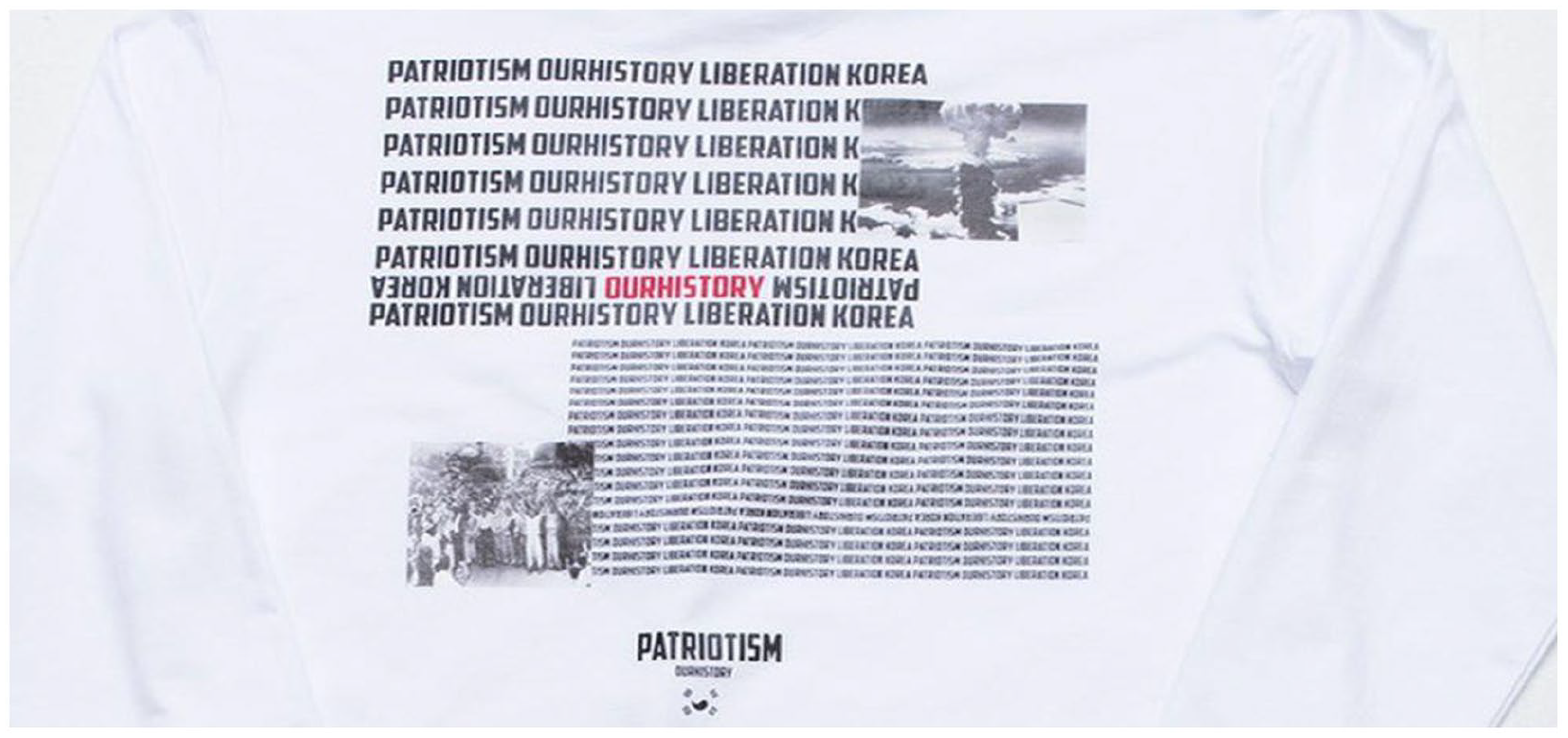
A screenshot sample of the shirt Jimin wore.
Both Japan and Korea are sensitive when it comes to the legacy of World War II. Korea was colonized by Japan from 1910 to 1945 and was liberated after the allies defeated Japan at the end of WWII. Millions of Koreans suffered under Japanese occupation and their treatment continues to impact relations between these two countries. Japan became the only country to have experienced a nuclear attack when the United States dropped atomic bombs on two Japanese cities, Hiroshima and Nagasaki, at the end of WWII (Wakatsuki & Kwon, 2018). Korea and Japan’s shared wartime memory remains a tremendously subtle issue in these two countries.
By nature, many Japanese reacted sensitively to Jimin’s T-shirt and criticized BTS on social media. One Japanese person tweeted, I can never accept the act that #BTS member wore the atomic bomb T-shirt humanely. The problem is not the relation between Japan and Korea. It’s just humanity. (8 November 2018)
A few days later, one another Japanese person indeed tweeted, One of members wore an Atomic Bomb’a t-shirt. As Japanese I will never forgive you. (10 November 2018)
As these tweets imply, some Japanese, including Japanese ARMY members, believed that BTS made a joke about the atomic bomb during WWII and supported TV Asahi’s decision. 3
In the midst of increasing criticism by several Japanese people, many ARMY members immediately reacted to protect BTS. A Twitter user and self-proclaimed ARMY tweeted as follows.
What’s happening with Japan is beyond our control right now. It’s unfortunate the boys won’t be able to perform on Music Station, but all we can do is support them by continuing to stream and buy their music and sending them our love and positive energy. (8 November 2018)
Another Twitter user also stated, And why did they questioning this issue at the same time with the current political situation between Japan and Korea? I love japan, although they had colonized my country too, past is the past, what we have to do now is be better than our predecessors, making the world better. (9 November 2018)
Defenders of BTS and, in particular, Jimin claimed that the T-shirt “was not disrespectful to the Japanese people,” as it was simply “a celebration of the defeat of the Japanese empire and the resulting independence of Korea” (Kelly, 2018). In the BTS National account at Twitter, one ARMY member still talked about it to defend Jimin’s T-shirt.
It’s about Jimin’s T-shirt, and I don’t support the atomic bomb itself, but without the two bombs, Japan wouldn’t surrender and we would still suffer. That T-shirt is a T-shirt to honor Korea’s liberation. (30 May 2020)
On Facebook, a BTS fan posted an interesting statement on the BTS Nation account to claim that, Japan, who nitpicked at BTS Jimin wearing the “Liberty T-shirt,” has rather informed the world of their invasion. Nowadays, overseas fans of BTS are continuously sending donation to the “Sharing House” to help the victims of the Japanese military comfort women. When Japan nitpicked abt the “Liberty T-shirt,” BTS’ overseas fans said through SNS, “Know the history of comfort women and war invasion correctly” and are encouraging donations ©sugafull27. (19 November 2018)
Jimin’s T-shirt was interpreted by many as unintentional, and in due course, ARMY supported BTS on social media, which showed their typical form of cyber-nationalism, in contrast to ethnic nationalism based on the sense of shared bloodline and ancestry (Shin, 2006). BTS fans’ online activities on this incident also occurred in other social media platforms.
More significantly, some ARMY members passionately worked together to develop a white paper project and published their own online white paper titled The Impact of a T-Shirt: BTS Meets Politics in a Digital World (2nd version) in December 2018. Once the Simon Wiesenthal Center (SWC, 2018) issued a statement, condemning Big Hit Entertainment and BTS for mocking the history, they started to work to publish this white paper only within 2 weeks. The working group members clearly stated their reasons as follows: we came together due to the frustrations that we shared: we were all frustrated by the online conversation surrounding the T-shirt incident, by the one-sided coverage from the international media, and by the statement released by the SWC. We wanted to show that there was more to the story than what was being reported. We wanted to show that the skewed reporting by the media and perceptions by some members of the public erased Koran experiences of history. We wanted to show that the SWC’s statement was problematic. We all wanted to do something. (White Paper Project, 2018, p. 4)
This fan activity proves that ARMY dedicated their time and energy to protect and/or support BTS in a very unusual level of fandom movement. As social-media-savvy young fans, they took the occurrence seriously. As Gellner (2006, p. 7) points out, banal nationalism can be formed when “two men are of the same nation if and only if they recognize each other as belonging in the same nation.” In the BTS sphere, there are also frequent remarks on belonging to online communities similar to belonging to a physical home-like space or a nation-state. The sense of togetherness is one of the most significant fundamentals of BTS communities, but not a physical nation-state (Lyan & Levkowitz, 2015). As Schneider (2018, p. 236) points out, “the need for community cohesion that nationalism relies upon indeed connects seamlessly with the kind of group dynamics that many digital technologies today promote,” and BTS fans utilize digital media to build their solidarity.
Social media posts between Japanese netizens and ARMY members show notably different perspectives. While Japanese netizens had a strong sense of distinctiveness based on national identity, and therefore based on the nation-state (Ching, 1998, cited in Han, 2015), ARMY’s defensive perspectives were not primarily based on Korean nationalism as the majority of fans tweeted and posted on social media were not Koreans. Regardless of their diverse national identity, ethnicity, and race, many fans vehemently defended BTS from Japanese critical points of view on the T-shirt controversy. As transnational fans, they actualized their cyber-nationalism tendency, not through defending a physical territorial nation-state, but for an imagined BTS nation. It is not necessarily patriotic; nevertheless, fans’ reactions certainly imply their pursuit of (imagined-)nationalistic online activities.
ARMY’s defense of BTS is not limited to East Asian affairs, as ARMY is active in participating in transnational affairs, which are not connected to Korea as a nation, but to BTS as an imagined nation-state in the globalized world. For example, one of the noticeable fan-nationalism occurred when Anne Hegerty, who is known on UK quiz show The Chase as “The Governess,” described BTS as “a little Korean boy band that’s fundamentally not important” on her Twitter in September 2020. She made the comments in response to a tweet from The Economist senior editor Anne McElvoy, who tweeted “Please no” in response to news that the group had spoken at the 75th UN General Assembly. McElvoy later apologized for her remarks, writing, “My earlier tweet about BTS was in jest and I’m sorry it was taken the wrong way. Apologies” (Chilton, 2020).
In this incident, ARMY was quick to defend BTS from Hegerty’s remarks on social media. One Twitter user said, Just because you don’t understand something doesn’t mean that it’s not important to someone else . . . in this case, millions of people across generations, cultures and genders worldwide. To dismiss them is to open yourself up to this type of scrutiny. (24 September 2020)
This tweet got 9200 likes and was re-tweeted as many as 1000 times. Replying to @anne_hegerty, one BTS fan tweeted as follows.
Little Korean boyband"? Excuse me? Some people are ALIVE because of those 7 boys. Those boys made a number of people happy and loved when no one else could. Those boys brought smiles on the faces of millions of people. Those boys gave people HOPE. They are more than just a ++. (24 September 2020)
ARMY’s protection of BTS in these crises is no accident. As Low (2019) points out, “BTS when translated to the English, language stands for Bulletproof Boy Scouts. Any boy scout would need a bulletproof vest, and the ARMY acts as that shield for them.” Originally, it meant that BTS protects and talks about the problems and worries of youth and young adults in their teens and 20s (Wickman, 2018). However, as these two exemplary incidents imply, ARMY has been one of the strongest in its fandom activities, and its protection of BTS in its imagined nation is one of the top priorities. BTS has been protected by dedicated transnational global fans. Cyber-nationalism, which is transnational in tandem with BTS and ARMY, connotates the identification process with Korean popular culture, and fans as BTS representatives or individuals consider BTS as the imagined and transnational sphere that they belong to and are associated with. The new transnational and imagined community “seeks self-affirmation across national borders and without geographic limits, as a deterritorialized nation in search of an inclusive (and exclusive) center around a constructed identity” (Kastoryano, 2007, p. 163).
ARMY citizens fulfill BTS’s messages
BTS fans’ activities in tandem with cyber-nationalism are not limited to defend the group under conflicting situations. BTS fans have rather advanced a new form of cyber-nationalism as they play a key role in systematically spreading BTS messages. As BTS has continued to develop its hopeful messages, which eventually lead to make the world better, many ARMY members regularly actualize their donation activities, while acting as faithful messengers of BTS music. It is well documented that BTS has created its global fame mainly because of its musicality embedded in lyrics alongside social media fandom (McLaren & Jin, 2020). As briefly noted, the name Bangtan Sonyeondan was deliberately chosen to represent the main goal of the group: to protect and to talk about the problems and worries of youth in their teens and 20s. As their musical background is hip-hop, their albums and songs have continuously attempted to participate in social issues. 4 For example, their debut single, No More Dream, talked about the problem of teens throwing away their futures and dreams for mindless studying. Likewise, their first three albums, making up the School Trilogy, continued on the same theme, as well as critiquing other aspects of society. There is no doubt that from the onset, BTS’s music has been centered around youth and social critique (Wickman, 2018).
Later, the development of the Love Yourself series took BTS beyond merely critiquing society and is their attempt at offering some solutions. The speech at the UN General Assembly in September 2018 came about a year after the group first launched their Love Myself campaign, a partnership with UNICEF’s End Violence program that raised over a million dollars through proceeds from album sales and other merchandise (Wickman, 2018). While identifying with BTS and their musical messages, ARMY has organized new projects and places to be donated to actualize BTS’s messages and values, as if BTS is the nation with which they work (J. Y. Lee, 2020). In other words, ARMY has already evolved as borderless identity, which cyber-nation would be part of, beyond a general fandom phenomenon. The majority of ARMY as social media users has created a newfangled form of fandom activism against social injustice in recent years.
Taking a very recent example, following the outbreak of protests in the United States in June 2020, sparked by the death of black man George Floyd due to brutal police actions, the Dallas Police Department asked people to share videos of “illegal activity protests” through the iWatch Dallas app. K-pop fans worldwide responded by inundating it with fan-made clips of idol performances, known as fancams, and memes of various K-pop artists, in an effort to prevent police from tracking protesters’ actions. Barely a day later, the app was reported to be experiencing technical difficulties (Reddy, 2020). When BTS and Big Hit Entertainment donated US$1 million to support the Black Lives Matter campaign, BTS fans decided to match it and did so in just over a day. The donation matching campaign came together on Twitter with the group’s fans coming up with the hashtag #MatchAMillion, which began trending internationally (H. J. Lee, 2020).
Immediately after the announcement, the fan group One In An Army (OIAA) organized its own fundraising drive and matched the amount in less than 24 hours (Reddy, 2020). At Twitter, OIAA Charity Project says “Like Artist, Like Fan. I am ONE in an ARMY. Together we can make a difference.” One fan states, “One In An ARMY is an account who handles fundraising for donations. They are the account who gathered 1 million dollars to match the $1 million that BTS donated for BLM,” which was tweeted on 15 November 2020, and therefore, ARMY members were able to donate money for this issue. As protests against police brutality erupted nationwide, online fandoms of BTS established a clear course of action: They would not use any of their normal promotional hashtags to boost their favorite music, instead focused on the message of BLM (Tiffany, 2020). ARMY members’ fundraising event indeed successfully influenced non-ARMY fans. One Twitter user said, A lot has been going on this year from the virus to these racial injustices. Being able to relate to the mental health topics that @BTS twt talks about is what got me into this fandom but I’m proud to see them and other army fight for #BLM and equality. (@ace_antagonist, 8 June 2020)
Another twitter user also tweeted below, Im not a #bts fan but..this was just wrong! Thank u to the #bts who stood for #BLM! @KanariKira (26 February 2021)
As such, many Twitter users who were not BTS fans also complimented what BTS and ARMY conducted, which means ARMY’s role as BTS messengers has been influential. BTS fans actively participate in a variety of political affairs and international conflicts, which are well supported by non-BTS fans too.
Over the past years, BTS has built a reputation as being one of the most socially conscious groups in the K-pop world. Their lyrics touch on significant subjects such as mental health, consumerism, and the education system. As BTS has been a part of society, the group has inspired ARMY to do good work, which eventually moved non-BTS fans as well (Low, 2019). Here, core ARMY members who lead a variety of socio-cultural activities show, A high level of media literacy and knowledge of political communication. The new generation of subcultural youth are digital natives, and their media literacy and political consciousness have developed out of the environment of mediatized politics, the global transmission of news, and omnipresent commercial messages. Through constant participation in media activities and mobilization, the group has gained considerable media literacy and media knowledge. (Wu et al., 2018, p. 43)
BTS fans’ activities are closely connected to the mediatization of politics. For digital natives, their main sources of information are from social media rather than the well-scripted and censored legacy media. By utilizing digital platforms, BTS fans not only defend BTS from conflicting socio-cultural situations but also promote BTS’s messages to fulfill their values regularly. BTS fans “fully believe in the boy band’s message of hope.” The ARMY has a saying, “You will find BTS when you need them the most” (Liu, 2020).
In a general nation-state, “membership in a society is an issue of social solidarity and cultural identity as well as legally constructed state citizenship” (Calhoun, 1999, p. 219); however, in the BTS sphere, members do not ask any kind of legal construction, but the cultural identity and social solidarity among themselves and between BTS and ARMY members. This means that the major tools used by BTS fans are their solidarity and loyalty to BTS, as well as their active and well-organized fandom activities. BTS fans form a strong fan-nationalism, although this does not mean that the entire ARMY members consider this kind of identity.
Critical interpretations of cyber-nationalism in the BTS sphere
The recent surfacing of social media-driven cyber-nationalism in tandem with BTS is much different from traditional nationalism and also from existing cyber-nationalism. To begin with, there is no doubt that the values inherent in BTS fandom have increasingly become the basis for political action. The traditional assumption in fandom studies is that “pop culture fans are usually apolitical and care nothing about nationalism and international relations” (Wu et al., 2018, p. 32). The K-pop industry is not different, as it has had a long history of avoiding commenting on political and social issues because they fear getting mired in politics may hurt business (H. J. Lee, 2020). ARMY figures out how they can best contribute to the BTS’s and fandom’s overall goals. BTS fans come from diverse backgrounds, and they are “encouraged to be as engaged as possible, and to participate in fan projects and campaigns” (Madden, 2020), which makes BTS fandom culturally political.
Their political activities are also notably different. As Fuchs (2020, p. 248) argues, “social media’s anonymity, high speed, superficiality, personalization, individualization, interactivity, attention economy, structures of reputation accumulation, and its networked and multimedia character support the spreading of far-right [nationalist] ideology online.” Fuchs (2020, p. 5) contends, “nationalism ideologically constructs a collective cultural and political identity” by referring to our country or our homeland. Right-wing ideology understands the nation as a cultural and/or biological community that it presents as a people. On the contrary, BTS fans’ cyber-national activities are not about right-wing movements. BTS fans’ recent activities related to various socio-political issues are political, not as right-wing nationalists, but as rather informed citizens who contemplate their roles in enhancing our society. Although there are several other fandoms that are politically engaged, this kind of cyber political activities in tandem with a particular fandom is new in the sense of a politically engaged BTS fandom is how high-profile ARMY’s digital prowess is.
Meanwhile, it is critical to understand that one of the most significant perspectives about cyber-nationalism in the BTS phenomenon is transnationality. Fueled by the increasing popularity of BTS since the mid-2000s, fans have arguably replaced ethnic Koreans in performing nationalism in cyberspace beyond Korea’s borders. Cyber-nationalism is supposed to be performed and encouraged by national representatives; however, as an unintended consequence of BTS fandom, such nationalism enables non-Korean BTS fans to act as promoters—albeit not patriots—of BTS nation, perhaps as part of the imagined Korean nation (Lyan, 2019). As Wu et al. (2018) aptly put it, this imagined nation-state is transnational: Compared to the earlier generations of educated youth, post-’80s military fans, and other male- dominated “informed nationalists,” the post- ’90s generation are fans of pop culture, are more diversified in gender composition, and the formation and articulation of their nationalist emotions are directly related to the new transnational commercial culture and global mobility. (p. 41)
The BTS nation is not what people have understood and advanced as there is no ethnic homogeneity among members. As Han (2015, p. 14) argues, when Korean popular culture reaches international audiences, Koreans are part of a globalized environment, but “whether or not their media content and interactions with others become globalized remains to be seen.” ARMY’s imagination and creation of the BTS sphere—not emphasizing ethnic nationality, nor diasporic Koreans—show that they have not been driven by traditional nationalistic motives; instead, they consider BTS as their imagined transnational nation-state. As Allahar (2004, p. 106) points out, “ethnic nationalism is to be found in situation where a discrete ethnic group lays claim to a national identity and patrimony that separates it from other groups, ethnic or non-ethnic, and has in mind a clear territorial base.” Nationalism in many countries has “such a meaning of which the sense of rising national consciousness, cultivating national identity, and stressing national culture and history” (Ju, 2007, pp. 10–11); however, in the case of the BTS fandom, fans as loyal citizens to BTS have advanced their belonging to the imagined transnational nation by participating in online and offline fandom activities.
In fact, some sizable number of fans acts as if they are part of a particular transnational, imagined nation-state. “Fans are empowered enough to not only stand alongside their idols—the result of several historical and technological changes—but even guide them, enacting change from a bottom-up, participatory stance” (Madden, 2020). As Woods (2016, p. 1) points out, “if political nationalism is focused on the achievement of political autonomy, cultural nationalism is focused on the cultivation of a nation. Here the vision of the nation is not a political organization, but a moral community,” and the BTS nation as an imagined nation-state certainly symbolizes the construction of a moral community, not emphasizing a political identity, but a cultural community through their transnational-cultural political activities.
The primary roles of BTS fans are not limited to protect BTS from all kinds of critiques, but are extended to promote BTS’s spirit and value, which make their transnational cyber activities unique. Their (trans-)nationalist activities are systematic, and through their participation in well-organized fan activities, they actualize their patriotic belonging to BTS and the nation. BTS fans are loyal to the group, and many fans form impressive online fandom activities, comprising cyber-nationalism. As Fuchs (2020, p. 5) argues, “in the age of digital capitalism, nationalist ideology is frequently communicated over social media platforms such as Facebook, Twitter, or YouTube.” In the imagined, transnational BTS sphere, global BTS fans have developed more active and direct participation in socio-political movements over the past decade, and their activities are highly visible due to the increasing role of social media and streaming services in popular culture consumption (Jin, 2021). The most common elitist interpretation framework used to employ “such labels as irrational and maniac with the image of Cyber Boxers to describe young netizens as a digital age group that uses emotional persuasiveness at the expense of reason” (Shi, 2016, cited in Wu et al., 2018, p. 32; Zou, 2019). Unlike these observations, BTS fans are not irrational, nor emotional, but logical and strategical. They are not a simple mass, but educated and informed citizens who are patriotic and motivated from cultural and political perspectives. These fans are critical of social injustice and inequality characterizing late capitalism.
In many incidents, “cyber- nationalism aims to gather netizens together by establishing a unified target and a certain enemy” (Wang, 2018, p. 57). For BTS fans, however, others are also an integral part of everyday life for global fans who enjoy K-pop and commute with themselves. Popular culture, in particular K-pop, represents contemporary global youth to a significant degree. For ARMY, it is not desirable to develop nationalistic sentiments or feelings as can be seen in banal nationalism. BTS is an imagined nation that they protect to build their belonging and comfortableness, while extenuating BTS’s messages to make a better world. Cyber-nationalism in the BTS context has no specific counterpart, nor targeting any nation-state.
BTS fans are not always united, of course, and fans themselves fight against each other in some affairs, as in the case of the physical nation-state due to different opinions. However, if others provoke BTS, the majority of BTS fans work together to oppose these potential enemies to BTS. In a normal situation, they work together to fight against global injustice, social inequality, while promoting hope to make a better society that they want to belong to.
Conclusion
This article has discussed cyber-nationalism in tandem with the transnationalization of K-pop, in particular BTS. This article examined the formation of transnational cyber-nationalism based on the soaring popularity of BTS driven in part by their fanbase. It also discussed how transnational cyber-nationalism shifts the notion of cyber-nationalism, which can be identified as negative, even patriotic parochialism into constructive and socio-culturally desirable fandom activities utilizing digital technologies.
In the early 21st century, BTS has become a global icon in the popular music scene. The boy band has entered the global music market and continued to enhance its global fandom based on the increasing number of ARMY. ARMY’s role has expanded, from increasing its voting power in the music awards to protecting BTS from controversies to spreading the group’s messages, as many fans play as if they are citizens in the BTS sphere. Mobilizing, organizing, and fundraising within the BTS community—particularly from ARMY—is no new feat (Madden, 2020); however, BTS fans’ cyber-nationalism activities on social media are unique as fans’ loyalty to BTS, and their nation are transnational and imagined.
BTS fandom shows how socially conscious and politically outspoken fans nudge the K-pop world to become more political, especially as K-pop aims to become part of the global music world. The current moment, therefore, is one of reckoning for K-pop entertainment houses, where “the narrow nationalism of its apoliticism appears at great odds with its American K-pop fans’ demand for political and social change” (H. J. Lee, 2020). BTS fans have developed “neither a ‘narrow nationalism’ nor a ‘thorough self-hate’, but accumulate more mature, active, and multiple abilities of participation” (Wu et al., 2018, p. 47).
In sum, BTS fandom has advanced a new form of fan-nationalism/cyber-nationalism in the digital platform era. By massively utilizing digital platforms and enthusiastically engaging with various socio-cultural activities, BTS fans have greatly shifted the notion of cyber-nationalism. As many fans consider BTS as the imagined national sphere with which transnational fans identify, it addressed how BTS fans utilize cyberspace to not only form alliances and belongs but also protect BTS from any critical points of view.