




Abstract

A crisis of the imagination: What is in store for our planetary future?
What if I told you that your imagination could solve climate change? Climate change is often described, across disciplines, as a crisis of the imagination. The psychology of climate change suggests that the reasons for our inability to address climate change are threefold. First, the sheer magnitude of the problem is difficult to grasp. Second, the problem of climate change is nonlinear, it starts out slow and then occurs more and more frequently making it initially difficult to see. Third, in the balancing of short-term gains versus long-term consequences, short-term gains often win out. Amitav Ghosh believes that our inability to mobilize around climate change shows that we, as a society, are deranged. C. Wright Mills’ coined the term the sociological imagination: connecting our personal troubles to public issues by imagining the link between the two. When it comes to climate change, even within the realms of academia, literature, history, and politics, our collective sociological imagination has failed to make the connection between individual and public climate change concerns. Which begs the question, are we still deranged in this manner today?
Geoff Mann and Joel Wainwright hope not. In Climate Leviathan: A Political Theory of Our Planetary Future (2018), Mann and Wainwright offer a first attempt at regaining our collective sanity and imagining what could be in store for our planetary future. The book employs various key historical and political thinkers spanning from Keynes to Gramsci, Marx to Naomi Klein. The authors admit that many of the ideas they put forth are not new, but rather reorganized and recast in a contemporary light. They propose a 2 × 2 theoretical model with four potential global responses to climate change based off of two variables: the world’s economic structure (capitalist or non-capitalist) and the distribution of world power (planetary sovereignty or anti-planetary sovereignty) (Table 1). Mann and Wainwright’s theory boils down to imagining future power structures that counter existing ones. They match these visions with illustrative examples of major world events to guide our imagination and place each theory in reality.
The 2x2 model of possible planetary frutures proposed by Mann and Wainright (p. 28).
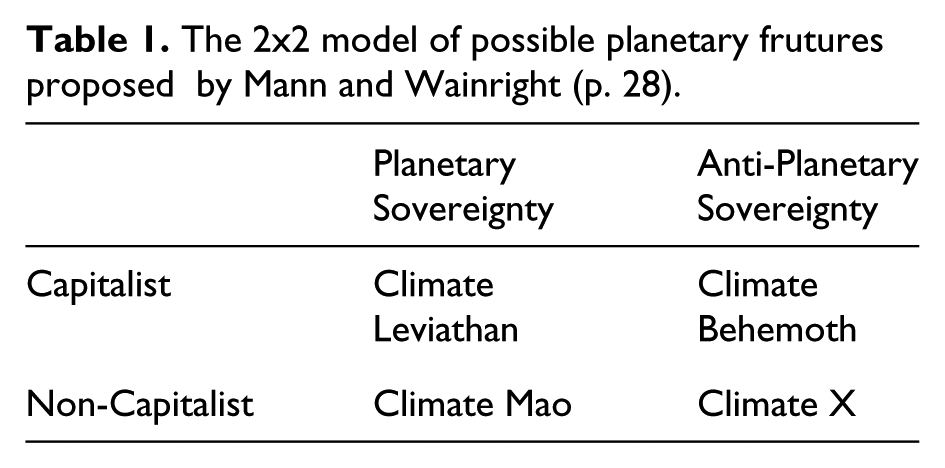
The authors believe that the most likely pathway of the future is, Climate Leviathan. Leviathan is very close to the status quo, a vision of capitalists in the United States and China making political and economic decisions for the world. The name of this option is in reference to Thomas Hobbes and his Leviathan. The Leviathan, according to Hobbes, is transformed from a biblical sea monster to the “‘Multitude united in one person’ to form the ‘common-wealth’” (p. 3). Climate Leviathan looks sort of like the climate accords, a display of hegemony under the guise of solving climate change. If Leviathan is the future, the inequalities that we have seen produced by climate change thusfar will be endlessly reproduced. Climate change will create an eco-apartheid where the rich protect themselves as the poor die off in increasing numbers. This might look like what we saw in the 2018 Wildfires in California: where Kim Kardashian hired private firefighters to protect her neighborhood while coerced prisoners paid US$1 an hour fought the same fire for the public just a few miles away. We will see the complete commodification of resilience. But if Climate Leviathan or business as usual seems unappealing, then there are three other distinct possibilities to evaluate: Climate Mao, Climate Behemoth, and Climate X.
Climate Mao keeps planetary sovereignty in a non-capitalist world, in this scenario we can picture a Maoist dictator gaining power from advocating against capitalism, but maintaining the world order. Like Leviathan, we will only hear the voice of one. The state will determine who can emit carbon, who can use what resources, and how waste will be regulated. “Climate Mao reflects the demand for rapid, revolutionary, state-led transformation today” (p. 39). The authors named this future after Mao because they believe that this possibility can only happen with Asian hegemony, suggesting that the revolutionary shift away from capitalism would occur in the geographic belt: between Pakistan and North Korea. The authors zoomed in on this region because of the geographical unevenness of risk for the negative effects of climate change in the region paired with the pockets of revolutionary ideals and hegemonic defiance that have historically existed there. Both Climate Leviathan and Climate Mao will have top-down adaptation strategies, and the difference is in who has the power to make this change and what the economic structures that will fund these changes will look like.
Climate Behemoth is the reverse of Climate Mao: capitalism remains but we see a complete tilt in the balance of world power taking either the form of “reactionary populism” or “revolutionary anti-state democracy” (p. 44). In both forms, Behemoth is of the masses. The authors contend that populist Behemoth is “Leviathan’s greatest threat” (p.30), arguing that this scenario may have already materialized in some contexts. Climate “Behemoth hates Mao for its faith in secular revolution, Leviathan for its liberal pretension to rational world government, and both for their willingness to sacrifice ‘liberty’ for lower carbon emissions” (p. 46). In the age of Trump, Modi, Bolsonaro, and Brexit, it is not hard to see what the authors predict: that as climate changes: the world will grow more fascist.
Finally, this brings us to Climate X, the least imaginable and most utopian possibility. Climate X is the least grounded in our status quo, which is its charm. Climate X builds on the second vision of a revolutionary anti-state democracy Climate Behemoth, but the key difference is that the movements that are confronting climate change will also confront capitalism. Since both capitalism and climate change perpetuate the same inequalities, Climate X determines that a future that confronts climate change will also confront capitalism. The face of this struggle would be the people most oppressed in existing society—people of color, women, incarcerated people, indigenous people, and working people. Climate X is a society where people who face inequality unite to combat separate inequalities through climate change. Climate X is the biggest challenge to our imaginations, but arguably can reap the highest reward by disrupting the current systems that promote and reproduce vast inequalities in today’s society.
My largest critique of the theoretical frame that Mann and Wainwright put forward is that they under develop the other possibility within Climate Behemoth, which they coin a “revolutionary anti-state democracy.” The left wing populism is one of the more optimistic of the possibilities. To me, this vision looks a lot like ideas proposed by Naomi Klein and Bill McKibben, where the People’s Climate Movement creates bottom up change within the confines of a capitalist democracy. The left wing populist Climate Behemoth looks a lot like a Green New Deal, abolishing ICE, ending mass incarceration, low carbon public housing, and electing more Alexandria Ocasio-Cortezs, Rashida Talibs, Ayanna Pressleys, and Ilhan Omars.
One of the highlights of the book is the clear articulation of their underlying assumptions. The most controversial of which are: first that though rapid climate change is not unstoppable, there are a plethora of political and economic reasons that it will not be stopped and second, that the elite transnational groups that comprise the existing hegemonic power acknowledge that climate change poses a direct and indirect threat to their power and desire to moderate and adapt to climate change as a way to stabilize their power and privilege. This serves as a guidepost for taking parts of the theory to task or building upon it. Within these assumptions is the core idea that the world is governed solely by the world’s economic structure and distribution of world power. There are more ways to stratify the world than just politically or economically and many more models of the future that can be built. Future theories can ideally be imaginative about what these variables are, and in turn open the possibilities beyond Climate X to Climate Y and Z as well, each becoming harder to imagine from our current deranged position which is perhaps exactly what we need. The historically and philosophically based framework is a welcome addition to the undertheorized world of climate change. Although theorizing around climate change has a long way to go, navigating through Climate Leviathan, Mao, Behemoth, and X helps the reader broaden their imagination of what the world can and might look like.