



Abstract
With the rapid development of digital visualization technologies, the visual value of cultural heritage is increasingly important, giving rise to new ways to interpret the true worth of heritage. Taking the case of geomedia as an example, the article aims to reflect on how the visual culture in historic conservation has been changed by way of exploring the new significance of cultural heritage and its historic conservation in the light of geomedia. Based on my fieldtrip study of the historic conservation of the Old City in Shantou, southeastern China, I claim that historic conservation of the Old City, assisted by visual activism from the ground up, reveals its close relation to geographical sites through digital knowhow of geomedia. The interaction between image pixels and physical space contributes to the process of continuous creation and recreation of the heritage sites experienced by viewers/visitors; they are sensorially enticed to blend multiple interpretations into their physical experience in real time and construct multivalent situations for their embodied encounter. These heritage sites, once saturated with location-based visual enactment, help perform an effective role as a connective node to integrate different temporal periods as well as different groups of actors in their drive to better the city’s future.
Introduction
The visual value of cultural heritage is of great significance in heritage studies and conservation practice. Both aesthetic quality and visual integrity are taken into account when assessing the value of the heritage (Jokilehto, 2008), and its visual performance is usually considered to promote it as a tourist destination (Almaiyah & Elkadi, 2012). In China, the public attention to historic conservation was aroused with the development of cultural industries and tourism in the 21st century (Y. Ruan, 2005). Before that, modern buildings in uniform style have been built in cities in the process of urbanizing construction since 1980s, replacing most historical ones that are full of regional characteristics. The few historical districts that survived, then, became the visual displays of the local history and culture. People are accustomed to appreciating these districts through their visual styles and understanding the cultural heritage by means of seeing or gazing as tourists (Urry, 2002).
Seeing, as stated by Mirzoeff (2016, p. 3), is a sensory feedback from the whole body rather than just the eyes. The way of seeing changes alongside with the changes of media technology and matters on the way we understand the world. The contemporary visual culture—the way we see the world—in the digital social media context has transformed into a form of practice to change, rather than perceive or understand, the world, which is called “Visual Activism” by Mirzoeff (2016). In this context, cultural heritage is now facing a sort of “visual turn” (Brusaporci, 2018), as the digital sphere renews people’s relationship with images. New ways to interpret the true worth of heritage is developed, as heritage is now regarded as “social production” in the present “participatory culture” (Giaccardi & Palen, 2008; Silberman & Purser, 2012), and historic conservation has become a grass-rooted process of meaning contest and heterotopias construction (Z. Xia, 2016) to change the world.
The emerging geomedia (McQuire, 2016) introduce the perspective of mobility and geographical location into media and communication technology and lead to great changes on people’s lifestyle when smart phones and other embedded technology become part of our everyday life (W. Sun, 2015). Taking the recent technology development into account, the questions concerning about the changing visual culture of heritage is raised in my paper, as to study on the way we see heritage and its historic conservation with the continuous changes of technology. The historic conservation activities of the Old City of Shantou (汕头), southeastern China, are studied.
The essay is structured as follows. After a brief introduction about my fieldtrip involved in my study, the next section will describe the overall trend of the historic conservation activities of the Old City. In this section, I will highlight that citizens participated via visual actions and made changes against the governmental projects. In section of “Heritage in place-making”, I will examine how the district changed by the location-based visual activism in the geomedia era, stressing the continuous construction and alternation of the heritage place. In the conclusion, I will discuss the role of heritage in the culture of visual activism at the age of geomedia.
Shantou is a regional city of eastern Guangdong Province (广东省), southeastern China. It has been a global trading port since 1860 and flourished due to trade and commerce, contributed by the local residents, foreign immigrants and overseas Chinese. The former urban center, usually called Xiaogongyuan Historic Quarters (小公园历史街区) or the Old City, was first constructed in 1920s and famous for its visual arts, such as the arcade architectures with Chinese and Western decoration (Figure 1). While the governmental projects of renewal were punctuated by suspension in 2004 and the re-start in 2016, diverse groups, including residents, academics, local non-government organizations (NGOs), overseas Chinese, and so on, have taken actions for its conservation and revitalization. Detailed data of these activities were collected in this research by means of participatory observation in several local groups themed on the conservation of the site. I joined their discussions on social media including Weibo (微博) and Wechat groups (微信群), and participated in some of their public activities from the planning to conducting, including workshops, exhibitions, group outings, and so on. I also had some informal interviews with some relevant persons during the activities. Historical documents and reports on local media are used as secondary data.
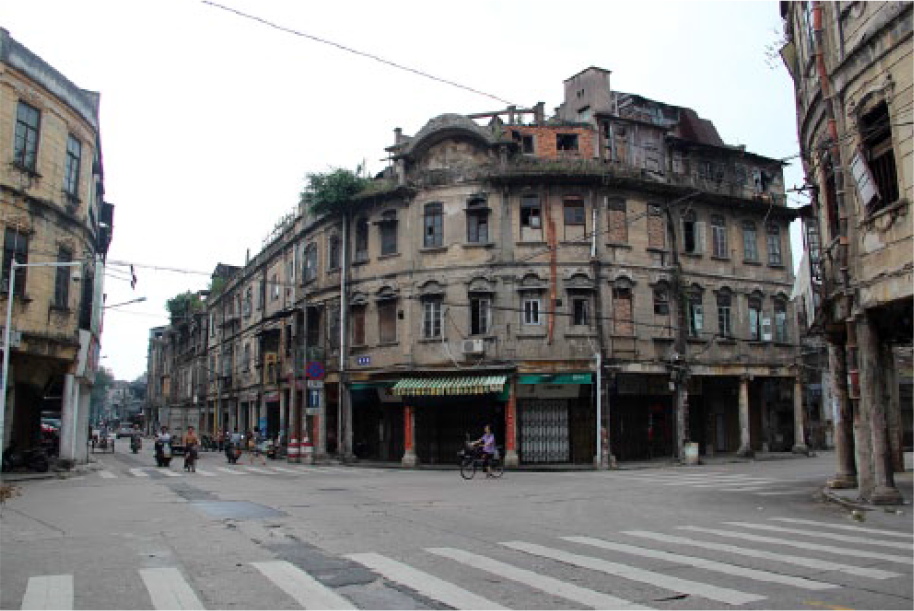
Street view in the Old City of Shantou, 2012.
Historic conservation as visual activism
The Old City of Shantou has faced a crisis since the 1980s. During the period, Shantou, similar to other cities in China, has witnessed a great change of urban construction, since it became one of the Special Economic Zones (经济特区) in the Reform and Opening Up. The city expanded eastward dramatically and many citizens who lived in the crowded old city moved to the new urban districts. Their former housing, long-aged buildings in the old city with delicate and abundant decorations, were gradually empty and out of repair. Some parts of them were demolished and reconstructed into modern apartments with eight floors in 1990s, to remove the dangers of the old buildings and offer more accommodation to the citizens. In 2004, the renewal project of the central part of the Old City started formally, aiming at changing it into a commercial area. However, the project was suspended half a year later due to financial difficulties. The area where old buildings has been torn down remains to be ruins overgrown with grass and cluttered with trash till now, while the buildings that survived continued aging without systematic reparation until the end of 2016.
Historic conservation of the Old City began almost at the same time with the crisis. Several photographers, both professional and amateur, started to take photos of the old buildings in late 1980s. Most of them showed great interest in both architecture and photography, trying to record the beautiful buildings by images before they were destroyed, and to inform more people about their value. Taking pictures became an important way to show citizens’ consideration.
Cai Haisong (蔡海松) is one of the photographers. He lived in the Old City since his birth and started to take photos there in 1989, when he learned the demolition of some architectures. Cai persisted in taking photographs in his spare time for nearly 30 years, as to race against time while the buildings were disappearing, and created lots of rare documentation of the disappeared architectures. Most of Cai’s photos (Figure 2) look serious and objective, just like the professional documentations of the built environment without any individual emotion. However, his appreciation and sympathy of the Old City shine through the thousands of photos. He tries to record the beauty and characters of the buildings and to conserve the history of the city and oppose the governmental process of replacing them with fashionable tall buildings. Meanwhile, the everyday life of the residents, often suffering from chaos, poverty, and bad environment, are usually omitted in his photos. When he tries to record and conserve the original or the “authentic” appearance of the landscapes, buildings and decorations by images, he, in fact, creates a purified image of the Old City with the perspective of his camera as well.
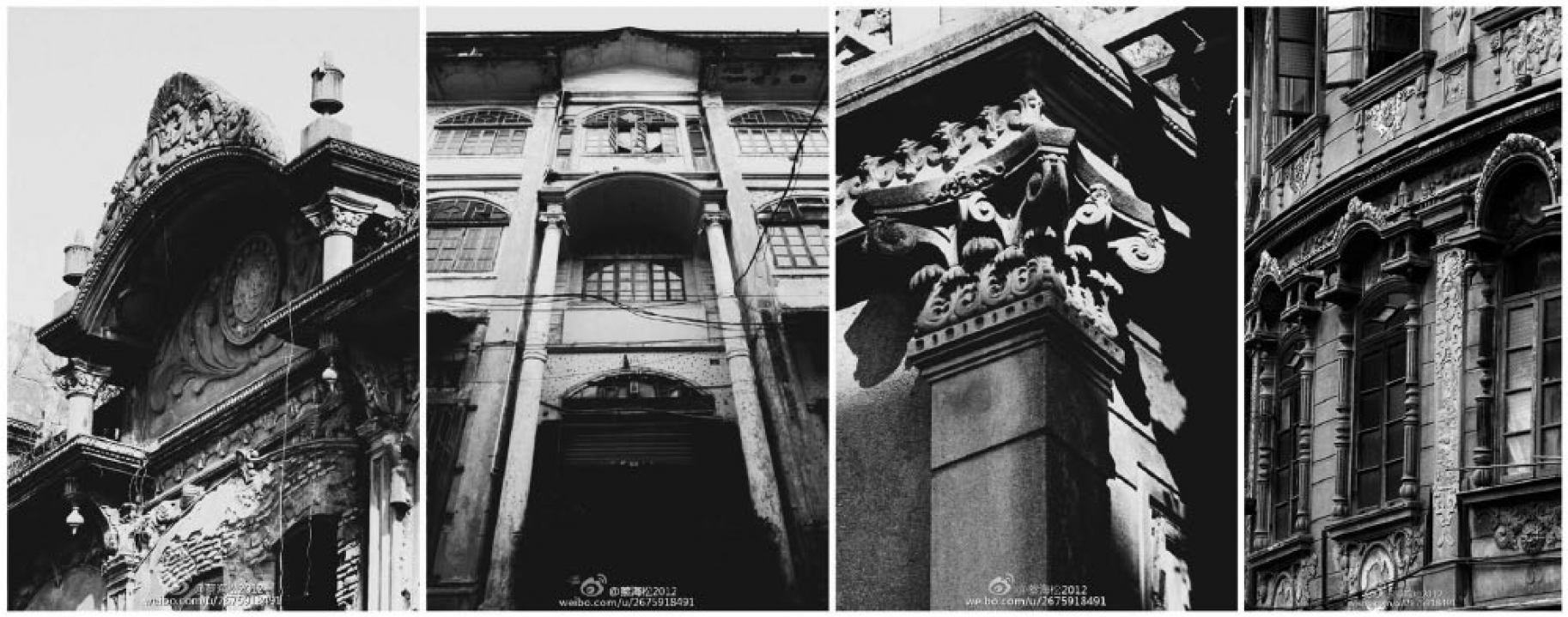
Photographing works of Cai Haisong, provided by Cai.
At that time, most public voices that could be heard came from the government and mass media. Most positions on the first several pages of the newspapers went to the rapid development of the new city, but photographers like Cai were often invited to post their works of the decaying Old City on the last pages of the newspapers where there were columns of culture. Together with the photos, some articles about the region written by some local historians were published as well. Local television also completed some documentaries about the district nearly 10 years ago, to promote the old streets and their history narrated by historians. Thus, the Old City obtained its high visibility in public when it was continuously exposed in the press. Its historical and aesthetic values were highlighted both in printing and video media, despite the indifferent attitude of the local government.
The recent decade has seen the widespread usage of the Internet and digital cameras. Pictures and stories of the Old City were posted on the local BBS and other social websites and were read and discussed by the young netizens most born in 1980s. Several online communities were founded to pay close attention to the district. They shared their discoveries about the local history and recent news, discussed the historic conservation in the online public space, and also hung out frequently in the district to take photos and to explore more stories and places of interest which were not known by most citizens. Most of these young people moved to new accommodations outside the Old City in their childhood, and the Old City seemed to be a mysterious place for them, as they heard some stories from the elder generations who once lived there. They, like “flaneurs” mentioned by Benjamin (1972/2002), hung out and walked along the old streets without a fixed destination. The typical 60-ft-wide streets with arcades, similar to the wide boulevards of Paris after the Haussmann’s renovation to demotivate wandering, instead offered wonderful places for walking and gazing in the Old City with both abundant architectural decoration and diverse urban life. The narrow streets behind the arcade buildings, not as crowded as they were in 1980s, were also some places of interest where people could be fortunate enough to find some marks of the past, such as boundary markers at the street corner, or a black wall which showed there could be a temple in the past where people lightened incenses and burned joss paper.
It is quite common for the “flaneurs” to share photos on the social websites after their hanging out. With digital cameras, they could snapshots of any scene they like, without having to worry about the limitation of shooting times. It is also much more convenient for them to post digital photos onto the Internet. Different from the serious documentation of the photographer Cai, photos of the netizens showed more special perspectives and personal opinions. Dilapidated houses, building facades covered with trees, elderly people sitting aside the passages, children running and playing were some typical elements on the online images of the Old City, showing its half-destroyed condition but peaceful everyday life there. Accompanied with the images was some interpretation concerned about nostalgia and homesick, telling stories of their childhood and families, expressing their sympathy on the decaying area, and even calling for more people to pay attention to and visit it. These topics continued in the “comment” segments of online posts, where more netizens participated in discussion and sharing. Among the comments, some people shared more similar experiences in the Old City and invited others to join some activities of hanging out and taking photos, while some people claimed that something should be done to stop damaging the Old City and to protect the cultural heritage.
Some collective activities of photo-taking were held for specific purposes occasionally. The typical examples were the series of activities called “Prosperity of the Yesterday” (昨日繁华). One asked participants to take pictures of a person holding the printed old advertisement in front of several department stores in the area related to the ad, comparing the different conditions in different periods of time. Another is to take photos of the postcards published in 1930s at the locations they originally took, trying to make a collage with the present landscape and the former one. By emphasizing on the current bad circumstance, the pictures, as products of the activities, tried to raise the voice of historic conservation to prevent the governmental removing process (Figure 3).
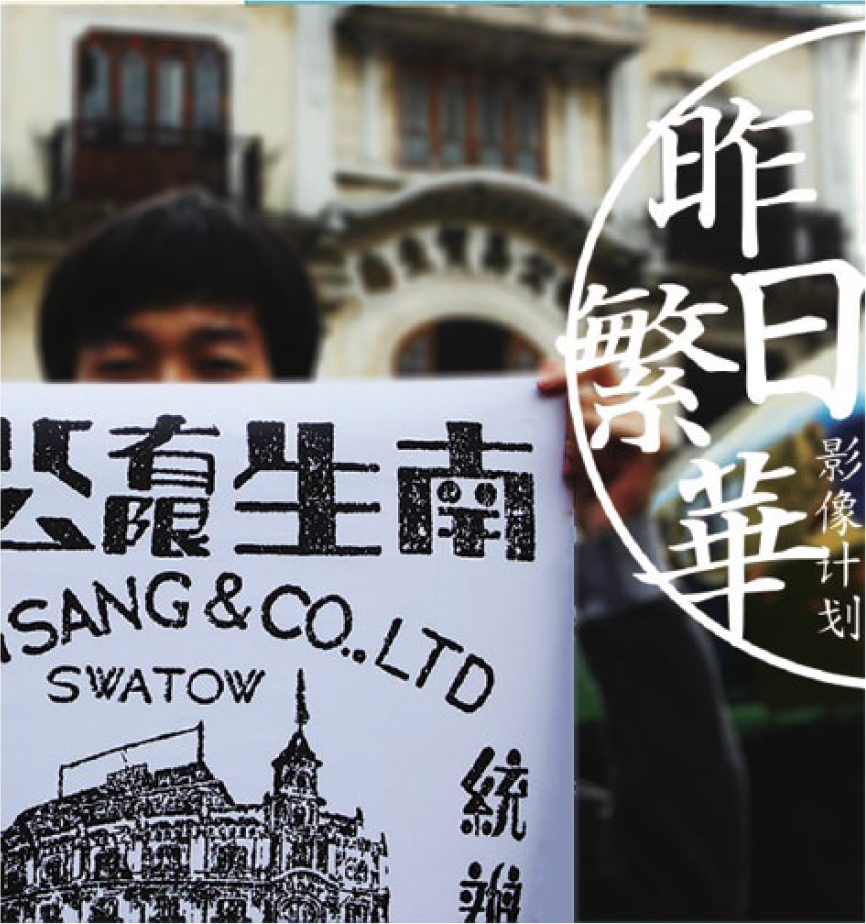
Poster of the Prosperity of the Yesterday from social website Douban (豆瓣网).
Most photos on the Internet showed the feelings of the photo-takers much more straightforward and personally. They never claim to be objective enough to record the old district professionally, but to memorize something that matters as well as to express and share their own opinions by creating their own images about the district. They, as ordinary citizens, got involved in the activities by hanging out physically and later posting photos online, to show their individual narratives in the participatory culture (Giaccardi, 2012) of social media. In this case, historic conservation was beyond the documentation of the material heritage buildings but to present memory and emotions via personal photographing and communicating devices and to call for attention on the protection of the district in the way of visual photos. As mentioned by Giaccardi (2012, p. 1), images online became the new frontier of cultural heritage practice, sharing personal experiences and views on the old buildings, unfolding the heritage’s social values of saving collective memory, and even intervening into the processes of urban construction. The visual activities made changes on the historic district via practice as “visual activism” (Mirzoeff, 2016, p. 77). Photos online and relevant practice of the Old City were in fact the social expressions of citizens, to realize the present miserable situation of the district, and to alter it by arousing more sympathy, preventing the governmental project of removal and calling for more measures of conservation and reactivation. The social interpretation of the visual actions worked as sort of indirect resistance against the government’s indifferent attitude and projects, to appeal for changing the decaying situation and raise the alternative voice of the public from the ground up, especially that of those who have moved out.
As shown above, historic conservation activities in the Old City of Shantou have been conducted in a way of visual activism. Citizens took actions to record their personal memories and to share their personal narratives with images, aiming at changing the historic site and bringing it into a well-protected situation. The emerging mobile smart phone and other types of geomedia technology embedded in everyday life now manifests its extra characteristics of ubiquity and location-awareness and enables more people to participate into photographing and posting anywhere and at any time, encouraging more types of heritage practice. The interaction between pixels and actions (Mirzoeff, 2016, p. 77)—visual activism—shows its close relation to geographical sites, and I try to define it as location-based visual activism. In the next section, I will examine how the Old City has been changed in this geomedia era.
Heritage in place-making
The central aim of historic conservation is not to retain the heritage in its original style and function but to sustain the old buildings’ life amid the contemporary society. As nongovernmental activities of civil groups, historic conservation of the Old City in Shantou focuses more on the presentation of its aesthetic, historical, and cultural significance, in ways of online shows and on-site exhibitions, rather than the practical maintenance and renovation of the architecture. However, presentation means not only to show what exists in geographical space in image pixels but also to change and create something. Different elements, like actions, images, media technology, physical spaces, interpretations, and social relations, gather together as a constellation in the location-based visual activism, and according to Massey’s (2005) definition of “place,” lead to the creation and recreation of a place. Heritage can be understood as a place of continuous relational construction and as a living practice contributing to the social production (Giaccardi & Palen, 2008) of shared values. In the case of Shantou, the Old City is experiencing the place-making with the activities, and some details of the change and construction will be discussed as follows.
Blending multiple interpretations into physical experience
Geographical location plays an important role in visual activism in the current geomedia era. For one thing, large amounts of images are now taken by ordinary citizens and posted online. They spread worldwide in the real time, as people are connected to the global network continuously via ubiquitous media devices. For another thing, more images of the Old City, together with advanced technology, are introduced into the physical site. Local residents are encouraged to be involved in the visual presentation and speak out their own views, as more of them are accessed to Internet. The interaction of image pixels and physical space leads to the reactivation of the old buildings and the construction of a new place with dynamic actions and multiple layers of interpretations.
The activities held by a local nongovernmental group for cultural conservation, called Swazui Association (汕头山水社), can be taken as examples. The group was built up by several undergraduate students on the social media and began to conduct their fieldwork research in the Old City since 2013, the time when smart phones started gaining its popularity. Some of the members recorded the residents’ family histories and ideas of the Old City, while the others did some mapping of the architectures to archive the building layouts. Several exhibitions based on their field study were held in the district, as to attract more attention of local residents. In these exhibitions, the architectures and everyday culture of the Old City were presented in the forms of text, photos, illustrations, scale-down models, and so on.
One exhibition called The Records of Siyong Block (四永志) in 2015 introduced the visual elements into an on-the-spot venue in the district and provided the local residents with multiple points of view of the block, which were inaccessible to them in the past. On display, there were both printed photos about the past, collected from the online database, and those about the present, taken by the Association members during the research. The former landscapes, shown by the old photos, were somehow strange to the visiting residents as they seldom viewed the place of the past in pictures. The recent everyday moments, shown by the contemporary photos, were too habitual to be realized by the residents in their daily life. The unfamiliarity of these photos thus incited lots of interest. A 1/50 scale-down three-dimensional (3D) model of the block was also introduced to offer the visitors a top-down overall view, which was also different from their normal view. In this way, the visual exhibition, as media presenting diversified points of views, was approachable to the residents and brought them to diverse ways to see the local district, leading to more personal recollection of their former experiences and more reflection on the physical environment and everyday life.
Besides that, ordinary inhabitants living in the block were encouraged to express themselves, and their stories and ideas, which were often ignored before as most mass media focused on public buildings and celebrities, were shown on the exhibition. These stories and ideas were collected from the local residents and were transformed into several visual forms for the public. A map of the block, in the form of collages on the basis of the bottom map produced by Computer Aided Design software, was on exhibition (Figure 4), and some points of facilities and landmarks in the block were marked on it, including outdoor seats, small temples, streetlights, and so on. Relevant pictures were stuck on the map to show the appearance of the facilities at the site. The residents’ daily routines, their relations with the neighbors, and their opinions of the district were also presented in the illustrations on the map created by the computer-generated images technology. Most of these stories were common and a bit trivial, but it did reflect the residents’ diverse perceptions and interpretations of the district. By means of visual exhibits of daily stories, the inhabitants and the everyday culture could be seen by the public, and possibly, both could be interacted with voices and culture from the outside. Pluralistic local knowledge of the historic district would then be recreated, when the aspects of ordinary residents and native everyday life were paid attention to and involved in the physical experience of the Old City.
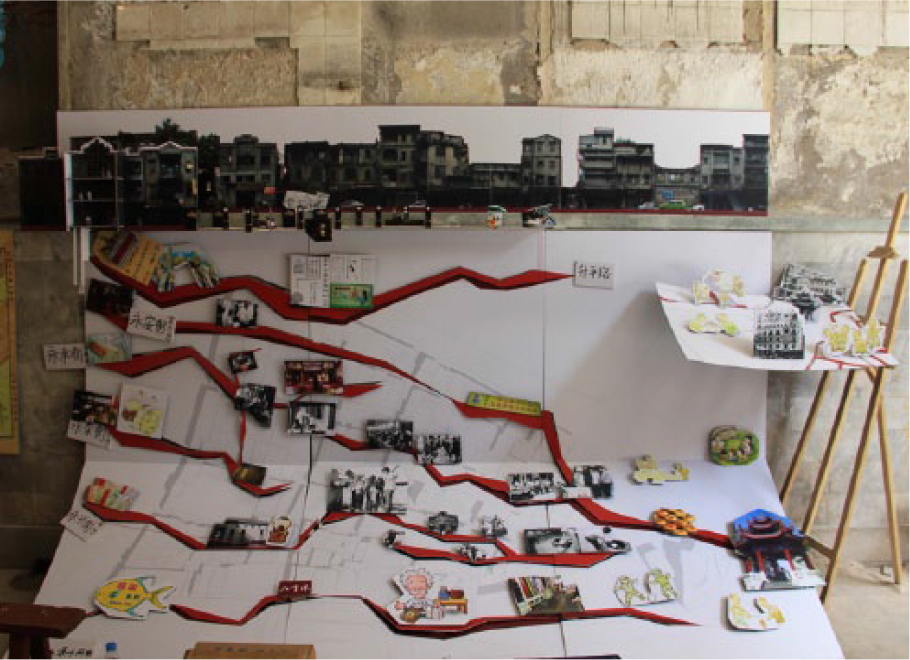
The exhibit of The Records of Siyong Block, provided by Swazui Association.
The venue also played an important role in the exhibition as it was an attraction itself. The venue was the first floor of the Shantou Building (汕头大厦), the tallest building in the city in 1930s and one of the most famous hotels before it was closed 30 years ago. When the building was re-opened for the exhibition temporarily, many people were excited to pay a visit, though it was still in the situation of disrepair and absence of any advanced facilities. Some remaining inner design, such as an octagonal atrium in the middle and a well-decorated wooden check-in counter, became part of the exhibition, accompanying with all the exhibiting items to construct a more complete record of the block. The material building, by combining with visual images of the exhibition, further reminded and connected the present visitors with the life in the past. In the meanwhile, new activities were introduced with the visual exhibition, and more people were attracted to visit and experience it, allowing the building to gain its popularity again. The building was thus changed practically, from being closed and lack of care to being dynamic with exhibits and visitors, adding with more visible images, physical experiences, and individual interpretations. It showed a path of constructing a new place from the old building and encouraged more people to think of the difficult problems of its regeneration and continuous recreation.
Quick Response (QR, or 二维码 in Chinese) codes are also applied by the Association to embed visual information into the Old City outside the exhibition venue. They are spread out in different parts of the district, being stuck on the outer walls of the buildings that could be seen by the travelers. Scanning the QR codes with their smart phones, travelers are led to some articles with text and images about the history of each building, and also some suggested touring routes which they could follow and walk around the district (Figure 5). In this way, they experience the Old City with collages of symbols connected with mobile technology, “involving into the interface of physical space and virtual world of meaning” (W. Sun, 2017). A new place as a combination of the material buildings and multiple interpretations is produced, when QR codes and mobile media embed into the tour in physical space. The whole district is transformed into a secret “museum” without fixed boundaries and strict management. Each old building with QR code acts as an exhibit to present the history and regional culture of the city. The “exhibits” are not preserved in their original styles, but change continuously with people living in and around, and with more memories, experiences, and opinions involved. Moreover, the “exhibits” are connected to the worldwide Internet with large amounts of images and text from different actors, offering rich experience to the visitors with both sense and perception in the physical space and that in the virtual world simultaneously.
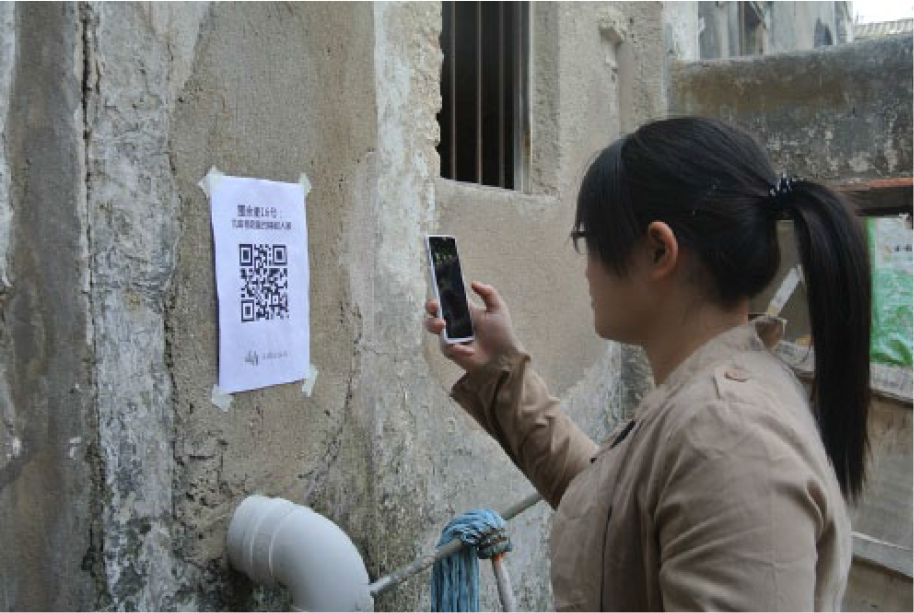
Scanning the QR code.
As shown by the activities mentioned above, the interaction of image pixels and geographical space has been promoted in recent years, with (1) material buildings and local knowledge presented in visual forms and (2) physical space and everyday life embedded with visual images of multiple perspectives and ubiquitous connection. The combination of the two is not the representation of built environment, nor the “remediation of heritage” mentioned by Koch (2013) to develop new heritage digitally online, and also nor the production of place atmosphere by digital visualization mentioned by Degen, Melhuish, and Rose (2017) to create attractive imagined images. It is to entice the citizens to blend the visual images and mobile technology of multiple narratives and interpretations into their physical experience of the material space and local life at the geographical site. The heritage maintains its basis on the geography and changes itself by absorbing multiple virtual meanings with pixels. This has been achieved by ground-up actions, while the grass-rooted historic conservation groups realize the significant ideas of geographical location and mobility, and practice their visual activism with the ubiquitous geomedia technology which relates the physical location to the virtual world of symbols and ideas closely and in real time. Thus, the actions make a change of the Old City both physically and digitally, extending the life of the heritage by steadily constructing new places from the Old City saturated with visual media. Meanwhile, multiple layers of heritage knowledge, including built environment, everyday life culture, and fragmented memories, are under reconstruction, leading to new physical experience of the visitors, virtual interpretations of the heritage, and even new relations between people and the place.
Constructing multivalent situations for embodied encounter
While media technology is embedded into everyday life and new experience of place is constructed, the social relations around the heritage are facing with changes as well. In examining cultural heritage in digital age, Silberman and Purser (2012) stated that digital memory communities were established when more people were allowed to participate through digital technology and to construct their collective memories online by communicating with other participators. They focused on digital heritage and communities produced and maintained online away from the physical places and local inhabitants and stressed on how people as diaspora were connected as a community via culture heritage online. By contrast, in my case of location-based visual activism, I observe that online communities relate closely to physical place, and different groups of relevant actors, both online and offline, have been connected by the heritage and conservation actions, leading to a change of daily life in the Old City.
As mentioned above, participators of historic conservation in Shantou took photos when walking around the old streets since nearly three decades ago. More people were encouraged to do so when they were later able to publish their works on the Internet by themselves. They not only shared their photos online and built up digital communities but also tried to arrange activities in the physical space and hung out in groups to explore the district. With convenient mobile devices connecting to Internet in real time, more people participate in the photo-taking and posting nowadays, which enlarges the scale of online communities with the same interest in the Old City. Pictures, videos, and other types of expression are posted on social media via the visitors’ smart phones, along with their location information in the real time just when they are physically on site. The posts are just like live shows of the heritage, presenting the ever-changing place and the flowing everyday life. It can be seen that the ubiquity of geomedia never leads to the end of physical visiting, but reinforces the desire of “firsthand” visit and “firsthand” photos, just as that mentioned by Jasson (2002) when analyzing the mediatization of tourism. The online communities have shown closer connections to the physical place and local life, when the perspective of geographic space is emphasized with mobile media.
Frequent visits to the physical space lead to the interpersonal communication between the amateur historic conservators and local residents. By getting in touch with the real life in the Old City, visitors from the online communities get aware of more interesting everyday culture of the natives as well as more practical problems. The local inhabitants, by chatting with the outsiders concerning with conservation, begin to reflect on the place they live and show their pride of their family and old housing while they still complain about their miserable living. The communication between the two groups helps them to obtain more insights of the other and to reflect on their own experience and ideas and leads to further actions of historic conservation.
Exhibitions with the visual presentation in the Old City reactivated some dull spaces into temporary public places where different groups of people gather and communicate, as diverse views were on display. People with different backgrounds, including professional architects, staffs of governmental departments, and merchants, both living inside and outside the district, were attracted to stop at the same physical space and were encouraged to share their stories and ideas by the exhibition with multiple interpretation of the heritage. Oral conversation and discussion happened among different persons, while the acts, behaviors, appearance, and clothing of each person on site could be seen by others. Despite the fragmentation of the face-to-face discussions, an active public place for people to speak, interact, and think of the future construction of the historic district was created, with the constellation of visual exhibition, human actions, and material venue.
In the meantime of embodied meeting and chatting, some visitors shared their experience and ideas of the exhibition on social media via their smart phones on hand and connected to wider social networks with their friends’ “likes” and comments. Being accessible to the Internet in every seconds, people now hardly depart their activities in the geographical space from those online. They shuttle back and forth through the two worlds without visible boundary and interact with others both in the two worlds at the same time. The simultaneous interaction in the virtual world affects visitors’ experience in the physical space, and the public place is in fact a combination of physical space and virtual networks. The exhibitions are no longer sightseeing, and not only “hyper-tourism” (Y. Yuan, 2016) with participatory experience but also construction of interactive situations for people from different groups to encounter and contact while moving, seeing, and connecting online continuously.
This kind of temporary public situation, offering “experience of being-with-others in public space,” matters significantly to develop “public civility,” as claimed by McQuire (2016, p. 95). The word “public” here refers to the definition from Sennett (2003); it stresses embodied encountering and seeing others, rather than that from Habermas (1989/1991) focusing on oral conversation and rational debate. McQuire mentioned that the “social skills” in urban life “emerge through the process of public encounter,” while people gather and are motivated to engage with others. It doesn’t matter that the discussion in the situation is always fragmented, temporary and casual, but it offers an occasion for people to see and to be seen by others, and new experiences of “becoming public” (McQuire, 2016, p. 95). In his case of participatory arts, McQuire emphasized on the role of the digital artworks to stimulate curiosity and participation.
Returning to my case of the Old City in Shantou, it is not difficult to conclude the visual activities mentioned above into the relational arts of constructing situations for new experience, but I would argue that different from the artworks mentioned by McQuire with advanced and expensive digital media to construct experimental and fascinating interfaces, the activities in Shantou were equipped with more widespread technology which was accessible and affordable for the grass-rooted actors with little budget. Despite the less dazzling technological effects, the visual activities in the Old City worked as an action to change, employing the daily used digital technology (photography, CGI, QR codes, mobile Internet, and those relating to smart phones) into the heritage district, altering the decaying buildings into some places with new images and dynamics, and thus encouraging more citizens to visit and encounter.
Besides involving digital technology into geographical space, the heritage status of the district also played an important role in the visual activities, although the public situations are never limited in the physical site. The Old City bears lots of living experiences, memories, social relations, and cultural identity of the citizens, as it is the place where they lived previously or currently, and also the former city center when the city reached its peak. It relates to rich and diverse narratives and interpretations, most hidden unconsciously in individual minds and lack of expression and externalization. When embedding with digital technology, a collection of memories, experiences, expectations, and other kinds of narratives and interpretations from different actors in different time and spaces were able to be created. People perceive it simultaneously with the physical environment when they are present at the space along with the ubiquitous geomedia. The compound of them, the collection and the physical space, contributes to the citizens’ sensory experience in the real time. Thus, technology is not the sole cause to promote embodied encounter when being placed into a space but shows its close relation to other factors like geographical location. The public situation is established by a combination of technology, geographical space, individual and collective narratives and interpretations of the site, and the actions of different actors on site and online. Geomedia, in this case, not only relates to physical space, as emphasized by McQuire, but also has more connection to “place,” which is full of meanings and sensory experiences besides the location and built environment, when motivating embodied encounter and new public relations.
The construction of the public situation by exhibitions encourages a wider range of participants and more multivalent situations. More residents get involved to hold their own activities for historic conservation, such as traditional parades on special festivals with live broadcast on the network. Historic conservation activities located in the Old City become increasingly common and habitual, embedding into the everyday lifestyle to practice the ideas of inheriting cultural heritage and reactivating the old buildings at grass-root. During the process, the online communities are maintained by activities face-to-face in the physical place, and the people inhabiting in the district nowadays show their closer connection to the globally communicative Internet in the everyday life via ubiquitous geomedia technology. The gap between the current residents and the visitors is narrowed by the frequent opportunities of embodied encounter. New collective memories of people from different groups are also constructed, with the constant location-based visual activism against the indifferent governmental attitude. The memories emerge continuously along with the collective actions, and as part of the collective memories of the place, are added in the pluralistic interpretations of the Old City, enriching the ever-evolving meaning of the heritage from the ground up and contributing to the cultural identity of local place as claimed by Castells (2000). Social relations between different groups have been established and can further be expanded and fastened as they are connected in the public situations when acting as active participators in historic conservation. An alternative sense of the place of the Old City is thus constructed with new social relations of the actors and the ever-emerging collective actions and memories.
Conclusion: heritage in the culture of location-based visual activism
Visual activities matter a lot on the historic conservation of the physical site and native life in the Old City of Shantou. Visual thoughts in a participatory culture of networked age motivate us to imagine the future and call for changes, resulting in the grass-rooted appeals for conservation. With the perspective of location and mobility introduced along with geomedia, visual activism shows its close relation to the geographical place, leading to the constant practical actions for alteration at the heritage site, involving into the everyday life and encouraging more local participation.
The location-based visual activism emphasizes on the continuous creation and recreation of heritage, with embedded geomedia technology, physical experience, narratives and interpretations, embodied activities, as well as built environment, in unison with the core sense of vision. The interaction between pixels and physical space by virtue of geomedia technology contributes to the revitalization of the Old City, by integrating the virtual sense of multiple interpretations into the physical experience in real time and constructing multivalent situations for embodied encounter of the public. New heritages are under ceaseless creation, superposing various layers of symbols, ideas, actions, and relations into the geographical space and transmitting the past and the present to the future. The transmission here doesn’t follow the linear temporal sequence, but places different times and diverse histories in a collage co-existing in the present time and space, achieved by the networked geomedia technology with its characteristics of ubiquitous connections between physical locations and virtual idea worlds. The heritage saturated with location-based visual media presents a hybrid blending of different temporal periods of human experiences and ideas, working as a connective node in the network of history.
The heritage and the historic conservation activities, as the result of collective collaboration, further offer a wider connection of diverse people. A wider connection, catalyzed with geomedia and mediated by the Old City as a node, means not only real-time interaction in an expanded spatial scale but also a multiple participation of actors with different experiences and various background perspectives. When taking part in the collective conservation activities, they gather around the heritage and encounter with others, constructing multivalent situations where one is viscerally present when shuttling back and forth through both geographical place and online network smoothly. Visual activities with geomedia are embedded into the local place and everyday routines, and the visual culture of geomedia is emerging, with the emphasis on the ubiquitous connection between geography and virtual worlds.
The (re)creation of heritage via visual activism produces the new relations between human and heritage as well. The mediated way of perceiving heritage via visual images at the modern age, as criticized by Choay (2001), has been changed, and turned into a way with a compound of both mediated and immediate experience. Ordinary citizens participate actively in the exploring and altering of the Old City, by attending activities at the heritage site, encountering with the material buildings and local everyday life with instant physical experience, and making some changes on the place. In the meanwhile, they keep connected with the global network digitally whenever they stay, exposing to more layers of heritage knowledge mediated by relevant images and text, and relating to more people via social network. Multivalent interpretations are thus added into the existing built environment, and new memories and social relations are produced, inspiring the vitality of the heritage, the monuments of their own histories, with the power of “the people” (Mirzoeff, 2016, p. 75).
Heritage in the visual culture of geomedia era explores its “competency to build,” as claimed by Choay (2001) in her examination on the modern significance of historic monuments that historic conservation is not an irrational cult to the past, but to satisfy the human’s demands for the future by combining ancient fragments with new relational spaces as well as the technological communication network. The building competency of the heritage is, on one hand, to bring the existing historical material space and local everyday life into the future landscape and lifestyle of the city. On the other hand, heritage contributes to building a wide but casual community both online and in physical space, once saturated with location-based visual enactments in the geomedia era. Shared knowledge and collective memories about the heritage are created and lead to the construction of a heritage-centered community, which is of great significance for the revitalization of the heritage place and a better future life of the city.
