




Abstract
Scholars are increasingly concerned with the polarizing nature of incivility which extends from the offline context to interactions on social networking sites. Although this is a common concern in the literature, few studies have empirically tested whether online swearing behaviors are purely individual acts of uttering strong emotion or contagious social practices that may heighten group polarization. Using the case of Hong Kong–Mainland China conflict, the current study taps into the discursive struggles in Sina Weibo discussion over contentious issues that provoke major conflicts between Hong Kong and Mainland China residents, with a focus on the use and diffusion of swear words. To explore the mechanism that underlies the virality of swearing on Sina Weibo, this study links the expressive and social functions of swearing to its linguistic contexts. Our findings show that emotion is not the single motivating factor. Personal pronouns—which the swearers used as positioning devices and identity markers—are the most important predictor. The effects of source cues particular to social networking site settings were also examined.
Social media enable constant and uncensored social interaction and allow their users to gain growing control of the communication process. One result is that hurtful online behavior has become an everyday occurrence on the social web (Antoci, Delfino, Paglieri, Panebianco, & Sabatini, 2016). The Pew Research Center has documented the increasing prevalence of uncivil interactions on social networking sites (SNSs). In total, 92% of the Internet users they surveyed held the belief that access to SNSs has facilitated cyber aggression and hostile activities (Duggan, 2014). Analysis of a random sample of more than 51 million English-language tweets showed that people curse more than twice as much online as they do in the real world (Wang, Chen, Thirunarayan, & Sheth, 2014). The concept of a “meme” has been used to describe the phenomenon in which online cursing circulates and proliferates similarly to how genes replicate (Guadagno, Rempala, Murphy, & Okdie, 2013). Users are likely to pick up each others’ words, especially swear words, and spread them virally on SNSs (Chartrand & van Baaren, 2009; Kwon & Gruzd, 2017).
What makes a swearing utterance more likely to be passed along online? And why are SNSs promoting cursing? There is a growing body of evidence on the online disinhibition effect—the loosening of social regulations in ways people communicate while online (Suler, 2004). It has been contended that the absence of social context cues (e.g. cues to position in the social hierarchy and formality or informality cues) in online interactions promotes a sense of dissociated identity with a different set of rules and norms in play. The use of web-based and mobile technology in SNSs has facilitated interactive dialogues in which users are more likely to condition their behavior to the behavior of their correspondents. It would be revealing to explore to what extent the rules and norms particular to SNS-based interactions relate to the contagion of swearing in computer-mediated communication (CMC). Using the case of mainlanders’ cursing at Hong Kongers on China’s Twitter-like Sina Weibo, this study seeks to examine how the “expressive” and “social” functions of swearing play out on SNSs. Moreover, we aim to identify “expressive” and “social” factors that turn online swearing into a contagious practice and to assess their relative impact in SNS-based interactions.
One major function of swearing is the “expressive” or “emotional” (Wajnryb, 2004). Jay (2009) summarized the use of swearing as signifying emotions such as anger, frustration, joy, and surprise. Although research has established that swearing can provoke emotion, the converse—that emotion arousal engenders swearing—has not yet received robust empirical validation (Stephens & Zile, 2017). Prior studies have theorized that venting serves as a mechanism for regulating the emotions. As a coping strategy expressing emotions, venting may alleviate the impact of an emotional event (Koole, 2009). Swearing as a reaction to emotion-eliciting cues may similarly have an emotion-regulating function (Kwon & Gruzd, 2017).
Another function of swearing is “social” (Wajnryb, 2004). Field studies of swearing (Jay, 1992, 2000; Jay & Janschewitz, 2008) have demonstrated that swearing in public settings is not uncommon and that much of the swearing occurring in spontaneous interactions is conversational. Research has found that motives for social swearing include constructing and asserting identity, making verbal emphasis, and signaling distance or affiliation (Vingerhoets, Bylsma, & de Vlam, 2013). Used along with linguistic positioning devices, a swearing utterance can help establish and maintain individual and group identities—people can project a certain identity and their membership in a certain group by swearing or not swearing (Vingerhoets et al., 2013). However, few studies have attempted to test to what extent these group features that influence offline swearing may have the same or different effects online. The power and influence of the group is well documented in social psychology (Sunstein, 2000), and it seems reasonable to suggest that there can be a mob mentality involved in online flaming.
Among the multiple linguistic forms of swear words, this study will focus on name-calling, defined as using words intended to be hurtful or insulting to label a single person or a group of people (Coe, Kenski, & Rains, 2014). It has been found to be one of the most common forms of bullying and a prevalent form of uncivil behavior online (Coe et al., 2014; Jay, 2009).
Context of the study: the Hong Kong–Mainland China conflict
The resource-related conflict between Hong Kong and Mainland China originated with the introduction of the “Individual Visit Scheme” in 2003. The scheme was designed to boost tourism and the retail industries in Hong Kong which had been suffering from a financial crisis since the severe acute respiratory syndrome (SARS) outbreak. It eased the bureaucratic restrictions on visits by mainlanders, but the gradual extension of the scheme eventually led to what was perceived by many in Hong Kong as an excess of mainland visitors (Anonymous, 2014). Some Hong Kong residents felt their everyday lives were extensively affected by increasing economic integration with the mainland, generating antipathy (Lau, 2017).
The broader context is that most parts of China’s modern empire are closely controlled by the Chinese Communist Party, but Hong Kong and Macau are exceptions. International agreements with Britain and Portugal specify that they are to retain “a high degree of autonomy” until mid-century. In practice, Beijing has increasingly come to insist that Hong Kong enjoys autonomy only within bounds approved by the mainland government (Wu, 2017). This has led some to perceive mainland tourists as persona non grata. Activists even advocate, albeit futilely, that Hong Kong should distance itself from Mainland China (Lam & Cooper, 2017).
All of these conflicts create misunderstandings and prejudice, and discrimination between people from the two areas has increased. The unwelcomed feeling from Hong Kong society discourages mainlanders from visiting or even discussing the issues in a positive light, potentially leading to additional miscommunication and misunderstandings. While a number of Hong Kongers have become hostile toward mainlanders, mainlanders have also developed a feeling of indifference and have not hesitated to gloat over Hong Kong’s difficulties (Baldwin & Pomfret, 2015).
The conflict has attracted prominent coverage by both the mainstream and social media. The mass media rarely provide space for individuals to express their views, but computer-mediated discussion tools such as Weibo are a platform on which a wider range of actors can struggle. Weibo has become an active agenda-setter and interpreter of the conflicts studied here. Anecdotal evidence points toward the important role of online discussion tools in shaping public opinion both in Mainland China and Hong Kong (Nip, 2004). In February 2012, it only took 7 days for the users of Hong Kong Golden Forum to raise sufficient funds to pay for newspapers ads attacking mainland visitors as “locusts.” Rancorous controversy ensued. In April 2014, a mainlander posted on China’s Tianya Club platform calling for a boycott of Hong Kong as a tourist and shopping destination. It soon drew many comments, echoing his feelings with numerous swear words.
Swearing as emotional utterance
Research has established that swear words serve as a linguistic resource people can draw from to express emotion; use of swear words can serve as emotionally arousing stimuli (Jay & Janschewitz, 2008) and elicit physiological responses (Bowers & Pleydell-Pearce, 2011). Research has also shown that swearing is more likely to occur when a strong emotion appears or when people intend to convey the intensity of an attitude, especially toward others. The linguistic practice of swearing to discharge emotion applies to both positive and negative emotions that are intense (Stephens & Zile, 2017).
The close link of swearing with a heightened state of emotional arousal has been well documented (Andersson & Trudgill, 2007). Experimental evidence suggests that swearing fluency increases with heightened emotional arousal. A study of college students found that the most frequent emotional causes of cursing were anger and frustration, more so than humor and pain (Jay, King, & Duncan, 2006). Jay (2000) found the largest portion of the swearing data are related to utterance of anger and frustration, followed by humor and pain which can also engender swearing. Kwon and Gruzd’s (2017) study of comments on YouTube videos found that commenters tended to pick up others’ use of swear words presumably because swear words function as a marker of high-arousal emotion.
The viral spread of emotions online is often referred to as “emotional contagion”. The phenomenon involves attuning one’s emotional state with that of those who are observing or interacting with (Hatfield, Cacioppo, & Rapson, 1993). The mechanism underlying such online emotional contagion is conceptualized as mimicry (Kwon & Gruzd, 2017)—a tendency of individuals to adopt the postures, gestures, and mannerisms of interaction partners. Online verbal mimicry occurs when one picks up the same words or clauses as others, just as in offline behavioral mimicry (Chartrand & van Baaren, 2009). SNSs have been observed to be venues where emotional contagion is frequent (Harris & Paradice, 2007). Without nonverbal cues (e.g. postures and expressions), the message receiver in an SNS interaction would infer the sender’s emotions using paralinguistic cues including word choice (Harris & Paradice, 2007). That encourages SNS users to mimic others’ expressions through textual mannerism, with a view to matching their feelings to the emotional environment as a way to empathize.
Previous studies have suggested that two dimensions of emotions have consequences for the process of online emotional contagion: emotional valence and emotional activation (Berger & Milkman, 2012; Kwon & Cho, 2017). In terms of valence, negative emotions tend to bear more weight than positive ones when transmitted online. Humans have a general cognitive bias in tending to give more weight to negative than to positive events. Across a range of psychological phenomena, it is a general principle that bad aspects make a stronger impression than good ones (Baumeister, Bratslavsky, Finkenauer, & Vohs, 2001). It has also been found that selecting and processing information is subject to such negativity bias. People pay more attention to negative than to positive news (Meffert, Chung, Joiner, Waks, & Garst, 2006). Negative emotions are more attention-grabbing, and the effects of positive and negative events are asymmetrical. Negative events evoke stronger physiological, cognitive, and behavioral responses (Taylor, 1991). Therefore, negative content not only has the potential to attract attention but also better motivates action (Muddiman & Stroud, 2017). Studies of online message transmission show that negative content is more likely to go viral. Naveed, Gottron and Alhadi (2011) found, for example, that on Twitter bad news travels faster than good news.
In terms of emotional activation, the emotions eliciting high arousal tend to bear more weight than those with low arousal. Arousing emotions are easily transmitted online through emotional contagion. Emotions that trigger a high level of physiological arousal activate a state of mobilization (Berger, 2011), a key factor in facilitating sharing behavior (Berger, 2011; Berger & Milkman, 2012). High arousal emotions such as the positive ones (awe) and negative ones (anger or anxiety) facilitate approach motivation and reinforce action tendencies regardless of the valence. In contrast, sadness is a negative emotion characterized by low arousal that inhibits action tendencies (Berger & Milkman, 2012; Stieglitz & Dang-Xuan, 2013).
Taken together, we formulate the following research question and hypotheses:
RQ1. To what extent do the swear words frequently used in Weibo discussions of the Hong Kong–Mainland China conflict vary in their expressed emotion?
H1a. Swearing that evokes negative emotion is more likely to go viral than swearing that evokes positive emotion.
H1b. Swearing that evokes high-arousal emotion is more likely to go viral than swearing with low-arousal emotion.
Pronoun use as identity markers
Besides the intra-individual psychological function, swearing also serves a range of interpersonal functions. For example, the use of swear words may elicit negative reactions from others, particularly, when the utterance is considered an affront by a listener. Swear words can also be employed to display humor, create an atmosphere of informality and intimacy, or increase group bonding, sometimes in verbal attacks on outsiders. A study of factory co-workers found a high frequency of swearing in conversations within their teams (Daly, Holmes, Newton, & Stubbe, 2004). Collective swearing directed toward their jobs serves to vent their frustration or dissatisfaction and strengthen feelings of connectedness. In a positive way, the act of swearing displays a sense of camaraderie and facilitates bonding with group members or can be used to project a particular group identity. The inter-individual function of swearing hinges on the contextual conditions. Among the contextual factors identified, existing studies have consistently shown a strong influence of the relationship between the swearer and others (Vingerhoets et al., 2013).
As an often-used linguistic positioning device, pronouns are recognized as an effective means of enacting indexicality in a swearing utterance while building a shared reference between the speaker and listener (Chung & Pennebaker, 2007). Pronouns have the function of the self-reference or of other references. First-person singular pronouns are self-referential; the second-person singular and plural are audience-referential; the third-person singular and plural are other-referential. Person referencing through pronoun use can be deployed to convey distancing, involvement, or alignment with interaction partners (De Fina, 2003). Pronouns thus help a speaker to construct group membership and manage his identity via positive self-reference and negative other reference (van Dijk, 2006). These person reference forms can indicate “… the position of the speaker with respect to the dimensions of interdependence versus autonomy from others and of personalization versus depersonalization of experience” (De Fina, 2003: 51)—what De Fina terms social orientation. In a swearing utterance, the speakers may vary his selection of personal pronouns to convey a stance “… through which social actors simultaneously evaluate objects, position subjects (themselves and others), and align with other subjects, with respect to any salient dimension of value in the sociocultural field” (Du Bois, 2007: 169). Personal pronouns may thus serve as markers of self-identity and group identity, as well as of social integration and social relations (Pennebaker & Lay, 2002).
Distancing
There has been abundant research on the choice of person references in terms of its distancing function. For instance, Maitland and Wilson (1987) have shown that “self-reference by means other than I or we is said to represent a desire on the part of speakers to distance themselves from the topic under discussion, or from the discourse participant himself/herself” (p. 498). In addition, it is suggested that the absence of first-person deixis indicates lack of engagement and creates an appearance of disinterest and impassiveness. Another distancing technique often used in political speech involves third-person reference devices through which the speaker places himself or herself and the “other” in an antagonistic situation (De Fina, 1995). The speaker uses third-person pronouns to mark the “other” with whom he or she, and he or she hopes his or her listeners too, doesn’t identify while simultaneously indicating that he or she is not part of a specific group of “others.” In political discourse, politicians use “they” as a resource to identify a person or group as “other,” creating a “self” and “other” distinction (Bramley, 2001). Research has found that the use of third-person pronouns indicates an out-group status and generates a negative response (Perdue, Dovidio, Gurtman, & Tyler, 1990). Frequent use of the third-person plural has been identified as a predictor of extremism (Kaati, Shrestha, & Cohen, 2016).
There is a dichotomous relationship between the self and others created during identity formation (Hegel, 1833). Individuals to some extent define themselves in terms of their relationships to others and to social groups (Bucholtz & Hall, 2005: 586). Collective objects are defined from the outside—the others who distinguish them from where they do not belong (Turner, Oakes, Haslam, & McGarty, 1994). When members of a group consider themselves to share a collective identity or a common interest, the relevant social categorization becomes salient (Sunstein, 2000). In that situation, they are more likely to comply with the in-group’s norms.
The social identity model of de-individuation has been often applied to capture the communication patterns of groups in computer-mediated settings (Postmes, Spears, & Lea, 1998). It has been observed that the visual anonymity in CMC reinforces de-individuation. Experimental studies of online commenting behavior have shown that offensive expressions are more often used in online comments when peers’ comments contain offensive words (Rösner & Krämer, 2016). While online, individuals are likely to feel subject to in-group norms, resulting in in-group favoritism and in some situations out-group stereotyping and bias (Postmes et al., 1998). That influence is especially strong when a social identity is shared with others and in-group membership is salient in favoring in-group members in the distribution of resources. That makes individuals who see themselves as members of a certain group more susceptible to social influence when the specific identity is activated through other references.
Involvement
The involvement function of person reference has been extensively examined, particularly, in terms of second-person referencing and first-person referencing. Tannen (1983) illustrated how the use of impersonal “you” bolsters listener involvement in that it “inserts the hearer into the narrative” (p. 368). In political discourse, second-person pronouns are frequently used to refer to opponents and signal an invitation to a verbal battle. Such direct address makes it personal and indicates antagonism, which demonstrates a way of turning a general social grumble into a provoking incitement (Kuo, 2002). De Fina’s (1995) analysis of political speeches has demonstrated how the use of I and we bolsters listener involvement. It has been found that incremental use of first-person singular pronouns is accompanied by incremental general arousal (Wegner & Giuliano, 1980). The use of first-person singular pronouns helps politicians construct a positive image through their rhetoric (Bramley, 2001). The use of “we” has attracted even more scholarly attention. Speakers may include different groups in the scope of “we” while excluding others (Zupnik, 1994). “We” is important in creating and calling attention to identity boundaries (Malone, 1997). It invokes a collective identity or group membership (Bramley, 2001). Sylwester and Purver (2015) have argued that Americans favoring the Republican Party use more first-person plural pronouns on Twitter because they have stronger perceptions of in-group similarity and consensus. Zupnik (1994) has pointed out that the first-person plural has a powerful persuasive function, activates a sense of group membership, and influences the evaluation of in-group and out-group members (Perdue et al., 1990). Exposure to in-group pronouns can produce positive evaluation and affection (Perdue et al., 1990). In addition, cues provided by in-group members are more likely to be picked up (Guadagno et al., 2013).
Based on the discussion above, we propose the following research question and hypotheses:
RQ2. To what extent do the linguistic contexts in which frequently used swear words appear online vary in terms of person reference?
H2a. First-person referencing is positively associated with the likelihood of swear words going viral.
H2b. Second-person referencing is positively associated with the likelihood of swear words going viral.
H2c. Third-person referencing is positively associated with the likelihood of swear words going viral.
Authority and bandwagon cues
Culnan and Markus (1987) have proposed a cues-filter-out theory regarding the uses and effects of CMC. They suggest that the critical difference between Internet-based interaction and face-to-face communication is a lack of physical and social cues. These characteristics of CMC foster anti-normative and uninhibited behavior, leading online communicators to act with aggression and on impulse (cf. Kim, 2000; O’Sullivan & Flanagin, 2003). However, the reduction of cues also creates social equality. Status and position cues are hidden in CMC, giving people considered high-status offline less influence. Group members can interact more equally in the discussion that occurs via computer-mediated formats (Kiesler, Siegel, & Mcguire, 1984; Siegel, Dubrovsky, Kiesler, & Mcguire, 1986). The lack of visual cues forces people interacting online to rely on cues of other sorts. According to the heuristic-systematic model, people rely on the heuristic cues or in other words the simple rules of judgment to process information and make decisions (Chaiken, 1980). Heuristic processing provides a cognitive mechanism that enables message processors to make judgment by relying more on accessible context information, such as the characteristic of the perceived source or other non-content cues. Its application to source cues allows processors to extend appraisals of the sources to the content they produce. In CMC, source cues such as trustworthiness, expertise, and attractiveness have been found to be influential in affecting a message’s repostability on social media (Liu, Liu, & Li, 2012). This study examines two types of source cues: authority cues and bandwagon cues (Sundar, Oeldorf-Hirsch, & Xu, 2008; Sundar, Xu, & Oeldorf-Hirsch, 2009).
Authority cues are associated with a source’s credibility. The influence of source credibility is well documented in social psychological research (e.g. Liu et al., 2012). Credibility implies the correctness or a source’s opinions and leads the audience to favor their validity (Chaiken, Liberman, & Eagly, 1989). Content created by a credible source is perceived as trustworthy and is more likely to be reposted (Liu et al., 2012). For example, it has been found that during an emergency, users are more likely to retweet content found on the Twitter feeds of the mass media and of traditional service organizations like the Red Cross (Starbird & Palen, 2010).
Bandwagon cues refer to the collective opinion of others (Sundar et al., 2008). Generally, people are likely to be persuaded by the opinions of their peers. If an opinion is supported by many other people, it tends to be more persuasive (Sundar et al., 2008). Research on e-commerce has focused on bandwagon cues as an aid in decision-making. Products with higher peer ratings are more likely to be purchased (Sundar et al., 2009). The endorsement from the majority view positively impact individuals’ product appraisal and purchase intentions. Lee and Sundar’s (2013) study of health messages in Twitter inferred bandwagon based on the number of a user’s followers. Their findings suggest that the bandwagon heuristics lead individuals to expect messages to be more credible when the content posted on Twitter is from a source with a larger number of followers. The bandwagon cues positively affect users’ perception of content credibility and behavioral intentions.
Based on these theoretical considerations, the following hypotheses are proposed:
H3a. Verified users’ swearing utterances are more likely to be passed along than those of regular users (authority cues).
H3b. The swearing utterances of users with more followers are more likely to be passed along than those of users with fewer followers (bandwagon cues).
Methods
Data
The data used in this study were collected from Sina Weibo, a Twitter-like microblogging social media platform widely used in Mainland China. Weibo is China’s largest and most used microblogging platform. Automated censorship mechanisms that block foul language are ubiquitous on various online platforms in China. Weibo is one of the few platforms on which cursing often evades it.
Our preliminary scrutiny of Weibo posts on the topic of Hong Kong–Mainland China conflict identified “gang can (港灿),” “gang du (港毒),” “gang gou (港狗),” and “yang nu (洋奴)” as the four most frequently used obscenities used in name-calling on the platform. Each has a particular insulting connotation when used by mainland Chinese to defame Hong Kongers. All of the Weibo posts containing those four keywords posted between 1 January 2010 and 24 March 2017 were retrieved and analyzed. After screening out posts irrelevant to the Hong Kong–Mainland China issue, the corpus contained 4998 source posts. The originator’s number of followers was recorded, along with whether the poster was a verified user and the number of reposts for each source post.
Analytical approaches
The “TextMind” (WenXin) system was adopted to identify emotional words, pronouns, and punctuation marks. TextMind is a Chinese-language text analysis program based on Linguistic Inquiry and Word Count (LIWC, Pennebaker, Booth, & Francis, 2007). TextMind uses the LIWC2007 English lexicon and the traditional Chinese C-LIWC lexicon. It also integrates the word segmentation and part-of-speech tagging modules of both the Natural Language Processing Information Retrieval (NLPIR) and the Language Technology Platform (LTP). The percentages of words in each of these target categories were computed. TextMind quantifies positive emotion using the percentage of positive words from the total number of words per Weibo post and quantifies negative valence using negative ones. The Weibo posts were also analyzed with respect to their use of personal pronouns, hashtags and exclamation marks, and measures of discrete emotions—anger, anxiety, and sadness. They were sorted into the TextMind word categories as the percentage of words from a given category in a text.
The statistical analysis included two steps. First, a series of one-way analysis of variances (ANOVAs) were conducted to determine whether the four swear words differed significantly in terms of the linguistic contexts in which they were deployed. For the categories with a significant difference, a post hoc Tukey’s honest significant difference (HSD) test was conducted to identify which specific pairs of swear words had statistically significant differences in their linguistic contexts.
Negative binomial regression was then conducted to model the effects of emotion, pronoun use, and source cues on the likelihood of virality. In this analysis, the dependent variable was the virality of a message containing swear words, measured by the number of times that message was reposted. Size is one of the most frequently used summary statistics of diffusion cascades (Goel, Anderson, Hofman, & Watts, 2016). The frequency of sharing online content is an important measure of social transmission that affects attitudes and decision-making (Berger & Milkman, 2012). With count data for the dependent variable, the distribution was skewed and over-dispersed. As such, negative binomial regressions were employed in this study. In total, 17 outliers (which receive more than 10,000 retweets) were removed to bolster the robustness of the analysis. The independent variables included positive emotion, anxiety, sadness, anger, other negative emotion, first-person pronouns, second-person pronouns, and third-person pronouns. The poster’s number of followers and whether the poster was a verified user were also tested as independent predictors of the number of reposts. The control variables included the word count and the number of hashtags and exclamation marks per message.
Results
Comparison of linguistic contexts
The results of the one-way ANOVA showed that there were statistically significant differences among the four swear words in both the positive and the negative emotions expressed in messages where they appeared (see Table 1). Posts containing yang nu tended to express less positive emotion than those containing the other three swear words, and the differences were statistically significant (F(3, 4846) = 5.93, p < 0.001). Yet, there was no statistically significant difference among the other three swear words studied.
A comparison of four swear words in emotional and language use.
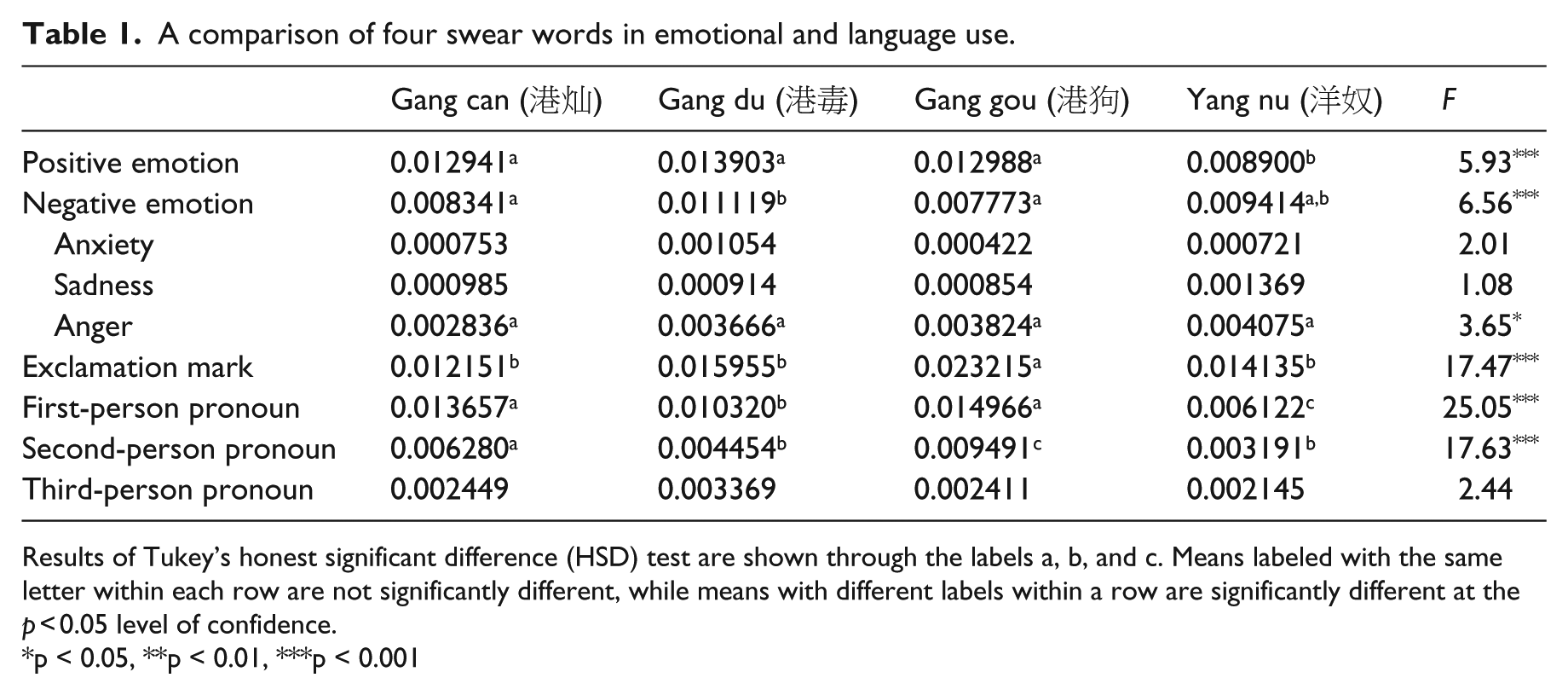
Results of Tukey’s honest significant difference (HSD) test are shown through the labels a, b, and c. Means labeled with the same letter within each row are not significantly different, while means with different labels within a row are significantly different at the p < 0.05 level of confidence.
*p < 0.05, **p < 0.01, ***p < 0.001
As for negative emotion, the post hoc analysis showed that the posts containing gang du expressed significantly more negative emotion than the posts containing the related words gang can and gang gou (F(3, 4846) = 6.56, p < 0.001). Yet, there was no statistically significant difference between the posts containing the swear word “yang nu” and those with the other three swear words.
Both gang can and gang gou are general insults, the former referring to Hong Kongers as ignorant and bumptious, the latter comparing Hong Kongers to dogs. In comparison, yang nu (foreigners’ lackeys) and gang du (Hong Kong poison) have more specific political connotations. Yang nu was often employed to imply that Hong Kongers pander to the interests of Westerners, while gang du usually referred to those who would like to make Hong Kong independent of Chinese rule. These results suggest that Weibo users expressed negative emotion more often than positive feelings when discussing political issues.
We further dissect the broad category of negative emotion into anger, anxiety, sadness, and other negative emotions. Neither of anxiety, sadness, or the other negative emotions showed significant results in the one-way ANOVA. There were, however, significant differences among the posts containing the four swear words in terms of their expression of anger (F(3, 4846) = 3.65, p < 0.05). A Tukey’s HSD test showed that the differences in anger expression between each pair were not significant.
As for exclamation marks as indicators of emotion intensity, there were also significant differences among the posts containing the four swear words (F(3, 4846) = 17.47, p < .001). The post hoc analysis showed that posts containing gang gou tended to contain more exclamation marks than those containing the other three words studied.
For pronoun use, the ANOVA results for first-person pronouns were significant (F(3, 4846) = 25.05, p < 0.001). The post hoc analysis showed that the posts containing either gang can or gang gou tended to use more first-person pronouns than those containing the other two words. Posts containing yang nu were the least likely to use first-person pronouns, a difference which was statistically significant.
As for second-person pronouns, there were also significant differences among the posts containing the four swear words (F(3, 4846) = 17.63, p < 0.001). The post hoc analysis revealed that the posts containing gang gou were significantly more likely to also use second-person pronouns than those with the other three swear words. Posts containing gang can ranked second, and that result too was significant. There was no statistically significant difference between gang du and yang nu in this respect.
Virality of swearing utterances
The average length of the posts was 57 words, considerably less than Weibo’s 140-word restriction, and the authors of these posts had an average of around 500 followers. The word count for each post showed the strongest correlation with the other variables. Number of fans had the weakest relationship with other variables. The variance inflation factors of these variables were all around 1 and 2, suggesting that the regression model is not subject to a multicollinearity problem.
Starting with a base-line model, four blocks of independent variables were added hierarchically (see Table 2). They show that all of the variables included in the models were significant predictors of repost frequency but their effect sizes were different. Akaike’s information criterion (AIC) was used to evaluate the effect size of each block of variables. Changes in AIC values allowed us to compare models for the effect size of each block of variables.
Coefficients of step-wise negative binomial regression predicting virality.
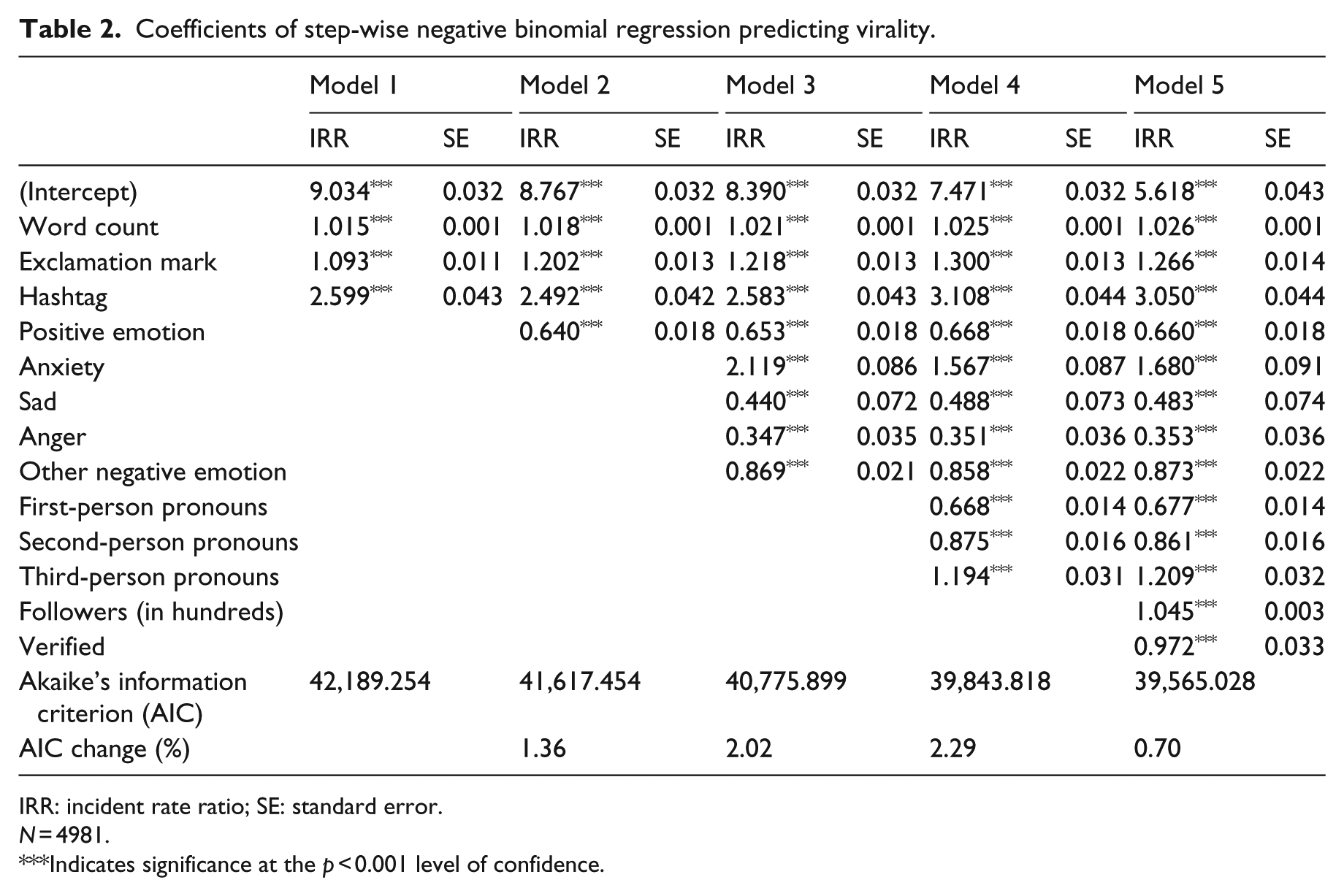
IRR: incident rate ratio; SE: standard error.
N = 4981.
Indicates significance at the p < 0.001 level of confidence.
The use of pronouns in a post was found to be the strongest predictor of the number of reposts. The model’s AIC value improved by 2.29% when the pronoun variables were added (Model 4). Among the three types of pronouns, first-person pronouns had the strongest relationship with repost numbers, followed by third-person pronouns; second-person pronouns had the weakest predictive power. The incident rate ratio (IRR) values show that a one-unit increase in the occurrence of first-person pronouns would decrease the number of reposts by a factor of 0.677. In other words, a one-unit increase in the occurrence of first-person pronouns would result in a 32.3% unit decrease in the number of reposts. A one-unit increase in the occurrence of second-person pronouns resulted in a 13.9% unit decrease in reposts. The use of first-person and second-person pronouns were both negatively associated with the appearance of swear words, so H2a and H2b were not supported. In contrast, if the occurrence of third-person pronouns increased by a point, the chance of being reposted was expected to increase by a factor of 20.9%. The use of third-person pronouns was positively associated with the virality of swear words, and H2c was supported.
Words expressing negative emotion were the second strongest predictors of the number of reposts. The model’s AIC value improved by 2.02% after the four relevant variables were added. Among them, only anxiety words had positive predictive power for repost numbers. A one-unit increase in words expressing anxiety resulted in a 68% increase in reposts. However, words that express sadness and anger were associated with 51.7% and 64.7% reductions in reposts, respectively, holding the other variables constant. Thus, H1b, which hypothesized that posts expressing anger and anxiety were more likely to go viral than those expressing sadness, was partially supported.
Words with positive emotions had the third strongest relationship with the number of reposts on Weibo. After the positive emotion variables were added to the model, the AIC value improved 1.36%. The IRR of 0.660 indicates that when the occurrence of words expressing positive emotion increased by one unit, the number of reposts decreased by 34% on average when other variables were held constant. Therefore, H1a was supported.
Among emotion-related word usage, anxious discussion was the most contagious in terms of generating reposts. It was the only emotion to show a positive relationship with repost frequency. Anger and sad discussions ranked second and third in terms of their negative effects. However, positive discussion also had a negative influence, the slightest effect among the emotional word usages.
The final block of variables concerned source cues—number of followers and verification status. As a whole, these two variables had a small impact on the number of reposts. The model’s AIC value improved only 0.70% after they were added, and the effect sizes were small. Specifically, an additional 100 followers predicted a 4.5% increase in reposts. And with everything else held equal, the post of an un-verified user was associated with a 2.8% lower number of reposts. Although those effect sizes were small, they were nevertheless significant in a statistical sense. H3a hypothesized that verified users’ swearing was more likely to be passed along, and H3b hypothesized that the swearing of users with more followers was also more likely to be passed along. Both H3a (about the influence of authority cues) and H3b (about bandwagon cues) were supported.
There were three variables in the basic model: word counts, exclamation marks, and hashtags. Among all of the variables modeled, the number of hashtags in a post had the largest effect on reposting. An additional hashtag in a post would produce an average of two reposts. Furthermore, if the number of words in a post increased by one unit, the post could expect an increase in reposting by a factor of 2.6%. An additional exclamation mark in the post would increase the likelihood of being reposted by a factor of 26.6%.
Discussion and conclusion
To explore the mechanism that accounts for the virality of swearing on SNSs, this study was designed to link the expressive and social functions of swearing online in Chinese to its linguistic context. An implicit assumption often made in prior research is that particular events can evoke feelings or emotions conducive to swearing in response. The findings here show that emotion is not the only motivating factor. Personal pronouns—which the swearers used as positioning devices and identity markers—were the most influential predictor of the contagion of swearing utterances, followed by presence of negative emotion, and then positive emotion. Source cues particular to SNS settings had the least impact. The role of linguistic contexts, as “content cues,” outweighs the role of source cues in terms of the virality of SNS posts with swearing. Moreover, whereas previous research has shown that swearing provokes an emotional response, these results show that emotional arousal can elicit swearing—or at least one aspect of it: the contagion of swearing.
The data point to a negativity bias in the spread of swearing on Weibo. Positive emotion has less impact on the repost frequency of obscene utterances than does negative emotion. With more positive emotion words in a post with swearing, the number of reposts is likely to be fewer. Among the negative emotions studied, only anxiety was found to increase the repost likelihood. Anger and sadness were both found to be negatively associated with the number of reposts. Anxiety is a negative, high-arousal emotion which promotes virality online along with other high-arousal emotions such as anger (e.g. Berger & Milkman, 2012). So these findings partly echo those of previous studies and verify the potential contagion of obscene utterances. However, neither sadness nor anger promotes virality online, implying that the presence of emotion in a message does not necessarily increase its virality. This might suggest that the effects of emotion depend not only on its valence and arousal but also on the context. In the context studied, anxiety expressed in Weibo posts through swearing may have aroused concerns about personal impact such as an unfriendly environment for mainland visitors, making Weibo users more likely to pass along such posts.
The functions and effects of swearing apparently depend heavily on the context in which it occurs. A range of factors have been taken into account in this study: the topic, the speaker–listener relationship, and the online setting in which the swearing occurs. In the context studied, Hong Kong and mainland citizens are often two opposing groups. On Weibo, where mainland users constitute the majority, they naturally form an in-group identity and treat Hong Kongers as out-group members. Those using swear words in referring to Hong Kongers on Weibo tend to use first-person pronouns to refer to mainlanders as in-group members. We would expect that first-person pronouns used as markers of self-consciousness and in-group identity could produce and reinforce group cohesion. However, the results suggest that the presence of first-person pronouns did not boost the virality of swear words. Using “I” and “we” in a post in fact tended to reduce the number of reposts. Second-person pronouns are often used to address potential interlocutors or signal provocation or incitement. Both first-person referencing and second-person referencing are often used as discursive strategies to bolster readers’ involvement. But using “you” in a post was also found to predict fewer reposts, contrary to expectations. The presence of second-person and first-person pronouns may have directed readers’ attention to the obscene utterance, but that attention was not necessarily translated into action.
In contrast, third-person referencing was found to boost the virality of swear words on Weibo. The third-person pronouns, as markers of “others,” indicate an out-group identity. Reference to the out-group or “other” is likely to increase the group consciousness of in-group members and their emotional levels and action tendencies (at least in terms of reposting the expletives). The distancing function of third-person references seems to be effective in increasing swearing’s contagion. The author is marking the “others” while indicating that he does not identify with them.
As might be expected, the opportunities for expression on SNSs promote intragroup conformity and intergroup comparisons. In terms of status and power differentials, this can mean that the power and status relations associated with categories are reinforced by the ease of online interaction. To examine the effect of source cues particular to SNS settings, this study considered authority and bandwagon heuristics, and both were found to predict a greater chance of an obscene utterance being reposted. Bandwagon cues represent peer opinion, and people tend to follow peer opinion in deciding whether or not to repost. If a post is sent by a user with more followers, it is likely to be more attractive to other users and to be reposted even more—the feedback loop that is the essence of virality. Authority cues in this study were represented by whether a poster has verified status. Most verified Weibo users have expertise in specific area, and the verification information serves as an authority cue for other users. If a verified user posts a message, it is more persuasive and more likely to be reposted. Reactions to swearing in the SNS setting are marked by power and status relationships, just as they are offline. However, it should be noted that their effect sizes were found in this study to be small. The original author’s characteristics were not as influential as the content of the post.
The longer a post containing swearing, the more likely it will be reposted. The stronger the emotion the swearing conveys, the more likely the message will be reposted. Notably, including hashtags was found to be a powerful predictor of repost probability. On SNSs, hashtags are used to mark message topics. They pre-suppose a virtual community of interested readers, group them, and invite ambivalent audience members to align with one side of the discourse (Zappavigna, 2011). The use of hashtags in a post encourages such alignment. Readers use hashtags to identify topics which they might be interested in reading. They are therefore cues to potential readers, and cues that are more likely to be picked up by sympathizers.
This study has demonstrated that linguistic styles vary in posts containing swearing. That and other factors influence the likelihood of a post being reposted. The study focused on name-calling as a form of swearing on the Chinese social media platform Weibo. Name-calling is a common-used form of incivility, referring to the use of offensive epithets to denigrate another party. The name-calling words studied are universally understood as offensive in Chinese society and are used to insult and/or stereotype Hong Kongers.
Weibo posts containing name-calling as a form of swearing have various linguistic styles determined by the swear words’ connotations. For example, those swear words studied which had political connotations were likely to induce negative emotions. The posts containing them were also more likely to use “they” as an identity marker of out-group members. This implies that political issues are likely to trigger negative emotions in online discussion, as well as the use of markers defining in-group and out-group. This study is not without limitation. It focused on just one use of swearing in name-calling. Future studies should consider including a wider variety of swear word applications in a variety of SNS platforms.
Footnotes
Funding
The research reported in this article is supported by a General Research Fund grant (HKBU 12632816) offered by the Research Grant Council of the Hong Kong Special Administrative Region Government.