




Abstract
The purpose of art is to lay bare the questions that have been hidden by the answers.
All the sounds in the city derive from the activity of its residents. Even natural sounds are filtered and modulated through the city as an audio equalizer. At the same time, as a social structure, the city acts as a force on its citizens.
Urban public space—here we adopt the usage accepted by common practice—is a site where this force manifests. Using transforming and spreading sound, this force is absorbed and reflected by the inhabitants of the city, resonating among them.
My field recording practice began in 2008, with the city as the “field” for recording. By arousing my auditory sense by field recording, I refresh my understanding of Shanghai and begin to realize the public. Through “sound-listening,” I discover urban public space.
Sounding: A Farewell Party
At 3:00 p.m. Saturday, on 24 November 2012, I strolled to Lu Xun Park in Hongkou District, Shanghai. Walking to the main entrance, I was faced with an open space crowded with people. Although there were many benches around the trees and the people who were there were mostly elderly, few were sitting. In the center of a group of people, many of whom were dancing gracefully, were groups playing brass band music and folk music, along with others who were playing solo. Watching the groups of musicians were young people and foreigners, occasionally taking photos. I vaguely heard the sound of a chorus, so I threaded through the throng of people following the sound (Figure 1).
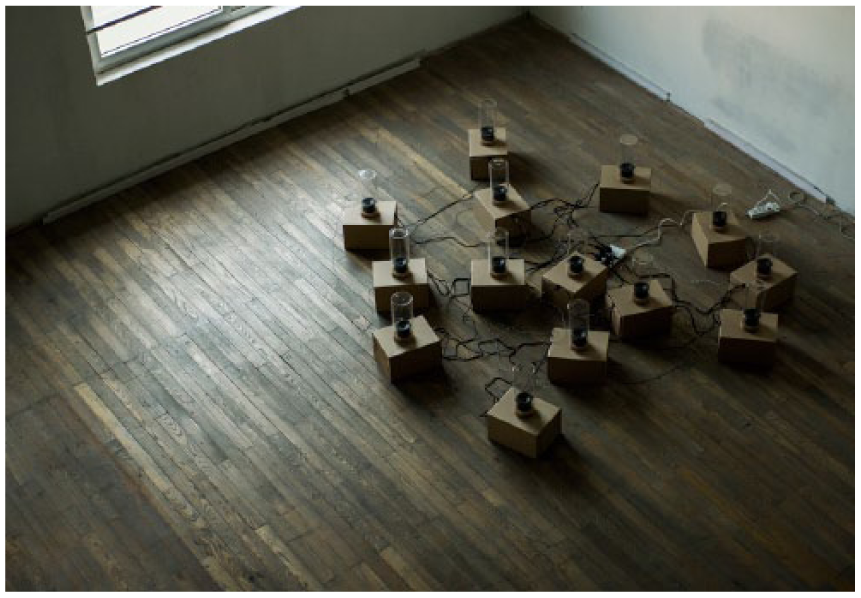
A Farewell Party, sound installation, 2016 photo by Yin Yi.
When I found them, I was little shocked. I had never seen or heard something like this: more than 300 people stood in a circle, singing together as a chorus. In the center of the circle stood an old man in his mid-60s, conducting the crowd with his sleeves rolled up and hands waving. Near him was a band, composed of erhu (Chinese instrument), bamboo flute, dulcimer, clarinet, violin, sand ball, and plastic bucket as bass drum. Almost every singer held sheet music, while some also held microphones that connected to the portable sound box. The singers were mostly in their 60s. They sang songs that were popular in the 1950s that praised the motherland, the people, the People’s Army, Chairman Mao, and rusticated youth during “down to the countryside movement” in late 1960s and early 1970s.
As a scavenger of city sound, I immediately took out my portable recording equipment. I first recorded the sound outside the group of singers, and then, after making my way through the singers, I placed my equipment in the center of the circle that was clear of people. Thus, my recording equipment and I were surrounded by more than 300 people while not influencing them. All kinds of sound rushed from all directions to me. I was slowly impressed by the scene and felt it even a bit unbearable.
When I came back home, I listened to these sounds again that were loud, rough, and stretched continuously. Immediately, I had a question in my mind: why were there more than 300 elderly people gathering together in a park, a public space, just for singing? Didn’t they have another place to sing? Nowadays, the Shanghai municipal government allocates a large amount of money each year from the government budget—it is said that there are more than 100 million RMB—into culture for the city. In addition to major arts colleges and traditional arts such as Peking Opera, Kunqu Opera, and other local folk arts, a large amount of money is used for mass cultural activities. The district and county streets have their own cultural hall or cultural centers, while sub-district cultural centers set up a variety of arts and cultural activities, most of which are free, or only charge a symbolic fee. Since her retirement, my mother partakes in the cultural life of her local cultural organization, participating in dance, calligraphy, chorus, English, computer, yoga, and Chinese painting once or twice a week. So why did not those elderly people in Lu Xun Park stay in cultural activity centers equipped with air conditioning and professional teachers, but instead gathered together to sing in the park every Saturday and Sunday from 1:00 p.m. to 4:00 p.m.?
The reason is that they want to make their sound in the public space. This generation has been completely marginalized in today’s social structure. They are not the focus of society, whether as consumers, producers, or participants. Through singing in the public space, they collectively and implicitly claim “we are here.” Not passive recipients of sounds, they actively produce their voice in public in order to have more people hear them. By singing in public space, they also become one of the actors in the city. The moment the airflow strokes the vocal cord, sound becomes the medium to connect to one another. Moreover, they experience something of their youth again, when they lived communally. Thus, songs are not only carriers of their memories but also a method of communicating with their peers. However, though the sound of their chorus is powerful in the space of Lu Xun Park, it is still insignificant and unnoticeable in the city as a whole.
Based on this experience, I made a sound installation A Farewell Party. The work consists of a poster hanging on the wall and 15 sealed glass jar on the ground with raw speakers in each jar. The poster is two photos stitched together. The upper part is a famous photo extolling the ‘Down to the Countryside Movement’ in 1960s. The image features educated youth packed in a departing train, stretching out their upper body and waving hands to bid farewell to their relatives and friends out the train window. In the foreground, a percussion ensemble is playing, creating a scene of great rejoicing. In the lower part of the poster is a photo I took of elderly people in Lu Xun Park. The image is a panorama of people singing together in a circle. Each speaker is looping the song I recorded in the Lu Xun Park. The audience can see those speakers clearly even as the sound is enclosed in the jar—blurred, compressed, and messy.
The name of my work comes from Czech writer Milan Kundera’s novel of the same name, A Farewell Party. I always think that these old people have two temporary parties every week, but they come to the party with the purpose of saying goodbye.
The work was done, but it did not seem to end. One day, I suddenly asked myself who would allow them to sing in the park? In almost any country, public assemblies of more than 300 people are required to apply in advance to government agencies. I wondered—if the collective singing is not a political activity, would they be allowed to sing in front of the entrance of the Peninsula Hotel or an exit in the square on the Nanjing East Road subway station? In considering this problem, I realized that there is a particular logic and mechanism of sound in urban public space.
Public: you’ve heard the ocean and a journey to Shanghai
The terms of “public space,” “public domain,” and “open space” are frequently heard from my friends who are philosophers, anthropologists, economists, urbanists, or architects. So in order to know more clearly whether we are talking about the same thing, we should simply define what the word “public space” refers to here.
“Urban public space” as used here refers to physical spaces of different sizes that are scattered across the city. They can either be indoors or outdoors. These spaces are open to anybody; even if they need to filter certain crowds, or need to restrain certain people from entering, they will operate with a kind of invisible mechanism. These spaces are not for public life or communication in the city, but provide the necessary resources for the city to function properly and for people to share resources for various purposes, such as obtaining the necessary resources and reduce costs at the same time. This is not my definition of “urban public space,” but the status quo that I have seen in China and Shanghai.
After meeting with the elderly choir in Lu Xun Park, I realized that sounds in the city are not self-generating but under the control of a set of hidden mechanisms. By making field recordings in the city and unscrambling, analyzing, and judging the sound materials, I divided the city’s public space into two main categories, such as commercial space and social space.
Commercial space
This kind of space belongs to business organizations whose sound runs according to the logic of capital. Common commercial places include shopping malls, cafes, bars, restaurants, and chain stores. Jazz in Starbucks, Bohemian style music in the MUJI shop, western pop music in an H&M store, guqin in Chinese teahouses, all those sounds should be matched to commodities to be sold.
But only when I heard fusion in the Yunnan restaurant on the Bund did I learn what the logic of capital really is. The official website of this Yunnan restaurant has a sentence in English that states, “We search and discover the lost ancient Chinese folklore recipe, totem, handicraft … We create, renovate, revive the precious heritage.” When I went to this restaurant, I found that 80% customers were White Europeans and Americans. The background music volume was extremely loud, making it like a noisy bar.
This kind of symbolic sound is a free gift to accompany consumption. As a gift, it must be free, and because it is free it may be consumed. Thus, sound under the logic of capital is symbolically consumed for free in commercial public space.
Social space
This kind of space belongs to the government or social institution. Sounds used in this kind of space establish an order. Social places include subways, airports, railway stations, buses, banks, hospitals, and government public affairs service centers. Some of the sounds include station announcements in subway trains, the announcement of numbers in banks and hospitals, and ticking sounds from crosswalks. All these sounds convey information. Delivering clear information establishes order; hence, sound in these spaces serves as a tool to regulate humans. I have made two sound works, corresponding to these two different types of spaces and use of sound.
Commercial space
At the end of 2016, I was invited by the curator of Shenzhen New Media Art Festival. The organizer of this new media festival is a local commercial real estate company. The main exhibition hall is in a large shopping center. I made a public sound work titled “You’ve Heard the Ocean.”
The work entails playing the sound of ocean that I recorded through the public broadcast system of the shopping center. The 4-minute recording of wave sound is played at the 22nd minute every hour because Shenzhen is located about 22° north latitude. At the same time, it will loop 24 hours even when the shopping center is closed. The sound of this work spreads through all the public spaces in the shopping mall, including the underground parking area. The shopping center continued to play their customized background music during this time.
A public broadcast system is a symbol of taking power as well as the material tool to implement such power. The work enters the space of this sonic mechanism when it uses the shopping center’s own sound system.
The sound of waves broadcast through the public sound playing system is almost identical to White noise, but its own dynamic changes differ from electronic sounds. In this way, the sound heard contrasts with the external environment, which makes it hard to consume.
In China, large shopping malls do not stop operations after they close to the public. During non-business hours, the shopping center has to do routine maintenance, such as cleaning, updating the space, and logistics. Normally, the shopping center does not play any sound during this time. However, my work “You’ve Heard Ocean” plays for employees in the shopping center and changes the commercial logic of sound in this space.
My efforts are not to make a piece of music that can be heard or paid attention to for the quality of the sound. The key is to communicate and compete with the commercial space. This means negotiating a new mechanism and logic.
Through the joint efforts of the curator and myself, this work was finally implemented in both Shenzhen and Shanghai. It was presented from 24 December 2016 until 19 March 2017 in the Shenzhen Merchants Shekou Huigang Shopping Center and Shanghai Huaihai 755.
Social space
As a Shanghainese, born and raised in Shanghai, I have found over the past 5 years living in Shanghai that there are fewer and fewer people and occasions to speak the Shanghai dialect. I have a daughter who is now 3 years old. Due to her poor Shanghai dialect, I proposed that she speaks Shanghai dialect at home.
One day we were on a subway train. When she heard the broadcast in Mandarin and English, my daughter said to me: “Dad, they did not speak Shanghai dialect.” I suddenly realized that the voice of the public announcement not only regulates our body but also disciplines our knowledge. Shanghai dialect is not used in public space (e.g. the subway) under the control of the government. Here, Shanghai dialect is not used to convey public information. It was belittled and forbidden. An example is that when you consult the station staff using a Shanghai dialect, he will answer you in Mandarin with a Shanghai accent. Later, I discussed this matter with my friend Liang Jie. He is also a Shanghainese, an economist living in the downtown area. Liang Jie told me about a recent research project he has completed, using 2000 survey samples. The survey addresses the number of people living in Shanghai who still speak Shanghai dialect. The result is not so optimistic. After learning about his research and the result, I decided to invite him to help me complete the performance art work “A Journey to Shanghai.”
The work aims to add the Shanghai dialect into the railway broadcast system. I chose Shanghai Metro Line 4 because it is an important traffic hub, forming a circle around Shanghai downtown. Passengers can transfer from Line 4 onto various lines. We carried out this work during the Spring Festival in 2017. One night, Liang Jie sat on the bench on the fourth line and played a prerecorded broadcast of his Shanghai dialect via iPad with a lithium battery speaker following each broadcast in Mandarin and English. We filmed the whole process as we took the fourth line around the loop.
In the video, without the Shanghai dialect spoken by Liang Jie, you almost cannot tell which Chinese city it is due to the interior ornaments, the night view outside of the train window, and the passengers with their similar expressions and clothes, as well as the same posture looking down at their mobile phones.
According to the Shanghai Metro Corporation’s official announcement, Shanghai rail transit has a total length of 617 km and 366 stations, ranking first in China and, by the end of 2015, the world. On 17 March 2017, passenger flow in a single day was up to 11.792 million, hitting a record high. However, only Line 16, newly built in the remote area of Pudong, has a broadcast voice in the Shanghai dialect, following announcements in Mandarin and English.
I have recorded subway sound in different cities. The subway in an area where Cantonese is spoken was not only broadcast in Cantonese but also broadcast in the order of Mandarin, Cantonese, and English. In Xiamen airport, which is located in the Minnan language spoken area, the broadcast system also has a Minnan version.
According to figures released by the Shanghai Statistics Bureau, Shanghai’s permanent population exceeded 24 million by the end of 2015. The number of inhabitants with a permanent residence permit was 14.25 million, while the number of migrant residents reached 9.9 million. These figures suggest that at least 40% of the Shanghai residents do not speak the Shanghai dialect. We can assume that the Shanghai dialect is not regarded as a useful tool to convey functional information in Shanghai public space.
However, what seems to be paradoxical is that the broadcast system in public buses has a Shanghai dialect version. So, here comes my question. Why is the subway so different from the bus if they both belong to the public transit system?
This reflects the fact that the Shanghai government adopts different strategies to address different groups through sound. Because the majority of the bus passengers are older people, the Shanghai dialect becomes the most suitable medium to convey information. Nowadays, the government is suppressing Shanghai local cultural characteristics in downtown public space in order to create an international, modern, diverse city spectacle.
Who decides the sounds we hear: gift
In 2014, I spent 3 months residing in Hamburg, Germany. In talking with a local artist about the sound in public space, he told me that the Hamburg Railway Station had been playing classical music such as Mozart’s Magic Flute and Vivaldi’s Four Seasons in the station square since 2008. The purpose was to keep homeless and other loiterers out of the square. The next day I went to the Hamburg train station to record sound. The music had been replaced by lounge music. I did not see anyone loitering that day. Later, I looked up relevant information online and found that the local newspaper Hamburger Abendblatt had reported that this measure had been effective (Figure 2).
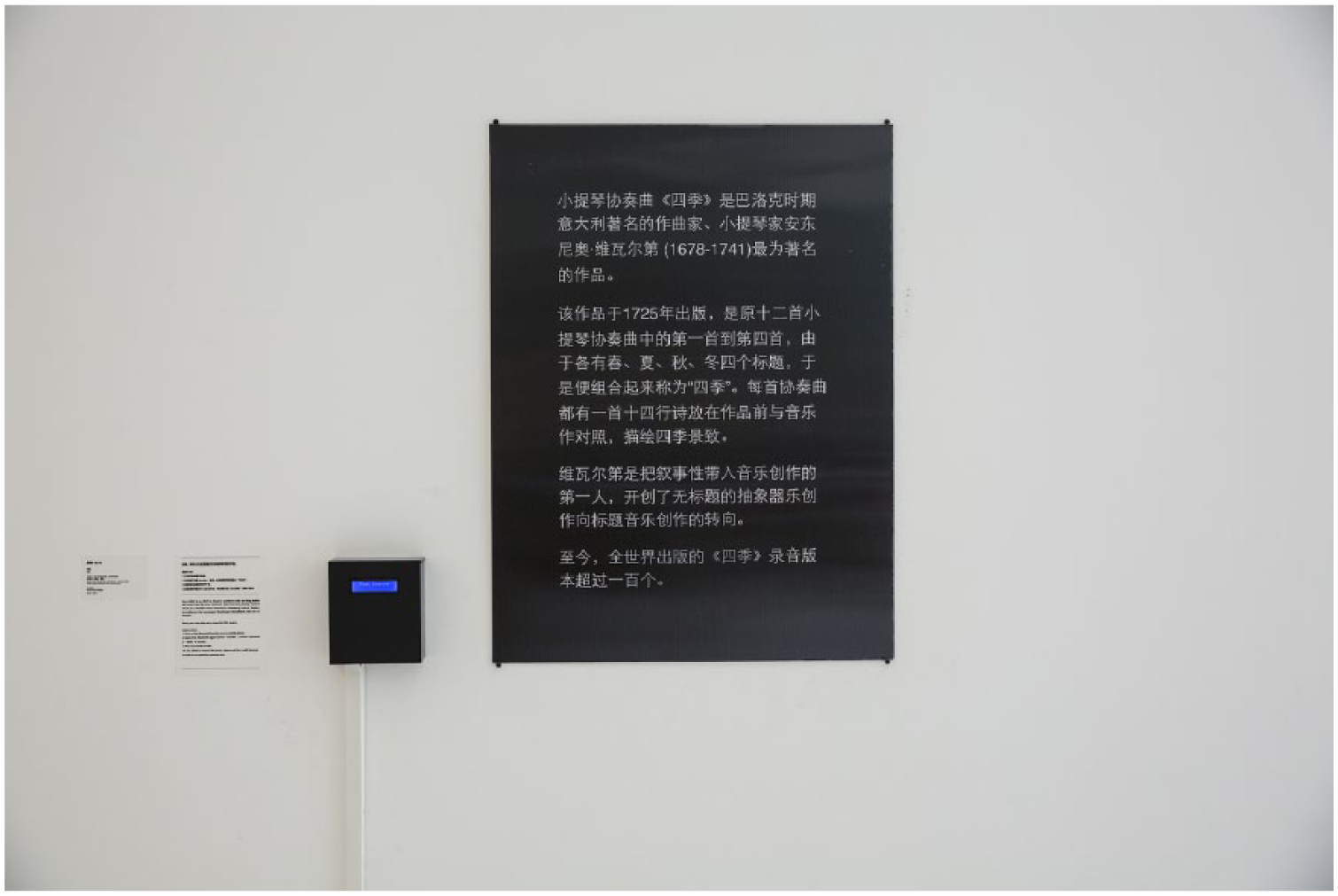
Gift, installation, 2017, photo by Yin Yi.
After returning to Shanghai, I always remembered the music in the square of the Hamburg train station. I talked about this matter with others now and again. Basically, everyone who heard the story would ask, how did music succeed to drive away loiterers?
In Germany, most of the loiterers I saw were not beggars, but self-marginalized people. Many of them were young people dressed in punk or heavy metal style. They had strong taste in music based on their cultural consciousness. Due to their loyalty to the subculture, they resisted classical music and electronic music that represents middle-class taste.
In March 2017, I placed my sound work Gift at the entrance of the Beijing Yang Art Museum. The work consisted of a Bluetooth audio receiver, a customized sound player and a lenticular sheet. The special grating plate included two overlapping paragraphs: One was the background to Vivaldi’s Four Seasons, the other explained why Hamburg Railway Station played Four Seasons. You could not see the two texts on the same lenticular sheet at the same time; you had to change your visual angle to see only one of them.
In the default state, the work plays Four Seasons in loop. The audience could play their own music using their phone to connect with the Bluetooth audio receiver. When the audience played their own music, the Four Seasons would automatically stop and vice versa.
How does sound become a tool as well as a violent weapon to discipline our body? How does it take effect? In public space, who will decide the contents we hear? When people have the right to decide what they listen to, will they exercise the rights, and how? How does music connect with ideology and what is the intensity of this connection? What is the cultural context of this connection? These are questions I hope to explore through the work “Gift.”
During the time I was producing “Gift,” I went to Lu Xun Park again to record the old peoples’ chorus. They had changed their place, leaving the main road and moving to a smaller open space in the park. There were fewer people. To my surprise, there was a large noise measurement device placed near them, showing the decibel level in real time when they sang. Compared with the Hamburg government, Lu Xun Park’s management appeared neither technical nor artistic (Figure 3).
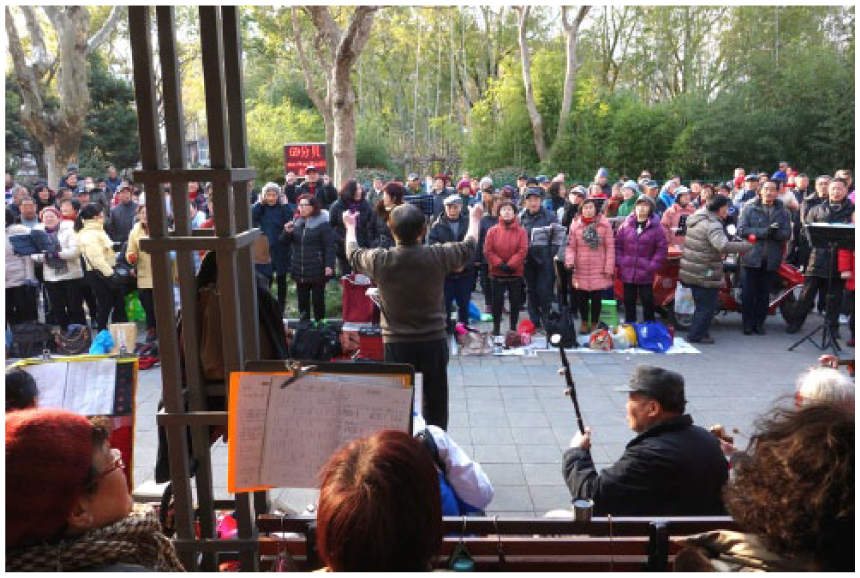
Singing in Lu Xun Park, 2017, photo by Yin Yi.