




Abstract
This article examines how dykes in London in the 1980s and 1990s conceived of cruising practices and erotic subjectivity in and through public spaces. It employs the notion of counterpublic to explore dyke cruising, both as a practice and as staged fantasies in the photographs of artists Tessa Boffin, Jill Posener, Ingrid Pollard, and Del LaGrace Volcano. The article examines why cruising – the search for intimacy, sex and belonging in public and a mode of producing space – became important to London dykes at this particular moment, when references to cruising appear in multiple lesbian anthologies, magazines and, more broadly, in visual culture. The photographs analysed here open a discussion about how different forms of public space (hypervisible, secluded, generic and semi-public spaces) impact on erotic desire. They illustrate that to intervene in public spaces, for example, around London landmarks and urban cemeteries, also involves intervening in the popular historical narratives of these sites. Counterpublics emerge here not only through the practice of cruising, but also by experimenting with popular historical narratives (by reimagining the tourist guide, statues and monuments and memory of the dead). The article argues that these experiments with history and fantasy contextualise cruising without overemphasising its liberatory potential. By creating a link between fantasy and reality, the staged encounters explore how we come to know and be a part of different types of public space. They also raise the question of what makes an imaginary, sexual or political, possible in a particular historical moment.
‘Maybe it is true, and wouldn’t it be wild if it were true, and who really cares whether or not it is truly true?’ (Butler, 2018: 2).
Introduction
‘Where do women cruise?’ This is the question posed in an issue of London’s short-lived early 1990s dyke magazine Shebang (Figure 1) by a young, presumably kinky gay man in leather in an advert for The Bell, a popular left-wing queer pub on Pentonville Road in King’s Cross
1
. He directs this question not to his female companion, who is wearing a more femme version of a similar black leather outfit (with leather shorts, jacket, cap and choker), but to the general public. Through his question, lesbian cruising becomes here a matter of public interest. They are both standing on the street. Her posture and facial expression are defiant. She replies confidently: ‘Only at THE BELL!!!’. His facial expression shows that he already knows the answer but enjoys asking her in public on the street. Her answer makes it clear that she already knows too. They want us all to know. Shebang magazine, Issue 2, February 1993. Bishopsgate, Jennie Lazenby Archive (LAZENBY/19).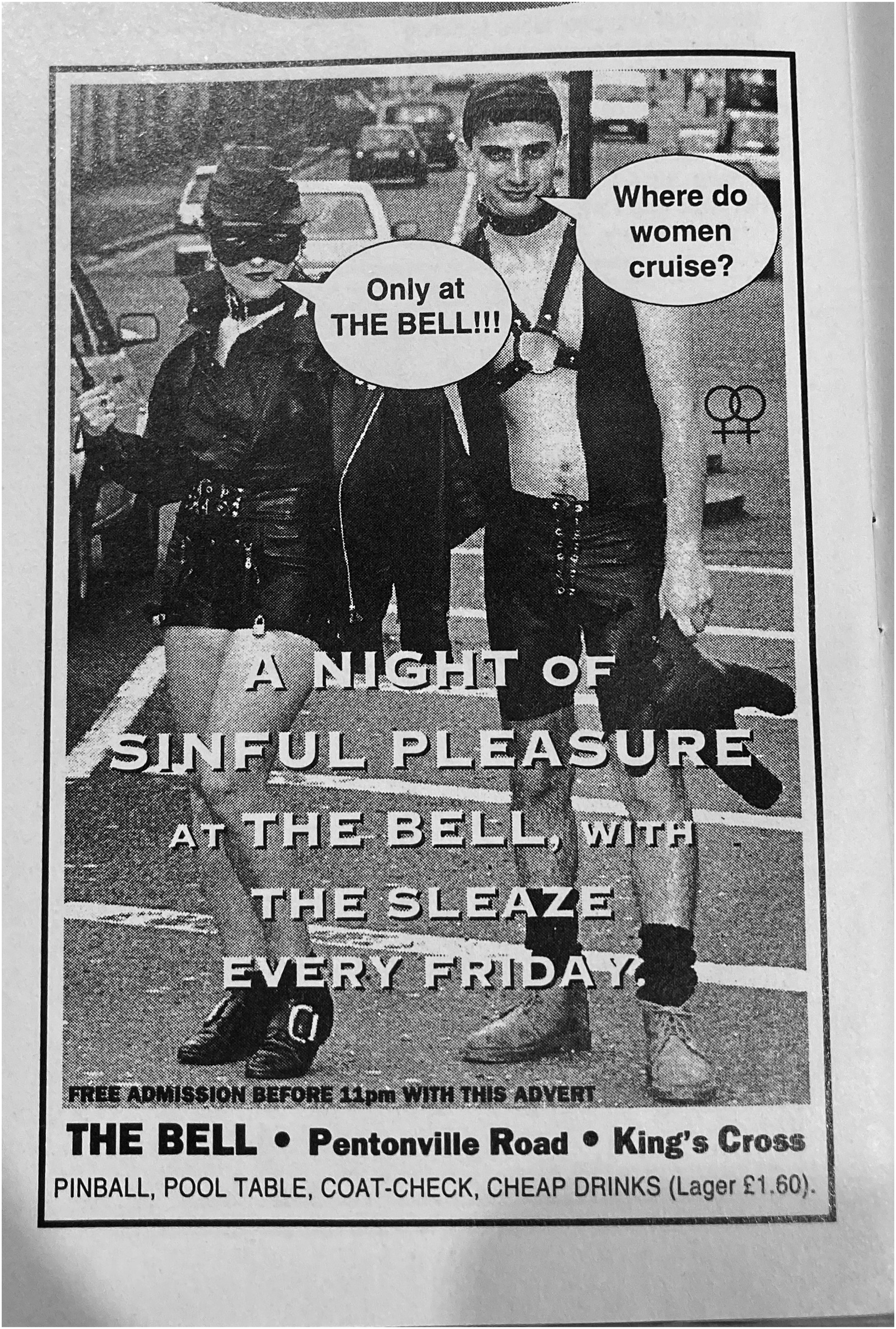
The question ‘Where do women cruise?’ in a lesbian magazine is important because we know a lot about gay male but little about lesbian, genderqueer or trans cruising. In the words of Del LaGrace Volcano writing about documenting queer dyke cruising: ‘It’s a strange absence, (Del LaGrace Volcano, 2025) 2 considering that there has long been an interest in cruising, not only as a historical practice (e.g., Delany, 2001; Espinoza, 2019; Houlbrook, 2005; Turner, 2003) but also as a form of queer enquiry into the politics of intimacy (e.g., Berland and Warner, 1998; Bersani, 2010; Espinoza, 2019; Munoz, 2009; Warner, 2002), urban inter-class contact (Delany, 2001), spatial agency (Brown, 2008) and the intersection of cruising and ecology (Gandy, 2012). The advert asks us to consider who is interpellated and what is explored when we talk about cruising. The direct naming of a lesbian cruising space allows us to explore the possibilities that exist for lesbians in public space and what it means to look at urban (public) space through the lens of lesbian cruising.
Taking this advertisement in Shebang as a starting point, the article draws on erotic photographs by artists Ingrid Pollard, Tessa Boffin, Jill Posener and Del LaGrace Volcano, a short film by Annette Kennerley as well as academic and community publications (primarily magazines and anthologies) by lesbians from the same period, to explore the significance of lesbian and, more specifically dyke cruising in 1980s and 1990s London. I use the terms ‘lesbian’ and ‘dyke’ interchangeably, to reflect how different artists and authors referred to themselves and their communities 3 . Rather than focusing on just the question ‘where do women cruise’, the article asks instead what dyke cruising makes possible. As such, the article explores a series of interrelated questions about how dykes imagine sexuality in public spaces, how they interpret and shape public space through erotic photography and what becomes possible for them through the potential of cruising. The article further analyses why cruising became important in lesbian conversations in London in the late 1980s and early 1990s. While the term “cruising” is less central to lesbian, dyke and trans histories, in this political moment, references to cruising appear in multiple lesbian anthologies, magazines and, more broadly, in visual culture.
The article first explores why cruising – the search for intimacy, sex and belonging in public and a mode of producing space – became important to London dykes at this particular moment and then – through a close reading of individual photographs – examines what erotic photography, as archive, can tell us about public space and about the limits and possibilities of counterpublic practices. 4 In particular, the article looks at the ways in which the photographers subverted popular historical narratives about public sites to alter the possibilities of these spaces. As such, the article hopes to contribute to discussions about urban public space, public history and counter-public practices at the intersection of history and queer theory. I refer to the cruising practices explored here as counterpublic to indicate their potential to prefigure social and political alternatives but also to point to their limit – they cannot replace political power building. While focusing on a specific context, London in the 1980s and 1990s, this article offers a broader insight into the ways in which lesbians, dykes and genderqueer people imagine their bodies and sexualities through public sites in a political moment of state disinvestment. The article contributes to analysing the role of counter-public spaces in the context of the closure of public spaces, for example through government cuts to public services, the loss of funding for community projects, arts and culture and often simultaneously the loss of legal rights and municipal and civic power.
Methodology and archival evidence: Erotic photography as historical source
The article works with visual archives, especially erotic photography, as primary historical source. There are several reasons for this, firstly the lack of more ‘traditional’ archival sources (e.g. government records and newspaper articles) and secondly the importance of photography and more broadly the creation of a visual lens within feminist and lesbian movements at this historical moment. As women did not have the same access to public and commercial spaces as men for a long time, the records of lesbian cruising differ from those of gay male sexual encounters. In The Lesbian History Sourcebook, Alison Oram and Annmarie Turnbull note that ‘[b]ecause the (British) male homosexual is a firm legal actor, there is far more evidence in legal records for men than there is for the homosexual woman’ (Oram, Turnbull, 2001: 6). This is also the case for gay male cruising. 5 Due to the state criminalisation of gay male sex and especially sex in public, court and police records, diaries and newspaper articles provide sources, albeit partial and problematic, for historical analysis (Houlbrook, 2005). The sources analysed here are of a different kind. Erotic photography documents the existence, potential and possibility of dyke cruising but, as Tessa Boffin points out, these photos are also deliberately staged and non-documentary. This does not make them less trustworthy historical sources, but rather a different kind of source. While these photos are a less reliable source for the exact way in which dyke cruising took place, they give us a very good idea of the desires it evoked in this moment.
There is, as Jennifer Evans writes, ‘much to be gained by viewing erotic photography as history, especially when we consider the emotional work of images in creating historical subjectivity in the changing places and spaces of viewing and display’ (Evans, 2023: 81). Evans argues that erotic images create historical subjectivity by constructing new social realities (including at different historical moments) as much as they document them. The images analysed here are to be understood in this way, in their immediate context, in connection with social movement histories and in the changing contexts in which they are viewed and displayed. The importance of the role of image making as subject making is also highlighted by the artists analysed here. Tessa Boffin and Jill Posener, for example, emphasise the role of photography within and alongside other political activism. Looking at the US context, Margaret Galvan argues that ‘we have overlooked how women wielded images to theorise their embodied sexuality directly’ (Galvan, 2023: 1). Galvan writes that what emerges in 1980s feminist and queer movements is ‘a visual vocabulary of sexuality and embodiment’ (Galvan, 2023: 6). Building on Galvan’s claim, this article asks: What is the importance of space and public places within this queer visual vocabulary? To explore this question, the article proposes a close reading of erotic photographs alongside publications by lesbians from the same period. It is notable that alongside Shebang, other lesbian magazines and publications also discussed cruising at this moment. A 1993 issue of the UK lesbian magazine LiP 6 , for example, features the article ‘Facts about cruising’, a personal story with cruising tips by the author and her friend. 7 The author, who has just broken up with her girlfriend writes: ‘Gonna get me onto the scene and have me a taster of this new upfront sexiness’ (Facts on Cruising, 1993: 8). 8 The visual analysis of staged cruising encounters is to be located in the context of discussions such as these in magazines, collective writing projects and friendship networks.
Working with erotic photography, this article speculates 9 on the relationship of dyke cruising between different types of public space. I use the notion of counterpublic as an analytic lens to describe how each photograph stages this relation. A close reading of each photograph reveals the counterpublics that emerge in and around each image. The article first looks at Abney, an urban overgrown cemetery in Stoke Newington, North East London, through the lens of Tessa Boffin’s photo series ‘The Knights Move’ and Anette Kennerley’s six-minute short film ‘Sex Lies and Religion’. Secondly, quotes from Kennerley and Volcano are used to analyse the significance of the semi-public space of the club for dyke cruising. Thirdly, the article follows Jill Posener’s ‘Dirty Girls Guide’ and its depiction of lesbian sexuality around London landmarks such as Big Ben, Harrods, Hyde Park and Buckingham Palace. Finally, I turn to a photo text by Ingrid Pollard, published in the fourth issue of Shebang, which explores Black lesbian desire through an unspecified but seemingly public space and encounter. This photo text depicts a moment of seeing, being seen and desiring, mediated by fragmented bodies and statues.
The photographs and short film illustrate four different types of public space (enclosed space, semi-public spaces, hypervisible space and public space in its abstract form, by which I mean visual references to a generic monumentality removed from a particular context) and how we come to know these spaces through popular narratives. The artists subvert forms of public history, for example by reimagining the genre of the tourist guide, memory of the dead, and the role of statues and monuments. They also offer us a starting point to think about how dyke cruising is mediated by other collective events (such as club nights, workshops and participation in political activism). Together, the photographs and film explore different aspects of lesbian cruising, including experimenting with gender and gender transgression, the shaping of desire through historic monumentality and colonial architecture and creating capacities for the enjoyment of public sites against their official use. The article explores these aspects through close readings of each photograph.
One of the primary sources for this analysis, alongside lesbian and dyke magazines such as Shebang is the 1991 photo collection Stolen Glances: Lesbians Take Photographs, edited by Tessa Boffin and Jean Fraser (Boffin and Fraser, 1991). I will focus on photographs and writings by Boffin, Posener, Pollard and Volcano, all featured in Stolen Glances. Not all photographs discussed here are in this volume (e.g., the photograph by Pollard is published in Shebang), moreover, some are not explicitly scenes of cruising. This volume is, nonetheless, a useful starting point as it brings together the writings and photography of lesbian photographers active in the UK and US in the 1980s. It explores lesbian identity in relation to race, class and disability and includes a historical and theoretical perspective on Section 28, censorship, pornography and SM cultures. Boffin and Fraser contextualise the volume, outlining why they are interested in photography that is deliberately staged and manipulated. Following Boffin and Fraser, the images within their collection aim to undermine the supposed naturalness of the straight image and of heterosexuality more broadly. Should these images, that are deliberately staged, be seen as records of actual encounters and practices or rather as archives of potentiality? Perhaps both is the case. To borrow a phrase from Judith Butler to describe the use of excitable speech, ‘maybe it is true, and wouldn’t it be wild if it were true, and who really cares whether or not it is truly true?’ (Butler, 2018: 2). Something else is also at stake.
What is important, as Jennifer Evans outlines in Photography as An Ethics of Seeing, is not just the meaning of the photograph but how it intervenes in the world, in this case how it helps to shape notions of erotic subjectivity, community and counterpublic practices (Evans, 2018: 2). The sources examined here (re)imagine lesbian sexuality and gender expressions by intervening in our understanding of place, popular or public history, and desire. They also assert the visual codes of pornography and gay male cruising and in so doing respond to discussions within the lesbian community in the early 1990s. As Cherry Smyth writes in Lesbians Talk Queer Notions, these discussions revolved around ‘more lesbians (…) discussing their erotic responses to gay male pornography and incorporating gay male sexual iconography into their fantasies, sex play and cultural representations’ (Smyth, 1992: p.42). 10 The photographs then do several things at once. While they stage rather than represent cruising encounters, they also respond and put into practice collective discussions. In this way, they are documentary. At the same time they also make an intervention. The photographs enact a public lesbian sex culture and spatial vocabulary of dyke cruising. 11 A close reading of each photograph can bring these overlapping layers of meaning to the fore.
A different claim to public space: Dyke cruising in context
In the 1980s, the advent of HIV/AIDS transformed gay cruising and queer activism. ‘Stop Clause 28’ and AIDS activism arguably united the queer community in the UK, but in a hostile and antagonistic political context. London LGBTQ + bookshop Gay’s The Word had been raided on 10 April 1984 by Customs and Excise officers who seized 144 books deemed to be obscene. Some sections of the feminist and lesbian movement also enacted censorship alongside the state. This led to lesbian produced erotic magazines, calendars, photography and anthologies being censored by some feminist and gay bookshops in the UK, including Gays The Word (Boffin and Fraser, 1991: 20). How does one understand one’s own body and desire in this context? How does one cruise, perhaps for the first time and not as a cis man? Although Tessa Boffin did not ask exactly this question, she describes the following sentiment in ‘Angelic Rebels’: ‘So what can a girl do? It takes some women years to come out. It takes some women years to become sexual. It takes some women years to talk about sex, let alone talk ‘dirty’’ (Boffin, 1990: 57) 12 . According to Boffin, lesbians had ‘just started talking through the pages of Square Peg, Serious Pleasure, and Quim, the first examples of lesbian erotica in Britain’ (Boffin, 1990: 57). Even if AIDS did not bring these conversations to a hold, it changed approaches to sexuality. Boffin made AIDS induced fear of sex and safer sex the topic of her photo series ‘Angelic Rebels: Lesbians and Safer Sex’, which suggests that AIDS activism can make it possible to engage in cruising and erotic desire once again, or perhaps for the first time, but in a transformed way. The article will return to this relation between cruising, political activism and - as the other images analysed here demonstrate - claims to public space.
Public sex is staged by lesbian photographers at a time when the relationship of queers to public spaces and institutions was contested and changing. As part of Margaret Thatcher’s war on trade unions and local government, the Greater London Council (GLC) was dissolved in 1986 under the Local Government Act 1985. With Ken Livingston, the GLC had come under a left-wing and socialist leadership in 1981, and it began to emphasise the importance of formal equality and rights, for example, with initiatives such as the London Charter for Gay and Lesbian Rights, citizenship and multiculturalism (Cooper, 1994: 2f.). In her book Sexing the City: Lesbian and Gay Politics within the Activist State, Davina Cooper calls this a ‘lesbian and gay municipal project’ (Copper, 1994: 3). While queer politics and policies were never straightforwardly integrated into municipal structures and provisions in the 1980s, the GLC’s limited queer municipalism ‘diverge(d) from the traditional relationship between the state and homosexuality’ (Cooper, 1994: 3). GLC funding of community centres and groups, arts and culture allowed for a different queer politics and engagement with the state. As Cherry Smyth notes in Lesbians Talk Queer Notions, ‘(t)he widespread defunding of the lesbian and gay voluntary sector in the post-GLC era meant reduced resources for lesbian and gay initiatives’ (Smyth, 1992: 15). Section 28 further made it clear that the British state would not tolerate open queer visibility and radical politics in and through publicly funded institutions. At the height of Thatcher’s power, amidst and despite HIV/AIDS and in the wake of the GLC, which for a moment had affirmed - if never straightforwardly integrated - gay and lesbian civic involvement, cruising still offered an avenue for queer placed-based belonging. But cruising makes a different claim to public space than lesbian and gay equal opportunities work within the GLC and local London councils had done. 13
In the late 1980s and early 1990s, the voices of gender non-conforming and trans people were not incorporated into local council and municipal policies, nor were other demands that did not fit easily into the language of equal opportunities (EDI). As Cooper notes: ‘Questions of butch and femme, cross-dressing, sado-masochism, for instance - all dimensions of internal gay and lesbian struggle - were neglected by municipal policies which aimed to treat all homosexual relations equally’ (Cooper, 1994: 177). When considering why cruising might be important to lesbian and dyke politics at this moment, perhaps we should consider its various more or less direct intentions to shift the realm of the possible. This includes representing what could not be a fundable municipal project, expressing solidarity with gay men and a claim to gay histories of public sex, playing with gender, sex and erotic desire beyond identity, exploring butch, femme, non-binary and trans masc erotic subjectivities in particular, but still doing so through a claim to the city.
Secluded public space: Memory of the dead and gender affirming erotic encounters in Abney Park
Abney Park, along with other urban cemeteries, has long been known as a place for gay male cruising in London (Brown, 2008; Cook, 2016; Gandy, 2012; Turner, 2003). In his thoughtful study ‘Queer Ecology: Nature, Sexuality and Heterotopic Alliances’, Matthew Gandy examines how gay male cruising and ecological diversity intersect through the lens of queer ecology. Gandy traces the history of this overgrown nineteenth century cemetery, which fell into disrepair and was abandoned from 1972 until Hackney took municipal ownership over it in 1979. While abandoned, plants began to overgrow and both its biodiversity and popularity as a cruising spot increased (Gandy, 2012: 728). 14 Although the cemetery is now managed again, it is still an important site for biodiversity in London as well as ‘an internationally recognised site for cruising by gay men’ (Gandy, 2012: 729). Gandy skilfully outlines the overlapping interests and alliances that have formed between cruisers and other park users (e.g., bird watchers, nature enthusiasts, sometimes heritage organisations, dog walkers, teenagers), linking cruising to other forms of social and cultural practices that constitute what Gandy terms ‘forms of site-specific spatial insurgency’ (Gandy, 2012: 734).
Gandy emphasises that many parks, squares and nature reserves in London have always been important places for sexual activity, including for heterosexual couples and sex workers, and not just for gay men. Towards the end of his article, he briefly addresses the gendered nature of cruising and asks: ‘To what extent does male cruising hold a liberatory potential that cuts across gender differences?’ (Gandy, 2012: 740). Gandy is right to point out that the historical associations with public sex and cruising are predominantly male (Gandy 2012: 740). But Abney in particular is also a place where dyke cruising and cruising fantasies take place. For example, the cemetery features as a site of dyke cruising in Tessa Boffin’s 1990 photo series ‘The Knights Move’ (Boffin 1991); Anette Kennerley’s 1993 short film ‘Sex Lies and Religion’ (Kennerley, 1993). These sources contest a framing of public sex as only gay male or heterosexual. Gandy, who does not directly engage with Boffin and Kennerley, rightly calls for the violent and exploitative dimensions of public sex to be analysed alongside accounts of gay male cruising. But surely consensual, joyful public sex between women, non-binary and trans people also deserves to be mentioned and would also bring to light barriers (e.g., through design, accessibility, or recourse to leisure time) to enjoying public spaces.
Set in Abney, Tessa Boffin’s black and white photo series places a series of characters, a knight, a knave, an angel, a casanova and a lady-in-waiting, ‘into the great heterosexual narratives of courtly and romantic love (…)’ (Boffin and Fraser 1991). These prototypical historical figures articulate a lesbian desire for historical role models and for erotic fantasy. I argue that Boffin’s fictional historical figures are, among other things, cruising. As Cherry Smyths writes in her commentary on Boffin’s work, ‘(t)he location of the piece, the cemetery, not only summons our dead heroines, from Janet Flanner to Gertrude Stein, but also vibrates with the frisson of public, outdoor sex. Gay male sex’ (Smyth, 1996: 109). Boffin’s photographs draw our attention to the site-specific practices of the cemetery, recognising it as a space of spiritual curiosity and heightened emotional feelings. This liminal spiritual space lends itself to Boffin’s experimentations with history, historical narrative and gender. In this secluded space, Boffin’s historical figures don’t seem out of place. After all, Abney ‘was the main burial ground for Dissenters who were members of non-established churches and was open to all regardless of any religious affiliation’ (Nowak, Roynesdal, 2022: 1195). As Zachary Nowak and Kary Roynesdal note in their account of the ‘botanical politics’ of public sex environments, ‘Abney Park’s non-conformist history starts with its establishment as the first nondenominational cemetery in Europe’ (Nowak, Roynesdal, 2022: 1195).
The photographs engage playfully with gender, raising the question of who is cruising historically and in our imagination. Boffin’s choice of characters (knight, knave, lady-in-waiting, etc.) shows how ideas of masculinity and femininity have changed throughout history, and it also asks who can place themselves in the role of these characters. Boffin states elsewhere that she does not believe that gender is ‘a necessary prerequisite for identification’ (Boffin, 1988: 159). Perhaps it is the play with gender that facilitates the appropriation of gay male cruising in her work. 15 While cruising is not the central aspect in ‘The Knights Move’, it forms a part of Boffin’s reclamation of history, a spiritual calling of deceased dykes, a play with gender and an intervention in public space. The photo series suggests that cruising holds a gender-affirming potential for dykes, for example through the exploration of butch and femme gender roles and sexuality, in the play with historically available forms of masculinity and femininity (and, though less explored here, the structuring role of race and class in this) 16 , and for masc genderqueer people, including butches, studs and transmasculine queers, through its long association with gay male culture.
Semi-public spaces of experimentation: clubs, pubs and bars
Annette Kennerley’s six-minute short film ‘Sex, Lies, Religion’ is a more explicit dyke cruising fantasy shot in Abney Park (Kennerley, 2017). 17 Although the film is set in Abney, Kennerley points out that club nights were as important to dyke cruising and the making of the film. She explains that ‘’Sex, Lies, Religion’ emerged from a random encounter at the short-lived Clit Club in Vauxhall’ (Kennerly, 2019) where discussion groups and workshops allowed herself and others to explore ideas about lesbian sexuality and politics (Kennerley, 2017). Talking about their collection ‘Love Bites’, 18 one of the first photographic monographs of queer dyke sexuality, Del LaGrace Volcano also reflects on the experimental nature of dyke club nights. Volcano explains:
‘Chain Reaction was the name of the queer dyke sex-performance club we ran (…). Rather than bring my camera into the club, a sacred and profane space, we often went out into the world and created public spectacles of ourselves: on top of Soho skyscrapers and the infamous and broken Cold Store overlooking the Thames. We posed and performed for each other, in parks and alleyways, in the back of Camerawork Gallery on the Roman Road in Bethnal Green (…) (Del LaGrace Volcano, 2022, https://web.archive.org/web/20220929163250/https://www.dellagracevolcano.se/gallery/love-bites-23196221). 19
The importance of pubs and club nights is also apparent in lesbian magazines. Returning to the same issue of Shebang discussed in the introduction, the opposite page advertises a new photography exhibition, ‘Undressing the Forbidden’, by Del LaGrace Volcano (at First Out Café Bar, Del LaGrace Volcano ‘Undressing the Forbidden’ 1993). 20 The erotic photo promoting Volcano’s show is surrounded by lesbian bar listings and ads for club nights and women’s only discos, including the advertisement for The Bell. As such, the ad illustrates well the above quotation. The fact that the erotic image of the photography exhibition is surrounded by listings of lesbian bar and club nights tells us something about the production of the photograph and the possibility of dyke sex cultures and erotic photography in the 1980s and 1990s. As Volcano notes, the interracial couple pictured (one of whom later transitioned) were part of their London queer friendship network and were involved in many of their photo and film projects. 21 Sarah F. Green writes in her work on lesbian feminist groups in London and this also applies to other lesbian and queer groups: ‘Friendship networks were involved in much lesbian public activity’ (Green, 1997: 60). The placement of Volcano’s ad in Shebang draws our attention to the boundary between public and private and the play with gender in erotic desire. But the photograph also disrupts an understanding of gender and desire as fixed and binary. It questions the supposed cisness of the advertised spaces that surround it (women only discos and events) and whose bodies and desires they support (e.g., invisibilising trans, nonbinary and intersex experiences). 22
The staged cruising fantasies in cemeteries and streets were in part made possible by other encounters and spaces, such as club nights, which are not captured by the camera. The semi-public nature of club nights offers an opportunity to experiment with gender and desire, while descending to more visible public spaces in a group can offer greater safety. As Cherry Smyth writes about cruising in Abney, (i)t’s only in gangs that we can be seen there’ (Smyth, 1996: 109). Lesbian cruising, as Jennifer Evans, Martin Lücke and Lorenz Weinberg note, requires closer attention to semi-public pursuits of pleasure in community venues, club nights, and at group events (Evans et al., 2023: 77). Looking at twentieth century German lesbian history, Evans, Lücke and Weinberg argue that if we shift our focus to events that bring together groups of lesbians in a specific public or semi-public space, for example if we look at flirtations at lesbian congresses, conferences and networking meetings, 23 other cruising practices become visible (Evans et al., 2023: 77).
These observations are also shared by Denise Bullock, who, in her article ‘Lesbian Cruising: An Examination of the Concept and Methods’ in the Journal of Homosexuality (Bullock, 2004) argues that the lesbian bar is the most accessible cruising ground for lesbians. 24 Drawing on ethnographic research and interviews, Bullock describes various aspects and styles of cruising in lesbian bars in the USA between 1979 and 1992. According to Bullock’s research, lesbians at this time ‘do not have a single, common definition of cruising and many find the term quite objectionable’ (Bullock, 2004: 6) due to negative associations with non-monogamous and impersonal sex and a fear of being labelled promiscuous (Bullock, 2004: 7f.). This becomes apparent in the interviews. Among the many humorous and matter of fact descriptions of Bullock’s interviewees, are also some that condemn and shame those whose ‘sole purpose is to go out and pick up a woman’ (Bullock, 2004: 16). Gender expression, ethnicity, body shape, membership of friendship networks and the ability to move casually around the bar, that is a code of ‘good lesbian behaviour’, determine how a person is perceived. 25 While the bar, a semi-public space, offers lesbians a safer place to flirt and cruise, perhaps creating the conditions of possibility for going out and desiring more openly in hypervisible spaces, it is not a space that is free from judgement and can be a place where judgements and social codes are amplified. In the UK we can see a similar pattern, when looking, for example, at the policies and debates about who was allowed to use the premises of various gay and lesbian spaces in the 1980s, for example the London Lesbian and Gay Centre in Faringdon (discussion about inclusion of bisexuals and SM groups, racism in the gay scene see Campkin, 2023), the Lesbian Centre and Black Lesbian Group in Camden (exclusions of trans lesbians and those visibly involved in S&M dyke cultures), 26 and various workshops and conferences on sexuality where admission of lesbians who did not adhere to a certain dress code and sexual behaviour was debated (Healy, 1996).
A guide to cruising hypervisible public spaces: Tourist sites and colonial architecture
How do you find your way around a city like London for the first time or rediscover the places that you pass again and again and that have become the backdrop to your everyday life? In Backward Glances: Cruising the Queer Streets of New York and London, Mark. W. Turner writes of his cruising encounters: ‘To begin with, it was a guidebook’s London for me - Westminster and the Houses of Parliament, Trafalgar Square, Piccadilly, St James’s Park - that first captured my imagination as a young visitor’ (Turner 2003: 69). Jill Posener, too, invites us to encounter a guidebook’s London in search of desire. The photographs of Posener’s ‘Dirty Girls Guide’ are easily localisable, featuring two white lesbians making out and posing in front of London landmarks from Big Ben and Harrods to Buckingham Palace. 27
Posener plays with the genre of the tourist and gay travel guide. 28 Guides such as the lesbian feminist Gaia’s Guide for Women, which was popular in the US and UK from the mid-1970s to the early 1990s, have historically created networks for sexual and gender dissidents to share practical information and resources. Yet, the political horizon and participatory nature of guidebooks such as Gaia was limited. As Alexandra Diva Ketchem notes, Gaia was primarily shaped by its white middle-class editors and readership, who determined what was considered safe, desirable and alluring (Ketchem, 2019: 503). 29 The mainstreaming of gay tourism and the professionalisation of gay travel guides in print and online media, which primarily target financially stable young white cis male travellers, have further undermined a participatory queer mapping culture. Scholars such as Christopher Ewing have analysed the sex tourism found in many gay male magazines and travel guides such as Spartacus, and their global economic and (neo)colonial implications (Ewing, 2023). 30 That’s not to say, of course, that travel guides aren’t read critically, joyfully against the grain or edited by readers. They are also, as Ketchem reminds us, ‘ephemeral objects, often becoming outdated moments after they are published’, yet providing a record of the existence of venues and the popular use of public spaces (Ketchem, 2019: 513). When considering Posner’s guide, we will have to engage with these different dimensions of the (gay) tourist guide.
As the title suggests, Posener’s ‘Dirty Girls Guide’ conveys a sense of sexual adventure and a break from everyday duties and heterosexual conformity. Travelling safely is not the main purpose of this guide. But like other guidebooks, the ‘Dirty Girls Guide’ aims to be easily consumable, creating a popular knowledge of what to expect in central London. By taking up the genre of the popular travel guide, Posener creates a sense of concrete possibility. The ‘Dirty Girls Guide’ is an invitation not just to look at these photos, but to imagine that you are immersed in the scenes, walking and feeling these streets. The photo taken on Westminster Bridge, for example, depicts a favourite place for tourists and newlyweds. Monumental sites and architecture often aim to keep sexuality at a distance. Westminster bridge with Big Ben in the background is a public space, where intimacy and sexuality have historically not remained taboo. Inserting themselves into this common motive, Posener’s couple project a lesbian belonging and perhaps a lesbian undoing of tourist London. But what kind of critical intervention is Posener’s photo series suggesting?
In Monuments as Cultural and Critical Objects: From Mesolithic to Eco-Queer, Thomas Houlton examines the ways in which monuments and monumental architecture conceal and disguise power (Houlton, 2022: 108), and how, in the important attempt of creating visibility, LGBTQ + claims to cultural heritage can replicate the aesthetics and politics of colonial monumentality. Houlton asks us to consider how colonial and imperial architecture not only shape the space of the here and now but also project the use of public space into the future (Houlton, 2022: 112f.). What does it mean to pose in front of and thus to insert oneself into London’s colonial and imperial sites which, as John Siblon writes, ‘‘remember’ a very white story whilst a more inclusive one is ‘forgotten’’ (Siblon, 2009: 152). If it is the guide’s intention to visually subvert state power by positioning two white dykes in front of London landmarks and their colonial memory culture, then the political implications and success of such visual representation need to be analysed more closely. What freedom and disruption of the colonial futurity projected by central London sites such as Buckingham Palace and Houses of Parliament can be gained within this moment of queer desire. What kind of opening into public space is created by this fantasy? And who would see themselves represented in their desire? I suggest that we read these photos not as an attempted subversion of power, or to visualise lesbian sexuality in public, although they aim to do that too, but to consider them as a snapshot of a life that includes the regular demand for a different use of public space. In what follows, I argue that the primary aim of these staged photographs is not subversion, but the recording of a moment that is understood as part of a broader political life.
We might be tempted to view Posener’s collaborators, with their spiky short hair, leather jacket and faux fur, as out of place in central London, but it is worth considering that they know it well. They might have lived or worked locally and come to central London for numerous reasons. If, for example, they were involved in protests and direct actions in the 1980s and early 1990s, protesting Section 28 or joining the Poll Tax riots, anti-apartheid rallies, anti-racism and Pride marches, HIV/AIDS activism or OutRage!, they would have been regular visitors to central London, passing Big Ben and the Houses of Parliament on their way to and from and during an action or march. 31 Perhaps these images are a return to central London, to make a public spectacle and demonstrate by other means that these are ‘our streets’. In this case, the staged scenes would be mediated by other collective actions and gatherings that allow the protagonists to gain the confidence to move more freely in public. The couple’s positioning among London’s landmarks is then not only the result of the photo shoot, but also of other actions. In this case, similar to Del LaGrace and Kennerley’s descriptions of what motivated and enabled their work, the intimacy in these images is mediated by collective events. The confidence gained in a crowd might translate, albeit not directly, to other ways of navigating hyper visible public spaces. In other words, we might feel comfortable openly expressing desire in front of Big Ben and other public sites because we’ve been here as a crowd.
I suggest this interpretation because Posener seems not to want the ‘Dirty Girls Guide’ to be perceived as escapist and isolated from other activities, especially political activism. In the reprint of the guide in Stolen Glances, Posener lists a number of activities in a text introducing the photo series. These activities include sex in public, writing slogans on the wall, abseiling through the House of Lords and participating in ACT UP (Posener, 1991: 204). Posener writes: ‘If we don’t take up public spaces, nobody will hear us. The state isn’t in any mood to help our cause’ (Posener, 1991: 204). Here, lesbian cruising and the creation of an erotic fantasy is one form of intervention and mobilisation of public space, alongside other activities and political actions. Posener’s text suggests that her protagonists, through regular visits, gained a good understanding of different central London sites, including of neighbouring and less visible streets and venues. This means that if they were harassed while cruising, they would know where the nearest underground station is, which streets to take or where to find a friendly cafe or busy pub. In some cases, they will have been previously harassed by the police during a demonstration and had to escape. The connection of dyke cruising with political activism is illustrated in another of Posener’s photographs, which depicts a public toilet with the spray-painted text: ‘Women’s Bogs not Bombs’, followed by the anarchist and peace sign (Posener, 1986). Here too, the demand for a lesbian public sex culture, for a different use of public space and public money, is connected to broader political demands, in this case alluding to the women’s peace movement and camps at Greenham Common.
I am not suggesting that cruising is or should always be political in this way. Rather, I argue that the photographs of dykes cruising in the mid-1980s to early 1990s are mediated by other collective encounters from club nights to protests. The photographers understand cruising in relation to other political and collective activities, as a way of making public space against its intended use and repression by the state. In the 1980s, gay male iconography and lifestyles became more accessible to women, even if their adoption was heavily criticised by parts of the feminist and lesbian community as an embrace of violent male behaviour (Healy, 1996; Smyth, 1992; ). Images of dykes cruising did not just aim for visibility. As one of the authors in Shebang notes: ‘Not only are we real but we’re real in the way you won’t admit. We aren’t only adding to history, we are changing it’ (Snap Happy, 1992: 8). Cruising is asserted by dykes at a time when gay men were blamed for engaging in promiscuous and public sex and some lesbian feminists argued strongly against reclaiming gay male cultures. 1980s to early 1990s lesbian photography suggests that there is a place for pleasure and desire in our political and historical imaginaries. The photographers affirm what the Conservatives feared, namely that visibility and positive images were just a starting point. They also indicate that participation in collective projects and actions creates networks of possibilities and can open avenues to explore and experiment with public space more broadly.
Erotic subjectivity and historic monumentality as abstract form
In the fourth issue of Shebang, a black and white photo-text spread over two pages announces ‘I see you, already I am intoxicated’ (Pollard: 1993). 32 In Ingrid Pollard’s artwork, we encounter a cruising gaze, both in text and image. ‘I see you’ works in more than one way. I see you in public, I don’t know you (or I didn’t know you before), but I desire, and you are desirable (even if trouble). In the following, I will describe the photo text to examine the counter-public emergence of erotic subjectivity resulting from the interplay of body parts and generic statues removed from their surroundings. The exact location of Pollard’s cruising scene or scene of meeting is unclear and perhaps not important. Fragmented and montaged body parts, the muscular back, the arms and head of a Black person appear alongside fragments of statues displaying similar body parts and postures. A second person, or rather an arm belonging to another person, can be seen in two of the cropped images. The generic white statues evoke the image and familiarity of public space in general. They could be anywhere in central London (or another European city). While abstracted from a specific space, there is yet a clear sense of navigating desire through space in Pollard’s photo text. The bodies of the protagonists become a part of and are seen through public statues and monuments, which carry partial and contested histories of the city. ‘Your touch on my skin on your skin my touch your touch on my skin on your skin my touch’ (Pollard: 1993). Arranged in a circular square, the text and mutual touch have no clear beginning and end. Who touches first becomes unimportant. Those involved have already gotten lost in each other. At the same time, the language of the body is interwoven with the gaze and posture of statues, mainly the movement of their arms and wings and the objects they hold: a sceptre, a trumpet, a harp and an olive branch. How do the statues and these objects mediate the desire expressed? Are they witnessing or actively shaping desire?
We only see the back of the protagonist. The statue, by contrast, is only depicted from the front with its upper body, arms and face, appearing as a counterpart to the person at the centre of desire. The gender of the two is not easily discernible. An arm flexing muscles is paired with the outstretched arm of a statue holding and blowing a long trumpet. The protagonist, with their arms around the back of their head, has a statue with a crown or headdress as a counterpart, looking at the viewer, holding and moving a sceptre in one of their arms. Whose history is being told here? Could this be part of the mutual touch? The statues remind us that our desire is not neutral and always navigates through the power structures and worlds we inhabit. At the same time, these sites afford a momentary break, a spot that hides us from passersby. There is a certain similarity between the posture of the person and that of the statue, but there is no definite likeness, a potential for mirroring one another that is not quite realised. Ultimately, the postures remain different, a generic history - trumpet, sceptre and headdress announce an epochal distance - does not quite become the here and now, never quite corresponding to the temporality of desire. The second arm tells of another touch.
In Unruly Visions, Gayatri Gopinath argues that ‘it is in the realm of the aesthetic that new forms of relationality and affiliation can be apprehended’ (Gopinath, 2018: 16). Photography allows us to see the intertwined nature of various bodies, landscapes, racial formations and historical experiences (Gopinath, 2018). Although she does not directly engage with Pollard’s work in this book, Gopniath’s observations speak to Pollard’s artistic practice which explores how landscape constructs us, particularly the relation of race, landscape and ideas of Britishness. In an interview with Tate Pollard explains that part of her work is an exploration of ‘(t)he hidden and the unhidden (…). How to place myself in any environment or location and how other people have done that throughout history. It’s also about encounter’ (Pollard, 2022). In this artwork, Pollard explores encounter and place through desiring bodies situated in an abstract landscape of historical monumentality. Pollard’s photo text suggests a relational understanding of subjectivity, where desiring bodies are embedded in social dynamics. The visual fragmentation of bodies and landscape is contrasted by a written text that narrates a fragmentary but clear statement of desire. 33 Bodies and cityscape seem to be at once undone and connected by a narrative of desire that could be described as sensual excess in the words of Amber Jamilla Musser. In Sensual Excess: Queer Femininity and Brown Jouissance, Musser invites us to turn towards a spatial mode of thinking sensuality (Musser, 2018: 29) to understand how structures of domination work to contain bodies and pleasures and how moments of brown jouissance transcends these constraints (Musser, 2018: 20). Throughout her analysis, Musser questions philosophical frameworks of the sovereign subject. According to Musser: ‘When sexuality is kept tethered to agency and sovereign subjectivity, it becomes easy to see that its organisation flows hierarchically, so that some subjects are perpetually given tenuous (at best) sexual citizenship’ (Musser, 2018: 37). Drawing on Lisa Lowe, Musser argues that ‘(i)n displacing the primacy of subjectivity, we move toward the space around the individual’ (Musser, p.42). In Pollard’s photo text neither the bodies nor the cityscape and its monumentality have total agency. It is the written text that speaks of agency and perhaps announces, in Musser’s words, following Treva B. Lindsey and Jessica Marie Johnson, ‘fully actualised erotic subjects’ (Musser, 2018: 39-40). It is the exploration of erotic subjectivity in and against historic monumentality that emerges from Pollard’s photo text.
In the landmark 1995 UK anthology Talking Black: Lesbians of African and Asian Descent, Valerie Mason-John and Adowa Okorrowa also argue for the importance of new epistemologies of the self and sensuality in opposition to the pornographic and scientific gaze of European sexual science. Mason-John and Okorrowa list the different sexual activities in which lesbians might engage, ‘from cruising; holding or observing hands; kissing; looking; stroking; teasing; rubbing; fucking; fisting; making love; using sex toys; lubricants; using food; role-playing; threesomes and group sex’ (Mason-John and Okorrowa. 1995: 89). Not only do Mason-John and Okorrowa include cruising in their open-ended description of lesbian sex they also incorporate an expansive understanding of space, asserting that women can express their sexuality anywhere they choose. This statement is not uncritical of the ways in which public and semi-public spaces are not accessible, enjoyable or open, but the conclusion of an analysis into the ways in which ‘Black lesbian sexuality is influenced by the colonization of Africa and Asia, the atrocities of slavery and by today’s racism, sexism and homophobia’ (Mason-John and Okorrowa. 1995: 72). Mason-John and Okorrowa note that contemporary society produces a wealth of material about sex but that most of it reinforces the European body shape and look (Mason-John and Okorrowa, 1995: 79). With an emphasis on the role of music, fashion, and style, they outline how Black lesbians in the UK have shaped changing sexual, erotic and gendered cultures. ‘Anywhere we choose’ is both a fact and a political demand. Perhaps this description of Black lesbian sexuality anticipates José Esteban Muñoz’ assertion that queerness is a ‘rejection of the here and now and an insistence on potentiality or concrete possibility for another world’ (Muñoz, 2009: 12). ‘Anywhere we choose’ is also a fitting description of the photographs discussed here. Boffin, Volcano, Posener and Pollard choose well known and familiar public sites for their explorations of desire. They take into account the site-specific histories and particular power relations inherent in different public spaces. In doing so, they create concrete possibilities for exploring erotic subjectivity.
Conclusion: The counterpublic capacity to enjoy public spaces
This article examines how dykes in London in the 1980s and 1990s conceived of cruising practices and erotic subjectivity in and through public spaces. Cruising, understood as the search for intimacy, sex and belonging in public, is visualised by dykes at the height of the AIDS pandemic, when gay men were blamed by a section of the media, government and public for participating in public sex cultures, and sections of the feminist and lesbian movement considered all male sexual practices, including gay male sexual cultures, as patriarchal and violent (especially pornography, erotic magazines, SM, and cruising). The photographs analysed here were taken as Section 28 came into force in the UK, and a municipal infrastructure, the Greater London Council (GLC) and its promise of municipal citizen involvement that had briefly and to a limited extent begun to include queers was dissolved. The political changes brought about by Thatcher-era Britain and the erosion of social housing, arts and cultural funding also impacted on the claims to public space discussed here. Funding for venues such as the London Lesbian and Gay Centre (LLGC) in Farringdon, the Black Lesbian and Gay Centre (BLGC) in Peckham, the Camden Lesbian Centre and Black Lesbian Group (CLCBLG) and other groups and venues was withdrawn in the 1990s. At this political moment, some London lesbians make a claim to cruising as a practice that generates a sense of erotic subjectivity and place-based belonging. The staged cruising encounters play with gender, sex and erotic desire beyond identity, exploring butch, femme, non-binary and trans masc erotic subjectivities. They do so through a claim to the city. And with the claim to the city also comes the city’s history.
The counterpublics in these photographs are expressed not only through claims to public space but also through their play with popular history. Abney Park and its history, as observed by Gandy, provide possibilities to different overlapping groups of people. Boffin articulates her demands to a history and erotic desire (which includes experimenting with gender) through this space and its temporality, for example by appealing to the temporality of the memory of the dead and the nondenominational spirituality of the cemetery, the life of female saints, angels and other figures, as well as alluding to the cemetery’s history of gay male cruising. In this way, Boffin harnesses the possibilities of this particular space and establishes a link between fantasy and reality. Jill Posener too intervenes in public sites by appropriating a popular form of public history, the tourist guide. Posener’s staged interventions in front of central London landmarks promote an erotic popular use of public spaces. The familiarity of the scenes - from tourism, promotional material, to family photo albums and film and TV - creates a sense of concrete, though not unambivalent, possibilities. Posener harnesses the ephemeral character of the tourist guide to explore a lesbian presence in hypervisible public spaces. The guide raises the question: What if we were to intervene not only in these public sites but in the way their histories are told and their futurity imagined? How could visibility and eroticisation operate differently? While Ingrid Pollard’s desiring bodies are removed from a specific space, there is yet a clear sense that desire navigates through the city’s claim to its history. How are ‘your touch’ and ‘my skin’ experienced through the landscape of Western European monumentality, which has long determined and dominated the models of interpretation of skin and touch? This remains an open question. In contrast to the desire manifested in cruising, in seeing and being seen in the moment, present in the here and now, the outstretched arms of the statues holding a trumpet, a sceptre and an olive branch bring a long view of history into the foreground. While the statues resemble the protagonist’s posture, they do not correspond directly to the expression of desire and temporality of cruising, suggesting that one is experienced through the other but not contained by it. The photo text invites us to consider the legacies of the UK’s colonial history and ‘monument mania’ (Siblon, 2009) on erotic subjectivity. But it also invites a reading in which the statues do not establish and reproduce the future of whiteness but are part of another erotic touch and futurity of desire. As such, the photographs open a discussion about how different forms of public space impact on erotic desire. Counterpublics emerge here not only through the spatial practice of cruising, but also by experimentating with popular historical narratives. The staged cruising encounters ask us to consider how we come to know and be part of different types of public space. The dyke viewer becomes implicated in these experiments with history and erotic fantasy and as such is an implicit part of the process of creating a counterpublic knowledge of these spaces.
The article refers to the practices explored here as counterpublic to emphasise that these staged encounters do not just portray a fantasy but imagine an embodied practice of public place making and through it an erotic subjectivity. Here, cruising is not understood as the liberal fulfilment of a personal desire detached from a concrete context. Rather, the photographs intervene in a specific site through its public modes of history. They create a link between the past, how we’ve come to know it, and a future that we’ve begun to imagine. They are counterpublic in this sense. The photographs depict a form of space making that runs counter to the intended public use of a particular place, but despite the explicit embrace of fantasy, this use does not seem unfamiliar. In the images discussed here, cruising as a practice is understood as one, though not the only or primary modality of claiming public space and its temporalities. 34 As counterpublic practices, these cruising encounters can prefigure new social and political realities, but they cannot replace political power building. Rather, the photographs suggest that there is a place for pleasure and desire in our political and historical imaginaries. In a similar way to the statement ‘anywhere we choose’, the photographs invoke a world where the structures inhibiting enjoyment of public spaces are no longer present. As Simona Castricum asks: ‘What if safety becomes permanent?’ (Castricum, 2023: 198). In ‘Music as a site of transing’, Castricum analyses how architecture as a practice and a build environment upholds essentialist, normative and binary frameworks of gender (Castricum, 2023: 193). She writes: ‘When your primary consideration moving through the built environment is surviving transphobia (and we can add: ableism, racism, anti-Blackness, Islamophobia and classism in all their intersections) and only secondarily navigating space, the capacity to enjoy the public domain is diminished’ (Casatricum, 2023: 204).
As Castricum outlines, when public space becomes primarily a question of survival, other modes of being and relating to others in public become diminished, especially the claim to desire, sensuality and erotic subjectivity. And yet, as John Siblon points out, public sites, statutes and monuments ‘can become spaces in which entangled personal and national histories are contested’ (Siblon, 2009: 146), that is, spaces where alternative uses and practices can first be experienced and then claimed. The photographs of staged cruising encounters allow the moment of enjoyment and experimentation of the public to be primary. Unlike accounts of gay male cruising, the danger of policing and criminalisation are not present in these accounts (though we do not know what happened during the photo shoots). 35 As such, the photographs arguably suspend the logic of the nation state, surveillance and policing for a moment, even if their long history and continued presence is not ignored. In this the photographers anticipate more recent interventions and a renewed and queered uptake of cruising and the lens of fantasy, for example in the manifesto and anthology Make the Golf Course a Public Sex Forest edited by Lyn Corelle and jimmy cooper in 2023. Here a privatised golf course in the USA is reclaimed as an erotic commons. Outlining its potential future history, the editors write at the end of their introductory chapter in the endnotes that ‘the land the Hiawatha Golf Course sits upon belongs to the Dakota people. Obviously it should in reality be returned to them, unconditionally, even if this means it’s not turned into a sex forest’ (Corelle and Cooper, 2023: 17). The authors consider the history and space around the erotic fantasy. From this perspective, as Musser argues, a different erotic subjectivity can be imagined.
The Bell, which advertised itself as THE place where lesbians cruise, closed its doors in 1995. An oral history project about The Bell confirms that this claim was not entirely unfounded (Hall, 2018). Gaia’s Guide also informed its readers that alongside pub prices, a dance floor and pool tables, they should expect a ‘cruisy atmosphere’ at the Bell (Gaia, 1985: 62). The pub was a popular cruising ground and beyond that, as Ben Campkin notes in Queer Premises, ‘an important site for forging of lesbian identities, and was where a diverse scene of lesbians, feminist allies, gay men, sex workers and leftists campaigners mixed’ (Campkin, 2023: 97). Much of central London, particularly King’s Cross where the Bell was located, has since been redeveloped and gentrified, opening up once again the question, where do dykes cruise (and mix with friends and comrades) and want to cruise in and beyond London and what would it mean to foreground these spaces. 36 As cruising captures the fantasy of another generation, how is the claim to erotic subjectivity through public sites and histories reconfigured? Following Volcano, Boffin, Kennerley, Posener and Pollard, imagining where we might want to cruise, entails experimenting with existing (gender, erotic, collective, every day, spatial etc.) practices, histories and encounters and recognising where they belong in our storytelling and imaginaries. Looking at the photos from a historical distance, for example seeing them in the archive rather than at home, in a park or collectively, will certainly have an impact on what becomes visible and seems possible.
The political and aesthetic stake of these staged encounters is to create a possibility, a link between fantasy and reality through an insertion into the popular historical narratives of public sites that does not overemphasise cruising’s liberatory potential but integrates it as part of a broader every day and political life, not detached from other collective work but also not entirely consumed by it, a moment that ‘maybe (…) is true’ and therefore can be seized. As such, the article argues that the staged photographs and discussions of cruising in lesbian magazines, anthologies and photography in the 1980s and 1990s raise the broader question of what makes an imaginary, sexual, political or otherwise, possible in a particular historical moment.
Footnotes
Acknowledgements
For the purpose of open access, the author has applied a Creative Commons Attribution (CC BY) licence to any Author Accepted Manuscript version arising from this submission. A special thanks to Maria Alexandrescu for their invaluable thoughts and feedback that helped me to think through this research, especially the spatial and landscape aspects of cruising and public sites. The research is also indebted to Alva Gotby and Pascale Siegrist, who read a draft and provided much valuable feedback, and to my History colleagues at Goldsmiths University of London, who generously and enthusiastically listened to and commented on an early presentation of this work. I am grateful for their generous support, collegiality and solidarity. I also would like to thank the students at Goldsmiths who I had the pleasure to work with, as well as those who attended talks on this topic at the Bishopsgate Institute and elsewhere for sharing their thoughts and insights with me.
Declaration of conflicting interests
The author(s) declared no potential conflicts of interest with respect to the research, authorship, and/or publication of this article.
Funding
The author(s) received no financial support for the research, authorship, and/or publication of this article.
