




Abstract
There is a kind of growing new media practice of capturing and mapping sound and an emergent global community of listeners interested in engaging with sounds of the environment, urban space, habitats and biospheres. Between user-driven Instagramming our everyday audio-visual experiences and professionally curated sound installations, there is an emergent space and a global audience for listening to ‘soundmaps’ of local and global environments. Sometimes interlinked and sometimes disparate, these communities connect to wider communities of practice and (environmental) activism in the context of social media, new media production and participatory cultures. There are also growing research initiatives that take up soundmapping as a way of inquiring into pressing spatial, geo-political and cultural issues primarily in cities and also in the endangered wilds. Interest in sound in a variety of interdisciplinary fields has grown exponentially over the last few decades. This article will externalize and analyse the frames of several emergent communities and their organizing themes as nascent in new media culture, and social networks specifically, as they intersect with phonography, creative soundmaking and ‘citizen science. By pointing out normative logics embedded in the practice of soundmapping, I then work towards a language of critical soundmapping by way of three examples that I suggest function as alternative forms of representation of and communication about sound environments: (1) the curated initiative Cities and Memory, (2) the creative research project London Sound Survey and (3) the climate change project Biosphere Soundscapes.
Introduction
Culture, after all, is a series of communicative acts, and differences in the mode of communication are often as important as differences in the mode of production, for they involve developments in the storing, analysis and creation of human knowledge, as well as the relationships between the individuals involved. (Goody, 1977, p. 37)
There is a kind of growing new media practice of capturing and mapping sound and an emergent global community of listeners interested in engaging with sounds of the environment, with habitats and biospheres. Between user-driven Instagramming our everyday audio-visual experiences and professionally curated sound installations, there is an evolving space for ‘soundmaps’ of local and global environments. Sometimes interlinked and sometimes disparate, these communities 1 connect to wider communities of practice and (environmental) activism in the context of social media, new media production and participatory cultures (Jenkins, Purushotma, Weigel, Clinton, & Robison, 2006). There are also growing research initiatives that take up soundmapping as a way of inquiring into pressing spatial, geo-political and cultural issues primarily in cities and also in the endangered wilds. Reinvigorated by contemporary work in technological histories of listening and audio (Lacey, 2013; Sterne, 2003), the cultural studies of sound has matured immensely and reached towards anthropology, sociology, race and gender studies, and critical geography, to name but a few (Sterne, 2012). Phonography and sound art (Lane & Carlyle, 2013) have made their own strides in theory and practice, intersecting legacies of acoustic ecology with the logics of new media culture. One manifestation of such cross-pollinations is the phenomenon of digital online soundmaps. As publicly engaging digital artefacts, soundmaps are important knowledge constructions, forms of communication and representations of space that have only recently begun to garner attention in academic circles (Anderson, 2015; Thulin, 2016; Waldock, 2011). If they are to serve, alongside visualizations and information displays as increasingly important forms of public-facing data, then we are in need of critical analytical frameworks for better ‘reading’ or rather ‘hearing’ the messages encoded into these novel forms of environmental cartography. Otherwise such crowdsourcing initiatives develop (and have been developing) under the apolitical rubric of Web 2.0 democratization of knowledge, celebrated across soundscape and sound art communities, and outside a critique of who, what and how is sonically represented.
This article will externalize and analyse the frames of several emergent communities and their organizing themes as nascent in new media culture and social networks specifically as they intersect with phonography, creative soundmaking and ‘citizen-science’ models of collaborative documentary and cultural archiving. Central to this project and underlying these soundmapping communities’ development are also the implicit histories of acoustic ecology and its particular ontologies of sound that inform grassroots developments in the mapping of sound. These histories reveal the inherent value systems of both documentary field recording and cartography as normative practices imposed onto the seemingly neutral medium of the soundmap. Mapping is discussed here as a profoundly political activity with the potential to reveal and redress sociocultural, racial and class relations latent in the metropolitan city and their tumultuous co-existence alongside natural and non-human habitats. Using frameworks developed in human geography, I analyse soundmapping as an artefact of public communication by de-normalizing its language, process and contexts of reception towards a formulation of critical soundmapping. I begin by building a theoretical framework for understanding the contributions, limitations and unique considerations that come along with mapping space and environment through sound. Pulling together conversations from radical cartography, sound studies and acoustic ecology, I offer a way of reading different types of digital soundmaps – from conceptual to geographically indexical – as communicative artefacts, public-facing externalizations of place, environment and human experience. By pointing out normative logics embedded in the practice of soundmapping, I then work towards a language of critical soundmapping by way of three examples that I suggest function as alternative forms of representation of and communication about sound environments: (1) the curated initiative Cities and Memory, (2) the creative research project London Sound Survey and (3) the climate change project Biosphere Soundscapes. The applied analysis will reference each of these soundmaps’ processes of engaging with field recording, their embedded assumptions about sound and listening and their community outreach in building local and global audiences. Within the field of soundscape studies, there already are a number of historical discourses across disciplines that theorize sound in relation to place and territoriality, ranging from sonic epistemologies as ‘poetic cartography’ (Feld, 2004), explorations of culture as ‘acoustic territories of place’ (LaBelle, 2010), conceptualizations of soundwalking as attending to place (McCartney, 2010) and soundscape composition as creative remix of emplaced aural experience (Westerkamp, 1998). These notions of territorialization link to participatory rubrics of ‘cybercartography’ (Théberge, 2005), an arguably antiquated term by now, but one that nevertheless signals an emphasis on the technology and domain of reception, and not on the content or process of mapping sound.
Soundmaps are geographic collections of individual sonic impressions of place normally involving geo-tagged audio recordings. Projects such as Urban Tapestries (Lane, Thelwall, Angus, Peckett, & West, 2003), Radio Aporee’s global participatory soundmap, New York’s (NY) SoundSeeker, Stanza’s project Soundities.org and HASTAC’s international collaboration of regional soundmaps (Ceraso, 2010) are examples of this increasingly globalized networked cultural practice. Their default view is an interactive map with overlaid audio tracks, making use of Google or Open Street Map web application programming interface (API), in contrast to global services such as Freesound.org and Audioboom.fm which allow geo-tagging of recordings but display them in themes, channels and other database views. Soundmaps can be graphic, conceptual, multimodal or digital artefacts that represent sonic locales in different ways, anchoring sonic information such as type, content, characteristics and relationships between sounds onto spatial representations of space. Using Cartesian logics, online soundmaps engage recording publics in supplying audio content, and in that they perform space in several overlapping formats: collaborative documentary, art installation, data gathering and cultural archive (Weird Vibrations, 2010). The format of each soundmap depends simultaneously on its designed constraints and on the participatory audiences interacting with it. By bringing together visual and sonic epistemologies, as Thulin (2016) suggests, soundmaps offer ‘rich ground for exploring how representations of time and space are performed between and across the senses’ (p. 2). In other words, soundmaps, within the paradigm of contemporary cartography, qualify as mash-ups by way of combining sound onto topographical information. Large-scale soundmaps are often crowdsourced, which, in the context of participatory social networks, ‘democratizes’ cartographic practices (Dodge & Kitchin, 2013), positioning soundmaps as ‘already’ radical and innovative. The reality of most crowdsourcing digital culture, soundmaps included, is much less diverse. Phonographic traditions and hobbyist field recording – echoes of the hi-fi culture of the 1990s – characterize the digital elites primarily contributing to projects of sonic cartography (Thulin, 2016). Digital divides both local and global place barriers to diverse perspectives, and with that, the idea that plurality equals democracy is also a myth sustained by the logics of neo-liberalism (Turner, 2013). This is precisely why the production of public knowledge via crowdsourced initiatives needs to be considered as a discursive system of practices, representations, values and power.
Frames of reference
To start with, how do we situate the seemingly ‘niche’ practice of soundmapping in relation to technological developments and respective cultural practices: mobile media moments within the workings of social media and digital knowledge production in a crowdsourced economy? In the cultural context of soundmapping, the problematic of recording straddles larger themes of cultural participation, the aestheticization and documentation of sensory experience, and questions around technological and cartographic literacy. More importantly, the contemporary technological moment resists any meaningful or effective separation of receptive audience and communities of practice: those who contribute to soundmaps are among their most avid listeners, and vice versa. Recording, soundmapping and consuming soundmaps are cultural activities dynamically reproduced within a cultural circuit that includes public conversation. Central to the digital labour of soundmapping is the crowdsourced economy ‘premised on mass participation with distributed voluntary effort’ (Dodge & Kitchin, 2013). In turn, crowdsourcing entails technological and social media literacy and a kind of digital citizenship predicated on shared online labour, but not necessarily a coordinated political aim. A condition of cyberculture, the novelty of soundmapping and the dynamics of participation echo Turner’s concept of the ‘democratic surround’ – a physical-virtual space of sensory information organized so that individuals may make sense of a complex world; at the same time, the democratic promise of such structures is always in danger of becoming too encircling and limited (Turner, 2013).
Soundmapping, simply put, is one way of having a ‘voice’ in the multiverse, where geographic representations of sound become de facto documentary archives of place. This is why it is important to situate soundmapping across several contemporary techno-cultural problematics: (1) the expectation of multimodality on social media; (2) an interest in de-normalizing institutional cartography and, as part of this trend, an interest in listening to the environment; and (3) the proliferation of information visualization as an increasingly popular tool for communicating sociopolitical information to the public. What is true of both infographics and soundmaps is neither are ‘value-free’ or objective representations of information, much as they manifest as such and invite communities to engage with them under the auspices of indexical neutrality. There is no one ‘soundscape’ of any given place, but a multitude of individual aural experiences. The next section delves into the unique aesthetic politics of soundmapping by drawing on discourses in radical cartography, situated within a conception of maps as artefacts of political communication.
What is radical in soundmapping?
Maps are ultimately representations; indeed the representation is chosen by those representing. They should be accepted as a subjective truth insofar that the map is an abstraction derived from something – the geographical territory – but it is not the thing itself. (echoxiii)
Contemporary developments in human geography and radical cartography provide invaluable alignments to understanding soundmapping. As argued by Denil (2011), Crampton (2009), Dodge and Kitchin (2013) and others, radical cartography is a movement away from ‘a niche-based study of maps as objects to a more comprehensive (and potentially interdisciplinary) study of mapping as practice, the knowledges it deploys, and the political field of its operations’ (Crampton, 2009, p. 840). What that means, in Denil’s terms, is unsettling the very concept of ‘mapicity’ – what makes maps artefacts of knowledge and communication. Some of the frames around radical cartography that Dodge and Kitchin (2013) propose include understanding maps as ‘ontogenic’ – a focus on maps as processes, whereby the process becomes the subject of study of values and epistemologies. Alongside Crampton (2009), who characterizes mapping as performative, participatory and political, Gerlach (2010) offers the notion of ‘vernacular’ mapping – a ‘co-fabrication of cartographies by human and non-human assemblages’, which function in an ecology of practice based on multiplication and difference. An important note to be made, however, particularly relevant to the normalized ‘participatory’ rubric in many soundmapping initiatives online, is that qualities such as participatory and vernacular (in contrast to institutional cartography) are not equivalent to ‘democratic’ counter-mapping. In fact, vernacular soundmapping tends to lack a sense of cohesive politics and, while reflective of a plurality of contributions, is not necessarily radical or counter-cultural. Still, as Waldock (2011) cautions, soundmaps as public representations of space have traditionally lacked the vernacular – the everyday, domestic soundscapes – and instead privilege what is not only institutionally significant but also still largely male-dominated perspectives of soundscape: local natural soundmarks, sonic icons, characteristic sound environments recorded by ‘digital elites’ with access and interest in phonography and field recording. One entire typology of sounds that are often missing are the everyday, mundane, domestic sounds or sounds of strife, inequality, alterity and resistance. Those voices somehow do not make it in these semi-institutionalized portals of sound, and that is an ideological absence we must highlight and shift. As Waldock (2011) aptly puts it,
… if soundmaps are a ‘permanent researchable resource’ (UK Soundmap), an ‘auditory archive of an environment’ (Montreal Soundmap), ‘a historical record and a subjective representation of the city’ (New York Soundseeker), then what is being constructed, in many cases, is a male-dominated record of sound, an insight into the significance of sound [from a normative perspective].
The normative logics of high-quality field recording, a branch of high-fidelity culture that operates as a masculine technological domain (Sterne, 2013), is thus one of the barriers in democratizing soundmapping. In contrast, the ability to record and upload audio recordings generated with at-hand mobile technology should, arguably, begin to redress this issue. And curiously, the rhetoric often used (still today) to describe a technological artefact’s transition from specialized to an everyday practice invokes the notion of ‘domestification’ – a feminized paradigm (Scifo, 2005). Such a discursive association certainly gives a new meaning to the relative lack of domestic sounds on soundmapping portals: soundmaps simply have not domesticated yet. To be clear, I am neither advocating that soundmaps become more institutionally legitimate nor that ‘domesticating’ them counts as radical representation. Rather, soundmaps ought to be subject to the same epistemological and ontological critiques that traditional as well as crowdsourced maps have received (Dodge & Kitchin, 2013), as part of a larger move to examine and redress the discursive frameworks of public communication. This analysis is also not meant to underplay the unique multimodal qualities that sound adds to topographical representations of space in their function as public documentary and cultural archive.
In the wider literature on acoustic ecology, as well as in emergent writings on soundmaps, sound is foregrounded for its ability to breathe both a sense of temporality and spatiality into Cartesian grids (Anderson, 2015; Thulin, 2016). Soundscapes unfold in time, and aside from offering at-a-glance view of geographical place, they are also experienced in time. As Anderson (2015) points out, there is no way to ‘zoom out’ of the soundmap and ‘hear the world’ the way that visual maps allow for a holistic grasp of geographical contours. Sound ‘re-narrates borders’ by performing boundaries as process (Crampton, 2009, p. 845). Even when located on a grid, soundscapes by nature traverse and overlap geographical boundaries: sounds can be heard from afar, from elsewhere, from completely different indexical places than those to which sound files are attached. The process of audio recording itself is a techno-cultural artefact that uniquely positions the listener and constructs a particular sonic reality of place. In other words, what audio recordings on a geographical grid represent is only one of the many possibilities of sounds that may be heard in that place; we may also hear sounds that belong elsewhere spatially and sounds that are temporally incidental. The audible in soundmaps therefore challenges the fundamentals of what does and does not ‘represent’ a given environment.
Does that make soundmaps already radical? The same discourses around soundscape studies and sound art also frame sound as inherently subjective and artistic: qualities, which align with Dodge and Kitchin’s (2013) conception of mapping as ‘a processual, creative, productive act, constructed through citational, embodied and contextual experiences’ (p. 19). Yet, the epistemological aspects of soundmapping as digital knowledge production are not typically discussed; thus, there is a need to develop critical tools for assessing the nuanced ‘normative logics’ implicit in the emergent grammar of soundmapping (Anderson, 2015; Thulin, 2016; Waldock, 2011). We need to articulate strategies for decoding the way that different soundmapping approaches operate as public knowledge practices for the communication of local and global sound environments. This is necessary in order to get at ‘democratizing’ this potentially important medium and developing explicitly critical practices of representation. The following are three propositions that form a model for such discursive analysis.
The soundmap as a communicative artefact: the grammar of mapping
Radical cartography’s focus on the map as process and not product (Crampton, 2009) points to the need to examine soundmapping representations as ‘texts’ comprising discursive gestures that follow a cohesive grammar of mediated communication (Manovich, 2016). What makes a map recognizable as such – it’s ‘mapicity’ – argues Mark Denil (2011), is a form of literacy grounded on mechanisms of competence. This language or schema is then shared by the intended communities that receive and interact with the soundmap. Adopting a critical perspective of field recording as a subjective (Westerkamp, 1998), self-reflexive (Anderson & Rennie, 2016) and multisensory praxis (Ceraso, 2014), we may examine here how different soundmaps reflect, permit or disavow the subjectivity of mediated listening and thus the potential for communicating listener experience. Furthermore, we may survey how the representation of place – of local and global environment – is performed as part of the soundmap’s tapestry of soundscapes in terms of manner or forms of alteration, transformation and reconstruction. What modalities is sound represented in and how are the formats of transformation manifested? More importantly, we need to understand how soundmapping as a seemingly neutral ‘sonic representation of place’ has particular histories and is rooted in ontological and epistemological traditions. These histories encompass acoustic ecology, phonography and their more recent intersections with mobile media production within a paradigm of prod-usership and spreadable media (Jenkins, Ford, & Green, 2013; Manovich, 2016). Specifically, I suggest a soundmapping grammar may include aspects such as: the representation of space/time visually and indexically, any textual annotation or subjective interpretation required or possible, visual iconography of different sound typologies or audible characteristics, and clarity of political content or aims.
The soundmap as process: recording cultures
[also important is] the relationship between these contributions and the potential formation of recording cultures on these websites; a recording culture that is constantly produced and reiterated by the soundmaps. (Waldock, 2011)
Borrowing from advances in the decoding of cartographic epistemologies, Thulin (2016), among others, argues that one of the most important aspects of ‘cartophony’ or soundmapping has traditionally relied on normative logics that include high-fidelity audio recording and hobbyist phonography, inspired by early soundscape initiatives such as the World Soundscape Project (WSP) (Schafer, 1975) and nature phonography such as the Great Animal Orchestra (Krause, 2012), among others. These cultures veer towards documentary and conservationist agendas and in that soundmaps-as-knowledge products constitute particular choices and absences in what is represented (Waldock, 2011); these presences and absences are directly related to the cultures formed around mediated engagement with soundmaps. With that, the tools of participation deserve a closer look. The transition from using an external microphone to recording directly with a smartphone has been a significant one in the short history of popular field recording. Not only does the type of equipment used imply a different contributor base, it transforms the possibilities of subjective aural experience in specific ways: as Westerkamp (1998) and McCartney (2010) emphasize, the ability of the microphone to heighten auditory experience by equalizing the sound level (and thus – perceived importance) of all sounds in a given acoustic environment shapes the very process of recording. A recordist hears what he or she is recording in real time, while the external microphone lends itself to ‘zooming in’ to specific sounds – something that is less likely to occur in a situation of recording with the built-in microphone of a mobile device (and without real-time monitoring through headphones). At the same time, the trade-off between the control of real-time monitoring and spontaneous everyday recording echoes larger themes of soundmapping praxis that frame possible recording cultures: for example, manner and avenues of crowdsourcing, rules around authorship of sounds, restrictions of audio quality and formats including length and/or creative transformation, and social media sharing infrastructure.
The soundmap as public engagement: listening publics
Implied, intended and incidental audiences are an inseparable part of the communicative platform of soundmaps. Alongside the communities of recordists and contributors formed around soundmapping initiatives, there are also the listening publics formed by both the geographies of regions represented through sound and the imagined technological communities of participatory social media. One of the important things to explore here is that soundmaps, as mediated cultural artefacts with increasing political power, co-constitute how publics consume and listen to the soundscapes of their local and global environments. These paradigms of representation – the grammars and processes of soundmapping, and particularly the venues of dissemination and models for community engagement – all contribute to the formation of a public sonic discourse, an audible re-territorialisation of place and the sociopolitical relations within it. With this, some relevant features to consider here include the following: How is the public invited to interact with the soundmap? Is the soundmap primarily scientific, documentary or artistic? How is it presented to the public and is it part of a (critical) public conversation about environments?
Soundmaps as public communication
It is important to situate soundmaps within the increasingly important paradigm of information visualization in its public function as a communicative medium. These are the new languages of knowledge in the age of big data (Manovich, 2016). Like popular infographics, digital soundmaps rely on visual ontologies of spatial and other sociopolitical relationships; ontologies, which, as new media theorists point out, perpetuate crafted, selective and sometimes biased narratives (Cairo, 2012). Both the conceptual logics of popular digital infographics (including soundmaps) as well as their ‘virality’ as social media artefacts endow them with a sense of legitimacy, when in fact they embody normative choices and techniques around representation, accessibility and aesthetics. How does this translate to soundmaps? Graphic soundmaps – visual maps not containing audio – are representations of sound typologies, audible characteristics and spatial relationships between sounds. Many use custom annotation systems, focus on capturing specific themes of interest and potentially blend scientific and artistic approaches in the representation of data as seen in the two soundmaps presented in Figure 1. One of the most popular types of institutional graphic soundmap is the urban noise map. The familiar decibel ranges used as comparative health and safety standards for noise pollution frame the sonic environment as magnitude: as the presence and absence of noise. In the noise map of Bath (Figure 1, left), regions of higher intensity sound levels are colour-coded in conventional gradients of urgency, predictably following the contours of major roads, while the city centre features ‘noise service requests’ referring to registered noise complaints – a very slim selection of real-life experience of urban noise. Much of the rest of the map is silent, faded. Yet, silence and noise have always been the purview of economic privilege, sites of inequality and shifting social mores, manifested through much more mundane sounds (Bijsterveld, 2008). In contrast, here is a contextual account of mapping noise in Bath, from a Cities and Memory blog post, referencing both the subjectivity of the mapping process and the material limitations of recording tools – both elements missing from sonic infographic ontologies:
Bath is, by any standards, a stunning city to look at, however, that by no means translates into a sonic treat, and in fact can even cause problems. Bath actually sounds quite homogeneous, its visual distinctiveness not matched by a sonic character or key soundmark features. That very Bath stone, coupled with high walls and quite a hilly city centre, causes problems for field recording too – the sound bounces fiercely off the stone walls, meaning traffic noise especially seems amplified around the city centre, drowning out more characterful sounds.
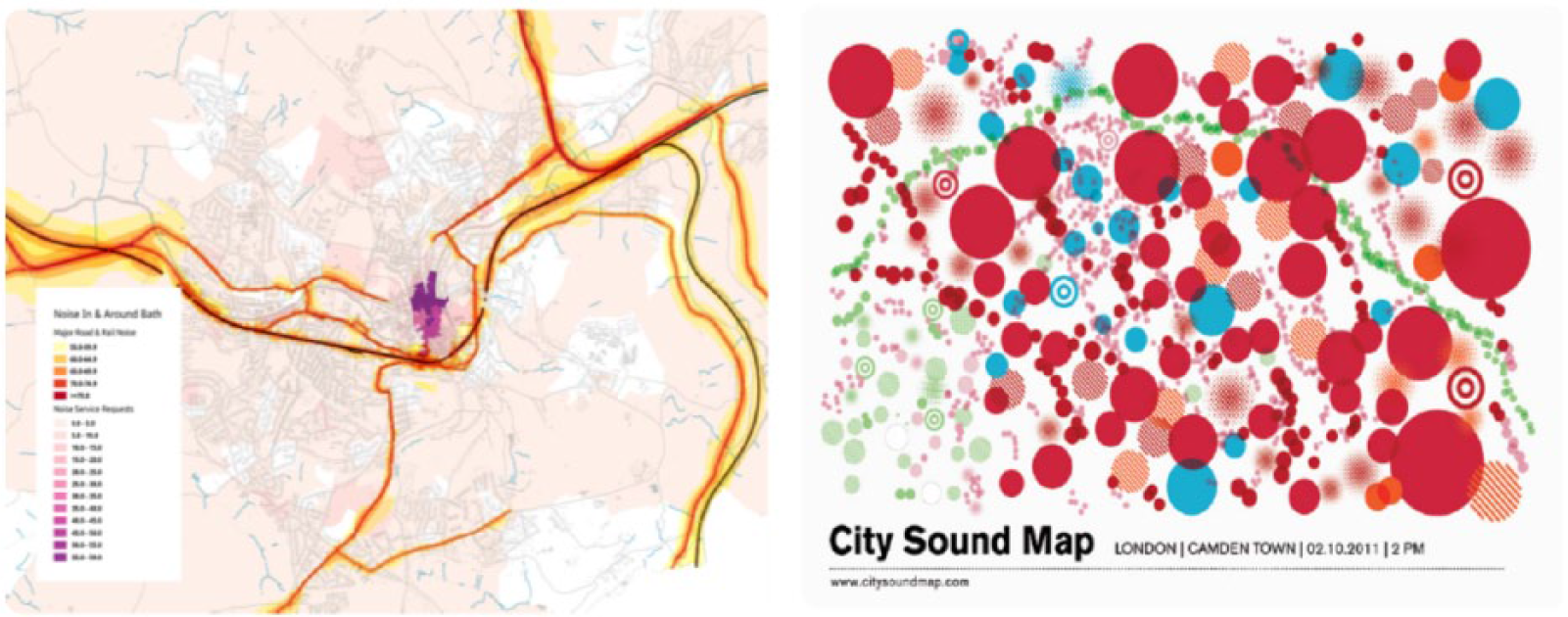
Decibel noise map of Bath (left): Dodds (2016), https://www.flickr.com/photos/ldodds/24905373952, Creative Commons licence. City Sound Map visualization (right): http://cargocollective.com/silviagiulianini/City-Sound-Map.
City Sound Map (Figure 1, right) is a crowdsourced representation of noise experiences. Circles indicate sonic profiles, annotated in colour and size depending on the severity of the noise complaint, while contour reflects the categories and qualities of the noise experience. As an open-source mobile tool and an international installation, this project attempts to represent the ‘felt’ and ‘experiential’ rather than scientifically measured noise pollution in cities. City Sound Map stresses individual experience, enabling the user to construct his or her own noise map and annotate instances with comment tags, selecting from a list of commonly identified sonic irritants. The installation version of this product is a ‘mashup’ of community-generated data, presented at select galleries around the world. While the tool’s visual language follows the birds-eye topological framework with sound presence indicated through size and colour, City Sound Map obfuscates the participation matrix of its data – who submits noise complaints, where, when and for what reason – a note we can’t ignore given the history of noise abatement and recent conversations about the racial and socio-economic bias of urban crowdsourcing apps (Peterson, 2015).
There is one obvious representational element missing in such infographics: actual sound. Multimodal online soundmaps fashioned as collaborative documentaries and cultural archives are already being used as forms of public knowledge creation (Anderson, 2015; Thulin, 2016; Waldock, 2011). One of the largest soundmapping communities, Radio Aporee, contains perhaps the richest collection of user-submitted audio recordings geo-tagged to a variety of locations around the globe. In existence for over 10 years now, it is one of the longest standing communities with an active membership, viewership and extensive archive of recordings. Their visual representation follows a traditional cartographic representation, with hot-spot areas along the grid where audio contributions are tagged on. Now let’s try to use the model of sonic cartography offered earlier to ‘read’ Radio Aporee as an artefact of public-facing communication. As Thulin (2016) outlines elsewhere, the grammar of Radio Aporee (and similar soundmapping portals) favours indexicality (sounds pinned to locations) through extensive annotation via a web submission form that includes commentary, time, date and other locative information, equipment used and acousmatic qualities of the recording (e.g. windy, dense). As such, Radio Aporee is clearly positioning itself as an archive and documentary, rather than an artistic work. Radio Aporee does not allow uploading of user-submitted photos but takes advantage of the Google Earth and Street View functions of the Google map engine, thus aiming to give primacy to the auditory modality. By de-coupling the recordist’s visual perspective at the time of recording, the platform obfuscates the subjectivity of listening in place, resulting in a montage of neutral grid view and presumably neutral auditory account.
The normative logic of high-fidelity recording in Radio Aporee, as Thulin (2016) points out, is evident in the creator’s refusal to allow mobile uploads, and insistence on web form entry with specific audio file extensions, that effectively restrict the participant pool to a very specific recording culture: primarily hobbyist field recordists (Waldock, 2011). The fact that Radio Aporee implicitly privileges environmental recordings (as opposed to, say, live commentaries, sound art, musical sharing or other audio content) can be gleaned from the technological configurations of the web and mobile platforms. One of the interactive features of the portal (especially the mobile application) is the GeoMixer which can be used to layer existing sound files and create custom soundwalks – that is, to link several environments into an imaginary soundscape. While maintaining a cartographic representation of sound environments, the project encourages listeners to explore surrogate soundscapes and sound trips and impose them onto another physical location. Since soundwalking is understood to be an active listening to place, the assumption is that recordings feature the environment in a kind of ‘pure’ state.
The goal of this archive is not stated explicitly beyond ‘mapping the world’, yet that itself reflects the legacy of colonial territorialization, rarely talked about in soundscape studies. To chart land is to claim symbolic ownership: to bring worlds into existence by controlling the means by which knowledge about space is culturally inscribed (Holland, 2012). Obfuscating the subjectivity of the cartographer(s) is the scapegoat of constructing an institutional public knowledge resource. To that end, historicizing the very idea of soundmapping the world can access additional elements of the normative logics of Radio Aporee and similar soundmapping initiatives. Enter the World Soundscape Project (Schafer, 1973). Started by the Canadian composer and environmental activist R. Murray Schafer, this project inadvertently laid the foundations for a long lineage of soundmapping; echoes of this type of community research and creative art practice reverberate across many online soundmapping initiatives today, both explicitly and implicitly, whether they are global or localized. Acoustic ecology is a worldwide phenomenon that has inspired droves of field recordists, nature conservationists and sound artists to approach phonography in particular ways and to focus on specific sounds, sonic characteristics and representations of aural experience. The WSP prescribes high-fidelity audio recording with a multitude of annotations, from hand-drawn soundmaps to sound diaries, decibel measurements and sound composition analysis. Moreover, WSP aimed at the onset to explore the idea of acoustic balance and with that the conservation of culturally significant sounds: for example, artisan soundscapes of metalworking, fishing or agriculture; sounds of work and spirituality as community soundmarks (Schafer, 1977). Many subsequent soundmapping projects – academic and artistic – that are modelled after the WSP directly espouse acoustic ecology’s ideals of raising awareness about the soundscape as an end in itself and embrace an agenda of soundscape conservation. This manifests through a focus on identifying ‘significant’ sounds that characterize local environments in a kind of imagined collective significance (Kautonen & Koivumäki, 2010). The open source and de-regulated manner of contribution to online soundmaps further conveys the imagined neutrality of representation. To heed growing warnings by cultural sound scholars, soundmaps perpetuate a remarkably ‘institutional’ view of the sonic environment through emphasis on cultural heritage and documentary, rather than on subjective experience that includes mundane and domestic soundscapes (Anderson, 2015; Waldock, 2011). To be clear, it is not that open-source soundmaps prohibit particular typologies of sound; rather, they encourage the emergence of specific grammars of ‘mapicity’ and cartographic epistemologies. In terms of communities of practice, for instance, the disciplinary history and context of field recording (Lane & Carlyle, 2013) entails a particular group of contributors: typically male, with background in experimental sound art, using specialized (often custom) recording equipment. So while the ease of use and ubiquity of mobile devices affords the participation and perspectives of a much wider and more diverse contributor base, technological guidelines in a portal such as Radio Aporee remain focused on high-fidelity phonography as the gold standard of representation for sonic environments.
Critical soundmapping
What then could be an alternative grammar, a more critical discursive re-imagining of online soundmaps in their function as public knowledge artefacts? What would a different type of soundmap look and sound like? How could these accessible information systems explore different types of relationships between sound, space and cultures? Soundmaps, after all, can provide basis for historical inquiry, context for negotiating urban space, insights into urban renewal and livability, and a myriad of other applications. The following three examples offer different non-traditional formats, mapping processes and audience participation that I will examine through the lens of the model proposed above: the map’s grammar and logics, the recording cultures it fosters and the listening publics it engages with.
Cities and Memory
In some ways, the global artwork Cities and Memory is most like traditional online soundmapping portals:: it offers a ‘world map’ view with geo-tagged audio recordings, and its tagline is ‘remixing the world, one sound at a time’, a familiar discourse of globality. Cities and Memory, however, defines itself as a global artwork: a participatory, yet curated portal for real and imagined soundscapes: ‘Every faithful field recording document on the sound map is accompanied by a re-imagination or an interpretation that imagines that place and time as somewhere else, somewhere new’ (Cities and Memory). Boasting over 1400 sounds from over 55 countries, Cities and Memory is a growing community of over 300 recordists and composers – some of whom have contributed ‘faithful’ field recordings while others re-composed versions. The collective is housed on its own server, where all recordings exist on a global soundmap, using the Open Street Map framework. Each pin location has two recordings attached to a place on the map without any additional interpretive or indexical information. The recordings are embedded using the Audioboom.fm audio player, which includes an image and a waveform display with every track. Cities and Memory also exists as themed album playlists on the Audioboom.fm platform: a representation much more reminiscent of streaming music than collaborative soundmapping (Figure 2). This setup clearly communicates a curated initiative meant to be explored geographically (on the main site) and aesthetically via social media. The creator of the collective, Stuart Fowkes, has a unique process for populating this particular soundmap: a set of field recordings are released to the wider sound art community under a theme (e.g. ‘sacred sound’, or ‘underground’ and even ‘Dada’); contributors ‘reimagine’ the field recordings with varying degrees of manipulation and compositional liberties; and they are then released as a collection of real and imagined soundscapes much like an album. While the artwork is ‘global’ and participatory, the curator ensures high-quality audio by recording much of the source material with a pro field kit (Cities and Memory, 2014). The source recordings are varied and include nature settings, community events, diverse urban environments, as well as vibrant domestic soundscapes. Cities and Memory has a global presence on social media, maintaining an active connection not only to general networked publics but also to open-source communities, by posting regular guides to DIY sound recording, production and mapping. The work is subversive of traditional soundmapping, I would argue, in two ways. First, it is explicitly curated, so while there is a grid view, the project does not pretend to be a purely documentary, exhaustive or neutral account of global soundscapes; instead the public is encouraged to interact with environmental sound via themes, reflecting on place and sonic qualities where the subjective interpretation of the ‘imagined’ soundscapes are foregrounded. Second, the participatory structure is transparent (mostly comprising sound artists and hobbyist recordists) but not prohibitive – in fact, the collective itself contributes to soundmapping literacy by regularly offering how-to guides and entry-level resources aimed at a general audience. The fact that Cities and Memory maintains active presence on the more popular social networks – Soundcloud, Facebook, Twitter – rather than existing only on a custom engine is a testament to the collective’s commitment to serve as a public knowledge resource, an awareness campaign of sonic environments and a literacy-building initiative. Conversely, one way in which this too falls under the normative logics of soundmapping outlined previously is the preservation of high-fidelity sound and the primarily aesthetic, apolitical motivation of the collection. As an artwork, Cities and Memory falls both inside and outside of what Born and Barry (2010) describe as ‘art-science’ – the missing critical part being an explicit political motivation for mapping sound, a deliberate recruitment of missing voices, perspectives and representations to live up to the celebratory techno-cultural ethic of open-source participation. Yet, each theme presents as a specific narrative, not merely as geographical mash-up of grid and sound, and each blog post by the collective critically addresses cultural or sociopolitical aspects of environmental soundscapes (e.g. Cities and Memory, 2015).
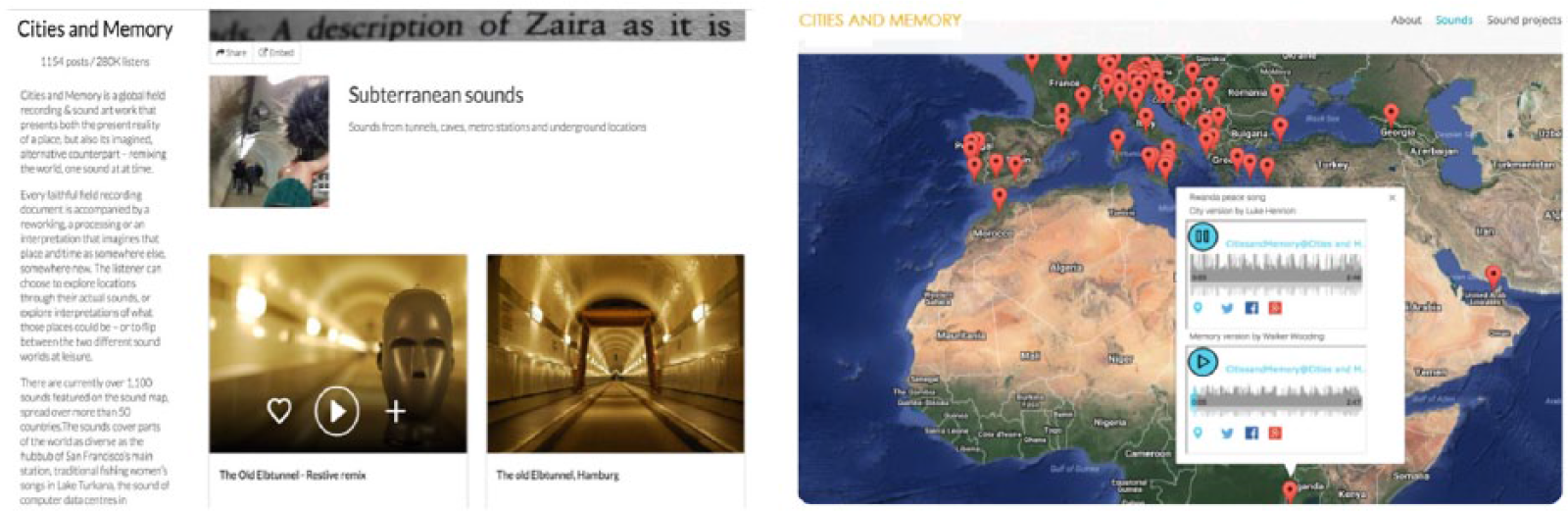
Cities and Memory interface as playlist (left): Cities and Memory, Screenshot ‘Subterranean Sounds’, https://audioboom.com/playlists/1300207-subterranean-sounds. Cities and Memory World Map (right): Cities and Memory, Screenshot ‘World Map’, http://citiesandmemory.com/sound-map/.
London Sound Survey
The London Sound Survey is the brainchild of sound archivist Ian Rowes, long-term specialist in the London’s Sound Archive. The website is a portal to Rowes’ sound study projects, many of which (but not all) include maps. Like Cities and Memory, London Sound Survey is part of a wider open-source knowledge-sharing culture, with a blog section dedicated to how-to guides for building and using equipment, web design of soundmaps and working with archival audio, as well as other sound works of general interest, and soundscape studies resources including a link to the World Forum for Acoustic Ecology (an organization directly based on R.M. Schafer’s work). With the exception of a small number of contributors – semi-pro (mostly male) field recordists – the site is populated by materials and annotations generated by Rowes himself. Rather than a ‘neutral’ documentary mapping, Rowes’ self-declared impetus for doing field recording and engaging in sound study is rooted in what Sterne (2012) would describe as ‘sonic imagination’:
Pleasure and curiosity have been the most reliable motivators, more so than a desire to ‘document’ the city, which in any event sounds boring and pompous. It’s also my way of capturing fragments of everyday experience so that they can be reproduced in the minds of others. (S. Fawkes)
The London Sound Survey is foremost a set of sound studies rather than an artwork or soundmap: research initiatives that combine field recordings with geo-spatial information, historical documentation, analytical findings and relatively transparent researcher descriptions. The projects are tailored not towards only a general public but also a community of independent (or institutional) researchers. There is an enormous amount of technical detail included in many of the projects presented: for example, extensive legends of custom map interfaces, complete annotation of wildlife or other distinctive elements featured in the sound recordings and detailed technical notes on recording equipment and other indexical information – time, place, year, as well as acousmatic description of the field recording. The precedence given to historical exploration and historical listening is evident in the very grammar of London’s general soundmap: a non-traditional grid depicting quadrants of the city ‘recorded at evenly-spaced points, each marking the centre of a square on the map’. Each square (Figure 3, left) represents an approximate geographical area of the city of London; clicking on it reveals a side-scrolling menu with embedded audio recordings tagged with time of day, sonic features and recording year. Taken together, these recordings span a period of time between 2009 and 2016, which allows for not only a plurality of sonic representations but also potentially a historical comparison. In the Layered London map, the listener can switch between three different historical maps while listening to a single modern-day field recording. This archival interface entails a kind of imaginative listening inviting the user to guess (since archival audio is unavailable) how different periods of the city’s history might have sounded like, as well as to note the immense cultural, economic and political changes that have taken place. The result of such a listening exploration is left up to the end user: the building blocks of the sound story are there, the interpretation belongs to the listener. The London Sound Survey also stretches the limits of ‘mapicity’ through whimsical embedding of logos, legends, photos and other symbols in place of geographical grids (Figure 3, right), in that subverting traditional soundmapping to instead invite listeners to focus on themes, patterns and moments of listening. While many of the projects featured reach towards a kind of public communication of ‘results’ and data, Rowes at the same time remains consistently skeptical of any effort to locate the ‘sound of a city’ definitively and outside specific research questions:
It’s an ill-posed question because any aggregate measure along a single dimension, such as London’s average sound frequency being x number of hertz, involves discarding a great deal of information. It’s not obvious what understanding such a fact could lead to. Second, differences in what’s sampled and how will produce wildly variable results. You can’t record everything.
2
Rowes acknowledges that traditionally field recording, phonography and sound art have been apolitical activities and then asks ‘can it be otherwise?’ This begs the question, ‘Are the London Sound Survey soundmaps political?’ The very fact that many of these maps bend the edges of cartography, even traditional soundmapping, is itself a radical practice. The projects are also inquiry-focused – for example, 1 year of bird recordings or London’s waterways – and transparently annotated with recordist, equipment and geo-indexical information. However, there is a layer of openness, an archival impulse to not overdetermine the message of the map, and instead invite the listener to form connections and discover patterns, resulting in a kind of datascape rather than political statement through sound. Perhaps the openness itself is radical and political; Rowes’ commentary is certainly poignant and critical in giving direction towards possible interpretations of the data provided in the soundmaps. The publics implicated as audience to the London Sound Survey are less the social media elites, and more specific stakeholder communities with vested interest in urban renewal and cultural archival work. 3 The projects fit best within a citizen-science paradigm supported in part by institutional connections, yet forward-facing as public intellectual work. The site also actively constructs literacy in sonic cartography, by challenging traditional grid models, presenting custom overlays and continuously empowering, through blog posts and transparent detail, a digital audience of fellow citizen-scientists to conduct and present their own sound studies.
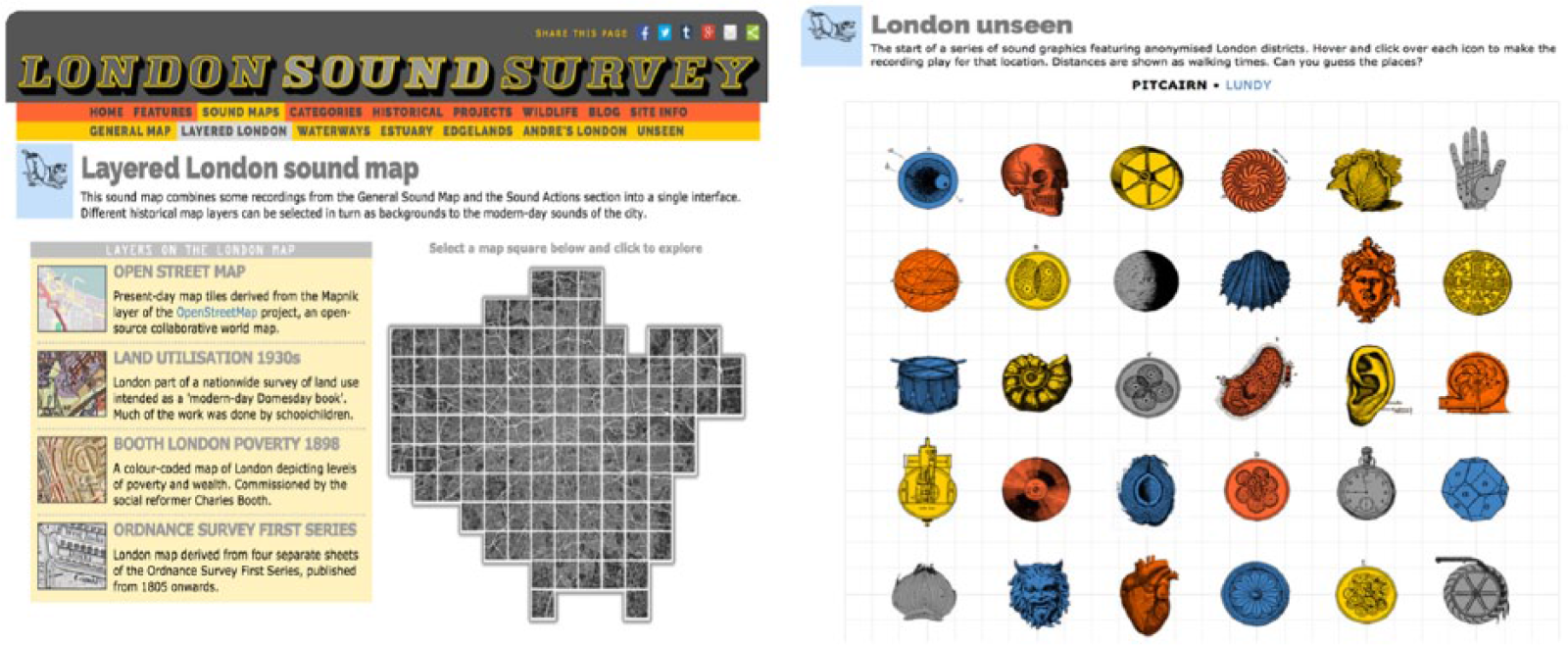
London Sound Survey: layered map of London (left): http://www.soundsurvey.org.uk/index.php/london_map/intro/. London Unseen (right): http://www.soundsurvey.org.uk/index.php/london_unseen/pitcairn/.
Biosphere Soundscapes
Biosphere Soundscapes is a portal and a virtual (mobile, online) platform ‘built with three fundamental systems in mind: supporting artistic residency programs, scientific labs and international masterclasses’. 4 From their own description online, this initiative is aimed at enabling ‘biosphere-networked performance, live streaming tools, the ability to mix soundscapes in real time, and the ability to compare climates and environmental changes’. I’ll focus on one artist in particular, Dr Leah Barclay, who has helped shape, populate and publicize this project, presenting natural habitat soundscapes to general publics worldwide. Biosphere Soundscapes is what it seems: a map of extremely technical, high-quality recordings of natural habitats including much of Australia’s wildlife, an Amazon Rainforest and (not yet available on the map) habitats from Northern indigenous communities in British Columbia, Canada. While the web portal displays a familiar world map view (Figure 4, left) promising that the next stage of the initiative will invite members of the public to upload natural sounds, we already have a cluster of familiar soundmapping grammars: high- fidelity phonography, aspirations to map the world’s biospheres, focus on conservation and promise to democratize representation by inviting public participation. As a knowledge construction initiative, the project is clearly established in relation to specialized stakeholders through artistic, academic and scientific partnerships. Each sub-project, for example, Rainforest Listening for Climate Week 2016, boasts professional recordists in conjunction with established partners. 5 Institutionally funded and produced outputs (i.e. field recordings) are disseminated in a top-down manner, with the main political motivation being advocacy for climate change and generating interest in listening to the environment. There is no specific reference, however, to sounding out the complexities of sociopolitical life on a micro-scale in each individual recording, for example, through ethnographic soundscape reconstruction. 6 The map in its conception is not set up to feature potentially conflicting perspectives sonically or to highlight the positionality of recordists as listeners in contested space. We don’t find the extensive technical detail of the London Sound Survey here, and the portal itself isn’t front-facing in terms of literacy-building guides and blog entries. Instead, Biosphere Soundscapes defines itself as an activist research initiative specifically ‘underpinned by the creative possibilities of acoustic ecology’, 7 positioning the project within a tradition of nature recording and sonic habitat analysis (Krause, 2012), an area as yet beyond citizen science. This project is not primarily a soundmap; where it creatively transforms into a soundmap and diverges from the oft-lamented purist ideals of acoustic ecology is in the manner of its dissemination to the public, through augmented reality and mobile technology–enhanced installations. For example, Rainforest Listening is a mobile public installation presented (among other venues) at Climate Week 2016 in Times Square, New York City. The installation utilizes the existing locative mobile app Recho (Figure 4, right), which allows a creator to attach sound recordings to a location that mobile publics may then access only when present at that location. In this scenario, the rich sounds of the Amazon rainforest are transmitted geo-spatially and simultaneously to any of the participants or mere bystanders at Times Square encouraging a sort of displaced, surrogate, ‘schizophonic’ (Schafer, 1977) listening to nature. This installation is meant, in the project’s own words, to ‘inspire communities across the world to listen to the environment and explore the value of sound as a measure for environmental health’. In that, it celebrates the pleasurable individual experience of listening to distant habitats, as well as the ineffable sharedness of the experience that is only accessible for a limited time at a particular geographic location. Rainforest Listening is only a soundmap inasmuch as sound is mapped onto a physical location and contributes to a mixed-reality soundscape: the virtual sounds of the forest and the real sounds of Times Square. It is also a ‘sonification of the sublime’ in using sound’s ephemerality to create an imagined community of listening publics: ear witnesses to climate change.
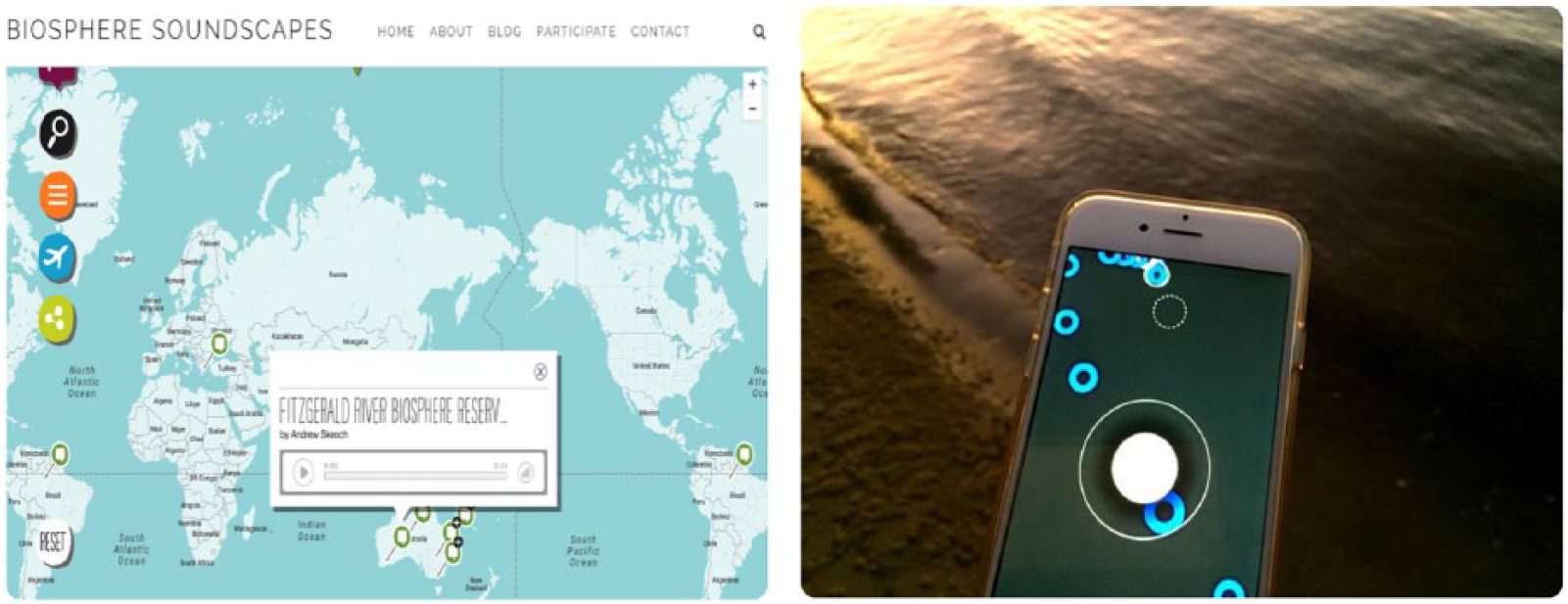
Biosphere Soundscapes World Map (left): Biosphere Soundscapes, Screenshot ‘Community’ Tab, http://www.biospheresoundscapes.org/community.html; Recho Inferface: River Listening (right): Barclay (2015).
Conclusion
In this article, I have argued for cross-pollination between advances in radical cartography, communication studies and emergent theorizations of soundmaps as artefacts of networked knowledge construction. I also suggest that a critical understanding of soundmaps entails attending to the language of mapping and geographical representation of sound, as well as to the recording cultures and listening publics that sustain and populate these digital archives. The three case studies present fertile ground for decoding and evaluating the language of soundmaps towards a conception of critical, radical and political soundmapping. Each project seems to contain both transgressive counter-mapping elements, as well as normative and persistent grammars of sonic representation. Perhaps a montage of more radical properties of each project can gesture towards a model of critical soundmapping: e.g. London Sound Survey’s alternative grid visualizations, symbolism and annotation; the curation of thematic soundscapes in conjunction with creative transformation modelled by Cities and Memory; and mobile augmented reality dissemination that engages collocated publics, as utilized by Biosphere Soundscapes. Returning to ideas of radical cartography and the democratic promise of crowdsourcing maps, it would seem that sound defies geographical boundaries by extending both spatially and temporally beyond the grid. Given existing recording cultures, explicit subjectivity in sonic representation is also paramount. Lessons from the London Sound Survey – the most ‘scientific’ of the case studies – carry cautionary approaches to the idea of exhausting a place or being comprehensive. Finally, the rhetorical significance of the sound content itself – what are the actual soundscapes being uploaded and circulated – is often the invisible problematic. If our three case studies demonstrate anything, it is that transparency in the political aims, recording motivations and defined purpose are necessary prerequisites for a critical soundmapping.
Beyond the mapping process, critical soundmaps must also consciously serve as artefacts of public communication: nodes in networked knowledge creation practices that actively seek to remedy social problems, facilitate the participation of underrepresented groups, and challenge dominant ontologies of space and place. In that capacity, they are distinguished by active public engagement, ethic of literacy-building and the rubric of open-ended stories: critical but not overdetermined approaches to the communication and representation of sonic environments. In a conceptual article on the practices and methodology of ‘art-science’, Born and Barry (2010) propose that the ‘context’ of knowledge production is something that has to be made not just through the work of scientists, but through interdisciplinary practices involving a series of other institutions and professionals, as well as citizens and publics. This is an apt description of what makes soundmaps potentially innovative records of place and urban change, and tools for networked engagement with the politics of sound and habitats. The most critical examples seem to involve both artistic and scientific approaches, while critical elements come in the communication of soundscapes as stories and not merely as nodes populating a grid. Perhaps the last preliminary characteristic of critical soundmapping is a limitation of the geographic scope of the map hand in hand with a specific inquiry. This is something many radical cartographers gesture at: that it is impossible to create a critical account of global dimensions or to represent a large general community. Rather, critical inquiry lends itself to small-scale projects, specific stakeholders and integrity-driven process for the collection and dissemination of soundscapes.
In many ways, the soundmapping initiatives I have focused on here exist outside and beyond the hype of soundmapping-the-world portals such as Radio Aporee, Freesound.org, the British Library UK Soundmap and even localized portals (Montreal Sound Map, Toronto Sound Map, NY SoundSeeker or Open Sound New Orleans, among many others), not only in terms of grammars of representation and forms of participation but also in terms of overt politics and communities of listeners. As such, they offer elements towards a novel and different model for engaging audiences in listening to the environment than one reliant on geographical indexicality. I argue that they generate a vibrant and critical dialogue through listening by focusing on issues, themes and problems of social and cultural significance, rather than strict adherence to pseudo-neutral charting of space. Yet, they may still embody normative logics inherited from cultural (and academic) traditions of documenting sonic environments. It is through decoding those logics that we may – and must – advance models of critical soundmapping as an intersectional and historiographic practice of negotiating co-habitation of human and non-human ecosystems.
Footnotes
Notes
Author biography
 .
.