




Abstract
Kolorob is a participatory platform connecting informal settlement communities with services and informal jobs in Dhaka, Bangladesh. Alongside technological systems, expertise from community, non-government, private-sector, volunteer and academic fields has been integral to the platform’s development. These socio-technical connections and networks, manifest through participatory design, agile software development and collaborative knowledge practices, have become productively entangled in the labour of platform production. We introduce a framework, participatory platform analysis, through which distinct layers – in the form of audiences, intermediaries, interfaces and databases – of this labour can be distinguished and examined. Our analysis draws upon focus group discussions, conducted in Mirpur in 2016 with emergent experts: youth facilitators, field officers and developers. We argue that the interests and tensions of co-designing participatory platforms relating to matters of public concern in South Asian mega-cities are reflective of the rising hybridity of expertise, generated through both institutional training and grass-roots practice, in contemporary urban life. The ‘narrative of expertise in the future’ compels us to recode knowledge production in the here and now: how we are making participatory platforms, the role of socio-technical expertise and the labour of communicating publics.
Keywords
Introduction: the communication of publics
As urbanisation rises and cities scale, they also frequently buckle under the strain of pressures to keep a diverse civic society involved and engaged in decision-making. In the early years of Web 2.0, it seemed collaborative digital technologies such as wikis, blogs and social media might pave the way for wider participation in an urbanised public sphere (Benkler, 2006; Jenkins, 2006; Langlois, 2012). Such expectations have had to become heavily attenuated. Rather than producing digital forums that could foster some approximation of a Habermasian-idealised communicative situation, evidence instead seems to point towards the channelling of publics into an endless labyrinth of self-corroborating echo chambers and filter bubbles. In the United States, a recent Pew study found that 67% of the American adult public used Facebook and two-thirds of that population obtained their news through the same channel (Gottfried & Shearer, 2016). While this does not preclude information being obtained from other sources, a high number of Facebook users now receive their news from this source alone, and even then only circumstantially (Gottfried & Shearer, 2016).
Echo chambers and filter bubbles are not restricted to the United States. In Bangladesh, research of social networking sites also points to a dependency on these platforms for communication, news, games and information and, increasingly, civic engagement (Al-Jubayer, 2013; Soron & Tarafder, 2015). Facebook and the company’s related Android apps – Messenger and WhatsApp – have proved especially popular. While the rise of such platforms is often championed in emerging economies, their ubiquity and control over content create similar ambivalences to those increasingly voiced in the United States. As prominent examples of what C.W. Anderson (2011) has referred to as algorithmic ‘publics’ and ‘ audience’, Facebook users receive information differentially, refracted through their previous likes, friends’ feeds and other data harvested by the site to determine user preferences for information. Precisely by offering people news they would prefer to see, opportunities for rational deliberation and consensus-building – hallmarks of democratic states and, as we discuss below, democratic cities – become diminished. Taken as a trend without correction, the shift from mainstream unidirectional broadcasting to fragmented social media channels produces less debate and less opportunity to negotiate difference in the public sphere. Social and economic distinctions solidify into political factions, and the public become canalised.
Broad shifts in news and other media production and consumption patterns offer concrete evidence that Web 2.0 technologies do not, in themselves, generate new forms of politics that are participatory in ways its early advocates foresaw or often intended. The rise of so-called ‘alt-right’ social media movements spearheaded by Breitbart.com , as one example, illustrates how a participatory technological apparatus can be organised to construct an explicitly exclusionary field of discourse.
Yet unequivocal critique which positions digital technologies as enablers of irrational and ‘post-truth’ tribalism – where the production of discourse through public forums serves ultimately to corral users into channels for advertising by capitalist enterprises and marketing by a political elite – also appears one-sided and simplistic. As counter-examples, Afzalan and Evans-Cowley (2015) have shown how social networking – Facebook and other much smaller online platforms such as Nextdoor, i-Neighbors and E-democracy – can provide new opportunities for localised interactions, information sharing and civic engagement. Although varying in terms of their inclusion and impact upon outcomes, these forums can facilitate local planning processes and neighbourhood interactions.
With respect to cities, these digital spaces can be thought as comprising the information infrastructures (Bowker, Baker, Millerand, & Ribes, 2009) that either support or hinder better navigation, use and governance. They also allow for the operative working out of particular kinds of problems, including problems with overtly political dimensions. As Easterling (2014) has noted in relation to such infrastructures, ‘infrastructure space, with the power and currency of software, is an operating system for shaping the cities’ (p. 4). Concrete examples of the adaptation of infrastructure to the urban context include digital dashboards, community maps, online historical archives, localised Q&A forums, event and meeting registration systems, and ‘smart city control and operation centers’ (Kitchin, 2014, p. 99). Together, these constitute what Kitchin has also termed ‘socio-technical assemblages’ – complex configurations of technical objects, devices, expertise, discourses, feedback loops and interconnections. Notwithstanding their complexity, ironically these assemblages also simplify: despite the ‘heterogeneous urban data’ (Psyllidis, 2015, p. 1) collected by smart city platforms, ‘disparate data silos’ (Psyllidis, 2015) are often retained. Just like news and media platforms, a canalisation effect can easily be produced by participatory platforms, editing out the hybrid sounds of the city.
The structure of our article – examining the politics, production and possibilities of participatory platforms – is as follows. First, we explore the interests and tensions of participatory platforms, along with their claims to inclusion and involvement. Second, we examine how these platforms are composed and decomposed through entanglements and effects of socio-technical expertise. We suggest that tracing the pluralistic and transgressive affordances of expertise – as both ‘convergent’ and ‘divergent’ – productively shows how such labour becomes concentrated and distributed across the design, implementation and use of such multifaceted platforms. A framework is then introduced – participatory platform analysis (PPA) – to identify four key platform layers through which socio-technical expertise unfolds: audiences, intermediaries, interfaces and databases. We then present the case study of Kolorob, an example of a participatory platform, along with commentary from focus groups with young participants – youth facilitators, field officers and developers – about their expectations and experiences of co-designing a participatory platform. Our analysis of these findings illustrates how intensities of socio-technical expertise unfold across different spaces and with variant accord and discord: always evolving, but joining and splitting as new circumstances and events arise.
Background: the politics and production of platforms
Recoding participation?
We utilise the term ‘participatory platform’ to describe those examples of assemblages that foreground social participation and which also explicitly draw attention to features that enable participation. In doing so, we draw upon Livingstone’s (2013) recent characterisation of ‘participation’ as a ‘taking part’ that also involves processes of representation – it is never ‘wholly an individuated act’ – and stakeholding – it ‘always advances certain interests’. This recognises the dynamics of what participation is. We would add participation is both a ‘matter of making’ (Swist, Hodge & Collin, 2016, p. 500), modulated via complexity and power relations, and a matter of action, a form of labour and investment. Referring to forms of participatory labour and expertise, we draw out the complexities of participation in our discussion below.
By ‘platform’, we mean the social and technical dimensions of infrastructures required to enable such labour to be performed. While ‘the promise of new technology is that the cacophony that is our modern world can be heard to the fullest’ (Hagen, 2011, p. 93), this points to the affordances for genuine participation and voices of underrepresented communities to be heard. Participatory platforms can be distinguished from other information infrastructures, such as networks, databases, data standards and communication forums, insofar as they actively encourage the labour – through prompts, reminders, ratings and other digital ‘nudges’ – that contributes directly to expansion and enrichment of the platform.
As digital practices, such platforms have become increasingly popular over the past decade to encourage knowledge sharing, to promote transparency and to take advantage of the growing array of open data sets. For example, participatory platforms are becoming ubiquitous across theorisations and enactments of ‘smart cities’ (Kitchin, 2014). Such platforms have obvious benefits in terms of their motivation to generate data not just for but also with communities. As the definition above implies, these assemblages, and the participation they invoke, are hardly apolitical in terms of their construction, content and contribution to the public sphere. Emerging infrastructures for digital citizenship, for instance, afford new inclusions while ingraining old exclusions (Poggiali, 2016, 2017). Indeed, as Langlois (2012) notes, politics is frequently enacted through such devices.
While government-initiated and civil society participatory platforms have become increasingly popular across cities in Western Europe, the United States and Australia (Holden & Moreno Pires, 2015; Kitchin, 2014), our analysis, instead, is oriented towards platforming work undertaken by non-governmental organisations (NGOs) in developing cities: an under-examined driver and locus of participatory platform development. While mapping projects such as Map Kibera (Hagen, 2011), Ushahidi and Muhimu (Poggiali, 2017) point to the politics and production in the African context, we focus upon the design and dilemmas involved in an NGO-initiated participatory platform co-produced in the South Asian mega-city of Dhaka. Such tensions provoke us to examine the enablers and constraints of labour and expertise in relation to how ‘city-as-a-platform’ (Anttiroiko, 2016) initiatives within the NGO sector are designed, implemented and used.
Participatory platforms are often promoted as a highly accessible form of contributing to the public domain. Yet they also attract critique. In the context of emerging economies, Facebook’s own attempt to deliver advertising-subsided Internet access through its internet.org and Free Basics programs has been heavily criticised, particularly in India (Murthy, 2015). Scholars reviewing other recent information and communications technologies for development (ICT4D) initiatives that intend to realise economic development and social inclusion through technology have commented variously that they reflect ‘the neoliberal project of self-cultivation and exemplifies neoliberal ideas of self-improvement and self-responsibility’ (McLennan, 2014), ‘risk draining resources away from meeting more basic needs in development context’ (Leye, 2009) and ‘attempt to reorder the social life of the beneficiaries in such a way that the provided information shapes their behavior and redefines their social relationships according to what is considered right by the donors’ (Andrade & Urquhart, 2012).
‘Bottom-up’ (Ayonka, 2010) and participatory design (Zewge, Dittrich, & Bekele, 2015) approaches have sometimes been posed as remedies to these ulterior extractive, inappropriate or manipulative tendencies of ICT platforms. As we note above, participation is not a simple process and in fast-growing cities involves convolutions of funding, infrastructure, labour and diverse expertise to wrest control and ownership of platforms from multinational organisational operators to local urban communities. For rights to informational ‘infrastructure’ (Jiménez, 2014) to be warranted, the democratic possibilities of ICT4D need to be both attempted and examined in practice. In our analysis of the labour of platform-making, we look into the degrees to which expertise is variously valued, invited, negated and coordinated.
Socio-technical expertise
Participatory platforms offer a contemporary context for Nowotny’s (2003) claim of an ongoing ‘dilemma of expertise’ (p.152), which is always indispensable to the provisioning of platform technologies and systems, but which must also continue to be contested and scrutinised. For Nowotny (2003), the politicisation of expertise demands it be transgressive in two senses: first, ‘it must address issues that can never be reduced to the purely scientific and purely technical’, and second, ‘it [must] address audiences that are never solely composed of fellow-experts’ (p. 152). In pursuing an analysis of platforms, we extend Nowotny’s political imperative to better understand socio-technical expertise: that which converges beyond and across disciplinary distinctions and organisational silos and which equally diverges, becoming distributed via the participatory design, use and implementation of platforms.
As Pure et al. (2013) have argued, expertise itself has become increasingly conceptually complex. In an examination of how emerging technologies complicate traditional notions of expertise, they highlight three aspects of this complexity. First, Internet-based tools create more information producers through bypassing of gatekeepers and lowering barriers; second, this often creates a deficit in terms of context, as there may be anonymity or ambiguity stemming from the hyperlinked structure and the verification of information uploaded; third, with the eradication of context, the source and intent of authorship can also become obfuscated. The multiplicity of producers, the loss of context and the obfuscation of intention flatten out the fields upon which information is rendered and then read. Yet, as we note earlier, it can also generate informational echo chambers where evidentiary material reverberates, continuously self-reinforcing and self-corroborating, and without appeal to the once-trusted authority of the expert. This very dilemma, of which expertise becomes foregrounded and backgrounded, brings us to the focus of our enquiry.
Nowotny’s (2000) examination of the ‘narrative of expertise in the future’ recognises that the ‘basis of legitimacy can no longer be derived from outside, but must emanate from the process of knowledge production which is involved’ (p. 20). Pursuing this operationally through an extension of the software architectural metaphor of the ‘stack’ – a term gaining critical theoretical currency, if not always unproblematically (Bratton, 2014; Terranova, 2014) – we seek to develop an expertise-informed method for analysing platforms. Stacks can be modular and adaptive, as well as rigid, and we sketch the ways in which platform assemblages extensively manage and distil types of communication and expertise, at the same time as being intensively malleable. In drawing out the complexity of a platform, Langlois (2012) describes how it ‘acts as a manager that enables, directs, and channels specific flows of communication as well as specific logics of transformation of data into culturally recognizable and valuable signs and symbols’ (p. 100). This accords with our own tracing in the following sections of the composition and decomposition of what we have termed ‘participatory platforms’, with a particular focus on how they communicate publics through forming and transforming socio-technical expertise. We outline below, and develop through the example of participatory geographical information systems (PGIS), four layers that help articulate how socio-technical expertise unfolds: audiences, intermediaries, interfaces and databases.
Framework: PPA
Building upon Bogost and Montfort’s (2009) concept of ‘platform studies’, the concept of ‘participatory platform analysis’ seeks to unpack how platforms are designed and maintained. We define PPA as the identification of layers – the audiences, intermediaries, interfaces and databases – that both distinguish socio-technical elements and expertise and show these to become entangled and even contradicted in their enactment. Such a process of exposing aims to complicate the apparent seamlessness by which platforms are often viewed in terms of their composition and communicative effects, coalescing in the formation of public and proprietary benefits. We propose this helps us to examine the ways in which different types of labour in the making of platforms modulate socio-technical expertise: reducing, augmenting and amplifying these enunciations.
Participatory platforms have multiple audiences which span a variety of scales: hyper-local, city-wide, regional, national and transnational. While there will always be an intended and central audience orienting platform design, there are also unintended and peripheral audiences. Equally, in an era of collaborative media and participatory tools, the expertise of this array of audiences is amplifying. In our example, PGIS develops a pluralised and intensified set of audience competencies through platforms that are ‘context- and issue-driven rather than technology-led and seek to emphasize community involvement in the production and/or use of geographical information’ (Dunn, 2007, p. 616). Furthermore, ‘rather than relying on only a few sources, each with a substantial investment in the information production and delivery processes’ (Pure et al., 2013, p. 38), the labour involved in creating these participatory digital mapping objects draws upon different types of audience expertise.
Intermediaries are roles played by those involved in the building of participatory platforms and, as van Schalkwyk, Caňares, Chattapadhyay, and Anderson (2015) suggest, can contribute different types of knowledge or capital. The authors describe an ‘open data intermediary’ as an agent in a data supply chain who facilitates the use of open data. The labour involved in being such an agent and facilitating data requires the development of particular types of expertise, such as collecting, analysing, managing and communicating data. PGIS, for example, ‘involves local communities in the creation of information to be fed into the GIS and subsequently used in spatial decision-making which affects them’ (Dunn, 2007, p. 619). Community information becomes amplified via these intermediaries, where expertise is augmented through PGIS practices. Intermediary expertise is therefore another component of labour in platform-making.
The front-end of software, or its interface, is the most prominent and obvious feature of participatory platforms. Becoming a ubiquitous feature of everyday life and participatory culture, as Plantin (2016) suggests, in a mapping context interfaces are formed through ‘online maps [that] often attempt to seamlessly weave a continuum of data, services, and applications from the contemporary web’ (p. 918). This ‘seamlessness’ of the interface belies the complexity of both formal and informal labour required for mapping platforms to be produced, maintained and utilised. Interface expertise constitutes, then, another element of the platforming process.
The database is a further feature of participatory platforms, and its operationalisation comprises – in the form of database administration, data entry and data analytics – database expertise. As politicised technical objects, databases can be understood as incorporating ‘a value structure into the data, one that is clearly not neutral in the competition for power’ (Johnson, 2014, p. 267). The design and maintenance of database entities and relationships inform how labour and expertise unfold, delineating which types of knowledge and opportunities for participation are privileged. How technical features of the back-end can be designed so as to augment practices and amplify data towards public benefit – rather than corporate profit – is not merely a detail of implementation, but has direct implications for the arrangement of labour and the opportunities for participation. Following our PGIS example, the ‘embeddedness’ of maps within online participatory culture utilises both private and public informational infrastructures and integrates ‘technical features – the release of the Google Maps API – from the abundance of remixable data – either from open data initiatives or from other online platforms delivering data compatible with mapping APIs’ (Plantin, 2016, p. 918).
Through the lens of PPA, we highlight how assemblages are made up of pluralistic and transgressive expertise – the politics of audiences and intermediaries, and the production of interfaces and databases – as a way of articulating the possible composition and decomposition of participatory platforms. This optic helps gauge the multilayered labour that unfolds through the forming and transforming of publics: converging at certain points, while diverging at others. It further highlights the propensities of expertise as both density and diffusion, modulated at different times and junctures throughout the labour of platforming. These undulations inform the way in which socio-technical expertise evolves, producing learning dynamics which are never stagnant, but which also meet particular challenges or obstacles that cause reorientations to occur. Acknowledging this complexity, we explore a case study that illustrates the interests and tensions that modulate diverse expertise within a participatory platform initiative.
Case study: Kolorob
Study background
Since July 2015, the authors of this article, in different roles and with varying expertise, have been working with developers, mappers and communities in Dhaka to co-produce a digital platform called Kolorob (‘noise, clamour’ in English). The vision of Kolorob was to design an app that would address the information gaps of communities living in slums and poor urban settlements through an Android mobile application. A key dimension to this design was that it be close in consultation with community members to ensure they felt a sense of ownership over the app. Funded by Save the Children Australia and implemented by Save the Children in Bangladesh, the project has created and populated a geoinformatic database of private and public service providers, including health, education, government, employment, legal and commercial services. The database is accessed through a custom-free mobile phone application built for the Android platform. The app provides a series of screens for interacting with the data, with the main interface being a map of Mirpur that shows approximately 5200 service locations distinguished by colour to represent their type (see Figure 1).
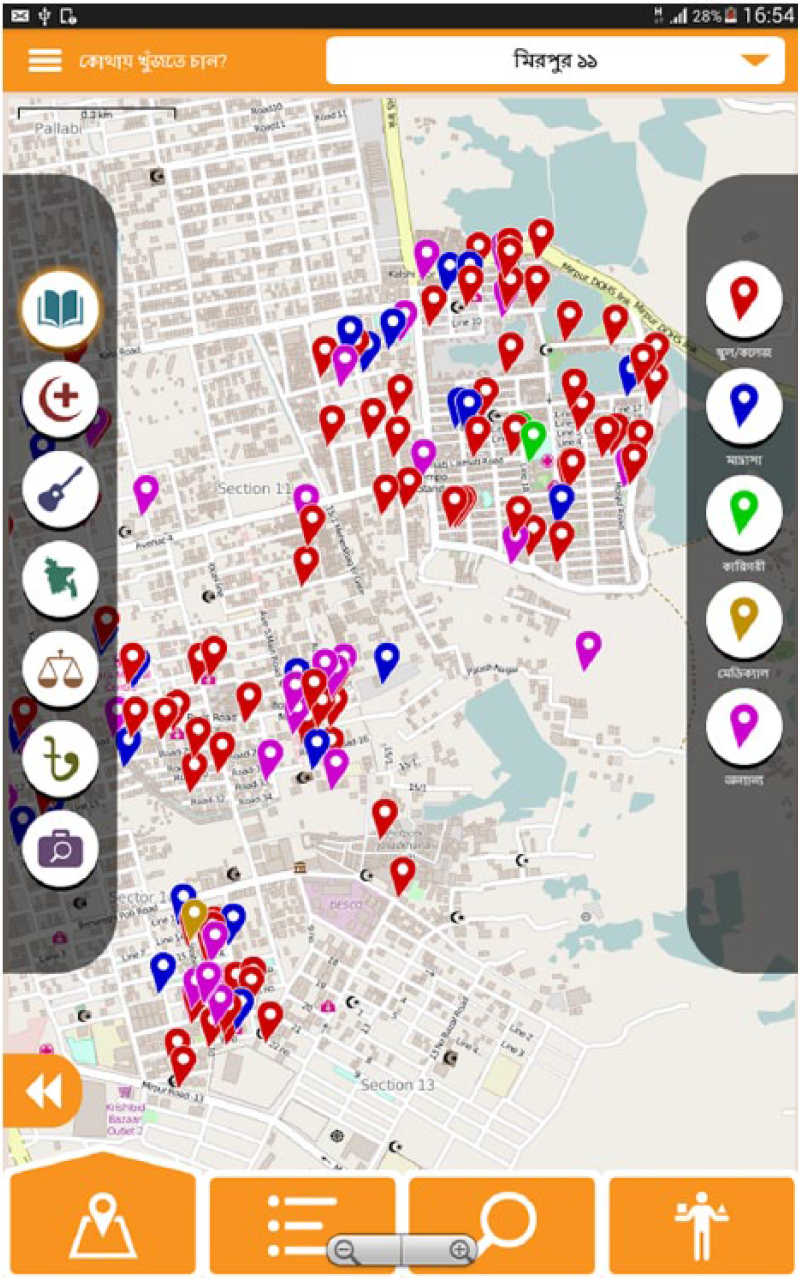
Main interface of the Kolorob application, version 2.04 (released 28 November 2016).
The app was first released on Google Playstore in March 2016, with a further major release launched in August 2016. During the first release, there were 1000 early adopters of the application which was downloaded or shared through peer-to-peer distribution – mostly by young people of the Mirpur area – and as of January 2017, the app has been downloaded more than 10,000 times through Google Playstore.
The initial release was installed and shared on the phones of youth volunteers, who then spread the app phone-by-phone, via a program called SHAREit, to a number of other community users. Between February and August 2016, feedback from these early adopters was used to refine and develop the application. Particular focus was given to performance, usability and incremental feature enhancements to increase the app’s utility. Due to licensing restrictions and the need to operate maps in an offline mode, Google Maps was replaced by OpenStreetMap (OSM), and search, service rating and job listing features were added through a series of 2-week ‘sprints’. Additional affordances of the transition to OSM included increased accuracy of navigating and routing.
After the August release of the app to PlayStore, additional features such as a marketplace and job listing were added along with minor and critical user interface enhancements. Various advertising, promotional and marketing campaigns were employed to test revenue-raising opportunities and to incentivise community members to install and use the app. Much like a commercial start-up, the project began to track a number of key indicators – customer and user demand, donor interest, competition, staff retention and the willingness of commercial service providers to pay to advertise – and by late 2016, numbers of service providers, downloads, search requests and references in social media had been increasing steadily. Towards the conclusion of its current funding cycle, the long-term sustainability of the project remained contingent upon a complex set of factors and risks. Nevertheless, the layering of this particular NGO-led platform had already exhibited a dynamic and fluctuating temporal pattern, marked by, on the positive side, the coupling of existing with emergent socio-technical expertise and deepened relationships with and between community groups and, on the negative side, the devastating terrorist attack on 1 July and its complicating effects on project implementation. Through focus groups conducted with young people involved in the project, we consider several threads of this pattern in the next section.
Overview of focus groups
We conducted focus groups during two visits to Dhaka in February and November 2016 towards the end of each of the two project funding cycles. As two of the authors worked for Save the Children as managers and technical advisors, they did not directly participate in the discussions. While their roles were clearly crucial, collectively we felt this would introduce a problematic power dynamic; they did, however, help to provide significant context and assistance for facilitating discussions. In both Baunia Badh and Paris Road communities, participants were drawn from the following stakeholder groups: youth facilitators, community parents, community leaders and young users of the application. We held separate focus groups with the application developers and field officers – whose role we discuss in more detail below – at Save the Children offices in the neighbouring district of Gulshan, Dhaka. A translator provided by Save the Children assisted in cases where participants preferred to speak in Bangla, and after participants read a plain language statement and consented to participate, we took notes and audio-recorded each conversation.
The questions of semi-structured focus groups covered five areas: participants’ broad outlook on life in Mirpur and Dhaka, responses to the rapidly rising use of mobile technologies, views on the Kolorob application, what role participants had played in the design and development of the application and the kinds of work they had undertaken and expertise they had gained during the project. Each discussion lasted between 60 and 90 minutes. Through the second set of discussions in November particularly, an important narrative emerged about the significance of developing a spectrum of socio-technical competencies and expertise among young people living in Mirpur and other areas of Dhaka, and we frequently adjusted our questions to pursue this narrative as opportunities arose. A brief overview of the three groups – youth facilitators, field officers and developers – is outlined below.
Youth facilitators
Young people living in informal settlements are often important communicators among families and peers, and they were significant stakeholders in both their contributions to and promotion of the Kolorob app. Recognising that local community engagement was essential for the project’s uptake and success, an underlying principle of the project was to foster youth volunteerism in driving interest and enthusiasm related to the Kolorob app among students and youth organisations. Eight young people from the community were selected and recruited through a competitive process to act as Kolorob ‘brand ambassadors’ in facilitating slum dwellers’ access to information on service providers from technology through the Kolorob app. As we discuss further below, through their roles they also continued their own personal and professional development, learning new leadership skills, building the capacity of their peers in the use of technology and establishing profiles, within the eyes of adults and elders, as valuable contributors of their own community. Focus group discussions, with participants aged 18–26 years, were conducted with approximately eight youth facilitators, four each in the respective areas of Baunia Badh and Paris Road.
Field officers
As the project continued to expand, the team became aware of an emerging need to collect data and map in other neighbourhoods of Mirpur, resulting in the introduction of three field officers and an OSM Mapper. This time, however, much of the learning received from the mapping and data collection of the two initial pilot sites could be implemented during the secondary phase of data collection to ensure efficient and effective data collection practices, and the provision of guidance, motivation and support to youth facilitators.
These field officers were thoroughly trained to map and collect data to minimise inaccuracies and inefficiencies during data collection and data validation processes. These included inconsistencies in Bangla phonetic spelling and misplaced data in OSM database. They were also trained to communicate effectively with service providers and to resolve issues that would arise during their fieldwork. Additionally, they would assist the youth facilitators with planning and managing campaigns to promote and increase outreach of the Kolorob app. Focus group discussions were conducted with two field officers, one female (F1, age 23) and one male (M1, age 30).
Developers
Mobilising a community of young developers, including Android developers, a back-end developer and a graphic designer to join the project team in-house, increased the effectiveness of participatory design processes and strengthened communication between the research and development teams. This also reduced time delays between community user testing and feedback on what would make the app more relevant, useful, functional and attractive, and the implementation of these changes in the application itself. Community involvement during user testing was crucial to ensure the team designed a user interface that could accommodate diverse language and computer literacy levels. Focus group discussions were conducted with three developers, including one female (F1, age 24) and two males (M1, age 29; M2, age 24).
Findings: co-evolving expertise through platform participation
Despite their distinct functional roles in the project, expertise from each of the groups co-evolved across each of the four layers of socio-technical expertise – audience, intermediary, interface and database – we introduced above. Consequently, we have arranged our findings according to those layers.
Audience expertise
We describe ‘audience expertise’ as the ability to become an audience – to participate, observe and respond – as well as the ability to anticipate others as audience – as other participants, viewers, users and collaborators.
Youth facilitators
The audience expertise of young facilitators was integral to the project. A distinct sense of achievement – a personal connection – was a common response from this group, which took into consideration how they themselves developed from being part of a participatory platform project. Through being key audience members and co-designers of the app, they talked of becoming more aware of themselves as technology users and as creators.
One young male (M1/FG1) was extremely proud of how obtaining a job in this project enabled him to develop his skills: ‘getting a job in this project they have developed so much about themselves’. Before starting his role, this respondent (M1/FG1) described a sense of trepidation in terms of not knowing what the role was for about until he attended a meeting, applied for the role and received training. He said he was
concerned at first, did not understand – but by attending a meeting he learnt, he got a circular and they all applied and they started their work and they have got lots of training on internet use, map use and learnt a lot about these technologies. (M1/FG1)
Noting what people in Mirpur needed to know and to possess, so as to develop an audience for the app, heightened the facilitators’ sense of connection to community. As intended beneficiaries of this app, youth facilitators needed to be keenly aware of the perspective of community – both as immediate neighbours and, through an estranging process of expert development, as target demographics and markets. Feelings associated with their facilitation role oscillated across a range of emotions, from concern and trepidation to pride and confidence – providing markers of their growing audience expertise throughout the course of the project. One young woman (F1/FG1) recounted her experience of how her reputation in the Baunia Badh community has evolved, as well as her capability to communicate: ‘Now the community leader knows her – and people start to know that she is working on development activities – that she is [name] … Now she can easily communicate with other people’ (F1/FG1). Another woman (F2/FG1) described the confidence and freedom she has developed since starting her role: ‘She was fearing at first service points – not confident at first … Now is more confident – can ask freely for their service for information. Now she can contact any person’ (F2/FG1). Another participant also expressed the sense of achievement in the community impact and awareness that they felt had grown over time:
Because people are getting service points and it is showing Paris Road; the community people are very much happy with that. As youth facilitator he is doing mapping, data collection etc and by [the] time people are getting are more curious about the application that workshops meetings etc are informing people more about this Kolorob application. (M2/FG2)
Equally, the facilitators also developed a strong connection with the sponsor organisation. The NGO was another audience constituent for the app (due to its leadership, funding and evaluation roles) and also for the young people employed as part of the project (in offering significant skill-building and advancement opportunities). This orientation was not only extremely important but also fragile, especially once the project came to a close:
For the last 2 years and they have learnt a lot about map use and technology using and they have many training – and they are now skilled […] If the platform created does not progress – will there be other projects to continue developing their skills on that project? (FG1 – group comment)
A concern, felt by many of the youth facilitators, emerged from the tensions between having learnt so much from this audience expertise and the sense of loss if the project discontinued, or there were no other projects which could utilise their skills.
Another aspect of audience expertise was constituted by the collective imagining, through workshops and dialogue with international consultants, of city-wide, national and international audiences. One example of this imagining was through the projection of how local community could be perceived beyond ‘slum’ stereotypes, by highlighting its array of businesses, and services, and drawing attention to strong community cooperation and resilience. For example, one young man (M1/FG1) described being proud of how the Kolorob app communicated Baunia Badh to the public: ‘although Baunia Badh is a poor place he is proud to be part of Kolorob and be part of this area’. Other participants conveyed a similar sense of pride in how their community would be perceived in more multidimensional ways through their involvement in the project.
Field officers
Field officers also developed audience expertise through their communicative role with communities, and they repeatedly referenced the positive attention they received. As one participant stated,
When I started work as an employer in the community launch one ‘apa’ [older sister/stranger] said I saw you last year in the community workshop and I was surprised that she remembered me and that is a big thing that I am making a connection with them that is the most important part of my journey. (F1)
The intended audience for the Kolorob platform – community members – were brought together not only directly through the mobile app but also often via the labour of these field officers in such face-to-face encounters.
As with the facilitator group, communications with communities also developed confidence, another significant aspect of their growing audience expertise. For example, one young man stated that ‘the main thing I have learnt is that I can talk to anyone – this is my greatest achievement’ (M1). The Kolorob app launch was an example of an event where the app was demonstrated to community members and provided an opportunity for a field officer to overcome her fear of presenting in public:
When I am on the stage when 300 and 400 people watching me and definitely that is a big thing […] if you have a specific fear how you can overcome if you have specific thinking about how you can solve it this is the thing I have actually learned. (F1)
A key part of this role involved, then, developing the expertise to address and to anticipate diverse audience responses. This proved equally important in the context of working in an NGO. In addition to their outgoing communication roles, facilitators also professionalised within that context – learning to work within a large bureaucracy, attend meetings and operate according to seemingly opaque procedures. Despite its challenges, in our discussions, they all expressed a shared sense of enjoyment, excitement and pride in being part of a unique technology project within a high-profile organisation. This organisational familiarity and competency is another example of audience expertise, generated from being involved in the participatory platform project. Expressing the support and connection they felt within their team, facilitators also emphasised the reciprocity of audience – how they too came to be accommodated. One described how ‘working here is a nice environment, colleagues and friendly most are young and work is very enjoying’ (M1). Another said,
I am lucky I have a wonderful team and a friendly environment and quite supportive team members that is a pride thinking that you have cooperative team members that they are helping you in every way for me that is a type of achievement. (F1)
One woman’s awareness of her standing in the organisation was boosted through the recognition, learning and responsibility that came with her role: ‘people who know me took it quite well working with an international organisation […] now have more scope to show your skills – I felt a positive vibe as an employee’ (F1). In support of the organisational affordance that permitted other kinds of expertise to evolve, another claimed, ‘no other NGO can give us this opportunity’ (M1).
Developers
The development group also emphasised the positive emotions of audience expertise through being involved in the Kolorob project, most notably the organisational connection which involvement with this participatory platform offered. For example, one participant described they enjoyed ‘being appreciated for the work we are doing and of course the experiences are gaining priceless’ (M1). Another emphasised the importance of being recognised and valued within the organisation:
I am in every meeting so in that way I was getting recognised I realised that it a good thing for me. I am normally a shy person and that time I was trying to present myself so that was dealing matters of myself. (F1)
Another team member described how much they valued the opportunity to work at such ‘a big well-regarded office, [and enjoyed the] chance to work here’, feeling that the project overall ‘was a really big part of my life’ (M2).
Intermediary expertise
By ‘intermediary expertise’, we mean the ability to engage, facilitate, collaborate and share knowledge with others. As with audience expertise, this took a variety of forms for members of each of the three groups.
Youth facilitators
For youth facilitators, the experience gained over the course of this project informed the development of their intermediary expertise. This knowledge sharing both diverged and converged across a range of locations, events and audiences, across which they could impart technical expertise, raise awareness of the project among the communities and discuss the specific benefits of service providers. For example, kiosks and schools became a base for conducting interactive tablet-based training sessions where community members could learn about technology, Internet and maps. The profile developed within their community stemmed from their entwined skills and role as intermediaries. As one participant put it,
As a volunteer I train [community members] from my city and others and in our area I want to give people what they need … Most of the time tell me they want to improve their ICT …[I] learn how to convince people, arrange meetings, improve skills how to use laptop projector and microphone etc. (M1/FG2)
Intermediary expertise evolved through sharing their knowledge via community training sessions, workshops and meetings with service providers. One participant described this range of activities:
First was to connect service point info – then they started to train people about the technologies … Many people trained at kiosk – to learn about technology, internet and maps … What is map? What is internet? what is Googlemap? Then they trained people through social excitement project – presented about Kolorob and meetings with service providers – and how they can get benefit. (M2/FG1)
These communicative events synthesised their expertise, crystallising their role as intermediaries throughout the course of the project.
Field officers
Participant responses also spoke of the growing intermediary expertise of field officers, who shared and communicated their technical expertise and new knowledge to others. For instance, one participant recounted their observations of explaining the value of the Kolorob platform to community members:
People are interested in this app because it is new there are so many apps and games and Kolorob is the first app that contains service points so they are very interested. Most of the people are not familiar with apps so we convinced them first […] what you can use it for, so then they are positive, so then they are interested [to] use this in their community. (M1)
The challenge of being a female in this role also became evident in terms of responding to – and sometimes confronting – community traditions and gender norms. For example, one young woman claimed, ‘there was a man saying that you should be at home, get married and spend some time with husbands and kids […]’ (F1). Despite this, she continued on in the role, gradually gaining the trust and respect of community elders. To address such challenges, teams were designed to be gender-balanced, and they were trained to keep community interactions and conversations focused on the Kolorob project.
Developers
Software developers also described sharing their expertise with others. One participant describing how their knowledge supported youth facilitators, where they ‘join[ed] in workshops where I give ICT support in the workshop. I have made community learn about technology’ (M2). They articulated new insights from being part of the community workshops, such as ‘the young people who are more attracted to new technologies, [whereas] the older person do not have that attraction’ (M2). Another participant described the development of their social skills and confidence: ‘Learning – a lot of social skills … I was a shy person and that is changing and right now I am in world-renowned organisation’ (M1). This was brought about through the re-skilling and increased management responsibilities involved: ‘so best thing about working environment – I am [the] new guy [and they are] entrusting me with new responsibilities. It motivated me a lot, re-skilling and [developing a] completely new interface’ (M1). Another participant stated that learning new communication skills through her role was a vital educational experience: ‘so everything was new to me – [I] learnt to how to communicate to the people and try to get information from the people, so strategy of learning to talk to people’ (F1).
Interface and database expertise
By ‘interface and database expertise’, we mean the competencies involved in the direct technical instrumentation of what are colloquially referred to as ‘front-end’ and ‘back-end’ software technologies. As becomes clear, this is not only limited to the specific activities involved in software development but also includes ‘soft’ capacities of providing specific structured design feedback, learning how to enter and format data in forms and spreadsheets and gaining general expertise about digital devices and infrastructure. Since many of our respondents blended their responses to questions about interfaces and databases, we group them together in our analysis.
Youth facilitators
The training provided served to expand the knowledge of youth facilitators about issues of data collection and storage and how this relates to specific aspects of the front-end/interface and back-end/database of the Kolorob platform. For example, one participant stated, ‘before [they] did not know about internet and how to open a google account and they are doing training with community members and now giving training to members about map and open a google account’ (M1/FG1). The dedicated education provided to develop their technical expertise, such as 2 days of OSM training, taught them how to locate map points and upload these points to a database (M2/FG1). As another participant remarked, ‘we get training for OSM, child safe-guarding policy and give ICT training’ (M1/FG2). The production of technical expertise enabled this group to create and adapt front-end and back-end artefacts (such as ODK forms and files) through tablets and phones. These became the interface and database techniques by which their knowledge could be further built upon and shared, creating a platform oriented towards public benefit.
Field officers
The interface and database expertise spanned not only the data collection for the Kolorob database but also the awareness raising of the value of the app through engaging communities in training, testing and occasional sessions of participatory design. The field officers were critical to these activities.
The process of gaining new interface and database expertise was in contrast to their educational backgrounds, with one participant outlining the contrast between her formal studies and the practical knowledge gained through the project’s field training. She describes an important turning point in this knowledge and how it opened up new opportunities and activities:
I received training about how to map so that was interesting so I was quite excited – wow now I can map – now I can make a point that is not in that map so then I started working in the field, collecting data. (F1)
They were also involved in setting up the enabling infrastructure, such as Wi-Fi points. As one officer explains,
First of all [when] I joined we have to prepare and how we work with work plan and the service provider meeting and the plans and I enjoyed that work and data collection from now I set some Wi-Fi points to the people and I really enjoyed what you have learnt because people are getting access and I enjoy work. (M1)
Developers
The marked development in interface and database expertise which stemmed from being part of the Kolorob initiative was reflected deeply through the comments of members of the software developer group. One participant described the steep learning curve involved in acquiring technical skills that came from joining a larger organisation:
Before [I had] little Android skills – learnt everything from here […] also I developed website Kolorob info, where [name deleted] told me to develop doing set-up and server set-up. From here I have also taking part in Android development. (M2)
Another emphasised the importance of their transition from a freelance role to that of an employee, based upon a decision to apply for a role as a community mapper in order to learn something new: ‘after that I was hired to map the pilot area Baunia Badh and Paris Road that is how I started’ (M1).
The variety of roles and responsibilities experienced by participants was also significant to shaping skills. As another participant put it, this involved adopting a systemic view: ‘seeing problems maintaining things – from mapping and data-collection and working on back-end, Android, FGD and back-end’ (F1).
Conclusion: listening to the hybrid city
The findings above illustrate the layered arrangements of socio-technical expertise – spanning audience, intermediary, interface and database – experienced by the youth facilitators, field officers and developers involved in the Kolorob project. We have interpreted these experiences as the co-evolving or co-constituting production of participatory platforms, a multivocal and overlapping performance contributing to an overall clamour or noise. For example, young people’s contributions to the interface and database (forms, files, tablets, Wi-Fi points, programming and design) intermingles with their role as intermediaries and audiences (training sessions, workshops, meetings and social media).
Their responses show both the distinguishing and blending of layers of new expertise young people acquired and how these were shared and communicated with others – though often with difficulty, involving compromise, avoidance and the adoption of sophisticated communicative techniques. Convergent expertise – labour involving extensive, multisectoral knowledge – had significant impact at certain times of the project’s process. Concurrently, there were times where a different aspect of labour was foregrounded: the need for splintering away towards divergent expertise, a distancing from knowledge blending in order to apply specialist, intensive expertise to the resolution of problems. For instance, the developers required contained time away from other groups to unravel, or investigate and solve, some of the new ideas generated through the convergence of ‘pluralistic expertise’ (Nowotny, 2003). In another example, insights from focus group discussions with youth facilitators illustrate the types of learning (e.g. utilising and adapting OSM processes) which developed as part of the data collection process. These different types of expertise are modified and modulated through, sometimes in isolation and sometimes in concert, as a kind of co-evolving expertise.
The Kolorob project is an example of how participatory platforms in South Asian mega-cities, involving rapidly emerging technologies, service delivery, informal settlements and community capacity-building, are driving new arrangements of socio-technical expertise. Reflecting the qualitative expectations and experiences of youth involved in this platform initiative, our observations provide a rich snapshot of the challenges and opportunities which such entanglements of expertise produce. Adopting what we have termed ‘participatory platform analysis’, we have highlighted how the density and diffusion of coalescing socio-technical expertise involve distinct and interwoven layers: audience, intermediaries, interface and database. Our findings, moreover, illustrate the sometimes difficult undulations of technology, labour and expertise in the making of a participatory platform oriented towards public benefit.
As the project participants themselves indicated, there remain further complexities in the translation of these accomplishments into the long- term aspirations of young people and their communities. Maintaining and sustaining participatory platforms designed for and by marginalised urban communities are less attractive than establishing them to begin with: less conspicuously entangled with narratives of innovation and more susceptible to the temptation to re-privatise what has been made public to ensure ongoing financial support. At the same time, as we have argued here, we might see among its merits that the project has developed limited opportunities to ‘un-canalise’ an increasingly information-bifurcated public. The pursuit of hybridity, openness and deliberation remains receding Habermasian ideals that projects like Kolorob must continue to aspire towards, even if at considerable cost and with uneven and largely unmeasurable benefit. Its example suggests, furthermore, a new form of rapprochement between the urban and the digital, with the dilemma of digital canalisation being combated by increasing possibilities for use of urban space and, conversely, with the dilemma of urban geospatial sequestration being addressed by online participatory platforms.
The hybrid experiences, environment and needs of people living in informal settlements are often elided in proprietary-led platforms. Uncontested claims are what make the sound of homogeneous cities most sonorous and imposing: top-down mapping of streets, filtering through ‘world-class’ rankings and looping back-end algorithmic newsfeeds. In contrast, NGO-initiated platforms like Kolorob offer what are still interstitial spaces for augmenting and amplifying community interests and values. Despite the precarious existence of participatory platforms, conditional upon a willingness by donors and participants to undertake risk, they help young citizens to cut through the canalisation occurring in more complex and calculated ways. This is done through augmenting the processes of labour composing audiences, intermediaries, interfaces and databases. The hybrid city encourages an attentive, multimodal approach: closer listening, considered walking, creative exploration and careful observation, all comprised via the cultivation of eclectic and novel socio-technical expertise.
Footnotes
Declaration of conflicting interests
The author(s) declared no potential conflicts of interest with respect to the research, authorship and/or publication of this article.
Funding
The author(s) disclosed receipt of the following financial support for the research, authorship, and/or publication of this article: received funding from Save the Children Bangladesh to evaluate the Kolorob project.