




Abstract
An online public forum could be a concrete site of the public sphere and an emerging space to be cultivated for deliberative democracy. Built on this premise, this article analyzes the case of the Hanshan Wenzhong Forum, an online forum designed and operated by the Suzhou municipal government, and discusses its potentials as a public space of the third kind, namely, differentiable from the kind exemplified by the state-run media or that seated in civil society. The research shows that given its design, this forum does not possess the ideal attributes of publicness. However, with a strong backstage supporting system, the municipal government has utilized the forum to respond quickly to online discussions, attend closely to public sentiment, and monitor its policy implementation in certain areas. More importantly, forum participants have brought issues of their private realm to the online public space and, in some cases, transformed them into public issues, as their posts incite public discussions and facilitate dialogues on such issues. Together, these features reveal potentials of the online public space of this type in enabling “authoritarian deliberation.”
Introduction
The lively discussion among Chinese communication scholars on publicness of media has benefited from the publication of the Chinese edition of Jürgen Habermas’ classic, The Structural Transformation of the Public Sphere, near the end of the last century and the rapid growth of the Internet at the dawn of this century. The former offers a theoretical vantage point, while the latter provides empirical conditions. The articulation of the two, however, has led to two competing views on the potentials of new media in fostering public life in China. On one hand, technological optimists argue that the networked space comprising news sites and social media platforms has the affordance of empowering individuals who wish to engage in free expressions and rational discussions, making the Habermasian ideal of the public sphere practically feasible. Notions such as the “Chinese-style public events” (Xu, 2004), “visibility” (Sun, 2014), and “discursive democracy” (Xiong, 2014), among others, have been advanced in discussing possible roles of the Internet in public formation in China. Technological pessimists, on the other hand, argue that although increasing quantity of information has been made accessible by network media, this is far from sufficient to ensure the public nature of cyberspace. The fragmentation of public issues, irrational expressions online, cyber violence, violations of individual privacy, and other illiberal symptoms of cyberspace have made the public sphere envisioned in Western liberal democracy an illusory utopia (Liu, 2010; Zhang, Z., 2004).
An interesting feature of the extant literature is that at times, both optimists and pessimists analyze the same events as illuminating cases in support of their views. For example, Huiran Gao (2015) and Chao Zhang (2013) analyzed the Wukan rebellion, where villagers in Wukan of Guangdong Province organized collective protests to defy the local government’s land-grabbing measures and exercise communal self-governance (He & Xue, 2014; Hess, 2015), but they reached very different conclusions. While Gao saw the Internet functioning as a platform for information sharing, public discussion, and individual participation critical for the protest, Zhang did not think bursting events such as the local resistance in Wukan would cultivate a rational citizenry; on the contrary, scholars of this stripe argue that such events could easily lead to a tyranny of the majority and result in broadened conflicts.
However, such opposing views have been developed largely with empirical inquiries into one of the two types of network spaces. The first is the public space consisting of commercial network portals such as Sina Weibo, Tencent Wechat, and Tianya Forum (e.g. Li & Luo, 2013; Sun, 2014; Yin, 2013; Zhang, W., 2013). The second is composed of online spaces created and run by state-owned media as their subsidiaries, an example being the “Qiangguo Forum” on people.com.cn, run by the official organ of the ruling party, People’s Daily (e.g. Cui & Shen, 2008; Zhao, 2010).
The online forum examined in this article belongs to a third type. Different from the other two, this forum is set up and operated by the executive branch of the municipal government; it is placed in the bureaucratic hierarchy just like all other government agencies. But it is a forum for city residents and a transmission belt between the residents and various government agencies. So far, researchers have mostly neglected forums of this type because their institutional emplacement has made them incompatible with the logic of the state-society framework and the prescriptions of the normative conception of the public sphere. In such a theoretical purview, the state, the ruling party, and the government are, by their very nature, at the opposing side of public spaces, public interests, and publicity that are rooted in autonomous civil society. As a result, scholars tend to be sensitive to the government’s regulatory policies on the Internet but aloof to deliberative potentials in government’s pro-active uses of the Internet.
Through this case study, I argue that online public spaces do not necessarily lose their publicness simply due to government involvement, nor do they function as an open space for citizens to engage freely in uninhibited expressions and rational debates for building consensus and influencing policy making. Based on the analyses of both quantitative and qualitative data gathered from and about the Hanshan Wenzhong Forum, this article will show that while falling far short of the normative expectations of publicness, this online public forum has enabled the government to respond swiftly to the issues raised on the forum, pay close attention to the sentiment expressed there, and follow up on the policy initiations to meet residents’ expectations expressed on the forum. The fact that the forum could fulfill these roles is to a large degree because the government has coupled it with a strong system of enactment. Furthermore, this article will show that people do express diverse views on this forum; those seemingly private concerns or under-the-breadth murmurs, if you will, under some conditions, do get transformed into public issues. Indirectly, then, they induce public debates and facilitate communication between government and the public as well as among different segments of the public. The forum of the third type then could function as a site for “authoritarian deliberation” (He & Warren, 2011; Jiang, 2010).
Publicity in the mutual constitution of subjects and structure
The Habermasian public sphere denotes the realm between the state and the society comprising individuals and groups with autonomous interests. In this realm, free individuals congregate as equals, discuss issues of their common concerns, engage in collective reasoning, and, on such a basis, reach some consensus and form public opinions that resist possible encroachment of public interests by the state power (Habermas, 1989). In this formulation, the public sphere as a normative category is an idealized public space that is free of systemic constraints of both political power and market. It is not only a physically embodied space but also a space that is discursively constituted with interactive engagements of the public. This conception includes at least three implications. First, the space must be open to all; people should be able to access it freely to encounter and have dialogues with one another. Second, the space must be neutral in the sense that it is not skewed by market forces or state power. This is where people gather to comment on government’s policies and actions, pressure the government to better represent public interests and regulate the market in service of building a society of kindness. Third, in such space, individuals follow noncoercive ethics of discourse to interact with one another, exchange ideas, carry out dialogues, debates, and deliberation, to achieve collective will that incorporates and transcends their private interests.
Particularly noteworthy is Habermas’ recognition that public is the subject of the public sphere in that it comprises individuals with autonomous character, critical spirit, and capacity in rational reasoning when discussing issues of common concern. It is on the basis of such agentic subject that public opinion can be formed, and upon its formation, it can criticize and regulate the state power. Without the public as the subject, individuals’ encountering of one another will not have rational constraints and, as a result, will produce discorded noises.
Following this logic, Habermas has incorporated his examination of the relationship between publicity and mass media in the normative framework of the public sphere. By doing so, he criticized media commercialization, vulgarization, and monopolization in advanced Western capitalist societies. In his analysis, he correlates these media changes with the degeneration of “a public critically reflecting on its culture to one that merely consumes it,” and the trend that “the public is split apart into minorities of specialists who put their reason to use nonpublicly and the great mass of consumers whose receptiveness is public but uncritical” (Habermas, 1989, p. 175). In other words, the dissolution of rational and critical subjects is in tandem with the “re-feudalization of the public sphere” or the emergence of the “pseudo public sphere.”
Clearly, Habermas in his discussion on public sphere envisions a utopia. In reality, we can find no media that meet all the normative specifications. They are, to varying degrees, controlled by the state, constrained by capitals of commercial interests, or subject to joint clamps of the two. Recognizing this fact has led John B. Thompson to offer a more optimistic amendment to Habermas’ formulation. In his view, Habermas derived his specifications of the normative public sphere from idealized face-to-face interpersonal communication. But the reality is that by late 20th century, our communication environment has changed to the one with mass media as a central means (Thompson, 1990). He uses concepts such as “increasingly despatialized,” “non-dialogical,” and “visible public” to interpret media and modernity, arguing that media do not so much destroy but reconstitute the public life.
Many more scholars have gone beyond Habermas’ formulation. For example, the feminist scholar Nancy Fraser (2009) has questioned Habermas’ vision of a unitary public sphere and argued that in both highly hierarchically structured and more horizontally differentiated societies, multiple public spheres are likely operating. Thus, scholars need to free themselves from the confine of the conception of a unitary public sphere. Advancing a similar line of arguments, others have moved to discuss interconnectivity among fluid and plural public spheres. For example, Peter M. Dahlgren (2001) argues that the public sphere, instead of being some predefined “seemingly endless terrain,” comprises communicative spaces, and “the boundaries of the public sphere are always to some extent fluid, in flex” (p. 41) and further “are discursively constructed, maintained, and altered” (p. 42).
By implications then, we must recognize truly inclusive and diverse subjects who participate in the constitution of the public sphere. From this vantage point, the Internet is an infrastructural setup with the technological affordance for, as Dahlgren states (2001), “extensive ‘interspatiality,’ the capacity (for people) to move freely between communicative spaces” (p. 50). In the words of Van Dijk (2006), in the Internet age, the public sphere is no longer aligned with a particular space or territory, nor should it be imagined as having some unitary character; rather, it is “reconstructed as a complex mosaic of distant, but overlapping and interconnected public spheres” (p. 189).
From a different angle, Daniel Dayan (2013) explicates the concept of “visibility” as a lens to understand the active roles of agentic subjects in the operation of multiple public spheres. In his view, the “visibility narrative” makes the case that the new—digital, network, and mobile—media allow publics to not only “acquire visibility, and … acquire visibility on their own terms” but also “define the visibility of others” and “become organizers of visibility” (p. 143). In other words, with new media, publics may free themselves from the filtering of the mass media and achieve visibility via their own “monstrative acts.” Or, in the words of Wei Sun (2014), new media, “with their technological attributes, may allow not only free expressions, but also visibility of self-performances that, analogous to the physical world, integrate multiple visual elements” (p. 3).
These arguments shift our analytical focus from the media as an instrument and platform to the agency of individuals who constitute the public. It is precisely with their arrival and congregation in cyberspaces that they constitute the publicness of the space through their expressions quo performances. In their recent article, Pan and Yu (2015) express this notion as a mutual constitution of space and communicative performance. They argue that to a large degree, individuals shape the spatial characteristic of a place by choosing to engage in specific communicative actions and turning the place into a site of their action. People’s uses of new media are making such spatial constitution increasingly more dynamic, filled with rapid changes, fluidity, and indeterminacy. In this view, space is a capacity; its meanings arise from actors’ agentic cultivation. It then stands to reason that space and publicness do not have a predetermined connection. That is to say, public space does not necessarily lead to publicity, nor does media space, but they possess a capacity for publicity, to be cultivated via individuals’ choices and actions.
Thus far, we have discussed two different but intertwined bodies of critical scholarship inspired by Habermas’ theory of public sphere. One focuses on the political and economic structure, questioning the normative turn from the discussion on the bourgeois public sphere and its historical transformation that involved the dual logic of market and power. Applied to the analysis of mass media, such critical analyses help us see that media are not predestined a “public space” for full discussions among the public and a brewery of public interests; the publicness of media arises from actual discursive exchanges among the public via and on the media. The other approach takes discursive practices in public life as its analytical focus and examines the openness, scope, degree of rationality, and levels of political efficacy implicated in such practices. From this line of analysis, we can see that practices are often shaped by structure. On one hand, the logic of media commercialization tends to fuel entertainment and consumption. As a result, public engagement, opinion expression, and collective activities may deteriorate into emotional hubbub; the erosion of civility in social interaction and encroachment of shared facticity by misinformation and network rumors may further polarize the public and its opinion. On the other hand, people may act on the affordances of the existing opportunity structure and devise innovative practices of expressions, interactions, and collective actions. As Yang (2009) states based on his analysis of collective resistance and advocacy by Chinese netizens and online activists, in China’s cyberspace, one can find the “most unorthodox, imaginative, and subversive ideas”; ordinary people, via their online engagement, “find a sense of self, community, and empowerment” (p. 2).
In sum, we cannot judge the publicness of a media platform based simply on a static structural analysis; rather, we need to analyze the affordance built into its design, the discursive practices that it entices, and the categories and functions of such practices. Taking this approach, in this article, we ask: What are the manifestations of publicness of a network platform designed and operated by a local government, given the broader context where the state has been strengthening its control over new media and online forums have been blurring the boundaries between the public and the private? More specifically, how do the public’s expressions and interactions get configured in ways to bring out certain capacity of a media space and foster certain features of publicity? To what degree has such a media space allowed exchanges, discussion, tolerance, as well as mutually benefitting and innovative problem-solving among different groups? To answer these questions, we will analyze the case of Hanshan Wenzhong Forum (Hanshan Wenzhong hereafter) run by Suzhou municipal government.
An online medium and potentials of authoritarian deliberation
Hanshan Wenzhong is an online platform for public consultation, grown out of the city government’s citizen service hotline of 12345. It has been in operation since the end of March 2012. The forum took its name from a poem of Tang dynasty (AD 618–907) on Suzhou, which depicts a serene night of the city, when the bell in the Buddhist temple named “Hanshan” announced the arrival of a passenger boat. Used here, while “Hanshan” designates the city of Suzhou, “Wenzhong,” “hearing the midnight bell” in the original poem, suggests “sounding alarming bells.” The name thus vividly conveys the designers’ imagination of and expectations for the forum. Its homepage banner positions the forum as part of the government’s effort to “build a 24/7 service-oriented government.” The Citizen Service Center of the Suzhou municipal government is charged with responsibility of operating the forum.
Fully positioned in the hierarchy of the municipal government, the forum differs from other discussion spaces provided by either commercial network portals or state-run media. It is fully owned, funded, and controlled by the municipal government; it is designed to be an online space for the government to interact with city residents; its official mission is to “broaden the channels for petitions from the masses, to win support of the masses for development by addressing people’s concerns, reaping people’s wisdoms, and pulling together people’s strengths.” 1 The structural feature is embedded with a unique built-in relationship between the forum as a government unit and the public. Unlike in a model of a unidirectional flow of information and influence, such as the propaganda model that has the government propagate information to the receiving public or the mass criticism model in which the government is pressured by mass upheavals, Hanshan Wenzhong, as a supplementary venue for the government to serve its “clients”—the public, improve the efficiency in its service delivery, and broaden the scope of its services, has a two-way interactive feature.
The forum is designed to create two-way trafficking of information that may be complete in four steps: A registered user posts something; a designated online agent (labeled in Chinese as “service respondent for people’s convenience”) responds to the post; the executive agency with the jurisdiction over the issue raised addresses it in the offline world; the online service respondent publicizes the result on the forum. The Citizen Service Center is also linked to such centers in all of the 10 administrative districts of the city, >150 government agencies, and other service providers (e.g. banks and telecommunication companies) in the city. They are all required to participate in the daily operation of the forum. Each is required to have designated individual(s) who are identified as “Sunshine Service Respondent(s) for People’s Convenience.” They are responsible for browsing the forum to read the online posts on things that fall in the jurisdiction of their organization, give initial responses, report to responsible officials, obtain information on how the issues have been treated, and report it back to the forum before a publically committed deadline. The authority at each administrative level is charged with responsibilities to review, assess, and render rewards or penalties on how its subordinating entities have responded to and handled the posts directed at them. Figure 1 shows the structural relationships of the system.
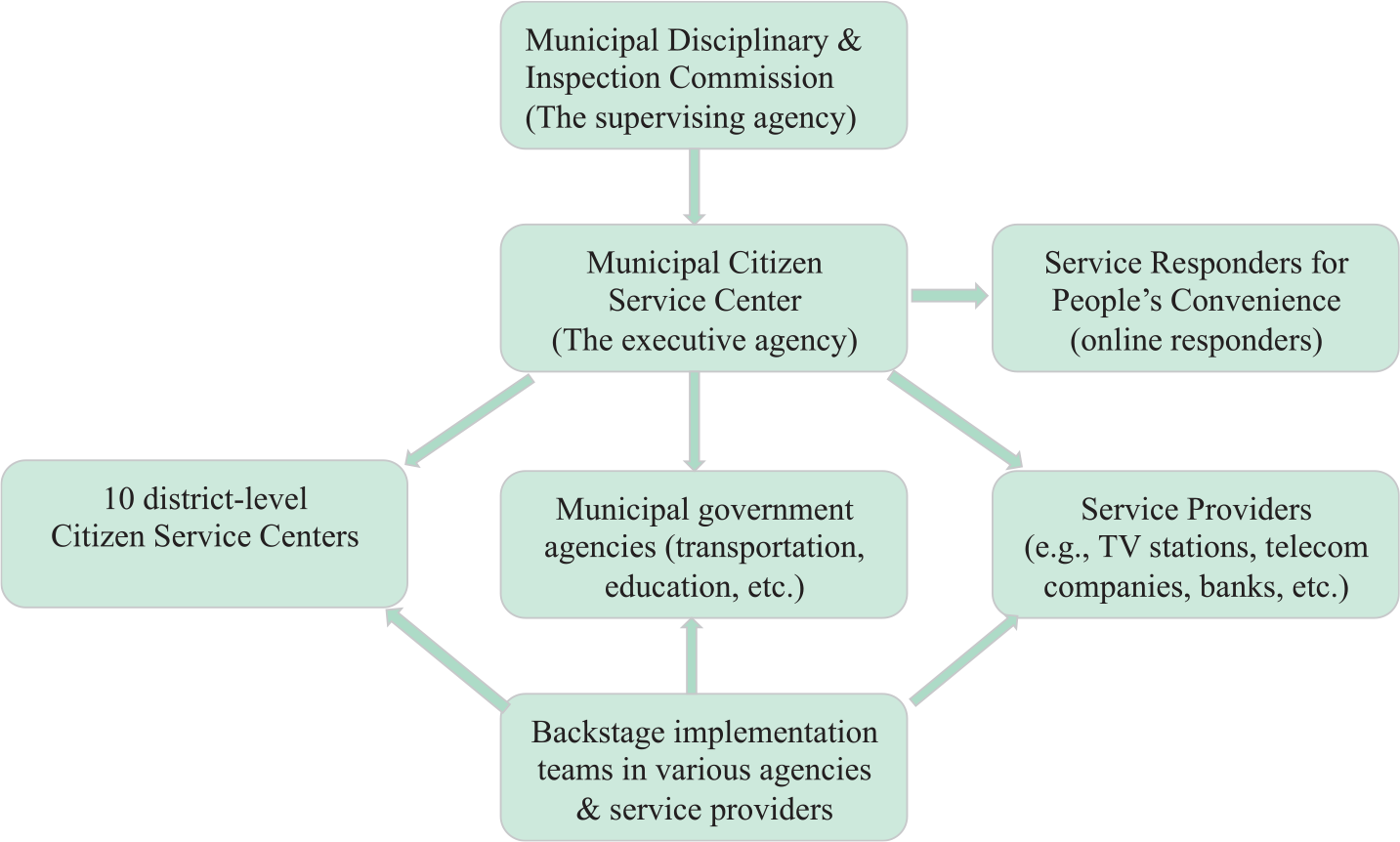
The structure of Hanshan Wenzhong in the municipal government hierarchy.
With this system, the municipal government mobilizes political and social resources and takes strong measures to bring the forum into operation. With a powerful offline bureaucratic structure for implementation, at least some of the issues that citizens raised on the forum do not simply stay wandering but get timely responses and even resolutions. As a result, the forum established its credibility very quickly. By August 2012, according to an online poll reported in the Suzhou’s city portal site, nearly 89% of the respondents had learned about Hanshan Wenzhong, >90% reported that they would express their concerns on the forum, and >62% agreed that the government-run forum played a significant role in strengthening accountability.
In principle, the forum is open to all globally. But because of its local orientation, most who browse and post on the forum are those who reside and/or work in the city. So far, there have been three types of users: >150 clearly labeled “Service Respondents,” >28,000 registered account holders, and many more unregistered visitors. Based on our daily visits for about a month in July 2015, there are 1300–1500 registered users online each day; if including unregistered visitors, the number doubles. In both the intent and the infrastructural design, the forum is open for interactions among users, between individual users and government agencies, as well as between government agencies. It allows free discussions on any government agency and official and holds them accountable. It also allows any user to comment on any issues related to society at large, the city, and people’s everyday life. Because posts are often submitted anonymously and users are not required to provide complete background information to register their accounts, it is difficult for us to obtain a demographic profile of the user population. Based on our inspection of the posts and responses, it is safe to say that users come from all walks of the city population with Internet accessibility.
These features of open access and apparent free expressions and interactions do not fully capture the publicness of the forum. Given that the forum is directly controlled by the municipal government, we must consider the extent to which the surveillance and regulatory controls of the forum exceed the levels of necessity for security, order, and privacy, as well as other issues related to protecting the interests of the government and balancing among competing interests. Integrating the materials from online observations, interviews, and news media reports, we have noted the following patterns.
First, by utilizing the public power to promote and operate the forum, Suzhou municipal government clearly intends to achieve two goals. One is to listen to the publics’ voices as a way to face the challenge of increased demands for diverse and efficient government services in the network age. The other is to transplant the offline hierarchical governing model to the cyberspace and achieve an integrated centralized governance and control. The two are paradoxically related. While the former goal requires unrestricted opening to and uninhibited expressions of public opinions, the latter involves placing the forum under the full control of the government. As a result, the forum as an institutionally emplaced medium, while fulfilling its role to encourage the public to attend to government policies and actions, bring public opinion to the government, and hold the government and its officials accountable, is also a means for the government to domesticate public opinion. It shows that the forum of this type has both functions of publicity and disciplinary control.
Second, the bureaucratically structured hierarchical architecture of the forum defines user membership with unequal powers and privileges. This is contrary to the principle of equality for all in public space. In fact, “service respondents” function collectively as a symbol or even an empty “signifier,” in that none of them is an autonomous participant in the forum, and each speaks and acts strictly on behalf of a specific government agency. In addition, they vary in amounts of power, depending on their placement in the government’s bureaucratic hierarchy. Their official status also differentiates them from other forum participants. As spokespersons and agents of the government, they are designated gatekeepers on the forum: Only those submissions that they have reviewed and approved can be posted on the forum and enter the process of being investigated, studied, and treated. This systemic arrangement severely limits free expressions on the forum.
Third, the forum requires user registration. Although anybody can create an account without supplying identification information, a prospective user is required to enter a verification code sent to his or her cellphone. A person’s account on the forum is thus directly linked to his or her cellphone. While participants operate anonymously to one another, their identities are clearly knowable to system operators through the cellphone registration system. To some extent, this measure goes beyond the necessity of system security and severely undermines the openness of the forum. Sensitive of China’s political environment, many users worry about retaliation against those who express critical views on the forum, despite repeated public assurances from government officials that “(A)ll posts on Hanshan Wenzhong and their IP addresses are strictly protected, and retaliation is strictly prohibited.” 2
Needless to say, Hanshan Wenzhong as a “government online office system” is not a Habermasian public space for free expression. However, it is a venue of public participation created in the spirit of maintaining government’s legitimacy and accountability. To that degree, it is a site for what He and Warren (2011) have called “authoritarian deliberation.” These two scholars regard deliberation as a mode of communication in a political process where participants use reasons, arguments, and justifications to influence one another’ preferences and positions. In contemporary China, while the political power is concentrated, the regime, for its continued legitimacy, needs and does invest political capital in creating deliberative spaces. In other words, there is a systemic imperative for managed deliberation. When power holders launch deliberation to gather information, read public sentiment, and formulate policies accordingly, they enter into dynamic interactions with the publics. The process involves mutual persuasion in and for public to some degrees.
An illustrative case is an event that occurred not long after Hanshan Wenzhong started its operation. It began with a report that Canglang Hospital had installed an imported Gamma Knife without regulatory approval. This is a system for radioactive treatment of cancer patients. The report caused panic among some of the residents in the neighborhoods around the hospital. They first expressed their concerns of radioactive hazard to property management agencies of their apartment complexes, government offices, and media outlets. When no response came, they decided to put up banners on the street and, at the same time, reported the issue and their actions on Hanshan Wenzhong. Their posts on the forum immediately elevated the issue to a hot online topic; very quickly, the comments following the original posts accumulated to 10 web pages. The offline implementation system of the forum was also activated. Government actions at both the municipal and district levels, in addition to giving online responses, launched investigations and organized community discussions. The flurry of activities led to the final resolution of the hospital moving the Gamma Knife out of the densely populated residential area and the hospital’s director apologizing to the local residents. In the aftermath, the administrator of Hanshan Wenzhong appeared on Suzhou TV’s live-interview show called Dialogue Suzhou to comment on the matter. He praised the netizens for their expressions on the forum, saying that
in their expressions of emotions, (the netizens) mostly were cool and not extreme; in their expression of interests, (they) spoke more about public interests than private interests; in analyzing the issue, (they) tended to offer in-depth analyses rather than being trapped in surface appearances.
In this case, we can see that the forum, as an institutionally emplaced medium, is limited in its publicness, but it does function as a site where citizens congregate and interact with one another. They push boundaries of expression on the forum, create innovative expressions, and initiate deliberations in various modes and directions. Their actions stir up the potentials of the forum as a public space.
The content of the private domain and the deliberation of public issues
In reality, the Habermasian public sphere faces practical constraints. Because of the normative requirements for individuals to be rational in analyses and expressions, as well as the structural inequality in the distributions of resources and opportunities for political participation, in reality, those who have their voices and possess the ability to swing public opinion tend to be elite. In other words, social structural factors make individuals unequal in their opportunities of participation and levels of influences. The mass media space is clearly configured with this kind of inequality: It excludes the mass publics in both access and standing; at the levels of value and ideological representations, the voices of these mass publics are largely ignored and masked.
The advent of the Internet has elevated the expectancy of democratic politics as well as functioning of the public sphere because it is assumed to bring out the possibilities that mass publics with basic technological know-how and access can disrupt the elite monopoly of the media and public discourse with their free expressions. The time-space extension of the network technologies also brings affordance for mass publics’ instant, informal, and egalitarian interactions, breaking through the elite’s mode of discourse and ideological dominance. Of course, the broadened mass participation may also bring out certain undesirable features of the public discourse, including fragmentation, factual inaccuracy, and concerns on private matters, among others. However, as stated earlier, the publicness of the Internet denotes not commonality or uniformity, but pluralism, dynamism, and differences, based on the recognition and appreciation of individuals and their wills and values. As Dahlgren (2005) points out, the extent to which the media fulfill its role of the public sphere is in how well it allows and supports expressions and appeals of different social groups.
If so, then, how can personally oriented, subjective, and emotionally loaded discourse of the private realm be brought to a network space that is open to public? How may diverse, differentiated, and sometimes even conflicting discourses of various persons or social groups contribute to the formation the publicness of the media? Or, more concretely, what kinds of talk may shape public issues, public opinions, and public interests? Addressing these questions, we examined the three interactive sections of Hanshan Wenzhong: “Wenzhong Pingtan,” “Open for Input,” and “Consultation and Complaints.” 3 The first section has the feature of “service respondents” posting topics of discussion and netizens responding with their comments; the latter two involve registered account holders initiating posts and others, regardless their registration status, responding to the initial posts. We compared the issue topics, categories of the topics, and language styles among the posts.
We first browsed all the posts on all 45 topics in the “Wenzhong Pingtan” section from the forum’s inauguration to 23 July 2015. These are the topics posted by the official “service respondents.” Table 1 shows those that had received >10,000 views (listed in a descending order based on number of views).
Initial posts in “Wenzhong Pingtan” with >10,000 views.
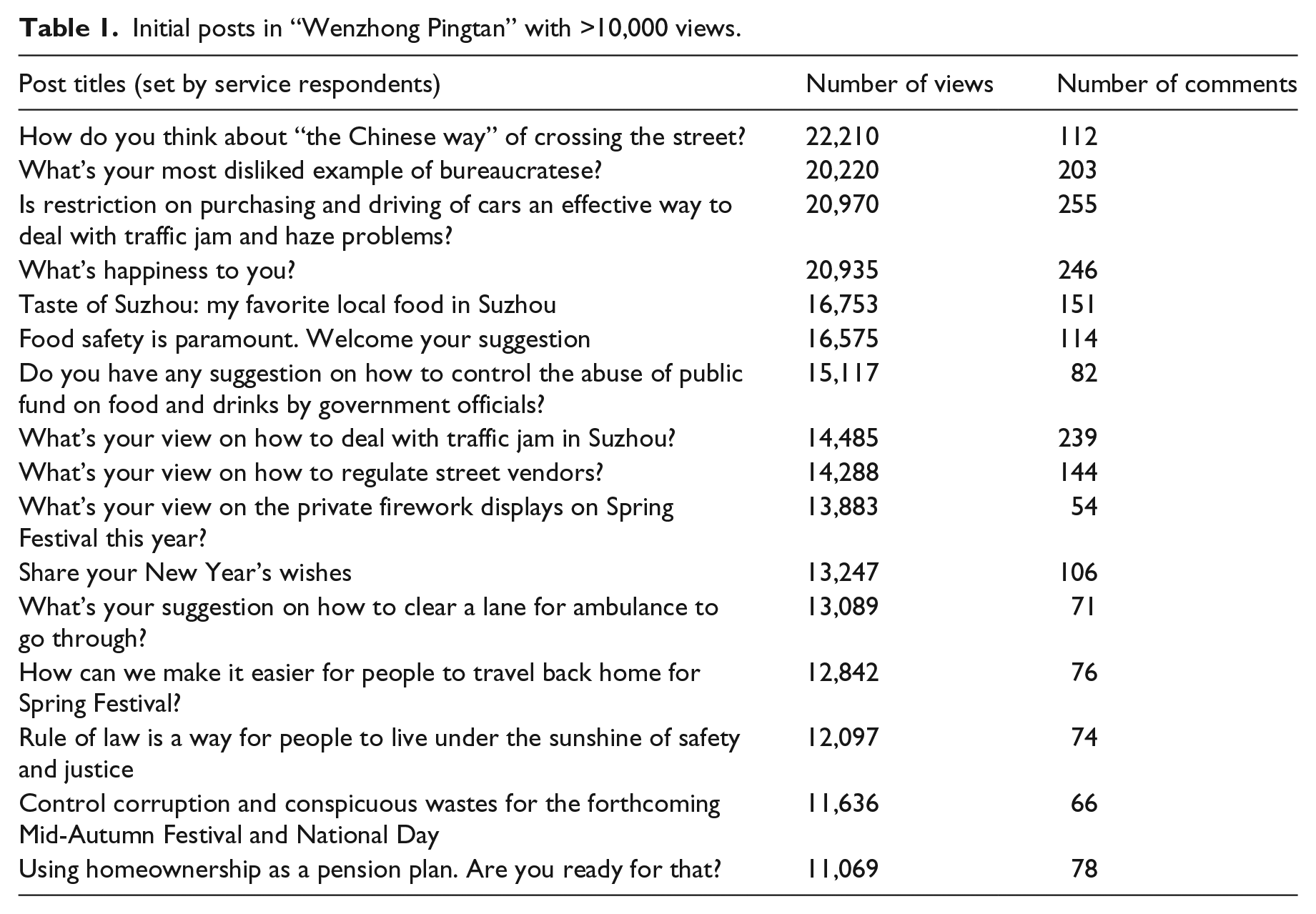
From this table, we can see that “service respondents” initiated posts covering a wide range of topics. First, most of the topics are on issues of public concern, and they are not even limited to the city. It seems that the “service respondents” attempted to entice discussions on some general public issues and solicit suggestions from the public on city management. Of course, there are also some topics such as “Share your New Year’s wishes” and “What’s happiness to you?” that seem to be mostly for attracting eyeballs.
Second, life experiences of broader publics may play some agenda-setting role in the discussion. For example, the topic of “using home ownership as a pension plan” was initiated at a time when four megacities in China, Beijing, Shanghai, Guangzhou, and Wuhan, started to experiment the policy initiative of encouraging people to buy their own home as their pension investment. The news generated nationwide attention. From the comments following the initial post, we can see that people brought their life experiences to discussions on this policy issue. One comment reads,
Once upon a time, the government was responsible for pension; then, people were led to rely on the interests from insurance companies; now, we are told that it’s left to older people’s own fate. The government deserves to be whipped.
Another says,
“Have one child and let government take care of you after your retirement,” … “Postpone retirement and be financially secure after your retirement,” … now, “Buy a home to support your retirement.” … The more I listen, the more I’m confused … Where did all our pension and tax payments go? With housing prices so ridiculously high and unstable, who could depend on such a plan for the last leg of their life?
These comments show that while expressions may be emotionally charged, there was a crystallized opinion opposing the policy of “making homeownership a pension plan.”
Third, following these posts were broad and somewhat egalitarian discussions among netizens. On each topic, after publicizing the initial post, the “service respondent” would post no further comment or answer any question. The discussion on the topic raised in the initial post took place among users without any orchestration. Such a discussion shows a lot of crosstalk but not necessarily an orderly dialogue. As it is the case in the “homeownership as a pension plan” example, while the same sentiment can be readily detected from the comments, there is no clear indication that such comments formed some logically coherent discourse.
The other two sections that we examined, “Open for Input” and “Consultation and Complaint,” permit registered account holders to initiate their posts. By design, the former is for suggestions, and the latter is for filing complaints or making grievance petitions. But the distinction between the two is unclear, and netizens do not bother with making it. As a result, the posts in these two sections overlap quite a bit. In addition, there are also more lively activities in these two sections compared with “Wenzhong Pingtan” that only allowed “service respondents” to initiate topics. For example, in July 2015 alone, the two sections had 9619 initiated posts, with 7551 under the “Consultation and Complaint” and 2068 under “Open for Input.” In addition, taking a couple of dates as illustrations, we can see that follow-up comments are much more numerous. For example, 24 July had 254 new posts and 1801 follow-up comments; 27 July had 320 new posts and 1732 response comments. These figures, while limited, do offer a glimpse on the active “dialogue” in these two sections.
Compared with posts by the “service respondents,” the posts by private netizens have the following characteristics. First, the posts tend to be pegged on things in people’s everyday life and relate to their personal interests. These range from the basic necessities of food and drink, health, and schooling to interpersonal relations, and many others; they were posted, it seemed, when authors’ own interests had been harmed in some way. These can be that, for example, dumpsters and recycling stations were too close to their home; a small restaurant on the ground floor of one’s apartment building is too noisy; kids are refused admission by a school with no justification and so on. Together, these topics form a holographic depiction of everyday life.
Second, the authors of these posts seem to be mostly interested in local issues; they do not post on topics outside of Suzhou, let alone those in the purview of the nation or the world. For example, at the midnight of 12 August 2015, a serious explosion in a warehouse in the harbor of the northern city of Tianjin grabbed the nation’s headline. But by 4:30 p.m. of 14 August, Hanshan Wenzhong had only 4 posts with 24 response comments related to the event. The four posts carried the following headings: “Thinking about the planning of chemical production areas and residential areas in light of the 812 explosion in Tianjin harbor,” “Are there plans to move Jiangnan High Polymer Fiber after the chemical explosion in Tianjin?” “Drawing lessons from Tianjin explosion and eradicate potential environmental hazard,” and “Reflections on relocating the Mingde Logistics Industry Park in light of the explosion in a Tianjin logistics warehouse.” 4 These headings and the comments to these posts all indicate that the participants on the forum were more concerned about immediate hazards of local chemical warehouses and polluting plants.
Third, many of the netizen-initiated posts do not have enduring lifespan. Some did not have enough resonance among forum participants due to their narrow personal focus; some were on simple problems that were quickly resolved by “service respondents”; some were on enduring and general issues that could not be readily addressed and they fell to the bottom of topic listing because the initiators did not follow them up. But in this swamp of personal issues, some topics or themes come up and down, revealing the enduring interest in them among forum visitors. To get a sense of such posts, we took advantage of the “reply and view” function on the forum to query all hot posts. On the basis of this systematic search, we chose 20 top ranked hot posts and classified them according to their thematic foci. They are presented in Table 2.
A profile of the top 20 hot posts in “Open for Input” and “Consultation and Complaint” sections.
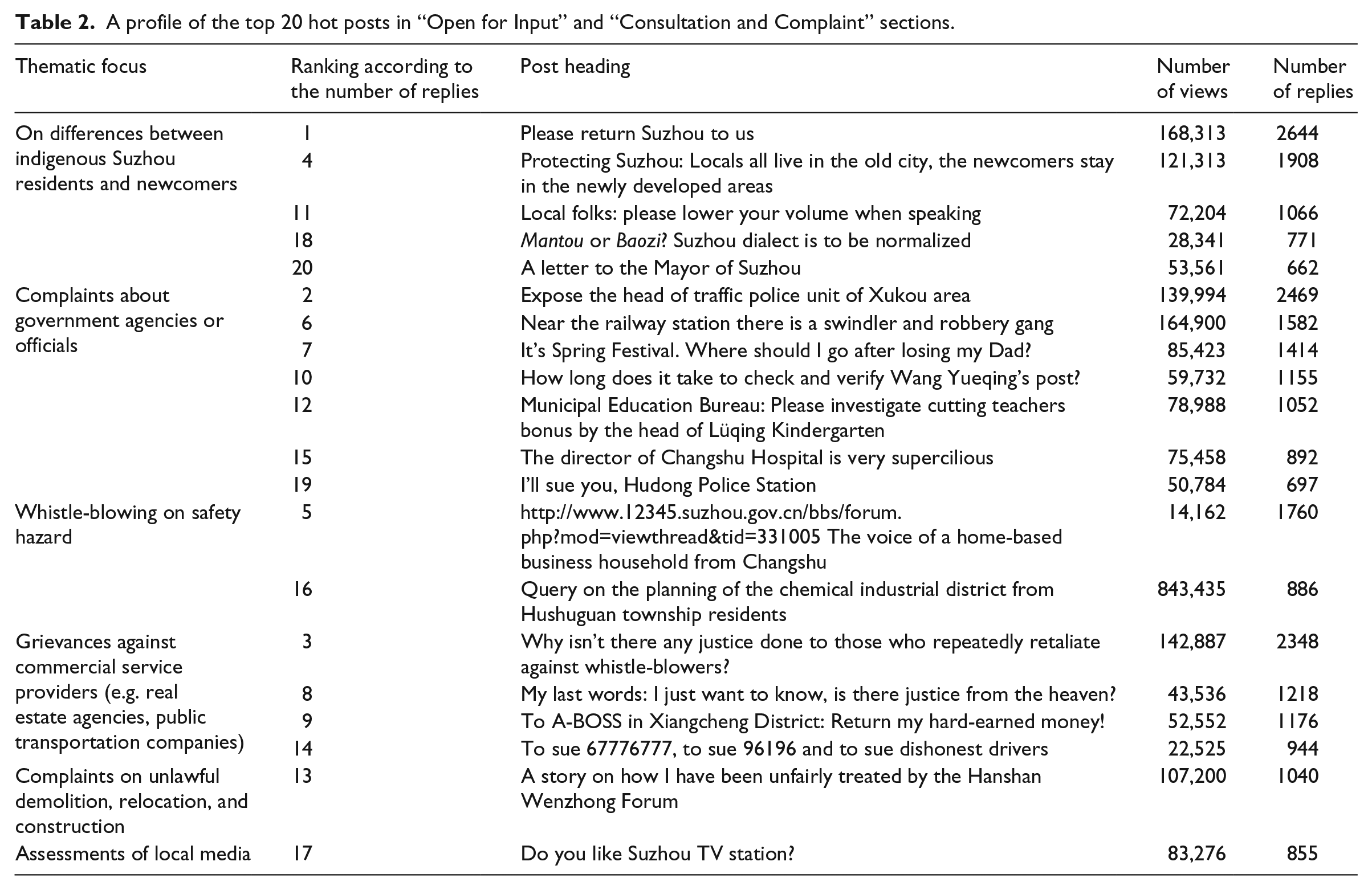
The amounts of viewing and commenting on the posts suggest that netizens indeed have engaged one another; or, there have been interactions among them. Given that no system of restriction is set on such interactions, then, the forum does have the two key features of publicness: openness and access. In addition, we observed no apparent correlation between the levels of viewing and the amounts of follow-up comments. We take such evidence to mean that netizens’ attention and the modes of engagement are scattered widely among varieties of topics.
Inspecting these posts more closely, we can extract the following characteristics. First, many of the topics are related to the tension between people and the government. We see grievances against traffic police, local police stations, hospitals, and state-run kindergartens; we also see complaints about safety and unfair treatment. Even for those grievances on mistreatments by commercial service providers, the aim is at the government for its inapt regulatory control. These topics related to city management and the residents’ everyday lives are, or at least are related to, public issues of the city.
Second, whether expressed from the vantage point of individuals’ private interests or that of the group, these topics are all relevant to the common interests of the general publics and broader concerns of social justice. For example, #6 is a post by a person who was victimized by a gang operating in the neighborhood near Suzhou Railway Station. She reported the incident to the police station in the neighborhood and received no effective response for a long period of time. As she stated in her post, bringing the issue to the forum was not for getting back RMB150 yuan that had been cheated out of her; rather, she wanted to warn people about safety and security.
Third, most of the topics raised in the posts received no indication of resolution. Among the 20 posts, only #2 and #15 received treatment notifications, all others have been hanging in limbo. But some of these posts, because of their relevance to public concerns, hanging in limbo also means that they continue to get floated to the top of the pile of topics and receive comments from new rounds of netizens.
Fourth, if a post author is known to be an individual, often, he/she may incite sympathy and empathetic concern from others. An example is #7. The person who wrote the post is a young woman. In her post, she tells her experiences of struggling to get her legally rightful compensation for having lost her father in a traffic accident. The reply comments showed a significant amount of sympathy and moral support. At times, netizens may form an organized collective to elevate an initial post through viewing and commenting. By doing so, they raise the salience of the issue in the initial post and attract more netizens to participate in discussion. Take #12 as an example. After the initial post, those who commented on the issue and extended the discussion included not only any netizen but also the author’s current and former colleagues and parents of the children from the kindergarten where the author works. Their participation broadened the issue to teachers’ duties, responsibilities, compensation, and management.
When people of different strata bring their private concerns or issues of self-interest to a public forum, there is a possibility of democratizing public life. This is so especially when there are more connections between personal issues and those of public policy or when diverse styles of talking about “personal issues” broaden the venues for public issues to be formed. With these possibilities, we can see that public issues and individuals’ private lives are closely intertwined. Arguably, such an intersection becomes even more active in the age of new network media, where
the imagined body of a micro public is mainly constructed by many individual minds, constituting the mind of a public; such a public mind in turn influences individuals’ minds. These micro dynamics then produce revolutionary impacts on social institutions and systems. (Shi & Hu, 2014)
Among all the voices and countless topics, some “meta-agendas” are brought up and discussed over and over again. They are enduring issues and often how they are treated become among the criteria for us to evaluate public life. Such meta-agendas intersect all issues under discussion but also transcend them. Examples include how fully all of the publics express their views, to what degree policies have resulted from public discussions, and to what degree such discussions take place under the condition of freedom and openness, and so on. Whenever they get set as agendas of conversation, it suggests that the dynamics and substance of public life may be changing. Using Charles Taylor’s (2007) language, it is through examining publicity in the context of such discursive formations of issues that we examine the “meta topical common space” (p. 56).
The above analysis shows that Hanshan Wenzhong as an institutionally emplaced medium has attracted citizens’ engagement with varying degrees of rationality; their expressions, either as individuals or on behalf of some groups, contain fragmented, irrational, and private information. At the same time, the forum offers potentials for them to consider and discuss issues with ample time and from various perspectives. As a result, although such online discussions may be filled with ambiguous, ambivalent, and even conflicting contents, participating subjects are able to handle them by mobilizing their coordinating ability. It is such a “messy” but open process that fosters participants’ habitus of critical and public rationality.
Limited publicity and deficiency of online deliberation
In the Chinese context, with the participation of mass publics and diverse discourses, an institutionally emplaced medium may lead to two possible scenarios. One is that discussion on the forum gets spilled over institutional boundaries, undermining the authority’s control over issue agenda, even resulting in some online storm of resistance or offline collective actions. Such a prospect may trigger even more severe media control. The other scenario is that online discussions help solidify and legitimize the authoritarian system. But they may also contribute to improving deliberative practices and, to that extent, harbor the potential of democratization. How a medium operates as a public forum needs to be assessed within the confines of these two scenarios. As Zhongdang Pan (2008, pp. 9–10) points out, “only by examining both media practices and the institutional arrangements that discipline such practices, and assessing how media operate as public apparatus with evidence from both aspects,” can we demonstrate the publicness of media. Similarly, as political theorists Stanley Benn and Gerald Gaus (1983) point out, we should assess media’s publicness in terms of accessibility, operators, and interests. Here, “accessibility” refers to the rights of public’s access to and use of a medium, “operators” denote the value orientation of those who control the medium, and “interests” ask whether the medium ultimately serves the publics’ interests. Following the logic of these propositions, in our inquiry of Hanshan Wenzhong as a public forum, we examine situated media practices, assessing the extent to which public elements are embodied in communicative practices taking place on this platform.
As stated earlier, as an online forum, Hanshan Wenzhong is widely open; any Internet user can access it; but all users do not get the same leeway for their activities; account registration and filtering by “service respondents” restrict users’ expressions and interactions in concrete ways. Thus, assessed in terms of accessibility criterion, the forum is not fully “public.” However, city residents, through their online posts and comments, interact with one another and through the mediation of “service respondents,” interact with government agencies to facilitate policy implementation. To this extent, the forum does function as an interface between public expressions and public administration. For example, the Inspections Office of the Suzhou Municipal Public Security Bureau told us that, in May 2015, Hanshan Wenzhong had 9398 posts and the Bureau handled 1032 of them (or 11%) that were in its jurisdiction. Such statistics provide a glimpse of the amount of issues that the forum brings to a government agency and illustrate Chadwick’s (2010) point that the Internet may facilitate speedy government responses to constituents’ concerns.
To probe further into the question of the extent to which public expressions on the forum have impacted government’s actions, we sought empirical illustrations. In this case, we traced all 4600 posts in the week of 25–31 July 2014 that received netizen feedback ratings on the responses that they had garnered. Among them, 702 posts had ratings by their authors. Of these, 61% rated “satisfied” and 32% “unsatisfied” with the responses. Other users may also rate the responses to such posts, but they do so on a 100-point scale. Among those who used the scale to express their assessment, >53% gave 60 or higher scores. These numbers, while only empirical fragments, are illustrative of users’ evaluations of their experiences through the forum.
In sum, Hanshan Wenzhong to some degree has allotted opportunities for people from different walks of life to access the forum and express their views freely. Its reach or accessibility is high, and it provides some affordance of publicness.
More systematic browsing of the forum also shows its severe limitations. We observe that users tended to rate positively those instances where the initial posts had led to speedy and real problem-solving responses. But these tend to involve concrete everyday problems such as interruptions in electricity supply, street potholes, vendors taking up sidewalks, and so on. Not surprisingly, users tended to rate negatively situations where initial posts had received only perfunctory responses from relevant government agencies or the problems reported in initial posts did not get resolved. Many of these situations involve really difficult and protracted problems such as bureaucratic red tapes, bullying behavior of government officials, city planning, distribution of educational resources, and so on. On such problems, while “service respondents” gave timely acknowledgement of having seen the posts, there were unlikely concrete solutions forthcoming. What we see then is a bifurcated mode of forum management driven by a “self-serving” motive. The government would act as a proprietor of the online public forum where problems are raised and addressed and government’s actions are publicized if doing so would not be controversial or harm its own interests or legitimacy; it would, however, equivocate on those posts that have raised issues involving entrenched interests. Viewed through this lens, we can say that Hanshan Wenzhong is not primarily a forum where people gather and interact freely to form public opinions and influence public policies. To put bluntly, there is no close fit of this institutionally emplaced medium in the deliberative model, democratic or not.
In addition, a model of democratic deliberation also stresses that individuals engage one another not only freely but also sincerely and with mutual respect. It has no room for manipulation, coercion, or deception. Viewed from this angle, Hanshen Wenzhong is highly defective as a public forum. In part, this is due to the absence of institutionally empowered actors who can directly influence policy making in the discussions on the forum. As described earlier, the “service respondents” are the only ones interacting online with netizens on behalf of the government. But other than passing information, they have little actual power. As a result, they typically respond to netizens’ posts in a formulaic fashion, saying something like “We’ve noticed this issue and an inquiry is under way. Please stay tuned.” Beyond that, “service respondents” rarely participate in discussions with netizens, on either the topics that they posted or those from netizens.
Assessed in the normative formulation of “the ideal speech situation,” we may even see such contrived “service respondents” as being detrimental to deliberativeness on the forum. This is not limited to many errors in their responses to netizens’ posts; more problematic are their absence as participants in discussion and bureaucratically formulaic responses. Such acts on their part, while institutionally prescribed, as stated in the guidelines of their work, place in a glaring display not only unequal status between them and ordinary netizens but also their lack of communicative sincerity and authenticity. Their formulaic responses irritate and even demean netizens, lower the credibility of the forum, and diminish the subjectivity of the “service respondents” as much needed forum participants. To use Linda Dennard’s (1996) vocabulary, thus, the forum is not operating as a place of sincere and egalitarian dialogues between public administrators and the public for the latter’s self-discovery.
The forum is also a place where certain social discords are on display, one of which is xenophobic sentiment against newcomers, who, disproportionately, are migrant workers. As shown in Table 2, such posts are not uncommon, and they generated significant numbers of views and comments. Even the post on Suzhou TV station contains a complaint against a particular show, “Let Zhao Hui Help You,” for the host of the show, Zhao Hui, allegedly uses the “public platform” of city’s TV station to help migrants to get settled in the city. Against the backdrop of rapid urban expansion in China, the fact that such a tension between locals and newcomers shows up on local media is not unique to Suzhou or to this particular online forum. There are good reasons that it should be a legitimate issue for open discussions. But on Hanshan Wenzhong, there is no adequate effort to coordinate such discussions toward some mutual understanding, respect, and integration. “Service Respondents,” the online agents of the government, are completely absent or inapt on this regard. For example, the post, “Please return Suzhou to me!” generated >2600 comments; only one of them came from a “service respondent.” It read, “(I)nclusion and integration are the direction for both native and newly arrived Suzhou residents. Your post highlights many things for us to think about. Let new and old Suzhou residents encourage each other!” Other similarly intoned posts faced similar fate: There were heated but disorderly debates, but nothing along the line of a mutual understanding or concrete policy measure came out. The prevalence of such situations only weakens the deliberative affordance of the forum.
Conclusion
This article shows that as an institutionally emplaced medium owned and operated by Suzhou’s municipal government, Hanshan Wenzhong, by design, is an extension to the cyberspace of the government’s administrative system. It has the characteristics of being highly centralized, structured, and controlled. There have been instances where certain posts were not approved to publish due to political sensitivity and certain accounts were closed due to violation of the rules of the forum. In addition, direct online dialogues between account holders require additional steps of “friending” each other. All these structural constraints limit the potentials of the forum for public deliberation.
We have also presented evidence to show that most of the posts on the forum are about private matters of everyday life. One may wonder whether the prevalence of such matters might overwhelm public issues. Furthermore, most posts expressed individuals’ expectation that government immediately address their specific concerns rather than having the public start a free and open discussion. Thus, we may also wonder whether the forum as a “network site of administration” limits the publics’ imagination of it as a potential deliberative platform and fosters an unrealistic public expectation that their posts must generate speedy and concrete government actions. The fact that some (or even a majority of) issues are not susceptible to such quick solutions may be taken as evidence of government’s lack of responsiveness, which in turn becomes a source of public’s disappointment and discontent.
Thus, assessed in the Habermasian normative model of public sphere, Hanshan Wenzhong is largely a disappointment. But after having examined the activities and expressions on the forum situationally, we can conclude that the medium does operate with limited but significant publicness and reveals the potentials for “authoritarian deliberation” (He & Warren, 2011). First, access to the forum is mostly unrestricted and equally distributed, making the forum an open site for public discussions and mutual persuasion between government and publics, on one hand, and as among the public, on the other hand. Second, netizens enjoy a great degree of freedom of expression. As a result, many from different walks of the city bring their private concerns and personal styles of expressions to the public stage, blurring the divide between the public and the private. But they also bring to the forum diverse and innovative expressions and the significance of individuals’ material interests. More importantly, they also continuously elevate the enduring “meta topics” concerning the basic principles of justice, fairness, government accountability, and rationality in approaching the issue raised on the forum, reflecting their ability and efforts to coordinate forum discussion. Third, to a significant extent, when interactions between the public and the government are embodied in successful quick responses and concrete problem-solving measures from the latter, they reduce the tension between the municipal government and the public and bolster public’s trust of the government as well as their identification with the city.
Our results show that from agenda setting to problem treatment, the forum has its structural bias dictated by its “institutionally emplaced” nature. But at the same time, it is also one of the innovations inspired by the increasingly prevalent talks about publicity and democratic deliberation. Such talks have appeared widely in officials’ speeches, official documents, and policy resolutions, as if they are being incorporated into the mainstream discourse of governance. However, as He (2015) points out, the principles of deliberative democracy remain foggy in such talks and attitudes toward them tenuous at best; as a result, when encountering a knotty problem, officials may resort to deliberation only if doing so serve their interests; after the problem’s resolution, they reverse back to their authoritarian way. Even when deliberation is organized, the officials try to use institutional design, procedure manipulation, participant selection, and other measures to assure their desired outcomes. Reflected in the Hanshan Wenzhong case, such tensions in “authoritarian deliberation” are among the structural reasons for the limited publicness and ineffectiveness of the online forum.
The same tensions may also account for episodes of lively activities on the forum and its potentials. For example, in the early days, the prominence of the then top administrator of the forum and his personal involvement in online discussions elevated the activeness, impact, and publicness of the forum. At the time, with the backing of the city’s highest authority, the forum was indeed very active, and expressions in posts and comments were daring in exposing to entrenched interests. Furthermore, “service respondents” could also influence the atmosphere and quality of discussions on the forum in important ways. When they responded to netizens’ posts in an open, direct, and egalitarian manner, they could induce more positive interactions; facilitate moving a problem toward its resolution; and, as a result, elicit more favorable ratings of the forum. Of course, different bureaucratic branches, motivated by their own interests, also extend their turf wars to this online space, as they try to evade their jurisdictional responsibilities and suppress certain issues from entering this online space.
With all the structural defects, still, we can conclude that Hanshan Wenzhong as an online medium is a “forum of the third kind” and has far-reaching significance. As consumption and leisure increasingly encroach upon public places in cities, compressing the space for dialogues between government and the public and among the publics, an online forum of this kind may broaden city space toward an exciting direction, the one that forefronts publicness and communicative interactions and opens up more space that make routine and legitimate low-threshold activities and opinion expressions via multiple devices and connections. Thinking along this line, we might envision more optimistically about the future development of a city toward being a more open and democratic community.
Footnotes
Acknowledgements
Based on the Chinese version originally published in Journalism and Communication (Xinwen yu Chuanbo Yanjiu), 2016, No. 8, pp. 67–87.