




Abstract
The public sphere was both one of the most popular and most debated concepts in political philosophy in the 20th century. It is one of the few concepts that has attracted attention from a wide range of disciplines. Despite the already rich intellectual history of the concept, many scholars still disagree over its proper use and definition. The purpose of this article is to review recent research into the public sphere with a co-citation analysis. A citation analysis helps to obtain a broader view of the development of the concept in different disciplines. Such an approach is of importance because the concept of the public sphere is neither fixed nor stable, as is typical for an essentially contested concept. Rather than finding the most prominent or even “right” interpretation of the concept, the primary goal of this study is to explore the evolvement and differentiation of the concept in different domains and disciplines over time. In such an analysis, the whole corpus of academic literature focusing on the public sphere as a concept can be captured. In a first step, I introduce the concept of the public sphere as an essentially contested concept. In a second step, I analyze 5386 publications from the last 20 years with a co-citation analysis. Based on the data, I identify different research communities, analyze the development of the communities and topics over time, and empirically observe some of the conditions of an essentially contested concept.
The public sphere was both one of the most popular and most debated concepts in political philosophy in the 20th century. It is one of the few concepts that has attracted attention from a wide range of disciplines, such as communication science, philosophy, political science, and history. Despite the already rich intellectual history of the concept, many scholars still disagree over its proper use and definition (Tully, 2013). The contested nature of the concept became evident at the beginning of the 20th century with the debate between Dewey (1927) and Lippmann (1925), who disagreed with each other on the status of the public sphere. Half a century later, Habermas (1962) followed with his seminal book Strukturwandel der Öffentlichkeit, which was also challenged from an early stage (e.g. Negt & Kluge, 1972). This trend continued with Habermas’ (1989) first book in English. 1 Only a few years later, the Habermasian concept of the public sphere was critically debated in Calhoun’s (1992) edited volume. Habermas, influential critics originating in feminist theory (e.g. Benhabib, 1992; Fraser, 1990), and scholars from the American liberal tradition (e.g. Schudson, 1992) contributed essays to this publication. Besides this, historically influenced debates around global societal changes, such as the third wave of democratization and the emergence of the Internet (e.g. Abbott, 2012; Papacharissi, 2002), fundamentally challenged the Habermasian concept of the public sphere.
As this short overview already indicates, one of the most interesting aspects of public sphere research is the debate itself and how the concept has continuously changed over time. Although extensive theoretical and empirical research has been carried out on the concept of the public sphere (Rauchfleisch & Kovic, 2016), only a few studies have investigated the public sphere literature in a systematic way. The purpose of this article is to review recent research into the public sphere with a co-citation analysis. This method has the potential to capture the whole corpus of academic literature focusing on the concept. Additionally, the intellectual structure of the concept can be mapped. Previously published studies identified, for example, different schools of thought (Ferree, Gamson, Gerhards, & Rucht, 2002) or analyzed in a literature review manually selected titles from a limited corpus of communication journals (Mercea, Lekakis, & Nixon, 2013). Both approaches are legitimate but have very narrow selection criteria for the literature. A citation analysis helps to obtain a broader view of the development of the concept in different disciplines. Such an approach is of importance because the concept of the public sphere is neither fixed nor stable. Rather than finding the most prominent or even “right” interpretation of the concept, the primary goal of this study is to explore the evolvement and differentiation of the concept in different domains and disciplines over time. So far, studies have only focused on one specific field (e.g. Mercea et al., 2013) or have on an abstract level identified different schools of thought (e.g. Ferree et al., 2002). The results of a co-citation analysis are useful for any scholar working with the concept because all relevant disciplines and domains will be captured, and thus, my study will give an overview of the public sphere scholarship of the last 20 years and possibly indicate future research directions.
The public sphere as an essentially contested concept
As a starting point, it makes sense to define roughly what the public sphere is. In the English language, it is clearly a terminus technicus, whereas the German word Öffentlichkeit can be either interpreted as the public in its everyday life meaning, or like its English equivalent as a terminus technicus. Habermas (1989) understands the public sphere as a “realm, which is … firmly situated between state and society” (Susen, 2011, p. 44). This very basic understanding is probably the least common denominator both theorists and empiricists can agree upon. Tully (2013) aptly pointed out that “any instances of publics and public spheres always share at least some similarities or criteria with others, but no one set of criteria is shared by all” (p. 171). Therefore, one aim of this article is to highlight the concept of the public sphere as an essentially contested concept before turning to the co-citation analysis. Some of the conditions of an essentially contested concept can be empirically captured in a citation analysis.
Essentially contested concepts
Gallie (1955) proposed the term essentially contested concept. Essentially, contested concepts “relate to a number of organized or semi-organized human activities” (Gallie, 1955, p. 168), such as political philosophy, philosophy of history, and the philosophy of religion. Gallie (1955) analyzed the concept of democracy and explicitly introduced it as an essentially contested concept. A well-known essentially contested concept in social science is social capital. Woolcock (2010), for example, analyzed this concept and came to the conclusion that the coherence and usefulness of essentially contested concepts:
rest not on a clear consensus regarding its definition and measurement, but on its capacity to draw attention to salient features of the social and political world … that are of significance in their own right and play a role in valued aspects of everyday life. (p. 470)
The same holds true for the concept of the public sphere. Essentially contested concepts can be best understood as a framework, or more accurately, as Collier, Hidalgo, and Maciuceanu (2006) describe, as “a set of interrelated criteria that serve to illuminate important problems in understanding and analyzing concepts” (p. 215). While in essence essentially contested concepts seem problematic in research, I will argue at the end of this study that the contestedness of the concept can be an advantage, especially in social science.
The seven conditions of essentially contested concepts
Gallie (1955) proposed seven conditions that characterize a concept as essentially contested. Collier et al. (2006) created an overview of the seven original conditions for contestedness and critically assessed them. The following summary will be based on their further developed framework. In the next part, I will evaluate the concept of the public sphere according to these conditions. This approach will help to understand better why the concept of the public sphere is highly contested.
Appraisiveness
An essentially contested concept has “normative valence attached” (Collier et al., 2006, p. 216) to it. Democracy, for example, is the “appraisive political concept par excellence” (Gallie, 1955, p. 184). Collier et al. (2006) sum it up as generally normative concepts.
Habermas (1962) introduced the bourgeois public sphere as the ideal version; thus, the concept was introduced as a highly normative concept. However, today the public sphere is, in a rather pragmatic view, seen as a precondition for democracy (e.g. in the European context: Eriksen, 2005). To add one more prominent example, which stands in opposition to Habermas’ conception and puts more emphasis on different functions of the public sphere, Fraser (1990) also proposed her understanding of counter-publics as the better public spheres.
Internal complexity and diverse describability
Internal complexity and diverse describability as conditions are interrelated to each other. Collier et al. (2006) concluded that “the internal complexity of a concept makes it plausible that different users may view, or describe, its meaning in different ways” (p. 216). Thus, the internal complexity of a concept allows diverse describability.
As has been described before, the public sphere as the sphere between the private and the political sphere is the most basic definition of the public sphere without putting emphasis on the different criteria and functions of the public sphere. If all kinds of communications, starting with interpersonal up to the level of mass media (e.g. Gerhards & Schäfer, 2010; Habermas, 1996), are being considered as an integral part of the public sphere, the concept becomes highly complex. Even with the more fundamental aspects of the theory, such as the form of communication and the demarcation to other systems (private vs. public), the scholarship offers diverse describability (e.g. Benhabib, 1992; Habermas, 1996). Another example is the general overview of Ferree et al. (2002), in which the authors present different traditions that put emphasis on the various aspects of public spheres.
Openness
Collier et al. (2006) determined the change over time as a central aspect of the openness of a concept. With changing circumstances, a concept has to be modified. According to Gallie (1955), “such modification cannot be prescribed or predicted in advance” (p. 172). The uncertainty of future developments also holds true for the concept of the public sphere. Habermas first analyzed the public sphere in the 1960s, with a focus on mass media in modern society. Back then, the understanding of the public sphere was a very fixed one. By contrast, contemporary scholars like Koopmans and Olzak (2004) conclude, “the boundaries of the public sphere are not fixed but expand and contract over time” (p. 202). Television and the Internet had a huge impact on the concept.
Reciprocal recognition
“[T]o use an essentially contested concept means to use it both aggressively and defensively” (Gallie, 1955, p. 172). Many examples can be found for this condition in the literature, but the most prominent one is probably the collection of essays in Calhoun’s (1992) book. Fraser and Benhabib (1992) directly questioned Habermas’ conception and at the same time promoted their understanding. Even Habermas himself at this point acknowledged their criticism and included it in his newer writings (e.g. Habermas, 1996). Another good example is the debate between Habermasians and poststructuralists (e.g. Dahlberg, 2014). Both sides recognize each other, but an end of the dispute is not in sight.
Exemplars
According to Gallie (1955), an essentially contested concept should be anchored in an original exemplar whose authority is accepted by all scholars. This condition is the most challenged and confusing one out of all criteria (Collier et al., 2006). Still, with the public sphere, such an original exemplar can be identified. Through Habermas’ historical investigation and normative preference of the bourgeois public sphere of the 18–19th century France and England, it has become the primary exemplar of the concept. Of course, the previously mentioned feminist theory has criticized this understanding, but it is still mentioned as a reference in recent studies in different contexts (e.g. Abbott, 2012; Yang, 2003), and scholars still use it as an ideal exemplar to which all empirical observed public spheres are compared. Not all scholars, however, acknowledge the authority of this exemplar (e.g. Fraser, 1992). Additionally, as more functionalistic conceptions of the public sphere indicate, this criterion can be ignored. Gerhards and Neidhardt (1990), as well as Luhmann (2000), for example, have a concept of the public sphere that ignores original exemplars. Even Habermas (1996) provides in his more recent publications a more functional definition of the public sphere without explicitly pointing to an original exemplar (Benkler, 2006).
Progressive competition
Based on Gallie’s understanding, it is almost impossible to have progression toward a mutual understanding. However, as Collier et al. (2006) concluded, with real-world examples, it might be possible to advance because the empirical world offers some evidence for or against a proposed version of the concept. Dahlberg (2004) as a contemporary theorist questions the purely philosophical approach in public sphere theory and acknowledges the crucial connection between theory and empirical evidence: “However, is it not the role of the theorist to assist researchers in formulating specific criteria of the public sphere for empirical research?” (p. 4).
This short overview has given an account of the reasons for the contestedness of the concept of the public sphere. Some of these conditions can only be analytically evaluated with a few examples, but others can also be measured in an empirical analysis. Therefore, for an empirical analysis, I have to first propose applicable conditions that can be later assessed in a citation analysis.
Research interest
As the previous section has shown, the public sphere is clearly an essentially contested concept. With the help of a citation analysis, I can empirically investigate some of the conditions of the essentially contested concept. First of all, the diverse describability and the openness lead to different disciplinary and theoretical understandings of the concept. As I have my roots in social science, I am aware of many empirical studies and theoretical developments of public sphere theory in communication science (e.g. Rauchfleisch & Schäfer, 2015). However, because the public sphere is an essentially contested concept, it will be interesting to investigate which authors and disciplines, in general, are conducting research in the domain of public sphere theory. A citation analysis based on a comprehensive corpus of literature without disciplinary constraints can offer a broad view of the current state of public sphere research. The advantage of a citation analysis is the suppression of a selection bias, which the researchers who are conducting the analysis might have. As mentioned before, the openness of the concept is firmly influenced by changing societal circumstances over time. In a citation analysis, different trends can be identified over time.
Reciprocal recognition and progressive competition are two more conditions that might be relevant to a citation analysis. With this method, I can empirically assess if different understandings are mentioned together in a publication or if, instead, a substantial fragmentation takes place. This point is crucial, because only if the various proponents of public sphere theory recognize each other, progressive competition can be achieved.
I propose the following three research questions for the empirical analysis:
RQ1. Which are the most influential publications in public sphere theory?
It seems plausible to assume that Habermas, with his publications, most likely dominates a ranking of the most quoted title in public sphere research. Still, it is of interest if other contesting understandings of the public sphere theory are also cited often. Feminist theory or in general poststructuralists might also have a high impact on the debate. Furthermore, it will already on an aggregated level be possible to see if progressive competition is taking place.
RQ2. Which communities can be identified?
Based on bibliometric data, I can create networks, which allow me to determine different communities. With an essentially contested concept, it will be interesting to see if diverse communities with a disciplinary or topical focus can be observed. Because of the openness and the internal complexity and diverse describability of the public sphere concept, a broad range of communities can be expected. Most likely, these communities will be rooted in different disciplines. Furthermore, with the citation networks, I analyze the relative distance of the communities to each other and the degree of fragmentation.
RQ3. How have the communities developed over time?
With historical data, it will be possible to identify trends in research. Because of the openness of the concept, changing circumstances in the empirical world most likely had an impact on scholarship in the last 20 years. One such well-known trend is the focus on the Internet (Mercea et al., 2013). Besides this apparent trend, other topical or theoretical patterns can be identified with an automatic content analysis of the literature of the last 20 years.
Method
In order to answer the proposed research questions, I have chosen citation analysis as a method. Mainly applied in the field of bibliometrics (Moed, 2005) as a tool to measure research performance, it can also be used to analyze the theoretical development of concepts (e.g. de Bakker, Groenenwegen, & den Hond, 2005). Instead of focusing on specific journals, which would already exclude possible strands of research, literature was filtered based on the keyword public sphere*. As a terminus technicus, this keyword precisely filters the relevant literature. Scopus has been chosen as a platform to collect the sample for the analysis. 2 In comparison to the Web of Science database, Scopus also covers some non-English speaking journals, which are not part of the Social Science Citation Index. 3 Furthermore, Scopus also includes some edited volumes and books (Gasparyan, Ayvazyan, & Kitas, 2013). Because I want to capture the current state of public sphere research, the inclusion of mainly journal articles is justifiable. These articles should represent the current debate. Still, books will also be an important part, because they are included as a possible reference (citations) and centrally appear in the co-citation networks.
I included a publication in my analysis if public sphere appeared either in the title, abstract, or was used as a keyword. Additionally, only publications published between 1996 and 2015 were included in the analysis because Scopus does not comprehensively cover publications before 1996 (Gasparyan et al., 2013). Based on these criteria, a clean corpus consisting of 5386 publications could be identified with bibliographic information and abstracts. The data were downloaded in April 2015. Therefore, 2015 is only partly covered in the following analysis (e.g. RQ3). The whole corpus consists of 4740 (88%) journal articles, 4 439 (8.2%) chapters in edited volumes, and 203 (3.8%) books.
All following analyses, as well as data preparation, were done in R. On average, each publication used 50.96 (standard deviation (SD) = 60.57) references. I gave each publication a unique ID. 5 In a next step, the right approach had to be chosen. In the context of public sphere theory, a co-citation analysis (for an overview of different approaches, see Boyack & Klavans, 2010; Small, 1973) on the document level seems appropriate. Even Habermas as the chief proponent of public sphere theory with his original exemplar “took several crucial philosophical twists and turns after the publication of his first major book” (Kellner, 2000, p. 259). It can be expected that publications of the same author may appear in different communities.
For the co-citation analysis, the data had to be manipulated in a first step. For each document, I extracted the references and saved them as a vector. For each vector, I created all possible combinations of couples. These bibliographic couples were all merged and further used as an undirected edge table for a network analysis with the R package igraph (Csardi & Nepusz, 2006). For the final analysis, I included only publications that were at least cited in four or more documents (cited in at least 1% of the documents) in the co-citation analysis.
With the edge list, I generated an undirected network consisting of 5018 nodes and 420,043 edges. Each node represents a unique reference, and the weight of the edge between two nodes displays in how many documents they have been quoted together. In a next step, only edges with a minimum weight of 2 were kept. Based on this network, communities can be identified through modularity-based community detection. One of the most effective methods is the Louvain algorithm (Blondel, Guillaume, Lambiotte, & Lefebvre, 2008). Instead of using similarity measures, this approach relies solely on the topology of the network and can incorporate the weights of the edges (Wallace, Gingras, & Duhon, 2009). As a result, each cited reference belongs to a particular community. In the last step, the documents were classified based on the used references. If the majority of the quoted references in a document belong to a distinct community, the document was classified as being part of this community (relevant for the journals in Table 2 and the topic models).
Additionally, topics in the abstracts of the documents were identified with an automatic content analysis (Latent Dirichlet Allocation (LDA): Blei, Ng, & Jordan, 2003). LDA is a suitable procedure to identify scientific topics (Griffiths & Steyvers, 2004). I calculated the LDA with the MALLET program (McCallum, 2002), which I called from within R. Before running the model, stop words were filtered based on the list available in MALLET. I deleted all numbers, replaced all hyphens with space characters, and converted all words to lowercase. Additionally, I stemmed the words with a Porter-Stemmer (Bouchet-Valat, 2014). Thus, words were reduced to their stems. I set the parameters for the LDA according to Steyvers and Griffiths’ (2007) recommendation. For the LDA, asymmetric Dirichlet priors over the document–topic distributions were used (Wallach, Mimno, & McCallum, 2009). 6 After several runs with a different number of topics (k), a model with 20 topics was chosen. The topics with the highest probability were also present in models with a lower number of topics. Because the public sphere as a topic is already rather narrowly defined, more than 20 topics did not provide further insights. Based on the words with the highest probability, the topics were classified (see Figure 2 as an example for 2 topics). The identified communities were in the last step combined with the topics from the LDA.
Results
Since 1996, the number of publications per year focusing on the public sphere increased continuously, but reached its peak in 2012 (see Figure 1) and has since slightly declined. Public sphere theory, however, still seems to be prevalent, with around 500 publications in 2014. From 267,092 references, 141,245 (52.9%) are journal articles, 109,297 (40.9%) are books, 7 10,930 (4.1%) are sources from the Internet, and 5620 (2.1%) are chapters in edited volumes.
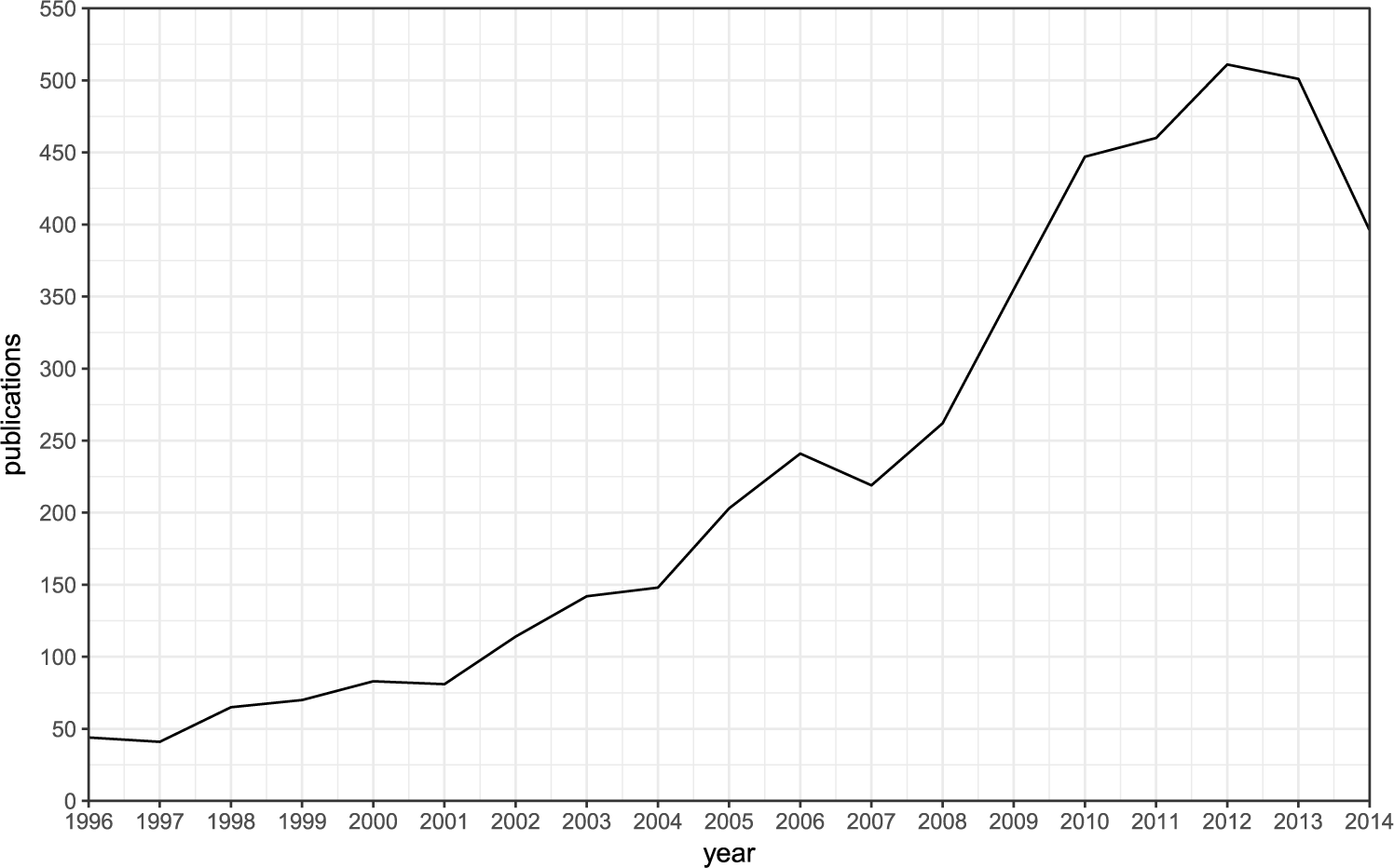
The number of publications per year focusing on the concept of the public sphere.
RQ1: most influential publications in the public sphere literature
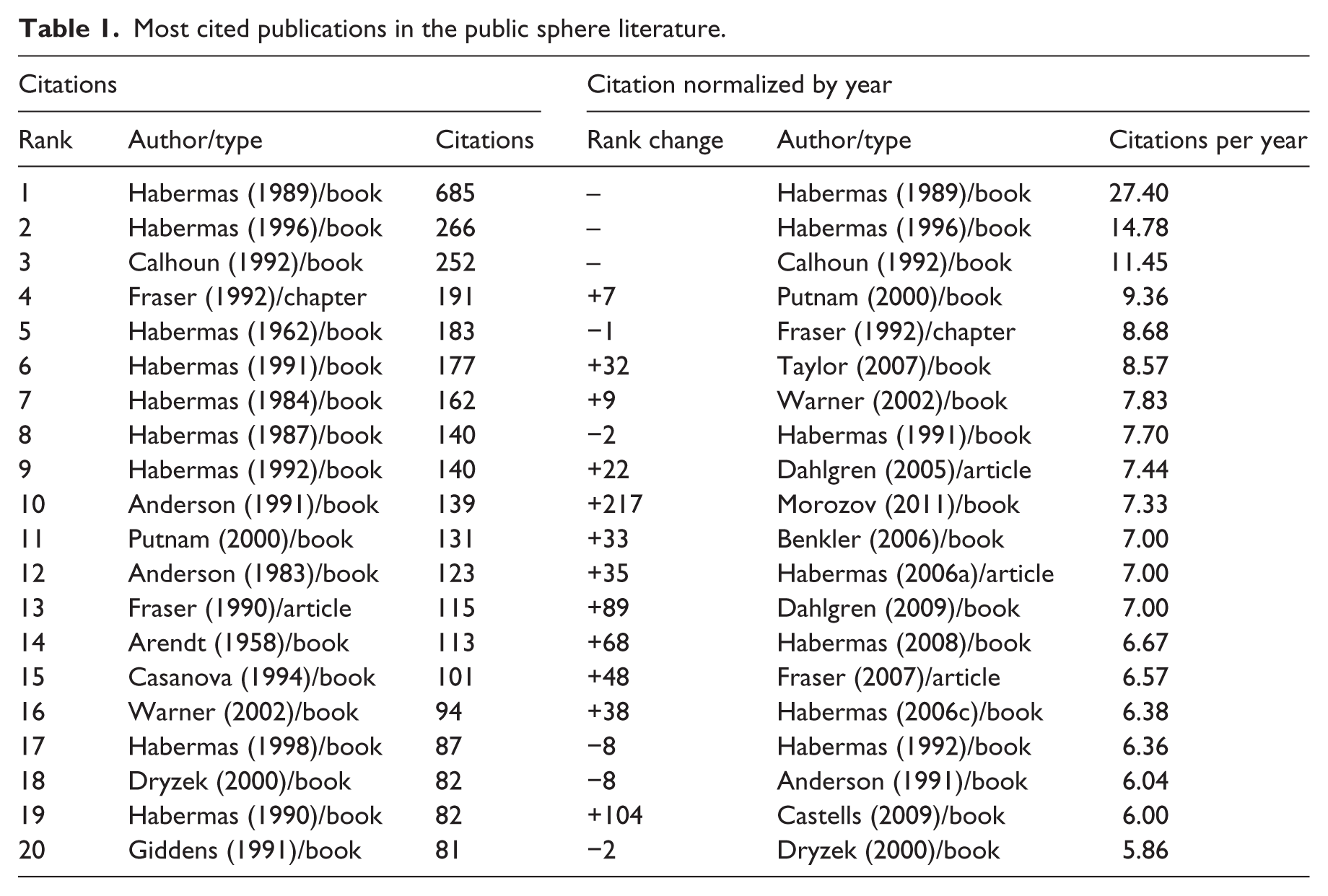
The most cited book by far in the literature is Habermas’ (1989) English first edition of The Structural Transformation of the Public Sphere. The second most cited book is also from Habermas (1996) (Between Facts and Norms). In third place is Calhoun’s (1992) edited volume Habermas and the Public Sphere, which includes a collection of articles from different scholars. Fraser’s (1992) piece in this edited volume is the fourth most cited title. The following positions are all occupied by various books and editions from Habermas. In positions 10–20, modern classics from Anderson (1983) (The Imagined Community), Putnam (2000), and Arendt (1958) follow. Also, Dryzek’s (2000) analysis of deliberative democracy is in the top 20. Besides the two almost identical essays from Fraser (1990, 1992), all titles in the top 20 are books and cope mainly with a historical analysis of the public sphere or closely related concepts. The most recent book, which clearly belongs to the group of counter-public literature, is from Warner (2002). Interestingly, the original concept of the public sphere by Habermas and the concept of counter-publics dominate on an aggregated level.
All titles in the top 20 have been published at least 10 years ago or earlier. Because these titles were published many years ago, they have a higher probability of receiving more citations than titles that have just been published recently. Therefore, the citation count has been normalized by years since publication. The number states the average number of cites per year (see Table 1). The normalized by-year list shows that the two English first editions of The Structural Transformation of the Public Sphere and Between Facts and Norms, as well as Calhoun’s (1992) edited volume, are also leading the list. Notwithstanding, the focus has clearly shifted in recent years from historical analysis to the Internet. Five titles in this list are especially noteworthy because they all focus on the Internet, and none of them are part of the non-normalized top 20 list. Dahlgren (2005) directly related to the concept of the public sphere by Habermas and the criticism in Calhoun’s (1992) edited volume. Benkler (2006) also cited Habermas but focused mainly on the further developed concept of the public sphere from Between Facts and Norms (Habermas, 1996). Morozov (2011), as a skeptic who questions the potential of the Internet to foster a well-functioning public sphere, only briefly relates to Habermas and mentions an article (Habermas, 2006a) in the bibliography. This article is somehow of importance for Internet research because it was the first time that Habermas (2006a) mentioned the Internet in an extended footnote.
Most cited publications in the public sphere literature.
RQ2: community analysis
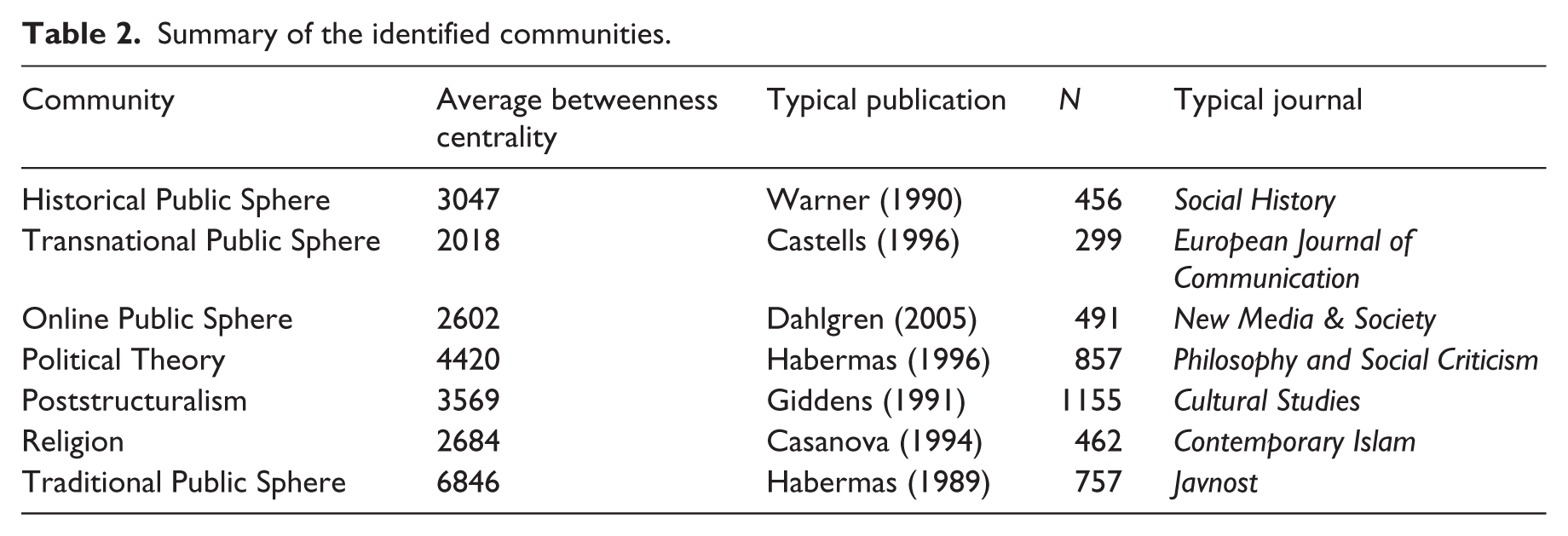
The communities in the co-citation network were identified with the Louvain algorithm (Blondel et al., 2008). Overall, seven communities could be determined (see Table 2). In order to classify these communities in a first step, I considered the most quoted authors in each community. In a second phase, I calculated the average probability for each of the topics identified in the LDA for each community. Finally, I identified the most popular journals in each community. Based on this information, names were given to the communities.
Summary of the identified communities.
Some communities can already be classified based on the most quoted publications in the community and the typical journals in which the community gets quoted. When the probability of topics in each community is taken into account, the communities can be clearly classified. Internet and religion as topics are reliable indicators for two of the communities (see Figure 2).
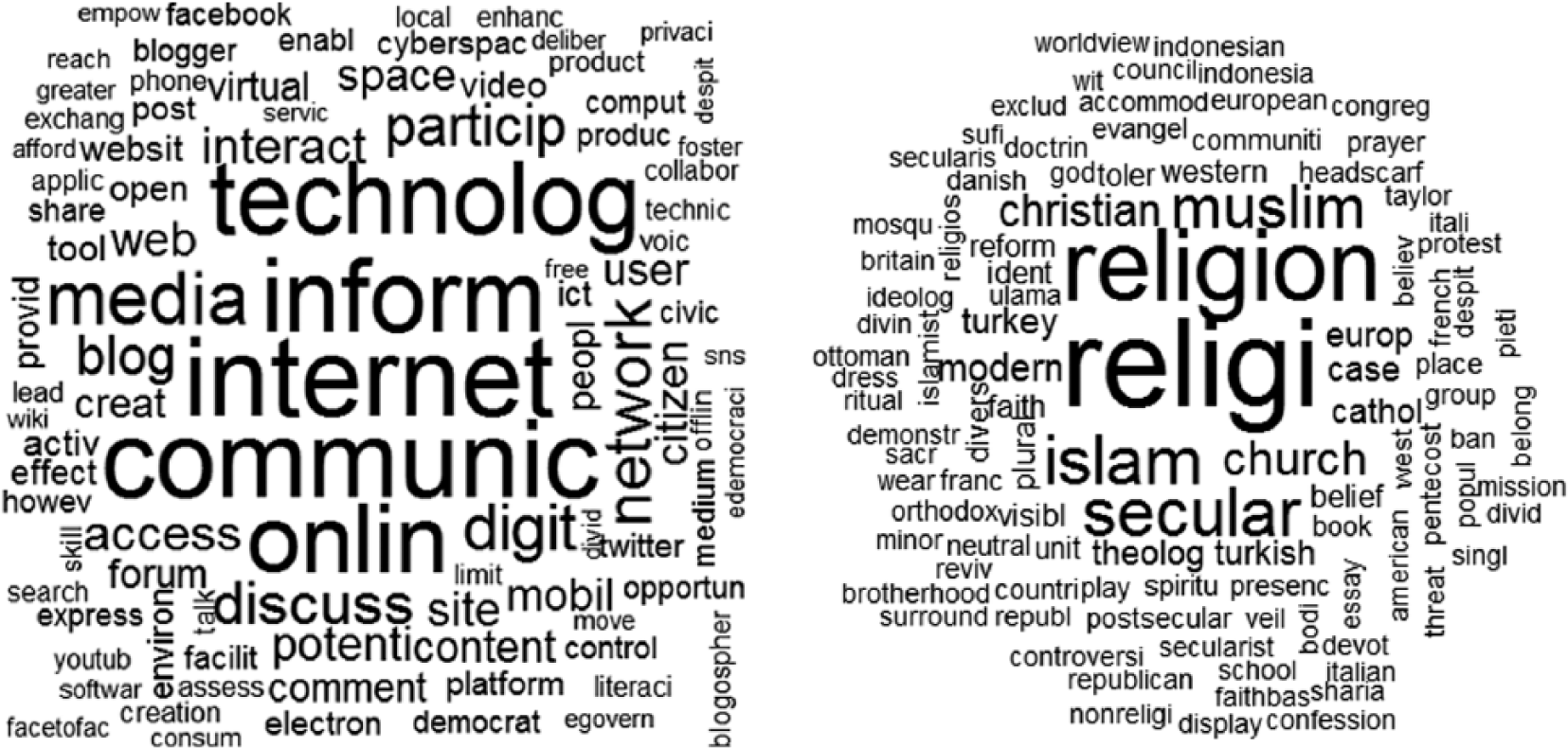
The two word clouds of the topics Internet and Religion with the top 100 words. Size of the word represents the probability that a word belongs to the specific topic.
Literature as a topic helps to identify the historical public sphere community, which is strongly influenced by the work of Warner (2002), who focuses on literary historical public spheres (see Figure 3). Political deliberation and power are topics with high probabilities in the political theory community. Political deliberation is also a topic with high probability in the transnational community that focuses mainly on the European public sphere, as the top journal in this community indicates. Castells (1996), with his idea of a networked society, fits well into this community. Interestingly, traditional media is a topic with high probability in the traditional public sphere community. It seems plausible to assume that Habermas’ focus on the role of the press in The Structural Transformation of the Public Sphere sparked research in this area. The topically most heterogeneous community is the poststructuralism community. The only topics that frequently appear in contrast to other communities are language and identity as well as violence. One of the identified topics signifies empirical studies and analyses: the topic Study/Analysis has the highest probability to appear in the transnational and online public sphere communities.
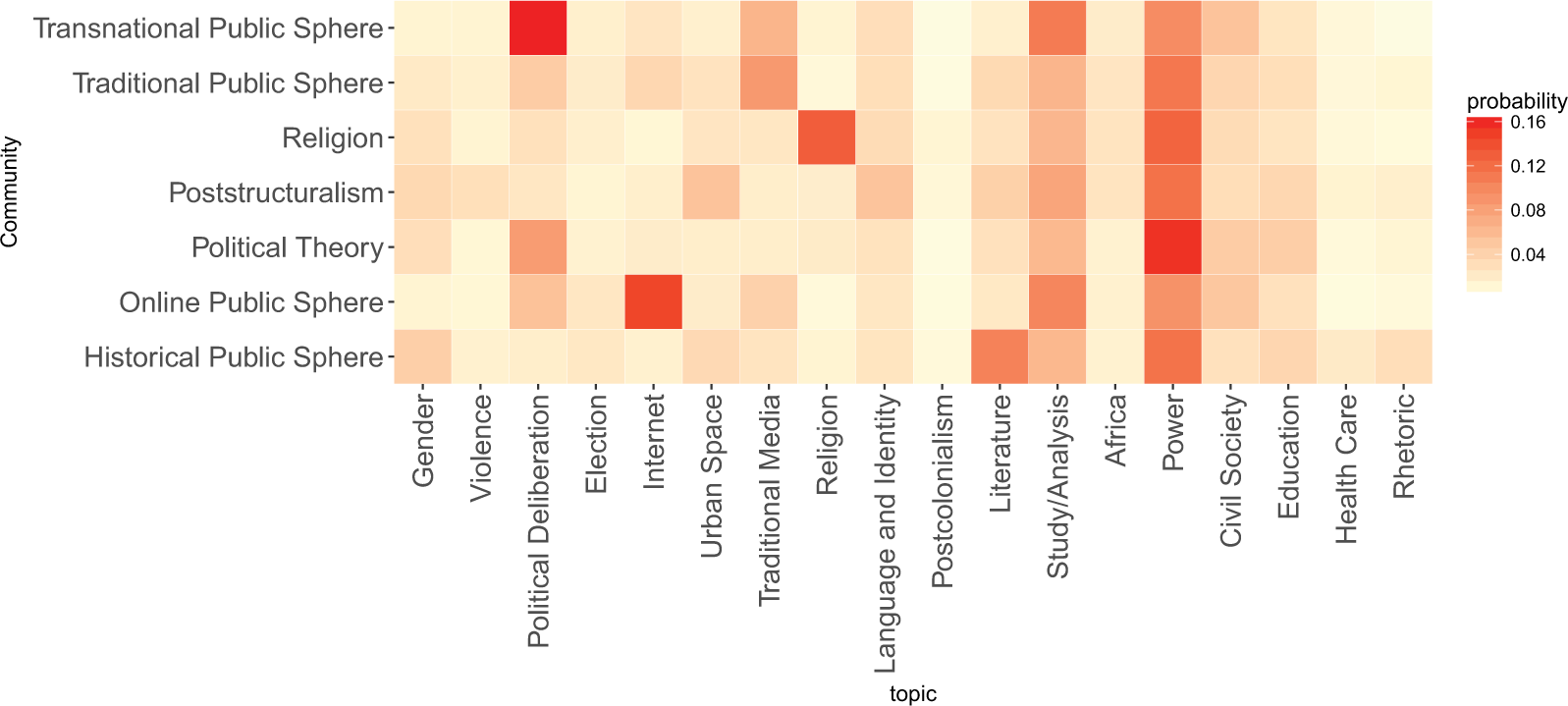
Heat map of the topics and communities. Probability shows the average probability of a topic for each community. Two topics are excluded because they can be classified as general research topics (‘public sphere’ and ‘research’).
The historical public sphere community can be described as a particular case, because in this community, instead of Habermas, Warner (2002) dominates as an author. The poststructuralism community is similar, but in this community, there are mostly authors leading the most quoted list who do not specifically focus on the concept of the public sphere (e.g. Appadurai, 1996; Giddens, 1991).
I further analyzed, based on the co-occurrence edge list, how near the communities are to each other. Because all unique publications from the co-citation analysis can hardly be visualized in a single figure, I examined the distance between the communities on an aggregated level. In a first step, I calculated how often publications from different communities appear together in the same document. In a next step, I created a distance matrix (Jaccard index). Based on the distance matrix, the relative distance between the communities in a two-dimensional field could be visualized through multidimensional scaling (Cox & Cox, 2001). The visualization shows that the poststructuralism, traditional public sphere, and political theory communities are quite close to each other (see Figure 4). In other words, the literature from all three communities is often quoted together in documents. As the results have already shown, most of the theoretical discourse is taking place in these three communities, and publications from these communities are often cited together. The topically classified communities, such as the religion and online public sphere communities, are further away from the more theoretical communities. Still, the traditional public sphere community has the highest betweenness centrality score (Freeman, 1978) of all communities (see Table 2). Therefore, it is the most central community, connecting all other communities with each other. Overall, the network as a whole has an extremely high centrality score (0.60). 8
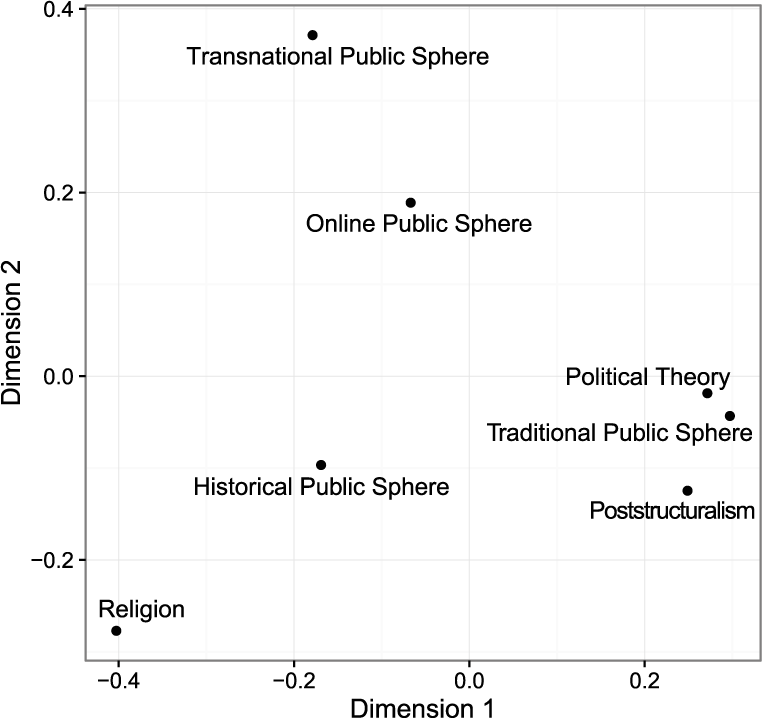
Multi-Dimensional Scaling (Cox & Cox, 2001) of the communities based on the distance matrix of the co-citation network.
RQ3: development over time
The last research question can be answered based on the previously identified communities. I calculated how many times publications belonging to a specific community were quoted in each year in comparison to the total number of quotes in each year (see Figure 5). Furthermore, an ordinary least squares (OLS) linear regression was calculated for each community to identify trends over time.
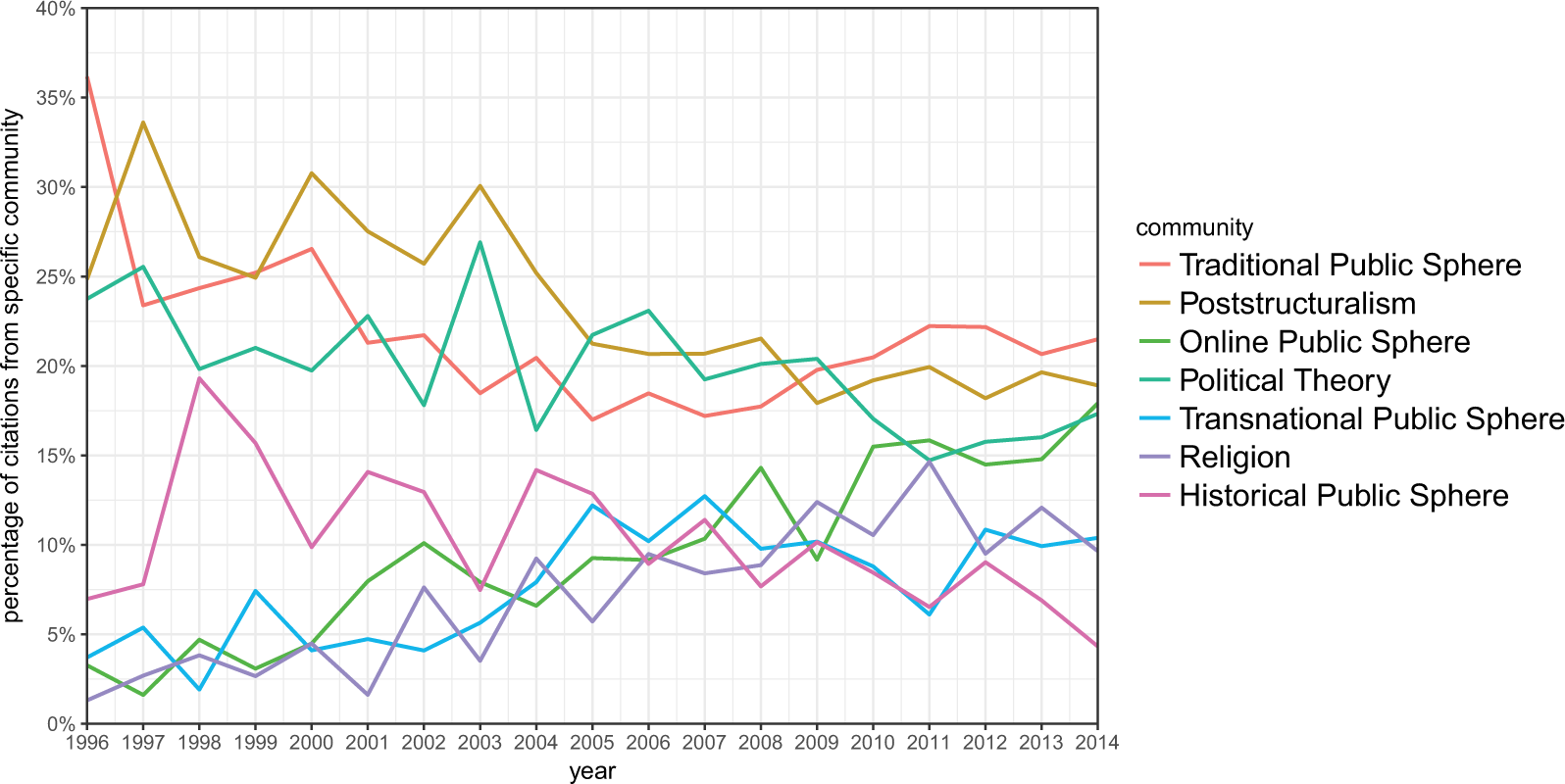
Relative importance of communities in citation network over time.
The size of the R2 shows how steady the trend is, and the β indicates if a trend is negative or positive. Based on the linear regression fit, the clearest and steadiest positive trend over time could be observed for the online public sphere (β = 0.90, t(18) = 9.25, p < 0.001, R2 = 0.79, F(1, 18) = 66.45, p < 0.001) and religion (β = 0.89, t(18) = 8.15, p < 0.001, R2 = 0.82, F(1, 18) = 85.61, p < 0.001) communities. A clear and steady negative trend then could be observed for the traditional public sphere community (β = −0.76, t(18) = −4.97, p < 0.001, R2 = 0.55, F(1, 18) = 24.71, p < 0.001). The other communities did not yield a clear trend.
The results show that the online public sphere and religion communities have become more important in the last 20 years. Especially after 2001, the religion community started to become comparably more important. Twenty years ago, almost half of all citations belonged to the traditional public sphere community. However, over the years, literature from the traditional public sphere community became less prominent. Still, around 20% of the quoted literature per year still belongs to the traditional public sphere community.
The results of the analysis of the topics over time show similar trend patterns (see Figure 6). The topics were visualized in the same manner as Griffiths and Steyvers (2004) visualized their LDA topics over time. Internet (β = 0.78, t(18) = 5.43, p < 0.001, R2 = 0.60, F(1, 18) = 29.43, p < 0.001) and religion (β = 0.84, t(18) = 6.49, p < 0.001, R2 = 0.68, F(1, 18) = 42.13, p < 0.001) both show as a topic the steadiest and clearest positive trends in the last 20 years. The clearest negative trends were observed for gender (β = 0.75, t(18) = −4.93, p < 0.001, R2 = 0.55, F(1, 18) = 24.37, p < 0.001) and power (β = −0.85, t(18) = −6.98, p < 0.001, R2 = 0.71, F(1, 18) = 48.72, p < 0.001). Power, however, is still a topic that appears in many publications, whereas gender as a topic became less popular in relative numbers. 9
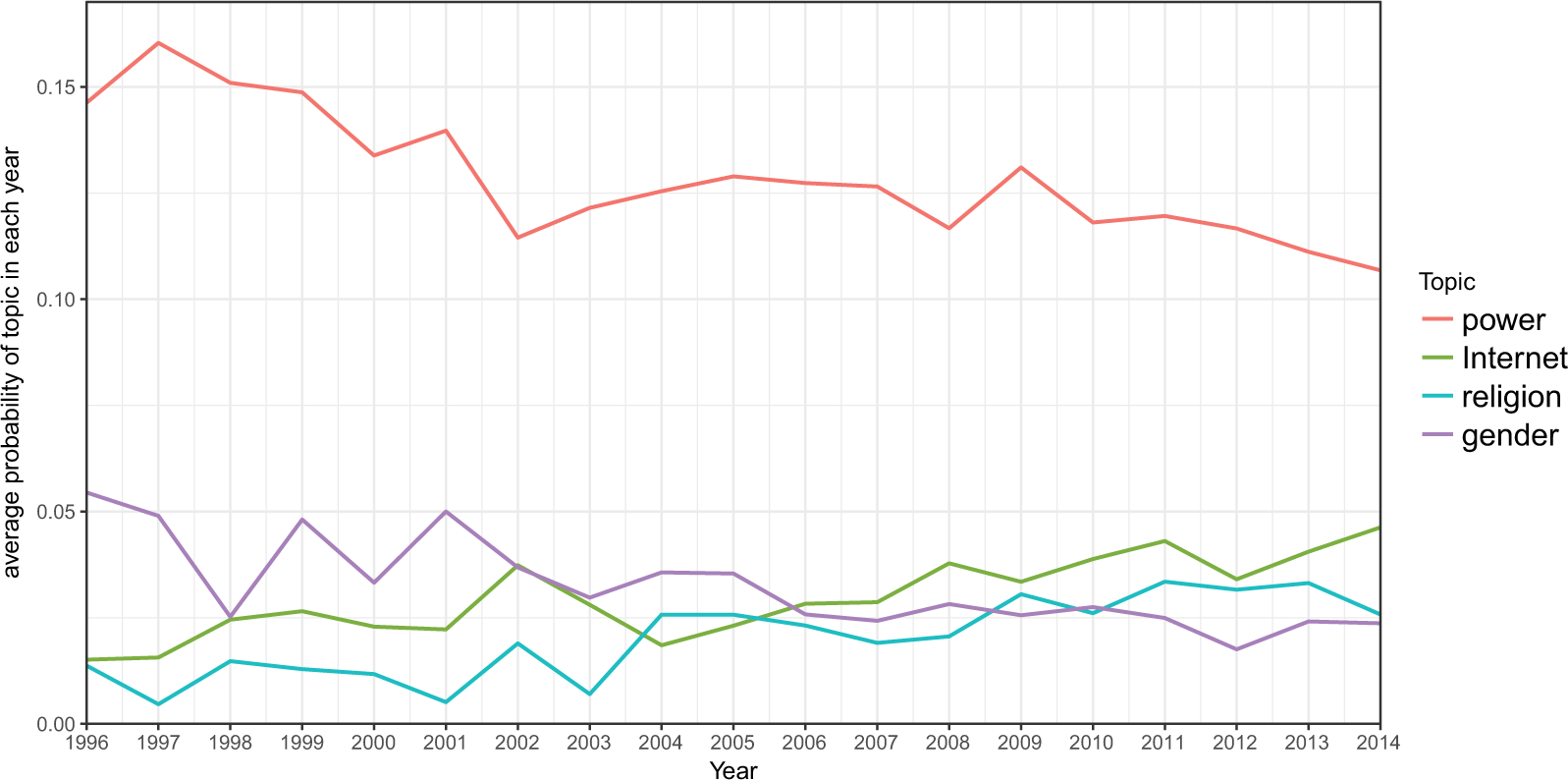
The four topics with the strongest trends (best fitting linear trend) were included in the plot.
Discussion
As expected, Habermas dominates with his books the debate of the concept of the public sphere. I identified with the co-citation analysis different communities with different foci. Even though the public sphere is an essentially contested concept, there exists with the traditional public sphere community a group of publications that consists of different understandings of the concept. This fact can be interpreted as a healthy sign of reciprocal recognition. An excellent example of reciprocal recognition is one of the most quoted books in my analysis: in Calhoun’s (1992) book, different proponents debate the concept of the public sphere. Overall, different conceptions are often mentioned in the same publication, as the closeness of the poststructuralism, traditional public sphere, and political theory communities to each other shows. The communities with strong theory development are at the epicenter of the debate, whereas communities with a disciplinary (e.g. history) or topical focus (Internet and religion) are more removed from the center. Still, in the future, the online public sphere community might move toward the epicenter of the debate. Over the last few years, publications with conceptual work from this community are among the most quoted titles.
Habermas had an impact with different publications on various communities. All books after Habermas’ linguistic turn (e.g. Habermas, 1984, 1996) belong to the political theory community, whereas The Structural Transformation of the Public Sphere (Habermas, 1989) belongs to the traditional public sphere community. The political theory community focuses on the concept of deliberative democracy, and Habermas’ influence is mainly due to his focus on deliberation in the context of public sphere theory. However, Habermas (2006b) also had an impact in the religion community with the article “Religion in the Public Sphere.” It can be concluded that Habermas influenced many different disciplines with his publications.
The diverse describability and the openness as conditions of an essentially contested concept become most apparent in the observed trends, which are strongly influenced by changing circumstances in society, as well as by the theoretical debate. The importance of the Internet and religion in public sphere research has grown over the last 20 years. The Internet as technology fostered new discussions, and scholars such as Papacharissi (2002) and Dahlgren (2005) had a high impact with their articles in the online public sphere community, as well as in communication science in general. 10 Similarly, the steady growth of religion as a topic is strongly connected with the emergence of religiously motivated terrorism. One indicator is the high growth after 2001, the year of the attack on the World Trade Center in New York. Even Habermas (2006b, 2008) shifted his focus during this time on the role of religion in the public sphere. Both cases clearly exemplify the openness of the concept and, as Woolcock (2010) highlights as a primary purpose of such concepts, “the potential to draw attention to the salient features of the social and political world” (p. 470).
In contrast to the trends mentioned above that are firmly influenced by societal change, the slow relative decline of gender and power is most likely due to the development of the academic debate. In the early 1990s, feminist theory (e.g. Fraser, 1990) had a strong influence and started a new strand of research. Nowadays, the popularity of this strand has faded in relative terms because the Internet receives relatively more attention. Still, Fraser (1992), as an eminent proponent of feminist theory, is still being quoted as the main critic of Habermas’ classic concept of the public sphere. Interestingly, she is often directly quoted with Habermas together and also belongs to the traditional public sphere community.
Reciprocal recognition as a precondition for the progressive competition is fulfilled. Different conceptions are often quoted together in the same publication. The future will show if real progress can be observed. Scholarship in the online public sphere and transnational public sphere communities has the largest potential to contribute to future theoretical development. In both communities, many empirical studies are published, as the results of the topic model showed. Additionally, both communities contribute to the theoretical debate about public spheres. For communication science, this can be seen as a great opportunity: both communities are deeply rooted in communication science, and both have the potential to attract the attention of other disciplines and influence them if they can shift their focus to theory development.
Never-ending debate as an opportunity
First of all, this study helped to identify the different notions of the concept of the public sphere. One should be open and acknowledge the various positions in the debate and accept that a final consensus can most likely never be reached. Still, progressive competition is possible if reciprocal recognition is taking place. Therefore, public sphere theorists and researchers should be aware of other competing conceptions. Even Habermas himself acknowledged other understandings and also tried to incorporate criticism into his publications to advance his theory (e.g. Habermas, 1996). Second, from a scientific point of view, the openness of the concept might seem like a caveat, but it can also be seen as a strength of the theory. Without openness, Habermas’ rather seasoned concept could not have survived in social science over the last 50 years. With changing circumstances, the concept could be modified. Such empirical challenges help to test the theoretical assumptions of the concept of the public sphere and force theorists to lower their level of abstraction. This also means scholars can ignore Gallie’s (1955) notion that a contested concept should remain anchored in original exemplars as these are questionable (e.g. Fraser, 1992). Finally, with an optimistic perspective, progressive competition can already be seen because, as long as researchers try to address each other, progressive competition is possible.
Footnotes
Acknowledgements
I would like to thank James Preston for his valuable comments.
1.
2.
Web of Science has also been considered for the analysis, but Scopus offered more hits. The sample of the Web of Science yielded similar results for all three research questions.
3.
Still, my study does not cover the many existing studies of the public sphere published in Chinese and German languages.
4.
Articles in conference proceedings were also counted as journal articles.
5.
Up to three authors, the publication year and the page numbers, if it was an article or book chapter, were included in the ID. With this step it was possible to distinguish multiple publications by the same author in the same year.
6.
α = 50/T and β = 0.01. Hyperparameters were optimized every 20 iterations after 50 burn-in iterations. Overall 600 iterations were used to ensure that the log-likelihood stabilizes.
7.
Dissertations were also counted as books.
8.
In a similar analysis of the concept “agenda-setting,” the network only had a centrality score of 0.41 (Rauchfleisch, in press).
9.
The topics were measured in relative numbers. The probability is normalized and adds up to 1 in each analyzed document.
10.
Dahlgren’s (2005) article is one of the most downloaded articles of the journal Political Communication and  one of the most downloaded of the journal New Media and Society.