



Abstract
This study examines whether the emerging communication environment makes people perceive media as more or less biased. Do social media contribute to the perception of a hostile media environment? Or do they promote a “friendly” media phenomenon through processes of selective affiliation/exposure and/or user filtration of disagreeable content? Based on the idea of egocentric publics, that is, the emergence of socially networked publics that are key for our understanding of current communication processes and examining these questions in a politically polarized society—Colombia—results indicate that reliance on social media for news exacerbates the perceptions of media bias. These perceptions of bias in turn foster political action in both the “campaigning” and “complaining” dimensions of political engagement. Thus, egocentric publics can be sources of political mobilization, but part of their mobilizing influence works through perceptions of a biased communication environment. Implications of these findings are discussed.
The prevailing wisdom—espoused by media professionals and scholars alike—is that people around the world are self-selecting into social networks that are more homogeneous and more ideologically polarized enabled, in part, by digital media technologies. These claims have an intuitive appeal, resonating with common experience: some media have grown increasingly partisan (Starr, 2012), people have a tendency to select ideologically consistent media (Pew Research Center, 2014; Stroud, 2011), and partisanship in media increases political polarization (Levendusky, 2013). These factors may contribute to the emergence of a polarized, combative public sphere, one in which “my” media and the people that I am connected to are friendly, while others and their media are increasingly hostile.
These arguments, which are based on the idea of selective exposure to like-minded media and selective affiliation with like-minded others, suggest that people are increasingly able to filter out disagreeable information (Pariser, 2011). Digital media, they argue, contribute to these processes through technologies that enhance cognitive and social filtering of information along lines of ideological and/or social similarity (Sunstein, 2007). According to this logic, digital media technologies contribute to political polarization because people are increasingly embedded in socially and politically homogeneous communication networks. Furthermore, there is some cross-national evidence suggesting that in the late 20th century, multiple countries experienced the emergence of a “friendly” media phenomenon (Goldman & Mutz, 2011), that is, an increased exposure of citizens to like-minded media that is mostly reinforcing.
However, it is unclear whether people actually inhabit worlds that are increasingly polarized and in which media appear to be more biased. It has been argued that a new type of public—egocentric publics—has emerged with the development of digital media and, in particular, social media. Those arguments suggest that digital media—especially those designed to articulate and expand offline social networks—may diversify, rather than homogenize, communication networks, thereby exposing people to more incongruent media content and/or political disagreement, not less (Barnidge, 2015a; Rojas, 2015). Additionally, this content is often posted by socially relevant contacts (Barnidge, 2015b). Following the logic of egocentric publics, increased heterogeneity of social contact and exposure to incongruent media and/or social opinion may heighten the salience of disagreeable ideas, which could lead to perceived media bias and contribute to perceptions of political polarization that may, or may not, be accurate. In other words, social network diversity increases exposure to incongruent messages, leading to perceived media bias, perceived political polarization (if not actual polarization), and, subsequently, corrective forms of political engagement (Rojas, 2010).
Concepts and theory
Underlying the idea of egocentric publics is the argument that new communication platforms—especially those that center on online social networks—make a new type of public possible. In these new spheres of communication, public engagement revolves around social connections (Rojas, 2015; Rojas & Macafee, 2013; Wojcieszak & Rojas, 2011). This notion of egocentric publics builds on the now classic studies of social networks, which redefined community as “personal communities” (Fischer, 1982; Wellman & Potter, 1999). But it also highlights the communicative dimension of social relations and the meso-social implications of new communication technologies: that is, while social media may not necessarily be “mass” in scope, their size, dispersion, and origin go well beyond traditional notions of interpersonal groups and social networks (Rojas, 2015).
On an online social network like Facebook, the average number of connections worldwide is around 200 (Backstrom, Boldi, Rosa, Ugander, & Vigna, 2012). This figure rises to more than 300 among users in the United States (Smith, 2014) where the platform originated. These numbers are not exclusive to Facebook: on the micro blogging site Twitter, an active user is followed by 235 people on average (Basch, 2012); on WeChat, the Chinese social messaging system, 63% of users have 50 or more contacts (TechNode, 2015).
This increase in network size, particularly of the weak ties within people’s network (Bakshy, Rosenn, Marlow, & Adamic, 2012), is accompanied by reduced density (Hampton, Goulet, Marlow, & Rainie, 2012), increased heterogeneity (Ugander, Karrer, Backstrom, & Marlow, 2011), and the ideologically diversity of news someone is exposed to (Bakshy, Messing, & Adamic, 2015). Pariser (2011) has argued that our social networks have increasingly become important filters of the information we consume. However, because of the characteristics of egocentric publics, this kind of information filtering can plausibly contribute to the heterogeneity, rather than homogeneity, of public discourse.
The egocentric public notion builds on this concept of “information filtration”—an idea that originated from observing highly centralized, traditional system-level institutions such as the news media—by accounting for the fact that filtration processes are now partially distributed within social networks alongside a robust interpretative framework of user-generated selection, rating, and comment (Rojas, 2015). In the 21st century, evidence has begun to accumulate that increasingly indicates that social networking sites promote exposure to political difference (Bakshy et al., 2015; Barnidge, 2015a; Kim, 2011; Kim, Hsu, & Gil de Zúñiga, 2013; Messing, & Westwood, 2014; Pew Research Center, 2014).
Reliance on social media for the distribution and interpretation of news implies that we need to revisit ideas of media bias and perception of bias. An important body of empirical evidence suggests that when exposed to information, we are likely to process it in a way that supports our previous beliefs (Lord, Ross, & Lepper, 1979). This selective processing mechanism has been explicated as a pervasive assimilation bias. Vallone, Ross, and Lepper (1985) conducted an experiment in which news broadcasts of the Middle East conflict were shown to Israeli and Arab students, both groups of students found the newscasts to be biased in favor of the other side. Vallone et al. (1985) theorized that this “hostile media perception” as the result of a processing of media content based on previous attitudes about media content rather than on the content itself.
In explaining the hostile media phenomena, Gunther (1992) has argued that trust in media should be understood as a “relational variable—an audience response to media content” (p. 147), that is, the receiver’s perception rather than an objective attribute of messages or their sources. This suggests that, traditionally, perceptions of media bias were more a function of someone’s ideology and levels of trust in media rather than an objective assessment of media content (Perloff, 2015).
Research conducted in different countries suggests that perceived media bias is on the rise (e.g. Pew Research Center, 2012) and overall levels of trust in media are decreasing (World Values Survey, 2015). Additionally, a comparative study of 44 countries suggests that exposure to online news reduces trust in media (Tsfati & Ariely, 2014). We argue that in egocentric publics, as social media operate as filters of news, people will perceive increased media bias for one of two reasons: (a) because people are actually more exposed to diverse information and as they encounter inconsistent information, their perception of media bias is augmented, regardless of whether actual bias exists or (b) because even if disagreeable content is “successfully” filtered out (Colleoni, Rozza, & Arvidsson, 2014), people may justify the need for filtering precisely because of their heightened perception of media bias. Thus, we pose the following hypothesis:
Hypothesis 1. Exposure to news via online social networks will be positively related with perceptions of media bias.
Furthermore, perceptions of media bias are not without consequence. The corrective action hypothesis (Barnidge & Rojas, 2014; Rojas, 2010) posits that when people perceive media to be biased and influential, they will take action geared toward correcting for the perceived consequences of media content. Corrective actions have been theoretically grounded in two related phenomena: the third-person effect and the hostile media phenomena. The core argument is that because people tend to believe others will be more affected by media content than themselves (third-person effect) and that news media tend to be biased against their views (hostile media effect), they will attempt to counter what they perceive as the negative effects of media by engaging in a range or series of communicative and/or political practices of their own.
To date, hundreds of studies have lent support to Davison’s (1983) original proposition that people who believe others are more susceptible to the negative influence of mass media. Furthermore, evidence shows that these perceptions have consequences. Some people respond to this perceptual gap by trying to prevent the content from being disseminated (i.e. censorship), by accommodating to a new normal as if the effects on others have already materialized (i.e. accommodation) or by trying to mitigate the potential impact of media by taking action that counters any of its potential perceived negative consequences (i.e. correction; for an extended review of these outcomes, see Rojas, 2010; Sun, Shen, & Pan, 2008).
Because of the accumulated evidence in support of corrective action as a response to perceived media bias (see, for example, Barnidge & Rojas, 2014; Chung, Munno, & Moritz, 2015; Feldman, Hart, Leiserowitz, Maibach, & Roser-Renouf, 2015; Hart, Feldman, Leiserowitz, & Maibach, 2015; Hwang, Pan, & Sun, 2008; Kim, 2015; Leung & Lo, 2015; Lim & Golan, 2011; Lin, 2014; Wei & Golan, 2013), it is plausible to expect that the perceptions of media bias that result from exposure to news via egocentric publics will result in increased political engagement in terms of not only “campaigning” but also “complaining.” Thus, we pose the following hypothesis:
Hypothesis 2. Perceptions of media bias will be positively related to political engagement both in terms of voting and protesting.
To test these notions, we rely on a representative survey sample collected in a politically polarized public sphere, Colombia. We employ structural equation modeling (SEM) to explore the relationships between news exposure on social media with perceived media bias, as well as the outcomes of these perceptions in terms of the “campaigning” and “complaining” dimensions of political engagement (Kim, Wyatt, & Katz, 1999).
Study context
Colombia’s political system is a formal democracy in which regular elections are held. The conservative-liberal party divide that traditionally characterized Latin America evolved into a multiparty system with certain parties representing the right (supporting, for example, free trade and a strong military and including, for example, Partido de Unidad Nacional (Partido de la U), Partido Conservador Colombiana, and Centro Democrático), others representing the political center (which seek social reforms, for example, Partido Liberal and Partido Verde), and others representing the left (proposing, for example, a wider role for government, protecting Colombian production, and land redistribution, for example, Polo Democrático and Unión Patriótica). The press in Colombia tends to be closely tied to big business interests and has been described as a market-based press with a “weak legacy of media pluralism” (Waisbord, 2008, p. 3). The Internet has allowed for more ideologically oriented political expression; a vibrant sphere of political communication has emerged on Twitter, where political leaders routinely express their views to millions of followers, debate policy issues, and launch/deflect personal attacks. To understand the magnitude of this phenomena, consider that in 2012, Colombia ranked 12 among the top 20 countries in the world with the most Twitter accounts (Bennett, 2012), and 43% of its population is on Facebook, making it 17th in the world in terms of total users (Allin1Social, 2015).
Perhaps the most relevant event in the recent political history of Colombia was a failed peace process with Fuerzas Armadas Revolucionarias de Colombia (FARC), Colombia’s oldest and most important guerrilla group, at the turn of the century. The disillusionment that followed the failure influenced the presidential election of 2002, in which Álvaro Uribe, a right-wing politician who promised that guerrillas would be defeated through the use of force, was elected president. Uribe was subsequently reelected for a second 4-year term in 2006. While president, Uribe escalated the government offensive against leftist rebels; he negotiated a peace process with paramilitary groups that sent some of its members to prison and led others to reorganize themselves as emerging outlaw groups. Despite Uribe’s popularity, various scandals involving corruption in government contracts, human rights violations, and illegal monitoring of opposition parties enhanced skepticism and distrust for those with differing views (Rodriguez & Seligson, 2008). This distrust can be captured as a left/right divide, which has been intensifying. People who identified with the center decreased in the first decade of the 21st century, while people identifying with the extreme right grew (Rojas, Orozco, Gil de Zúñiga, & Wojcieszak, 2011).
In 2010, Uribe’s former defense minister and Partido de la U candidate, Juan Manuel Santos, was elected president, defeating Antanas Mockus from Partido Verde. Once elected, Santos distanced himself from Uribe, moving the Partido de la U closer to the center and initiating a peace process with FARC. Uribe and some other members of Partido de la U left the party and created a new coalition. Under the banner of Centro Democratico, they tried to stop Santo’s reelection bid in 2014. Ultimately, Santos, with a broader coalition that included center and leftist parties, was able to prevail against Oscar Iván Zuluaga from Centro Democrático, winning 51% of the popular vote in the second round of a highly contested presidential election. This recent election was one of the most polarizing in Colombian history, with campaigns engaging negative campaigning and, allegedly, illegal surveillance, defamation, and electoral fraud—claims that are being investigated by the Colombian judiciary. The electoral results were posited by Santos as a referendum on the peace process, framing his critics as enemies of peace. Meanwhile, the right-wing opposition from Centro Democrático framed the peace process as bowing to FARC demands and Santos as a socialist. Centro Democrático advocates for what they refer to as “peace without impunity,” which, by-and-large, means a military surrender of FARC followed by judgment of their war crimes.
This context—characterized by heightened political tension, sharp division in terms of electoral politics and policy positions, and increased reliance on social media to communicate political ideas—seems an ideal scenario to explore the question of whether egocentric publics foster perceptions of media bias that can result in corrective action.
Methods
Sample and data
This study relies on national survey data collected from June 28 to July 29 of 2014 in 10 cities in Colombia by the Universities of Wisconsin and Externado de Colombia as part of their biennial study of communication and political attitudes in Colombia. The sample was designed to represent Colombia’s adult urban population—76% of Colombia’s 47.6 million inhabitants live in urban areas (DANE, 2014).
Survey respondents were selected using a multi-stage stratified random sample procedure that selected households randomly based on city size and census data. Once the number of households was allocated for a given city, a number of city blocks were selected randomly according to housing district and strata. Then, individual households were randomly selected within each block. Finally, the study used the “adult in the household who most recently celebrated a birthday” technique to identify an individual respondent at random. Up to three visits to each household were made (if needed) to increase participation in the survey. A local professional polling firm, Deproyectos Limitada, collected the data and 1102 face-to-face completed responses were obtained for a response rate of 55.5%. 1
Measures
Bearing in mind our substantive interests are not in the possible causal roles played by demographic factors, we remove their influence by partialling them out and setting up a path model to be fitted on the covariance matrix via a residualizing procedure. In this context, “social media use” and “news use” are placed as causally exogenous variables that predict a set of endogenous variables that include voting, protest participation, and perceived media bias.
Endogenous variables
Voting
Voting was measured with two survey items that asked whether respondents voted in the first and second rounds of the Colombian presidential election, respectively. The final variable thus ranges from 0 (did not vote in either round) to 2 (voted in both rounds; Kendall’s τ = .64, M = 1.28, SD = .87).
Protest
Participating in a protest was measured with three survey items asking respondents (1 = yes, 0 = no) whether they had participated in a rally, a protest, or a roadblock in the last 12 months. These items were averaged to create the final variable (Cronbach’s α = .67, M = .10, SD = .24).
Perceived media bias
Respondents were asked to name the newspaper, radio station, and television news broadcast they read, listened, or watched most often during the most recent election campaign for the Colombian Presidency. After each, respondents were asked whether the news organization they named favored a particular political party or candidate (1 = yes, 0 = no). A fourth item asked whether the Internet sources they used favored a particular party or candidate. These four items were averaged to compute the final variable (Cronbach’s α = .78, M = .30, SD = .38).
Social media news use
Social media news use was measured with four survey items asking respondents how frequently (0 = never, 5 = very often) they read news and public affair information on Facebook and Twitter (two items per medium). These items were averaged within media (r = .53 for Facebook and r = .52 for Twitter). These items were positively correlated across media (r = .60). To deal with the high number of missing cases for the Twitter item (among social media users, 98% use Facebook (SE = .01), whereas only 30% use Twitter (SE = .02)), the two items were combined pairwise rather than listwise (M = 1.92, SD = 1.39).
Exogenous variables
Social media use
Frequency of social media use was measured with two survey items asking respondents how many times a day they check Facebook and/or Twitter, respectively (0 = never, 5 = several times a day). These items were positively correlated (r = .30), and the two items were combined pairwise (M = 3.55, SD = 1.32).
News use
Traditional news use was measured with eight survey items asking respondents how many days in the last week they listened to radio news, read a daily newspaper, regional newspaper, or news magazine, and/or watched television local, national, cable, or international cable television news. These items were averaged to create the final variable (Cronbach’s α = .72, M = 2.10, SD = .92).
Control variables
A little more than half (57%) of the sample is female (SE = .02). The average age is 34.02 years (SD = 12.47). The average respondent attended some college or trade school (M = 4.70, SD = 1.21, measured on an 8-point scale ranging from 0 = none to 7 = post-graduate degree). The Colombian household energy strata system was used as a proxy measure of socio-economic status. The scale, which ranges from 0 to 6, reflects the physical size of the house via its energy consumption (M = 2.83, SD = 1.13).
Analysis
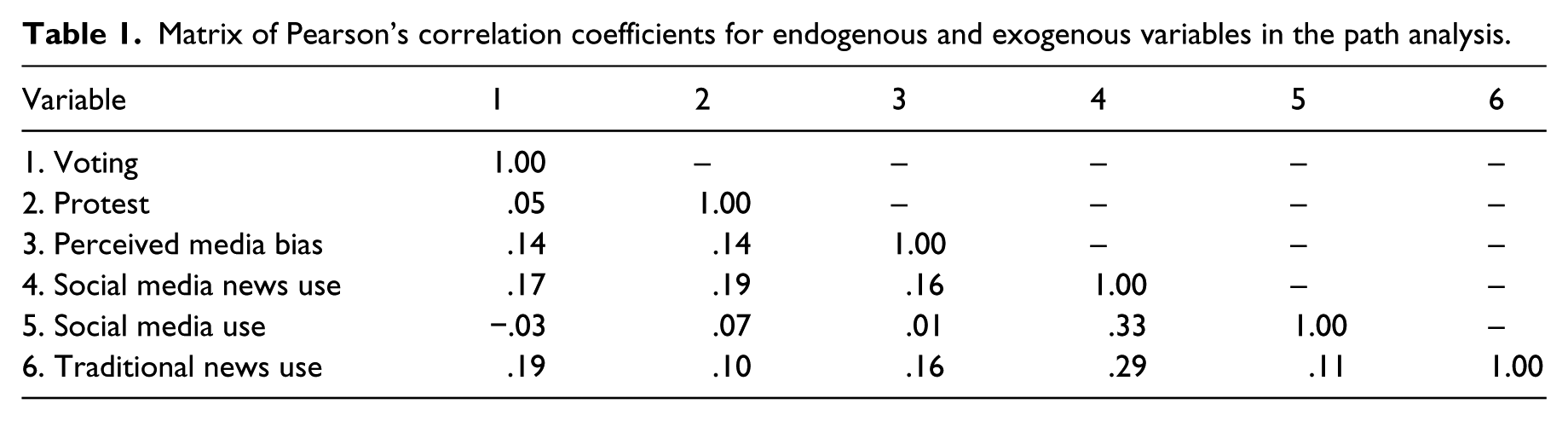
Data were cleaned and entered into R. Cases with missing values were removed via listwise deletion, leaving n = 527 cases for analysis (i.e. users of social media). Endogenous variables were residualized on the set of control variables. To test the hypothetical model shown in Figure 1, the “lavaan” package (Roseel, 2012) was used to fit a path analysis model with the correlation matrix shown in Table 1. The model was estimated by maximum likelihood (ML) (Figure 2).
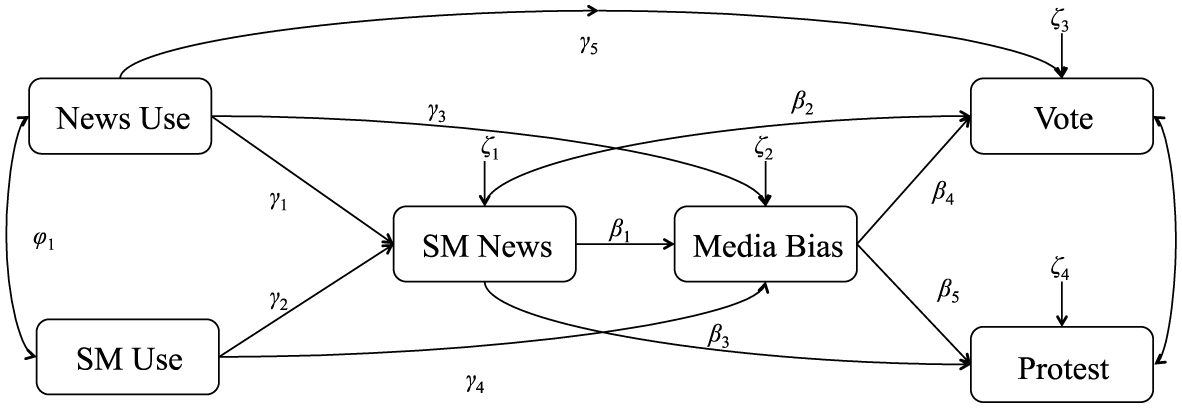
Hypothetical model showing predicted relationships among exogenous and endogenous variables.
Matrix of Pearson’s correlation coefficients for endogenous and exogenous variables in the path analysis.
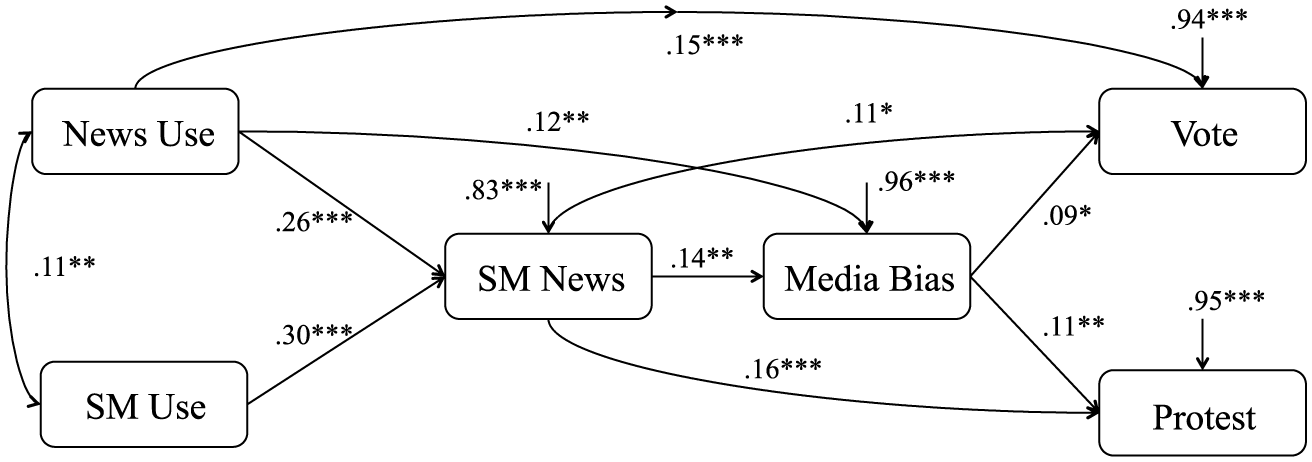
Completely standardized solution from path analysis.
Results
The model shown in Table 2 was a good fit to the data (
Goodness-of-fit measures for path analysis.
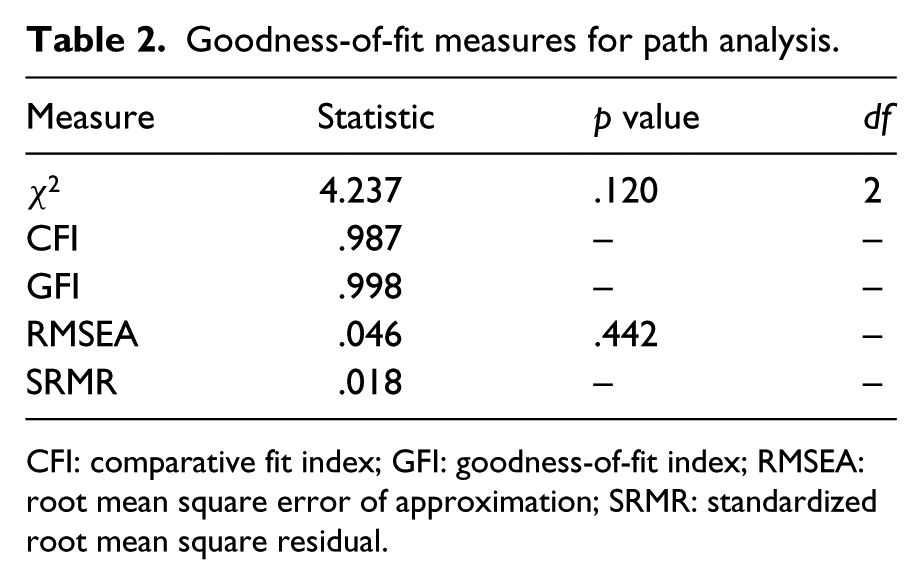
CFI: comparative fit index; GFI: goodness-of-fit index; RMSEA: root mean square error of approximation; SRMR: standardized root mean square residual.
Once it was established that the model was a good fit to the data, the coefficients among the exogenous and endogenous variables were assessed. The completely standardized coefficients are reported here, where p < .05 unless otherwise indicated. The model shows that both traditional news use (γ1 = .26) and social media use (γ2 = .30) were positively related to social media news use—combining to explain about 17% of the residualized variance in that variable (ζ1 = .83). Traditional news media use and general social media were also related to each other (ϕ1 = .11).
Traditional news use exhibited a positive direct relationship with perceived media bias (γ3 = .12), as well as a direct and indirect (i.e. “total”) relationship (θ1 = .16). But general social media use was not significantly related (γ4 = −.05, n.s.). Nor was the relationship mediated by social media news use. The latter, however, did have a direct positive relationship with perceived media bias (β1 = .14), lending support for H1. Rather the “total” relationship between social media use and perceived media bias was close to zero (θ2 = −.01, n.s.). This set of variables explained about 4% of the residualized variance in perceived media bias (ζ2 = .96).
Turning to the part on the hypothesized “corrective action” consequences, the results show that news use in both traditional and social media contexts is positively related to frequency to vote. Supporting H2, perceived media bias also positively predicted voting (β4 = .09). News use in both traditional (γ5 = .15) and social media settings (β2 = .11) was also positively related to voting. The total relationships for traditional news use (θ3 = .16) and social media news use (θ4 = 12) were not substantially larger than their direct relationships. These variables explained about 6% of the residualized variance (ζ3 = .94).
Providing additional support for H2, perceived media bias also positively predicted protest outcomes (β5 = .11). Social media news use was also significantly related both directly (β3 = .16) and in total (θ5 = .18) with protest participation. These two variables explained about 5% of the residualized variance in the protest variable (ζ4 = .95).
Conclusion and discussion
The analysis illustrates the corrective action process among social media users by highlighting relationships between key concepts at a single point in time. To briefly summarize the results, the model shows that using social media to follow the news or public affairs is positively associated with perceived media bias, which is, in turn, associated with both voting and protest participation. People who use social media more often and people who use traditional news media more often are more likely to use social media for news.
These findings suggest that the filtering of news through egocentric publics does not contribute to a “friendly media” phenomenon. In fact, they show quite the opposite. In part, thanks to the increased heterogeneity of these publics, news exposure on online social channels results in increased perceptions of media bias. These results deal specifically with the perception of bias, so we cannot conclude that egocentric publics expose social media users to more diverse information. But our claims are consistent with Facebook studies that actually consider the diversity of the content provided by social media contacts (e.g. Bakshy et al., 2015), as well as the notion of relative hostile media, which indicates that content that is unaligned with pre-existing beliefs is considered to be biased (Gunther, Christen, Liebhart, & Chia, 2001).
While in this study we do not test the mechanism by which social media news use results in perceived news bias, we argue that it through the exposure to the increasingly heterogeneous information that is distributed by peoples’ online social networks. We think this is particularly true of bidirectional networks, such as Facebook, in which ties are sustained for social rather than political reasons. While unidirectional networks, such as Twitter, may be more susceptible to processes of selective exposure, the increased information diversity that results from the expanded affordances of weak tie maintenance in bidirectional online networks results in exposure to the “other side.” The implication is that egocentric publics actually increase the level of heterogeneity in people’s news diets. This result is consistent with previous research which shows that the filtration of information on social media contributes to the perception of increased political polarization by making people aware of different positions and exposing them to extreme exemplars of those positions (Rojas et al., 2012).
The results also show that perceptions of media bias are associated with political action, and this mobilizing effect is not limited to systemic political participation (i.e. voting), but also extends to protests against the political system. This finding aligns with previous research on corrective action (e.g. Rojas, 2010), while extending the corrective action logic by showing that the new communication infrastructure of news that increasingly relies on online social networks will, if anything, amplify the importance of perceived media bias as a facilitator of political action. This conclusion poses a fascinating challenge for scholars interested in the intersection of communication and the public: on one hand, technologically enabled publics contribute to a more diverse and vibrant public sphere, but on the other hand, part of that vibrancy and its subsequent mobilization is built on the perception of bias, a perception that might tell us more about the biases of the public than the actual biases of media, and which might be less conducive to a rational reconstruction of the public sphere.
In this article, we do not focus on corrective actions aimed directly at correcting public discourse (as we have done in previous work, see, for example, Rojas, 2010), but rather on subsequent forms of political action that are affected by these perceptions of bias. Hwang et al. (2008) offer a possible pathway from perceptions of media bias to the types of actions considered in this study under the concept of “media indignation.” The underlying idea is that indignation with the perceived bias of content functions as a motivating force that may lead to take discursive action, as well as cascade into other forms of action that are ideologically motivated.
Naturally, this study is not without limitations. For starters, the analyses are based on a cross-sectional design, making casual claims more tenuous. In particular, it could be argued that perceived bias actually leads to seeking alternative news sources. Furthermore, an alternative model that flips the position of perceived media bias and social media news use is statistically equivalent to the model reported in this article. Therefore, it is ultimately not possible to infer which causal order is a better fit to these data: news use to perception or perception to news use. Nevertheless, we would be more concerned with this potential limitation if we were measuring active seeking of alternative news sources, which might actually be influenced by perceptions of bias on mainstream media. But in this case, we are dealing with mere exposure to information, and the fact that overall social media use is an important predictor of news use of social media but not of perceived bias suggests to us that the causal order presented is, theoretically, more plausible.
Additionally, the fact that we tested the model in the context of a single media system rather than across media systems always leaves the possibility of some contextual peculiarity that explains these results. And while we cannot think of any specific peculiarities, future research should address this limitation by testing our model in a comparative design.
While in the 20th century personal contacts provided “safe” spaces for the discussion and crystallization of political attitudes and mass media were supposed to provide a space to encounter oppositional views and foster deliberation (Mutz & Martin, 2001), it appears that in the 21st century, broader conceptualizations of the public need to allow for the emergence of new dynamics of information distribution, news experiences that lead to differences in interpretation, and new affordances that affect the likelihood and nature of deliberation. Only by acknowledging these emerging meso-level public phenomena and integrating them into a broader theory will be able to make sense of the new multifaceted relations between communication and “the public.”