



Abstract
This article offers an updated account of the media portrayals of China’s growing cohort of single women through an analysis of “solo lady influencers” on RedNote. Drawing on netnography, it identifies three archetypes that articulate distinct modes of living single, namely glamorous go-getters, struggling proletariats, and lying-flat nomads. To craft commercially viable personae, solo lady influencers engage in what I term identity bricolage, an affective practice of assembling identity-based resources into curated self-presentations that cultivate relatability. In this process, singlehood functions as a form of identity capital that becomes monetizable when it is braided with class position, gendered selfhood, and lifestyle orientations, producing personae that are both distinctive and resonant. Filtered through postfeminist sensibilities for affective calibration, these strategically differentiated personae speak to segmented audiences within China’s expanding single economy, yet they also idealize singlehood in exclusionary ways that reproduce inequalities and narrow the imaginaries of women’s life possibilities. Identity bricolage thus offers an intersectional lens for understanding influencer self-fashioning on RedNote, revealing the entanglement of cultural expression and market logics under China’s platform capitalism, where monetization increasingly rewards relatability over visibility.
Introduction
“Ever since I turned 33, I have let go of my ‘romantic brain’ and embraced a solo-living lifestyle.” Accompanied by this voiceover, the video depicts a woman tending flowers, strolling along the beach, and cycling outdoors. The video is part of a vlog by a self-described “39-year-old unmarried solo lady.” The term “solo lady” (duhuonvzi, 独活女子) originates from the popular Japanese drama ソロ活女子 and refers to women who derive fulfillment from solitary activities. This persona has gained traction on Chinese social media. The phrase “romantic brain” (恋爱脑), used in the voiceover, is an internet slang term referring to individuals, often straight women, preoccupied with romantic relationships. This derogatory expression mirrors broader societal critiques of romantic idealism and speaks to the rising tide of singlehood among young women in China.
Several factors contribute to the increasing prevalence of singlehood among urban women in China. First, the process of individualization, accelerated by China’s rapid urbanization and modernization, has eroded traditional family structures and increased personal autonomy, encouraging more individualized lifestyle orientations among urban women (Yan, 2020). Second, feminist ideologies have gained traction, prompting women, particularly educated middle-class professionals, to seek personal and professional fulfillment beyond conventional marital roles (Fincher, 2014; Martin, 2018). Third, economic pressures, such as rising living costs, job insecurity, and the financial burdens of marriage and childrearing, have made marriage less viable for women in precarious employment, particularly in the aftermath of China’s post-pandemic recession (Chen, 2024). A 2021 Communist Youth League survey found that approximately 44% of urban female respondents did not plan to marry (Hongxing News, 2021). Taken together, these shifts do not affect all women equally but are inflected by differences in class position, gendered selfhood, and lifestyle orientations.
These sociocultural shifts in China have fueled a burgeoning single economy, a market ecosystem characterized by the demand for products and services tailored to individual lifestyles and consumption habits, including solo-friendly housing, compact appliances, personalized travel, and self-care products (Wang, 2022). In 2022, the market size of China’s single economy reached 6.44 trillion Renminbi (RMB; approximately 900 billion USD; chyxx.com, 2024). Importantly, this single economy is internally structured by classed, gendered, and lifestyle differences, which shape how singlehood is lived, narrated, and tied to different patterns of consumption. Depictions of single-living lifestyles have become increasingly prevalent on Chinese lifestyle platforms, where a growing volume of curated content aligns with the diverse preferences of single consumers. It is within this stratified and segmented terrain that solo lady influencers have emerged, connecting audiences with brands through what Chinese marketers describe as a “vertical” model, in which influencers specialize in niche lifestyle genres and attract highly targeted audiences, a process amplified by algorithmic recommendation systems (Guo, 2022). While single women were once stigmatized as “leftover ladies” and, to a large extent, continue to be marginalized in official Chinese discourse (Fincher, 2014; Zheng & Xu, 2022), digital platforms now provide a space for solo lady influencers, most of whom identify as single, to position themselves as lifestyle icons, tailoring online personae to resonate with audiences’ varied aspirations and constraints.
Based on a netnography of RedNote, a lifestyle platform in China, this study asks the following: (1) How do solo lady influencers strategically represent themselves for segmented audiences? (2) In what ways do these self-representations reshape the cultural meanings of singlehood? In line with Gill’s (2017) call for an intersectional analysis attentive to classed and gendered differences, this study introduces identity bricolage, a concept that brings into dialogue Kanai’s (2018) theory of relatability in digital culture and Côté’s (2016) theory of identity capital to examine how these influencers mobilize identity-based resources to curate relatable personae. Situating their online performances as commodified identity work shaped by RedNote’s monetization model, this study positions the self-representations of single women, a group long stigmatized in official discourses, as a case that connects niche influencer practices to broader debates on gendered media representation within Chinese platform capitalism.
Media Representations of Single Women Amid China’s Gendered Paradoxes
Over recent decades, one of China’s most profound cultural shifts has centered on changing perceptions of women and marriage (Zhang, 2020). During the Maoist era (1949–1976), women were positioned as equal partners in nation-building, with policies promoting labor participation and gender equality, yet this state-led egalitarianism also imposed a dual burden of productive and reproductive work and defined the “modern woman” as a self-sacrificing worker-citizen (Li, 2000; Yin, 2022). Since the post-1978 period of economic reform, a “refeminization” has confined women more to domestic roles amid marketization, while the one-child policy and subsequent pronatalist campaigns have reinforced heteronormative marriage norms, framing marriage and childbirth as patriotic duties and stigmatizing delayed unions (Ge, 2025; Yeung & Hu, 2016). Officially sanctioned media have promoted ideals of womanhood that fuse Confucian familism with neoliberal self-responsibilization, exemplified by the dutiful, emotionally caring yet professionally competent wife-mother, thereby consolidating a narrow template of modern womanhood even as processes of individualization cultivate aspirations for personal agency, particularly among educated urban women (Yin, 2022; Zavoretti, 2024). At the same time, these ideals are highly classed across China’s increasingly stratified social landscape: while urban middle-class women are interpellated as key subjects of state-led modernization, working-class women are symbolically relegated to “low quality” and rendered less compatible with dominant narratives of modern womanhood (Chen, 2020b).
Against this backdrop, feminist politics in contemporary China have taken ambivalent forms. On one hand, liberal vocabularies of female empowerment emphasizing independence, self-love, and refusal to settle in intimate relationships circulate widely in popular culture, offering younger women terms to question compulsory marriage and hypergamy (Yin, 2022; You et al., 2021). On the other hand, more explicit critiques of hypergamy, gender double standards, and structural inequality are contested and sometimes dismissed as excessive or divisive, and calls for autonomy are folded back into individualized projects of self-improvement and emotional management (Yang, 2024; You et al., 2021). At the same time, labor market precarization has constrained life choices, leading some women to embrace singlehood as a pragmatic response to economic precarity (Ya & Shen, 2025). Amid these tensions between hegemonic marriage ideals, tightened control over gender politics, and declining marriage rates, singlehood emerges as both a lived reality and a contested cultural category (Zurndorfer, 2018).
Building on these gendered paradoxes, media representations of single women have become a key arena where state imperatives and individual contestations play out. In the early 2000s, stigmatization was institutionalized when the All-China Women’s Federation coined the term “leftover women” for unmarried women over 27, aligning early marriage and childbirth with demographic goals (Fincher, 2014). Amplified by state-run media, the term portrayed single women in TV shows and news reports as “educated” and “successful” yet also “unwanted,” “selfish,” and “intimidating” (Feldshuh, 2018; Fincher, 2014). Faced with this pejorative framing, many single women have turned to social media to resist stigma and renegotiate gender roles (Gui, 2020). Online spaces have thus become sites for critiquing marketized marital structures and celebrating women’s economic and sexual autonomy (Wu & Dong, 2019). The backlash against the “leftover women” discourse eventually led the All-China Women’s Federation to ban the term in 2017 (Yu, 2022). Yet, advocacy of voluntary singlehood and marriage avoidance still risks being branded as “gender antagonism,” a label used to normalize gender inequalities and delegitimize feminist claims (Liao, 2025).
In the wake of the 2017 ban, however, mainstream media did not simply abandon the underlying logics of the “leftover women” frame. TV dramas weave together traditional marriage norms with postfeminist discourses of choice, self-responsibility, and neoliberal self-improvement (Peng, 2024; Xu & Zheng, 2025; Zheng & Xu, 2022), often centering on hypercompetent single heroines whose “superwoman” persona simultaneously celebrates individual female success and establishes an almost unattainable model of womanhood (Xu & Zheng, 2023). Studies of news images similarly identify hybrid visual scripts that juxtapose conservative, pronatalist ideals with celebrations of singlehood, professional success, and liberal gender values (Yu, 2022; Yu et al., 2023). Taken together, these hybrid depictions underscore the unresolved tension between enduring patriarchal norms and shifting imaginaries of female independence.
With the rise of the single economy, singlehood in China has been increasingly commodified through cultural productions, campaigns, and public events that package empowerment, independence, and confidence as lifestyle ideals. In this market-driven cultural economy, media representations of single women translate feminist vocabularies into marketable messages and consumer practices (Guo, 2024), shaping how singlehood is imagined, performed, and consumed in contemporary China. Against this backdrop, single lady influencers have gained traction by weaving feminist-inflected claims into platform-based self-branding.
Commodified Singlehood on RedNote
This commercialization of singlehood has found fertile ground on lifestyle-oriented digital platforms, with RedNote emerging as a key site. Founded in 2013 as an overseas shopping platform targeting urban middle-class women, RedNote has since evolved into China’s largest lifestyle-sharing platform. By June 2024, it reported 339 million monthly active users, approximately 70% of whom are female (Huang, 2024), making it a vibrant space where users, especially young women, collectively shape trends, norms, and recommendations through peer interaction and participatory content creation (Chen & Jiang, 2025). Functioning as a female-dominated “traffic medium” where user attention is the core currency that sustains the business model (Zhang et al., 2020), RedNote’s recommendation algorithms classify and rank posts based on engagement and relevance, privileging traffic-generating, monetizable, and affectively relatable content. This sorting performs market segmentation by parsing users into fine-grained lifestyle and consumption niches, allowing influencers and brands to address highly segmented audiences.
Building on its female-dominated, community-driven, and finely segmented user base, RedNote has developed a well-established model for monetizing lifestyle posts through its zhongcao culture (Shen & Abidin, 2025). Zhongcao, literally “planting the seed of interest,” refers to the circulation of lifestyle recommendations that blur the boundary between personal sharing and commercial promotion and has become a prevalent mode of native advertising across China’s broader “traffic media” ecology (Nan & Chen, 2025; Zhang et al., 2020). Unlike conventional advertising, zhongcao emphasizes emotional resonance and targeted communication, embedding consumption cues within personal narratives for specific user segments (Nan & Chen, 2025). Its effectiveness lies in influencers’ ability to share relatable experiences that cultivate trust, rapport, and community interaction within particular niches (Yi & Xian, 2025).
At the algorithmic level, engagement metrics become disciplinary mechanisms that reward content exemplifying RedNote’s preferred scripts through the allocation of traffic and revenue (Zhang et al., 2020). To maximize reach, influencers learn to “play with” or “please” RedNote’s algorithms (Zhang et al., 2020), crafting posts that trigger saves, likes, comments, and follows to enter higher “traffic pools.” Such work involves continuous “collaboration” with the platform, including monitoring trending topics, experimenting with recommended formats, and even taking algorithm-focused marketing courses (Fan, 2025). Sustained engagement, in turn, enables influencers to monetize their identities by converting everyday, relatable narratives into commercial value (Guo, 2022; Shen & Abidin, 2025). Under RedNote’s algorithmic governance and influencer policies, creators are trained to become self-managing, entrepreneurial subjects who internalize platform rules around authenticity, content quality, and positive affect (Ju, 2022). Further conditioned by a dual regime of platform self-censorship and state red lines (Zhang et al., 2020), content creators remain within the bounds of platform-sanctioned positivity and self-improvement (Guo, 2022; Yang & Tang, 2018).
These dynamics point to a specifically Chinese configuration of platform capitalism. Classical accounts conceptualize platform capitalism as an economic model in which digital platforms monopolize and exploit data as a key raw material (Srnicek, 2017). In contrast, Lin (2025) reconceptualizes platform capitalism as a regime in which influencers commodify and mobilize their very identities as assets within algorithmic systems of monetization and audience segmentation. Under this regime, online identity functions simultaneously as capital and a consumer good within state–platform synergies, and creators are compelled to stage carefully calibrated identity performances, turning relatable persona work into a key vector of value extraction.
Situated within broader socioeconomic shifts, these platformized self-branding practices align with China’s rising single economy, where independence, self-care, and solo living are increasingly mobilized as affective appeals and valorized as consumer ideals (Wang, 2022). Within this context, solo lady influencers have become a rapidly expanding genre on RedNote, turning single-lifestyle content into micro-enterprises through relatable narratives of everyday single life (Guo, 2024). Scholarship on this genre is still developing. Guo’s (2024) study provides the first sustained academic analysis of living-alone wanghong, showing how urban professional women’s singleness is commercialized within Chinese influencer culture. More broadly, recent influencer scholarship calls for intersectional, culturally embedded research (Fowler & Thomas, 2023; Matich et al., 2020), especially in Global South contexts (Ourahmoune & El Jurdi, 2022). Building on Guo’s (2024) work, this article conceptualizes solo lady influencers on RedNote as a heterogeneous formation shaped by China’s rising feminism, the individualizing turn, and the post-pandemic economic slowdown. With this intersectional framing in place, this article shows how singlehood becomes monetizable capital through its articulation with class position, gendered selfhood, and lifestyle orientations, producing differentiated personae for segmented audiences. It thus extends intersectional approaches in influencer studies by specifying how intersecting differences are assembled and converted into value under China’s platform capitalism. Moreover, it traces the social implications of this mechanism, illuminating the entanglements of identity performance, gender politics, and platform capitalism in contemporary China’s single economy.
Forging Relatability Through Identity Bricolage
By centering their content, self-presentation, and audience engagement on female experiences, solo lady influencers’ gendered positioning, together with the relational logic of RedNote’s monetization model, resonates with Kanai’s theorization of relatability in feminine digital culture. Kanai (2018) defines relatability as “an affective relation produced through labor that reflects a desirable notion of common experience to an unknown audience” (pp. 3–4) and argues that it hinges on “the conversion of general experience into an individual asset” (p. 125). Notably, influencers cultivate relatability by converting everyday professional, social, and intimate lives into content that appears simultaneously distinctive and resonant, inviting audiences into a sense of intimacy while leveraging selective moments, emotions, and interactions from everyday experiences to craft aspirational personae (Duffy, 2017; Kanai, 2018; Marwick, 2015). Informed by a post-Fordist sensibility of the self, this labor involves presenting a collection of valuable experiences and relationships as classificatory tools through which audiences can recognize themselves. As Kanai (2018) notes, feminism here is dismantled into affective fragments such as aspirations, confidence, independence, and selective critiques of sexism, then tethered to individual value and assembled to enhance relatability.
To specify the mechanism through which relatability is produced and monetized, drawing on feminist work on emotional labor and affective life (Gill & Kanai, 2018; Hochschild, 2012; Illouz, 2007), I use affect to refer to forms of feeling that are produced, regulated, and rendered valuable within social relations. As digital media has become a key site where such feelings are encoded and circulated, influencers and followers inhabit a position of affective commonality, treating certain figures and scenarios as recognizable reference points through which the self can be made, branded, and shared (Kanai, 2018, 2019). Curating a relatable persona therefore involves continuous attunement to platform-specific affective expectations and audiences’ anticipated responses, turning affect itself into a form of capital that can be accumulated as visibility, engagement, and commercial or symbolic reward (Gill & Kanai, 2018; Kanai, 2019).
Kanai’s emphasis on the conversion of different facets of life into individualized assets resonates with Côté’s conceptualization of identity capital. According to Côté (2016), in modern society, individuals assemble a diversified portfolio of resources to navigate life trajectories. Collectively termed identity capital, these resources encompass not only tangible markers such as wealth, credentials, and networks but also intangible markers such as personal traits, values, and self-conceptions, thus extending “capital” beyond material and institutional assets (Côté, 2016). In Bourdieusian terms, identity capital functions as a resource that can be strategically mobilized and reconfigured to generate value across different social fields (Chen & Jiang, 2025). Crucially, identity capital is not hierarchically fixed but flexibly deployed in relation to audience expectations and situational demands (Ho & Bauder, 2012). This flexibility becomes especially salient in digital media, where the attention economy operates as a relentless game of differences (Reckwitz, 2020), requiring identity capital to be continually curated and displayed as distinctive to secure attention. Recent scholarship extends identity capital to influencer culture, highlighting how online self-representation transforms life experiences into symbolic, cultural, and economic value (Chen & Jiang, 2025).
Bringing together Kanai’s theorization of relatability and Côté’s concept of identity capital, this study introduces the concept of identity bricolage to theorize how solo lady influencers in China cultivate relatability by mobilizing a multifarious portfolio of resources. Following Lévi-Strauss (1966, p. 17), bricolage denotes a mode of cultural creation “by means of a heterogeneous repertoire which, even if extensive, is nevertheless limited,” requiring one to combine a finite set of materials into innovative configurations. Social media constitutes an especially fertile site for such practices, compelling users through cultural imperatives and platform demands to compose, configure, and recombine life elements into self-presentations that appear distinctive and personal (Reckwitz, 2020). Building on this logic, I define identity bricolage as an affective practice of assembling identity-based resources, such as class position, gendered selfhood, and lifestyle orientations, into curated personae that cultivate monetizable relatability. In practice, this entails crafting personae that are both distinctive and resonant, mobilizing resources such as career achievements, consumption preferences, and personal values to evoke a sense of shared experience while projecting aspirational distinction. This concept underscores the tactical curation of multifaceted online performances in an increasingly segmented influencer economy.
While discourse analyses (Hurley, 2019; Page, 2024) have provided crucial insights into the multimodal orchestration of visuals, texts, symbols, and platform affordances in influencer identity construction, my framework of identity bricolage builds on these contributions but follows a different analytic trajectory grounded in a Bourdieusian logic of capital. This perspective shifts attention from how semiotic elements are orchestrated to secure visibility to how identity-based resources are strategically assembled and juxtaposed as marketing techniques for value extraction in the influencer economy. Such a shift aligns with and further illuminates a feature of Chinese platform capitalism, whereby the performative logic of influencers has shifted from managing presence to sustain audience attention to manipulating affective stance to foster relatability (Lin, 2025). As singlehood is simultaneously embraced by a growing public audience yet stigmatized by the state, identity bricolage reveals the affective dynamics of solo lady influencers, demonstrating how singlehood can be repurposed as identity capital and blended with other valued resources to appeal to segmented audiences while mitigating the risks of overt feminist expression.
Methodology
To capture the in situ processes of solo lady influencers’ identity performance, I conducted a netnographic study on RedNote between August 2024 and April 2025. While interview-based methods often elicit retrospective accounts, they are less effective for tracing identity work as it emerges and circulates on digital platforms. By contrast, netnography, rooted in cultural anthropology and adapted for the study of internet-based communications and consumer culture (Kozinets, 2010), enables contextual, longitudinal analysis of digital interactions and cultural phenomena, including posts, images, and audience engagement over time. This combination of contextual immersion and multimodal data collection makes it especially suited for examining how solo lady influencers construct and communicate their online personae.
The research began with keyword searches for “独活女子” (duhuonvzi / solo lady), “独居” (duju / living alone), “单身” (danshen / single), “独自” (duzi / on one’s own), and “一(个)人” (yi (ge) ren / one person) to identify relevant posts. I ranked these posts by popularity and examined the top 50 posts, along with their associated accounts, for each keyword search. I then refined the pool by selecting accounts whose names, bios, video titles, or cover texts consistently included these keywords. I also excluded five accounts operated by male influencers to focus on creators who present themselves as single women, a group historically targeted by the “leftover women” discourse and positioned at the intersection of demographic governance, patriarchal familialism, and marketized media culture. In total, I identified over 60 accounts aligned with the “solo lady” theme, with follower counts ranging from dozens to several hundred thousand.
To immerse myself in the content, interactions, and community dynamics surrounding solo lady influencers on RedNote, I spent at least an hour a day reading, watching, liking, and commenting on selected accounts. As a female researcher of gender and social media, I embraced the fun, intimate, and courageous content shared by the influencers while maintaining a critical perspective on the politics embedded in their self-representation. I paid close attention to how solo lady influencers mobilized various resources to construct online personae, tracking tensions between empowerment and commodification without diminishing the labor, creativity, or intentionality behind their work.
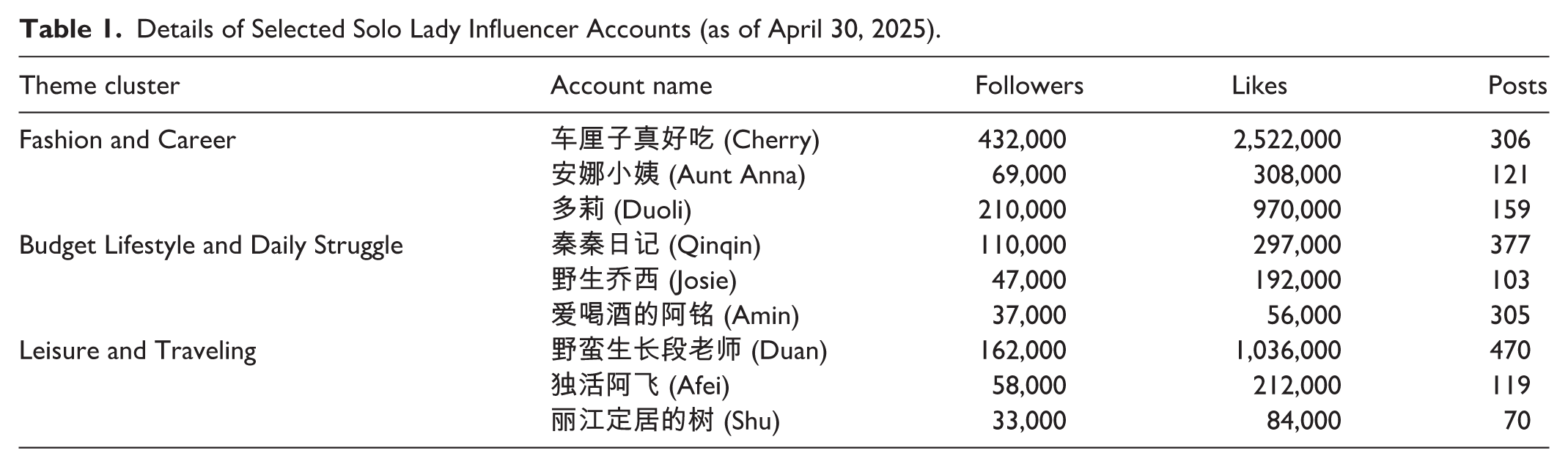
During this immersive phase, I documented visual, textual, audio, and interactive elements through screenshots and analytic memos. I created a color-coded spreadsheet to support initial coding, with each color corresponding to a recurring theme. This system enabled me to track and compare recurring patterns across accounts. Based on this preliminary analysis, I identified three thematic clusters of solo lady influencers: (1) fashion and career advancement, (2) budget lifestyle and daily struggle, and (3) leisure and travel. I retained only accounts with at least 30,000 followers, a threshold commonly recognized in industry metrics as indicative of full-scale influencers with substantial reach and engagement (Duke, 2020). All of these accounts showed evidence of direct monetization, typically through brand partnerships, affiliate links, and embedded product placements. Based on my netnographic observations, such sponsored content appeared in roughly one to four posts per month, depending on account size and thematic focus. Employing purposive sampling, I selected three representative accounts from each theme cluster, capturing variation across subthemes. This approach enabled me to “intentionally target information-rich cases that exhibit key variations in the phenomenon under study” (Divon et al., 2025, p. 7). From these nine accounts (see Table 1 for details), I collected 2030 posts, including text, photos, videos, hashtags, and comments. While the sample is not exhaustive, it provides a nuanced account of the diverse narratives presented by solo lady influencers.
Details of Selected Solo Lady Influencer Accounts (as of April 30, 2025).
The visual, textual, and audio content from selected accounts was loaded into NVivo 12 Plus for coding. Adopting Layder’s (1998) approach of “adaptive coding,” I applied keyword themes from the preliminary analysis to sections of text and generated new inductive codes emerging from the data. After completing this round of coding, I undertook a comprehensive review of the coded content and reorganized the framework to capture higher-order thematic relationships and discursive structures. In this process, I identified three prominent archetypes in solo lady influencers’ self-representations that reflected distinct orientations toward selfhood, lifestyle, and socioeconomic status: glamorous go-getters, struggling proletariats, and lying-flat nomads.
Diverse Self-Representations of Solo Lady Influencers
Solo Ladies as Glamorous Go-Getters
The rise of China’s single economy is inextricably tied to urban, middle-class, and affluent single women who simultaneously drive and are targeted by this market (Wang, 2022). To appeal to brands catering to this demographic, many solo lady influencers on RedNote portray themselves as “glamorous go-getters.” Through displays of career success, luxury consumption, and refined lifestyles, they frame singlehood as emancipation through material prosperity. In doing so, they present autonomy and choice as most readily achievable within urban professional and entrepreneurial milieus, with their ability to opt out of conventional marriage underpinned by elite status. At the same time, by leveraging cultural stigma, personal vulnerability, and existential uncertainty surrounding singlehood, influencers construct relatable personae, transforming singlehood into a visible marker of modern womanhood that fuses economic independence, emotional self-management, and curated consumption.
A quintessential example is Aunt Anna, a 56-year-old entrepreneur. In her content, she shows herself at high-profile conferences, on international business trips, and at industry forums, declaring, “When a woman chooses not to devote herself to serving her husband and raising children, by her fifties she will be called a CEO, not a CEO’s wife.” Anna’s autonomous, economically self-sufficient persona aligns with Wu and Dong’s (2019) notion of Chinese “non-cooperative” feminism, which frames career success and economic independence as a means to evade marital institutions and assert control over one’s life. By foregrounding her professional achievements and rejection of domestic roles, Anna embodies the “victorious woman” discourse that reframes singlehood as a marker of empowerment rather than social failure (Yu et al., 2023; Zhang, 2020). Yet she also distinguishes herself by highlighting her age and life stage. Through accounts of her single life, this self-proclaimed forerunner of unmarried, child-free living invites younger women to identify with her as a “cool aunt,” as her RedNote handle suggests, rather than a distant, unapproachable icon. Such self-disclosure stages an inner-self revelation to the public (Banet-Weiser, 2012), offering reassurance and solidarity to younger Chinese women navigating lifelong singlehood as a viable alternative to marriage (Zhang, 2020). By bricolaging singlehood with other forms of identity capital, such as entrepreneurial prowess, age-based wisdom, and intergenerational warmth, Aunt Anna calibrates an affective stance of confident, caring seniority, crafting a relatable persona that is at once distinctive and resonant. Beneath one of her popular videos, the top-liked comment reads: “This is how I want to live at 50.”
To sustain this aspirational lifestyle, solo lady influencers stage busyness as disciplined self-management. By sharing packed schedules, energy-preserving routines, and meticulous time-management, they present themselves as organized and in control. In today’s knowledge-intensive economy, visible busyness, when framed as self-directed efficiency rather than coerced overwork, can operate as identity capital, indexing an elite subject who is in demand, efficient, and hard-working (Bellezza et al., 2017). For followers, these performances model a desirable way of living that links competence and emotional stability to careful time-management and routine (Chen & Jiang, 2025), crystallizing a postfeminist ethos that celebrates agency, autonomy, and self-optimization (Gill, 2007).
At the same time, discipline is framed as a practical necessity for the well-being of solo living. A salient illustration is Cherry, who opens one vlog by admitting:
I’ve recently fallen into anxiety again . . . I need to shake off this state quickly, and my way of resisting anxiety is to fill up my time completely. An orderly life can genuinely help one grow and move forward.
She then cuts to a sequence of soothing, aestheticized activities in her lavish home, including flower arranging, aromatherapy, and wine tasting, transforming moments of emotional turmoil into demonstrations of proactive self-care. By sharing personal “hiccups” such as anxiety, Cherry’s narrative aligns with Kanai’s (2018) account of vulnerability in feminine digital cultures, signaling emotional authenticity and fostering relatability by articulating shared negative affects without overwhelming audiences (Kanai, 2018). Demonstrating what Cvetkovich (1992) terms “comforting anxieties,” Cherry invites audiences to participate in an imaginary where discomforts are acknowledged yet manageable (Kanai, 2018). This carefully calibrated trajectory exemplifies Hochschild’s (2012) concept of “feeling rules,” which shape how women narrate self-regulation in neoliberal contexts that demand both an attachment to ideals of perfection and ongoing efforts to achieve it while managing struggle. Moreover, by scripting a consumption-based solution to anxiety, Cherry’s self-help rhetoric exemplifies what Gill (2007) calls “a postfeminist sensibility,” recasting affective difficulties as matters of self-surveillance, disciplined self-transformation, and lifestyle consumption. These scripts normalize a middle-class gendered ideal in which access to wellness products, curated leisure, and aesthetic experiences is taken for granted, positioning self-care labor as a key site through which marketable femininity is produced. By bricolaging the identity capital of singlehood with self-discipline, aesthetic luxury, wellness expertise, and emotional openness, Cherry fine-tunes the balance between anxiety and comfort, assembling a relatable persona that is both aspirational and approachable (Kanai, 2018).
Furthermore, in a context where single women remain stigmatized in official discourses, singlehood itself becomes a site where anxieties about neoliberal demand for perfection are both articulated and commodified. In one vlog, Duoli confides:
My mother always wants me to be perfect . . . In her eyes, my choice to be single is a mistake. I am now learning to reconcile with the version of myself that looks like a failure in her eyes. This is not self-abandonment, but a commitment to invest more energy in myself and persist in becoming better.
The video then cuts to her promotion of a collagen drink with the slogan “Let your skin shine.” Duoli’s narration of frustration with maternal judgment, feelings of inadequacy, and moments of self-doubt resonates with many Chinese single women, who struggle to cope with pressure from their families and society (Gui, 2023). By framing herself as “imperfect” in her mother’s eyes yet still committed to self-betterment, Duoli mobilizes identity capital of singlehood, emotional vulnerability, and aspirational self-improvement. Through this bricolage, disappointment, shame, and hope are woven into a legible emotional trajectory, producing relatability by offering reassurance and recognition to audiences who see their own struggles reflected in her story (Kanai, 2018).
At the same time, the vlog illustrates how relatability is tethered to commercial imperatives. Duoli’s confession of imperfection is, as Tasker and Negra (2007, p. 2) note, an example of commodifying feminism “via the figure of the woman as empowered consumer,” where self-advancement is framed through curated consumption. By linking her emotional vulnerability to the promotion of a beauty product, Duoli’s narrative exemplifies how personal struggles are folded into influencer marketing, with consumption reframed as both empowerment and obligation (McRobbie, 2015). Her endorsement of the product exemplifies what Tasker and Negra (2007) describe as the mainstreaming of beauty treatments within the middle class, positioning consumption as a moralized path to self-betterment. By turning an intimate story of negotiating perfectionist expectations into a sponsor-friendly performance of self-nourishment, Duoli demonstrates how perceived imperfection itself becomes a relatable and monetizable asset within China’s platformed single economy.
Through identity bricolage, solo living influencers weave singlehood with tensions between assertiveness and approachability, discipline and vulnerability, and aspiration and imperfection. By crafting multifaceted personae that are both distinctive and resonant, they forge connections with segmented audiences. At the same time, they embody a postfeminist subjectivity that conflates liberation with commodified self-discipline and self-care, where wellness and beauty products are marketed as necessities for self-nourishment and as affirmations of modern womanhood, reproducing gendered consumerist demands under neoliberal logic (Martínez-Jiménez, 2023). In this process, the image of singlehood is reframed as a desirable lifestyle benchmark tied to consumption and self-optimization. Crucially, this benchmark and its associated affective repertoire are anchored in middle-class and elite norms of femininity, privileging women with the resources to pursue such curated autonomy, while leaving those constrained by economic insecurity or structural inequalities outside the promise of fulfillment.
Solo Ladies as Struggling Proletariats
Beyond urban, affluent women, China’s single economy also includes those who espouse singlehood as a response to the insecurity of the post-pandemic economic downturn (Chen, 2024). To reach this austerity-driven market, a growing number of solo lady influencers on RedNote, often self-identified as “ordinary” singles living in rentals, curate “struggling proletariat” personae, recasting singlehood as a practical strategy for coping with precarity. By sharing candid vignettes of economic hardship and social marginalization, they forge their relatability through a grounded-yet-aspirational display of everyday life, recasting modern womanhood in working-class terms of frugality, self-reliance, and resilience.
This approach is evident in Amin’s vlog, which documents her arduous journey of building a social media presence and moving from unemployment back into work. In one vlog, she declares:
At 30, unmarried and childless, I’m truly grateful for not being married . . . I can’t even afford a decent home. With no money, I dare not quit my job as I once did . . . that’s why I’m even more grateful to be alone.
Amin’s remarks speak to the plight of many Chinese young adults who postpone starting long-term relationships or families due to financial pressures in the post-pandemic downturn (Chen, 2024). By foregrounding her age, unmarried status, and lack of children, she invokes the gendered life-course expectations that define a “proper” woman through timely marriage and motherhood, only to reframe her deviation from this norm as responsible and even protective. Framing financial instability as a paradoxical source of autonomy, Amin reconfigures the harsh realities of economic marginalization into a resilient survival strategy, performing a working-class femininity that is modest, self-supporting, and emotionally strong. By bricolaging the identity capital of singlehood, economic struggle, entrepreneurial perseverance, and wry humor, her narrative holds together an affective mix of anxiety, frustration, and cautious optimism, producing a persona that is pragmatic yet aspirational, precarious yet hopeful. Rather than rejecting societal ideals of marriage, family, and economic success outright, she reworks them through “articulations of disappointment, but not disenchantment” (Kanai, 2018, p. 17), channeling disillusionment into a continuous negotiation between structural constraints and personal agency.
Such narratives, imbued with “both a sincerity and affective investment” (Kanai, 2018, p. 18), transform hardship into emotionally charged points of connection with audiences. Through such emotionally charged storytelling, influencers cultivate affective resonance, as evidenced by audiences’ supportive comments recounting similar experiences of precarity. Like Amin, this cohort of solo lady influencers performs identity bricolage by articulating singlehood through shared experiences of vulnerability and resilience, thereby cultivating empathy and belonging.
At the same time, these affective practices offer therapeutic solace for women navigating gendered exclusion. In China’s neoliberal turn, where female citizenship is increasingly defined by consumption, economically disadvantaged single women endure heightened social exclusion (Ferry, 2003). Many of the acrimonious comments in the dataset targeted this group. Qinqin, a 30-year-old freelancer who describes herself as having only 10,000 RMB (1428 USD) in savings, often reflects on the challenge of living with depression. Yet, from this vulnerable position, she demonstrates notable resilience in a vlog confronting misogynistic harassment she faced online:
No one has the right to judge someone else’s life. We ordinary women should also have the right to choose . . . Even though society has made some progress, marriage is still the same old story. I choose not to play this game. May we always have the right to choose.
The rhetorical invocation of “we ordinary women,” as Kanai (2019, p. 19) observes, hinges on positioning oneself against dominant ideals of femininity, projecting an affinity with audiences and rendering misogyny into a shared, survivable reality. Framing ordinariness as a specifically feminine condition defined by being judged, scrutinized, and blamed, Qinqin constructs what Berlant (2008, p. 10) describes as a “common emotional world,” where shared experiences of gendered exclusion and hostility become the basis for solidarity. Her post’s comment section has received an outpouring of support as respondents praise her courage, share similar experiences, and seek advice for navigating hardships. These responses enact a therapeutic ethos of emotional reciprocity grounded in empowerment (Illouz, 2007; Zhao & Lim, 2021).
Moreover, Qinqin’s language of “choice” gives this shared vulnerability a postfeminist gloss of resilience and self-determination (Gill & Orgad, 2018). Emblematic of popular feminism, her “narratives of suffering” (Riley et al., 2022) exist in a “call and response” dynamic with popular misogyny (Banet-Weiser, 2015), galvanizing female solidarity around shared struggle. Central to these narratives is the performance of bouncing back from adversity, through which she embodies the “imperfect-resilient” subject to legitimize her feminine self (Ntalla, 2025). Bricolaging the identity capital of singlehood, precarious financial standing, lived experience of depression, and the tenacity to publicly confront misogynistic hostility, Qinqin reworks negative affect into a performative script of resilience, thereby transforming a stigmatized feminine status into a powerful resource for relatability and moral authority.
Rooted in working-class milieus, some solo lady influencers present themselves through depictions of modest homes and thrift routines, most notably in popular “one-person meal” vlogs. Josie, for instance, chronicles her life in a cramped Shanghai attic, having survived two layoffs before securing new employment. In sharp contrast to RedNote’s typical luxury showcases (Guo, 2022), Josie foregrounds austerity in her post headline: “With a monthly rent of 1000 RMB (≈ $137), I survive on 10 RMB dinners,” positioning herself as an emblem of minimalist resilience. In her small yet meticulously arranged space, everyday rituals such as cooking simple meals, dining alone, binge-watching free online shows, and working overtime become rites of endurance. Cinematically, through controlled aperture, strategic angles, and soft lighting, she elevates mundane routines and objects into a poetics of austerity, evoking homeliness, comfort, and simplicity.
This aestheticization of austerity recalls Bramall’s (2013) concept of “austerity chic,” a cultural aesthetic emerging from economic constraints that critiques overconsumption and emphasizes alternative sources of pleasure. As Josie reflects, “I used to shop a lot. Now I just want stable work, a stable home, good food, and a little peace of mind.” By performing a femininity marked by careful budgeting, domestic competence, and affective stability, Josie turns austerity into a stylish and morally admirable way of life. Her narrative resonates with Chinese youth confronting precarious labor markets and unattainable home ownership during the post-pandemic economic downturn (Chen, 2024), encouraging coping strategies that prioritize emotional well-being over material wealth. Audience responses further underscore this relatability, as followers recount their own low-budget routines, express comfort in “not being alone” in such circumstances, and praise Josie for making constrained living feel warm and dignified. By bricolaging the identity capital of singlehood, domestic austerity, and minimalist aesthetics, Josie carefully balances resignation with contentment to create a soothing affective template for living with less, curating a persona that is both distinctive and resonant, and turning precarious living into a relatable lifestyle.
Notably, austerity chic is characterized by a nuanced performance that encourages compensatory consumption (Harris, 2019). By reconfiguring everyday spending as a survival strategy, Josie weaves brand sponsorship into her narratives so that e-coupons, budget meals, and space-saving furniture become “smart” ways to save money, time, and space. This mirrors Nathanson’s (2014, p. 148) observation of recession-era fashion bloggers who neutralized the frivolity of consumption by foregrounding “cost consciousness” narratives. In moralizing thriftiness and resourcefulness, Josie sustains the very consumerist logic she appears to critique, aligning with a postfeminist emphasis on savvy, self-managing femininity that frames empowerment through consumption (Tasker & Negra, 2007).
Amid China’s post-pandemic recession, a surge of solo lady influencers chronicle their frugal lifestyles and everyday struggles online. Through identity bricolage, they blend singlehood with other forms of identity capital, including lived hardship, thrift routines, entrepreneurial pursuits, and austerity aesthetics. By curating distinctive yet resonant personae that navigate tensions between precarity and aspiration, frugality and style, and ordinariness and tenacity, they craft relatable self-representations, fostering emotional support and a sense of belonging. Yet these unflinching portrayals of struggle and resilience also transform hardship into consumable content that caters to the single economy. What appears as feminine austerity thus becomes a new mode of marketable performance, in which stories of coping and “staying positive” function as affective commodities, reabsorbed into RedNote’s consumerist logics. As Littler (2024, p. 502) notes, resilience tactics often target women with fewer resources, especially working-class women, and turn their stories into “parables of progress.” By aestheticizing frugality and packaging resilience as a feminine lifestyle, and by framing “choice” and self-care as appropriate responses to structural insecurity, solo lady influencers’ narratives reconcile thrift with consumption and fold popular feminism into a postfeminist sensibility, ultimately obscuring structural inequalities and reinforcing the very consumer culture they purport to resist (McRobbie, 2020; Ntalla, 2025).
Solo Ladies as Lying-Flat Nomads
In China’s individualizing turn, an increasing number of youths have come to prioritize self-interest and personal happiness (Liang & Simpson, 2022), providing fertile ground for digital self-representations that valorize autonomy, mobility, and selective withdrawal from demanding career paths. Aligning with this ethos, some solo lady influencers on RedNote frame singlehood as an embrace of freedom from the gendered obligations of marriage and caregiving, as well as from the pressures of high-intensity salaried work. Associating singlehood with lifestyle choices of early retirement and nomadic living, these solo lady influencers curate a nonconforming, on-the-move femininity centered on self-determination, adventure, and defiance of social expectations. They cultivate an affective tone of lightness, detachment, and exhilaration through candid expressions of nonconformity, recasting single life as a liberatory space that resonates with audiences who share their aspirations toward greater autonomy.
Shu, for instance, writes in one of her posts:
Born in the 1980s, divorced, child-free, and now lying flat in Lijiang
1
after quitting my job. I don’t want to live my life just to please others. Social norms, others’ expectations, and the constraints of various interest-based relationships cannot bind me anymore.
Accompanied by images of her reclining in a sparse room, Shu’s post invokes the “lying flat” (tangping) movement, a countercultural stance that rejects hypercompetitive societal norms equating success with relentless productivity and material accumulation (Zhu & Peng, 2024). Amid China’s economic slowdown and deepening social stratification, where a volatile labor market and escalating costs of social reproduction have made upward mobility increasingly elusive (Zhang & Liu, 2021), Shu frames singlehood as a self-directed journey rather than social withdrawal. Her display of an unmoored life mirrors a collective disillusionment among Chinese youth who enact a form of “soft” resistance to career, marriage, and parenthood as markers of success (Zhang & Li, 2023, p. 49). While state media derides the lying-flat lifestyle as apathetic and defeatist (Chen, 2020a), Shu’s vlog instead embodies an ethic of care and a redirected vitality. Portraying solitude and idleness as part of an enriching pursuit of joy and repair, she calls hiking alone “the cheapest luxury,” adding: “In nature, I can connect with all things, and all things are nourishing me.” In contemporary China, marked by hyperurbanization and techno-social acceleration, such slow-living, back-to-nature imagery speaks to a collective yearning for simplicity, rootedness, and respite (Li, 2020). By bricolaging the identity capital of material disaffiliation, defiance of social norms, mobility, and ecological sensibility, Shu’s display of aloneness and idleness evokes a soothing atmosphere of quiet joy and self-preservation, curating an understated yet aspirational persona that reframes singlehood as a deliberate project of alternative flourishing. By fashioning a mode of femininity organized less around being a wife and mother or a dutiful employee than around being a self-defining subject, this persona resonates with young women gravitating toward more open and flexible life courses in China’s individualization (Martin, 2018).
Similar to Shu, Duan celebrates singlehood as liberation from conventional gendered expectations. In her vlog, vibrant footage of her globetrotting adventures is paired with subtitles that declare:
What should a woman do if she’s 30 and unmarried? Live a happy life alone! Ski down mountain slopes, ride horses through valleys, trek deserts, even explore Antarctica . . . Why waste time worrying about something as trivial as marriage?
By framing marriage as “trivial,” Duan boldly challenges the traditional Chinese social order that ties a woman’s moral worth to her marital status (Gui, 2020). Her message aligns with a broader shift toward China’s individualization, where personal fulfillment increasingly outweighs traditional life scripts of marriage and family (Yan, 2020). By redefining what constitutes a “happy life,” her vlog positions singlehood not as a void but as a rich terrain for self-discovery.
This ethos unfolds through Duan’s adventures and reflective commentary. Describing herself as “a blank paper with imprints of every place I go,” Duan embodies a “nomadic subjectivity,” a mode of being characterized by a willingness to embrace change, ambiguity, and complexity (Braidotti, 2011). This nomadic lifestyle, marked by unpredictability and openness, epitomizes both a physical and existential departure from socially sanctioned milestones such as marriage, stable employment, and home ownership.
While her personal narration and candid reflections foster a sense of closeness with viewers who share the same aspirations, her curated portfolio of spectacular travel experiences transforms fragments of everyday narration into a lifestyle script charged with distinction and desirability. By bricolaging the identity capital of singlehood, geographic mobility, and cosmopolitan adventure into an affective script of curiosity and fearless play, Duan invites audiences to imagine single life as possibility rather than lack, thereby forging relatability among viewers seeking alternative scripts of fulfillment beyond marriage, family, and salaried work. In doing so, she models a postfeminist feminine ideal in which empowerment is expressed through individualized choice, even as structural gender and class inequalities remain largely unaddressed (Gill & Orgad, 2018).
Mirroring the “lying-flat” movement’s refusal to treat the body as a productivity machine, many solo lady influencers embrace early retirement in pursuit of nomadic lifestyles. Afei, a former marketer whose travel-and-live vlogs attract thousands of followers, puts it bluntly:
Being unmarried and childless, I’ve sidestepped the usual financial pressures. I retired before forty and escaped the relentless corporate grind. After all, the whole point of working is to stop working.
Rejecting the conventional ideal of lifelong dedication to work, Afei reframes her single status as a resource that frees her from the “screw-tightening” routines of corporate life. Her narrative challenges neoliberal norms that repackage work as a “passion project” and tether fulfillment to relentless striving (Duffy & Wissinger, 2017; McRobbie, 2018). Her appeal also resonates with a broader trend in China, where younger generations increasingly prioritize autonomy and personal well-being as an exit from precarious, hypercompetitive work environments (Wei, 2020; Yan, 2020).
Afei’s reflections strike a chord with audiences who long for freedom from wage-labor constraints. On her vlog, she intersperses solo-trip tales with budgeting tips and income-automation hacks, presenting herself as both an adventurous traveler and a pragmatic peer. These fragments function as a “means of sociality and connection” (Mancinelli, 2020, p. 430), fostering intimacy while scripting an aspirational ethos of mobility and independence. Her carefully streamlined packing lists, budgeting routines, and practical hacks exemplify what Tai (2020) describes as an efficient, on-the-move femininity, in which the feminine self is continuously optimized financially, emotionally, and logistically to stay mobile while still conforming to recognizable norms of femininity. Through identity bricolage, she weaves the identity capital of singlehood with financial savvy, mobility skills, digital fluency, and nomadic courage, crafting a multifaceted persona that speaks to audiences navigating exhaustion and uncertainty in precarious work environments. By framing freedom as the reward for individualized choice, self-care, and self-optimization, her story exemplifies a gendered resilience culture (Gill & Orgad, 2018) that subtly relocates responsibility for escaping overwork and other gendered burdens onto individual women. Moreover, by transforming a generational sense of burnout and constraint into a monetizable “savvy nomad” persona, she illustrates how relatively privileged mobility enables women to rework experiences of crisis into opportunities for flexible self-reinvention that can be packaged as a distinctive personal brand (Tai, 2020).
At the same time, Afei’s rejection of traditional success metrics does not fully escape the logic of consumerism. The nomadic lifestyle she promotes remains embedded in market dynamics where intangible resources such as mobility, experiences, and online visibility operate as markers of status distinction in China’s burgeoning new economy (Chen & Jiang, 2025). Through sponsorships from outdoor gear brands and insurance companies, Afei monetizes her curated persona, exemplifying how personal biographies become commodified assets in China’s emerging single economy, where experiential consumption is increasingly valorized.
In this case, solo lady influencers intertwine child-free singlehood and nomadic mobility with the ethos of lying flat through identity bricolage, foregrounding a mood of ease, spontaneity, and controlled detachment from conventional responsibilities. By balancing withdrawal and engagement, pragmatism and aspiration, and detachment from work and passionate self-exploration, they curate lifestyles that appear both accessible and extraordinary, fostering relatability with audiences yearning for alternatives to prescribed trajectories. Yet these imaginaries are readily commodified, as romanticized wanderlust and mobility expertise are rebranded as consumer assets, turning freedom into a marketable lifestyle script. While such lying-flat nomadic figures exemplify a form of relatively privileged mobility and cosmopolitanism that rests on classed and passport advantages, these conditions are downplayed in favor of narratives of individual planning and courage (Tai, 2020). Through these narratives, this cohort advances a postfeminist vision of liberated femininity, in which autonomy is equated with mobility, flexibility, and savvy self-care (McRobbie, 2020; Tai, 2020). By framing opting out of marriage and stable employment as a freely chosen lifestyle, this postfeminist sensibility risks sidelining the more constrained, everyday realities of women for whom such lifestyles remain unattainable (Gill, 2007; McRobbie, 2008).
Discussion
Across three archetypes of solo lady influencers, “glamorous go-getters” frame singlehood as an enabling condition for professional success and material achievement, “struggling proletariats” depict it as a site of resilience and survival amid economic precarity, and “lying-flat nomads” reimagine it as a vehicle for self-exploration and disengagement from conventional life scripts. Mobilizing postfeminist idioms to varying degrees, these portrayals reveal distinct affective strategies that address segmented audiences within the single economy. Despite differences in class position, gendered selfhood, and orientations toward work, intimacy, and lifestyle, a common thread lies in their mobilization of singlehood as a form of identity capital, reconstituted as “affective, malleable matter, ready to be summoned, combined, and attached to varying signifiers and affects” (Kanai, 2018, p. 172). As Kanai (2018) notes, relatability in feminine digital cultures functions as an affective technology for negotiating the tensions between neoliberal demands and feminine “failure.” Through identity bricolage, solo ladies assemble singlehood with both enabling resources and constraining experiences into curated personae legible within a postfeminist configuration of gender politics. In a context where single women are simultaneously stigmatized in pronatalist state discourse yet celebrated as drivers of the “single economy,” their carefully calibrated disclosures of anxiety, economic struggle, and career burnout invite viewers to recognize their own difficulties as shared yet ultimately manageable through individualized self-work, thereby normalizing a modern femininity organized around autonomy, resilience, and consumption.
In this process, influencers generate what Berlant (2008, p. viii) calls “an intimate public,” a porous, affective space where strangers find belonging through shared experiences. As “a space of mediation in which the personal is refracted through the general” (Berlant, 2008, p. viii), the intimate public operates when markets address a consumer bloc by circulating texts and things that claim to express its core interests and desires (Berlant, 2008, p. 5). Within this affective economy, intimate narratives of struggle and aspiration are folded into recommendation scripts, transforming resonance into consumer cues. Entangled with commercial logics, the intimate public organized around singlehood becomes a site where solo lady influencers extract value by converting relatable scripts into brand collaborations, product promotion, and algorithmic traction. Relatability thus functions simultaneously as a mode of affective belonging and as a market device, recasting the social as an audience of potential consumers and rendering gendered intimacy into exchange value (Gill & Kanai, 2018).
Solo lady influencers exemplify the “fetishization of identity” within China’s platform capitalism, where personal experiences, emotions, and social roles are transformed into marketable assets, fueling an identity-driven influencer culture (Lin, 2025). While Lin (2025) highlights how class performance accrues value, the solo lady case demonstrates that gendered performances can also become symbolic currency in contemporary China, where marriage, relationships, and reproduction remain central to a discursive battlefield shaped by censorship and profit (Liao, 2025). In a digital ecosystem increasingly oriented toward niche segmentation (Chen & Ding, 2025), influencers forge differentiated bonds with segmented consumers through identity bricolage, tactically assembling classed aspirations, feminist sensibilities, and orientations toward work, consumption, and lifestyle into monetizable personae.
Although solo lady influencers foreground singlehood, they do not directly challenge the patriarchal institution of marriage. Instead, they exemplify what Berlant (2008) calls “the juxtapolitical,” a mode of cultural practice that offers a sense of proximity to politics while simultaneously displacing demands for overt confrontation. By offering solace, care, and small tactics of survival to women navigating compressed horizons of choice amid precarious labor markets and the state’s demographic governance, the popularity of solo lady influencers indexes both the appeal of autonomy and “single-as-solution” as a modest, pragmatic hope for relief within a constrained social landscape. The juxtapolitical space offers temporary relief from stigma and cultivates a shared vocabulary of autonomy and resilience, yet its impact remains largely confined to consumable feelings and commodified selfhoods. In China, where digital feminism is subject to state censorship and algorithmic governance (Gu & Heemsbergen, 2023), feminist critique is tolerated mainly when mediated through lifestyle branding, personal improvement, or market-friendly scripts of empowerment. The gender and feminist politics that emerge here are therefore highly conditional: self-discipline, individualized choice, and consumerist self-making are positioned as the primary routes to modern womanhood (Gill, 2007; McRobbie, 2008), whereas more contentious feminist critiques are softened into therapeutic narratives of resilience, self-care, and perseverance (Banet-Weiser, 2018; Gill & Orgad, 2018). Thus, what appears as a cultural negotiation of gender norms risks becoming a depoliticized mode of affective labor that sustains platform capitalism while offering only market-compatible idioms for living “otherwise.” In this sense, the relatability forged by solo lady influencers through identity bricolage illuminates how feminist and postfeminist discourses are appropriated, diluted, and reassembled within China’s platformed single economy.
Conclusion
This study offers an updated account of the media representations of single women in China. Amid China’s ongoing processes of individualization, rising feminism, and increasing labor precarity, singlehood has grown more prominent in social and cultural life. Yet discrimination against single women persists on multiple fronts. In everyday life, enduring stigma around remaining single or postponing marriage continues to shape family expectations, workplace evaluations, and intimate relationships (Feldshuh, 2018; Fincher, 2014). In public discourse, mainstream media and online debates continue to problematize challenges to conventional marriage and gender norms, sometimes casting such challenges as a form of gender antagonism (Liao, 2025; Yin, 2022). Against this backdrop, the demographic shift toward more people living single has spurred a burgeoning single economy that has begun to unsettle entrenched stereotypes. While earlier portrayals of female singlehood often oscillated between triumphant career heroines or unwanted spinsters, a recent wave of solo lady influencers on RedNote foregrounds a more diverse and nuanced picture.
This article introduces the concept of identity bricolage to illuminate an intersectional mechanism through which influencers translate identity into value for segmented consumer markets. For solo lady influencers, singlehood becomes a form of identity capital when braided with class position, gendered selfhood, and orientations toward work, consumption, and lifestyle. Filtered through postfeminist sensibilities for affective calibration, their personae translate shared experiences into personal assets that feel both distinctive and resonant. By assembling intersecting identity-based resources to forge monetizable relatability, these influencers respond to the growing demand for diversity in marketing (Ferraro et al., 2024), facilitating fine-tuned targeting within China’s platformed single economy.
At the same time, identity bricolage incentivizes creators to translate intimate life into sponsor-friendly, marketable content, exemplifying what McMillan Cottom (2020, p. 443) calls the “predatory inclusion” of marginalized subjects. In China’s platform economy, monetization has shifted from a visibility-based logic to commerce-driven models premised on cultivated trust and intimacy, thereby spurring the proliferation of niche influencers (Lin, 2025; Zheng & Ewen, 2025). Solo lady influencers, in turn, exemplify how commercially viable forms of affect are formatted, calibrated, and monetized through identity bricolage, converting lived complexity into sponsor-friendly content. In the process, their public presence as emblems of female autonomy is both celebrated and commodified, binding creators to platform governance and state imperatives.
Beyond monetization, the self-representation of solo lady influencers also reshapes the meaning of singlehood. Embodying a postfeminist sensibility, these performances frame the choice not to marry as a normative mandate of autonomy and independence. This mandate to choose as proof of selfhood resonates with Reckwitz’s (2020) notion of “singularity,” whereby individuals confront the imperative to present themselves as distinctive, particularly in the digital sphere where attention is increasingly secured through self-differentiation. Yet under platform capitalism, their performances remain aligned with marketable ideals, transforming the rhetoric of uniqueness into commodified difference (Weiß et al., 2025). In this context, singlehood is not only celebrated but also elevated to a moral-aesthetic ideal that valorizes self-discipline, resilience, and individualized choice. These idealized versions, however, reproduce inequalities of professional status, lifestyle aesthetics, economic security, and digital fluency, recasting singlehood as a normative and exclusionary standard rather than an open possibility.
Footnotes

Ethical considerations
The research has been approved by the Harbin Institute of Technology Research Ethics Committee (Reference Number: 2025040).
Funding
The author disclosed receipt of the following financial support for the research, authorship, and/or publication of this article: This work was supported by the Shenzhen High-level Talent Grant.
Declaration of conflicting interests
The author declared no potential conflicts of interest with respect to the research, authorship, and/or publication of this article.
Data availability statement
The data analyzed in this study were obtained from publicly accessible posts on RedNote. In accordance with the platform’s terms of use and ethical research guidelines, individual posts are not reproduced in full. All materials cited are publicly available and may be accessed directly via the platform.