



Abstract
The rise of short-video platforms has transformed identity into a hyper-commodified asset, merging performative self-presentation with algorithmic governance. This article introduces the fetishized identity economy (FIE), a theoretical framework that reinterprets Marxian commodity fetishism, Bourdieusian symbolic capital, and Baudrillardian hyperreality to analyze how digital personas are constructed, staged, and monetized. The FIE framework centers on three interrelated concepts: persona capital (algorithmically optimized self-performance), staged class (the commodification of social status as symbolic spectacle), and platform capitalism (the cultural and ideological shaping of profitable identity performances). Through a case study of Chinese influencer Sister Yu, the article illustrates how identity under the FIE is engineered rather than expressed, shaped by state-platform synergies that reward particular narratives of gender, labor, and class. By doing so, this study critiques the neoliberal assumptions embedded in Western influencer discourse and offers an alternative lens to understand the complex interplay of identity, governance, and platform logics. The research contributes to ongoing debates on platform labor, attention economies, and the global contours of influencer culture.
Keywords
Introduction
The rise of social media has given birth to a paradoxical economy where human identity is both the most valuable commodity and the most exploited form of labor. Zuboff (2023) aptly captures this duality, describing identity as the “new raw material” of surveillance capitalism. At the same time, critical scholars have highlighted the systemic exploitation of users’ self-branding labor (e.g., Banet-Weiser, 2012; Fuchs, 2014; Terranova, 2000). However, critical scholarship remains strikingly silent on the underlying mechanisms that drive this identity economy. While platforms profit from the algorithmic performance of identity (Gillespie, 2014) and influencers commodify their personal narratives as branded content (Abidin, 2016), existing theoretical frameworks fail to explain how identity itself became a form of capital in the context of late capitalism (Hearn, 2008; Terranova, 2000). This theoretical gap obscures a profound shift: personal narratives have evolved into raw material for extraction (Scholz, 2013), emotional authenticity is engineered into spectacle (Senft, 2013), and social connection is reduced to a metrics-driven transaction (Gerlitz & Helmond, 2013). This article introduces the concept of the fetishized identity economy (FIE), aiming to address the analytical and theoretical lag in critical scholarship while exposing how platform capitalism has transformed the very essence of human experience into its newest frontier for profit.
The FIE refers to the phenomenon in which individuals, particularly vloggers, commodify their personal identities to gain visibility, attention, and profit. In this economy, identity functions both as capital and as a consumer good, actively curated and performed to satisfy platform algorithms and audience expectations. Drawing on Marx’s theory of commodity fetishism, the FIE underscores how digital personas are not simply representations but performative acts shaped increasingly by the demands of platform capitalism. This process transforms personal experiences, emotions, and social roles into marketable assets, fueling the rise of identity-driven influencer culture.
I argue that three core components are central to the FIE: (1) persona capital, the performative construction of online selves; (2) staged class, the dramatization of social status; and (3) platform capitalism, the algorithmic monetization of identity. By analyzing these interconnected elements, this article contributes to the expanding literature on the attention economy and influencer culture. It offers a contemporary framework to explore the intersection of identity, class, capitalism, and digital technology in the social media age.
The article is structured as follows: I begin by reviewing literature on self-commodification, celebrity studies, and neoliberalism in the Chinese context, providing the background and foundation for the FIE framework. I then define the core concepts of the proposed framework and offer a methodological note outlining the empirical approach. This is followed by findings from a case study that illustrates the broader dynamics of the FIE in practice. Finally, I conclude with a discussion that rearticulates the implications of the FIE, highlighting its distinctiveness and its engagement with recent scholarship.
Theoretical foundations
From celebrity to influencer
As Marshall (1997) observed, celebrity embodies a paradox: it represents both fleeting triviality and a concentrated site of cultural meaning, achieved through the performance of individuality. This paradox aligns closely with the commodification of identity that defines contemporary influencer culture. In this sense, the self as a marketable persona on social media platforms is not entirely new. Consequently, the connection between celebrity studies and today’s influencer culture is both direct and inescapable.
Dyer’s (1979) seminal study of Hollywood stardom illustrates how celebrities are constructed through paradoxical forms of authenticity, appearing simultaneously ordinary and extraordinary. This framework directly sheds light on a core tension within influencer culture: influencers perform “authentic” rural labor while attaining celebrity status through algorithmic amplification. Social media platforms have industrialized these star-making processes, first captured in Turner’s (2013) notion of the “DIY celebrity” (p. 70), and later expanded by Abidin (2018) as the “DIY celebrity template” (p. 10). Abidin further identified how platforms cultivate ecosystems of performative authenticity, which she termed “calibrated amateurism,” to enhance relatability (p. 92).
Celebrity studies have identified three key developments in digital fame that flow seamlessly into the rise of influencer culture. First, identity production has scaled up dramatically through what Turner (2013) described as the “demotic turn,” whereby digital platforms facilitate mass participation in the creation of fame. Second, the paradox of authenticity has become even more pronounced, as Marwick (2013) argued, with influencers required to continuously perform relatability while maintaining aspirational appeal. Third, the platformization of celebrity is itself paradoxical: while platform business models tend to centralize value capture, their flexible structures simultaneously allow for decentralized patterns of value creation (Yuan, 2024).
Self-commodification
Existing scholarship has established that self-commodification in digital spaces involves transforming personal identity into a marketable asset, shaped by individual agency (Duffy, 2017; Marwick, 2013), platform logics (Bucher, 2016; Srnicek, 2017; Van Dijck, 2013; Van Dijck et al., 2018), and neoliberal economic imperatives (Banet-Weiser, 2012; Cohen, 2019; Harvey, 2007; Zuboff, 2023). Key studies have emphasized the rise of self-branding (Marwick, 2013) and visibility labor (Abidin, 2016), where users strategically curate personas to align with algorithmic incentives and audience expectations. Platforms such as Instagram and TikTok actively facilitate this process by prioritizing content that conforms to marketable ideals (Van Dijck, 2013), while paradoxically commodifying “authenticity” itself (Banet-Weiser, 2012). Scholars have also documented how marginalized groups—particularly women, racialized communities, and gig workers—navigate heightened pressures to conform to monetizable identities, often blurring the lines between labor and leisure (Duffy, 2017). The concept of microcelebrity (Senft, 2013) further underscores how identity performance is tied to economic gain, with influencers treating their lives as branded products (Khamis et al., 2017). Recent work has extended these insights to diverse identities, including race (Tica, 2024), multiraciality (Ho & Tanaka, 2023), and femininity (O’Connell, 2023), revealing how monetized personas dominate cultural fields. Collectively, these studies highlight the interplay between platform capitalism, algorithmic governance, and identity commodification, framing self-commodification as both an entrepreneurial strategy and a site of precarity (Gandini, 2016).
Neoliberalism in Chinese influencer culture
Chinese neoliberalism on social media takes a form that is both hybrid and contradictory, diverging significantly from Western paradigms of influencer culture. While Western platforms typically valorize individualism, self-branding, and authenticity as routes to empowerment and resistance (Banet-Weiser, 2012; Duffy, 2017), Chinese digital culture embeds entrepreneurial self-fashioning within collective, nationalist, and culturally specific frameworks. Influencer success in China often depends not on rejecting dominant norms, but on performing individual distinction in ways that harmonize with prevailing ideology, Confucian values, and mainstream narratives. This results in what Peng (2021) terms “platformed collectivism,” a form of neoliberal subjectivity in which self-optimization and self-commodification are tightly interwoven with social duty, moral virtue, and ideological conformity. Such a dynamic can be understood as a form of “contradictory neoliberalism,” a condition in which neoliberal individualism is both enacted and constrained through collective logics and nationalist discourses.
Unlike Western “girlboss” feminism (Amoruso, 2014), which often casts success as an individual triumph over systemic barriers (Duffy, 2017), Chinese neoliberal feminism frequently commodifies patriarchal norms. Peng’s (2021) analysis of WeChat influencer Mimeng illustrates how women are encouraged to “housetrain” husbands, merging consumer empowerment with Confucian ideals of domestic harmony. Bouvier (2024) called it “overdetermined self-betterment.” Here, neoliberalism does not challenge patriarchy but rather repackages it as marketable aspiration.
Chinese social media further rewards influencers who align with nationalist narratives, blending self-promotion with ideological conformity. Li’s (2024) study of Eileen Gu’s Olympic fame shows how Chinese feminists strategically leverage nationalism to legitimize their positions. This differs from Western platforms’ celebration of authenticity as personal truth (Marwick, 2013); in China, authenticity is mediated through dual imperatives: capitalist profitability and ideological cohesion.
The FIE
While existing scholarship has extensively examined the commodification of identity through celebrity culture, self-branding, and platformized neoliberalism, critical gaps remain in understanding how these dynamics converge under contemporary platform capitalism. For instance, although studies have critiqued the performative nature of “realness” (e.g., Arriagada & Bishop, 2021), they have not fully addressed how authenticity itself becomes a fetishized commodity. To address these gaps, I shift from the concept of “self-commodification” to what I term the fetishized identity economy, developing a critical framework that adapts and synthesizes existing perspectives.
At the core of the FIE is the concept of commodity fetishism, introduced by Marx (1867/2024), which describes the process by which social relations are obscured by the commodity form, transforming objects and their associated labor into fetishized entities. In the context of short-video platforms, personal identity undergoes a similar transformation, shifting from an intrinsic, private self to an object of consumption. As Marx’s theory of commodity fetishism suggests, the value of these identities becomes increasingly detached from their authenticity, instead tied to their capacity to attract attention, fuel emotional engagement, and convert visibility into economic capital.
This conceptualization of fetishized identity aligns with Baudrillard’s (1994) idea of hyperreality, which he defines as “a real without origin or reality” (p. 1), where the boundary between reality and its representation blurs. In the FIE, digital identities are not merely reflections of the self; they are performative acts, meticulously crafted to meet the demands of platform algorithms and audience expectations. This performativity mirrors Baudrillard’s (1994) concept of the simulacrum, in which the constructed image of the self becomes more real than the reality it seeks to represent.
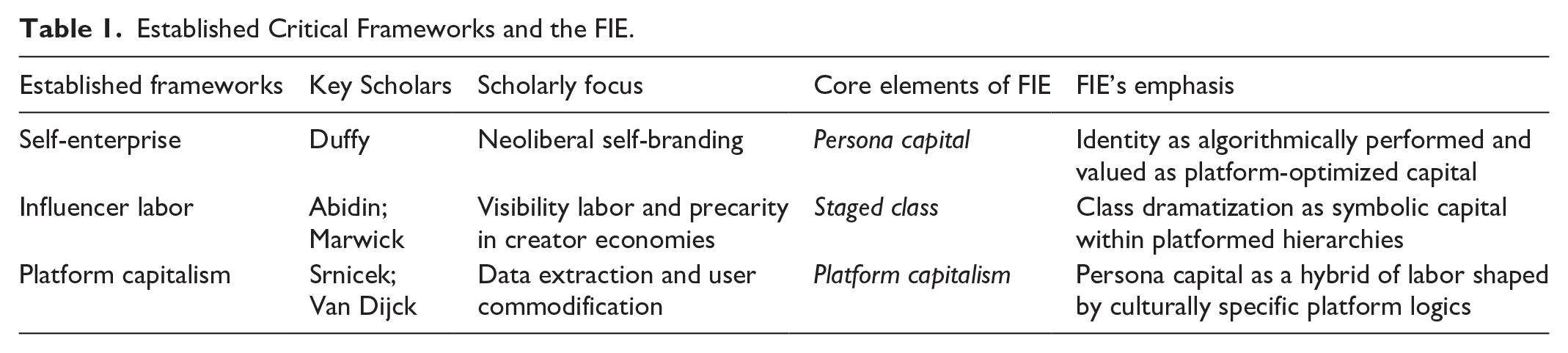
The FIE framework is built on three key elements: persona capital, staged class, and platform capitalism. It diverges from established critical frameworks in three significant ways (see Table 1), each of which I will now discuss in turn.
Established Critical Frameworks and the FIE.
Persona capital
The FIE is driven by persona capital—the value embedded in an individual’s digital persona across social media and digital platforms. This form of capital is a type of social currency, derived from the performance, cultivation, and monetization of online identity. It encompasses the emotional and social value generated through personal branding, where individuals construct and manage curated images of themselves to attract followers, engagement, and visibility.
Unlike traditional forms of capital, persona capital is intangible and non-monetary in the conventional sense. Its value lies in visibility, emotional resonance, and audience loyalty, often quantified through likes, shares, comments, and views. These metrics are then converted into both social influence and economic gain through brand partnerships, live stream sales, e-commerce, and sponsorships.
The FIE framework expands on conventional understandings of self-enterprise (Duffy, 2017; Duffy & Pruchniewska, 2017) by demonstrating how digital identities operate as algorithmically performed capital. Within platform capitalism, creators do more than brand themselves—they actively construct and refine their personas as datafied assets, calibrated for algorithmic visibility and valuation. In this context, persona capital emerges as a form of platform-native value: identity is not static but continuously and strategically performed to satisfy the metric-driven demands of digital attention economies (Goldhaber, 1997; Lovink, 2012; Wu, 2017).
Staged class
Staged class refers to the strategic performance of class identity within influencer culture, particularly through the dramatization of downward mobility as a form of symbolic capital (Bourdieu, 1984). Staged class does not reflect an authentic account of lived experience but instead functions as a curated social signifier intended to evoke emotional resonance and accumulate value within attention economies. Creators intentionally craft content that depicts vulnerability, hardship, or social precarity in stylized and emotionally charged ways, transforming class difference into a commodified and monetizable spectacle.
This performative logic stands in contrast to influencer labor (Abidin, 2016; Marwick, 2013), which centers on visibility labor—the continuous and precarious work of maintaining audience attention, managing self-branding, and navigating algorithmic demands. The distinction between the two lies in both emphasis and mechanism: whereas influencer labor foregrounds the affective and temporal demands of sustaining digital presence, staged class emphasizes the performance of class as a symbolic dramatization strategically designed to foster relatability and optimize algorithmic visibility. In this framing, influencer labor manages presence, while staged class manipulates positionality. Informed by Berlant’s (2011) notion of “compassionate consumption,” these stylized performances of social struggle function as emotional currency, inviting affective investment from audiences. Ultimately, staged class highlights how class identity in platform economies becomes fluid, theatrical, and transactional (Greenhalgh-Spencer et al., 2015), serving as a dynamic form of symbolic capital that circulates and accrues value within digital media environments.
Platform capitalism
The final key element in the FIE is platform capitalism, though this concept requires a revised interpretation. Within the FIE framework, creators’ identities are not only commodified and negotiated in accordance with platform algorithms, but also play an active role in monetization processes. Creators contribute to platform revenue through content production, e-commerce activities, and the convergence of both. This updated model of platform capitalism contrasts with traditional conceptions, which primarily depict users as commodities whose data are extracted for profit (e.g., Srnicek, 2017; Van Dijck et al., 2018; Zuboff, 2023). The FIE framework further highlights how creators, through staged performances and carefully curated personas, actively participate in and shape the commercial ecosystem of platform capitalism, thereby shaping the power dynamics between platforms and users.
Methodological note
This study employs a two-pronged approach, combining case study analysis with qualitative content analysis to explore the dynamics of the FIE. The case study centers on Sister Yu, a prominent Chinese influencer who has successfully monetized her persona across major short-video platforms such as Douyin (the Chinese counterpart of TikTok) and Kuaishou.
Several factors inform the decision to focus on Sister Yu. First, her story is well documented in the media, providing a rich empirical foundation for analysis. This extensive coverage offers a detailed account of her experiences and strategies. Second, Sister Yu’s case provides valuable insights into the economic and social dimensions of the FIE. As a successful influencer, she has adeptly navigated the complexities of curating and performing a digital persona, leveraging it to generate significant income. Third, Sister Yu’s legal challenges and public backlash highlight critical regulatory and ethical issues within the FIE, making her an ideal subject for exploring the broader implications of identity commodification in digital spaces.
This study includes qualitative content analysis of all 233 videos posted by Sister Yu on Douyin to examine her persona capital, staged class, and engagement with platform capitalism. Due to the homogeneity of her content—consistent themes such as cooking, laboring, traditional celebrations, and special events, as well as standardized formats (e.g., identical titles, background music, and roles)—quantitative analysis was deemed unsuitable. The adopted qualitative approach, critically interpretive in nature, allowed for a focus on the nuanced ways these repetitive elements contribute to the commodification of her identity.
The case of Sister Yu: navigating platform capitalism through a fetishized rural femininity
According to the China Netcasting Development Research Report (2024), by December 2023, the total number of short-video accounts on major platforms had reached 1.55 billion, while the number of professional live streaming hosts in China had grown to 15.08 million. The report underscores the significant consumer-driven impact of short-video live streaming, revealing that over 70% of users made purchases after watching short videos or live streams.
Against this backdrop, Sister Yu, also known as “Dongbei Yu Jie” on Douyin (Figure 1), stood at the pinnacle of this massive live stream sales pyramid. According to Feigua, a Chinese short-video data analytics platform, she generated over 100 million yuan ($13.8 million) in sales from 28 live stream shopping events before her downfall, earning her the designation of “top-tier influencer” (Zhao, 2024). Furthermore, Sister Yu and her husband controlled over 20 companies, which China Central Television (CCTV) referred to as a “business empire” (“Jiemi,” 2024).
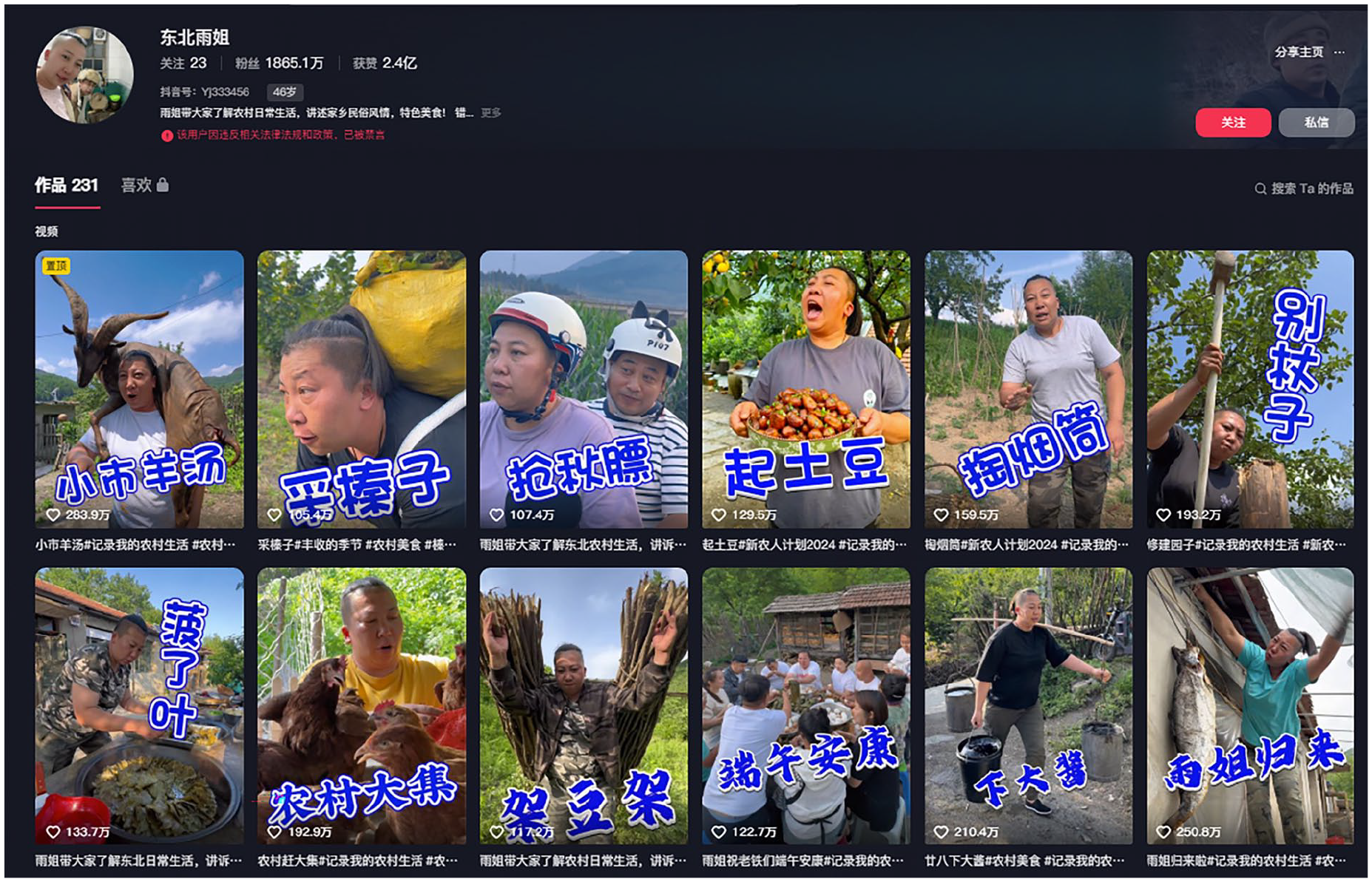
Sister Yu’s Douyin account page. 1
Sister Yu rose to fame as an influencer on Douyin for her portrayal of rural life in Northeast China. Even after her account was suspended due to an e-commerce scandal, she retained a substantial following of 20 million and had accumulated 240 million likes on the platform. Her content, which capitalized on the cultural allure of rural life, presented an “authentic” vision of rural living, with most of her videos receiving around 1 million likes each. Notably, Sister Yu’s success was not a solo effort but rather the result of a team-based production, with fixed roles (Hu, 2023). Note that Sister Yu initially chose Kuaishou, another popular short-video platform, to focus on rural-themed content. However, it was on Douyin that she truly gained her fame. Despite the rural themes in her content, Sister Yu’s popularity is largely attributed to her appeal among young audiences in first-and second-tier cities in China (Xue, 2024).
Sister Yu’s downfall began in late September 2024, when fellow Douyin influencer Dawa, with 285K followers, accused her of selling adulterated sweet potato noodles during a live stream (Chen, 2024). As the controversy gained momentum, Sister Yu issued an apology and promised refunds to affected customers, only to later delete the apology video. This sparked heated discussions on social media, with the hashtag “#SisterYuDeletedApologyVideo” trending on Weibo (Yang, 2024, p. 8). Shortly thereafter, the local Market Supervision Administration investigated and found that Sister Yu had made false claims in her live stream regarding the ingredients of the noodles. She was subsequently fined 1.65 million yuan ($227,000) and had illegal earnings confiscated (“Guanyu,” 2024). This led to the suspension of her accounts across all major Chinese social media platforms.
The controversy deepened when CCTV reported that Sister Yu and much of her crew were not actual residents of Moshiyu Village, the rural setting featured in her videos (“Jiemi,” 2024). Instead, the village was used solely as a filming location, with the crew renting local houses specifically for filming and live streaming. Villagers informed reporters that Sister Yu and her team were not documenting real rural life, but rather performing it for the camera (Yan & Chi, 2024).
In the following analysis, I explore Sister Yu’s case through three analytical units I previously developed: persona capital, staged class, and platform capitalism. These units shed light on how the FIE manifests in the real world. In this context, the concepts of rural femininity, rurality, and authenticity align with these three elements, each playing a defining role in her case. Within the FIE framework, these elements are fetishized, transforming into fetishized rural femininity, aspirational rurality, and authenticity as a cult. Fetishized rural femininity blends muscularity with nurturing qualities, aspirational rurality curates an idealized image of rural life for urban audiences, and authenticity as a cult elevates the notion of the “real” to a revered status—what Baudrillard (1994) might call the “hyperreal.”
Fetishized rural femininity as persona capital
Sister Yu embodies a blend of contrasting gender identities: muscular yet nurturing, traditional yet modern, commanding yet considerate. This combination transforms her into a Janus-like figure, facing two directions at once in her videos. The result is a cohesive, idealized, and fetishized rural femininity, which forms the foundation of her persona capital.
Rural femininity, as used here, refers to a strategically crafted digital performance that merges traditional Chinese agrarian womanhood with neoliberal entrepreneurialism. This hybrid identity combines masculine-coded physical labor, like slaughtering livestock or building structures, with traditionally feminine domestic tasks such as cooking and caregiving. Sister Yu’s consistently unadorned aesthetic—sun-weathered skin, muscular build, practical clothing, and visibly calloused hands—constitutes what may be termed “a semiotics of the soil”: a visual language through which urban audiences perceive her as an authentic rural subject. The virality of Sister Yu’s videos, to a great extent, capitalizes on this constructed rural femininity.
In her content, Sister Yu frequently performs tasks that traditionally require significant physical labor—often activities associated with men—while skillfully balancing family responsibilities with grace and resilience. One of her most popular videos showcases her slaughtering a pig with remarkable efficiency and strength (@dongbeiyujie, 2023a). The video begins with her capturing a large pig, immediately establishing her as capable in traditionally male-dominated tasks. Close-up shots highlight her physical strength, reinforcing her image as a hardworking rural woman. The scene transitions to her preparing the meat for cooking, demonstrating her versatility as she smoothly shifts from physically demanding tasks to more domestic ones. This duality fosters admiration for her skills and strengthens her emotional connection with her audience, who see her as both strong and compassionate.
In another video, Sister Yu constructs a pigpen from scratch (@dongbeiyujie, 2023b). “I’ve been thinking about tearing down the wall to build a pigpen,” she says to the camera. The next shot shows her husband lounging in a rocking chair, sipping milk, while Sister Yu begins clearing debris and kicking down a stone wall. By showcasing her physical labor, assertiveness, and skill, Sister Yu cultivates a persona that aligns with the “self-made” rural matriarch ideal, particularly in the context of Chinese rural-urban narratives. When it is time to cook, her femininity re-emerges. She asks her husband, still seated, what he wants for dinner. “Millets with eggs,” he replies. “That sounds like something a pregnant woman would eat. Fine, I’ll make it for you,” she responds. The next sequence shows her efficiently preparing multiple dishes. As the sky darkens, she announces, “Dinner’s ready!”
Like Janus, Sister Yu’s femininity is two-faced, blending tradition with modernity. She embodies the stereotype of the “hardworking rural woman,” but complicates it by asserting her independence, rejecting unsolicited advice from her husband, and doing things her way. This persona capital makes her relatable to a broad audience by tapping into both traditional values of hard work and a more modern, empowered femininity.
Sister Yu’s fetishized rural femininity also includes an authoritative yet caring side. In a Mid-Autumn Festival video (@dongbeiyujie, 2023d), she purchases an entire goat for the celebration, symbolizing her role as both a provider and a central figure in the community. Her actions—jogging home with the goat draped over her shoulders, cooking, and managing preparations—demonstrate her competence and leadership. This portrayal elevates Sister Yu to a position of authority, not only within her household but also in the community she has cultivated online. In another video, the presence of Yibo, a high-profile Somali influencer who speaks fluent Northeastern Chinese, further elevates Sister Yu’s status as a community leader (@dongbeiyujie, 2023c). Yibo’s admiration for her hospitality and cooking further enhances her persona, positioning her as a rural celebrity capable of impressing even outsiders. The contrast between her rural simplicity and Yibo’s cosmopolitan background adds depth to her image, showcasing her versatility and ability to connect with diverse audiences.
Persona capital is also central to Sister Yu’s “Shopping Trip to the Country Market,” her most liked and shared Douyin post, which garnered 4.31 million likes and 1.4 million shares (@dongbeiyujie, 2024b). Throughout the video, Sister Yu is portrayed as a relatable figure with a distinctive regional persona. Her direct interactions with vendors and playful yet commanding tone with her husband blend humor, authority, and charm—key elements that enhance her persona capital. This exaggerated performance of her “authentic” rural identity makes her content commodifiable. In the FIE, Sister Yu’s “real” self becomes a commodity that is consumed and shared widely. Her identity is marketed as authentic, yet framed within a context of entertainment, encouraging viewers to follow her for more glimpses into this “real” life.
This idea of “real” or hyperreal is underscored in a video where Sister Yu prepares suantangzi (sour corn noodles) (@dongbeiyujie, 2024a). Despite a recent incident in which seven people died from eating the dish (Li & Sun, 2020), Sister Yu humorously and candidly promotes it, adding a layer of raw authenticity that resonates with her audience, particularly those familiar with rural life. Her persona capital is also tied to her gendered role in the home, as she handles most of the physically demanding tasks, such as washing corn and grinding it into slurry. This reinforces her image as a capable, no-nonsense woman, standing in contrast to her husband, who plays a passive role. This dynamic reflects a common rural stereotype in China, where men are typically less involved in domestic labor and women are seen as the backbone of the household. In this way, Sister Yu’s persona serves both as a tool for audience connection and as a form of capital.
However, this fetishized vision of rural femininity is not without its complications. In one video featuring the foreign influencer RussianNanaa 2 (@dongbeiyujie, 2024d), Sister Yu’s apprentice pointedly refers to RussianNanaa as “36D,” a blunt sexual reference that reduces the Russian influencer’s identity to a bodily measurement. This moment foregrounds the role of overt sexuality and disrupts the otherwise coherent portrayal of femininity within Sister Yu’s mediated universe.
First, the label “36D” explicitly objectifies RussianNanaa by reducing her to her breast size, positioning her body as a site of spectacle and sexual desire. This moment of sexual objectification stands in stark contrast to the persona capital that Sister Yu meticulously cultivates, a strategically branded and well-selling identity rooted in competence, modesty, and maternal strength. Second, the scene underscores the commodification of femininity in influencer culture. RussianNanaa’s visibility depends largely on sexual display and performative allure, traits that cater to the logics of algorithmic amplification and platform economies. Her sexuality is not incidental; it is a deliberate strategy for capturing attention and driving engagement. Third, the interaction between Sister Yu and RussianNanaa signals a shift in power dynamics. While Sister Yu’s influence stems from her authenticity and embodied labor, RussianNanaa’s flirtation with Sister Yu’s husband introduces an undercurrent of competition and momentarily destabilizes the moral and social order the videos typically affirm. This exchange exposes the inherent tension within the idealized image of rural femininity, revealing how quickly it can be disrupted by the sexualized, attention-driven logic that governs contemporary influencer culture.
Despite these complications, fetishized rural femininity remains a recurring theme in Sister Yu’s videos. It represents a form of persona capital that she actively cultivates and markets. Her audience is drawn not only to her content but also to the authenticity her persona promises. The appeal lies in her ability to perform both vulnerability and strength simultaneously, creating a hybridized femininity that is both aspirational and accessible. By navigating between the roles of hardworking rural woman and nurturing figure, Sister Yu capitalizes on the emotional resonance this persona evokes. Her rural femininity is not just a reflection of her life but a carefully constructed, commodified identity strategically designed to attract engagement, sponsorships, and a loyal following. Ultimately, it serves as a key driver of economic value within the FIE.
Staged class and aspirational rurality
Duffy’s (2017) concept of aspirational labor provides a valuable framework for analyzing Sister Yu’s performance of rural femininity as a form of gendered entrepreneurship within China’s platform economy. While Western influencers often present their digital labor as passion-driven, thereby masking its inherent precarity, Sister Yu adapts this logic to a Chinese context shaped by state-led narratives of rural revitalization. Her content aestheticizes manual labor such as pickling vegetables or constructing pigpens, transforming these everyday tasks into aspirational spectacles that align with what Duffy (2015) terms the “romance of work.” In contrast to Western influencers who conceal collective labor behind polished Instagram aesthetics, Sister Yu adopts a deliberately “unpolished” style that serves a similar purpose: it obscures the involvement of team-based production through a narrative of individual resilience and self-made success. Duffy et al.’s (2021) concept of the “nested precarities of visibility” further elucidates the multiple, intersecting pressures creators like Sister Yu must negotiate, including evolving market demands, algorithmic regulation, and broader socio-political expectations, all of which inform the meticulous construction of her digital persona.
Building on this framework, the following discussion shifts from aspirational labor to the related concept of aspirational rurality, examining how Sister Yu’s portrayal of rural life intersects with the performance and staging of class. Her content strategically presents rural labor, cooking, and traditional celebrations as part of a curated vision of peasant life that emphasizes hard work, humility, and the purity of rural existence. In doing so, Sister Yu offers a form of downward mobility, framed as a return to untainted roots, an alternative to the perceived artificiality and materialism of urban life. Here, rurality is not merely a background but becomes an aspirational social class in itself, a cultural ideal onto which urban audiences project their desires for simplicity, authenticity, and escape.
In the mutton soup video (@dongbeiyujie, 2024c), the staged class elements are subtly crafted through Sister Yu’s lifestyle. Her physical strength, paired with the rustic setting, portrays an identity rooted in hard work, resourcefulness, and tradition. The video emphasizes these class markers in an exaggerated way, such as the visual focus on Sister Yu carrying heavy water buckets and chopping goat meat. These actions are both impressive and somewhat theatrical, reinforcing her role as a strong, capable rural woman.
The idealization of rural authenticity continues in the shopping trip video (@dongbeiyujie, 2024b). The bustling market, vibrant goods, and Sister Yu’s candid interactions with vendors present the rural setting as romanticized and full of potential for those seeking a simpler, “genuine” lifestyle. Moreover, the interactions between Sister Yu and her husband, Laokuai, serve as a comedic yet poignant form of class staging. Laokuai is depicted as childlike and passive, following Sister Yu around as she takes charge in the market. This dynamic subtly reinforces Sister Yu’s authority as the head of the household and the active participant in this “market drama.” The county market, in this sense, becomes a site of class performance: it is not just a shopping trip but an opportunity to showcase Sister Yu’s economic savvy, bargaining skills, and deep knowledge of local products. Her role here is about more than just shopping—it is a performance of rural expertise that is commodified for her online audience.
Staged class also emerges in lighter moments, such as the playful exchange between Sister Yu and Laokuai. His hesitancy to help with cooking is portrayed as endearing, reinforcing the rural, sitcom-like dynamic of their relationship. These moments of humor and exaggeration highlight the simplified, romanticized social class dynamics often seen in rural narratives. They play into urban fantasies about the rustic, down-to-earth qualities of rural life, qualities that appeal to an affluent or urbanized audience who view rurality as an exotic commodity. In this way, her videos present a simplified, digestible form of rural “charm” for urban audiences to consume and fantasize about, without confronting the complex socio-economic issues underlying rural life—much like agricultural tourism.
Aspirational rurality also highlights the glorification and simplification of rural labor. In the pickling cabbage video (@dongbeiyujie, 2023e), for example, the labor-intensive process is romanticized. Sister Yu’s manual labor, her connection to nature, and her ability to manage tasks with charm are framed as part of a narrative of rural pride and authenticity. However, this portrayal glosses over the more difficult aspects of agricultural work. The video presents rural life as accessible, straightforward, and satisfying, distancing the audience from the less glamorous realities of such labor. Similarly, the Mid-Autumn Festival video (@dongbeiyujie, 2023d) exaggerates the celebratory nature of rural life, portraying the act of slaughtering a goat and preparing a large festive meal as a communal and fulfilling effort. Sister Yu’s calm demeanor while organizing the meal frames physical labor not as a burden but as part of a meaningful, rewarding lifestyle.
To some extent, aspirational rurality in Sister Yu’s videos reverses the typical class narrative, where rural figures are often seen looking up to urban elites. Instead, it suggests that rural life offers its own distinct value, one that transcends mere economic wealth. The videos featuring Yibo (@dongbeiyujie, 2023c) and RussianNanaa (@dongbeiyujie, 2024d) illustrate this idea. As foreign guests familiar with Chinese culture and dialects, their visits to Sister Yu’s home make the rural setting seem like a place that even globally aware figures can admire. The dynamics between Sister Yu, Yibo, and RussianNanaa reflect a class play, with the foreign guests, despite their global status, positioned as awestruck by rural life. The interactions between Sister Yu and RussianNanaa further highlight the divide between rural simplicity and the sophisticated international influences entering the rural sphere. This dynamic reinforces the idea that rural life is both accessible and aspirational, designed to be relatable to urban viewers while elevating the image of rural existence.
Built on simplicity, authenticity, and a connection to the land, the rural class that Sister Yu presented becomes commodified through her content. What was once considered a lower-class identity is reimagined as an aspirational ideal, something to be envied and desired. Through her carefully constructed performances, Sister Yu blurred the line between reality and performance, transforming an imagined version of rural class into a commodity for urban consumers seeking both authenticity and escapism. In doing so, she exemplified how social class, within the aspirational rurality narrative, is not only performed but packaged for profit in the logic of platform capitalism.
Authenticity as a cult in platform capitalism
In her first video posted on Douyin, Sister Yu casually dismissed a fake account impersonating her. She said, “Who cares if it’s real or fake? Let it be.” This relaxed response reinforced her grounded, no-nonsense persona (@dongbeiyujie, 2022). It suggested a lack of concern for external validation, signaling to her audience that her identity and content were based on authenticity, not a carefully curated image.
However, in the context of platform capitalism, authenticity is more than just sincerity. It becomes a tool for engagement, monetization, and brand-building. Sister Yu’s authenticity is not merely about being true to herself; it is about aligning her persona with audience expectations. This is where authenticity morphs into a “cult.” It does not imply deception but rather the creation of an idealized version of reality. This version is elevated and crafted for commercial purposes. As Baudrillard (1994) suggests, audiences do not consume raw authenticity. They consume a hyperreal version of it—meticulously staged for profit. By positioning authenticity as a sacred commodity, Sister Yu fosters emotional connections with her followers. She then monetizes these connections through sponsorships, e-commerce, and engagement metrics. Within platform capitalism, the value of authenticity is not derived from its inherent truthfulness. It comes from its ability to generate profit through emotional resonance and audience interaction.
In her shopping trip video (@dongbeiyujie, 2024b), Sister Yu capitalizes on the fetishization of rural authenticity in two key ways. First, she promotes rural commodities and monetizes her interactions. Her exchanges with market vendors are not just casual conversations. They are strategic marketing moments for local goods central to her e-commerce business. References to products like “pig-snout mushrooms” and “the best mutton soup” highlight this. By incorporating these items into her personal brand, she enhances their perceived authenticity. This makes them more appealing to her audience. Her description of the market as a “hundred-year-old” institution deepens this connection. She transforms the space into both a cultural landmark and a consumable spectacle. Second, her playful, promotional tone, especially when discussing the mutton soup, shows how she reframes everyday activities to align with her commercial goals. Under platform capitalism, personal brands are inextricably linked to performative identities. Even spontaneous moments are strategically crafted for monetization.
Cross-cultural collaborations further emphasize the manufactured nature of authenticity in platform capitalism. A notable example is Yibo’s guest appearance in a video (@dongbeiyujie, 2023c). Yibo is an international influencer fluent in Chinese. He has experience living in various countries and a strong reputation for cultural knowledge. His presence does not just boost engagement; it confers cross-cultural legitimacy. This highlights the constructed nature of authenticity as something strategically curated for diverse audiences.
This raises an intriguing question: what happens when authenticity collides with platform capitalism? The video featuring “36D” RussianNanaa (@dongbeiyujie, 2024d) provides a revealing case. The tension between Sister Yu’s idealized rural femininity and RussianNanaa’s overtly sexualized nickname is not merely a clash between local and global cultural trends; it is a calculated decision shaped by the logic of platform capitalism. As a savvy content creator, Sister Yu likely recognized that sexualized content reliably attracts attention and sparks discussion in digital media spaces. Her strategic embrace of this dynamic, despite contradicting her carefully crafted rural femininity, highlights the dominance of platform capitalism within the FIE. Ultimately, her decision to lean into, rather than avoid, this tension shows that in the battle between authenticity and monetization, capitalism prevails. This is the answer.
Platform capitalism not only dictates what content gets promoted but also serves as a site of economic exchange. In some of Sister Yu’s highest-performing live streams, a significant portion of her traffic came from platform-driven recommendations. On March 20, 2024, her agricultural assistance live stream generated between 2.5 and 5 million yuan ($344K–687K) in just 2 hr. Nearly 80% of the traffic came from Douyin’s algorithmic recommendations (Xue, 2024). Similarly, a January 2024 live stream produced sales between 10 and 25 million yuan ($1.37–3.44 million). About 60% of traffic came from Douyin’s recommendation system (Xue, 2024). These figures reveal the extent to which platform visibility—and thus financial success—depends on algorithmic amplification rather than organic audience engagement.
Moreover, platform capitalism thrives on the commodification of public trust. Sister Yu’s live streaming scandal illustrates how ethical concerns often take a backseat to profitability. After her ban, numerous imitation accounts surfaced on short-video platforms. These included “Northeastern Brother Yu,” “Northeastern Aunt Yu,” “Northeastern Mom Yu,” and “Northeastern Dad Yu.” This so-called “Yu family” quickly proliferated, creating a “Northeastern Yu Universe.” Major Chinese news outlets condemned the phenomenon as a blatant attempt to exploit “Sister Yu’s remaining commercial value” (Zhao, 2024). This imitation frenzy underscores a fundamental truth of platform capitalism: once authenticity is commodified, it becomes endlessly replicable. It is diluted into an economy of imitation, where what is marketed as “real” is merely the most profitable version of itself.
Discussion and conclusion
The FIE framework emerges from the Chinese context but engages with global debates on influencer culture. Sister Yu’s case exemplifies how platform capitalism fetishizes identity in ways that both align with and diverge from Western paradigms—such as the commodification of downward mobility versus aspirational luxury. By provincializing Western theories, this study does not merely critique their limitations but also identifies transferable logics (e.g., algorithmic performativity, class staging) that could inform analyses of influencers elsewhere, provided due attention to cultural, economic, and infrastructural differences.
The FIE gains critical specificity in the Chinese context, particularly on short-video platforms like Douyin, where monetization hinges less on aspirational luxury and more on algorithmically optimized performances of mundanity, most notably rurality, as seen in the case of creators like Sister Yu. Unlike Western influencers who often capitalize on branded partnerships and luxury lifestyles (Abidin, 2016; Marwick, 2015), Chinese rural influencers commodify downward mobility, staging hardship and simplicity to attract urban audiences seeking “authentic” rural escapism. This phenomenon reveals a central paradox within the Chinese influencer economy: authenticity does not serve as a pathway to upward mobility, as seen in the valorization of playcats and knockoffs, but rather operates as a strategic performance to sustain visibility, relatability, and consumer engagement, particularly in the domains of direct sales and traffic-based monetization. In this context, creators accumulate persona capital not through displays of corporate polish, but by strategically downplaying their social status through carefully curated performances. This dynamic echoes Jensen’s (2014) concept of “poverty porn,” in which representations of hardship function as emotional and visual currency.
Notably, the notion of “rural femininity” resonates with Duffy and Hund’s (2015) concept of “entrepreneurial femininity.” Both frameworks explore how women strategically perform gendered identities in digital spaces to navigate neoliberal expectations, particularly within the context of the attention economy. Each highlights the commodification of femininity, yet they diverge in terms of cultural and class-based contexts. In Duffy and Hund’s analysis, fashion bloggers exemplify a post-feminist ideal that glamorizes consumption, passion-driven labor, and curated authenticity, effectively obscuring the privilege and invisible labor that underpin their success. By contrast, rural femininity, as exemplified by the case of Sister Yu, eschews urban glamour in favor of a “semiotics of the soil,” emphasizing banality and mundanity. It merges masculine-coded agricultural labor with feminine domesticity, thereby constructing a hyperreal image of the rural woman tailored for both rural and urban audiences. Moreover, while Duffy and Hund’s subjects operate within elite, consumerist spheres, rural femininity challenges urban bourgeois aesthetics by valorizing physical labor and rural resilience. Nonetheless, both forms of performed femininity risk obscuring structural inequalities: fashion bloggers often downplay their economic privilege, whereas rural influencers may inadvertently romanticize poverty.
To situate the FIE within broader debates on influencer economies, Bollmer and Guinness’s (2024) The Influencer Factory offers a productive contrast. While The Factory frames influencers as emblematic of the “Corpocene”—an era where personhood collapses into corporate form—the FIE complicates this model by foregrounding the culturally specific agency of creators. For Bollmer and Guinness, influencers are self-owned micro-corporations performing autonomy while enmeshed in material infrastructures of production—houses, warehouses, vehicles, and staff. Influencer labor, in their account, is marked by alienation under the guise of seamless personal branding.
By contrast, the FIE resists reducing creators to alienated laborers. It highlights how Douyin’s algorithmic privileging of rural aesthetics and class relatability fosters a distinct mode of self-commodification. Creators like Sister Yu perform curated rural femininity that aligns with state-platform expectations. Though presented as humble and mundane, her content was backed by a professional commercial team, revealing how performances of rurality are often strategic entrepreneurial acts. These are not merely expressions of authenticity, but calculated tactics of visibility, grounded in class identification, rural nostalgia, and monetization via traffic rather than brand alignment.
Thus, the FIE reframes identity fetishism not as pure alienation but as a dialectical process shaped by infrastructural constraints, cultural desires, and tactical self-staging. While The Factory interprets influencer labor through the lens of corporate standardization, the FIE foregrounds creators’ ambivalent negotiation with platform capitalism, where performances of rural femininity are not erasures of labor but its expression. These aesthetics are not supplementary to material labor; they are the labor, rendering visibility, simplicity, and hardship into monetizable content.
Crucially, as one anonymous reviewer aptly observes, the FIE offers a framework for “provincializing” US-centric models of digital labor and self-entrepreneurship. It shows that influencer economies are shaped by culturally specific logics, local narratives, and platform infrastructures. In Sister Yu’s case, visibility is produced through the aesthetics of lack rather than abundance as seen in “tradwife” influencers in the United States.
As a popular trend on TikTok, tradwife content typically features women, often from rural or suburban areas in the United States, who romanticize traditional gender roles such as homemaking, marital submission, and conservative femininity as a return to the so-called good old days. This nostalgic and deeply gendered identity, more accurately described as a fetishized one, finds an unexpected echo in China.
“A new domestic online persona” (Proctor, 2022), the tradwife and Sister Yu represent parallel yet culturally distinct expressions of neoliberal femininity within digital environments. Both phenomena promote them as aspirational lifestyles. However, they stem from different ideological foundations, even as they participate in a shared economy of fetishized identity.
Tradwife creators often explicitly reject feminism or adopt anti-feminist stances (Stotzer & Nelson, 2025), frequently aligning with conservative or right-wing values in the West (Sykes & Hopner, 2024). Its participants frame domesticity as a form of resistance against what Banet-Weiser (2018) called “market feminism” or “popular feminism.” Sister Yu’s portrayal of authenticity, by contrast, supports nationalistic narratives. Her carefully constructed rural life is not a rejection of modernity; rather, it is a celebration of it. Her content centered on festivals and holidays, featuring consumer activities such as shopping, elaborate meal preparation, and event hosting, reflects a curated embrace of contemporary consumer culture. Also, unlike tradwife influencers, who depict domesticity as a retreat from capitalist values, Sister Yu reframes rurality as a new form of entrepreneurial frontier, engaging with capitalist logic rather than resisting it.
The FIE makes three key contributions to influencer studies: first, it offers a culturally grounded model that de-centers US-based assumptions about visibility, labor, and value, showing how they are often generated through performative downward mobility rather than upward branding; second, it theorizes authenticity not as a fixed quality but as a tactical aesthetic shaped by algorithmic logics and class identification; and third, it provides a comparative framework for analyzing how curated simplicity—whether in China’s rural influencer culture or in Western “tradwife” narratives—is differentially mobilized to monetize identity, revealing how self-commodification takes diverse and culturally specific forms under platform capitalism.
Footnotes

Funding
The author(s) received no financial support for the research, authorship, and/or publication of this article.
Declaration of conflicting interests
The author(s) declared no potential conflicts of interest with respect to the research, authorship, and/or publication of this article.