



Abstract
Many individuals regularly use multiple social media platforms, and their information exposure is shaped by the various networks they maintain across these platforms. Given the rising trend of multi-platform social media use, this article introduces a two-step approach to investigate how networks across platforms conjointly and distinctly relate to incidental exposure to news and political information. Our analysis of survey data from the United States showed that greater immersion in multiple politically heterogeneous networks across platforms predicted higher counter-attitudinal incidental exposure, while greater immersion in multiple politically homogeneous networks across platforms predicted higher pro-attitudinal incidental exposure. Among the popular platforms, immersion in networks on Facebook, X (Twitter), and YouTube played a particularly influential role in these relationships. Surprisingly, we also found that greater immersion in homogeneous networks across multiple platforms predicted higher counter-attitudinal exposure, even though immersion in any single platform’s homogeneous network was not a significant predictor.
Keywords
Individuals often inadvertently encounter news and political information shared by their contacts on social media, even when using these platforms for socializing or entertainment (Vaccari & Valeriani, 2021). This form of incidental exposure has been found to be more likely than active seeking of information to expose users to diverse viewpoints, which influence political knowledge, attitudes, and participation (Schäfer, 2023). Given its significance, some scholars examined its antecedents and found that a more heterogenous social media network predicted more incidental exposure to news or counter-attitudinal political information (e.g., Ahmadi & Wohn, 2018; Lee & Kim, 2017; Lu & Lee, 2021).
However, these studies either examined a single platform (Lu & Lee, 2021) or relied on general measures of social media network heterogeneity (Ahmadi & Wohn, 2018; Barnidge & Xenos, 2024), without considering the growing trend of multi-platform social media use. Given the proliferation of social media, users often engage with multiple platforms and shift between them for information consumption (Dvir-Gvirsman et al., 2023). Their information exposure is shaped by the different information sources and preferred modalities of each platform and, more importantly, the different networks users maintain across platforms.
Scholars have recently called for more research on multi-platform social media use to better capture user experiences and the distinct and combined influences of different platforms (Bode & Vraga, 2017; Matassi & Boczkowski, 2023). While recent survey research suggests that using more social media platforms increased incidental exposure (Guo & Chen, 2022), the role of different patterns of multi-platform use—particularly the maintenance of multiple politically homogeneous or heterogeneous networks across platforms—remains unclear.
Addressing the trend of multi-platform social media use and the gap in the literature on incidental exposure, this study proposes a two-step approach to investigate how different networks across platforms conjointly and distinctly relate to incidental exposure to news and political information (referred to as “incidental exposure” below). In the first step—examining the conjoint role of multiple networks across platforms—we propose the indices of multi-platform network heterogeneity (MPNHE) and multi-platform network homogeneity (MPNHO), which are conceptualized as the levels of immersion in heterogeneous and homogeneous networks across platforms (as calculated by summing the product of usage level and network heterogeneity or homogeneity on each platform), and examine their relationships with overall incidental exposure. The second step evaluates how immersion in the network on each platform relates to incidental exposure, with significant predictors indicating the critical role of particular platforms in driving overall incidental exposure.
Our analysis of the online survey data from the United States found that higher MPNHE (i.e., a high level of immersion in heterogeneous networks across multiple platforms) predicted greater counter-attitudinal incidental exposure, and higher MPNHO (i.e., a high level of immersion in homogeneous networks across platforms) was related to greater pro-attitudinal incidental exposure, which indicates the additive influence of multiple networks across platforms. The immersion in networks on Facebook, X (formerly called Twitter), and YouTube was found to play a key role in explaining the aforementioned relationships.
More importantly and surprisingly, higher MPNHO also predicted greater counter-attitudinal incidental exposure, while the levels of immersion in the homogeneous networks on any specific platform did not significantly predict counter-attitudinal incidental exposure. This suggests that the “porous boundaries” of homogeneous networks (Lee et al., 2014) allow some counter-attitudinal information to flow through; this flow of information accumulates across platforms, promoting greater counter-attitudinal exposure, with no single platform playing a dominant role. Further analysis revealed that higher MPNHO predicted net pro-attitudinal incidental exposure. This suggests that while individuals engaging with homogeneous networks across platforms encounter some counter-attitudinal information, they are still more likely to be incidentally exposed to pro-attitudinal viewpoints.
Incidental Exposure and Social Media Network
Incidental exposure, defined as individuals encountering news or political information without actively seeking it, is prevalent on social media, where users are exposed to different information shared by their contacts or followed accounts (Tewksbury et al., 2001; Vaccari & Valeriani, 2021). 1 Users often encounter cross-cutting content through incidental exposure on social media, as they connect with weak-tie contacts or follow accounts with different political opinions (Barnidge & Xenos, 2024). Specifically, survey studies have found that counter-attitudinal incidental exposure promotes online engagement, such as news sharing and commenting (Guo & Chen, 2022; Weeks et al., 2017).
Recently, scholars have called for more research on pro-attitudinal incidental exposure, as users are incidentally exposed to both pro- and counter-attitudinal information (Kim & Kwak, 2022; Lai, 2023). Since counter-attitudinal incidental exposure can offset selective exposure (Lee & Kim, 2017), understanding pro-attitudinal exposure is crucial because it may weaken this counterbalancing effect.
Overall, incidental exposure plays a vital role in fostering democratic engagement. Schäfer’s (2023) scoping review found a general positive relationship between incidental exposure and civic participation. By increasing the diversity of news sources individuals consume, incidental exposure enhances issue knowledge, particularly among those with low political interest (Lee & Kim, 2017; Schäfer, 2023). Yet, it also has potential downsides. Incidental exposure may increase news avoidance by overwhelming users and foster misperceptions by exposing them to misinformation (Borah et al., 2022; Schäfer, 2023). Given its profound implications for political cognition and behaviors, it is essential to explore how incidental exposure is shaped in an increasingly platform-saturated media environment.
While past studies have extensively examined the impact of incidental exposure, scholars have only recently begun to investigate its antecedents (Barnidge & Xenos, 2024; Thorson, 2020). Schäfer’s (2023) review summarizes key antecedents, including individual characteristics, media use, and social media network properties. Politically interested individuals and those using social media for entertainment reported higher incidental exposure (Schäfer, 2023), and news consumption and social media use were found to relate positively to incidental exposure (Barnidge & Xenos, 2024; Lu & Lee, 2019).
Social media network heterogeneity often remained a significant predictor after controlling for individual characteristics and media use. Past survey research has found that a more heterogenous network on social media promotes higher incidental exposure (Ahmadi & Wohn, 2018; Barnidge & Xenos, 2024; Lee & Kim, 2017) and specifically higher counter-attitudinal exposure (Lu & Lee, 2019), given the more diverse political information and news sources shared within networks that include contacts of different backgrounds and opinions.
Studying Incidental Exposure in the Multi-Platform Social Media Environment
Past studies on social media networks and incidental exposure have generally taken one of two approaches: examining a single platform (e.g., Lu & Lee, 2021) or adopting general measures of social media network heterogeneity that are not platform-specific (e.g., Barnidge & Xenos, 2024; Lee & Kim, 2017).
While the single-platform approach provides insights into the network effect of a specific platform (often Facebook), any findings about one platform cannot be generalized to others due to the (sometimes substantial) differences in platform affordances. More importantly, this approach cannot address the rising trend of multi-platform social media use (Matassi & Boczkowski, 2023). Many users use multiple platforms to satisfy different needs. For example, in the United States, the context of this study, adults used an average of 2.84 platforms according to the 2016 General Social Survey (Lohmann & Zagheni, 2020).
Users engaging with multiple platforms are more likely influenced by their different networks across platforms rather than by their network on any one platform. It is plausible that specific platforms exert more decisive influence than others on incidental exposure or that these platforms exert a synergistic effect. Therefore, it is necessary to understand the network effects of different platforms in comparison to one another and the conjoint effects of maintaining multiple networks across platforms.
However, while using general measures of social media network heterogeneity is not tied to a single platform, that approach still cannot address multi-platform use and has two major limitations. First, it treats social media as a monolithic entity, overlooking the varied affordances and norms across platforms. More importantly, it remains unclear whether users, when reporting their social media network composition, base their responses on an average across platforms or on their most intensively used platform. This variation can compromise the measurement validity.
Recent research has shown a growing interest in multi-platform use and generally adopts two approaches: (a) comparing the effect of using one platform to another (Halpern et al., 2017; Yarchi et al., 2020) and (b) examining the conjoint effect of using multiple platforms (Chan et al., 2021; Guo & Chen, 2022). Both approaches have received limited attention in incidental exposure research. Regarding the comparative approach, Fletcher and Nielsen (2018) used survey data to examine how the effect of incidental exposure on the number of online news sources consumed varied across Facebook, X, and YouTube, but no studies have compared the network effect on incidental exposure across platforms.
For the conjoint effect approach, Guo and Chen (2022) found that using more social media platforms is associated with higher counter-attitudinal incidental exposure. However, this approach, which counts the number of platforms used, cannot account for variations in usage levels and network composition across platforms.
A Two-Step Approach to Understanding the Role of Multiple Platforms
Inspired by recent studies on multi-platform use, we introduce a two-step approach to investigate how different networks across platforms are related, both conjointly and distinctly, to incidental exposure to news and political information. For outcomes, we consider counter- and pro-attitudinal incidental exposure, along with net incidental exposure (i.e., whether users experience more counter- or pro-attitudinal incidental exposure).
The First Step: Examining the Conjoint Role of Multiple Social Media Networks
To study the conjoint role of networks across multiple platforms, we propose the multi-platform network heterogeneity (MPNHE) index, which captures the degree to which users engage with politically heterogeneous networks across platforms. Operationally, it is calculated as the sum of the product of usage level and network heterogeneity on each popular social media platform:

This MPNHE index has two main features. First, to address the role of multiple networks across platforms, it considers network heterogeneity as the extent to which users assemble social media networks with contacts or accounts holding differing political views. This approach, termed the “ego-network difference” by Hopp et al. (2020), emphasizes network composition independently of user interactions. By contrast, some studies focused on discussion network heterogeneity, examining the frequency of discussions with demographically or politically different individuals (Barnidge & Xenos, 2024; Lee & Kim, 2017). These studies assume that heterogeneity matters only when activated through communication, but political differences within one’s network can be relevant even if they remain uncommunicated (Lee, 2022), especially for incidental exposure, which often happens outside political discussions. Thus, we adopt the ego-network difference approach to define network heterogeneity, recognizing incidental exposure happening outside active discussions.
Second, the MPNHE index captures both network heterogeneity and usage level rather than simply averaging a user’s levels of network heterogeneity across platforms. This design reflects the usage-weighted network composition, or at a deeper level, the potential for encountering heterogenous information sources across platforms. The joint consideration of both network properties and usage is theoretically necessary in the context of multi-platform use, where networks on different platforms likely exert differential influence depending on platform usage. A network on a heavily used platform is more likely to shape a user’s incidental exposure than one on a rarely used platform.
Notably, past survey-based studies using the ego-network difference approach did not incorporate usage as a weighting factor (e.g., Hopp et al., 2020; Lee, 2022), as they either assumed a monolithic social environment or focused on a single platform. However, applying this approach directly to a multi-platform context without usage weighting would be conceptually invalid, as it unrealistically assumes all platforms contribute equally.
In our study, higher MPNHE scores mean that users not only have more heterogeneous networks across multiple platforms but also use these platforms frequently. It is possible that users have more heterogeneous networks on some platforms and more homogeneous ones on others; however, if they spend more time on platforms with homogeneous networks, the platforms with more heterogenous networks may have a limited influence on users’ overall incidental exposure because of their low usage levels. Therefore, these users’ MPNHE scores will remain low because the index sums the products of usage level and network heterogeneity across different platforms.
We hypothesize that higher MPNHE relates to greater counter-attitudinal incidental exposure for three reasons. First, past studies have found that having more heterogeneous networks and using more platforms independently predicted higher counter-attitudinal incidental exposure (Guo & Chen, 2022; Lu & Lee, 2021). Building on these separate findings, we expect that multiple heterogeneous networks across platforms may exert an additive or combined influence on counter-attitudinal incidental exposure.
Second, individuals using multiple platforms are more likely to encounter information in the different modes preferred by each platform: that is, short texts on X, longer posts on Facebook, visual content on Instagram and YouTube, and links embedded in messaging app conversations (Kim, 2023). Engaging with multiple platforms thus provides users with diverse modes of incidental exposure, even for the same piece of information.
Third, platforms have different logics of algorithmic selection, which means that the effects of heterogeneous networks will vary. For example, Facebook and Instagram select content for users’ feeds from their network contacts, and X and YouTube recommend more content from accounts or channels that users do not follow or subscribe to but are associated with those that they do. These different mechanisms explain how using multiple platforms with heterogeneous networks (i.e., higher MPNHE) relates to greater counter-attitudinal incidental exposure from more diverse sources.
It is worth noting that a low MPNHE score can result from three scenarios: (a) individuals who are inactive or non-users across platforms, (b) users with mostly heterogeneous networks yet being inactive across platforms, and (c) users with primarily homogeneous networks across platforms. Users in scenario (c) may have higher levels of pro-attitudinal incidental exposure than those with high MPNHE scores, while users in scenarios (a) and (b) may exhibit similar levels of pro-attitudinal incidental exposure to those with high MPNHE. Thus, we examine how MPNHE relates to pro-attitudinal incidental exposure without proposing a directional hypothesis.
For net incidental exposure, we hypothesize that higher MPNHE is associated with more counter-attitudinal than pro-attitudinal incidental exposure. Although pro-attitudinal news and political information may still be shared in highly heterogeneous networks, the information within these networks is likely to be predominantly counter-attitudinal, given the orientations of their network contacts.
In addition, we consider the level of immersion in homogeneous networks across multiple platforms by proposing the multi-platform network homogeneity (MPNHO) index, which sums the product of usage level and network homogeneity (i.e., the reverse-coded levels of network heterogeneity) on each popular platform:

Notably, past studies treated network properties as standalone variables (without weighting by usage), and therefore did not need to consider both network heterogeneity and homogeneity, which were essentially reverse-coded versions of each other (Hopp et al., 2020; Lee, 2022). However, since we treat usage as a necessary scaling factor that reflects the level of immersion in a network, it becomes important to include both MPNHE and MPNHO and to treat them as non-redundant constructs. For example, low immersion in multiple heterogeneous networks is not necessarily equivalent to high immersion in multiple homogeneous networks, as explained in the earlier discussion of low MPNHE scenarios.
Similar to the previous discussion on MPNHE, we hypothesize that higher MPNHO will predict greater pro-attitudinal incidental exposure. Using multiple platforms with homogeneous networks provides more informational opportunities, owing to the potential additive effect of multiple networks, different predominant content modalities, and varied algorithmic selections recommending different sources across platforms.
Low MPNHO scores mean that users are inactive or have mainly heterogeneous networks across platforms. Admittedly, users may be less likely to encounter counter-attitudinal information in a politically homogeneous network. However, those who frequently engage with multiple homogeneous networks may have a higher level of counter-attitudinal exposure than those who are inactive across platforms, as counter-attitudinal viewpoints may still be brought up during like-minded interactions or selected by the algorithms (Mak et al., 2024). We examine the relationship between MPNHO and counter-attitudinal incidental exposure without proposing a directional hypothesis, given the lack of empirical evidence from past research.
Finally, for net incidental exposure, we hypothesize that higher MPNHO relates to more pro-attitudinal than counter-attitudinal incidental exposure. Although counter-attitudinal information may be brought up within highly homogeneous networks, the information shared within these networks tends to be pro-attitudinal.
We therefore propose the following hypotheses and research questions:
Hypothesis 1 (H1). Higher MPNHE relates to greater counter-attitudinal incidental exposure (H1a) and more counter-attitudinal than pro-attitudinal incidental exposure (H1b).
Research Question 1 (RQ1). How does MPNHE relate to pro-attitudinal incidental exposure?
Hypothesis 2 (H2). Higher MPNHO relates to greater pro-attitudinal incidental exposure (H2a) and more pro-attitudinal than counter-attitudinal incidental exposure (H2b).
Research Question 2 (RQ2). How does MPNHO relate to counter-attitudinal incidental exposure?
The Second Step: Comparing the Distinct Roles of Different Social Media Networks
The second step is to analyze how networks on individual platforms uniquely relate to overall incidental exposure, offering more nuanced insights into the conjoint influence of multiple networks. For instance, if MPNHE or MPNHO significantly predicts incidental exposure, the second step can help identify which platform’s network is more influential. Alternatively, if MPNHE or MPNHO is a significant predictor, but none of the individual platform networks is, this suggests that the effect arises from the conjoint influence of multiple networks across platforms, with no single platform being particularly influential.
MPNHE and MPNHO are calculated by summing the products of usage level and network heterogeneity or homogeneity on each major social media platform. Each product reflects the level of immersion in a heterogeneous or homogeneous network on a particular platform, and these values are used in the second step of our analysis. Analyzing these network immersion indices of individual platforms enables direct comparison with the results of our analysis of conjoint influence, as these indices are the exact components that constitute the MPNHE and MPNHO measures.
For our two-step analysis, we select the six platforms most frequently used for news in the United States: Facebook, YouTube, X, Instagram, TikTok, and Facebook Messenger (Newman et al., 2024). As noted earlier, past research on incidental exposure has rarely compared network effects across platforms, leaving limited evidence on which platform’s network is more influential.
For two reasons, we expect that high levels of immersion in Facebook and X networks will be stronger predictors of incidental exposure than immersion in the networks on the other platforms. First, political elites, news agencies, journalists, and civil groups in the United States are active on Facebook and X, generating a substantial flow of news and political information that reach general users directly or indirectly through resharing by network contacts (Friedland et al., 2022). Second, given the longer history of Facebook and X being used for political campaigns and social movements, users are more likely to encounter campaign and advocacy messages on these platforms (Kreiss et al., 2018; Suk et al., 2023).
Although Instagram and TikTok have traditionally been used less for news, Hendrickx’s (2024) recent interview study shows that users increasingly encounter news content adapted to these platforms. Instagram in particular has been more widely used in social movements, with related information circulated on the platform (Suk et al., 2023). Thus, immersion in Instagram and TikTok networks may also significantly predict incidental exposure, albeit less strongly than immersion in Facebook or X networks.
We also expect that immersion in YouTube networks will significantly predict incidental exposure. On YouTube, users subscribe to different channels of interest, forming one-way, asymmetrical connections similar to those on X (Fletcher & Nielsen, 2018). Focusing on the network of subscribed channels (Wattenhofer et al., 2012), the present study considers network heterogeneity on YouTube as political differences between users and their subscribed channels. The network of subscribed channels influences incidental exposure, as the algorithm recommends relevant but unsubscribed content to appear on the main page (Chen et al., 2023). Notably, Fletcher and Nielsen (2018) found that users are incidentally exposed to more news sources on YouTube than on Facebook.
Despite limited empirical evidence, immersion in the network on Facebook Messenger may also predict incidental exposure. We conceptualize network heterogeneity on Facebook Messenger as political differences between users and their frequent contacts. 2 News engagement and political discussion have been common on Facebook Messenger, where users can share news and political information encountered on other platforms or websites with targeted contacts or in group chats (Murray et al., 2023). Moreover, users are more likely to encounter news and political information shared by contacts who may hesitate to share them on social networking sites (Valeriani & Vaccari, 2017).
As the second step of analysis examines numerous relationships—how immersion levels in heterogeneous and homogeneous networks on each platform relate to three outcomes—we pose a research question rather than offering hypotheses:
Research Question 3 (RQ3). How do the levels of immersion in heterogeneous and homogeneous networks on each platform relate to counter-attitudinal, pro-attitudinal, and net incidental exposure?
Method
Sampling
Survey data were collected by YouGov from April 1 to April 9, 2024. YouGov interviewed 1046 respondents from its opt-in panel and matched them down to a final sample of 1000, using a sampling frame constructed to approximate the U.S. adult population in terms of gender, age, race, and education. This sampling frame used is designed to be politically representative of U.S. adults, drawing on various sources, such as the American Community Survey and the 2020 Current Population Survey Voting and Registration supplements. While not probability-based, opt-in panel samples of this kind are common in academic research and allow for cautious generalization.
Measures
Independent Variables
The levels of immersion in heterogeneous and homogeneous networks on each platform, along with MPNHE and MPNHO, are calculated using both usage levels and network heterogeneity on individual platforms. Supplemental Appendix I offers a detailed example of the calculation. Table 1 presents descriptive statistics for usage levels, network heterogeneity and homogeneity, and immersion in heterogeneous and homogeneous networks across platforms.
Descriptive Statistics of Usage Level and Network Heterogeneity on Each Platform.
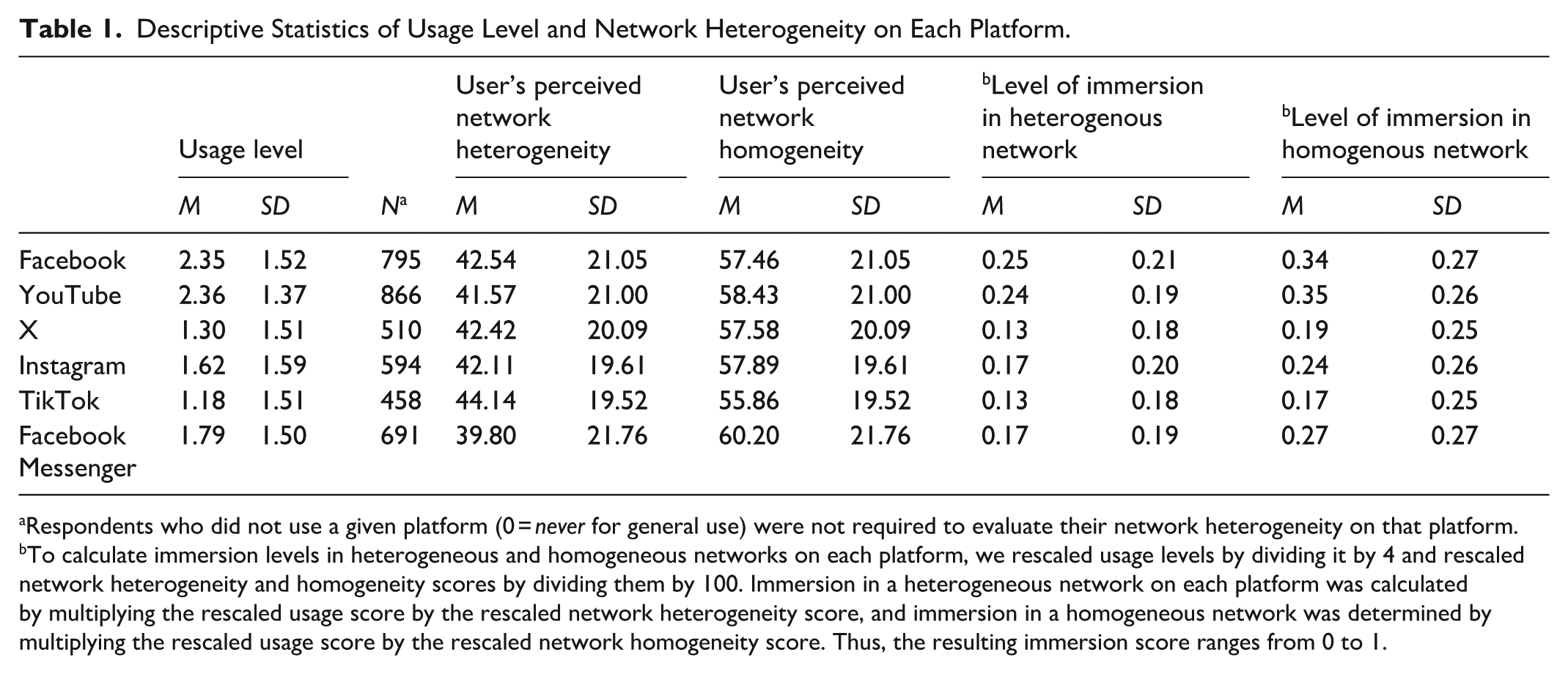
Respondents who did not use a given platform (0 = never for general use) were not required to evaluate their network heterogeneity on that platform.
To calculate immersion levels in heterogeneous and homogeneous networks on each platform, we rescaled usage levels by dividing it by 4 and rescaled network heterogeneity and homogeneity scores by dividing them by 100. Immersion in a heterogeneous network on each platform was calculated by multiplying the rescaled usage score by the rescaled network heterogeneity score, and immersion in a homogeneous network was determined by multiplying the rescaled usage score by the rescaled network homogeneity score. Thus, the resulting immersion score ranges from 0 to 1.
For usage level, respondents reported how often they used (a) Facebook, (b) YouTube, (c) X, (d) Instagram, (e) TikTok, and (f) Facebook Messenger in the prior week on a five-point scale from 0 = never to 4 = very often. When measuring social media network heterogeneity, some studies assess general differences, including diversity in religion, gender, and political views among network contacts (e.g., Barnidge & Xenos, 2024; Kim et al., 2021). Others focus on specific dimensions, like ethnic heterogeneity (Velasquez et al., 2021), political views (Chan et al., 2019), and views on specific issues (Lee, 2022). This study adopts the latter approach, focusing on political differences within networks because of its focus on attitudinal congruency of incidental exposure.
To measure network heterogeneity and homogeneity, respondents who reported using a platform (selecting any option other than 0 = never) were asked about the political views of their contacts on Facebook, X, Instagram, and TikTok from 0 = almost all of them have different political views from mine to 100 = almost all of them have similar political views to mine (adapted from Hopp et al., 2020). These responses were used as network homogeneity scores, while network heterogeneity scores were calculated by subtracting each score from 100. A similar question format was applied to Facebook Messenger (focusing on frequent contacts) and YouTube (focusing on subscribed channels).
Heterogeneous and Homogeneous Network Immersion on Each Platform
We rescaled usage levels by dividing them by four and rescaled network heterogeneity and homogeneity scores by dividing them by 100. Immersion in a heterogeneous network on each platform was calculated by multiplying the rescaled usage score by the rescaled heterogeneity score, while immersion in a homogeneous network was determined by multiplying the rescaled usage score by the rescaled homogeneity score. The resulting immersion score ranges from 0 to 1, with 1 indicating frequent immersion in a fully heterogeneous or homogeneous network on a given platform.
Multi-Platform Network Heterogeneity
The MPNHE index sums the product of rescaled usage level and network heterogeneity on each of the six platforms (i.e., the immersion score mentioned earlier), yielding a score from 0 to 6. A score of 6 indicates frequent immersion in fully heterogeneous networks on all platforms (i.e., 1 (rescaled use level) × 1 (rescaled network heterogeneity) × 6 (platforms), M = 1.08, SD = 0.84).
Multi-Platform Network Homogeneity
Similarly, the MPNHO index sums the product of rescaled usage level and network homogeneity on each of the six platforms. Again, the index score ranges from 0 to 6, with a score of 6 indicating that respondents frequently immerse themselves in a fully homogeneous network on all platforms (M = 1.57, SD = 1.12).
Dependent Variables
Incidental Exposure to News and Political Information
Adapting measures from past studies (Guo & Chen, 2022; Weeks et al., 2017), we first presented respondents with a statement noting that “sometimes people accidentally come across political opinions or news on social media as they did not seek out or expect to see political opinions when they went online.” Respondents then reported how often they accidentally encountered news or political information on social media that (a) disagreed with their political views, (b) was critical of a politician or a political party they support, (c) agreed with their political views, and (d) was favorable about a politician or a political party they support (1 = never to 5 = very often).
An index of counter-attitudinal incidental exposure was formed by averaging the responses to (a) and (b) (M = 2.86, SD = 1.08, Spearman-Brown coefficient = .85). Responses to (c) and (d) were averaged to form the index of pro-attitudinal incidental exposure (M = 2.98, SD = 1.11, Spearman-Brown coefficient = .88). Net incidental exposure was calculated by subtracting the level of pro-attitudinal incidental exposure from the level of counter-attitudinal incidental exposure. A positive score means net counter-attitudinal incidental exposure, while a negative score means net pro-attitudinal incidental exposure (M = −0.12, SD = 0.93).
Covariates
All the analyses included demographics, political interest, partisanship, news use, political talk, and media trust as controls (Lu & Lee, 2021; Schäfer, 2023). Demographic variables included age (M = 48.95, SD = 18.13), gender (females = 51.40%), education (five-point scale from 1 = no high school to 5 = postgraduate degree; M = 3.50, SD = 1.55, Mdn: 3 = some college), race (non-whites = 32.60%), and household income (16-point scale from 1 = less than $15,000 to 16 = $500,000 or more; M = 6.83, SD = 3.68, Mdn: 8 = $70,000–$79,999). Regarding political interest, respondents indicated how often they follow what is going on in politics from 1 = hardly at all to 4 = most of the time (M = 3.13, SD = 1.01). Partisanship was measured on a seven-point scale (from 1 = strong Democrat to 7 = strong Republican; M = 3.80, SD = 2.23).
For news use, respondents reported how often they consumed various news sources in the prior week on a five-point scale from 1 = never to 5 = very often. We computed three variables: left-leaning news use (averaging three items; Cronbach’s α = .80, M = 1.89, SD = 1.02), moderate and center-left news use (averaging eight items; Cronbach’s α = .91, M = 2.21, SD = 1.04), and right-leaning news use (averaging five items; Cronbach’s α = .87, M = 1.91, SD = 1.03). Supplemental Appendix II presents the full list of items.
Regarding political talk, respondents indicated how often they discuss politics and current affairs in person with (a) family members and friends, (b) co-workers, (c) people who agree with them, and (d) people who disagree with them, from 1 = never to 5 = very often. The four items were averaged to form an index (Cronbach’s α = .77, M = 2.78, SD = 0.90). For media trust, they reported how much trust they have in the news media (from 1 = none at all to 4 = a great deal; M = 2.57, SD = 0.85).
Results
We conducted multiple linear regression analyses using ordinary least squares estimation. To implement our two-step approach, we ran two regression models for each outcome: counter-attitudinal, pro-attitudinal, and net incidental exposure. Table 2 summarizes the results. The first model for each outcome included MPNHE and MPNHO as predictors to examine the conjoint role of networks across multiple platforms (Models 1a, 2a, and 3a of Table 2), while the second model included the scores of heterogenous and homogeneous networks immersion on each platform to investigate the distinct role of immersion in the network on an individual platform (Models 1b, 2b, and 3b of Table 2). 3
Regression Models Predicting Incidental Exposure.
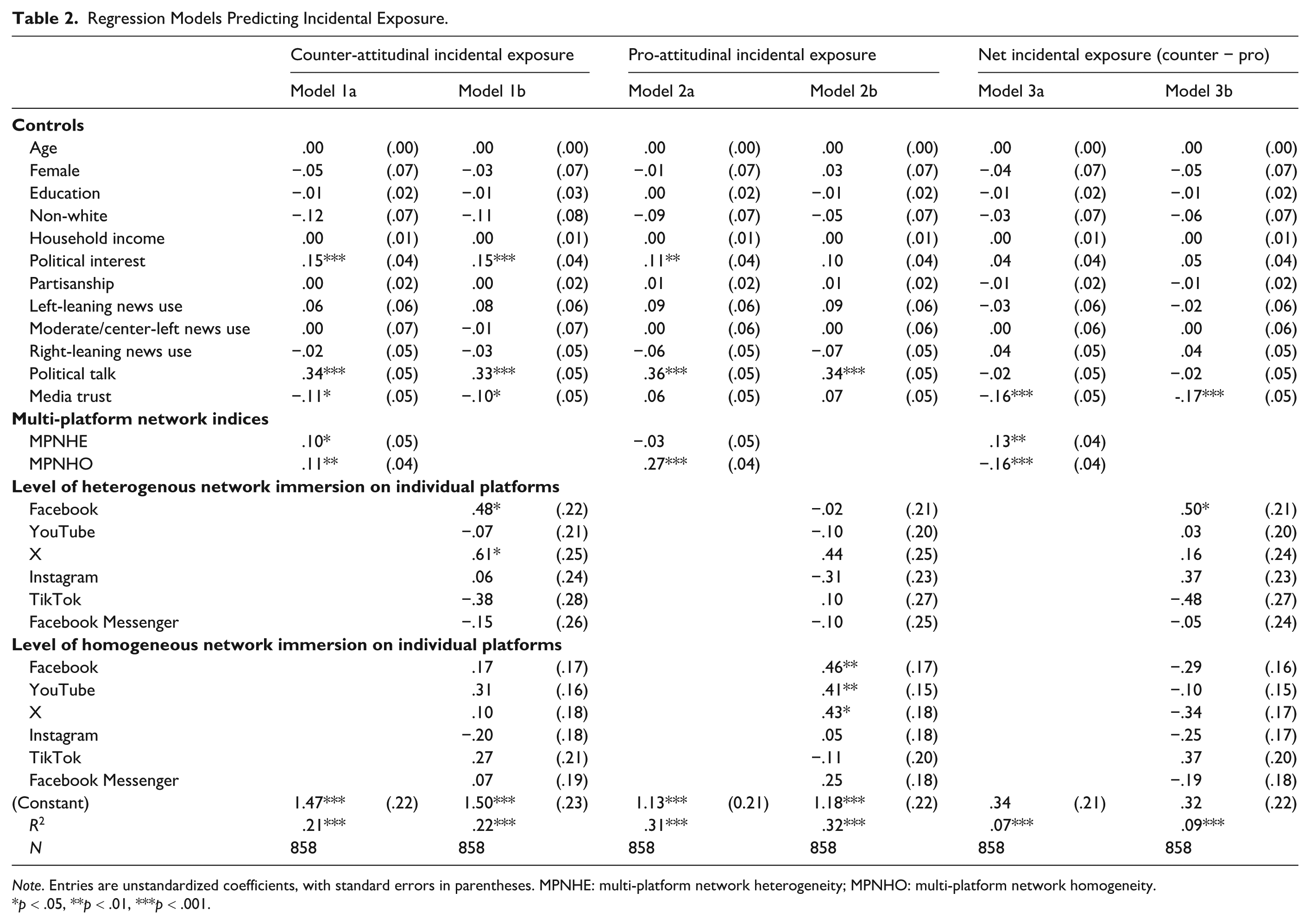
Note. Entries are unstandardized coefficients, with standard errors in parentheses. MPNHE: multi-platform network heterogeneity; MPNHO: multi-platform network homogeneity.
p < .05, **p < .01, ***p < .001.
The First Step: Examining the Conjoint Role of Multiple Social Media Networks
The first step is to examine how networks across multiple platforms conjointly relate to incidental exposure. Table 2 shows that higher MPNHE relates to greater counter-attitudinal incidental exposure (B = 0.10, SE = 0.05, p < .05) and net counter-attitudinal incidental exposure (B = 0.13, SE = 0.04, p < .01). H1a and H1b are therefore supported. For the relationship between MPNHE and pro-attitudinal incidental exposure (RQ1), we found no significant relationship between the two variables.
Moreover, Table 2 shows that higher MPNHO relates to greater pro-attitudinal incidental exposure (B = 0.27, SE = 0.04, p < .001) and net pro-attitudinal incidental exposure (B = -0.16, SE = 0.04, p < .001). Thus, H2a and H2b are supported. Regarding the relationship between MPNHO and counter-attitudinal incidental exposure (RQ2), MPNHO was found to be positively related to counter-attitudinal incidental exposure (B = 0.11, SE = 0.04, p < .01).
The Second Step: Comparing the Distinct Roles of Networks on Different Platforms
The next step is to examine and compare the distinct role of immersion in the heterogeneous or homogeneous network on each platform (RQ3). The results show that higher levels of immersion in heterogenous networks on Facebook and X predict greater counter-attitudinal incidental exposure (Facebook: B = 0.48, SE = 0.22, p < .05; X: B = 0.61, SE = 0.25, p < .05).
Moreover, higher levels of immersion in homogeneous networks on Facebook, YouTube, and X relate to greater pro-attitudinal incidental exposure (Facebook: B = 0.46, SE = 0.17, p < .01; YouTube: B = 0.41, SE = 0.15, p < .01; X: B = 0.43, SE = 0.18, p < .05). Regarding net incidental exposure, a higher level of immersion in the heterogenous network on Facebook relates to net counter-attitudinal incidental exposure (B = 0.50, SE = 0.21, p < .05); this is the only significant predictor.
Robustness Check
To address potential multicollinearity, we examined the variance inflation factor (VIF) and conducted additional regression analyses. The VIF values for MPNHE and MPNHO in Models 1a, 2a, and 3a are 1.41 and 1.90, respectively, and the VIFs of the 12 network immersion variables in Models 1b, 2b, and 3b range from 1.49 to 2.45. All values are far below the threshold of 10, indicating an unlikely occurrence of multicollinearity. Furthermore, we ran four supplementary regression models for each outcome, each including controls: (a) with MPNHE as the sole predictor, (b) with only MPNHO, (c) with only the network heterogeneity immersion scores of the six platforms, and (d) with only the network homogeneity immersion scores of the six platforms. The results of these analyses (see Supplemental Appendix III) are similar to those of the main analysis.
Discussion
We introduce a two-step approach to investigate how networks across platforms relate conjointly and distinctly to incidental exposure to news and political information. To examine the conjoint role of networks, we propose the concepts of MPNHE and MPNHO which represent the levels of immersion in heterogenous and homogeneous networks across multiple platforms, respectively.
Analyzing U.S. survey data, we found that higher MPNHE predicted higher counter-attitudinal incidental exposure, with immersion in heterogenous networks on Facebook and X playing a particularly important role. Moreover, higher MPNHO was related to greater pro-attitudinal incidental exposure, with immersion in homogeneous networks on Facebook, X, and YouTube being more influential. Even more importantly, higher MPNHO predicted higher counter-attitudinal incidental exposure, although immersion in homogeneous networks on none of the individual platforms was a significant predictor.
Regarding net incidental exposure, higher MPNHE predicted net counter-attitudinal incidental exposure, and higher MPNHO predicted net pro-attitudinal incidental exposure. As to the distinct role of individual platforms, only immersion in heterogeneous networks on Facebook significantly predicted net counter-attitudinal incidental exposure. Implications are discussed.
Conjoint Role of Multiple Networks Across Platforms
Responding to calls for more multi-platform research (Bode & Vraga, 2017; Matassi & Boczkowski, 2023), the present study is the first to illustrate the conjoint role or “additive influence” of multiple networks across social media platforms in shaping incidental exposure.
To highlight the additional insights of our approach compared to recent studies focusing on the number of platforms used, we ran a post hoc analysis using the number of platforms used as the independent variable to predict our core outcomes (see Supplemental Appendix IV for details). Consistent with prior findings (Guo & Chen, 2022), our post hoc analysis shows that using more platforms predicted greater counter-attitudinal incidental exposure. However, the number of platforms used showed no significant relationship with net incidental exposure, whereas MPNHE and MPNHO significantly predicted net incidental exposure. This pinpoints the significance of considering network composition across platforms.
One of the most insightful and surprising findings is that higher MPNHO relates to greater counter-attitudinal incidental exposure, with an effect size comparable to that of MPNHE (B = .11 and .10 for MPNHO and MPNHE, respectively). Meanwhile, all the scores for immersion in homogeneous networks on individual platforms were not significant predictors of counter-attitudinal incidental exposure, which highlights the conjoint influence of homogeneous networks across platforms, with no single platform playing a particularly influential role.
Users who are more immersed in politically homogeneous networks across platforms were more likely to be exposed to counter-attitudinal content, potentially because disagreeing opinions were still brought up during like-minded interactions. Early studies in this area highlighted the “porous boundaries” on social media that expose users to political differences (Lee et al., 2014). Our study extends the literature by showing how the porous boundaries of politically homogeneous networks can accumulate across platforms, increasing counter-attitudinal incidental exposure. This challenges the conventional view that homogeneity only reinforces like-minded exposure and offers a new perspective in a multi-platform context.
Given that our operationalization of MPNHO accounts for both usage level and network composition, one could argue that the positive relationship between MPNHO and counter-attitudinal incidental exposure might be driven by high frequency of social media use rather than network composition. However, if usage frequency were the dominant factor, MPNHE, which also considers both usage level and network composition, should have predicted pro-attitudinal exposure, which it did not.
The Role of Individual Social Media Networks
In addition, immersion in networks on Facebook, X, and YouTube, among other popular platforms, was found to play a more important role in explaining different types of incidental exposure. This highlights the need to study incidental exposure beyond the context of Facebook, which is often the focus of past single-platform studies (Lu & Lee, 2021).
Notably, immersion in networks on Facebook and X emerged as more influential than on other platforms in shaping both pro- and counter-attitudinal incidental exposure. In addition to previously discussed factors, such as higher levels of political content and stronger norms of political discussion, platform-specific affordances may further contribute to their influential roles. For example, both Facebook and X offer newsfeeds that integrate text- and visual-oriented content, exposing users to more diverse modes of information. In contrast, Facebook Messenger lacks such feeds, while Instagram and TikTok are primarily visual platforms with limited support for text-based news dissemination.
Another key affordance is the ability to share external links: Facebook and X allow direct link sharing, and many news sites feature one-click sharing buttons for these two platforms—less common for other platforms. Algorithmic recommendation systems may also play a role. X recommends trending content, much of it being political, while Facebook promotes viral posts and updates from weak-tie connections, potentially increasing exposure to dissimilar views (Thorson, 2020). Future research should investigate which specific affordances, for example, newsfeeds, link sharing, or algorithmic curation, underlie the platform-specific effects on incidental exposure.
Notably, Facebook and X have recently reduced the prominence of news and political content, while visually oriented platforms, including TikTok and Instagram, have grown in importance in information exposure (Newman et al., 2024). Recent years have also witnessed increasing partisan sorting of social media use in the United States, with strong partisans withdrawing from legacy platforms (e.g., Democrats leaving X, Trump supporters leaving Facebook) and migrating to ideologically aligned niche platforms (e.g., Mastodon, Truth Social) (Otala et al., 2021; Wang et al., 2024). Future studies may compare the roles of niche platforms to legacy social media or consider including niche platforms in the operationalization of MPNHE and MPNHO for strong partisans; specifically, higher levels of immersion in these niche and partisan platforms may reduce cross-cutting exposure.
Values of the Two-Step Approach
Our two-step approach builds on two types of analysis commonly used in recent multi-platform research: (a) comparing effects across platforms and (b) examining the conjoint effect of using multiple platforms. To our knowledge, past research has yet to combine both in the same study.
Our study illustrates how the two approaches can complement each other. For example, we found that higher MPNHE predicted greater counter-attitudinal exposure and that Facebook and X were particularly influential. Moreover, we observed a positive relationship between MPNHO and counter-attitudinal incidental exposure, with no single platform playing a particularly important role. These findings suggest that omitting either step would yield an incomplete understanding of how multi-platform use relates to incidental exposure.
Notably, our operationalization of MPNHE, MPNHO, and platform-specific network immersion indices accounts for both network composition and usage. One could argue that, as in past studies, it is more intuitive to treat them as separate variables. As suggested by one of our anonymous reviewers, we conducted a supplementary multilevel modeling (MLM) analysis using random intercept models, testing interactions between platform-specific network heterogeneity and usage, as well as between user-level average heterogeneity and usage (see Supplemental Appendix V for detailed results). The user-level interaction significantly predicted all three outcomes, lending support to our theoretical focus on cumulative network immersion across platforms. In contrast, the platform-level interaction was not a significant predictor of any outcome, potentially owing to limited within-user variance in our outcomes, which capture overall incidental exposure rather than platform-specific exposure.
Still, we acknowledge the value of examining platform-specific incidental exposure to better understand how exposure unfolds on individual platforms. While our study assesses the conjoint and distinct roles of different platform networks in shaping overall exposure, future research can extend our approach by conducting the “third step” of analysis: using more refined measurements of platform-specific incidental exposure to examine how network characteristics and usage interact to shape exposure within each platform, while also accounting for users’ average platform usage and network characteristics (e.g., applying the MLM approach).
More importantly, our two-step approach is applicable to examining other outcomes, such as news engagement and political knowledge, that have been found to be influenced by social media networks (Chan et al., 2019; Hopp et al., 2020). Past studies on these outcomes also focused on a single platform or adopted general measures of social media network properties. Given the continuing trend of multi-platform use, future studies can adopt our approach to study its impact on other outcomes.
Limitations and Conclusion
This study has four major limitations. First, using cross-sectional survey data limits the ability to make causality claims. While overall incidental exposure is unlikely to influence usage and network heterogeneity on individual platforms, future studies should adopt a panel survey design to examine the directionality of these relationships (Chan et al., 2022).
Second, network heterogeneity is operationalized as a reverse-coded version of network homogeneity, rather than as a separate measure. Future research could explore asking respondents to estimate separate numbers or proportions of heterogeneous and homogeneous contacts on each platform. While estimating absolute numbers can be cognitive demanding, especially across multiple platforms, asking about proportions may introduce a validity issue: the two estimated proportions may exceed 100% without clear instructions. Alternatively, computational methods could directly assess users’ actual network heterogeneity and homogeneity across platforms, rather than relying on subjective evaluations. However, this approach is substantially more resource-intensive than survey-based approaches and exceeds the scope of existing computational studies, which typically focus on a single platform. In short, future studies are encouraged to compare our findings with those based on alternative measurements, such as separate survey estimates or computational analyses of network composition.
Third, the present study focuses on political differences within networks and does not address other dimensions, such as demographics, religion, and cultural background. Future studies could examine multiple dimensions, incorporate them into the calculation of MPNHE and MPNHO, and observe any changes in the findings.
Finally, the present study does not consider the different levels of incidental exposure suggested by recent research. For example, Matthes et al. (2020) distinguish between the passive scanning and intentional processing of incidentally encountered content. Future studies could examine whether using multiple platforms may encourage more passive scanning than intentional processing, given that users’ attention is spread across platforms.
Despite these limitations, this is the first study to examine how different networks across social media platforms conjointly and distinctly relate to incidental exposure to news and political information. More importantly, the two-step approach employed in this study can serve as a starting point for further investigation of the impact of multi-platform social media use on incidental exposure and other core outcomes.
Supplemental Material
sj-docx-1-sms-10.1177_20563051251386721 – Supplemental material for Multi-Platform Social Media Use and Incidental Exposure: A Two-Step Analysis of the Conjoint and Distinct Roles of Network Heterogeneity and Homogeneity Across Platforms
Supplemental material, sj-docx-1-sms-10.1177_20563051251386721 for Multi-Platform Social Media Use and Incidental Exposure: A Two-Step Analysis of the Conjoint and Distinct Roles of Network Heterogeneity and Homogeneity Across Platforms by Macau K. F. Mak and Michael W. Wagner in Social Media + Society
Footnotes

Funding
The authors disclosed receipt of the following financial support for the research, authorship, and/or publication of this article: This work was supported by William T. Evjue Distinguished Chair for the Wisconsin Idea funds.
Declaration of conflicting interests
The authors declared no potential conflicts of interest with respect to the research, authorship, and/or publication of this article.
Supplemental material
Supplemental material for this article is available online.
Notes
Author biographies
References
Supplementary Material
Please find the following supplemental material available below.
For Open Access articles published under a Creative Commons License, all supplemental material carries the same license as the article it is associated with.
For non-Open Access articles published, all supplemental material carries a non-exclusive license, and permission requests for re-use of supplemental material or any part of supplemental material shall be sent directly to the copyright owner as specified in the copyright notice associated with the article.
